EP0983473B1 - Pump control - Google Patents
Pump control Download PDFInfo
- Publication number
- EP0983473B1 EP0983473B1 EP98921618A EP98921618A EP0983473B1 EP 0983473 B1 EP0983473 B1 EP 0983473B1 EP 98921618 A EP98921618 A EP 98921618A EP 98921618 A EP98921618 A EP 98921618A EP 0983473 B1 EP0983473 B1 EP 0983473B1
- Authority
- EP
- European Patent Office
- Prior art keywords
- pump
- period
- call
- burner unit
- beginning
- Prior art date
- Legal status (The legal status is an assumption and is not a legal conclusion. Google has not performed a legal analysis and makes no representation as to the accuracy of the status listed.)
- Expired - Lifetime
Links
Images

Classifications
-
- F—MECHANICAL ENGINEERING; LIGHTING; HEATING; WEAPONS; BLASTING
- F24—HEATING; RANGES; VENTILATING
- F24D—DOMESTIC- OR SPACE-HEATING SYSTEMS, e.g. CENTRAL HEATING SYSTEMS; DOMESTIC HOT-WATER SUPPLY SYSTEMS; ELEMENTS OR COMPONENTS THEREFOR
- F24D19/00—Details
- F24D19/10—Arrangement or mounting of control or safety devices
- F24D19/1006—Arrangement or mounting of control or safety devices for water heating systems
- F24D19/1009—Arrangement or mounting of control or safety devices for water heating systems for central heating
- F24D19/1012—Arrangement or mounting of control or safety devices for water heating systems for central heating by regulating the speed of a pump
-
- F—MECHANICAL ENGINEERING; LIGHTING; HEATING; WEAPONS; BLASTING
- F24—HEATING; RANGES; VENTILATING
- F24H—FLUID HEATERS, e.g. WATER OR AIR HEATERS, HAVING HEAT-GENERATING MEANS, e.g. HEAT PUMPS, IN GENERAL
- F24H15/00—Control of fluid heaters
- F24H15/20—Control of fluid heaters characterised by control inputs
- F24H15/212—Temperature of the water
- F24H15/219—Temperature of the water after heating
-
- F—MECHANICAL ENGINEERING; LIGHTING; HEATING; WEAPONS; BLASTING
- F24—HEATING; RANGES; VENTILATING
- F24H—FLUID HEATERS, e.g. WATER OR AIR HEATERS, HAVING HEAT-GENERATING MEANS, e.g. HEAT PUMPS, IN GENERAL
- F24H15/00—Control of fluid heaters
- F24H15/30—Control of fluid heaters characterised by control outputs; characterised by the components to be controlled
- F24H15/355—Control of heat-generating means in heaters
- F24H15/36—Control of heat-generating means in heaters of burners
-
- F—MECHANICAL ENGINEERING; LIGHTING; HEATING; WEAPONS; BLASTING
- F24—HEATING; RANGES; VENTILATING
- F24H—FLUID HEATERS, e.g. WATER OR AIR HEATERS, HAVING HEAT-GENERATING MEANS, e.g. HEAT PUMPS, IN GENERAL
- F24H15/00—Control of fluid heaters
- F24H15/40—Control of fluid heaters characterised by the type of controllers
- F24H15/486—Control of fluid heaters characterised by the type of controllers using timers
-
- Y—GENERAL TAGGING OF NEW TECHNOLOGICAL DEVELOPMENTS; GENERAL TAGGING OF CROSS-SECTIONAL TECHNOLOGIES SPANNING OVER SEVERAL SECTIONS OF THE IPC; TECHNICAL SUBJECTS COVERED BY FORMER USPC CROSS-REFERENCE ART COLLECTIONS [XRACs] AND DIGESTS
- Y02—TECHNOLOGIES OR APPLICATIONS FOR MITIGATION OR ADAPTATION AGAINST CLIMATE CHANGE
- Y02B—CLIMATE CHANGE MITIGATION TECHNOLOGIES RELATED TO BUILDINGS, e.g. HOUSING, HOUSE APPLIANCES OR RELATED END-USER APPLICATIONS
- Y02B30/00—Energy efficient heating, ventilation or air conditioning [HVAC]
- Y02B30/70—Efficient control or regulation technologies, e.g. for control of refrigerant flow, motor or heating
Definitions
- the present invention relates to apparatus for and a method of controlling a pump, and more especially for one in a heating system with a boiler.
- the present invention provides apparatus as defined in Claim 1 hereinafter.
- the invention allows the pump to be turned off when the burner unit is in an off/Iow ignition mode while not providing risk from lack of control from the boiler, and thereby provides significantly reduced energy consumption.
- any energy savings benefiting from modulation of the burner ignition, while considered worthwhile obtaining, are often outweighed by the extra energy consumption and hence monetary cost of keeping the pump operating.
- the apparatus may include the features of any one or more of the dependent Claims 2 to 9.
- the present invention also provides a method as defined in Claim 11 hereinafter.
- the method may include the features of any one or more of dependent Claims 12 to 17.
- a preferred embodiment of the present invention provides apparatus for control of a pump for a heating system with a boiler having a burner unit for actuation by a signal calling for operation and a pump for circulation of fluid around a heating system, the apparatus characterised by: means to determine the time interval between (i) the beginning of a first period, after each start-up of the boiler, during which there is no call for operation of the burner unit, and (ii) the beginning of the subsequent call for operation of the burner unit, during which time interval the pump operates; means to turn the pump off at the beginning of the second period after each start-up of the boiler, during which period there is no call, and for a length of time corresponding to the output of the determining means; means to measure the delay between (i) re-activation of the pump at the end of said second period, and (ii) the next call for operation of the boiler; means to turn the pump off at the beginning of the third period after each start-up of the boiler and for a length of time corresponding to that effected during said second period modified,
- the present invention also provides a method of control of a pump for a heating system with a boiler having a burner unit for actuation by a signal calling for operation and a pump for circulation of fluid around a heating system, the method characterised by: determining the time interval between (i) the beginning of a period during which there is no call for operation of the burner unit, and (ii) the beginning of the subsequent call for operation of the burner unit; and turning the pump off, at the beginning of the next period during which there is no call for operation of the burner unit, and for a time period in dependence on the output of the determining step
- the present invention also provides a method of control of a pump for a heating system with a boiler having a burner unit for actuation by a signal calling for operation and a pump for circulation of fluid around a heating system, the method characterised by: determining the time interval between (i) the beginning of a first period, after each start-up of the boiler, during which there is no call for operation of the burner unit, and (ii) the beginning of the subsequent call for operation of the burner unit, during which time interval the pump operates; turning the pump off at the beginning of the second period after each start-up of the boiler, during which period there is no call, and for a length of time corresponding to the output of the determining means; measuring the delay between (i) re-activation of the pump at the end of said second period, and (ii) the next call for operation of the boiler; turning the pump off at the beginning of the third period after each start-up of the boiler; and for a length of time corresponding to that effected during said second period modified, as appropriate, by the measured delay
- the present invention also provides a control unit comprising means to determine the time interval between (i) the beginning of a period during which there is no call for operation of the burner unit, and (ii) the beginning of the subsequent call for operation of the burner unit, and means to turn the pump off, at the beginning of the next period during which there is no call for operation of the burner unit, for a time period in dependence on the output of the determining means.
- the present invention also provides a control unit comprising means to determine the time interval between (i) the beginning of a first period, after each start-up of the boiler, during which there is no call for operation of the burner unit, and (ii) the beginning of the subsequent call for operation of the burner unit, during which time interval the pump operates; means to turn the pump off at the beginning of the second period after each start-up of the boiler, during which period there is no call, and for a length of time corresponding to the output of the determining means; means to measure the delay between (i) re-activation of the pump at the end of said second period, and (ii) the next call for operation of the boiler; means to turn the pump off at the beginning of the third period after each start-up of the boiler and for a length of time corresponding to that effected during said second period modified, as appropriate, by the measured delay at the end of said second period.
- control units may also comprise flame control means with features described in the specific description, and/or room temperature control means with features described in the specific description.
- the present invention is particularly suited to a heating system utilising a modulating boiler (whether in capacity cpntrol or water-temperature control), but is also applicable to a boiler without modulating control; also the invention is applicable to heating systems incorporating the provision of domestic hot water as well as space heating.
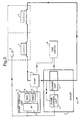
- the conventional heating system 1 of Figure 1 incorporates a boiler 2 with a burner unit 4, the ignition and operation of which is achieved by flame control unit 4 subject to any signals from room temperature controller 5 calling for heat and instructing the burner to provide a specified water temperature, T s , at the output of the boiler 2.
- a pump 6 ensures circulation of water through boiler 2, around the pipes of system 1 and hence through radiators 7 in a number of rooms, one of which contains controller 5.
- flame control unit 4 senses a temperature below its setting of T s , it sends a "BURNER-ON" signal BO to burner unit 4 instructing ignition of the burners to a level to provide the water temperature T s at the boiler output.
- Flame control unit 4 controls and modulates the output of the burner unit 3 in accordance with the difference between the actual water temperature and T s until the difference is zero, whereupon flame control unit 4 sends a "BURNER-OFF" signal BF to burner unit 3.
- Boiler 2 is turned on and off under the control of a time switch 8 which likewise activates or de-activates pump 6 which must be running all the time boiler 2 is on (even when there is no call for heat) in order to ensure that the heating system 1 is under control by monitoring of the boiler output water temperature.
- FIG. 2 illustrates one embodiment of the present invention being a heating system 10 with many elements of the conventional heating system 1 (wherein Figure 2 uses the same reference numerals as Figure 1 where appropriate to indicate equivalent elements), a major distinction being in the provision of a pump control unit 11 incorporating a timer 12, a microprocessor 13 and RAM storage 14; in this way pump 6 is able to be off when there is no call for burner operation without any need to monitor the water temperature in system 10, and hence the overall power used is reduced.
- pump control 11 operates as follows:-
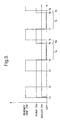
- pump 6 When boiler 2 is turned on by time switch 8 (or alternatively by manual override), pump 6 is likewise actuated. Assuming that the ambient temperature in the room containing controller 5 is below its setting T si , whic is the temperature achieved when the boiler output water temperature is T s , controller 5 sends a call for heat signal to flame control unit 4 specifying an appropriate water temperature output, T s , and so burner unit 3 is activated, causing heated water to be circulated around system 10 (this being the situation at time t 1 of Figure 3).
- the water temperature sensed by flame control unit 4 has fallen again to a level such that the difference between the water temperature and T s causes flame control unit 4 to send signal BO (i) to ignite the burner unit 3 and operate it at an appropriate burner rate, and (ii) to stop timer 12 which sends, under direction of microprocessor 13, data on t 3 for storage in RAM store 14.
- flame control unit 4 once again sends signal BF (i) to turn off burner unit 3 and (ii) to pump control unit 11, but now microprocessor 12, using the data in RAM store 14, operates to turn off pump 6 for a length of time t a being in length the difference between t 3 and t 2 .
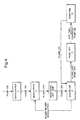
- t 5 i.e. when pump 6 has been off for time t a , pump control unit 11 starts up pump 6, and timer 12 starts timing how long it takes before flame control unit 4 sends another signal BO (i.e. at t 6 ) calling for heat; microprocessor 13 uses the measured time, t m , to make a correction to t a for use when pump 6 is next turned off (but, of course, while boiler 6 is still on).
- t m 1 minute or less
- burner unit 3 is activated within a relatively short period (e.g. t m is between 1 and 3 minutes ), the next off-period t b remains the same as t a .
- t 10 when flame control unit 4 next sends signal BO, pump 6 is maintained off for a length of time based on t b after any correction deemed appropriate due to the size of t n and calculated in like manner to the size of t b as indicated above.
- This correction routine is repeated for each sequence beginning with flame control unit 4 sending a signal BO.
- the correction routine is repeated until the delay between pump 6 being turned on and burner unit 4 being turned on (e.g. t m , t n ) is between 100% and 105% of the pump-off period in two successive sequences, whereupon the correction routine is not repeated for a predetermined number (e.g. 20) of sequences.
- pump control unit 11 and its functions can be incorporated within the room temperature controller 5 or the flame control unit 4 or elsewhere in the boiler 2 and utilise any microprocessor, timer and RAM store therein.
Landscapes
- Engineering & Computer Science (AREA)
- General Engineering & Computer Science (AREA)
- Chemical & Material Sciences (AREA)
- Thermal Sciences (AREA)
- Combustion & Propulsion (AREA)
- Mechanical Engineering (AREA)
- Physics & Mathematics (AREA)
- Steam Or Hot-Water Central Heating Systems (AREA)
- Reciprocating Pumps (AREA)
- Control Of The Air-Fuel Ratio Of Carburetors (AREA)
- Rotary Pumps (AREA)
- Fertilizing (AREA)
- Vehicle Body Suspensions (AREA)
Abstract
Description
Claims (18)
- Apparatus controlling pump (6) of a heating system (10) with a boiler (2) having a burner unit (3) for actuation by a signal (BO) calling for operation and a pump (6) for circulation of fluid around a heating system (10), the apparatus characterised by: means (11) to determine the time interval between (i) the beginning of a period during which there is no call for operation of the burner unit (3), and (ii) the beginning of the subsequent call for operation of the burner unit (3); and means (11) to turn the pump off, at the beginning of the next period during which there is no call for operation of the burner unit (3), for a time period in dependence on the output of the determining means (11).
- Apparatus according to Claim 1 characterised by means (11) to modify the time period during which the pump (6) is next off, in dependence on the delay between the most recent turn-on of the pump (6) and the following call for operation of the burner unit (3).
- Apparatus according to Claim 1 or 2 characterised in that the means (11) to turn the pump (6) off operates for a duration corresponding to the time interval.
- Apparatus according to any preceding Claim, characterised in that the means (11) to turn off the pump (6) is not operable for the first period of no call for the burner unit (3) after each start-up of the apparatus.
- Apparatus according to any preceding Claim,
characterised by: means (11) to determine the time interval between (i) the beginning of a first period, after each start-up of the boiler (2), during which there is no call for operation of the burner unit (3), and (ii) the beginning of the subsequent call for operation of the burner unit (3), during which time interval the pump operates; means (11) to turn the pump (6) off at the beginning of the second period after each start-up of the boiler, during which period there is no call, and for a length of time corresponding to the output of the determining means (11); means (11) to measure the delay between (i) re-activation of the pump (6) at the end of said second period, and (ii) the next call for operation of the boiler; means (11) to turn the pump (6) off at the beginning of the third period after each start-up of the boiler (2) and for a length of time corresponding to that effected during said second period modified, as appropriate, by the measured delay at the end of said second period. - Apparatus according to Claim 5, characterised in that the delay measurement means (11) measures the delay between (i) re-activation of the pump at the end of one period, and (ii) the next call for operation of the boiler, and characterised by modification means (11) to modify the time for which the pump (6) is off in the next sequence in accordance with output from the delay-measurement means (11).
- Apparatus according to any preceding Claim characterised by means (11) to effect correction of the pump-off time for each sequence beginning with a new signal BO.
- Apparatus according to any preceding Claims characterised by means to effect correction of the pump-off time repeatedly until the delay is at a predetermined percentage value of the time interval.
- Apparatus according to any preceding Claim characterised in that the apparatus comprises a control unit for a heating system.
- A heating system (10) incorporating apparatus for control of a pump (6), the apparatus being according to any of Claims 1 to 9.
- A method of control of a pump (6) for a heating system (10) with a boiler (2) having a burner unit (3) for actuation by a signal (BO) calling for operation and a pump (6) for circulation of fluid around a heating system (10), the method characterised by: determining the time interval between (i) the beginning of a period during which there is no call for operation of the burner unit (3), and (ii) the beginning of the subsequent call for operation of the burner unit 3; and turning the pump (6) off, at the beginning of the next period during which there is no call for operation of the burner unit (3), for a time period in dependence on the output of the determining step.
- A method according to Claim 11, characterised by modifying the time period, during which the pump (6) is next off, in dependence on the delay between the most recent turn-on of the pump (6) and the following call for operation of the burner unit (3).
- A method according to Claim 11 or 12, characterised by turning the pump (6) off for a duration corresponding to the time interval.
- A method according to any of Claims 11 to 13 characterised by maintaining the pump (6) operable for the first time period of no call for the burner unit (3) after each start-up of the apparatus.
- A method according to any of Claims 11 to 14,
characterised by: determining the time interval between (i) the beginning of a first period, after each start-up of the boiler (2), during which there is no call for operation of the burner unit (3), and (ii) the beginning of the subsequent call for operation of the burner unit (3), during which time interval the pump (6) operates; turning the pump (6) off at the beginning of the second period after each start-up of the boiler (2), during which period there is no call, and for a length of time corresponding to the output of the determining step; measuring the delay between (i) re-activation of the pump (6) at the end of said second period, and (ii) the next call for operation of the boiler (2); turning the pump (6) off at the beginning of the third period after each start-up of the boiler (2); and for a length of time corresponding to that effected during said second period modified, as appropriate, by the measured delay at the end of said second period. - A method according to Claim 15 characterised by measuring the delay between (i) re-activation of the pump (6) at the end of one period, and (ii) the next call for operation of the boiler (2), and modifying the time for which the pump (6) is off in the next sequence in accordance with output from the delay-measurement step.
- A method according to any of Claims 11 to 16 characterised by effecting correction of the pump-off time for each sequence beginning with a new signal BO.
- A method according to any of Claims 11 to 16 characterised by repeating correction of the pump-off time until the delay is at a predetermined percentage value of the time interval.
Applications Claiming Priority (3)
| Application Number | Priority Date | Filing Date | Title |
|---|---|---|---|
| GB9710139 | 1997-05-19 | ||
| GBGB9710139.8A GB9710139D0 (en) | 1997-05-19 | 1997-05-19 | Pump control |
| PCT/GB1998/001392 WO1998053257A1 (en) | 1997-05-19 | 1998-05-15 | Pump control |
Publications (2)
| Publication Number | Publication Date |
|---|---|
| EP0983473A1 EP0983473A1 (en) | 2000-03-08 |
| EP0983473B1 true EP0983473B1 (en) | 2002-12-11 |
Family
ID=10812541
Family Applications (1)
| Application Number | Title | Priority Date | Filing Date |
|---|---|---|---|
| EP98921618A Expired - Lifetime EP0983473B1 (en) | 1997-05-19 | 1998-05-15 | Pump control |
Country Status (6)
| Country | Link |
|---|---|
| EP (1) | EP0983473B1 (en) |
| AT (1) | ATE229632T1 (en) |
| AU (1) | AU7440598A (en) |
| DE (1) | DE69810105T2 (en) |
| GB (2) | GB9710139D0 (en) |
| WO (1) | WO1998053257A1 (en) |
Cited By (1)
| Publication number | Priority date | Publication date | Assignee | Title |
|---|---|---|---|---|
| EP2161510A1 (en) | 2008-07-31 | 2010-03-10 | Siemens Aktiengesellschaft | Process for controlling a pump and a heat generator in a heating system |
Families Citing this family (1)
| Publication number | Priority date | Publication date | Assignee | Title |
|---|---|---|---|---|
| CN100449212C (en) * | 2007-06-14 | 2009-01-07 | 上海联达节能科技有限公司 | Winter-heating water circulating pump energy-saving control method |
Family Cites Families (2)
| Publication number | Priority date | Publication date | Assignee | Title |
|---|---|---|---|---|
| IT1218475B (en) * | 1987-03-24 | 1990-04-19 | Artemio Ronzani | AND CONOMIZER FOR HEATING |
| JPH1019283A (en) * | 1996-07-01 | 1998-01-23 | Sunpot Co Ltd | Hot water heating system |
-
1997
- 1997-05-19 GB GBGB9710139.8A patent/GB9710139D0/en active Pending
-
1998
- 1998-05-15 GB GB9810515A patent/GB2326739A/en active Pending
- 1998-05-15 AU AU74405/98A patent/AU7440598A/en not_active Abandoned
- 1998-05-15 WO PCT/GB1998/001392 patent/WO1998053257A1/en not_active Ceased
- 1998-05-15 AT AT98921618T patent/ATE229632T1/en not_active IP Right Cessation
- 1998-05-15 DE DE69810105T patent/DE69810105T2/en not_active Expired - Lifetime
- 1998-05-15 EP EP98921618A patent/EP0983473B1/en not_active Expired - Lifetime
Cited By (1)
| Publication number | Priority date | Publication date | Assignee | Title |
|---|---|---|---|---|
| EP2161510A1 (en) | 2008-07-31 | 2010-03-10 | Siemens Aktiengesellschaft | Process for controlling a pump and a heat generator in a heating system |
Also Published As
| Publication number | Publication date |
|---|---|
| WO1998053257A1 (en) | 1998-11-26 |
| GB2326739A (en) | 1998-12-30 |
| DE69810105T2 (en) | 2003-07-17 |
| DE69810105D1 (en) | 2003-01-23 |
| GB9810515D0 (en) | 1998-07-15 |
| ATE229632T1 (en) | 2002-12-15 |
| AU7440598A (en) | 1998-12-11 |
| GB9710139D0 (en) | 1997-07-09 |
| EP0983473A1 (en) | 2000-03-08 |
Similar Documents
| Publication | Publication Date | Title |
|---|---|---|
| CA1238392A (en) | Adaptive low fire hold control system | |
| GB2045466A (en) | Automatic control of heating sources | |
| EP0983473A1 (en) | Pump control | |
| JPH10103606A (en) | Automatic number control method of fluid heater | |
| JP2754393B2 (en) | Electric water heater boiling control device | |
| JP2853346B2 (en) | Electric water heater system | |
| EP0283633B1 (en) | Heating system | |
| KR19980017335A (en) | Flow control method of gas boiler according to heating water circulation resistance | |
| GB2307731A (en) | Controlling gas supply in a gas boiler | |
| JP3096581B2 (en) | Heating machine control method and control device | |
| JPH03286960A (en) | Hot water storing type hot water heater | |
| JP3136839B2 (en) | Combustion control device | |
| JPH0326080B2 (en) | ||
| JPS59183245A (en) | Electrical water heater | |
| JP2548094Y2 (en) | Combustion control system for cold start of boiler etc. | |
| JP3203944B2 (en) | Electric water heater | |
| JPS6039701Y2 (en) | Air conditioning control device | |
| JPS6032836Y2 (en) | Circulation pump control device | |
| KR20000019898A (en) | Method of feeding hot water of gas boiler | |
| KR19980039672A (en) | Electric thermostat rice cooker with variable duty rate and its method | |
| JPH05215400A (en) | Controller for hot water storage type electric warm water oven | |
| JP2001355916A (en) | Electric water heater | |
| JPH04295547A (en) | Timer operating method of warm-air heater | |
| JPH0711340B2 (en) | Hot water heating system | |
| JPS60235944A (en) | Electric water heater |
Legal Events
| Date | Code | Title | Description |
|---|---|---|---|
| PUAI | Public reference made under article 153(3) epc to a published international application that has entered the european phase |
Free format text: ORIGINAL CODE: 0009012 |
|
| 17P | Request for examination filed |
Effective date: 19991115 |
|
| AK | Designated contracting states |
Kind code of ref document: A1 Designated state(s): AT BE CH DE DK ES FI FR GB IE IT LI LU NL PT SE |
|
| 17Q | First examination report despatched |
Effective date: 20000525 |
|
| GRAG | Despatch of communication of intention to grant |
Free format text: ORIGINAL CODE: EPIDOS AGRA |
|
| RBV | Designated contracting states (corrected) |
Designated state(s): AT BE CH DE DK ES FI FR GB IE IT LI LU NL PT SE |
|
| GRAG | Despatch of communication of intention to grant |
Free format text: ORIGINAL CODE: EPIDOS AGRA |
|
| GRAG | Despatch of communication of intention to grant |
Free format text: ORIGINAL CODE: EPIDOS AGRA |
|
| GRAG | Despatch of communication of intention to grant |
Free format text: ORIGINAL CODE: EPIDOS AGRA |
|
| GRAH | Despatch of communication of intention to grant a patent |
Free format text: ORIGINAL CODE: EPIDOS IGRA |
|
| GRAH | Despatch of communication of intention to grant a patent |
Free format text: ORIGINAL CODE: EPIDOS IGRA |
|
| GRAA | (expected) grant |
Free format text: ORIGINAL CODE: 0009210 |
|
| AK | Designated contracting states |
Kind code of ref document: B1 Designated state(s): AT BE CH DE DK ES FI FR GB IE IT LI LU NL PT SE |
|
| PG25 | Lapsed in a contracting state [announced via postgrant information from national office to epo] |
Ref country code: LI Free format text: LAPSE BECAUSE OF FAILURE TO SUBMIT A TRANSLATION OF THE DESCRIPTION OR TO PAY THE FEE WITHIN THE PRESCRIBED TIME-LIMIT Effective date: 20021211 Ref country code: IT Free format text: LAPSE BECAUSE OF FAILURE TO SUBMIT A TRANSLATION OF THE DESCRIPTION OR TO PAY THE FEE WITHIN THE PRESCRIBED TIME-LIMIT;WARNING: LAPSES OF ITALIAN PATENTS WITH EFFECTIVE DATE BEFORE 2007 MAY HAVE OCCURRED AT ANY TIME BEFORE 2007. THE CORRECT EFFECTIVE DATE MAY BE DIFFERENT FROM THE ONE RECORDED. Effective date: 20021211 Ref country code: FI Free format text: LAPSE BECAUSE OF FAILURE TO SUBMIT A TRANSLATION OF THE DESCRIPTION OR TO PAY THE FEE WITHIN THE PRESCRIBED TIME-LIMIT Effective date: 20021211 Ref country code: CH Free format text: LAPSE BECAUSE OF FAILURE TO SUBMIT A TRANSLATION OF THE DESCRIPTION OR TO PAY THE FEE WITHIN THE PRESCRIBED TIME-LIMIT Effective date: 20021211 Ref country code: BE Free format text: LAPSE BECAUSE OF FAILURE TO SUBMIT A TRANSLATION OF THE DESCRIPTION OR TO PAY THE FEE WITHIN THE PRESCRIBED TIME-LIMIT Effective date: 20021211 Ref country code: AT Free format text: LAPSE BECAUSE OF FAILURE TO SUBMIT A TRANSLATION OF THE DESCRIPTION OR TO PAY THE FEE WITHIN THE PRESCRIBED TIME-LIMIT Effective date: 20021211 |
|
| REF | Corresponds to: |
Ref document number: 229632 Country of ref document: AT Date of ref document: 20021215 Kind code of ref document: T |
|
| REG | Reference to a national code |
Ref country code: GB Ref legal event code: FG4D |
|
| REG | Reference to a national code |
Ref country code: CH Ref legal event code: EP |
|
| REG | Reference to a national code |
Ref country code: IE Ref legal event code: FG4D |
|
| REF | Corresponds to: |
Ref document number: 69810105 Country of ref document: DE Date of ref document: 20030123 |
|
| PG25 | Lapsed in a contracting state [announced via postgrant information from national office to epo] |
Ref country code: SE Free format text: LAPSE BECAUSE OF FAILURE TO SUBMIT A TRANSLATION OF THE DESCRIPTION OR TO PAY THE FEE WITHIN THE PRESCRIBED TIME-LIMIT Effective date: 20030311 Ref country code: PT Free format text: LAPSE BECAUSE OF FAILURE TO SUBMIT A TRANSLATION OF THE DESCRIPTION OR TO PAY THE FEE WITHIN THE PRESCRIBED TIME-LIMIT Effective date: 20030311 Ref country code: DK Free format text: LAPSE BECAUSE OF FAILURE TO SUBMIT A TRANSLATION OF THE DESCRIPTION OR TO PAY THE FEE WITHIN THE PRESCRIBED TIME-LIMIT Effective date: 20030311 |
|
| PG25 | Lapsed in a contracting state [announced via postgrant information from national office to epo] |
Ref country code: LU Free format text: LAPSE BECAUSE OF NON-PAYMENT OF DUE FEES Effective date: 20030515 |
|
| ET | Fr: translation filed | ||
| PG25 | Lapsed in a contracting state [announced via postgrant information from national office to epo] |
Ref country code: ES Free format text: LAPSE BECAUSE OF FAILURE TO SUBMIT A TRANSLATION OF THE DESCRIPTION OR TO PAY THE FEE WITHIN THE PRESCRIBED TIME-LIMIT Effective date: 20030627 |
|
| REG | Reference to a national code |
Ref country code: CH Ref legal event code: PL |
|
| PLBE | No opposition filed within time limit |
Free format text: ORIGINAL CODE: 0009261 |
|
| STAA | Information on the status of an ep patent application or granted ep patent |
Free format text: STATUS: NO OPPOSITION FILED WITHIN TIME LIMIT |
|
| 26N | No opposition filed |
Effective date: 20030912 |
|
| PGFP | Annual fee paid to national office [announced via postgrant information from national office to epo] |
Ref country code: IE Payment date: 20080424 Year of fee payment: 11 |
|
| REG | Reference to a national code |
Ref country code: IE Ref legal event code: MM4A |
|
| PG25 | Lapsed in a contracting state [announced via postgrant information from national office to epo] |
Ref country code: IE Free format text: LAPSE BECAUSE OF NON-PAYMENT OF DUE FEES Effective date: 20090515 |
|
| PGFP | Annual fee paid to national office [announced via postgrant information from national office to epo] |
Ref country code: FR Payment date: 20110511 Year of fee payment: 14 |
|
| PGFP | Annual fee paid to national office [announced via postgrant information from national office to epo] |
Ref country code: GB Payment date: 20110421 Year of fee payment: 14 Ref country code: NL Payment date: 20110523 Year of fee payment: 14 |
|
| PGFP | Annual fee paid to national office [announced via postgrant information from national office to epo] |
Ref country code: DE Payment date: 20110531 Year of fee payment: 14 |
|
| REG | Reference to a national code |
Ref country code: NL Ref legal event code: V1 Effective date: 20121201 |
|
| GBPC | Gb: european patent ceased through non-payment of renewal fee |
Effective date: 20120515 |
|
| REG | Reference to a national code |
Ref country code: FR Ref legal event code: ST Effective date: 20130131 |
|
| REG | Reference to a national code |
Ref country code: DE Ref legal event code: R119 Ref document number: 69810105 Country of ref document: DE Effective date: 20121201 |
|
| PG25 | Lapsed in a contracting state [announced via postgrant information from national office to epo] |
Ref country code: NL Free format text: LAPSE BECAUSE OF NON-PAYMENT OF DUE FEES Effective date: 20121201 |
|
| PG25 | Lapsed in a contracting state [announced via postgrant information from national office to epo] |
Ref country code: GB Free format text: LAPSE BECAUSE OF NON-PAYMENT OF DUE FEES Effective date: 20120515 Ref country code: FR Free format text: LAPSE BECAUSE OF NON-PAYMENT OF DUE FEES Effective date: 20120531 |
|
| PG25 | Lapsed in a contracting state [announced via postgrant information from national office to epo] |
Ref country code: DE Free format text: LAPSE BECAUSE OF NON-PAYMENT OF DUE FEES Effective date: 20121201 |