EP0983792A1 - Procédé de carbonylation - Google Patents
Procédé de carbonylation Download PDFInfo
- Publication number
- EP0983792A1 EP0983792A1 EP99306705A EP99306705A EP0983792A1 EP 0983792 A1 EP0983792 A1 EP 0983792A1 EP 99306705 A EP99306705 A EP 99306705A EP 99306705 A EP99306705 A EP 99306705A EP 0983792 A1 EP0983792 A1 EP 0983792A1
- Authority
- EP
- European Patent Office
- Prior art keywords
- carbon monoxide
- flow rate
- reactor
- monoxide flow
- acetic acid
- Prior art date
- Legal status (The legal status is an assumption and is not a legal conclusion. Google has not performed a legal analysis and makes no representation as to the accuracy of the status listed.)
- Granted
Links
- 238000000034 method Methods 0.000 title claims abstract description 35
- 238000005810 carbonylation reaction Methods 0.000 title description 23
- 230000006315 carbonylation Effects 0.000 title description 20
- QTBSBXVTEAMEQO-UHFFFAOYSA-N Acetic acid Chemical compound CC(O)=O QTBSBXVTEAMEQO-UHFFFAOYSA-N 0.000 claims abstract description 75
- UGFAIRIUMAVXCW-UHFFFAOYSA-N Carbon monoxide Chemical compound [O+]#[C-] UGFAIRIUMAVXCW-UHFFFAOYSA-N 0.000 claims abstract description 74
- 229910002091 carbon monoxide Inorganic materials 0.000 claims abstract description 74
- 238000006243 chemical reaction Methods 0.000 claims abstract description 34
- OKKJLVBELUTLKV-UHFFFAOYSA-N Methanol Chemical compound OC OKKJLVBELUTLKV-UHFFFAOYSA-N 0.000 claims abstract description 31
- 239000007788 liquid Substances 0.000 claims abstract description 30
- 239000003054 catalyst Substances 0.000 claims abstract description 25
- 229910001868 water Inorganic materials 0.000 claims abstract description 21
- XBDQKXXYIPTUBI-UHFFFAOYSA-M Propionate Chemical compound CCC([O-])=O XBDQKXXYIPTUBI-UHFFFAOYSA-M 0.000 claims abstract description 20
- KXKVLQRXCPHEJC-UHFFFAOYSA-N acetic acid trimethyl ester Natural products COC(C)=O KXKVLQRXCPHEJC-UHFFFAOYSA-N 0.000 claims abstract description 20
- XLYOFNOQVPJJNP-UHFFFAOYSA-N water Substances O XLYOFNOQVPJJNP-UHFFFAOYSA-N 0.000 claims abstract description 20
- 229910000510 noble metal Inorganic materials 0.000 claims abstract description 14
- INQOMBQAUSQDDS-UHFFFAOYSA-N iodomethane Chemical compound IC INQOMBQAUSQDDS-UHFFFAOYSA-N 0.000 claims abstract description 12
- 229910052741 iridium Inorganic materials 0.000 claims description 16
- GKOZUEZYRPOHIO-UHFFFAOYSA-N iridium atom Chemical compound [Ir] GKOZUEZYRPOHIO-UHFFFAOYSA-N 0.000 claims description 16
- 229910052751 metal Inorganic materials 0.000 claims description 13
- 239000002184 metal Substances 0.000 claims description 13
- 229910052703 rhodium Inorganic materials 0.000 claims description 8
- 239000010948 rhodium Substances 0.000 claims description 8
- MHOVAHRLVXNVSD-UHFFFAOYSA-N rhodium atom Chemical group [Rh] MHOVAHRLVXNVSD-UHFFFAOYSA-N 0.000 claims description 8
- 150000004694 iodide salts Chemical class 0.000 claims description 6
- 229910001505 inorganic iodide Inorganic materials 0.000 claims description 2
- 239000007789 gas Substances 0.000 description 9
- -1 hydrocarbyl halide Chemical class 0.000 description 7
- KJTLSVCANCCWHF-UHFFFAOYSA-N Ruthenium Chemical compound [Ru] KJTLSVCANCCWHF-UHFFFAOYSA-N 0.000 description 6
- 230000001276 controlling effect Effects 0.000 description 6
- 229910052707 ruthenium Inorganic materials 0.000 description 6
- 150000001875 compounds Chemical class 0.000 description 5
- 238000004519 manufacturing process Methods 0.000 description 5
- 238000004821 distillation Methods 0.000 description 4
- 229910021638 Iridium(III) chloride Inorganic materials 0.000 description 3
- 150000001242 acetic acid derivatives Chemical class 0.000 description 3
- 239000003426 co-catalyst Substances 0.000 description 3
- 238000001035 drying Methods 0.000 description 3
- 229910052762 osmium Inorganic materials 0.000 description 3
- SYQBFIAQOQZEGI-UHFFFAOYSA-N osmium atom Chemical compound [Os] SYQBFIAQOQZEGI-UHFFFAOYSA-N 0.000 description 3
- 239000000047 product Substances 0.000 description 3
- 238000000746 purification Methods 0.000 description 3
- 239000000376 reactant Substances 0.000 description 3
- DANYXEHCMQHDNX-UHFFFAOYSA-K trichloroiridium Chemical compound Cl[Ir](Cl)Cl DANYXEHCMQHDNX-UHFFFAOYSA-K 0.000 description 3
- IJGRMHOSHXDMSA-UHFFFAOYSA-N Atomic nitrogen Chemical compound N#N IJGRMHOSHXDMSA-UHFFFAOYSA-N 0.000 description 2
- CURLTUGMZLYLDI-UHFFFAOYSA-N Carbon dioxide Chemical compound O=C=O CURLTUGMZLYLDI-UHFFFAOYSA-N 0.000 description 2
- LCGLNKUTAGEVQW-UHFFFAOYSA-N Dimethyl ether Chemical compound COC LCGLNKUTAGEVQW-UHFFFAOYSA-N 0.000 description 2
- 230000003213 activating effect Effects 0.000 description 2
- 229910052784 alkaline earth metal Inorganic materials 0.000 description 2
- 239000002585 base Substances 0.000 description 2
- 238000006555 catalytic reaction Methods 0.000 description 2
- 239000012535 impurity Substances 0.000 description 2
- 238000011065 in-situ storage Methods 0.000 description 2
- HSZCZNFXUDYRKD-UHFFFAOYSA-M lithium iodide Chemical group [Li+].[I-] HSZCZNFXUDYRKD-UHFFFAOYSA-M 0.000 description 2
- VNWKTOKETHGBQD-UHFFFAOYSA-N methane Chemical compound C VNWKTOKETHGBQD-UHFFFAOYSA-N 0.000 description 2
- 239000012071 phase Substances 0.000 description 2
- 230000001105 regulatory effect Effects 0.000 description 2
- 150000003839 salts Chemical class 0.000 description 2
- SNCQSZKBYORHGB-UHFFFAOYSA-N 2-methylpyridin-1-ium;iodide Chemical class [I-].CC1=CC=CC=[NH+]1 SNCQSZKBYORHGB-UHFFFAOYSA-N 0.000 description 1
- QTBSBXVTEAMEQO-UHFFFAOYSA-M Acetate Chemical compound CC([O-])=O QTBSBXVTEAMEQO-UHFFFAOYSA-M 0.000 description 1
- GYHNNYVSQQEPJS-UHFFFAOYSA-N Gallium Chemical compound [Ga] GYHNNYVSQQEPJS-UHFFFAOYSA-N 0.000 description 1
- UFHFLCQGNIYNRP-UHFFFAOYSA-N Hydrogen Chemical compound [H][H] UFHFLCQGNIYNRP-UHFFFAOYSA-N 0.000 description 1
- HCHKCACWOHOZIP-UHFFFAOYSA-N Zinc Chemical compound [Zn] HCHKCACWOHOZIP-UHFFFAOYSA-N 0.000 description 1
- 150000004729 acetoacetic acid derivatives Chemical class 0.000 description 1
- CUJRVFIICFDLGR-UHFFFAOYSA-N acetylacetonate Chemical compound CC(=O)[CH-]C(C)=O CUJRVFIICFDLGR-UHFFFAOYSA-N 0.000 description 1
- 239000002253 acid Substances 0.000 description 1
- 239000003513 alkali Substances 0.000 description 1
- 229910001516 alkali metal iodide Inorganic materials 0.000 description 1
- 150000001340 alkali metals Chemical class 0.000 description 1
- 229910001619 alkaline earth metal iodide Inorganic materials 0.000 description 1
- 150000001342 alkaline earth metals Chemical class 0.000 description 1
- 230000009286 beneficial effect Effects 0.000 description 1
- 239000006227 byproduct Substances 0.000 description 1
- 229910052793 cadmium Inorganic materials 0.000 description 1
- BDOSMKKIYDKNTQ-UHFFFAOYSA-N cadmium atom Chemical compound [Cd] BDOSMKKIYDKNTQ-UHFFFAOYSA-N 0.000 description 1
- 239000001569 carbon dioxide Substances 0.000 description 1
- 229910002092 carbon dioxide Inorganic materials 0.000 description 1
- 125000002915 carbonyl group Chemical group [*:2]C([*:1])=O 0.000 description 1
- 150000001732 carboxylic acid derivatives Chemical class 0.000 description 1
- 230000003197 catalytic effect Effects 0.000 description 1
- 238000005886 esterification reaction Methods 0.000 description 1
- 229910052733 gallium Inorganic materials 0.000 description 1
- 229930195733 hydrocarbon Natural products 0.000 description 1
- 150000002430 hydrocarbons Chemical class 0.000 description 1
- 229910052739 hydrogen Inorganic materials 0.000 description 1
- 239000001257 hydrogen Substances 0.000 description 1
- XMBWDFGMSWQBCA-UHFFFAOYSA-N hydrogen iodide Chemical compound I XMBWDFGMSWQBCA-UHFFFAOYSA-N 0.000 description 1
- HLYTZTFNIRBLNA-LNTINUHCSA-K iridium(3+);(z)-4-oxopent-2-en-2-olate Chemical compound [Ir+3].C\C([O-])=C\C(C)=O.C\C([O-])=C\C(C)=O.C\C([O-])=C\C(C)=O HLYTZTFNIRBLNA-LNTINUHCSA-K 0.000 description 1
- KZLHPYLCKHJIMM-UHFFFAOYSA-K iridium(3+);triacetate Chemical compound [Ir+3].CC([O-])=O.CC([O-])=O.CC([O-])=O KZLHPYLCKHJIMM-UHFFFAOYSA-K 0.000 description 1
- HTXDPTMKBJXEOW-UHFFFAOYSA-N iridium(IV) oxide Inorganic materials O=[Ir]=O HTXDPTMKBJXEOW-UHFFFAOYSA-N 0.000 description 1
- 239000007791 liquid phase Substances 0.000 description 1
- QSHDDOUJBYECFT-UHFFFAOYSA-N mercury Chemical compound [Hg] QSHDDOUJBYECFT-UHFFFAOYSA-N 0.000 description 1
- 229910052753 mercury Inorganic materials 0.000 description 1
- 150000002736 metal compounds Chemical class 0.000 description 1
- 229910001511 metal iodide Inorganic materials 0.000 description 1
- 229910052757 nitrogen Inorganic materials 0.000 description 1
- 229910052756 noble gas Inorganic materials 0.000 description 1
- 150000002835 noble gases Chemical class 0.000 description 1
- 150000003891 oxalate salts Chemical class 0.000 description 1
- 238000004886 process control Methods 0.000 description 1
- JUJWROOIHBZHMG-UHFFFAOYSA-O pyridinium Chemical compound C1=CC=[NH+]C=C1 JUJWROOIHBZHMG-UHFFFAOYSA-O 0.000 description 1
- 125000001453 quaternary ammonium group Chemical group 0.000 description 1
- 238000011084 recovery Methods 0.000 description 1
- 229910052702 rhenium Inorganic materials 0.000 description 1
- WUAPFZMCVAUBPE-UHFFFAOYSA-N rhenium atom Chemical compound [Re] WUAPFZMCVAUBPE-UHFFFAOYSA-N 0.000 description 1
- 239000013589 supplement Substances 0.000 description 1
- WFKWXMTUELFFGS-UHFFFAOYSA-N tungsten Chemical compound [W] WFKWXMTUELFFGS-UHFFFAOYSA-N 0.000 description 1
- 229910052721 tungsten Inorganic materials 0.000 description 1
- 239000010937 tungsten Substances 0.000 description 1
- 229910052725 zinc Inorganic materials 0.000 description 1
- 239000011701 zinc Substances 0.000 description 1
Images

Classifications
-
- C—CHEMISTRY; METALLURGY
- C07—ORGANIC CHEMISTRY
- C07C—ACYCLIC OR CARBOCYCLIC COMPOUNDS
- C07C51/00—Preparation of carboxylic acids or their salts, halides or anhydrides
- C07C51/15—Preparation of carboxylic acids or their salts, halides or anhydrides by reaction of organic compounds with carbon dioxide, e.g. Kolbe-Schmitt synthesis
-
- B—PERFORMING OPERATIONS; TRANSPORTING
- B01—PHYSICAL OR CHEMICAL PROCESSES OR APPARATUS IN GENERAL
- B01J—CHEMICAL OR PHYSICAL PROCESSES, e.g. CATALYSIS OR COLLOID CHEMISTRY; THEIR RELEVANT APPARATUS
- B01J19/00—Chemical, physical or physico-chemical processes in general; Their relevant apparatus
- B01J19/0006—Controlling or regulating processes
-
- B—PERFORMING OPERATIONS; TRANSPORTING
- B01—PHYSICAL OR CHEMICAL PROCESSES OR APPARATUS IN GENERAL
- B01J—CHEMICAL OR PHYSICAL PROCESSES, e.g. CATALYSIS OR COLLOID CHEMISTRY; THEIR RELEVANT APPARATUS
- B01J3/00—Processes of utilising sub-atmospheric or super-atmospheric pressure to effect chemical or physical change of matter; Apparatus therefor
- B01J3/04—Pressure vessels, e.g. autoclaves
-
- B—PERFORMING OPERATIONS; TRANSPORTING
- B01—PHYSICAL OR CHEMICAL PROCESSES OR APPARATUS IN GENERAL
- B01J—CHEMICAL OR PHYSICAL PROCESSES, e.g. CATALYSIS OR COLLOID CHEMISTRY; THEIR RELEVANT APPARATUS
- B01J8/00—Chemical or physical processes in general, conducted in the presence of fluids and solid particles; Apparatus for such processes
- B01J8/0005—Catalytic processes under superatmospheric pressure
-
- C—CHEMISTRY; METALLURGY
- C07—ORGANIC CHEMISTRY
- C07C—ACYCLIC OR CARBOCYCLIC COMPOUNDS
- C07C51/00—Preparation of carboxylic acids or their salts, halides or anhydrides
- C07C51/10—Preparation of carboxylic acids or their salts, halides or anhydrides by reaction with carbon monoxide
- C07C51/12—Preparation of carboxylic acids or their salts, halides or anhydrides by reaction with carbon monoxide on an oxygen-containing group in organic compounds, e.g. alcohols
-
- B—PERFORMING OPERATIONS; TRANSPORTING
- B01—PHYSICAL OR CHEMICAL PROCESSES OR APPARATUS IN GENERAL
- B01J—CHEMICAL OR PHYSICAL PROCESSES, e.g. CATALYSIS OR COLLOID CHEMISTRY; THEIR RELEVANT APPARATUS
- B01J2219/00—Chemical, physical or physico-chemical processes in general; Their relevant apparatus
- B01J2219/00049—Controlling or regulating processes
- B01J2219/00162—Controlling or regulating processes controlling the pressure
-
- B—PERFORMING OPERATIONS; TRANSPORTING
- B01—PHYSICAL OR CHEMICAL PROCESSES OR APPARATUS IN GENERAL
- B01J—CHEMICAL OR PHYSICAL PROCESSES, e.g. CATALYSIS OR COLLOID CHEMISTRY; THEIR RELEVANT APPARATUS
- B01J2219/00—Chemical, physical or physico-chemical processes in general; Their relevant apparatus
- B01J2219/00049—Controlling or regulating processes
- B01J2219/00164—Controlling or regulating processes controlling the flow
Definitions
- the present invention relates in general to a carbonylation process for the production of acetic acid and in particular to a process for the production of acetic acid by the carbonylation of methanol and/or a reactive derivative thereof in the presence of a Group VIII noble metal as catalyst, a hydrocarbyl halide as co-catalyst and optionally a promoter.
- Homogeneous liquid phase processes for the production of acetic acid by the Group VIII noble metal catalysed, hydrocarbyl halide co-catalysed reaction of carbon monoxide are well-known.
- the process using rhodium as the noble metal catalyst is described in, for example GB-A-1,233,121; EP-A-0384652; and EP-A-0391680.
- the process using iridium as the noble metal catalyst is described in, for example, GB-A-1234121, US-A-3772380, DE-A-1767150, EP-A-061997, EP-A-0618184, EP-A-0618183, EP-A-0657386 and WO-A-95/31426.
- Carbonylation processes for the production of acetic acid in the presence of either a rhodium or an iridium carbonylation catalyst are operated on a commercial scale at several locations worldwide.
- the continuous rhodium-catalysed, homogeneous methanol carbonylation process is said to consist of three basic sections; reaction, purification and off-gas treatment.
- the reaction section comprises a stirred tank reactor, operated at elevated temperature and pressure, and a flash vessel. Liquid reaction composition is withdrawn from the reactor and is passed through a flashing valve to a flash tank where the majority of the lighter components of the liquid reaction composition (methyl iodide, methyl acetate and water) together with product acetic acid are vaporised.
- the vapour fraction is then passed to the purification section whilst the liquid fraction (comprising the rhodium catalyst in acetic acid) is recycled to the reactor (cf Figure 2 of Howard et al).
- the purification section is said to comprise a first distillation column (the light ends column), a second distillation column (the drying column) and a third distillation column (the heavy ends column) (cf Figure 3 of Howard et al).
- methyl iodide and methyl acetate are removed overhead along with some water and acetic acid.
- the vapour is condensed and allowed to separate into two phases in a decanter, both phases being returned to the reactor.
- Unconverted carbon monoxide is vented from the reactor and after recovery of volatile components therefrom is generally discarded.
- methyl acetate concentrations in the liquid reaction composition of less than about 6% w/w, which levels are generally associated with the use of rhodium catalysts, practically all the methyl acetate is converted by carbonylation to acetic acid. Under such circumstances little, if any, difficulty is experienced in controlling the reactor temperature.
- the present invention provides a method of controlling the carbon monoxide flow to a reactor wherein acetic acid is produced continuously by feeding carbon monoxide through a control valve and methanol and/or a reactive derivative thereof, there being maintained in the reactor a liquid reaction composition comprising at least 5% w/w methyl acetate, a finite concentration of water, from 1 to 30% w/w methyl iodide, a Group VIII noble metal catalyst, optionally at least one promoter and acetic acid comprising the remainder of the composition which method comprises the steps of-
- the method comprises activating the control valve through a low signal selector responsive to inputs from either a reactor pressure controller or a carbon monoxide feed flow controller, the flow-controller being governed by the maximum allowable carbon monoxide flow rate, as calculated by a calculation block functioning to determine a time-averaged carbon monoxide flow rate and add a constant value thereto, the input to the signal selector and hence operation of the control valve being through the flow controller when the carbon monoxide feed rate to the reactor is higher than the maximum allowable carbon monoxide flow rate and through the pressure controller when the carbon monoxide feed rate to the reactor is lower than the maximum allowable carbon monoxide flow rate.
- the flow-controller is not normally in control of the flow valve operation because the flow rate is normally below the maximum allowable carbon monoxide flow rate as determined by the calculation block and the pressure controller is operative through the selector.
- the carbon monoxide flow output becomes lower than the pressure controller output and the flow controller takes control through the selector.
- the flow controller may be in permanent charge of operation of the control valve in which case the calculation block sets a value for the maximum allowable carbon monoxide flow such that the flow through the control valve does not exceed this value.
- An advantage of the process according to the present invention is that satisfactory control of the process can be achieved at high methyl acetate conversions, thereby improving plant stability and, in consequence, reliability.
- the flow of high pressure vent gas is used to control the reactor pressure.
- a method for achieving this comprises activating the high pressure vent gas control valve through a signal selector responsive to inputs from either a flow controller or a second pressure controller, the second pressure controller being governed by a set-point which is below the pressure of the first pressure controller, referred to hereinbefore, the input to the signal selector and hence operation of the control valve being through the second pressure controller when the reactor pressure falls below the set-point and through the flow controller when the reactor pressure is equal to or above the set-point.
- this may also be achieved by means of a set point high limit to the high pressure ventgas controller, or by other process control techniques.
- the set-point of the second pressure controller is suitably set from 1.0 to 5.0 %, for example about 2%, lower than that of the first pressure controller.
- the set-point of the first pressure controller is set at 27.6 bar
- the set-point of the second pressure controller may suitably be set at 27.1 bar.
- the flow controller is in charge of the high pressure vent gas control valve.
- Reactive derivatives of methanol include methyl acetate, dimethyl ether and methyl iodide.
- liquid reaction composition comprising at least 5% w/w, typically at least 8% w/w, methyl acetate, a finite concentration of water, from 1 to 30% w/w methyl iodide, a Group VIII noble metal catalyst, optionally at least one promoter and acetic acid comprising the remainder of the composition.
- rhodium may be used as the Group VIII noble metal catalyst at high methyl acetate concentrations in the liquid reaction composition of at least 5%, typically at least 8% w/w, such high concentrations are much more characteristic of the use of iridium catalysts.
- the method of controlling the carbon monoxide flow to the reactor is therefore preferably used in combination with an iridium catalyst.
- the concentration of methyl acetate may suitably be up to 30% w/w, preferably up to 25% w/w. Typically the concentration of methyl acetate may be in the range from 10 to 20% w/w.
- Water is present in the liquid reaction composition in a finite concentration, that is at least 0.1% w/w.
- water may be present in an amount from 0.1 to 30% w/w, typically from 0.1 to 20% w/w, for example from 0.1 to 10% w/w.
- Preferably water is present in an amount from 1 to 6% w/w.
- Water may be formed in situ in the carbonylation reaction, for example by the esterification reaction between methanol and/or reactive derivative thereof reactant and carboxylic acid product. Water may be introduced to the carbonylation reactor together with or separately from the other liquid reactants. Water may be separated from the liquid reaction composition withdrawn from the reactor and recycled in controlled amounts to maintain the required concentration in the carbonylation reaction composition.
- Methyl iodide co-catalyst may suitably be present in the liquid reaction composition in an amount in the range from 1 to 30% w/w, more preferably from 1 to 20% w/w, for example from 1 to 10% w/w.
- the Group VIII noble metal may be present in the liquid reaction composition in any form which is soluble in the composition. It may be added to the liquid reaction composition in any form which is soluble in the composition or is convertible to soluble form. Iridium, for example, is preferably used as a chloride-free compound such as a carboxylate salt, e.g. the acetate, which is soluble in one or more of the liquid reaction components, e.g. water and/or acetic acid, and so may be added as a solution therein.
- a carboxylate salt e.g. the acetate
- the liquid reaction components e.g. water and/or acetic acid
- Suitable iridium-containing compounds which may be added to the liquid reaction composition include IrCl 3 , IrI 3 , IrBr 3 , [Ir(CO) 2 I] 2 , [Ir(CO) 2 Cl] 2 , [Ir(CO) 2 Br] 2 , [Ir(CO) 4 I 2 ] - H + , [Ir(CO) 2 Br 2 ] - H + , [Ir(CO) 2 I 2 ] - H + , [Ir(CH 3 )I 3 (CO) 2 ] - H + , Ir(CO) 12 , IrCl 3.
- the concentration of the catalyst in the liquid reaction composition is in the range from 50 to 5000 ppm by weight of the metal, preferably 100 to 1500 ppm by weight of the metal.
- one or more promoters may be present in the liquid reaction composition.
- the choice of promoter will to some extent depend upon the nature of the catalytic metal employed. Using iridium as catalyst the use of metal promoters is preferred.
- the metal promoter may suitably be one or more of osmium, rhenium, ruthenium, cadmium, mercury, zinc, gallium, iridium and tungsten.
- the promoter is selected from ruthenium and osmium and more preferably is ruthenium.
- the promoter may comprise any promoter metal-containing compound which is soluble in the liquid reaction composition.
- the promoter may be added to the liquid reaction composition in any suitable form which dissolves in the liquid reaction composition or is convertible to soluble form.
- promoter metal-containing compounds examples include carboxylate salts, for example acetates and carbonyl complexes.
- choride-free compounds are employed.
- the promoter metal compounds are free of impurities which provide or generate in-situ ionic iodides which may inhibit the reaction in the presence of iridium catalysts, for example alkali or alkaline earth metal or other metal salts.
- the metal promoter is present in an effective amount up to the limit of its solubility in the liquid reaction composition.
- the promoter is suitably present in the liquid reaction composition at a molar ratio of each promoter (when present) : iridium in the range [0.1 to 100:1].
- the beneficial effect of a promoter such as ruthenium has been found to be greatest at the water concentration which gives the maximum carbonylation rate at any defined methyl acetate and methyl iodide concentration.
- a suitable promoter concentration is from 400 to 5000 ppm. Similar molar ratios of promoter:metal may be used in relation to Group VIII noble metals other than iridium.
- iodide promoters are preferred. Both inorganic and organic iodides may be employed. Suitable inorganic iodides include alkali metal and alkaline earth metal iodides. A preferred metal iodide is lithium iodide. The iodides may be added as such or in the form of salts, for example carboxylate salts, such as acetates, which are convertible to iodides under carbonylation conditions. Alternatively organic iodides, suitably selected from quaternary ammonium, pyridinium and picolinium iodides may be employed.
- the carbon monoxide feed to the carbonylation process may be essentially pure or may contain impurities such as carbon dioxide, methane, nitrogen, noble gases, water and C 1 to C 4 paraffinic hydrocarbons.
- the presence of hydrogen in the carbon monoxide is not generally desirable.
- the partial pressure of carbon monoxide in the carbonylation reaction vessel may suitably be in the range from 1 to 70 barg, preferably from I to 35 barg, more preferably from 1 to 15 barg.
- the total pressure of the carbonylation process is suitably in the range 10 to 100 barg, preferably 10 to 50 barg.
- the temperature at which the carbonylation process is operated is suitably in the range from 100 to 300°C, preferably in the range form 150 to 220°C.
- the method of the present invention is particularly applicable to the use of iridium carbonylation catalysts in the presence of ruthenium and/or osmium, preferably ruthenium, as catalyst promoter, because of the high carbonylation rates achievable with such catalysts.
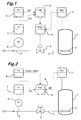
- Figures 1 and 2 are schematic representations of two means for achieving controlled carbon monoxide flow to a carbonylation reactor and Figures 3 and 4 are schematic representations of two means for achieving reactor pressure control by controlling the flow of high pressure vent gas.
- the flow rate of carbon monoxide through the valve 3 is measured by the flow transmitter 6 and is fed to the calculation block 8 where its average value over the preceding 10 minutes is calculated and to this value is added a constant amount to give a maximum carbon monoxide flow rate which in turn is fed as a set point to the flow controller 9.
- the carbon monoxide flow rate to the reactor through the valve 3 is regulated by the pressure controller 11 because the rate as measured by the flow transmitter 6 is below the maximum carbon monoxide flow rate and therefore below the set point in the carbon monoxide flow controller 9. Under these conditions the flow controller 9 is inoperative.
- FIGS 3 and 4 illustrate schemes for carbon monoxide vent flow control which may be used to supplement the carbon monoxide input reactor controls as described hereinbefore.
- 21 is a carbonylation reactor
- 22 is a carbon monoxide sparger communicating through line 23 with a supply of carbon monoxide
- 24 is a first pressure controller
- 25 is a second pressure controller
- 26 is a carbon monoxide vent line from the reactor 21
- 27 is an optional methyl iodide removal assembly
- 28 is a high pressure vent gas control valve
- 29 is a gas vent
- 30 is a flow controller
- 31 is a signal selector.
- the numerals 21 to 30 are identical to those in Figure 1. However, instead of denoting a signal selector the numeral 31 denotes an input block producing a set point high limit.
- the high pressure vent gas control valve (28) is activated through the signal selector (31) responsive to inputs from either the flow controller (30) or the second pressure controller (25), the second pressure controller being governed by a set-point which is below the pressure of the first pressure controller (24), the output from to the signal selector (31) and hence operation of the control valve (28) is defined by the flow controller (30) when the reactor pressure is equal to or above the set-point of the second pressure controller (25).
Landscapes
- Chemical & Material Sciences (AREA)
- Organic Chemistry (AREA)
- Chemical Kinetics & Catalysis (AREA)
- Engineering & Computer Science (AREA)
- Oil, Petroleum & Natural Gas (AREA)
- Organic Low-Molecular-Weight Compounds And Preparation Thereof (AREA)
- Low-Molecular Organic Synthesis Reactions Using Catalysts (AREA)
Applications Claiming Priority (2)
| Application Number | Priority Date | Filing Date | Title |
|---|---|---|---|
| GB9819079 | 1998-09-03 | ||
| GBGB9819079.6A GB9819079D0 (en) | 1998-09-03 | 1998-09-03 | Carbonylation process |
Publications (2)
| Publication Number | Publication Date |
|---|---|
| EP0983792A1 true EP0983792A1 (fr) | 2000-03-08 |
| EP0983792B1 EP0983792B1 (fr) | 2004-04-14 |
Family
ID=10838190
Family Applications (1)
| Application Number | Title | Priority Date | Filing Date |
|---|---|---|---|
| EP99306705A Expired - Lifetime EP0983792B1 (fr) | 1998-09-03 | 1999-08-24 | Procédé de carbonylation |
Country Status (15)
| Country | Link |
|---|---|
| US (1) | US6255527B1 (fr) |
| EP (1) | EP0983792B1 (fr) |
| JP (1) | JP4330214B2 (fr) |
| KR (1) | KR100620294B1 (fr) |
| CN (1) | CN1138748C (fr) |
| CA (1) | CA2281352C (fr) |
| DE (1) | DE69916383T2 (fr) |
| GB (1) | GB9819079D0 (fr) |
| ID (1) | ID23316A (fr) |
| MY (1) | MY126547A (fr) |
| RU (1) | RU2214390C2 (fr) |
| SA (1) | SA99200657B1 (fr) |
| SG (1) | SG82632A1 (fr) |
| UA (1) | UA58537C2 (fr) |
| YU (1) | YU49267B (fr) |
Cited By (5)
| Publication number | Priority date | Publication date | Assignee | Title |
|---|---|---|---|---|
| US6552221B1 (en) | 1998-12-18 | 2003-04-22 | Millenium Petrochemicals, Inc. | Process control for acetic acid manufacture |
| EP1484104A4 (fr) * | 2002-02-27 | 2008-03-12 | Daicel Chem | Procede et appareil de controle de l'alimentation d'un compose de reaction gazeuse |
| WO2012054499A1 (fr) * | 2010-10-18 | 2012-04-26 | Lyondell Chemical Technology, L.P. | Procédé de production d'acide acétique |
| CN109641826A (zh) * | 2016-06-14 | 2019-04-16 | 英国石油化学品有限公司 | 乙酸生产方法 |
| EP2406181B1 (fr) * | 2009-03-11 | 2020-10-28 | Basf Se | Procédé de production du phosgène |
Families Citing this family (18)
| Publication number | Priority date | Publication date | Assignee | Title |
|---|---|---|---|---|
| JP5069827B2 (ja) | 2001-02-28 | 2012-11-07 | 株式会社ダイセル | 反応制御方法および制御装置 |
| FR2826960B1 (fr) * | 2001-07-03 | 2005-10-21 | Acetex Chimie | Procede de controle d'une production d'acide acetique et/ou d'acetate de methyle en continu |
| US6677480B2 (en) * | 2002-01-28 | 2004-01-13 | Celanese International Corporation | Process control in production of acetic acid via use of heavy phase density measurement |
| GB0316756D0 (en) * | 2003-07-17 | 2003-08-20 | Bp Chem Int Ltd | Process |
| GB0601861D0 (en) * | 2006-01-30 | 2006-03-08 | Bp Chem Int Ltd | Process |
| US7989659B2 (en) * | 2007-05-17 | 2011-08-02 | Celanese International Corporation | Method and apparatus for making acetic acid with improved light ends column productivity |
| US8822717B2 (en) | 2010-11-24 | 2014-09-02 | LyondellBassell Acetyls, LLC | Vinyl acetate production process |
| US9193657B2 (en) | 2012-08-17 | 2015-11-24 | Celanese International Corporation | Catalyst stability in carbonylation processes |
| CN106715379B (zh) | 2014-10-02 | 2020-05-19 | 国际人造丝公司 | 用于生产乙酸的方法 |
| US9487464B2 (en) | 2015-01-30 | 2016-11-08 | Celanese International Corporation | Processes for producing acetic acid |
| MY181741A (en) | 2015-01-30 | 2021-01-06 | Celanese Int Corp | Processes for producing acetic acid |
| US9561994B2 (en) | 2015-01-30 | 2017-02-07 | Celanese International Corporation | Processes for producing acetic acid |
| MX2017009867A (es) | 2015-01-30 | 2017-11-15 | Celanese Int Corp | Procedimientos para producir acido acetico. |
| US10413840B2 (en) | 2015-02-04 | 2019-09-17 | Celanese International Coporation | Process to control HI concentration in residuum stream |
| US9512056B2 (en) | 2015-02-04 | 2016-12-06 | Celanese International Corporation | Process to control HI concentration in residuum stream |
| US9505696B2 (en) | 2015-02-04 | 2016-11-29 | Celanese International Corporation | Process to control HI concentration in residuum stream |
| US10695756B2 (en) | 2015-06-12 | 2020-06-30 | Enerkem, Inc. | Metal-loaded zeolite catalysts for the halogen-free conversion of dimethyl ether to methyl acetate |
| CN113600109B (zh) * | 2021-08-17 | 2023-07-25 | 江苏索普工程科技有限公司 | 一种甲醇羰基化制醋酸微界面反应系统及方法 |
Citations (5)
| Publication number | Priority date | Publication date | Assignee | Title |
|---|---|---|---|---|
| US5352415A (en) * | 1993-09-29 | 1994-10-04 | Hoechst Celanese Corporation | Control system for acetic acid manufacturing process |
| EP0618184A1 (fr) * | 1993-03-31 | 1994-10-05 | Pardies Acetiques | Procédé de préparation d'acides carboxyliques ou des esters correspondants en présence d'un catalyseur à base d'irridium |
| EP0657386A1 (fr) * | 1993-12-10 | 1995-06-14 | Pardies Acetiques | Procédé de préparation d'une solution à base d'iridium, solution obtenue et utilisation de celle-ci en tant que catalyseur |
| WO1995031426A1 (fr) * | 1994-05-13 | 1995-11-23 | Pardies Acetiques | Procede de preparation d'acides carboxyliques ou des esters correspondants en presence d'un catalyseur a base d'iridium et d'iodures sous forme soluble |
| EP0687662A2 (fr) * | 1994-06-15 | 1995-12-20 | Daicel Chemical Industries, Ltd. | Procédé de production d'acide acétique de haute pureté |
Family Cites Families (19)
| Publication number | Priority date | Publication date | Assignee | Title |
|---|---|---|---|---|
| SE364255B (fr) | 1967-04-05 | 1974-02-18 | Monsanto Co | |
| SE364254B (fr) | 1967-04-05 | 1974-02-18 | Monsanto Co | |
| US3772380A (en) | 1970-03-12 | 1973-11-13 | Monsanto Co | Production of carboxylic acids and esters |
| US3769329A (en) * | 1970-03-12 | 1973-10-30 | Monsanto Co | Production of carboxylic acids and esters |
| US4039395A (en) * | 1975-08-11 | 1977-08-02 | Monsanto Company | Purification of acetic acid |
| US4111982A (en) * | 1976-07-26 | 1978-09-05 | Monsanto Company | Coproduction of acetic and propionic acids |
| US4255591A (en) * | 1978-11-20 | 1981-03-10 | Monsanto Company | Carbonylation process |
| DE3038448A1 (de) * | 1980-10-11 | 1982-06-03 | Hoechst Ag, 6000 Frankfurt | Verfahren zur herstellung von essigsaeure, acetaldehyd und ethanol aus synthesegas |
| ZA853339B (en) * | 1984-05-03 | 1985-12-24 | Celanese Corp | Methanol carbonylation process |
| GB8904125D0 (en) * | 1989-02-23 | 1989-04-05 | British Petroleum Co Plc | Process for preparing carboxylic acids |
| EP0391680B1 (fr) | 1989-04-06 | 1994-06-15 | BP Chemicals Limited | Procédé de préparation d'acides carboxyliques |
| US5210322A (en) * | 1990-09-20 | 1993-05-11 | Union Carbide Chemicals & Plastics Technology Corporation | Processes for the preparation of ethers |
| GB9211671D0 (en) * | 1992-06-02 | 1992-07-15 | Bp Chem Int Ltd | Process |
| GB9306409D0 (en) | 1993-03-26 | 1993-05-19 | Bp Chem Int Ltd | Process |
| FR2703351A1 (fr) | 1993-03-31 | 1994-10-07 | Rhone Poulenc Chimie | Procédé de préparation d'acides carboxyliques ou des esters correspondants en présence d'un catalyseur à base de rhodium et d'iridium. |
| US5374774A (en) * | 1994-03-11 | 1994-12-20 | Hoechst Celanese Corporation | Control system for an acetic acid manufacturing process |
| US5510524A (en) * | 1995-02-21 | 1996-04-23 | Bp Chemicals Limited | Process for the production of a carboxylic acid |
| US5696284A (en) * | 1995-06-21 | 1997-12-09 | Bp Chemicals Limited | Process for the carbonylation of alkyl alcohols and/or reactive derivatives thereof |
| GB9517184D0 (en) * | 1995-08-22 | 1995-10-25 | Bp Chem Int Ltd | Process |
-
1998
- 1998-09-03 GB GBGB9819079.6A patent/GB9819079D0/en not_active Ceased
-
1999
- 1999-08-24 DE DE69916383T patent/DE69916383T2/de not_active Expired - Lifetime
- 1999-08-24 EP EP99306705A patent/EP0983792B1/fr not_active Expired - Lifetime
- 1999-08-26 SG SG9904199A patent/SG82632A1/en unknown
- 1999-09-01 YU YU42999A patent/YU49267B/sh unknown
- 1999-09-01 KR KR1019990036931A patent/KR100620294B1/ko not_active Expired - Fee Related
- 1999-09-01 JP JP24806099A patent/JP4330214B2/ja not_active Expired - Fee Related
- 1999-09-02 UA UA99094915A patent/UA58537C2/uk unknown
- 1999-09-02 CA CA002281352A patent/CA2281352C/fr not_active Expired - Fee Related
- 1999-09-02 RU RU99119600/04A patent/RU2214390C2/ru not_active IP Right Cessation
- 1999-09-02 MY MYPI99003785A patent/MY126547A/en unknown
- 1999-09-03 ID IDP990839D patent/ID23316A/id unknown
- 1999-09-03 US US09/389,488 patent/US6255527B1/en not_active Expired - Lifetime
- 1999-09-03 CN CNB991217756A patent/CN1138748C/zh not_active Expired - Fee Related
- 1999-10-11 SA SA99200657A patent/SA99200657B1/ar unknown
Patent Citations (5)
| Publication number | Priority date | Publication date | Assignee | Title |
|---|---|---|---|---|
| EP0618184A1 (fr) * | 1993-03-31 | 1994-10-05 | Pardies Acetiques | Procédé de préparation d'acides carboxyliques ou des esters correspondants en présence d'un catalyseur à base d'irridium |
| US5352415A (en) * | 1993-09-29 | 1994-10-04 | Hoechst Celanese Corporation | Control system for acetic acid manufacturing process |
| EP0657386A1 (fr) * | 1993-12-10 | 1995-06-14 | Pardies Acetiques | Procédé de préparation d'une solution à base d'iridium, solution obtenue et utilisation de celle-ci en tant que catalyseur |
| WO1995031426A1 (fr) * | 1994-05-13 | 1995-11-23 | Pardies Acetiques | Procede de preparation d'acides carboxyliques ou des esters correspondants en presence d'un catalyseur a base d'iridium et d'iodures sous forme soluble |
| EP0687662A2 (fr) * | 1994-06-15 | 1995-12-20 | Daicel Chemical Industries, Ltd. | Procédé de production d'acide acétique de haute pureté |
Cited By (10)
| Publication number | Priority date | Publication date | Assignee | Title |
|---|---|---|---|---|
| US6552221B1 (en) | 1998-12-18 | 2003-04-22 | Millenium Petrochemicals, Inc. | Process control for acetic acid manufacture |
| EP1484104A4 (fr) * | 2002-02-27 | 2008-03-12 | Daicel Chem | Procede et appareil de controle de l'alimentation d'un compose de reaction gazeuse |
| US7381837B2 (en) | 2002-02-27 | 2008-06-03 | Daicel Chemical Industries, Ltd. | Method and apparatus for controlling feed of gaseous reaction component |
| EP2406181B1 (fr) * | 2009-03-11 | 2020-10-28 | Basf Se | Procédé de production du phosgène |
| WO2012054499A1 (fr) * | 2010-10-18 | 2012-04-26 | Lyondell Chemical Technology, L.P. | Procédé de production d'acide acétique |
| CN103124901A (zh) * | 2010-10-18 | 2013-05-29 | 莱昂德尔化学技术公司 | 乙酸生产方法 |
| CN103124901B (zh) * | 2010-10-18 | 2016-06-01 | 莱昂德尔化学技术公司 | 乙酸生产方法 |
| EA024607B1 (ru) * | 2010-10-18 | 2016-10-31 | ЛАЙОНДЕЛЛБЭЗЕЛЛ ЭСИТИЛЗ, ЭлЭлСи | Способ производства уксусной кислоты |
| CN109641826A (zh) * | 2016-06-14 | 2019-04-16 | 英国石油化学品有限公司 | 乙酸生产方法 |
| CN109641826B (zh) * | 2016-06-14 | 2021-10-22 | 英力士乙酰英国有限公司 | 乙酸生产方法 |
Also Published As
| Publication number | Publication date |
|---|---|
| MY126547A (en) | 2006-10-31 |
| SG82632A1 (en) | 2001-08-21 |
| ID23316A (id) | 2000-04-05 |
| SA99200657B1 (ar) | 2006-11-05 |
| RU2214390C2 (ru) | 2003-10-20 |
| JP2000095723A (ja) | 2000-04-04 |
| US6255527B1 (en) | 2001-07-03 |
| JP4330214B2 (ja) | 2009-09-16 |
| CN1138748C (zh) | 2004-02-18 |
| DE69916383T2 (de) | 2004-08-12 |
| YU42999A (en) | 2000-12-28 |
| EP0983792B1 (fr) | 2004-04-14 |
| YU49267B (sh) | 2004-12-31 |
| CA2281352A1 (fr) | 2000-03-03 |
| DE69916383D1 (de) | 2004-05-19 |
| CA2281352C (fr) | 2009-06-09 |
| UA58537C2 (uk) | 2003-08-15 |
| GB9819079D0 (en) | 1998-10-28 |
| KR100620294B1 (ko) | 2006-09-06 |
| KR20000022843A (ko) | 2000-04-25 |
| CN1252401A (zh) | 2000-05-10 |
Similar Documents
| Publication | Publication Date | Title |
|---|---|---|
| EP0983792B1 (fr) | Procédé de carbonylation | |
| US5932764A (en) | Iridium-catalyzed carbonylation process for the production of a carboxylic acid | |
| CA2281379C (fr) | Procede de carbonylation | |
| RU2160248C2 (ru) | Способ получения уксусной кислоты путем карбонилирования | |
| US6458996B1 (en) | Process for the production of acetic acid | |
| EP0643034B1 (fr) | Procédé et catalysateur pour la production d'acide acétique | |
| US5510524A (en) | Process for the production of a carboxylic acid | |
| MXPA96002082A (en) | Process for the production of acetic acid by carbonilac | |
| JPH0723337B2 (ja) | メタノールカルボニル化法 | |
| JP5356334B2 (ja) | 酢酸の製造方法 | |
| CA2498821C (fr) | Procede de production d'acide acetique | |
| US20080293967A1 (en) | Control of formic acid impurities in industrial glacial acetic acid | |
| EP0999198B1 (fr) | Procédé pour la préparation de l'acide acétique | |
| GB2334955A (en) | Carbonylation process for the production of acetic acid | |
| GB2393437A (en) | Production of acetic acid by iridium-catalysed carbonylation using one or more metal iodides or iodide-generating salts or complexes | |
| MXPA97009588A (en) | Carbonilation process catalyzed with iridio for the production of a carboxil acid | |
| MXPA96004931A (es) | Proceso para la produccion de acido acetico mediante la carbonilacion de eter dimetilico |
Legal Events
| Date | Code | Title | Description |
|---|---|---|---|
| PUAI | Public reference made under article 153(3) epc to a published international application that has entered the european phase |
Free format text: ORIGINAL CODE: 0009012 |
|
| AK | Designated contracting states |
Kind code of ref document: A1 Designated state(s): DE FR GB |
|
| AX | Request for extension of the european patent |
Free format text: AL;LT;LV;MK;RO;SI |
|
| 17P | Request for examination filed |
Effective date: 20000802 |
|
| AKX | Designation fees paid |
Free format text: DE FR GB |
|
| GRAP | Despatch of communication of intention to grant a patent |
Free format text: ORIGINAL CODE: EPIDOSNIGR1 |
|
| GRAS | Grant fee paid |
Free format text: ORIGINAL CODE: EPIDOSNIGR3 |
|
| GRAA | (expected) grant |
Free format text: ORIGINAL CODE: 0009210 |
|
| AK | Designated contracting states |
Kind code of ref document: B1 Designated state(s): DE FR GB |
|
| REG | Reference to a national code |
Ref country code: GB Ref legal event code: FG4D |
|
| REF | Corresponds to: |
Ref document number: 69916383 Country of ref document: DE Date of ref document: 20040519 Kind code of ref document: P |
|
| ET | Fr: translation filed | ||
| PLBE | No opposition filed within time limit |
Free format text: ORIGINAL CODE: 0009261 |
|
| STAA | Information on the status of an ep patent application or granted ep patent |
Free format text: STATUS: NO OPPOSITION FILED WITHIN TIME LIMIT |
|
| 26N | No opposition filed |
Effective date: 20050117 |
|
| PGFP | Annual fee paid to national office [announced via postgrant information from national office to epo] |
Ref country code: DE Payment date: 20140827 Year of fee payment: 16 |
|
| PGFP | Annual fee paid to national office [announced via postgrant information from national office to epo] |
Ref country code: GB Payment date: 20140827 Year of fee payment: 16 Ref country code: FR Payment date: 20140818 Year of fee payment: 16 |
|
| REG | Reference to a national code |
Ref country code: DE Ref legal event code: R119 Ref document number: 69916383 Country of ref document: DE |
|
| GBPC | Gb: european patent ceased through non-payment of renewal fee |
Effective date: 20150824 |
|
| REG | Reference to a national code |
Ref country code: FR Ref legal event code: ST Effective date: 20160429 |
|
| PG25 | Lapsed in a contracting state [announced via postgrant information from national office to epo] |
Ref country code: DE Free format text: LAPSE BECAUSE OF NON-PAYMENT OF DUE FEES Effective date: 20160301 Ref country code: GB Free format text: LAPSE BECAUSE OF NON-PAYMENT OF DUE FEES Effective date: 20150824 |
|
| PG25 | Lapsed in a contracting state [announced via postgrant information from national office to epo] |
Ref country code: FR Free format text: LAPSE BECAUSE OF NON-PAYMENT OF DUE FEES Effective date: 20150831 |