EP0984226A1 - Verfahren zur Erzeugung von warmem Trink- und Heizwasser sowie Heizungsanordnung bzw. Kompaktheizungsanordnung hierfür - Google Patents
Verfahren zur Erzeugung von warmem Trink- und Heizwasser sowie Heizungsanordnung bzw. Kompaktheizungsanordnung hierfür Download PDFInfo
- Publication number
- EP0984226A1 EP0984226A1 EP98810876A EP98810876A EP0984226A1 EP 0984226 A1 EP0984226 A1 EP 0984226A1 EP 98810876 A EP98810876 A EP 98810876A EP 98810876 A EP98810876 A EP 98810876A EP 0984226 A1 EP0984226 A1 EP 0984226A1
- Authority
- EP
- European Patent Office
- Prior art keywords
- heat
- heat exchanger
- heating
- compressor
- temperature
- Prior art date
- Legal status (The legal status is an assumption and is not a legal conclusion. Google has not performed a legal analysis and makes no representation as to the accuracy of the status listed.)
- Granted
Links
- 238000000034 method Methods 0.000 title claims abstract description 17
- 238000010438 heat treatment Methods 0.000 title claims description 40
- 239000008236 heating water Substances 0.000 title claims description 23
- 239000012530 fluid Substances 0.000 claims abstract description 21
- 230000006835 compression Effects 0.000 claims abstract description 8
- 238000007906 compression Methods 0.000 claims abstract description 8
- 230000008569 process Effects 0.000 claims abstract description 8
- XLYOFNOQVPJJNP-UHFFFAOYSA-N water Substances O XLYOFNOQVPJJNP-UHFFFAOYSA-N 0.000 claims abstract description 6
- 239000003651 drinking water Substances 0.000 claims description 28
- 235000020188 drinking water Nutrition 0.000 claims description 27
- 230000000712 assembly Effects 0.000 claims description 5
- 238000000429 assembly Methods 0.000 claims description 5
- 238000004519 manufacturing process Methods 0.000 claims description 3
- 238000009529 body temperature measurement Methods 0.000 claims 1
- 230000003247 decreasing effect Effects 0.000 claims 1
- 239000013529 heat transfer fluid Substances 0.000 description 9
- 239000007788 liquid Substances 0.000 description 8
- 238000010586 diagram Methods 0.000 description 5
- 230000008901 benefit Effects 0.000 description 3
- 238000012546 transfer Methods 0.000 description 3
- 239000003570 air Substances 0.000 description 2
- 230000008878 coupling Effects 0.000 description 2
- 238000010168 coupling process Methods 0.000 description 2
- 238000005859 coupling reaction Methods 0.000 description 2
- 239000000523 sample Substances 0.000 description 2
- 239000002689 soil Substances 0.000 description 2
- 210000002023 somite Anatomy 0.000 description 2
- 238000009423 ventilation Methods 0.000 description 2
- 230000002776 aggregation Effects 0.000 description 1
- 238000004220 aggregation Methods 0.000 description 1
- 239000012080 ambient air Substances 0.000 description 1
- 230000002308 calcification Effects 0.000 description 1
- 238000004140 cleaning Methods 0.000 description 1
- 238000009833 condensation Methods 0.000 description 1
- 230000005494 condensation Effects 0.000 description 1
- 238000001816 cooling Methods 0.000 description 1
- 238000013461 design Methods 0.000 description 1
- 230000035622 drinking Effects 0.000 description 1
- 230000007613 environmental effect Effects 0.000 description 1
- 239000003673 groundwater Substances 0.000 description 1
- 230000006872 improvement Effects 0.000 description 1
- 238000009434 installation Methods 0.000 description 1
- 238000012423 maintenance Methods 0.000 description 1
- 238000005259 measurement Methods 0.000 description 1
- 238000002156 mixing Methods 0.000 description 1
- 238000002360 preparation method Methods 0.000 description 1
- 230000005855 radiation Effects 0.000 description 1
- 230000009467 reduction Effects 0.000 description 1
- 230000000630 rising effect Effects 0.000 description 1
- 230000011664 signaling Effects 0.000 description 1
- 230000007704 transition Effects 0.000 description 1
Images

Classifications
-
- F—MECHANICAL ENGINEERING; LIGHTING; HEATING; WEAPONS; BLASTING
- F24—HEATING; RANGES; VENTILATING
- F24D—DOMESTIC- OR SPACE-HEATING SYSTEMS, e.g. CENTRAL HEATING SYSTEMS; DOMESTIC HOT-WATER SUPPLY SYSTEMS; ELEMENTS OR COMPONENTS THEREFOR
- F24D3/00—Hot-water central heating systems
- F24D3/18—Hot-water central heating systems using heat pumps
-
- F—MECHANICAL ENGINEERING; LIGHTING; HEATING; WEAPONS; BLASTING
- F24—HEATING; RANGES; VENTILATING
- F24D—DOMESTIC- OR SPACE-HEATING SYSTEMS, e.g. CENTRAL HEATING SYSTEMS; DOMESTIC HOT-WATER SUPPLY SYSTEMS; ELEMENTS OR COMPONENTS THEREFOR
- F24D19/00—Details
- F24D19/10—Arrangement or mounting of control or safety devices
- F24D19/1006—Arrangement or mounting of control or safety devices for water heating systems
- F24D19/1066—Arrangement or mounting of control or safety devices for water heating systems for the combination of central heating and domestic hot water
- F24D19/1072—Arrangement or mounting of control or safety devices for water heating systems for the combination of central heating and domestic hot water the system uses a heat pump
-
- F—MECHANICAL ENGINEERING; LIGHTING; HEATING; WEAPONS; BLASTING
- F24—HEATING; RANGES; VENTILATING
- F24D—DOMESTIC- OR SPACE-HEATING SYSTEMS, e.g. CENTRAL HEATING SYSTEMS; DOMESTIC HOT-WATER SUPPLY SYSTEMS; ELEMENTS OR COMPONENTS THEREFOR
- F24D3/00—Hot-water central heating systems
- F24D3/08—Hot-water central heating systems in combination with systems for domestic hot-water supply
-
- Y—GENERAL TAGGING OF NEW TECHNOLOGICAL DEVELOPMENTS; GENERAL TAGGING OF CROSS-SECTIONAL TECHNOLOGIES SPANNING OVER SEVERAL SECTIONS OF THE IPC; TECHNICAL SUBJECTS COVERED BY FORMER USPC CROSS-REFERENCE ART COLLECTIONS [XRACs] AND DIGESTS
- Y02—TECHNOLOGIES OR APPLICATIONS FOR MITIGATION OR ADAPTATION AGAINST CLIMATE CHANGE
- Y02B—CLIMATE CHANGE MITIGATION TECHNOLOGIES RELATED TO BUILDINGS, e.g. HOUSING, HOUSE APPLIANCES OR RELATED END-USER APPLICATIONS
- Y02B30/00—Energy efficient heating, ventilation or air conditioning [HVAC]
- Y02B30/12—Hot water central heating systems using heat pumps
-
- Y—GENERAL TAGGING OF NEW TECHNOLOGICAL DEVELOPMENTS; GENERAL TAGGING OF CROSS-SECTIONAL TECHNOLOGIES SPANNING OVER SEVERAL SECTIONS OF THE IPC; TECHNICAL SUBJECTS COVERED BY FORMER USPC CROSS-REFERENCE ART COLLECTIONS [XRACs] AND DIGESTS
- Y02—TECHNOLOGIES OR APPLICATIONS FOR MITIGATION OR ADAPTATION AGAINST CLIMATE CHANGE
- Y02B—CLIMATE CHANGE MITIGATION TECHNOLOGIES RELATED TO BUILDINGS, e.g. HOUSING, HOUSE APPLIANCES OR RELATED END-USER APPLICATIONS
- Y02B30/00—Energy efficient heating, ventilation or air conditioning [HVAC]
- Y02B30/52—Heat recovery pumps, i.e. heat pump based systems or units able to transfer the thermal energy from one area of the premises or part of the facilities to a different one, improving the overall efficiency
Definitions
- the invention relates to a method for producing warm drinking and heating water and a heating arrangement or compact heating arrangement therefor.
- the object of the invention is a method with a compression heat pump process to show, in which an optimal heating of drinking water and Heating water for heating if possible with a minimal heating arrangement is achieved.
- the object is achieved in that the heat transport fluid of a compression heat pump arrangement always first through the heat exchanger for what is to be heated Drinking water and then only depending on the remaining heat Heating the heating water is used. Flows through the heat transfer fluid however, always directly the heat exchanger for the drinking water and, if sufficient Residual heat is present, then directly for the heating water.
- the heat flow image representation in FIG. 1 for the arrangement or compact heating arrangement according to the invention represents a compression heat pump arrangement.
- the arrangement has a first heat exchanger 1 for producing warm drinking water. Furthermore, it has a second heat exchanger 3 for producing warm heating water and a bypass 5 with which this heat exchanger 3 can be bridged.
- a third heat exchanger 7 is connected to a heat source 9 , not shown, the heat transport fluid of which is transported by a pump 10 from the heat source 9 to the heat exchanger 7 .
- the soil is preferably used as a heat source by means of a probe system or a surface collector, because the environmental energy required for the entire heat supply of a house is available permanently and with high efficiency.
- the connection to a ventilation system is also possible.
- the arrangement has a compressor 11 , a hot water boiler 13 with the heat exchanger 1 and a measuring device 15 , two solenoid valves 17a and 17b , an expansion valve 19 , a control device 21 , a filter dryer 23 and a further measuring device 25 , which in the return 27 of the heating water is arranged to measure its temperature.
- the expansion valve 19 is connected via a line 20 (usually a capillary) to the inlet of the compressor 11 . This connection is used to adjust the pressure of the heat transfer fluid.
- the outlet of the heat exchanger 7 is connected to the inlet of the compressor 11 via a pipe 29 .
- the outlet of the compressor 11 leads via the line 31 to the inlet of the heat exchanger 1 .
- the output of the heat exchanger 1 is connected to the line 32 via the solenoid valve 17b to the input of the heat exchanger 3 and its output via line 33 to the input of the filter dryer 23 .
- the inlet and outlet of the heat exchanger 3 can be bridged with the bypass 5 , as already explained above.
- the solenoid valve 17a is arranged in the bypass 5 .
- the output of the filter dryer 23 is connected via line 34 to the input of the expansion valve 19 and its output via line 35 to the input of the heat exchanger 7 .
- the signaling device is the control device 21 via line 39 with the temperature measuring device 25 in the heating return 27 , with an outside temperature measuring device 40 via line 41 , with the temperature measuring device 15 in the boiler 13 via line 42 , with a frequency converter 44 via line 45 , with a pump 43 connected to one of the two solenoid valves 17a and 17b in the heating flow 46 via a line 48 and via lines 47a and 47b .
- the frequency converter can be used to generate a preferably changeable alternating current frequency for driving the compressor 11 . The higher the frequency, the faster the pump motor of the compressor 11 runs and the higher the compressor output.
- the frequency converter 44 is connected to the compressor via the electrical line 49 . That is, the compressor 11 is adjustable in speed. This allows a significant improvement in the performance figures to be achieved in the partial load range. Another advantage is that the compressor 11 only has to be designed for the output in the control heating range and only the demand peaks at very low outside temperatures can be covered by corresponding speed increases.
- the solenoid valve 17a in the bypass 5 When operating only for the production of warm drinking water, the solenoid valve 17a in the bypass 5 is completely open and the solenoid valve 17b in the line 32 to the heat exchanger 3 for the heating water is completely closed. No heat transfer fluid therefore flows through the heat exchanger for the heating water.
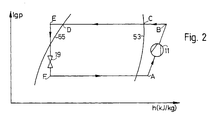
- the wet fluid vapor absorbs heat in the heat exchanger 7 , which is supplied by the above-mentioned probe system 9 .
- this results in a movement from point F in the wet steam area over curve 53 to point A in the dry steam area.
- the predetermined temperature is stored in a memory of the control device 21 .
- the actual temperature of the drinking water as an indirect measure of the residual heat of the heat transfer fluid leaving the heat exchanger 1 is compared with this predetermined (stored) temperature.
- the solenoid valve 17b is opened by the control device 21 via the control line 47b and the solenoid valve 17a in the bypass 5 is closed via the control line 47a .
- the heat transport fluid now flows through the heat exchanger 3 for additional heating of the heating water.
- the control device 21 starts the pump 43 in the heating flow 46 via the control line 48 (the pump 43 can of course also always be in operation).
- the heat transfer fluid cools down as a result of heat being released in the heat exchanger 3 and leaves the heat exchanger 3 through the line 33 as wet steam or as a liquid (point E in FIG. 2 ). The rest of the process is analogous to what was said above.
- the high temperature level of the heat transport fluid present at the outlet of the compressor 11 can always be used for the preparation of warm drinking water.
- This has the advantage that the drinking water in the boiler 13 is kept at a temperature in a self-regulating manner when the heat pump is operating. If hot drinking water is removed and the boiler is "warmed up", the full heat pump output can be transferred to the drinking water and rapid heating can be achieved.
- the heating of drinking water and heating water is designed by the control device 21 such that the heating of drinking water always has priority.
- the drinking water temperature is determined with the temperature measuring device 15 , as already mentioned above.
- the sensor belonging to the measuring device 15 is preferably arranged in the lower third of the boiler 13 .
- the temperature of the heating water is determined using the temperature measuring device 25 , ie its measuring sensor in the return 27 .
- there is an external temperature sensor 40 which, like the two other sensors, is connected to the control device 21 .
- the outside sensor 40 is used in particular to specify a value for the return temperature of the heating water, taking into account the measured outside temperature.
- the control device 21 then increases the current frequency for the compressor 11 through the frequency converter 44 by means of a signal. This increases the compressor output and results in a higher heat flow. Since the compressor 11 is speed-controllable, the system can normally be operated in a part-load range, ie in a control heating mode. The need peaks at very low outside temperatures then only have to be covered by a corresponding increase in speed. If this cover, which is only necessary for a few days, is to be dispensed with, an adjustable frequency converter 44 is also not required. This design of the heating arrangement, in which the components are designed not for the peak, but for the regular heating operation, allows the components to be minimized, which results in a significant cost reduction in terms of purchase and installation.
- bypass 5 It is also not always necessary to switch completely between bypass 5 and a flow through heat exchanger 3 , it is also possible to send only a partial flow of heat fluid through the bypass and heat exchanger 3 .
- a partial shutdown of the heating circuit could also be carried out, e.g. B. in the way that certain rooms would only be heated at predetermined times of the day.
- the compressor output does not have to be controlled via the frequency converter 44.
- Other control methods can also be used depending on the compressor type selected be used.
- FIG. 3 shows a spatial division of the components already shown in FIG. 1 into a compact heating arrangement 59 .
- the compact heating arrangement 59 is constructed in two parts with two cabinet units 61a and 61b . To save space, the two cabinet units 61a and 61b are arranged one above the other, but could also be set up next to one another or separately.
- the compact heating arrangement 59 typically has a base area of approximately 80 cm ⁇ 80 cm and a total height of approximately two meters when placed one above the other.
- the lower cabinet unit 61a essentially contains the boiler 13 ' for the drinking water to be heated.
- the boiler 13 ' has a double enamelled wall, around which the tubes 62 of the heat exchanger 1' are wound.
- the inflow pipe 31 ' to the heat exchanger 1' and also the pipe 32 ' for the heat transport fluid flowing out of the heat exchanger 1' are guided side by side upwards to the top of the cabinet unit 61a and pass there via a connecting flange 63a and 63b into the cabinet unit 61b .
- a pipeline 31 '' leads from the connecting flange 63a to the outlet of the compressor 11 ' .
- a pipe 32 ′′ leads from the connecting flange 63b to the solenoid valves 17a ′ and 17b ′ .
- the solenoid valve 17a ' is part of the bypass 5' with which the heat exchanger 3 ' for the heating water can be bridged.
- the outlet line 33 'of the heat exchanger s 3' also leads here to the expansion valve 19 ' , from which a line 35' then leads to the heat exchanger 7 ' for the fluid of the heat source 9' .
- the heat transport fluid from and to the heat source 9 ' is also moved here by a pump 10' .
- the output of the heat exchanger 7 ' is connected via line 29' to the input of the compressor 11 ' .
- the heating water heated in the heat exchanger 3 ' is conveyed with a pump 43' in the flow.
- the compressor 11 ' , the two solenoid valves 17a and 17b and the pump 43' are controlled by a control device 21 ' by evaluating the measurement results of a temperature measuring device 15' in the boiler 13 ' , an outside temperature measuring device 40' and a measuring device 25 ' for the temperature of the heating water.
- the unit By dividing the compact heating system into two, the unit is divided into a unit that is preferably subject to service and a unit that requires relatively little service.
- the connecting flanges 63a and 63b and the signal line 42 ' between the temperature measuring device 15' in the boiler 13 ' and the control device 21 have to be separated.
- the connections 65a and 65b to the heat source 9 ' and the connections 67a and 67b to the heating circuit must be separated.
- the upper unit can thus be easily detached from the lower one and, if desired, replaced with a new unit or transported to a workshop for service.
- the heat transfer liquid located in the tubes of the upper cabinet unit 61b must be extracted here. If suction is to be dispensed with, the connecting flanges 63a and 63b must be replaced by so-called split couplings (quick-release couplings) which close them when the pipe connections are opened.
- FIG. 1 Further assemblies can be connected to the heating arrangement as shown in FIG. 1 or as a compact heating arrangement as shown in FIG. 3 .
- An electrical additional heating 69 can be provided as additional heating for the boiler 13 , which is switched on by the control device 21 when hot drinking water is required or when the ambient temperature is low.
- a so-called solar heating system 71 can also be switched on as additional boiler heating, in which warm water is generated by solar radiation.
- the solar heating system 71 has a solar collector 72 , an expansion vessel 73 , a heat exchanger r 74 in the boiler 13 and a vent valve 75 and a pump 76 which drives the heat transfer fluid through the associated line system.
- warm air can also be used directly for space heating if an additional fan is used.
- the groundwater, the soil and also the ambient air can serve as the heat source 9 or 9 ' .
- Indoor air can also be used as a heat source, which should be discharged into the environment for room ventilation.
Landscapes
- Engineering & Computer Science (AREA)
- Physics & Mathematics (AREA)
- Thermal Sciences (AREA)
- Chemical & Material Sciences (AREA)
- Combustion & Propulsion (AREA)
- Mechanical Engineering (AREA)
- General Engineering & Computer Science (AREA)
- Heat-Pump Type And Storage Water Heaters (AREA)
- General Preparation And Processing Of Foods (AREA)
- Cookers (AREA)
Abstract
Description
- Fig. 1
- ein Wärmeflissbild der erfindungsgemässen Anordnung,
- Fig. 2
- ein dazu gehörendes Druck-Enthalpie-Diagramm, wobei der Druck vertikal logarithmisch und die Enthalpie horizontal aufgetragen sind und
- Fig. 3
- die in Figur 1 dargestellte Anlage in einem Aufbau als zweiteilige Kompaktheizungsanordnung.

Claims (8)
- Verfahren zur Erzeugung sowohl von warmem Trink- sowie auch von Heizungswasser in einem Kompressions-Wärmepumpenprozess, bei dem das Wärmetransportfluid durch einen ersten Wärmetauscher (1) für das Trinkwasser geführt und je nach verbleibender Restwärme nach dem ersten Wärmetauscher (1) auch noch durch einen zweiten Wärmetauscher (3) für das Heizungswasser geführt oder an diesem vorbeigeführt wird.
- Verfahren nach Anspruch 1, dadurch gekennzeichnet, dass die Restwärme durch eine Temperaturmessung des Trinkwassers ermittelt wird und bevorzugt bei zu geringer Restwärme die Verdichterleistung im Kompressions-Wärmepumpenprozess erhöht und bei zu hoher erniedrigt wird.
- Verfahren nach Anspruch 1 oder 2, dadurch gekennzeichnet, dass die Temperatur des Heizungswassers insbesondere im Rücklauf (27) gemessen und bei zu tiefer Temperatur die Verdichterleistung im Kompressions-Wärmepumpenprozess erhöht und bei zu hoher erniedrigt wird.
- Anordnung zur Durchführung des Verfahrens nach einem der Ansprüche 1 bis 3 mit einer Kompressions-Wärmepumpenanordnung mit einem Wärmetransportfluid, einem ersten Wärmetauscher (1) zur Erzeugung von warmem Trinkwasser, einem zweiten Wärmetauscher (3) zur Erzeugung von warmem Heizungswasser, einem Bypass (5), mit dem der zweite Wärmetauscher (3) überbrückbar ist, einer Messeinrichtung (15), mit der die Restwärme des Wärmetransportfluids nach Verlassen des ersten Wärmetauschers (1) bestimmbar ist und einer Steuereinrichtung (21), welche bei zu geringer Restwärme den Wärmetransportfluidfluss durch den zweiten Wärmetauscher (3) über den Bypass (5) reduziert, bevorzugt vollständig unterbindet.
- Anordnung nach Anspruch 4, gekennzeichnet durch einen den ersten Wärmetauseher (1) aufweisenden Warmwasserboiler (13), aus dem das Trinkwasser abnehmbar ist und der ein mit einer mit der Steuereinrichtung (21) verbundenen Messeinrichtung (15) zusammenwirkendes Boilertemperaturmesselement hat.
- Anordnung nach Anspruch 4 oder 5, gekennzeichnet durch einen mit der Steuereinrichtung (21) verbundenen Verdichter (11), dessen Verdichterleistung von der Steuereinrichtung (21) bei zu geringer Restwärme erhöh- bzw. bei zu hoher Verdichterleistung reduzierbar ist und bevorzugt die Steuereinrichtung (21) einen Frequenzumrichter (44) zur Steuerung der Verdichterleistung hat.
- Anordnung nach einem der Ansprüche 4 bis 6, gekennzeichnet durch eine Temperaturmesseinrichtung (25) zur Messung der Temperatur des Heizwassers, welche bevorzugt im Heizwasserrücklauf (27) zum zweiten Wärmetauscher (3) angeordnet ist, und eine Verbindung (39) dieser Temperaturmesseinrichtung (25) mit der Steuereinrichtung (21), um die Verdichterleistung des Verdichters (14) bei zu geringer Restwärme zu erhöhen bzw. bei zu hoher Verdichterleistung zu reduzieren.
- Anordnung nach einem der Ansprüche 4 bis 7, dadurch gekennzeichnet, dass sie als Kompaktheizungsanordnung (59) mit zwei voneinander trennbaren, bevorzugt übereinander angeordneten Schrankeinheiten (61a, 61b) ausgebildet ist, deren eine, bevorzugt untere Schrankeinheit (61a) den ersten Wärmetauscher (1') mit Boiler (13') für das warme Trinkwasser hat und eine andere, bevorzugt obere Schrankeinheit (61b) elektrisch zu steuernde Baugruppen, wie Ventile sowie anzutreibende Baugruppen, wie Pumpen, Verdichter und Expansionsventil aufweist, welche in der Regel wartungsintensiver sind als die Baugruppen der einen, bevorzugt unteren Schrankeinheit (61a) und somit mit der anderen Schrankeinheit (61b) als Ganzes zu Servicezwecken abnehmbar und überprüfbar sind.
Priority Applications (3)
| Application Number | Priority Date | Filing Date | Title |
|---|---|---|---|
| AT98810876T ATE244384T1 (de) | 1998-09-03 | 1998-09-03 | Verfahren zur erzeugung von warmem trink- und heizwasser sowie heizungsanordnung bzw. kompaktheizungsanordnung hierfür |
| DE59808914T DE59808914D1 (de) | 1998-09-03 | 1998-09-03 | Verfahren zur Erzeugung von warmem Trink- und Heizwasser sowie Heizungsanordnung bzw. Kompaktheizungsanordnung hierfür |
| EP98810876A EP0984226B1 (de) | 1998-09-03 | 1998-09-03 | Verfahren zur Erzeugung von warmem Trink- und Heizwasser sowie Heizungsanordnung bzw. Kompaktheizungsanordnung hierfür |
Applications Claiming Priority (1)
| Application Number | Priority Date | Filing Date | Title |
|---|---|---|---|
| EP98810876A EP0984226B1 (de) | 1998-09-03 | 1998-09-03 | Verfahren zur Erzeugung von warmem Trink- und Heizwasser sowie Heizungsanordnung bzw. Kompaktheizungsanordnung hierfür |
Publications (2)
| Publication Number | Publication Date |
|---|---|
| EP0984226A1 true EP0984226A1 (de) | 2000-03-08 |
| EP0984226B1 EP0984226B1 (de) | 2003-07-02 |
Family
ID=8236297
Family Applications (1)
| Application Number | Title | Priority Date | Filing Date |
|---|---|---|---|
| EP98810876A Revoked EP0984226B1 (de) | 1998-09-03 | 1998-09-03 | Verfahren zur Erzeugung von warmem Trink- und Heizwasser sowie Heizungsanordnung bzw. Kompaktheizungsanordnung hierfür |
Country Status (3)
| Country | Link |
|---|---|
| EP (1) | EP0984226B1 (de) |
| AT (1) | ATE244384T1 (de) |
| DE (1) | DE59808914D1 (de) |
Cited By (6)
| Publication number | Priority date | Publication date | Assignee | Title |
|---|---|---|---|---|
| FR2819307A1 (fr) * | 2001-01-10 | 2002-07-12 | Jacques Bernier | Pompe a chaleur mixte chauffage et eau chaude sanitaire |
| ES2176126A1 (es) * | 2001-05-04 | 2002-11-16 | Serna Hermanos A A S L | Sistema integral de calefaccion, refrigeracion y produccion de agua caliente sanitaria mediante recuperacion |
| WO2007004962A1 (en) * | 2005-07-06 | 2007-01-11 | Thermia Värme Ab | Control device |
| EP1757868A1 (de) * | 2005-08-13 | 2007-02-28 | George Curtis | Elektrischer Kombinationsboiler |
| EP3315873A1 (de) * | 2016-10-26 | 2018-05-02 | Gorenje Gospodinjski aparati d.d. | Wärmepumpe |
| DE102017116079A1 (de) * | 2017-07-18 | 2019-01-24 | Eisenmann Se | Versorgungskreis für ein Wärmeträgermedium für einen Verbraucher, Industrieanlage und Verfahren zum Betreiben von solchen |
Families Citing this family (1)
| Publication number | Priority date | Publication date | Assignee | Title |
|---|---|---|---|---|
| IT202300022170A1 (it) * | 2023-10-23 | 2025-04-23 | Snf Envirotech Srl | Impianto e metodo di riscaldamento di acqua |
Citations (3)
| Publication number | Priority date | Publication date | Assignee | Title |
|---|---|---|---|---|
| DE3423262A1 (de) * | 1983-07-30 | 1985-02-07 | Joh. Vaillant Gmbh U. Co, 5630 Remscheid | Verfahren zur regelung einer waermepumpe in verbindung mit einer weiteren waermequelle |
| DE8313741U1 (de) * | 1983-05-09 | 1985-12-05 | Happel GmbH & Co, 4690 Herne | Gerät zur parallelen Erzeugung von Heiz- und Warmwasser mittels einer Wärmepumpe |
| WO1992019919A1 (de) * | 1991-04-30 | 1992-11-12 | Scheel Henning W | Flächenheizungs-/klimatisierungsanlage |
Family Cites Families (1)
| Publication number | Priority date | Publication date | Assignee | Title |
|---|---|---|---|---|
| FR2679016B1 (fr) * | 1991-07-09 | 1997-12-26 | Sofath | Pompe a chaleur a regulation piece par piece et a puissance variable. |
-
1998
- 1998-09-03 DE DE59808914T patent/DE59808914D1/de not_active Revoked
- 1998-09-03 AT AT98810876T patent/ATE244384T1/de not_active IP Right Cessation
- 1998-09-03 EP EP98810876A patent/EP0984226B1/de not_active Revoked
Patent Citations (3)
| Publication number | Priority date | Publication date | Assignee | Title |
|---|---|---|---|---|
| DE8313741U1 (de) * | 1983-05-09 | 1985-12-05 | Happel GmbH & Co, 4690 Herne | Gerät zur parallelen Erzeugung von Heiz- und Warmwasser mittels einer Wärmepumpe |
| DE3423262A1 (de) * | 1983-07-30 | 1985-02-07 | Joh. Vaillant Gmbh U. Co, 5630 Remscheid | Verfahren zur regelung einer waermepumpe in verbindung mit einer weiteren waermequelle |
| WO1992019919A1 (de) * | 1991-04-30 | 1992-11-12 | Scheel Henning W | Flächenheizungs-/klimatisierungsanlage |
Cited By (6)
| Publication number | Priority date | Publication date | Assignee | Title |
|---|---|---|---|---|
| FR2819307A1 (fr) * | 2001-01-10 | 2002-07-12 | Jacques Bernier | Pompe a chaleur mixte chauffage et eau chaude sanitaire |
| ES2176126A1 (es) * | 2001-05-04 | 2002-11-16 | Serna Hermanos A A S L | Sistema integral de calefaccion, refrigeracion y produccion de agua caliente sanitaria mediante recuperacion |
| WO2007004962A1 (en) * | 2005-07-06 | 2007-01-11 | Thermia Värme Ab | Control device |
| EP1757868A1 (de) * | 2005-08-13 | 2007-02-28 | George Curtis | Elektrischer Kombinationsboiler |
| EP3315873A1 (de) * | 2016-10-26 | 2018-05-02 | Gorenje Gospodinjski aparati d.d. | Wärmepumpe |
| DE102017116079A1 (de) * | 2017-07-18 | 2019-01-24 | Eisenmann Se | Versorgungskreis für ein Wärmeträgermedium für einen Verbraucher, Industrieanlage und Verfahren zum Betreiben von solchen |
Also Published As
| Publication number | Publication date |
|---|---|
| EP0984226B1 (de) | 2003-07-02 |
| DE59808914D1 (de) | 2003-08-07 |
| ATE244384T1 (de) | 2003-07-15 |
Similar Documents
| Publication | Publication Date | Title |
|---|---|---|
| DE10231877B4 (de) | Konstanttemperaturflüssigkeitszirkuliervorrichtung | |
| EP1606564B1 (de) | Verfahren und vorrichtung zur energierückgewinnung | |
| DE69634942T2 (de) | Regelkreis für Latenzkühlmittel für Klimaanlage | |
| DE60107901T2 (de) | Heisswasserzufuhrsystem mit einem Wärmepumpenkreis | |
| DE69211012T2 (de) | Klimaanlage für räume | |
| DE4434831A1 (de) | Anlage zur kombinierten Energieerzeugung | |
| DE1451044A1 (de) | Einrichtung zur Steuerung von Umgebungsbedingungen | |
| DE3112228A1 (de) | Kaeltemittelkondensationssystem | |
| EP2354677B1 (de) | Nutzung von Wärme aus den Fernwärmerücklauf | |
| DE3101138A1 (de) | Waermepumpe mit waermetauschern | |
| EP0984226B1 (de) | Verfahren zur Erzeugung von warmem Trink- und Heizwasser sowie Heizungsanordnung bzw. Kompaktheizungsanordnung hierfür | |
| AT521703B1 (de) | Warmwasserbereitungsanlage | |
| DE10033052A1 (de) | Verfahen zum Betreiben einer Gasturbinenanlage sowie Gasturbinenanlage zur Durchführung des Verfahrens | |
| DE2732639C2 (de) | Vorrichtung zur Übertragung von Heizwärme von einer Wärmequelle auf Verbraucherkreise | |
| DE602004012905T2 (de) | Energie sparende klimaprüfkammer und betriebsverfahren | |
| CH708598B1 (de) | Anordnung und Verfahren zum Raumtemperieren und Warmwasserbereitstellen. | |
| DE102009017423B4 (de) | Verfahren zur Ladungssteuerung eines Warmwasserschichtspeichers mit einer Wärmepumpe | |
| DE1454527A1 (de) | Klimaanlage fuer das Beheizen und Kuehlen eines Gebaeudes | |
| DE202011111059U1 (de) | Wärmepumpenanlage | |
| DE202015107108U1 (de) | Vorrichtung zur Erzeugung von Brauchwarmwasser und zur Klimatisierung eines oder mehrerer Räume eines Gebäudes | |
| EP2204619B1 (de) | Vorrichtung und verfahren für einen optimierten betrieb eines klimatisierungssystems und klimatisierungssystem | |
| DE4138774A1 (de) | Waermepumpe | |
| DE3004324A1 (de) | Vorrichtung zur regelung einer heizungsanlage mit wenigstens einer einrichtung zur gewinnung von waerme aus einem absorber | |
| DE102008061135A1 (de) | Verfahren zum Steuern oder Regeln einer Heizungsanlage und Heizanlage | |
| CH634127A5 (de) | Waermekraftwerk mit einer trockenkuehleinrichtung. |
Legal Events
| Date | Code | Title | Description |
|---|---|---|---|
| PUAI | Public reference made under article 153(3) epc to a published international application that has entered the european phase |
Free format text: ORIGINAL CODE: 0009012 |
|
| AK | Designated contracting states |
Kind code of ref document: A1 Designated state(s): AT CH DE LI NL |
|
| AX | Request for extension of the european patent |
Free format text: AL;LT;LV;MK;RO;SI |
|
| 17P | Request for examination filed |
Effective date: 20000627 |
|
| AKX | Designation fees paid |
Free format text: AT CH DE LI NL |
|
| 17Q | First examination report despatched |
Effective date: 20020506 |
|
| GRAH | Despatch of communication of intention to grant a patent |
Free format text: ORIGINAL CODE: EPIDOS IGRA |
|
| GRAH | Despatch of communication of intention to grant a patent |
Free format text: ORIGINAL CODE: EPIDOS IGRA |
|
| GRAA | (expected) grant |
Free format text: ORIGINAL CODE: 0009210 |
|
| RAP1 | Party data changed (applicant data changed or rights of an application transferred) |
Owner name: ALPHA-INNOTEC GMBH |
|
| RIN1 | Information on inventor provided before grant (corrected) |
Inventor name: EGLI, PETER |
|
| AK | Designated contracting states |
Designated state(s): AT CH DE LI NL |
|
| PG25 | Lapsed in a contracting state [announced via postgrant information from national office to epo] |
Ref country code: NL Free format text: LAPSE BECAUSE OF FAILURE TO SUBMIT A TRANSLATION OF THE DESCRIPTION OR TO PAY THE FEE WITHIN THE PRESCRIBED TIME-LIMIT Effective date: 20030702 |
|
| REG | Reference to a national code |
Ref country code: CH Ref legal event code: EP |
|
| REG | Reference to a national code |
Ref country code: CH Ref legal event code: NV Representative=s name: KELLER & PARTNER PATENTANWAELTE AG |
|
| REF | Corresponds to: |
Ref document number: 59808914 Country of ref document: DE Date of ref document: 20030807 Kind code of ref document: P |
|
| PG25 | Lapsed in a contracting state [announced via postgrant information from national office to epo] |
Ref country code: AT Free format text: LAPSE BECAUSE OF NON-PAYMENT OF DUE FEES Effective date: 20030903 |
|
| NLV1 | Nl: lapsed or annulled due to failure to fulfill the requirements of art. 29p and 29m of the patents act | ||
| PLBI | Opposition filed |
Free format text: ORIGINAL CODE: 0009260 |
|
| 26 | Opposition filed |
Opponent name: STIEBEL ELTRON GMBH & CO. KG Effective date: 20040331 |
|
| PLAX | Notice of opposition and request to file observation + time limit sent |
Free format text: ORIGINAL CODE: EPIDOSNOBS2 |
|
| PGFP | Annual fee paid to national office [announced via postgrant information from national office to epo] |
Ref country code: CH Payment date: 20040817 Year of fee payment: 7 |
|
| PGFP | Annual fee paid to national office [announced via postgrant information from national office to epo] |
Ref country code: DE Payment date: 20040824 Year of fee payment: 7 |
|
| PLBB | Reply of patent proprietor to notice(s) of opposition received |
Free format text: ORIGINAL CODE: EPIDOSNOBS3 |
|
| RDAF | Communication despatched that patent is revoked |
Free format text: ORIGINAL CODE: EPIDOSNREV1 |
|
| RDAG | Patent revoked |
Free format text: ORIGINAL CODE: 0009271 |
|
| STAA | Information on the status of an ep patent application or granted ep patent |
Free format text: STATUS: PATENT REVOKED |
|
| REG | Reference to a national code |
Ref country code: CH Ref legal event code: PL |
|
| 27W | Patent revoked |
Effective date: 20051011 |