EP0984313A2 - Anzeigevorrichtung mit reflektierender Folie, welche eine mittels Laser auftragbare Beschichtung besitzt - Google Patents
Anzeigevorrichtung mit reflektierender Folie, welche eine mittels Laser auftragbare Beschichtung besitzt Download PDFInfo
- Publication number
- EP0984313A2 EP0984313A2 EP99202693A EP99202693A EP0984313A2 EP 0984313 A2 EP0984313 A2 EP 0984313A2 EP 99202693 A EP99202693 A EP 99202693A EP 99202693 A EP99202693 A EP 99202693A EP 0984313 A2 EP0984313 A2 EP 0984313A2
- Authority
- EP
- European Patent Office
- Prior art keywords
- conductive
- viewable
- images
- light modulating
- layer
- Prior art date
- Legal status (The legal status is an assumption and is not a legal conclusion. Google has not performed a legal analysis and makes no representation as to the accuracy of the status listed.)
- Withdrawn
Links
Images


Classifications
-
- G—PHYSICS
- G02—OPTICS
- G02F—OPTICAL DEVICES OR ARRANGEMENTS FOR THE CONTROL OF LIGHT BY MODIFICATION OF THE OPTICAL PROPERTIES OF THE MEDIA OF THE ELEMENTS INVOLVED THEREIN; NON-LINEAR OPTICS; FREQUENCY-CHANGING OF LIGHT; OPTICAL LOGIC ELEMENTS; OPTICAL ANALOGUE/DIGITAL CONVERTERS
- G02F1/00—Devices or arrangements for the control of the intensity, colour, phase, polarisation or direction of light arriving from an independent light source, e.g. switching, gating or modulating; Non-linear optics
- G02F1/01—Devices or arrangements for the control of the intensity, colour, phase, polarisation or direction of light arriving from an independent light source, e.g. switching, gating or modulating; Non-linear optics for the control of the intensity, phase, polarisation or colour
- G02F1/13—Devices or arrangements for the control of the intensity, colour, phase, polarisation or direction of light arriving from an independent light source, e.g. switching, gating or modulating; Non-linear optics for the control of the intensity, phase, polarisation or colour based on liquid crystals, e.g. single liquid crystal display cells
- G02F1/133—Constructional arrangements; Operation of liquid crystal cells; Circuit arrangements
- G02F1/1333—Constructional arrangements; Manufacturing methods
- G02F1/1343—Electrodes
- G02F1/134309—Electrodes characterised by their geometrical arrangement
-
- G—PHYSICS
- G02—OPTICS
- G02F—OPTICAL DEVICES OR ARRANGEMENTS FOR THE CONTROL OF LIGHT BY MODIFICATION OF THE OPTICAL PROPERTIES OF THE MEDIA OF THE ELEMENTS INVOLVED THEREIN; NON-LINEAR OPTICS; FREQUENCY-CHANGING OF LIGHT; OPTICAL LOGIC ELEMENTS; OPTICAL ANALOGUE/DIGITAL CONVERTERS
- G02F1/00—Devices or arrangements for the control of the intensity, colour, phase, polarisation or direction of light arriving from an independent light source, e.g. switching, gating or modulating; Non-linear optics
- G02F1/01—Devices or arrangements for the control of the intensity, colour, phase, polarisation or direction of light arriving from an independent light source, e.g. switching, gating or modulating; Non-linear optics for the control of the intensity, phase, polarisation or colour
- G02F1/13—Devices or arrangements for the control of the intensity, colour, phase, polarisation or direction of light arriving from an independent light source, e.g. switching, gating or modulating; Non-linear optics for the control of the intensity, phase, polarisation or colour based on liquid crystals, e.g. single liquid crystal display cells
- G02F1/133—Constructional arrangements; Operation of liquid crystal cells; Circuit arrangements
- G02F1/1333—Constructional arrangements; Manufacturing methods
- G02F1/1343—Electrodes
- G02F1/13439—Electrodes characterised by their electrical, optical, physical properties; materials therefor; method of making
-
- G—PHYSICS
- G02—OPTICS
- G02F—OPTICAL DEVICES OR ARRANGEMENTS FOR THE CONTROL OF LIGHT BY MODIFICATION OF THE OPTICAL PROPERTIES OF THE MEDIA OF THE ELEMENTS INVOLVED THEREIN; NON-LINEAR OPTICS; FREQUENCY-CHANGING OF LIGHT; OPTICAL LOGIC ELEMENTS; OPTICAL ANALOGUE/DIGITAL CONVERTERS
- G02F1/00—Devices or arrangements for the control of the intensity, colour, phase, polarisation or direction of light arriving from an independent light source, e.g. switching, gating or modulating; Non-linear optics
- G02F1/01—Devices or arrangements for the control of the intensity, colour, phase, polarisation or direction of light arriving from an independent light source, e.g. switching, gating or modulating; Non-linear optics for the control of the intensity, phase, polarisation or colour
- G02F1/13—Devices or arrangements for the control of the intensity, colour, phase, polarisation or direction of light arriving from an independent light source, e.g. switching, gating or modulating; Non-linear optics for the control of the intensity, phase, polarisation or colour based on liquid crystals, e.g. single liquid crystal display cells
- G02F1/137—Devices or arrangements for the control of the intensity, colour, phase, polarisation or direction of light arriving from an independent light source, e.g. switching, gating or modulating; Non-linear optics for the control of the intensity, phase, polarisation or colour based on liquid crystals, e.g. single liquid crystal display cells characterised by the electro-optical or magneto-optical effect, e.g. field-induced phase transition, orientation effect, guest-host interaction or dynamic scattering
- G02F1/13718—Devices or arrangements for the control of the intensity, colour, phase, polarisation or direction of light arriving from an independent light source, e.g. switching, gating or modulating; Non-linear optics for the control of the intensity, phase, polarisation or colour based on liquid crystals, e.g. single liquid crystal display cells characterised by the electro-optical or magneto-optical effect, e.g. field-induced phase transition, orientation effect, guest-host interaction or dynamic scattering based on a change of the texture state of a cholesteric liquid crystal
-
- H—ELECTRICITY
- H05—ELECTRIC TECHNIQUES NOT OTHERWISE PROVIDED FOR
- H05K—PRINTED CIRCUITS; CASINGS OR CONSTRUCTIONAL DETAILS OF ELECTRIC APPARATUS; MANUFACTURE OF ASSEMBLAGES OF ELECTRICAL COMPONENTS
- H05K3/00—Apparatus or processes for manufacturing printed circuits
- H05K3/36—Assembling printed circuits with other printed circuits
- H05K3/361—Assembling flexible printed circuits with other printed circuits
Definitions
- the field of invention pertains to image displays which can selectively transmit or reflect light.
- a first sheet has transparent ITO conductive areas and a second sheet has electrically conductive inks printed on display areas.
- the sheets can be glass, but in practice have been formed of Mylar polyester.
- a dispersion of liquid crystal material in a binder is coated on the first sheet, and the second sheet is pressed onto the liquid crystal material. Electrical potential applied to opposing conductive areas operate on the liquid crystal material to expose display areas. The display ceases to present an image when de-energized.
- Taliq products form electrical interconnection by offsetting the two sheets and contacting trace conductors from each of the two sheets.
- the prior art typically requires multiple, separate layers to build up the display.
- the electrical traces and transparent conductive layers are typically formed through repeated vacuum deposition and photolithography of materials on the substrate. These processes are expensive and require long processing times on capital intensive equipment. Because most display structures are formed of glass, two sheets are used and are offset to permit connection to two separate and exposed sets of traces that are disposed on separate sheets
- the prior art discloses isolating each layer on separate sides of the display, and connecting the traces to drive electronics using solder connections, wire bonds or pressure contact. Such connections do require that both sets of traces be exposed on a surface for the connection process.
- the uniform, multi-layer structure prevents connection to the inner conductive layer.
- Another object of the present invention is to provide a display device that can be formed using coating techniques.
- This object is achieved in a display for presenting selected images to a viewer, comprising:
- the disclosed structure has the advantage of providing a reflective display using a laser patternable conductive evaporated coating over a liquid crystal, light modulating layer.
- a laser patternable evaporated coating is inexpensive when deposited over a liquid crystal-polymer coating created using current photographic coating technology.
- the display can be patterned using laser to create a display.
- a single large substrate of material can be coated and formed into different types of displays by exposing the light sensitive material to different patterns.
- Another advantage is that the display can be formed as sheets using coating methods instead of bonding methods.
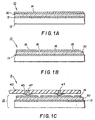
- FIG. 1A A sectional view of a display 10 prior to complete processing used in the invention is shown in FIG. 1A.
- the display 10 includes a substrate 12.
- Substrate 12 can be made of a transparent polymeric material, such as Kodak Estar film base formed of polyester plastic, and have a thickness of between 20 and 200 microns. In an exemplary embodiment, substrate 12 can be a 80 micron thick sheet of polyester film base. Other polymers, such as transparent polycarbonate, can also be used.
- An optically transparent, electrically conductive layer 13 is formed over the substrate 12.
- the transparent, electrically conductive layer 13 can be formed of tin-oxide or Indium-Tin-Oxide (ITO), with ITO being the preferred material.
- ITO Indium-Tin-Oxide
- the transparent, electrically conductive layer 13 is sputtered onto the substrate 12 to a resistance of less than 250 ohms per square.
- a light modulating layer 30 is formed over the transparent, electrically conductive layer 13.
- Light modulating layer 30 can be a liquid crystal of conventional design.
- the liquid crystal materials can be nematic (undoped) and should exhibit high optical and electrical anisotropy and match the index of refraction of the carrier polymer when the material is electrically oriented. Examples of such nematic materials are Merck BL001, BL005, and BL011.
- Light modulating layer can also incorporate a chiral doped nematic liquid crystal such as those disclosed in US-A-5,695,682. Examples of such materials are Merck BL112 and BL126. Application of fields of various intensity and duration change the state of chiral doped nematic materials from a reflective to a transmissive state. These materials have the advantage of maintaining a given state indefinitely after the field is removed. Other light reflecting or diffusing modulating, electrically operated materials can also be coated such as a micro-encapsulated ferroelectric (FLC) material.
- FLC micro-encapsulated ferroelectric
- a liquid crystal material is homogenized in a polymeric binder such as de-ionized gelatin or polyvinyl alcohol (PVA).
- a polymeric binder such as de-ionized gelatin or polyvinyl alcohol (PVA).
- Emulsions have been made having binder concentrations of between 10 to 50 percent. Such compounds are machine coatable on equipment associated with photographic films. It is important that the binder have a low ionic content. The presence of ions in such a binder hinders the development of an electrical field across the dispersed liquid crystal material. Additionally, ions in the binder can migrate in the presence of an electrical field, chemically damaging the light modulating layer 30.
- the liquid crystal and gelatin emulsion is coated to a thickness of between 5 and 30 microns to optimize light modulating of light modulating layer 30. The coating thickness, size of the liquid crystal bubbles and concentration of the bubbles of liquid crystal materials is designed to either diffuse or reflect light.
- a patternable conductive layer 14 is evaporated over light modulating layer 30.
- platinum oxide was sputtered over a liquid crystal-gelatin emulsion approximately 7 microns thick.
- the patternable conductive layer 17 formed a metallic layer of conductivity sufficient to carry a charge to operate on the light modulating layer 30.
- Other commonly used materials and processes can be used to provide a vacuum deposited coat to create patternable conductive layer 14. In a vacuum environment, materials such as aluminum, tin, silver, platinum, carbon, tungsten, molybdenum or Indium can be used. Oxides of said metals can be used to darken patternable conductive layer 14.
- the metal material in the vacuum chamber can be excited by energy from resistance heating, cathodic arc, electron beam, sputtering or magnetron excitation.
- the use of Tin-Oxide or Indium-Tin Oxide permits coatings of patternable conductive coating 17 that are transparent.
- An ITO coating can be formed over light modulating layer 30 that has less than 250 ohms per square of resistance and high light transmission.
- FIG. 1B is a sectional view through the display 10 after laser processing.
- the patternable conductive layer 14 has been laser scribed create viewable and conductive images 16 and non-conductive areas 18, as shown in FIG. 1B.
- the effective conductivity of the viewable and conductive images 16 is less than 250 ohms per square.
- Viewable and conductive images 16 appear black, having an optical density of greater than 2.0 D.
- Nominally conductive metal in non-conductive areas 18 has been removed using a Yttrium-Aluminum Garnet (YAG) laser to define the extent of viewable and conductive images 16.
- Non-conductive areas 18 are typically gaps approximately 25-100 microns wide that electrically isolate electrically viewable and conductive images 16.
- the YAG laser can generate patterns in patternable conductive layer 14 for both opaque and transmissive coatings of materials.
- Prior art disclosed the use of an adhesive to bond a patterned conductive layer 17 over light modulating layer 30.
- an adhesively bonded display required 30 volts to clear light modulating layer 30.
- a second display with an identical light modulating layer 30 was vacuum coated with platinum oxide to create patternable conductive layer 14.
- a YAG laser created patterned indicia in patternable conductive layer 14.
- the drive voltage required to clear light modulating layer 30 was under one volt.
- the evaporated metallic coating over light modulating layer 30 has a lower drive voltage than an adhesively bonded patternable conductive layer 14.
- FIG. 1C is a section view of processed display 10 connected to circuit board 40 to form a display 10.
- Circuit board 40 has a series of traces that are connected to viewable and conductive images 16 through contact pads 47.
- the present invention is suitable for use as a privacy screen.
- it can be placed over a bathroom window and in a driven condition can be transparent and in an undriven condition can be opaque.
- the layers 13 and 14 need not be patterned.
- the display 10 can be formed as a sheet. In this case the display 10 is either transparent or opaque and does not need to present viewable images.
- Patternable conductive layer 14 can be soft, in which case, connection between circuit board 40 and patternable conductive layer 14 must be done without damaging viewable and conductive images 16.
- Indium powder is deposited between circuit board 40 and patternable conductive layer 14 and the two components are heated to melt the indium and form an electrical connection between circuit board 40 and patternable conductive layer 14.
- an electrically conductive adhesive is used to form connection between circuit board 40 and patternable conductive layer 14.
- External drive circuitry of conventional design selectively drives viewable and conductive images 16 to change optical properties of selected drive segments of display 10.
- the light modulating layer 30 is effective in two conditions. In a first condition, the light modulating layer 30 prevents the viewing of the viewable and conductive images 16, and in a second condition, the light modulating layer 30 permits the viewing of the viewable and conductive images 16.
- an alternating voltage is applied to transparent, electrically conductive layer 13 to provide an electrical field across viewable and conductive images 16 that are electronically grounded.
- Using an alternating voltage across light modulating layer 30 prevents the damage from migration of ions within and between any of the layers.
- a frequency of greater than 60 cycles per second in the alternating voltage is sufficient to orient molecules in the light modulating layer 30.
- transparent patternable conductive layer 14 is not patterned, and provides a continuous translucent sheet that can be electrically driven to a transmissive state to create an electrically cleared privacy screen.
- patternable conductive layer 14 is an evaporated metal oxide which creates a dark background that absorbs light.
- patternable conductive layer 14 is an electrically conductive, light transmissive coating of Indium Tin Oxide.
- viewable and conductive images 16 become laser formed conductive traces 100, which are formed between non-conductive areas 18to create conductive traces 100.
- Transparent, electrically conductive layer 13 is laser scribed in a first direction.
- Patternable conductive layer 14 is then coated over light modulating layer 30.
- Patternable conductive layer 14 is laser scribed to form non-conductive areas 18 between conductive traces 100.
- Coatings over transparent, electrically conductive layer 13 are removed to expose conductive traces 100 in transparent, electrically conductive layer 13.
- Conductive traces 100 are disposed across display 10 orthogonally to create pixels 90 at intersections of traces 100.
- Coatings over transparent, electrically conductive area 13 are removed from connection area 52 to permit connection to individual traces formed in transparent, electrically conductive layer 13.
- a signal (e1-e2) applied across pairs of traces from each of the two electrically conductive layers permits operation on a given pixel element.
- voltage is applied using electrical leads 101, two of which are shown. There is a lead 101 attached on the connection area 52 to every row and there is a lead 101 attached to every column on the patternable conductive layer 14.
- an activated pixel 91 is driven by the two leads 101 visible in FIG. 7A.
- FIG. 7A is not to scale.
- FIGS. 2A and 2B show top views of each of the two parts of a display 10.
- FIG. 2A shows a circuit board 40, which has circuit board traces 45 running from a position under each viewable and conductive image 16.
- Contact pads 47 are located under each viewable and conductive image 16 and are connected to each conductive trace 45 to provide electrical interconnect to each viewable and conductive image 16 on display 10.
- FIG. 2B is a top view of display 10 with light modulating layer 30 sectioned away to show viewable and conductive images 16.
- the patternable conductive layer 14 in the display 10 has been laser scribed to create viewable and conductive images 16.
- Non-conductive areas 18 serve to electrically isolate viewable and conductive images 16.
- a power pin 50 contacts a connection area 52, which has been laser scribed to expose transparent, electrically conductive layer 13. Multiple power pins 50 connected to multiple connection areas 52 can be used to ensure a uniform field across the transparent, electrically conductive layer 13.
- Circuit board 40 has a set of circuit board traces 45 that provide interconnection to external drive electronics (not shown). Each circuit board trace 45 terminates under a separate viewable and conductive image 16. Contact pads 47 press against each viewable and conductive image 16.
- FIG. 3A which shows an inactivated state
- viewable and conductive images 16 are obscured by light modulating layer 30 which reflects light from absorption by the viewable and conductive images 16.
- Power pin 50 continuously supplies an alternating voltage through connection area 52 to transparent, electrically conductive layer 13.
- FIG. 3B shows the activation of one area of display 10.
- a circuit board trace 45 has a first electrical potential switched to ground.
- the circuit board trace 45 carries the ground potential to contact pad 47 (shown in FIG. 3A) and into viewable and conductive image 16.
- Power pin 50 supplies an alternating voltage to the transparent, electrically conductive layer 13 on the other side of light modulating layer 30.
- patternable conductive layer 14 is a sputtered coating of transparent Indium-Tin-Oxide.
- Circuit board 40 is attached to a single patternable area 14 at the edge of display 10.
- Light modulating layer 30 is a conventional nematic liquid crystal material that creates an translucent privacy screen.
- Power pin 50 can be acted on to supply an alternating voltage to transparent, electrically conductive layer 13.
- Application of the alternating current field clears light modulating layer 30.
- the use of a sputtered transparent conductor over the light modulating layer 30 provides a simple, energy efficient method of providing a field across clearing light modulating layer 30 without a second sheet.
- FIG. 4A is a sectional view showing the optical operation of a diffusing display 10 in non-operating and operating mode.
- An alternating voltage is supplied through power pin 50 to the transparent, electrically conductive layer 13.
- a ground signal is applied to viewable and conductive image 16.
- the applied alternating voltage across light modulating layer 30 causes the liquid crystal material to align with the imposed electrical field.
- the area of light modulating layer 30 over viewable and conductive image 16 becomes transparent and viewable and conductive image 16 absorbs absorbed light 64.
- the black conductive material from patternable conductive layer 14 absorbs light in the viewable and conductive image 16, causing the displayed area to appear black in a white background.
- a viewable and conductive image 16 is not grounded and no voltage exists between viewable and conductive image 16 and the transparent, electrically conductive layer 13.
- Light modulating layer 30 reflects light striking display 10 back as reflected light 60, creating a "white" image.
- FIG. 4B is a sectional view showing the optical operation of a reflecting display 10 in non-operating and operating mode.
- a ground voltage is supplied through power pin 50 to the transparent, electrically conductive layer 13.
- a signal is applied to viewable and conductive image 16.
- Viewable and conductive image 16 in this case is a transparent, electrically conductive coating of Indium-Tin-Oxide.
- a YAG laser has been used to remove ITO material in non-conductive areas 18.
- a drive signal has been applied to across light modulating layer 30 to cause a chiral nematic liquid crystal material to become transparent.
- Transparent light modulating layer 30 over viewable and conductive image 16 transmits transmitted light 66.
- a black material can be disposed behind display 10, causing the displayed area to appear black.
- a viewable and conductive image 16 is driven to a reflective state.
- Light modulating layer 30 reflects light striking display 10 back as reflected light 60, creating a "white" image.
- a chiral nematic material in light modulating area 30 can reflect light at specific, visible wavelengths such as red, green or blue. Reflected light 60 can be a portion of the visible color spectrum, so that some portions of incident light are reflected light 60, while other portions of the spectrum are transmitted light 66.
- Individual sheets can be used to create color-black displays, or stacked to create a full color display, as is disclosed in Hashimoto et al, "Reflective Color Display Using Cholesteric Liquid Crystals", SID 98 Digest, Article 31.1, 1998, pp. 897-900.
- the present invention has the advantage of using coating methods instead of bonding methods.
- FIGS. 5A-5D are schematic representations of how the viewable and conductive images 16 are formed in the patternable conductive layer 14.
- a transparent substrate 12 is coated with transparent electrically conductive layer 13 using sputtered Indium-Tin-Oxide.
- a light modulating layer 30 which includes liquid crystal material in a polymeric binder is coated over transparent, electrically conductive layer 13.
- display 10 has a patternable conductive layer 14 such as aluminum or platinum, which has been coated by evaporative techniques over light modulating layer 30.
- a high powered laser beam 80 from a Ytterium-Aluminum-Garnett (YAG) laser is used to remove portions of patternable conductive layer 14.
- the laser beam 80 actually scribes the material down and into light modulating layer 30 in a predetermined pattern to form viewable and conductive images 16 which are electrically isolated from each other.
- the patterning laser can be a 700 series laser head from Lee Laser, Inc. of Orlando, Florida. Such a laser emits light at 1064 nanometers wavelength at up to 25 watts.
- this laser can be operated at 18 amps and 10 kilohertz with a beam diameter of 100 microns and travel at 1000 millimeters per sec and scribe through patternable conductive layer 14. Under the operating conditions, 2.3 Watts of power are used to scribe a 100 micron line at 1000 millimeters per second.
- a conventional photosensitive etch resist material is applied over the surface of patternable conductive layer 14. Actinic radiation is used to selectively polymerize the etch resist material into an etch resistant state. An acid etch is applied for a time that permits etching through patternable conductive layer 14. Display 10 is then washed in a solvent to remove the etch resist.
- circuit board 40 includes contact pads 47 has been pressed against the viewable and conductive images 16 to provide electrical connections to them. Electrically conductive adhesive material can be used fasten circuit board 40 to the display 10. A power pin 50 formed in the printed circuit board 40 contacts a portion of transparent, electrically conductive layer 13. It should be noted that in an area 52 the patternable conductive layer 14 and light modulating layer 30 have been removed to facilitate direct electrical connection to the transparent, electrically conductive layer 13.
- FIG. 6A is a partial top view of a different application for display 10.
- Conductive areas 16 and non-conductive areas 18 cover the majority of the sheet, and power areas 25 have been formed on two sides of display 10.
- Power areas 25 have had all coatings above transparent, electrically conductive layer 13 removed. The overlying layers can be removed by chemical etching. Power areas 25 permit electrical connection to transparent, electrically conductive layer 13.
- FIG. 6B is a magnified rear view of the surface of display 10.
- Conductive areas 16 are small conductive pads define pixel elements on display 10.
- Non-conductive area 18 define a fine conductor-free mesh that limits conductive areas 16.
- Nonconductive areas 18 are required to limit an electrical field operating between transparent, electrically conductive layer 13 and conductive areas 16.
- the light modulating layer 30 is composed of material having state-memory, such as cholesteric liquid crystal, the sheet can be used to form a electrically writable sheet.
- the method wherein the laser light beam is provided by a YAG laser.
- the metallic conductive layer includes indium tin oxide.
- the method further including the step of electrically connecting the viewable and conductive images to contact pads.
Landscapes
- Physics & Mathematics (AREA)
- Nonlinear Science (AREA)
- Mathematical Physics (AREA)
- Chemical & Material Sciences (AREA)
- Crystallography & Structural Chemistry (AREA)
- General Physics & Mathematics (AREA)
- Optics & Photonics (AREA)
- Geometry (AREA)
- Liquid Crystal (AREA)
- Devices For Indicating Variable Information By Combining Individual Elements (AREA)
- Illuminated Signs And Luminous Advertising (AREA)
- Electrochromic Elements, Electrophoresis, Or Variable Reflection Or Absorption Elements (AREA)
Applications Claiming Priority (2)
| Application Number | Priority Date | Filing Date | Title |
|---|---|---|---|
| US146656 | 1998-09-03 | ||
| US09/146,656 US6236442B1 (en) | 1998-09-03 | 1998-09-03 | Method of making liquid crystal display having patterned conductive images |
Publications (2)
| Publication Number | Publication Date |
|---|---|
| EP0984313A2 true EP0984313A2 (de) | 2000-03-08 |
| EP0984313A3 EP0984313A3 (de) | 2004-03-17 |
Family
ID=22518376
Family Applications (1)
| Application Number | Title | Priority Date | Filing Date |
|---|---|---|---|
| EP99202693A Withdrawn EP0984313A3 (de) | 1998-09-03 | 1999-08-19 | Anzeigevorrichtung mit reflektierender Folie, welche eine mittels Laser auftragbare Beschichtung besitzt |
Country Status (3)
| Country | Link |
|---|---|
| US (1) | US6236442B1 (de) |
| EP (1) | EP0984313A3 (de) |
| JP (1) | JP2000089688A (de) |
Cited By (2)
| Publication number | Priority date | Publication date | Assignee | Title |
|---|---|---|---|---|
| EP1058147A3 (de) * | 1999-06-04 | 2002-04-24 | Eastman Kodak Company | Mehrlagige lichtmodulierende Platte mit zweifacher Polarität |
| CN104094362A (zh) * | 2011-12-21 | 2014-10-08 | 3M创新有限公司 | 基于银纳米线的透明导电涂层的激光图案化 |
Families Citing this family (17)
| Publication number | Priority date | Publication date | Assignee | Title |
|---|---|---|---|---|
| DE19835263C2 (de) * | 1998-08-04 | 2000-06-21 | Siemens Ag | Integrierte Schaltung mit durch Energieeinwirkung auftrennbaren elektrischen Verbindungstellen |
| US6394870B1 (en) * | 1999-08-24 | 2002-05-28 | Eastman Kodak Company | Forming a display having conductive image areas over a light modulating layer |
| US6323928B1 (en) * | 2000-06-26 | 2001-11-27 | Eastman Kodak Company | Method of forming a liquid crystal display with color dielectric layer |
| US20030043095A1 (en) * | 2001-08-31 | 2003-03-06 | Kia Silverbrook | Scanning electronic book |
| DE10212304C1 (de) * | 2002-03-20 | 2003-12-04 | Bayer Ag | Verfahren zur Herstellung von metallisierten Kunststoffformteilen und deren Verwendung |
| US6788362B2 (en) * | 2002-08-16 | 2004-09-07 | Eastman Kodak Company | Pigment layer for polymer-dispersed liquid crystal displays |
| US6900876B2 (en) | 2003-02-13 | 2005-05-31 | Eastman Kodak Company | Process and structures for selective deposition of liquid-crystal emulsion |
| US6950157B2 (en) * | 2003-06-05 | 2005-09-27 | Eastman Kodak Company | Reflective cholesteric liquid crystal display with complementary light-absorbing layer |
| US20050237473A1 (en) * | 2004-04-27 | 2005-10-27 | Stephenson Stanley W | Coatable conductive layer |
| US20050253987A1 (en) * | 2004-05-17 | 2005-11-17 | Eastman Kodak Company | Reflectance-matching layer for cholesteric display having dye layer and reflective conductors |
| US7333166B2 (en) * | 2004-05-21 | 2008-02-19 | Industrial Technology Research Institute | Matrix display through thermal treatment |
| US20060062898A1 (en) * | 2004-09-17 | 2006-03-23 | Eastman Kodak Company | Method of making a display sheet comprising discontinuous stripe coating |
| GB2419215A (en) * | 2004-10-14 | 2006-04-19 | Magink Display Technologies In | Display device |
| US7990515B2 (en) * | 2004-12-10 | 2011-08-02 | Industrial Technology Research Institute | Bistable display |
| US7583834B2 (en) * | 2005-03-04 | 2009-09-01 | Eastman Kodak Company | Laser etched fiducials in roll-roll display |
| US7329368B2 (en) * | 2005-12-08 | 2008-02-12 | Industrial Technology Research Institute | Temperature compensating chiral dopants |
| WO2019244871A1 (ja) * | 2018-06-18 | 2019-12-26 | 凸版印刷株式会社 | 調光シート、および、調光シートの製造方法 |
Family Cites Families (7)
| Publication number | Priority date | Publication date | Assignee | Title |
|---|---|---|---|---|
| US4435047A (en) | 1981-09-16 | 1984-03-06 | Manchester R & D Partnership | Encapsulated liquid crystal and method |
| US5187601A (en) * | 1988-03-07 | 1993-02-16 | Semiconductor Energy Laboratory Co., Ltd. | Method for making a high contrast liquid crystal display including laser scribing opaque and transparent conductive strips simultaneously |
| US5695682A (en) | 1991-05-02 | 1997-12-09 | Kent State University | Liquid crystalline light modulating device and material |
| US5463482A (en) * | 1993-10-18 | 1995-10-31 | Raychem Corporation | Liquid crystal composite with droplets of plural chiral nematic materials with different reflection bands |
| DE69500415T2 (de) * | 1994-02-22 | 1998-02-05 | Philips Electronics Nv | Laserätzverfahren |
| US6124851A (en) | 1995-07-20 | 2000-09-26 | E Ink Corporation | Electronic book with multiple page displays |
| JP3146945B2 (ja) * | 1995-09-20 | 2001-03-19 | 株式会社日立製作所 | 液晶表示装置及びその製造方法 |
-
1998
- 1998-09-03 US US09/146,656 patent/US6236442B1/en not_active Expired - Lifetime
-
1999
- 1999-08-19 EP EP99202693A patent/EP0984313A3/de not_active Withdrawn
- 1999-08-26 JP JP11239605A patent/JP2000089688A/ja active Pending
Cited By (3)
| Publication number | Priority date | Publication date | Assignee | Title |
|---|---|---|---|---|
| EP1058147A3 (de) * | 1999-06-04 | 2002-04-24 | Eastman Kodak Company | Mehrlagige lichtmodulierende Platte mit zweifacher Polarität |
| CN104094362A (zh) * | 2011-12-21 | 2014-10-08 | 3M创新有限公司 | 基于银纳米线的透明导电涂层的激光图案化 |
| CN104094362B (zh) * | 2011-12-21 | 2017-01-18 | 3M创新有限公司 | 基于银纳米线的透明导电涂层的激光图案化 |
Also Published As
| Publication number | Publication date |
|---|---|
| US6236442B1 (en) | 2001-05-22 |
| EP0984313A3 (de) | 2004-03-17 |
| JP2000089688A (ja) | 2000-03-31 |
Similar Documents
| Publication | Publication Date | Title |
|---|---|---|
| US6236442B1 (en) | Method of making liquid crystal display having patterned conductive images | |
| US6262697B1 (en) | Display having viewable and conductive images | |
| EP1079261B1 (de) | Verfahren zur Herstellung einer Anzeigevorrichtung mit leitenden Oberflächen auf einer lichtmodulierenden Schicht | |
| EP1324106B1 (de) | Schicht zur Verteilung eines elektrischen Feldes für dispergierte Flüssigkristallbeschichtungen | |
| EP1258860A1 (de) | Ansteuerschaltung für cholesterische Flüssigkristallanzeigen | |
| JP2003296684A (ja) | メモリとポリマー分散コレステリック液晶表示装置付き取引カード | |
| EP1058147A2 (de) | Mehrlagige lichtmodulierende Platte mit zweifacher Polarität | |
| EP1403687A2 (de) | Cholesterisches Flüssigkristallanzeigesystem | |
| US7307608B2 (en) | Unipolar drive chip for cholesteric liquid crystal displays | |
| US20030202136A1 (en) | Display having front contacts and printable area | |
| EP1324107B1 (de) | Transparente Schicht zur Verteilung eines elektrischen Feldes für dispergierte Flüssigkristallbeschichtungen | |
| US6215540B1 (en) | Light modulating layer with different transmissive states with conductive pixel areas formed from a photosensitive layer | |
| EP1225471B1 (de) | Anzeigefläche mit elektrisch leitender Verbundschicht und Polymerdispergierter Flüssigkristallschicht | |
| US6690447B1 (en) | Liquid-crystal display comprising a dielectric layer between electrodes and methods for making the same | |
| US6585849B2 (en) | Method of making liquid crystal display having a dielectric adhesive layer for laminating a liquid crystal layer | |
| US6323928B1 (en) | Method of forming a liquid crystal display with color dielectric layer | |
| US6710760B1 (en) | Unipolar drive for cholesteric liquid crystal displays | |
| US6641873B2 (en) | Method of forming a display using cholesteric material | |
| EP1065556B1 (de) | Neutraldichte, mehrschichtige Folie mit Speichereigenschaften | |
| EP1475654A1 (de) | Matrixadressierbare Segmentanzeige mit Positiv- und Negativdarstellung | |
| US20030016329A1 (en) | Making a liquid crystal display using heat and pressure lamination of liquid crystal coating | |
| US7129911B2 (en) | Segmented display having uniform optical properties | |
| US5912716A (en) | Selectively presenting viewable and conductive images | |
| US7130013B2 (en) | Method of forming a display |
Legal Events
| Date | Code | Title | Description |
|---|---|---|---|
| PUAI | Public reference made under article 153(3) epc to a published international application that has entered the european phase |
Free format text: ORIGINAL CODE: 0009012 |
|
| AK | Designated contracting states |
Kind code of ref document: A2 Designated state(s): AT BE CH CY DE DK ES FI FR GB GR IE IT LI LU MC NL PT SE |
|
| AX | Request for extension of the european patent |
Free format text: AL;LT;LV;MK;RO;SI |
|
| PUAL | Search report despatched |
Free format text: ORIGINAL CODE: 0009013 |
|
| AK | Designated contracting states |
Kind code of ref document: A3 Designated state(s): AT BE CH CY DE DK ES FI FR GB GR IE IT LI LU MC NL PT SE |
|
| AX | Request for extension of the european patent |
Extension state: AL LT LV MK RO SI |
|
| RIC1 | Information provided on ipc code assigned before grant |
Ipc: 7C 09K 19/54 B Ipc: 7G 02F 1/1333 B Ipc: 7G 02F 1/1343 A |
|
| 17P | Request for examination filed |
Effective date: 20040816 |
|
| 17Q | First examination report despatched |
Effective date: 20040929 |
|
| AKX | Designation fees paid |
Designated state(s): DE FR GB |
|
| STAA | Information on the status of an ep patent application or granted ep patent |
Free format text: STATUS: THE APPLICATION IS DEEMED TO BE WITHDRAWN |
|
| 18D | Application deemed to be withdrawn |
Effective date: 20060516 |