EP0984385A2 - Erkennungsverarbeitung für eine zweidimensionale Kodierung - Google Patents
Erkennungsverarbeitung für eine zweidimensionale Kodierung Download PDFInfo
- Publication number
- EP0984385A2 EP0984385A2 EP99306866A EP99306866A EP0984385A2 EP 0984385 A2 EP0984385 A2 EP 0984385A2 EP 99306866 A EP99306866 A EP 99306866A EP 99306866 A EP99306866 A EP 99306866A EP 0984385 A2 EP0984385 A2 EP 0984385A2
- Authority
- EP
- European Patent Office
- Prior art keywords
- dimensional code
- code
- recognizing
- code data
- data
- Prior art date
- Legal status (The legal status is an assumption and is not a legal conclusion. Google has not performed a legal analysis and makes no representation as to the accuracy of the status listed.)
- Granted
Links
Images








Classifications
-
- G—PHYSICS
- G06—COMPUTING OR CALCULATING; COUNTING
- G06K—GRAPHICAL DATA READING; PRESENTATION OF DATA; RECORD CARRIERS; HANDLING RECORD CARRIERS
- G06K7/00—Methods or arrangements for sensing record carriers, e.g. for reading patterns
- G06K7/10—Methods or arrangements for sensing record carriers, e.g. for reading patterns by electromagnetic radiation, e.g. optical sensing; by corpuscular radiation
- G06K7/14—Methods or arrangements for sensing record carriers, e.g. for reading patterns by electromagnetic radiation, e.g. optical sensing; by corpuscular radiation using light without selection of wavelength, e.g. sensing reflected white light
Definitions
- the present invention relates to two-dimensional code recognition processing.
- bar code system is used extensively in various industrial fields.
- the system involves encoding in bars alphanumeric characters representing types and conditions of goods and articles, and typically attaching such codes to the goods and articles so that the codes may be scanned later for retrieval of relevant information (e.g., about their types and conditions).
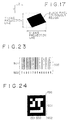
- Fig. 23 shows a so-called one-dimensional bar code.
- a one-dimensional bar code label 500 is made up of a code part 501 and an ID (identification number) part 502.
- the code part 501 includes a combination of different widths of bars (in black) and bar-to-bar spaces (blanks).
- the ID part 502 indicates a code contained in the code part 501. Specifically, the ID part 502 shows as readable information alphanumeric characters that are coded in the code part 501.
- This type of one-dimensional bar code 500 is read by an optical recognition apparatus called a bar code scanner for recognition.
- One way of reading the above-described one-dimensional bar code 500 is by use of a CCD video camera. As more and more bare are arranged to accommodate growing volumes of coded information, however, it becomes increasingly difficult for the CCD video camera to properly read such one-dimensional bar codes 500.
- each code comprising a code part 601 and an ID part 602.
- the code part 601 has a plurality of black square cells arranged two-dimensionally according to predetermined layout rules.
- the ID part 602 indicates a code that is contained in the code part 601.
- the two-dimensional code 600 has one disadvantage. That is, when the video camera picks up an image of a two-dimensional code 600 for code recognition, it is often difficult to distinguish the code from smear, dirt or other distracting images picked up nearby. The result is that code data are often difficult to recognize precisely.
- the present invention seeks to provide a method and an apparatus for permitting efficient and accurate recognition of expanded code data made of a plurality of two-dimensional codes in combination.
- a two-dimensional code recognition processing method for recognizing a two-dimensional code made of a plurality of square cells arranged in accordance with predetermined layout rules, the method including the steps of: recognizing code data assigned to the two-dimensional code captured from external image information; and linking the plurality of code data to generate expanded code data, if a plurality of code data are recognized successively over time in the recognizing step, or if a plurality of code data are recognized from the same image information in the recognizing step.
- a two-dimensional code recognition processing apparatus for recognizing a two-dimensional code made of a plurality of square cells arranged in accordance with predetermined layout rules, the apparatus comprising: recognizing means for recognizing code data assigned to the two-dimensional code captured from external image information; and linking means for linking the plurality of code data to generate expanded code data, if a plurality of code data are recognized successively over time by the recognizing means, or if a plurality of code data are recognized from the same image information by the recognizing means.
- a two-dimensional code recognition processing program storage medium for storing a two-dimensional code recognition processing program in a manner executable by a computer, the two-dimensional code recognition processing program comprising the steps of: recognizing code data assigned to the two-dimensional code captured from external image information; and linking the plurality of code data to generate expanded code data, if a plurality of code data are recognized successively over time in the recognizing step, or if a plurality of code data are recognized from the same image information in the recognizing step.
- code data assigned to a two-dimensional code are recognized from the externally captured image information. If a plurality of code data are successively recognized over time or if these code data are recognized from the same image information, then the code data are linked so as to generate expanded code data.
- Embodiments of the present invention relate to a two-dimensional code recognition processing method, a two-dimensional code recognition processing apparatus, and a two-dimensional code recognition processing program storage medium for permitting efficient and accurate recognition of expanded code data made of a plurality of suitably captured two-dimensional codes in combination.
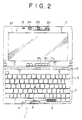
- Figs. 1 through 6 show typical structures of a portable personal computer 1.
- the personal computer 1 is a mini-notebook type personal computer that primarily comprises a body 2 and a display part 3 attached swingingly to the body 2.
- Fig. 1 is a perspective view of the computer with the display part 3 swung open away from the body 2.
- Fig. 2 is a plan view of the computer in Fig. 1.
- Fig. 3 is a left-hand side view of the computer with the display part 3 swung shut onto the body 2.
- Fig. 4 is a right-hand side view of the computer with the display part 3 swung open 180 degrees relative to the body 2.
- Fig. 5 is a front view of the computer in Fig. 3.
- Fig. 6 is a bottom view of the computer in Fig. 4.
- the front face of the body 2 comprises a keyboard 4 and a stick type pointing device 5.
- the keyboard 4 is used to input characters, symbols, etc.
- the stick type pointing device 5 is used to move a mouse cursor.
- a pawl 13 is provided at the upper end of the display part 3. As shown in Fig. 3, with the display part 3 closed onto the body 2, the pawl 13 hooks into a hole 6 in the body 2. At the front of the body 2 is a slide lever 7 furnished in a parallelly slidable fashion. The slide lever 7 is used to lock and unlock the pawl 13 engaged with the hole 6. With the pawl 13 unlocked, the display part 3 may be swung open away from the body 2. Adjacent to the pawl 13 is a microphone 24 which, as depicted in Fig. 6, may pick up sound from both the front and the back side of the body 2.
- the front of the body 2 further comprises a programmable power key (PPK) 9.
- PPK programmable power key
- An air outlet 11 is provided on the right-hand side of the body 2, as shown in Fig. 4.
- An air inlet 14 is provided at the lower end on the front of the body 2 .
- To the further right of the air outlet 11 is a slot 12 to accommodate a PCMCIA (Personal Computer Memory Card International Association) card (called a PC card).
- PCMCIA Personal Computer Memory Card International Association
- An LCD (liquid crystal display) 21 for displaying images is provided on the front of the display part 3.
- an image pickup part 22 mounted rotatably on the display part 3. More specifically, the image pickup part 22 is rotatable to any position within a range of 180 degrees in the same direction as the LCD 21 and in the opposite direction thereof (i.e., toward the back).
- the image pickup part 22 is furnished with the CCD video camera 23.
- a group of lamps including a power lamp PL, a battery lamp BL, a message lamp ML and other lamps formed of LEDs.
- Reference numeral 40 in Fig. 3 denotes a power switch furnished on the left-hand side of the body 2
- reference numeral 25 in Fig. 5 represents an adjusting ring used to adjust the focus of the CCD video camera 23.
- Reference numeral 26 in Fig. 6 stands for a cover that conceals an opening through which an additional memory is installed into the body 2
- reference numeral 41 denotes a hole through which to insert a pin to unlock the pawl of the cover 26.
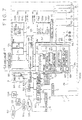
- Fig. 7 illustrates an internal structure of the personal computer 1.
- an internal bus 51 is connected to a CPU (central processing unit) 52, a PC card 53 inserted as needed, a RAM (random access memory) 54, and a graphic chip 81.
- the internal bus 51 is coupled to an external bus 55.
- the external bus 55 for its part, is connected to a hard disk drive (HDD) 56, an I/O (input/output) controller 57, a keyboard controller 58, a stick type pointing device controller 59, a sound chip 60, an LCD controller 83, and a modem 50.
- HDD hard disk drive
- the CPU 52 is a controller that controls diverse computer functions.
- the PC card 53 is installed as needed when an optional function is to be added.
- Image data captured by the CCD video camera 23 are forwarded to a processing part 82 for processing.
- the image data processed by the processing part 82 are input to the graphic chip 81 connected to the internal bus 51.
- the graphic chip 81 stores the input image data into an internal VRAM 81A, and retrieves the data from the memory as needed for output to the LCD controller 83.
- the LCD controller 83 Given the image data from the graphic chip 81, the LCD controller 83 outputs the data to the LCD 21 for display.
- Back lights 84 are provided to illuminate the LCD 21 from the back.
- an electronic mail program (an application program) 54A, an auto pilot program (another application program) 54B and the OS (operating program) 54C are transferred from the HDD 56 to the RAM 54 and retained therein.
- the electronic mail program 54A is a program that exchanges correspondence with an external entity using a communication line such as a telephone line by way of a network.
- a received mail acquisition function is specifically included in the electronic mail program 54A.
- the received mail acquisition function checks a mail server 93 to see if a mail box 93A therein contains any e-mail addressed to this program (i.e., to the user). If any such mail is found in the mail box 93A, the received mail acquisition function carries out a suitable process to acquire that mail.
- the auto pilot program 54B is a program that starts up and carries out a plurality of predetermined processes (or programs) in a predetermined sequence.
- the OS (operating system) 54C controls basic computer functions. Typical operating systems are Windows 95 (registered trademark), Windows 98 (registered trademark) and the like.
- the hard disk drive (HDD) 56 connected to the external bus 55 side contains the electronic mail program 56A, the auto pilot program 56B, the OS (operating system, or basic program software) 56C, and a two-dimensional code recognition program 56D.
- the two-dimensional code recognition program 56D in operation detects a logo mark cell part 301 of a logo mark part 201 and a code part 202, of a two-dimensional code from image data held in the VRAM 81A of the graphic chip 81.
- the two-dimensional code recognition program 56D then recognizes code data of the code part 202 so as to retrieve relevant coded information therefrom.
- the I/O controller 57 has a microcontroller 61 equipped therewith an I/O interface 62.
- the microcontroller 61 is constituted by the I/O interface 62, a CPU 63, a RAM 64 and a ROM 69 which are interconnected to each other.
- the RAM 64 includes a key input status register 65, an LED (light-emitting diode) control register 66, a set time register 67, and a register 68.
- the set time register 67 is used to start the operation of a start sequence controller 76 when a time preset by the user (i.e., starting condition) is reached.
- the register 68 holds a correspondence between a preset combination of operation keys (starting condition) on the one hand and an application program to be started on the other hand. When the user inputs the preset combination of operation keys, the corresponding application program (e.g., electronic mail program) is started.
- the key input status register 65 gets and retains an operation key flag.
- the LED control register 66 is used to control the illumination of the message lamp ML indicating that boot-up status of an application program (e.g., electronic mail program) which is held in the register 68.
- a desired time of a day may be set to the set time register 67.
- the microcontroller 61 is connected to a backup battery 74.
- the battery 74 allows values of the registers 65, 66 and 67 to be retained when power to the body 2 is turned off.
- the ROM 69 in the microcontroller 61 contains in advance a wake-up program 70, a key input monitoring program 71, and an LED control program 72 in advance.
- the ROM 69 is illustratively composed of an EEPROM (electrically erasable and programmable read only memory).
- the EEPROM is also called a flash memory.
- the microcontroller 61 is connected to an RTC (real-time clock) 75 that continuously keeps the current time.
- the wake-up program 70 in the ROM 69 is a program that checks to see if a preset time in the set time register 67 is reached on the basis of real-time clock data from the RTC 75. When the preset time is reached, the wake-up program 70 starts up a predetermined process (or program).
- the key input monitoring program 71 continuously monitors whether the PPK 9 is pushed by the user.
- the LED control program 72 controls the lighting of the message lamp ML.
- the ROM 69 contains a BIOS (basic input/output system) 73.
- BIOS basic input/output system
- the BIOS is a software program that controls exchanges of data (input and output) between the OS or application software on the one hand and peripheral devices (e.g., display part, keyboard, hard disk drive) on the other hand.
- the keyboard controller 58 connected to the external bus 55 controls input from the keyboard 4.
- the stick type pointing device controller 59 controls input from the stick type pointing device 5.
- the sound chip 60 receives input from the microphone 24, or supplies sound signals to the built-in speaker 8.
- the modem 50 permits connection to a communication network 92 such as the Internet and to the mail server 93 through a public telephone line 90 and an Internet service provider 91.
- the power switch 40 is operated to turn on and off the power supply.
- a half-push switch 85 is activated when the shutter button 10 is half-pushed.
- a full-push switch 86 is turned on when the shutter button 10 is fully pushed.
- a reverse switch 87 is turned on when the image pickup part 22 is rotated by 180 degrees (i.e., when the CCD video camera 23 is rotated into a direction suitable for picking up an image on the opposite side of the LCD 21).
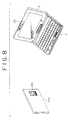
- Fig. 8 shows a personal computer 1.
- an object 100 is illustratively a business card-like object.
- a two-dimensional code label 101 is attached, including printing, thereon.
- the two-dimensional code label 101 is made of a plurality of square cells (black portions) arranged two-dimensionally in accordance with predetermined layout rules.
- a layout pattern of the cells represents predetermined coded form alphanumeric characters, such as a number 200 in this example.
- the two-dimensional code 101 comprises a logo mark cell part 201 and a code part 202.
- the two parts as a whole are formed in an area consisting of seven blocks (each block represents a rectangular area of a single square cell) in the X-axis direction and 9.5 blocks in the Y-axis direction. That area is defined as the 7 ⁇ 9.5 block area, and like definition will also apply hereunder.
- the logo mark part 201 is made of a logo mark cell part 301 and a non-cell part 302.
- the logo mark cell part 301 constitutes a 7 ⁇ 1.5 block rectangular area which, when printed, representing a hollowed logo mark, characters, numerals and other hollowed readable character information associated with the two-dimensional code.
- "CyberCode" attached to the two-dimensional code system forms a typical logo mark.
- Such information signifying what the two-dimensional code in question means is given in hollowed characters constituting a human-readable mark.
- the logo mark part 301 is not limited to expressing only logo marks.
- the part may illustratively represent the name of the corporation of the applicant of the present invention which developed the two-dimensional code system and for which this applicant works.
- the logo mark part may also express a URL (Uniform Resource Locator) indicating where information resources are located in connection with the code scheme of two-dimensional code 101.
- URL is a method for uniquely designating locations where files and other information resources are stored in a distributed manner on the Internet.
- CyberCode is Sony's unique two-dimensional code system that offers about 16.77 million different patterns (in 24 bits). Of these patterns, about one million patterns (in 20 bits) may be registered as desired for program start-up purposes. The remaining code patterns are reserved for future service expansion. "CyberCode” works as an index to what is represented by the code in question, the index allowing relevant information to be retrieved from computer storage. When a user starts a program through a new interface feature "CyberCode Finder," the user finds that the corresponding information leaps from the object having the "CyberCode” onto the computer screen.”
- a 7 ⁇ 1 block area on the side of the code part 202 includes the non-cell part 302 that contains no cell.
- the major axis of the logo mark cell part 301 is called a side A (in the X-axis direction in Fig. 9) and its minor axis is called a side B (in the Y-axis direction in Fig. 9).
- the code part 202 has a top left corner cell and a top right corner cell.
- the top left corner cell is located seven blocks above from the leftmost edge of the logo mark cell part 301;
- the right top corner cell is seven blocks above from the rightmost edge of the logo mark cell part 301.
- a bottom left corner cell is located one block above from the leftmost edge of the logo mark cell part 301, and a bottom right corner cell is one block above from the rightmost edge of the logo mark cell part 301.
- the top left, top right, bottom left and bottom right corner cells are collectively referred to as the corner cells unless they need to be distinguished specifically from one another.
- a three-block area contiguously surrounding each corner cell contains no cells.
- the corner cells are defined as the cells located as described relative to the logo mark cell part 301, each cell having no cells in the three-block area therearound.
- Figs. 12A through 12D show typical two-dimensional codes.
- Code parts 202 of two-dimensional code 101 in Fig. 12A indicate code data representing ID numbers 200, 201, 202, 203, 1500, 1501, 1502 and 1503 in coded form are printed.
- ID part 203 under each logo mark cell part 301 is a printed number corresponding to a coded ID number.
- each logo mark cell part 301 of the two-dimensional code 101 has a logo mark printed as hollowed characters.
- Fig. 12C omits a number corresponding to the ID number in the ID part 203 of each two-dimensional code label 101.
- each logo mark cell part 301 has a number corresponding to the ID number, printed as hollowed characters.
- the logo mark is printed in black in the ID part 203.
- the code parts 202 of the two-dimensional code 101 in Figs. 12A through 12D are all prepared according to the same specifications.
- the above-mentioned logo mark cell part 301 is constituted by a rectangular area having a predetermined aspect ratio and including a black pixel contiguous region made of a plurality of contiguously arranged black pixels, as will be described later.
- the logo mark cell part 301 further comprises readable information (as hollowed) associated with the two-dimensional code 101.
- a rectangular logo mark cell part 301 having a predetermined aspect ratio is detected in the initial stage.
- the detected logo mark cell part 301 is used as a reference for detecting and recognizing other cells that may exist in a predetermined search range. That is, the logo mark cell part 301 is not merely provided as a readable logo mark format indicating the meaning of the two-dimensional code 101; the logo mark cell part 301 also offers a reference function for use in the two-dimensional code recognition process.
- the logo mark cell part 301 has not only the reference-indicating function but also the function of displaying logo marks and characters, as shown in Figs. 12B through 12D, thereby enabling to provide both reference information necessary for the recognition process and human-readable information at once in the smallest possible area that is occupied.
- the personal computer 1 is capable of picking up the object 100 and two-dimensional code 101 using the CCD video camera 23.
- the computer 1 proceeds to recognize code data of the captured two-dimensional code 101.
- the CPU 52 initializes a counter value "i" to 1 for counting a threshold value representing a brightness level.
- the threshold value may be set to one of five levels. More specifically, the counter setting may range descendingly from threshold value A, a maximum value corresponding to set No. 1, to a threshold value E, a minimum value corresponding to set No. 5.
- step S2 the CPU 52 performs binarization on the image data held in the VRAM 81A in accordance with the threshold value that is set on the counter "i". Each pixel greater than the threshold value in brightness is coded its pixel value as "0". The "0" coded pixel is shown white when displayed. In the description that follows, each pixel whose pixel value is coded as "0" is called a white pixel.
- each pixel less than the threshold value in brightness is coded its pixel value as "1".
- the "1" coded pixel is shown black when displayed.
- each pixel whose pixel value is coded as "1” is called a black pixel.
- step S3 as shown in Fig. 15, the CPU 52 successively numbers (labels), from top left to bottom right, regions each composed of continuous black pixels.
- step S4 the CPU 52 obtains a total number M of black pixel contiguous regions, and checks to see if the obtained total number M is at least 257 or greater. If the value M is found to be at least 257 or greater, then the CPU 52 judges that the image frame currently stored in the VRAM 81A is not fit for subsequent processing, step S4 is followed by step S5. Images unsuitable for subsequent processing are appreciably grainy images known as dither images. Attempts to recognize such images forcibly will overload the CPU doing the necessary computations. In such cases, recognition of the dither image is skipped and step S5 is reached.
- the threshold value A represented by set No. 1 is the maximum threshold value in this example.
- the maximum value A is taken as the threshold value for binarization, a large number of pixels constituting the image data have a brightness level relatively lower than the value A.
- the greater part of the pixels are recognized as black pixels thereby increasing the total number M of black pixel contiguous regions. If the set number on the counter "i" is incremented by 1 in step S5, and the next-highest threshold value comes into effect as the threshold for the next binarization. This in turn reduces the number of pixels that are regarded as black pixels.
- the binarization process is carried out so that the frame as a whole becomes fit for a relatively bright image.
- the threshold value is reduced progressively to represent lower levels of brightness for binarization, the binarization process is performed so that the entire frame becomes fit for relatively dark images. Because five alternative threshold levels are provided and because the threshold value is set for one alternative level to another, highly accurate binary data may be generated consistently regardless of brightness fluctuations in the entire image frame.
- step S7 is reached.
- step S7 the CPU 52 judges to see if a certain display location on the LCD 21 of the two-dimensional code 101 recognized in the previously executed two-dimensional code recognition process, such as a center point of the logo mark cell part 301, is stored in the RAM 54 or in other suitable memory. If such a location is found to be stored, step S8 is reached in which the stored point is set as a start point for a logo mark part detection process. If the CPU 52 judges in step S7 that no location of the two-dimensional code 101 has been stored, step S9 is reached.
- a certain display location on the LCD 21 of the two-dimensional code 101 recognized in the previously executed two-dimensional code recognition process such as a center point of the logo mark cell part 301
- step S9 the CPU 52 sets as the start point a display center point of 320 ⁇ 240 pixels on the LCD 21 (e.g., the pixel that locates 160th on the X-axis and 120th on the Y-axis).
- the setting permits efficient detection of a logo mark cell part 301.
- step S10 the logo mark part detection process is carried out. Detailed steps constituting the logo mark cell part detection process in step S10 are described below with reference to the flowchart in Fig. 16.
- step S21 the CPU 52 initializes the counter "j" to 1 for counting the total number M of black pixel contiguous regions.
- step S22 the CPU 52 searches for black pixel contiguous regions throughout the screen on the LCD 21 in counterclockwise spiral fashion from the start point established in steps S8 and S9 of Fig. 13. The black pixel contiguous region detected first is selected as a logo mark cell part candidate region.
- step S23 the CPU 52 determines sides AT and BT corresponding to the sides A and B of a logo mark cell part 301 shown in Fig. 10, selected as the logo mark cell part candidate region in step S22.
- the side AT is the longer of two line segments, one formed by projection onto the X-axis of the image of the black pixel contiguous region on the LCD 21 (X-axis projection line), the other formed by like projection of the same region onto the Y-axis (Y-axis projection line).
- the side BT is the shorter of the two projection lines.
- step S24 the CPU 52 judges to see if the side BT corresponding to the minor axis is made up of fewer than 20 pixels.
- a black pixel contiguous region whose minor axis (side B) is composed of fewer than 20 pixels is a logo mark cell part 301
- the side BT has a still smaller number of pixels because the ratio of a side of each block to the side B is 1 to 1.5 as shown in Fig. 9. In that case, the smallest cells (in 1 ⁇ 1 block area) become too small to be displayed properly on the LCD 21.
- step S24 the CPU 52 judges that the side BT of the logo mark cell part candidate region selected in step S22 includes equal to or at least 20 pixels, then the CPU 52 goes to step S27, if determined so.
- step S27 the CPU 52 judges to see if the side AT of the logo mark cell part candidate region comprises more than 300 pixels.
- a black pixel contiguous region whose major axis (side A) comprises more than 300 pixels is a logo mark cell part 301, then each side of a block becomes too long to be displayed properly because the ratio of one side of the block to the side A is one to seven as depicted in Fig. 9. That is, as shown in Fig.
- step S27 the black pixel contiguous region selected this time in step S22 is judged to be other than a logo mark cell part 301. In that case, step S24 is followed by step S25.
- step S27 the CPU 52 judges that the side AT of the logo mark cell part candidate region selected in step S22 does not comprise more than 300 pixels (i.e., region made up of 300 pixels at most), then step S28 is reached.
- step S28 the CPU 52 judges to see if the total number of black pixels in the logo mark cell part candidate region is at least 20 or greater and less than 1500. If the result of the check in step S28 is affirmative, step S29 is reached.
- step S25 If the total number M of black pixels in the logo mark cell part candidate region is judged in step S28 to be fewer than 20 or at least 1500 or greater, then step S25 is reached.
- the total number of black pixels is less than 20, the same problem arises as that occurred when the side BT had fewer than 20 pixels in step S24.
- the total number of black pixels is at least 1500 or greater, the same problem develops as that incurred when the side AT is found to have more than 300 pixels in step S27. In any case, there is only a limited possibility that the candidate region is a logo mark cell part 301.
- a function f(i, j) provides 1 if the pixel determined by the X coordinate "i" and Y coordinate "j" on the LCD 21 is black, and provides 0 if the pixel in question is white.
- step S30 the CPU 52 calculates by use of expression (5) below the ratio of major axis to minor axis for the logo mark cell part candidate region judged to be fit in step S29. A check is made to see if the calculated ratio v is at least 2.0 and 25 at most.
- V (a+c)+ b 2 +(a-c) 2 (a+c)- b 2 +(a-c) 2
- step S31 the CPU 52 establishes (assumes) the logo mark cell part candidate region selected in step S22 as a logo mark cell part 301.
- the number denoting the black pixel contiguous region constituting the logo mark cell part candidate region is placed into the RAM 54.
- step S22 when logo mark cell part candidate region selected this time in step S22 is judged to be other than a logo mark cell part 301, that is, when in step S28 the total number of black pixels was judged to be less than 20 or at least 1500 or greater; when in step S29 the logo mark cell part candidate region was not judged to have the necessary fitness; or when in step S30 the ratio of side AT to side BT was less than 2.0 or at least 25 or greater.
- the logo mark cell candidate region established in S22 is determined not to be the logo mark cell part 301, and step S25 is reached.
- the CPU 52 thereupon regards the next-detected black pixel contiguous region as the next logo mark cell part candidate region, and proceeds to carry out the subsequent steps.
- step S31 is bypassed with no logo mark cell part 301 established, and the process is then brought to an end. That is, the image data (of one frame) subjected to the current two-dimensional code recognition process are judged to exclude any logo mark cell part 301.
- step S11 in Fig. 13 is reached next.
- step S11 a judgement is made to see if a logo mark cell part 301 was detected in step S10. If the logo mark cell part 301 is judged to have been detected, step S12 is reached in which a code part detection process is carried out. Detailed steps constituting the code part detection process in step S12 are described below with reference to the flowchart in Fig. 18.
- step S41 the CPU 52 initializes the counter "j" to 1 for counting the total number M of black pixel contiguous regions detected in step S3 of Fig. 13.
- step S42 the CPU 52 selects as a top left corner cell candidate region a black pixel contiguous region whose number corresponds to the counter value.
- step S43 the CPU 52 judges to see if the length ratio of side AT to side BT determined as shown in Fig. 17 for the top left corner cell candidate region selected in step S42 is three-fold at most. If the result of the judgement in step S43 is affirmative, step S44 is reached.
- step S44 the CPU 52 judges if the top left corner cell candidate region selected in step S42 exists within a range of search set beforehand for the logo mark cell part 301 detected in step S10 of Fig. 13. If the region in question is found within the range, step S45 is reached. In step S45, the top left corner cell candidate region is established (assumed) as the top left corner cell.
- step S42 If the length ratio of side AT to side BT is judged to be greater than three-fold in step S43, or if the candidate region is not found in the range of search in step S44, then the black pixel contiguous region selected in step S42 is judged to be other than the top left corner cell and step S46 is reached.
- step S42 the black pixel contiguous region denoted by the next number is regarded as the next top left corner cell candidate region, and the subsequent steps are carried out.
- step S48 When the top left corner cell is established in step S45, step S48 is reached.
- step S48 the CPU 52 initializes another counter "k" to 2 for counting the number denoting the current black pixel contiguous region.
- step S49 the CPU 52 selects as a top right corner cell candidate region a black pixel contiguous region whose number corresponds to the value on the counter "k".
- step S50 the CPU 52 calculates the area ratio of the top left corner cell (whose area is defined by the number of pixels therein) set in step S45, to the top right corner cell candidate region (its area defined by its pixel count) selected in step S49. If the ratio (in terms of area) is judged to be six-fold at most, step S51 is reached.
- step S52 the CPU 52 establishes (assumes) as the top right corner cell the top right corner cell candidate region selected in step S49.
- step S55 With the top right corner cell established (assumed) in step S52, step S55 is reached.
- the CPU 52 performs affine transformation whereby the region formed by the top left corner cell set in step S45, by the top right corner cell established in step S52, and by the logo mark cell part 301 set in step S10 of Fig. 13 is turned into a region of seven blocks long in the X-axis direction and 9.5 blocks long in the Y-axis direction on the screen of the LCD 21.
- the length of one side on each block is calculated on the basis of the side AT or BT of the logo mark cell part 301 established in step S10.
- step S56 the CPU 52 erases from the image transformed in step S55 the logo mark cell part 301 set in step S10 of Fig. 13 and a region corresponding to a non-cell part 302 paired with the part 301 (7 ⁇ 2.5 block region). Inside the 7 ⁇ 7 block region resulting from the erasure, the black pixel contiguous regions are mapped as cells whereby a code map is created.
- step S57 the CPU 52 detects a square cell from among the cells making up the code map prepared in step S56, and judges to see if a three-block area contiguously surrounding the detected cell is composed of white pixels. If the result of the judgement in step S57 is affirmative, step S58 is reached. In step S58, the CPU 52 establishes (assumes) the code map created in step S56 as a code part 202 of the two-dimensional code 101. When the code part 202 is detected in the manner described, the process comes to an end.
- step S46 a judgement is made to see if the value on the counter "j" is equal to the total number M. If the value on the counter "j" is not judged to be equal to the total number M, step S47 is reached in which the counter "j" is incremented by 1. Step S47 is followed by step S42 in which the next-numbered black pixel contiguous region is selected as the next top left corner cell candidate region, and the subsequent steps are repeated.
- step S46 If in step S46 the value on the counter "j" is judged to be equal to the total number M, then the image currently subjected to the two-dimensional code recognition process is judged to exclude any two-dimensional code. The process is then terminated.
- step S13 of Fig. 13 is reached.
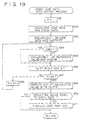
- step S13 a check is made to see if a code part 202 has been detected in step S12. If a code part 202 is judged to have been detected, step S14 is reached to carry out code data verification process. Detailed steps constituting the code data verification process in step S14 are described below with reference to the flowchart in Fig. 19.
- step S61 the CPU 52 initializes a counter "p" to 1 for counting the number of times in which a reference value, to be computed in steps S63 and S65 below, is shifted right one bit.
- step S62 the CPU 52 calculates value of code data and check data based on the code map of the code part 202 detected in step S12 of Fig. 13.
- step S63 the CPU 52 performs exclusive OR on the code data value (a bit stream) computed in step S62 and 0xFFFFFF, and regards the resulting value (another bit stream) as a reference value (reference bit stream).
- step S64 the CPU 52 checks to see if the LSB (least significant bit) of the reference bit stream is set to 1. If the LSB is not judged to be 1, step S65 is reached.
- step S65 the CPU 52 performs exclusive OR on the reference value computed in step 563 (reference bit stream) and 0x8408, and considers the resulting value (another bit stream) to be a new reference value (reference bit stream). Step S65 is followed by step S66.
- step S64 If in step S64 the CPU 52 judges that the LSB is set to 1 in the reference value (reference bit stream) calculated in step S63, the CPu 52 reaches step S66 by skipping step S65.
- step S66 the CPU 52 shifts to right by one bit the reference value (reference bit stream) computed in step S63 or S65.
- step S67 the CPU 52 judges the value on the counter "p" to be 24, step 569 is reached.
- step S69 the CPU 52 performs AND on the bit stream computed in steps S64 through S68 and 0x1FFF.
- step S70 the CPU 52 judges if the value obtained by the AND operation in step S69 is equal to the value of check data computed in step S62. If the compared values are found to be equal in step S70, the code part 202 detected in step S13 of Fig. 13 is considered to have a suitable pattern as a two-dimensional code 101.
- step S71 the code part 202 of the two-dimensional code label 101 is finalized. The code data verification process is then terminated.
- step S70 the CPU 52 judges that the value computed in step S69 is not equal to the check data calculated in step S62, the CPU 52 terminates the process by skipping step S71.
- step S15 of Fig. 13 is reached.
- step S15 a check is made to see if the code part 202 was finalized in step S71 of Fig. 19. If the code part 202 is judged to have been finalized, then step S16 is reached.
- step S16 the CPU 52 places the value of code data computed in step S62 of Fig. 19 (i.e., value of the two-dimensional code 101) into the RAM 54 for storage therein. The two-dimensional code recognition process is then terminated.
- step S11 the logo mark cell part 301 is not judged to have been detected
- step S13 the code part 202 is not judged to have been detected
- step S15 the code part 202 is not judged to have been finalized
- the logo mark cell part 301 representing attributes of a two-dimensional code 101 such as a logo mark is used as the reference for the recognition process whereby the code part 202 is detected.
- the feature makes it possible to minimize the area occupied by the two-dimensional code. Because the logo mark cell part 301 offers not only the reference-indicating function but also the function of displaying a logo mark or characters, it is possible to provide both reference information necessary for the recognition process and human-readable information at once in the smallest possible area that is occupied by the code.
- Fig. 20 is a flowchart of steps whereby a plurality of two-dimensional codes are read and processes corresponding to the read codes are carried out successively.
- the user prompts the personal computer 1 to recognize a plurality of two-dimensional codes one at a time at suitable intervals.
- step S81 the CPU 52 checks to see if a two-dimensional code is recognized. The process in step S81 is repeated until a two-dimensional code is recognized. Once a two-dimensional code is recognized, step S82 is reached.
- step S82 a check is made to see if a continuity flag bit is 1.
- the continuity flag bit is any one of 24 bits that make up the code part 202 of each two-dimensional code 202. If the flag is found to be set (i.e., the flag is "1"), that means the two-dimensional code in question constitutes data continued to another two-dimensional code that has been previously recognized or has yet to be recognized. If the flag is not judged to be set (i.e., the flag is "0"), that means the corresponding two-dimensional code is either a stand-alone two-dimensional code (a code designating a self-contained process based on its own data) or the last of a series of two-dimensional codes.
- step S84 a check is made to see if the 24 bits including the continuity bit and constituting the recognized two-dimensional code are all "0.” If it is not found that the 24 bits are all "0,” step S85 is reached. In step S85, the same process as that done in step S83 is carried out. When step S83 or S85 is repeated as described, a desired number of bits (23, 46, 69, etc.) are provided. Two-dimensional codes are thus used to constitute code data of a large volume for use in complicated processing.
- step S86 is reached in which the linked data are established as the current bit value and stored into the RAM 54.
- the continuity flag is 0 and the remaining 23 bits are not all 0, that means the two-dimensional code in question is the last of a series of two-dimensional codes (to be linked).
- step S86 the linked data are placed into the RAM 54.
- step S87 a process corresponding to the stored data is carried out.
- the steps above are arranged to cancel all previous code data if an erroneous two-dimensional code has been recognized.
- the code recognition process is then started from the beginning.
- Steps S101 through S116 a two-dimensional code label 101-1 is recognized.
- the process made up of steps S101 through S116 is the same as that of steps S1 through S16 in Fig. 13 and thus will not be described further.
- steps S117 is reached.
- step S117 a check is made to see if there still exists any area where the presence or absence of a logo mark (i.e., two-dimensional code label 101) has yet to be determined.
- the number of the two-dimensional code labels 101 is four; the two-dimensional code label 101-1 may illustratively have a value of "0x111111” and is located top left; the two-dimensional code label 101-2 may have a value of "0x222222” and is located top right: the two-dimensional code label 101-3 may have a value of "0x333333" and is located bottom left; and the two-dimensional code label 101-4 may have a value of "0x444444" and is located bottom right.
- the four two-dimensional code labels 101-1 through 101-4 are given the first through the fourth priority when sequenced from top left to bottom right according to their layout information.
- the later the sequence of a label the higher the positions of the bits represented by that label.
- the two-dimensional code label 101-1 is provided with the first priority, followed by the label 101-2 with the second, label 101-3 with the third, and label 101-4 with the fourth. Therefore the resulting bit combination of the newly expanded code data is given as "0x444444333333222222111111".
- Code data corresponding to the images of the four two-dimensional code labels 101-1 through 101-4 are recognized successively from the images of these codes derived from the same image information.
- the recognized code data are linked so as to generate newly expanded code data (bit combination).
- a process corresponding to the code data thus acquired is carried out by the personal computer 1.
- a computer program designed to perform the above-described processes may be retained on such package media as floppy disks, CD-ROMs and DVDs; or on semiconductor memories, magnetic disks and the like where the program is stored temporarily or permanently; or on wired and wireless communication media such as local area networks, the Internet, digital satellite broadcasting networks; or in diverse communication interfaces such as routers and modems for transmitting or receiving the program offered by the foregoing media.
- Such media, networks, interfaces and other measures allow the program to be installed in computers for program execution.
- the image processing program storage medium as mentioned in this specification refers broadly to all such media, networks, interfaces and measures.
Landscapes
- Engineering & Computer Science (AREA)
- Physics & Mathematics (AREA)
- Artificial Intelligence (AREA)
- General Health & Medical Sciences (AREA)
- Toxicology (AREA)
- Electromagnetism (AREA)
- Health & Medical Sciences (AREA)
- Computer Vision & Pattern Recognition (AREA)
- General Physics & Mathematics (AREA)
- Theoretical Computer Science (AREA)
- Image Processing (AREA)
- Character Discrimination (AREA)
- Image Analysis (AREA)
Applications Claiming Priority (2)
| Application Number | Priority Date | Filing Date | Title |
|---|---|---|---|
| JP24585798 | 1998-08-31 | ||
| JP24585798 | 1998-08-31 |
Publications (3)
| Publication Number | Publication Date |
|---|---|
| EP0984385A2 true EP0984385A2 (de) | 2000-03-08 |
| EP0984385A3 EP0984385A3 (de) | 2003-01-15 |
| EP0984385B1 EP0984385B1 (de) | 2013-02-20 |
Family
ID=17139874
Family Applications (1)
| Application Number | Title | Priority Date | Filing Date |
|---|---|---|---|
| EP99306866A Expired - Lifetime EP0984385B1 (de) | 1998-08-31 | 1999-08-27 | Erkennungsverarbeitung für eine zweidimensionale Kodierung |
Country Status (2)
| Country | Link |
|---|---|
| US (1) | US6325287B1 (de) |
| EP (1) | EP0984385B1 (de) |
Cited By (5)
| Publication number | Priority date | Publication date | Assignee | Title |
|---|---|---|---|---|
| EP1383107A1 (de) * | 2002-07-16 | 2004-01-21 | Sharp Kabushiki Kaisha | Klingeltoncodeaufbau und Klingeltoncodelesegerät für Mobiltelefone |
| US7188139B1 (en) * | 1999-11-18 | 2007-03-06 | Sony Corporation | Portable information processing terminal, information input/output system and information input/output method |
| US7469066B2 (en) | 2003-04-08 | 2008-12-23 | Nippon Telegraph And Telephone Corporation | Information coding apparatus, information decoding apparatus, and method and program for the same |
| CN112149440A (zh) * | 2020-08-27 | 2020-12-29 | 深圳长城开发精密技术有限公司 | 一种多维度多条码的快速定位识别方法 |
| CN115511031A (zh) * | 2022-09-30 | 2022-12-23 | 三维码(厦门)网络科技有限公司 | 一种扩容二维码、三维码解码方法、系统、设备和介质 |
Families Citing this family (17)
| Publication number | Priority date | Publication date | Assignee | Title |
|---|---|---|---|---|
| JP4419269B2 (ja) * | 2000-04-18 | 2010-02-24 | 富士通株式会社 | 二次元コード抽出方法 |
| US7321687B2 (en) * | 2002-03-07 | 2008-01-22 | Canon Kabushiki Kaisha | Apparatus and method for image processing to label an object in a binary image |
| KR20060088419A (ko) * | 2005-02-01 | 2006-08-04 | 삼성전자주식회사 | 디스크 교환시기 표시방법 |
| WO2006100720A1 (ja) * | 2005-03-18 | 2006-09-28 | Fujitsu Limited | コード画像処理方法 |
| EP2355526A3 (de) | 2010-01-14 | 2012-10-31 | Nintendo Co., Ltd. | Computerlesbares Speichermedium mit einem Anzeigesteuerungsprogramm darauf, Anzeigesteuerungsvorrichtung, Anzeigesteuerungssystem und Anzeigesteuerungsverfahren |
| JP5898842B2 (ja) | 2010-01-14 | 2016-04-06 | 任天堂株式会社 | 携帯型情報処理装置、携帯型ゲーム装置 |
| JP5800501B2 (ja) | 2010-03-12 | 2015-10-28 | 任天堂株式会社 | 表示制御プログラム、表示制御装置、表示制御システム、及び、表示制御方法 |
| US8384770B2 (en) | 2010-06-02 | 2013-02-26 | Nintendo Co., Ltd. | Image display system, image display apparatus, and image display method |
| US8633947B2 (en) | 2010-06-02 | 2014-01-21 | Nintendo Co., Ltd. | Computer-readable storage medium having stored therein information processing program, information processing apparatus, information processing system, and information processing method |
| EP2395769B1 (de) | 2010-06-11 | 2015-03-04 | Nintendo Co., Ltd. | Bildanzeigeprogramm, Bildanzeigesystem und Bildanzeigeverfahren |
| JP5647819B2 (ja) | 2010-06-11 | 2015-01-07 | 任天堂株式会社 | 携帯型電子機器 |
| JP5739674B2 (ja) | 2010-09-27 | 2015-06-24 | 任天堂株式会社 | 情報処理プログラム、情報処理装置、情報処理システム、および、情報処理方法 |
| US8854356B2 (en) | 2010-09-28 | 2014-10-07 | Nintendo Co., Ltd. | Storage medium having stored therein image processing program, image processing apparatus, image processing system, and image processing method |
| US8468610B2 (en) * | 2011-01-27 | 2013-06-18 | Echostar Technologies L.L.C. | Determining fraudulent use of electronic devices utilizing matrix codes |
| US8634654B2 (en) | 2011-04-15 | 2014-01-21 | Yahoo! Inc. | Logo or image recognition |
| JP6075180B2 (ja) | 2013-04-18 | 2017-02-08 | オムロン株式会社 | 作業管理システムおよび作業管理方法 |
| US11151630B2 (en) | 2014-07-07 | 2021-10-19 | Verizon Media Inc. | On-line product related recommendations |
Citations (3)
| Publication number | Priority date | Publication date | Assignee | Title |
|---|---|---|---|---|
| US4488679A (en) | 1982-11-01 | 1984-12-18 | Western Publishing Company, Inc. | Code and reading system |
| DE4107020A1 (de) | 1991-03-05 | 1992-09-10 | Franzis Verlag Gmbh | Verfahren zur zweidimensionalen speicherung von daten auf einem bedruckbaren oder fotografisch entwickelbaren medium |
| US5414251A (en) | 1992-03-12 | 1995-05-09 | Norand Corporation | Reader for decoding two-dimensional optical information |
Family Cites Families (6)
| Publication number | Priority date | Publication date | Assignee | Title |
|---|---|---|---|---|
| JP3499913B2 (ja) * | 1994-03-16 | 2004-02-23 | ペンタックス株式会社 | データシンボル読み取り装置 |
| JP2867904B2 (ja) * | 1994-12-26 | 1999-03-10 | 株式会社デンソー | 2次元コード読取装置 |
| US5619027A (en) * | 1995-05-04 | 1997-04-08 | Intermec Corporation | Single width bar code symbology with full character set utilizing robust start/stop characters and error detection scheme |
| JP3209108B2 (ja) * | 1996-08-23 | 2001-09-17 | 松下電器産業株式会社 | 2次元コード読み取り装置 |
| US6000614A (en) * | 1996-12-20 | 1999-12-14 | Denso Corporation | Two-dimensional code reading apparatus |
| US6036094A (en) * | 1997-06-13 | 2000-03-14 | Symbol Technologies, Inc. | Hand-held optical scanner for reading two-dimensional bar code symbols and the like |
-
1999
- 1999-08-27 EP EP99306866A patent/EP0984385B1/de not_active Expired - Lifetime
- 1999-08-30 US US09/385,402 patent/US6325287B1/en not_active Expired - Lifetime
Patent Citations (3)
| Publication number | Priority date | Publication date | Assignee | Title |
|---|---|---|---|---|
| US4488679A (en) | 1982-11-01 | 1984-12-18 | Western Publishing Company, Inc. | Code and reading system |
| DE4107020A1 (de) | 1991-03-05 | 1992-09-10 | Franzis Verlag Gmbh | Verfahren zur zweidimensionalen speicherung von daten auf einem bedruckbaren oder fotografisch entwickelbaren medium |
| US5414251A (en) | 1992-03-12 | 1995-05-09 | Norand Corporation | Reader for decoding two-dimensional optical information |
Cited By (8)
| Publication number | Priority date | Publication date | Assignee | Title |
|---|---|---|---|---|
| US7188139B1 (en) * | 1999-11-18 | 2007-03-06 | Sony Corporation | Portable information processing terminal, information input/output system and information input/output method |
| EP1383107A1 (de) * | 2002-07-16 | 2004-01-21 | Sharp Kabushiki Kaisha | Klingeltoncodeaufbau und Klingeltoncodelesegerät für Mobiltelefone |
| EP1755108A1 (de) * | 2002-07-16 | 2007-02-21 | Sharp Kabushiki Kaisha | Klingeltoncodeaufbau und Klingeltoncodelesegerät für Mobiltelefone |
| KR100897960B1 (ko) * | 2002-07-16 | 2009-05-18 | 샤프 가부시키가이샤 | 코드 구조, 코드 판독 단말기, 휴대 전화 및 기록 매체 |
| US7766239B2 (en) | 2002-07-16 | 2010-08-03 | Sharp Kabushiki Kaisha | Code structure and code reading terminal |
| US7469066B2 (en) | 2003-04-08 | 2008-12-23 | Nippon Telegraph And Telephone Corporation | Information coding apparatus, information decoding apparatus, and method and program for the same |
| CN112149440A (zh) * | 2020-08-27 | 2020-12-29 | 深圳长城开发精密技术有限公司 | 一种多维度多条码的快速定位识别方法 |
| CN115511031A (zh) * | 2022-09-30 | 2022-12-23 | 三维码(厦门)网络科技有限公司 | 一种扩容二维码、三维码解码方法、系统、设备和介质 |
Also Published As
| Publication number | Publication date |
|---|---|
| EP0984385B1 (de) | 2013-02-20 |
| US6325287B1 (en) | 2001-12-04 |
| EP0984385A3 (de) | 2003-01-15 |
Similar Documents
| Publication | Publication Date | Title |
|---|---|---|
| EP0969403B1 (de) | Erkennungsverfahren und Erkennungsgerät für eine zweidimensionale Kodierung, und Speichermedium | |
| EP0984385B1 (de) | Erkennungsverarbeitung für eine zweidimensionale Kodierung | |
| JP3794463B2 (ja) | 多次元コード認識処理方法、多次元コード認識処理装置、および多次元コード認識処理プログラム | |
| KR100674402B1 (ko) | 화상 처리 장치, 화상 처리 방법 및 저장 매체 | |
| JP3786167B2 (ja) | 2次元コード認識処理方法、2次元コード認識処理装置、および2次元コード認識処理プログラム格納媒体 | |
| US9805225B2 (en) | Apparatus for recognizing character and barcode simultaneously and method for controlling the same | |
| US7111787B2 (en) | Multimode image capturing and decoding optical reader | |
| US7421123B2 (en) | Information processing apparatus, an information processing method and a medium | |
| EP2064651B1 (de) | System und verfahren zum decodieren und analysieren von strichcodes durch verwendung einer mobilen einrichtung | |
| JP4674644B2 (ja) | 画像処理装置、画像処理方法、および画像処理プログラム媒体 | |
| US20020170970A1 (en) | Optical reader having decoding and image capturing functionality | |
| EP1619604A2 (de) | Verfahren zur Bestimmung des Typs eines Kodes und Verfahren zur Detektion von Kodegrenzen | |
| CN104781835B (zh) | 二维码 | |
| EP1580683A1 (de) | Vorrichtung zur erkennung von strichcodes | |
| CN104781833A (zh) | 二维码 | |
| CN113936288A (zh) | 倾斜文本方向分类方法、装置、终端设备和可读存储介质 | |
| JP4352287B2 (ja) | 画像処理装置、画像処理方法、および画像処理プログラム媒体 | |
| JP2007034625A (ja) | 情報表示装置 | |
| US20010042788A1 (en) | Image processing apparatus, image processing method and image processing program storage medium | |
| US12321818B2 (en) | Method and apparatus for decoding optical codes of different orientations | |
| JP2001307013A (ja) | バーコード読取装置 | |
| WO2007108053A1 (ja) | コード認識方法及び装置、電子装置、プログラム及び記憶媒体 |
Legal Events
| Date | Code | Title | Description |
|---|---|---|---|
| PUAI | Public reference made under article 153(3) epc to a published international application that has entered the european phase |
Free format text: ORIGINAL CODE: 0009012 |
|
| AK | Designated contracting states |
Kind code of ref document: A2 Designated state(s): AT BE CH CY DE DK ES FI FR GB GR IE IT LI LU MC NL PT SE |
|
| AX | Request for extension of the european patent |
Free format text: AL;LT;LV;MK;RO;SI |
|
| PUAL | Search report despatched |
Free format text: ORIGINAL CODE: 0009013 |
|
| AK | Designated contracting states |
Kind code of ref document: A3 Designated state(s): AT BE CH CY DE DK ES FI FR GB GR IE IT LI LU MC NL PT SE |
|
| AX | Request for extension of the european patent |
Free format text: AL;LT;LV;MK;RO;SI |
|
| RIC1 | Information provided on ipc code assigned before grant |
Free format text: 7G 06K 7/10 A, 7G 06K 7/14 B, 7G 06K 19/06 B |
|
| 17P | Request for examination filed |
Effective date: 20030701 |
|
| AKX | Designation fees paid |
Designated state(s): DE FR GB |
|
| 17Q | First examination report despatched |
Effective date: 20081210 |
|
| GRAP | Despatch of communication of intention to grant a patent |
Free format text: ORIGINAL CODE: EPIDOSNIGR1 |
|
| RIN1 | Information on inventor provided before grant (corrected) |
Inventor name: IHARA, KEIGO, INTELL. PROP. DPT. Inventor name: NAKAJIMA, SHINJI, C/O INTELL. PROP. DPT. Inventor name: REKIMOTO, JUNICHI, C/O SONY COMPUTER SCIENCE Inventor name: SUEYOSHI, TAKAHIKO, C/O INTELL. PROP. DPT. |
|
| GRAS | Grant fee paid |
Free format text: ORIGINAL CODE: EPIDOSNIGR3 |
|
| GRAA | (expected) grant |
Free format text: ORIGINAL CODE: 0009210 |
|
| AK | Designated contracting states |
Kind code of ref document: B1 Designated state(s): DE FR GB |
|
| REG | Reference to a national code |
Ref country code: GB Ref legal event code: FG4D |
|
| REG | Reference to a national code |
Ref country code: DE Ref legal event code: R096 Ref document number: 69944626 Country of ref document: DE Effective date: 20130418 |
|
| PLBE | No opposition filed within time limit |
Free format text: ORIGINAL CODE: 0009261 |
|
| STAA | Information on the status of an ep patent application or granted ep patent |
Free format text: STATUS: NO OPPOSITION FILED WITHIN TIME LIMIT |
|
| 26N | No opposition filed |
Effective date: 20131121 |
|
| REG | Reference to a national code |
Ref country code: DE Ref legal event code: R097 Ref document number: 69944626 Country of ref document: DE Effective date: 20131121 |
|
| REG | Reference to a national code |
Ref country code: DE Ref legal event code: R084 Ref document number: 69944626 Country of ref document: DE |
|
| REG | Reference to a national code |
Ref country code: GB Ref legal event code: 746 Effective date: 20150424 |
|
| REG | Reference to a national code |
Ref country code: DE Ref legal event code: R084 Ref document number: 69944626 Country of ref document: DE Effective date: 20150410 |
|
| REG | Reference to a national code |
Ref country code: FR Ref legal event code: PLFP Year of fee payment: 18 |
|
| REG | Reference to a national code |
Ref country code: FR Ref legal event code: PLFP Year of fee payment: 19 |
|
| REG | Reference to a national code |
Ref country code: FR Ref legal event code: PLFP Year of fee payment: 20 |
|
| PGFP | Annual fee paid to national office [announced via postgrant information from national office to epo] |
Ref country code: DE Payment date: 20180823 Year of fee payment: 20 Ref country code: FR Payment date: 20180827 Year of fee payment: 20 |
|
| PGFP | Annual fee paid to national office [announced via postgrant information from national office to epo] |
Ref country code: GB Payment date: 20180822 Year of fee payment: 20 |
|
| REG | Reference to a national code |
Ref country code: DE Ref legal event code: R071 Ref document number: 69944626 Country of ref document: DE |
|
| REG | Reference to a national code |
Ref country code: GB Ref legal event code: PE20 Expiry date: 20190826 |
|
| PG25 | Lapsed in a contracting state [announced via postgrant information from national office to epo] |
Ref country code: GB Free format text: LAPSE BECAUSE OF EXPIRATION OF PROTECTION Effective date: 20190826 |