EP0984429B1 - Dimensionsreduktion für die Sprechernormalisierung und Sprecher- und Umgebungsadaptation mittels Eigenstimm-Techniken - Google Patents
Dimensionsreduktion für die Sprechernormalisierung und Sprecher- und Umgebungsadaptation mittels Eigenstimm-Techniken Download PDFInfo
- Publication number
- EP0984429B1 EP0984429B1 EP99306667A EP99306667A EP0984429B1 EP 0984429 B1 EP0984429 B1 EP 0984429B1 EP 99306667 A EP99306667 A EP 99306667A EP 99306667 A EP99306667 A EP 99306667A EP 0984429 B1 EP0984429 B1 EP 0984429B1
- Authority
- EP
- European Patent Office
- Prior art keywords
- speaker
- eigenspace
- model
- maximum likelihood
- training
- Prior art date
- Legal status (The legal status is an assumption and is not a legal conclusion. Google has not performed a legal analysis and makes no representation as to the accuracy of the status listed.)
- Expired - Lifetime
Links
Images



Classifications
-
- G—PHYSICS
- G10—MUSICAL INSTRUMENTS; ACOUSTICS
- G10L—SPEECH ANALYSIS TECHNIQUES OR SPEECH SYNTHESIS; SPEECH RECOGNITION; SPEECH OR VOICE PROCESSING TECHNIQUES; SPEECH OR AUDIO CODING OR DECODING
- G10L15/00—Speech recognition
- G10L15/06—Creation of reference templates; Training of speech recognition systems, e.g. adaptation to the characteristics of the speaker's voice
- G10L15/065—Adaptation
- G10L15/07—Adaptation to the speaker
-
- G—PHYSICS
- G06—COMPUTING OR CALCULATING; COUNTING
- G06F—ELECTRIC DIGITAL DATA PROCESSING
- G06F18/00—Pattern recognition
- G06F18/20—Analysing
- G06F18/21—Design or setup of recognition systems or techniques; Extraction of features in feature space; Blind source separation
- G06F18/213—Feature extraction, e.g. by transforming the feature space; Summarisation; Mappings, e.g. subspace methods
- G06F18/2135—Feature extraction, e.g. by transforming the feature space; Summarisation; Mappings, e.g. subspace methods based on approximation criteria, e.g. principal component analysis
Definitions
- the present invention relates generally to speech recognition and more particularly to speaker adaptation whereby the parameters of a speech recognition model are revised to better recognize the speech of a new speaker.
- Speech recognition systems may be speaker dependent or speaker independent. Speaker dependent systems are trained to understand what a single individual says, by being given a large number of examples of words uttered by that individual (these examples are called the "training data"). Speaker dependent systems tend to be very accurate for the individual they are trained on, and inaccurate for everybody else. Speaker independent systems are designed to be used by anybody who speaks the language of the application; typically, they are trained on data from many different people. The error rate for a speaker independent system, carrying out recognition on a speaker not in the training data, is roughly two to three times higher than the error rate for a comparable speaker dependent system carrying out recognition on the speaker it is trained on.
- the present invention relates to an alternative technique with which to carry out speaker normalization and speaker and environment adaptation.
- This technique concerns a method for performing speaker adaptation as is disclosed in European patent application publication no. EP 0953968.
- the method disclosed in EP 0953968 includes constructing an eigenspace from a set of speaker models wherein the parameters of the models are adjusted after constructing the eigenspace.
- the technique enables an initially speaker independent recognition system to quickly attain a performance level on new speakers and new acoustic environments that approach speaker dependent systems, without requiring large amounts of training data for each new speaker.
- We call our technique 'eigenvoice adaptation We have discovered that eigenvoice adaptation can be applied in a variety of different contexts, as will be illustrated herein through some specific examples.
- eigenvoice adaptation involves an advantageous dimensionality reduction that can greatly improve the speed and efficiency at which speaker and environment adaptation is performed.
- Dimensionality reduction refers to a mapping of high-dimensional space onto low-dimensional space.
- a variety of different techniques may be used to effect dimensionality reduction. These include Principal Component Analysis (PCA), Linear Discriminant Analysis (LDA), Factor Analysis (FA), Singular Value Decomposition (SVD) and other transformations that apply reduction criteria based on variance.
- PCA Principal Component Analysis
- LDA Linear Discriminant Analysis
- FA Factor Analysis
- Singular Value Decomposition Singular Value Decomposition
- our eigenvoice adaptation techniques apply dimensionality reduction to a set of complete speaker models in order to find basis vectors spanning the space of these speaker models.
- a large collection of speaker models is analyzed in an offline step using dimensionality reduction to yield a set of eigenvectors that we call "eigenvoice vectors" or "eigenvoices.”
- This offline step is fairly computationally intensive, although it has to be performed only once. After that, each time the speech recognition system is used, it carries out a computationally inexpensive operation on adaptation data obtained from the new speaker, to obtain a vector in the space spanned by the eigenvoices. This new vector gives the adapted model for the new speaker.
- Part of the power of the invention derives from the eigenvoice representation of the collective set of training speakers and of the new individual speaker for which the recognition system is being adapted.
- the eigenspace developed during the dimensionality reduction step represents the collective speech traits of all the training speakers.
- the individual eigenvectors that define this n-dimensional space each contain different information and may be represented, for example, as members of an ordered list or array.
- Computational burden is significantly reduced with the present invention because the eigenvectors are orthogonal, allowing subsequent computations to be performed by solving a set of linear equations that a computer can calculate quite readily.
- MLED Maximum Likelihood Eigenvoice Decomposition
- the speaker-dependent models may be obtained and enhanced prior to dimensionality reduction using auxiliary adaptation techniques.
- auxiliary adaptation techniques include Maximum A Posteriori estimation (MAP) and other transformation-based approaches, such as Maximum Likelihood Linear Regression (MLLR).
- the eigenvoice adaptation technique is applied to develop an initial adapted model and this model is then further improved using auxiliary adaptation techniques, such as those described above. Often the best results may be obtained by applying the MLED technique first and then one of these auxiliary adaptation techniques.
- eigenvoice adaptation techniques discussed so far have involved dimensionality reduction applied to a collective set of training speakers.
- Yet another aspect of the invention involves application of dimensionality reduction to the set of transformation matrices resulting from a transformation-based adaptation technique such as MLLR.
- each training speaker is used to estimate a set of transformation matrices from a speaker-independent model (using MLLR, for example).
- the set of transformation matrices for each training speaker is then vectorized (turned into a high-dimensional supervector).
- a dimensionality reduction technique is then applied to the set of supervectors to yield a low-dimensional set of eigenvectors we call "eigentransform vectors" or "eigentransforms.”
- the system assumes the new speaker's transformation matrices are located in the subspace spanned by the eigentransforms and then applies the resulting transforms to the speaker independent model.
- a statistical process such as Bayesian estimation may be performed in eigenspace as a way of better locating where to place a new speaker within eigenspace.
- Prior knowledge from the training speakers, for example) about what areas of speaker space are densely or thinly populated is used to refine estimates of where to locate the new speaker within eigenspace.
- the eigenvoice adaptation techniques described here will allow construction of a robust adapted model based on a very short, and potentially incomplete, training session. These techniques thus lend themselves to speaker and environment adaptation applications where a large quantity of adaptation data may not be available. For example, the techniques would work well in a speech-enabled interactive marketing system where the new speaker responds by telephone to system navigation prompts and the system adapts to the new speaker automatically as the speaker proceeds to navigate through the system to place an order.
- HMMs Hidden Markov Models
- Any speech unit (such as a phrase, word, subword, phoneme or the like) can be modeled, with all knowledge sources included in that model.
- the HMM represents an unknown process that produces a sequence of observable outputs at discrete intervals, the outputs being members of some finite alphabet (corresponding to the predefined set of speech units).
- an HMM 10 is illustrated by a set of states (S 1 , S 2 ... S 5 ), vectors that define transitions between certain pairs of states, illustrated as arrows in Figure 1, and a collection of probability data.
- the Hidden Markov Model includes a set of transition probabilities 12 associated with the transition vectors and a set of output probabilities 14 associated with the observed output at each state.
- the model is clocked from one state to another at regularly spaced, discrete intervals. At clock-time, the model may change from its current state to any state for which a transition vector exists. As illustrated, a transition can be from a given state back to itself.
- transition probabilities represent the likelihood that a transition from one state to another will occur when the model is clocked.
- each transition has associated with it a probability value (between 0 and 1).
- the sum of all probabilities leaving any state equals 1.
- transition probability Table 12 a set of exemplary transition probability values has been given in transition probability Table 12 . It will be understood that in a working embodiment these values would be generated by the training data, with the constraint that the sum of all probabilities leaving any state equals 1.
- the model can be thought of as emitting or outputting one member of its alphabet.
- a phoneme-based speech unit has been assumed.
- the symbols identified in output probability Table 14 correspond to some of the phonemes found in standard English. Which member of the alphabet gets emitted upon each transition depends on the output probability value or function learned during training. The outputs emitted thus represent a sequence of observations (based on the training data) and each member of the alphabet has a probability of being emitted.
- HMMs are often based on probability functions comprising one or more Gaussian distributions. When a plurality of Gaussian functions are used they are typically additively mixed together to define a complex probability distribution, as illustrated at 16 .
- the probability distributions can be described by a plurality of parameters. Like the transition probability values (Table 12 ) these output probability parameters may comprise floating point numbers. Parameters Table 18 identifies the parameters typically used to represent probability density functions (pdf) based on observed data from the training speakers. As illustrated by the equation in Figure 1 at Gaussian function 16 , the probability density function for an observation vector O to be modeled is the iterative sum of the mixture coefficient for each mixture component multiplied by the Gaussian density N, where the Gaussian density has a mean vector u j and covariance matrix U j computed from the cepstral or filter bank coefficient speech parameters.
- Hidden Markov Model recognizer may vary widely from one application to another.
- the HMM example shown in Figure 1 is intended merely to illustrate how Hidden Markov Models are constructed, and is not intended as a limitation upon the scope of the present invention.
- Hidden Markov Modeling concept there are many variations on the Hidden Markov Modeling concept.
- the eigenvoice adaptation technique of the invention can be readily adapted to work with each of the different Hidden Markov Model variations, as well as with other parameter-based speech modeling systems.
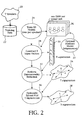
- each model can be a set of HMMs, one HMM for each sound unit. This is illustrated in Figure 2 at 26 .
- the speaker-dependent models may be enhanced using auxiliary adaptation techniques.
- auxiliary adaptation techniques include Maximum A Posteriori estimation (MAP) and other transformation-based approaches, such as Maximum Likelihood Linear Regression (MLLR).
- MAP Maximum A Posteriori estimation
- MLLR Maximum Likelihood Linear Regression
- a set of T supervectors is constructed at 28 .
- the supervector for each speaker comprises an ordered list of parameters (typically floating point numbers) corresponding to at least a portion of the parameters 18 of the Hidden Markov Models for that speaker. Parameters corresponding to the sound units are included in the supervector for a given speaker.
- the parameters may be organized in any convenient order. The order is not critical; however, once an order is adopted it must be followed for all T speakers.
- the ordered Hidden Markov Model parameters are then concatenated to form the supervector.
- the choice of which HMM parameters to include in the supervector may depend on the available processing power. We have found that constructing supervectors from the Gaussian means gives good results. If greater processing power is available, the supervectors may also include other HMM parameters, such as the transition probabilities (Table 12 , Fig. 1) or the Covariance matrix parameters (parameters 18 , Fig. 1). Naturally, if the Hidden Markov Models generate discrete outputs (as opposed to probability densities) then these output values may be used to comprise the supervector.
- dimensionality reduction is performed at step 32 .
- Dimensionality reduction is effected by mapping of high-dimensional space onto low-dimensional space.
- a variety of different techniques may be used to effect dimensionality reduction. These include Principal Component Analysis (PCA), Linear Discriminant Analysis (LDA), Factor Analysis (FA), Independent Component Analysis (ICA), Singular Value Decomposition (SVD) and other transformations that apply reduction criteria based on variance.
- PCA Principal Component Analysis
- LDA Linear Discriminant Analysis
- FA Factor Analysis
- ICA Independent Component Analysis
- Singular Value Decomposition Singular Value Decomposition
- the class of dimensionality reduction techniques useful in implementing the invention is defined as follows.
- T training supervectors obtained from speaker-dependent models for speech recognition.
- V dimension
- X [x1, x2, ..., xV] ⁇ T
- E is less than or equal to T, the number of training supervectors
- W [w1, w2, ..., wE] ⁇ T.
- the values of the parameters of M are calculated in some way from the set of T training supervectors.
- W M*X.
- M has dimension E*V
- Examples include Principal Component Analysis, Independent Component Analysis, Linear Discriminant Analysis, Factor Analysis, and Singular Value Decomposition.
- the invention may be implemented with any such method (not only those listed) for finding such a constant linear transformation M in the special case where the input vectors are training supervectors derived from speaker-dependent modeling, and where M is used to carry out the aforementioned technique.
- T eigenvectors Dimensionality reduction upon T supervectors yields T eigenvectors, as at 34 .
- T eigenvectors are eigenvectors.
- These eigenvectors define what we call eigenvoice space or eigenspace.
- the eigenvectors that make up the eigenvoice space contain different information; they each represent a different dimension across which different speakers may be differentiated. Each supervector in the original training set can be represented as a linear combination of these eigenvectors.
- the eigenvectors are ordered by their importance in modeling the data: the first eigenvector is more important than the second, which is more important than the third, and so on. Our experiments with this technique thus far show that the first eigenvector appears to correspond to a male-female dimension.
- T eigenvectors Although a maximum of T eigenvectors is produced at step 32 , in practice, it is possible to discard several of these eigenvectors, keeping only the first N eigenvectors. Thus at step 36 we optionally extract N of the T eigenvectors to comprise a reduced parameter eigenspace at 38 .
- the higher order eigenvectors can be discarded because they typically contain less important information with which to discriminate among speakers. Reducing the eigenvoice space to fewer than the total number of training speakers provides an inherent data compression that can be helpful when constructing practical systems with limited memory and processor resources.
- speaker normalization, speaker adaptation or environment adaptation can be readily accomplished. While constructing the eigenspace is somewhat computationally intensive, and is typically conducted offline, adaptation is a comparatively simple computational operation that can be performed while the new speaker is using the system.
- speech from new speaker 40 is used at step 42 to train a speaker dependent model to construct a set of HMMs 44 (one for each sound unit).
- the speaker dependent model can be trained in either a supervised mode, where the training system knows the content of the training speech in advance, or in an unsupervised mode, where the speech recognition system uses a speaker independent model to determine the content of the adaptation speech.
- the speaker dependent model trained on this new speaker will usually be very inadequate for recognition, at least at first. However, the model may nevertheless be used to construct a supervector.
- the supervector is constructed at step 46 such that the supervector (supervector 48 ) is constrained to fall within the eigenvoice space 38 previously created from the training speakers.
- Supervector 48 is constructed with the imposed constraint that the HMM model used for recognition must be a linear combination of the eigenvoices comprising eigenvoice space 38 .
- the speaker dependent model 44 serves to estimate the linear combination of coefficients that will comprise the adapted model for that new speaker.
- a new set of HMMs is constructed based on supervector 48 to generate the adapted model 52 .
- an optional iterative process may be performed at 54 to construct a new supervector from the adapted model 52 and thereafter to construct another set of HMMs from which a further adapted model may be constructed.
- Figure 4 illustrates, in two dimensional space, the process by which the speech model of a new speaker is constrained within the eigenspace 38 .
- the eigenspace is a multidimensional space of order equal to the number of eigenvectors generated through dimensionality reduction.
- the new speaker is shown diagrammatically by data point 60 .
- Data point 60 would correspond to the supervector 48 shown in Figure 3.
- the new speaker at 60 lies outside eigenspace 38 .
- the adaptation procedure involves finding a point within eigenspace that represents a good adapted model for this new speaker.
- the adapted model is based on the input speech uttered by the new speaker, but also constrained to be within eigenspace 38 .
- a projection operation finds the point within eigenspace that is as close as possible to the point outside of eigenspace corresponding to the new speaker's input speech.
- the simple projection would place the new speaker at point 64 within eigenspace 38 . It bears noting that these pointsare actually supervectors from which a set of HMMs can be reconstituted.
- the projection operation is a comparatively crude technique that does not guarantee that the point within eigenspace is optimal for the new speaker. Furthermore, the projection operation requires that the supervector for the new speaker contain a complete set of data to represent the entire set of HMMs for that speaker. This requirement gives rise to a significant practical limitation.
- that speaker When using projection to constrain a new speaker to the eigenspace, that speaker must supply enough input speech so that all speech units are represented in the data. For example, if the Hidden Markov Models are designed to represent all phonemes in the English language, then the training speaker must supply examples of all phonemes before the simple projection technique can be used. In many applications this constraint is simply not practical.
- the maximum likelihood technique of the invention addresses both of the above-mentioned drawbacks of simple projection.
- the maximum likelihood technique of the invention finds a point 66 within eigenspace 38 that represents the supervector corresponding to a set of Hidden Markov Models that have the maximum probability of generating the speech supplied by the new speaker. For illustration purposes, the maximum likelihood process is illustrated by line 68 in Figure 4.
- the maximum likelihood technique is based on probabilities arising from the actual adaptation data and thus weights the more informative data more heavily. Unlike the simple projection technique, the maximum likelihood technique will work even if the new speaker has not supplied a full set of training data (i.e., data for some of the sound units are missing). In effect, the maximum likelihood technique takes into account the context under which the supervectors are constructed, namely from Hidden Markov Models involving probabilities that certain models are more likely than others to generate the input speech supplied by the new speaker.
- the maximum likelihood technique will select the supervector within eigenspace that is the most consistent with the new speaker's input speech, regardless of how much input speech is actually available.
- the new speaker is a young female native of Alabama.
- the maximum likelihood technique will select a point within eigenspace that represents all phonemes (even those not yet represented in the input speech) consistent with this speaker's native Alabama female accent.
- Figure 5 shows how the maximum likelihood technique works.
- the input speech from the new speaker is used to construct supervector 70 .
- the supervector comprises a concatenated list of speech parameters, corresponding to cepstral coefficients or the like.
- these parameters are floating point numbers representing the Gaussian means extracted from the set of Hidden Markov Models corresponding to the new speaker.
- Other HMM parameters may also be used.
- these HMM means are shown as dots, as at 72 .
- supervector 70 When fully populated with data, supervector 70 would contain floating point numbers for each of the HMM means, corresponding to each of the sound units represented by the HMM models. For illustration purposes it is assumed here that the parameters for phoneme "ah" are present but parameters for phoneme "iy" are missing.
- the eigenspace 38 is represented by a set of eigenvectors 74, 76 and 78 .
- the supervector 70 corresponding to the observation data from the new speaker may be represented in eigenspace by multiplying each of the eigenvectors by a corresponding eigenvalue, designated W 1 , W 2 ... W n .
- These eigenvalues are initially unknown.
- the maximum likelihood technique finds values for these unknown eigenvalues. As will be more fully explained, these values are selected by seeking the optimal solution that will best represent the new speaker within eigenspace.
- an adapted model 80 is produced.
- the supervector of the input speech may have had some missing parameter values (the "iy" parameters, for example)
- the supervector 80 representing the adapted model is fully populated with values. That is one benefit of the invention.
- the values in supervector 80 represent the optimal solution, namely that which has the maximum likelihood of representing the new speaker in eigenspace.
- the individual eigenvalues W 1 , W 2 ... W n may be viewed as comprising a maximum likelihood vector, herein referred to as maximum likelihood vector .
- Figure 5 illustrates vector diagrammatically at 82. As the illustration shows, maximum likelihood vector 82 comprises the set of eigenvalues W 1 , W 2 ... W n .
- the procedure for performing adaptation using the maximum likelihood technique is shown in Figure 6.
- Speech from a new speaker comprising the observation data, is used to construct a set of HMMs as depicted at 100 .
- the set of HMMs 102 is then used in constructing a supervector as depicted at 104 .
- the supervector 106 comprises a concatenated list of HMM parameters extracted from the HMM models 102 .
- a probability function Q is constructed at 108 .
- the presently preferred embodiment employs a probability function that represents the probability of generating the observed data for the pre-defined set of HMM models 102 . Subsequent manipulation of the probability function Q is made easier if the function includes not only a probability term P but also the logarithm of that term, log P.
- the probability function is then maximized at step 110 by taking the derivative of the probability function individually with respect to each of the eigenvalues W 1 , W 2 ... W n .
- the eigenspace is of dimension 100
- this system calculates 100 derivatives of the probability function Q setting each to zero and solving for the respective W. While this may seem like a large computation, it is far less computationally expensive than performing the thousands of computations typically required of conventional MAP or MLLR techniques.
- the resulting set of Ws represent the eigenvalues needed to identify the point in eigenspace corresponding to the point of maximum likelihood.
- the set of Ws comprises a maximum likelihood vector in eigenspace.
- each of the eigenvectors (eigenvectors 74 , 76 and 78 in Fig. 5) define a set of orthogonal vectors or coordinates against which the eigenvalues are multiplied to define a point constrained within eigenspace.
- This maximum likelihood vector depicted at 112 , is used to construct supervector 114 corresponding to the optimal point in eigenspace (point 66 in Fig. 4).
- Supervector 114 may then be used at step 116 to construct the adapted model 118 for the new speaker.
- the ⁇ j are orthogonal and the w j are the eigenvalues of our speaker model.
- any new speaker can be modeled as a linear combination of our database of observed speakers. Then with s in states of ⁇ , m in mixture Gaussians of M.
- auxiliary adaptation techniques include Maximum A Posteriori estimation (MAP) and transformation-based approaches, such as Maximum Likelihood Linear Regression (MLLR).
- MAP Maximum A Posteriori estimation
- MLLR Maximum Likelihood Linear Regression
- the eigenvoice techniques try to estimate the position of a new speaker in eigenvoice space. However, unless the new speaker was also a training speaker, it is unlikely that he or she is located exactly in this subspace. The eigenvoice technique works well if the new speaker is close to the estimated position in eigenvoice space, but that may not always be the case. Thus, in general, the eigenvoice technique, used alone, is unlikely to provide the "true" model for the new speaker. The eigenvoice technique cannot represent phenomena peculiar to the new speaker (i.e., not seen among the training speakers). The advantage of the eigenvoice techniques is that they quickly provide a reasonable approximate model for the new speaker.
- MAP and other transformation-based approaches such as MLLR are quite capable of finding the "true” model for the new speaker; but they get to it slowly if they start from a speaker-independent model (the usual approach).
- MLED or some other eigenvoice technique, followed by auxiliary processing such as MAP or other transformation-based approaches such as MLLR, offers the best of both worlds: fast estimation of a reasonably good model for the new speaker followed by convergence to the "true" model.
- Transformation-based auxiliary adaptation techniques such as MLLR, can also provide the raw material for dimensionality reduction.
- the eigenvoice adaptation is performed upon dimensionally-reduced transform matrices as opposed to dimensionally-reduced model parameters.
- the training speaker data are run through a transformation process and the resulting transformation matrices are then used to generate the eigenspace.
- T speakers at 130 supply training data 132 and these training data are then operated upon by a transformation-based adaptation technique, such as MLLR, to estimate transformation matrices, one per speaker, as at 134 .
- This generates a set of transformation matrices W 1 , one per speaker, as illustrated at 136 .
- the set of transformation matrices would be applied to the speaker model 137 in representing each speaker.
- the set of transformation matrices is then used at step 138 to construct T supervectors 140 .
- the supervectors may be constructed by concatenating the transformation matrix parameters similar to the manner in which speaker model parameters were concatenated in previous examples.
- Dimensionality reduction is then performed at step 142 , yielding an eigenspace 144 of T "eigentransform" vectors.
- the process may optionally extract a subset N of the T eigentransforms as indicated at 146 . This results in an eigenspace 148 of N eigentransforms.
- the system assumes that the appropriate transforms W i for that new speaker are located in the subspace spanned by the eigentransforms.
- the system estimates the appropriate linear combination of eigentransforms, using a simple projection or other technique such as the MLED technique described above. This results in an eigentransform vector for the new speaker than can readily be applied to the speaker independent model in order to arrive at the adapted model for the new speaker.
- the training speakers themselves, are not evenly distributed across eigenspace. Rather, there is a probability distribution, with some regions within eigenspace being thinly populated and other regions being densely populated. Inasmuch as this probability distribution comes from the training speakers and is thus known after training, Bayesian estimation can be used advantageously within eigenspace.
- Bayesian estimation takes into account both the prior probability distribution (of the original training speakers) and the observed data from the new speaker.
- a prior probability distribution g( ⁇ ) for speaker models ⁇ Given observations O for a new speaker, Bayesian estimation endeavors to find the ⁇ that maximizes the following relationship: L ( O
- Bayesian estimation involves a blend of prior probability distribution with newly observed data where a maximum probability is sought for the new estimate.
- w is the vector of weights on the eigenvoices defined in the following equation:
- Lambda hat is an initial estimate for the new speaker model (e.g., the speaker independent model)
- v is a vector obtained from the first derivatives of the log prior
- ⁇ is a time factor. The time factor, ⁇ models the variability of a speaker over time ⁇ the more time-varying a particular eigendimension is, the more weight will be put on the prior in that dimension.
- Another way of incorporating priors and carrying out Bayesian estimation in eigenvoice space is to estimate Gaussian densities for the high dimensional data, using the projections of such data into low dimensional eigenspace. If x is an observation vector drawn from the class omega and E is an eigenspace obtained by choosing the first K eigenvectors derived from dimensionality reduction on the training data from omega, then the following equation holds: P ( x
- ⁇ ) P E ( x
- the single-Gaussian density in eigenspace E is represented by the term: P E ( x
- the single-Gaussian distribution in the dual space, that is, in the space orthogonal to eigenvoice space is represented by the term: P E ( x
- Both terms can be estimated entirely from the set of training data vectors, using only the projections into E and the residuals.
- each eigendimension is roughly independent.
- Each dimension could then be divided into a small number of clusters, with each cluster having a single-Gaussian output distribution and a prior probability (calculated from training speakers).
- Adaptation then involves choosing the most likely distribution in each dimension, based on observation from the new speaker. This approach is attractive in cases where there is high confidence in the training data and much less confidence in the data from the new speaker.
- the training speakers can be clustered into a finite number of output distributions in eigenvoice space, each with a prior probability. Adaptation then consists of finding the cluster that best matches the new observations. This technique places more weight on the priors than on the new observation data.
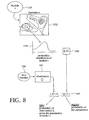
- Figure 8 summarizes the basic Bayesian estimation technique as applied to eigenvoice space.
- the training data generates models lambda illustrated at 150 .
- These models correspond to an eigenspace 152 .
- the models are not evenly distributed across the eigenspace, rather there are regions of dense population and regions of sparse population. This has been illustrated diagrammatically in the form of a "topographical" map.
- These models lambda have a probability distribution illustrated diagrammatically at 154 and also depicted at 156 by the probability function g(lambda).
- the new speaker 160 provides observation data O, shown diagrammatically at 162 .
- Probability distribution 156 and observation O are multiplied in Bayesian equation 164 and this product is used to seek the model lambda for the new speaker that maximized the Bayesian equation 164 .
- equation 164 comprises a first term that depends on the probability of encountering observation O, given the parameters of model lambda; and a second term that depends on the probability distribution of the original training data.
- the first term represents the new speaker and the second term represents the priors.
- E the number of different environments in the training data.
- Each of the E models is trained on many different speakers in the same environment.
- the E different recording environments will be as diverse as possible.
- the eigenvoice procedure is carried out as described above.
- the eigenvoice vectors will represent the components of variation between environments.
- the first eigenvector may or may not represent the male-female dimension as it did in the speaker adaptation example.
- the eigenvoice adaptation techniques of the invention can be deployed in a variety of different contexts. They may be used singly or in combination with other adaptation techniques as outlined above.
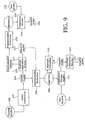
- Figure 9 summarizes some of the possible uses and implementations of the eigenvoice adaptation techniques. Referring to Figure 9, training speakers 200 provide input to the model constructor 202 used to generate the initial set of speaker models 204 . At this point several different approaches can be taken.
- dimensionality reduction can be performed upon the speaker models 204 to generate the eigenspace 208 .
- speaker models 204 can be refined using an auxiliary adaptation process 210 to produce a set of refined or enhanced models 212 .
- the auxiliary adaptation process can implement MAP estimation or other transformation-based approach, such as MLLR.
- Dimensionality reduction 206 may then be applied to these enhanced models, yielding an eigenspace 208 based on the enhanced models of the training speakers 200 .
- Adaptation of a new speaker, such as new speaker 214 is performed by the adaptation process 216 which places the new speaker into eigenspace 208 by any of the techniques described above.
- the presently preferred embodiment uses the maximum likelihood technique MLED for new speaker placement into eigenspace.
- each vector within eigenspace corresponds to a speaker model.
- placing the new speaker 214 into eigenspace results in a vector in eigenspace that represents an adapted model for that new speaker.
- this adapted model is indicated at 218 .
- Bayesian estimation uses prior knowledge from the training speakers 200 about which areas of speaker space are densely or thinly populated, and this knowledge is used to refine the estimate of where to place a new speaker within that space.
- an auxiliary adaptation process 222 may be performed upon it to produce a more refined adapted model illustrated at 224 .
- the auxiliary adaptation process 222 can employ MAP estimation or some transformation-based approach, such as MLLR.
- adaptation process 216 arrives quickly at an estimate of the adapted model for the new speaker; adaptation process 222 refines that estimate to find the best adapted model.
- the dimensionality reduction step has been performed on the speaker models 204.
- the dimensionality reduction process involves forming a concatenated supervector for each of the training speakers, using suitable model parameters such as the Hidden Markov Model parameters.
- Dimensionality reduction is not limited to speaker models, however. Dimensionality reduction can also be applied to transformation matrices generated using other speaker adaptation techniques, such as the auxiliary adaptation processes illustrated at 210 .
- Figure 9 also illustrates this alternate use of the dimensionality reduction technique.
- the auxiliary adaptation process 210 generates transformation matrices as a by-product of its operation. These transformation matrices are illustrated in Figure 9 at 226 .
- the auxiliary adaptation process 210 may be a transformation-based operation such as MLLR, which generates a set of transformation matrices W i from a speaker-independent (Sl) model. This set of matrices for each training speaker is then vectorized, as by concatenation, to yield a high-dimensional supervector. Dimensionality reduction is then performed at 228 to yield an eigenspace 230 corresponding to a set of "eigentransform" vectors.
- MLLR transformation-based operation
- Sl speaker-independent
- the adaptation process 234 assumes that the appropriate transforms W i for that new speaker are located in the subspace spanned by the eigentransforms (eigenspace 230 ). Having estimated the appropriate linear combination of eigentransforms, using the MLED method, for example, the system then applies the resulting transforms W i to the speaker independent model to yield the adapted model 236 for the new speaker.
- Figure 9 is intended to summarize a number of the different eigenvoice adaptation techniques described elsewhere in this document. Thus the illustration in Figure 9 is intended merely to show use of these techniques in context. A given implementation in accordance with the invention may use some, but not necessarily all, of the processes illustrated here. Moreover, Figure 9 is not intended to be exhaustive. Numerous other combinations are also envisioned within the scope of the invention as set forth in the appended claims.
Landscapes
- Engineering & Computer Science (AREA)
- Physics & Mathematics (AREA)
- Artificial Intelligence (AREA)
- Theoretical Computer Science (AREA)
- Data Mining & Analysis (AREA)
- Computer Vision & Pattern Recognition (AREA)
- Human Computer Interaction (AREA)
- Bioinformatics & Computational Biology (AREA)
- Multimedia (AREA)
- Audiology, Speech & Language Pathology (AREA)
- Health & Medical Sciences (AREA)
- Life Sciences & Earth Sciences (AREA)
- Bioinformatics & Cheminformatics (AREA)
- Acoustics & Sound (AREA)
- Evolutionary Biology (AREA)
- Evolutionary Computation (AREA)
- General Engineering & Computer Science (AREA)
- General Physics & Mathematics (AREA)
- Computational Linguistics (AREA)
- Stereophonic System (AREA)
- Management, Administration, Business Operations System, And Electronic Commerce (AREA)
- Information Retrieval, Db Structures And Fs Structures Therefor (AREA)
Claims (19)
- Ein Verfahren zur Durchführung von Sprecheradaptation oder - normalisierung, das folgende Schritte umfasst:Repräsentieren einer Vielheit von Traningssprechern (20) als einen Satz von Sprechermodellen (26), wobei besagte Modelle eine Vielheit von Parametem (18) definieren;Einstellen (27) wenigstens einiger der besagten Parameter der besagten Modelle, um einen Satz zusätzlich adaptierter Sprechermodelle (26) zu definieren;Konstruieren eines Eigenraums (38), zum Repräsentieren der besagten Vielheit von Trainingssprechern durch Durchführen von Dimensionsreduktion (32) an besagtem Satz zusätzlich adaptierter Modelle, um einen Satz Basisvektoren (34) zu generieren, die besagten Eigenraum definieren;Generieren eines adaptierten Modells (52), unter Verwendung von Eingabesprache seitens eines neuen Sprechers (40), um besagtes adaptiertes Modell zu trainieren; undbeim Generieren besagten adaptierten Modells (52) Verwendung besagten Satzes von Basisvektoren, um besagtes adaptiertes Modell so einzuengen, dass besagtes adaptiertes Modell innerhalb des besagten Eigenraums (38) liegt.
- Das Verfahren des Anspruchs 1, worein besagter Einstellschritt unter Verwendung einer maximum a posteriori Schätzung durchgeführt wird.
- Das Verfahren des Anspruchs 1, worin besagter Einstellschritt unter Verwendung eines Schätzungsprozesses auf Transformationsbasis durchgeführt wird.
- Das Verfahren des Anspruchs 1, worin besagter Einstellschritt unter Verwendung linearer Regression mit Maximum-Likelihood-Schätzung (110) durchgeführt wird.
- Das Verfahren des Anspruchs 1, worin besagter Schritt der Generierung besagten adaptierten Modells die Verwendung von Eingabesprache seitens des besagten neuen Sprechers umfasst, um einen Maximum-Likelihood-Vektor zu generieren und um besagtes adaptiertes Modell zu trainieren, während besagter Satz von Basisvektoren und besagter Maximum-Likelihood-Vektor dazu verwendet werden besagtes adaptierte Modell so einzuengen, dass besagtes adaptierte Modell innerhalb besagtem Eigenraum liegt.
- Das Verfahren des Anspruchs 1, worin besagtes Verfahren außerdem den Schritt der Ausblendung von Modellparametem aus besagtem adaptiertem Modell und Einstellen wenigstens einiger besagter ausgeblendeter Parameter auf der Basis besagter Eingabesprache seitens des besagten neuen Sprechers umfasst.
- Das Verfahren des Anspruchs 6, worin besagter Ausblendungsschritt unter Verwendung einer maximum a posteriori Schätzung durchgeführt wird.
- Das Verfahren des Anspruchs 6, worin besagter Ausblendungsschritt unter Verwendung eines Schätzungsprozesses auf Transformationsbasis durchgeführt wird.
- Das Verfahren des Anspruchs 6, worin besagter Ausblendungsschritt unter Verwendung linearer Regression mit Maximum-Likelihood-Schätzung durchgeführt wird.
- Das Verfahren des Anspruchs 6, worin besagter Schritt der Generierung besagten adaptierten Modells die Verwendung von Eingabesprache seitens des besagten neuen Sprechers umfasst, um einen maximalen Wahrscheinlichkeitsvektor zu generieren und um besagtes adaptierte Modell zu trainieren, während besagter Satz von Basisvektoren und besagter Maximum-Likelihood-Vektor dazu verwendet werden besagtes adaptierte Modell so einzuengen, dass besagtes adaptierte Modell innerhalb besagtem Eigenraum liegt.
- Das Verfahren des Anspruchs 10, worin besagter Trainingsschritt unter Verwendung einer maximum a posteriori Schätzung durchgeführt wird.
- Das Verfahren des Anspruchs 10, worein besagter Trainingsschritt unter Verwendung eines Schätzungsprozesses auf Transformationsbasis durchgeführt wird.
- Das Verfahren des Anspruchs 10, worein besagter Trainingsschritt unter Verwendung linearer Regression mit Maximum-Likelihood-Schätzung (110) durchgeführt wird.
- Das Verfahren des Anspruchs 1, worin besagter Schritt der Repräsentierung besagter Vielheit von besagten Trainingssprechem als einen Satz von Modellen das Repräsentieren besagter Vielheit von besagten Trainingssprechern als erste Sätze von Transformationsmatrizen umfasst.
- Das Verfahren des Anspruchs 14, worin besagter Schritt der Durchführung besagter Dimensionsreduktion das Durchführen besagter Dimensionsreduktion an besagten ersten Sätzen von Transformationsmatrizen umfasst.
- Das Verfahren wie in Anspruch 14 oder Anspruch 15 beansprucht, worin besagter Schritt der Generierung besagten adaptierten Modells das Generieren eines zweiten Satzes von Transformationsmatrizen umfasst.
- Das Verfahren wie in einem beliebigen der Ansprüche 14 bis 16 beansprucht, worin besagte erste Sätze von Transformationsmatrizen durch lineare Regression mit Maximum-Likelihood-Schätzung generiert werden.
- Das Verfahren wie in einem beliebigen der Ansprüche 14 bis 17 beansprucht, das weiter Vektorisieren jedes der besagten ersten Sätze von Transformationsmatrizen umfasst, um einen Satz Supervektoren zu definieren und Dimensionsreduktion an besagten Supervektoren durchzuführen, um besagten Eigenraum zu definieren.
- Das Verfahren wie in einem beliebigen der Ansprüche 14 bis 18 beansprucht, das weiter umfasst:Generieren besagten zweiten Satzes von Transformationsmatrizen unter Verwendung von Eingabesprache seitens eines neuen Sprechers, um einen Maximum-Likelihood-Vektor zu generieren; undVerwenden besagten Maximum-Likelihood-Vektors, um eine Position innerhalb besagten Eigenraums zu bestimmen.
Applications Claiming Priority (2)
| Application Number | Priority Date | Filing Date | Title |
|---|---|---|---|
| US148753 | 1998-09-04 | ||
| US09/148,753 US6343267B1 (en) | 1998-04-30 | 1998-09-04 | Dimensionality reduction for speaker normalization and speaker and environment adaptation using eigenvoice techniques |
Publications (3)
| Publication Number | Publication Date |
|---|---|
| EP0984429A2 EP0984429A2 (de) | 2000-03-08 |
| EP0984429A3 EP0984429A3 (de) | 2000-11-22 |
| EP0984429B1 true EP0984429B1 (de) | 2004-05-06 |
Family
ID=22527202
Family Applications (1)
| Application Number | Title | Priority Date | Filing Date |
|---|---|---|---|
| EP99306667A Expired - Lifetime EP0984429B1 (de) | 1998-09-04 | 1999-08-23 | Dimensionsreduktion für die Sprechernormalisierung und Sprecher- und Umgebungsadaptation mittels Eigenstimm-Techniken |
Country Status (6)
| Country | Link |
|---|---|
| US (1) | US6343267B1 (de) |
| EP (1) | EP0984429B1 (de) |
| JP (1) | JP2000081893A (de) |
| CN (1) | CN1178202C (de) |
| DE (1) | DE69916951T2 (de) |
| TW (1) | TW452758B (de) |
Cited By (1)
| Publication number | Priority date | Publication date | Assignee | Title |
|---|---|---|---|---|
| CN113505801A (zh) * | 2021-09-13 | 2021-10-15 | 拓小拓科技(天津)有限公司 | 用于超维计算的强度值向量表生成方法和图像编码方法 |
Families Citing this family (186)
| Publication number | Priority date | Publication date | Assignee | Title |
|---|---|---|---|---|
| US6343267B1 (en) | 1998-04-30 | 2002-01-29 | Matsushita Electric Industrial Co., Ltd. | Dimensionality reduction for speaker normalization and speaker and environment adaptation using eigenvoice techniques |
| US8095581B2 (en) * | 1999-02-05 | 2012-01-10 | Gregory A Stobbs | Computer-implemented patent portfolio analysis method and apparatus |
| WO2000054256A1 (de) * | 1999-03-08 | 2000-09-14 | Siemens Aktiengesellschaft | Verfahren und anordnung zur ermittlung einer merkmalsbeschreibung eines sprachsignals |
| KR100307623B1 (ko) * | 1999-10-21 | 2001-11-02 | 윤종용 | 엠.에이.피 화자 적응 조건에서 파라미터의 분별적 추정 방법 및 장치 및 이를 각각 포함한 음성 인식 방법 및 장치 |
| US6526379B1 (en) * | 1999-11-29 | 2003-02-25 | Matsushita Electric Industrial Co., Ltd. | Discriminative clustering methods for automatic speech recognition |
| US6571208B1 (en) * | 1999-11-29 | 2003-05-27 | Matsushita Electric Industrial Co., Ltd. | Context-dependent acoustic models for medium and large vocabulary speech recognition with eigenvoice training |
| US6868381B1 (en) * | 1999-12-21 | 2005-03-15 | Nortel Networks Limited | Method and apparatus providing hypothesis driven speech modelling for use in speech recognition |
| WO2001063597A1 (en) * | 2000-02-25 | 2001-08-30 | Koninklijke Philips Electronics N.V. | Speech recognition device with reference transformation means |
| MXPA02008921A (es) | 2000-03-14 | 2004-10-15 | James Hardie Res Pty Ltd | Materiales de construccion de fibras-cemento, con aditivos de baja densidad. |
| US8645137B2 (en) | 2000-03-16 | 2014-02-04 | Apple Inc. | Fast, language-independent method for user authentication by voice |
| US20080147404A1 (en) * | 2000-05-15 | 2008-06-19 | Nusuara Technologies Sdn Bhd | System and methods for accent classification and adaptation |
| US6751590B1 (en) * | 2000-06-13 | 2004-06-15 | International Business Machines Corporation | Method and apparatus for performing pattern-specific maximum likelihood transformations for speaker recognition |
| US6961703B1 (en) * | 2000-09-13 | 2005-11-01 | Itt Manufacturing Enterprises, Inc. | Method for speech processing involving whole-utterance modeling |
| DE10047723A1 (de) * | 2000-09-27 | 2002-04-11 | Philips Corp Intellectual Pty | Verfahren zur Ermittlung eines Eigenraums zur Darstellung einer Mehrzahl von Trainingssprechern |
| DE10047724A1 (de) * | 2000-09-27 | 2002-04-11 | Philips Corp Intellectual Pty | Verfahren zur Ermittlung eines Eigenraumes zur Darstellung einer Mehrzahl von Trainingssprechern |
| DE10047718A1 (de) * | 2000-09-27 | 2002-04-18 | Philips Corp Intellectual Pty | Verfahren zur Spracherkennung |
| US7006969B2 (en) * | 2000-11-02 | 2006-02-28 | At&T Corp. | System and method of pattern recognition in very high-dimensional space |
| US20030164119A1 (en) | 2002-03-04 | 2003-09-04 | Basil Naji | Additive for dewaterable slurry and slurry incorporating same |
| HUP0303345A3 (en) | 2001-03-02 | 2004-05-28 | James Hardie Int Finance Bv | A method and apparatus for forming a laminated sheet material by spattering |
| US6895376B2 (en) * | 2001-05-04 | 2005-05-17 | Matsushita Electric Industrial Co., Ltd. | Eigenvoice re-estimation technique of acoustic models for speech recognition, speaker identification and speaker verification |
| JP2002366187A (ja) * | 2001-06-08 | 2002-12-20 | Sony Corp | 音声認識装置および音声認識方法、並びにプログラムおよび記録媒体 |
| US7050969B2 (en) * | 2001-11-27 | 2006-05-23 | Mitsubishi Electric Research Laboratories, Inc. | Distributed speech recognition with codec parameters |
| US7209881B2 (en) | 2001-12-20 | 2007-04-24 | Matsushita Electric Industrial Co., Ltd. | Preparing acoustic models by sufficient statistics and noise-superimposed speech data |
| US7472062B2 (en) * | 2002-01-04 | 2008-12-30 | International Business Machines Corporation | Efficient recursive clustering based on a splitting function derived from successive eigen-decompositions |
| US7139703B2 (en) * | 2002-04-05 | 2006-11-21 | Microsoft Corporation | Method of iterative noise estimation in a recursive framework |
| US20030195751A1 (en) * | 2002-04-10 | 2003-10-16 | Mitsubishi Electric Research Laboratories, Inc. | Distributed automatic speech recognition with persistent user parameters |
| CN1312656C (zh) * | 2002-09-24 | 2007-04-25 | 松下电器产业株式会社 | 说话人标准化方法及用该方法的语音识别装置 |
| US20040122672A1 (en) * | 2002-12-18 | 2004-06-24 | Jean-Francois Bonastre | Gaussian model-based dynamic time warping system and method for speech processing |
| US7165026B2 (en) | 2003-03-31 | 2007-01-16 | Microsoft Corporation | Method of noise estimation using incremental bayes learning |
| US7516157B2 (en) * | 2003-05-08 | 2009-04-07 | Microsoft Corporation | Relational directory |
| US8229744B2 (en) * | 2003-08-26 | 2012-07-24 | Nuance Communications, Inc. | Class detection scheme and time mediated averaging of class dependent models |
| US20080208581A1 (en) * | 2003-12-05 | 2008-08-28 | Queensland University Of Technology | Model Adaptation System and Method for Speaker Recognition |
| KR100612840B1 (ko) * | 2004-02-18 | 2006-08-18 | 삼성전자주식회사 | 모델 변이 기반의 화자 클러스터링 방법, 화자 적응 방법및 이들을 이용한 음성 인식 장치 |
| GB2414328A (en) * | 2004-05-17 | 2005-11-23 | Mitsubishi Electric Inf Tech | Discrimination transforms applied to frequency domain derived feature vectors |
| US7496509B2 (en) * | 2004-05-28 | 2009-02-24 | International Business Machines Corporation | Methods and apparatus for statistical biometric model migration |
| US7567903B1 (en) * | 2005-01-12 | 2009-07-28 | At&T Intellectual Property Ii, L.P. | Low latency real-time vocal tract length normalization |
| WO2006076661A2 (en) * | 2005-01-14 | 2006-07-20 | Tremor Media Llc | Dynamic advertisement system and method |
| US20070050243A1 (en) * | 2005-08-23 | 2007-03-01 | Way Out World, Llc | Multi-unit system and methods for game augmented interactive marketing |
| US20070050242A1 (en) * | 2005-08-23 | 2007-03-01 | Way Out World, Llc | Solo-unit system and methods for game augmented interactive marketing |
| US20070049367A1 (en) * | 2005-08-23 | 2007-03-01 | Way Out World, Llc | Methods for game augmented interactive marketing |
| US8677377B2 (en) | 2005-09-08 | 2014-03-18 | Apple Inc. | Method and apparatus for building an intelligent automated assistant |
| JP2007114413A (ja) * | 2005-10-19 | 2007-05-10 | Toshiba Corp | 音声非音声判別装置、音声区間検出装置、音声非音声判別方法、音声区間検出方法、音声非音声判別プログラムおよび音声区間検出プログラム |
| WO2007056344A2 (en) | 2005-11-07 | 2007-05-18 | Scanscout, Inc. | Techiques for model optimization for statistical pattern recognition |
| US9318108B2 (en) | 2010-01-18 | 2016-04-19 | Apple Inc. | Intelligent automated assistant |
| JP4282704B2 (ja) * | 2006-09-27 | 2009-06-24 | 株式会社東芝 | 音声区間検出装置およびプログラム |
| US20080109391A1 (en) * | 2006-11-07 | 2008-05-08 | Scanscout, Inc. | Classifying content based on mood |
| US8977255B2 (en) | 2007-04-03 | 2015-03-10 | Apple Inc. | Method and system for operating a multi-function portable electronic device using voice-activation |
| AU2008296072A1 (en) * | 2007-09-07 | 2009-03-12 | Bionovo, Inc. | Estrogenic extracts of Astragalus membranaceus Fisch.Bge.Var.mongolicus Bge. of the Leguminosae Family and uses thereof |
| US8549550B2 (en) * | 2008-09-17 | 2013-10-01 | Tubemogul, Inc. | Method and apparatus for passively monitoring online video viewing and viewer behavior |
| US8577996B2 (en) * | 2007-09-18 | 2013-11-05 | Tremor Video, Inc. | Method and apparatus for tracing users of online video web sites |
| US8209927B2 (en) | 2007-12-20 | 2012-07-03 | James Hardie Technology Limited | Structural fiber cement building materials |
| US9330720B2 (en) | 2008-01-03 | 2016-05-03 | Apple Inc. | Methods and apparatus for altering audio output signals |
| US8775416B2 (en) * | 2008-01-09 | 2014-07-08 | Yahoo!Inc. | Adapting a context-independent relevance function for identifying relevant search results |
| JP4950930B2 (ja) * | 2008-04-03 | 2012-06-13 | 株式会社東芝 | 音声/非音声を判定する装置、方法およびプログラム |
| US8996376B2 (en) | 2008-04-05 | 2015-03-31 | Apple Inc. | Intelligent text-to-speech conversion |
| US20090259551A1 (en) * | 2008-04-11 | 2009-10-15 | Tremor Media, Inc. | System and method for inserting advertisements from multiple ad servers via a master component |
| US10496753B2 (en) | 2010-01-18 | 2019-12-03 | Apple Inc. | Automatically adapting user interfaces for hands-free interaction |
| US8521530B1 (en) | 2008-06-30 | 2013-08-27 | Audience, Inc. | System and method for enhancing a monaural audio signal |
| US20100030549A1 (en) | 2008-07-31 | 2010-02-04 | Lee Michael M | Mobile device having human language translation capability with positional feedback |
| US9612995B2 (en) | 2008-09-17 | 2017-04-04 | Adobe Systems Incorporated | Video viewer targeting based on preference similarity |
| WO2010067118A1 (en) | 2008-12-11 | 2010-06-17 | Novauris Technologies Limited | Speech recognition involving a mobile device |
| US9858925B2 (en) | 2009-06-05 | 2018-01-02 | Apple Inc. | Using context information to facilitate processing of commands in a virtual assistant |
| US10241752B2 (en) | 2011-09-30 | 2019-03-26 | Apple Inc. | Interface for a virtual digital assistant |
| US10706373B2 (en) | 2011-06-03 | 2020-07-07 | Apple Inc. | Performing actions associated with task items that represent tasks to perform |
| US10241644B2 (en) | 2011-06-03 | 2019-03-26 | Apple Inc. | Actionable reminder entries |
| US9431006B2 (en) | 2009-07-02 | 2016-08-30 | Apple Inc. | Methods and apparatuses for automatic speech recognition |
| US20110093783A1 (en) * | 2009-10-16 | 2011-04-21 | Charles Parra | Method and system for linking media components |
| US8374867B2 (en) * | 2009-11-13 | 2013-02-12 | At&T Intellectual Property I, L.P. | System and method for standardized speech recognition infrastructure |
| EP2502195A2 (de) * | 2009-11-20 | 2012-09-26 | Tadashi Yonezaki | Verfahren und vorrichtung zur optimierung einer zuweisung von werbeinhalten |
| US10553209B2 (en) | 2010-01-18 | 2020-02-04 | Apple Inc. | Systems and methods for hands-free notification summaries |
| US10679605B2 (en) | 2010-01-18 | 2020-06-09 | Apple Inc. | Hands-free list-reading by intelligent automated assistant |
| US10276170B2 (en) | 2010-01-18 | 2019-04-30 | Apple Inc. | Intelligent automated assistant |
| US10705794B2 (en) | 2010-01-18 | 2020-07-07 | Apple Inc. | Automatically adapting user interfaces for hands-free interaction |
| DE202011111062U1 (de) | 2010-01-25 | 2019-02-19 | Newvaluexchange Ltd. | Vorrichtung und System für eine Digitalkonversationsmanagementplattform |
| US9008329B1 (en) * | 2010-01-26 | 2015-04-14 | Audience, Inc. | Noise reduction using multi-feature cluster tracker |
| US8682667B2 (en) | 2010-02-25 | 2014-03-25 | Apple Inc. | User profiling for selecting user specific voice input processing information |
| US8473287B2 (en) | 2010-04-19 | 2013-06-25 | Audience, Inc. | Method for jointly optimizing noise reduction and voice quality in a mono or multi-microphone system |
| US8538035B2 (en) | 2010-04-29 | 2013-09-17 | Audience, Inc. | Multi-microphone robust noise suppression |
| US8781137B1 (en) | 2010-04-27 | 2014-07-15 | Audience, Inc. | Wind noise detection and suppression |
| US9558755B1 (en) | 2010-05-20 | 2017-01-31 | Knowles Electronics, Llc | Noise suppression assisted automatic speech recognition |
| US8447596B2 (en) | 2010-07-12 | 2013-05-21 | Audience, Inc. | Monaural noise suppression based on computational auditory scene analysis |
| US10762293B2 (en) | 2010-12-22 | 2020-09-01 | Apple Inc. | Using parts-of-speech tagging and named entity recognition for spelling correction |
| US9262612B2 (en) | 2011-03-21 | 2016-02-16 | Apple Inc. | Device access using voice authentication |
| US10057736B2 (en) | 2011-06-03 | 2018-08-21 | Apple Inc. | Active transport based notifications |
| US8994660B2 (en) | 2011-08-29 | 2015-03-31 | Apple Inc. | Text correction processing |
| US10134385B2 (en) | 2012-03-02 | 2018-11-20 | Apple Inc. | Systems and methods for name pronunciation |
| US9483461B2 (en) | 2012-03-06 | 2016-11-01 | Apple Inc. | Handling speech synthesis of content for multiple languages |
| US9406299B2 (en) * | 2012-05-08 | 2016-08-02 | Nuance Communications, Inc. | Differential acoustic model representation and linear transform-based adaptation for efficient user profile update techniques in automatic speech recognition |
| US9280610B2 (en) | 2012-05-14 | 2016-03-08 | Apple Inc. | Crowd sourcing information to fulfill user requests |
| US9064491B2 (en) | 2012-05-29 | 2015-06-23 | Nuance Communications, Inc. | Methods and apparatus for performing transformation techniques for data clustering and/or classification |
| US9721563B2 (en) | 2012-06-08 | 2017-08-01 | Apple Inc. | Name recognition system |
| US9495129B2 (en) | 2012-06-29 | 2016-11-15 | Apple Inc. | Device, method, and user interface for voice-activated navigation and browsing of a document |
| NZ730641A (en) * | 2012-08-24 | 2018-08-31 | Interactive Intelligence Inc | Method and system for selectively biased linear discriminant analysis in automatic speech recognition systems |
| US9576574B2 (en) | 2012-09-10 | 2017-02-21 | Apple Inc. | Context-sensitive handling of interruptions by intelligent digital assistant |
| US9547647B2 (en) | 2012-09-19 | 2017-01-17 | Apple Inc. | Voice-based media searching |
| US9640194B1 (en) | 2012-10-04 | 2017-05-02 | Knowles Electronics, Llc | Noise suppression for speech processing based on machine-learning mask estimation |
| GB2510200B (en) * | 2013-01-29 | 2017-05-10 | Toshiba Res Europe Ltd | A computer generated head |
| EP4560630A3 (de) | 2013-02-07 | 2025-08-06 | Apple Inc. | Sprachauslöser für einen digitalen assistenten |
| US9368114B2 (en) | 2013-03-14 | 2016-06-14 | Apple Inc. | Context-sensitive handling of interruptions |
| WO2014144579A1 (en) | 2013-03-15 | 2014-09-18 | Apple Inc. | System and method for updating an adaptive speech recognition model |
| CN105027197B (zh) | 2013-03-15 | 2018-12-14 | 苹果公司 | 训练至少部分语音命令系统 |
| WO2014197336A1 (en) | 2013-06-07 | 2014-12-11 | Apple Inc. | System and method for detecting errors in interactions with a voice-based digital assistant |
| US9582608B2 (en) | 2013-06-07 | 2017-02-28 | Apple Inc. | Unified ranking with entropy-weighted information for phrase-based semantic auto-completion |
| WO2014197334A2 (en) | 2013-06-07 | 2014-12-11 | Apple Inc. | System and method for user-specified pronunciation of words for speech synthesis and recognition |
| WO2014197335A1 (en) | 2013-06-08 | 2014-12-11 | Apple Inc. | Interpreting and acting upon commands that involve sharing information with remote devices |
| US10176167B2 (en) | 2013-06-09 | 2019-01-08 | Apple Inc. | System and method for inferring user intent from speech inputs |
| EP3008641A1 (de) | 2013-06-09 | 2016-04-20 | Apple Inc. | Vorrichtung, verfahren und grafische benutzeroberfläche für gesprächspersistenz über zwei oder mehrere instanzen eines digitaler assistenten |
| HK1220313A1 (zh) | 2013-06-13 | 2017-04-28 | 苹果公司 | 用於由语音命令发起的紧急呼叫的系统和方法 |
| US10791216B2 (en) | 2013-08-06 | 2020-09-29 | Apple Inc. | Auto-activating smart responses based on activities from remote devices |
| US9251784B2 (en) | 2013-10-23 | 2016-02-02 | International Business Machines Corporation | Regularized feature space discrimination adaptation |
| CN106462772B (zh) | 2014-02-19 | 2019-12-13 | 河谷控股Ip有限责任公司 | 对象识别特征的基于不变量的维数缩减、系统和方法 |
| US9620105B2 (en) | 2014-05-15 | 2017-04-11 | Apple Inc. | Analyzing audio input for efficient speech and music recognition |
| US10592095B2 (en) | 2014-05-23 | 2020-03-17 | Apple Inc. | Instantaneous speaking of content on touch devices |
| US9502031B2 (en) | 2014-05-27 | 2016-11-22 | Apple Inc. | Method for supporting dynamic grammars in WFST-based ASR |
| US9966065B2 (en) | 2014-05-30 | 2018-05-08 | Apple Inc. | Multi-command single utterance input method |
| US10170123B2 (en) | 2014-05-30 | 2019-01-01 | Apple Inc. | Intelligent assistant for home automation |
| US9633004B2 (en) | 2014-05-30 | 2017-04-25 | Apple Inc. | Better resolution when referencing to concepts |
| US9842101B2 (en) | 2014-05-30 | 2017-12-12 | Apple Inc. | Predictive conversion of language input |
| US9715875B2 (en) | 2014-05-30 | 2017-07-25 | Apple Inc. | Reducing the need for manual start/end-pointing and trigger phrases |
| US10078631B2 (en) | 2014-05-30 | 2018-09-18 | Apple Inc. | Entropy-guided text prediction using combined word and character n-gram language models |
| US9785630B2 (en) | 2014-05-30 | 2017-10-10 | Apple Inc. | Text prediction using combined word N-gram and unigram language models |
| US9430463B2 (en) | 2014-05-30 | 2016-08-30 | Apple Inc. | Exemplar-based natural language processing |
| US9734193B2 (en) | 2014-05-30 | 2017-08-15 | Apple Inc. | Determining domain salience ranking from ambiguous words in natural speech |
| US10289433B2 (en) | 2014-05-30 | 2019-05-14 | Apple Inc. | Domain specific language for encoding assistant dialog |
| US9760559B2 (en) | 2014-05-30 | 2017-09-12 | Apple Inc. | Predictive text input |
| US9338493B2 (en) | 2014-06-30 | 2016-05-10 | Apple Inc. | Intelligent automated assistant for TV user interactions |
| US10659851B2 (en) | 2014-06-30 | 2020-05-19 | Apple Inc. | Real-time digital assistant knowledge updates |
| US10446141B2 (en) | 2014-08-28 | 2019-10-15 | Apple Inc. | Automatic speech recognition based on user feedback |
| WO2016033364A1 (en) | 2014-08-28 | 2016-03-03 | Audience, Inc. | Multi-sourced noise suppression |
| US9818400B2 (en) | 2014-09-11 | 2017-11-14 | Apple Inc. | Method and apparatus for discovering trending terms in speech requests |
| US10789041B2 (en) | 2014-09-12 | 2020-09-29 | Apple Inc. | Dynamic thresholds for always listening speech trigger |
| US9606986B2 (en) | 2014-09-29 | 2017-03-28 | Apple Inc. | Integrated word N-gram and class M-gram language models |
| US9646609B2 (en) | 2014-09-30 | 2017-05-09 | Apple Inc. | Caching apparatus for serving phonetic pronunciations |
| US10074360B2 (en) | 2014-09-30 | 2018-09-11 | Apple Inc. | Providing an indication of the suitability of speech recognition |
| US9886432B2 (en) | 2014-09-30 | 2018-02-06 | Apple Inc. | Parsimonious handling of word inflection via categorical stem + suffix N-gram language models |
| US9668121B2 (en) | 2014-09-30 | 2017-05-30 | Apple Inc. | Social reminders |
| US10127911B2 (en) | 2014-09-30 | 2018-11-13 | Apple Inc. | Speaker identification and unsupervised speaker adaptation techniques |
| US10552013B2 (en) | 2014-12-02 | 2020-02-04 | Apple Inc. | Data detection |
| US9711141B2 (en) | 2014-12-09 | 2017-07-18 | Apple Inc. | Disambiguating heteronyms in speech synthesis |
| US9865280B2 (en) | 2015-03-06 | 2018-01-09 | Apple Inc. | Structured dictation using intelligent automated assistants |
| US9886953B2 (en) | 2015-03-08 | 2018-02-06 | Apple Inc. | Virtual assistant activation |
| US9721566B2 (en) | 2015-03-08 | 2017-08-01 | Apple Inc. | Competing devices responding to voice triggers |
| US10567477B2 (en) | 2015-03-08 | 2020-02-18 | Apple Inc. | Virtual assistant continuity |
| US9899019B2 (en) | 2015-03-18 | 2018-02-20 | Apple Inc. | Systems and methods for structured stem and suffix language models |
| US9842105B2 (en) | 2015-04-16 | 2017-12-12 | Apple Inc. | Parsimonious continuous-space phrase representations for natural language processing |
| US10083688B2 (en) | 2015-05-27 | 2018-09-25 | Apple Inc. | Device voice control for selecting a displayed affordance |
| US10127220B2 (en) | 2015-06-04 | 2018-11-13 | Apple Inc. | Language identification from short strings |
| US9578173B2 (en) | 2015-06-05 | 2017-02-21 | Apple Inc. | Virtual assistant aided communication with 3rd party service in a communication session |
| US10101822B2 (en) | 2015-06-05 | 2018-10-16 | Apple Inc. | Language input correction |
| US11025565B2 (en) | 2015-06-07 | 2021-06-01 | Apple Inc. | Personalized prediction of responses for instant messaging |
| US10255907B2 (en) | 2015-06-07 | 2019-04-09 | Apple Inc. | Automatic accent detection using acoustic models |
| US10186254B2 (en) | 2015-06-07 | 2019-01-22 | Apple Inc. | Context-based endpoint detection |
| US10747498B2 (en) | 2015-09-08 | 2020-08-18 | Apple Inc. | Zero latency digital assistant |
| US10671428B2 (en) | 2015-09-08 | 2020-06-02 | Apple Inc. | Distributed personal assistant |
| US9697820B2 (en) | 2015-09-24 | 2017-07-04 | Apple Inc. | Unit-selection text-to-speech synthesis using concatenation-sensitive neural networks |
| US11010550B2 (en) | 2015-09-29 | 2021-05-18 | Apple Inc. | Unified language modeling framework for word prediction, auto-completion and auto-correction |
| US10366158B2 (en) | 2015-09-29 | 2019-07-30 | Apple Inc. | Efficient word encoding for recurrent neural network language models |
| US11587559B2 (en) | 2015-09-30 | 2023-02-21 | Apple Inc. | Intelligent device identification |
| US10691473B2 (en) | 2015-11-06 | 2020-06-23 | Apple Inc. | Intelligent automated assistant in a messaging environment |
| US10049668B2 (en) | 2015-12-02 | 2018-08-14 | Apple Inc. | Applying neural network language models to weighted finite state transducers for automatic speech recognition |
| US10223066B2 (en) | 2015-12-23 | 2019-03-05 | Apple Inc. | Proactive assistance based on dialog communication between devices |
| US10446143B2 (en) | 2016-03-14 | 2019-10-15 | Apple Inc. | Identification of voice inputs providing credentials |
| US9934775B2 (en) | 2016-05-26 | 2018-04-03 | Apple Inc. | Unit-selection text-to-speech synthesis based on predicted concatenation parameters |
| US9972304B2 (en) | 2016-06-03 | 2018-05-15 | Apple Inc. | Privacy preserving distributed evaluation framework for embedded personalized systems |
| US10249300B2 (en) | 2016-06-06 | 2019-04-02 | Apple Inc. | Intelligent list reading |
| US10049663B2 (en) | 2016-06-08 | 2018-08-14 | Apple, Inc. | Intelligent automated assistant for media exploration |
| DK179588B1 (en) | 2016-06-09 | 2019-02-22 | Apple Inc. | INTELLIGENT AUTOMATED ASSISTANT IN A HOME ENVIRONMENT |
| US10067938B2 (en) | 2016-06-10 | 2018-09-04 | Apple Inc. | Multilingual word prediction |
| US10490187B2 (en) | 2016-06-10 | 2019-11-26 | Apple Inc. | Digital assistant providing automated status report |
| US10192552B2 (en) | 2016-06-10 | 2019-01-29 | Apple Inc. | Digital assistant providing whispered speech |
| US10586535B2 (en) | 2016-06-10 | 2020-03-10 | Apple Inc. | Intelligent digital assistant in a multi-tasking environment |
| US10509862B2 (en) | 2016-06-10 | 2019-12-17 | Apple Inc. | Dynamic phrase expansion of language input |
| DK179049B1 (en) | 2016-06-11 | 2017-09-18 | Apple Inc | Data driven natural language event detection and classification |
| DK179343B1 (en) | 2016-06-11 | 2018-05-14 | Apple Inc | Intelligent task discovery |
| DK179415B1 (en) | 2016-06-11 | 2018-06-14 | Apple Inc | Intelligent device arbitration and control |
| DK201670540A1 (en) | 2016-06-11 | 2018-01-08 | Apple Inc | Application integration with a digital assistant |
| US10043516B2 (en) | 2016-09-23 | 2018-08-07 | Apple Inc. | Intelligent automated assistant |
| US10593346B2 (en) | 2016-12-22 | 2020-03-17 | Apple Inc. | Rank-reduced token representation for automatic speech recognition |
| DK201770439A1 (en) | 2017-05-11 | 2018-12-13 | Apple Inc. | Offline personal assistant |
| DK179496B1 (en) | 2017-05-12 | 2019-01-15 | Apple Inc. | USER-SPECIFIC Acoustic Models |
| DK179745B1 (en) | 2017-05-12 | 2019-05-01 | Apple Inc. | SYNCHRONIZATION AND TASK DELEGATION OF A DIGITAL ASSISTANT |
| DK201770432A1 (en) | 2017-05-15 | 2018-12-21 | Apple Inc. | Hierarchical belief states for digital assistants |
| DK201770431A1 (en) | 2017-05-15 | 2018-12-20 | Apple Inc. | Optimizing dialogue policy decisions for digital assistants using implicit feedback |
| DK179549B1 (en) | 2017-05-16 | 2019-02-12 | Apple Inc. | FAR-FIELD EXTENSION FOR DIGITAL ASSISTANT SERVICES |
| EP3786945B1 (de) * | 2018-04-12 | 2023-07-19 | Spotify AB | Sprachbasierte authentifizierung |
| CN109887484B (zh) * | 2019-02-22 | 2023-08-04 | 平安科技(深圳)有限公司 | 一种基于对偶学习的语音识别与语音合成方法及装置 |
Family Cites Families (35)
| Publication number | Priority date | Publication date | Assignee | Title |
|---|---|---|---|---|
| US4903035A (en) | 1983-12-20 | 1990-02-20 | Bsh Electronics, Ltd. | Electrical signal separating device having isolating and matching circuitry |
| US4718088A (en) | 1984-03-27 | 1988-01-05 | Exxon Research And Engineering Company | Speech recognition training method |
| JPS62231993A (ja) | 1986-03-25 | 1987-10-12 | インタ−ナシヨナル ビジネス マシ−ンズ コ−ポレ−シヨン | 音声認識方法 |
| US4817156A (en) | 1987-08-10 | 1989-03-28 | International Business Machines Corporation | Rapidly training a speech recognizer to a subsequent speaker given training data of a reference speaker |
| JPH01102599A (ja) | 1987-10-12 | 1989-04-20 | Internatl Business Mach Corp <Ibm> | 音声認識方法 |
| JP2733955B2 (ja) | 1988-05-18 | 1998-03-30 | 日本電気株式会社 | 適応型音声認識装置 |
| US5127055A (en) | 1988-12-30 | 1992-06-30 | Kurzweil Applied Intelligence, Inc. | Speech recognition apparatus & method having dynamic reference pattern adaptation |
| JPH0636156B2 (ja) | 1989-03-13 | 1994-05-11 | インターナショナル・ビジネス・マシーンズ・コーポレーション | 音声認識装置 |
| DE3931638A1 (de) | 1989-09-22 | 1991-04-04 | Standard Elektrik Lorenz Ag | Verfahren zur sprecheradaptiven erkennung von sprache |
| JP3014177B2 (ja) | 1991-08-08 | 2000-02-28 | 富士通株式会社 | 話者適応音声認識装置 |
| US5280562A (en) * | 1991-10-03 | 1994-01-18 | International Business Machines Corporation | Speech coding apparatus with single-dimension acoustic prototypes for a speech recognizer |
| US5278942A (en) * | 1991-12-05 | 1994-01-11 | International Business Machines Corporation | Speech coding apparatus having speaker dependent prototypes generated from nonuser reference data |
| EP0559349B1 (de) | 1992-03-02 | 1999-01-07 | AT&T Corp. | Lernverfahren und Gerät zur Spracherkennung |
| US5233681A (en) * | 1992-04-24 | 1993-08-03 | International Business Machines Corporation | Context-dependent speech recognizer using estimated next word context |
| US5293584A (en) * | 1992-05-21 | 1994-03-08 | International Business Machines Corporation | Speech recognition system for natural language translation |
| US5473728A (en) | 1993-02-24 | 1995-12-05 | The United States Of America As Represented By The Secretary Of The Navy | Training of homoscedastic hidden Markov models for automatic speech recognition |
| US5664059A (en) | 1993-04-29 | 1997-09-02 | Panasonic Technologies, Inc. | Self-learning speaker adaptation based on spectral variation source decomposition |
| JPH075892A (ja) | 1993-04-29 | 1995-01-10 | Matsushita Electric Ind Co Ltd | 音声認識方法 |
| US5522011A (en) * | 1993-09-27 | 1996-05-28 | International Business Machines Corporation | Speech coding apparatus and method using classification rules |
| WO1995009416A1 (en) | 1993-09-30 | 1995-04-06 | Apple Computer, Inc. | Continuous reference adaptation in a pattern recognition system |
| JP2692581B2 (ja) | 1994-06-07 | 1997-12-17 | 日本電気株式会社 | 音響カテゴリ平均値計算装置及び適応化装置 |
| US5793891A (en) | 1994-07-07 | 1998-08-11 | Nippon Telegraph And Telephone Corporation | Adaptive training method for pattern recognition |
| US5825978A (en) * | 1994-07-18 | 1998-10-20 | Sri International | Method and apparatus for speech recognition using optimized partial mixture tying of HMM state functions |
| US5737723A (en) | 1994-08-29 | 1998-04-07 | Lucent Technologies Inc. | Confusable word detection in speech recognition |
| US5864810A (en) * | 1995-01-20 | 1999-01-26 | Sri International | Method and apparatus for speech recognition adapted to an individual speaker |
| JP3453456B2 (ja) | 1995-06-19 | 2003-10-06 | キヤノン株式会社 | 状態共有モデルの設計方法及び装置ならびにその状態共有モデルを用いた音声認識方法および装置 |
| US5842163A (en) * | 1995-06-21 | 1998-11-24 | Sri International | Method and apparatus for computing likelihood and hypothesizing keyword appearance in speech |
| US5806029A (en) | 1995-09-15 | 1998-09-08 | At&T Corp | Signal conditioned minimum error rate training for continuous speech recognition |
| JP2871561B2 (ja) | 1995-11-30 | 1999-03-17 | 株式会社エイ・ティ・アール音声翻訳通信研究所 | 不特定話者モデル生成装置及び音声認識装置 |
| US5787394A (en) | 1995-12-13 | 1998-07-28 | International Business Machines Corporation | State-dependent speaker clustering for speaker adaptation |
| US5778342A (en) | 1996-02-01 | 1998-07-07 | Dspc Israel Ltd. | Pattern recognition system and method |
| US5895447A (en) | 1996-02-02 | 1999-04-20 | International Business Machines Corporation | Speech recognition using thresholded speaker class model selection or model adaptation |
| JP3302266B2 (ja) | 1996-07-23 | 2002-07-15 | 沖電気工業株式会社 | ヒドン・マルコフ・モデルの学習方法 |
| US6343267B1 (en) | 1998-04-30 | 2002-01-29 | Matsushita Electric Industrial Co., Ltd. | Dimensionality reduction for speaker normalization and speaker and environment adaptation using eigenvoice techniques |
| CN1144172C (zh) | 1998-04-30 | 2004-03-31 | 松下电器产业株式会社 | 包括最大似然方法的基于本征音的发言者适应方法 |
-
1998
- 1998-09-04 US US09/148,753 patent/US6343267B1/en not_active Expired - Lifetime
-
1999
- 1999-08-23 EP EP99306667A patent/EP0984429B1/de not_active Expired - Lifetime
- 1999-08-23 DE DE69916951T patent/DE69916951T2/de not_active Expired - Fee Related
- 1999-09-03 CN CNB991183916A patent/CN1178202C/zh not_active Expired - Lifetime
- 1999-09-06 JP JP11251083A patent/JP2000081893A/ja active Pending
- 1999-11-09 TW TW088115209A patent/TW452758B/zh not_active IP Right Cessation
Cited By (2)
| Publication number | Priority date | Publication date | Assignee | Title |
|---|---|---|---|---|
| CN113505801A (zh) * | 2021-09-13 | 2021-10-15 | 拓小拓科技(天津)有限公司 | 用于超维计算的强度值向量表生成方法和图像编码方法 |
| CN113505801B (zh) * | 2021-09-13 | 2021-11-30 | 拓小拓科技(天津)有限公司 | 一种用于超维计算的图像编码方法 |
Also Published As
| Publication number | Publication date |
|---|---|
| DE69916951D1 (de) | 2004-06-09 |
| CN1178202C (zh) | 2004-12-01 |
| EP0984429A3 (de) | 2000-11-22 |
| EP0984429A2 (de) | 2000-03-08 |
| DE69916951T2 (de) | 2005-06-23 |
| TW452758B (en) | 2001-09-01 |
| US6343267B1 (en) | 2002-01-29 |
| JP2000081893A (ja) | 2000-03-21 |
| CN1253353A (zh) | 2000-05-17 |
Similar Documents
| Publication | Publication Date | Title |
|---|---|---|
| US6343267B1 (en) | Dimensionality reduction for speaker normalization and speaker and environment adaptation using eigenvoice techniques | |
| US6263309B1 (en) | Maximum likelihood method for finding an adapted speaker model in eigenvoice space | |
| US6141644A (en) | Speaker verification and speaker identification based on eigenvoices | |
| Shinoda et al. | A structural Bayes approach to speaker adaptation | |
| Woodland | Speaker adaptation for continuous density HMMs: A review | |
| Huo et al. | On-line adaptive learning of the continuous density hidden Markov model based on approximate recursive Bayes estimate | |
| US6327565B1 (en) | Speaker and environment adaptation based on eigenvoices | |
| JP2871561B2 (ja) | 不特定話者モデル生成装置及び音声認識装置 | |
| Lee et al. | Speaker adaptation based on MAP estimation of HMM parameters | |
| JP4450991B2 (ja) | 音声認識システムのための動的にコンフィギュレーション可能な音響モデル | |
| EP0921519B1 (de) | Technik zur Adaptation von Hidden Markov Modellen für die Spracherkennung | |
| EP1488411B1 (de) | Vorrichtung zur bestimmung von parametern eines gauss'schen mischungmodells (gmm) oder eines gmm basierten hidden markov modells | |
| US6895376B2 (en) | Eigenvoice re-estimation technique of acoustic models for speech recognition, speaker identification and speaker verification | |
| EP0804721A2 (de) | Verfahren und vorrichtung zur auf eienen individuellen srecher angepasste spracherkennung | |
| WO1996022514A9 (en) | Method and apparatus for speech recognition adapted to an individual speaker | |
| US6341264B1 (en) | Adaptation system and method for E-commerce and V-commerce applications | |
| EP0953968B1 (de) | Sprecher- und Umgebungsadaptation auf der Basis von Stimm-Eigenvektoren sowie der Maximalwahrscheinlichkeitsmethode | |
| Bengio et al. | Learning the decision function for speaker verification | |
| Diakoloukas et al. | Maximum-likelihood stochastic-transformation adaptation of hidden Markov models | |
| US20020143539A1 (en) | Method of determining an eigenspace for representing a plurality of training speakers | |
| JPWO2007105409A1 (ja) | 標準パタン適応装置、標準パタン適応方法および標準パタン適応プログラム | |
| Sankar | Robust HMM estimation with Gaussian merging-splitting and tied-transform HMMs | |
| Chien et al. | A hybrid algorithm for speaker adaptation using MAP transformation and adaptation | |
| EP1178467A1 (de) | Sprecherverifikation und -erkennung in Eigenräumen | |
| Kim et al. | Maximum a posteriori adaptation of HMM parameters based on speaker space projection |
Legal Events
| Date | Code | Title | Description |
|---|---|---|---|
| PUAI | Public reference made under article 153(3) epc to a published international application that has entered the european phase |
Free format text: ORIGINAL CODE: 0009012 |
|
| AK | Designated contracting states |
Kind code of ref document: A2 Designated state(s): DE ES FR GB IT |
|
| AX | Request for extension of the european patent |
Free format text: AL;LT;LV;MK;RO;SI |
|
| PUAL | Search report despatched |
Free format text: ORIGINAL CODE: 0009013 |
|
| AK | Designated contracting states |
Kind code of ref document: A3 Designated state(s): AT BE CH CY DE DK ES FI FR GB GR IE IT LI LU MC NL PT SE |
|
| AX | Request for extension of the european patent |
Free format text: AL;LT;LV;MK;RO;SI |
|
| 17P | Request for examination filed |
Effective date: 20000929 |
|
| AKX | Designation fees paid | ||
| RBV | Designated contracting states (corrected) |
Designated state(s): DE ES FR GB IT |
|
| REG | Reference to a national code |
Ref country code: DE Ref legal event code: 8566 |
|
| REG | Reference to a national code |
Ref country code: DE Ref legal event code: 8570 |
|
| 17Q | First examination report despatched |
Effective date: 20021122 |
|
| GRAP | Despatch of communication of intention to grant a patent |
Free format text: ORIGINAL CODE: EPIDOSNIGR1 |
|
| RTI1 | Title (correction) |
Free format text: DIMENSIONALITY REDUCTION FOR SPEAKER NORMALIZATION AND SPEAKER AND ENVIRONMENT ADAPTATION USING EIGENVOICE TECHNIQUES |
|
| GRAS | Grant fee paid |
Free format text: ORIGINAL CODE: EPIDOSNIGR3 |
|
| GRAA | (expected) grant |
Free format text: ORIGINAL CODE: 0009210 |
|
| AK | Designated contracting states |
Kind code of ref document: B1 Designated state(s): DE ES FR GB IT |
|
| PG25 | Lapsed in a contracting state [announced via postgrant information from national office to epo] |
Ref country code: IT Free format text: LAPSE BECAUSE OF FAILURE TO SUBMIT A TRANSLATION OF THE DESCRIPTION OR TO PAY THE FEE WITHIN THE PRESCRIBED TIME-LIMIT;WARNING: LAPSES OF ITALIAN PATENTS WITH EFFECTIVE DATE BEFORE 2007 MAY HAVE OCCURRED AT ANY TIME BEFORE 2007. THE CORRECT EFFECTIVE DATE MAY BE DIFFERENT FROM THE ONE RECORDED. Effective date: 20040506 |
|
| REG | Reference to a national code |
Ref country code: GB Ref legal event code: FG4D |
|
| REF | Corresponds to: |
Ref document number: 69916951 Country of ref document: DE Date of ref document: 20040609 Kind code of ref document: P |
|
| PG25 | Lapsed in a contracting state [announced via postgrant information from national office to epo] |
Ref country code: ES Free format text: LAPSE BECAUSE OF FAILURE TO SUBMIT A TRANSLATION OF THE DESCRIPTION OR TO PAY THE FEE WITHIN THE PRESCRIBED TIME-LIMIT Effective date: 20040817 |
|
| ET | Fr: translation filed | ||
| PLBE | No opposition filed within time limit |
Free format text: ORIGINAL CODE: 0009261 |
|
| STAA | Information on the status of an ep patent application or granted ep patent |
Free format text: STATUS: NO OPPOSITION FILED WITHIN TIME LIMIT |
|
| GBPC | Gb: european patent ceased through non-payment of renewal fee |
Effective date: 20040823 |
|
| 26N | No opposition filed |
Effective date: 20050208 |
|
| REG | Reference to a national code |
Ref country code: GB Ref legal event code: 728V |
|
| REG | Reference to a national code |
Ref country code: GB Ref legal event code: 728Y |
|
| PGFP | Annual fee paid to national office [announced via postgrant information from national office to epo] |
Ref country code: FR Payment date: 20060808 Year of fee payment: 8 |
|
| PGFP | Annual fee paid to national office [announced via postgrant information from national office to epo] |
Ref country code: DE Payment date: 20060817 Year of fee payment: 8 |
|
| PGFP | Annual fee paid to national office [announced via postgrant information from national office to epo] |
Ref country code: GB Payment date: 20060823 Year of fee payment: 8 |
|
| GBPC | Gb: european patent ceased through non-payment of renewal fee |
Effective date: 20070823 |
|
| REG | Reference to a national code |
Ref country code: FR Ref legal event code: ST Effective date: 20080430 |
|
| PG25 | Lapsed in a contracting state [announced via postgrant information from national office to epo] |
Ref country code: DE Free format text: LAPSE BECAUSE OF NON-PAYMENT OF DUE FEES Effective date: 20080301 |
|
| PG25 | Lapsed in a contracting state [announced via postgrant information from national office to epo] |
Ref country code: FR Free format text: LAPSE BECAUSE OF NON-PAYMENT OF DUE FEES Effective date: 20070831 |
|
| PG25 | Lapsed in a contracting state [announced via postgrant information from national office to epo] |
Ref country code: GB Free format text: LAPSE BECAUSE OF NON-PAYMENT OF DUE FEES Effective date: 20070823 |