EP0984531A2 - Laser à excimer avec multiplicateur d'impulsions et de faisceaux - Google Patents
Laser à excimer avec multiplicateur d'impulsions et de faisceaux Download PDFInfo
- Publication number
- EP0984531A2 EP0984531A2 EP99117280A EP99117280A EP0984531A2 EP 0984531 A2 EP0984531 A2 EP 0984531A2 EP 99117280 A EP99117280 A EP 99117280A EP 99117280 A EP99117280 A EP 99117280A EP 0984531 A2 EP0984531 A2 EP 0984531A2
- Authority
- EP
- European Patent Office
- Prior art keywords
- pulse
- laser
- excimer laser
- output
- pulses
- Prior art date
- Legal status (The legal status is an assumption and is not a legal conclusion. Google has not performed a legal analysis and makes no representation as to the accuracy of the status listed.)
- Ceased
Links
Images






Classifications
-
- H—ELECTRICITY
- H01—ELECTRIC ELEMENTS
- H01S—DEVICES USING THE PROCESS OF LIGHT AMPLIFICATION BY STIMULATED EMISSION OF RADIATION [LASER] TO AMPLIFY OR GENERATE LIGHT; DEVICES USING STIMULATED EMISSION OF ELECTROMAGNETIC RADIATION IN WAVE RANGES OTHER THAN OPTICAL
- H01S3/00—Lasers, i.e. devices using stimulated emission of electromagnetic radiation in the infrared, visible or ultraviolet wave range
- H01S3/005—Optical devices external to the laser cavity, specially adapted for lasers, e.g. for homogenisation of the beam or for manipulating laser pulses, e.g. pulse shaping
- H01S3/0057—Temporal shaping, e.g. pulse compression, frequency chirping
-
- H—ELECTRICITY
- H01—ELECTRIC ELEMENTS
- H01S—DEVICES USING THE PROCESS OF LIGHT AMPLIFICATION BY STIMULATED EMISSION OF RADIATION [LASER] TO AMPLIFY OR GENERATE LIGHT; DEVICES USING STIMULATED EMISSION OF ELECTROMAGNETIC RADIATION IN WAVE RANGES OTHER THAN OPTICAL
- H01S3/00—Lasers, i.e. devices using stimulated emission of electromagnetic radiation in the infrared, visible or ultraviolet wave range
- H01S3/14—Lasers, i.e. devices using stimulated emission of electromagnetic radiation in the infrared, visible or ultraviolet wave range characterised by the material used as the active medium
- H01S3/22—Gases
- H01S3/223—Gases the active gas being polyatomic, i.e. containing two or more atoms
- H01S3/225—Gases the active gas being polyatomic, i.e. containing two or more atoms comprising an excimer or exciplex
Definitions
- This invention relates to lasers and in particular to excimer lasers. This application is a continuation-in-part of Serial No. 09/148,514 filed September 4, 1998.
- Krypton-Fluoride (KrF) excimer lasers are currently becoming the workhorse light source for the integrated circuit lithography industry.
- the KrF laser produces a laser beam having a narrow-band wavelength of about 248 nm and can be used to produce integrated circuits with dimensions as small as about 180 nm.
- Such a KrF laser is described in U.S. Patent No. 5,023,844 which is incorporated herein by reference.
- a complete description of a state-of-the art production quality KrF laser is described in U.S. Patent Application Serial Number 09/041,474 which is also incorporated herein by reference.
- the Argon Fluoride (ArF) excimer laser is very similar to the KrF laser.
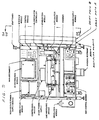
- FIG. 1 A typical prior art excimer laser used in the production of integrated circuits is depicted in FIG. 1.
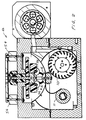
- a cross-section of the laser chamber of this prior art laser is shown in FIG. 2.
- a pulse power system comprised of a commutator module and a compression module and powered by a high voltage power supply module provides electrical pulses to electrodes 6 located in a discharge chamber 8.
- Typical state-of-the-art 1 ArF lasers are operated at a pulse rate of about 1000 Hz with pulse energies of about 10 mJ per pulse if narrow band.
- Typical 1000 Hz broad bond ArF lasers may produce about 50 mJ per pulse.
- the laser gas for an ArF laser, about 0.1% fluorine, 3% argon and the rest neon) at about 3 to 3.5 atmospheres is circulated through the space between the electrodes at velocities of about 25 meters per second. This is done with tangential blower 10 located in the laser discharge chamber.
- the laser gases are cooled with a heat exchanger 11 also located in the chamber and a cold plate (not shown) mounted on the outside of the chamber.
- the natural bandwidth of the excimer lasers is narrowed by a line narrowing module as shown in FIG. 1.
- Commercial excimer laser systems are typically comprised of several modules that may be replaced quickly without disturbing the rest of the system. Principal modules include:
- modules shown in FIG. 1 are designed for quick replacement as individual units to minimize down time to the laser when maintenance is performed.
- Electrodes 6 consists of a cathode and a grounded anode. The anode is supported in this prior art embodiment near the center of the chamber. Flow is counter-clockwise in this view.
- Peaking capacitor 54 is charged prior to each pulse by pulse power system. During the voltage buildup on peaking capacitor 54 a high electric field is created by two preionizers 56 which produce an ion field between the electrodes and as the charge on the peaking capacitor reaches about 16,000 volts, a discharge across the electrode is generated producing the excimer laser pulse and discharging peaking capacitor 54. Following each pulse, the gas flow between the electrodes of about 2.5 cm per millisecond, created by blower 10, is sufficient to provide fresh laser gas between the electrodes in time for the next pulse occurring 1.0 millisecond later.
- a feedback control system measures the output laser energy of each pulse, determines the degree of deviation from a desired pulse energy, and then sends a signal to the control module to adjust the power supply voltage so that the energy of subsequent pulses are close to a desired energy.
- a major advantage of the excimer laser over many other lasers for use as a lithography light source is that the excimer laser beam is naturally very spatially incoherent compared to most other laser sources.
- Laser beams from other potential lithography laser sources such as a quintupled Nd-YAG is highly coherent and as a result would produce speckle if used for a lithography source.
- Techniques have been proposed to minimize the speckle produced by pulse beams from these solid state lasers. For example, see United States Patent No. 5,233,460 which is incorporated herein by reference.
- FIG. 3 shows a pulse delay technique from Patent No. 5,233,460. In this case, the output pulses of a coherent laser beam are split into multiple beams which are each subjected to a different delay and are recombined to greatly reduce the coherence of the beam.
- Optical arrangements for multiplying pulses have been proposed for optical communication.
- the system similar to that shown in FIG. 4 was proposed by Rubenstein in 1969 (C.B. Rubenstein, "Optical Pulse Generator", U.S. Patent No. 3,430,048) for increasing data transmission rates.
- Another pulse multiplying system designed for use in communication was proposed by De Lange (E. O. DeLange et al., "Optical Pulse Multiplexer", (U.S. Patent No. 3,447,856, June 1969) and an example of one of his techniques for multiplying the number of pulses by 32 is shown in FIG. 5.
- optical pulse multiplexer systems designed for optical communication is described in a patent by Herriott and Schulte (U.S. Patent No. 3,501,222).
- the present invention provides an excimer laser with optical pulse multiplication produced by separating a laser beam into a plurality of beams and multiplying the pulse rate in each beam.
- a pulse multiplier optical system receives the laser output beam and produces multiple output beams, each beam having a larger number of pulses with substantially reduced intensity values as compared to the laser output beam.
- CaF 2 flats are used along with maximum reflection mirrors to split the laser beam into four beams each with a 4X increased pulse rate.
- the present invention is particularly important as an improvement to the ArF excimer laser industry to reduce two-photon absorption damage to optical equipment in lithography machines.
- a factor of four reduction in peak power decreases the quantity of two photon absorption damage done by the synthesized four-pulse burst by a factor of about 16 compared to delivering all of the energy in the single pulse emitted by the laser.
- This is a useful method of prolonging the lifetime of very expensive beam delivery systems such as those used in photolithography stepper systems without reducing the total dose available at the wafer.
- the pulse multiplier system is contained in a module which can be pre-aligned and quickly installed on the excimer laser.
- the 193 nm wavelength of the ArF laser is near the practical, short-wavelength limit of the transmission window in common optical materials used with ultraviolet light in the process of integrated circuit lithography.
- the high energy of the ArF laser photon (6.4eV) also increases the probability of nonlinear, two-photon absorption processes.
- the dominant excimer laser beam fused silica absorption is not through the linear absorption coefficient a o but through two-photon absorption.
- Two-photon absorption is the initial step for the formation of color centers (solarization) and compaction (in SiO 2 ), although the processes leading to these two effects are different.
- the two-photon absorption process is nonlinear, increasing as the square of the laser power intensity (W/cm 2 ), because the process requires the presence of two photons simultaneously in the vicinity of the absorbing atom.
- the probability of two photons being at the same place is proportional to the laser beam intensity squared (as measured in watts/cm 2 or photons/second-cm 2 , since the probability of each of the two photons being in the reaction space increases linearly with the intensity.
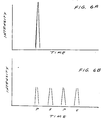
- FIG. 6 shows an optical schematic of a first preferred embodiment of the present invention.
- This is a low loss optical pulse multiplier 52 which quadruples the effective pulse repetition rate of the ArF laser source 50 without significantly reducing the total energy throughput. All pulses leaving the multiplexer propagate along the same beam line with near-perfect overlap.
- ArF laser 50 emits plane-polarized light at a wavelength of 193 nm and at a pulse repetition rate of 1000 Hz.
- a typical beam cross-section is about 0.3 cm x 1.3 cm or about 0.39 cm 2 .
- the pulse energy is about 10 mJ.
- the number of 193 nm photons in each pulse therefore, is about 1 x 10 16 photons which are spread across the beams 0.39 cm 2 cross section.
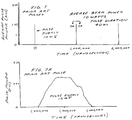
- a typical ArF pulse, as displayed in FIG. 7A has a duration of about 40 ns which gives it a spatial length of about 12 meters. There, the pulse defines a spatial volume of about 468 cm 3 within which these 10 16 photons are traveling. Because the spatial distribution of photons across the cross section of the beam in the horizonal and vertical directions varies by about 30 to 40 percent and because of the temporal variation in intensity generally as indicated in FIG. 7A, the peak density is roughly 2 to 4 times the average density.
- Two photon absorption in UV optics is very significant.
- Two photon absorption can be reduced by either spreading the pulse spatially or temporally. Spatial spreading of the beam means larger optics and this invention does not deal with this alternative.
- the pulse can be spread temporally by changes in the design of the laser to extend the duration of the discharge, and this invention also does not deal with this alternative. This invention permits a passive temporal optical spreading of the pulse.
- the plane of polarization of the ArF laser beam 54 is horizontal, and therefore "P" with respect to the first polarizing beamsplitter it encounters.
- a first quarter wave plate 56 inserted between the laser and a first beamsplitter 58 converts the polarization state to circular.
- One half of the light, the "P” component passes through 50/50 polarizing beamsplitter 58 with no loss other than the scatter and absorption associated with this optical element.
- the other half of the light, the "S” component is reflected into the first, or "A" delay path.
- the next optic encountered is a second quarter wave plate 60 which converts the polarization of the light to circular, and then a second 50/50 polarizing beamsplitter 62, oriented the same way as the first one so it reflects one half of the light into delay path B.
- a second quarter wave plate 60 which converts the polarization of the light to circular
- a second 50/50 polarizing beamsplitter 62 oriented the same way as the first one so it reflects one half of the light into delay path B.
- One half of the "P" polarized light passes straight through this second beamsplitter. This is the first sub-pulse in a burst of 4 sub-pulses to exit the pulse multiplier.
- the "S” component is reflected into delay path "A". After making two passes through a third quarter wave plate 64, reflected by the mirror M1, it is converted to "P", which passes through the first beamsplitter 58.
- the rest of the delay path “A” contains another mirror, M2, and a fourth quarter wave plate 66, which returns the light to the original path, but now as “S” polarization.
- Delay path “A” adds sufficient path length to partially or completely separate the arrival times of pulses #1 and #2 at the sample location.
- the #2 pulse has "S” polarization as originally defined and is reflected toward quarter wave plate 60 which converts the polarization state to circular. Again, one half of this light exits the multiplexer with no further delay.
- Both pulses #1 and #2 send one half of their light to delay path "B" because of the quarter wave plate located ahead of the third beamsplitter.
- Delay path “B” has about twice the path length of delay path "A”.
- These further-delayed pulses become sub-pulses 3 and 4.
- the mirrors M3 and M4 and the two quarter-wave plates in delay path “B” perform the same functions as their counterparts in delay path "A”.
- This sequence is repeated for every pulse of the source laser, so that a 4-pulse burst leaves the multiplexer for each single source laser pulse. There is no significant change in the total energy delivered, but the peak powers experienced by any following optical component are greatly reduced.
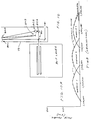
- a laser pulse at 54, leaving the laser is depicted qualitatively in FIG. 6A and the four pulses at 68 leaving beamsplitter 62 is depicted qualitatively in FIG. 6B.
- pulses 1 through 4 arrive with alternating "P" and "S" polarizations according to the initial definition. This becomes meaningless for most optical lens systems in which the angles of incidence do not depart from normal by more than, for example, ⁇ 20 degrees.
- another quarter wave plate can be placed at the output of the invention described to convert all of the "S" and "P” pulses to circular polarization.
- a Pockel's cell can be added at the output and temporally switched to convert 2 of the pulses so that all 4 have the same polarization state.
- a beam multiplier module is attached to a state of the art ArF modular excimer laser used for integrated circuit lithography.
- the module contains optical components to define a delay path A and a delay path B as described with respect to FIG. 6.
- Delay path A is shown in FIG. 9A and delay path B is shown in FIG. 9B.
- Delay path A is about 6 meters, and delay path B is about 12 meters.
- the 6 meter delay path will produce a temporal delay of about 20 nS, and the 12 meter delay will produce a delay of about 40 nS.
- FIG. 7 represents a typical pulse laser beam of a state of the art ArF laser operating at 1000 Hz with 10 mJ pulses.
- the pulse duration is about 40 nS, and the general temporal shape of a typical single pulse is shown in FIG. 7A.
- the average pulse power is about 250 kw, and the peak pulse power is about 300 kw.
- the reader should note that the 40 ns duration pulse (on the 2-1/2 millisecond time scale) appear as three vertical lines on FIG. 7.
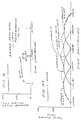
- FIG. 8A shows four pulses created by the FIGS. 9, 9A and 9B pulse multiplying module.
- Sub-pulse 1 appearing at 1,000,000 ns after time zero is not delayed at all as compared to the original pulse.
- Sub-pulses 2, 3 and 4 are delayed 20 nS, 40 ns and 60 ns respectively, and each pulse carries about 2.5 mJ.
- the four sub-pulses follow the same beam path on exiting the multiplexer and form a composite pulse having substantially all of the energy of the original pulse of 10 mJ, but the pulse is now spread over about 100 ns and the average composite pulse power has been reduced from about 250 kw to 100 kw, and the peak pulse power has been reduced from about 300 kw to about 150 kw.
- a pulse multiplying technique similar to that described by Partlo and Oldham in U.S. Patent No. 5,233,460 for coherence reduction is used in a pulse multiplier module 79 to reduce the intensity of ArF excimer laser pulses.
- beamsplitter 80 has one surface which is anti-reflection coated and the other surface coated for partial reflectance and partial transmission.
- R s the reflectance of the beam-splitter
- R p for the P-polarization.
- the transmittance (1-R s ) for the S-polarization and (1-R p ) for the P-polarization.
- the stage is aligned such that the laser source is incident with its energy in the P-polarized state.
- a fraction equal to R p of the incident energy will be reflected by the beam-splitter which (1-R p ) will pass through the beamsplitter and then on to the 45 degree mirrors.
- Two 45 degree mirrors 82A and 82B are arranged so that they transmit the beam up and over, changing both its direction of travel and its polarization relative to its direction of travel.
- the beam is then incident on three normal minors 84A, 84B and 84C directing it back to beamsplitter 80 after a total delay path of about 30 feet to provide a 30 ns pulse delay.
- the pulse After making a full traversal of the delay arm, the pulse encounters the beamsplitter again, but this time in the S-polarization state, and thus S s will be reflected which (1-R s ) will be transmitted and travel along the same path as the original reflected fraction. At this point there remains (1-R p )R s of the original laser pulse energy inside the delay arm. This energy is again rotated by the two 45 degree mirrors and travels via the normal mirror back once again to the beamsplitter. The polarization has now returned to the P state and thus the beamsplitter will transmit (1-R p ) of this energy.
- FIG. 11 A third preferred embodiment of the present invention is shown in FIG. 11. This embodiment is substantially the same as the one described above except the polarization of the beam is not rotated.
- the multiplier module 89 comprises a beamsplitter 90 and five total reflection mirrors.
- Beamsplitter 90 is a reflective-transmissive beam splitter and is chosen to reflect 38 percent to the horizontally polarized light exiting the ArF laser as sub-pulse 1 and to transmit about 62 percent of the beam which, as above, is delayed 30 ns before it returns to beamsplitter 90.
- the beam multiplier module is installed on the output side of the laser as indicated in FIG. 9.
- a preferred installation would utilize three pins aligned in a triangular pattern and three alignment bolts aligned in a triangular pattern interspersed with the pins in order to provide angular adjustment of the beam multiplier optics in relation to the laser optics.
- a multiplexer is the only available method of significantly increasing the pulse delivery rate to the optics under test.
- the weakness of multiplexers using quarter wave plates and polarizing beam splitter cubes is the splitter coating itself.
- Such complex multi-layer dielectric coatings are more subject to damage than the samples under test, and so these optics would have to be replaced many times during a 100 billion shot run, at great cost and with the loss of time associated with realignment and recalibration of the system.
- the system shown in FIG. 12 totally eliminates the damage susceptible multi-layer dielectric coatings by replacing the polarizing beam splitter beam cubes with uncoated calcium fluoride flats, and the high reflectivity multi-layer dielectric mirrors in the delay paths with magnesium fluoride - coated aluminum.
- the initial efficiency of the MgF 2 overcoated aluminum does not show reflectivity degradation when exposed to UV at either 248 nm or 193 nm; even at much higher power densities than those required in a low fluence multiplexer.
- the reduced reflectivity associated with the MgF 2 overcoated aluminum mirrors (compared to the multielectric layer type) is of no consequence in the life test mode because of the very small pulse energy density required at the samples under test: ⁇ 0.1mJ/cm 2 , typically.
- Uncoated CaF 2 flats are extremely resistant to UV irradiation damage when compared to beam splitter cubes.
- the required 50/50 beam splitter function is accomplished simply by inserting the CaF 2 flat in the linear polarized beam at the correct angle. Fresnel reflection calculations to determine the necessary single-surface reflectivity of the two-sided CaF 2 flats so that 50/50, reflect/transmit performance is achieved lead to a required single-surface reflectivity close to 34%. The other approximately 16% reflection comes from back surface reflection.
- Calculations to determine the required angle of incidence to produce a single-surface reflection of 34% yield an angle in the vicinity of 72.2 degrees for "S" polarized light.
- the angle can be fine-tuned in practice to account for material absorption and scatter losses, both surface and bulk.
- the multiplexer of FIG. 12 is far more resistant to damage and less complex than multiplexers which use quarter wave plates and multi-layer dielectric coatings, both in the polarizing beam cubes and high reflectivity delay path mirrors.
- a second function of the invention is to provide multiple beam paths so that many targets can be illuminated simultaneously.
- FIG. 12 A layout of a preferred optical system for multiplying pulses and beams is shown in FIG. 12. This layout assumes a horizontally linearly polarized 1000 Hz pulse laser beam leaving laser 20.
- the polarization of the laser beam is rotated 90 degrees to vertical polarization by polarization rotator 22 which preferably is formed by two 45° mirrors. (Of course, the rotator would not be required if the output from the laser were already vertictally polarized, or alternatively the optics to be described below could be arranged vertically to accommodate a horizontal polarization from the laser.)
- the beam strikes a first CaF 2 flat 31 and is split into reflected and transmitted beams of equal intensity.
- the reflected beam is again reflected by MgF 2 mirrors M41 and M42 and is then sent to the center of a second CaF 2 flat 32.
- second CaF 2 flat 32 there are now two beams, each comprised of two pulses separated by the difference in the direct path from flat 31 to flat 32 and the 31 to M41 to M42 to 32 delay-path.
- the path distance difference preferably is about 6 meters.
- Each of the two beams leaving flat 32 are split again by a second CaF 2 flat 34 and a third CaF flat 33.
- Mirrors M43 and M44 form a second delay path of a length approximately twice that of the 31 to M41 to M42 to 32 path.
- the result is two beams (51 and 52) each containing four pulses.
- the mirror pair M45 and M46 form a delay line of the same length as the M43 and M44 path.
- two more beams (53 and 54) containing four pulses are produced.
- the path 34 to 43 to 44 to 35 is greater than path 34 to 35 by about 12 meters.
- path 32 to 45 to 46 to 33 is greater than path 32 to 33 by about 12 meters.
- the pulses are shown with decreasing intensity as they are split by the CaF 2 flats.
- the snap shot pulse width is actually wider than that indicated on FIG. 12 since as stated above the typical pulse width is about 6 meters (i.e., about equal to the difference between the 31-32 and the 31-M41-M42-32 path lengths).
- Each of the four beam paths delivers pulses at 4X the rate of the source laser, and each can be used to expose DUV material samples.
- the effective pulse repetition rate is 4 kHz in the case of a 1 kHz source laser, and 8 kHz in the case of a 2 kHz laser.
- all beam splitters are CaF 2 flats and all maximum reflection mirrors are MgF overcoated aluminum mirrors.
- each of the four beams can be split into an additional 4, resulting in a total of 16 beams for sample exposure, each one delivering an effective pulse repetition rate of 32 kHz. This would allow the data acquisition rate in any one of the beams to exceed current rates by a factor of approximately 80. Also, any of the pulse multiplication techniques described above could be used to multiply pulses either upstream or downstream of this layout.
- FIG. 12 layout would be a two-beam, 2X multiplication layout in which the two beams leaving CaF 2 flat 32 would be utilized, eliminating the rest of the optics shown in FIG. 12.
Landscapes
- Physics & Mathematics (AREA)
- Electromagnetism (AREA)
- Lasers (AREA)
- Engineering & Computer Science (AREA)
- Plasma & Fusion (AREA)
- Optics & Photonics (AREA)
- Exposure Of Semiconductors, Excluding Electron Or Ion Beam Exposure (AREA)
- Exposure And Positioning Against Photoresist Photosensitive Materials (AREA)
Applications Claiming Priority (4)
| Application Number | Priority Date | Filing Date | Title |
|---|---|---|---|
| US09/148,514 US6067311A (en) | 1998-09-04 | 1998-09-04 | Excimer laser with pulse multiplier |
| US148514 | 1998-09-04 | ||
| US09/183,860 US6314119B1 (en) | 1998-09-04 | 1998-10-30 | Excimer laser with pulse and beam multiplier |
| US183860 | 1998-10-30 |
Publications (2)
| Publication Number | Publication Date |
|---|---|
| EP0984531A2 true EP0984531A2 (fr) | 2000-03-08 |
| EP0984531A3 EP0984531A3 (fr) | 2002-09-25 |
Family
ID=26845937
Family Applications (1)
| Application Number | Title | Priority Date | Filing Date |
|---|---|---|---|
| EP99117280A Ceased EP0984531A3 (fr) | 1998-09-04 | 1999-09-02 | Laser à excimer avec multiplicateur d'impulsions et de faisceaux |
Country Status (2)
| Country | Link |
|---|---|
| EP (1) | EP0984531A3 (fr) |
| JP (1) | JP2000091684A (fr) |
Cited By (2)
| Publication number | Priority date | Publication date | Assignee | Title |
|---|---|---|---|---|
| US6389045B1 (en) | 1999-04-19 | 2002-05-14 | Lambda Physik Ag | Optical pulse stretching and smoothing for ArF and F2 lithography excimer lasers |
| CN116018232A (zh) * | 2020-10-13 | 2023-04-25 | 极光先进雷射株式会社 | 玻璃的加工方法 |
Families Citing this family (4)
| Publication number | Priority date | Publication date | Assignee | Title |
|---|---|---|---|---|
| US7379651B2 (en) * | 2003-06-10 | 2008-05-27 | Abu-Ageel Nayef M | Method and apparatus for reducing laser speckle |
| US7995280B2 (en) * | 2004-12-01 | 2011-08-09 | Carl Zeiss Smt Gmbh | Projection exposure system, beam delivery system and method of generating a beam of light |
| JP4627185B2 (ja) * | 2004-12-27 | 2011-02-09 | 株式会社小松製作所 | 光学パルスストレッチ装置における遅延光学路長の設定方法 |
| JP7000117B2 (ja) * | 2016-11-29 | 2022-01-19 | キヤノン株式会社 | ノイズ低減装置およびそれを有する検出装置 |
Family Cites Families (6)
| Publication number | Priority date | Publication date | Assignee | Title |
|---|---|---|---|---|
| US3501222A (en) * | 1965-11-23 | 1970-03-17 | Bell Telephone Labor Inc | Optical pulse generator |
| US3430048A (en) * | 1965-12-17 | 1969-02-25 | Bell Telephone Labor Inc | Optical pulse generator |
| US3447856A (en) * | 1966-10-07 | 1969-06-03 | Bell Telephone Labor Inc | Optical pulse multiplier |
| US4511220A (en) * | 1982-12-23 | 1985-04-16 | The United States Of America As Represented By The Secretary Of The Air Force | Laser target speckle eliminator |
| US5233460A (en) * | 1992-01-31 | 1993-08-03 | Regents Of The University Of California | Method and means for reducing speckle in coherent laser pulses |
| US5891605A (en) * | 1996-01-16 | 1999-04-06 | Lucent Technologies Inc. | Reduction in damage to optical elements used in optical lithography for device fabrication |
-
1999
- 1999-09-02 EP EP99117280A patent/EP0984531A3/fr not_active Ceased
- 1999-09-06 JP JP29144699A patent/JP2000091684A/ja active Pending
Cited By (2)
| Publication number | Priority date | Publication date | Assignee | Title |
|---|---|---|---|---|
| US6389045B1 (en) | 1999-04-19 | 2002-05-14 | Lambda Physik Ag | Optical pulse stretching and smoothing for ArF and F2 lithography excimer lasers |
| CN116018232A (zh) * | 2020-10-13 | 2023-04-25 | 极光先进雷射株式会社 | 玻璃的加工方法 |
Also Published As
| Publication number | Publication date |
|---|---|
| EP0984531A3 (fr) | 2002-09-25 |
| JP2000091684A (ja) | 2000-03-31 |
Similar Documents
| Publication | Publication Date | Title |
|---|---|---|
| US6314119B1 (en) | Excimer laser with pulse and beam multiplier | |
| US7245420B2 (en) | Master-oscillator power-amplifier (MOPA) excimer or molecular fluorine laser system with long optics lifetime | |
| US20030219094A1 (en) | Excimer or molecular fluorine laser system with multiple discharge units | |
| US8654438B2 (en) | Master oscillator-power amplifier drive laser with pre-pulse for EUV light source | |
| US7227881B2 (en) | Master oscillator—power amplifier excimer laser system | |
| US6381257B1 (en) | Very narrow band injection seeded F2 lithography laser | |
| US6389045B1 (en) | Optical pulse stretching and smoothing for ArF and F2 lithography excimer lasers | |
| US7778302B2 (en) | Laser system | |
| US20080144671A1 (en) | Laser system | |
| EP1147581A1 (fr) | Laser au f2 a coupleur de sortie a etalon | |
| KR20040032988A (ko) | 라인 선택되고 두 챔버를 갖춘 에프 투 레이저 시스템 | |
| US6577663B2 (en) | Narrow bandwidth oscillator-amplifier system | |
| US20030016708A1 (en) | Chirp compensation method and apparatus | |
| US20020101900A1 (en) | Molecular fluorine laser with single spectral line and polarized output | |
| US6747741B1 (en) | Multiple-pass interferometric device | |
| EP0984531A2 (fr) | Laser à excimer avec multiplicateur d'impulsions et de faisceaux | |
| US6603788B1 (en) | Resonator for single line selection | |
| US20020021730A1 (en) | Laser with versatile output energy | |
| JP2002094160A (ja) | F2レーザ | |
| US6795473B1 (en) | Narrow band excimer laser with a prism-grating as line-narrowing optical element | |
| US6785316B1 (en) | Excimer or molecular laser with optimized spectral purity | |
| US6690703B1 (en) | Molecular fluorine laser system |
Legal Events
| Date | Code | Title | Description |
|---|---|---|---|
| PUAI | Public reference made under article 153(3) epc to a published international application that has entered the european phase |
Free format text: ORIGINAL CODE: 0009012 |
|
| AK | Designated contracting states |
Kind code of ref document: A2 Designated state(s): AT BE CH CY DE DK ES FI FR GB GR IE IT LI LU MC NL PT SE |
|
| AX | Request for extension of the european patent |
Free format text: AL;LT;LV;MK;RO;SI |
|
| PUAL | Search report despatched |
Free format text: ORIGINAL CODE: 0009013 |
|
| AK | Designated contracting states |
Kind code of ref document: A3 Designated state(s): AT BE CH CY DE DK ES FI FR GB GR IE IT LI LU MC NL PT SE |
|
| AX | Request for extension of the european patent |
Free format text: AL;LT;LV;MK;RO;SI |
|
| 17P | Request for examination filed |
Effective date: 20030310 |
|
| AKX | Designation fees paid |
Designated state(s): DE FR GB NL |
|
| RAP1 | Party data changed (applicant data changed or rights of an application transferred) |
Owner name: CYMER, INC. |
|
| 17Q | First examination report despatched |
Effective date: 20070309 |
|
| STAA | Information on the status of an ep patent application or granted ep patent |
Free format text: STATUS: THE APPLICATION HAS BEEN REFUSED |
|
| 18R | Application refused |
Effective date: 20111112 |