EP0984574B1 - Rückwärtskompatible Fehlerwiederherstellung in Ringsübertragungssystemen mit bidirektionalen multiplexierten geschalteten Sektionen - Google Patents
Rückwärtskompatible Fehlerwiederherstellung in Ringsübertragungssystemen mit bidirektionalen multiplexierten geschalteten Sektionen Download PDFInfo
- Publication number
- EP0984574B1 EP0984574B1 EP99306650A EP99306650A EP0984574B1 EP 0984574 B1 EP0984574 B1 EP 0984574B1 EP 99306650 A EP99306650 A EP 99306650A EP 99306650 A EP99306650 A EP 99306650A EP 0984574 B1 EP0984574 B1 EP 0984574B1
- Authority
- EP
- European Patent Office
- Prior art keywords
- node
- connection
- path
- jumpered
- jumper
- Prior art date
- Legal status (The legal status is an assumption and is not a legal conclusion. Google has not performed a legal analysis and makes no representation as to the accuracy of the status listed.)
- Expired - Lifetime
Links
- 230000005540 biological transmission Effects 0.000 title claims description 52
- 230000002457 bidirectional effect Effects 0.000 title claims description 12
- 238000012545 processing Methods 0.000 claims description 38
- 238000004891 communication Methods 0.000 claims description 24
- 238000000034 method Methods 0.000 claims description 16
- 230000004044 response Effects 0.000 claims description 11
- 230000003287 optical effect Effects 0.000 description 10
- 230000000644 propagated effect Effects 0.000 description 10
- 239000013307 optical fiber Substances 0.000 description 8
- 230000009471 action Effects 0.000 description 6
- 238000012790 confirmation Methods 0.000 description 5
- 238000010586 diagram Methods 0.000 description 5
- 230000000694 effects Effects 0.000 description 5
- 239000000835 fiber Substances 0.000 description 5
- 230000001902 propagating effect Effects 0.000 description 4
- 230000001360 synchronised effect Effects 0.000 description 4
- 230000015556 catabolic process Effects 0.000 description 3
- 230000008859 change Effects 0.000 description 3
- 230000006735 deficit Effects 0.000 description 3
- 238000006731 degradation reaction Methods 0.000 description 3
- 230000008569 process Effects 0.000 description 3
- 230000001934 delay Effects 0.000 description 2
- 230000001419 dependent effect Effects 0.000 description 1
- 238000001514 detection method Methods 0.000 description 1
- 230000006870 function Effects 0.000 description 1
- 229910000078 germane Inorganic materials 0.000 description 1
- RGNPBRKPHBKNKX-UHFFFAOYSA-N hexaflumuron Chemical compound C1=C(Cl)C(OC(F)(F)C(F)F)=C(Cl)C=C1NC(=O)NC(=O)C1=C(F)C=CC=C1F RGNPBRKPHBKNKX-UHFFFAOYSA-N 0.000 description 1
- 238000003780 insertion Methods 0.000 description 1
- 230000037431 insertion Effects 0.000 description 1
- 230000008054 signal transmission Effects 0.000 description 1
- PPASLZSBLFJQEF-RKJRWTFHSA-M sodium ascorbate Substances [Na+].OC[C@@H](O)[C@H]1OC(=O)C(O)=C1[O-] PPASLZSBLFJQEF-RKJRWTFHSA-M 0.000 description 1
Images





Classifications
-
- H—ELECTRICITY
- H04—ELECTRIC COMMUNICATION TECHNIQUE
- H04J—MULTIPLEX COMMUNICATION
- H04J3/00—Time-division multiplex systems
- H04J3/02—Details
- H04J3/08—Intermediate station arrangements, e.g. for branching, for tapping-off
- H04J3/085—Intermediate station arrangements, e.g. for branching, for tapping-off for ring networks, e.g. SDH/SONET rings, self-healing rings, meashed SDH/SONET networks
-
- H—ELECTRICITY
- H04—ELECTRIC COMMUNICATION TECHNIQUE
- H04J—MULTIPLEX COMMUNICATION
- H04J2203/00—Aspects of optical multiplex systems other than those covered by H04J14/05 and H04J14/07
- H04J2203/0001—Provisions for broadband connections in integrated services digital network using frames of the Optical Transport Network [OTN] or using synchronous transfer mode [STM], e.g. SONET, SDH
- H04J2203/0028—Local loop
- H04J2203/0039—Topology
- H04J2203/0042—Ring
-
- H—ELECTRICITY
- H04—ELECTRIC COMMUNICATION TECHNIQUE
- H04J—MULTIPLEX COMMUNICATION
- H04J2203/00—Aspects of optical multiplex systems other than those covered by H04J14/05 and H04J14/07
- H04J2203/0001—Provisions for broadband connections in integrated services digital network using frames of the Optical Transport Network [OTN] or using synchronous transfer mode [STM], e.g. SONET, SDH
- H04J2203/0057—Operations, administration and maintenance [OAM]
- H04J2203/006—Fault tolerance and recovery
Definitions
- This invention relates to bidirectional multiplex section-switched ring transmission systems and, more particularly, to a failure restoration method and apparatus for use in such systems.
- bi-directional multiplex section switched self-healing ring transmission systems also referred to herein as bi-directional line-switched rings (BLSRs)
- BLSRs bi-directional line-switched rings
- the length of the restoration path would be looped and may cause signals to traverse the ocean three times for particular fault conditions making the path extremely long, causing long delays and degraded system performance. The long delays and degraded service is extremely undesirable.
- BLSR line switched ring
- each node sends a subsequent node address contained in an APS byte of the K1 and K2 bytes in a multiplexed signal overhead to the subsequent node.
- each node adjacent the trouble sends the address of the node normally connected thereto via the troubled line.
- Each node of the network is provided with a bypass circuit for the APS byte and an address comparison circuit for comparing the address in the APS byte with a current node address.
- Each node closes the bypass circuit and receives the APS byte when the result of comparison proves coincident, and opens the bypass circuit and allows passage of ASP byte when the result proves non-coincident.
- the prior restoration problems resulting from a system transmission path degradation are overcome, in accordance with the principles of the invention, by the use of a jumper flag indicating an establishment of a jumpered connection path, for each active tributary affected by the path degradation.
- the jumpered connection path at an affected node eliminates any unnecessary loop formed in the re-established connection path caused by the loopback connection at that node.
- each node there is stored in memory at each node entries identifying (1) its provisioned (or normal) service connection path and (2) a jumper flag indicating if a jumpered connection path exists.
- a loopback setup complete message received at a node from both the first and second directions, it is determined if a jumpered connection is needed at that node. If a jumpered connection is not needed, conventional BLSR processing is performed. If a jumpered connection is needed, the provisioned connection is taken down, the jumpered connection is put up, a jumper flag is set, and conventional BLSR processing is performed.
- a jumper flag is set at that node. If the jumper flag is set, the jumpered connection is taken down, the provisioned connection is restored, and the jumper flag is reset. If the jumper flag is not set, conventional BLSR processing is performed.
- the present invention describes a communication node for use in a bidirectional multiplex section-switched ring transmission system including a plurality of nodes and a first and second transmission paths, each transmission path including a service path and a protection path interconnecting said plurality of nodes and transporting communications signals around said system from node to node in a different transmission direction, said node detecting a trouble in the transmission path and rerouting a connection around the troubled transmission path, said node CHARACTERIZED BY:
- the operation of the present invention can be programmed into existing node controllers and is compatible with existing restoration procedures.
- each item or block of each figure has a reference designation associated therewith, the first number of which refers to the figure in which that item is first located (e.g., 104 is located in Fig. 1).
- Fig. 1 shows, in simplified form, BLSR transmission system 100, which for brevity and clarity of exposition is shown as including only ring nodes 101 through 104, each incorporating an embodiment of the invention. It will be apparent that additional or fewer ring nodes and different orientation of ring nodes may be employed, as desired.
- Ring nodes 101 through 104 are interconnected by transmission path 110, including service path 110-S and protection path 110-P, in a counter-clockwise direction, and by transmission path 120, including service path 120-S and protection path 120-P, in a clockwise direction.
- transmission paths 110 and 120 are each comprised of two (2) optical fibers. It will be apparent, however, each of transmission paths 110 and 120 could be comprised of a single optical fiber.
- bidirectional multiplex section-switched ring transmission system 100 could be either a two (2) optical fiber or a four (4) optical fiber system.
- each of the fibers in transmission paths 110 and 120 includes service bandwidth and protection bandwidth.
- each of transmission paths 110 and 120 includes an optical fiber for service bandwidth and a separate optical fiber for protection bandwidth.
- Such bidirectional multiplex section-switched ring transmission systems are known.
- transmission of digital signals in the CCITT Synchronous Digital Hierarchy (SDH) digital signal format is assumed.
- SDH Synchronous Digital Hierarchy
- the invention is equally applicable to other digital signal formats, for example, the ANSI SONET digital signal format.
- requests and acknowledgments for protection switch action are transmitted in an Automatic Protection Switch (APS) channel in the SDH multiplex section overhead accompanying the protection paths 110-P and 120-P on each of transmission paths 110 and 120.
- the APS channel in the SDH format, comprises the K1 and K2 bytes (shown in Fig. 6) in the SDH overhead of each of protection paths 110-P and 120-P.
- a "communications circuit" is considered to be a AU-4 SDH digital signal having its entry and exit points on the ring.
- Each of ring nodes 101 through 104 comprises an add-drop multiplexer (ADM).
- ADM add-drop multiplexer
- Such add-drop multiplexer arrangements are known.
- the ADM operates in a transmission sense to pass, i.e., express, signals through the ring node, to add signals at the ring node, to drop signals at the ring node, and to bridge and switch signals, in accordance with the principles of the invention, during a protection switch at the ring node.
- the ADM operates in a transmission sense to pass, i.e., express, signals through the ring node, to add signals at the ring node, to drop signals at the ring node, and to bridge and switch signals, in accordance with the principles of the invention, during a protection switch at the ring node.
- Note that in the event of a loop failure normal "loopbacks" of the affected signals in ring nodes adjacent to (i.e.,border) the failure occur in a well known manner in these bidirectional
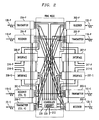
- Fig. 2 shows, in simplified block diagram form, details of ring nodes 101 through 104.
- a clockwise digital signal transmission direction is assumed in the service path 110-S and the protection path 110-P on transmission path 110. It will be apparent that operation of the ring node and the ADM therein would be similar for a counter-clockwise service path 120-S and the protection path 120-P on transmission path 120.
- service path 110-S and protection path 110-P entering the ring node and supplying STM-N SDH optical signals to receiver 201-S and receiver 201-P, respectively, where N is, for example, 16.
- service path 120-S and protection path 120-P entering the ring and supplying STM-N SDH optical signals to receiver 202-S and receiver 202-P, respectively, where N is, for example, 16.
- N is, for example, 16.
- receivers 201 and 202 are identical, and are shown in Fig. 3, to be described below.
- the SDH STM-N optical signals exit the ring node on service path 110-S as an output from transmitter 203-S, on service path 120-S as an output from transmitter 204-S, on protection path 110-P as an output from transmitter 203-P and on protection path 120-P as an output from transmitter 204-P.
- transmitters 203 and 204 are identical and are shown in Fig. 4, to be described below.
- AU-4 SDH output signals from receiver 201-S are routed under control of controller 210 either to transmitter 203-S, i.e., expressed through to service path 110-S, to interface 206-S to be dropped, also to interface 206-S for protection switching to interface 206-P where it will be dropped or to transmitter 203-P to be supplied to protection path 110-P.
- AU-4 SDH output signals from receiver 202-S are routed under control of controller 210 either to transmitter 204-S, i.e., expressed through to service path 120-S, to interface 207-S to be dropped, also to interface 206-S for protection switching to interface 206-P where it will be dropped or to transmitter 204-P to be supplied to protection path 120-P.
- the AU-4 signals from receiver 201-P are supplied either to transmitter 203-P, i.e., expressed through to protection path 110-P, to interface 206-S to be dropped or to transmitter 203-S to be supplied to service path 110-S.
- AU-4 signals from receiver 202-P are routed under control of controller 210 either to transmitter 204-P, i.e., expressed through to protection path 120-P, to interface 207-S to be dropped or to transmitter 204-S to be supplied to service path 120-S.
- AU-4 SDH signals being added and dropped via interface 206-S can be bridged to transmitter 203-P and, hence, protection path 110-P and can be switched from receiver 202-P and, hence, from protection path 120-P, all under control of controller 210.
- AU-4 SDH signals being added and dropped via interface 207-S can be bridged to transmitter 204-P and, hence, protection path 120-P and can be switched from receiver 201-P and, hence, from protection path 110-P, all under control of controller 210.
- Interfaces 206-S, 206-P, 207-S and 207-P are employed to interface to particular duplex links 216-S, 216-P, 217-S and 217, respectively, and could include any desired arrangement.
- interfaces 206 and 207 could include a CEPT-4 digital signal interface to a DSX, a STM-1E (electrical) SDH digital signal interfacing to a DSX, an optical extension interface to an STM-1 SDH optical signal or the like.
- Such interface arrangements are known.
- controller 210 uses the program shown in the flow charts of Fig. 10 (which are stored in memory 220) to control the adding, dropping, and bridging of the signals via interfaces 206 and 207, as well as, the direct bridging and switching of the AU-4 tributaries being added and dropped to and from protection paths 110-P and 120-P. Controller 210 also monitors the status of interfaces 206 and 207 and the digital signals supplied thereto via the control bus arrangement. Specifically, controller 210 monitors interfaces 206 and 207 for a signal failure condition, i.e., loss-of-signal, loss-of-frame, coding violations and the like. The controller also monitors for loopback completion, takedown completion, clear, and other messages.
- a signal failure condition i.e., loss-of-signal, loss-of-frame, coding violations and the like.
- Controller 210 operates to effect the jumpering (signal path to protection path connection), bridging, and switching of communications tributaries at ring nodes, if necessary. Controller 210 communicates with receivers 201 and 202, transmitters 203 and 204 and interfaces 206 and 207 via a control bus arrangement. Specifically, controller 210 monitors the incoming digital signals to determine loss-of-signal, SDH format K bytes (of Fig. 6) and the like. Additionally, controller 210 causes the insertion of appropriate K byte messages (of Fig. 6) for protection switching purposes, examples of which are described below.
- controller 210 is advantageously provisioned via bus 212 with the identities (IDs) of all the communications tributaries passing through the ring node, as well as, those communications tributaries being added and/or dropped at the ring node (stored in tables of Fig. 7 - 9), the identity of all the ring nodes in system 100 and the positions of the ring nodes in system 100 (stored in Fig. 5).
- IDs identities
- controller 210 is advantageously provisioned via bus 212 with the identities (IDs) of all the communications tributaries passing through the ring node, as well as, those communications tributaries being added and/or dropped at the ring node (stored in tables of Fig. 7 - 9), the identity of all the ring nodes in system 100 and the positions of the ring nodes in system 100 (stored in Fig. 5).
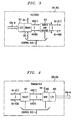
- Fig. 3 shows, in simplified form, details of receivers 201 and 202 of Fig. 2.
- the receiver includes an optical/electrical (O/E) interface 301, demultiplexer (DEMUX) 302 and driver and router 303.
- An STM-N SDH optical signal is supplied to O/E 301 which converts it to an electrical STM-N signal.
- the AUG (1) through AUG (N) signals are supplied to driver and router 303 where they are routed under control of controller 210 via the control bus as AU-4 (1) through AU-4 (M) SDH signals.
- each STM-N signal can include N AUG tributaries, in this example.
- the AU-4 (1) through AU-4 (M) signals are routed under control of controller 210, as described above regarding Fig. 2.
- DEMUX 302 also re-moves STM overhead (OH), and supplies the APS channel K bytes to controller 210 via the control bus.
- Fig. 4 shows, in simplified form, details of transmitters 203 and 204 of Fig. 2.
- the transmitter includes select unit 401, multiplexer (MUX) 402 and etectrical/optical interface (E/O) 403.
- the AUG tributaries are supplied to MUX 402 where overhead (OH) is added to yield an electrical STM-N SDH signal.
- E/O interface 403 converts the STM-N into an optical STM-N for transmission on the corresponding fiber transmission path.
- MUX 402 also inserts appropriate K byte messages under control of controller 210 via the control bus.
- Fig. 5 shows a ring node map table including the node identification (ID) of and relative location of each of ring nodes 101 through 104 of system 100.
- the ring node map table is provisioned via 212 in memory of controller 210.
- the K1 byte indicates a re-quest of a communications tributary for switch action.
- the first four (4) bits of the K1 byte indicate the switch re-quest priority and the last four (4) bits indicate the ring node identification (ID) of the destination ring node.
- the K2 byte indicates an acknowledgment of the requested protection switch action.
- the first four (4) bits of the K2 byte indicate the ring node ID of the source ring node and the last 4 bits indicate the action taken.
- the first four bits of the K1 bytes are "priority" field which indicated the type of system message, e.g., idle, SF-loop, clear, loopback complete, takedown, etc.
- the fifth bit of K2 bytes is a long/short bit which indicates the path length.
- the last three bits of the K2 bytes are called "action taken" field , e.g., idle, FERF (far end remote failure), etc.
- FIGs. 7 - 9 are illustrative node traffic tables for ring nodes 104, 101, and 102, respectively. These node traffic tables include the identification of the ring node communications traffic, i.e., the active communications tributaries, in both the clockwise (CW) direction and the counter-clockwise (CCW) direction of transmission. The active communications tributaries include those being added, dropped, bridged or expressed through the nodes 104, 101, and 102.
- Our illustrative tributary signal "X" connection shown in Fig. 1, enters node 104 and is routed via node 101 and exits at node 102.
- the tables of FIGs 7 - 9 include the IDs of active communications tributaries in the clockwise (CW) direction (shown as 701, 801, and 901, respectively) and counter-CW (CCW) direction (shown as 710, 810, and 910, respectively). These tables identify the tributaries (using AU-4#s), the "provisioned" destination paths of those tributaries, and the jumper statuses. Shown in the node 104 table of Fig. 7 is the AU-4 tributary identification, i.e., X in our example. As previously noted, the number of AU-4 tributaries can be up to 16. As shown in Fig.
- the provisioned connection 711 is designated 102 (s7) indicating that CW service channel 7 carries the X signal to node 102.
- the provisioned connection 811 is designated 104 (s7) indicating that CW service channel 7 carries the X signal from node 104.
- the provisioned connection 911 is designated T (S7) indicating that CW service channel 7 carries the X signal in an express manner, i.e., the X signal passes through rather than entering or exiting at this node.
- the X signal path after the transmission path break is shown as 721, 821, 921 in Figs. 7, 8, and 9 , respectively.
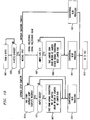
- Fig. 10 is a flow chart illustrating the operation of controller 210, in accordance with the invention, in controlling the operation of the ring nodes in order to effect the bridging and switching of tributary traffic paths in the presence of a ring impairment or removal of the impairment.
- a ring impairment is defined as a failure or degradation of the signals from any cause including failure of the transmission paths or of the equipment. It should be noted that all so-called part-time service which was being transported on the protection paths 110-P and 120-P is preempted upon detection of the failure. Thus, the part-time service is taken off of the protection paths 110- P and 120- P.
- the controller runs the process shown in the flowchart.
- the controller 210 loops between steps 1003 and 1001 perpetually checking for a change in the content of K bytes (of Fig. 6) of an incoming STM-N signal. If a change in the content of the K bytes is detected, then the process continues on to 1005; if not, it returns to 1001.
- the controller will take one of three branches depending on whether the new K-byte content indicates one of the following: (1) signal failure/degrade or clear, (2) loopback setup complete, or (3) loopback takedown complete. All other K-byte content changes are handled according to the rules laid down in the BLSR processing document (ITU-T G.841)
- control is passed to1013, which returns the controller to the wait loop of 1001.
- step involving the jumpered circuits is a null step, for no jumpers can exist at this point.
- step (2) it has been explicitly culled out to make it symmetrical with step (2).
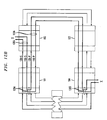
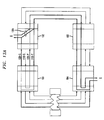
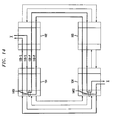
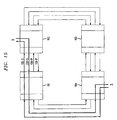
- Figs. 11 through 16 provide an illustration of the operation of the present invention for a single failure occurring within a normally operating ring, and will make reference to Figs. 7 through 10.
- the following description assumes that an X signal tributary connection has been established, in a well known manner, to enter node 104 and traverse node 101 and exit at node 102, as is shown in Fig. 11.
- the node tables for nodes 104, 102, and 101, shown in Figs. 7 - 9, respectively, have stored therein the "provisioned" connection information, in a well known manner, as depicted by 711, 811, and 911.
- a complete fiber cut fault has occurred between nodes 101 and 104.
- a cable cut interrupts the transmission of the X signal tributary (the two directions of the signal being indicated by bold lines).
- Nodes 101 and 104 which border the cable cut, determine that a failure has occurred and propagate a failure message via the K-bytes in both CW and CCW directions.
- both border nodes 101 and 104 are concurrently sending messages to the next node of the system (i.e., node 101 is sending to node 102 and node 104 to node 103).
- the controller When the failure message is received at node 102, the controller, having detected a change in the K-bytes, ceases looping at 1003, checks the message at 1005, and proceeds to step 1007, where it checks the jumper flag.
- the jumper flag In this example, we are assuming that the ring was unimpaired prior to the fiber cut fault, hence the jumper flag is not set, and therefore, control passes directly to step 1011. Normal BLSR processing is performed which consists of putting up a protection pass through 1201, which allows onward propagation of the K-bytes to node 103.
- step 1005 the receipt of the K-bytes at node 104 causes its controller to pass to step 1005.
- step 1005 There are no jumpers, so control passes on to 1011 and normal BLSR operation takes place - in this case this comprises the setting up of signal loopback 1203.
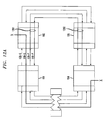
- Fig. 12b shows the signal "X" connection 1205 after each border node 104 and 101 has received the "failure" message which originated from the other border node and has performed a loopback connection.
- step 1011 the controllers of border nodes 101 and 104 then propagated a "loopback complete" confirmation message to the other system nodes. Control at the border nodes then returns, via step 1013, to looping at steps 1001-1003.
- step 1014 the "loopback complete" message from node 101 is received before the one from node 104 arrives, step 1014 is performed, and control is transferred to normal BLSR processing in step 1019, which does nothing further than pass on the "loopback complete" K-bytes.
- step 1014 When the "loopback complete" message from node 104 is received at node 102, it performs step 1014 and proceeds on to step 1015, since the other loopback complete message (i.e., the one from node 101) has already been received.
- step 1015 a jumper is needed, since the X signal tributary will need to be received from (and transmitted to) the right-hand side in order to eliminate the loop formed to the left.
- Step 1017 causes node 102 to remove provisioned connection 1205 and passthrough connection 1206 of Fig. 12b, and put in jumpers (1301 of Figs. 13a and 13b), and set the jumper flag (column 804 of row 821 of Fig. 8). Note that the record of the originally provisioned connection is maintained in the node's memory (column 803 of Fig. 8) for subsequent restoral.
- Node 102 then propagates the loopback completion message CCW to node 101, where per normal BLSR operation, steady state is reached. Control at 102 also returns to steady state (looping at 1001-1003) via step 1013.
- step 1003 the clear message is originated at both of the border nodes 101 and 104 and is propagated via node 102 and 103, respectively.
- step 1007 the jumper flag is checked; since the flag is set indicating that a jumper exists at node 102 (see column 804 and row 821 of Fig. 8) the controller performs step 1009, and (1) the jumpered connection is taken down, (2) normal (i.e., provisioned) circuit connections restored, and (3) the jumper flag reset.
- step 1011 whereupon normal BLSR processing is performed, which in this case means that the nodes propagates the clear message to the next node, 103.
- step 1013 the clear message
- the clear message is similarly processed in node 103, where it is merely passed through since there are no jumpers set at that node.
- the takedown confirmation messages from node 104 is propagated back through nodes 103 and 102 to 101, and similarly the takedown confirmation messages from node 101 is propagated back through nodes 102 and 103 to 104, with regular BLSR processing being performed at all nodes per step 1021 in Fig. 10, and stable operation is reached.
Landscapes
- Engineering & Computer Science (AREA)
- Computer Networks & Wireless Communication (AREA)
- Signal Processing (AREA)
- Small-Scale Networks (AREA)
- Time-Division Multiplex Systems (AREA)
Claims (12)
- Kommunikationsknoten (Fig. 2) zur Verwendung in einem bidirektionalen gemultiplexten abschnittsvermittelten Ringübertragungssystem (Fig. 1) mit mehreren Knoten (101-104) und einem ersten (110) und einem zweiten (120) Übertragungsweg, wobei jeder Übertragungsweg einen Dienstweg und einen Schutzweg enthält, die die mehreren Knoten verbinden und Kommunikationssignale in dem System in einer unterschiedlichen Übertragungsrichtung von Knoten zu Knoten umhertransportieren, wobei der Knoten ein Problem in dem Übertragungsweg erkennt und eine Verbindung neu um den problematischen Übertragungsweg herum routet, wobei der Knoten durch folgendes gekennzeichnet ist:Speicher (202) zum Speichern von Einträgen, die alle Knoten und ihre relativen Positionen in dem System identifizieren, und zum Speichern von Einträgen für jeden der an einem Knoten aktiven Kommunikationszubringer, darunter Einträge, die seinen bereitgestellten Dienstverbindungsweg identifizieren, und ein Rangierflag (804), das anzeigt, ob ein Weg einer rangierten Verbindung (1301) existiert;eine programmierbare Steuerung (200) zum Zugreifen auf Einträge in dem Speicher bzw. Aktualisieren dieser und zum Steuern von Kommunikationszubringern und umfassend:ein auf eine an einem Knoten sowohl aus der ersten als auch aus der zweiten Richtung empfangene Prüfschleifen-Einrichtungsabschlußnachricht reagierendes Bestimmungsmittel (1015) zum Bestimmen, ob eine rangierte Verbindung an diesem Knoten notwendig ist;ein Rangierverbindungsmittel (1017) zum Einrichten einer rangierten Verbindung, wenn das Bestimmungsmittel anzeigt, daß eine rangierte Verbindung an diesem Knoten notwendig ist, wobei die Rangierverbindung durch Abbauen der bereitgestellten Verbindung, Aufbauen der rangierten Verbindung und Setzen eines Rangierflags eingerichtet wird; und das es dem herkömmlichen BLSR-Verarbeitungsmittel erlaubt, BLSR-Verarbeitung durchzuführen;ein BLSR-Verarbeitungsmittel (1019) zum Durchführen von BLSR-Verarbeitung, wenn das Bestimmungsmittel anzeigt, daß keine rangierte Verbindung notwendig ist, oder nachdem das Rangierverbindungsmittel (1017) die rangierte Verbindung eingerichtet hat.
- Knoten nach Anspruch 1, wobei als Reaktion auf eine an diesem Knoten sowohl aus der ersten als auch aus der zweiten Richtung empfangene Prüfschleifen-Abbaunachricht herkömmliche BLSR-Verarbeitung durchgeführt wird.
- Knoten nach Anspruch 1, wobei
als Reaktion auf eine an diesem Knoten sowohl aus der ersten als auch aus der zweiten Richtung empfangene Signalausfall- bzw. -verschlechterungsnachricht bestimmt wird, ob ein Rangierflag an diesem Knoten gesetzt werden soll,
die rangierte Verbindung abgebaut, die bereitgestellte Verbindung wiederhergestellt und das Rangierflag zurückgesetzt wird, wenn das Rangierflag gesetzt ist; und
herkömmliche BLSR-Verarbeitung durchgeführt wird, wenn das Rangierflag nicht gesetzt ist. - Knoten nach einem der Ansprüche 1 bis 3, wobei
als Reaktion auf eine an diesem Knoten sowohl aus der ersten als auch aus der zweiten Richtung empfangene Löschnachricht bestimmt wird, ob ein Rangierflag an diesem Knoten gesetzt ist,
die rangierte Verbindung abgebaut, die bereitgestellte Verbindung wiederhergestellt und das Rangierflag zurückgesetzt wird, wenn das Rangierflag gesetzt ist; und
herkömmliche BLSR-Verarbeitung durchgeführt wird, wenn das Rangierflag nicht gesetzt ist. - Knoten nach Anspruch 1, wobei die Nachricht K-Byte enthält.
- Bidirektionales gemultiplextes abschnittsvermitteltes Ringübertragungssystem (Fig. 1), das die mehreren Knoten (101-104) enthält, wobei jeder Knoten der Knoten nach Anspruch 1 ist.
- System nach Anspruch 6, wobei die rangierte Verbindung nur an Knoten notwendig ist, an denen Verkehr aus dem ersten oder dem zweiten Übertragungsweg ein- oder ausgekoppelt wird.
- Verfahren zum Betrieb eines Knotens (Fig. 2) eines bidirektionalen gemultiplexten abschnittsvermittelten Ringübertragungssystems (100) mit mehreren Knoten (101-104) und einem ersten (110) und einem zweiten (120) Übertragungsweg, wobei jeder Übertragungsweg einen Dienstweg und einen Schutzweg enthält, die die mehreren Knoten verbinden und Kommunikationssignale in dem System in einer unterschiedlichen Übertragungsrichtung von Knoten zu Knoten umhertransportieren, wobei der Knoten ein Problem in dem Übertragungsweg erkennt und eine Verbindung neu um den problematischen Übertragungsweg herum routet, wobei das Verfahren durch die folgenden Schritte gekennzeichnet ist:A. Speichern von Einträgen, die alle Knoten und ihre relativen Positionen in dem System identifizieren;B. Speichern von Einträgen für jeden der an einem Knoten aktiven Kommunikationszubringer, darunter Einträge, die seinen bereitgestellten Dienstverbindungsweg und seinen Weg der rangierten Verbindung (1301) identifizieren, und ein Rangierflag, das anzeigt, ob ein Weg einer rangierten Verbindung existiert;C. als Reaktion auf eine an einem Knoten sowohl aus der ersten als auch aus der zweiten Richtung empfangene Prüfschleifen-Einrichtungsabschlußnachricht Bestimmen, ob eine rangierte Verbindung an diesem Knoten notwendig ist,C1. Durchführen herkömmlicher BLSR-Verarbeitung, wenn keine rangierte Verbindung notwendig ist,C2. Abbauen der bereitgestellten Verbindung, Aufbauen der rangierten Verbindung, Setzen eines Rangierflags und Durchführen herkömmlicher BLSR-Verarbeitung, wenn eine rangierte Verbindung notwendig ist.
- Verfahren nach Anspruch 8, ferner mit dem folgenden Schritt:als Reaktion auf eine an diesem Knoten sowohl aus der ersten als auch aus der zweiten Richtung empfangene Prüfschleifen-Abbaunachricht Durchführen herkömmlicher BLSR-Verarbeitung.
- Verfahren nach einem der Ansprüche 8 oder 9, ferner mit den folgenden Schritten:als Reaktion auf eine an diesem Knoten sowohl aus der ersten als auch aus der zweiten Richtung empfangene Signalausfall- bzw. -verschlechterungsnachricht Bestimmen, ob ein Rangierflag an diesem Knoten gesetzt ist,Abbauen der rangierten Verbindung, Wiederherstellen der bereitgestellten Verbindung und Zurücksetzen des Rangierflags, wenn das Rangierflag gesetzt ist; undDurchführen herkömmlicher BLSR-Verarbeitung, wenn das Rangierflag nicht gesetzt ist.
- Verfahren nach einem der Ansprüche 8, 9 oder 10, ferner mit den folgenden Schritten:als Reaktion auf eine an diesem Knoten sowohl aus der ersten als auch aus der zweiten Richtung empfangene Signalausfall- bzw. -verschlechterungs-Löschnachricht Bestimmen, ob ein Rangierflag an diesem Knoten gesetzt ist,Abbauen der rangierten Verbindung, Wiederherstellen der bereitgestellten Verbindung und Zurücksetzen des Rangierflags, wenn das Rangierflag gesetzt ist; undDurchführen herkömmlicher BLSR-Verarbeitung, wenn das Rangierflag nicht gesetzt ist.
- Verfahren nach Anspruch 8, das an mehreren Knoten des bidirektionalen gemultiplexten abschnittsvermittelten Ringübertragungssystems durchgeführt wird.
Applications Claiming Priority (2)
| Application Number | Priority Date | Filing Date | Title |
|---|---|---|---|
| US146209 | 1998-09-02 | ||
| US09/146,209 US6246667B1 (en) | 1998-09-02 | 1998-09-02 | Backwards-compatible failure restoration in bidirectional multiplex section-switched ring transmission systems |
Publications (3)
| Publication Number | Publication Date |
|---|---|
| EP0984574A2 EP0984574A2 (de) | 2000-03-08 |
| EP0984574A3 EP0984574A3 (de) | 2003-12-03 |
| EP0984574B1 true EP0984574B1 (de) | 2007-03-21 |
Family
ID=22516296
Family Applications (1)
| Application Number | Title | Priority Date | Filing Date |
|---|---|---|---|
| EP99306650A Expired - Lifetime EP0984574B1 (de) | 1998-09-02 | 1999-08-23 | Rückwärtskompatible Fehlerwiederherstellung in Ringsübertragungssystemen mit bidirektionalen multiplexierten geschalteten Sektionen |
Country Status (6)
| Country | Link |
|---|---|
| US (1) | US6246667B1 (de) |
| EP (1) | EP0984574B1 (de) |
| JP (1) | JP3390705B2 (de) |
| AU (1) | AU4588299A (de) |
| CA (1) | CA2278828C (de) |
| DE (1) | DE69935560T2 (de) |
Families Citing this family (35)
| Publication number | Priority date | Publication date | Assignee | Title |
|---|---|---|---|---|
| US7570583B2 (en) | 1997-12-05 | 2009-08-04 | Cisco Technology, Inc. | Extending SONET/SDH automatic protection switching |
| JP3175826B2 (ja) * | 1998-11-24 | 2001-06-11 | 日本電気株式会社 | ネットワーク構成方法およびネットワーク管理ノード |
| US6973267B1 (en) * | 1999-07-01 | 2005-12-06 | Cisco Technology, Inc. | Autoprotected optical communication ring network |
| EP1096712A3 (de) * | 1999-10-29 | 2005-09-07 | Nippon Telegraph and Telephone Corporation | Pfadnetzwerk und Verfahren zur Benutzung des Pfadnetzwerks, das die Konvertierung des Schutzpfades in einen aktiven Pfad verwendet |
| IT1316316B1 (it) * | 2000-02-01 | 2003-04-10 | Cit Alcatel | Metodo di protezione del traffico in reti di trasporto in fibra otticain tecnologia wdm |
| US6920113B1 (en) * | 2000-03-28 | 2005-07-19 | Telsima Inc. | Transport of iscochronous and bursty data on a sonet ring |
| US7085293B2 (en) | 2000-03-28 | 2006-08-01 | Telsima Inc. | Scaleable transport of TDM channels in a synchronous frame |
| EP1161014A1 (de) * | 2000-05-31 | 2001-12-05 | PIRELLI CAVI E SISTEMI S.p.A. | Selbstschützendes optisches Nachrichtenübertragungs-Ringnetzwerk |
| US6965572B1 (en) * | 2000-06-07 | 2005-11-15 | At&T Corp. | Loopback capability for bi-directional multi-protocol label switching traffic engineered trucks |
| US20020059408A1 (en) * | 2000-11-02 | 2002-05-16 | Krishna Pattabhiraman | Dynamic traffic management on a shared medium |
| US20030031126A1 (en) * | 2001-03-12 | 2003-02-13 | Mayweather Derek T. | Bandwidth reservation reuse in dynamically allocated ring protection and restoration technique |
| US6892329B2 (en) * | 2001-04-02 | 2005-05-10 | Corrigent Systems Ltd. | Selective protection for ring topologies |
| US7054264B2 (en) * | 2001-07-24 | 2006-05-30 | Corrigent Systems Ltd. | Interconnect and gateway protection in bidirectional ring networks |
| US7061859B2 (en) | 2001-08-30 | 2006-06-13 | Corrigent Systems Ltd. | Fast protection in ring topologies |
| US6766482B1 (en) | 2001-10-31 | 2004-07-20 | Extreme Networks | Ethernet automatic protection switching |
| US6917986B2 (en) * | 2002-01-07 | 2005-07-12 | Corrigent Systems Ltd. | Fast failure protection using redundant network edge ports |
| US6778492B2 (en) * | 2002-01-17 | 2004-08-17 | Cisco Technology, Inc. | Load balancing for fast reroute backup tunnels |
| US7158721B2 (en) * | 2002-02-25 | 2007-01-02 | Corrigent Systems Ltd. | Performance monitoring of multiple channels in an automatic protection switched network |
| US7151742B1 (en) * | 2002-03-08 | 2006-12-19 | Mindspeed Technologies, Inc. | Flow control for communication ring access control |
| US6801865B2 (en) * | 2002-03-21 | 2004-10-05 | Engage Networks, Inc. | Meter monitoring and tamper protection system and method |
| US7433593B1 (en) * | 2002-06-28 | 2008-10-07 | Ciena Corporation | Switching algorithm for optical fiber networks |
| US7032135B2 (en) * | 2002-08-02 | 2006-04-18 | Corrigent Systems Ltd. | Equipment protection using a partial star architecture |
| US7848249B1 (en) | 2002-09-30 | 2010-12-07 | Cisco Technology, Inc. | Method for computing FRR backup tunnels using aggregate bandwidth constraints |
| US7418493B1 (en) | 2002-09-30 | 2008-08-26 | Cisco Technology, Inc. | Method for computing FRR backup tunnels using aggregate bandwidth constraints |
| US20050058060A1 (en) * | 2003-09-16 | 2005-03-17 | Nortel Networks Limited | K-byte extension and tunnel identifying scheme for tunnel-based shared mesh protection |
| US7974223B2 (en) * | 2004-11-19 | 2011-07-05 | Corrigent Systems Ltd. | Virtual private LAN service over ring networks |
| US7402520B2 (en) * | 2004-11-26 | 2008-07-22 | Applied Materials, Inc. | Edge removal of silicon-on-insulator transfer wafer |
| US7983150B2 (en) * | 2006-01-18 | 2011-07-19 | Corrigent Systems Ltd. | VPLS failure protection in ring networks |
| US7808931B2 (en) * | 2006-03-02 | 2010-10-05 | Corrigent Systems Ltd. | High capacity ring communication network |
| US7593400B2 (en) * | 2006-05-19 | 2009-09-22 | Corrigent Systems Ltd. | MAC address learning in a distributed bridge |
| US7660303B2 (en) | 2006-08-22 | 2010-02-09 | Corrigent Systems Ltd. | Point-to-multipoint functionality in a bridged network |
| US7660234B2 (en) * | 2006-09-22 | 2010-02-09 | Corrigent Systems Ltd. | Fault-tolerant medium access control (MAC) address assignment in network elements |
| CN100589427C (zh) * | 2007-02-14 | 2010-02-10 | 中兴通讯股份有限公司 | 一种以太网自动保护方法 |
| JP4866942B2 (ja) * | 2009-07-09 | 2012-02-01 | 富士通テレコムネットワークス株式会社 | 伝送装置、伝送制御方法およびosc処理装置 |
| CN101998186A (zh) * | 2009-08-13 | 2011-03-30 | 中兴通讯股份有限公司 | 网络保护方法及装置 |
Family Cites Families (7)
| Publication number | Priority date | Publication date | Assignee | Title |
|---|---|---|---|---|
| US5341364A (en) | 1992-06-02 | 1994-08-23 | At&T Bell Laboratories | Distributed switching in bidirectional multiplex section-switched ringtransmission systems |
| US5442623A (en) * | 1992-08-17 | 1995-08-15 | Bell Communications Research, Inc. | Passive protected self healing ring network |
| JPH0795225A (ja) * | 1993-09-20 | 1995-04-07 | Fujitsu Ltd | 双方向リングネットワーク制御方式 |
| JPH07264228A (ja) * | 1994-03-17 | 1995-10-13 | Fujitsu Ltd | パスais発生機能を備えるblsrネットワーク |
| JPH0897841A (ja) * | 1994-09-29 | 1996-04-12 | Hitachi Ltd | パス切替伝送装置の制御方法及びパス切替伝送装置 |
| JP2630283B2 (ja) * | 1994-12-21 | 1997-07-16 | 日本電気株式会社 | リングネットワークシステムのオーダーワイヤ通信制御方法 |
| JP2677244B2 (ja) * | 1995-05-10 | 1997-11-17 | 日本電気株式会社 | プロテクション制御信号伝達システム |
-
1998
- 1998-09-02 US US09/146,209 patent/US6246667B1/en not_active Expired - Lifetime
-
1999
- 1999-07-26 CA CA002278828A patent/CA2278828C/en not_active Expired - Fee Related
- 1999-08-23 EP EP99306650A patent/EP0984574B1/de not_active Expired - Lifetime
- 1999-08-23 DE DE69935560T patent/DE69935560T2/de not_active Expired - Lifetime
- 1999-09-01 AU AU45882/99A patent/AU4588299A/en not_active Abandoned
- 1999-09-02 JP JP24811999A patent/JP3390705B2/ja not_active Expired - Fee Related
Also Published As
| Publication number | Publication date |
|---|---|
| EP0984574A2 (de) | 2000-03-08 |
| AU4588299A (en) | 2000-03-16 |
| DE69935560T2 (de) | 2007-12-06 |
| US6246667B1 (en) | 2001-06-12 |
| JP3390705B2 (ja) | 2003-03-31 |
| CA2278828A1 (en) | 2000-03-02 |
| EP0984574A3 (de) | 2003-12-03 |
| DE69935560D1 (de) | 2007-05-03 |
| CA2278828C (en) | 2003-01-28 |
| JP2000165427A (ja) | 2000-06-16 |
Similar Documents
| Publication | Publication Date | Title |
|---|---|---|
| EP0984574B1 (de) | Rückwärtskompatible Fehlerwiederherstellung in Ringsübertragungssystemen mit bidirektionalen multiplexierten geschalteten Sektionen | |
| EP0573211B1 (de) | Verteilte Vermittlung in einem Ringübertragungssystem mit multiplexten bidirektionalen vermittelten Stufen | |
| EP0590872B1 (de) | Anlage und Verfahren zum selektiven tributären Schalten in einem bidirektionellen Ringvermittlungssystem | |
| US5442620A (en) | Apparatus and method for preventing communications circuit misconnections in a bidirectional line-switched ring transmission system | |
| US5278824A (en) | Dual hubbing in a bidirectional line-switched ring transmission system | |
| US5440540A (en) | Ring interworking between a bidirectional line-switched ring transmission system and another ring transmission system | |
| CA2337352C (en) | Method and apparatus for signaling path restoration information in a mesh network | |
| US8116196B2 (en) | Shared mesh signaling method and apparatus | |
| US6757306B1 (en) | Method and system for intermediate system level 2 transparency using the SONET LDCC | |
| EP0994635B1 (de) | Verfahren und Vorrichtung zur Datenübertragung in synchronen optischen Netzen | |
| JPH07212382A (ja) | 通信システム | |
| JPH07264223A (ja) | ネットワークの信号救済方法および装置 | |
| JP2001016240A (ja) | 光リングネットワーク | |
| EP1217789B1 (de) | Verfahren zur autoregeneration und wiederherstellung von verkehr | |
| JP3226773B2 (ja) | 複数のリングノードのうちの所定のリングノードに用いる方法とリングノード伝送システムにおいて通信回路を確定的にスケルチする方法 | |
| CN1059768C (zh) | 双重连接 |
Legal Events
| Date | Code | Title | Description |
|---|---|---|---|
| PUAI | Public reference made under article 153(3) epc to a published international application that has entered the european phase |
Free format text: ORIGINAL CODE: 0009012 |
|
| AK | Designated contracting states |
Kind code of ref document: A2 Designated state(s): AT BE CH CY DE DK ES FI FR GB GR IE IT LI LU MC NL PT SE |
|
| AX | Request for extension of the european patent |
Free format text: AL;LT;LV;MK;RO;SI |
|
| PUAL | Search report despatched |
Free format text: ORIGINAL CODE: 0009013 |
|
| AK | Designated contracting states |
Kind code of ref document: A3 Designated state(s): AT BE CH CY DE DK ES FI FR GB GR IE IT LI LU MC NL PT SE |
|
| AX | Request for extension of the european patent |
Extension state: AL LT LV MK RO SI |
|
| 17P | Request for examination filed |
Effective date: 20040522 |
|
| AKX | Designation fees paid |
Designated state(s): DE FR GB |
|
| GRAP | Despatch of communication of intention to grant a patent |
Free format text: ORIGINAL CODE: EPIDOSNIGR1 |
|
| GRAS | Grant fee paid |
Free format text: ORIGINAL CODE: EPIDOSNIGR3 |
|
| GRAA | (expected) grant |
Free format text: ORIGINAL CODE: 0009210 |
|
| AK | Designated contracting states |
Kind code of ref document: B1 Designated state(s): DE FR GB |
|
| REG | Reference to a national code |
Ref country code: GB Ref legal event code: FG4D |
|
| REF | Corresponds to: |
Ref document number: 69935560 Country of ref document: DE Date of ref document: 20070503 Kind code of ref document: P |
|
| ET | Fr: translation filed | ||
| PLBE | No opposition filed within time limit |
Free format text: ORIGINAL CODE: 0009261 |
|
| STAA | Information on the status of an ep patent application or granted ep patent |
Free format text: STATUS: NO OPPOSITION FILED WITHIN TIME LIMIT |
|
| 26N | No opposition filed |
Effective date: 20071227 |
|
| REG | Reference to a national code |
Ref country code: GB Ref legal event code: 732E Free format text: REGISTERED BETWEEN 20131031 AND 20131106 |
|
| REG | Reference to a national code |
Ref country code: FR Ref legal event code: CD Owner name: ALCATEL-LUCENT USA INC. Effective date: 20131122 |
|
| REG | Reference to a national code |
Ref country code: FR Ref legal event code: GC Effective date: 20140410 |
|
| REG | Reference to a national code |
Ref country code: FR Ref legal event code: RG Effective date: 20141015 |
|
| REG | Reference to a national code |
Ref country code: FR Ref legal event code: PLFP Year of fee payment: 17 |
|
| REG | Reference to a national code |
Ref country code: FR Ref legal event code: PLFP Year of fee payment: 18 |
|
| PGFP | Annual fee paid to national office [announced via postgrant information from national office to epo] |
Ref country code: GB Payment date: 20160819 Year of fee payment: 18 Ref country code: DE Payment date: 20160822 Year of fee payment: 18 |
|
| PGFP | Annual fee paid to national office [announced via postgrant information from national office to epo] |
Ref country code: FR Payment date: 20160822 Year of fee payment: 18 |
|
| REG | Reference to a national code |
Ref country code: DE Ref legal event code: R119 Ref document number: 69935560 Country of ref document: DE |
|
| GBPC | Gb: european patent ceased through non-payment of renewal fee |
Effective date: 20170823 |
|
| REG | Reference to a national code |
Ref country code: FR Ref legal event code: ST Effective date: 20180430 |
|
| PG25 | Lapsed in a contracting state [announced via postgrant information from national office to epo] |
Ref country code: DE Free format text: LAPSE BECAUSE OF NON-PAYMENT OF DUE FEES Effective date: 20180301 Ref country code: GB Free format text: LAPSE BECAUSE OF NON-PAYMENT OF DUE FEES Effective date: 20170823 |
|
| PG25 | Lapsed in a contracting state [announced via postgrant information from national office to epo] |
Ref country code: FR Free format text: LAPSE BECAUSE OF NON-PAYMENT OF DUE FEES Effective date: 20170831 |