EP0984599A2 - Verfahren und Vorrichtung in einem Datennetz zur Abbildung logischer Namen von Datenverarbeitungssystemen auf Adressen und umgekehrt - Google Patents
Verfahren und Vorrichtung in einem Datennetz zur Abbildung logischer Namen von Datenverarbeitungssystemen auf Adressen und umgekehrt Download PDFInfo
- Publication number
- EP0984599A2 EP0984599A2 EP99117215A EP99117215A EP0984599A2 EP 0984599 A2 EP0984599 A2 EP 0984599A2 EP 99117215 A EP99117215 A EP 99117215A EP 99117215 A EP99117215 A EP 99117215A EP 0984599 A2 EP0984599 A2 EP 0984599A2
- Authority
- EP
- European Patent Office
- Prior art keywords
- network
- query
- request
- additional information
- information
- Prior art date
- Legal status (The legal status is an assumption and is not a legal conclusion. Google has not performed a legal analysis and makes no representation as to the accuracy of the status listed.)
- Withdrawn
Links
- 238000000034 method Methods 0.000 title claims abstract description 28
- 238000013507 mapping Methods 0.000 title claims abstract description 12
- 238000012545 processing Methods 0.000 title claims abstract description 7
- 238000003384 imaging method Methods 0.000 claims description 3
- 230000004044 response Effects 0.000 claims description 3
- 230000007246 mechanism Effects 0.000 abstract description 4
- 230000005540 biological transmission Effects 0.000 description 5
- 238000012546 transfer Methods 0.000 description 4
- 230000008569 process Effects 0.000 description 3
- 238000004458 analytical method Methods 0.000 description 2
- 238000013475 authorization Methods 0.000 description 2
- 230000008901 benefit Effects 0.000 description 2
- 241001522296 Erithacus rubecula Species 0.000 description 1
- 238000013500 data storage Methods 0.000 description 1
- 238000011161 development Methods 0.000 description 1
- 230000018109 developmental process Effects 0.000 description 1
- 230000006872 improvement Effects 0.000 description 1
- 238000007726 management method Methods 0.000 description 1
- 238000012552 review Methods 0.000 description 1
- 238000012795 verification Methods 0.000 description 1
Images
Classifications
-
- H—ELECTRICITY
- H04—ELECTRIC COMMUNICATION TECHNIQUE
- H04L—TRANSMISSION OF DIGITAL INFORMATION, e.g. TELEGRAPHIC COMMUNICATION
- H04L61/00—Network arrangements, protocols or services for addressing or naming
Definitions
- the invention relates to a method for mapping logical Names of data processing systems on network addresses and vice versa, in a data network, with one in this network distributed database system which was required for the mapping Contains information.
- the invention further relates to a device for performing the method.
- DNS Domain Name Service
- a domain is also understood to mean groups of hosts (Data processing systems) that are in a logical relationship stand to each other, e.g. B. geographically (domain 'de' for Germany) or organizationally.
- DNS is an online database system that is able to map machine-readable machine names into computer addresses (IP addresses). The information is available everywhere in the data network. In view of the enormous amount of information in this regard, data storage is no longer possible on a central computer. DNS also takes on the task of information management and distribution. The administration of subordinate subdomains is delegated, for example to the corresponding organizations.
- the DNS protocol is supported by DNS servers. This provide a hierarchically ordered namespace to companies and institutions to give machine names an opportunity and determine addresses yourself.
- mapping of logical names to computer addresses must be ambiguous (1: n figure). This is for example the case with information services that are in an 'information pool' provide several information servers, which contain (can) contain the same data. Each of these servers corresponds to a network address (but not necessarily one Computer).
- n figure is Round Robin DNS.
- the different IP addresses not assigned randomly, but after a cyclical one Queue, the so-called round robin procedure. This enables a fairly even distribution the load on the existing computer systems.
- the DNS load balancing procedure also ensures a more even distribution of the calls. A description of this can also be found at Cisco.
- the DNS system When a computer name is requested, the DNS system generates a list of the relevant computers (hosts), sorted according to the current load. This guarantees that the available systems are utilized as evenly as possible.
- the object of the invention is to improve the known Mapping process to specify.
- An image request from a user (this can also be a program or a DNS name server) arrives at a special program, the so-called 'resolver'.
- the resolver usually translates the mapping query into a suitable query (e.g. into a database query). This process can be carried out as before.
- the main advantages of the invention are that all already known mechanisms and programs for imaging from computer addresses to logical computer names to simple ones Way can be used.
- the invention is one Extension and substantial improvement of the procedure, in particular he puts another security measure for Networks against unauthorized access.
- the main focus is on the type of additional used Information received.
- the additional information can, for example, be information included about the user. These can be used for different types Purposes are used, for example for checking a Access authorization. Furthermore, it could be for the individual user a preset 'user profile' already exists, which contains further details.
- Recipient address can be, for example, addresses of a Act corporate nets, i.e. an internal company network. Also An important advantage here is the possibility of verification of access rights, especially in combination with the user address.
- Load balancing such as in the Introduction described. If a first User 'user1' calls an information service, he becomes too exchange data with a slow computer of the service provider (i.e. the name of the information service in the address of the slow computer resolved). If, on the other hand, a second user 'user2' wants to use the same information service, he gets a fast calculator.
- the specified factors can be both as absolute values, however can also be viewed as an upper or lower limit (e.g. minimum quality, Maximum cost).
- additional information is provided a statement about the security of the desired data transmission involved. For example, this is cheap, if several servers with different Encryption methods are available.
- the additional information can also be used to check the admissibility of inquiries. This is not possible with the previous DNS method. In this way, company-internal networks can be secured externally, or access from corporate nets outside can be prevented. Access to access providers that do not originate from registered customers can also be rejected, for example.
- a response can be generated without referring to a to have to access the next DNS server. This reduces the Number of accesses to the DNS server and thus the network load.
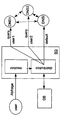
- FIG. 1 shows the route of a query from the user to the DNS server, where the query is then resolved according to known principles.
- An image request is made by a user (user) started. This can be a simple query act like the UNIX command 'nslookup', or a Data transfer request via 'telnet'. But it can also to be a call that is already from another DNS Server processed and passed on according to known mechanisms has been.
- This request is transmitted to a utility program (resolver), which resides in a network element (SG) and has the task of determining a response to the request.
- a utility program resolveer
- SG network element
- DNS server the resolver
- the resolver In order to be able to send an understandable request to the DNS server, the resolver (if it cannot already give the answer itself) must reformulate the request into a so-called 'query'. This procedure corresponds to the already known DNS method.
- the additional information consists of information about the sender, that is, the 'user'. In order to interpret the additional information correctly, further information may be necessary. These are available in a separate database (DB) or from information sources distributed across the network.
- DB database
- the decision to which DNS server the query is then forwarded to is decided in this simple case based on the sender address (i.e. the 'users').
- Üser1 is only authorized in an internal company network (Corporate Network) build connections, he will therefore referenced to DNS Server (DNS1) and can only resolve names from the company network.
- DNS1 DNS Server
- User2 has one Standard access to a special service provider, such as an information database and the query forwarded to a second DNS server (DNS2).
- DNSi DNS server
- the DNS servers are usually through the existing data network connected and give queries as before continue (dashed arrows).
Landscapes
- Engineering & Computer Science (AREA)
- Computer Networks & Wireless Communication (AREA)
- Signal Processing (AREA)
- Computer And Data Communications (AREA)
- Data Exchanges In Wide-Area Networks (AREA)
Abstract
Description
Im weit verbreiteten Internet etwa ist eine solche IP-Adresse 32 Bit lang.
Daher wird ein System benötigt, welches eine Umwandlung von sogenannten Host-Namen, also solchen, die vom Menschen lesbar sind, in Netz-Adressen vornimmt.
Eine ausführliche Beschreibung dieses Dienstes findet sich entweder in den RFCs 1034 und 1035, oder in dem Buch 'DNS und BIND' von Paul Albitz und Cricket Liu.
Die Informationen sind dabei überall im Datennetz verfügbar.
Angesichts der inzwischen ungeheuren Menge an diesbezüglichen Informationen ist die Datenhaltung nicht mehr auf einem zentralen Rechner möglich. DNS übernimmt dabei auch die Aufgabe der Informationsverwaltung und Verteilung.
Die Administration von untergeordneten Subdomains werden dabei delegiert, etwa an die entsprechenden Organisationen.
Das DNS System generiert auf die Anfrage eines Rechnernamens eine Liste der in Frage kommenden Rechner (Hosts), sortiert nach der aktuellen Auslastung. Dies garantiert eine möglichst gleichmäßige Auslastung der zur Verfügung stehenden Systeme.
Dieser stellt die Schnittstelle dar und kann auf die DNS Nameserver zur Ermittlung der gesuchten Adresse zugreifen.
Der Resolver übersetzt in der Regel die Abbildungsanfrage in eine passende Abfrage (z. B. in eine Datenbankquery). Dieser Vorgang kann wie bisher durchgeführt werden.
Das Entscheidungsverfahren (distribution) kann dabei beispielsweise wie folgt vorgehen:
Dabei können etwa firmeninterne Netze nach außen abgesichert werden, bzw. Zugriffe aus Corporate Nets nach 'draußen' verhindert werden. Auch können zum Beispiel Zugriffe auf Zugangsanbieter, welche nicht von eingetragenen Kunden stammen, abgewiesen werden.
Figur 1 den Weg einer Abfrage vom Benutzer bis zum DNS Server, wo die Abfrage dann nach bekannten Prinzipien aufgelöst wird.
Dieses Vorgehen entspricht dem bereits bekannten DNS Verfahren.
Um die Zusatzinformation korrekt interpretieren zu können, sind möglicherweise weitere Angaben notwendig. Diese stehen zur Verfügung, in einer eigenen Datenbank (DB) oder auch aus im Netz verteilten Informationsquellen.
- BIND
- Berkeley Internet Name Domain
- DNS
- Domain-Name Service
- ftp
- File Transfer Protocol
- IP
- Internet Protocol
- ISP
- Internet Service Provider
- MIT
- Massachusetts Institute of Technology
- RFC
- Request for Comments
Paul Albitz & Cricket Liu
deutsche Ausgabe, 1. Auflage 1997, O'Reilly Verlag
DOMAIN NAMES - CONCEPTS AND FACILITIES
P. Mockapetris, November 1987
DOMAIN NAMES - IMPLEMENTATION AND SPECIFICATION
P. Mockapetris, November 1987
DNS, Round Robin DNS, DNS Load Balancing:
http://www.cisco.com/
Claims (9)
- Verfahren zur Abbildung von logischen Namen von Datenverarbeitungssystemen auf Netz-Adressen und umgekehrt, in einem Datennetz, mit einem im Netz verteilten Datenbanksystem, welches die für die Abbildung benötigten Informationen enthält, wobeieine Abbildungsanfrage in einem ersten Netzelement (Resolver) in eine geeignete Abfrage (Query) umformuliert wird, so daßdiese Abfrage von mindestens einem der im Datennetz verteilt existierenden Diensteprogramme (DNS) in geeigneter Weise bearbeitet und/oder weitergeleitet werden kann, um das Abbildungsergebnis zu ermitteln,
dadurch gekennzeichnet, daß
durch Analyse der Abfrage zusätzliche Informationen gewonnen werden, aufgrund derer eine Entscheidung getroffen wird, an welches Dienstprogramm im Datennetz diese Abfrage weitergeleitet werden muß. - Verfahren nach Anspruch 1,
dadurch gekennzeichnet, daß
die zusätzlichen Informationen Angaben über den Absender der Abbildungsanfrage enthalten. - Verfahren nach einem der vorherigen Ansprüche,
dadurch gekennzeichnet, daß
die zusätzlichen Informationen Angaben über den Empfänger der Abbildungsanfrage enthalten. - Verfahren nach einem der vorherigen Ansprüche,
dadurch gekennzeichnet, daß
die zusätzlichen Informationen Angaben über die Qualität des der Abbildungsanfrage zugrundeliegenden Verbindungswunsches enthalten. - Verfahren nach einem der vorherigen Ansprüche,
dadurch gekennzeichnet, daß
die zusätzlichen Informationen Angaben über die Sicherheit des der Abbildungsanfrage zugrundeliegenden Verbindungswunsches enthalten. - Verfahren nach einem der vorherigen Ansprüche,
dadurch gekennzeichnet, daß
anhand der zusätzlichen Informationen die Zulässigkeit der Anfrage oder des Verbindungsaufbauwunsches geprüft wird. - Verfahren nach Anspruch 6,
dadurch gekennzeichnet, daß
bei Erkennen der Unzulässigkeit der Anfrage oder des Verbindungswunsches eine Antwort mit einer Ablehnungsinformation generiert und an das Netzelement (Resolver) zurückgeschickt wird. - Verfahren nach einem der vorherigen Ansprüche,
dadurch gekennzeichnet, daß
die Anfrage an ein vordefiniertes Dienstprogramm (default DNS) weitergeleitet wird, wenn aufgrund der zusätzlichen Informationen keine Entscheidung zugunsten eines speziellen Dienstprogrammes getroffen werden kann. - Vorrichtung zur Bearbeitung von zusätzlichen Informationen bei der Abbildung von logischen Namen von Datenverarbeitungssystemen auf Netzadressen und umgekehrt (SG), in einem Datennetz, mit einem im Netz verteilten Datenbanksystem, welches die für die Abbildung benötigten Informationen enthält,mit Mitteln zum Empfang von Abfragen (query) von einem ersten Netzelement (resolver) undmit Mitteln zum Auswerten der empfangenen Abtrage (distribution) nach zusätzlichen Informationen undmit Mitteln zum Ermitteln eines geeigneten Diensteprogrammes zur Abbildung (DNS) undmit Mitteln zum Weitersenden der empfangenen Query zu dem ausgewählten Diensteprogramm.
Applications Claiming Priority (2)
| Application Number | Priority Date | Filing Date | Title |
|---|---|---|---|
| DE19839804A DE19839804A1 (de) | 1998-09-01 | 1998-09-01 | Verfahren und Vorrichtung in einem Datennetz zur Abbildung logischer Namen von Datenverarbeitungssystemen auf Adressen und umgekehrt |
| DE19839804 | 1998-09-01 |
Publications (2)
| Publication Number | Publication Date |
|---|---|
| EP0984599A2 true EP0984599A2 (de) | 2000-03-08 |
| EP0984599A3 EP0984599A3 (de) | 2003-11-12 |
Family
ID=7879425
Family Applications (1)
| Application Number | Title | Priority Date | Filing Date |
|---|---|---|---|
| EP99117215A Withdrawn EP0984599A3 (de) | 1998-09-01 | 1999-09-01 | Verfahren und Vorrichtung in einem Datennetz zur Abbildung logischer Namen von Datenverarbeitungssystemen auf Adressen und umgekehrt |
Country Status (2)
| Country | Link |
|---|---|
| EP (1) | EP0984599A3 (de) |
| DE (1) | DE19839804A1 (de) |
Family Cites Families (1)
| Publication number | Priority date | Publication date | Assignee | Title |
|---|---|---|---|---|
| US6154777A (en) * | 1996-07-01 | 2000-11-28 | Sun Microsystems, Inc. | System for context-dependent name resolution |
-
1998
- 1998-09-01 DE DE19839804A patent/DE19839804A1/de not_active Withdrawn
-
1999
- 1999-09-01 EP EP99117215A patent/EP0984599A3/de not_active Withdrawn
Non-Patent Citations (2)
| Title |
|---|
| MOCKAPETRIS P: "RFC1034 - Domain Names - Concepts and Facilities", NETWORK WORKING GROUP REQUEST FOR COMMENTS, XX, XX, 1 November 1987 (1987-11-01), XX, pages 1 - 55, XP000864262 * |
| MOCKAPETRIS P: "RFC1035 - DOMAIN NAMES - IMPLEMENTATION AND SPECIFICATION", NETWORK WORKING GROUP REQUEST FOR COMMENTS, XX, XX, 1 November 1987 (1987-11-01), XX, pages 1 - 55, XP000864261 * |
Also Published As
| Publication number | Publication date |
|---|---|
| EP0984599A3 (de) | 2003-11-12 |
| DE19839804A1 (de) | 2000-03-02 |
Similar Documents
| Publication | Publication Date | Title |
|---|---|---|
| DE69720351T2 (de) | Verfahren und Vorrichtung zum Begrenzen des Zugriffes an privater Information in Domänennamensystemen durch Umleitung von Abfrageanforderungen | |
| DE69909839T3 (de) | Optimierte Lokalisierung von Netzwerkbetriebsmittel | |
| DE69838739T2 (de) | Verfahren und Vorrichtung zum Darstellen und Verwenden von Netzwerktopologiedaten | |
| DE69832946T2 (de) | Verteiltes System und Verfahren zur Steuerung des Zugriffs auf Netzmittel und Ereignismeldungen | |
| DE69915441T2 (de) | System und Verfahren für automatischen authentifizierten Zugang zu einer Mehrzahl von Netzbetreibern durch eine einzige Anmeldung | |
| DE69935138T2 (de) | System und Verfahren zur Optimierung der Leistung und der Verfügbarkeit eines DHCP Dienstes | |
| DE60302994T2 (de) | Multicast Router mit Übersetzungsfunktion von Protokollen gemäß Any-Source-Multicast und Source-Specific-Multicast | |
| DE69934871T2 (de) | Verfahren und System zur optimalen Auswahl eines Webfirewalls in einem TCP/IP Netzwerk | |
| DE69929268T2 (de) | Verfahren und System zur Überwachung und Steuerung der Netzzugriffe | |
| DE69524104T2 (de) | Verfahren und gerät für einen lokalen rechnernetzzugang | |
| DE60213391T2 (de) | Persönlicher Firewall mit Positionsdetektion | |
| DE69730906T2 (de) | Namendienst für ein redundantes Internetservernetz | |
| DE69433833T2 (de) | Datenverarbeitungsgerät für Gleichung der Benutzerslast in einem Netz | |
| DE69728182T2 (de) | Verfahren und gerät zum entfernten netzwerkzugriffseintrag und netzwerkzugriffsbericht | |
| DE112013001446B4 (de) | Erkennen von transparenten Einheiten zum Abfangen von Datenübertragungen in Netzwerken | |
| DE69735009T2 (de) | Übertragungssystem | |
| DE69806810T2 (de) | Vorrichtung und verfahren zur übertragbarkeit von elektronischen postaddressen | |
| DE602005000017T2 (de) | Kommunikationsvorrichtung, Verfahren und Programm zur Namenauflösung | |
| DE19910236A1 (de) | Verfahren zur Spracherkennung | |
| EP1364517B1 (de) | Verfahren zur bereitstellung von sonderzeichen beinhaltenden internet-adressen | |
| DE60208719T2 (de) | Verfahren zur bereitstellung einer zugriffsanforderung zu dem selben server auf basis eines einzigen identifiziereres | |
| DE602004006786T2 (de) | Sortierung von Adressen in einem Domainnamenserver | |
| DE69734179T2 (de) | Verfahren und Vorrichtung zum Begrenzen des Zugriffs auf private Information in Domain Name Systemen durch Informationsfilterung | |
| WO1998018093A1 (de) | System und verfahren zum datenaustausch in einem netzwerk | |
| EP0984599A2 (de) | Verfahren und Vorrichtung in einem Datennetz zur Abbildung logischer Namen von Datenverarbeitungssystemen auf Adressen und umgekehrt |
Legal Events
| Date | Code | Title | Description |
|---|---|---|---|
| PUAI | Public reference made under article 153(3) epc to a published international application that has entered the european phase |
Free format text: ORIGINAL CODE: 0009012 |
|
| AK | Designated contracting states |
Kind code of ref document: A2 Designated state(s): AT BE CH CY DE DK ES FI FR GB GR IE IT LI LU MC NL PT SE |
|
| AX | Request for extension of the european patent |
Free format text: AL;LT;LV;MK;RO;SI |
|
| RAP1 | Party data changed (applicant data changed or rights of an application transferred) |
Owner name: GARDEROS SOFTWARE INNOVATIONS GMBH |
|
| PUAL | Search report despatched |
Free format text: ORIGINAL CODE: 0009013 |
|
| AK | Designated contracting states |
Kind code of ref document: A3 Designated state(s): AT BE CH CY DE DK ES FI FR GB GR IE IT LI LU MC NL PT SE |
|
| AX | Request for extension of the european patent |
Extension state: AL LT LV MK RO SI |
|
| RIC1 | Information provided on ipc code assigned before grant |
Ipc: 7H 04L 29/12 B Ipc: 7H 04L 29/06 A |
|
| 17P | Request for examination filed |
Effective date: 20040113 |
|
| 17Q | First examination report despatched |
Effective date: 20040428 |
|
| AKX | Designation fees paid |
Designated state(s): AT BE CH CY DE DK ES FI FR GB GR IE IT LI LU MC NL PT SE |
|
| STAA | Information on the status of an ep patent application or granted ep patent |
Free format text: STATUS: THE APPLICATION IS DEEMED TO BE WITHDRAWN |
|
| 18D | Application deemed to be withdrawn |
Effective date: 20040909 |