EP0984698B1 - Anti-microbial coatings having indicator properties and wound dressings - Google Patents
Anti-microbial coatings having indicator properties and wound dressings Download PDFInfo
- Publication number
- EP0984698B1 EP0984698B1 EP19980902901 EP98902901A EP0984698B1 EP 0984698 B1 EP0984698 B1 EP 0984698B1 EP 19980902901 EP19980902901 EP 19980902901 EP 98902901 A EP98902901 A EP 98902901A EP 0984698 B1 EP0984698 B1 EP 0984698B1
- Authority
- EP
- European Patent Office
- Prior art keywords
- microbial
- layer
- metal
- top layer
- wound dressing
- Prior art date
- Legal status (The legal status is an assumption and is not a legal conclusion. Google has not performed a legal analysis and makes no representation as to the accuracy of the status listed.)
- Expired - Lifetime
Links
Images
Classifications
-
- A—HUMAN NECESSITIES
- A61—MEDICAL OR VETERINARY SCIENCE; HYGIENE
- A61L—METHODS OR APPARATUS FOR STERILISING MATERIALS OR OBJECTS IN GENERAL; DISINFECTION, STERILISATION OR DEODORISATION OF AIR; CHEMICAL ASPECTS OF BANDAGES, DRESSINGS, ABSORBENT PADS OR SURGICAL ARTICLES; MATERIALS FOR BANDAGES, DRESSINGS, ABSORBENT PADS OR SURGICAL ARTICLES
- A61L31/00—Materials for other surgical articles, e.g. stents, stent-grafts, shunts, surgical drapes, guide wires, materials for adhesion prevention, occluding devices, surgical gloves, tissue fixation devices
- A61L31/14—Materials characterised by their function or physical properties, e.g. injectable or lubricating compositions, shape-memory materials, surface modified materials
- A61L31/16—Biologically active materials, e.g. therapeutic substances
-
- A—HUMAN NECESSITIES
- A01—AGRICULTURE; FORESTRY; ANIMAL HUSBANDRY; HUNTING; TRAPPING; FISHING
- A01N—PRESERVATION OF BODIES OF HUMANS OR ANIMALS OR PLANTS OR PARTS THEREOF; BIOCIDES, e.g. AS DISINFECTANTS, AS PESTICIDES OR AS HERBICIDES; PEST REPELLANTS OR ATTRACTANTS; PLANT GROWTH REGULATORS
- A01N59/00—Biocides, pest repellants or attractants, or plant growth regulators containing elements or inorganic compounds
- A01N59/16—Heavy metals; Compounds thereof
-
- A—HUMAN NECESSITIES
- A61—MEDICAL OR VETERINARY SCIENCE; HYGIENE
- A61F—FILTERS IMPLANTABLE INTO BLOOD VESSELS; PROSTHESES; DEVICES PROVIDING PATENCY TO, OR PREVENTING COLLAPSING OF, TUBULAR STRUCTURES OF THE BODY, e.g. STENTS; ORTHOPAEDIC, NURSING OR CONTRACEPTIVE DEVICES; FOMENTATION; TREATMENT OR PROTECTION OF EYES OR EARS; BANDAGES, DRESSINGS OR ABSORBENT PADS; FIRST-AID KITS
- A61F13/00—Bandages or dressings; Absorbent pads
- A61F13/00051—Accessories for dressings
- A61F13/00055—Saturation indicators
-
- A—HUMAN NECESSITIES
- A61—MEDICAL OR VETERINARY SCIENCE; HYGIENE
- A61F—FILTERS IMPLANTABLE INTO BLOOD VESSELS; PROSTHESES; DEVICES PROVIDING PATENCY TO, OR PREVENTING COLLAPSING OF, TUBULAR STRUCTURES OF THE BODY, e.g. STENTS; ORTHOPAEDIC, NURSING OR CONTRACEPTIVE DEVICES; FOMENTATION; TREATMENT OR PROTECTION OF EYES OR EARS; BANDAGES, DRESSINGS OR ABSORBENT PADS; FIRST-AID KITS
- A61F13/00—Bandages or dressings; Absorbent pads
- A61F13/00051—Accessories for dressings
- A61F13/00059—Accessories for dressings provided with visual effects, e.g. printed or colored
-
- A—HUMAN NECESSITIES
- A61—MEDICAL OR VETERINARY SCIENCE; HYGIENE
- A61F—FILTERS IMPLANTABLE INTO BLOOD VESSELS; PROSTHESES; DEVICES PROVIDING PATENCY TO, OR PREVENTING COLLAPSING OF, TUBULAR STRUCTURES OF THE BODY, e.g. STENTS; ORTHOPAEDIC, NURSING OR CONTRACEPTIVE DEVICES; FOMENTATION; TREATMENT OR PROTECTION OF EYES OR EARS; BANDAGES, DRESSINGS OR ABSORBENT PADS; FIRST-AID KITS
- A61F13/00—Bandages or dressings; Absorbent pads
- A61F13/00051—Accessories for dressings
- A61F13/00063—Accessories for dressings comprising medicaments or additives, e.g. odor control, PH control, debriding, antimicrobic
-
- A—HUMAN NECESSITIES
- A61—MEDICAL OR VETERINARY SCIENCE; HYGIENE
- A61F—FILTERS IMPLANTABLE INTO BLOOD VESSELS; PROSTHESES; DEVICES PROVIDING PATENCY TO, OR PREVENTING COLLAPSING OF, TUBULAR STRUCTURES OF THE BODY, e.g. STENTS; ORTHOPAEDIC, NURSING OR CONTRACEPTIVE DEVICES; FOMENTATION; TREATMENT OR PROTECTION OF EYES OR EARS; BANDAGES, DRESSINGS OR ABSORBENT PADS; FIRST-AID KITS
- A61F13/00—Bandages or dressings; Absorbent pads
- A61F13/00987—Apparatus or processes for manufacturing non-adhesive dressings or bandages
- A61F13/00991—Apparatus or processes for manufacturing non-adhesive dressings or bandages for treating webs, e.g. for moisturising, coating, impregnating or applying powder
-
- A—HUMAN NECESSITIES
- A61—MEDICAL OR VETERINARY SCIENCE; HYGIENE
- A61F—FILTERS IMPLANTABLE INTO BLOOD VESSELS; PROSTHESES; DEVICES PROVIDING PATENCY TO, OR PREVENTING COLLAPSING OF, TUBULAR STRUCTURES OF THE BODY, e.g. STENTS; ORTHOPAEDIC, NURSING OR CONTRACEPTIVE DEVICES; FOMENTATION; TREATMENT OR PROTECTION OF EYES OR EARS; BANDAGES, DRESSINGS OR ABSORBENT PADS; FIRST-AID KITS
- A61F13/00—Bandages or dressings; Absorbent pads
- A61F13/01—Non-adhesive bandages or dressings
- A61F13/01008—Non-adhesive bandages or dressings characterised by the material
-
- A—HUMAN NECESSITIES
- A61—MEDICAL OR VETERINARY SCIENCE; HYGIENE
- A61F—FILTERS IMPLANTABLE INTO BLOOD VESSELS; PROSTHESES; DEVICES PROVIDING PATENCY TO, OR PREVENTING COLLAPSING OF, TUBULAR STRUCTURES OF THE BODY, e.g. STENTS; ORTHOPAEDIC, NURSING OR CONTRACEPTIVE DEVICES; FOMENTATION; TREATMENT OR PROTECTION OF EYES OR EARS; BANDAGES, DRESSINGS OR ABSORBENT PADS; FIRST-AID KITS
- A61F13/00—Bandages or dressings; Absorbent pads
- A61F13/01—Non-adhesive bandages or dressings
- A61F13/01021—Non-adhesive bandages or dressings characterised by the structure of the dressing
- A61F13/01029—Non-adhesive bandages or dressings characterised by the structure of the dressing made of multiple layers
-
- A—HUMAN NECESSITIES
- A61—MEDICAL OR VETERINARY SCIENCE; HYGIENE
- A61L—METHODS OR APPARATUS FOR STERILISING MATERIALS OR OBJECTS IN GENERAL; DISINFECTION, STERILISATION OR DEODORISATION OF AIR; CHEMICAL ASPECTS OF BANDAGES, DRESSINGS, ABSORBENT PADS OR SURGICAL ARTICLES; MATERIALS FOR BANDAGES, DRESSINGS, ABSORBENT PADS OR SURGICAL ARTICLES
- A61L15/00—Chemical aspects of, or use of materials for, bandages, dressings or absorbent pads
- A61L15/16—Bandages, dressings or absorbent pads for physiological fluids such as urine or blood, e.g. sanitary towels, tampons
- A61L15/18—Bandages, dressings or absorbent pads for physiological fluids such as urine or blood, e.g. sanitary towels, tampons containing inorganic materials
-
- A—HUMAN NECESSITIES
- A61—MEDICAL OR VETERINARY SCIENCE; HYGIENE
- A61L—METHODS OR APPARATUS FOR STERILISING MATERIALS OR OBJECTS IN GENERAL; DISINFECTION, STERILISATION OR DEODORISATION OF AIR; CHEMICAL ASPECTS OF BANDAGES, DRESSINGS, ABSORBENT PADS OR SURGICAL ARTICLES; MATERIALS FOR BANDAGES, DRESSINGS, ABSORBENT PADS OR SURGICAL ARTICLES
- A61L15/00—Chemical aspects of, or use of materials for, bandages, dressings or absorbent pads
- A61L15/16—Bandages, dressings or absorbent pads for physiological fluids such as urine or blood, e.g. sanitary towels, tampons
- A61L15/42—Use of materials characterised by their function or physical properties
- A61L15/46—Deodorants or malodour counteractants, e.g. to inhibit the formation of ammonia or bacteria
-
- A—HUMAN NECESSITIES
- A61—MEDICAL OR VETERINARY SCIENCE; HYGIENE
- A61L—METHODS OR APPARATUS FOR STERILISING MATERIALS OR OBJECTS IN GENERAL; DISINFECTION, STERILISATION OR DEODORISATION OF AIR; CHEMICAL ASPECTS OF BANDAGES, DRESSINGS, ABSORBENT PADS OR SURGICAL ARTICLES; MATERIALS FOR BANDAGES, DRESSINGS, ABSORBENT PADS OR SURGICAL ARTICLES
- A61L17/00—Materials for surgical sutures or for ligaturing blood vessels ; Materials for prostheses or catheters
- A61L17/005—Materials for surgical sutures or for ligaturing blood vessels ; Materials for prostheses or catheters containing a biologically active substance, e.g. a medicament or a biocide
-
- A—HUMAN NECESSITIES
- A61—MEDICAL OR VETERINARY SCIENCE; HYGIENE
- A61L—METHODS OR APPARATUS FOR STERILISING MATERIALS OR OBJECTS IN GENERAL; DISINFECTION, STERILISATION OR DEODORISATION OF AIR; CHEMICAL ASPECTS OF BANDAGES, DRESSINGS, ABSORBENT PADS OR SURGICAL ARTICLES; MATERIALS FOR BANDAGES, DRESSINGS, ABSORBENT PADS OR SURGICAL ARTICLES
- A61L29/00—Materials for catheters, medical tubing, cannulae, or endoscopes or for coating catheters
- A61L29/14—Materials characterised by their function or physical properties, e.g. lubricating compositions
- A61L29/16—Biologically active materials, e.g. therapeutic substances
-
- A—HUMAN NECESSITIES
- A61—MEDICAL OR VETERINARY SCIENCE; HYGIENE
- A61F—FILTERS IMPLANTABLE INTO BLOOD VESSELS; PROSTHESES; DEVICES PROVIDING PATENCY TO, OR PREVENTING COLLAPSING OF, TUBULAR STRUCTURES OF THE BODY, e.g. STENTS; ORTHOPAEDIC, NURSING OR CONTRACEPTIVE DEVICES; FOMENTATION; TREATMENT OR PROTECTION OF EYES OR EARS; BANDAGES, DRESSINGS OR ABSORBENT PADS; FIRST-AID KITS
- A61F13/00—Bandages or dressings; Absorbent pads
- A61F2013/00089—Wound bandages
- A61F2013/00157—Wound bandages for burns or skin transplants
-
- A—HUMAN NECESSITIES
- A61—MEDICAL OR VETERINARY SCIENCE; HYGIENE
- A61F—FILTERS IMPLANTABLE INTO BLOOD VESSELS; PROSTHESES; DEVICES PROVIDING PATENCY TO, OR PREVENTING COLLAPSING OF, TUBULAR STRUCTURES OF THE BODY, e.g. STENTS; ORTHOPAEDIC, NURSING OR CONTRACEPTIVE DEVICES; FOMENTATION; TREATMENT OR PROTECTION OF EYES OR EARS; BANDAGES, DRESSINGS OR ABSORBENT PADS; FIRST-AID KITS
- A61F13/00—Bandages or dressings; Absorbent pads
- A61F2013/00089—Wound bandages
- A61F2013/00217—Wound bandages not adhering to the wound
- A61F2013/00234—Wound bandages not adhering to the wound metallic layer
-
- A—HUMAN NECESSITIES
- A61—MEDICAL OR VETERINARY SCIENCE; HYGIENE
- A61F—FILTERS IMPLANTABLE INTO BLOOD VESSELS; PROSTHESES; DEVICES PROVIDING PATENCY TO, OR PREVENTING COLLAPSING OF, TUBULAR STRUCTURES OF THE BODY, e.g. STENTS; ORTHOPAEDIC, NURSING OR CONTRACEPTIVE DEVICES; FOMENTATION; TREATMENT OR PROTECTION OF EYES OR EARS; BANDAGES, DRESSINGS OR ABSORBENT PADS; FIRST-AID KITS
- A61F13/00—Bandages or dressings; Absorbent pads
- A61F2013/00361—Plasters
- A61F2013/00365—Plasters use
- A61F2013/00519—Plasters use for treating burn
-
- A—HUMAN NECESSITIES
- A61—MEDICAL OR VETERINARY SCIENCE; HYGIENE
- A61F—FILTERS IMPLANTABLE INTO BLOOD VESSELS; PROSTHESES; DEVICES PROVIDING PATENCY TO, OR PREVENTING COLLAPSING OF, TUBULAR STRUCTURES OF THE BODY, e.g. STENTS; ORTHOPAEDIC, NURSING OR CONTRACEPTIVE DEVICES; FOMENTATION; TREATMENT OR PROTECTION OF EYES OR EARS; BANDAGES, DRESSINGS OR ABSORBENT PADS; FIRST-AID KITS
- A61F13/00—Bandages or dressings; Absorbent pads
- A61F2013/00361—Plasters
- A61F2013/00544—Plasters form or structure
- A61F2013/00582—Properties of backing
- A61F2013/00587—Thickness
-
- A—HUMAN NECESSITIES
- A61—MEDICAL OR VETERINARY SCIENCE; HYGIENE
- A61F—FILTERS IMPLANTABLE INTO BLOOD VESSELS; PROSTHESES; DEVICES PROVIDING PATENCY TO, OR PREVENTING COLLAPSING OF, TUBULAR STRUCTURES OF THE BODY, e.g. STENTS; ORTHOPAEDIC, NURSING OR CONTRACEPTIVE DEVICES; FOMENTATION; TREATMENT OR PROTECTION OF EYES OR EARS; BANDAGES, DRESSINGS OR ABSORBENT PADS; FIRST-AID KITS
- A61F13/00—Bandages or dressings; Absorbent pads
- A61F2013/00361—Plasters
- A61F2013/00902—Plasters containing means
- A61F2013/0091—Plasters containing means with disinfecting or anaesthetics means, e.g. anti-mycrobic
-
- A—HUMAN NECESSITIES
- A61—MEDICAL OR VETERINARY SCIENCE; HYGIENE
- A61F—FILTERS IMPLANTABLE INTO BLOOD VESSELS; PROSTHESES; DEVICES PROVIDING PATENCY TO, OR PREVENTING COLLAPSING OF, TUBULAR STRUCTURES OF THE BODY, e.g. STENTS; ORTHOPAEDIC, NURSING OR CONTRACEPTIVE DEVICES; FOMENTATION; TREATMENT OR PROTECTION OF EYES OR EARS; BANDAGES, DRESSINGS OR ABSORBENT PADS; FIRST-AID KITS
- A61F13/00—Bandages or dressings; Absorbent pads
- A61F2013/00361—Plasters
- A61F2013/00902—Plasters containing means
- A61F2013/00936—Plasters containing means metal
-
- A—HUMAN NECESSITIES
- A61—MEDICAL OR VETERINARY SCIENCE; HYGIENE
- A61F—FILTERS IMPLANTABLE INTO BLOOD VESSELS; PROSTHESES; DEVICES PROVIDING PATENCY TO, OR PREVENTING COLLAPSING OF, TUBULAR STRUCTURES OF THE BODY, e.g. STENTS; ORTHOPAEDIC, NURSING OR CONTRACEPTIVE DEVICES; FOMENTATION; TREATMENT OR PROTECTION OF EYES OR EARS; BANDAGES, DRESSINGS OR ABSORBENT PADS; FIRST-AID KITS
- A61F13/00—Bandages or dressings; Absorbent pads
- A61F2013/00361—Plasters
- A61F2013/00902—Plasters containing means
- A61F2013/0094—Plasters containing means for sensing physical parameters
- A61F2013/00965—Plasters containing means for sensing physical parameters microbiological activity
-
- A—HUMAN NECESSITIES
- A61—MEDICAL OR VETERINARY SCIENCE; HYGIENE
- A61L—METHODS OR APPARATUS FOR STERILISING MATERIALS OR OBJECTS IN GENERAL; DISINFECTION, STERILISATION OR DEODORISATION OF AIR; CHEMICAL ASPECTS OF BANDAGES, DRESSINGS, ABSORBENT PADS OR SURGICAL ARTICLES; MATERIALS FOR BANDAGES, DRESSINGS, ABSORBENT PADS OR SURGICAL ARTICLES
- A61L2300/00—Biologically active materials used in bandages, wound dressings, absorbent pads or medical devices
- A61L2300/10—Biologically active materials used in bandages, wound dressings, absorbent pads or medical devices containing or releasing inorganic materials
- A61L2300/102—Metals or metal compounds, e.g. salts such as bicarbonates, carbonates, oxides, zeolites, silicates
-
- A—HUMAN NECESSITIES
- A61—MEDICAL OR VETERINARY SCIENCE; HYGIENE
- A61L—METHODS OR APPARATUS FOR STERILISING MATERIALS OR OBJECTS IN GENERAL; DISINFECTION, STERILISATION OR DEODORISATION OF AIR; CHEMICAL ASPECTS OF BANDAGES, DRESSINGS, ABSORBENT PADS OR SURGICAL ARTICLES; MATERIALS FOR BANDAGES, DRESSINGS, ABSORBENT PADS OR SURGICAL ARTICLES
- A61L2300/00—Biologically active materials used in bandages, wound dressings, absorbent pads or medical devices
- A61L2300/40—Biologically active materials used in bandages, wound dressings, absorbent pads or medical devices characterised by a specific therapeutic activity or mode of action
- A61L2300/404—Biocides, antimicrobial agents, antiseptic agents
-
- A—HUMAN NECESSITIES
- A61—MEDICAL OR VETERINARY SCIENCE; HYGIENE
- A61L—METHODS OR APPARATUS FOR STERILISING MATERIALS OR OBJECTS IN GENERAL; DISINFECTION, STERILISATION OR DEODORISATION OF AIR; CHEMICAL ASPECTS OF BANDAGES, DRESSINGS, ABSORBENT PADS OR SURGICAL ARTICLES; MATERIALS FOR BANDAGES, DRESSINGS, ABSORBENT PADS OR SURGICAL ARTICLES
- A61L2300/00—Biologically active materials used in bandages, wound dressings, absorbent pads or medical devices
- A61L2300/60—Biologically active materials used in bandages, wound dressings, absorbent pads or medical devices characterised by a special physical form
- A61L2300/606—Coatings
- A61L2300/608—Coatings having two or more layers
-
- Y—GENERAL TAGGING OF NEW TECHNOLOGICAL DEVELOPMENTS; GENERAL TAGGING OF CROSS-SECTIONAL TECHNOLOGIES SPANNING OVER SEVERAL SECTIONS OF THE IPC; TECHNICAL SUBJECTS COVERED BY FORMER USPC CROSS-REFERENCE ART COLLECTIONS [XRACs] AND DIGESTS
- Y10—TECHNICAL SUBJECTS COVERED BY FORMER USPC
- Y10T—TECHNICAL SUBJECTS COVERED BY FORMER US CLASSIFICATION
- Y10T428/00—Stock material or miscellaneous articles
- Y10T428/24—Structurally defined web or sheet [e.g., overall dimension, etc.]
- Y10T428/24777—Edge feature
- Y10T428/24793—Comprising discontinuous or differential impregnation or bond
-
- Y—GENERAL TAGGING OF NEW TECHNOLOGICAL DEVELOPMENTS; GENERAL TAGGING OF CROSS-SECTIONAL TECHNOLOGIES SPANNING OVER SEVERAL SECTIONS OF THE IPC; TECHNICAL SUBJECTS COVERED BY FORMER USPC CROSS-REFERENCE ART COLLECTIONS [XRACs] AND DIGESTS
- Y10—TECHNICAL SUBJECTS COVERED BY FORMER USPC
- Y10T—TECHNICAL SUBJECTS COVERED BY FORMER US CLASSIFICATION
- Y10T428/00—Stock material or miscellaneous articles
- Y10T428/24—Structurally defined web or sheet [e.g., overall dimension, etc.]
- Y10T428/24802—Discontinuous or differential coating, impregnation or bond [e.g., artwork, printing, retouched photograph, etc.]
- Y10T428/24826—Spot bonds connect components
-
- Y—GENERAL TAGGING OF NEW TECHNOLOGICAL DEVELOPMENTS; GENERAL TAGGING OF CROSS-SECTIONAL TECHNOLOGIES SPANNING OVER SEVERAL SECTIONS OF THE IPC; TECHNICAL SUBJECTS COVERED BY FORMER USPC CROSS-REFERENCE ART COLLECTIONS [XRACs] AND DIGESTS
- Y10—TECHNICAL SUBJECTS COVERED BY FORMER USPC
- Y10T—TECHNICAL SUBJECTS COVERED BY FORMER US CLASSIFICATION
- Y10T428/00—Stock material or miscellaneous articles
- Y10T428/249921—Web or sheet containing structurally defined element or component
-
- Y—GENERAL TAGGING OF NEW TECHNOLOGICAL DEVELOPMENTS; GENERAL TAGGING OF CROSS-SECTIONAL TECHNOLOGIES SPANNING OVER SEVERAL SECTIONS OF THE IPC; TECHNICAL SUBJECTS COVERED BY FORMER USPC CROSS-REFERENCE ART COLLECTIONS [XRACs] AND DIGESTS
- Y10—TECHNICAL SUBJECTS COVERED BY FORMER USPC
- Y10T—TECHNICAL SUBJECTS COVERED BY FORMER US CLASSIFICATION
- Y10T428/00—Stock material or miscellaneous articles
- Y10T428/25—Web or sheet containing structurally defined element or component and including a second component containing structurally defined particles
- Y10T428/256—Heavy metal or aluminum or compound thereof
-
- Y—GENERAL TAGGING OF NEW TECHNOLOGICAL DEVELOPMENTS; GENERAL TAGGING OF CROSS-SECTIONAL TECHNOLOGIES SPANNING OVER SEVERAL SECTIONS OF THE IPC; TECHNICAL SUBJECTS COVERED BY FORMER USPC CROSS-REFERENCE ART COLLECTIONS [XRACs] AND DIGESTS
- Y10—TECHNICAL SUBJECTS COVERED BY FORMER USPC
- Y10T—TECHNICAL SUBJECTS COVERED BY FORMER US CLASSIFICATION
- Y10T428/00—Stock material or miscellaneous articles
- Y10T428/28—Web or sheet containing structurally defined element or component and having an adhesive outermost layer
- Y10T428/2848—Three or more layers
Definitions
- the invention relates to anti-microbial coatings formed from one or more antimicrobial metals and to multilayer laminated wound dressings.
- Noble metal ions such as silver and gold ions are known for their anti-microbial activity and have been used in medical care for many years to prevent and treat infection.
- Water soluble silver nitrate has been widely used as an astringent and as a potent anti-microbial solution. For example, 10% silver solution preparations are applied directly to ulcers of the mouth; dressings wetted with 0.5% silver nitrate solutions are used to cover second and third degree burns, especially to protect against gram negative infections; and drops of a 1% silver nitrate solution in the eye is still a legally required treatment in many areas of the world for prophylaxis of ophthalmia neonatorum.
- antimicrobial agents derived from anti-microbial metals such as silver, and wound treatment procedures using same are sought to improve the anti-microbial efficacy of the metal ions, to reduce the frequency of the application of the anti-microbial agent, and to improve infection control in wound treatment. Also needed is a visible indicator of the anti-microbial activity and effect, so as to minimize over application of the anti-microbial agents and unnecessary wound dressing removal, and thus improve patient comfort and minimize sensitivity reactions to anti-microbial metals.
- anti-microbial materials which provide efficacious and sustainable anti-microbial effect. Such materials are described in, for example US Patent 5,454,886, issued October 3, 1995, to Burrell et al.
- the materials are formed as powders, foils, flakes, coatings or thin films from one or more anti-microbial metals so as to contain atomic disorder.
- the inventors made a number of surprising discoveries when working on improvements to the anti-microbial materials formed with atomic disorder described in their previous patent applications. Firstly, they discovered that a thin film of an anti-microbial metal material on a reflective base layer coating, such as a reflective silver coating, was capable of producing an interference colour. By altering the refractive index and/or the thickness of the top layer, different, discernible interference colours were produced. Secondly, they discovered that if the top anti-microbial metal layer was formed with atomic disorder so as to produce an anti-microbial effect when exposed to alcohol or electrolyte, sharp interference colours were produced, providing a useful indicator of activation (release of ions etc.) from medical devices and the like carrying such a coating.
- the present invention extends to a method of indicating exposure of multilayer anti-microbial material formed with atomic disorder to an alcohol or electrolyte through the use of interference colours.
- the invention provides a multilayer anti-microbial material comprising a) a base layer of a partly reflective material capable of generating an interference colour when covered with a partly reflective, partly light transmissive top layer; and b) a top layer formed over said base layer, said top layer being a partly reflective, partly light transmissive thin film containing at least one anti-microbial metal and having a thickness such that an interference colour is produced, said top layer having a refractive index different from that of the base layer, and the anti-microbial metal being formed with sufficient atomic disorder such that the top layer, in contact with an alcohol or water based electrolyte, releases ions, atoms, molecules or clusters of the anti-microbial metal into the alcohol or water based electrolyte at a concentration sufficient to provide a localized anti-microbial effect on a sustainable basis.
- the invention extends to anti-microbial materials in which the top layer is formed above the base layer by such techniques as vapour deposition, and to materials having an in situ generated top layer.
- the base layer might be provided as a substrate (ex. medical device) which is partly reflective such that it can provide an interference colour when covered with a partly reflective, partly transmissive top layer.
- the base layer is formed from a metal selected from Ag, Au, Pt, Pd, Cu, Ta or Al, with Au, Ag, Pt, Pd and Cu being most preferred.
- both the top and base layers are formed from anti-microbial metals formed with atomic disorder.
- the top layer is most preferably formed from Au or Ag.
- the top layer is a composite material formed by depositing the antimicrobial metal in a matrix with atoms or molecules of a different material, wherein the different material provides atomic disorder in the matrix.
- the different material may be a biocompatible metal such as Ta, Ti, Nb, V, Hf, Zn, Mo, Si or Al, or oxides, nitrides, carbides, borides, halides, sulphides or hydrides of such biocompatible metals.
- the different material may be atoms or molecules absorbed or trapped from the atmosphere used in a vapour deposition process, including oxygen, nitrogen, hydrogen, boron, sulphur or halogens.
- the different material may be an oxide, nitride, carbide, boride, halide, sulphide or hydride of an anti-microbial metal.
- the top layer is formed with Ag as the matrix metal, and either or both of silver oxide and absorbed or trapped oxygen as the different material.
- the base layer when provided as a coating on a substrate, is preferably at least 25 nm thick and more preferably at least 60 nm thick. If formed from an atomically disordered antimicrobial metal, the base layer is preferably between about 300 and 2500 nm thick so as to provide a prolonged anti-microbial effect after the top layer is dissolved.
- the top layer is preferably less than 400 nm thick and is more preferably between 5 and 210 nm thick. Most preferably, the top layer is between 40 and 160 nm thick.
- the invention also extends to a process for producing a multilayer anti-microbial material capable of indicating exposure to an alcohol or a water based electrolyte.
- the process includes a) providing a base layer of a partly reflective material capable of generating an interference colour when covered with a partly reflective, partly light transmissive top layer; and b) providing a top layer over said base layer, said top layer being a partly reflective, partly light transmissive thin film containing at least one anti-microbial metal and having a thickness such that an interference colour is produced, said top layer having a refractive index different from that of the base layer, and said anti-microbial metal being formed with sufficient atomic disorder such that the top layer, in contact with an alcohol or water based electrolyte, releases ions, atoms, molecules or clusters of the anti-microbial metal into the alcohol or water based electrolyte at a concentration sufficient to provide a localized anti-microbial effect on a sustainable basis.
- the top layer can be provided by depositing it above the base layer, for instance by vapour deposition, or the top layer can be provided as an in situ generated top layer. In either process, a colour change occurs on contact with an alcohol or water based electrolyte so as to indicate activation of the material.
- the inventors also discovered, when working with wound dressings materials that multilayer wound dressings could be laminated together with the use of ultrasonic welding at intermittent locations, to produce a wound dressing which could be conveniently cut to size, without causing delamination of the layers, and without having to resort to the use of stitching or adhesives to bind the layers together.
- the presence of the ultrasonic welds at intermittent locations on the dressing was surprisingly advantageous over stitched dressings or the use of adhesives, since the ultrasonically welded dressings were found to have excellent conformability properties (i.e. ability to conform to wound and skin contours).
- the ultrasonic welds were also found to only minimally interfere with penetrability properties of the dressings.
- the invention provides a multilayer, laminated wound dressing, including:
- the wound dressing is formed with an anti-microbial coating which is the multilayer anti-microbial material set out above, so as to provide an interference colour indicator of activation on contacting an alcohol or a water based electrolyte.
- Metal or “metals” includes one or more metals whether in the form of substantially pure metals, alloys or compounds such as oxides, nitrides, borides, sulphides, halides or hydrides.
- Anti-microbial metals are metals whose ions have an anti-microbial effect. Preferably, the metal will also be biocompatible. Preferred anti-microbial metals include Ag, Au, Pt, Pd, Ir (i.e. the noble metals), Sn, Cu, Sb, Bi and Zn.
- Biocompatible means non-toxic for the intended utility. Thus, for human utility, biocompatible means non-toxic to humans or human tissues.
- Anti-microbial effect means that atoms, ions, molecules or clusters of the antimicrobial metal (hereinafter “species” of the anti-microbial metal) are released into the alcohol or electrolyte which the material contacts in concentrations sufficient to inhibit bacterial (or other microbial) growth in the vicinity of the material.
- the most common method of measuring anti-microbial effect is by measuring the zone of inhibition (ZOI) created when the material is placed on a bacterial lawn.
- ZOI zone of inhibition
- a relatively small or no ZOI indicates a non useful anti-microbial effect, while a larger ZOI (ex. greater than 5 mm) indicates a highly useful anti-microbial effect.
- ZOI zone of inhibition
- sustained release or “sustainable basis” are used to define release of atoms, molecules, ions or clusters of an anti-microbial metal that continues over time measured in hours or days, and thus distinguishes release of such metal species from the bulk metal, which release such species at a rate and concentration which is too low to achieve an anti-microbial effect, and from highly soluble salts of anti-microbial metals such as silver nitrate, which releases silver ions virtually instantly, but not continuously, in contact with an alcohol or electrolyte.
- Atomic disorder includes high concentrations of: point defects in a crystal lattice, vacancies, line defects such as dislocations, interstitial atoms, amorphous regions, gain and sub grain boundaries and the like relative to its normal ordered crystalline state. Atomic disorder leads to irregularities in surface topography and inhomogeneities in the structure on a nanometer scale.
- Normal ordered crystalline state means the crystallinity normally found in bulk metal materials, alloys or compounds formed as cast, wrought or plated metal products. Such materials contain only low concentrations of such atomic defects as vacancies, grain boundaries and dislocations.
- “Diffusion”, when used to describe conditions which limit diffusion in processes to create and retain atomic disorder i.e. which freeze-in atomic disorder, means diffusion of atoms and/or molecules on the surface or in the matrix of the material being formed.
- Substrate means any surface, usually that of a medical device, which is itself partly reflective, or which can be coated with a partly reflective metal coating by such techniques vapour deposition including evaporation or physical vapour deposition.
- a reflective base layer is provided on a substrate, it does not mean that every substrate needs to have such a layer formed thereon, but is meant to include a substrate which is inherently reflective, such as for instance reflective plates or instruments formed of polymers, metals or dielectrics, such that it can provide an interference colour.
- Medical device means any device, appliance, fixture, fibre, fabric or material intended for a medical, health care or personal hygiene utility, including, without limitation orthopaedic pins, plates, implants, tracheal tubes, catheters, insulin pumps, wound closures, drains, shunts, dressings, connectors, prosthetic devices, pacemaker leads, needles, dental prostheses, ventilator tubes, surgical instruments, wound dressings, incontinent pads, sterile packaging clothing footwear, personal hygiene products such as diapers and sanitary pads, and biomedical/biotechnical laboratory equipment such as tables, enclosures and wall coverings and the like.
- Medical devices may be made of any suitable material, for example metals, including steel, aluminum and its alloys, latex, nylon, silicone, polyester, glass, ceramic, paper, cloth and other plastics and rubbers.
- the device will be made of a bioinert or biocompatible material.
- the device may take on any shape dictated by its utility, ranging from flat sheets to disc, rods and hollow tubes.
- the device may be rigid or flexible, a factor dictated by its intended utility.
- Alcohol or water based electrolyte is meant to include any alcohol or water based electrolyte that the anti-microbial materials of the present invention might contact in order to activate (i.e cause the release of species of the anti-microbial metal) into same.
- the term is meant to include alcohols, water, gels, fluids, solvents, and tissues containing water, including body fluids (for example blood, urine or saliva), and body tissue (for example skin, muscle or bone).
- Cold change is meant to include changes of intensity of light under monochromatic light as well as changes of hue from white light containing more than one wavelength.
- An “interference colour” is produced when light impinges on two or more partly reflective surfaces separated by a distance which bears the right relationship to the wavelength of the light to be removed by destructive interference.
- Partly reflective when used to describe the base or top layer materials, means that the material has a surface which reflects a portion of incident light, but which also transmits a portion of the incident light. Reflection occurs when a ray of incoming light encounters a boundary or interface characterized by a change in refractive index between two media.
- That interface is with air.
- the interface is with the top layer. The reflectance of the base and top layers is balanced so as to generate an interference colour.
- Partly light transmissive when used to describe a thin film of the top layer material means that the thin film is capable of transmitting at least a portion of incident visible light through the thin film.
- Detectable when used to describe a colour change means an observable shift in the dominant wavelength of the reflected light, whether the change is detected by instrument, such as a spectrophotometer, or by the human eye.
- the dominant wavelength is the wavelength responsible for the colour being observed.
- “Wound” means cut, lesion, burn or other trauma to human or animal tissue requiring a wound dressing.
- “Wound dressing” means a covering for a wound.
- the invention provides anti-microbial materials formed with at least two layers, a base layer and a top layer, so as to produce an interference colour. Both layers are partly reflective; the top layer is partly light transmissive.
- the top layer is a thin film containing at least one anti-microbial metal formed with sufficient atomic disorder such that the top layer, in contact with an alcohol or water based electrolyte, releases ions, atoms, molecules or clusters of the anti-microbial metal at a concentration sufficient to provide a localized antimicrobial effect on a sustainable basis.
- the top layer in contact with the alcohol or electrolyte, will undergo a change in optical path length, either by a change in thickness resulting from some dissolution, or through a change in the refractive index of the top layer resulting from a change in the composition of a newly formed thin layer formed on the top layer. Either or both of these results are sufficient to cause a detectable colour change, thus providing an indicator that the top coating has been activated.
- interference colours are known in the art for decorative effects, diffraction gratings and diagnostic assay techniques, and thus the properties of at least two layers of materials necessary to generate an interference colour, that is the balance of reflectance, transmittance, layer thicknesses, and refractive indices of the layers, are generally well known in the art.
- the prior art has generally taught one to anodize a metal to produce a thin layer of a generally transparent oxide above a reflective base metal (see for example US 5,124,172 issued June 23, 1992 to Burrell et al.).
- Other prior art has taught sputter coating certain reflective metals with oxides of same or different metals in order to generate interference colours (see for example US 4,702,955, issued October 27, 1987, to Allred et al.).
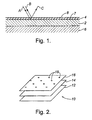
- the anti-microbial materials of this invention and the generation of an interference colour are shown schematically in Figure 1.
- the material includes a base layer 2 and a top layer 4 over the base layer 2.
- the base and top layers 2, 4 are generally provided on a substrate 6, such as the surface of a medical device. However, if the substrate is itself partly reflective, the substrate can serve as the base layer.
- Both the base layer 2 and the top layer 4 are formed from a partly reflective material. In this way, at least a portion of the incoming light is reflected from the surface of the layer while another portion is transmitted through the layer.
- the top layer 4 is partly light transmissive to allow incident light to reach the interface with the base layer 2.
- the top layer 4 thus cannot approximate 100% reflectivity, such as in pure Al or Ag, or interference colours cannot be generated, as is well known in the art.
- the materials for layers 2, 4 should be balanced in their reflectances in order to generate an interference colour.
- the top layer 4 is deposited as a thin film having a thickness which maintains adequate transmittance to generate an interference colour.
- the refractive index for the materials in layers 2, 4 is different, accomplished by differences in their actual or effective compositions. For instance different materials in the two layers will result in the materials having different actual refractive indexes.
- the layers can be deposited with different porosities or different levels/types of atomic disorder, in order to achieve different effective compositions, and thus different refractive indexes.
- incoming light A reflects off the interface 7 of the base and top layers 2, 4.
- Incoming light B reflects from the interface 8 of the top layer 4 with air, and interferes with the light reflected from the interface 7, so as to generate an "interference colour" C.
- the particular colour which is generated and its brightness will depend on the properties of the layers 2, 4, most importantly on the composition of the layers, which determines its transmittance and absorption properties, along with its refractive index, and on the thickness of the layers.
- it is desirable to generate first and second order interference colours by limiting the thickness of the base layer and top layers to minimize the number of internal reflections.
- First and second order interference colours are generally brighter than third and fourth order etc. colours, making them more aesthetically pleasing, more consistently reproducible in manufacturing, and more susceptible to detectable colour change on variations in thickness on dissolution of even a minor amount of the top layer 4.
- the property which determines the particular colour which is generated is the effective optical thickness of the top layer 4, that is the product of the refractive index of the top layer material and the actual thickness of the top layer 4.
- the colour which is desired can be altered by changing the actual thickness or the top layer 4 or its refractive index.
- the base layer 2 is a partly reflective material capable of generating an interference colour when covered with a partly reflective, partly transmissive top layer 4.
- Reflective materials such as polymers, dielectrics or metals may be used in the base layer.
- the base layer 2 may be coated with an additional layer (not shown) to change its reflectance.
- a reflective plastic plate might be coated with a discontinuous (islands) or continuous thin coating of a reflective metal such as silver to produce a base layer whose average reflectance could be better balanced with that of the top layer to generate the desired interference colour effect.
- the material in the base layer 2 is a reflective metal.
- Such metals are known in the art and include, for example one or more of the valve metals, e.g. Ta, Nb, Ti, Zr and Hf, as well as transition metals such as Au, Ag, Pt, Pd, Sn, Cu, V, W and Mo, or the metal Al. More preferably, the base material is formed from Ag, Au, Pt, Pd, Cu, Ta and Al.
- a metal such as tantalum as the base layer 2 may cause reduction of oxide containing materials in the top layer 4.
- a barrier layer such as tantalum oxide formed by anodizing at least a portion of the top surface of the Ta metal, should be included above a tantalum layer.
- Preferred metals for the base layer 2 are the anti-microbial metals Au, Ag, Pt, Pd, Sn and Cu, most preferably Au, Pt and Ag, in a partly reflective form.
- the base layer 2 may be formed by known techniques, such as the vapour deposition techniques of evaporation or physical vapour deposition.
- the base layer 2 is formed as a thin film by physical vapour deposition with atomic disorder, as set out below and in the inventors' previous patent applications, for example US 5,454,889, in order to produce a sustainable anti-microbial effect when the base layer is ultimately exposed to an alcohol or water based electrolyte.
- the thickness of the base layer 2 is generally not critical, provided that it is partly reflective. Preferred thicknesses will vary widely with the material composition and the desired colour. However, in that the layer 2 is preferably a thin film formed by physical vapour deposition techniques, it should be at least about 25 nm thick to create a useful colour.
- the base layer 2 should be greater than 60 nm thick, more preferably 300 to 2500 nm thick, and most preferably 600 to 900 nm thick.
- the top layer 4 is formed of a partly reflective, partly light transmissive thin film containing at least one anti-microbial metal formed with atomic disorder so as to produce a sustainable anti-microbial effect, and ultimate colour change, when exposed to an alcohol or a water based electrolyte.
- the anti-microbial metal is preferably one or more of Ag, Au, Pt, Pd, Ir, Sn, Cu, Sb, Bi, and Zn in a partly reflective, partly transmissive form. More preferably, the anti-microbial metal is Ag, Au, Pt, Pd or Cu.
- the thickness of the top layer 4 formed from these metals is preferably less than 400 nm in order to maintain the preferred level of light transmission.
- the desired thickness will vary with the composition of the top layer 4, and with the desired end colour and colour change.
- the thickness will generally be less than about 400 nm. More preferably, the thickness will range from 5 to 210 nm, most preferably from 10 to 100 nm.
- the top layer 4 may be a thin film of the base layer material, formed with a different refractive index for instance by altering the deposition conditions to change the porosity, composition and/or degree of atomic disorder in the layers 2, 4.
- the top layer 4 may be provided as an in situ generated top layer by virtue of its thickness and/or composition changing on contacting an alcohol or water based electrolyte, so as to produce an interference colour which differs from the initial colour of the base layer 2.
- the top layer 4 is a thin film of a composite material formed by co-, sequentially or reactively depositing an anti-microbial metal in a matrix with atoms or molecules of a different material to create atomic disorder in the matrix, in the manner set out below.
- the different material is selected from a) biocompatible metals, b) oxygen, nitrogen, hydrogen, boron, sulphur or halogens, or c) an oxide, nitride, carbide, boride, halide, sulphide or hydride of either or both of an anti-microbial metal or a biocompatible metal.
- the top layer material is a composite material containing silver, and one or both of silver oxide and atoms or molecules containing oxygen trapped or absorbed in the silver matrix.
- the term "silver oxide” is meant to include any oxide or mixture of oxides of silver.
- the top layer 4 is preferably not formed solely of AgO and/or Ag 2 O, since the solubility of these materials is low for providing a useful anti-microbial effect in accordance with the present invention.
- At least the top layer 4, and preferably also the base layer 2 is formed in a crystalline form from anti-microbial metals with atomic disorder so as to produce an anti-microbial effect.
- the production of atomic disorder through physical vapour deposition techniques is described in the previous patent applications, including U.S. 5,454,886, and as outlined below.
- the anti-microbial metal is deposited as a thin metallic film on one or more surfaces of the substrate, typically a medical device, by vapour deposition techniques.
- Physical vapour techniques which are well known in the art, all deposit the metal from the vapour, generally atom by atom, onto a substrate surface.
- the techniques include vacuum or arc evaporation, sputtering, magnetron sputtering and ion plating.
- the deposition is conducted in a manner to create atomic disorder in the coating as defined hereinabove.
- Various conditions responsible for producing atomic disorder are useful. These conditions are generally those which one has been taught to avoid in thin film deposition techniques, since the object of most thin film depositions is to create a defect free, smooth and dense film (see for example J.A. Thornton, supra ). While such conditions have been investigated in the art, they had not been linked to enhanced solubility of the coatings so-produced prior to Applicants inventions.
- the preferred conditions which are used to create atomic disorder during the deposition process include:
- the metals used in the coating are those known to release ions etc. having an antimicrobial effect, as set out above.
- the metal must also be biocompatible.
- Preferred metals include the noble metals Ag, Au, Pt, Pd, and Ir as well as Sn, Cu, Sb, Bi, and Zn or alloys or compounds of these metals or other metals. Most preferred is Ag or Au, or alloys or compounds of one or more of these metals.
- a thin film is formed on at least a part of the surface of the substrate/medical device.
- the film has a thickness no greater than that needed to provide release of metal ions on a sustainable basis over a suitable period of time, and to generate the desired interference colour.
- the thickness will vary with the particular metal in the coating (which varies the solubility and abrasion resistance), and with the degree of atomic disorder in (and thus the solubility of) the coating. The thickness will be thin enough that the coating does not interfere with the dimensional tolerances or flexibility of the device for its intended utility.
- the anti-microbial effect of the material so produced is achieved when the coated substrate is brought into contact with an alcohol or a water based electrolyte such as, a body fluid or body tissue, thus releasing metal ions, atoms, molecules or clusters.
- concentration of the metal species which is needed to produce an anti-microbial effect will vary from metal to metal.
- anti-microbial effect is achieved in body fluids such as plasma, serum or urine at concentrations less than about 0.5 - 5 ⁇ g/ml.
- the ability to achieve release of metal atoms, ions, molecules or clusters on a sustainable basis from a coating is dictated by a number of factors, including coating characteristics such as composition, structure, solubility and thickness, and the nature of the environment in which the device is used. As the level of atomic disorder is increased, the amount of metal species released per unit time increases. For instance, a silver metal film deposited by magnetron sputtering at T/Tm ⁇ 0.5 and a working gas pressure of about 7 mTorr releases approximately 1/3 of the silver ions that a film deposited under similar conditions, but at 30 mTorr, will release over 10 days. Films that are created with an intermediate structure (ex.
- the time required for total dissolution will be a function of film thickness and the nature of the environment to which they are exposed.
- the relationship in respect of thickness is approximately linear, i.e. a two fold increase in film thickness will result in about a two fold increase in longevity.
- a coating deposited by magnetron sputtering such that the working gas pressure was low (ex. 15 mTorr) for 50% of the deposition time and high (ex. 30 mTorr) for the remaining time, has a rapid initial release of metal ions, followed by a longer period of slow release.
- This type of coating is extremely effective on devices such as urinary catheters for which an initial rapid release is required to achieve immediate anti-microbial concentrations followed by a lower release rate to sustain the concentration of metal ions over a period of weeks.
- the substrate temperature used during vapour deposition should not be so low that annealing or recrystallization of the coating takes place as the coating warms to ambient temperatures or the temperatures at which it is to be used (ex. body temperature).
- This allowable ⁇ T that the temperature differential between the substrate temperature during deposition and the ultimate temperature of use, will vary from metal to metal.
- preferred substrate temperatures of -20 to 200°C, more preferably -10°C to 100°C are used.
- Atomic order may also be achieved, in either or both of the base and top layers 2, 4 in accordance with the present invention, by preparing composite metal materials, that is materials which contain one or more anti-microbial metals in a metal matrix which includes atoms or molecules different from the anti-microbial metals.
- Our preferred technique for preparing a composite material is to co- or sequentially deposit the anti-microbial metal(s) with one or more other inert, biocompatible metals selected from Ta, Ti, Nb, Zn, V, Hf, Mo, Si, Al and alloys of these metals or other metal elements, typically other transition metals.
- inert metals have a different atomic radii from that of the anti-microbial metals, which results in atomic disorder during deposition. Alloys of this kind can also serve to reduce atomic diffusion and thus stabilize the disordered structure.
- Thin film deposition equipment with multiple targets for the placement of each of the anti-microbial and inert metals is preferably utilized.
- the layer(s) of the inert metal(s) should be discontinuous, for example as islands within the anti-microbial metal matrix.
- the final ratio of the anti-microbial metal(s) to inert metal(s) should be greater than about 0.2.
- the most preferable inert metals are Ti, Ta, Zn and Nb. It is also possible to form the anti-microbial coating from oxides, carbides, nitrides, sulphides, borides, halides or hydrides of one or more of the anti-microbial metals and/or one or more of the inert metals to achieve the desired atomic disorder.
- Another composite material within the scope of the present invention is formed by reactively co- or sequentially depositing, by physical vapour techniques, a reacted material into the thin film of the anti-microbial metal(s).
- the reacted material is an oxide, nitride, carbide, boride, sulphide, hydride or halide of the anti-microbial and/or inert metal, formed in situ by injecting the appropriate reactants, or gases containing same, (ex. air, oxygen, water, nitrogen, hydrogen, boron, sulphur, halogens) into the deposition chamber. Atoms or molecules of these gases may also become absorbed or trapped in the metal film to create atomic disorder.
- the reactant may be continuously supplied during deposition for codeposition or it may be pulsed to provide for sequential deposition.
- the final ratio of antimicrobial metal(s) to reaction product should be greater than about 0.2. Air, oxygen, nitrogen and hydrogen are particularly preferred reactants.
- the above deposition techniques to prepare composite coatings may be used with or without the conditions of lower substrate temperatures, high working gas pressures and low angles of incidence previously discussed. One or more of these conditions are preferred to retain and enhance the amount of atomic disorder created in the coating.
- an adhesion layer on the substrate or medical device to be coated, as is known in the art.
- a layer of Ti, Ta or Nb may be first deposited to enhance adhesion of the subsequently deposited anti-microbial coating.
- a barrier layer such as tantalum oxide formed by anodization may be needed, as set out above.
- the wound dressing in accordance with the invention includes at least two, and preferably at least three layers, laminated together by ultrasonic welding.
- a three layer wound dressing in accordance with the invention is shown generally at 10 in Figure 2 to include a first layer 12, which will be wound facing in use, a second layer 14, which preferably forms an absorbent core, and a third, optional layer 16, which forms the outer layer.
- the layers 12, 14 (and optionally 16) are laminated together by ultrasonic welds 18 at intermittent locations across the dressing 10.
- the first layer 12 of the wound dressing 10 is formed of a perforated, preferably non-adherent material which allows for fluids to penetrate or diffuse therethrough in either or both directions.
- the perforated material may be formed of a woven or non-woven, non-woven being preferred, fabric such as cotton, gauze, a polymeric film such as polyethylene, nylon, polypropylene or polyester, an elastomer such as polyurethane or polybutadiene elastomers, or a foam such as open cell polyurethane foam.
- Exemplary perforated, non-adherent materials useful for the wound dressing include non-woven meshes such as DELNETTM P530, which is a non-woven wound veil formed of high density polyethylene using extrusion, embossing and orientation processes, produced by Applied Extrusion Technologies, Inc. Of Middletown, Delaware, USA. This same product is available as Exu-Dry CONFORMANT 2TM Wound Veil, from Frass Survival Systems, Inc., Bronx, New York, USA as a subset of that company's Wound Dressing Roll (Non-Adherent) products.
- DELNETTM P530 is a non-woven wound veil formed of high density polyethylene using extrusion, embossing and orientation processes, produced by Applied Extrusion Technologies, Inc. Of Middletown, Delaware, USA.
- This same product is available as Exu-Dry CONFORMANT 2TM Wound Veil, from Frass Survival Systems, Inc., Bronx, New York, USA as a subset of that company'
- non-woven meshes include CARELLETM or NYLON 90TM, available from Carolina Formed Fabrics Corp., N-TERFACETM, available from Winfield Laboratories, Inc., of Richardson, Texas, USA.
- Exemplary woven meshes may be formed from fibreglass or acetate, or cotton gauze.
- An exemplary hydrophilic polyurethane foam is HYPOLTM, available from W.R. Grace & Co., New York, NY, USA.
- At least one of the first and second layers 12, 14 is formed from a polymeric material which is amenable to ultrasonic welding, that is which will melt on the application of localized heat and then fuse the layers together on cooling.
- the second, absorbent layer is formed from an absorbent material for absorbing moisture from the wound, or as in the case of a burn wound dressing, for holding moisture next to the wound.
- the absorbent material is an absorbent needle punched non-woven rayon/polyester core such as SONTARATM 8411, a 70/30 rayon/polyester blend commercially available from Dupont Canada, Mississauga, Ontario, Canada. This product is sold by National Patent Medical as an American White Cross sterile gauze pad.
- other suitable absorbent materials include woven or non-woven materials, non-woven being preferred made from fibers such as rayon, polyester, rayon/polyester, polyester/cotton, cotton and cellulosic fibers. Exemplary are creped cellulose wadding, an air felt of air laid pulp fibers, cotton, gauze, and other well known absorbent materials suitable for wound dressings.
- the third layer 16 of the wound dressing 10 is optional, but is preferably included to regulate moisture loss, or to act as a barrier layer (for example for moisture, oxygen penetration), to carry an anti-microbial coating, or alternatively to act as an adhesive layer to anchor the wound dressing around the wound.
- the third layer 16 is preferably formed of perforated, non-adherent material such as used in the first layer 12. This allows moisture penetration as sterile water and the like are added.
- Additional layers may be included between or above the first, second and third layers 12, 24, 16, as is well known in wound dressings.
- first, second and third layer as used herein and in the claims is not meant to exclude such additional layers.
- the first and second layers are laminated together at intermittent spaced locations across the dressing 10 by ultrasonic welds 18.
- Ultrasonic welding is a known technique in the quilting art, and thus will not be discussed at length. Briefly, heat (generated ultrasonically) and pressure are applied to either side of the dressing 10 at localized spots through an ultrasonic horn so as to cause melting of at least one of the plastic materials in the first and second layers 12, 14, and the subsequent bonding together of the layers on cooling.
- the welds appear at localized circular spots and are preferably less than 0.5 cm in diameter. If the third layer 16 is present, the ultrasonic welding can be performed from either side of the dressing, and will bind all three layers 12, 14 and 16 together.
- the use of ultrasonic welding of the layers at spaced locations has the advantage of retaining the absorbent and moisture penetration properties of the layers 12, 14, while retaining the conforming properties of the dressing. Edge seams, stitching and adhesives have the disadvantage of interfering with one or more of these desirable properties of wound dressings.
- the wound dressing may be cut to smaller sizes, as needed, without causing delamination. Preferred spacings of about 2.5 cm between welds allows the dressing to be cut down to about 2.5 cm sizes, while maintaining at least one weld to hold the laminated layers together.
- the wound dressing of this invention preferably includes an anti-microbial coating formed from an anti-microbial metal.
- the coating is applied to one or more of the layers 12, 14, 16, but is most preferably applied at least to the first, wound facing layer 12 to provide a localized anti-microbial effect next to the wound.
- the coating may also be applied to the outer layer 16 for additional anti-microbial effect.
- the coating is most preferably formed with atomic disorder in accordance with the procedures set out above and as described in US Patent 5,454,886.
- the coating is formed as a multilayer anti-microbial coating, as set above, to produce an interference colour.
- the coating provides not only an anti-microbial effect to limit infection, but also acts as an indicator of activation of the dressing.
- an electrolyte such as wound exudate, blood or added water
- even minor dissolution of the anti-microbial metal results in a detectable colour change, indicating that an anti-microbial effect is being provided. If there is no colour change, additional moisture might be provided to the coating by adding water, until a colour change is detected.
- wound exudates are usually sufficient to activate the coating. Once activated, the dressing should be maintained in a moist condition by the addition of sterile water if necessary.
- Wound dressings with anti-microbial coatings of an anti-microbial metal formed with atomic disorder are preferably sterilized without applying excessive thermal energy, which can anneal out the atomic disorder, thereby reducing or eliminating a useful anti-microbial effect.
- Gamma radiation is preferred for sterilizing such wound dressings, as discussed in US Patent 5,454,886.
- the sterilized wound dressings should be sealed in air tight packaging which excludes light penetration to avoid additional oxidation of the anti-microbial coating.
- Metallized polyester peelable pouches are preferred.
- the shelf life of anti-microbial wound dressings thus sealed is over one year.
- Bi-layer metal coatings were produced by magnetron sputtering onto glass coverslips base layers of Ag, Ta or Au and covering with top layers of Ag under the sputtering conditions set out in Table 1.
- Al was sputtered onto Al foil, the Ag sputtering conditions being as set out in Table 1.
- top layer was varied, as set out in Table 2 below.
- the base layers of Ag, Ta, and Au had thicknesses of 200 nm.
- the resulting bilayer coatings had the appearances as set out in Table 2.
- Top Layer Thickness Base Layer Ag 99/1% Ar/O 2 Colour: Bronze Base Layer Ag 100 % Ar Colour: Silver Base Layer Ta 100 % Ar Colour: Grey Base Layer Au 100 % Ar Colour: Gold 10 nm Bronze/Red Pale Red Light Grey Yellow/Orange 20 nm Purple Pink/Yellow Silver Auburn 30 nm Blue/Purple Light Purple Silver Blue 40 nm Light Blue Grey/Blue Gold to Silver Turquoise 50 nm Lt Blue/Yellow Silver Purple to Silver Teal 60 nm Light Yellow Light Yellow Blue to Silver Lt Blue/Green 70 nm Bronze Lt Green/Yellow Blue to Silver Yellow 80 nm Purple Light Pink Olive to Grey Green/Yellow 90 nm Purple/Pink Pink Olive to Grey Olive 100 nm Aquamarine Aqua/Pink Pink to Grey L
- the coatings formed on Ta metal changed to silver or grey within about 10 minutes of sputtering, indicating the need for a barrier layer to prevent reduction of the top layer to Ag base metal.
- This example is included to demonstrate a bilayer anti-microbial silver coating on a wound dressing material.
- a high density polyethylene wound dressing, CONFORMANT 2TM was coated with a silver base layer and a silver/oxide top layer to generate a coloured antimicrobial coating having indicator value.
- the coating layers were formed by magnetron sputtering under the conditions set out in Table 3.
- the resulting coating was blue in appearance. A fingertip touch was sufficient to cause a colour change to yellow.
- the base layer was about 900 nm thick, while the top layer was 100 nm thick.
- the coating was analyzed by nitric acid digestion and atomic absorption analysis to contain 0.24 +/- 0.04 mg silver per mg high density polyethylene.
- the coating is a binary alloy of silver (>97%) and oxygen with negligible contaminants, based on secondary ion mass spectroscopy.
- the coating as viewed by SEM, was highly porous and consisted of equiaxed nanocrystals organized into coarse columnar structures with an average grain size of 10 nm. Silver release studies demonstrated that silver was released continuously from the coating until an equilibrium concentration of about 66 mg/L was reached (determined by atomic absorption), a level that is 50 to 100 times higher than is expected from bulk silver metal (solubility ⁇ 1mg/L).
- top layer By varying the coating conditions for the top layer to lengthen the sputtering time to 2 min, 15 sec., a yellow coating was produced.
- the top layer had a thickness of about 140 nm and went through a colour change to purple with a fingertip touch.
- a purple coating was produced by shortening the sputtering time to 1 min, to achieve a top layer thickness of about 65 nm. A fingertip touch caused a colour change to yellow.
- High density polyethylene mesh dressing material CONFORMANT 2TM dressing was coated with a bilayer blue anti-microbial coating as set forth in Example 2, using the sputtering conditions of Table 3.
- Two layers of this coated dressing material were placed above and below an absorbent core material formed from needle punched rayon/polyester (SONTARATM 8411).
- the first, wound facing layer of coated polyethylene was oriented with the blue coating side down, while the third, outer layer of coated polyethylene was oriented with the blue coating facing inwardly toward the absorbent core.
- the three layers were laminated together by ultasonic welding to produce welds between all three layers spaced at about 2.5 cm intervals across the dressing. This allowed the wound dressing to be cut down to about 2.5 cm size portions for the treatment of smaller wounds, while still providing at least one weld in the dressing portion.
- the coated dressings were sterilized using gamma radiation and a sterilization dose of 25 kGy.
- the finished dressing was packaged in sealed individually metallized polyester peelable pouches, and has shown a shelf life greater than 1 year in this form.
- the absorptive capacity and moisture content of the finished dressing was tested to ensure that the dressing maintained the capability to absorb after coating.
- Packaged, sterile dressings were tested and compared to uncoated, untreated control dressings.
- the absorptive capacity of the test dressings was 7.36 g of distilled water and 7.32 g of 1.23 sodium nitrate, compared to absorption by the control dressings of 7.76 g and 7.45 g respectively, indicating similar uptakes by both materials.
- the drop penetration of the coated dressings was tested and was found not to differ from the control dressings.
- the moisture content was 4.1% and 3.6% for the coated dressing and for the untreated controls respectively. Based on these results, it was concluded that the coating of the present invention does not alter the moisture related properties of the dressing.
- This example is included to demonstrate an anti-microbial material with an in situ generated top layer on contact with an alcohol or a water based electrolyte in order to cause a colour change through the generation of an interference colour.
- a single layer anti-microbial coating was produced by magnetron sputtering onto high density polyethylene wound dressing using the base layer as set out in Example 3, the sputtering conditions being those set out in Table 3 of Example 2.
- the resulting coating was about 900 nm thick and bronze in appearance.
- the coating was wetted with a wet fingertip touch (saliva), causing the colour of the coating to change to blue.
- the colour change was the result of the in situ generation of a thin film meeting the description of a reflective and light transmissive top layer as set out above, over a reflective base layer, thus creating the conditions necessary for producing an interference colour.
- the mechanism is believed to be as follows.
- the water on the coating caused a change in both the thickness of the coating and the composition of a thin top layer of the coating, thereby creating a thin top layer which had a different refractive index from the underlying coating.
- Water from the fingertip was sufficient to displace air in the surface pores of the film (which is known from SEM to be porous), initiating both dissolution of the film and changing the refractive index of the thin layer.
- the blue interference colour resulted from the incident light reflecting off both the air/thin layer interface and the thin layer/base layer interface and recombining to create a changed, blue colour.
Landscapes
- Health & Medical Sciences (AREA)
- Life Sciences & Earth Sciences (AREA)
- Engineering & Computer Science (AREA)
- General Health & Medical Sciences (AREA)
- Animal Behavior & Ethology (AREA)
- Public Health (AREA)
- Veterinary Medicine (AREA)
- Biomedical Technology (AREA)
- Chemical & Material Sciences (AREA)
- Vascular Medicine (AREA)
- Heart & Thoracic Surgery (AREA)
- Epidemiology (AREA)
- Medicinal Chemistry (AREA)
- Molecular Biology (AREA)
- Materials Engineering (AREA)
- Inorganic Chemistry (AREA)
- Surgery (AREA)
- Hematology (AREA)
- Agronomy & Crop Science (AREA)
- Wood Science & Technology (AREA)
- Zoology (AREA)
- Environmental Sciences (AREA)
- Plant Pathology (AREA)
- Pest Control & Pesticides (AREA)
- Dentistry (AREA)
- Manufacturing & Machinery (AREA)
- Materials For Medical Uses (AREA)
- Laminated Bodies (AREA)
- Solid-Sorbent Or Filter-Aiding Compositions (AREA)
- Investigating Or Analysing Materials By The Use Of Chemical Reactions (AREA)
- Measuring Or Testing Involving Enzymes Or Micro-Organisms (AREA)
- Agricultural Chemicals And Associated Chemicals (AREA)
- Sanitary Thin Papers (AREA)
- Investigating Or Analyzing Materials By The Use Of Ultrasonic Waves (AREA)
- Pharmaceuticals Containing Other Organic And Inorganic Compounds (AREA)
Applications Claiming Priority (3)
| Application Number | Priority Date | Filing Date | Title |
|---|---|---|---|
| US08/818,869 US6333093B1 (en) | 1997-03-17 | 1997-03-17 | Anti-microbial coatings having indicator properties and wound dressings |
| US818869 | 1997-03-17 | ||
| PCT/CA1998/000102 WO1998041095A2 (en) | 1997-03-17 | 1998-02-17 | Anti-microbial coatings having indicator properties and wound dressings |
Publications (2)
| Publication Number | Publication Date |
|---|---|
| EP0984698A2 EP0984698A2 (en) | 2000-03-15 |
| EP0984698B1 true EP0984698B1 (en) | 2003-04-16 |
Family
ID=25226644
Family Applications (1)
| Application Number | Title | Priority Date | Filing Date |
|---|---|---|---|
| EP19980902901 Expired - Lifetime EP0984698B1 (en) | 1997-03-17 | 1998-02-17 | Anti-microbial coatings having indicator properties and wound dressings |
Country Status (22)
| Country | Link |
|---|---|
| US (1) | US6333093B1 (da) |
| EP (1) | EP0984698B1 (da) |
| JP (1) | JP2001515495A (da) |
| KR (1) | KR20000076358A (da) |
| CN (1) | CN1250350A (da) |
| AR (1) | AR011196A1 (da) |
| AT (1) | ATE237225T1 (da) |
| AU (1) | AU737975B2 (da) |
| BR (1) | BR9808341A (da) |
| CA (1) | CA2284096C (da) |
| DE (1) | DE69813546T2 (da) |
| DK (1) | DK0984698T3 (da) |
| EA (1) | EA002284B1 (da) |
| ES (1) | ES2193509T3 (da) |
| GE (1) | GEP20012526B (da) |
| HU (1) | HUP0003183A3 (da) |
| IL (1) | IL131781A0 (da) |
| NZ (1) | NZ337250A (da) |
| PL (1) | PL335403A1 (da) |
| PT (1) | PT984698E (da) |
| WO (1) | WO1998041095A2 (da) |
| ZA (1) | ZA981557B (da) |
Cited By (3)
| Publication number | Priority date | Publication date | Assignee | Title |
|---|---|---|---|---|
| WO2007084295A1 (en) * | 2006-01-13 | 2007-07-26 | 3M Innovative Properties Company | Silver-containing antimicrobial articles and methods of manufacture |
| US7745509B2 (en) | 2003-12-05 | 2010-06-29 | 3M Innovative Properties Company | Polymer compositions with bioactive agent, medical articles, and methods |
| US8399027B2 (en) | 2005-04-14 | 2013-03-19 | 3M Innovative Properties Company | Silver coatings and methods of manufacture |
Families Citing this family (172)
| Publication number | Priority date | Publication date | Assignee | Title |
|---|---|---|---|---|
| US5814094A (en) | 1996-03-28 | 1998-09-29 | Becker; Robert O. | Iontopheretic system for stimulation of tissue healing and regeneration |
| US8801681B2 (en) | 1995-09-05 | 2014-08-12 | Argentum Medical, Llc | Medical device |
| US7214847B1 (en) | 1997-09-22 | 2007-05-08 | Argentum Medical, L.L.C. | Multilayer conductive appliance having wound healing and analgesic properties |
| US6087549A (en) | 1997-09-22 | 2000-07-11 | Argentum International | Multilayer laminate wound dressing |
| US8455710B2 (en) * | 1997-09-22 | 2013-06-04 | Argentum Medical, Llc | Conductive wound dressings and methods of use |
| US6861570B1 (en) | 1997-09-22 | 2005-03-01 | A. Bart Flick | Multilayer conductive appliance having wound healing and analgesic properties |
| EP1168997B1 (en) | 1999-04-02 | 2013-04-24 | KCI Licensing, Inc. | Vacuum assisted closure system with provision for introduction of agent |
| US7547302B2 (en) * | 1999-07-19 | 2009-06-16 | I-Flow Corporation | Anti-microbial catheter |
| US6350253B1 (en) | 1999-07-19 | 2002-02-26 | I-Flow Corporation | Catheter for uniform delivery of medication |
| GB2356145B (en) * | 1999-11-10 | 2004-07-28 | Mas Mfg Ltd | Dressing |
| US20020009486A1 (en) * | 1999-11-30 | 2002-01-24 | 3M Innovative Properties Company | Therapeutic agent delivery incorporating reflective optical film |
| US20070009586A1 (en) * | 2000-02-29 | 2007-01-11 | Cohen Kelman I | Wound dressings containing complexes of transition metals and alginate for elastase sequestering |
| US7137968B1 (en) * | 2000-03-13 | 2006-11-21 | Nucryst Pharmaceuticals Corp. | Transcutaneous medical device dressings and method of use |
| US7358204B2 (en) * | 2000-04-13 | 2008-04-15 | The Procter And Gamble Company | Soft, thick, non-linting nonwoven |
| US6719987B2 (en) | 2000-04-17 | 2004-04-13 | Nucryst Pharmaceuticals Corp. | Antimicrobial bioabsorbable materials |
| CA2343440A1 (en) * | 2000-07-13 | 2002-01-13 | G. Alan Thompson | Ultrasonic process for autocatalytic deposition of metal |
| AU2001278322B2 (en) | 2000-07-27 | 2005-12-22 | Smith & Nephew (Overseas) Limited | Treatment of hyperproliferative skin disorders and diseases |
| US7008647B2 (en) * | 2001-04-23 | 2006-03-07 | Nucryst Pharmaceuticals Corp. | Treatment of acne |
| US7001617B2 (en) | 2001-04-23 | 2006-02-21 | Nueryst Pharmaceuticals Corp. | Method of induction of apoptosis and inhibition of matrix metalloproteinases using antimicrobial metals |
| US7255881B2 (en) * | 2000-07-27 | 2007-08-14 | Nucryst Pharmaceuticals Corp. | Metal-containing materials |
| US20030194444A1 (en) * | 2000-07-27 | 2003-10-16 | Burrell Robert E. | Methods of treating skin and integument conditions |
| US6989157B2 (en) * | 2000-07-27 | 2006-01-24 | Nucryst Pharmaceuticals Corp. | Dry powders of metal-containing compounds |
| US20030170314A1 (en) * | 2000-07-27 | 2003-09-11 | Burrell Robert E. | Compositions of metal-containing compounds |
| US20030185901A1 (en) | 2000-07-27 | 2003-10-02 | Burrell Robert E. | Methods of treating conditions with a metal-containing material |
| US7427416B2 (en) * | 2000-07-27 | 2008-09-23 | Nucryst Pharmaceuticals Corp. | Methods of treating conditions using metal-containing materials |
| US20030180379A1 (en) * | 2000-07-27 | 2003-09-25 | Burrell Robert E. | Solutions and aerosols of metal-containing compounds |
| US6492573B1 (en) | 2000-08-17 | 2002-12-10 | Arthur Ashman | Biocompatible oral bandage, application and method of manufacture |
| DE10045462A1 (de) * | 2000-09-14 | 2002-03-28 | Beiersdorf Ag | Wundauflage und/oder Kompresse aus mehreren Lagen Vliesstoff |
| CN1529621A (zh) * | 2001-01-18 | 2004-09-15 | - | 敷料和用于所述敷料的治疗溶液 |
| WO2002058748A1 (en) * | 2001-01-26 | 2002-08-01 | Camelot Technologies Limited | Absorbent pad for rendering hazardous liquids non-hazardous |
| JP4339592B2 (ja) * | 2001-02-08 | 2009-10-07 | コロプラスト アクティーゼルスカブ | 抗微生物性銀化合物を含む医療用包帯 |
| US6695824B2 (en) | 2001-04-16 | 2004-02-24 | The United States Of America As Represented By The Secretary Of The Army | Wound dressing system |
| JP2004529929A (ja) * | 2001-04-23 | 2004-09-30 | ニュクリスト ファーマシューティカルズ コーポレーション | アポトーシスの誘導およびマトリックスメタロプロテイナーゼの阻害のための金属の使用 |
| US20030026848A1 (en) * | 2001-07-06 | 2003-02-06 | Joshi Ashok V. | Beneficial materials for topical or internal use by a human or other animal |
| US6612479B2 (en) | 2001-10-10 | 2003-09-02 | Ford Global Technologies, Llc | Apparatus and method for joining layers of materials |
| US6691909B2 (en) | 2001-10-10 | 2004-02-17 | Ford Global Technologies, Llc | Sonotrode for ultrasonic welding apparatus |
| US7201925B2 (en) * | 2002-04-23 | 2007-04-10 | Nueryst Pharmaceuticals Corp. | Treatment of ungual and subungual diseases |
| GB0215023D0 (en) * | 2002-06-28 | 2002-08-07 | Bristol Myers Squibb Co | Wound dressing |
| US20040110738A1 (en) * | 2002-10-22 | 2004-06-10 | Gillis Scott H. | Prophylactic treatment methods |
| US8100872B2 (en) | 2002-10-23 | 2012-01-24 | Tyco Healthcare Group Lp | Medical dressing containing antimicrobial agent |
| GB0224986D0 (en) | 2002-10-28 | 2002-12-04 | Smith & Nephew | Apparatus |
| US8066854B2 (en) * | 2002-12-18 | 2011-11-29 | Metascape Llc | Antimicrobial coating methods |
| AU2003299685A1 (en) * | 2002-12-18 | 2004-07-22 | Ionic Fusion Corporation | Ionic plasma deposition of anti-microbial surfaces and the anti-microbial surfaces resulting therefrom |
| DK1996744T3 (da) * | 2002-12-18 | 2011-05-09 | Nanosurface Technologies Llc | Fremgangsmåder til antimikrobiel coating |
| EP1587502B2 (en) | 2002-12-31 | 2025-05-21 | BSN medical GmbH | Wound dressing |
| CN100536806C (zh) * | 2002-12-31 | 2009-09-09 | Bsn医疗有限责任公司 | 具有允许敷料膨胀的顺应元件的伤口敷料 |
| CA2460585A1 (en) * | 2003-05-16 | 2004-11-16 | Exciton Technologies Inc. | Deposition products, composite materials and processes for the production thereof |
| GB2408206B (en) * | 2003-11-18 | 2007-11-28 | Johnson & Johnson Medical Ltd | Antioxidant and antimicrobial wound dressing materials |
| WO2004112852A1 (en) * | 2003-06-23 | 2004-12-29 | Beiersdorf Ag | Antimicrobial wounddressing |
| DE10328261B4 (de) * | 2003-06-23 | 2007-10-25 | Beiersdorf Ag | Desinfizierende Auflage mit Silberbeschichtung und ihre Verwendung |
| US8563447B2 (en) * | 2003-08-14 | 2013-10-22 | Milliken & Company | Silver-containing wound care device |
| US7842306B2 (en) * | 2003-08-14 | 2010-11-30 | Milliken & Company | Wound care device having fluid transfer properties |
| US20050037057A1 (en) * | 2003-08-14 | 2005-02-17 | Schuette Robert L. | Silver-containing antimicrobial fabric |
| US20050147657A1 (en) * | 2003-08-14 | 2005-07-07 | Milliken & Company | White silver-containing wound care device |
| US7118761B2 (en) | 2003-08-14 | 2006-10-10 | Canada T Andrew | Method for producing a silver-containing wound care device |
| US20050035327A1 (en) * | 2003-08-14 | 2005-02-17 | Canada T. Andrew | Topical silver-based antimicrobial composition for wound care devices |
| US7531711B2 (en) | 2003-09-17 | 2009-05-12 | Ossur Hf | Wound dressing and method for manufacturing the same |
| EP1675536B1 (en) | 2003-09-17 | 2016-01-20 | BSN medical GmbH | Wound dressing and method for manufacturing the same |
| US20050066816A1 (en) * | 2003-09-29 | 2005-03-31 | Wright Vivian A. | Tracheostomy nebulizing pad |
| GB0325129D0 (en) | 2003-10-28 | 2003-12-03 | Smith & Nephew | Apparatus in situ |
| DE10353756A1 (de) | 2003-11-17 | 2005-06-30 | Bio-Gate Bioinnovative Materials Gmbh | Schichtmaterial |
| US8075758B2 (en) * | 2003-12-11 | 2011-12-13 | Ceramatec, Inc. | Electrolytic method to make alkali alcoholates using ion conducting alkali electrolyte/separator |
| EP1702089A2 (en) * | 2003-12-11 | 2006-09-20 | American Pacific Corporation | Electrolytic method to make alkali alcoholates using ceramic ion conducting solid membranes |
| US7824536B2 (en) * | 2003-12-11 | 2010-11-02 | Ceramatec, Inc. | Electrolytic method to make alkali alcoholates using ceramic ion conducting solid membranes |
| DE102004001594B4 (de) * | 2004-01-09 | 2006-09-21 | Bio-Gate Ag | Wundauflage und Verfahren zu deren Herstellung |
| US7662176B2 (en) | 2004-02-19 | 2010-02-16 | Vomaris Innovations, Inc. | Footwear apparatus and methods of manufacture and use |
| US7457667B2 (en) * | 2004-02-19 | 2008-11-25 | Silverleaf Medical Products, Inc. | Current producing surface for a wound dressing |
| US20050246849A1 (en) * | 2004-05-10 | 2005-11-10 | Minkler Douglas J | Sanitizing handle for cleaning tool |
| BRPI0418880A (pt) * | 2004-07-06 | 2007-12-11 | Synthes Gmbh | revestimento colorido de geração de interferência para implantes e instrumentos cirúrgicos |
| US20060020234A1 (en) * | 2004-07-21 | 2006-01-26 | Lin-Shing Chou | Absorbent sac wound dressing |
| US20060034899A1 (en) * | 2004-08-12 | 2006-02-16 | Ylitalo Caroline M | Biologically-active adhesive articles and methods of manufacture |
| DE202004017052U1 (de) * | 2004-11-02 | 2005-06-09 | Riesinger, Birgit | Vorrichtung zur Wundbehandlung unter Einsatz von Unterdruck |
| DE202004018245U1 (de) * | 2004-11-24 | 2005-07-07 | Riesinger, Birgit | Drainagevorrichtung zur Wundbehandlung unter Einsatz von Unterdruck |
| TWI282385B (en) * | 2004-12-02 | 2007-06-11 | Taiwan Textile Res Inst | Method for producing durably anti-microbial fibers |
| CA2529236A1 (en) * | 2004-12-07 | 2006-06-07 | Centre Des Technologies Textiles | New antimicrobial material |
| US7909773B2 (en) * | 2005-06-03 | 2011-03-22 | Tyco Healthcare Group Lp | Post-operative bacteria test strip spool and method |
| US20060282028A1 (en) * | 2005-06-10 | 2006-12-14 | Howard Pamela A | Wound Management System |
| DE102005042372B3 (de) * | 2005-09-07 | 2007-01-18 | Dräger Medical AG & Co. KG | Medizinische Geräte mit keimreduzierenden Oberflächen, diese enthaltende Atemschutzmasken sowie deren Verwendung |
| US9247736B2 (en) | 2005-12-14 | 2016-02-02 | 3M Innovative Properties Company | Antimicrobial adhesive films |
| WO2007070649A2 (en) | 2005-12-14 | 2007-06-21 | 3M Innovative Properties Company | Antimicrobial coating system |
| JP4955015B2 (ja) * | 2005-12-20 | 2012-06-20 | セラマテック・インク | Naイオン伝導セラミックス膜を使用した次亜塩素酸ナトリウム製造の電解プロセス |
| EP1976815B1 (en) * | 2006-01-11 | 2012-06-27 | Ceramatec, Inc. | Synthesis of biodiesel using alkali ion conductive ceramic membranes |
| AU2007208343B2 (en) * | 2006-01-27 | 2008-12-04 | Chameleon Scientific Corporation | Antimicrobial coating methods |
| WO2007106581A2 (en) * | 2006-03-15 | 2007-09-20 | Promethean Lifesciences, Inc. | Preparation and storage of stable, antimicrobially active materials |
| US20070243258A1 (en) * | 2006-04-13 | 2007-10-18 | 3M Innovative Properties Company | Method and apparatus for forming crosslinked chromonic nanoparticles |
| WO2007140573A1 (en) * | 2006-04-24 | 2007-12-13 | Axcelon Biopolymers Corporation | Nanosilver coated bacterial cellulose |
| US7731104B2 (en) * | 2006-04-26 | 2010-06-08 | Wagner Spray Tech Corporation | Texture sprayer |
| US8137303B2 (en) * | 2006-05-08 | 2012-03-20 | Becton, Dickinson And Company | Vascular access device cleaning status indication |
| WO2007137306A2 (en) * | 2006-05-24 | 2007-11-29 | Daniel Adam Polakow | A touch indicator |
| JP4988838B2 (ja) * | 2006-06-29 | 2012-08-01 | バイオセル ゲゼルシャフト フュア バイオテクロノジー ミット ベシュレンクテル ハフツング | 創傷被覆材 |
| CN101500620B (zh) * | 2006-06-29 | 2013-06-05 | 博欧赛·格赛什·阿福特生物技术有限公司 | 伤口敷料 |
| US20080014278A1 (en) * | 2006-06-30 | 2008-01-17 | Nucryst Pharmaceuticals | Metal-containing formulations and methods of use |
| US20080060550A1 (en) * | 2006-09-12 | 2008-03-13 | Macdonald Gavin | Color changing skin sealant with co-acid trigger |
| US20080063615A1 (en) * | 2006-09-12 | 2008-03-13 | Macdonald John Gavin | Color changing skin sealant |
| EP2081528B1 (en) * | 2006-09-26 | 2018-11-14 | T.J. Smith & Nephew, Limited | Lattice dressing |
| US9820888B2 (en) | 2006-09-26 | 2017-11-21 | Smith & Nephew, Inc. | Wound dressing |
| DE102006047041A1 (de) | 2006-10-02 | 2008-04-10 | Birgit Riesinger | Flächenhafter Absorptionskörper |
| US20080122582A1 (en) * | 2006-11-29 | 2008-05-29 | Texas Instruments Incorporated | Location Based Portable Device Feature Disabler |
| US20080145316A1 (en) * | 2006-12-14 | 2008-06-19 | Macdonald John Gavin | Skin coating with microbial indicator |
| FR2913597B1 (fr) * | 2007-03-14 | 2009-10-09 | Chanel Parfums Beaute Soc Par | Utilisation cosmetique de resinates organiques |
| EP2142277A4 (en) * | 2007-04-03 | 2012-01-04 | Ceramatec Inc | ELECTROCHEMICAL METHOD FOR RECYCLING AQUEOUS ALKALICHEMICIA USING CERAMIC ION-LEADING SOLID MEMBRANES |
| TWI335820B (en) * | 2007-08-08 | 2011-01-11 | Medical & Pharm Ind Tech & Dev | Compound dressing |
| ITPN20070030U1 (it) * | 2007-09-24 | 2009-03-25 | Abe Sport Group S R L | "articolo medicale adesivo comprendente almeno uno strato di materiale antibatterico" |
| US8246590B2 (en) | 2007-10-11 | 2012-08-21 | Spiracur, Inc. | Closed incision negative pressure wound therapy device and methods of use |
| US20090123569A1 (en) * | 2007-11-08 | 2009-05-14 | Macdonald John Gavin | Coverage indicating technology for skin sealants using tannates |
| BRPI0820704A2 (pt) * | 2007-12-12 | 2015-06-16 | 3M Innovative Proferties Company | Métodos de fabricação de materiais poliméricos moldados |
| US8865227B2 (en) * | 2007-12-20 | 2014-10-21 | Smith & Nephew (Overseas) Limited | Metal carbonate particles and methods of making thereof |
| GB2459081A (en) * | 2008-01-31 | 2009-10-14 | Tecvac Ltd | Coated biomedical components |
| ITBO20080303A1 (it) * | 2008-05-19 | 2009-11-20 | Emodial S R L | Tampone premifistola |
| US20100030170A1 (en) * | 2008-08-01 | 2010-02-04 | Keith Alan Keller | Absorptive Pad |
| US20100260824A1 (en) * | 2008-08-28 | 2010-10-14 | Tyco Healthcare Group Lp | Antimicrobial Foam Compositions, Articles and Methods |
| US8697437B1 (en) | 2008-08-29 | 2014-04-15 | University Of South Florida | Magnetic metabolite and diagnostic transfer disks |
| US9119906B2 (en) | 2008-09-24 | 2015-09-01 | Integran Technologies, Inc. | In-vivo biodegradable medical implant |
| GB2465015B (en) | 2008-11-06 | 2012-09-26 | Brightwake Ltd | Composite elastic wound dressing material |
| DE102008062824A1 (de) | 2008-12-23 | 2010-07-01 | Paul Hartmann Ag | Wundauflage |
| US7982087B2 (en) * | 2009-01-09 | 2011-07-19 | Smith & Nephew, Inc. | Wound dressing |
| US9132225B2 (en) | 2009-01-15 | 2015-09-15 | Brightwake Limited | Cardiopulmonary bypass circuit including a filtration device |
| GB0902368D0 (en) | 2009-02-13 | 2009-04-01 | Smith & Nephew | Wound packing |
| EP2229962A1 (en) | 2009-03-20 | 2010-09-22 | Laura Martelli | Medical-surgical devices with antibacterial coating for human or animal implant and a method for their production |
| GB2469020B (en) * | 2009-03-30 | 2014-04-02 | Brightwake Ltd | Composite absorbent materials and methods for their production |
| US8444614B2 (en) | 2009-04-10 | 2013-05-21 | Spiracur, Inc. | Methods and devices for applying closed incision negative pressure wound therapy |
| EP2905037B1 (en) * | 2009-04-10 | 2017-05-17 | KCI Licensing, Inc. | Devices for applying closed incision negative pressure wound therapy |
| RU2414882C1 (ru) * | 2010-02-01 | 2011-03-27 | Семен Семенович Семенов | Антибактериальный материал для базисов съемных зубных протезов |
| RU2437645C1 (ru) * | 2010-04-05 | 2011-12-27 | Государственное образовательное учреждение высшего профессионального образования "Воронежская государственная медицинская академия им. Н.Н. Бурденко Федерального агентства по здравоохранению и социальному развитию" | Съемный пластиночный протез с серебром в наноформе |
| US20110257611A1 (en) * | 2010-04-16 | 2011-10-20 | Kci Licensing, Inc. | Systems, apparatuses, and methods for sizing a subcutaneous, reduced-pressure treatment device |
| KR101959092B1 (ko) | 2010-07-09 | 2019-03-15 | 오를리콘 서피스 솔루션스 아크티엔게젤샤프트, 페피콘 | 항균 의료 제품 및 그것의 제조 방법 |
| TWI434966B (zh) | 2010-10-04 | 2014-04-21 | Far Eastern New Century Corp | Preparation method of superabsorbent antibacterial fiber and its use |
| US9181093B2 (en) | 2011-07-29 | 2015-11-10 | Avent, Inc. | Two part oxygen generating system |
| US8652531B2 (en) | 2011-07-29 | 2014-02-18 | Kimberly-Clark Worldwide, Inc. | Indicator for oxygen generation |
| US9402770B2 (en) | 2011-12-09 | 2016-08-02 | Covidien | Antimicrobial non-adherent dressings and related methods therefor |
| US20130226061A1 (en) * | 2012-02-29 | 2013-08-29 | Richard M. Dickson | Multi-layer bandages and methods for dressing a wound |
| RU2508062C1 (ru) * | 2012-07-23 | 2014-02-27 | федеральное государственное бюджетное учреждение "Центральный научно-исследовательский институт травматологии и ортопедии имени Н.Н. Приорова" Министерства здравоохранения Российской Федерации | Способ профилактики гнойно-воспалительных осложнений при лечении травматолого-ортопедических пациентов с использованием аппаратов внешней фиксации |
| US9656000B2 (en) * | 2012-10-18 | 2017-05-23 | International Business Machines Corporation | Wound dressing |
| US9023399B2 (en) | 2012-11-16 | 2015-05-05 | NU Technology, LLC | Water-soluble anti-inflammatory cream with natural ingredients base |
| GB201309369D0 (en) * | 2013-05-24 | 2013-07-10 | Smith & Nephew | Moisture indicating system |
| US20190212311A1 (en) | 2013-01-11 | 2019-07-11 | Smith & Nephew Plc | Ph and moisture indicator devices and formulations |
| GB201317746D0 (en) | 2013-10-08 | 2013-11-20 | Smith & Nephew | PH indicator |
| EP2968648B1 (en) | 2013-03-15 | 2020-12-23 | Smith & Nephew plc | Wound dressing and method of treatment |
| US9393004B2 (en) | 2013-04-15 | 2016-07-19 | Theodore C. Solomon | Tissue protection system and method |
| US10058455B2 (en) | 2013-06-10 | 2018-08-28 | Ultramend, Inc. | Nano-enhanced wound dressing |
| CN104345085A (zh) * | 2013-08-01 | 2015-02-11 | 中国石油化工股份有限公司 | 电解液及其用途 |
| RU2549975C1 (ru) * | 2013-11-06 | 2015-05-10 | Федеральное государственное бюджетное образовательное учреждение высшего профессионального образования "Национальный исследовательский Томский политехнический университет" | Способ профилактики и лечения гастрита, язвенной болезни желудка и двенадцатиперстной кишки |
| US20230069052A1 (en) * | 2014-02-26 | 2023-03-02 | Dimitrije Stojanovski | Metallic bandage |
| CN106687801A (zh) | 2014-07-10 | 2017-05-17 | 史密夫及内修公开有限公司 | 聚合物材料以及关于聚合物材料的改进 |
| USD776823S1 (en) * | 2015-03-13 | 2017-01-17 | Osiris Therapeutics, Inc. | Biological product support element |
| WO2016160983A1 (en) | 2015-03-30 | 2016-10-06 | C. R. Bard, Inc. | Application of antimicrobial agents to medical devices |
| US20160310679A1 (en) * | 2015-04-22 | 2016-10-27 | Frederick Hirth | Bandage having injection port and sterilzation indicator |
| KR20180004199A (ko) * | 2015-05-05 | 2018-01-10 | 쓰리엠 이노베이티브 프로퍼티즈 캄파니 | 항미생물 물품 및 이의 사용 방법 |
| US20180177910A1 (en) * | 2015-06-25 | 2018-06-28 | Medicore Global Llc | Wound dressing comprising copper |
| CN108136065A (zh) * | 2015-06-29 | 2018-06-08 | 3M创新有限公司 | 抗微生物制品及其使用方法 |
| US10064273B2 (en) | 2015-10-20 | 2018-08-28 | MR Label Company | Antimicrobial copper sheet overlays and related methods for making and using |
| GB201600746D0 (en) | 2016-01-14 | 2016-03-02 | Smith & Nephew | Improvements in and relating to polymer materials |
| GB201600747D0 (en) | 2016-01-14 | 2016-03-02 | Smith & Nephew | Improvements in and relating to devices |
| DK3228329T3 (da) * | 2016-04-06 | 2022-08-29 | Upm Kymmene Corp | Fremgangsmåde til fremkomst af et lægemiddel, omfattende nanofibrillar cellulose og et lægemiddel |
| CN109640903A (zh) * | 2016-08-30 | 2019-04-16 | 史密夫及内修公开有限公司 | 用于施加减压疗法的系统 |
| WO2018218096A1 (en) * | 2017-05-26 | 2018-11-29 | Musc Foundation For Research Development | Multi-layered system for wound healing along with methods of its formation and use |
| CN107347913A (zh) * | 2017-06-14 | 2017-11-17 | 南阳师范学院 | 纸基二维Au@Ag核壳纳米粒子复合杀菌剂的制备方法 |
| KR20200091378A (ko) * | 2017-07-20 | 2020-07-30 | 고메즈-로페즈, 웬세슬라오 | 창상 및 감염 치료를 위한, 생체에 적합한 나노 구조의 생체 촉매 소재를 포함하는 제제 |
| WO2019232454A1 (en) | 2018-05-31 | 2019-12-05 | Matt Mcgrath Design & Co, Llc | Anatomical attachment device and associated method of use |
| CN215915829U (zh) | 2018-07-02 | 2022-03-01 | C·R·巴德股份有限公司 | 抗微生物导管组件 |
| CN108904893B (zh) * | 2018-07-24 | 2021-12-10 | 南方科技大学 | 一种兼具抗菌和生物相容性的复合涂层及其制备方法和应用 |
| GB201815537D0 (en) * | 2018-09-24 | 2018-11-07 | Splash About International Ltd | A garment |
| EP3669838A1 (en) * | 2018-12-21 | 2020-06-24 | Paul Hartmann S.A. | Array of absorbent dressings for the treatment of wounds |
| KR102145298B1 (ko) * | 2019-12-13 | 2020-08-18 | 장은수 | 의료용 차폐막 및 이를 포함하는 의료용 차폐막 어셈블리 |
| US20230233722A1 (en) * | 2020-06-04 | 2023-07-27 | Survivon Ltd. | Article with pathogen inhibiting treatment |
| US20210388217A1 (en) * | 2020-06-10 | 2021-12-16 | Ami Industries, Inc. | Enhanced maintenance antiviral coatings for cabin surfaces |
| US12486562B2 (en) | 2020-06-15 | 2025-12-02 | Vapor Technologies, Inc. | Anti-microbial coating physical vapor deposition such as cathodic arc evaporation |
| US11821075B2 (en) * | 2020-06-15 | 2023-11-21 | Vapor Technologies, Inc. | Anti-microbial coating physical vapor deposition such as cathodic arc evaporation |
| DE102020207985A1 (de) | 2020-06-28 | 2021-12-30 | Innomotion AG | Sterile Vorrichtung zur Bedeckung der menschlichen Haut und Verfahren zur Herstellung einer sterilen Vorrichtung |
| US11812744B2 (en) | 2020-08-20 | 2023-11-14 | Magic 8 Box LLC | Antimicrobial laminates and coatings indicating efficacy |
| JP7431139B2 (ja) * | 2020-10-20 | 2024-02-14 | シチズン時計株式会社 | 抗菌性金色部材および時計 |
| KR102274661B1 (ko) * | 2020-10-26 | 2021-07-09 | 주식회사 이노테라피 | 생체적합성 필름 및 이의 제조방법 |
Family Cites Families (38)
| Publication number | Priority date | Publication date | Assignee | Title |
|---|---|---|---|---|
| US2590906A (en) | 1946-11-22 | 1952-04-01 | Farrand Optical Co Inc | Reflection interference filter |
| US3811752A (en) | 1972-06-28 | 1974-05-21 | Ford Motor Co | Light reflex-refracting coating system for coloring metals |
| US4170460A (en) | 1975-01-27 | 1979-10-09 | Ppg Industries, Inc. | Method of making colored glass articles |
| GB2063920B (en) | 1979-11-29 | 1983-09-21 | Atomic Energy Authority Uk | Decorative anodised films on substrates |
| US4860737A (en) | 1981-02-13 | 1989-08-29 | Smith And Nephew Associated Companies P.L.C. | Wound dressing, manufacture and use |
| NZ199684A (en) | 1981-02-13 | 1985-03-20 | Smith & Nephew Ass | Wound dressing;wound facing layer a conformable elastomeric integral net |
| GB2121355B (en) * | 1982-06-01 | 1986-01-02 | David Pownall | Securing synthetic plastics sheet material to metal surfaces |
| GB2132939A (en) * | 1982-11-29 | 1984-07-18 | Wycombe Marsh Paper Mills Ltd | Sterilizable medical wrap |
| CA1237645A (en) | 1982-12-21 | 1988-06-07 | John H. Fisher | Assay technique |
| US4891113A (en) | 1984-12-17 | 1990-01-02 | Ppg Industries, Inc. | Method of making architectural coating with interference colors |
| US4902581A (en) | 1984-12-17 | 1990-02-20 | Ppg Industries, Inc. | Architectural coating with interference colors |
| US4964963A (en) | 1984-12-17 | 1990-10-23 | Ppg Industries, Inc. | Method of making architectural coating with interference colors |
| US4702955A (en) | 1985-07-24 | 1987-10-27 | Ovonic Synthetic Materials Company, Inc. | Multilayer decorative coating |
| EP0264395B1 (de) * | 1986-04-24 | 1991-03-13 | Teich Aktiengesellschaft | Verbundfolie für verpackungszwecke sowie deren verwendungen |
| US4728323A (en) | 1986-07-24 | 1988-03-01 | Minnesota Mining And Manufacturing Company | Antimicrobial wound dressings |
| DE3782417T2 (de) | 1986-08-20 | 1993-04-08 | Libbey Owens Ford Co | Solarbauteil aus glas und verfahren zu seiner herstellung. |
| JPS6378051A (ja) | 1986-09-22 | 1988-04-08 | Teijin Ltd | 免疫検出用簡易デバイス及び免疫検出方法 |
| CA1317206C (en) | 1986-09-22 | 1993-05-04 | Takeyuki Kawaguchi | Method for detecting a component of a biological system and detection device and kit therefor |
| US4874664A (en) | 1986-11-21 | 1989-10-17 | Toyota Jidosha Kabushiki Kaisha | Birefringent plate and manufacturing method for the same |
| JPH0791491B2 (ja) | 1987-07-06 | 1995-10-04 | 日本ペイント株式会社 | マイカ調熱硬化型塗料組成物 |
| US4844965A (en) | 1988-01-25 | 1989-07-04 | Medtex Products, Inc. | Absorptive device for incontinent patients |
| CA1337173C (en) | 1989-04-28 | 1995-10-03 | Westaim Biomedical Corp. | Thin film diagnostic device |
| US5227168A (en) | 1989-11-21 | 1993-07-13 | Bruce Barber | Method of treating a wound |
| CA2029172C (en) | 1989-11-28 | 2002-04-02 | Eric Flam | Dressing including an indicator |
| DE3940748A1 (de) | 1989-12-09 | 1991-06-13 | Ver Glaswerke Gmbh | Elektrisch beheizbare autoglasscheibe aus verbundglas |
| US5085653A (en) | 1990-12-10 | 1992-02-04 | Harry Levy | Durable and reusable incontinent underpads |
| CA2033107C (en) | 1990-12-24 | 2001-06-12 | Robert Edward Burrell | Actively sterile surfaces |
| JP2883761B2 (ja) * | 1991-12-06 | 1999-04-19 | 工業技術院長 | 雑菌繁殖防止体 |
| US5681575A (en) * | 1992-05-19 | 1997-10-28 | Westaim Technologies Inc. | Anti-microbial coating for medical devices |
| JP3201023B2 (ja) | 1992-11-17 | 2001-08-20 | 東亞合成株式会社 | 抗菌性合成繊維の製造方法 |
| US5437621A (en) | 1992-11-19 | 1995-08-01 | Marmon Holdings, Inc. | Medical dressing of a multilayered material |
| US5376431A (en) | 1993-05-12 | 1994-12-27 | Reflexite Corporation | Retroreflective microprism sheeting with silver/copper reflecting coating and method of making same |
| GB9311232D0 (en) * | 1993-06-01 | 1993-07-21 | Robinson & Sons Ltd | Ultrasonically welded personal hygiene products |
| US5454886A (en) | 1993-11-18 | 1995-10-03 | Westaim Technologies Inc. | Process of activating anti-microbial materials |
| CA2136455C (en) | 1993-11-18 | 1999-06-29 | Robert Edward Burrell | Process for producing anti-microbial effect with complex silver ions |
| US5510163A (en) | 1994-05-18 | 1996-04-23 | National Research Council Of Canada | Optical storage media having visible logos |
| US5465735A (en) | 1994-12-01 | 1995-11-14 | The Kendall Company | Wound dressing |
| GB9504493D0 (en) * | 1995-03-07 | 1995-04-26 | British United Shoe Machinery | Wound dressing lamination |
-
1997
- 1997-03-17 US US08/818,869 patent/US6333093B1/en not_active Expired - Lifetime
-
1998
- 1998-02-17 EA EA199900832A patent/EA002284B1/ru not_active IP Right Cessation
- 1998-02-17 HU HU0003183A patent/HUP0003183A3/hu unknown
- 1998-02-17 BR BR9808341A patent/BR9808341A/pt not_active IP Right Cessation
- 1998-02-17 ES ES98902901T patent/ES2193509T3/es not_active Expired - Lifetime
- 1998-02-17 GE GEAP19985033A patent/GEP20012526B/en unknown
- 1998-02-17 WO PCT/CA1998/000102 patent/WO1998041095A2/en not_active Ceased
- 1998-02-17 NZ NZ337250A patent/NZ337250A/en not_active IP Right Cessation
- 1998-02-17 AU AU59782/98A patent/AU737975B2/en not_active Expired
- 1998-02-17 CN CN98803425A patent/CN1250350A/zh active Pending
- 1998-02-17 PT PT98902901T patent/PT984698E/pt unknown
- 1998-02-17 DK DK98902901T patent/DK0984698T3/da active
- 1998-02-17 KR KR1019997008460A patent/KR20000076358A/ko not_active Withdrawn
- 1998-02-17 EP EP19980902901 patent/EP0984698B1/en not_active Expired - Lifetime
- 1998-02-17 AT AT98902901T patent/ATE237225T1/de not_active IP Right Cessation
- 1998-02-17 DE DE1998613546 patent/DE69813546T2/de not_active Expired - Lifetime
- 1998-02-17 PL PL33540398A patent/PL335403A1/xx unknown
- 1998-02-17 JP JP53996798A patent/JP2001515495A/ja not_active Ceased
- 1998-02-17 CA CA 2284096 patent/CA2284096C/en not_active Expired - Lifetime
- 1998-02-17 IL IL13178198A patent/IL131781A0/xx unknown
- 1998-02-25 ZA ZA981557A patent/ZA981557B/xx unknown
- 1998-03-17 AR ARP980101200 patent/AR011196A1/es not_active Application Discontinuation
Cited By (6)
| Publication number | Priority date | Publication date | Assignee | Title |
|---|---|---|---|---|
| US7745509B2 (en) | 2003-12-05 | 2010-06-29 | 3M Innovative Properties Company | Polymer compositions with bioactive agent, medical articles, and methods |
| US8193267B2 (en) | 2003-12-05 | 2012-06-05 | 3M Innovative Properties Company | Polymer compositions with bioactive agent, medical articles, and methods |
| US8399027B2 (en) | 2005-04-14 | 2013-03-19 | 3M Innovative Properties Company | Silver coatings and methods of manufacture |
| WO2007084295A1 (en) * | 2006-01-13 | 2007-07-26 | 3M Innovative Properties Company | Silver-containing antimicrobial articles and methods of manufacture |
| US8192764B2 (en) | 2006-01-13 | 2012-06-05 | 3M Innovative Properties Company | Silver-containing antimicrobial articles and methods of manufacture |
| US9289450B2 (en) | 2006-01-13 | 2016-03-22 | 3M Innovative Properties Company | Silver-containing antimicrobial articles and methods of manufacture |
Also Published As
| Publication number | Publication date |
|---|---|
| US6333093B1 (en) | 2001-12-25 |
| AU737975B2 (en) | 2001-09-06 |
| PT984698E (pt) | 2003-09-30 |
| BR9808341A (pt) | 2000-05-16 |
| WO1998041095A3 (en) | 1999-03-11 |
| EA002284B1 (ru) | 2002-02-28 |
| PL335403A1 (en) | 2000-04-25 |
| JP2001515495A (ja) | 2001-09-18 |
| ATE237225T1 (de) | 2003-05-15 |
| IL131781A0 (en) | 2001-03-19 |
| DK0984698T3 (da) | 2003-08-11 |
| AR011196A1 (es) | 2000-08-02 |
| EP0984698A2 (en) | 2000-03-15 |
| ES2193509T3 (es) | 2003-11-01 |
| DE69813546T2 (de) | 2004-04-08 |
| KR20000076358A (ko) | 2000-12-26 |
| HUP0003183A3 (en) | 2003-10-28 |
| GEP20012526B (en) | 2001-09-25 |
| CA2284096C (en) | 2007-12-04 |
| ZA981557B (en) | 1998-09-03 |
| EA199900832A1 (ru) | 2000-04-24 |
| HUP0003183A2 (hu) | 2001-02-28 |
| DE69813546D1 (de) | 2003-05-22 |
| WO1998041095A2 (en) | 1998-09-24 |
| NZ337250A (en) | 2001-08-31 |
| CA2284096A1 (en) | 1998-09-24 |
| CN1250350A (zh) | 2000-04-12 |
| AU5978298A (en) | 1998-10-12 |
Similar Documents
| Publication | Publication Date | Title |
|---|---|---|
| EP0984698B1 (en) | Anti-microbial coatings having indicator properties and wound dressings | |
| CA2399765C (en) | Transcutaneous medical device dressings and method of use | |
| US6692773B2 (en) | Treatment of hyperproliferative skin disorders and diseases | |
| AU2001239069A1 (en) | Transcutaneous medical device dressings and method of use | |
| US5770255A (en) | Anti-microbial coating for medical devices | |
| AU2001278322A1 (en) | Treatment of hyperproliferative skin disorders and diseases | |
| CA2136455C (en) | Process for producing anti-microbial effect with complex silver ions | |
| US5454886A (en) | Process of activating anti-microbial materials | |
| US5985308A (en) | Process for producing anti-microbial effect with complex silver ions | |
| UA46720C2 (uk) | Спосіб одержання антимікробного матеріалу, спосіб досягнення антимікробного ефекту, антимікробна форма срібного матеріалу, тонкозернистий антимікробний матеріал та спосіб одержання тонкозернистого антимікробного матеріалу | |
| MXPA99008275A (es) | Recubrimientos antimicrobianos que tienen propiedades de indicador y apositos de heridas | |
| HK1032883A (en) | Anti-microbial coatings having indicator properties and wound dressings | |
| HK1011939B (en) | Anti-microbial coating for medical devices |
Legal Events
| Date | Code | Title | Description |
|---|---|---|---|
| PUAI | Public reference made under article 153(3) epc to a published international application that has entered the european phase |
Free format text: ORIGINAL CODE: 0009012 |
|
| 17P | Request for examination filed |
Effective date: 19991015 |
|
| AK | Designated contracting states |
Kind code of ref document: A2 Designated state(s): AT BE CH DE DK ES FI FR GB GR IE IT LI LU MC NL PT SE |
|
| AX | Request for extension of the european patent |
Free format text: AL PAYMENT 19991015;LT PAYMENT 19991015;LV PAYMENT 19991015;MK PAYMENT 19991015;RO PAYMENT 19991015;SI PAYMENT 19991015 |
|
| RAP1 | Party data changed (applicant data changed or rights of an application transferred) |
Owner name: WESTAIM BIOMEDICAL CORP. |
|
| RAP1 | Party data changed (applicant data changed or rights of an application transferred) |
Owner name: NUCRYST PHARMACEUTICALS CORP. |
|
| GRAH | Despatch of communication of intention to grant a patent |
Free format text: ORIGINAL CODE: EPIDOS IGRA |
|
| GRAH | Despatch of communication of intention to grant a patent |
Free format text: ORIGINAL CODE: EPIDOS IGRA |
|
| GRAA | (expected) grant |
Free format text: ORIGINAL CODE: 0009210 |
|
| AK | Designated contracting states |
Designated state(s): AT BE CH DE DK ES FI FR GB GR IE IT LI LU MC NL PT SE |
|
| AX | Request for extension of the european patent |
Extension state: AL LT LV MK RO SI |
|
| REG | Reference to a national code |
Ref country code: GB Ref legal event code: FG4D |
|
| REG | Reference to a national code |
Ref country code: CH Ref legal event code: NV Representative=s name: TROESCH SCHEIDEGGER WERNER AG Ref country code: CH Ref legal event code: EP |
|
| REF | Corresponds to: |
Ref document number: 69813546 Country of ref document: DE Date of ref document: 20030522 Kind code of ref document: P |
|
| REG | Reference to a national code |
Ref country code: IE Ref legal event code: FG4D |
|
| NLR4 | Nl: receipt of corrected translation in the netherlands language at the initiative of the proprietor of the patent | ||
| REG | Reference to a national code |
Ref country code: SE Ref legal event code: TRGR |
|
| REG | Reference to a national code |
Ref country code: DK Ref legal event code: T3 |
|
| REG | Reference to a national code |
Ref country code: GR Ref legal event code: EP Ref document number: 20030402471 Country of ref document: GR |
|
| LTIE | Lt: invalidation of european patent or patent extension |
Effective date: 20030416 |
|
| REG | Reference to a national code |
Ref country code: PT Ref legal event code: SC4A Free format text: AVAILABILITY OF NATIONAL TRANSLATION Effective date: 20030716 |
|
| ET | Fr: translation filed | ||
| REG | Reference to a national code |
Ref country code: ES Ref legal event code: FG2A Ref document number: 2193509 Country of ref document: ES Kind code of ref document: T3 |
|
| PG25 | Lapsed in a contracting state [announced via postgrant information from national office to epo] |
Ref country code: LU Free format text: LAPSE BECAUSE OF NON-PAYMENT OF DUE FEES Effective date: 20040217 Ref country code: IE Free format text: LAPSE BECAUSE OF NON-PAYMENT OF DUE FEES Effective date: 20040217 Ref country code: FI Free format text: LAPSE BECAUSE OF NON-PAYMENT OF DUE FEES Effective date: 20040217 Ref country code: AT Free format text: LAPSE BECAUSE OF NON-PAYMENT OF DUE FEES Effective date: 20040217 |
|
| PG25 | Lapsed in a contracting state [announced via postgrant information from national office to epo] |
Ref country code: SE Free format text: LAPSE BECAUSE OF NON-PAYMENT OF DUE FEES Effective date: 20040218 |
|
| PLBE | No opposition filed within time limit |
Free format text: ORIGINAL CODE: 0009261 |
|
| STAA | Information on the status of an ep patent application or granted ep patent |
Free format text: STATUS: NO OPPOSITION FILED WITHIN TIME LIMIT |
|
| PG25 | Lapsed in a contracting state [announced via postgrant information from national office to epo] |
Ref country code: MC Free format text: LAPSE BECAUSE OF NON-PAYMENT OF DUE FEES Effective date: 20040228 Ref country code: BE Free format text: LAPSE BECAUSE OF NON-PAYMENT OF DUE FEES Effective date: 20040228 |
|
| PG25 | Lapsed in a contracting state [announced via postgrant information from national office to epo] |
Ref country code: LI Free format text: LAPSE BECAUSE OF NON-PAYMENT OF DUE FEES Effective date: 20040229 Ref country code: CH Free format text: LAPSE BECAUSE OF NON-PAYMENT OF DUE FEES Effective date: 20040229 |
|
| PG25 | Lapsed in a contracting state [announced via postgrant information from national office to epo] |
Ref country code: DK Free format text: LAPSE BECAUSE OF NON-PAYMENT OF DUE FEES Effective date: 20040301 |
|
| 26N | No opposition filed |
Effective date: 20040119 |
|
| BERE | Be: lapsed |
Owner name: *NUCRYST PHARMACEUTICALS CORP. Effective date: 20040228 |
|
| PG25 | Lapsed in a contracting state [announced via postgrant information from national office to epo] |
Ref country code: PT Free format text: LAPSE BECAUSE OF NON-PAYMENT OF DUE FEES Effective date: 20040831 |
|
| PG25 | Lapsed in a contracting state [announced via postgrant information from national office to epo] |
Ref country code: NL Free format text: LAPSE BECAUSE OF NON-PAYMENT OF DUE FEES Effective date: 20040901 |
|
| PG25 | Lapsed in a contracting state [announced via postgrant information from national office to epo] |
Ref country code: GR Free format text: LAPSE BECAUSE OF NON-PAYMENT OF DUE FEES Effective date: 20040903 |
|
| REG | Reference to a national code |
Ref country code: DK Ref legal event code: EBP |
|
| EUG | Se: european patent has lapsed | ||
| REG | Reference to a national code |
Ref country code: CH Ref legal event code: PL |
|
| NLV4 | Nl: lapsed or anulled due to non-payment of the annual fee |
Effective date: 20040901 |
|
| REG | Reference to a national code |
Ref country code: IE Ref legal event code: MM4A |
|
| PG25 | Lapsed in a contracting state [announced via postgrant information from national office to epo] |
Ref country code: IT Free format text: LAPSE BECAUSE OF NON-PAYMENT OF DUE FEES Effective date: 20080217 |
|
| REG | Reference to a national code |
Ref country code: FR Ref legal event code: TP |
|
| REG | Reference to a national code |
Ref country code: DE Ref legal event code: R081 Ref document number: 69813546 Country of ref document: DE Owner name: SMITH & NEPHEW ( OVERSEAS )LTD., GB Free format text: FORMER OWNER: NUCRYST PHARMACEUTICALS CORP., FORT SASKATCHEWAN, CA Effective date: 20110310 Ref country code: DE Ref legal event code: R081 Ref document number: 69813546 Country of ref document: DE Owner name: SMITH & NEPHEW ( OVERSEAS )LTD., GB Free format text: FORMER OWNER: NUCRYST PHARMACEUTICALS CORP., FORT SASKATCHEWAN, ALBERTA, CA Effective date: 20110310 |
|
| REG | Reference to a national code |
Ref country code: FR Ref legal event code: PLFP Year of fee payment: 19 |
|
| REG | Reference to a national code |
Ref country code: FR Ref legal event code: PLFP Year of fee payment: 20 |
|
| PGFP | Annual fee paid to national office [announced via postgrant information from national office to epo] |
Ref country code: FR Payment date: 20170112 Year of fee payment: 20 Ref country code: DE Payment date: 20170214 Year of fee payment: 20 |
|
| PGFP | Annual fee paid to national office [announced via postgrant information from national office to epo] |
Ref country code: GB Payment date: 20170215 Year of fee payment: 20 |
|
| PGFP | Annual fee paid to national office [announced via postgrant information from national office to epo] |
Ref country code: ES Payment date: 20170112 Year of fee payment: 20 Ref country code: IT Payment date: 20170221 Year of fee payment: 20 |
|
| REG | Reference to a national code |
Ref country code: DE Ref legal event code: R071 Ref document number: 69813546 Country of ref document: DE |
|
| REG | Reference to a national code |
Ref country code: GB Ref legal event code: PE20 Expiry date: 20180216 |
|
| PG25 | Lapsed in a contracting state [announced via postgrant information from national office to epo] |
Ref country code: GB Free format text: LAPSE BECAUSE OF EXPIRATION OF PROTECTION Effective date: 20180216 |
|
| REG | Reference to a national code |
Ref country code: ES Ref legal event code: FD2A Effective date: 20180525 |
|
| PG25 | Lapsed in a contracting state [announced via postgrant information from national office to epo] |
Ref country code: ES Free format text: LAPSE BECAUSE OF EXPIRATION OF PROTECTION Effective date: 20180218 |