EP0984863B1 - Flachdruck - Google Patents
Flachdruck Download PDFInfo
- Publication number
- EP0984863B1 EP0984863B1 EP98922951A EP98922951A EP0984863B1 EP 0984863 B1 EP0984863 B1 EP 0984863B1 EP 98922951 A EP98922951 A EP 98922951A EP 98922951 A EP98922951 A EP 98922951A EP 0984863 B1 EP0984863 B1 EP 0984863B1
- Authority
- EP
- European Patent Office
- Prior art keywords
- less
- hydrophilic layer
- particulate material
- printing
- range
- Prior art date
- Legal status (The legal status is an assumption and is not a legal conclusion. Google has not performed a legal analysis and makes no representation as to the accuracy of the status listed.)
- Expired - Lifetime
Links
- 238000007639 printing Methods 0.000 title claims description 49
- 239000000463 material Substances 0.000 claims description 63
- 239000011236 particulate material Substances 0.000 claims description 43
- 239000000758 substrate Substances 0.000 claims description 36
- BPQQTUXANYXVAA-UHFFFAOYSA-N Orthosilicate Chemical compound [O-][Si]([O-])([O-])[O-] BPQQTUXANYXVAA-UHFFFAOYSA-N 0.000 claims description 29
- 239000011230 binding agent Substances 0.000 claims description 22
- 238000000034 method Methods 0.000 claims description 14
- 239000002245 particle Substances 0.000 claims description 13
- 238000001228 spectrum Methods 0.000 claims description 7
- 230000003746 surface roughness Effects 0.000 claims description 7
- 229910018557 Si O Inorganic materials 0.000 claims description 6
- LIVNPJMFVYWSIS-UHFFFAOYSA-N silicon monoxide Inorganic materials [Si-]#[O+] LIVNPJMFVYWSIS-UHFFFAOYSA-N 0.000 claims description 6
- QVGXLLKOCUKJST-UHFFFAOYSA-N atomic oxygen Chemical compound [O] QVGXLLKOCUKJST-UHFFFAOYSA-N 0.000 claims description 4
- 238000000921 elemental analysis Methods 0.000 claims description 4
- 229910052760 oxygen Inorganic materials 0.000 claims description 4
- 239000001301 oxygen Substances 0.000 claims description 4
- 239000010703 silicon Substances 0.000 claims description 4
- 229910052710 silicon Inorganic materials 0.000 claims description 4
- 238000001157 Fourier transform infrared spectrum Methods 0.000 claims description 3
- 230000003247 decreasing effect Effects 0.000 claims description 2
- 239000012530 fluid Substances 0.000 description 27
- 239000004411 aluminium Substances 0.000 description 19
- 229910052782 aluminium Inorganic materials 0.000 description 19
- XAGFODPZIPBFFR-UHFFFAOYSA-N aluminium Chemical compound [Al] XAGFODPZIPBFFR-UHFFFAOYSA-N 0.000 description 19
- XLYOFNOQVPJJNP-UHFFFAOYSA-N water Substances O XLYOFNOQVPJJNP-UHFFFAOYSA-N 0.000 description 14
- 229910052751 metal Inorganic materials 0.000 description 13
- 239000002184 metal Substances 0.000 description 13
- VYPSYNLAJGMNEJ-UHFFFAOYSA-N Silicium dioxide Chemical compound O=[Si]=O VYPSYNLAJGMNEJ-UHFFFAOYSA-N 0.000 description 11
- 239000000976 ink Substances 0.000 description 11
- PNEYBMLMFCGWSK-UHFFFAOYSA-N aluminium oxide Inorganic materials [O-2].[O-2].[O-2].[Al+3].[Al+3] PNEYBMLMFCGWSK-UHFFFAOYSA-N 0.000 description 9
- 238000011161 development Methods 0.000 description 9
- 238000005259 measurement Methods 0.000 description 9
- GWEVSGVZZGPLCZ-UHFFFAOYSA-N Titan oxide Chemical compound O=[Ti]=O GWEVSGVZZGPLCZ-UHFFFAOYSA-N 0.000 description 8
- 239000000843 powder Substances 0.000 description 8
- 239000000523 sample Substances 0.000 description 8
- 239000004115 Sodium Silicate Substances 0.000 description 7
- 239000011248 coating agent Substances 0.000 description 7
- 238000000576 coating method Methods 0.000 description 7
- 238000009826 distribution Methods 0.000 description 7
- 239000004033 plastic Substances 0.000 description 7
- 229920003023 plastic Polymers 0.000 description 7
- 229910052911 sodium silicate Inorganic materials 0.000 description 7
- 239000010936 titanium Substances 0.000 description 7
- 238000002149 energy-dispersive X-ray emission spectroscopy Methods 0.000 description 6
- NTHWMYGWWRZVTN-UHFFFAOYSA-N sodium silicate Chemical compound [Na+].[Na+].[O-][Si]([O-])=O NTHWMYGWWRZVTN-UHFFFAOYSA-N 0.000 description 6
- RTAQQCXQSZGOHL-UHFFFAOYSA-N Titanium Chemical compound [Ti] RTAQQCXQSZGOHL-UHFFFAOYSA-N 0.000 description 5
- 239000000123 paper Substances 0.000 description 5
- 238000002360 preparation method Methods 0.000 description 5
- 238000004626 scanning electron microscopy Methods 0.000 description 5
- 239000000377 silicon dioxide Substances 0.000 description 5
- 229910052719 titanium Inorganic materials 0.000 description 5
- 238000004140 cleaning Methods 0.000 description 4
- 229910052681 coesite Inorganic materials 0.000 description 4
- 229910052906 cristobalite Inorganic materials 0.000 description 4
- 229910052755 nonmetal Inorganic materials 0.000 description 4
- BASFCYQUMIYNBI-UHFFFAOYSA-N platinum Chemical compound [Pt] BASFCYQUMIYNBI-UHFFFAOYSA-N 0.000 description 4
- 235000019353 potassium silicate Nutrition 0.000 description 4
- 230000008569 process Effects 0.000 description 4
- 230000005855 radiation Effects 0.000 description 4
- 229910052682 stishovite Inorganic materials 0.000 description 4
- 239000008399 tap water Substances 0.000 description 4
- 235000020679 tap water Nutrition 0.000 description 4
- 229910052905 tridymite Inorganic materials 0.000 description 4
- 229920000742 Cotton Polymers 0.000 description 3
- 238000005033 Fourier transform infrared spectroscopy Methods 0.000 description 3
- XUIMIQQOPSSXEZ-UHFFFAOYSA-N Silicon Chemical compound [Si] XUIMIQQOPSSXEZ-UHFFFAOYSA-N 0.000 description 3
- HEMHJVSKTPXQMS-UHFFFAOYSA-M Sodium hydroxide Chemical compound [OH-].[Na+] HEMHJVSKTPXQMS-UHFFFAOYSA-M 0.000 description 3
- 238000010521 absorption reaction Methods 0.000 description 3
- 229910052910 alkali metal silicate Inorganic materials 0.000 description 3
- 229910045601 alloy Inorganic materials 0.000 description 3
- 239000000956 alloy Substances 0.000 description 3
- 239000008199 coating composition Substances 0.000 description 3
- 229910052593 corundum Inorganic materials 0.000 description 3
- 239000002270 dispersing agent Substances 0.000 description 3
- 238000001035 drying Methods 0.000 description 3
- YTCQFLFGFXZUSN-BAQGIRSFSA-N microline Chemical compound OC12OC3(C)COC2(O)C(C(/Cl)=C/C)=CC(=O)C21C3C2 YTCQFLFGFXZUSN-BAQGIRSFSA-N 0.000 description 3
- 239000000203 mixture Substances 0.000 description 3
- -1 polyethylene Polymers 0.000 description 3
- 229920005989 resin Polymers 0.000 description 3
- 239000011347 resin Substances 0.000 description 3
- 238000010008 shearing Methods 0.000 description 3
- 150000004760 silicates Chemical class 0.000 description 3
- 239000007787 solid Substances 0.000 description 3
- 239000004094 surface-active agent Substances 0.000 description 3
- 230000000007 visual effect Effects 0.000 description 3
- 229910001845 yogo sapphire Inorganic materials 0.000 description 3
- 125000003821 2-(trimethylsilyl)ethoxymethyl group Chemical group [H]C([H])([H])[Si](C([H])([H])[H])(C([H])([H])[H])C([H])([H])C(OC([H])([H])[*])([H])[H] 0.000 description 2
- WTQZSMDDRMKJRI-UHFFFAOYSA-N 4-diazoniophenolate Chemical compound [O-]C1=CC=C([N+]#N)C=C1 WTQZSMDDRMKJRI-UHFFFAOYSA-N 0.000 description 2
- 229910000838 Al alloy Inorganic materials 0.000 description 2
- XKRFYHLGVUSROY-UHFFFAOYSA-N Argon Chemical compound [Ar] XKRFYHLGVUSROY-UHFFFAOYSA-N 0.000 description 2
- 206010073306 Exposure to radiation Diseases 0.000 description 2
- DGAQECJNVWCQMB-PUAWFVPOSA-M Ilexoside XXIX Chemical compound C[C@@H]1CC[C@@]2(CC[C@@]3(C(=CC[C@H]4[C@]3(CC[C@@H]5[C@@]4(CC[C@@H](C5(C)C)OS(=O)(=O)[O-])C)C)[C@@H]2[C@]1(C)O)C)C(=O)O[C@H]6[C@@H]([C@H]([C@@H]([C@H](O6)CO)O)O)O.[Na+] DGAQECJNVWCQMB-PUAWFVPOSA-M 0.000 description 2
- WHXSMMKQMYFTQS-UHFFFAOYSA-N Lithium Chemical compound [Li] WHXSMMKQMYFTQS-UHFFFAOYSA-N 0.000 description 2
- KKCBUQHMOMHUOY-UHFFFAOYSA-N Na2O Inorganic materials [O-2].[Na+].[Na+] KKCBUQHMOMHUOY-UHFFFAOYSA-N 0.000 description 2
- 229910019142 PO4 Inorganic materials 0.000 description 2
- NBIIXXVUZAFLBC-UHFFFAOYSA-N Phosphoric acid Chemical compound OP(O)(O)=O NBIIXXVUZAFLBC-UHFFFAOYSA-N 0.000 description 2
- 239000004698 Polyethylene Substances 0.000 description 2
- MCMNRKCIXSYSNV-UHFFFAOYSA-N Zirconium dioxide Chemical compound O=[Zr]=O MCMNRKCIXSYSNV-UHFFFAOYSA-N 0.000 description 2
- 239000002253 acid Substances 0.000 description 2
- 229910000147 aluminium phosphate Inorganic materials 0.000 description 2
- 238000004458 analytical method Methods 0.000 description 2
- TZCXTZWJZNENPQ-UHFFFAOYSA-L barium sulfate Chemical compound [Ba+2].[O-]S([O-])(=O)=O TZCXTZWJZNENPQ-UHFFFAOYSA-L 0.000 description 2
- 230000008859 change Effects 0.000 description 2
- 150000001875 compounds Chemical class 0.000 description 2
- 239000008367 deionised water Substances 0.000 description 2
- 238000009472 formulation Methods 0.000 description 2
- 238000010191 image analysis Methods 0.000 description 2
- 239000007788 liquid Substances 0.000 description 2
- 150000002739 metals Chemical class 0.000 description 2
- 238000001000 micrograph Methods 0.000 description 2
- 238000012986 modification Methods 0.000 description 2
- 230000004048 modification Effects 0.000 description 2
- 229910052605 nesosilicate Inorganic materials 0.000 description 2
- 229920003986 novolac Polymers 0.000 description 2
- 230000003287 optical effect Effects 0.000 description 2
- 239000011368 organic material Substances 0.000 description 2
- 150000004762 orthosilicates Chemical class 0.000 description 2
- NBIIXXVUZAFLBC-UHFFFAOYSA-K phosphate Chemical compound [O-]P([O-])([O-])=O NBIIXXVUZAFLBC-UHFFFAOYSA-K 0.000 description 2
- 239000010452 phosphate Substances 0.000 description 2
- 229910052697 platinum Inorganic materials 0.000 description 2
- 229920000573 polyethylene Polymers 0.000 description 2
- KMUONIBRACKNSN-UHFFFAOYSA-N potassium dichromate Chemical compound [K+].[K+].[O-][Cr](=O)(=O)O[Cr]([O-])(=O)=O KMUONIBRACKNSN-UHFFFAOYSA-N 0.000 description 2
- 239000002904 solvent Substances 0.000 description 2
- 239000012798 spherical particle Substances 0.000 description 2
- 238000004544 sputter deposition Methods 0.000 description 2
- 238000010186 staining Methods 0.000 description 2
- 238000004381 surface treatment Methods 0.000 description 2
- 239000004408 titanium dioxide Substances 0.000 description 2
- ABEXEQSGABRUHS-UHFFFAOYSA-N 16-methylheptadecyl 16-methylheptadecanoate Chemical compound CC(C)CCCCCCCCCCCCCCCOC(=O)CCCCCCCCCCCCCCC(C)C ABEXEQSGABRUHS-UHFFFAOYSA-N 0.000 description 1
- 239000005995 Aluminium silicate Substances 0.000 description 1
- 229910001369 Brass Inorganic materials 0.000 description 1
- 241001481710 Cerambycidae Species 0.000 description 1
- 241000579895 Chlorostilbon Species 0.000 description 1
- 241001301450 Crocidium multicaule Species 0.000 description 1
- 241000764238 Isis Species 0.000 description 1
- NTIZESTWPVYFNL-UHFFFAOYSA-N Methyl isobutyl ketone Chemical compound CC(C)CC(C)=O NTIZESTWPVYFNL-UHFFFAOYSA-N 0.000 description 1
- UIHCLUNTQKBZGK-UHFFFAOYSA-N Methyl isobutyl ketone Natural products CCC(C)C(C)=O UIHCLUNTQKBZGK-UHFFFAOYSA-N 0.000 description 1
- 239000004677 Nylon Substances 0.000 description 1
- 239000004111 Potassium silicate Substances 0.000 description 1
- 229910004489 SiLi Inorganic materials 0.000 description 1
- BQCADISMDOOEFD-UHFFFAOYSA-N Silver Chemical compound [Ag] BQCADISMDOOEFD-UHFFFAOYSA-N 0.000 description 1
- 229910000831 Steel Inorganic materials 0.000 description 1
- 238000002441 X-ray diffraction Methods 0.000 description 1
- HCHKCACWOHOZIP-UHFFFAOYSA-N Zinc Chemical compound [Zn] HCHKCACWOHOZIP-UHFFFAOYSA-N 0.000 description 1
- 239000005083 Zinc sulfide Substances 0.000 description 1
- 239000003513 alkali Substances 0.000 description 1
- 229910052783 alkali metal Inorganic materials 0.000 description 1
- 229910000272 alkali metal oxide Inorganic materials 0.000 description 1
- 150000001340 alkali metals Chemical class 0.000 description 1
- ILRRQNADMUWWFW-UHFFFAOYSA-K aluminium phosphate Chemical compound O1[Al]2OP1(=O)O2 ILRRQNADMUWWFW-UHFFFAOYSA-K 0.000 description 1
- 229940001007 aluminium phosphate Drugs 0.000 description 1
- 235000012211 aluminium silicate Nutrition 0.000 description 1
- 239000001164 aluminium sulphate Substances 0.000 description 1
- 235000011128 aluminium sulphate Nutrition 0.000 description 1
- 229910052786 argon Inorganic materials 0.000 description 1
- 239000002585 base Substances 0.000 description 1
- 230000008901 benefit Effects 0.000 description 1
- 230000002902 bimodal effect Effects 0.000 description 1
- 238000005422 blasting Methods 0.000 description 1
- 239000010951 brass Substances 0.000 description 1
- 125000002091 cationic group Chemical group 0.000 description 1
- 239000003518 caustics Substances 0.000 description 1
- 239000000919 ceramic Substances 0.000 description 1
- 238000005524 ceramic coating Methods 0.000 description 1
- 239000003153 chemical reaction reagent Substances 0.000 description 1
- 229910017052 cobalt Inorganic materials 0.000 description 1
- 239000010941 cobalt Substances 0.000 description 1
- GUTLYIVDDKVIGB-UHFFFAOYSA-N cobalt atom Chemical compound [Co] GUTLYIVDDKVIGB-UHFFFAOYSA-N 0.000 description 1
- 239000008119 colloidal silica Substances 0.000 description 1
- 239000000084 colloidal system Substances 0.000 description 1
- 230000000052 comparative effect Effects 0.000 description 1
- 230000001143 conditioned effect Effects 0.000 description 1
- 238000012790 confirmation Methods 0.000 description 1
- 238000007796 conventional method Methods 0.000 description 1
- 238000005238 degreasing Methods 0.000 description 1
- 230000001419 dependent effect Effects 0.000 description 1
- 238000000151 deposition Methods 0.000 description 1
- BUACSMWVFUNQET-UHFFFAOYSA-H dialuminum;trisulfate;hydrate Chemical compound O.[Al+3].[Al+3].[O-]S([O-])(=O)=O.[O-]S([O-])(=O)=O.[O-]S([O-])(=O)=O BUACSMWVFUNQET-UHFFFAOYSA-H 0.000 description 1
- 239000012153 distilled water Substances 0.000 description 1
- 230000000694 effects Effects 0.000 description 1
- 229920001971 elastomer Polymers 0.000 description 1
- 239000010976 emerald Substances 0.000 description 1
- 229910052876 emerald Inorganic materials 0.000 description 1
- 238000000724 energy-dispersive X-ray spectrum Methods 0.000 description 1
- 238000005530 etching Methods 0.000 description 1
- 238000013401 experimental design Methods 0.000 description 1
- 238000000605 extraction Methods 0.000 description 1
- 230000006870 function Effects 0.000 description 1
- 239000011521 glass Substances 0.000 description 1
- 230000005484 gravity Effects 0.000 description 1
- 150000004677 hydrates Chemical class 0.000 description 1
- 238000005286 illumination Methods 0.000 description 1
- 238000005417 image-selected in vivo spectroscopy Methods 0.000 description 1
- 238000003384 imaging method Methods 0.000 description 1
- 229910010272 inorganic material Inorganic materials 0.000 description 1
- 239000011147 inorganic material Substances 0.000 description 1
- 229910017053 inorganic salt Inorganic materials 0.000 description 1
- 238000012739 integrated shape imaging system Methods 0.000 description 1
- 230000001788 irregular Effects 0.000 description 1
- 229940053080 isosol Drugs 0.000 description 1
- NLYAJNPCOHFWQQ-UHFFFAOYSA-N kaolin Chemical compound O.O.O=[Al]O[Si](=O)O[Si](=O)O[Al]=O NLYAJNPCOHFWQQ-UHFFFAOYSA-N 0.000 description 1
- 229910052744 lithium Inorganic materials 0.000 description 1
- 229910052912 lithium silicate Inorganic materials 0.000 description 1
- QSHDDOUJBYECFT-UHFFFAOYSA-N mercury Chemical compound [Hg] QSHDDOUJBYECFT-UHFFFAOYSA-N 0.000 description 1
- 229910052753 mercury Inorganic materials 0.000 description 1
- 229910052914 metal silicate Inorganic materials 0.000 description 1
- 238000000386 microscopy Methods 0.000 description 1
- 229920001778 nylon Polymers 0.000 description 1
- 238000007645 offset printing Methods 0.000 description 1
- 239000003921 oil Substances 0.000 description 1
- 239000003973 paint Substances 0.000 description 1
- 239000011101 paper laminate Substances 0.000 description 1
- 230000008447 perception Effects 0.000 description 1
- 239000000049 pigment Substances 0.000 description 1
- 229920000728 polyester Polymers 0.000 description 1
- 229910052913 potassium silicate Inorganic materials 0.000 description 1
- NNHHDJVEYQHLHG-UHFFFAOYSA-N potassium silicate Chemical compound [K+].[K+].[O-][Si]([O-])=O NNHHDJVEYQHLHG-UHFFFAOYSA-N 0.000 description 1
- 239000011164 primary particle Substances 0.000 description 1
- 239000002987 primer (paints) Substances 0.000 description 1
- 125000001453 quaternary ammonium group Chemical group 0.000 description 1
- 230000009467 reduction Effects 0.000 description 1
- 239000013074 reference sample Substances 0.000 description 1
- 230000000717 retained effect Effects 0.000 description 1
- 238000005488 sandblasting Methods 0.000 description 1
- HBMJWWWQQXIZIP-UHFFFAOYSA-N silicon carbide Chemical compound [Si+]#[C-] HBMJWWWQQXIZIP-UHFFFAOYSA-N 0.000 description 1
- 229910010271 silicon carbide Inorganic materials 0.000 description 1
- 239000002002 slurry Substances 0.000 description 1
- 229910052708 sodium Inorganic materials 0.000 description 1
- 239000011734 sodium Substances 0.000 description 1
- GCLGEJMYGQKIIW-UHFFFAOYSA-H sodium hexametaphosphate Chemical compound [Na]OP1(=O)OP(=O)(O[Na])OP(=O)(O[Na])OP(=O)(O[Na])OP(=O)(O[Na])OP(=O)(O[Na])O1 GCLGEJMYGQKIIW-UHFFFAOYSA-H 0.000 description 1
- 235000019982 sodium hexametaphosphate Nutrition 0.000 description 1
- 235000019351 sodium silicates Nutrition 0.000 description 1
- 241000894007 species Species 0.000 description 1
- 239000007921 spray Substances 0.000 description 1
- 239000010935 stainless steel Substances 0.000 description 1
- 229910001220 stainless steel Inorganic materials 0.000 description 1
- 239000010959 steel Substances 0.000 description 1
- 239000000126 substance Substances 0.000 description 1
- 125000001273 sulfonato group Chemical group [O-]S(*)(=O)=O 0.000 description 1
- 239000000725 suspension Substances 0.000 description 1
- 235000012222 talc Nutrition 0.000 description 1
- 239000001577 tetrasodium phosphonato phosphate Substances 0.000 description 1
- 239000004753 textile Substances 0.000 description 1
- OGIDPMRJRNCKJF-UHFFFAOYSA-N titanium oxide Inorganic materials [Ti]=O OGIDPMRJRNCKJF-UHFFFAOYSA-N 0.000 description 1
- 239000010981 turquoise Substances 0.000 description 1
- 238000004506 ultrasonic cleaning Methods 0.000 description 1
- 239000011701 zinc Substances 0.000 description 1
- 229910052725 zinc Inorganic materials 0.000 description 1
- DRDVZXDWVBGGMH-UHFFFAOYSA-N zinc;sulfide Chemical compound [S-2].[Zn+2] DRDVZXDWVBGGMH-UHFFFAOYSA-N 0.000 description 1
Images

Classifications
-
- B—PERFORMING OPERATIONS; TRANSPORTING
- B41—PRINTING; LINING MACHINES; TYPEWRITERS; STAMPS
- B41N—PRINTING PLATES OR FOILS; MATERIALS FOR SURFACES USED IN PRINTING MACHINES FOR PRINTING, INKING, DAMPING, OR THE LIKE; PREPARING SUCH SURFACES FOR USE AND CONSERVING THEM
- B41N3/00—Preparing for use and conserving printing surfaces
- B41N3/03—Chemical or electrical pretreatment
- B41N3/038—Treatment with a chromium compound, a silicon compound, a phophorus compound or a compound of a metal of group IVB; Hydrophilic coatings obtained by hydrolysis of organometallic compounds
Definitions
- This invention relates to planographic printing and provides a substrate for a planographic printing member and a planographic printing member per se.
- the invention particularly, although not exclusively, relates to lithographic printing.
- Lithographic processes involve establishing image (printing) and non-image (non-printing) areas on a substrate, substantially on a common plane.
- non-image areas and image areas are arranged to have different affinities for printing ink.
- non-image areas may be generally hydrophilic or oleophobic and image areas may be oleophilic.
- a dampening or fountain (water-based) liquid is, in general, applied initially to a plate prior to application of ink so that it adheres to the non-image areas and repels oil based inks therefrom.
- dry ink is repelled from non-image areas due to their release property.
- Image and non-image areas can be created by processes which include a step of exposing a layer of image material on the surface of the substrate to radiation.
- the exposure to radiation creates solubility differences in the image material corresponding to image and non-image areas.
- the more soluble areas are removed, leaving a pattern on the substrate corresponding to the image.
- lithographic plates are highly dependent on the substrate itself and particularly its uppermost surface, since it is this surface which must bond with image material prior to imaging of the plate but allow release of soluble image material during development and, furthermore, it must be non-ink accepting and thereby define non-image areas of the plate.
- One of the most common substrates used in lithographic printing comprises an aluminium base layer which is treated to make it ready for use.
- the aluminium may be roughened, for example by electrograining, anodized and then conditioned by chemical means, for example by treatment with water, a solution of phosphate or silicate salt, or a polycarboxylic acid.
- hydrophilic layer On a support of, for example, aluminium or plastics.
- Numerous different hydrophilic layers have been proposed which possess a whole range of chemistries and morphologies.
- very few printing plates of the type described have been commercialised. Those that have tend to have poor properties and are generally used for low quality, short run length applications.
- EP-A-514 312 discloses an offset printing plate comprising an aluminium substrate and a ceramic layer of sodium and/or potassium silicate thereupon, the ceramic coating having a roughness value Ra of between 0.3 and 0.9.
- a printing member comprising:
- Ra may be measured using a Talkysurf Plus unit fitted with a 112/2564-430 head, supplied by Rank Taylor Hobson Inc of Leicester, U.K.
- the Ra may be at least 0.2 ⁇ m, suitably at least 0.25 ⁇ m, preferably at least 0.3 ⁇ m, more preferably at least 0.35 ⁇ m, especially at least 0.4 ⁇ m.
- the Ra may be less than 1.5 ⁇ m, suitably less than 1 ⁇ m, preferably less than 0.8 ⁇ m, more preferably less than 0.7 ⁇ m, especially less than 0.6 ⁇ m, most preferably less than 0.5 ⁇ m.
- the Ra in a first direction, across the plate is preferably substantially the same as the Ra perpendicular to said first direction.
- the hydrophilic layer comprises a particulate material and a binder
- SEM Scanning Electron Microscopy
- the hydrophilic layer may have a surface skewness (Ssk) of greater than -0.5, preferably greater than -0.2, more preferably greater than 0, especially greater than 0.5, most preferably greater than 1.0.
- the Ssk may be less than 2.0, preferably less than 1.5, more preferably less than 1.4, especially less than 1.2.
- Ssk may be measured using any suitable instrument.
- a stylus measuring instrument is preferably used, such as a Rank Taylor Hobson Form Talysurf 3D unit fitted with a stylus of radius 2 ⁇ m as described in Assessment 2 hereinafter.
- an elemental analysis of the hydrophilic layer shows that it includes the elements silicon and oxygen.
- elemental analysis shows that the hydrophilic layer includes the element aluminium.
- the analysis shows the layer includes the element titanium.
- the elemental analysis may be carried out using Energy Dispersive X-ray analysis (EDX), for example as described in Assessment 6 hereinafter.
- EDX Energy Dispersive X-ray analysis
- the % of silicon measured as described in Assessment 6 is preferably in the range 10%-20%, more preferably 11% - 17%.
- the % of oxygen measured the same way is preferably in the range 5% - 12%, more preferably 7% - 11%.
- the % of aluminium measured in the same way is preferably in the range 40% - 60%, more preferably 45% - 55%.
- the % titanium is preferably in the range 15% - 30%, more preferably 19% - 25% (when assessing the K alpha electron energy level).
- the ratio of Ti : Al in the hydrophilic layer may be in the range 0.5 to 2, preferably 0.75 to 1.25, more preferably 0.9 to 1.1.
- the ratio of (Al+Ti) : si in the layer may be in the range 1 to 10, preferably 2 to 6, more preferably 3 to 5.
- a reflectance FT-IR spectrum of the hydrophilic layer has at least one peak in one (but preferably has at least one peak in each) of the following ranges: 1200 to 1300 cm -1 (especially in the range 1220 to 1280 cm -1 ), 1100 to 1200 cm -1 (especially in the range 1130 to 1190 cm -1 ) and 900 to 1000 cm -1 (especially in the range 920 to 980 cm -1 ).
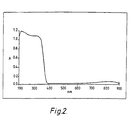
- a UV-VIS absorbence spectrum shows that, on lowering the wavelength, absorbence starts to increase rapidly at a wavelength in the range 380 to 430 nm, preferably 390 to 420 nm and reaches a value of greater than 1.
- Said hydrophilic layer preferably includes a material having Si-O bonds.
- the binder includes said material having Si-O bonds.
- Said binder material may be a component of a polymeric material which includes Si-O bonds.
- Said polymeric material may include -Si-O-Si-, especially -Si-O-Si-O- moieties.
- At least 50 wt%, suitably at least 60 wt%, preferably at least 70 wt%, more preferably at least 80 wt%, especially at least 90 wt% of said binder material is made up of a polymeric material having Si-O bonds as described.
- said binder material consists essentially of a polymeric material having Si-O bonds as described.
- Said binder material may make up at least 5 wt%, preferably at least 10 wt%, more preferably at least 15 wt%, especially at least 20 wt% of said hydrophilic layer. Said binder material may make up less than 50 wt%, preferably less than 40 wt%, more preferably less than 30 wt%, especially less than 25 wt%, of said hydrophilic layer.
- Said binder material may be derived or derivable from a silicate material for example water glasses, metasilicates, orthosilicates, sesquisilicates and modified silicates such as borosilicate and phosphosilicate.
- Said binder material is preferably derived or derivable from a silicate solution.
- Said binder material preferably includes less than 10 wt%, preferably less than 5 wt%, more preferably less than 1 wt%, especially substantially no, organic material, for example polymeric organic material.
- Said particulate material is preferably dispersed in said binder material.
- 30 to 85 wt%, preferably 40 to 80 wt%, more preferably 50 to 80 wt%, especially 60 to 80 wt% of said hydrophilic layer is composed of said particulate material.
- Said particulate material may be organic or inorganic.
- Organic particulate materials may be provided by latexes or organosols or polymeric balls, such as of nylon.
- Inorganic particulate materials may be selected from alumina, silica, silicon carbide, zinc sulphide, zirconia, barium sulphate, talcs, clays (e.g. kaolin), lithopone and titanium oxide.
- Said particulate material may comprise a first particulate material.
- Said first material may have a hardness of greater than 8 Modified Mohs (on a scale of 0 to 15), preferably greater than 9 and, more preferably, greater than 10 Modified Mohs.
- Said first material may comprise generally spherical particles. Alternatively, said material may comprise flattened particles or platelets.
- Said first material may have a mean particle size of at least 0.1 ⁇ m, preferably at least 0.5 ⁇ m and, more preferably at least 1 ⁇ m.
- Said first material may have a mean particle size of less than 200 ⁇ m, suitably less than 100 ⁇ m, preferably less than 45 ⁇ m, more preferably less than 20 ⁇ m, especially less than 10 ⁇ m and, most preferably, less than 5 ⁇ m.
- the particle size distribution for 95% of particles of the first material may be in the range 0.01 to 150 ⁇ m, preferably in the range 0.05 to 75 ⁇ m, more preferably in the range 0.05 to 30 ⁇ m.
- Said first material preferably comprises an inorganic material.
- Said first material preferably comprises alumina which term includes Al 2 O 3 and hydrates thereof, for example Al 2 O 3 .3H 2 O.
- said material is Al 2 O 3 .
- Said hydrophilic layer may include at least 10 wt%, suitably at least 20 wt%, preferably at least 25 wt%, more preferably at least 30 wt%, especially at least 35 wt% of said first particulate material.
- Said hydrophilic layer may include less than 80 wt%, suitably less than 70 wt%, preferably less than 60 wt%, more preferably less than 50 wt%, especially less than 40 wt% of said first particulate material.
- the ratio of the wt% of said first particulate material to binder material may be in the range 0.5 to 2, preferably in the range 1 to 2, more preferably in the range 1.4.to 1.8.
- Said particulate material may comprise a second particulate material.
- Said second particulate material may have a mean particle size of at least 0.001 ⁇ m, suitably at least 0.005 ⁇ m, preferably at least 0.01 ⁇ m, more preferably at least 0.05 ⁇ m, especially at least 0.1 ⁇ m.
- Said mean particle size may be less than 200 ⁇ m, suitably less than 100 ⁇ m, preferably less than 50 ⁇ m, more preferably less than 10 ⁇ m, especially less than ⁇ m, most preferably less than 0.5 ⁇ m.
- Said hydrophilic layer may include at least 10 wt%, suitably at least 20 wt%, preferably at least 25 wt%, more preferably at least 30 wt%, especially at least 35 wt% of said second particulate material.
- Said hydrophilic layer may include less than 80 wt%, suitably less than 70 wt%, preferably less than 60 wt%, more preferably less than 50 wt%, especially less than 40 wt% of said second particulate material.
- Said second material is preferably a pigment.
- Said second material is preferably inorganic.
- Said second material is preferably titanium dioxide.
- the ratio of the wt% of said second particulate material to binder material may be in the range 0.5 to 2, preferably in the range 1 to 2, more preferably in the range 1.4 to 1.8.
- Said first and second materials preferably define a multimodal, for example a bimodal particle size distribution.
- the ratio of the wt% of said first particulate material to said second particulate material may be in the range 0.3 to 3, preferably 0.5 to 2, more preferably 0.75 to 1.33, especially about 1 : 1.
- Said hydrophilic layer may include one or more additional materials for improving its adhesion to a support, especially a plastics support.
- a preferred additional material is organic and is preferably polymeric. Resins are preferred.
- Said support may comprise a metal layer.
- Preferred metals include aluminium, zinc and titanium, with aluminium being especially preferred.
- Said support may comprise an alloy of the aforesaid metals. Other alloys that may be used include brass and steel, for example stainless steel.
- Said support may comprise a non-metal layer.
- Preferred non-metal layers include layers of plastics, paper or the like.
- Preferred plastics include polyester, especially polyethylene terephthlate.
- Said support may include one or a plurality of layers. Where the support comprises a plurality of layers, it may comprise a plastics, paper or textile layer and another layer. Said other layer may be a metal layer, suitably of a type described above. In this case, said support may comprise a metal to plastics or paper laminate; or metal may be applied by other means to plastics or paper, for example by sputtering or the like.
- Said support may be any type of support used in printing.
- it may comprise a cylinder or, preferably, a plate.
- Said support may have a width of at least 10 cm, suitably at least 20 cm, preferably at least 30 cm, more preferably at least 40 cm, especially at least 50 cm.
- Said support may have a width of less than 300 cm, suitably less than 200 cm, preferably less than 160 cm, more preferably less than 100 cm, especially less than 80 cm.
- Said support may comprise a web of material which may have a width as described above.
- the web has a width in the range 0.7 m to 1.5 m.
- Said support may have a length of at least 20 cm, suitably at least 40 cm, preferably at least 60 cm. Said support may have a length of less than 300 cm, suitably less than 250 cm, preferably less than 200 cm, more preferably less than 150 cm, especially less than 105 cm. The support suitably does not have a length of about 35 cm.
- Said support may have a thickness of at least 0.1 mm. Said support may have a thickness of less than 0.6 mm.
- Said support may be pretreated prior to the application of said hydrophilic layer by one or more conventional methods used in the surface treatment of aluminium or other supports, for example caustic etch cleaning, solvent etching, acid cleaning, brush graining, mechanical graining, slurry graining, sand blasting, abrasive cleaning, electrocleaning, solvent degreasing, ultrasonic cleaning, alkali non-etch cleaning, primer coating, flame treatment, grit/shot blasting and electrograining. Details of such methods are provided in: "The surface treatment and finishing of aluminium and its alloys" S. Wernick, R. Pinner and P. G. Sheasby published by Finishing Publication Ltd., ASM International, 5th edition 1987.
- Said support may be provided with a roughened surface over which the hydrophilic layer may be provided.
- a subbing layer or layers may be provided over the support.
- the substrate may have a whiteness (L) value of at least 75, preferably at least 80, more preferably at least 82.
- the substrate may have a whiteness value of less than 100, preferably less than 90, more preferably less than 87.
- the substrate may have a gloss value of at least 5, preferably at least 7, more preferably at least 9.
- the substrate may have a gloss value of less than 20, preferably less than 18, more preferably less than 15, especially less than 13.
- Said hydrophilic layer may have an average thickness of less than 100 ⁇ m, suitably less than 50 ⁇ m, preferably less than 20 ⁇ m, more preferably less than 10 ⁇ m, especially less than 5 ⁇ m. In some cases, the layer may have an average thickness of less than 3 ⁇ m. Said hydrophilic layer may have an average thickness of greater than 0.1 ⁇ m, suitably greater than 0.3 ⁇ m, preferably greater than 0.5 ⁇ m, more preferably greater than 1 ⁇ m.
- Said hydrophilic layer may include 1 to 20 g of material per metre squared of substrate.
- said layer includes 3 to 20 g, more preferably 5 to 18 g, of material per metre squared of substrate.
- said layer includes 8 to 16 g of material per metre squared.
- substantially the entire hydrophilic layer can be removed by immersing a support including the layer in a stripping solution at a temperature of 96°C for 20 minutes and rubbing cotton wool over the layer.
- the stripping solution may comprise potassium dichromate (160g), phosphoric acid (85%, 460g) and water (2700g). Removal of the layer as described may enable the weight of the hydrophilic layer to be assessed.
- a printing member comprising a substrate as described according to said first aspect and an image layer.
- the assessment as to whether a substrate of a printing member is as described according to said first aspect may involve removing the image layer, for example by exposure and/or development.
- image layer includes a layer that can subsequently be partially removed in order to define areas to be printed and includes a layer which already defines areas to be printed.
- Said image layer may include one or a plurality of layers.
- Said image layer is preferably arranged to be removed during or after exposure to radiation, in order to define areas to be printed.
- printing members which are imaged using, for example UV radiation, visible light thermal IR radiation can all benefit from using a substrate of the type described, as can printing members prepared by depositing an image layer information-wise on the substrate.
- the printing member may be processible to a resolution of 10 ⁇ m or less, suitably 9 ⁇ m or less, preferably 8 ⁇ m or less, more preferably 7 ⁇ m or less, especially 6.5 ⁇ m or less.
- the printing member may be processible to give dots having a roundness of less than 2, preferably less than 1.8, more preferably less than 1.6, especially less than 1.4, when the image is digitised to a resolution of 1.32 pixels. ⁇ m -1 .
- the printing member may have a broad exposure latitude, suitably of greater than 1.2, preferably greater than 1.3, more preferably greater than 1.35, especially greater than 1.4.
- Exposure latitude may be assessed as described under point 7 in the Kir Report 34 referred to above (except that the modification described in Assessment 12 hereinafter is preferably followed).
- the printing member may have a broad dot range, following exposure and development conditions that give rise to a Stouffer Clear 3, suitably of 99% or greater, preferably 99.5% or greater at one extreme; and 2.0% or less, preferably 1.0% or less at the other extreme.
- the dot range may be assessed as described under point 6 in the Kir Report 34 referred to above.
- the printing member may be for use in stochastic printing, wherein image areas include dots of less than 20 ⁇ m maximum diameter, suitably less than 18 ⁇ m maximum diameter, preferably less than 16 ⁇ m maximum diameter, more preferably less than 15 ⁇ m maximum diameter, especially less than 14 ⁇ m maximum diameter are intended to be produced.
- Said printing member is preferably capable of printing an area, for example a dot, having a maximum diameter of less than 30 ⁇ m, preferably less than 25 ⁇ m, more preferably less than 20 ⁇ m.
- a method of preparing a substrate for a planographic printing member may include the step of forming a hydrophilic layer on a support by contacting the support with a fluid comprising a silicate solution in which particulate material as described in any statement herein is dispersed.
- Said silicate solution may comprise a solution of any soluble silicate including compounds often referred to as water glasses, metasilicates, orthosilicates and sesquisilicates.
- Said silicate solution may comprise a solution of a modified silicate for example a borosilicate or phosphosilicate.
- Said silicate solution may comprise one or more, preferably only one, metal or non-metal silicate.
- a metal silicate may be an alkali metal silicate.
- a non-metal silicate may be quaternary ammonium silicate.
- Said silicate solution may be formed from silicate wherein the ratio of the number of moles of Si species, for example SiO 2 , to the number of moles of cationic, for example metal species is in the range 0.25 to 10, preferably in the range 0.25 to about 6, more preferably in the range 0.5 to 4.
- Said silicate is preferably alkali metal silicate.
- the ratio of the number of moles of SiO 2 to the number of moles of M 2 O in said silicate, where M represents an alkali metal may be at least 0.25, suitably at least 0.5, preferably at least 1, more preferably at least 1.5. Especially preferred is the case wherein said ratio is at least 2.5. Said ratio may be less than 6, preferably less than 5 and more preferably less than 4.
- Preferred alkali metal silicates include lithium, sodium and potassium silicates, with lithium and/or sodium silicate being especially preferred.
- a silicate solution comprising only sodium silicate is most preferred.
- Said fluid may comprise 2 to 30 wt% of silicate (e.g. dissolved sodium silicate solid), preferably 5 to 20 wt%, more preferably 8 to 16 wt%.
- the fluid may be prepared using 10 to 60 wt%, preferably 30 to 50 wt%, more preferably 35 to 45 wt% of a silicate solution which comprises 30 to 40 wt% silicate.
- Said fluid may include 5 to 60 wt% of particulate material.
- the fluid includes 10 to 50 wt%, more preferably 15 to 45 wt%, especially 20 to 40 wt% of particulate material.
- the ratio of the weight of silicate to the weight of particulate material in the fluid is preferably in the range 0.1 to 2 and, more preferably, in the range 0.1 to 1. Especially preferred is the case wherein the ratio is in the range 0.2 to 0.6.
- Said fluid may include more than 20 wt%, preferably more than 30 wt%, more preferably more than 40 wt%, especially more than 45 wt% water (including water included in said silicate solution).
- Said fluid may include less than 80 wt%, preferably less than 70 wt%, more preferably less than 65 wt%, especially less than about 60 wt% water.
- the ratio of the wt% of silicate (e.g. dissolved sodium silicate solid) to the wt% of said first material may be in the range 0.25 to 4, preferably in the range 0.5 to 1.5 and more preferably about 1.
- the ratio of the wt% of silicate to the wt% of said second material may be in the range 0.25 to 4, preferably in the range 0.5 to 1.5 and more preferably about 1.
- the ratio of the wt% of first material to the wt% of second material may be in the range 0.5 to 2, preferably in the range 0.75 to 1.5, more preferably about 1 to 1.
- Said particulate material may include a third material which is preferably adapted to lower the pH of the fluid.
- Said third material may be a colloid, suitably colloidal silica or an inorganic salt, suitably a phosphate, with aluminium phosphate being preferred.
- a third material is provided, preferably less than 30wt% more preferably less than 20wt%, especially less than 10wt% of said particulate material is comprised by said third material.
- the pH of said fluid may be greater than 9.0, is preferably greater than 9.5 and, more preferably, greater than 10.0. Especially preferred is the case wherein the pH is greater than 10.5.
- the pH is suitably controlled so that the silicate remains in solution and does not form a gel.
- a gel is generally formed when the pH of a silicate solution falls below pH9.
- the pH of said fluid is preferably less than 14, more preferably less than 13.
- the fluid may include other compounds for adjusting its properties.
- the fluid may include one or more surfactants.
- Said fluid may include 0 to 1 wt% of surfactant(s).
- a suitable class of surfactants comprises anionic sulphates or sulphonates.
- the fluid may include viscosity builders for adjusting the viscosity of the fluid.
- Said fluid may include 0 to 10 wt%, preferably 0 to 5 wt% of viscosity builder(s).
- the fluid may include dispersants for dispersing the inorganic particulate material throughout the fluid.
- Said fluid may include 0 to 2 wt% of dispersant(s).
- a suitable dispersant may be sodium hexametaphosphate.
- Said fluid may have a viscosity of less than 100 centipoise when measured at 20°C and a shear rate of 200s -1 using a Mettler Rheomat 180 Viscometer incorporating a double gap measuring geometry.
- said viscosity is less than 50 centipoise, more preferably less than 30 centipoise when measured as aforesaid.
- the viscosity is less than 20 centipoise.
- Said fluid may be applied to said support by any suitable means which is preferably non-electrochemical.
- Said fluid may be applied to both sides of said support in order to form a hydrophilic layer on both sides.
- a support with such a layer on both sides may be used to prepare a double-sided lithographic plate.
- the side of the plate which does not carry an image layer may be protected by the hydrophilic layer.
- Said fluid is preferably applied to only one surface of said support.
- Said fluid may be applied to said support to form a hydrophilic layer having an average thickness after drying, of less than 20 ⁇ m, preferably less than 10 ⁇ m and, more preferably, less than 5 ⁇ m. Especially preferred is the case wherein the average thickness is less than 3 ⁇ m.
- the method preferably includes the steps of providing suitable conditions for the removal of water from the fluid after it has been applied to the support. Suitable conditions may involve passive or active removal of water and may comprise causing an air flow over the support and/or adjusting the humidity of air surrounding the support.
- the method includes the step of arranging the support in a heated environment.
- the support may be placed in an environment so that its temperature does not exceed 230°C, preferably does not exceed 200°C and, more preferably, does not exceed 175°C. Especially preferred is the case wherein the support temperature does not exceed 150°C.
- the support may be arranged in the heated environment for less than 180 seconds, preferably less than 120 seconds and, more preferably, less than 100 seconds.
- the invention extends to a method of stochastic or colour printing, the method using a printing member which includes a substrate comprising a support and a hydrophilic layer having a surface roughness (Ra) in the range 0.1 um to 2 um, said hydrophilic layer comprising a particulate material and a binder material for the particulate material.
- a printing member which includes a substrate comprising a support and a hydrophilic layer having a surface roughness (Ra) in the range 0.1 um to 2 um, said hydrophilic layer comprising a particulate material and a binder material for the particulate material.
- the invention extends to the use of a printing member comprising a substrate which comprises a support and a hydrophilic layer having a surface roughness (Ra) in the range 0.1 um to 2 um, said hydrophilic layer comprising a particulate material and a binder material for the particulate material, in stochastic printing or colour printing.
- a printing member comprising a substrate which comprises a support and a hydrophilic layer having a surface roughness (Ra) in the range 0.1 um to 2 um, said hydrophilic layer comprising a particulate material and a binder material for the particulate material, in stochastic printing or colour printing.
- a 0.2 mm gauge aluminium alloy sheet of designation AA1050 was cut to a size of 459 mm by 525 mm. The sheet was then immersed face up in a solution of sodium hydroxide dissolved in distilled water (100g/l) at ambient temperature for 60 seconds and thoroughly rinsed with water.
- Deionised water 150g; 40 wt%) was added to a 250ml beaker and sheared using a Silverson high shear mixer. Titanium dioxide powder (53.29g; 14.21 wt%) was then added in portions over a period of four minutes with the shearing continuing. Then, alumina powder (53.29g; 14.21wt%) was added in portions over a period of four minutes with the shearing continuing. On completion of the addition, sodium silicate solution (118.43g; 31.58 wt%) was added with shearing for a further three minutes. The viscosity of the liquid was found to be about 10 centipoise when measured at 20°C and a shear rate of 200s -1 using a Mettler Rheomat 180 Viscometer incorporating a double gap measuring geometry.
- the coating formulation prepared in Step 2 was coated onto the aluminium sheet prepared in Step 1 using a rotating Meyer bar coater (designation K303) to give a 12 ⁇ m wet film thickness.
- the coated sheet prepared in Step 3 was placed in an oven at 130°C for 80 seconds. The plate was then removed from the oven and allowed to cool to ambient temperature.
- the dried sheet prepared in Step 4 was immersed in aluminium sulphate (0.1M) for thirty seconds. The sheet was then spray rinsed for about twenty seconds using tap water and fan dried.
- a printing plate was produced from the sheet prepared in Step 5 by coating, using a Meyer bar, a light sensitive material of the quinone diazide/novolak resin type at a dry coating weight of 2 g/m 2 .
- the light sensitive material was dried at 130°C for 80 seconds.
- the light-sensitive coating includes a blue colour change dye which is arranged to change from dark blue to turquoise green on exposure.
- the plate comprises an electrograined and anodised substrate provided with a quinone diazide/novolak resin and a dye as described in Example 1, Step 6.
- Results are provided in Table 1 wherein the Ra stated is an average of 204 runs.
- the surface skewness can be used to describe the shape of the surface height distribution.
- the skewness is zero.
- the skewness may be negative if the distribution has a longer tail at its lower side of the mean plane, or positive if the distribution has a longer tail at the upper side of the mean plane.
- the positive value for the Ssk of Example 1 shows that the surface is peak dominated; the negative value for Example C1 shows that the surface is pit dominated.
- Minolta Multigloss 268 reflectometer supplied by Minolta U.K. Limited of Milton Keynes, England.
- the unit was calibrated using an internal standard which is related to a black glass standard with a defined index of refraction (usually 1.567) which equals 100 units.
- the sample was sputter-coated with platinum using a Fisons Instruments SEM coating system model SC510.
- the sputter coating was carried out in a low pressure argon plasma for 120 seconds using a plasma current of 20 mA at 900 volts.
- Microscopy was carried out using the secondary electron detector of a Hitachi S-4100 field emission scanning electron microscope.
- a condenser lens 8 was used with an accelerating voltage of 10 keV and a working distance of 5 mm.
- the emission current was 10 ⁇ A.
- a micrograph was obtained using a magnification of x1000.
- a visual assessment of this micrograph shows that the surface morphology is defined by particulate material of two types:
- a sample of substrate was prepared as described in Assessment 5 except that it was sputter coated with platinum for only 90 seconds.
- a Hitachi Scientific Instruments S-4100 field emission scanning electron microscope was used with the following conditions: accelerating voltage 20 kV, condenser lens 8, extraction voltage 4.7 kV, emission current 20 ⁇ A, working distance 20 mm, beam monitor aperture 2, objective aperture 1 and magnification 1000x.
- the X-ray analysis was carried out using the following acquisition set-up: fast counting mode, process time 3, upper energy 30 keV, preset livetime 200, acquisition rate approximately 7000 counts per second operating with a 30% deadtime. Window integral measurements were made using the "quant" requirement function of the software.
- EDX elemental measurements were undertaken for 6 different areas on the sample.
- the absorption peaks obtained in the EDX spectra were assessed to indicate the elements present and integrated to give an indication of the relative amounts of each of the elements.
- Example 1 A sample of the substrate of Example 1 of length 10 cm and width 3 cm was cut from a sheet prepared as described in Example 1, step 5 and subjected to reflectance FT-IR using a Perkin Elmer System 2000 FT-IR unit, obtained from Perkin Elmer Limited of England. The sample was mounted on a variable angle reflectance attachment 13969 supplied by Graseby Specac Limited of Kent, England. Scanning of the sample was along the metal grain direction and at a scan angle of 84°. A spectrum obtained is shown in figure 1. Peaks are noted at the following wavenumbers (cm -1 ).
- a UV-VIS absorbence spectrum was run on a sample of substrate prepared as described in Example 1, Step 5 using a Perkin Elmer Lambda 15 UV/VIS spectrometer, fitted with an integrating sphere attachment and being obtained from Bodenseewek Perkin-Elmer GmbH of Uberlingen, Germany.
- the scanning speed was 240nm/min, the slit width was 2nm and the reference sample was 1050 aluminium alloy.
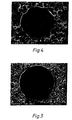
- Examples 1 and C1 prepared as described in Assessment 9, were evaluated by capturing an image of 10 dots using a JVC KY-F55BE 3CCD colour video camera fitted to an Olympus BX60 optical microscope set up for dark field illumination and having an Olympus dark field lens (UMP lan fl; 20x/0.46 bd; ⁇ /O).
- the microscope and lens were obtained from Olympus Optical Company (UK) Limited of London, England.
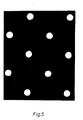
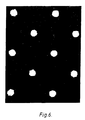
- Computer generated masks were produced for image analysis and these are shown in figures 5 and 6 for respective examples 1 and C1 Image analysis was carried out using Image-Pro Plus Version 1.3 for Windows obtained from Media Cybernetics of Maryland, USA. Image resolution was found to be 1.32 pixels ⁇ m -1 .
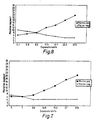
- Figures 7 and 8 provide resolution graphs for plates of Examples 1 and C1 respectively from which it will be noted that the resolution of Example 1 is about 6 ⁇ m and that of Example C1 is about 8 ⁇ m.
- Example 1 The exposure latitude of Example 1 was found to be 1.44; and that of Example C1 found to be 1.32.
- Example 1 The dot range of Example 1 was found to be 0.5 to 99.5%; and that of Example C1 found to be 1 to 99%.
- the plates were exposed at the lowest exposure (Stouffer Clear 0) and assessed after being processed as described in Assessment 9.
- the plate of Example 1 appeared clear of photocoat, whereas some photocoat was retained in the grain of the plate of Example C1.
- Example 1 had better colour contrast between the image and non-image areas than Example C1.
- Example 1 had better colour contrast between the two areas compared to Example C1.
- Example 1 reproduced a stochastic screen very satisfactorily.
- the lowest spot size of 16 ⁇ m diameter was held well at clear 3 Stouffer for Example 1, whereas this spot was virtually eliminated on the plate of Example C1.
- Example 1 The procedure of Example 1 was repeated, excepted that Melinex 539 (biaxial polyethylene terephthlate (PET) film provided with an anti-static coating (supplied by ICI Melinex of Wilton, England)) was used instead of aluminium. The majority of properties of the plate produced were found to be similar to those of Example 1.
- Melinex 539 biaxial polyethylene terephthlate (PET) film provided with an anti-static coating (supplied by ICI Melinex of Wilton, England) was used instead of aluminium.
- PET polyethylene terephthlate
- Example 1 The procedure of Example 1 was repeated, except that Simcote 400 (a paper obtained from Samuel Grant Ltd of England) was used instead of aluminium. The majority of properties of the plate produced were found to be similar to those of Example 1.
- SED Statistical Experimental Design
Landscapes
- Chemical & Material Sciences (AREA)
- Organic Chemistry (AREA)
- Printing Plates And Materials Therefor (AREA)
Claims (13)
- Druckelement, umfassend:ein Substrat, welches einen Träger und eine hydrophile Schicht mit einer Oberflächenrauheit (Ra) im Bereich von 0,1 µm bis 2 µm umfasst, wobei die hydrophile Schicht ein teilchenförmiges Material und ein Bindemittelmaterial für das teilchenförmige Material umfasst; wobei das Druckelement Information in einer stochastischen Form trägt.
- Element gemäß Anspruch 1, wobei der Ra-Wert mindestens 0,1 µm und weniger als 0,6 µm beträgt.
- Element gemäß einem der vorstehenden Ansprüche, wobei eine Elementaranalyse der hydrophilen Schicht zeigt, dass sie die Elemente Silicium und Sauerstoff enthält.
- Element gemäß einem der vorstehenden Ansprüche, wobei das Verhältnis von Ti: Al in der hydrophilen Schicht im Bereich von 0,5 bis 2 ist.
- Element gemäß einem der vorstehenden Ansprüche, wobei ein Reflexions-FT-IR-Spektrum der hydrophilen Schicht mindestens ein Signal in einem der nachstehenden Bereiche aufweist: 1200 bis 1300 cm-1, 1100 bis 1200 cm-1 und 900 bis 1000 cm-1.
- Element gemäß einem der vorstehenden Ansprüche, wobei ein UV/VIS-Absorptionsspektrum zeigt, dass mit Abnahme der Wellenlänge die Absorption bei einer Wellenlänge im Bereich von 380 bis 430 nm schnell anzusteigen beginnt und einen Wert größer als 1 erreicht.
- Element gemäß einem der vorstehenden Ansprüche, wobei die hydrophile Schicht ein Si-O-Bindungen aufweisendes Material enthält.
- Element gemäß einem der vorstehenden Ansprüche, wobei das Bindemittelmaterial von einem Silicatmaterial abstammt oder ableitbar ist.
- Element gemäß einem der vorstehenden Ansprüche, wobei das teilchenförmige Material ein erstes teilchenförmiges Material, welches eine mittlere Teilchengröße von mindestens 0,1 µm und weniger als 200 µm aufweist, und ein zweites teilchenförmiges Material, welches eine mittlere Teilchengröße von mindestens 0,001 µm und weniger als 200 µm aufweist, umfasst.
- Element gemäß einem der vorstehenden Ansprüche, welches einen Weißgradswert (L) von mindestens 75 und weniger als 100 aufweist.
- Element gemäß einem der vorstehenden Ansprüche, welches einen Glanzwert von mindestens 5 und weniger als 20 aufweist.
- Verfahren eines stochastischen Drucks oder Farbdrucks, wobei das Verfahren ein Druckelement verwendet, welches ein Substrat, umfassend einen Träger und eine hydrophile Schicht mit einer Oberflächenrauheit (Ra) im Bereich von 0,1 µm bis 2 µm, enthält, wobei die hydrophile Schicht ein teilchenförmiges Material und ein Bindemittelmaterial für das teilchenförmige Material umfasst.
- Verwendung eines Druckelements, umfassend ein Substrat, welches einen Träger und eine hydrophile Schicht mit einer Oberflächenrauheit (Ra) im Bereich von 0,1 µm bis 2 µm umfasst, wobei die hydrophile Schicht ein teilchenförmiges Material und ein Bindemittelmaterial für das teilchenförmige Material umfasst, für stochastischen Druck oder Farbdruck.
Applications Claiming Priority (3)
| Application Number | Priority Date | Filing Date | Title |
|---|---|---|---|
| GB9710549 | 1997-05-23 | ||
| GBGB9710549.8A GB9710549D0 (en) | 1997-05-23 | 1997-05-23 | Planographic printing |
| PCT/GB1998/001496 WO1998052768A1 (en) | 1997-05-23 | 1998-05-22 | Planographic printing |
Publications (2)
| Publication Number | Publication Date |
|---|---|
| EP0984863A1 EP0984863A1 (de) | 2000-03-15 |
| EP0984863B1 true EP0984863B1 (de) | 2003-11-05 |
Family
ID=10812865
Family Applications (1)
| Application Number | Title | Priority Date | Filing Date |
|---|---|---|---|
| EP98922951A Expired - Lifetime EP0984863B1 (de) | 1997-05-23 | 1998-05-22 | Flachdruck |
Country Status (7)
| Country | Link |
|---|---|
| EP (1) | EP0984863B1 (de) |
| JP (1) | JP2001525745A (de) |
| AU (1) | AU7541198A (de) |
| DE (1) | DE69819494T2 (de) |
| GB (1) | GB9710549D0 (de) |
| WO (1) | WO1998052768A1 (de) |
| ZA (1) | ZA984349B (de) |
Families Citing this family (4)
| Publication number | Priority date | Publication date | Assignee | Title |
|---|---|---|---|---|
| US6261740B1 (en) | 1997-09-02 | 2001-07-17 | Kodak Polychrome Graphics, Llc | Processless, laser imageable lithographic printing plate |
| GB2357060B (en) * | 1999-12-08 | 2002-12-31 | Kodak Polychrome Graphics Co | Planographic printing |
| EP1167016A3 (de) * | 2000-06-19 | 2003-09-17 | Toyo Seikan Kaisha, Ltd. | Sauerstoff absorbierendes Laminat und Herstellungsverfahren dafür |
| US20020056388A1 (en) * | 2000-09-28 | 2002-05-16 | Naonori Makino | Lithographic printing plate precursor, printing method and printing machine |
Citations (1)
| Publication number | Priority date | Publication date | Assignee | Title |
|---|---|---|---|---|
| WO1998034796A1 (en) * | 1997-02-07 | 1998-08-13 | Kodak Polychrome Graphics Company Ltd. | Planographic printing member and process for its manufacture |
Family Cites Families (4)
| Publication number | Priority date | Publication date | Assignee | Title |
|---|---|---|---|---|
| US3470013A (en) * | 1966-02-18 | 1969-09-30 | Hercules Inc | Coated plastic |
| ES2036127B1 (es) * | 1991-05-16 | 1994-02-01 | Sers S A | Plancha para la impresion y procedimiento para su fabricacion. |
| ATE201167T1 (de) * | 1995-11-24 | 2001-06-15 | Kodak Polychrome Graphics Co | Hydrophilierter träger für flachdruckplatte und verfahren zu seiner herstellung |
| GB9624224D0 (en) * | 1996-11-21 | 1997-01-08 | Horsell Graphic Ind Ltd | Planographic printing |
-
1997
- 1997-05-23 GB GBGB9710549.8A patent/GB9710549D0/en active Pending
-
1998
- 1998-05-22 EP EP98922951A patent/EP0984863B1/de not_active Expired - Lifetime
- 1998-05-22 WO PCT/GB1998/001496 patent/WO1998052768A1/en not_active Ceased
- 1998-05-22 AU AU75411/98A patent/AU7541198A/en not_active Abandoned
- 1998-05-22 ZA ZA984349A patent/ZA984349B/xx unknown
- 1998-05-22 DE DE69819494T patent/DE69819494T2/de not_active Expired - Lifetime
- 1998-05-22 JP JP55014498A patent/JP2001525745A/ja not_active Withdrawn
Patent Citations (1)
| Publication number | Priority date | Publication date | Assignee | Title |
|---|---|---|---|---|
| WO1998034796A1 (en) * | 1997-02-07 | 1998-08-13 | Kodak Polychrome Graphics Company Ltd. | Planographic printing member and process for its manufacture |
Also Published As
| Publication number | Publication date |
|---|---|
| ZA984349B (en) | 1998-11-23 |
| DE69819494T2 (de) | 2004-09-16 |
| DE69819494D1 (de) | 2003-12-11 |
| EP0984863A1 (de) | 2000-03-15 |
| AU7541198A (en) | 1998-12-11 |
| GB9710549D0 (en) | 1997-07-16 |
| JP2001525745A (ja) | 2001-12-11 |
| WO1998052768A1 (en) | 1998-11-26 |
Similar Documents
| Publication | Publication Date | Title |
|---|---|---|
| US6105500A (en) | Hydrophilized support for planographic printing plates and its preparation | |
| EP0939920B2 (de) | Flachdruck | |
| CN111867848A (zh) | 平版印刷版原版及平版印刷版原版的制造方法 | |
| US4542089A (en) | Lithographic substrate and its process of manufacture | |
| US6357351B1 (en) | Substrate for planographic printing | |
| US5432046A (en) | Process for preparing improved lithographic printing plates by brushgraining with alumina/quartz slurry | |
| WO1998052768A1 (en) | Planographic printing | |
| JP2023020769A (ja) | 機上現像型平版印刷版原版、及び印刷版の作製方法 | |
| JP2000225780A (ja) | 印刷版用支持体及び印刷版並びに画像形成方法 | |
| US6293197B1 (en) | Hydrophilized substrate for planographic printing | |
| EP0983151B1 (de) | Flachdruckverfahren | |
| US7171902B2 (en) | Direct drawing lithographic printing plate material | |
| EP0983150A1 (de) | Flachdruck | |
| EP0721397B1 (de) | Verfahren zur herstellung lithographischer druckfarben | |
| JP4252272B2 (ja) | 感光性平版印刷版 | |
| JPH11254848A (ja) | 平版印刷版の製造方法 | |
| WO2006059477A1 (ja) | 平版印刷版用修正液及び平版印刷版の画像修正方法 | |
| ITRM990401A1 (it) | Procedimento di formazione di un substrato di alluminio per una lastra litografica, e lastra litografica presensibilizzata. | |
| JP2000229485A (ja) | 印刷版用支持体、その製造方法及び該支持体を用いた印刷版 | |
| KR19990071563A (ko) | 평판 인쇄 플레이트용 친수성 지지체 및 그 제조방법 | |
| GB2357060A (en) | Planographic printing |
Legal Events
| Date | Code | Title | Description |
|---|---|---|---|
| PUAI | Public reference made under article 153(3) epc to a published international application that has entered the european phase |
Free format text: ORIGINAL CODE: 0009012 |
|
| 17P | Request for examination filed |
Effective date: 19991116 |
|
| AK | Designated contracting states |
Kind code of ref document: A1 Designated state(s): DE FR GB |
|
| 17Q | First examination report despatched |
Effective date: 20000607 |
|
| GRAH | Despatch of communication of intention to grant a patent |
Free format text: ORIGINAL CODE: EPIDOS IGRA |
|
| GRAS | Grant fee paid |
Free format text: ORIGINAL CODE: EPIDOSNIGR3 |
|
| GRAA | (expected) grant |
Free format text: ORIGINAL CODE: 0009210 |
|
| AK | Designated contracting states |
Kind code of ref document: B1 Designated state(s): DE FR GB |
|
| REG | Reference to a national code |
Ref country code: GB Ref legal event code: FG4D |
|
| REF | Corresponds to: |
Ref document number: 69819494 Country of ref document: DE Date of ref document: 20031211 Kind code of ref document: P |
|
| PGFP | Annual fee paid to national office [announced via postgrant information from national office to epo] |
Ref country code: GB Payment date: 20040406 Year of fee payment: 7 |
|
| ET | Fr: translation filed | ||
| PLBE | No opposition filed within time limit |
Free format text: ORIGINAL CODE: 0009261 |
|
| STAA | Information on the status of an ep patent application or granted ep patent |
Free format text: STATUS: NO OPPOSITION FILED WITHIN TIME LIMIT |
|
| 26N | No opposition filed |
Effective date: 20040806 |
|
| PG25 | Lapsed in a contracting state [announced via postgrant information from national office to epo] |
Ref country code: FR Free format text: LAPSE BECAUSE OF NON-PAYMENT OF DUE FEES Effective date: 20050131 |
|
| REG | Reference to a national code |
Ref country code: FR Ref legal event code: ST |
|
| PG25 | Lapsed in a contracting state [announced via postgrant information from national office to epo] |
Ref country code: GB Free format text: LAPSE BECAUSE OF NON-PAYMENT OF DUE FEES Effective date: 20050522 |
|
| GBPC | Gb: european patent ceased through non-payment of renewal fee |
Effective date: 20050522 |
|
| PGFP | Annual fee paid to national office [announced via postgrant information from national office to epo] |
Ref country code: DE Payment date: 20120531 Year of fee payment: 15 |
|
| PG25 | Lapsed in a contracting state [announced via postgrant information from national office to epo] |
Ref country code: DE Free format text: LAPSE BECAUSE OF NON-PAYMENT OF DUE FEES Effective date: 20131203 |
|
| REG | Reference to a national code |
Ref country code: DE Ref legal event code: R119 Ref document number: 69819494 Country of ref document: DE Effective date: 20131203 |