EP0985586A2 - Anti lock system for a vehicle electromechanical brake system based on a fuzzy controller - Google Patents
Anti lock system for a vehicle electromechanical brake system based on a fuzzy controller Download PDFInfo
- Publication number
- EP0985586A2 EP0985586A2 EP99116801A EP99116801A EP0985586A2 EP 0985586 A2 EP0985586 A2 EP 0985586A2 EP 99116801 A EP99116801 A EP 99116801A EP 99116801 A EP99116801 A EP 99116801A EP 0985586 A2 EP0985586 A2 EP 0985586A2
- Authority
- EP
- European Patent Office
- Prior art keywords
- pressure
- alr
- small
- fuzzy controller
- wheel
- Prior art date
- Legal status (The legal status is an assumption and is not a legal conclusion. Google has not performed a legal analysis and makes no representation as to the accuracy of the status listed.)
- Granted
Links
- 230000001133 acceleration Effects 0.000 claims abstract description 8
- 230000000903 blocking effect Effects 0.000 claims description 12
- 230000001419 dependent effect Effects 0.000 claims 1
- 238000012423 maintenance Methods 0.000 description 1
- 230000001105 regulatory effect Effects 0.000 description 1
Images
Classifications
-
- B—PERFORMING OPERATIONS; TRANSPORTING
- B60—VEHICLES IN GENERAL
- B60T—VEHICLE BRAKE CONTROL SYSTEMS OR PARTS THEREOF; BRAKE CONTROL SYSTEMS OR PARTS THEREOF, IN GENERAL; ARRANGEMENT OF BRAKING ELEMENTS ON VEHICLES IN GENERAL; PORTABLE DEVICES FOR PREVENTING UNWANTED MOVEMENT OF VEHICLES; VEHICLE MODIFICATIONS TO FACILITATE COOLING OF BRAKES
- B60T8/00—Arrangements for adjusting wheel-braking force to meet varying vehicular or ground-surface conditions, e.g. limiting or varying distribution of braking force
- B60T8/17—Using electrical or electronic regulation means to control braking
- B60T8/174—Using electrical or electronic regulation means to control braking characterised by using special control logic, e.g. fuzzy logic, neural computing
Definitions
- the invention relates to an anti-lock braking system in which several speed values and pressure values with the help of one Fuzzy controller controls an actuator in a braking system becomes.
- New requirements for the braking functions and the requirement after reducing the assembly and maintenance costs to new braking systems where the power is no longer available a braking torque request from the driver, which is direct is transmitted as a force via a hydraulic system is, but in those with the help of an electrical Signal an electromechanical brake actuator is controlled, a frictional force by means of an electrical energy supply generated on a brake.
- an electromechanical brake actuator is controlled, a frictional force by means of an electrical energy supply generated on a brake.
- Even with an electromechanical one Braking system is a device that makes sense Blocking a braked wheel prevents and thus the Stability of the braked vehicle maintains. To do this Wheel speed sensor devices for each wheel or for each group of wheels, and electric, continuously actuating brake pressure or force actuators that are independent Brake pressure or an independent braking force for each Wheel or can set for each group of wheels needed.
- Wheel slip is determined by, for example, a vehicle reference speed from the fastest, not powered Wheel determined taking into account steering locks and the slip of a wheel from the ratio between the measured Wheel speed and vehicle reference speed calculated becomes. If the target pressure specified by the driver is one exceeds a certain value depending on the road surface, would block the wheel in question, this is off known reasons undesirable. Therefore the target pressure must be like this be reduced so that the wheel is no longer locked.
- ABS system is known from US Pat. No. 4,842,342 Basis of a fuzzy controller known, in which from tire speed values and vehicle acceleration values with With the help of a fuzzy controller the braking force of a hydraulic Brake system is regulated.
- An anti-lock braking system is known from US Pat. No. 5,001,640 known on the basis of a fuzzy controller, in which in addition to speed values that of an electronic control unit requested hydraulic pressure to regulate the Brake pressure is used.
- the object on which the invention is based is now an anti-lock braking system based on a fuzzy controller for to specify an electromechanical braking system in which a largely optimal ABS control with the least possible effort and a relatively simple rule base is achieved.
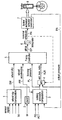
- a unit 1 for slip calculation how already mentioned at the beginning, e.g. B. from one of several wheel speeds WI a vehicle speed and from it again in connection with a speed W of the concerned Rades a slip SW calculated and a fuzzy controller 5 and a unit 3 for calculating a blocking pressure PL supplied.
- the wheel speed W determines the wheel acceleration AW and also fed to the fuzzy controller 5.
- Unit 3 and a divider 4 receive signals PA for the current one Pressure from a unit 7, which from an electrical Brake actuator and an associated control unit exists. At the Input of the unit 7 is a signal for a nominal pressure PN feeds that the electric brake 8 is to receive.
- the in the unit 7 present pressure PA is with the help of the signal on the input side of the unit 3 and the divider 4 fed.
- a starting value for signals PO and ACT pass a blocking pressure.
- This starting value can, for example the current pressure PA at the beginning of ABS braking at the time when the ABS is currently active.
- the signal for the Blocking pressure PL in unit 3 updated such that the signal PA for the current pressure then always as a blocking pressure is saved when the slip SW a certain Threshold exceeds, the threshold fixed or, for example, by a separate controller can be tracked.
- This dynamic adjustment of the blocking pressure carries, for example, changes in road properties or the tire properties.
- the Indian Unit 3 calculated value for the blocking pressure PL is both the fuzzy controller 5 and the divider unit 4 on the input side supplied, in the latter a signal for a Pressure ratio ALR formed and also on the input side Fuzzy controller is fed.
- ALR can optionally, in the Drawing indicated by dashed lines, instead of the signal PA for the current pressure also the signal PN for the nominal pressure be used.
- the fuzzy controller 5 uses a Fuzzy control base on the output side a pressure change rate DP fed to a unit 6 with integrating behavior and which forms the signal for the nominal pressure PN.
- the output variable DP has the linguistic values 100, 50, 10, 5, zero, m10, m20, m50, m100 and m300, with "m” each means a negative value.
- the rule base is preferably constructed so that firstly different blocks depending on the value of the blocking pressure PL are addressed with fuzzy rules that apply to different Lane properties are optimized and that secondly the positive pressure change rate the lower the closer that is Pressure ratio ALR is one.
- This anti-lock braking system is easy and easy to tune, e.g. B. based on driving tests, already possible because only subsequent parts in the rule base can be changed and the condition parts can remain.
Landscapes
- Engineering & Computer Science (AREA)
- Physics & Mathematics (AREA)
- Fuzzy Systems (AREA)
- Mathematical Physics (AREA)
- Software Systems (AREA)
- Theoretical Computer Science (AREA)
- Transportation (AREA)
- Mechanical Engineering (AREA)
- Regulating Braking Force (AREA)
Abstract
Description
Die Erfindung betrifft ein Antiblockiersystem, bei dem aus mehreren Geschwindigkeitswerten und Druckwerten mit Hilfe eines Fuzzy-Reglers ein Aktuator in einem Bremssystem gesteuert wird.The invention relates to an anti-lock braking system in which several speed values and pressure values with the help of one Fuzzy controller controls an actuator in a braking system becomes.
Neue Anforderungen bei den Bremsfunktionen und die Forderung nach der Reduzierung der Montage- und Wartungskosten führen zu neuen Bremssystemen, bei denen die Kraft nicht mehr durch eine vom Fahrer ausgehende Bremsmomentanforderung, die direkt als Kraft über ein hydraulisches System übertragen wird, erzeugt wird, sondern bei denen mit Hilfe eines elektrischen Signals ein elektromechanischer Bremsaktuator gesteuert wird, der mittels einer elektrischen Energieversorgung eine Reibkraft an einer Bremse erzeugt. Auch bei einem elektromechanischen Bremssystem ist eine Vorrichtung sinnvoll, welche das Blockieren eines gebremsten Rades verhindert und somit die Fahrstabilität des gebremsten Fahrzeuges erhält. Hierzu werden Radgeschwindigkeit-Sensoreinrichtungen für jedes Rad oder für jede Gruppe von Rädern, und elektrische, kontinuierlich stellende Bremsdruck oder -kraftaktuatoren, die einen unabhängigen Bremsdruck oder eine unabhängige Bremskraft für jedes Rad oder für jede Radgruppe einstellen können, benötigt. Für jedes Rad liegt ein Raddrehzahlsensor vor, der ein Raddrehzahlsignal an die Rechen- und die Steuereinheit übermittelt. Aus diesen Raddrehzahlen wird in bekannter Weise der Radschlupf ermittelt, in dem zum Beispiel eine Fahrzeugreferenzgeschwindigkeit aus dem am schnellsten, nicht angetriebenen Rad unter Berücksichtigung von Lenkeinschlägen ermittelt wird und der Schlupf eines Rades aus Verhältnis zwischen gemessener Raddrehzahl und Fahrzeugreferenzgeschwindigkeit berechnet wird. Wenn der vom Fahrer vorgegebene Solldruck einen bestimmten von der Fahrbahnoberfläche abhängigen Wert überschreitet, würde das betreffende Rad blockieren.Dies ist aus bekannten Gründen unerwünscht. Deshalb muß der Solldruck so reduziert werden, daß ein Blockieren des Rades nicht mehr erfolgt.New requirements for the braking functions and the requirement after reducing the assembly and maintenance costs to new braking systems where the power is no longer available a braking torque request from the driver, which is direct is transmitted as a force via a hydraulic system is, but in those with the help of an electrical Signal an electromechanical brake actuator is controlled, a frictional force by means of an electrical energy supply generated on a brake. Even with an electromechanical one Braking system is a device that makes sense Blocking a braked wheel prevents and thus the Stability of the braked vehicle maintains. To do this Wheel speed sensor devices for each wheel or for each group of wheels, and electric, continuously actuating brake pressure or force actuators that are independent Brake pressure or an independent braking force for each Wheel or can set for each group of wheels needed. For each wheel there is a wheel speed sensor that sends a wheel speed signal transmitted to the computing and control unit. From these wheel speeds in a known manner Wheel slip is determined by, for example, a vehicle reference speed from the fastest, not powered Wheel determined taking into account steering locks and the slip of a wheel from the ratio between the measured Wheel speed and vehicle reference speed calculated becomes. If the target pressure specified by the driver is one exceeds a certain value depending on the road surface, would block the wheel in question, this is off known reasons undesirable. Therefore the target pressure must be like this be reduced so that the wheel is no longer locked.
Aus der US-Patentschrift 4,842,342 ist ein ABS-System auf der Basis eines Fuzzy-Reglers bekannt, bei dem aus Reifengeschwindigkeitswerten und Fahrzeugbeschleunigungswerten mit Hilfe eines Fuzzy-Reglers die Bremskraft eines hydraulischen Bremssystems geregelt wird.An ABS system is known from US Pat. No. 4,842,342 Basis of a fuzzy controller known, in which from tire speed values and vehicle acceleration values with With the help of a fuzzy controller the braking force of a hydraulic Brake system is regulated.
Aus der US-Patentschrift 5,001,640 ist ein Antiblockiersystem auf der Basis eines Fuzzy-Reglers bekannt, bei dem neben Geschwindigkeitswerten der von einer elektronischen Steuereinheit angeforderte hydraulische Druck zur Regelung des Bremsdrucks herangezogen wird.An anti-lock braking system is known from US Pat. No. 5,001,640 known on the basis of a fuzzy controller, in which in addition to speed values that of an electronic control unit requested hydraulic pressure to regulate the Brake pressure is used.
Die der Erfindung zugrundeliegende Aufgabe besteht nun darin, ein Antiblockiersystem auf der Basis eines Fuzzy-Reglers für ein elektromechanisches Bremssystem anzugeben, bei dem eine weitgehend optimale ABS-Regelung mit möglichst geringem Aufwand und einer relativ einfachen Regelbasis erreicht wird.The object on which the invention is based is now an anti-lock braking system based on a fuzzy controller for to specify an electromechanical braking system in which a largely optimal ABS control with the least possible effort and a relatively simple rule base is achieved.
Diese Aufgabe wird erfindungsgemäß durch die Merkmale des Patentanspruchs 1 gelöst. Die weiteren Ansprüche betreffen vorteilhafte Ausgestaltungen der Erfindung.This object is achieved by the features of the claim 1 solved. The other claims relate to advantageous Embodiments of the invention.
In der Zeichnung ist ein Ausführungsbeispiel eines erfindungsgemäßen
Antiblockiersystems für ein einzelnes Rad dargestellt.
In einer Einheit 1 zur Schlupfberechnung werden, wie
eingangs bereits erwähnt, z. B. aus einer von mehreren Radgeschwindigkeiten
WI eine Fahrzeuggeschwindigkeit und daraus
wiederum im Zusammenhang mit einer Geschwindigkeit W des betreffenden
Rades ein Schlupf SW berechnet und einem Fuzzy-Regler
5 sowie einer Einheit 3 zur Berechnung eines Blockierdruckes
PL zugeführt. Durch ein Differenzierglied wird aus
der Radgeschwindigkeit W die Radbeschleunigung AW ermittelt
und ebenfalls dem Fuzzy-Regler 5 zugeführt. Die Einheit 3 und
eine Teilereinrichtung 4 erhalten Signale PA für den aktuellen
Druck aus einer Einheit 7, die aus einem elektrischen
Bremsaktuator und einem zugehörigen Steuergerät besteht. Am
Eingang der Einheit 7 wird ein Signal für einen Nenndruck PN
einspeist, den die elektrische Bremse 8 erhalten soll. Der in
der Einheit 7 vorliegende aktuelle Druck PA wird mit Hilfe
des Signals eingangsseitig der Einheit 3 und der Teilereinrichtung
4 zugeführt. Zum Beispiel zum Beginn einer Bremsung
wird der Einheit 3 durch Signale PO und ACT ein Startwert für
einen Blockierdruck übergeben. Dieser Startwert kann beispielsweise
der aktuelle Druck PA zu Beginn der ABS-Bremsung
sein, also zum Zeitpunkt, bei dem das ABS gerade aktiv wird.
In Abhängigkeit der Schlupfwerte SW wird das Signal für den
Blockierdruck PL in der Einheit 3 derart aktualisiert, daß
das Signal PA für den aktuellen Druck immer dann als Blokkierdruck
gespeichert wird, wenn der Schlupf SW einen bestimmten
Schwellenwert übersteigt, wobei der Schwellenwert
fest vorgegeben oder aber bspw. durch einen eigenen Regler
nachgeführt sein kann. Diese dynamische Anpassung des Blokkierdrucks
trägt beispielsweise Änderungen der Fahrbahneigenschaften
oder der Reifeneigenschaften Rechnung. Der in der
Einheit 3 errechnete Wert für den Blockierdruck PL wird sowohl
dem Fuzzy-Regler 5 als auch der Teilereinheit 4 eingangsseitig
zugeführt, wobei in letzterer ein Signal für ein
Druckverhältnis ALR gebildet und ebenso eingangsseitig dem
Fuzzy-Regler zugeführt wird.In the drawing is an embodiment of an inventive
Anti-lock braking system shown for a single wheel.
In a unit 1 for slip calculation, how
already mentioned at the beginning, e.g. B. from one of several wheel speeds
WI a vehicle speed and from it
again in connection with a speed W of the concerned
Rades a slip SW calculated and a
Zur Bildung des Druckverhältnisses ALR kann optional, in der
Zeichnung gestrichelt angedeutet, an Stelle des Signals PA
für den aktuellen Druck auch das Signal PN für den Nenndruck
herangezogen werden. Der Fuzzy-Regler 5 erzeugt mit Hilfe einer
Fuzzy-Regelbasis ausgangsseitig eine Druckänderungsrate
DP, die einer Einheit 6 mit integrierendem Verhalten zugeführt
wird und die das Signal für den Nenndruck PN bildet. To form the pressure ratio ALR can optionally, in the
Drawing indicated by dashed lines, instead of the signal PA
for the current pressure also the signal PN for the nominal pressure
be used. The
Im folgenden ist beispielhaft eine solche Fuzzy-Regelbasis,
die die Eingangsgrößen des Fuzzy-Reglers in Form von Wenn-Dann-Regeln
mit der Ausgangsgröße Druckänderungsrate DP verknüpft,
dargestellt.
Für den Schlupf SW sind lediglich die linguistischen Werte
"ok", "too_small", "too_large" und "much_too_large", für die
Radbeschleunigung AW lediglich die linguistischen Werte
"too_neg", "normal" und "too_pos", für den Blockierdruck PL
nur die linguistischen Werte "is_small" und "is_large" und
für das Druckverhältnis ALR nur die linguistischen Werte
"very_large", "larger one", "one" und "small" vorhanden und
aus ihrer englischen Übersetzung selbsterklärend. Im Folgeteil
hat die Ausgangsgröße DP die linguistischen Werte 100,
50, 10, 5, zero, m10, m20, m50, m100 und m300, wobei "m" jeweils
einen negativen Wert bedeutet.For the slip SW are only the linguistic values
"ok", "too_small", "too_large" and "much_too_large", for the
Wheel acceleration AW only the linguistic values
"too_neg", "normal" and "too_pos", for the blocking pressure PL
only the linguistic values "is_small" and "is_large" and
only the linguistic values for the pressure ratio ALR
"very_large", "larger one", "one" and "small" available and
self-explanatory from their English translation. In the next part
the output variable DP has the
Die Regelbasis ist vorzugsweise so aufgebaut, daß erstens abhängig vom Wert des Blockierdrucks PL verschiedene Blöcke mit Fuzzy-Regeln angesprochen werden, die auf unterschiedliche Fahrbahneigenschaften optimiert sind und daß zweitens die positive Druckänderungsrate je geringer ist, desto näher das Druckverhältnis ALR bei Eins liegt.The rule base is preferably constructed so that firstly different blocks depending on the value of the blocking pressure PL are addressed with fuzzy rules that apply to different Lane properties are optimized and that secondly the positive pressure change rate the lower the closer that is Pressure ratio ALR is one.
Bei diesem Antiblockiersystem ist eine gute und einfache Abstimmbarkeit, z. B. auf der Basis von Fahrversuchen, bereits dadurch möglich, daß lediglich Folgeteile in der Regelbasis geändert werden und die Bedingungsteile bestehen bleiben können.This anti-lock braking system is easy and easy to tune, e.g. B. based on driving tests, already possible because only subsequent parts in the rule base can be changed and the condition parts can remain.
Claims (6)
bei dem der Fuzzy-Regler in Abhängigkeit eines Radschlupfes (SW), einer Radbeschleunigung (AW), eines Blockierdruckes (PL) und eines Druckverhältnisses (ALR) aus aktuellem Bremsdruck (PA) oder Nenndruck (PN) durch den Blockierdruck die Bremsdruckänderungsrate (DP) bildet.Anti-lock braking system according to claim 1,
where the fuzzy controller is dependent on a wheel slip (SW), a wheel acceleration (AW), a locking pressure (PL) and a pressure ratio (ALR) from the current brake pressure (PA) or nominal pressure (PN) by the locking pressure the brake pressure change rate (DP) forms.
bei dem eine Einheit (3) zur Berechnung des Blockierdruckes derart vorgesehen ist, daß der aktuelle Druck (PA) jeweils dann als Blockierdruck (PL) gespeichert wird, wenn der Radschlupf einen bestimmten Schwellwert übersteigt.Anti-lock braking system according to claim 2,
in which a unit (3) for calculating the blocking pressure is provided in such a way that the current pressure (PA) is stored as a blocking pressure (PL) when the wheel slip exceeds a certain threshold value.
bei dem der Fuzzy-Regler eine Regelbasis derart aufweist, daß die positive Druckänderungsrate je geringer ist, desto näher das Druckverhältnis (ALR) bei Eins liegt.Anti-lock braking system according to claim 2 or 3,
in which the fuzzy controller has a control basis such that the lower the positive pressure change rate, the closer the pressure ratio (ALR) is to one.
bei dem der Fuzzy-Regler eine Regelbasis derart aufweist, daß die Bremsdruckänderungsrate nur von der Radbeschleunigung (AW) und vom Druckverhältnis (ALR) abhängt, sofern der Radschlupf als in Ordnung bewertet wird.Anti-lock braking system according to one of Claims 2 to 4,
in which the fuzzy controller has a control basis such that the brake pressure change rate depends only on the wheel acceleration (AW) and the pressure ratio (ALR), provided that the wheel slip is rated as OK.
für die Radbeschleunigung (AW) lediglich linguistische Werte "normal", "zu negativ" und "zu positiv",
für das Druckverhältnis (ALR) lediglich linguistische Werte "Eins", "größer als Eins", "klein groß", und "sehr groß" sowie für Blockierdruck (PL) lediglich linguistische Werte "klein" und "groß" vorhanden sind.Anti-lock braking system according to one of Claims 2 to 5, in which the fuzzy controller has a control base such that only linguistic values "in order", "too small", "too large" and "much too large" for the wheel slip (SW) ,
for wheel acceleration (AW) only linguistic values "normal", "too negative" and "too positive",
only linguistic values "one", "greater than one", "small large", and "very large" are available for the pressure ratio (ALR), and only linguistic values "small" and "large" are available for blocking pressure (PL).
Applications Claiming Priority (2)
| Application Number | Priority Date | Filing Date | Title |
|---|---|---|---|
| DE19840826 | 1998-09-07 | ||
| DE19840826 | 1998-09-07 |
Publications (3)
| Publication Number | Publication Date |
|---|---|
| EP0985586A2 true EP0985586A2 (en) | 2000-03-15 |
| EP0985586A3 EP0985586A3 (en) | 2001-03-28 |
| EP0985586B1 EP0985586B1 (en) | 2009-02-25 |
Family
ID=7880115
Family Applications (1)
| Application Number | Title | Priority Date | Filing Date |
|---|---|---|---|
| EP99116801A Expired - Lifetime EP0985586B1 (en) | 1998-09-07 | 1999-09-01 | Anti lock system for a vehicle electromechanical brake system based on a fuzzy controller |
Country Status (4)
| Country | Link |
|---|---|
| US (1) | US6272421B1 (en) |
| EP (1) | EP0985586B1 (en) |
| JP (1) | JP2000085563A (en) |
| DE (1) | DE59914967D1 (en) |
Cited By (6)
| Publication number | Priority date | Publication date | Assignee | Title |
|---|---|---|---|---|
| WO2008071577A1 (en) * | 2006-12-12 | 2008-06-19 | Continental Automotive Gmbh | Brake control minimizing oscillation and noise |
| RU2540212C1 (en) * | 2013-07-09 | 2015-02-10 | федеральное государственное бюджетное образовательное учреждение высшего профессионального образования "Южно-Российский государственный технический университет (Новочеркасский политехнический институт)" | Acs device for train pneumoelectric brakes and method of its application |
| WO2018182554A3 (en) * | 2016-10-05 | 2018-12-13 | Karaosmanoglu Selcuk | Zero-lock braking system |
| CN109131282A (en) * | 2018-07-10 | 2019-01-04 | 江苏理工学院 | A kind of Varied scope fuzzy control method of automobile ABS |
| WO2022078649A1 (en) * | 2020-10-14 | 2022-04-21 | Robert Bosch Gmbh | Method for controlling a torque of at least one wheel |
| CN120840571A (en) * | 2025-09-25 | 2025-10-28 | 福州大学 | Anti-lock braking control system and method for off-road vehicle steep slope descent |
Families Citing this family (8)
| Publication number | Priority date | Publication date | Assignee | Title |
|---|---|---|---|---|
| US7019632B2 (en) * | 2001-08-13 | 2006-03-28 | George Stuart Cole | Vehicle braking signal system with varying area display |
| US6684987B2 (en) | 2001-12-28 | 2004-02-03 | Visteon Global Techologies, Inc. | Motor-driven feedback mechanism |
| ES2343667B2 (en) * | 2008-12-31 | 2011-08-17 | Universidad De Malaga | CAR BRAKING SYSTEM WITH ADHERENCE PREDICTION AND CONTINUOUS BRAKE PRESSURE CONTROL. |
| CN101867339B (en) * | 2010-04-09 | 2013-03-06 | 奇瑞汽车股份有限公司 | Motor control method of electronic mechanical braking system |
| JP5472350B2 (en) * | 2012-03-16 | 2014-04-16 | トヨタ自動車株式会社 | Braking force control device |
| CN102862559B (en) * | 2012-10-16 | 2015-04-08 | 奇瑞汽车股份有限公司 | Line control anti-lock brake (ABS) system based on controller area network (CAN) bus and control method thereof |
| CN104015711B (en) * | 2014-06-17 | 2016-06-01 | 广西大学 | A kind of bi-fuzzy control method of automobile ABS |
| CN121043832B (en) * | 2025-11-04 | 2026-02-13 | 福州大学 | Braking anti-lock control method, reference vehicle speed calculation method and torque difference correction calculation method |
Citations (2)
| Publication number | Priority date | Publication date | Assignee | Title |
|---|---|---|---|---|
| US4842342A (en) | 1987-11-17 | 1989-06-27 | Nissan Motor Co., Ltd. | Antiskid brake control system based on fuzzy inference |
| US5001640A (en) | 1987-06-27 | 1991-03-19 | Nippondenso Co., Ltd. | Servo control system |
Family Cites Families (4)
| Publication number | Priority date | Publication date | Assignee | Title |
|---|---|---|---|---|
| JP2855987B2 (en) * | 1992-08-26 | 1999-02-10 | 三菱自動車工業株式会社 | Anti-skid braking method |
| FR2696398B1 (en) | 1992-10-06 | 1994-11-04 | Thomson Csf | Method, braking device and equipped vehicle. |
| US5416709A (en) * | 1993-11-03 | 1995-05-16 | National Science Council | Fuzzy controller for anti-skid brake systems |
| JP3565938B2 (en) * | 1995-03-14 | 2004-09-15 | トヨタ自動車株式会社 | Vehicle braking force control device |
-
1999
- 1999-09-01 DE DE59914967T patent/DE59914967D1/en not_active Expired - Fee Related
- 1999-09-01 EP EP99116801A patent/EP0985586B1/en not_active Expired - Lifetime
- 1999-09-06 JP JP11251997A patent/JP2000085563A/en active Pending
- 1999-09-07 US US09/391,040 patent/US6272421B1/en not_active Expired - Fee Related
Patent Citations (2)
| Publication number | Priority date | Publication date | Assignee | Title |
|---|---|---|---|---|
| US5001640A (en) | 1987-06-27 | 1991-03-19 | Nippondenso Co., Ltd. | Servo control system |
| US4842342A (en) | 1987-11-17 | 1989-06-27 | Nissan Motor Co., Ltd. | Antiskid brake control system based on fuzzy inference |
Cited By (7)
| Publication number | Priority date | Publication date | Assignee | Title |
|---|---|---|---|---|
| WO2008071577A1 (en) * | 2006-12-12 | 2008-06-19 | Continental Automotive Gmbh | Brake control minimizing oscillation and noise |
| RU2540212C1 (en) * | 2013-07-09 | 2015-02-10 | федеральное государственное бюджетное образовательное учреждение высшего профессионального образования "Южно-Российский государственный технический университет (Новочеркасский политехнический институт)" | Acs device for train pneumoelectric brakes and method of its application |
| WO2018182554A3 (en) * | 2016-10-05 | 2018-12-13 | Karaosmanoglu Selcuk | Zero-lock braking system |
| CN109131282A (en) * | 2018-07-10 | 2019-01-04 | 江苏理工学院 | A kind of Varied scope fuzzy control method of automobile ABS |
| WO2022078649A1 (en) * | 2020-10-14 | 2022-04-21 | Robert Bosch Gmbh | Method for controlling a torque of at least one wheel |
| US12552385B2 (en) | 2020-10-14 | 2026-02-17 | Robert Bosch Gmbh | Method for controlling a torque of at least one wheel using a trained radial basis function network |
| CN120840571A (en) * | 2025-09-25 | 2025-10-28 | 福州大学 | Anti-lock braking control system and method for off-road vehicle steep slope descent |
Also Published As
| Publication number | Publication date |
|---|---|
| US6272421B1 (en) | 2001-08-07 |
| JP2000085563A (en) | 2000-03-28 |
| EP0985586B1 (en) | 2009-02-25 |
| DE59914967D1 (en) | 2009-04-09 |
| EP0985586A3 (en) | 2001-03-28 |
Similar Documents
| Publication | Publication Date | Title |
|---|---|---|
| EP4077077B1 (en) | Method and system for controlling the slip control of a vehicle wheel | |
| WO1999065746A1 (en) | Electrically controlled braking system and associated control method | |
| EP1129000A2 (en) | Method and device for securing the standstill of a vehicle, notably in conjunction with a vehicle speed control | |
| WO2008037347A1 (en) | Braking system and method for braking a vehicle with a hybrid drive | |
| EP0985586B1 (en) | Anti lock system for a vehicle electromechanical brake system based on a fuzzy controller | |
| DE10128357A1 (en) | Procedure for regulating driving stability | |
| DE102016203093A1 (en) | Method for operating a brake system for motor vehicles and brake system | |
| WO2001026943A1 (en) | Device and method for controlling at least one variable of vehicle movement | |
| EP2582561A1 (en) | Method and device for controlling an electrically actuable brake and an electronic brake system | |
| DE19615805A1 (en) | Vehicle braking unit control and control circuit | |
| DE19747093A1 (en) | Method of electrically actuating motor vehicle brakes using brake-by-wire | |
| DE19834167B4 (en) | Method and device for adjusting the braking power to current wheel-road-traction conditions | |
| DE10332207A1 (en) | Method for controlling a brake system and brake system for a vehicle | |
| EP0927119A1 (en) | Method and device for determining a variable describing the speed of a vehicle | |
| DE2447182C2 (en) | Method and device for regulating the brake pressure on the wheels of a vehicle | |
| EP0037565B1 (en) | Control system for fluid-actuated brakes of vehicles with automatic brake control | |
| DE19813194C2 (en) | Method and circuit arrangement for regulating the braking process in a motor vehicle | |
| EP1070623B1 (en) | Method for anti-skid control | |
| EP0751887A1 (en) | Method and circuit for increasing the stability of motor vehicles fitted with anti-lock brake systems | |
| EP1515881A1 (en) | Method and device for setting a desired longitudinal deceleration or longitudinal acceleration | |
| DE19909948A1 (en) | Automobile braking system control method uses detected transverse acceleration or steering angle of automobile for selective operation of wheel brakes | |
| EP2213535A1 (en) | ABS control method for a vehicle and vehicle with an ABS braking system | |
| EP0980781B1 (en) | Method and device for traction control in motor vehicles | |
| DE102024120292A1 (en) | Braking procedure, electronic braking system and vehicle | |
| DE102023201427A1 (en) | System and method for coordinating and controlling drive and/or braking torques and motor vehicle |
Legal Events
| Date | Code | Title | Description |
|---|---|---|---|
| PUAI | Public reference made under article 153(3) epc to a published international application that has entered the european phase |
Free format text: ORIGINAL CODE: 0009012 |
|
| AK | Designated contracting states |
Kind code of ref document: A2 Designated state(s): DE FR GB IT SE |
|
| AX | Request for extension of the european patent |
Free format text: AL;LT;LV;MK;RO;SI |
|
| PUAL | Search report despatched |
Free format text: ORIGINAL CODE: 0009013 |
|
| AK | Designated contracting states |
Kind code of ref document: A3 Designated state(s): AT BE CH CY DE DK ES FI FR GB GR IE IT LI LU MC NL PT SE |
|
| AX | Request for extension of the european patent |
Free format text: AL;LT;LV;MK;RO;SI |
|
| 17P | Request for examination filed |
Effective date: 20010419 |
|
| AKX | Designation fees paid |
Free format text: DE FR GB IT SE |
|
| RAP1 | Party data changed (applicant data changed or rights of an application transferred) |
Owner name: PACIFICA GROUP TECHNOLOGIES PTY LTD |
|
| 17Q | First examination report despatched |
Effective date: 20060925 |
|
| GRAP | Despatch of communication of intention to grant a patent |
Free format text: ORIGINAL CODE: EPIDOSNIGR1 |
|
| RIC1 | Information provided on ipc code assigned before grant |
Ipc: B60T 8/17 20060101AFI20080814BHEP |
|
| GRAS | Grant fee paid |
Free format text: ORIGINAL CODE: EPIDOSNIGR3 |
|
| GRAA | (expected) grant |
Free format text: ORIGINAL CODE: 0009210 |
|
| AK | Designated contracting states |
Kind code of ref document: B1 Designated state(s): DE FR GB IT SE |
|
| REG | Reference to a national code |
Ref country code: GB Ref legal event code: FG4D Free format text: NOT ENGLISH |
|
| REF | Corresponds to: |
Ref document number: 59914967 Country of ref document: DE Date of ref document: 20090409 Kind code of ref document: P |
|
| PG25 | Lapsed in a contracting state [announced via postgrant information from national office to epo] |
Ref country code: SE Free format text: LAPSE BECAUSE OF FAILURE TO SUBMIT A TRANSLATION OF THE DESCRIPTION OR TO PAY THE FEE WITHIN THE PRESCRIBED TIME-LIMIT Effective date: 20090525 |
|
| PLBE | No opposition filed within time limit |
Free format text: ORIGINAL CODE: 0009261 |
|
| STAA | Information on the status of an ep patent application or granted ep patent |
Free format text: STATUS: NO OPPOSITION FILED WITHIN TIME LIMIT |
|
| 26N | No opposition filed |
Effective date: 20091126 |
|
| GBPC | Gb: european patent ceased through non-payment of renewal fee |
Effective date: 20090901 |
|
| REG | Reference to a national code |
Ref country code: FR Ref legal event code: ST Effective date: 20100531 |
|
| PG25 | Lapsed in a contracting state [announced via postgrant information from national office to epo] |
Ref country code: FR Free format text: LAPSE BECAUSE OF NON-PAYMENT OF DUE FEES Effective date: 20090930 Ref country code: DE Free format text: LAPSE BECAUSE OF NON-PAYMENT OF DUE FEES Effective date: 20100401 |
|
| PG25 | Lapsed in a contracting state [announced via postgrant information from national office to epo] |
Ref country code: GB Free format text: LAPSE BECAUSE OF NON-PAYMENT OF DUE FEES Effective date: 20090901 |
|
| PG25 | Lapsed in a contracting state [announced via postgrant information from national office to epo] |
Ref country code: IT Free format text: LAPSE BECAUSE OF FAILURE TO SUBMIT A TRANSLATION OF THE DESCRIPTION OR TO PAY THE FEE WITHIN THE PRESCRIBED TIME-LIMIT Effective date: 20090225 |