EP0987285B1 - Procede de preparation d'un polycarbonate aromatique - Google Patents
Procede de preparation d'un polycarbonate aromatique Download PDFInfo
- Publication number
- EP0987285B1 EP0987285B1 EP98921788A EP98921788A EP0987285B1 EP 0987285 B1 EP0987285 B1 EP 0987285B1 EP 98921788 A EP98921788 A EP 98921788A EP 98921788 A EP98921788 A EP 98921788A EP 0987285 B1 EP0987285 B1 EP 0987285B1
- Authority
- EP
- European Patent Office
- Prior art keywords
- aromatic
- acid diester
- reaction
- diphenyl carbonate
- ester interchange
- Prior art date
- Legal status (The legal status is an assumption and is not a legal conclusion. Google has not performed a legal analysis and makes no representation as to the accuracy of the status listed.)
- Expired - Lifetime
Links
Classifications
-
- C—CHEMISTRY; METALLURGY
- C08—ORGANIC MACROMOLECULAR COMPOUNDS; THEIR PREPARATION OR CHEMICAL WORKING-UP; COMPOSITIONS BASED THEREON
- C08G—MACROMOLECULAR COMPOUNDS OBTAINED OTHERWISE THAN BY REACTIONS ONLY INVOLVING UNSATURATED CARBON-TO-CARBON BONDS
- C08G64/00—Macromolecular compounds obtained by reactions forming a carbonic ester link in the main chain of the macromolecule
- C08G64/20—General preparatory processes
- C08G64/30—General preparatory processes using carbonates
-
- C—CHEMISTRY; METALLURGY
- C08—ORGANIC MACROMOLECULAR COMPOUNDS; THEIR PREPARATION OR CHEMICAL WORKING-UP; COMPOSITIONS BASED THEREON
- C08G—MACROMOLECULAR COMPOUNDS OBTAINED OTHERWISE THAN BY REACTIONS ONLY INVOLVING UNSATURATED CARBON-TO-CARBON BONDS
- C08G64/00—Macromolecular compounds obtained by reactions forming a carbonic ester link in the main chain of the macromolecule
- C08G64/20—General preparatory processes
- C08G64/30—General preparatory processes using carbonates
- C08G64/307—General preparatory processes using carbonates and phenols
-
- C—CHEMISTRY; METALLURGY
- C07—ORGANIC CHEMISTRY
- C07C—ACYCLIC OR CARBOCYCLIC COMPOUNDS
- C07C68/00—Preparation of esters of carbonic or haloformic acids
Definitions
- This invention relates to an economically advantageous process for producing polycarbonate having a high molecular weight and excellent color. More specifically, it relates to a process for producing polycarbonate through an ester interchange reaction between an aromatic dihydroxy compound and an aromatic carbonic acid diester produced by a specific process.
- Polycarbonate is widely used for such applications as optical disks, mechanical parts and the like due to its excellent transparency, mechanical properties and thermal properties.
- an ester interchange catalyst typified by a basic compound is used to perform ester interchange in a molten state while heating at a temperature of 160 to 300°C, and the reaction product is directly pelletized after the completion of the reaction to produce a product. Therefore, this process is simpler and more economical than the interfacial polycondensation process.
- An aromatic carbonic acid diester is generally produced through a dehydrochlorination reaction between an aromatic monohydroxy compound and phosgene, that is, so-called phosgene process. This process, however, involves safety and environmental problems because of the use of phosgene. Further, since the obtained aromatic carbonic acid diester contains an organic acid typified by phenyl chloroformate as a reaction intermediate, an ester interchange reaction is impeded when an aromatic polycarbonate is to be produced through the ester interchange reaction. Therefore, purification for removing the organic acid, for example, purification by washing with hot water as disclosed by JP-B 38-1373 (the term "JP-B" as used herein means an "examined Japanese patent publication”), must be carried out.
- An aromatic carbonic acid diester obtained through an ester interchange reaction between an alkyl carbonate typified by dimethyl carbonate and an aromatic monohydroxy compound without using phosgene increases the costs of an aromatic carbonic acid diester due to its low reaction yield, which induces an increase in the costs of the obtained aromatic polycarbonate. Therefore, it is not practical.
- the need for washing with hot water to remove the organic acid is low-and simple purification such as distillation may be carried out.
- EP-A-0 737 665 discloses a process for producing a diaryl carbonate from a diaryl oxalate, which process does not employ phosgene as a starting compound.
- JP-A 8-333307 proposes a process for obtaining an aromatic carbonic acid diester through the decarbonylation reaction of an aromatic oxalic acid diester.
- the aromatic oxalic acid diester can be produced through an ester interchange reaction between an alkyl oxalate typified by dimethyl oxalate and an aromatic monohydroxy compound
- the reaction rate of an ester interchange reaction between an alkyl oxalate and an aromatic monohydroxy compound is extremely high.
- the yield of an aromatic carbonic acid diester produced through the decarbonylation reaction of an aromatic oxalic acid diester is also high. Consequently, an aromatic carbonic acid diester can be produced by the above process at a low cost.
- an organic phosphorus compound is used as a catalyst.
- Typical examples of the organic phosphorus compound include phosphonium salts, phosphine, phosphine dihalide and phosphine oxide. Phosphonium halide, phosphine dihalide and a combination of phosphine or phosphine oxide and a halogen compound are preferred as a catalyst.
- an organic phosphorus compound containing halogen is inevitably used to obtain an aromatic carbonic acid diester at a high yield.
- An aromatic carbonic acid diester produced through the above decarbonylation reaction does not contain an organic acid as a reaction intermediate impurity unlike an aromatic carbonic acid diester synthesized by the phosgene process.
- EP-A-0351168 discloses a process for preparing a polycarbonate by melt polycondensation of aromatic dihydroxy compounds and carbonic acid diesters.
- the present inventors have conducted intensive studies to produce an aromatic polycarbonate having a high molecular weight and excellent color from an aromatic carbonic acid diester obtained through the above decarbonylation reaction and an aromatic dihydroxy compound and have found that it is effective in producing the aromatic polycarbonate to control the content of hydrolyzable halogen contained in the aromatic carbonic acid diester to a value lower than a predetermined value.
- the present invention has been accomplished based on this finding.
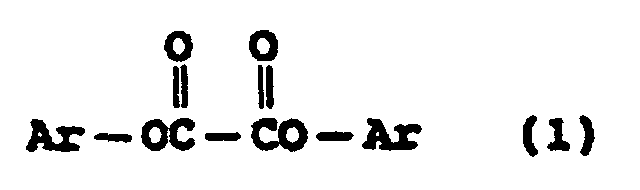
- a process for producing an aromatic polycarbonate through an ester interchange reaction between an aromatic carbonic acid diester and an aromatic dihydroxy compound wherein the aromatic carbonic acid diester is obtained through the decarbonylation reaction of an aromatic oxalic acid diester represented by the following general formula (1): wherein two Ar's are the same or different aromatic hydrocarbon groups having 6 to 14 carbon atoms, and contains 5 ppm or less of hydrolyzable halogen.
- the aromatic polycarbonate is produced through an ester interchange reaction between an aromatic dihydroxy compound and an aromatic carbonic acid diester, and a characteristic feature is that there is used the aromatic carbonic acid diester obtained through the decarbonylation reaction of an aromatic oxalic acid diester represented by the above general formula (1).
- the aromatic dihydroxy compound may be one which is generally used as a dihydroxy component of an aromatic polycarbonate. More specifically, an aromatic dihydroxy compound represented by the following general formula (3) is used. wherein W is -O-, -S-, -SO-, -SO 2 -,
- n is an integer of 0 to 4
- R 5 and R 6 are the same or different and each a halogen atom or hydrocarbon group having 1 to 12 carbon atoms.
- the halogen atom is preferably a chlorine atom, bromine atom or iodine atom.
- the hydrocarbon group is advantageously an aliphatic hydrocarbon group having 1 to 12 carbon atoms, preferably 1 to 5 carbon atoms, such as methyl group or ethyl group, or an aromatic hydrocarbon group having 6 to 12 carbon atoms, such as phenyl group.
- R 7 and R 8 are the same or different and each a halogen atom, hydrogen atom or hydrocarbon group having 1 to 12 carbon atoms.
- Illustrative examples of the hydrocarbon group are the same as those listed for the above R 5 and R 6 .
- R 9 is an alkylene group having 3 to 8 carbon atoms.
- aromatic dihydroxy compound examples include bis(4-hydroxyphenyl)methane, 2,2-bis(4-hydroxyphenyl)propane, 2,2-bis(4-hydroxy-3-methylphenyl)propane, 4,4-bis(4-hydroxyphenyl)heptane, 2,2-bis(4-hydroxy-3,5-dichlorophenyl)propane, 2,2-bis(4-hydroxy-3,5-dibromophenyl)propane, bis(4-hydroxyphenyl)oxide, bis(3,5-dichloro-4-hydroxyphenyl)oxide, p,p'-dihydroxydiphenyl, 3,3'-dichloro-4,4'-dihydroxydiphenyl, bis(4-hydroxyphenyl)sulfone, resorcinol, hydroquinone, 1,4-dihydroxy-2,5-dichlorobenzene, 1,4-dihydroxy-3-methylbenzene, bis(4-hydroxyphenyl)s
- the aromatic carbonic acid diester to be reacted with the aromatic dihydroxy compound may be one which is generally used for the production of an aromatic polycarbonate through an ester interchange process. More specifically, an aromatic carbonic acid diester represented by the following general formula (2) is used.
- R 1 , R 2 , R 3 and R 4 are the same or different and each a hydrogen atom, an alkyl group having 1 to 4 carbon atoms, a phenyl group or a halogen atom.
- aromatic carbonic acid diester examples include diphenyl carbonate, m-cresyl carbonate, m-cresyl phenyl carbonate, p-cresyl carbonate, p-cresyl phenyl carbonate, dinaphthyl carbonate, bis(diphenyl)carbonate, bis(chlorophenyl)carbonate, and the like. Of these, diphenyl carbonate is particularly preferred.
- an aromatic carbonic acid diester obtained through the decarbonylation reaction of an aromatic oxalic acid diester is used in the present invention.
- the aromatic oxalic acid diester is represented by the following general formula (1). wherein two Ar's are the same or different aromatic hydrocarbon groups having 6 to 14 carbon atoms.
- the aromatic oxalic acid diester represented by the above general formula (1) can also be represented by the following general formula (1') in relation to the general formula (2) since an aromatic carbonic acid diester represented by the above general formula (2) is formed by the decarbonylation reaction of the aromatic oxalic acid diester.
- R 1 , R 2 , R 3 and R 4 are the same as defined in the above general formula (2).
- Aromatic oxalic acid diester compounds include, for example, diphenyl oxalate, m-cresyl oxalate, m-cresyl phenyl oxalate, p-cresyl oxalate, p-cresyl phenyl oxalate, dinaphthyl oxalate, bis(diphenyl)oxalate, bis(chlorophenyl)oxalate, and the like. Of these, diphenyl oxalate is particularly preferred.
- An aromatic carbonic acid diester obtained through the decarbonylation reaction of an aromatic oxalic acid diester is used in the present invention.
- This reaction is not particularly limited but a process described in JP-A 8-333307, for example, may be used as an industrial process for inducing this reaction.
- the process described in this publication is excellent because of its high conversion and selectivity.
- an organic phosphorus compound such as a phosphonium salt, phosphine, phosphine dihalide or phosphine oxide is used as a catalyst.
- a catalyst which makes it possible to obtain an aromatic carbonic acid diester (typically, diphenyl carbonate) at a high yield is an organic phosphorus compound containing halogen or a combination of an organic phosphorus compound and a halogen compound. Therefore, it can be said that the preferred process described by the above publication is to obtain an aromatic carbonic acid diester through the decarbonylation reaction of an aromatic oxalic acid diester using an organic phosphorus compound containing halogen (chlorine or bromine) as a catalyst.
- the present inventors have produced an aromatic polycarbonate through an ester interchange reaction using an aromatic carbonic acid diester obtained through the above decarbonylation reaction, separated and purified by a commonly used method.
- an ester interchange reaction between the aromatic carbonic acid diester obtained by the above process and an aromatic dihydroxy compound was carried out by commonly used means, the ester interchange reaction did not proceed easily and it was difficult to obtain an aromatic polycarbonate having a sufficiently high degree of polymerization after an elapse of a predetermined time. More inconveniently, was that the obtained polycarbonate was unsatisfactory in terms of color.
- the present inventors have further made extensive studies on a certain compound derived from the decarbonylation reaction of the aromatic oxalic acid diester.
- the aromatic carbonic acid diester is preferably subjected to a contact treatment with hot water heated to a temperature higher than the melting point of the aromatic carbonic acid diester, preferably a contact treatment with hot water having a pH of 8 to 10.
- a contact treatment with hot water having a pH of 8 to 10. These treatments may be conducted in combination, or the aromatic carbonic acid diester may be subjected to a contact treatment with hot water after purified, for example, by distillation.
- the hydrolyzable halogen may be removed using an adsorptive clay.
- the contact treatment of the aromatic carbonic acid diester with hot water is carried out at a temperature of 80 to 120°C, preferably 80 to 100°C.
- the aromatic carbonic acid diester may be subjected to an ordinary interfacial extraction with neutral hot water while the aromatic carbonic acid diester is in a molten state.
- a basic compound such as sodium carbonate, potassium carbonate, sodium hydrogencarbonate or potassium hydrogencarbonate may be used. It is preferred that 0.5 to 5 parts by weight of hot water, based on 1 part by weight of the aromatic carbonic acid diester, is used in the above contact treatment with hot water.
- an aromatic carbonic acid diester purified by distillation after the above contact treatment with hot water is conducted is particularly preferably used.
- the above contact treatment with hot water and purification by distillation can be carried out once or two or more times separately, the number of times of the contact treatment and purification is determined according to the desired content of the hydrolyzable halogen and from an economical point of view.
- an ester interchange process known per se may be used. That is, the aromatic carbonic acid diester represented by the above general formula (2) is used in an amount of 1.005 to 1.20 mole, more preferably 1.01 to 1.10 mole, based on 1 mole of the aromatic dihydroxy compound represented by the above general formula (3).
- ester interchange reaction between the aromatic dihydroxy compound of the general formula (3) and the aromatic carbonic acid diester represented by the general formula (2) containing 5 ppm or less, preferably 2 ppm or less, of hydrolyzable halogen is preferably carried out in the presence of a catalyst while they are molten by heating.
- ester interchange reaction catalyst As the ester interchange reaction catalyst is generally used an alkali metal compound, alkaline earth metal compound or nitrogen-containing basic compound. These catalysts will be described below.
- the alkali metal compound used as a catalyst is selected from hydroxides, hydrogencarbonates, carbonates, acetates, nitrates, nitrites, sulfites, cyanates, thiocyanates, stearates, borohydrides, benzoates, hydrogen phosphates, bisphenol salts and phenol salts of alkali metals.
- alkali metal compound examples include sodium hydroxide, potassium hydroxide, lithium hydroxide, sodium hydrogencarbonate, potassium hydrogencarbonate, lithium hydrogencarbonate, sodium carbonate, potassium carbonate, lithium carbonate, sodium acetate, potassium acetate, lithium acetate, sodium nitrate, potassium nitrate, lithium nitrate, sodium nitrite, potassium nitrite, lithium nitrite, sodium sulfite, potassium sulfite, lithium sulfite, sodium cyanate, potassium cyanate, lithium cyanate, sodium thiocyanate, potassium thiocyanate, lithium thiocyanate, sodium stearate, potassium stearate, lithium stearate, sodium borohydride, potassium borohydride, lithium borohydride, sodium borophenylate, sodium benzoate, potassium benzoate, lithium benzoate, disodium hydrogenphosphate, dipotassium hydrogenphosphate, dilithium hydrogenphosphate; disodium salts, dipotassium salts
- the alkaline earth metal compound used as a catalyst is selected from calcium hydroxide, barium hydroxide, magnesium hydroxide, strontium hydroxide, calcium hydrogencarbonate, barium hydrogencarbonate, magnesium hydrogencarbonate, strontium hydrogencarbonate, calcium carbonate, barium carbonate, magnesium carbonate, strontium carbonate, calcium acetate, barium acetate, magnesium acetate, strontium acetate, calcium stearate, barium stearate, magnesium stearate, strontium stearate and the like.
- the above alkali metal compound or alkaline earth metal compound is used in such an amount that a metal element contained in the catalyst is to be 1 x 10 -8 to 5 x 10 -5 equivalent, preferably 1 x 10 -7 to 5 x 10 -6 equivalent, based on one mole of the aromatic dihydroxy compound.
- the alkali metal compound or alkaline earth metal compound may adversely affect the physical properties of the obtained polycarbonate or the ester interchange reaction may not fully proceed, thereby making it impossible to produce a high-molecular-weight polycarbonate undesirably.
- the nitrogen-containing basic compound used as a catalyst is selected from ammonium hydroxides having an alkyl, aryl or alkylaryl group, such as tetramethylammonium hydroxide (Me 4 NOH), tetraethylammonium hydroxide (Et 4 NOH), tetrabutylammonium hydroxide (Bu 4 NOH), benzyl trimethylammonium hydroxide ( ⁇ -CH 2 (Me) 3 NOH) and hexadecyl trimethylammonium hydroxide; tertiary amines such as triethyl amine, tributyl amine, dimethylbenzyl amine, hexadecyl dimethyl amine; and basic salts such as tetramethylammonium borohydride (Me 4 NBH 4 ), tetrabutylammonium borohydride (Bu 4 NBH 4 ), tetrabutylammonium tetraphenyl borate
- the nitrogen-containing basic compound is used in an amount of 1 x 10 -5 to 1 x 10 -3 equivalent, preferably 1 x 10 -5 to 5 x 10 -4 equivalent, based on 1 mole of the aromatic dihydroxy compound.
- ester interchange reaction catalysts may be used alone or in combination of two or more.
- an alkali metal compound or alkaline earth metal compound and a nitrogen-containing basic compound may be used in combination.
- the range of the catalyst is changed properly according to the ratio of the compounds.
- auxiliary catalyst used for an esterification reaction and ester interchange reaction, such as an alkali metal salt or alkaline earth metal salt of boron or aluminum hydroxide, quaternary ammonium salt, alkoxide of an alkali metal or alkaline earth metal, organic acid salt of an alkali metal or alkaline earth metal, zinc compound, boron compound, silicon compound, germanium compound, organic tin compound, lead compound, osmium compound, antimony compound, zirconium compound and the like.
- the present invention is not limited to these.
- the auxiliary catalysts may be used alone or in combination of two or more.
- a stabilizer may be added to the polycarbonate obtained by the process of the present invention.
- Known stabilizers may be used effectively as the stabilizer used in the present invention.
- ammonium salts and phosphonium salts of sulfonic acid are preferred, and ammonium salts and phosphonium salts of dodecylbenzenesulfonic acid such as tetrabutyl phosphonium dodecylbenzene sulfonate and ammonium salts and phosphonium salts of paratoluenesulfonic acid such as tetrabutylammonium paratoluene sulfonate are more preferred.
- Preferred sulfonates include methylbenzene sulfonate, ethylbenzene sulfonate, butylbenzene sulfonate, octylbenzene sulfonate, phenylbenzene sulfonate, methyl paratoluene sulfonate, ethyl paratoluene sulfonate, butyl paratoluene sulfonate, octyl paratoluene sulfonate, phenyl paratoluene sulfonate and the like, and the most preferred sulfonate is tetrabutyl phosphonium dodecylbenzene sulfonate.
- the stabilizer may be used in an amount of 0.5 to 50 moles, preferably 0.5 to 10 moles, more preferably 0.8 to 5 moles, based on 1 mole of the polymerization catalyst selected from the alkali metal compound or the alkaline earth metal compound.
- the stabilizer is added to and kneaded with a molten polycarbonate directly or after dissolved or dispersed in a suitable solvent.
- a biaxial extruder is preferred and a vented biaxial extruder is particularly preferred when the stabilizer is dissolved or dispersed in a solvent.
- additives may be added to polycarbonate as long as the object of the present invention can be attained.
- additives are preferably added to a molten polycarbonate like in the case of a stabilizer, and include a heat stabilizer, epoxy compound, ultraviolet absorber, release agent, colorant, slipping agent, anti-blocking agent, lubricant, organic filler, inorganic filler and the like.
- a heat stabilizer, ultraviolet absorber, release agent and colorant are particularly and generally used and may be used in combination of two or more.
- Illustrative examples of the heat stabilizer used in the present invention include phosphorus compounds, phenolic stabilizers, organic thioether-based stabilizers, hindered amine-based stabilizers and the like.
- ultraviolet absorber are used commonly used ultraviolet absorbers which include, for example, salicylic acid-based ultraviolet absorbers, benzophenone-based ultraviolet absorbers, benzotriazole-based ultraviolet absorbers, cyanoacrylate-based ultraviolet absorbers and the like.
- release agent may be used generally known release agents which include, for example, hydrocarbon-based release agents such as paraffins, fatty acid-based release agents such as stearic acid, fatty acid amide-based release agents such as stearic acid amide, alcohol-based release agents such as stearyl alcohols and pentaerythritol, fatty acid ester-based release agents such as glycerin monostearate, silicone-based release agents such as silicone oil and the like.
- hydrocarbon-based release agents such as paraffins
- fatty acid-based release agents such as stearic acid
- fatty acid amide-based release agents such as stearic acid amide
- alcohol-based release agents such as stearyl alcohols and pentaerythritol
- fatty acid ester-based release agents such as glycerin monostearate
- silicone-based release agents such as silicone oil and the like.
- colorant may be used both organic and inorganic pigments and dyes.
- the method for adding these additives is not particularly limited, but these additives may be directly added to polycarbonate, or master pellets thereof may be prepared first, and added.
- the ester interchange reaction between the aromatic dihydroxy compound and the aromatic carbonic acid diester of the present invention can be carried out by distilling out an aromatic monohydroxy compound formed by stirring them, while heating, in an inert gas atmosphere as known in the prior art.
- the reaction temperature is generally 120 to 350°C, preferably 160 to 300°C, and the pressure reduction rate of a reaction system is increased to 10 to 0.1 Torr in the latter stage of the reaction so as to make it easy to distill out the aromatic monohydroxy compound, thereby completing the reaction.
- an aromatic polycarbonate having a high molecular weight and excellent color can be easily produced without impairing ester interchange reactivity for the production of the aromatic polycarbonate by using an aromatic carbonic acid diester obtained through the decarbonylation of an aromatic oxalic acid diester and controlling the amount of hydrolyzable halogen contained in the aromatic carbonic acid diester to a value smaller than a predetermined value.
- the Lab value of a polycarbonate pellet (2.5 (short diameter) x 3.3 (long diameter) x 3.0 (length) mm) is measured by a reflection method using the ND-1001DP of Nippon Denshoku Kogyo Co., Ltd. and the b value is used as an index of yellowness.
- impossible denotes that pelletization was impossible to be done because of low molecular weight of the polycarbonate and hence, the color could not be measured.
- the amount of halogen ions formed by the hydrolysis of hydrolyzable halogen is measured by the following method.
- One gram of an aromatic carbonic acid diester is dissolved into 20 ml of toluene, and the 10 ml of purified water is added, and stirred for 20 minutes to extract halogen ions into water.
- the amount of halogen ions contained in 50 ⁇ l of this solution is determined using 2 mM of NaHCO 3 as an elute and the DX500 Ion Chromatograph of Dionex Co., Ltd.
- Polycarbonate having a viscosity-average molecular weight of 15,200 was obtained and cut into a pellet with a cutter. This pellet was measured for the physical properties of the polycarbonate. The conditions and results are shown in Tables I-A and I-B below.
- Diphenyl carbonate obtained through the decarbonylation reaction of diphenyl oxalate using tetraphenyl phosphonium chloride as a catalyst, contained 24 ppm of hydrolyzable chlorine.
- An ester interchange reaction between this diphenyl carbonate and bisphenol A was carried out in the same manner as in Example 1 to synthesize polycarbonate. The conditions and results are shown in Tables I-A and I-B below.
- Diphenyl carbonate obtained through the decarbonylation reaction of diphenyl oxalate using tetraphenyl phosphonium chloride as a catalyst, contained 24 ppm of hydrolyzable chlorine.
- An ester interchange reaction between this diphenyl carbonate and bisphenol A was carried out in the same manner as in Example 1 except that a disodium salt of bisphenol A was used in place of sodium hydroxide as an ester interchange catalyst in an amount of 2.0 x 10 -6 mole, in terms of sodium, based on bisphenol A, to synthesize polycarbonate.
- the conditions and results are shown in Tables I-A and I-B below.
- Diphenyl carbonate obtained through the decarbonylation reaction of diphenyl oxalate using a hydrochloride of tetraphenyl phosphonium chloride as a catalyst, contained 39 ppm of hydrolyzable chlorine.
- An ester interchange reaction between this diphenyl carbonate and bisphenol A was carried out in the same manner as in Example 1 except that a disodium salt of bisphenol A was used in place of sodium hydroxide as an ester interchange catalyst in an amount of 3.0 x 10 -5 mole, in terms of sodium, based on bisphenol A, to synthesize polycarbonate.
- the conditions and results are shown in Tables II-A and II-B below.
- Diphenyl carbonate containing 1.5 ppm of hydrolyzable chlorine was obtained in the same manner as in Example 15 except that washing with hot water was carried out only once.
- Polycarbonate was synthesized using this diphenyl carbonate under the same conditions as those of Example 15. A pellet of this polycarbonate was used for the measurement of its physical properties. The conditions and results are shown in Tables II-A and II-B below.
- Diphenyl carbonate obtained through the decarbonylation reaction of diphenyl oxalate using triphenyl phosphine and chloroform as catalysts, contained 15 ppm of hydrolyzable chlorine.
- An ester interchange reaction between this diphenyl carbonate and bisphenol A was carried out in the same manner as in Example 21 to synthesize polycarbonate.
- a pellet of this polycarbonate was used for the measurement of its physical properties. The conditions and results are shown in Tables III-A and III-B below.
- Example 24 Washing with hot distilled water was carried out only once in the same manner as in Example 24 to obtain diphenyl carbonate containing 7.3 ppm of hydrolyzable bromine. Polycarbonate was obtained using this diphenyl carbonate under the same conditions as in Example 24. The conditions and results are shown in Tables III-A and III-B below.
Landscapes
- Chemical & Material Sciences (AREA)
- Organic Chemistry (AREA)
- Health & Medical Sciences (AREA)
- Chemical Kinetics & Catalysis (AREA)
- Medicinal Chemistry (AREA)
- Polymers & Plastics (AREA)
- Polyesters Or Polycarbonates (AREA)
Claims (14)
- Procédé de production d'un polycarbonate aromatique par réaction d'échange d'ester entre un diester d'acide carbonique aromatique et un composé dihydroxylé aromatique, dans lequel le diester d'acide carbonique aromatique est obtenu par la réaction de décarbonylation d'un diester d'acide oxalique aromatique représenté par la formule générale suivante (1) :dans laquelle deux Ar sont des groupes hydrocarbonés aromatiques identiques ou différents ayant 6 à 14 atomes de carbone,

et a une teneur en halogène hydrolysable de 5 ppm ou moins, dans lequel l'halogène hydrolysable est tiré d'un catalyseur utilisé dans la réaction de décarbonylation du diester d'acide oxalique aromatique et dans lequel le catalyseur utilisé dans ladite réaction de décarbonylation est une combinaison d'un composé de phosphore organique et d'un composé halogéné, ou un composé de phosphore organique contenant un halogène. - Procédé de production d'un polycarbonate aromatique selon la revendication 1, dans lequel le diester d'acide carbonique aromatique contient 2 ppm ou moins d'un halogène hydrolysable.
- Procédé de production d'un polycarbonate aromatique selon la revendication 1, dans lequel le diester d'acide carbonique aromatique est représenté par la formule générale suivante :dans laquelle R1, R2, R3 et R4 sont identiques ou différents et chacun est un atome d'hydrogène, un groupe alkyle ayant 1 à 4 atomes de carbone, un groupe phényle ou un atome d'halogène.

- Procédé de production d'un polycarbonate aromatique selon la revendication 1, dans lequel le composé dihydroxylé aromatique est représenté par la formule générale suivante (3) :dans laquelle W est -O-, -S-, -SO-, -SO2-,
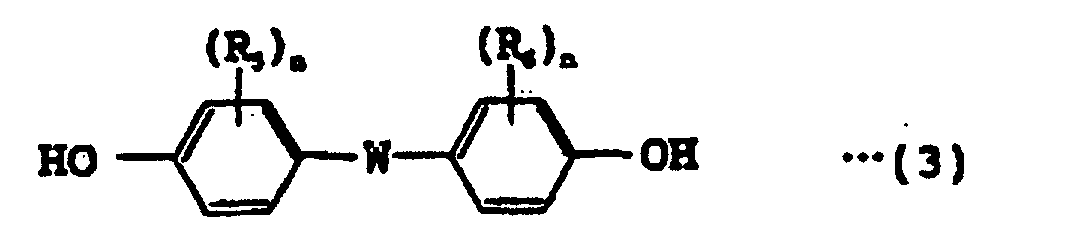 dans laquelle n est 0 à 4, R5 et R6 sont identiques ou différents et chacun est un atome d'halogène ou un groupe hydrocarboné ayant 1 à 12 atomes de carbone, R7 et R8 sont identiques ou différents et sont chacun un atome d'halogène, un atome d'hydrogène ou un groupe hydrocarboné ayant 1 à 12 atomes de carbone, et R9 est un groupe alkylène ayant 3 à 8 atomes de carbone.
- Procédé de production d'un polycarbonate aromatique selon la revendication 1, dans lequel la réaction d'échange d'ester est effectuée en présence d'au moins un catalyseur choisi dans le groupe constitué des composés de métaux alcalins, des composés de métaux alcalino-terreux et des composés basiques contenant de l'azote.
- Procédé de production d'un polycarbonate aromatique selon la revendication 1, dans lequel un composé de métal alcalin et un composé de métal alcalino-terreux sont utilisés comme catalyseurs en quantité équivalente totale de 1 x 10⁻⁸ à 5 x 10⁻⁵ par rapport à 1 mole du composé dihydroxylé aromatique dans la réaction d'échange d'ester.
- Procédé de production d'un polycarbonate aromatique selon la revendication 1, dans lequel un composé basique contenant de l'azote est utilisé comme catalyseur en quantité équivalente de 1 x 10⁻⁵ à 1 x 10⁻³ par rapport à 1 mole du composé dihydroxylé aromatique dans la réaction d'échange d'ester.
- Procédé de production d'un polycarbonate aromatique selon la revendication 1, dans lequel la réaction d'échange d'ester est effectuée à une température de 160°C à 300°C.
- Procédé de production d'un polycarbonate aromatique selon la revendication 1, dans lequel le diester d'acide carbonique aromatique est obtenu par la réaction de décarbonylation du diester d'acide oxalique aromatique et est soumis à un traitement de contact avec de l'eau chaude portée à une température supérieure au point de fusion du diester d'acide carbonique aromatique.
- Procédé de production d'un polycarbonate aromatique selon la revendication 9, dans lequel l'eau chaude a un pH de 8 à 10.
- Procédé de production d'un polycarbonate aromatique selon la revendication 9, dans lequel une purification par distillation est effectuée avant ou après le traitement de contact précité avec l'eau chaude.
- Diester d'acide carbonique aromatique obtenu par la réaction de décarbonylation du diester d'acide oxalique aromatique représenté par la formule générale suivante (1) :dans laquelle deux Ar sont des groupes hydrocarbonés aromatiques identiques ou différents ayant 6 à 14 atomes de carbone,
et a une teneur en halogène hydrolysable de 5 ppm ou moins, dans lequel l'halogène hydrolysable est tiré d'un catalyseur utilisé dans la réaction de décarbonylation du diester d'acide oxalique aromatique et dans lequel le catalyseur utilisé dans ladite réaction de décarbonylation est une combinaison d'un composé de phosphore organique et d'un composé halogéné, ou un composé de phosphore organique contenant un halogène - Utilisation du diester d'acide carbonique aromatique selon la revendication 12 dans la production d'un polycarbonate aromatique.
- Polycarbonate aromatique obtenu par réaction d'échange d'ester entre le diester d'acide carbonique aromatique de la revendication 12 et un composé dihydroxylé aromatique.
Applications Claiming Priority (5)
| Application Number | Priority Date | Filing Date | Title |
|---|---|---|---|
| JP13486497 | 1997-05-26 | ||
| JP13486497 | 1997-05-26 | ||
| JP13486597 | 1997-05-26 | ||
| JP13486597 | 1997-05-26 | ||
| PCT/JP1998/002276 WO1998054240A1 (fr) | 1997-05-26 | 1998-05-25 | Procede de preparation d'un polycarbonate aromatique |
Publications (3)
| Publication Number | Publication Date |
|---|---|
| EP0987285A1 EP0987285A1 (fr) | 2000-03-22 |
| EP0987285A4 EP0987285A4 (fr) | 2000-08-16 |
| EP0987285B1 true EP0987285B1 (fr) | 2003-07-09 |
Family
ID=26468846
Family Applications (1)
| Application Number | Title | Priority Date | Filing Date |
|---|---|---|---|
| EP98921788A Expired - Lifetime EP0987285B1 (fr) | 1997-05-26 | 1998-05-25 | Procede de preparation d'un polycarbonate aromatique |
Country Status (8)
| Country | Link |
|---|---|
| US (1) | US6265524B1 (fr) |
| EP (1) | EP0987285B1 (fr) |
| KR (1) | KR20010012654A (fr) |
| CN (1) | CN1265120A (fr) |
| DE (1) | DE69816295T2 (fr) |
| ES (1) | ES2202852T3 (fr) |
| TW (1) | TW464662B (fr) |
| WO (1) | WO1998054240A1 (fr) |
Families Citing this family (14)
| Publication number | Priority date | Publication date | Assignee | Title |
|---|---|---|---|---|
| JP4686826B2 (ja) * | 2000-08-04 | 2011-05-25 | 宇部興産株式会社 | ポリカーボネートの製法 |
| CN1243715C (zh) * | 2000-08-04 | 2006-03-01 | 宇部兴产株式会社 | 碳酸二芳基酯产物和聚碳酸酯的制备 |
| EP2143750B1 (fr) * | 2002-04-22 | 2012-06-27 | Mitsubishi Chemical Corporation | Composition de polycarbonate aromatique, procédé de production correspondant, et récipient creux obtenu à partir de celle-ci |
| CN101585914B (zh) * | 2002-04-22 | 2011-12-14 | 三菱化学株式会社 | 芳香族聚碳酸酯、其制造方法、聚碳酸酯组合物及由该组合物得到的中空容器 |
| US9150687B2 (en) | 2004-10-01 | 2015-10-06 | Merck Patent Gmbh | Electronic devices containing organic semi-conductors |
| US10149483B2 (en) | 2011-08-05 | 2018-12-11 | Kraft Foods Group Brands Llc | Ready-to-bake batter and methods of making the same |
| EP2712893A1 (fr) | 2012-10-01 | 2014-04-02 | Basf Se | Pipeline avec propriétés d'accumulation de chaleur |
| US9890895B2 (en) | 2012-10-01 | 2018-02-13 | Basf Se | Pipeline with heat-storing properties |
| US10442885B2 (en) | 2012-12-13 | 2019-10-15 | Basf Se | Hydrolysis-stable polyurethane for coating elements in maritime applications |
| EP2743285A1 (fr) | 2012-12-13 | 2014-06-18 | Basf Se | Polyuréthane stable pendant l'hydrolyse pour application dans une zone offshore |
| EP2743284A1 (fr) | 2012-12-13 | 2014-06-18 | Basf Se | Polyuréthane stable pendant l'hydrolyse destiné à revêtir des éléments dans les applications maritimes |
| WO2016035051A2 (fr) | 2014-09-05 | 2016-03-10 | Sabic Global Technologies B.V. | Procédé de polymérisation à l'état fondu de polycarbonate et polycarbonate fabriqué à partir de celui-ci |
| DE102016119477A1 (de) * | 2016-10-12 | 2018-04-12 | Epc Engineering Consulting Gmbh | Katalysator-System |
| CN107082878B (zh) * | 2017-05-18 | 2019-04-26 | 濮阳市宏源石油化工有限公司 | 用于制备芳香族聚碳酸酯的复合催化剂及其应用 |
Citations (2)
| Publication number | Priority date | Publication date | Assignee | Title |
|---|---|---|---|---|
| EP0351168A2 (fr) * | 1988-07-11 | 1990-01-17 | Ge Plastics Japan Ltd. | Procédé de préparaton de polycarbonates |
| EP0737665A1 (fr) * | 1995-04-04 | 1996-10-16 | Ube Industries, Ltd. | Procédé pour la préparation de carbonates de diaryle |
Family Cites Families (4)
| Publication number | Priority date | Publication date | Assignee | Title |
|---|---|---|---|---|
| JPH0618868B2 (ja) | 1988-09-22 | 1994-03-16 | 日本ジーイープラスチックス株式会社 | ポリカーボネートの製造方法 |
| US5892091A (en) * | 1995-04-04 | 1999-04-06 | Ube Industries, Ltd. | Catalyst for decarbonylation reaction |
| JP3482761B2 (ja) | 1995-04-04 | 2004-01-06 | 宇部興産株式会社 | ジアリールカーボネートの製造法 |
| US5922827A (en) * | 1996-09-27 | 1999-07-13 | Ube Industries, Ltd. | Process for producing a polycarbonate |
-
1998
- 1998-05-25 KR KR1019997010615A patent/KR20010012654A/ko not_active Ceased
- 1998-05-25 US US09/424,318 patent/US6265524B1/en not_active Expired - Fee Related
- 1998-05-25 CN CN98807574A patent/CN1265120A/zh active Pending
- 1998-05-25 DE DE69816295T patent/DE69816295T2/de not_active Expired - Fee Related
- 1998-05-25 WO PCT/JP1998/002276 patent/WO1998054240A1/fr not_active Ceased
- 1998-05-25 ES ES98921788T patent/ES2202852T3/es not_active Expired - Lifetime
- 1998-05-25 EP EP98921788A patent/EP0987285B1/fr not_active Expired - Lifetime
- 1998-05-26 TW TW087108169A patent/TW464662B/zh not_active IP Right Cessation
Patent Citations (2)
| Publication number | Priority date | Publication date | Assignee | Title |
|---|---|---|---|---|
| EP0351168A2 (fr) * | 1988-07-11 | 1990-01-17 | Ge Plastics Japan Ltd. | Procédé de préparaton de polycarbonates |
| EP0737665A1 (fr) * | 1995-04-04 | 1996-10-16 | Ube Industries, Ltd. | Procédé pour la préparation de carbonates de diaryle |
Also Published As
| Publication number | Publication date |
|---|---|
| CN1265120A (zh) | 2000-08-30 |
| DE69816295T2 (de) | 2004-05-27 |
| ES2202852T3 (es) | 2004-04-01 |
| EP0987285A4 (fr) | 2000-08-16 |
| KR20010012654A (ko) | 2001-02-26 |
| TW464662B (en) | 2001-11-21 |
| EP0987285A1 (fr) | 2000-03-22 |
| DE69816295D1 (de) | 2003-08-14 |
| WO1998054240A1 (fr) | 1998-12-03 |
| US6265524B1 (en) | 2001-07-24 |
Similar Documents
| Publication | Publication Date | Title |
|---|---|---|
| US5717057A (en) | Method of manufacturing polycarbonate | |
| US6723823B2 (en) | Method of polycarbonate preparation | |
| US6265524B1 (en) | Process for the preparation of aromatic polycarbonate | |
| EP1427770B1 (fr) | Procede de production de polycarbonate | |
| EP0926181B1 (fr) | Procédé de fabrication de polycarbonate | |
| JP2005505651A (ja) | ポリカーボネート樹脂の末端封鎖法及び当該方法に用いられる組成物 | |
| JPH059282A (ja) | ポリカーボネートの製造方法 | |
| EP1554332A1 (fr) | Procede de preparation de polycarbonate | |
| EP3640278B1 (fr) | Résine de polycarbonate aromatique, procédé pour la production de celle-ci et composé dihydroxy aromatique | |
| JP2021021078A (ja) | エステル交換法による高耐熱性(コ)ポリカーボネートの製造 | |
| KR20020032433A (ko) | 폴리카보네이트 제조방법 | |
| JP3327307B2 (ja) | ポリカーボネートの製造方法 | |
| JP2000186137A (ja) | ポリカーボネート及び光学材料 | |
| WO2004033530A1 (fr) | Procede de preparation de polycarbonate | |
| EP0508775B1 (fr) | Procédé pour la préparation de copolycarbonates | |
| JP3327308B2 (ja) | ポリカーボネートの製造方法 | |
| JPH07316278A (ja) | 芳香族ポリカーボネートの製造方法 | |
| ES2287568T3 (es) | Metodo para preparar resina de policarbonato. | |
| JPWO1998054240A1 (ja) | 芳香族ポリカーボネートの製造方法 | |
| KR100529366B1 (ko) | 폴리카보네이트 수지의 제조방법 | |
| EP0890596B1 (fr) | Procédé de préparation de poly (carbonates d'aryles) | |
| JP3283629B2 (ja) | 芳香族ポリカーボネートの製造方法 | |
| JPH08104747A (ja) | 芳香族ポリカーボネートの製造方法 | |
| JPH06329785A (ja) | 芳香族ポリカーボネートの製造方法 | |
| JP2002069169A (ja) | 溶融流動性芳香族ポリカーボネート |
Legal Events
| Date | Code | Title | Description |
|---|---|---|---|
| PUAI | Public reference made under article 153(3) epc to a published international application that has entered the european phase |
Free format text: ORIGINAL CODE: 0009012 |
|
| 17P | Request for examination filed |
Effective date: 19991130 |
|
| AK | Designated contracting states |
Kind code of ref document: A1 Designated state(s): BE DE ES FR GB IT NL |
|
| A4 | Supplementary search report drawn up and despatched |
Effective date: 20000630 |
|
| AK | Designated contracting states |
Kind code of ref document: A4 Designated state(s): BE DE ES FR GB IT NL |
|
| RAP1 | Party data changed (applicant data changed or rights of an application transferred) |
Owner name: UBE INDUSTRIES, LTD. Owner name: TEIJIN LIMITED |
|
| 17Q | First examination report despatched |
Effective date: 20020410 |
|
| GRAH | Despatch of communication of intention to grant a patent |
Free format text: ORIGINAL CODE: EPIDOS IGRA |
|
| GRAH | Despatch of communication of intention to grant a patent |
Free format text: ORIGINAL CODE: EPIDOS IGRA |
|
| GRAA | (expected) grant |
Free format text: ORIGINAL CODE: 0009210 |
|
| AK | Designated contracting states |
Designated state(s): BE DE ES FR GB IT NL |
|
| PG25 | Lapsed in a contracting state [announced via postgrant information from national office to epo] |
Ref country code: NL Free format text: LAPSE BECAUSE OF FAILURE TO SUBMIT A TRANSLATION OF THE DESCRIPTION OR TO PAY THE FEE WITHIN THE PRESCRIBED TIME-LIMIT Effective date: 20030709 Ref country code: IT Free format text: LAPSE BECAUSE OF FAILURE TO SUBMIT A TRANSLATION OF THE DESCRIPTION OR TO PAY THE FEE WITHIN THE PRESCRIBED TIME-LIMIT;WARNING: LAPSES OF ITALIAN PATENTS WITH EFFECTIVE DATE BEFORE 2007 MAY HAVE OCCURRED AT ANY TIME BEFORE 2007. THE CORRECT EFFECTIVE DATE MAY BE DIFFERENT FROM THE ONE RECORDED. Effective date: 20030709 Ref country code: BE Free format text: LAPSE BECAUSE OF FAILURE TO SUBMIT A TRANSLATION OF THE DESCRIPTION OR TO PAY THE FEE WITHIN THE PRESCRIBED TIME-LIMIT Effective date: 20030709 |
|
| REG | Reference to a national code |
Ref country code: GB Ref legal event code: FG4D |
|
| REF | Corresponds to: |
Ref document number: 69816295 Country of ref document: DE Date of ref document: 20030814 Kind code of ref document: P |
|
| NLV1 | Nl: lapsed or annulled due to failure to fulfill the requirements of art. 29p and 29m of the patents act | ||
| REG | Reference to a national code |
Ref country code: ES Ref legal event code: FG2A Ref document number: 2202852 Country of ref document: ES Kind code of ref document: T3 |
|
| PGFP | Annual fee paid to national office [announced via postgrant information from national office to epo] |
Ref country code: FR Payment date: 20040510 Year of fee payment: 7 |
|
| PLBE | No opposition filed within time limit |
Free format text: ORIGINAL CODE: 0009261 |
|
| STAA | Information on the status of an ep patent application or granted ep patent |
Free format text: STATUS: NO OPPOSITION FILED WITHIN TIME LIMIT |
|
| PGFP | Annual fee paid to national office [announced via postgrant information from national office to epo] |
Ref country code: ES Payment date: 20040518 Year of fee payment: 7 |
|
| ET | Fr: translation filed | ||
| PG25 | Lapsed in a contracting state [announced via postgrant information from national office to epo] |
Ref country code: GB Free format text: LAPSE BECAUSE OF NON-PAYMENT OF DUE FEES Effective date: 20040525 |
|
| 26N | No opposition filed |
Effective date: 20040414 |
|
| PG25 | Lapsed in a contracting state [announced via postgrant information from national office to epo] |
Ref country code: DE Free format text: LAPSE BECAUSE OF NON-PAYMENT OF DUE FEES Effective date: 20041201 |
|
| GBPC | Gb: european patent ceased through non-payment of renewal fee |
Effective date: 20040525 |
|
| PG25 | Lapsed in a contracting state [announced via postgrant information from national office to epo] |
Ref country code: ES Free format text: LAPSE BECAUSE OF NON-PAYMENT OF DUE FEES Effective date: 20050526 |
|
| PG25 | Lapsed in a contracting state [announced via postgrant information from national office to epo] |
Ref country code: FR Free format text: LAPSE BECAUSE OF NON-PAYMENT OF DUE FEES Effective date: 20060131 |
|
| REG | Reference to a national code |
Ref country code: FR Ref legal event code: ST Effective date: 20060131 |
|
| REG | Reference to a national code |
Ref country code: ES Ref legal event code: FD2A Effective date: 20050526 |