EP0988253B1 - Elektrochemische behandlung von ionenaustauschmaterial - Google Patents
Elektrochemische behandlung von ionenaustauschmaterial Download PDFInfo
- Publication number
- EP0988253B1 EP0988253B1 EP98920386A EP98920386A EP0988253B1 EP 0988253 B1 EP0988253 B1 EP 0988253B1 EP 98920386 A EP98920386 A EP 98920386A EP 98920386 A EP98920386 A EP 98920386A EP 0988253 B1 EP0988253 B1 EP 0988253B1
- Authority
- EP
- European Patent Office
- Prior art keywords
- exchange material
- regions
- ion exchange
- interface
- water
- Prior art date
- Legal status (The legal status is an assumption and is not a legal conclusion. Google has not performed a legal analysis and makes no representation as to the accuracy of the status listed.)
- Expired - Lifetime
Links
- 239000000463 material Substances 0.000 title claims abstract description 67
- 238000005342 ion exchange Methods 0.000 title claims abstract description 49
- XLYOFNOQVPJJNP-UHFFFAOYSA-N water Substances O XLYOFNOQVPJJNP-UHFFFAOYSA-N 0.000 claims abstract description 54
- 150000001450 anions Chemical class 0.000 claims abstract description 47
- 150000001768 cations Chemical class 0.000 claims abstract description 43
- 238000000034 method Methods 0.000 claims abstract description 38
- 150000002500 ions Chemical class 0.000 claims abstract description 28
- -1 hydrogen ions Chemical class 0.000 claims abstract description 15
- 241000047703 Nonion Species 0.000 claims abstract description 10
- 239000001257 hydrogen Substances 0.000 claims abstract description 6
- 229910052739 hydrogen Inorganic materials 0.000 claims abstract description 6
- 230000008929 regeneration Effects 0.000 claims description 24
- 238000011069 regeneration method Methods 0.000 claims description 24
- 150000003839 salts Chemical class 0.000 claims description 18
- BASFCYQUMIYNBI-UHFFFAOYSA-N platinum Chemical compound [Pt] BASFCYQUMIYNBI-UHFFFAOYSA-N 0.000 claims description 16
- 238000005341 cation exchange Methods 0.000 claims description 9
- RTAQQCXQSZGOHL-UHFFFAOYSA-N Titanium Chemical compound [Ti] RTAQQCXQSZGOHL-UHFFFAOYSA-N 0.000 claims description 8
- 238000005349 anion exchange Methods 0.000 claims description 8
- 239000012528 membrane Substances 0.000 claims description 8
- 229910052697 platinum Inorganic materials 0.000 claims description 8
- 239000010936 titanium Substances 0.000 claims description 6
- 239000004743 Polypropylene Substances 0.000 claims description 5
- 238000011010 flushing procedure Methods 0.000 claims description 5
- 229920001155 polypropylene Polymers 0.000 claims description 5
- 125000006850 spacer group Chemical group 0.000 claims description 5
- 238000000926 separation method Methods 0.000 claims description 4
- 229910001200 Ferrotitanium Inorganic materials 0.000 claims description 3
- 239000000203 mixture Substances 0.000 claims description 3
- 229910001220 stainless steel Inorganic materials 0.000 claims description 3
- 239000010935 stainless steel Substances 0.000 claims description 3
- 229910052719 titanium Inorganic materials 0.000 claims description 3
- 239000011347 resin Substances 0.000 description 43
- 229920005989 resin Polymers 0.000 description 43
- NWUYHJFMYQTDRP-UHFFFAOYSA-N 1,2-bis(ethenyl)benzene;1-ethenyl-2-ethylbenzene;styrene Chemical compound C=CC1=CC=CC=C1.CCC1=CC=CC=C1C=C.C=CC1=CC=CC=C1C=C NWUYHJFMYQTDRP-UHFFFAOYSA-N 0.000 description 22
- 239000003729 cation exchange resin Substances 0.000 description 20
- 239000003957 anion exchange resin Substances 0.000 description 19
- 239000003456 ion exchange resin Substances 0.000 description 12
- 229920003303 ion-exchange polymer Polymers 0.000 description 12
- 239000000243 solution Substances 0.000 description 11
- 230000008569 process Effects 0.000 description 8
- 239000000126 substance Substances 0.000 description 7
- 239000007788 liquid Substances 0.000 description 6
- 238000000746 purification Methods 0.000 description 6
- 230000008901 benefit Effects 0.000 description 4
- HEMHJVSKTPXQMS-UHFFFAOYSA-M Sodium hydroxide Chemical compound [OH-].[Na+] HEMHJVSKTPXQMS-UHFFFAOYSA-M 0.000 description 3
- 239000007864 aqueous solution Substances 0.000 description 3
- 229910001415 sodium ion Inorganic materials 0.000 description 3
- 241000894007 species Species 0.000 description 3
- 239000002253 acid Substances 0.000 description 2
- 229940023913 cation exchange resins Drugs 0.000 description 2
- 229920001429 chelating resin Polymers 0.000 description 2
- 230000001186 cumulative effect Effects 0.000 description 2
- 239000008367 deionised water Substances 0.000 description 2
- 230000000694 effects Effects 0.000 description 2
- 230000005684 electric field Effects 0.000 description 2
- XLYOFNOQVPJJNP-ZSJDYOACSA-N heavy water Substances [2H]O[2H] XLYOFNOQVPJJNP-ZSJDYOACSA-N 0.000 description 2
- 238000006386 neutralization reaction Methods 0.000 description 2
- 238000005498 polishing Methods 0.000 description 2
- 230000001172 regenerating effect Effects 0.000 description 2
- 239000007787 solid Substances 0.000 description 2
- 229910003556 H2 SO4 Inorganic materials 0.000 description 1
- UFHFLCQGNIYNRP-UHFFFAOYSA-N Hydrogen Chemical compound [H][H] UFHFLCQGNIYNRP-UHFFFAOYSA-N 0.000 description 1
- 239000004677 Nylon Substances 0.000 description 1
- 230000002378 acidificating effect Effects 0.000 description 1
- 239000003513 alkali Substances 0.000 description 1
- 239000012670 alkaline solution Substances 0.000 description 1
- 125000000129 anionic group Chemical group 0.000 description 1
- QVGXLLKOCUKJST-UHFFFAOYSA-N atomic oxygen Chemical compound [O] QVGXLLKOCUKJST-UHFFFAOYSA-N 0.000 description 1
- 230000004888 barrier function Effects 0.000 description 1
- 239000002585 base Substances 0.000 description 1
- 125000002091 cationic group Chemical group 0.000 description 1
- 239000003518 caustics Substances 0.000 description 1
- 230000008859 change Effects 0.000 description 1
- 238000001311 chemical methods and process Methods 0.000 description 1
- 238000006243 chemical reaction Methods 0.000 description 1
- 230000001419 dependent effect Effects 0.000 description 1
- 238000011033 desalting Methods 0.000 description 1
- 238000006073 displacement reaction Methods 0.000 description 1
- 230000009977 dual effect Effects 0.000 description 1
- 238000003487 electrochemical reaction Methods 0.000 description 1
- 230000008030 elimination Effects 0.000 description 1
- 238000003379 elimination reaction Methods 0.000 description 1
- 230000007613 environmental effect Effects 0.000 description 1
- 230000007717 exclusion Effects 0.000 description 1
- 238000011065 in-situ storage Methods 0.000 description 1
- 229920001778 nylon Polymers 0.000 description 1
- 230000003647 oxidation Effects 0.000 description 1
- 238000007254 oxidation reaction Methods 0.000 description 1
- 239000001301 oxygen Substances 0.000 description 1
- 229910052760 oxygen Inorganic materials 0.000 description 1
- 238000010248 power generation Methods 0.000 description 1
- 239000008213 purified water Substances 0.000 description 1
- 230000009467 reduction Effects 0.000 description 1
- 230000002441 reversible effect Effects 0.000 description 1
- 239000012266 salt solution Substances 0.000 description 1
- 238000003860 storage Methods 0.000 description 1
- 239000012609 strong anion exchange resin Substances 0.000 description 1
- 239000012607 strong cation exchange resin Substances 0.000 description 1
- 239000012498 ultrapure water Substances 0.000 description 1
- 239000002699 waste material Substances 0.000 description 1
Images



Classifications
-
- C—CHEMISTRY; METALLURGY
- C02—TREATMENT OF WATER, WASTE WATER, SEWAGE, OR SLUDGE
- C02F—TREATMENT OF WATER, WASTE WATER, SEWAGE, OR SLUDGE
- C02F1/00—Treatment of water, waste water, or sewage
- C02F1/46—Treatment of water, waste water, or sewage by electrochemical methods
- C02F1/469—Treatment of water, waste water, or sewage by electrochemical methods by electrochemical separation, e.g. by electro-osmosis, electrodialysis, electrophoresis
- C02F1/4693—Treatment of water, waste water, or sewage by electrochemical methods by electrochemical separation, e.g. by electro-osmosis, electrodialysis, electrophoresis electrodialysis
- C02F1/4695—Treatment of water, waste water, or sewage by electrochemical methods by electrochemical separation, e.g. by electro-osmosis, electrodialysis, electrophoresis electrodialysis electrodeionisation
-
- B—PERFORMING OPERATIONS; TRANSPORTING
- B01—PHYSICAL OR CHEMICAL PROCESSES OR APPARATUS IN GENERAL
- B01D—SEPARATION
- B01D61/00—Processes of separation using semi-permeable membranes, e.g. dialysis, osmosis or ultrafiltration; Apparatus, accessories or auxiliary operations specially adapted therefor
- B01D61/42—Electrodialysis; Electro-osmosis ; Electro-ultrafiltration; Membrane capacitive deionization
- B01D61/44—Ion-selective electrodialysis
- B01D61/46—Apparatus therefor
- B01D61/48—Apparatus therefor having one or more compartments filled with ion-exchange material, e.g. electrodeionisation
-
- B—PERFORMING OPERATIONS; TRANSPORTING
- B01—PHYSICAL OR CHEMICAL PROCESSES OR APPARATUS IN GENERAL
- B01J—CHEMICAL OR PHYSICAL PROCESSES, e.g. CATALYSIS OR COLLOID CHEMISTRY; THEIR RELEVANT APPARATUS
- B01J47/00—Ion-exchange processes in general; Apparatus therefor
- B01J47/02—Column or bed processes
- B01J47/06—Column or bed processes during which the ion-exchange material is subjected to a physical treatment, e.g. heat, electric current, irradiation or vibration
- B01J47/08—Column or bed processes during which the ion-exchange material is subjected to a physical treatment, e.g. heat, electric current, irradiation or vibration subjected to a direct electric current
-
- B—PERFORMING OPERATIONS; TRANSPORTING
- B01—PHYSICAL OR CHEMICAL PROCESSES OR APPARATUS IN GENERAL
- B01J—CHEMICAL OR PHYSICAL PROCESSES, e.g. CATALYSIS OR COLLOID CHEMISTRY; THEIR RELEVANT APPARATUS
- B01J49/00—Regeneration or reactivation of ion-exchangers; Apparatus therefor
- B01J49/30—Electrical regeneration
-
- C—CHEMISTRY; METALLURGY
- C02—TREATMENT OF WATER, WASTE WATER, SEWAGE, OR SLUDGE
- C02F—TREATMENT OF WATER, WASTE WATER, SEWAGE, OR SLUDGE
- C02F1/00—Treatment of water, waste water, or sewage
- C02F1/42—Treatment of water, waste water, or sewage by ion-exchange
-
- C—CHEMISTRY; METALLURGY
- C02—TREATMENT OF WATER, WASTE WATER, SEWAGE, OR SLUDGE
- C02F—TREATMENT OF WATER, WASTE WATER, SEWAGE, OR SLUDGE
- C02F1/00—Treatment of water, waste water, or sewage
- C02F1/46—Treatment of water, waste water, or sewage by electrochemical methods
-
- C—CHEMISTRY; METALLURGY
- C02—TREATMENT OF WATER, WASTE WATER, SEWAGE, OR SLUDGE
- C02F—TREATMENT OF WATER, WASTE WATER, SEWAGE, OR SLUDGE
- C02F2201/00—Apparatus for treatment of water, waste water or sewage
- C02F2201/46—Apparatus for electrochemical processes
- C02F2201/461—Electrolysis apparatus
- C02F2201/46105—Details relating to the electrolytic devices
- C02F2201/46115—Electrolytic cell with membranes or diaphragms
Definitions
- the present invention relates generally to water treatment with ion exchange materials and particularly to methods and apparatus for the electrochemical treatment of anion and cation exchange resins.
- Ion exchange is the reversible interchange of ions between a solid (often termed resin) and a liquid in which there is no permanent change in the structure of the solid that is the ion exchange material.
- the utility of ion exchange rests with the ability to use and reuse the ion exchange materials, employing an appropriate regeneration step.
- dissolved salts are commonly removed from the water by passage through ion exchange materials or resins.
- a combination of a cation exchange resin (in the H + form) and an anion exchange resin (in the OH - form) are used to remove the cations and anions, respectively.
- Two beds, one containing each resin type, may be used in tandem for the removal of many salts. If the aqueous solution is first passed through a bed of cation exchange resin (in the H + form), the cations in the solution are taken up by the cation exchanger, and an equivalent amount of H + ions are released into the solution (thus preserving electroneutrality).
- This (now acidic) solution is then passed through a second bed of anion exchange resin (in the OH - form), and the anions in the solution are taken up by the anion exchanger.
- the OH - that is released neutralises the H + in the solution thereby forming water.
- the dissolved salts have effectively been removed from the solution. (If the sequence of the desalting is reversed, a corresponding scenario, with an intermediate alkaline solution, will apply).
- a mixed bed of ion exchange resin is preferable, either in the place of the tandem bed configuration, or in addition to it, as a final polishing step.
- the cation and anion resins are intimately mixed, and the cations and anions are removed from the solution at the same time, with immediate neutralisation of the H + and OH - released by the resins forming water. It is possible to achieve a greater level of salt removal from aqueous solutions with this configuration, as the chemical equilibrium process is "driven" by the loss of H + and OH - by mutual neutralisation.
- the cation and anion beds must be regenerated.
- the cation and anion resins in the mixed resin bed must be physically separated before chemical regeneration can be carried out.
- This regeneration is usually by treatment with acid (typically H 2 SO 4 ) and alkali (typically NaOH), respectively.
- acid typically H 2 SO 4
- alkali typically NaOH
- the present inventors have developed a method of treating ion exchange resins using mild, inexpensive and ecologically acceptable electrochemical techniques. This method does not require regenerating chemicals, and has the added advantage that the water purification process and ion exchange regeneration can be carried out in the same vessel, with no need to disturb the resin bed. In the case of the mixed bed systems, this process also has the advantage that the regeneration can be carried out on resin beds without needing to separate the cation exchange resin from the anion exchange resin.
- the present invention consists in a method of treating an ion exchange material, the method including:
- the two regions can include single or mixed forms of ion exchange material. It will be appreciated that when single forms of ion exchange material are placed in each region, it is necessary for efficient operation of the method that the cation exchange material is positioned in the region associated with the cathode and the anion exchange material is positioned in the region associated with the anode. With mixed forms of anion and cation exchange materials in both regions, in order to ensure that the ion exchange material is efficiently treated, the polarity of the electrodes is preferably reversed and an electric potential applied such that the portion of material in each region not initially treated undergoes respective ion displacement.
- simultaneous electrochemical regeneration of the ion exchange material in the regions occurs.
- the anions and cations associated with the ion exchange material and removed by the method are preferably salts.
- the salts have accumulated on the ion exchange material during treatment of water prior to carrying out the method according to the present invention to regenerate the ion exchange material.
- the interface can be in any form which allows the removal or flushing of ions and water which reach thereto during the movement of ions under the influence of the electric potential.
- Suitable forms include, but not limited to, non-ion selective membrane, frit, porous spacer, cavity formed by physical separation of the two regions of ion exchange material, inert material, valve arrangement, and physical boundary between the two regions.
- the physical boundary between the two regions may also form a suitable interface.
- the interface is polypropylene frit associated with a valve to allow the removal of the ions and water.
- the cations and/or anions formed during step (c) are removed prior to crossing the interface and entering the other region of ion exchange material.
- the step (b) is used as a means to remove salts dissolved in water to be treated.
- the one or more regions are flushed with water to be treated such that any dissolved salts therein are bound to the ion exchange material.
- steps (c) and (d) are then carried out.
- the distinct advantage of this form of water treatment process is that the ion exchange material can be regenerated in situ .
- the anode is preferably formed of platinum coated titanium, whereas the cathode can be formed of platinum coated titanium or stainless steel. It will be appreciated, however, that the electrodes may be formed of any suitable material.
- Step (d) can be carried out by any suitable means which results in removal of the ions and water from the interface and immediate surrounding area.
- One suitable means is to flush the interface with water for example. It will be appreciated, however, that any suitable means would be applicable.
- the present invention consists in an electrochemical cell comprising:
- the electrochemical cell is particularly suitable for carrying out the method according to the first aspect of the present invention.
- the cell can be used to purify water by removing dissolved salts or for regenerating ion exchange materials placed in the regions thereof.
- the anode is preferably formed of platinum coated titanium, whereas the cathode can be formed of platinum coated titanium or stainless steel. It will be appreciated, however, that the electrodes may be formed of any suitable material.
- the interface is positioned approximately equidistant between the two electrodes and the regions therebetween contain substantially the same volume or amount of ion exchange material.
- the means for applying the electric potential can be any suitable power source.
- the amount of potential applied will depend on the type and amount of ion exchange material. Typically, for a cell containing XXXX of strong ion-exchanger, a current of YYYYY is applied for ZZZZZ minutes to achieve substantially complete regeneration of a fully exhausted ion exchange material. It will be appreciated that these values are only examples and will vary depending on the material, extent of exhaustion and volume used.
- the present consists in the use of the cell according to the second aspect of the present invention to regenerate ion exchange material.
- the present consists in the use of the cell according to the second aspect of the present invention to treat water to remove dissolved salts therefrom.
- the present invention does not require anion and cation selective membranes for its operation. Rather, the regions or beds of ion exchange material are used as a barrier to the transport of the unwanted ions.
- the elimination of the need for ion-selective membranes is a considerable advantage over the prior art, leading to a simpler, more robust and less expensive system.
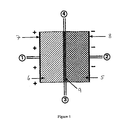
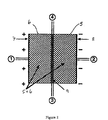
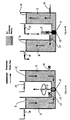
- this schematic demonstrates the general principle of the method of ion exchange material regeneration according to the present invention for a pair of separate regions or beds of cation and anion exchange resin.
- a bed of anion exchange resin 5 and a bed of cation exchange resin 6 are placed between a pair of anode 7 and cathode 8 electrodes. Water is provided to the beds 5 and 6 through input ports 1 and 2 and exits through output port 3. If an appropriate electric potential is applied across the anode 7 and the cathode 8, and there is water in the vicinity of the two electrodes 7 and 8, the following electrochemical processes take place:
- the interface 9 may comprise a porous spacer, a cavity formed by physical separation of the two resin beds, an intermediate boundary of some spacer material (such as ion exchange resin or inert material) or may simply represent the interface between the two resin beds.
- some spacer material such as ion exchange resin or inert material
- the cations and anions meet in this region and some means is afforded for them to flow out of the cell in a liquid stream (aqueous or other).
- this system can be used both to desalt an aqueous solution (in the operating mode), and to regenerate the ion exchange resins, without needing to disturb the resin beds, or to remove resin from the cell.
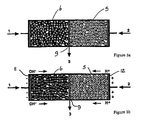
- Figure 3 (a) shows the pair of separate resin beds, with the left hand compartment 6 containing anion exchange resin, and the right hand compartment 5 containing cation exchange resin. Both beds 5 and 6 are shown in their fully exhausted state; that is there is substantially no cation exchange resin in the H + state and no anion exchange resin in the OH - state. It will be appreciated, however, that the resin can be in a partially or fully exhausted state, and regeneration can be carried out partially or fully.
- H + ions migrate through the right hand compartment 5, they replace the cations associated with the cation exchange resin, so the resin is converted to the H + form.
- the cations that are released also migrate together with any surplus H + in the direction of the cathode 11.
- the cations and anions meet at the interface 9, any equivalent amounts of H + and OH - that are present neutralise each other to form water, and the remainder of the ionic species (salts) can be removed through exit port 3.
- Figure 4(a) shows the configuration relevant for a mixed bed system.
- both the left- and the right-hand compartments 6 and 5 are filled with a mixture of anion and cation exchange resins.
- Both beds are shown in their fully exhausted state; that is, there is no cation exchange resin in the H + state and no anion exchange resin in the OH - state. It will be appreciated, however, that the resin can be in a partially or fully exhausted state, and regeneration can be carried out partially or fully.
- H + ions migrate through the right hand compartment 5, they replace the cations associated with the cations exchange resin, so the resin is converted to the H + form.
- the cations that are released also migrate with any surplus H + ions in the direction of the cathode 11
- the cations have no effect on the state of the anion exchange resin in the compartment.
- the ions migrate toward the middle of the cell, and they have the ability to replace the cations and anions that are associated with the cation exchange and anion exchange resins in the left hand compartment 6 and right hand compartment 5, respectively.
- the following examples refer to a cylindrical electrochemical cell with the features shown in Figure 1.
- the interface in this cell was a porous polypropylene frit.
- the right-hand compartment 5 and the left-hand compartment 6 were filled respectively with Amberlite IRA-420TM strong anion exchange resin (I5-5O mesh ASTM) and Amberlite 1R-120TM strong cation exchange resin (15-50 mesh ASTM). These resins are used as an example only, and the invention is not restricted to, or specific for, any particular ion exchange resins or materials.
- the ion exchange capacity of the resins in each compartment was -17 millimoles. The resins had been converted to the Cl - and Na + forms respectively, by standard chemical methods, and were thoroughly washed with deionised water to remove any residual salts.
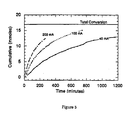
- the electrodes 7 and 8 were platinum coated to titanium mesh (6 cm diameter). The electrodes were placed in intimate contact with the resin, and were held in place by a pair of endplates which were clamped to the cell, forming a sealed unit. High purity deionised water was pumped into the cell through ports 1 and 2, and flowed out through port 3. A galvanostat was used to apply a constant current across the platinum coated titanium mesh electrodes. Water was pumped into the cell through ports 1 and 2, and the effluent from port 3 was collected. The pH, conductivity, and Na + ion concentration of the effluent solution were monitored, and the current and potential were recorded. The results for three different current densities are shown in Figure 5. This graph shows the cumulative number of moles of Na + ions collected through port 3 as a function of time.
- Figure 6 shows the cumulative number of moles of both Na + and CI - ions collected through port 3 as a function of time for a current flow of 40 mA.
- Figure 7 shows the electrochemical efficiency of operation of the cell. For each mole of electrons, one mole of H + and one mole of OH - are produced. If each mole of electrons led to the regeneration of one mole of cation exchange resin and one mole of anion exchange resin, the electrochemical efficiency of the cell would be 100%.
- the overall percentage coulombic efficiency of cation exchange resin conversion is plotted as a function of the percentage of the cation exchange resin in the cell that has been regenerated.
- Figure 8 shows a preferred embodiment of the present invention in which the interface between the two beds of resin is formed by a Tee valve 13 where the liquid flow passages 18 in the valve are substantially filled with anion and cation exchange resin in a mixed or unmixed state.
- this valve 13 is turned such that each end of the flow through passage 18 of the valve 13 is open to one of the resin beds and that the flow passage normal to this is open to a port through which cations and/or anions and water (waste salt solution) can flow.
- the valve 13 is turned such that the liquid flow passage 18 of the valve 13 is no longer open to the resin beds.
- the resin is regenerated in a countercurrent fashion (i.e. the water flow and the ion between the two resin beds in the water purification part of the cycle.
- water is fed through a further input port 16 at the base of bed 5 and exits through port 15 before being fed through the other bed 6 by means of port 17.
- the purified water exits through port 14.
- Ports 16 and 17 are closed when the cell is in the regeneration mode.
- the resin is regenerated in a countercurrent fashion (i.e. the water flow and the ion flow both proceed through the resin beds in one direction in the purification cycle, and both proceed in the opposite direction through the resin beds in the regeneration mode).
- the cell appears as a cylinder, the success of the process is not dependent upon, or restricted to, this particular geometry.
- the size of the cell is not a limiting factor. For example, similar efficiency has been achieved in a cylindrical cell of approximately five times this capacity.
- similar efficiency has been achieved in a cell in a U-tube configuration rather than a straight cylinder with a capacity of approximately ten times this capacity.
- Similar efficiency has also been achieved in a cell where the polypropylene frit is replaced by a pair of nylon meshes holding the two resin beds apart (i.e. where the cavity is simply filled with liquid). The rate of water flow through the cell and the current have also been varied with no drop in electrochemical efficiency.
Landscapes
- Chemical & Material Sciences (AREA)
- Chemical Kinetics & Catalysis (AREA)
- Organic Chemistry (AREA)
- Water Supply & Treatment (AREA)
- Engineering & Computer Science (AREA)
- Life Sciences & Earth Sciences (AREA)
- Hydrology & Water Resources (AREA)
- Environmental & Geological Engineering (AREA)
- Electrochemistry (AREA)
- General Chemical & Material Sciences (AREA)
- Health & Medical Sciences (AREA)
- Analytical Chemistry (AREA)
- Molecular Biology (AREA)
- Urology & Nephrology (AREA)
- Water Treatment By Electricity Or Magnetism (AREA)
- Manufacture Of Macromolecular Shaped Articles (AREA)
- Battery Electrode And Active Subsutance (AREA)
- Treatment Of Water By Ion Exchange (AREA)
Claims (20)
- Verfahren für die Behandlung eines Ionenaustauschmaterials, wobei das Verfahren folgendes umfasst:a) Positionierung von mindestens zwei Bereichen des Ionenaustauschmaterials zwischen einer Anoden- und einer Kathodenelektrode, wobei mindestens ein Teil der zwei Bereiche durch eine nicht-ionenspezifische durchlässige Grenzfläche getrennt ist;b) Versorgung mit Wasser der mindestens zwei Bereiche;c) Anlegen eines elektrischen Potentials zwischen den Elektroden, wodurch die Generierung von Wasserstoffionen an der Anode und Hydrooxidionen an der Kathode verursacht wird, wodurch die Ionen veranlasst werden, sich durch jeden Bereich zu den entgegengesetzt geladenen Elektroden hin zu bewegen und dadurch mindestens einen Teil von entweder Anionen oder Kationen zu verlagern, die mit dem Ionenaustauschmaterial in jedem Bereich in Verbindung sind, so dass die verlagerten Anionen und Kationen ebenfalls veranlasst werden, sich durch die Bereiche zu den entgegengesetzt geladenen Elektroden hin zu bewegen; undd) Entfernen mindestens einiger der sich während des Schrittes (c) gebildeten Anionen und/oder Kationen, welche die Grenzfläche erreichen.
- Verfahren gemäß Anspruch 1, worin ein Bereich ein Anionenaustauschmaterial umfasst und der andere Bereich ein Kationenaustauschmaterial umfasst.
- Verfahren gemäß Anspruch 2, worin der Bereich, der das Anionenaustauschmaterial umfasst neben der Anode positioniert ist und der Bereich, der das Kationenaustauschmaterial umfasst, neben der Kathode positioniert ist.
- Verfahren gemäß Anspruch 1, worin die mindestens zwei Bereiche ein Gemisch von Anionen- und Kationenaustauschmaterialien umfassen.
- Verfahren gemäß Anspruch 4, worin nach dem Anlegen des Potentials während einer Zeitperiode, die Polarität der Elektroden vertauscht wird und ein zweites Potential angelegt wird.
- Verfahren gemäß einem der Ansprüche 1 bis 5, worin eine gleichzeitige elektrochemische Regeneration des Ionenaustauschmaterials in den mindestens zwei Bereichen auftritt.
- Verfahren gemäß einem der Ansprüche 1 bis 6, worin die Anionen und Kationen, die mit dem Ionenaustauschmaterial verbunden sind und entfernt werden, Salze sind, die sich auf dem Ionenaustauschmaterial während der Deionisierungsbehandlung des Wassers angesammelt haben.
- Verfahren gemäß einem der Ansprüche 1 bis 7, worin die nicht-ionenspezifische durchlässige Grenzfläche aus der Gruppe ausgewählt wird, bestehend aus einer nichtionenselektiven Membran, einer Fritte, einem porösen Ausfüller, einer Kavität, die durch physikalische Trennung der zwei Bereiche des Ionenaustauschmaterials gebildet ist, einem inerten Material, einer Ventilanordnung, und einer physikalischen Grenze zwischen den zwei Bereichen.
- Verfahren gemäß Anspruch 8, worin die Grenzfläche eine Fritte aus Polypropylen ist in Verbindung mit einem Ventil, um die Entfernung der Ionen und des Wassers von der Grenzfläche zu ermöglichen.
- Verfahren gemäß einer der Ansprüche 1 bis 9, worin sich die in dem Schritt (c) gebildeten Kationen und/oder Anionen und Wasser entfernt werden vor dem Überschreiten der Grenzfläche und dem Eindringen in den anderen Bereich des Ionenaustauschmaterials.
- Verfahren gemäß einem der Ansprüche 1 bis 10, worin der Schritt (b) als Mittel verwendet wird, um das Salz, das im Wasser aufgelöst ist, zu entfernen, bevor die Schritte (c) und (d) ausgeführt werden.
- Verfahren gemäß einem der Ansprüche 1 bis 11, worin der Schritt (d) aus dem Spülen der Grenzfläche mit Wasser besteht.
- Elektrochemische Zelle umfassend:(a) eine Anoden- und Kathodenelektrode;(b) mindestens zwei Bereiche, die so angepasst sind, um ein Ionenaustauschmaterial zu beinhalten, wobei die Bereiche zwischen den Elektroden positioniert sind,(c) wenigstens ein Teil der zwei Bereiche, der durch eine nicht-ionenspezifische durchlässige Grenzfläche abgetrennt ist;(d) Mittel zur Versorgung der mindestens zwei Bereiche mit Wasser;(e) Mittel für das Anlegen eines elektrischen Potentials zwischen den Elektroden; und(f) Mittel für die Entfernung von Ionen, Salzen und Wasser aus der Grenzfläche; worin während der Anwendung das Anlegen eines elektrischen Potentials die Generierung von Wasserstoffionen an der Anode und Hydrooxidionen an der Kathode verursacht wird, wobei die Ionen veranlasst werden, durch jeden Bereich zur entgegengesetzt geladenen Elektrode sich zu bewegen und dadurch mindestens ein Teil der entweder Anionen oder Kationen, verbunden mit dem Ionenaustauschmaterial in jedem Bereich verlagert wird, so dass die verlagerten Anionen und Kationen ebenfalls veranlasst werden durch die Bereiche zu den entgegengesetzt geladenen Elektroden sich hin zu bewegen; und mindestens einige der gebildeten Anionen und/oder Kationen, welche die Grenzfläche erreichen, durch die Spüleinrichtung entfernt werden.
- Zelle gemäß Anspruch 13, worin die Anode aus platinbeschichtetem Titan und die Kathode aus platinbeschichtetem Titan oder rostfreiem Stahl gebildet ist.
- Zelle gemäß Anspruch 13 oder 14, worin ein Bereich ein Anionenaustauschmaterial umfasst und der andere Bereich ein Kationenaustauschmaterial umfasst.
- Zelle gemäß Anspruch 15, worin der Bereich, der das Anionenaustauschmaterial umfasst neben der Anode positioniert ist und der Bereich, der das Kationenaustauschmaterial umfasst, neben der Kathode positioniert ist.
- Zelle gemäß Anspruch 13 oder 14, worin mindestens zwei Bereiche ein Gemisch von Anionen- und Kationenaustauschmaterialien umfassen.
- Zelle gemäß einer der Ansprüche 13 bis 17, worin die nicht-ionenspezifische durchlässige Grenzfläche ausgewählt wird aus einer Gruppe bestehend aus einer nichtionenselektiven Membran, einer Fritte, einem porösen Ausfüller, einer durch physikalische Trennung zweier Bereiche des Ionenaustauschmaterials gebildete Kavität, einem inerten Material, einer Ventilanordnung, und einer physikalischen Grenze zwischen zwei Bereichen.
- Zelle gemäß Anspruch 18, worin die Grenzfläche eine Fritte aus Polypropylen ist, die mit einem Ventil verbunden ist, um das Entfernen der Ionen und des Wassers aus der Grenzfläche zu ermöglichen.
- Zelle gemäß einem der Ansprüche 13 bis 19, worin das Mittel (f) so ausgebildet ist, um das Spülen der Grenzfläche mit Wasser zu ermöglichen.
Priority Applications (1)
| Application Number | Priority Date | Filing Date | Title |
|---|---|---|---|
| DK98920386T DK0988253T3 (da) | 1997-05-09 | 1998-05-08 | Elektrokemisk behandling af ionbyttermateriale |
Applications Claiming Priority (3)
| Application Number | Priority Date | Filing Date | Title |
|---|---|---|---|
| AUPO6715A AUPO671597A0 (en) | 1997-05-09 | 1997-05-09 | Electrochemical regeneration of ion exchange resin |
| AUPO671597 | 1997-05-09 | ||
| PCT/AU1998/000336 WO1998051621A1 (en) | 1997-05-09 | 1998-05-08 | Electrochemical treatment of ion exchange material |
Publications (3)
| Publication Number | Publication Date |
|---|---|
| EP0988253A1 EP0988253A1 (de) | 2000-03-29 |
| EP0988253A4 EP0988253A4 (de) | 2000-12-13 |
| EP0988253B1 true EP0988253B1 (de) | 2004-08-04 |
Family
ID=3801007
Family Applications (1)
| Application Number | Title | Priority Date | Filing Date |
|---|---|---|---|
| EP98920386A Expired - Lifetime EP0988253B1 (de) | 1997-05-09 | 1998-05-08 | Elektrochemische behandlung von ionenaustauschmaterial |
Country Status (11)
| Country | Link |
|---|---|
| US (1) | US6280599B1 (de) |
| EP (1) | EP0988253B1 (de) |
| JP (1) | JP3512425B2 (de) |
| KR (1) | KR100519196B1 (de) |
| AT (1) | ATE272578T1 (de) |
| AU (1) | AUPO671597A0 (de) |
| DE (1) | DE69825445T2 (de) |
| DK (1) | DK0988253T3 (de) |
| ES (1) | ES2229493T3 (de) |
| PT (1) | PT988253E (de) |
| WO (1) | WO1998051621A1 (de) |
Families Citing this family (14)
| Publication number | Priority date | Publication date | Assignee | Title |
|---|---|---|---|---|
| AUPO671597A0 (en) | 1997-05-09 | 1997-06-05 | Crc For Waste Management And Pollution Control Limited | Electrochemical regeneration of ion exchange resin |
| US6709560B2 (en) * | 2001-04-18 | 2004-03-23 | Biosource, Inc. | Charge barrier flow-through capacitor |
| KR100917433B1 (ko) | 2001-11-29 | 2009-09-14 | 가부시키가이샤 에바라 세이사꾸쇼 | 이온 교환기를 재생시키는 방법 및 장치, 그리고 전해질처리장치 |
| WO2008048656A2 (en) * | 2006-10-18 | 2008-04-24 | Kinetico Incorporated | Electroregeneration apparatus and water treatment method |
| US7813106B2 (en) * | 2006-12-19 | 2010-10-12 | General Electric Company | High current efficiency supercapacitor desalination devices and methods of making the same |
| EP2208523B1 (de) | 2008-12-31 | 2013-02-20 | EMD Millipore Corporation | Elektroentionisierungsvorrichtung mit Aufteilung eines hydrodynamischen Stroms |
| KR101031017B1 (ko) * | 2009-03-02 | 2011-04-25 | 삼성전기주식회사 | 이온 교환체를 이용한 수퍼커패시터 전극 |
| US9790109B2 (en) * | 2010-04-30 | 2017-10-17 | General Electric Company | Method for sanitizing an electrodeionization device |
| US8496797B2 (en) * | 2010-12-14 | 2013-07-30 | General Electric Company | Electrical deionization apparatus |
| US9724645B2 (en) | 2012-02-02 | 2017-08-08 | Tangent Company Llc | Electrochemically regenerated water deionization |
| CN107754868B (zh) * | 2017-11-23 | 2023-11-10 | 南通纺织丝绸产业技术研究院 | 一种基于紧固装置的离子交换材料电化学再生装置 |
| CA3267144A1 (en) * | 2022-09-22 | 2024-04-04 | The Methodist Hospital | ROTARY ELECTROCHEMICAL ETCHING CELL |
| CN116161797B (zh) * | 2023-03-28 | 2024-12-17 | 河南力诚环保科技有限公司 | 一种污水处理用人工湿地系统及其运行方法 |
| CN117250146B (zh) * | 2023-11-20 | 2024-04-09 | 中汽数据(天津)有限公司 | 一种汽车金属板电偶腐蚀反转的评估方法 |
Family Cites Families (13)
| Publication number | Priority date | Publication date | Assignee | Title |
|---|---|---|---|---|
| US2763607A (en) | 1951-06-19 | 1956-09-18 | Tno | Process and apparatus for desalting liquids by means of ion-exchangers, and for regenerating said exchangers |
| US2812300A (en) | 1956-02-07 | 1957-11-05 | Clayton Manufacturing Co | Electrolytic regeneration of ion exchange resins |
| US3006828A (en) * | 1957-12-09 | 1961-10-31 | Gen Electric | Water demineralizing methods and systems |
| DE1442432B2 (de) | 1961-03-17 | 1971-10-21 | Kakihana, Hidetake; Mitsubishi Kasei Kogyo Kabushiki Kaisha; Power Reactor and Nuclear Fuel Development Corp.; Tokio | Verfahren zum kontinuierlichen trennen von gleichgeladenen ionen durch elektrophorese und trennzelle zur durchfuehrung dieses verfahrens |
| WO1983003984A1 (fr) * | 1982-05-13 | 1983-11-24 | Gerhard Kunz | Procede de traitement d'une phase liquide, en particulier procede de dessalement de solutions aqueuses, ainsi que dispositif permettant sa mise en oeuvre |
| US4636296A (en) * | 1983-08-18 | 1987-01-13 | Gerhard Kunz | Process and apparatus for treatment of fluids, particularly desalinization of aqueous solutions |
| DE3568946D1 (en) * | 1984-07-09 | 1989-04-27 | Millipore Corp | Improved electrodeionization apparatus and method |
| GB8515923D0 (en) * | 1985-06-24 | 1985-07-24 | Atomic Energy Authority Uk | Electrochemical ion exchange |
| US5364527A (en) * | 1990-06-20 | 1994-11-15 | Heinz Zimmermann | Apparatus and process for treating water |
| US5211823A (en) * | 1991-06-19 | 1993-05-18 | Millipore Corporation | Process for purifying resins utilizing bipolar interface |
| DE4238532A1 (de) * | 1992-11-14 | 1994-05-19 | Kunz Gerhard K | Verfahren und Vorrichtung zum Entsalzen wäßriger Lösungen mittels Ionenaustauschermassen |
| DE4418812C2 (de) | 1994-05-30 | 1999-03-25 | Forschungszentrum Juelich Gmbh | Einfach- und Mehrfachelektrolysezellen sowie Anordnungen davon zur Entionisierung von wäßrigen Medien |
| AUPO671597A0 (en) | 1997-05-09 | 1997-06-05 | Crc For Waste Management And Pollution Control Limited | Electrochemical regeneration of ion exchange resin |
-
1997
- 1997-05-09 AU AUPO6715A patent/AUPO671597A0/en not_active Abandoned
-
1998
- 1998-05-08 JP JP54860998A patent/JP3512425B2/ja not_active Expired - Fee Related
- 1998-05-08 EP EP98920386A patent/EP0988253B1/de not_active Expired - Lifetime
- 1998-05-08 AT AT98920386T patent/ATE272578T1/de not_active IP Right Cessation
- 1998-05-08 DK DK98920386T patent/DK0988253T3/da active
- 1998-05-08 US US09/331,488 patent/US6280599B1/en not_active Expired - Fee Related
- 1998-05-08 ES ES98920386T patent/ES2229493T3/es not_active Expired - Lifetime
- 1998-05-08 DE DE69825445T patent/DE69825445T2/de not_active Expired - Fee Related
- 1998-05-08 PT PT98920386T patent/PT988253E/pt unknown
- 1998-05-08 WO PCT/AU1998/000336 patent/WO1998051621A1/en not_active Ceased
- 1998-05-08 KR KR10-1999-7010349A patent/KR100519196B1/ko not_active Expired - Fee Related
Also Published As
| Publication number | Publication date |
|---|---|
| DE69825445T2 (de) | 2005-08-04 |
| ATE272578T1 (de) | 2004-08-15 |
| ES2229493T3 (es) | 2005-04-16 |
| WO1998051621A1 (en) | 1998-11-19 |
| PT988253E (pt) | 2004-12-31 |
| KR20010012396A (ko) | 2001-02-15 |
| DE69825445D1 (de) | 2004-09-09 |
| AUPO671597A0 (en) | 1997-06-05 |
| DK0988253T3 (da) | 2004-12-06 |
| JP2001524029A (ja) | 2001-11-27 |
| KR100519196B1 (ko) | 2005-10-06 |
| JP3512425B2 (ja) | 2004-03-29 |
| EP0988253A4 (de) | 2000-12-13 |
| US6280599B1 (en) | 2001-08-28 |
| EP0988253A1 (de) | 2000-03-29 |
Similar Documents
| Publication | Publication Date | Title |
|---|---|---|
| US6280599B1 (en) | Electrochemical treatment of ion exchange material | |
| US2788319A (en) | Ion exchange method and apparatus | |
| JP3244689B2 (ja) | 水を浄化するための電気脱イオン化及び紫外線処理方法 | |
| US4596641A (en) | Electrochemical deionization | |
| EP2208523B1 (de) | Elektroentionisierungsvorrichtung mit Aufteilung eines hydrodynamischen Stroms | |
| EA025677B1 (ru) | Низкоэнергетическая система и способ опреснения морской воды | |
| JPH03207487A (ja) | 水精製方法 | |
| JPH07308548A (ja) | 電気化学的脱イオン化方法 | |
| MX2010010844A (es) | Sistema y metodo de baja energia para desalinizar agua de mar. | |
| JP5868421B2 (ja) | 電気脱イオン化装置 | |
| KR20100012064A (ko) | 이온흡착매트를 이용한 전기동력학적 고효율 토양오염 복원시스템 | |
| WO2025105064A1 (ja) | 水処理装置 | |
| JP4609924B2 (ja) | 電気式脱イオン水製造装置 | |
| JP2003311130A (ja) | 脱塩装置 | |
| JP2009297670A (ja) | 電気式脱イオン水製造装置 | |
| EP2980027A1 (de) | Betrieb einer Vorrichtung zur Beseitigung von Ionen mit Warm- und Kaltwasser | |
| JP4672601B2 (ja) | 脱イオン水製造装置 | |
| JP4828242B2 (ja) | 電気式脱イオン水製造装置及び脱イオン水製造方法 | |
| JP2011121027A (ja) | 電気式脱イオン水製造装置 | |
| AU719236B2 (en) | Electrochemical treatment of ion exchange material | |
| JP3729347B2 (ja) | 電気再生式脱塩装置 | |
| JP6752932B2 (ja) | 水処理装置および水処理方法 | |
| JP2003326272A (ja) | 電気再生式脱塩装置 | |
| JP3570350B2 (ja) | 電気脱イオン装置及び純水製造装置 | |
| JP3501339B2 (ja) | 電気式脱イオン水製造装置 |
Legal Events
| Date | Code | Title | Description |
|---|---|---|---|
| PUAI | Public reference made under article 153(3) epc to a published international application that has entered the european phase |
Free format text: ORIGINAL CODE: 0009012 |
|
| 17P | Request for examination filed |
Effective date: 19991130 |
|
| AK | Designated contracting states |
Kind code of ref document: A1 Designated state(s): AT BE CH CY DE DK ES FI FR GB GR IE IT LI LU MC NL PT SE |
|
| AX | Request for extension of the european patent |
Free format text: AL PAYMENT 19991130;LT PAYMENT 19991130;LV PAYMENT 19991130;MK PAYMENT 19991130;RO PAYMENT 19991130;SI PAYMENT 19991130 |
|
| A4 | Supplementary search report drawn up and despatched |
Effective date: 20001031 |
|
| AK | Designated contracting states |
Kind code of ref document: A4 Designated state(s): AT BE CH CY DE DK ES FI FR GB GR IE IT LI LU MC NL PT SE |
|
| RIC1 | Information provided on ipc code assigned before grant |
Free format text: 7C 02F 1/42 A, 7C 02F 1/469 B, 7B 01J 47/06 B, 7B 01J 49/00 B, 7B 01J 47/08 B, 7C 02F 1/46 B |
|
| GRAP | Despatch of communication of intention to grant a patent |
Free format text: ORIGINAL CODE: EPIDOSNIGR1 |
|
| GRAS | Grant fee paid |
Free format text: ORIGINAL CODE: EPIDOSNIGR3 |
|
| GRAA | (expected) grant |
Free format text: ORIGINAL CODE: 0009210 |
|
| RAP1 | Party data changed (applicant data changed or rights of an application transferred) |
Owner name: CRC FOR WASTE MANAGEMENT AND POLLUTION CONTROL LIM |
|
| AK | Designated contracting states |
Kind code of ref document: B1 Designated state(s): AT BE CH CY DE DK ES FI FR GB GR IE IT LI LU MC NL PT SE |
|
| AX | Request for extension of the european patent |
Extension state: AL LT LV MK RO SI |
|
| REG | Reference to a national code |
Ref country code: GB Ref legal event code: FG4D |
|
| REG | Reference to a national code |
Ref country code: CH Ref legal event code: EP |
|
| REG | Reference to a national code |
Ref country code: IE Ref legal event code: FG4D |
|
| REF | Corresponds to: |
Ref document number: 69825445 Country of ref document: DE Date of ref document: 20040909 Kind code of ref document: P |
|
| REG | Reference to a national code |
Ref country code: SE Ref legal event code: TRGR |
|
| REG | Reference to a national code |
Ref country code: DK Ref legal event code: T3 |
|
| REG | Reference to a national code |
Ref country code: GR Ref legal event code: EP Ref document number: 20040403743 Country of ref document: GR |
|
| REG | Reference to a national code |
Ref country code: PT Ref legal event code: SC4A Free format text: AVAILABILITY OF NATIONAL TRANSLATION Effective date: 20041028 |
|
| REG | Reference to a national code |
Ref country code: CH Ref legal event code: NV Representative=s name: URS WEGMANN DIPL.-ING. ETH |
|
| LTIE | Lt: invalidation of european patent or patent extension |
Effective date: 20040804 |
|
| PGFP | Annual fee paid to national office [announced via postgrant information from national office to epo] |
Ref country code: GR Payment date: 20050413 Year of fee payment: 8 |
|
| REG | Reference to a national code |
Ref country code: ES Ref legal event code: FG2A Ref document number: 2229493 Country of ref document: ES Kind code of ref document: T3 |
|
| PGFP | Annual fee paid to national office [announced via postgrant information from national office to epo] |
Ref country code: PT Payment date: 20050502 Year of fee payment: 8 |
|
| PG25 | Lapsed in a contracting state [announced via postgrant information from national office to epo] |
Ref country code: FI Free format text: LAPSE BECAUSE OF NON-PAYMENT OF DUE FEES Effective date: 20050506 |
|
| PG25 | Lapsed in a contracting state [announced via postgrant information from national office to epo] |
Ref country code: LU Free format text: LAPSE BECAUSE OF NON-PAYMENT OF DUE FEES Effective date: 20050508 Ref country code: CY Free format text: LAPSE BECAUSE OF FAILURE TO SUBMIT A TRANSLATION OF THE DESCRIPTION OR TO PAY THE FEE WITHIN THE PRESCRIBED TIME-LIMIT Effective date: 20050508 Ref country code: AT Free format text: LAPSE BECAUSE OF NON-PAYMENT OF DUE FEES Effective date: 20050508 |
|
| PG25 | Lapsed in a contracting state [announced via postgrant information from national office to epo] |
Ref country code: IE Free format text: LAPSE BECAUSE OF NON-PAYMENT OF DUE FEES Effective date: 20050509 |
|
| PG25 | Lapsed in a contracting state [announced via postgrant information from national office to epo] |
Ref country code: MC Free format text: LAPSE BECAUSE OF NON-PAYMENT OF DUE FEES Effective date: 20050531 Ref country code: LI Free format text: LAPSE BECAUSE OF NON-PAYMENT OF DUE FEES Effective date: 20050531 Ref country code: DK Free format text: LAPSE BECAUSE OF NON-PAYMENT OF DUE FEES Effective date: 20050531 Ref country code: CH Free format text: LAPSE BECAUSE OF NON-PAYMENT OF DUE FEES Effective date: 20050531 |
|
| PLBE | No opposition filed within time limit |
Free format text: ORIGINAL CODE: 0009261 |
|
| STAA | Information on the status of an ep patent application or granted ep patent |
Free format text: STATUS: NO OPPOSITION FILED WITHIN TIME LIMIT |
|
| ET | Fr: translation filed | ||
| PGFP | Annual fee paid to national office [announced via postgrant information from national office to epo] |
Ref country code: BE Payment date: 20050714 Year of fee payment: 8 |
|
| 26N | No opposition filed |
Effective date: 20050506 |
|
| PG25 | Lapsed in a contracting state [announced via postgrant information from national office to epo] |
Ref country code: NL Free format text: LAPSE BECAUSE OF NON-PAYMENT OF DUE FEES Effective date: 20051201 |
|
| REG | Reference to a national code |
Ref country code: CH Ref legal event code: PL |
|
| NLV4 | Nl: lapsed or anulled due to non-payment of the annual fee |
Effective date: 20051201 |
|
| REG | Reference to a national code |
Ref country code: IE Ref legal event code: MM4A |
|
| REG | Reference to a national code |
Ref country code: DK Ref legal event code: EBP |
|
| PGFP | Annual fee paid to national office [announced via postgrant information from national office to epo] |
Ref country code: GB Payment date: 20060503 Year of fee payment: 9 |
|
| PGFP | Annual fee paid to national office [announced via postgrant information from national office to epo] |
Ref country code: SE Payment date: 20060505 Year of fee payment: 9 |
|
| PGFP | Annual fee paid to national office [announced via postgrant information from national office to epo] |
Ref country code: DE Payment date: 20060508 Year of fee payment: 9 |
|
| PGFP | Annual fee paid to national office [announced via postgrant information from national office to epo] |
Ref country code: FR Payment date: 20060515 Year of fee payment: 9 |
|
| PG25 | Lapsed in a contracting state [announced via postgrant information from national office to epo] |
Ref country code: BE Free format text: LAPSE BECAUSE OF NON-PAYMENT OF DUE FEES Effective date: 20060531 |
|
| PGFP | Annual fee paid to national office [announced via postgrant information from national office to epo] |
Ref country code: IT Payment date: 20060531 Year of fee payment: 9 |
|
| PGFP | Annual fee paid to national office [announced via postgrant information from national office to epo] |
Ref country code: ES Payment date: 20060621 Year of fee payment: 9 |
|
| PG25 | Lapsed in a contracting state [announced via postgrant information from national office to epo] |
Ref country code: PT Free format text: LAPSE BECAUSE OF NON-PAYMENT OF DUE FEES Effective date: 20061108 |
|
| REG | Reference to a national code |
Ref country code: PT Ref legal event code: MM4A Free format text: LAPSE DUE TO NON-PAYMENT OF FEES Effective date: 20061108 |
|
| BERE | Be: lapsed |
Owner name: *CRC FOR WASTE MANAGEMENT AND POLLUTION CONTROL LT Effective date: 20060531 |
|
| EUG | Se: european patent has lapsed | ||
| GBPC | Gb: european patent ceased through non-payment of renewal fee |
Effective date: 20070508 |
|
| REG | Reference to a national code |
Ref country code: FR Ref legal event code: ST Effective date: 20080131 |
|
| PG25 | Lapsed in a contracting state [announced via postgrant information from national office to epo] |
Ref country code: DE Free format text: LAPSE BECAUSE OF NON-PAYMENT OF DUE FEES Effective date: 20071201 |
|
| PG25 | Lapsed in a contracting state [announced via postgrant information from national office to epo] |
Ref country code: GB Free format text: LAPSE BECAUSE OF NON-PAYMENT OF DUE FEES Effective date: 20070508 |
|
| PG25 | Lapsed in a contracting state [announced via postgrant information from national office to epo] |
Ref country code: SE Free format text: LAPSE BECAUSE OF NON-PAYMENT OF DUE FEES Effective date: 20070509 |
|
| PG25 | Lapsed in a contracting state [announced via postgrant information from national office to epo] |
Ref country code: FR Free format text: LAPSE BECAUSE OF NON-PAYMENT OF DUE FEES Effective date: 20070531 |
|
| REG | Reference to a national code |
Ref country code: ES Ref legal event code: FD2A Effective date: 20070509 |
|
| PG25 | Lapsed in a contracting state [announced via postgrant information from national office to epo] |
Ref country code: GR Free format text: LAPSE BECAUSE OF NON-PAYMENT OF DUE FEES Effective date: 20061205 Ref country code: ES Free format text: LAPSE BECAUSE OF NON-PAYMENT OF DUE FEES Effective date: 20070509 |
|
| PG25 | Lapsed in a contracting state [announced via postgrant information from national office to epo] |
Ref country code: IT Free format text: LAPSE BECAUSE OF NON-PAYMENT OF DUE FEES Effective date: 20070508 |