EP0988387B9 - Rekombinantes konstrukt für eine erhöhte expression von genen in pflanzen. - Google Patents
Rekombinantes konstrukt für eine erhöhte expression von genen in pflanzen. Download PDFInfo
- Publication number
- EP0988387B9 EP0988387B9 EP98922831A EP98922831A EP0988387B9 EP 0988387 B9 EP0988387 B9 EP 0988387B9 EP 98922831 A EP98922831 A EP 98922831A EP 98922831 A EP98922831 A EP 98922831A EP 0988387 B9 EP0988387 B9 EP 0988387B9
- Authority
- EP
- European Patent Office
- Prior art keywords
- gene
- sequence
- expressed
- plant
- replicase
- Prior art date
- Legal status (The legal status is an assumption and is not a legal conclusion. Google has not performed a legal analysis and makes no representation as to the accuracy of the status listed.)
- Expired - Lifetime
Links
Images


Classifications
-
- C—CHEMISTRY; METALLURGY
- C12—BIOCHEMISTRY; BEER; SPIRITS; WINE; VINEGAR; MICROBIOLOGY; ENZYMOLOGY; MUTATION OR GENETIC ENGINEERING
- C12N—MICROORGANISMS OR ENZYMES; COMPOSITIONS THEREOF; PROPAGATING, PRESERVING, OR MAINTAINING MICROORGANISMS; MUTATION OR GENETIC ENGINEERING; CULTURE MEDIA
- C12N15/00—Mutation or genetic engineering; DNA or RNA concerning genetic engineering, vectors, e.g. plasmids, or their isolation, preparation or purification; Use of hosts therefor
- C12N15/09—Recombinant DNA-technology
- C12N15/63—Introduction of foreign genetic material using vectors; Vectors; Use of hosts therefor; Regulation of expression
- C12N15/67—General methods for enhancing the expression
-
- C—CHEMISTRY; METALLURGY
- C12—BIOCHEMISTRY; BEER; SPIRITS; WINE; VINEGAR; MICROBIOLOGY; ENZYMOLOGY; MUTATION OR GENETIC ENGINEERING
- C12N—MICROORGANISMS OR ENZYMES; COMPOSITIONS THEREOF; PROPAGATING, PRESERVING, OR MAINTAINING MICROORGANISMS; MUTATION OR GENETIC ENGINEERING; CULTURE MEDIA
- C12N15/00—Mutation or genetic engineering; DNA or RNA concerning genetic engineering, vectors, e.g. plasmids, or their isolation, preparation or purification; Use of hosts therefor
- C12N15/09—Recombinant DNA-technology
- C12N15/63—Introduction of foreign genetic material using vectors; Vectors; Use of hosts therefor; Regulation of expression
- C12N15/79—Vectors or expression systems specially adapted for eukaryotic hosts
- C12N15/82—Vectors or expression systems specially adapted for eukaryotic hosts for plant cells, e.g. plant artificial chromosomes (PACs)
- C12N15/8216—Methods for controlling, regulating or enhancing expression of transgenes in plant cells
Definitions
- This invention is related to molecular biology and biotechnology exploiting plant genetic engineering by recombinant DNA technology.
- This invention describes a DNA construct based on viral sequences which are capable of activating or increasing the expression of a gene in recombinant DNA-containing tissue.
- the envention is useful for increasing the expression of a gene, derived from heterologous plant species, or has non-plant origin.
- the invention will facilitate in the genetic engineering to express proteins of interest or express novel plant phenotypes of economic or investigative value.
- the invention relates to a method of expressing a gene sequence in plant cells or in a plant.
- the invention also relates to a recombinant DNA molecule for said method and to a eukaryotic cell transformed with the DNA molecule.
- RNAs of many plant and animal viruses belonging to so-called Sindbis-like supergroup are functionally monocistronic: only the 5'- proximal gene can be translated by eukaryotic ribosomes. All the internal translationally silent genes are expressed from subgenomic RNAs (sgRNA) produced by transcription of the minus-copy of the full-length genomic RNA from internal sites - subgenomic promoters (sgPr). All RNA viruses produce during their replicative cycle the virus-specific RNA-dependent RNA polymerase (replicase) which is essential for the synthesis of various species of viral RNA.
- sgRNA subgenomic RNAs
- sgPr subgenomic RNAs
- All RNA viruses produce during their replicative cycle the virus-specific RNA-dependent RNA polymerase (replicase) which is essential for the synthesis of various species of viral RNA.
- the replicase gene is localized 5'-proximally within the monopartite genomes of the members of Sindbis-like viruses (e.g. tobacco mosaic virus, TMV, potato virus X, PVX, brome mosaic virus, BMV), i.e. represent the only translatable gene of the polycistronic genome (for a review, see Bruening et al. (1979) In “Molecular Biology of Plants", Academic Press, New York-London, pp.241-272). Specific cis -acting sequences within the minus-copy of the genomic RNA are required for synthesis of sgRNAs.
- Sindbis-like viruses e.g. tobacco mosaic virus, TMV, potato virus X, PVX, brome mosaic virus, BMV
- replicase allows it to recognize these internal sequences (sgPrs) to synthesize sgRNAs by partial transcription of the negative-strand RNA. This mechanism has been clearly established for some plant viruses in vitro (Miller et al . (1985) Nature 313 , 68-70) and in vivo (Gargouri et al . (1989) Virology 171 , 386-393).
- viral replicase expressed from the integrated cDNAs in transgenic plants can replicate viral RNAs and produce subgenomic RNAs (Leiser et al , (1992) Proc.Natl.Acad.Sci.USA 89 , 9136-9140).
- the replicase will be able to act in trans to recognize in vivo the specific sgPr not only in full-length viral genome but also in the short chimeric minus-sense RNA transcripts carrying a foreign gene (in antisense orientation). This could result in producing the respective sgRNA by the mechanism adapted for viral sgRNA synthesis.
- the complete nucleotide sequence of the PVX genome has been reported for Russian (Skryabin et al . (1988a) Nucleic Acid Res. 16 , 10929-10930) and several other strains (for example, see Querci et al . (1993) J.Gen.Virol. 74 , 2251-2255.).
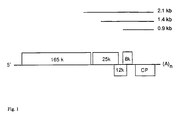
- the PVX genome contains five ORFs coding for the 165kDa replicase, three movement proteins (MPs) (25kDa, 12kDa and 8kDa) and coat protein (CP) (Fig.1).
- the replicase protein is translated directly from the genomic RNA, and its expression is controlled by the 5'-untranslated genomic leader sequence ( ⁇ -sequence).
- the ⁇ -leader has been shown to enhance strongly the translation of foreign genes both in vitro (Smirnyagina et al, (1991) Biochimie 73 , 587-598) and in vivo (Tomashevskaya et al . (1993) J.Gen.Virol. 74 , 2717-2724).
- the separate sgRNAs are produced in PVX infection for the MPs and CP expression which are 3'-coterminal with the genomic RNA (Fig. 1) (Morozov et al . (1991) J.Gen. Virol. 72 , 2039-2043).
- US 5,633,447 describes a DNA construct having a subgenomic promoter of a positive strand RNA virus and a gene of interest in negative sense orientation.
- RNA viruses for the introduction and expression of non-viral foreign genes in plants has been demonstrated by the cited references above as well as by French et al . (1986) (Science 231 , 1294-1297).
- all these viral vectors have been capable of autonomous replication in plant cells, thus, providing a risk for cell pathogenesis in a manner typical for wild type virus.
- Another disadvantage of self-replicating RNA vectors is that they are not stable for the maintenance of non-viral sequences (Donson et al . (1991) Proc.Natl.Acad.Sci.USA 88, 7204-7208).
- the invention provides a method of expressing a gene sequence to be expressed in plant cells or in a plant according to claim 1.
- the invention also provides a recombinant DNA molecule according to claim 12 and a eucaryotic cell according to claim 13.
- the present invention focuses on the super-expression of foreign genes in transgenic cells by to combining within a single cDNA construct and respective RNA transcript, several trans - and cis -acting genetic elements of viral origin which will act in concert to trigger the following functional events: a) the primary chimeric continuous RNA transcript is produced by the transformed cells from plant-expressible promoter (35S promoter) (Fig.2); b) RNA replicase produced by direct translation of the 5'-proximal gene of a single continuous primary transcript will synthesize secondary monocistronic (Fig.3A) (or dicistronic (Fig.3B)) mRNA as a result of the transcription from sgPr sequence.
- Fig.3A secondary monocistronic
- Fig.3B dicistronic
- RNA transcripts originated from sgPr will include at their 3'-end the minus copy of RNA replicase gene and genomic promoter for plus-RNA synthesis (Fig 3 A and B).
- RNA replicase produced in transgenic cell will bind with the 3'-terminal sequence of this RNA (genomic promoter) producing upon transcription the RNA molecules carrying the plus-polarity replicase gene at the 5'-end. Translation of these mRNAs will result in production of additional replicase in transgenic plant (Fig.4).
- Expression refers to the transcription and translation of a gene so that a protein is synthesized.
- Super-expression means the expression at least several-fold higher than the expression in normal conditions.
- Promoter refers to the sequence at the 5' end of a structural gene which directs the initiation of DNA transcription. Promoter sequences are necessary to drive the expression of the downstream gene(s).
- Eukaryotic (including plant-specific) promoters generally contain the TATA box about 10-35 bp 5' to the transcription start site.
- 35S promoter refers to a plant-expressible cauliflower mosaic virus promoter providing the TATA box and other sequences responsible for maximum efficiency of transcription.
- This promoter could also serve as a transcriptional recombinant promoter for gene expression in monocotyledonous plants (Last et al ., European Patent Application EP 0 459 643 A2 (91304205.7) and plant anaerobic regulatory element (Peacock et al ., European Patent Application EP 0 278 658 A2 (No. 88 300 852.6).
- the first of these expression segments represents a unique transcription module (under the control of plant-specific promoter) comprising a PVX replicase gene at the 5'-proximal position (in sense orientation) followed by sgPr of PVX (in anti-sense orientation) fused to a polylinker sequence.
- the second element contains additional translational enhancer of PVX ( ⁇ -leader sequence) placed between sgPr and polylinker providing to the higher level of gene expression.
- the third element contains in addition to the second element an internal ribosomal entry site (IRES) to create dicistronic mRNAs capable of co-expressing the gene of interest which can be placed under the ⁇ -enhancer and IRES-controlled selectable marker gene, thus, significantly simplifying selection of proper transgenic plant lines.
- IRES internal ribosomal entry site
- the cited application suggested to employ two cDNA constructions: cDNA of replicase gene and a recombinant virus genomic RNA where exogenous gene is present instead of natural CP gene.
- This approach is cumbersome and difficult to put into practice because it requires double plant cell transformation. In the present invention only one plant cell transformation is required.
- Viral subgenomic promoter for the heterologous gene expression was used by Gerlach et al. (PCT WO 91/13994), who have proposed a nucleic acid sequence comprising; (a) a transcriptional promoter; (b) a heterologous gene sequence operably linked to said transcriptional promoter; and (c) a sgPr ligated to the heterologous gene sequence.
- the proposed cDNA construction contains heterogenous gene in antisense orientation but does not the include the viral-derived replicase gene in contrast to the present invention.
- Viral sgPrs in viral RNA genomes contain a set of consensus sequences specific for a particular virus group (see, for example, Solovyev et al, (1994) J.Gen.Virol. 75 , 259-267). All known sgPrs are operating only at RNA level. Anti-sense orientation of RNA segments refers to the RNA complementary to the mRNA being translated. Chimeric sequence or construct refers to a nucleotide sequence derived from at least two heterologous parts.
- Production of genetically modified plant tissue expressing a protein of interest under the control of a expression activating element and an upstream plant-specific promoter combines the specific points of the present disclosure with a variety of techniques and expedients known in the art. In most instances, alternative methods exist for each stage of the overall process. The choice of the methods depends on variables such as of the vector system for the introduction and stable maintenance of the expression activating element plant-specific promoter polyadenylation signal, the plant species to be modified and the desire regeneration strategy, the RNA polymerase gene, sgPr and the particular gene of interest to be used.
- subgenomic promoter sgPr of 25K protein gene (Fig.1) of the coat protein gene might be replaced by other related promoters.
- One application of the invention is to localize the synthesised proteins in vacuoles, cytoplasm or intercellular space by using a proper signal peptide sequence to translocate the proteins in the desired place.
- This invention could be applied for super-expression of different proteins: a) the animal RNA-binding protein to achieve nonspecific resistance to different DNA- and RNA-containing viruses; b) normal and defective plant virus-derived CP, movement protein or replicase for providing plant virus resistance; c) plant proteins such as thaumatin; d) essential amino acid-rich proteins improving nutritional value of plant crops; e) medical useful proteins such as antibodies and interferon; f) enzymes such as amylases, cellulases, proteases, lipases.
- a principal feature of the present invention in its preferred embodiment is the recombinant plasmid having an inserted plant-specific promoter and polyadenylation signal directing the transcription of viral replicase gene (in sense orientation) and heterologous gene(s) of interest (in anti-sense orientation) whose expression is directed by transcription activation from viral sgPr and by translational activation from PVX ⁇ -sequence (Fig.2-4). It has been determind that translational activation is the most effective when gene of interest is placed immediately 3' to the ⁇ -sequence in the respective translatable transcript (Fig.3). To avoid significant differences in the rates of expression of genes of interest in different plant lines, the selective marker gene under the control of IRES can be inserted on the 3' side of the transcript.
- the single cDNA construct directs the synthesis of respective primary RNA transcript controlled by 35S promoter and polyadenylation signal (PAS) of cauliflower mosaic virus (Odell et al . (1985) Nature 313 , 810-812) (Fig.2C).
- the primary chimeric RNA transcript includes the PVX replicase gene at the 5' end (Fig.2E).
- RNA replicase produced by direct translation of the 5'-proximal gene of a single continuous primary transcript synthesizes secondary dicistronic mRNA as a result of the transcription from sgPr sequence (Fig.3B).
- Fig. 3B As a result transformed shoots expressing the secondary transcript (Fig. 3B) could be easily selected by growing on the kanamycin-containing media. The respective kanamycin-resistant plants will produce also 2'-5' oligoadenylate synthetase (Fig. 3B) conferring them the resistance to virus infection (Truve et al . (1993) Biotechnology 11, 1048-1052). It can be expected that the PVX RNA replicase produced in transgenic cell will bind with the 3'-terminal sequence of the secondary RNA (Fig. 3B) representing the PVX genomic promoter for plus-RNA synthesis producing after transcription the RNA molecules carrying the plus-polarity replicase gene at the 5'-end (Fig.4). Translation of these mRNAs will result in production of additional replicase in transgenic plant.
- Example 1 Construction, of plasmids containing the PVX replicase gene. GUS gene and PVX sgPr
- the full-length PVX cDNA clone pBS118 (Morozov et al . (1990). Biochimie 72, 677-684) was used for PCR amplification of RdRp gene with PVX specific primers PVXpo15 (corresponding to the residues 1-24 of PVX genome) and PVXpo13 (corresponding to residues 4421-4451 and including artificial KpnI site at the 5' terminus).
- the resulting PCR fragment was cleaved by MunI and KpnI and ligated to EcoRI-KpnI-cleaved pRT 101 (Topfer et al . (1987). Nucleic Acids Res. 15 , 5890), to give pRTX-Pol.
- the pBS118 clone was also used for PCR-mediated amplification of PVX sgPr.
- the reaction was directed by the primers PVX-SGXba (corresponding to the residues 5241-5265 of PVX genome) and PVX-SGNco (complementary to the residues 5625-5651 and including artificial Nco1 site at the 5' terminus).
- the plasmid pTZ-G12 - derivative of pTZ18R (Zelenina et al . (1992).
- FEBS Letters 296 , 267-270) was used for PCR-amplification of ⁇ -glucuronidase (GUS) gene.
- GUS ⁇ -glucuronidase
- the reaction was directed by universal reverse sequencing primer and the primer (24-mer) complementary to the 3' end of GUS gene and including artificial Kpn1 site. Then, the PCR products corresponding to PVX sgPr and GUS gene were cleaved with NcoI and ligated to each other. The ligation product corresponding to the fusion of sgPr-GUS gene was isolated from agarose gel, cleaved with Xba1 and Kpn1 and ligated to Xba1-Kpn1-cleaved pRTX-Pol, to give pRTX-PSG.
- the protoplasts were again sedimented, washed, sedimented and resuspended in TBS9 (Tris 3.63 g/l, CaCl 2 .2H 2 O 876 mg/l, NaCl 8.78 mg/l, mannitol 50g/l, pH 9.0) at concentration of 2x10 6 protoplasts/ml.
- the tubes were spun gently ( ⁇ 100g) for 5 minutes, the supernatants removed and protoplasts resuspended in 1 ml of M-S culture medium.
- the protoplast suspension were transferred to 35 mm petri dishes which were sealed in parafilm and incubated at 25°C in the dark to allow expression of the GUS gene.
- Example 5 Particle gun bombardment and testing GUS activity in plants .
- Particle gun bombardment was performed using flying disk method (for example, see Daniell (1993) (Methods in Enzymology 217, 537-557) with high-pressure helium-based apparatus PDS-1000 (Bio-Rad). Briefly, for each series of shots, DNA was precipitated on tungsten particles with calcium chloride and ethanol after the addition, while vortexing, of 10 ⁇ l of plasmid DNA (at 0.5-1.5 mg/ml to 6 mg of tungsten particles suspended in 100 ⁇ l of 50% glycerol, and then tungsten particles kept in suspension in cold 95% ethanol (90 mg/ml). After sonication 5 ⁇ l of this mixture was placed immediately on each plastic flying disk and used for bombardment when the particles had dried.
- flying disk method for example, see Daniell (1993) (Methods in Enzymology 217, 537-557) with high-pressure helium-based apparatus PDS-1000 (Bio-Rad).
- DNA was precipitated on tungs
- a detached leaf of Nicotiana benthamiana (15-30 mm size) was placed in the center of a plastic Petri dish and bombarded on a solid support at a target distance of 7 cm. Bombardment was done with a pulse of 1350 kPa helium gas in a vacuum chamber.
- Inoculated leaves were sampled 24 to 72 hrs after bombardment. PVX replicase and sgPr activity was monitored by histochemical detection of GUS expression described (Jefferson et al . (1987) Plant Molecular Biology Report 5, 387-405). Samples were infiltrated in the colorimetric GUS substrate, modified (De Block and Debrouwer (1992) Plant J. 2 , 261-266) to limit the diffusion of the intermediate products of the reaction: 0.115 M phosphate buffer, pH 7.0, containing 5-bromo-4-chloro-3-indolyl- ⁇ -D-glucuronide (X-Gluc) 600 ⁇ g/ml; 3mM potassium ferricyanide; 10mM EDTA. After incubation overnight at 37° C, the leaves fixed in 70% ethanol and examined by light microscopy.
Landscapes
- Genetics & Genomics (AREA)
- Health & Medical Sciences (AREA)
- Life Sciences & Earth Sciences (AREA)
- Engineering & Computer Science (AREA)
- Wood Science & Technology (AREA)
- Organic Chemistry (AREA)
- Biomedical Technology (AREA)
- Biotechnology (AREA)
- General Engineering & Computer Science (AREA)
- Chemical & Material Sciences (AREA)
- Zoology (AREA)
- Bioinformatics & Cheminformatics (AREA)
- Biophysics (AREA)
- Microbiology (AREA)
- Plant Pathology (AREA)
- Molecular Biology (AREA)
- Biochemistry (AREA)
- General Health & Medical Sciences (AREA)
- Physics & Mathematics (AREA)
- Cell Biology (AREA)
- Breeding Of Plants And Reproduction By Means Of Culturing (AREA)
- Micro-Organisms Or Cultivation Processes Thereof (AREA)
- Agricultural Chemicals And Associated Chemicals (AREA)
- Fertilizers (AREA)
- Preparation Of Compounds By Using Micro-Organisms (AREA)
Claims (13)
- Methode zur Expression einer in Pflanzenzellen oder in einer Pflanze zu exprimierenden Gensequenz, umfassend das Einführen eines rekombinanten DNA-Moleküls in Pflanzenzellen, wobei das rekombinante DNA-Molekül umfasst:(a) einen Transkriptionspromotor,(b) ein 3' zum Transkriptionspromotor befindliches von einem Virus abgeleitetes Replicasegen,(c) eine zu exprimierende Gensequenz,(d) eine subgenomische Promotorsequenz, die an die zu exprimierende Gensequenz gebunden ist,worin
die Replicase-Gensequenz eine Orientierung aufweist, die bei der Transkription ein primäres RNA-Transkript ergibt, das die Replicase-Gensequenz in Positivsinn-Orientierung aufweist; und
die zu exprimierende Gensequenz und die subgenomische Promotorsequenz in einer Orientierung sind, die bei der Transkription ein primäres RNA-Transkript ergibt, das die zu exprimierende Gensequenz und die subgenomische Promotorsequenz in Negativsinn-Orientierung aufweist. - Methode nach Anspruch 1, worin der Transkriptionspromotor ein eukaryotischer Promotor ist.
- Methode nach Anspruch 2, worin der Transkriptionspromotor ein pflanzenspezifischer Promotor eines Pflanzenvirus ist.
- Methode nach einem der Ansprüche 1 bis 3, worin das Replikatgen ein pflanzenspezifisches Replicase-Gen eines Pflanzenvirus ist.
- Methode nach einem der Ansprüche 1 bis 4, worin die subgenomische Promotorsequenz ein pflanzenspezifischer subgenomischer Promotor eines pflanzenviralen Ursprungs ist, der dazu fähig ist, mit einer aus dem Replicase-Gen exprimierten Replicase in Wechselwirkung zu treten.
- Methode nach einem der Ansprüche 1 bis 5, worin die zu exprimierende Gensequenz ein gewünschtes Polypeptid-Produkt kodiert, das ausgewählt ist aus der Gruppe bestehend aus: Antibiotika, Toxine, Hormone, Enzyme, mikrobielle Proteine und tierische Proteine.
- Methode nach einem der Ansprüche 1 bis 5, worin die zu exprimierende Gensequenz ein Polypeptid-Produkt kodiert, das eine Virusinfektion beeinflusst oder das eine Eigenschaft modifiziert, die ausgewählt ist aus der Gruppe bestehend aus: Pheno-Typ, Sterilität, Salztoleranz, Virusanfälligkeit, Dürre-Toleranz, Azidität und Farbe einer Pflanze; oder das Polypeptid-Produkt ein bestimmbares Signal erzeugt.
- Methode nach einem der Ansprüche 1 bis 7, die zusätzlich ein Gen umfasst, das einen selektierbaren Marker kodiert, der Antibiotika-Resistenz, Herbizid-Resistenz, Farbveränderung verleiht, oder das ein Polypeptid kodiert, das fähig ist, mit einem Substrat unter Bildung eines bestimmbaren Signals zu reagieren.
- Methode nach einem der Ansprüche 1 bis 8, die zwischen dem Replicase-Gen und der zu exprimierenden Gensequenz eine weitere unter der Kontrolle einer internen Ribosomen-Eingangsposition (IRES) zu exprimierende Gensequenz enthält, wobei die weitere zu exprimierende Gensequenz und IRES eine Orientierung aufweisen, die bei der Transkription ein primäres RNA-Transkript ergibt, das eine weitere zu exprimierende Gensequenz und IRES in Negativsinn-Orientierung aufweist.
- Methode nach einem der Ansprüche 1 bis 9, die zusätzlich die αβ-Leader-Sequenz von PVX-Virus als Translations-verstärkende Nucleotid-Sequenz umfasst, die sich zwischen der Transkriptions-Initiierungsposition der subgenomischen Promotorsequenz und dem 5'-Ende der zu exprimierenden Gensequenz befindet.
- Methode nach einem der Ansprüche 1 bis 10, worin das Replicase-Gen, die zu exprimierende Gensequenz und die subgenomische Promotorsequenz unter der Wirkung des Transkriptionspromotors transkribiert werden, um ein primäres Transkript zu ergeben, das dazu fähig ist, unter der Wirkung der aus dem Replicase-Gen exprimierten Replicase und dem subgenomischen Promotor transkribiert zu werden, um ein sekundäres Transkript zu ergeben.
- Rekombinantes DNA-Molekül, wie in einem der Ansprüche 1 bis 10 definiert.
- Eukaroytische Zelle, transformiert mit dem rekombinanten DNA-Molekül nach Anspruch 12.
Applications Claiming Priority (3)
| Application Number | Priority Date | Filing Date | Title |
|---|---|---|---|
| FI972325A FI110323B (fi) | 1997-06-02 | 1997-06-02 | Rekombinanttikonstrukti geenin ilmentämisen lisäämiseksi kasveissa |
| FI972325 | 1997-06-02 | ||
| PCT/FI1998/000445 WO1998055636A1 (en) | 1997-06-02 | 1998-05-28 | Recombinant construct for enhancement of gene expression in plants |
Publications (3)
| Publication Number | Publication Date |
|---|---|
| EP0988387A1 EP0988387A1 (de) | 2000-03-29 |
| EP0988387B1 EP0988387B1 (de) | 2006-10-11 |
| EP0988387B9 true EP0988387B9 (de) | 2007-02-28 |
Family
ID=8548956
Family Applications (1)
| Application Number | Title | Priority Date | Filing Date |
|---|---|---|---|
| EP98922831A Expired - Lifetime EP0988387B9 (de) | 1997-06-02 | 1998-05-28 | Rekombinantes konstrukt für eine erhöhte expression von genen in pflanzen. |
Country Status (8)
| Country | Link |
|---|---|
| US (1) | US6573427B1 (de) |
| EP (1) | EP0988387B9 (de) |
| AT (1) | ATE342366T1 (de) |
| AU (1) | AU7532998A (de) |
| CA (1) | CA2292897C (de) |
| DE (1) | DE69836136T2 (de) |
| FI (1) | FI110323B (de) |
| WO (1) | WO1998055636A1 (de) |
Families Citing this family (12)
| Publication number | Priority date | Publication date | Assignee | Title |
|---|---|---|---|---|
| US7235716B2 (en) | 1997-06-03 | 2007-06-26 | Chromatin, Inc. | Plant centromere compositions |
| US7227057B2 (en) | 1997-06-03 | 2007-06-05 | Chromatin, Inc. | Plant centromere compositions |
| US7193128B2 (en) | 1997-06-03 | 2007-03-20 | Chromatin, Inc. | Methods for generating or increasing revenues from crops |
| US7119250B2 (en) * | 1997-06-03 | 2006-10-10 | The University Of Chicago | Plant centromere compositions |
| CN1191357C (zh) * | 1998-12-22 | 2005-03-02 | 博伊斯·汤普生植物研究所 | 口服的免疫原性细菌肠毒素在转基因植物中的表达 |
| US7989202B1 (en) | 1999-03-18 | 2011-08-02 | The University Of Chicago | Plant centromere compositions |
| WO2002083867A2 (en) * | 2001-04-17 | 2002-10-24 | Icon Genetics, Inc. | Ires enabled gene trapping in plants |
| CN1533438A (zh) * | 2001-06-08 | 2004-09-29 | �����Ŵ��Ƽ���˾ | 在植物生产蛋白质的方法 |
| WO2005083096A1 (en) * | 2004-02-23 | 2005-09-09 | Chromatin, Inc. | Plants modified with mini-chromosomes |
| AU2006287553A1 (en) * | 2005-09-08 | 2007-03-15 | Chromatin, Inc. | Plants modified with mini-chromosomes |
| WO2008112972A2 (en) * | 2007-03-15 | 2008-09-18 | Chromatin, Inc. | Centromere sequences and minichromosomes |
| EP2456894A4 (de) | 2009-07-23 | 2013-09-25 | Chromatin Inc | Sorghum-zentromer-sequenzen und -minichromosomen |
Family Cites Families (13)
| Publication number | Priority date | Publication date | Assignee | Title |
|---|---|---|---|---|
| US5316931A (en) * | 1988-02-26 | 1994-05-31 | Biosource Genetics Corp. | Plant viral vectors having heterologous subgenomic promoters for systemic expression of foreign genes |
| US5977438A (en) * | 1988-02-26 | 1999-11-02 | Biosource Technologies, Inc. | Production of peptides in plants as viral coat protein fusions |
| US5217879A (en) * | 1989-01-12 | 1993-06-08 | Washington University | Infectious Sindbis virus vectors |
| US5633441A (en) * | 1989-08-04 | 1997-05-27 | Plant Genetic Systems, N.V. | Plants with genetic female sterility |
| WO1991013994A1 (en) * | 1990-03-13 | 1991-09-19 | Commonwealth Scientific And Industrial Research Organisation | Gene expression |
| EP0596979B1 (de) | 1991-08-01 | 2002-01-30 | Large Scale Biology Corporation | Rekombinierte virale nukleinsäure aus pflanzen |
| JP3378962B2 (ja) | 1991-08-07 | 2003-02-17 | アンダースン,ダブリュー.,フレンチ | 内部リボソームエントリー部位を含むレトロウイルスベクター |
| EP0672754B1 (de) | 1992-03-31 | 2004-05-19 | Kanebo Ltd. | Pflanzenvirus-vektor, plasmid, methode der expression fremder gene und methode zur gewinnung obiger genprodukte |
| EP0573767B1 (de) | 1992-04-28 | 2000-07-12 | Nihon Nohyaku Co., Ltd. | Verfahren zur Herstellung eines fremden Gens oder dessen Produkt in Pflanzenzellen |
| DE4315109A1 (de) | 1993-05-06 | 1994-11-10 | Inst Pflanzengenetik & Kultur | Verfahren und Vektorkonstrukt zur Expressionssteigerung von Transgenen |
| SE9401091D0 (sv) | 1994-03-31 | 1994-03-31 | Bioption Ab | Alphavirus cDNA vectors |
| US5437706A (en) | 1994-06-10 | 1995-08-01 | Borealis Technical Incorporated Limited | Method for operating a blast furnace |
| US5633447A (en) * | 1994-08-25 | 1997-05-27 | Mycogen Plant Science, Inc. | Plant tissue comprising a subgenomic promoter |
-
1997
- 1997-06-02 FI FI972325A patent/FI110323B/fi not_active IP Right Cessation
-
1998
- 1998-05-28 AT AT98922831T patent/ATE342366T1/de active
- 1998-05-28 EP EP98922831A patent/EP0988387B9/de not_active Expired - Lifetime
- 1998-05-28 AU AU75329/98A patent/AU7532998A/en not_active Abandoned
- 1998-05-28 DE DE69836136T patent/DE69836136T2/de not_active Expired - Lifetime
- 1998-05-28 CA CA002292897A patent/CA2292897C/en not_active Expired - Fee Related
- 1998-05-28 WO PCT/FI1998/000445 patent/WO1998055636A1/en not_active Ceased
- 1998-05-28 US US09/445,092 patent/US6573427B1/en not_active Expired - Fee Related
Also Published As
| Publication number | Publication date |
|---|---|
| US6573427B1 (en) | 2003-06-03 |
| EP0988387B1 (de) | 2006-10-11 |
| ATE342366T1 (de) | 2006-11-15 |
| EP0988387A1 (de) | 2000-03-29 |
| DE69836136D1 (de) | 2006-11-23 |
| AU7532998A (en) | 1998-12-21 |
| FI110323B (fi) | 2002-12-31 |
| CA2292897A1 (en) | 1998-12-10 |
| FI972325A0 (fi) | 1997-06-02 |
| DE69836136T2 (de) | 2007-03-15 |
| WO1998055636A1 (en) | 1998-12-10 |
| CA2292897C (en) | 2007-05-01 |
| FI972325L (fi) | 1998-12-03 |
Similar Documents
| Publication | Publication Date | Title |
|---|---|---|
| EP1017834B1 (de) | Verfahren zur ko-expression von mehr als einem gen unter verwendung von mindestens einer internen ribosomenzugangsstelle | |
| US6933378B2 (en) | Methods for coexpression of more than one gene in eukaryotic cells | |
| Carrington et al. | Cap-independent enhancement of translation by a plant potyvirus 5'nontranslated region | |
| JP4546029B2 (ja) | 植物における対象とする核酸配列の増幅及び発現に用いる方法及びベクター | |
| US7303909B2 (en) | Binary vectors for the improved transformation of plants systems | |
| Turpen et al. | Transfection of whole plants from wounds inoculated with Agrobacterium tumefaciens containing cDNA of tobacco mosaic virus | |
| EP1499722B1 (de) | Auf trans-splicing basierende amplifikationsvectoren | |
| EP1339859B1 (de) | Verfahren und vektoren zur herstellung von transgenen pflanzen | |
| JP2004536573A (ja) | 植物における遺伝子発現を調節するための組換えウイルススイッチ | |
| EP0988387B9 (de) | Rekombinantes konstrukt für eine erhöhte expression von genen in pflanzen. | |
| WO1993001283A1 (en) | Selection-gene-free transgenic plants | |
| JP2010502203A (ja) | ポテクスウイルスに由来するレプリコン | |
| US20040221330A1 (en) | Processes and vectors for producing transgenic plants | |
| AU5549099A (en) | Translation control elements for high-level protein expression in the plastids of higher plants and methods of use thereof | |
| US7238854B2 (en) | Method of controlling site-specific recombination | |
| EP1563079B1 (de) | Verfahren zur kontrolle zellulärer prozesse in pflanzen | |
| US7504555B2 (en) | Translation control elements for high-level protein expression in the plastids of higher plants and methods of use thereof | |
| Jung et al. | Use of animal viral internal ribosome entry site sequence makes multiple truncated transcripts without mediating polycistronic expression in rice | |
| JP4783886B2 (ja) | キャップ非依存性rna翻訳効率制御要素およびその利用 | |
| MAITI et al. | MOLECULAR BIOLOGY AND BIOTECHNOLOGICAL | |
| AU2002319224A1 (en) | Process and vectors for producing transgenic plants |
Legal Events
| Date | Code | Title | Description |
|---|---|---|---|
| PUAI | Public reference made under article 153(3) epc to a published international application that has entered the european phase |
Free format text: ORIGINAL CODE: 0009012 |
|
| 17P | Request for examination filed |
Effective date: 19991218 |
|
| AK | Designated contracting states |
Kind code of ref document: A1 Designated state(s): AT BE CH CY DE DK ES FI FR GB GR IE IT LI LU MC NL PT SE |
|
| 17Q | First examination report despatched |
Effective date: 20030107 |
|
| GRAP | Despatch of communication of intention to grant a patent |
Free format text: ORIGINAL CODE: EPIDOSNIGR1 |
|
| GRAS | Grant fee paid |
Free format text: ORIGINAL CODE: EPIDOSNIGR3 |
|
| GRAA | (expected) grant |
Free format text: ORIGINAL CODE: 0009210 |
|
| AK | Designated contracting states |
Kind code of ref document: B1 Designated state(s): AT BE CH CY DE DK ES FI FR GB GR IE IT LI LU MC NL PT SE |
|
| PG25 | Lapsed in a contracting state [announced via postgrant information from national office to epo] |
Ref country code: NL Free format text: LAPSE BECAUSE OF FAILURE TO SUBMIT A TRANSLATION OF THE DESCRIPTION OR TO PAY THE FEE WITHIN THE PRESCRIBED TIME-LIMIT Effective date: 20061011 Ref country code: FI Free format text: LAPSE BECAUSE OF FAILURE TO SUBMIT A TRANSLATION OF THE DESCRIPTION OR TO PAY THE FEE WITHIN THE PRESCRIBED TIME-LIMIT Effective date: 20061011 |
|
| REG | Reference to a national code |
Ref country code: GB Ref legal event code: FG4D |
|
| REG | Reference to a national code |
Ref country code: CH Ref legal event code: EP |
|
| REG | Reference to a national code |
Ref country code: IE Ref legal event code: FG4D |
|
| REF | Corresponds to: |
Ref document number: 69836136 Country of ref document: DE Date of ref document: 20061123 Kind code of ref document: P |
|
| REG | Reference to a national code |
Ref country code: CH Ref legal event code: NV Representative=s name: A. BRAUN, BRAUN, HERITIER, ESCHMANN AG PATENTANWAE |
|
| PG25 | Lapsed in a contracting state [announced via postgrant information from national office to epo] |
Ref country code: SE Free format text: LAPSE BECAUSE OF FAILURE TO SUBMIT A TRANSLATION OF THE DESCRIPTION OR TO PAY THE FEE WITHIN THE PRESCRIBED TIME-LIMIT Effective date: 20070111 Ref country code: DK Free format text: LAPSE BECAUSE OF FAILURE TO SUBMIT A TRANSLATION OF THE DESCRIPTION OR TO PAY THE FEE WITHIN THE PRESCRIBED TIME-LIMIT Effective date: 20070111 |
|
| PG25 | Lapsed in a contracting state [announced via postgrant information from national office to epo] |
Ref country code: ES Free format text: LAPSE BECAUSE OF FAILURE TO SUBMIT A TRANSLATION OF THE DESCRIPTION OR TO PAY THE FEE WITHIN THE PRESCRIBED TIME-LIMIT Effective date: 20070122 |
|
| PG25 | Lapsed in a contracting state [announced via postgrant information from national office to epo] |
Ref country code: PT Free format text: LAPSE BECAUSE OF FAILURE TO SUBMIT A TRANSLATION OF THE DESCRIPTION OR TO PAY THE FEE WITHIN THE PRESCRIBED TIME-LIMIT Effective date: 20070319 |
|
| ET | Fr: translation filed | ||
| NLV1 | Nl: lapsed or annulled due to failure to fulfill the requirements of art. 29p and 29m of the patents act | ||
| RAP2 | Party data changed (patent owner data changed or rights of a patent transferred) |
Owner name: ICON GENETICS GMBH |
|
| RIN2 | Information on inventor provided after grant (corrected) |
Inventor name: MOROZOV, SERGEY Inventor name: DOROKHOV, YURII Inventor name: KORPELA, TIMO Inventor name: ATABEKOV, JOSEPH |
|
| REG | Reference to a national code |
Ref country code: GB Ref legal event code: 732E |
|
| REG | Reference to a national code |
Ref country code: CH Ref legal event code: PUE Owner name: ICON GENETICS GMBH Free format text: KORPELA, TIMO#KASARMINK 5 AS 8#20500 TURKU (FI) $ DOROKHOV, YURII#PROFSOJUZNAJA STREET, 146-3-187#MOSCOW 117321 (RU) $ MOROZOV, SERGEY#TVADOVSKY STR. 1-228#MOSCOW, 153458 (RU) $ ATABEKOV, JOSEPH#LOMONOSOVSKII PROSPECT, 15-142#MOSCOW 117311 (RU) -TRANSFER TO- ICON GENETICS GMBH#BRIENNERSTRASSE 12A#80333 MUENCHEN (DE) |
|
| PLBE | No opposition filed within time limit |
Free format text: ORIGINAL CODE: 0009261 |
|
| 26N | No opposition filed |
Effective date: 20070712 |
|
| REG | Reference to a national code |
Ref country code: FR Ref legal event code: TP |
|
| BECA | Be: change of holder's address |
Owner name: ICON GENETICS G.M.B.H.BRIENNERSTRASSE 12A, D-80333 Effective date: 20061011 |
|
| BECH | Be: change of holder |
Owner name: ICON GENETICS G.M.B.H. Effective date: 20061011 |
|
| PG25 | Lapsed in a contracting state [announced via postgrant information from national office to epo] |
Ref country code: MC Free format text: LAPSE BECAUSE OF NON-PAYMENT OF DUE FEES Effective date: 20070531 |
|
| PG25 | Lapsed in a contracting state [announced via postgrant information from national office to epo] |
Ref country code: GR Free format text: LAPSE BECAUSE OF FAILURE TO SUBMIT A TRANSLATION OF THE DESCRIPTION OR TO PAY THE FEE WITHIN THE PRESCRIBED TIME-LIMIT Effective date: 20070112 |
|
| REG | Reference to a national code |
Ref country code: CH Ref legal event code: PFA Owner name: ICON GENETICS GMBH Free format text: ICON GENETICS GMBH#BRIENNERSTRASSE 12A#80333 MUENCHEN (DE) -TRANSFER TO- ICON GENETICS GMBH#BRIENNERSTRASSE 12A#80333 MUENCHEN (DE) |
|
| PG25 | Lapsed in a contracting state [announced via postgrant information from national office to epo] |
Ref country code: LU Free format text: LAPSE BECAUSE OF NON-PAYMENT OF DUE FEES Effective date: 20070528 Ref country code: CY Free format text: LAPSE BECAUSE OF FAILURE TO SUBMIT A TRANSLATION OF THE DESCRIPTION OR TO PAY THE FEE WITHIN THE PRESCRIBED TIME-LIMIT Effective date: 20061011 |
|
| PGFP | Annual fee paid to national office [announced via postgrant information from national office to epo] |
Ref country code: IE Payment date: 20110517 Year of fee payment: 14 Ref country code: CH Payment date: 20110512 Year of fee payment: 14 Ref country code: FR Payment date: 20110523 Year of fee payment: 14 |
|
| PGFP | Annual fee paid to national office [announced via postgrant information from national office to epo] |
Ref country code: BE Payment date: 20110511 Year of fee payment: 14 Ref country code: AT Payment date: 20110427 Year of fee payment: 14 |
|
| PGFP | Annual fee paid to national office [announced via postgrant information from national office to epo] |
Ref country code: IT Payment date: 20110429 Year of fee payment: 14 |
|
| PGFP | Annual fee paid to national office [announced via postgrant information from national office to epo] |
Ref country code: DE Payment date: 20120525 Year of fee payment: 15 |
|
| BERE | Be: lapsed |
Owner name: ICON GENETICS G.M.B.H. Effective date: 20120531 |
|
| REG | Reference to a national code |
Ref country code: CH Ref legal event code: PL |
|
| REG | Reference to a national code |
Ref country code: AT Ref legal event code: MM01 Ref document number: 342366 Country of ref document: AT Kind code of ref document: T Effective date: 20120528 |
|
| PG25 | Lapsed in a contracting state [announced via postgrant information from national office to epo] |
Ref country code: LI Free format text: LAPSE BECAUSE OF NON-PAYMENT OF DUE FEES Effective date: 20120531 Ref country code: CH Free format text: LAPSE BECAUSE OF NON-PAYMENT OF DUE FEES Effective date: 20120531 Ref country code: AT Free format text: LAPSE BECAUSE OF NON-PAYMENT OF DUE FEES Effective date: 20120528 |
|
| REG | Reference to a national code |
Ref country code: IE Ref legal event code: MM4A |
|
| PG25 | Lapsed in a contracting state [announced via postgrant information from national office to epo] |
Ref country code: IT Free format text: LAPSE BECAUSE OF NON-PAYMENT OF DUE FEES Effective date: 20120528 Ref country code: BE Free format text: LAPSE BECAUSE OF NON-PAYMENT OF DUE FEES Effective date: 20120531 |
|
| REG | Reference to a national code |
Ref country code: FR Ref legal event code: ST Effective date: 20130131 |
|
| PG25 | Lapsed in a contracting state [announced via postgrant information from national office to epo] |
Ref country code: FR Free format text: LAPSE BECAUSE OF NON-PAYMENT OF DUE FEES Effective date: 20120531 Ref country code: IE Free format text: LAPSE BECAUSE OF NON-PAYMENT OF DUE FEES Effective date: 20120528 |
|
| PGFP | Annual fee paid to national office [announced via postgrant information from national office to epo] |
Ref country code: GB Payment date: 20130522 Year of fee payment: 16 |
|
| PG25 | Lapsed in a contracting state [announced via postgrant information from national office to epo] |
Ref country code: DE Free format text: LAPSE BECAUSE OF NON-PAYMENT OF DUE FEES Effective date: 20131203 |
|
| REG | Reference to a national code |
Ref country code: DE Ref legal event code: R119 Ref document number: 69836136 Country of ref document: DE Effective date: 20131203 |
|
| GBPC | Gb: european patent ceased through non-payment of renewal fee |
Effective date: 20140528 |
|
| PG25 | Lapsed in a contracting state [announced via postgrant information from national office to epo] |
Ref country code: GB Free format text: LAPSE BECAUSE OF NON-PAYMENT OF DUE FEES Effective date: 20140528 |