EP0988716B1 - Procede pour l'acquisition de frequences de radiobalises a faisceaux etroits dans un systeme de communication par satellite - Google Patents
Procede pour l'acquisition de frequences de radiobalises a faisceaux etroits dans un systeme de communication par satellite Download PDFInfo
- Publication number
- EP0988716B1 EP0988716B1 EP98925303A EP98925303A EP0988716B1 EP 0988716 B1 EP0988716 B1 EP 0988716B1 EP 98925303 A EP98925303 A EP 98925303A EP 98925303 A EP98925303 A EP 98925303A EP 0988716 B1 EP0988716 B1 EP 0988716B1
- Authority
- EP
- European Patent Office
- Prior art keywords
- group
- slot
- metric
- largest
- frequency
- Prior art date
- Legal status (The legal status is an assumption and is not a legal conclusion. Google has not performed a legal analysis and makes no representation as to the accuracy of the status listed.)
- Expired - Lifetime
Links
- 238000000034 method Methods 0.000 title claims description 41
- 238000004891 communication Methods 0.000 title claims description 25
- 238000009825 accumulation Methods 0.000 claims 1
- 230000008569 process Effects 0.000 description 18
- 230000010267 cellular communication Effects 0.000 description 3
- 238000010586 diagram Methods 0.000 description 3
- 230000003993 interaction Effects 0.000 description 3
- 230000005540 biological transmission Effects 0.000 description 2
- 230000001413 cellular effect Effects 0.000 description 2
- 238000012545 processing Methods 0.000 description 2
- 230000001360 synchronised effect Effects 0.000 description 2
- 206010003591 Ataxia Diseases 0.000 description 1
- 206010010947 Coordination abnormal Diseases 0.000 description 1
- 230000004913 activation Effects 0.000 description 1
- 239000000654 additive Substances 0.000 description 1
- 230000000996 additive effect Effects 0.000 description 1
- 238000001514 detection method Methods 0.000 description 1
- 238000011161 development Methods 0.000 description 1
- 230000004069 differentiation Effects 0.000 description 1
- 230000000694 effects Effects 0.000 description 1
- 238000011156 evaluation Methods 0.000 description 1
- 230000006870 function Effects 0.000 description 1
- 230000000977 initiatory effect Effects 0.000 description 1
- 230000002452 interceptive effect Effects 0.000 description 1
- 208000028756 lack of coordination Diseases 0.000 description 1
- 238000012986 modification Methods 0.000 description 1
- 230000004048 modification Effects 0.000 description 1
- 230000008450 motivation Effects 0.000 description 1
- 230000008707 rearrangement Effects 0.000 description 1
- 230000008054 signal transmission Effects 0.000 description 1
- 230000011664 signaling Effects 0.000 description 1
- 238000006467 substitution reaction Methods 0.000 description 1
- 238000012360 testing method Methods 0.000 description 1
- 238000012546 transfer Methods 0.000 description 1
Images


Classifications
-
- H—ELECTRICITY
- H04—ELECTRIC COMMUNICATION TECHNIQUE
- H04B—TRANSMISSION
- H04B7/00—Radio transmission systems, i.e. using radiation field
- H04B7/14—Relay systems
- H04B7/15—Active relay systems
- H04B7/185—Space-based or airborne stations; Stations for satellite systems
- H04B7/1853—Satellite systems for providing telephony service to a mobile station, i.e. mobile satellite service
- H04B7/18532—Arrangements for managing transmission, i.e. for transporting data or a signalling message
Definitions
- the present invention relates to satellite telephone communication systems, and more particularly, to a method for acquiring a spotbeam beacon frequency within a satellite communications system.
- Satellite-cellular communication systems such as the Association of SouthEast Asian Nations' (ASEAN) Cellular Satellite (ACeS) system which is designed to provide telephone coverage by use of a geostationary satellite
- ASEAN Association of SouthEast Asian Nations'
- ACeS Cellular Satellite
- telephonic communication shall be possible between the radiotelephone and the satellite-based transceiver.
- the user of the radiotelephone shall be able to communicate telephonically with another party by way of the ground station and the satellite-based transceiver.
- the radiotelephone To function properly, particularly when the communication system utilizes digital communication techniques, the radiotelephone must be synchronized with a network station of the cellular communication network. Conventionally, synchronization signals are transmitted by the network station to the radiotelephone to synchronize the radiotelephone with the network station.
- Other communication systems similarly utilize conventional, synchronization signals for similar purposes.
- TDMA time division multiple access
- a given frequency band is divided into a series of discrete frames each having a series of discrete timeslots therein, each timeslot for use by a different subscriber.
- ACeS provides for multiple users per time slot, effectively becoming a 16- or 32-slot system.
- information may be transmitted in burst form in accordance with a particular multiframe configuration.
- a normal burst is the transfer of speech or data information.
- burst types include high-power synchronization bursts, groups of which form the aforementioned synchronization signals, which are preferably unevenly spaced across many frames within a multiframe, i.e. , 102 consecutive frames in the ACeS system.
- the initial high-power synchronization burst in such a signal is placed at the start of the first frame in a multiframe, signaling the multiframe boundry, and the remaining synchronization bursts, usually three, which could constitute high-power broadcast bursts, are unevenly spaced from the initial sync burst within the multiframe by known offsets.
- a radiotelephone or cellular phone upon initial power up, is not synchronized with the digital bit stream emanating from the transmitter and must ascertain the multiframe boundry, i.e. , the start of the initial synchronization burst, within that bit stream. Once the first sync burst and the multiframe boundry are found, the receiver may then quickly get in sync with the transmission. However, many multiframes of the transmission may transpire and a significant number of processing steps performed before synchronization is achieved even without the presence of interfering signals.
- Coarse synchronization is designed to narrow the bit stream selection to a particular portion of consecutive bits hopefully containing the initial high-power sync burst, i.e. , the multiframe boundry.
- Fine synchronization determines the exact location of the initial sync burst within that portion by correlating or matching a segment of the selected consecutive bits to a bit pattern, and shifting the segment bit-by-bit until correlation and synchronization are achieved.
- Control channels between an orbiting satellite and a mobile station telephone are enabled through a beacon channel providing general information to a mobile station and enabling initial carrier acquisition. Interaction between the satellite and the mobile station requires that the mobile station acquire a fix upon the beacon frequency associated with the spotbeam within which the mobile station is located.
- the spotbeam comprises a focused antenna pattern transmitted from a satellite to a limited geographical area. The spotbeam enables transmission of signals from a satellite to a well-defined area in which the mobile station is located.
- Connections occur via a short or normal spotbeam selection process.
- a short spotbeam selection process which utilizes prestored information or user interaction within an ACeS system, acquisition times of up to two minutes are allowed.
- acquisition times of up to twelve minutes are allowed.
- spotbeam beacon frequency may be used as a spotbeam beacon frequency.
- Each spotbeam may have a unique beacon frequency.
- the mobile station must search through over 140 different beam frequencies to determine the beacon frequency for the mobile station.
- the present invention overcomes the foregoing and other problems with a method for acquiring a spotbeam beacon frequency within a satellite communication system.
- a list of candidate frequencies is compiled. This list may comprise a list of most recently used frequencies or may be selected from a preestablished hierarchy of frequencies.
- the list of candidate frequencies is processed to establish the largest slot metric for each candidate frequency over a particular period of time.
- the candidate frequencies are divided into two frequency groups based upon the largest slot metric determined for each candidate frequency.
- the largest slot metric for each frequency group (the group metric) is selected from the slot metrics associated with each frequency in the group.
- the group metrics are used to compute a ratio wherein the larger one of the group metrics is used as a numerator and the smaller one of the group metrics is used as a denominator within the ratio. This ratio is compared to a predetermined threshold value which establishes the minimum ratio level needed to determine if the beacon frequency is within the currently selected frequency group. If the ratio exceeds the threshold value, the frequency having the largest slot metric within the group of candidate frequencies is selected as the beacon frequency. Otherwise, a next group of candidate frequencies is selected, and the above process is repeated until a ratio is found which exceeds the preselected threshold value.
- the fast acquisition process of the present invention is effect for a majority of users within a link margin smaller than the link margin of existing systems.
- a satellite 10 in geosynchronous, low earth or medium earth orbit provides a number of spotbeams 15 providing communications to a number of selected location areas.
- Each of the spotbeams 15 is a focused antenna pattern transmitted to a limited geographic area.
- the spotbeams 15 are used by satellites 10 to deliver a signal to a geographically well-defined area.
- a beacon frequency 20a, 20b, 20c ... enabling the satellite 10 to form a communications link with a mobile station 25 for transmitting control channel information between the satellite 10 and the mobile station 25.
- Each beacon frequency 20 is different for each spotbeam 15.
- the communications link between the mobile station 25 and the satellite 10 is initiated upon activation of the mobile station 25.
- the mobile station 25 includes a processor 30 including circuits for acquiring the beacon frequency 35, for performing coarse adjustments 40 and for performing fine adjustments 45 to tune and synchronize the mobile station to the beacon frequency and to achieve time synchronization between the mobile station 25 and the satellite 10.
- the list of candidate beacon frequencies 35 is stored within a prioritized frequency list 50 including all possible beacon frequencies listed in priority order.
- the priority order of the beacon frequencies may be based upon the most recently accessed frequencies according to a predetermined priority.
- the mobile station 25 scans through a first set of L frequencies retrieved from the beginning of the prioritized frequency list 50 stored within the mobile station at step 75.
- L frequencies may include frequencies which were most recently found to be a beacon frequency or may comprise a set list which is always accessed in a predetermined order.
- a beacon frequency acquisition program is activated at step 80 to locate the spotbeam beacon frequency 20.
- Inquiry step 85 determines whether or not the beacon frequency has been acquired. If not, an inquiry is made at step 90 to determine whether or not all possible beacon frequencies have been searched from the priority frequency list 50. If so, control passes to step 95 and a standard slow search process is performed for the beacon frequency. Otherwise, control passes back to step 75, and the next L frequencies are retrieved for processing by the beacon frequency acquisition algorithm.
- the processor 30 proceeds to a fast coarse time acquisition process at step 100 to generally locate the initial high-power sync burst, i.e. , the multiframe boundry.
- the process scans over a 62 frame window for this task.
- a sixty-two frame window is used to assure detection of at least two high-power synchronization bursts. If a multiframe configuration other than an ACeS configuration was used, any number of frames may be scanned as long as at least two high-power sync bursts are detected.
- the metric for each slot is calculated. The slot metrics and knowledge of spacing between high-power synchronization bursts may then be used to generally locate the control channel multiframe boundry using known techniques.
- s i the spacing between the i-th high-power synchronization burst and a previous synchronization burst.
- An early-late testing technique may be used to differentiate the high-power synchronization burst from the high-power paging alert bursts.
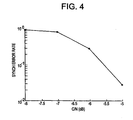
- FIGURE 4 illustrates the performance of the fast coarse time synchronization algorithm. It can be seen that less than 3% sync error rate can be achieved from a signal-to- noise ratio (C/N) greater than -5dB. This situation will cover a majority of the users of an ACeS system. With a search frequency list containing 8 frequencies, the minimal time needed to acquire coarse time sync is only 1.757 seconds or approximately 3.7 multiframes. A timeframe is .577 mS long, 8 slots comprise a 2.3 mS frame and 102 frames comprise a 0.47 second multiframe. For a worst case scenario, where a mobile station must search through all 140 carrier frequencies to find the right beacon frequency, only 26 seconds or approximately 55.3 multifames would be needed.
- C/N signal-to- noise ratio
- the total sync time with this invention is between 2.7 and 27 seconds. This is greatly improved from the 2-minute to 12-minute times required for beacon frequency synchronization for a previous system having C/N of -8dB.
- the beacon frequency acquisition algorithm finds the largest accumulated power in a slot at each frequency over a 40 frame window.
- each control channel multiframe has four high-power synchronization bursts located at slot 0 of frames 0, 22, 61 and 81.
- searching for the largest accumulated power in a slot over a 40 frame window one can utilize the energy contribution from at least one high-power synchronization burst.
- a counter i is set equal to one.
- a switch to a first frequency is made.
- the largest metric for the present frequency is then calculated over the N (40) frame window. This is accomplished by letting r i j be the received signal sample at time iT at frequency f j , where T is the bit duration.
- the accumulated energy in the 1-th slot at frequency f j equals: where N is the number of bits per slot; and
- M is the total number of slots in the search window.
- M 320 (i.e., 8 slots per frames for a 40 frame window totaling 320 slots).
- the largest accumulated power in a slot at frequency f j can be expressed as: p 1 j and A j are referred to as the slot metric and carrier metric, respectively. It may be assumed that A 1 >A 2 >...>A L .
- the groups with largest metrics are placed in S 1 , and the frequencies with smaller metrics are placed in S 2 .
- the group metrics for each of the two subsets S 1 and S 2 are determined at step 140.
- the group metrics G 1 and G 2 associated with S 1 and S 2 are defined as: or in an alternate embodiment;
- the ratio between the group metrics G 1 and G 2 is calculated at step 145 and used to determine whether f 1 (which has the largest slot metric) is the beacon frequency used by the current spotbeam.
- the motivation for using the ratio ⁇ of group metrics for a decision on carrier frequency acquisition is mainly for a scenario where a user is in the boundry of the coverage area of several spotbeams. In this case, more than one frequency could yield large carrier metric having nearly equal values. Therefore, if we merely took the ratio of two slot metrics A 1 and A 2 , a ratio near one would be provided and we could miss detecting a beacon frequency.
Landscapes
- Engineering & Computer Science (AREA)
- Physics & Mathematics (AREA)
- Astronomy & Astrophysics (AREA)
- Aviation & Aerospace Engineering (AREA)
- General Physics & Mathematics (AREA)
- Computer Networks & Wireless Communication (AREA)
- Signal Processing (AREA)
- Radio Relay Systems (AREA)
- Mobile Radio Communication Systems (AREA)
Claims (9)
- Procédé pour acquérir une fréquence de balise à faisceau étroit dans un système de communication par satellite, comprenant les étapes suivantes :a) on accède à un ensemble de fréquences candidates;b) pendant une fenêtre à trames multiples, on détermine une plus grande métrique de créneau pour chaque fréquence dans l'ensemble de fréquences candidates, la métrique de créneau comprenant une puissance accumulée sur un créneau;c) on divise l'ensemble de fréquences candidates en un premier groupe et un second groupe, chaque groupe contenant au moins deux fréquences, sur la base de la plus grande métrique de créneau associée à chacune des fréquences;d) on calcule un rapport entre des métriques de groupe des premier et second groupes, la métrique de groupe étant la plus grande parmi les plus grandes métriques de créneau à l'intérieur d'un groupe;e) on compare le rapport calculé à un seuil prédéterminé;f) si le rapport calculé dépasse le seuil prédéterminé, on sélectionne la fréquence associée à la plus grande métrique de créneau comme la fréquence de balise à faisceau étroit; etg) on détermine une position de frontière de multitrame à l'intérieur de la fréquence de balise à faisceau étroit détectée.
- Procédé selon la revendication 1, dans lequel l'étape de détermination comprend en outre les étapes suivantes :on effectue une acquisition de temps grossière sur la fréquence de balise à faisceau étroit détectée, pour sélectionner un groupe de bits contenant une frontière de multitrame; eton effectue une acquisition de temps fine sur la fréquence de balise à faisceau étroit détectée, pour détecter la position de la frontière de multitrame à l'intérieur du groupe de bits.
- Procédé selon la revendication 1 ou 2, dans lequel l'étape de détermination d'une plus grande métrique de créneau comprend la détermination d'une puissance du signal reçu accumulée sur un créneau.
- Procédé selon la revendication 1 ou 2, dans lequel l'étape dé détermination d'une plus grande métrique de créneau comprend la détermination d'une accumulation d'un logarithme de la puissance du signal reçu sur un créneau.
- Procédé selon la revendication 1, dans lequel la fenêtre à trames multiples couvre au moins une salve de synchronisation de puissance élevée.
- Procédé selon la revendication 1, dans lequel la fenêtre a une longueur de 40 trames.
- Procédé selon la revendication 1, dans lequel l'étape de calcul comprend les étapes suivantes :on détermine les métriques de groupe pour les premier et second groupes, les métriques de groupe comprenant la plus grande métrique de créneau à l'intérieur de chacun des groupes, la métrique de groupe comprenant une plus grande puissance accumulée dans un créneau pour des fréquences dans les premier et second groupes; eton divise la plus grande métrique de groupe par la métrique de groupe inférieure pour déterminer un rapport entre les deux métriques de groupe.
- Procédé selon la revendication 1 ou 2, incluant en outre les étapes suivantes :on accède à un second ensemble de fréquences candidates si le rapport calculé ne dépasse pas la valeur du seuil prédéterminé; eton répète les étapes a) - c) pour le second ensemble de fréquences candidates.
- Procédé selon la revendication 2, dans lequel l'étape d'accomplissement d'une acquisition de temps grossière rapide est accomplie sur une période de trame incluant au moins deux salves de synchronisation de puissance élevée.
Applications Claiming Priority (3)
| Application Number | Priority Date | Filing Date | Title |
|---|---|---|---|
| US08/874,047 US6072786A (en) | 1997-06-12 | 1997-06-12 | Method for acquisition of spotbeam beacon frequency within a satellite communications system |
| US874047 | 1997-06-12 | ||
| PCT/US1998/011830 WO1998057445A1 (fr) | 1997-06-12 | 1998-06-09 | Procede pour l'acquisition de frequences de radiobalises a faisceaux etroits dans un systeme de communication par satellite |
Publications (2)
| Publication Number | Publication Date |
|---|---|
| EP0988716A1 EP0988716A1 (fr) | 2000-03-29 |
| EP0988716B1 true EP0988716B1 (fr) | 2005-09-14 |
Family
ID=25362875
Family Applications (1)
| Application Number | Title | Priority Date | Filing Date |
|---|---|---|---|
| EP98925303A Expired - Lifetime EP0988716B1 (fr) | 1997-06-12 | 1998-06-09 | Procede pour l'acquisition de frequences de radiobalises a faisceaux etroits dans un systeme de communication par satellite |
Country Status (9)
| Country | Link |
|---|---|
| US (1) | US6072786A (fr) |
| EP (1) | EP0988716B1 (fr) |
| JP (1) | JP4008506B2 (fr) |
| CN (1) | CN1260920A (fr) |
| AU (1) | AU7728898A (fr) |
| CA (1) | CA2293680A1 (fr) |
| DE (1) | DE69831569T2 (fr) |
| TW (1) | TW408537B (fr) |
| WO (1) | WO1998057445A1 (fr) |
Families Citing this family (6)
| Publication number | Priority date | Publication date | Assignee | Title |
|---|---|---|---|---|
| US6198921B1 (en) * | 1998-11-16 | 2001-03-06 | Emil Youssefzadeh | Method and system for providing rural subscriber telephony service using an integrated satellite/cell system |
| US6434361B1 (en) * | 1999-09-29 | 2002-08-13 | Trw Inc. | Synchronization burst processor for a processing satellite |
| US7142809B1 (en) * | 2001-02-27 | 2006-11-28 | The Directv Group, Inc. | Device and method to locally fill gaps in spotbeam satellite systems with frequency re-use |
| US10484082B2 (en) | 2016-12-02 | 2019-11-19 | Haris Corporation | Space asset tracker |
| CN109525300B (zh) * | 2018-10-25 | 2021-07-27 | 北京爱科迪通信技术股份有限公司 | 一种多频点寻星方法和系统 |
| US11611460B2 (en) * | 2020-09-22 | 2023-03-21 | Samsung Electronics Co., Ltd. | Carrier frequency error estimator with banked correlators |
Family Cites Families (15)
| Publication number | Priority date | Publication date | Assignee | Title |
|---|---|---|---|---|
| US3879581A (en) * | 1972-11-24 | 1975-04-22 | Hughes Aircraft Co | Processing repeater for TDMA communication system |
| FR2436535A1 (fr) * | 1978-09-15 | 1980-04-11 | Ibm France | Procede et systeme de synchronisation d'un reseau de communication a acces multiple par repartition dans le temps et utilisant un satellite ayant plusieurs antennes a faisceau directif sur des frequences differentes |
| US4425639A (en) * | 1981-01-12 | 1984-01-10 | Bell Telephone Laboratories, Incorporated | Satellite communications system with frequency channelized beams |
| JPS6356024A (ja) * | 1986-08-27 | 1988-03-10 | Nec Corp | 同期バ−スト送信位相制御方式 |
| US5422813A (en) * | 1992-12-17 | 1995-06-06 | Stanford Telecommunications, Inc. | No-outage GPS/commercial RF positioning system |
| US5383225A (en) * | 1992-12-17 | 1995-01-17 | Motorola, Inc. | Synchronizer for TDMA acquisition signal having an unknown frequency |
| US5642358A (en) * | 1994-04-08 | 1997-06-24 | Ericsson Inc. | Multiple beamwidth phased array |
| US5596315A (en) * | 1994-10-03 | 1997-01-21 | Motorola, Inc. | Message unit for use with multi-beam satellite-based messaging system and method of operation thereof |
| US5551058A (en) * | 1994-10-31 | 1996-08-27 | Motorola, Inc. | Method and system for intelligent cell selection using location data in cellular systems |
| US5638399A (en) * | 1994-11-15 | 1997-06-10 | Stanford Telecommunications, Inc. | Multi-beam satellite communication system with user terminal frequencies having transceivers using the same set of frequency hopping |
| KR0142949B1 (ko) * | 1995-06-16 | 1998-08-01 | 김광호 | 이동국과 기지국간의 초기 동기 맞춤시간을 최소화한 주파수 운용 방법 |
| GB2303764A (en) * | 1995-07-28 | 1997-02-26 | Int Mobile Satellite Org | Communication with a mobile station in an unknown spot beam |
| US5805646A (en) * | 1996-10-08 | 1998-09-08 | Ericsson Inc. | Synchronization method, and associated circuitry, for improved synchronization of a receiver with a transmitter using early-late testing during coarse synchronization |
| US5838745A (en) * | 1996-10-09 | 1998-11-17 | Ericsson Inc. | Synchronization method, and associated circuitry, for improved synchronization of a receiver with a transmitter using nonlinear transformation metrics |
| US5875182A (en) * | 1997-01-16 | 1999-02-23 | Lockheed Martin Corporation | Enhanced access burst for random access channels in TDMA mobile satellite system |
-
1997
- 1997-06-12 US US08/874,047 patent/US6072786A/en not_active Expired - Lifetime
-
1998
- 1998-06-03 TW TW087108723A patent/TW408537B/zh not_active IP Right Cessation
- 1998-06-09 DE DE69831569T patent/DE69831569T2/de not_active Expired - Lifetime
- 1998-06-09 WO PCT/US1998/011830 patent/WO1998057445A1/fr not_active Ceased
- 1998-06-09 CA CA002293680A patent/CA2293680A1/fr not_active Abandoned
- 1998-06-09 JP JP50304499A patent/JP4008506B2/ja not_active Expired - Lifetime
- 1998-06-09 AU AU77288/98A patent/AU7728898A/en not_active Abandoned
- 1998-06-09 EP EP98925303A patent/EP0988716B1/fr not_active Expired - Lifetime
- 1998-06-09 CN CN98806145A patent/CN1260920A/zh active Pending
Also Published As
| Publication number | Publication date |
|---|---|
| EP0988716A1 (fr) | 2000-03-29 |
| WO1998057445A1 (fr) | 1998-12-17 |
| DE69831569D1 (de) | 2005-10-20 |
| US6072786A (en) | 2000-06-06 |
| TW408537B (en) | 2000-10-11 |
| DE69831569T2 (de) | 2006-06-14 |
| JP2002505815A (ja) | 2002-02-19 |
| CN1260920A (zh) | 2000-07-19 |
| AU7728898A (en) | 1998-12-30 |
| JP4008506B2 (ja) | 2007-11-14 |
| CA2293680A1 (fr) | 1998-12-17 |
Similar Documents
| Publication | Publication Date | Title |
|---|---|---|
| US5506863A (en) | Method and apparatus for operating with a hopping control channel in a communication system | |
| EP0891660B1 (fr) | Methode de synchronisation et composants de circuit associes permettant de synchroniser le recepteur et l'emetteur | |
| US6400751B1 (en) | Adaptive frequency sharing method and apparatus | |
| US6353645B1 (en) | Systems and methods for fast terminal synchronization in a wireless communication system | |
| EP0875102B1 (fr) | Service de messages brefs a haute puissance par frequence porteuse specialisee | |
| US5854784A (en) | Power-saving method for providing synchronization in a communications system | |
| EP0931391B1 (fr) | Synchronisation amelioree d'un recepteur avec un emetteur au moyen d'essais precoces/tardifs pendant la phase de synchronisation approximative | |
| US6072786A (en) | Method for acquisition of spotbeam beacon frequency within a satellite communications system | |
| KR20010042425A (ko) | 위성 통신망에 의해 발생된 s 동기 신호 검출 방법 및 장치 | |
| JP2002524912A (ja) | スペクトラム拡散通信システムのアクセスチャネルアクイジションにおいて周波数およびタイミングの不確かさを決定するシステムおよび装置 | |
| US5838745A (en) | Synchronization method, and associated circuitry, for improved synchronization of a receiver with a transmitter using nonlinear transformation metrics | |
| US7180970B1 (en) | Automatic link establishment using external synchronization |
Legal Events
| Date | Code | Title | Description |
|---|---|---|---|
| PUAI | Public reference made under article 153(3) epc to a published international application that has entered the european phase |
Free format text: ORIGINAL CODE: 0009012 |
|
| 17P | Request for examination filed |
Effective date: 20000111 |
|
| AK | Designated contracting states |
Kind code of ref document: A1 Designated state(s): DE FR GB |
|
| 17Q | First examination report despatched |
Effective date: 20030415 |
|
| RAP1 | Party data changed (applicant data changed or rights of an application transferred) |
Owner name: ERICSSON INC. |
|
| GRAP | Despatch of communication of intention to grant a patent |
Free format text: ORIGINAL CODE: EPIDOSNIGR1 |
|
| GRAS | Grant fee paid |
Free format text: ORIGINAL CODE: EPIDOSNIGR3 |
|
| GRAA | (expected) grant |
Free format text: ORIGINAL CODE: 0009210 |
|
| AK | Designated contracting states |
Kind code of ref document: B1 Designated state(s): DE FR GB |
|
| REG | Reference to a national code |
Ref country code: GB Ref legal event code: FG4D |
|
| REF | Corresponds to: |
Ref document number: 69831569 Country of ref document: DE Date of ref document: 20051020 Kind code of ref document: P |
|
| ET | Fr: translation filed | ||
| PLBE | No opposition filed within time limit |
Free format text: ORIGINAL CODE: 0009261 |
|
| STAA | Information on the status of an ep patent application or granted ep patent |
Free format text: STATUS: NO OPPOSITION FILED WITHIN TIME LIMIT |
|
| 26N | No opposition filed |
Effective date: 20060615 |
|
| PGFP | Annual fee paid to national office [announced via postgrant information from national office to epo] |
Ref country code: DE Payment date: 20130627 Year of fee payment: 16 Ref country code: GB Payment date: 20130627 Year of fee payment: 16 |
|
| PGFP | Annual fee paid to national office [announced via postgrant information from national office to epo] |
Ref country code: FR Payment date: 20130702 Year of fee payment: 16 |
|
| REG | Reference to a national code |
Ref country code: DE Ref legal event code: R119 Ref document number: 69831569 Country of ref document: DE |
|
| GBPC | Gb: european patent ceased through non-payment of renewal fee |
Effective date: 20140609 |
|
| REG | Reference to a national code |
Ref country code: DE Ref legal event code: R119 Ref document number: 69831569 Country of ref document: DE Effective date: 20150101 |
|
| REG | Reference to a national code |
Ref country code: FR Ref legal event code: ST Effective date: 20150227 |
|
| PG25 | Lapsed in a contracting state [announced via postgrant information from national office to epo] |
Ref country code: DE Free format text: LAPSE BECAUSE OF NON-PAYMENT OF DUE FEES Effective date: 20150101 |
|
| PG25 | Lapsed in a contracting state [announced via postgrant information from national office to epo] |
Ref country code: GB Free format text: LAPSE BECAUSE OF NON-PAYMENT OF DUE FEES Effective date: 20140609 Ref country code: FR Free format text: LAPSE BECAUSE OF NON-PAYMENT OF DUE FEES Effective date: 20140630 |