EP0989502A1 - Aktualisierungsverfahren für einen inhaltsadressierbaren Trietypspeicher, und Router um solch ein Verfahren zu implementieren - Google Patents
Aktualisierungsverfahren für einen inhaltsadressierbaren Trietypspeicher, und Router um solch ein Verfahren zu implementieren Download PDFInfo
- Publication number
- EP0989502A1 EP0989502A1 EP99402302A EP99402302A EP0989502A1 EP 0989502 A1 EP0989502 A1 EP 0989502A1 EP 99402302 A EP99402302 A EP 99402302A EP 99402302 A EP99402302 A EP 99402302A EP 0989502 A1 EP0989502 A1 EP 0989502A1
- Authority
- EP
- European Patent Office
- Prior art keywords
- cell
- bits
- register
- memory
- trie
- Prior art date
- Legal status (The legal status is an assumption and is not a legal conclusion. Google has not performed a legal analysis and makes no representation as to the accuracy of the status listed.)
- Granted
Links
Images




Classifications
-
- G—PHYSICS
- G06—COMPUTING OR CALCULATING; COUNTING
- G06F—ELECTRIC DIGITAL DATA PROCESSING
- G06F16/00—Information retrieval; Database structures therefor; File system structures therefor
- G06F16/90—Details of database functions independent of the retrieved data types
- G06F16/903—Querying
- G06F16/90335—Query processing
- G06F16/90344—Query processing by using string matching techniques
Definitions
- the present invention relates to memories associative, and in particular memories of the “ TRIE ”(from the English verb“ reTRIEve ”).
- the register assigned to the first section of the chain which is also the entry point of the table, is called doorman.
- the data to be analyzed in the form of bit strings, that is to say to compare with the content of the TRIE memory, will also be called routes below.
- the succession of chained cells associated with a road will be called path in the table.
- Each register of the table will be said to be of order i ⁇ 0 if it is assigned to the (i + 1) th section of one or more stored routes.
- the gatekeeper register is therefore of order 0.
- the TRIE memory associates with each of its order registers i ⁇ 0 a unique sequence of iK bits corresponding to the first iK bits of each route whose path in the table passes through a cell of the register in question.
- the analysis rank i is set to 0 and the gate register R 0 is selected as register R.
- the content C of the cell T [R, V i ] designated by the (i + 1) -th tranche V i of the route in the selected order register i is read in step 2. If this cell contains a pointer for further analysis, as indicated in test 3 the value 1 of a bit FP (C) stored in the cell, the order register i + 1 designated by this pointer Ptr (C) is selected as register R for the next iteration in step 4, and rank i is incremented.
- the Ref (C) status read in the cell concerned is returned to step 5 as a result of consulting the table.
- This algorithm allows the analysis of routes with any number of slices.
- the same table can be used for several types of analyzes by managing data from different gatekeepers. Moreover, he allows you to control the data analysis time: the analysis of a number N of slices of K bits will last for plus N times the duration of an iteration.
- the algorithm of figure 2 can be implemented very quickly by a hardware component managing access to the memory table. In particular, it allows realization of high performance routers for packet switched telecommunications networks.
- the packet header is analyzed on the fly by the component, and the status associated with a route designates for example a output port of the router to which should be routed packets with a destination address consistent with this route.
- Such a router can be multi-protocol. For this, we analyze different portions of the header at from different doormen. For example, a first analysis of one (or more) header field designating the protocol used and / or the version of this protocol can be analyzed from a first doorman.
- This first analysis provides a reference which, although corresponding to a logical end of analysis, can be materialized in the TRIE memory by a pointer to further analysis designating another gatekeeper register to use to analyze the rest of the header.
- the reference can also trigger timers or jumps of a specified number of bits in the header analyzed so you can choose which portion of the header should then be analyzed.
- a a number of analyzes are generally performed successively, to trigger the required operations by the protocols supported according to the content of headers. One of these analyzes will focus on the address of destination to accomplish the routing function proper.
- IP Internet Protocol
- the IP routing process is essentially based on the analysis of the level 3 destination addresses of the protocol (see C. Huottima: “Routing in the Internet”, Editions Eyrolles, 1995).
- the addresses of the frames to be routed are registered in an internal management table, called the routing table or "forwarding table", where they are associated with parameters which characterize the accesses to which they will be directed.
- the routing operation consists in comparing the addresses carried by the incoming frames with those contained in the table and in directing them towards the correct interface.
- An aggregate describes a set of addresses using the data of a common header and a mask which fixes the length in bits of the address part to be analyzed. This representation of the data in the table is strongly linked to the method of allocating addresses which associates an aggregate with a subnetwork or with a set of subnetworks, and therefore implicitly with a geographical location. These aggregates can be specified for some of their addresses which require specific routing.
- the TRIE memory is well suited to the role of routing table in a process of routing IP frames.
- the concept of reason is identified with the concept of address to be recognized, and the status can carry the information necessary for the orientation of the data.
- the algorithms used to keep the content of the TRIE memory up to date do not respond satisfactorily to the constraints imposed by the management of the “longest match”. For example, it is difficult to insert into the TRIE table both a status S0 valid for the reason V 0 , ..., V N and another status S1 valid for the longer reason V 0 , ..., V N , V N + 1 , ..., V P. Furthermore, these algorithms generally assume that the binary data to be analyzed has a length multiple of the size K of the slices, which is not the case in the context of the management of an IP routing table whose masks can have any length.
- An object of the present invention is to overcome practical limitations encountered with memories TRIE, and in particular to enrich the possibilities offered by routers using such memories.
- the data is recorded in TRIE memory cells in response to commands inserting and deleting binary patterns from variable length each associated with a reference, from so that when analyzing a bit string, the reference issued either that associated with the longest binary patterns coinciding with the start of the chain analyzed.
- auxiliary tables For updates, we can notably use two auxiliary tables: a mirror table which reflects the contents of the TRIE memory and a phantom table memorizing the references associated with the inserted binary patterns.
- the phantom table stores, for each cell haunted by an order register i ⁇ 0 from the TRIE memory, each reference associated with an inserted pattern of (i + 1) K-D bits, such as 0 ⁇ D ⁇ K, whose first iK bits form the sequence associated with said order register i, and whose Last K-D bits correspond to the first K-D of K bits designating said haunted TRIE memory cell at within said order register i.
- Another aspect of the present invention relates to a packet router, comprising an analysis circuit the header of packets received, using a memory associative type TRIE, and means for updating the TRIE memory, operating in accordance with a process such as defined above.
- the mask does not coincide not with a slice border.
- the statuses registered in the cells determined by developing an incomplete slice will called explicit status.
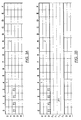
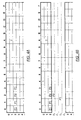
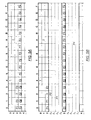
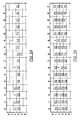
- the explicit statuses are shown underlined in Figures 3 to 7.
- the integrated pattern (0100 1010 0010) takes the same path in the memory, but it is longer than the previous pattern, and it ends on a border between analysis sections. It is enough to replace by P2 the status contained in the cell indexed by the value of the last section. Statuses that are associated with patterns in this way are also called explicit statuses. It can be noted that by reversing the order of examples 1 and 2, the insertion of the pattern (0100 1010 00) would have respected the status P2 corresponding to a longer pattern. In general, the order of insertion of the different patterns presented in the examples has no influence on the final content of the TRIE memory.
- the length of the integrated pattern exceeds the alignment of the last section of the preceding patterns.
- the status P2 is therefore replaced by a pointer to register 3.
- the status P3 is associated with all of the patterns of the form 4A2X, with 8 ⁇ X ⁇ B, according to the principle presented in the example 1.
- the paths leading to P2 status must be characterized. We see that they correspond to the set of 16-bit patterns which begin with the hexadecimal values 4A2, excluding those already used to describe the longer pattern 4A28, mask 14. This is the set ⁇ 4A2X, with 0 ⁇ X ⁇ 8 or B ⁇ X ⁇ F ⁇ .
- the P2 status is entered in the corresponding cells of the register 3.
- Such status which results from a propagation in the TRIE memory of an erased status will be called implicit status.
- the implicit statuses are represented doubly underlined in figures 5 to 7
- Such a pattern is represented in a TRIE table by 2 KA paths of which the M first slices, of respective values V 0 , ..., V M-1 , are represented on a common path leading to the order register M associated with the corresponding sequence of MK bits, the last section of which, truncated to A bits, is represented by the status S in the cells of this register indexed by V M .2 KA + Z for 0 ⁇ Z ⁇ 2 KA (example 1). If we cut the register into 2 A groups of 2 KA contiguous elementary cells, we see that the status S occupies all the elementary cells of one of these groups, indexed by V M. These groups will be called virtual cells.
- the status to be taken into account for the analysis and to be entered in the table is that which corresponds to the longest reason, that is to say, according to this above, the one whose value of A is the largest and therefore the virtual cell of size 2 KA is the narrowest.
- the relation (R2) expresses that the status contained in the cell indexed by V ' M is replaced by a pointer to the following register, the registration of a pointer having priority over the registration of any status.
- the condition (R5) describes the propagation of the status S on all the free cells of the registers R M + 1 to R N-1 if they exist.
- the condition (R3) characterizes the content of the virtual cell indexed by V N on the register R N , in accordance with the rule R1.
- the condition (R4) describes the propagation of the status S on the register R N (example 3).
- the function ⁇ prohibits that this status S is registered in the virtual cell indexed by V N which contains S '.
- Path management procedures during inserting and deleting patterns in memory, translate the above rules. They are based on a set of data structures presented below.
- the content of each real cell of a register is the content of the virtual cell to which it belongs and therefore of the corresponding non-empty ghost cell of lesser depth of its phantom table.
- the flowchart of FIG. 8 illustrates a way of consulting the phantom table in order to recover, for a given cell T [R, W] from the memory TRIE, the content of the phantom cell GT [R, V, D] which represents the virtual cell of minimum depth D including cell T [R, W] in question.
- this procedure will be noted ghost (R, W, G , D ). It can be executed in the form of a function called by the coordinates R, W of the cell concerned in the TRIE memory, and returning the associated ghost status G of minimum depth as well as this depth D (the underlined arguments of the ghost function , and other functions considered below, represent the values returned as a result of this function, and the underlined arguments of the values not modified by the function).
- the depth D is initialized to 0.
- FIG. 9 shows a recursive procedure for propagating a status S 'associated with a pattern ⁇ ' of length L 'from a register R of the memory TRIE, possibly taking into account the length L ⁇ L' d ' a motif ⁇ which may be identical to the motif ⁇ 'or different.
- This procedure is noted Forward_status (R, L, S ', L').
- the Forward_status procedure (R, L, S', L) manages the updating of the implicit status in the case where one seeks to register the status S 'on the longer pattern paths already present in the memory. In other words, if we transform these into a “longest match” of the pattern entered.
- the Forward_status (R, L, S', L ') procedure manages the propagation of the implicit statuses in the case of the deletion of a pattern whose status S' is covered by a pointer.
- the shadow ⁇ of length L can be the ghost of a status masked by S ', but it can possibly be empty.
- the passage from FIG. 7B to FIG. 6B, which consists in removing the pattern 4 of mask 4 and of status P5 amounts to propagating the "empty" shadow in place of P5 from cell T [0, 4], i.e. from register 1.
- the Forward_status (R, L, S ', L') procedure is recursive and includes an iteration for each slice of K bits identified by the index Z going from 0 to 2 K -1.
- Z is initialized to 0 in step 20, and incremented in step 21 if the test 22 carried out at the end of the iteration shows that Z ⁇ 2 K -1.
- the content of the cell MT [R, Z] of the mirror table corresponding to the cell T [R , Z] of the TRIE memory is read in step 23.
- a register is says available when each of its cells does contain no pointer and is not haunted.
- the coordinate cell R, V is updated in memory TRIE and in the mirror table. This update consists of set the FP bit to 1 and write the pointer R 'of the register allocated in the Ptr field of the cell.
- This update 40 consists of writing active status F in the Ref field of cell T [R, Z], and the length ⁇ of this status F in the field ⁇ of the MT cell [R, Z].
- step 45 the ghost function (R, G, F , D ), is called in step 45 to obtain the active status F which corresponds to the pattern which, before the insertion of the motif ⁇ , fulfilled the condition of “longest match” for the coordinate cell R, V.
- the virtual cell to which the ⁇ pattern ends is examined to carry out the required updates, by examining each cell of the mirror table belonging to the register R and indexed by W + Z for 0 ⁇ Z ⁇ 2 KB -1.
- the content of this cell of the mirror table is read in step 51.
- step 57 which follows step 53, or test 55 if D ⁇ KB, we test the value of the bit FP relative to the cell under examination T [R, W + Z], to determine whether it contains a pointer.
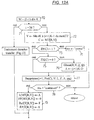
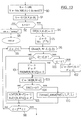
- the function flowchart, as called at rank i ⁇ 0 is shown in Figures 12 and 13.
- the number M of slices of the reason ⁇ to examine before the last installment is calculated by Euclidean division of L-1 by the length K of a slice. If the call rank i of the function is equal to M (test 71), the last tranche is processed in the manner described later with reference to Figure 13.
- the variable of K bits V receives the (i + 1) th slice of K bits of the pattern ⁇ , and the content of the cell of the mirror table of coordinates R, V is read (step 72 ). If the corresponding cell in the TRIE memory does not contain a pointer (test 73), this is because the pattern for which removal is requested is not contained in the TRIE memory. In this case, the function returns to row i a result res indicating an error (step 74), and the deletion procedure ends.
- the Delete function is then called at rank i + 1 for which the order register i + 1 designated by the pointer Ptr (C) read at rank i in the mirror table is selected.
- the function is invoked in step 77 with the Delete arguments (i + 1, Ptr (C), ⁇ , L, F, ⁇ , res ). If the result returned res does not indicate that the procedure must continue (test 78), the execution of the function at rank i is terminated.
- i 0 (test 80) or if the register R of order i contains at least one pointer or at least one haunted cell, then the execution of the function at rank i ends at step 81 by returning as result res a stop indication.
- the slice index Z is compared to 2 K -1 in test 85, and incremented in step 86 if Z ⁇ 2 K -1.
- Z 2 K -1
- all the cells of the R register have been freed, that is to say that they no longer contain a pointer and are no longer haunted.
- the register R can therefore be restored in step 87 in the list of available registers, allocable in the insertion procedures (step 35 in FIG. 10A).
- the execution of the function at rank i is then terminated in step 88 by returning the result "continue".
- the status S contained in the cell phantom GT [R, G, K-B] is read in step 91. If this status S has the value 0 (test 92) is that we asked for the deletion of a reason to which none was associated status, so the deletion procedure is ends at row M by returning a res result indicating an error (step 93).
- the status S is deleted in step 94 by writing the value 0 in the cell GT [R, V, KB] of the phantom table.
- the virtual cell is then updated, in a loop on the different slots of KB bits which complete the slot V of B bits.
- the ghost function (R, W + Z, G , D ) described with reference to Figure 8 is called in step 96. If the ghost procedure returned a phantom status G with a depth D smaller than KB (test 97), the deletion of the status S has no effect on the content of the cell T [R, W + Z].
- test 98 where Z is compared to 2 KB -1. As long as Z ⁇ 2 KB , 1, the index Z is incremented in step 99 before repeating step 96. If test 97 shows that the depth D returned by the ghost procedure is at least equal to KB, we examines in step 100 whether the phantom status G returned by the ghost procedure has the value 0 (no phantom status) or not.
- deletion causes cell T [R, W + Z] to no longer be haunted, so the FH bit for that cell is set to 0 in the mirror table in step 101
- this phantom status G becomes active status: it is assigned to status F 'at step 102, and its length (M + 1) K-D is assigned to the variable The.
- FP (C) 0 at test 104
- the coordinate cell R, W + Z is simply updated, by writing the active status F 'in the Ref
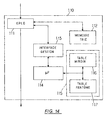
- FIG 14 shows a block diagram of a example of router 110 implementing the present invention.
- An analysis circuit 111 which can be a EPLD type programmable network, controls access to the TRIE memory 112.
- Circuit 111 applies the algorithm analysis shown in Figure 2 to chains of N bits included in packet headers received at the input of router 110. These packets can in particular consist of ATM cells (Asynchronous Transfer) Fashion).
- router 110 can be multi-protocol, and analyze different chains of header packets from different gatekeepers from TRIE memory 112.
- Circuit 111 is programmed to trigger the required operations depending on the result of the analysis. In particular, it directs the package towards either of a set of destination ports in based on destination address analysis contained in the header.
- interface 113 router management comprises registers in which the analysis circuit 111 forward packets containing information concerning the router itself, and in particular instructions to insert or delete patterns from the routing table. Note that interface 113 is one of many ways to transfer packets, and that the router information doesn’t are not necessarily in the form of packages.
- the router 110 further includes a processor 114 responsible for carrying out the procedures of Figures 8 to 13 relating to updates to the TRIE table. In contrary to the analysis of the packets by the circuit 111, these updates days are not necessarily performed in real time.
- a processor 114 responsible for carrying out the procedures of Figures 8 to 13 relating to updates to the TRIE table. In contrary to the analysis of the packets by the circuit 111, these updates days are not necessarily performed in real time.
- an area 116 is provided to contain the mirror table and an area 117 to contain the phantom table.
- the processor 114 When the execution of update procedures requires writing data to TRIE 112 memory (steps 28, 36, 40, 59, 79 and 105 of Figures 9 to 13), the processor 114 writes corresponding commands in management interface registers 113. These registers can be read by circuit 111 while it is not not processing a packet, so that the contents of the TRIE 112 memory is modified as required. The contents mirror table 116 and ghost table 117 is not actually changed by processor 114 that at the end of the procedure for inserting or deleting a pattern leading to such a modification.
- Data representation can take different forms in memories 112, 116 and 117.
- TRIE memory 112 to which the circuit 111 accesses real time there may not be a difference formal representation between a pointer and a status, although these two concepts are distinct in the logic in the analysis algorithm.
- FP bit is not necessarily present explicitly in the cells of memory 112.
- a status can have the same shape as a pointer that would point to another memory gatekeeper while triggering a time delay or a jump of a determined number of bits in the analyzed chain. This does not prevent that the analysis algorithm of Figure 2 is implemented logically.
- the mirror table 116 is a functional image of the TRIE 112 memory, forming a matrix of the same dimensions. This table 116 makes it possible to overcome the representation constraints necessary for circuit 111. It allows the processor 114 to follow the paths, to characterize, to register or propagate end of pattern status without having to hold account for the structure of the corresponding data in the cells of memory TRIE 112.
- the cells of mirror table 116 contain a simplified image of those of memory TRIE 112. As we have seen, it is not no need to include the status in the table mirror 116, but only the length of the patterns associated. It is sufficient that the statuses are stored in ghost table 117.
- the phantom table 117 stores the associated statuses with the binary patterns inserted, each status being memorized at a location on the ghost table 117 which corresponds to the TRIE 112 memory cell where it would be stored if the associated motif was the only motif inserted.
- ghost table 117 the statuses can be saved in a form similar to that provided by the user, the processor 114 taking care of the translations required.
- the addressing structure in the ghost table 117 can vary dynamically depending on TRIE memory registers that require registers ghosts (for example, only register 2 needs to phantom registers in the case illustrated in Figure 3B).
- Other ghost table organizations could be adopted.
- the haunted / non-haunted bit FH of each mirror table cell could be replaced by K bits each indicating whether there is a phantom status of depth D (0 ⁇ D ⁇ K) for the cell in question.
- the allocation of memory resources of the phantom table 117 is managed at the cell level and not at the register level.
Landscapes
- Engineering & Computer Science (AREA)
- Databases & Information Systems (AREA)
- Theoretical Computer Science (AREA)
- Computational Linguistics (AREA)
- Data Mining & Analysis (AREA)
- Physics & Mathematics (AREA)
- General Engineering & Computer Science (AREA)
- General Physics & Mathematics (AREA)
- Data Exchanges In Wide-Area Networks (AREA)
Applications Claiming Priority (2)
| Application Number | Priority Date | Filing Date | Title |
|---|---|---|---|
| FR9811856A FR2783618B1 (fr) | 1998-09-23 | 1998-09-23 | Procede de mise a jour d'une memoire associative de type trie, et routeur mettant en oeuvre un tel procede |
| FR9811856 | 1998-09-23 |
Publications (2)
| Publication Number | Publication Date |
|---|---|
| EP0989502A1 true EP0989502A1 (de) | 2000-03-29 |
| EP0989502B1 EP0989502B1 (de) | 2006-03-22 |
Family
ID=9530733
Family Applications (1)
| Application Number | Title | Priority Date | Filing Date |
|---|---|---|---|
| EP99402302A Expired - Lifetime EP0989502B1 (de) | 1998-09-23 | 1999-09-21 | Aktualisierungsverfahren für einen inhaltsadressierbaren Trietypspeicher, und Router um solch ein Verfahren zu implementieren |
Country Status (5)
| Country | Link |
|---|---|
| US (1) | US6425099B1 (de) |
| EP (1) | EP0989502B1 (de) |
| JP (1) | JP2000231792A (de) |
| DE (1) | DE69930493T2 (de) |
| FR (1) | FR2783618B1 (de) |
Cited By (1)
| Publication number | Priority date | Publication date | Assignee | Title |
|---|---|---|---|---|
| US7444562B2 (en) | 2003-10-28 | 2008-10-28 | France Telecom | Trie-type memory device with a compression mechanism |
Families Citing this family (4)
| Publication number | Priority date | Publication date | Assignee | Title |
|---|---|---|---|---|
| US7634500B1 (en) | 2003-11-03 | 2009-12-15 | Netlogic Microsystems, Inc. | Multiple string searching using content addressable memory |
| US7353332B2 (en) * | 2005-10-11 | 2008-04-01 | Integrated Device Technology, Inc. | Switching circuit implementing variable string matching |
| US7783654B1 (en) | 2006-09-19 | 2010-08-24 | Netlogic Microsystems, Inc. | Multiple string searching using content addressable memory |
| US7917486B1 (en) | 2007-01-18 | 2011-03-29 | Netlogic Microsystems, Inc. | Optimizing search trees by increasing failure size parameter |
Citations (3)
| Publication number | Priority date | Publication date | Assignee | Title |
|---|---|---|---|---|
| EP0380294A1 (de) * | 1989-01-23 | 1990-08-01 | Codex Corporation | Zeichenkettenanpassung |
| WO1996000945A1 (en) * | 1994-06-30 | 1996-01-11 | International Business Machines Corp. | Variable length data sequence matching method and apparatus |
| WO1998027662A2 (en) * | 1996-12-16 | 1998-06-25 | Juniper Networks | High speed variable length best match look-up in a switching device |
Family Cites Families (5)
| Publication number | Priority date | Publication date | Assignee | Title |
|---|---|---|---|---|
| JPH06318951A (ja) * | 1993-01-07 | 1994-11-15 | Toshiba Corp | セル転送方法およびセル転送システム |
| JP3110585B2 (ja) * | 1993-06-04 | 2000-11-20 | 川崎製鉄株式会社 | 半導体メモリ |
| FR2707775B1 (fr) | 1993-07-12 | 1996-04-12 | Duret Chrsitian | Procédé et dispositif d'analyse d'informations contenues dans des structures de données. |
| US5909440A (en) * | 1996-12-16 | 1999-06-01 | Juniper Networks | High speed variable length best match look-up in a switching device |
| GB2359693B (en) * | 2000-02-26 | 2003-07-16 | 3Com Corp | Network switch with truncated trie look-up facility |
-
1998
- 1998-09-23 FR FR9811856A patent/FR2783618B1/fr not_active Expired - Fee Related
-
1999
- 1999-09-14 US US09/395,673 patent/US6425099B1/en not_active Expired - Fee Related
- 1999-09-21 DE DE69930493T patent/DE69930493T2/de not_active Expired - Lifetime
- 1999-09-21 EP EP99402302A patent/EP0989502B1/de not_active Expired - Lifetime
- 1999-09-22 JP JP11269529A patent/JP2000231792A/ja active Pending
Patent Citations (3)
| Publication number | Priority date | Publication date | Assignee | Title |
|---|---|---|---|---|
| EP0380294A1 (de) * | 1989-01-23 | 1990-08-01 | Codex Corporation | Zeichenkettenanpassung |
| WO1996000945A1 (en) * | 1994-06-30 | 1996-01-11 | International Business Machines Corp. | Variable length data sequence matching method and apparatus |
| WO1998027662A2 (en) * | 1996-12-16 | 1998-06-25 | Juniper Networks | High speed variable length best match look-up in a switching device |
Cited By (1)
| Publication number | Priority date | Publication date | Assignee | Title |
|---|---|---|---|---|
| US7444562B2 (en) | 2003-10-28 | 2008-10-28 | France Telecom | Trie-type memory device with a compression mechanism |
Also Published As
| Publication number | Publication date |
|---|---|
| EP0989502B1 (de) | 2006-03-22 |
| DE69930493T2 (de) | 2006-12-21 |
| DE69930493D1 (de) | 2006-05-11 |
| FR2783618A1 (fr) | 2000-03-24 |
| US6425099B1 (en) | 2002-07-23 |
| JP2000231792A (ja) | 2000-08-22 |
| FR2783618B1 (fr) | 2002-01-04 |
Similar Documents
| Publication | Publication Date | Title |
|---|---|---|
| EP0639013B1 (de) | Verfahren und Vorrichtung zur Auswertung von Datenstrukturinformationen | |
| EP1030493B1 (de) | Verfahren um Verteilungsreferenzen mit Datenpaketen mittels eines TRIE-Speichers zu verknüpfen und Paketverarbeitungssystem das dieses Verfahren anwendet | |
| US7281085B1 (en) | Method and device for virtualization of multiple data sets on same associative memory | |
| US20040254909A1 (en) | Programming routes and access control lists in comparison tree data structures and their use such as in performing lookup operations | |
| EP0616477A1 (de) | Mindestkosten Weglendungsvorrichtung in einem Telekommunikationsnetz | |
| WO2009068822A2 (fr) | Procede et dispositif de tri de paquets | |
| EP3671578A1 (de) | Analyseverfahren einer ausführungssimulation eines quantenschaltkreises | |
| EP0989502B1 (de) | Aktualisierungsverfahren für einen inhaltsadressierbaren Trietypspeicher, und Router um solch ein Verfahren zu implementieren | |
| EP1335565B1 (de) | Verfahren und Vorrichtung zur Verarbeitung von Datenpaketen | |
| EP3293637A1 (de) | Indexverwaltung in einem flash-speicher | |
| US9900409B2 (en) | Classification engine for data packet classification | |
| EP0251861B1 (de) | Speicherverwaltungseinheit | |
| EP4186009B1 (de) | Verfahren zur zuweisung logischer qubits eines quantenalgorithmus in einem quantenprozessor | |
| EP0554177A1 (de) | Assoziativspeicherarchitektur | |
| Kuo et al. | A memory-efficient TCAM coprocessor for IPv4/IPv6 routing table update | |
| EP3671577A1 (de) | Analyseverfahren einer ausführungssimulation eines quantenschaltkreises | |
| WO2005052812A1 (fr) | Dispositif de memoire de type trie avec mecanisme de compression | |
| WO2005024840A1 (fr) | Dispositif de memoire trie avec compression en etendue | |
| WO2011097385A2 (en) | Duo-dual tcam architecture for routing tables with incremental update | |
| FR3047580B1 (fr) | Index de table de base de donnees | |
| WO2005024659A1 (fr) | Dispositif de memoire trie a mecanisme de pipeline circulaire | |
| EP0878939A1 (de) | ATM Zellenpositionierungsanlage | |
| EP1355454A1 (de) | Routinggerät mit paralleler Verarbeitung | |
| FR3131995A1 (fr) | Support de calculs sur nombres reels au niveau des commutateurs physiques | |
| FR2935502A1 (fr) | Procede d'optimisation de la duree de vie d'une memoire non volatile reinscriptible. |
Legal Events
| Date | Code | Title | Description |
|---|---|---|---|
| PUAI | Public reference made under article 153(3) epc to a published international application that has entered the european phase |
Free format text: ORIGINAL CODE: 0009012 |
|
| AK | Designated contracting states |
Kind code of ref document: A1 Designated state(s): DE GB |
|
| AX | Request for extension of the european patent |
Free format text: AL;LT;LV;MK;RO;SI |
|
| 17P | Request for examination filed |
Effective date: 20000329 |
|
| AKX | Designation fees paid |
Free format text: DE GB |
|
| 17Q | First examination report despatched |
Effective date: 20041006 |
|
| GRAP | Despatch of communication of intention to grant a patent |
Free format text: ORIGINAL CODE: EPIDOSNIGR1 |
|
| GRAS | Grant fee paid |
Free format text: ORIGINAL CODE: EPIDOSNIGR3 |
|
| GRAA | (expected) grant |
Free format text: ORIGINAL CODE: 0009210 |
|
| AK | Designated contracting states |
Kind code of ref document: B1 Designated state(s): DE GB |
|
| REG | Reference to a national code |
Ref country code: GB Ref legal event code: FG4D Free format text: NOT ENGLISH |
|
| REF | Corresponds to: |
Ref document number: 69930493 Country of ref document: DE Date of ref document: 20060511 Kind code of ref document: P |
|
| GBT | Gb: translation of ep patent filed (gb section 77(6)(a)/1977) |
Effective date: 20060605 |
|
| PLBE | No opposition filed within time limit |
Free format text: ORIGINAL CODE: 0009261 |
|
| STAA | Information on the status of an ep patent application or granted ep patent |
Free format text: STATUS: NO OPPOSITION FILED WITHIN TIME LIMIT |
|
| 26N | No opposition filed |
Effective date: 20061227 |
|
| PGFP | Annual fee paid to national office [announced via postgrant information from national office to epo] |
Ref country code: GB Payment date: 20110830 Year of fee payment: 13 Ref country code: DE Payment date: 20110902 Year of fee payment: 13 |
|
| GBPC | Gb: european patent ceased through non-payment of renewal fee |
Effective date: 20120921 |
|
| PG25 | Lapsed in a contracting state [announced via postgrant information from national office to epo] |
Ref country code: GB Free format text: LAPSE BECAUSE OF NON-PAYMENT OF DUE FEES Effective date: 20120921 Ref country code: DE Free format text: LAPSE BECAUSE OF NON-PAYMENT OF DUE FEES Effective date: 20130403 |
|
| REG | Reference to a national code |
Ref country code: DE Ref legal event code: R119 Ref document number: 69930493 Country of ref document: DE Effective date: 20130403 |