EP0989721A1 - Verfahren zum Einrichten einer Anrufweiterschaltung in einem Telekommunikationssystem - Google Patents
Verfahren zum Einrichten einer Anrufweiterschaltung in einem Telekommunikationssystem Download PDFInfo
- Publication number
- EP0989721A1 EP0989721A1 EP99306445A EP99306445A EP0989721A1 EP 0989721 A1 EP0989721 A1 EP 0989721A1 EP 99306445 A EP99306445 A EP 99306445A EP 99306445 A EP99306445 A EP 99306445A EP 0989721 A1 EP0989721 A1 EP 0989721A1
- Authority
- EP
- European Patent Office
- Prior art keywords
- value
- identifier
- user
- call forward
- user terminal
- Prior art date
- Legal status (The legal status is an assumption and is not a legal conclusion. Google has not performed a legal analysis and makes no representation as to the accuracy of the status listed.)
- Ceased
Links
- 238000000034 method Methods 0.000 title claims abstract description 52
- 230000004913 activation Effects 0.000 claims description 34
- 230000009471 action Effects 0.000 claims description 6
- 238000010200 validation analysis Methods 0.000 description 4
- 230000008901 benefit Effects 0.000 description 2
- 230000002650 habitual effect Effects 0.000 description 2
- 230000009467 reduction Effects 0.000 description 2
- 238000003780 insertion Methods 0.000 description 1
- 230000037431 insertion Effects 0.000 description 1
Images


Classifications
-
- H—ELECTRICITY
- H04—ELECTRIC COMMUNICATION TECHNIQUE
- H04M—TELEPHONIC COMMUNICATION
- H04M3/00—Automatic or semi-automatic exchanges
- H04M3/42—Systems providing special services or facilities to subscribers
- H04M3/54—Arrangements for diverting calls for one subscriber to another predetermined subscriber
-
- H—ELECTRICITY
- H04—ELECTRIC COMMUNICATION TECHNIQUE
- H04M—TELEPHONIC COMMUNICATION
- H04M3/00—Automatic or semi-automatic exchanges
- H04M3/42—Systems providing special services or facilities to subscribers
- H04M3/54—Arrangements for diverting calls for one subscriber to another predetermined subscriber
- H04M3/546—Arrangements for diverting calls for one subscriber to another predetermined subscriber in private branch exchanges
Definitions
- the field of the invention is that of telecommunications systems.
- the invention can be applied especially to private automatic branch exchange (PABX) and/or public automatic exchanges in telecommunications systems.
- PABX private automatic branch exchange
- public automatic exchanges in telecommunications systems.
- the invention relates to a method for the definition of a call forward operation within a telecommunications system.
- a private automatic branch exchange manages a plurality of telephone sets distributed geographically within the premises of an undertaking, where each user makes use of one of these telephone sets. It is useful to be able to forward a call from one telephone set (known as the forwarded set) to another (known as the destination set) so that the calls intended for the forwarded set finally reach the destination set.
- a local call forward function and a remote call forward function.
- the user In the first case (definition of a local forward function), the user, by means of his telephone keypad, keys in a code associated with the local call forward function, and then the number of the destination telephone set to which the call must be forwarded.
- the telephone set on which the local call forward operation has been programmed is the forwarded telephone set by default. Following the above two operations, a call reaching the forwarded telephone set is « rerouted » to the destination telephone set.
- the user In the second case (definition of a remote call forward operation), the user, by means of his telephone keypad, keys in a code associated with the remote call forward function and then the number of the originator telephone set from which the call forward operation must take place (the forwarded telephone set). Consequently, following this programming operation, a call reaching the forwarded telephone set is rerouted to the telephone set on which the user has programmed the call forward operation.
- the destination telephone set is the telephone set on which the remote call forward programming has been done.
- each (local or remote) call forward function requires the user to have knowledge of a distinct code.
- two different codes are necessary.
- the present invention is aimed especially at overcoming these different drawbacks of the prior art.
- one of the goals of the present invention is to provide a method for the definition of a call forward operation that requires only one code to generate a local call forward operation or a remote call forward operation.
- An additional goal of the invention is to provide a method of this kind enabling the definition, furthermore, of a call forward operation from a telephone set that is not involved in the call forward operation defined (i.e. a method enabling the definition of a third-party call forward operation).
- Another goal of the invention is to provide a method of this kind enabling a reduction of the risks of wrong rerouting due to a keying error on the number of the originator telephone set (or forwarded telephone set) or of the destination telephone set.
- the call forward defining operation is facilitated. This provides for a gain in time when at least one of these two default values is validated. Indeed, the user does not have to enter the value or values. Furthermore, reducing the quantity of information (the identifier of the originator user terminal and/or the identifier of the destination user terminal) entered by the user results in a reduction of the risks of wrongful rerouting through keying errors.
- the invention also enables the definition of a third type of call forward operation, namely a call forward operation performed by means of a user terminal that is not involved in the call forward operation (namely a user terminal whose identifier is neither that of the originator user terminal nor that of the destination user terminal).
- originator identifier and said destination identifier belong to the group comprising:
- identifier is generally applicable to any type of identifier.
- said elements of the telecommunications system belong to the group comprising:
- said definition user terminal belongs to the group comprising:
- any type of device fulfilling the functions of a telephone set may be suitable as a user terminal.
- the telephone sets notably comprise wire telephone sets and mobile telephone sets used in radiocommunication systems.
- the step in which the user determines said first other value comprises a step of entry and/or a step for the selection, from a first list of predetermined values, of said first other value.
- the selection action has the advantage, as compared with the entry operation, of reducing the risks of wrong rerouting due to a keying error on the identifier of the originator user terminal. Furthermore, this enables an increase in the speed of the operation for defining the call forward operation.
- the step in which the user determines said second other value comprises a step of entry and/or a step for the selection, from a second list of predetermined values, of second other value.
- said method is implemented in at least one automatic exchange or switch of said telecommunications system.
- said first default value or other value of said originator identifier belongs to the group comprising values of identifiers internal to said automatic exchange.
- said first default value of said originator identifier is the value of the identifier of said definition user terminal.
- the desired originator identifier is that of the identifier of the definition user terminal, this enables a gain in time for the user defining the call forward operation.
- said second default value or other value of said destination identifier belongs to the group comprising:
- the value of the destination identifier belongs to a group that is a super-set of the group comprising the originator identifier value.
- a characteristic of this kind makes it possible for example for the habitual user of the definition user terminal to be reached even when he is away from the local site associated with the automatic exchange managing the definition user terminal.
- the automatic exchange managing the destination user terminal may be different from the one managing the definition user terminal.
- said method further comprises a step for permitting/prohibiting the taking of said default value or other value of said originator identifier from among at least certain of said identifier values internal to said automatic exchange.
- said method furthermore comprises a step of permitting/prohibiting the taking of said second default value or other value of said destination identifier from among at least certain of said identifier values internal to said automatic exchange and/or at least certain of said identifier values external to or off premises with respect to said automatic exchange.
- said second default value of said destination identifier is a predetermined preference value, which is a function of the value of said originator identifier validated by the user.
- This presentation by default of a predetermined preference value , which is function of the originator identifier, as a destination identifier, enables an increase in most cases of the speed of execution of the call forward definition operation.
- said method comprises a preliminary step for the determination, by the user, of said predetermined preference value.
- said preliminary step for the determination, by the user, of said predetermined preference value comprises a step of entry and/or a step of selection, from a third list of predetermined values, of said preference value.
- said method furthermore comprises a step for the selection of at least one type of activation of the call forward operation defined during the previous steps, said type of activation belonging to the group comprising:
- a call intended initially for this forwarded user terminal may be rerouted:
- one of the types of activation may be proposed by default. In this case. the user may modify or preserve this type of activation proposed by default.
- said step of activation of the generic call forward function itself comprises a step of entering a predetermined code associated with said action.
- the user needs to know only one code, that of the generic call forward function, for all forms of call forwarding. It may be recalled that, unlike in the prior art, the user must know two codes (one for the local call forward function and the other for the remote call forward function).
- said call forward operation belongs to the group comprising:
- the invention enables forwarding "by a third party (user terminal)", namely a user terminal distinct from those ( « forwarded » and « destination ») terminals that are concerned by the call forward operation appeal to be defined. This averts the need, in particular, for the user to go to an office in which there is either the forwarded user terminal or the destination user terminal.
- a call forward operation of this kind by a third party user terminal may be done either by the habitual user of the forwarded user terminal or by a third party (for example a secretary who defines a call forward operation between two employees of the company from his or her own user terminal).
- a characteristic, such as this, of possible intervention by a third party promotes a certain degree of flexibility in the definition of the call forward operation.
- said method furthermore comprises a step for the entry, by the user, of a password so that said method is not completely executed unless the user enters said password.
- said step of entry, by the user, of a password immediately follows said step of activation of the generic call forward function.
- the entry of the password is therefore demanded as a matter of routine.
- said step for the entry, by the user, of a password immediately follows the step during which the user validates a value of said originator identifier, and said step of entry is performed only if the value of said originator identifier validated by the user during the previous step is not said first default value.
- the entering of the password is not done as a matter of routine but is aimed only at ensuring that only one authorized individual can make a call forward operation that is other than local (namely a remote call forward or third party call forward operation). Consequently, this ensures a certain degree of protection against any unauthorized use of the definition user terminal for the definition of a forward call by an outside user.
- the telephone network 11 comprises a plurality of public and/or private automatic exchanges 14, 15.
- a first private automatic branch exchange (or PABX) 14 that is connected to the telephone network 11 through a telephone link 12 and that manages, for example, a plurality of user terminals 141 to 143, an answering and/or recording machine 144 and a voice messaging service 145.
- Each of the user terminals 141 to 143 is connected to the automatic exchange 14 through telephone links 146 to 148.
- the answering and/or recording device 144 is connected to the automatic exchange 14 through a telephone link 149.
- the voice messaging service 145 is connected to the automatic exchange 14 through a link 1410.
- an identifier A to E is associated.
- This identifier A to E comprises in particular the number of the element of the telephone system and/or the name or names of the user or users.
- the user terminals 141 to 143 include especially telephone sets and microcomputers.
- the elements of the telecommunications system may be especially telephone sets 141 to 143, 151 to 153, answering and/or recording machines 144, 154, equipment providing for a voice messaging service 145, 155, microcomputers (not shown), etc.
- a second private automatic exchange 15 that is connected to the telephone system 11 through a telephone link 13 and that manages, for example, a plurality of user terminals 151 to 153, an answering and/or recording device 154 and a voice messaging service 155.
- Each of the user terminals 151 to 153 is connected to the automatic exchange 15 through telephone links 156 to 158.
- the answering and/or recording machine 154 is connected to the automatic exchange 15 through a telephone link 159.
- the voice message service 155 is connected to the automatic exchange 15 through a link 1510. With each of these different elements 151 to 155 connected to the automatic exchange 15 an identifier F to J is associated.
- the user uses one and the same generic call forward function (he needs to know only one code, that of the generic call forward function).
- the originator identifier and the destination identifier are internal to the automatic exchange 14 to which the definition user terminal (namely the user terminal on which the user defines the call forward operation) is connected.
- the originator identifier should be an identifier internal to this automatic exchange 14.
- the destination identifier may be an identifier that is either internal or external (off premises) with respect to this automatic exchange 14.
- the user In order to activate the generic call forward function, the user enters (21) a code at any user terminal (this user terminal is hereinafter called a "definition user terminal").
- the automatic exchange compares (22), the entered code, with each of the codes of a list of predetermined codes, each associated with a particular function. If the entered code does not correspond to the code of the generic call forward function and is not (221) associated with any other function either, then the execution of the method is interrupted (222). If the entered code corresponds to a code associated with another function, this other function is performed (223) (this is for example a function to record a new user terminal identifier in a list of predetermined identifiers).
- the automatic exchange activates (23) this generic call forward function.
- the system proposes (24) a first default value of the originator identifier of the call forward operation to be defined.
- the default value of the originator identifier is for example the value of the identifier of the definition user terminal so as to reduce, in most cases, the time needed to define the call forward operation.
- the user makes a first choice (251): either he validates the first default value of the originator identifier or he determines another first value of the originator identifier.
- this determination can be understood in the broad sense: it may be a selection (254) from a first list of predetermined values and/or an entry (256) of a non-preregistered value.
- the two actions selection 254 and entry 256 may succeed each other.
- a first default value or other default value of the originator identifier belongs to the values of identifiers internal to the automatic exchange connected to the definition user terminal.
- the system may ask (252) the user to enter a password.
- This request may come into play (see Figure 2A) if the user has indicated that he wishes to determine an originator identifier value different from the default proposed value.
- the step of entering the password immediately follows the step (23) for the activation of the generic call forward function.
- the system may propose (254) to the user that he selects a user terminal identifier from a first list of predefined identifiers.
- the identifiers of the first list have for example been defined especially during a previous call forward operation. It is clear that it may also be a list of preferred identifiers which the user has for example defined so that he does not have to key them in again.
- the system (256) asks the user to key in a first other value of the originator identifier. This first other value is therefore new for it does not belong to the first list of predetermined identifiers.
- any identifier value keyed in is inserted automatically into the first list of predetermined identifiers.
- the user (251 or 255 or 257) validates a first value of the originator identifier which is either that of the identifier of the definition user terminal or that of the identifier selected in a first list of predetermined identifiers or that of a keyed-in identifier.
- the system proposes (26) a second default value of the destination identifier to the user.
- This second default value of the destination identifier is for example a value selected by the user from a third predetermined preferred list, this third list possibly being itself a function of the value of the originator identifier validated by the user.
- This preferred third list may be drawn up in particular as a function of identifiers appearing at least a predetermined number of times during the definitions of previous call forward operations. It is possible, as the case may be, to envisage that this third list is a sub-list of the second list of the predetermined identifier values.
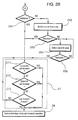
- the user operates a second choice (261) (cf. Figure 2B): either he validates the second default value of the destination identifier or he determines another second value of the destination identifier.
- This determination must be understood in the broad sense: it may be a selection (262) from a second list of predetermined values and/or an entry (264) of a second other non-prerecorded value.
- the two actions selection 262 and entry 264) may succeed each other.
- the system asks him (262) to select an identifier from a second list of predefined identifiers.
- This second list comprises, for example, values of destination identifiers that have already been the object of a definition, especially during a previous call forward operation.
- the system asks (264) the user to key in another second value of the destination identifier.
- this second other value is new since it is not included in the second list of preferred identifiers.
- the user validates (261 or 263 or 265) a second value which is either the one coming from the third list (preferred value as a function of the originator value) or that of the identifier selected from the second list of predefined identifiers or that of a new keyed-in identifier.
- the system may optionally propose a step 27 to the user.
- This is a step for the selection of at least one type of activation of the call forward operation defined beforehand (during the steps 21 to 265).
- This selection step 27 itself comprises several successive steps explained here below:
Landscapes
- Engineering & Computer Science (AREA)
- Signal Processing (AREA)
- Sub-Exchange Stations And Push- Button Telephones (AREA)
Priority Applications (1)
| Application Number | Priority Date | Filing Date | Title |
|---|---|---|---|
| EP99306445A EP0989721A1 (de) | 1998-08-21 | 1999-08-17 | Verfahren zum Einrichten einer Anrufweiterschaltung in einem Telekommunikationssystem |
Applications Claiming Priority (3)
| Application Number | Priority Date | Filing Date | Title |
|---|---|---|---|
| EP98460032 | 1998-08-21 | ||
| EP98460032 | 1998-08-21 | ||
| EP99306445A EP0989721A1 (de) | 1998-08-21 | 1999-08-17 | Verfahren zum Einrichten einer Anrufweiterschaltung in einem Telekommunikationssystem |
Publications (1)
| Publication Number | Publication Date |
|---|---|
| EP0989721A1 true EP0989721A1 (de) | 2000-03-29 |
Family
ID=26151804
Family Applications (1)
| Application Number | Title | Priority Date | Filing Date |
|---|---|---|---|
| EP99306445A Ceased EP0989721A1 (de) | 1998-08-21 | 1999-08-17 | Verfahren zum Einrichten einer Anrufweiterschaltung in einem Telekommunikationssystem |
Country Status (1)
| Country | Link |
|---|---|
| EP (1) | EP0989721A1 (de) |
Citations (2)
| Publication number | Priority date | Publication date | Assignee | Title |
|---|---|---|---|---|
| US5012511A (en) * | 1990-04-06 | 1991-04-30 | Bell Atlantic Network Services, Inc. | Method of and system for control of special services by remote access |
| EP0531048A2 (de) * | 1991-09-03 | 1993-03-10 | AT&T Corp. | System zur Bereitstellung von personalisierten Fernsprechanrufmerkmalen |
-
1999
- 1999-08-17 EP EP99306445A patent/EP0989721A1/de not_active Ceased
Patent Citations (2)
| Publication number | Priority date | Publication date | Assignee | Title |
|---|---|---|---|---|
| US5012511A (en) * | 1990-04-06 | 1991-04-30 | Bell Atlantic Network Services, Inc. | Method of and system for control of special services by remote access |
| EP0531048A2 (de) * | 1991-09-03 | 1993-03-10 | AT&T Corp. | System zur Bereitstellung von personalisierten Fernsprechanrufmerkmalen |
Non-Patent Citations (1)
| Title |
|---|
| "REMOTE CALL FORWARDING", IBM TECHNICAL DISCLOSURE BULLETIN, vol. 36, no. 6B, 1 June 1993 (1993-06-01), pages 267 - 268, XP000377377 * |
Similar Documents
| Publication | Publication Date | Title |
|---|---|---|
| US7460857B2 (en) | Method and apparatus for providing information in response to a delayed grant of subscriber permission | |
| US6542733B1 (en) | System and method for controlling personal telephone number dialing lists and dialing capabilities | |
| US7835731B2 (en) | Telephone with dynamically programmable push buttons for access to advanced applications | |
| US6311063B1 (en) | Method of and system for emulation of multiple subscriber profiles on a single mobile phone in a wireless telecommunications network | |
| US7603108B2 (en) | Automatic connection and access controls for communications devices | |
| US7162019B1 (en) | System and method for privacy screening | |
| JPH08500956A (ja) | 電話呼を完成させるのに用いる方法 | |
| US6459784B1 (en) | Method for the definition of a call forward operation within a telecommunications system | |
| JPH08500954A (ja) | 遠隔通信フォローミーサービス | |
| WO2000067494A1 (en) | Apparatus and method for mobile subscriber service modification | |
| EP1692852B1 (de) | Kommunikationssystem mit direktzugriffs-mailbox | |
| US20040247105A1 (en) | System and method for a network-based call reception limiter | |
| US20070127675A1 (en) | System and method for managing communications | |
| US5905944A (en) | Secure communication of access information | |
| WO2000002369A1 (en) | Method for controlling diversion in telecommunication | |
| US6714634B1 (en) | Method and apparatus for selecting disabling music on hold in a telecommunication system | |
| US20020021793A1 (en) | Destination unavailable state and notification service for public telephone network | |
| JPH08223293A (ja) | 通信回線を用いた情報提供サービスにおけるパスワード接続方法 | |
| AU751585B2 (en) | Method and device in telecommunications system | |
| KR100765718B1 (ko) | 메시징 서비스와 연동하는 전화번호 안내 시스템 및 방법 | |
| JP2004511112A (ja) | セルラ電話を介したサービス提供者発見システム |
Legal Events
| Date | Code | Title | Description |
|---|---|---|---|
| PUAI | Public reference made under article 153(3) epc to a published international application that has entered the european phase |
Free format text: ORIGINAL CODE: 0009012 |
|
| AK | Designated contracting states |
Kind code of ref document: A1 Designated state(s): AT BE CH CY DE DK ES FI FR GB GR IE IT LI LU MC NL PT SE |
|
| AX | Request for extension of the european patent |
Free format text: AL;LT;LV;MK;RO;SI |
|
| 17P | Request for examination filed |
Effective date: 20000915 |
|
| AKX | Designation fees paid |
Free format text: AT BE CH CY DE DK ES FI FR GB GR IE IT LI LU MC NL PT SE |
|
| 17Q | First examination report despatched |
Effective date: 20050714 |
|
| RAP3 | Party data changed (applicant data changed or rights of an application transferred) |
Owner name: LUCENT TECHNOLOGIES INC. |
|
| STAA | Information on the status of an ep patent application or granted ep patent |
Free format text: STATUS: THE APPLICATION HAS BEEN REFUSED |
|
| 18R | Application refused |
Effective date: 20090619 |