EP0991033A2 - Vereinfachtes Benutzen von Chipkarten - Google Patents
Vereinfachtes Benutzen von Chipkarten Download PDFInfo
- Publication number
- EP0991033A2 EP0991033A2 EP99117108A EP99117108A EP0991033A2 EP 0991033 A2 EP0991033 A2 EP 0991033A2 EP 99117108 A EP99117108 A EP 99117108A EP 99117108 A EP99117108 A EP 99117108A EP 0991033 A2 EP0991033 A2 EP 0991033A2
- Authority
- EP
- European Patent Office
- Prior art keywords
- card
- application
- smart card
- card application
- smart
- Prior art date
- Legal status (The legal status is an assumption and is not a legal conclusion. Google has not performed a legal analysis and makes no representation as to the accuracy of the status listed.)
- Withdrawn
Links
Images



Classifications
-
- G—PHYSICS
- G06—COMPUTING OR CALCULATING; COUNTING
- G06K—GRAPHICAL DATA READING; PRESENTATION OF DATA; RECORD CARRIERS; HANDLING RECORD CARRIERS
- G06K19/00—Record carriers for use with machines and with at least a part designed to carry digital markings
-
- G—PHYSICS
- G07—CHECKING-DEVICES
- G07F—COIN-FREED OR LIKE APPARATUS
- G07F7/00—Mechanisms actuated by objects other than coins to free or to actuate vending, hiring, coin or paper currency dispensing or refunding apparatus
- G07F7/08—Mechanisms actuated by objects other than coins to free or to actuate vending, hiring, coin or paper currency dispensing or refunding apparatus by coded identity card or credit card or other personal identification means
- G07F7/10—Mechanisms actuated by objects other than coins to free or to actuate vending, hiring, coin or paper currency dispensing or refunding apparatus by coded identity card or credit card or other personal identification means together with a coded signal, e.g. in the form of personal identification information, like personal identification number [PIN] or biometric data
- G07F7/1008—Active credit-cards provided with means to personalise their use, e.g. with PIN-introduction/comparison system
-
- G—PHYSICS
- G06—COMPUTING OR CALCULATING; COUNTING
- G06Q—INFORMATION AND COMMUNICATION TECHNOLOGY [ICT] SPECIALLY ADAPTED FOR ADMINISTRATIVE, COMMERCIAL, FINANCIAL, MANAGERIAL OR SUPERVISORY PURPOSES; SYSTEMS OR METHODS SPECIALLY ADAPTED FOR ADMINISTRATIVE, COMMERCIAL, FINANCIAL, MANAGERIAL OR SUPERVISORY PURPOSES, NOT OTHERWISE PROVIDED FOR
- G06Q20/00—Payment architectures, schemes or protocols
- G06Q20/30—Payment architectures, schemes or protocols characterised by the use of specific devices or networks
- G06Q20/34—Payment architectures, schemes or protocols characterised by the use of specific devices or networks using cards, e.g. integrated circuit [IC] cards or magnetic cards
- G06Q20/341—Active cards, i.e. cards including their own processing means, e.g. including an IC or chip
-
- G—PHYSICS
- G06—COMPUTING OR CALCULATING; COUNTING
- G06Q—INFORMATION AND COMMUNICATION TECHNOLOGY [ICT] SPECIALLY ADAPTED FOR ADMINISTRATIVE, COMMERCIAL, FINANCIAL, MANAGERIAL OR SUPERVISORY PURPOSES; SYSTEMS OR METHODS SPECIALLY ADAPTED FOR ADMINISTRATIVE, COMMERCIAL, FINANCIAL, MANAGERIAL OR SUPERVISORY PURPOSES, NOT OTHERWISE PROVIDED FOR
- G06Q20/00—Payment architectures, schemes or protocols
- G06Q20/30—Payment architectures, schemes or protocols characterised by the use of specific devices or networks
- G06Q20/34—Payment architectures, schemes or protocols characterised by the use of specific devices or networks using cards, e.g. integrated circuit [IC] cards or magnetic cards
- G06Q20/355—Personalisation of cards for use
- G06Q20/3552—Downloading or loading of personalisation data
-
- G—PHYSICS
- G07—CHECKING-DEVICES
- G07F—COIN-FREED OR LIKE APPARATUS
- G07F7/00—Mechanisms actuated by objects other than coins to free or to actuate vending, hiring, coin or paper currency dispensing or refunding apparatus
- G07F7/08—Mechanisms actuated by objects other than coins to free or to actuate vending, hiring, coin or paper currency dispensing or refunding apparatus by coded identity card or credit card or other personal identification means
- G07F7/0806—Details of the card
- G07F7/0833—Card having specific functional components
- G07F7/084—Additional components relating to data transfer and storing, e.g. error detection, self-diagnosis
Definitions
- the invention refers to a smart card with stored information which is used in the execution of a computer program (card application) outside the smart card, and a procedure for operating such a card application.
- Cards consisting of, amongst other things, a microprocessor (chip) and memory units are already known. They are also known as smart cards. This type of card is used together with devices possessing a card reader. These terminals can be, for example, personal computers or network computers (NCs).
- NCs network computers
- the card application In order that the card application can be executed, it is necessary that it is explicitly started by the user.
- the starting is carried out, for example, by entering a corresponding command using a computer keyboard or by clicking on corresponding icons on a graphic user interface with a computer mouse. If the card user uses a terminal unknown to him/her or a terminal which only has restricted facilities for entering start commands, the starting of card applications can be difficult.
- the started card application requires a smart card to execute certain functions
- the user is requested to insert the corresponding smart card in a smart card reader for this purpose. It is also necessary that the user inserts into the reader exactly that smart card which is supported by the started application. After the smart card has been inserted, the card application can use the smart card.
- a procedure is known where a smart card is used with an NC in order to identify the card user in logging on for a session.
- information is read from the smart card by the NC and transmitted to a server.
- This makes available to the user a selection of computer programs which are permitted for use by the user.
- the computer programs can be started up manually or automatically. If one of the started computer programs is a card application, then the user must insert a smart card which supports the card application in order to be able to use the smart card.
- the smart card There is data in the memory of the smart card which can be read out and used by a card application, and/or a computer program which can be used by a card application.
- Each stored set of data in the smart card memory or each computer program in the smart card memory has an application identifier allocated to it.
- the smart card additionally receives a statement (control information) on the start mode of each card application which can use a set of data described by the application identifiers and stored on the smart card and/or a computer program stored on the smart card.
- the application identifier and the statements (control information) on the start mode are parts of a card configuration.
- the computer programs stored on the smart card are preferably Java applications (Java applets). Data and computer programs can be filed simultaneously in the smart card memory.
- a background program is executed in a terminal which waits for the insertion of a smart card into a smart card reader. After inserting a smart card into the smart card reader, the background program reads the card configuration, i.e. the application identifier and control information, from the smart card.
- the background program reads statements on that application which the data or Java applets can use on the smart card such as their name and the location of the card application. These statements are also located either in the card configuration on the smart card or the card configuration is divided into several parts where at least the application identifier and control information are in the part filed on the smart card, whereas the remaining parts of the card configuration are located in a configuration file outside the smart card.
- the background program automatically loads and starts the card application, which the data or Java applets use on the smart card, as long as the control information ("AUTOSTART") is allocated to the card application in the card configuration on the smart card.
- AUTOSTART the control information
- the data or Java applets on the inserted smart card can be used by the started card application.
- the use of the invention presented allows exactly that card application to be loaded and started in a terminal which can use information from the memory of a smart card previously loaded into the smart card reader.
- the card user must simply insert the smart card into the terminal and operate the card application which starts automatically It is no longer necessary for the card user to know how that card application which supports the smart card being used has been started. Also, the card user no longer has to insert the intended smart card into the reader after the start of the card application as this is already in the reader.
- the card application to be started depends solely on the smart card inserted by the card user into the reader. For example, a first and a second card application are automatically started for a first smart card, whilst a first and a third application are automatically started for a second smart card.
- a terminal can work, for example, as an automatic bank when used with the first smart card, whilst the same terminal can take over, for example, the function of an automatic ticket dispenser when used with a second card.
- the smart card user must himself select, from different applications available, the card application used by the smart card which he is using, and start it as described in Figure 1.
- the selection and starting occurs, for example using a graphic user interface.
- the card application After the card application is started, it waits for the insertion of a supported smart card. After such a smart card has been inserted by the user into a corresponding smart card reader, the card application can use the smart card.
- a background program is executed in a terminal.
- the background program is an independent program in a terminal, independent of other card applications. It waits for the insertion of any smart card into the reader.
- the background program is implemented based on the OpenCard Framework (OpenCard Framework 1.1, White Paper, http://www.opencard.org).
- the background program can, however, also be part of another program which runs in the background, such as the operating system of the terminal.
- the background program can also be realised through other means.
- the background program is automatically started on the start of the terminal system. However, it can also be started manually.
- the terminal is a PC with a smart card reader.
- devices such as NCs and set-top boxes could also be used, i.e. devices which are used for decoding encoded television images and other applications such as bank business, or other devices with smart card readers.
- a Java platform is used as a terminal.
- the smart card memory contains data which can be used by at least one card application and/or at least one computer program which can be used by at least one card application.
- the computer program in the preferred embodiment is a Java applet.
- the card configuration on the smart card is read automatically by the background program.
- the type of smart card and the form of data transmission were established when necessary. This is carried out automatically in a known manner by the background program. For example, information which is located on the smart card (e.g. "Answer to reset", ASR) is read for this purpose.
- ASR Automatic to reset
- the card configuration on the smart card consists of at least the following components:
- the background program reads the following information which can be located both in the card configuration on the smart card, as in the preferred embodiment, as well as in a second part of the card configuration in one or several configuration files outside the smart card:
- a clear identifier to ISO 7816-5 International Standard, Identification cards - Integrated circuit cards with contacts
- ISO 7816-5 International Standard, Identification cards - Integrated circuit cards with contacts
- An example of such an identifier is "D27600002200000091”.
- the address held in the card configuration in the preferred embodiment is a URL (uniform resource locator), this being an address in a format which is preferred on the Internet, such as http://www.xbank.com/apps. However, any other address format can be used.
- URL uniform resource locator
- the control information contains a statement on the start mode of a card application. This statement has the value AUTOSTART when the card application is to be started automatically, or START_AFTER_SELECTION if the card application is to be started by the user, or NEVER_START when the card application is deactivated.
- the content of the control information is not, however, restricted to these examples.
- the control information can contain any other information on the start of the card application.
- the card configuration contains a set of statements on control information, application label, address and name of the card application for each application identifier.
- the data structure for filing the card configuration is preferably applied by the smart card manufacturer.
- data can be filed in the card configuration at the time of the data structures being defined on the smart card or at a later point in time.
- the background program After the background program has read the card configuration, it loads the card applications which are given in the card configuration into the terminal memory whereby the card application is loaded from that address stated in the card configuration which is stated for the respective card application. Addresses can be local or remote addresses (e.g. local hard disk, Internet, ). To load the card application, the background program has access to data and/or program files in these addresses. The background program particularly has access to computer networks such as the Internet.
- the background program then automatically starts the card application whose start mode is defined as AUTOSTART in the control information.
- the card application started in this way can use the smart card already inserted into the card reader. If the start mode START_AFTER_SELECTION is allocated to the card application, then after loading the card application from the corresponding address, no automatic start can take place. Instead, this card application can only be started if selected by the card user. To do this, the user is offered the application label of the data or Java applets for selection, for example in the form of a graphic menu.
- start mode of the card application is NEVER_START, then the card application is neither started automatically nor offered to the user for selection.
- An additional embodiment has the card applications not identified by the start mode AUTOSTART not being loaded into the terminal until the user has selected it.
- An additional embodiment has at least one card application being continually located in the memory of the terminal and therefore after a corresponding smart card has been inserted into the reader it does not have to be loaded from an address but can be used immediately.
- the smart card is a Java card used in conjunction with a Java platform.
- Figure 3 shows the card configuration for this embodiment.
- Java applets are used here instead of a file in which the card configuration is filed for file oriented smart cards.
- a master applet on the smart card which, amongst other things, is responsible for the creation and deletion of applications on the card, and in addition there is an info applet and at least one application applet which can be used through a card application.
- An APDU (application protocol data unit) command such as "LIST" is sent to the master applet through the background program whereby the master applet causes a list of application identifiers of all application applets on the card to be sent back to the background program in the form of an APDU response.
- the background program After the background program has received all the application identifiers of all the application applets, it can then receive the missing information (start mode, address, ...) using the info applet.
- the information applet replies back to the background program in response to a corresponding command from the background program such as "getLabel" with the control information which belongs to the given identifier of an application applet, the address of the card application to be started as well as the name of the card application to be started.
- the functionality of the info applet can be integrated into the master applet. Then a command, for example "getInfo", can send back all the information to the background program which is necessary for starting the card application.
- a command for example "getInfo"
- the card application to be started is a Java application.
- the statement contained in the card configuration on the card application to be started then contains information on which Java class has to be started.
- the Java class is an "ApplicationFactory" class, i.e. a class which joins together applications from different Java components.
- the background program loads the ApplicationFactory from the corresponding stated address, starts the ApplicationFactory and issues to it both the identifier of at least one of those Java applets which are located in the smart card memory and which the Java application to be created can use, as well as the ATR of the smart card as parameters.
- the ApplicationFactory uses these parameters in order to create the corresponding card application, here a Java application, and to adapt to the specially used card type.
- the ApplicationFactory, as well as the Java applets used as components of the combined Java application are preferably located on a common computer on the Internet.
- the background program has access to local and remote memories, such as the Internet.
- the combined card application is started automatically by the background program as long as the start mode is AUTOSTART.
- files can be used to file the card configuration in it.
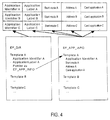
- Figure 4 shows the representation of the card configuration on a file oriented smart card in accordance with a second embodiment of the invention presented.
- the card configuration is located in two separate files on the smart card.
- the application identifier and application label are filed in the first file.
- the first file (EF_DIR) are additionally filed pointers to the parts of the card configuration which are located in a second file.
- EF_APP_INFO In the second file (EF_APP_INFO) are filed additional statements on the start mode, address and name of the card application to be started.
- This embodiment preferably uses the Europay-Mastercard-Visa (EMV) standard (EMV '96 Version 3.0, 30 th June 1996, Integrated Circuit Card Specification for Payment Systems) for the description of the first file.
- EMV Europay-Mastercard-Visa
- the first file then conforms to the file EF_DIR defined in the EMV standard.
- TLV tag length value
- ISO 8825 Information Processing Systems - Open System Interconnection - Specification of Basic Encoding Rules for Abstract Syntax Notation One (ASN.1)
- the syntax of the application identifier and application label is known.
- a syntax is used which is coded in accordance with ISO 8825 in a TLV structure.
- the lengths of the addresses and the names of the Java classes are preferably variable whereas the length of the start mode is 1 Byte.
- Figure 5 shows the representation of the card configuration on a file oriented smart card in accordance with a third preferred embodiment of the invention presented.
- the card configuration is completely located in a single file on the smart card.
- Files and data structures are shown as in the first embodiment in accordance with ISO 8825.
- the contents of the card configuration are distributed to several locations.
- At least one of the additional contents of the card configuration, such as the address, is located outside the smart card and is read by the background program from at least one configuration file which is located outside the smart card, such as on a local computer or on a remote computer, for example in a computer network such as the Internet.
- the background program is additionally used to start application programs even before the insertion of a smart card into the reader, where these programs can also be card applications.
- the start of these programs is carried out automatically or after the user has made a selection, according to certain information which is read for this purpose from the background program from user-defined or other files.
- the programs are loaded previously from addresses which result from the information read. In this way, the user-defined or other files are not located on the smart card but are, for example, located in local or remote computers.
- a security question can be executed before start of the card application, such as asking for a password or a personal identification number (PIN).
- PIN personal identification number
- a secure connection to a computer in the Internet can be created automatically as soon as a corresponding smart card is inserted into the reader and the PIN is entered.
- the card application is stopped automatically if the smart card is removed from the reader.
- a "cash card” type smart card is started automatically as soon as the corresponding smart card is inserted into a reader and the start mode of the card application is AUTOSTART.
- the card application is ended automatically as soon as the cash card is removed from the reader, which reduces the possibility of outside manipulation of the data and contributes to an improvement in data security.
- the invention presented can obviously also be applied if several card applications are simultaneously supported by one smart card.
- An embodiment of the invention presented intends that the card applications are themselves stored in the smart card.
- a smart card instead of a smart card, other devices such as mobile telephones or computers can be used with the invention presented.
- the transmission of data between such a device and the terminal can be carried out in a contactless manner, for example. Even contactless reading of a smart card by a contactless reader is applicable in the invention presented.
Landscapes
- Engineering & Computer Science (AREA)
- Physics & Mathematics (AREA)
- General Physics & Mathematics (AREA)
- Business, Economics & Management (AREA)
- Theoretical Computer Science (AREA)
- Microelectronics & Electronic Packaging (AREA)
- Computer Networks & Wireless Communication (AREA)
- Accounting & Taxation (AREA)
- Strategic Management (AREA)
- General Business, Economics & Management (AREA)
- Stored Programmes (AREA)
Applications Claiming Priority (2)
| Application Number | Priority Date | Filing Date | Title |
|---|---|---|---|
| DE19845582A DE19845582A1 (de) | 1998-10-02 | 1998-10-02 | Vereinfachtes Benutzen einer Chipkarte |
| DE19845582 | 1998-10-02 |
Publications (2)
| Publication Number | Publication Date |
|---|---|
| EP0991033A2 true EP0991033A2 (de) | 2000-04-05 |
| EP0991033A3 EP0991033A3 (de) | 2002-01-16 |
Family
ID=7883290
Family Applications (1)
| Application Number | Title | Priority Date | Filing Date |
|---|---|---|---|
| EP99117108A Withdrawn EP0991033A3 (de) | 1998-10-02 | 1999-08-28 | Vereinfachtes Benutzen von Chipkarten |
Country Status (8)
| Country | Link |
|---|---|
| EP (1) | EP0991033A3 (de) |
| JP (1) | JP3422734B2 (de) |
| KR (1) | KR100374526B1 (de) |
| CN (1) | CN1109970C (de) |
| DE (1) | DE19845582A1 (de) |
| IL (1) | IL131356A (de) |
| PL (1) | PL335773A1 (de) |
| TW (1) | TW451163B (de) |
Cited By (3)
| Publication number | Priority date | Publication date | Assignee | Title |
|---|---|---|---|---|
| KR100438189B1 (ko) * | 2000-12-22 | 2004-07-02 | 한국전자통신연구원 | 보조 프로세서를 이용한 스마트 카드 |
| WO2013178426A1 (de) * | 2012-05-15 | 2013-12-05 | Fujitsu Technology Solutions Intellectual Property Gmbh | Elektronisches zugangsschutzsystem, verfahren zum betrieb eines computersystems, chipkarte und firmwarekomponente |
| US8882561B2 (en) | 2006-04-07 | 2014-11-11 | Mattel, Inc. | Multifunction removable memory device with ornamental housing |
Families Citing this family (9)
| Publication number | Priority date | Publication date | Assignee | Title |
|---|---|---|---|---|
| JP2002196934A (ja) | 2000-12-26 | 2002-07-12 | Toshiba Corp | 端末装置、携帯可能電子装置の取扱システムおよび携帯可能電子装置の取扱方法 |
| DE10120806B4 (de) * | 2001-04-27 | 2005-12-15 | Fenkart Informatik & Telekommunikations Kg | Vorrichtung und Verfahren zur Übertragung von multimedialen Datenobjekten |
| US20030231343A1 (en) | 2002-05-08 | 2003-12-18 | Ayako Kobayashi | Image forming apparatus, program adding method, and a recording medium |
| KR100971137B1 (ko) * | 2003-01-09 | 2010-07-20 | 주식회사 비즈모델라인 | 스마트 카드 연계 처리형 마그네틱 스트라이프 기반 네트워크 카드 운영 시스템 |
| CN100362468C (zh) * | 2004-01-06 | 2008-01-16 | 英业达股份有限公司 | 免安装应用程序的方法 |
| DE102007041270A1 (de) * | 2007-08-31 | 2009-03-05 | Printed Systems Gmbh | Multimediasystem |
| KR100971128B1 (ko) * | 2008-01-09 | 2010-07-20 | 주식회사 비즈모델라인 | 마그네틱 스트라이프 기반 네트워크 카드 운영 방법 |
| US8905309B2 (en) | 2008-03-10 | 2014-12-09 | Infineon Technologies Ag | Reader application device |
| CN109144596B (zh) * | 2017-06-16 | 2020-09-18 | 腾讯科技(深圳)有限公司 | 快捷启动方法、装置、终端、服务器及系统 |
Family Cites Families (8)
| Publication number | Priority date | Publication date | Assignee | Title |
|---|---|---|---|---|
| JPH02214994A (ja) * | 1989-02-15 | 1990-08-27 | Hitachi Maxell Ltd | Icカード |
| DE4302634A1 (de) * | 1993-01-30 | 1994-08-04 | Ralf Waldorf Stahringer | Rechner |
| JP3578220B2 (ja) * | 1994-06-15 | 2004-10-20 | トムソン コンシユーマ エレクトロニクス インコーポレイテツド | マイクロプロセッサの介入のないスマートカードメッセージ転送 |
| DE19508724C1 (de) * | 1995-03-10 | 1996-10-31 | Siemens Ag | Chipkarte mit geschütztem Betriebssystem |
| FR2734927B1 (fr) * | 1995-05-30 | 1997-07-04 | Syseca | Lecteur pour carte a puce intelligente |
| DE19522527A1 (de) * | 1995-06-23 | 1997-01-02 | Ibm | Verfahren zur Vereinfachung der Kommunikation mit Chipkarten |
| US5923884A (en) * | 1996-08-30 | 1999-07-13 | Gemplus S.C.A. | System and method for loading applications onto a smart card |
| ATE281680T1 (de) * | 1997-03-24 | 2004-11-15 | Visa Int Service Ass | System und verfahren für eine mehrzweckchipkarte die eine nachträgliche speicherung einer anwendung auf dieser karte ermöglicht |
-
1998
- 1998-10-02 DE DE19845582A patent/DE19845582A1/de not_active Withdrawn
-
1999
- 1999-08-11 IL IL13135699A patent/IL131356A/xx not_active IP Right Cessation
- 1999-08-19 TW TW088114153A patent/TW451163B/zh not_active IP Right Cessation
- 1999-08-28 EP EP99117108A patent/EP0991033A3/de not_active Withdrawn
- 1999-09-16 KR KR10-1999-0039752A patent/KR100374526B1/ko not_active Expired - Fee Related
- 1999-09-29 CN CN99120555A patent/CN1109970C/zh not_active Expired - Fee Related
- 1999-09-30 JP JP27947499A patent/JP3422734B2/ja not_active Expired - Fee Related
- 1999-10-01 PL PL99335773A patent/PL335773A1/xx unknown
Cited By (4)
| Publication number | Priority date | Publication date | Assignee | Title |
|---|---|---|---|---|
| KR100438189B1 (ko) * | 2000-12-22 | 2004-07-02 | 한국전자통신연구원 | 보조 프로세서를 이용한 스마트 카드 |
| US8882561B2 (en) | 2006-04-07 | 2014-11-11 | Mattel, Inc. | Multifunction removable memory device with ornamental housing |
| WO2013178426A1 (de) * | 2012-05-15 | 2013-12-05 | Fujitsu Technology Solutions Intellectual Property Gmbh | Elektronisches zugangsschutzsystem, verfahren zum betrieb eines computersystems, chipkarte und firmwarekomponente |
| US9824202B2 (en) | 2012-05-15 | 2017-11-21 | Fujitsu Technology Solutions Intellectual Property Gmbh | Electronic access-protection system, method of operating a computer system, chip card and firmware component |
Also Published As
| Publication number | Publication date |
|---|---|
| TW451163B (en) | 2001-08-21 |
| IL131356A (en) | 2003-11-23 |
| CN1109970C (zh) | 2003-05-28 |
| CN1250182A (zh) | 2000-04-12 |
| JP2000148456A (ja) | 2000-05-30 |
| EP0991033A3 (de) | 2002-01-16 |
| KR20000028688A (ko) | 2000-05-25 |
| PL335773A1 (en) | 2000-04-10 |
| DE19845582A1 (de) | 2000-04-06 |
| JP3422734B2 (ja) | 2003-06-30 |
| IL131356A0 (en) | 2001-01-28 |
| KR100374526B1 (ko) | 2003-03-03 |
Similar Documents
| Publication | Publication Date | Title |
|---|---|---|
| US7543331B2 (en) | Framework for providing a configurable firewall for computing systems | |
| KR100886137B1 (ko) | 스마트카드에 소프트웨어 콤포넌트, 특히 애플릿을로딩하는 방법 | |
| US6944650B1 (en) | System for accessing an object using a “web” browser co-operating with a smart card | |
| US7232073B1 (en) | Smart card with multiple applications | |
| US7487920B2 (en) | Integrated circuit card system and application loading method | |
| CN1457614A (zh) | 向通用用户识别模块的程序下载系统 | |
| US7340748B2 (en) | Automatic client proxy configuration for portable services | |
| CN101416204B (zh) | 安全设备 | |
| KR100374526B1 (ko) | 스마트 카드 및 그를 이용한 컴퓨터 프로그램 동작 방법 | |
| US6707892B2 (en) | Application terminal | |
| KR20050117605A (ko) | 네트워크 확장형 스마트 카드 및 운영 방법 | |
| EP1665044A1 (de) | Verfahren und system für fernkartenzugang, computerprogrammprodukt dafür | |
| US7275681B2 (en) | Method and device for processing data for customizing an application of a portable communication device, for example a smart card | |
| KR20050074857A (ko) | 스마트 카드용 데이터(또는 애플리케이션) 탑재방법 및시스템 | |
| CN114462562A (zh) | 智能卡写卡方法、系统、电子设备及存储介质 | |
| CN116170794B (zh) | 一种用于智能卡在线空发系统及其方法 | |
| US6435405B1 (en) | Method and system for identifying and handling critical chip card commands | |
| KR100928848B1 (ko) | 스마트 카드 단말기용 호스트 애플리케이션 제공 방법 | |
| Balacheff et al. | Smartcards–from security tokens to intelligent adjuncts | |
| Sauveron et al. | Smart Card Reader and Mobile APIs | |
| Hwang et al. | A Research of enhanced Web-based USIM system using by ActiveX | |
| KR20110084864A (ko) | 통신망을 이용한 아이씨 카드용 데이터(또는 애플리케이션) 탑재 방법 | |
| Vogt et al. | Middleware for smart cards | |
| KR20040083966A (ko) | 스마트 카드 및 스마트 카드 시스템 | |
| KR20090014411A (ko) | 아이씨 카드용 데이터(또는 애플리케이션) 탑재 시스템 |
Legal Events
| Date | Code | Title | Description |
|---|---|---|---|
| PUAI | Public reference made under article 153(3) epc to a published international application that has entered the european phase |
Free format text: ORIGINAL CODE: 0009012 |
|
| AK | Designated contracting states |
Kind code of ref document: A2 Designated state(s): AT BE CH CY DE DK ES FI FR GB GR IE IT LI LU MC NL PT SE |
|
| AX | Request for extension of the european patent |
Free format text: AL;LT;LV;MK;RO;SI |
|
| PUAL | Search report despatched |
Free format text: ORIGINAL CODE: 0009013 |
|
| AK | Designated contracting states |
Kind code of ref document: A3 Designated state(s): AT BE CH CY DE DK ES FI FR GB GR IE IT LI LU MC NL PT SE |
|
| AX | Request for extension of the european patent |
Free format text: AL;LT;LV;MK;RO;SI |
|
| RIC1 | Information provided on ipc code assigned before grant |
Free format text: 7G 06K 7/00 A, 7G 07F 7/10 B |
|
| 17P | Request for examination filed |
Effective date: 20020611 |
|
| AKX | Designation fees paid |
Free format text: AT BE CH CY DE DK ES FI FR GB GR IE IT LI LU MC NL PT SE |
|
| STAA | Information on the status of an ep patent application or granted ep patent |
Free format text: STATUS: THE APPLICATION IS DEEMED TO BE WITHDRAWN |
|
| 18D | Application deemed to be withdrawn |
Effective date: 20060301 |