EP0992878A2 - Appareil et méthode de positionnement absolu et relatif d'un curseur graphique - Google Patents
Appareil et méthode de positionnement absolu et relatif d'un curseur graphique Download PDFInfo
- Publication number
- EP0992878A2 EP0992878A2 EP99307531A EP99307531A EP0992878A2 EP 0992878 A2 EP0992878 A2 EP 0992878A2 EP 99307531 A EP99307531 A EP 99307531A EP 99307531 A EP99307531 A EP 99307531A EP 0992878 A2 EP0992878 A2 EP 0992878A2
- Authority
- EP
- European Patent Office
- Prior art keywords
- touchpad
- movement
- relative
- touching
- positioning
- Prior art date
- Legal status (The legal status is an assumption and is not a legal conclusion. Google has not performed a legal analysis and makes no representation as to the accuracy of the status listed.)
- Granted
Links
Images

Classifications
-
- G—PHYSICS
- G06—COMPUTING OR CALCULATING; COUNTING
- G06F—ELECTRIC DIGITAL DATA PROCESSING
- G06F1/00—Details not covered by groups G06F3/00 - G06F13/00 and G06F21/00
- G06F1/16—Constructional details or arrangements
- G06F1/1613—Constructional details or arrangements for portable computers
- G06F1/1615—Constructional details or arrangements for portable computers with several enclosures having relative motions, each enclosure supporting at least one I/O or computing function
- G06F1/1616—Constructional details or arrangements for portable computers with several enclosures having relative motions, each enclosure supporting at least one I/O or computing function with folding flat displays, e.g. laptop computers or notebooks having a clamshell configuration, with body parts pivoting to an open position around an axis parallel to the plane they define in closed position
-
- G—PHYSICS
- G06—COMPUTING OR CALCULATING; COUNTING
- G06F—ELECTRIC DIGITAL DATA PROCESSING
- G06F1/00—Details not covered by groups G06F3/00 - G06F13/00 and G06F21/00
- G06F1/16—Constructional details or arrangements
- G06F1/1613—Constructional details or arrangements for portable computers
- G06F1/1633—Constructional details or arrangements of portable computers not specific to the type of enclosures covered by groups G06F1/1615 - G06F1/1626
- G06F1/1684—Constructional details or arrangements related to integrated I/O peripherals not covered by groups G06F1/1635 - G06F1/1675
- G06F1/169—Constructional details or arrangements related to integrated I/O peripherals not covered by groups G06F1/1635 - G06F1/1675 the I/O peripheral being an integrated pointing device, e.g. trackball in the palm rest area, mini-joystick integrated between keyboard keys, touch pads or touch stripes
-
- G—PHYSICS
- G06—COMPUTING OR CALCULATING; COUNTING
- G06F—ELECTRIC DIGITAL DATA PROCESSING
- G06F3/00—Input arrangements for transferring data to be processed into a form capable of being handled by the computer; Output arrangements for transferring data from processing unit to output unit, e.g. interface arrangements
- G06F3/01—Input arrangements or combined input and output arrangements for interaction between user and computer
- G06F3/02—Input arrangements using manually operated switches, e.g. using keyboards or dials
- G06F3/0202—Constructional details or processes of manufacture of the input device
- G06F3/021—Arrangements integrating additional peripherals in a keyboard, e.g. card or barcode reader, optical scanner
- G06F3/0213—Arrangements providing an integrated pointing device in a keyboard, e.g. trackball, mini-joystick
-
- G—PHYSICS
- G06—COMPUTING OR CALCULATING; COUNTING
- G06F—ELECTRIC DIGITAL DATA PROCESSING
- G06F3/00—Input arrangements for transferring data to be processed into a form capable of being handled by the computer; Output arrangements for transferring data from processing unit to output unit, e.g. interface arrangements
- G06F3/01—Input arrangements or combined input and output arrangements for interaction between user and computer
- G06F3/048—Interaction techniques based on graphical user interfaces [GUI]
- G06F3/0487—Interaction techniques based on graphical user interfaces [GUI] using specific features provided by the input device, e.g. functions controlled by the rotation of a mouse with dual sensing arrangements, or of the nature of the input device, e.g. tap gestures based on pressure sensed by a digitiser
- G06F3/0488—Interaction techniques based on graphical user interfaces [GUI] using specific features provided by the input device, e.g. functions controlled by the rotation of a mouse with dual sensing arrangements, or of the nature of the input device, e.g. tap gestures based on pressure sensed by a digitiser using a touch-screen or digitiser, e.g. input of commands through traced gestures
Definitions
- the present invention relates to positioning a graphics cursor on a computer display and to a positioning device that permits both absolute and relative positioning.
- GUI graphics user interface
- Examples of known input or positioning devices include touchpads, touch screens, track balls, computer tablets and computer mouse products. These devices utilize either absolute or relative positioning schemes to achieve placement of a cursor at a desired location.
- Absolute positioning schemes are commonly implemented in devices such as graphic tablets and touch screens.
- absolute positioning there is a one to one correspondence between a point on the positioning device and a point on the computer screen.
- designation of a point on the positioning device results in a predefined response at the corresponding position on the computer screen.
- Disadvantages of absolute positioning include that the devices tend to be relatively large to maximize the number of selectable points on the input device, the devices tend to lack precision (i.e., fine positioning cannot be achieved) and the devices are often prone to alignment problems in which it is difficult to have specific positions on the input device repeatedly translate to the same point on the computer screen.
- Relative positioning schemes are commonly utilized in devices such as track balls, mice and touchpads, etc.
- a graphics cursor In relative positioning, a graphics cursor is positioned by moving an input device relative to its current position. Relative positioning schemes generally strike a compromise between the effective handling of large graphics cursor movements and fine positioning. The result of this compromise is often a positioning device that achieves neither desired levels of large graphics cursor movement or fine positioning.
- a related positioning scheme is acceleration-based relative positioning.
- the rate at which the input device is accelerated corresponds to the rate at which the graphics cursor is moved.
- acceleration-based techniques facilitate both fine positioning and large graphics cursor movements, their design and implementation are complicated. The use of acceleration based devices can also be frustrating not only to new users but also to experienced users that are used to a device with a slightly different acceleration sensitivity.
- U.S. Patent No. 5,327,161, issued July 5, 1994, to James Logan and Blair Evans is representative of prior art positioning devices. While prior art positioning devices have contributed to the advancement of computer-user interfaces, there is room for improvement. For example, at times a user may desire absolute positioning to immediately move to a desired location on a screen. At other times, a user may desire relative positioning for efficient placement of a graphics cursor relative to its previous position, e.g., in positioning a graphics cursor amongst text characters.
- the present invention includes a method of positioning a graphics cursor that includes the steps of receiving a touched location indicating signal from a touchpad; determining from a touched location indicating signal whether to invoke an absolute positioning mode of operation or a relative positioning mode of operation; and generating, in said absolute positioning mode of operation, a signal that facilitates formation of a graphics cursor on a display at a location that corresponds to an indicated touched location.
- Other method steps include detecting continually touching movement on a touchpad and generating a signal that facilitates movement of a graphics cursor from a previous position in a manner analogous to movement of detected continually touching movement relative to a reference location.
- the present invention includes an electronic apparatus that includes a touchpad; a display; and processing logic coupled between said touchpad and said display that processes touched location signals from said touchpad in such a manner as to provide absolute or relative positioning of a graphics cursor for said display.
- Fig. 1 is a perspective view of a laptop or notebook computer having a touchpad in accordance with the present invention.
- Fig. 2 is a plan view of a touchpad in accordance with the present invention.
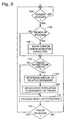
- Fig. 3 is a flow diagram of logic that implements the operation of a touchpad in a word processing application in accordance with the present invention.
- Fig. 4 is an embodiment of a keyboard in accordance with the present invention.
- Computer 5 includes components such as a processor or processing logic 6, memory 7 (these two are shown in phantom lines because they are internal), an alphanumeric keypad 9 and a display screen 10.
- Computer 5 also includes a touchpad 20 for use in controlling a graphics cursor such as a cursor arrow 12 or the like.
- Control buttons 21,22 analogous to the right and left click buttons of a mouse, may also be provided as is known (although alternatives to such buttons are discussed below).
- Track pad 20 in conjunction with processing logic 6 provides absolute and relative positioning of graphics cursor 12.
- Touchpad 20 preferably includes a known touchpad surface 23 that provides an indication of the point on the surface of the touchpad that a user's finger or stylus or the like is touching.
- touchpad 20 has at least 50 points per linear inch. Suitable touchpad surfaces are known in the art. In the text that follows, operation of touchpad 20 is described first, followed by a description of logic through which the operation is achieved.
- Touchpad 20 in a preferred embodiment, has dimensions of approximately 2" x 2" so that it may be readily installed in a notebook computer (Fig. 1), a keyboard (Fig. 4), a stand alone unit or the like. It should be recognized, however, that the touchpad may be made of any desired dimensions without departing from the scope of the present invention.
- Touchpad 20 preferably has two markings 25,26 for visual and/or tactile reference. These markings may have a physical relief so that they may be determined by touch or may be painted on or the like. Regardless of how they are embodied, markings 25,26 are provided over or aligned with appropriate regions of the touchpad surface as now discussed.
- One marking is a line 26 that is preferably provided approximately 1/2" or 1/4" from an edge (the top edge in Fig. 2) of the touchpad.
- Line 26 divides touchpad 20 into a first region 30 that is approximately 1 and 1/2" x 2" and maps to a computer screen such as screen 12 of Fig. 1. It should be recognized that this region has a shape analogous to that of a computer screen, i.e., the horizontal dimension is greater than the vertical dimension. Points in region 30 map to corresponding points in an associated display screen such that absolute positioning can be achieved.
- Designation of a point in region 30, with a finger or stylus or the like preferably invokes a software routine executed by processing logic 6 or equivalent logic (discussed in more detail below with reference to Fig. 3) that moves a predefined graphics cursor to a location on the associated display screen that corresponds to the point touched.
- touchpad 20 may be small compared to a display screen, there may not be enough points on touchpad 20 to permit accurate placement of a graphics cursor. Relative positioning is, therefore, preferably invoked to achieve this fine placement and dot or location 25 preferably provides a reference point for relative positioning.
- the act of sliding that finger preferably invokes relative positioning.
- the graphics cursor (on screen 12) does not move while the finger is being moved towards dot 25, however, movement away from the dot causes the cursor to move in that direction. Movement from a touched location is preferably processed using an x-y coordinate system.
- region 31 The region above line 26 (region 31) is provided so that a user can invoke relative positioning directly. If a user first places their finger in region 31, i.e., above line 26, and slides that finger towards dot 25, then relative positioning is invoked.
- Fig. 3 a flow diagram of logic that implements the operation of touchpad 20 in a word processing application in accordance with the present invention is shown. It should be recognized that the flow diagram of Fig. 3 is for a representative word processing application and the formation of graphics cursors in other word processing applications and in non-word processing applications (e.g. spread sheet applications, design applications, etc.) may differ without departing from the scope of the present invention.
- the logic of Fig. 3 is implemented as software that is executed by the processor of the computer with which the touchpad is used, e.g., processor 6 of computer 5. This software may be installed as device driver software. Where appropriate, the logic of Fig. 3 produces signals (e.g., output signals) that interact with known display graphics generation logic to create the computer or other electronic device display.
- step 102 a determination is made as to whether touchpad 20 has been touched. If it has, a determination is made in step 104 as to whether region 30 has been touched thus invoking absolute positioning. If region 30 was touched, a location indicating graphics cursor is moved in the on-screen display to a location that corresponds to the point touched (step 106). If region 30 was not touched, then by default region 31 that invokes relative position was touched.
- step 122 a determination is made as to whether the finger is moved away from the center (or other designated reference location) of the touchpad.
- a relative movement coefficient is calculated based on the position of the finger relative to the center of the touchpad (step 123). In a preferred embodiment, the amount of relative movement is increased as the distance from the center increases (discussed in more detail below). In step 124, the position indicating graphics cursor is moved by the appropriate relative amount. This or like schemes provide accelerated-type relative positioning.
- step 110 processing related to the new graphics cursor position is performed. This may involve implementing a drag and drop or cut and paste or the like.
- step 108 If the finger is released at step 108, then flow proceeds to step 102. If the finger is not released, then flow proceeds to step 122.
- step 110 may be invoked in response to clicking a conventional mouse
- alternatives to mouse button depressions or the like for implementing graphics cursor movement are contemplated and within the present invention.
- Such alternatives may include detecting the touching of a second distinct location on touchpad 20. The detection of a second distinct touch could be treated the same as a control button depression.
- An alternative embodiment has been contemplated that includes tapping the touchpad screen. In this embodiment, an additional parameter such as time is added that would respond to a tap or taps that occurs within a predefined time period. If a second distinct touching of the touchpad is detected within this predefined time period, a control signal is generated. This control signal could be treated the same as a control button depression or perform some other function.
- step 123 one location based relative position scheme may be implemented as now described.
- the below parameters are defined as stated:
- Keyboard 50 in accordance with the present invention is shown.
- Keyboard 50 consists of an alphanumeric keypad or the like 9 such as that found on conventional computer keyboards.
- Keyboard 50 also includes touchpad 20 and in at least one embodiment control buttons 21,22 (or an equivalent therefor).
Landscapes
- Engineering & Computer Science (AREA)
- Theoretical Computer Science (AREA)
- General Engineering & Computer Science (AREA)
- Physics & Mathematics (AREA)
- Human Computer Interaction (AREA)
- General Physics & Mathematics (AREA)
- Computer Hardware Design (AREA)
- Mathematical Physics (AREA)
- Position Input By Displaying (AREA)
- User Interface Of Digital Computer (AREA)
Applications Claiming Priority (2)
| Application Number | Priority Date | Filing Date | Title |
|---|---|---|---|
| US09/164,939 US6559833B2 (en) | 1998-10-01 | 1998-10-01 | Apparatus and method for achieving absolute and relative positioning of a graphics cursor |
| US164939 | 1998-10-01 |
Publications (3)
| Publication Number | Publication Date |
|---|---|
| EP0992878A2 true EP0992878A2 (fr) | 2000-04-12 |
| EP0992878A3 EP0992878A3 (fr) | 2002-06-12 |
| EP0992878B1 EP0992878B1 (fr) | 2006-04-26 |
Family
ID=22596737
Family Applications (1)
| Application Number | Title | Priority Date | Filing Date |
|---|---|---|---|
| EP99307531A Expired - Lifetime EP0992878B1 (fr) | 1998-10-01 | 1999-09-23 | Appareil et méthode de positionnement absolu et relatif d'un curseur graphique |
Country Status (3)
| Country | Link |
|---|---|
| US (2) | US20030048259A1 (fr) |
| EP (1) | EP0992878B1 (fr) |
| DE (1) | DE69931005T2 (fr) |
Cited By (7)
| Publication number | Priority date | Publication date | Assignee | Title |
|---|---|---|---|---|
| FR2800885A1 (fr) * | 1999-11-09 | 2001-05-11 | Siemens Automotive Sa | Procede de commande d'une surface tactile |
| EP1621238A1 (fr) * | 2004-07-26 | 2006-02-01 | Nintendo Co., Limited | Emulation d'un joystick par l'utilisation d'un dispositif de pointage |
| EP1832965A1 (fr) * | 2006-03-10 | 2007-09-12 | E-Lead Electronic Co., Ltd. | Procédé d'entrée composite pour commander le curseur |
| WO2011077448A1 (fr) * | 2009-12-21 | 2011-06-30 | Rohan Pandey | Dispositif électronique tactile amélioré |
| US8574077B2 (en) | 2004-07-26 | 2013-11-05 | Nintendo Co., Ltd. | Storage medium having game program stored thereon, game apparatus, input device, and storage medium having program stored thereon |
| WO2014134078A1 (fr) * | 2013-03-01 | 2014-09-04 | Microsoft Corporation | Navigation à distance sur l'affichage d'un dispositif informatique cible par l'intermédiaire de l'écran d'un dispositif informatique source |
| EP3151094A4 (fr) * | 2014-05-27 | 2018-01-24 | Wacom Co., Ltd. | Dispositif de détection d'indicateur et procédé de traitement de signal associé |
Families Citing this family (26)
| Publication number | Priority date | Publication date | Assignee | Title |
|---|---|---|---|---|
| US9513744B2 (en) * | 1994-08-15 | 2016-12-06 | Apple Inc. | Control systems employing novel physical controls and touch screens |
| US8482534B2 (en) * | 1995-06-29 | 2013-07-09 | Timothy R. Pryor | Programmable tactile touch screen displays and man-machine interfaces for improved vehicle instrumentation and telematics |
| US6131047A (en) | 1997-12-30 | 2000-10-10 | Ericsson Inc. | Radiotelephones having contact-sensitive user interfaces and methods of operating same |
| JP3784355B2 (ja) * | 2002-09-20 | 2006-06-07 | クラリオン株式会社 | 電子機器 |
| FI20030451A0 (fi) * | 2003-03-25 | 2003-03-25 | Planmeca Oy | Hammashoitokoneen ohjausjärjestely |
| US7746321B2 (en) | 2004-05-28 | 2010-06-29 | Erik Jan Banning | Easily deployable interactive direct-pointing system and presentation control system and calibration method therefor |
| US20060125796A1 (en) * | 2004-12-10 | 2006-06-15 | Utz James R | Systems and methods for configuring user interface devices |
| FR2888705A1 (fr) * | 2005-07-13 | 2007-01-19 | France Telecom | Terminal mobile equipe d'une alimentation automatique |
| US9285897B2 (en) | 2005-07-13 | 2016-03-15 | Ultimate Pointer, L.L.C. | Easily deployable interactive direct-pointing system and calibration method therefor |
| KR100666217B1 (ko) * | 2005-12-07 | 2007-01-10 | 서종범 | 컴퓨터용 입력 시스템 |
| CN2874595Y (zh) * | 2005-12-30 | 2007-02-28 | 鸿富锦精密工业(深圳)有限公司 | 笔记本电脑键盘 |
| US20090096749A1 (en) * | 2007-10-10 | 2009-04-16 | Sun Microsystems, Inc. | Portable device input technique |
| US8294669B2 (en) * | 2007-11-19 | 2012-10-23 | Palo Alto Research Center Incorporated | Link target accuracy in touch-screen mobile devices by layout adjustment |
| TWI413920B (zh) * | 2008-01-28 | 2013-11-01 | Primax Electronics Ltd | 電腦游標控制系統 |
| US8451236B2 (en) * | 2008-12-22 | 2013-05-28 | Hewlett-Packard Development Company L.P. | Touch-sensitive display screen with absolute and relative input modes |
| TW201101103A (en) * | 2009-06-29 | 2011-01-01 | Wistron Corp | Method for controlling a computer system and related computer system |
| US9542006B2 (en) * | 2011-01-16 | 2017-01-10 | High Sec Labs Ltd. | Secure KM switch |
| US20170371515A1 (en) | 2014-11-19 | 2017-12-28 | Honda Motor Co., Ltd. | System and method for providing absolute and zone coordinate mapping with graphic animations |
| US9727231B2 (en) | 2014-11-19 | 2017-08-08 | Honda Motor Co., Ltd. | System and method for providing absolute coordinate and zone mapping between a touchpad and a display screen |
| USD914682S1 (en) * | 2018-06-12 | 2021-03-30 | Salim Bhojani | Keyboard |
| US11126282B2 (en) | 2019-03-29 | 2021-09-21 | Honda Motor Co., Ltd. | System and method for touchpad display interaction with interactive and non-interactive regions |
| US11237014B2 (en) | 2019-03-29 | 2022-02-01 | Honda Motor Co., Ltd. | System and method for point of interest user interaction |
| JP7377088B2 (ja) * | 2019-12-10 | 2023-11-09 | キヤノン株式会社 | 電子機器およびその制御方法、プログラム、並びに記憶媒体 |
| US10922246B1 (en) | 2020-07-13 | 2021-02-16 | High Sec Labs Ltd. | System and method of polychromatic identification for a KVM switch |
| US11334173B2 (en) | 2020-07-13 | 2022-05-17 | High Sec Labs Ltd. | System and method of polychromatic identification for a KVM switch |
| CN113434076B (zh) * | 2021-08-23 | 2021-12-07 | 统信软件技术有限公司 | 一种单手控制方法、装置及移动终端 |
Family Cites Families (9)
| Publication number | Priority date | Publication date | Assignee | Title |
|---|---|---|---|---|
| SE442851B (sv) | 1983-04-18 | 1986-02-03 | Saab Scania Ab | Forfarande och anordning vid styrsystem |
| US4935728A (en) | 1985-01-02 | 1990-06-19 | Altra Corporation | Computer control |
| US4782327A (en) | 1985-01-02 | 1988-11-01 | Victor B. Kley | Computer control |
| US5327161A (en) * | 1989-08-09 | 1994-07-05 | Microtouch Systems, Inc. | System and method for emulating a mouse input device with a touchpad input device |
| GB2266038B (en) | 1992-03-24 | 1995-07-12 | Afe Displays Limited | Information input system for a computer |
| US5543590A (en) | 1992-06-08 | 1996-08-06 | Synaptics, Incorporated | Object position detector with edge motion feature |
| US5355148A (en) * | 1993-01-14 | 1994-10-11 | Ast Research, Inc. | Fingerpoint mouse |
| US5956019A (en) | 1993-09-28 | 1999-09-21 | The Boeing Company | Touch-pad cursor control device |
| US6020878A (en) * | 1998-06-01 | 2000-02-01 | Motorola, Inc. | Selective call radio with hinged touchpad |
-
1998
- 1998-10-01 US US09/164,939 patent/US20030048259A1/en active Granted
- 1998-10-01 US US09/164,939 patent/US6559833B2/en not_active Expired - Fee Related
-
1999
- 1999-09-23 EP EP99307531A patent/EP0992878B1/fr not_active Expired - Lifetime
- 1999-09-23 DE DE69931005T patent/DE69931005T2/de not_active Expired - Lifetime
Cited By (10)
| Publication number | Priority date | Publication date | Assignee | Title |
|---|---|---|---|---|
| FR2800885A1 (fr) * | 1999-11-09 | 2001-05-11 | Siemens Automotive Sa | Procede de commande d'une surface tactile |
| WO2001035204A1 (fr) * | 1999-11-09 | 2001-05-17 | Siemens Automotive S.A. | Procede de commande d'une surface tactile |
| EP1621238A1 (fr) * | 2004-07-26 | 2006-02-01 | Nintendo Co., Limited | Emulation d'un joystick par l'utilisation d'un dispositif de pointage |
| US7824266B2 (en) | 2004-07-26 | 2010-11-02 | Nintendo Co., Ltd. | Storage medium having game program stored thereon, game apparatus and input device |
| EP1844824A3 (fr) * | 2004-07-26 | 2012-11-07 | Nintendo Co., Ltd. | Emulation de joystick avec un dispositif de pointage |
| US8574077B2 (en) | 2004-07-26 | 2013-11-05 | Nintendo Co., Ltd. | Storage medium having game program stored thereon, game apparatus, input device, and storage medium having program stored thereon |
| EP1832965A1 (fr) * | 2006-03-10 | 2007-09-12 | E-Lead Electronic Co., Ltd. | Procédé d'entrée composite pour commander le curseur |
| WO2011077448A1 (fr) * | 2009-12-21 | 2011-06-30 | Rohan Pandey | Dispositif électronique tactile amélioré |
| WO2014134078A1 (fr) * | 2013-03-01 | 2014-09-04 | Microsoft Corporation | Navigation à distance sur l'affichage d'un dispositif informatique cible par l'intermédiaire de l'écran d'un dispositif informatique source |
| EP3151094A4 (fr) * | 2014-05-27 | 2018-01-24 | Wacom Co., Ltd. | Dispositif de détection d'indicateur et procédé de traitement de signal associé |
Also Published As
| Publication number | Publication date |
|---|---|
| DE69931005D1 (de) | 2006-06-01 |
| EP0992878B1 (fr) | 2006-04-26 |
| US6559833B2 (en) | 2003-05-06 |
| DE69931005T2 (de) | 2006-12-21 |
| US20030048259A1 (en) | 2003-03-13 |
| EP0992878A3 (fr) | 2002-06-12 |
Similar Documents
| Publication | Publication Date | Title |
|---|---|---|
| EP0992878B1 (fr) | Appareil et méthode de positionnement absolu et relatif d'un curseur graphique | |
| DE60029888T2 (de) | Verfahren und Gerät zur grafischen Rückmeldung während zeitabhängigen Benutzereingaben | |
| US6208329B1 (en) | Supplemental mouse button emulation system, method and apparatus for a coordinate based data input device | |
| Smith et al. | The radial scroll tool: scrolling support for stylus-or touch-based document navigation | |
| US5825351A (en) | Method and apparatus for noise filtering for an input device | |
| US5943043A (en) | Touch panel "double-touch" input method and detection apparatus | |
| KR101424294B1 (ko) | 터치스크린 장치의 사용자로부터 수신된 입력 및 제스쳐에 응답하여 동작을 수행하는 컴퓨터로 구현된 방법 및 컴퓨터판독가능 매체 | |
| US8004503B2 (en) | Auto-calibration of a touch screen | |
| CA2076506C (fr) | Dispositif et methode pour reduire le temps-systeme pendant l'encrage d'un dispositif d'entree a stylet de systeme de traitement de donnees | |
| US6972776B2 (en) | Scrolling method using screen pointing device | |
| TW432323B (en) | Digital map display scrolling method, digital map display scrolling device, and storage device for storing digital map display scrolling program | |
| KR100636184B1 (ko) | 정보 처리 장치의 표시 화면에 표시되는 표시 윈도우의위치 제어 방법 및 위치 제어 장치 | |
| JP2999947B2 (ja) | 表示画面上に表示されているオブジェクトの操作方法及び装置 | |
| US6535233B1 (en) | Method and apparatus for adjusting the display scale of an image | |
| US6822638B2 (en) | Pointing device for navigating a 3 dimensional GUI interface | |
| US6075533A (en) | Method of utilizing a three-dimensional mouse in the windows operating systems | |
| WO1998000775A9 (fr) | Pave a effleurement a regions de deroulement et de panoramique | |
| WO1996030890A1 (fr) | Systeme pour etendre la fonction de deplacement | |
| CN1160242A (zh) | 使用虚拟边界选择性映射纸簿式输入装置的方法和设备 | |
| US7576726B2 (en) | Dual-positioning controller and method for controlling an indicium on a display of an electronic device | |
| US20090262072A1 (en) | Cursor control system and method thereof | |
| TWI284274B (en) | Method for controlling intelligent movement of touch pad | |
| EP0795837A1 (fr) | Dispositif de pointage utilisateur avec coussins tactiles pour entrer des données de sélection et de pression | |
| US20050012717A1 (en) | Input device for computer system | |
| CN101063910A (zh) | 操控于三维空间且利用多个手指致动式传感器的指针装置 |
Legal Events
| Date | Code | Title | Description |
|---|---|---|---|
| PUAI | Public reference made under article 153(3) epc to a published international application that has entered the european phase |
Free format text: ORIGINAL CODE: 0009012 |
|
| AK | Designated contracting states |
Kind code of ref document: A2 Designated state(s): AT BE CH CY DE DK ES FI FR GB GR IE IT LI LU MC NL PT SE |
|
| AX | Request for extension of the european patent |
Free format text: AL;LT;LV;MK;RO;SI |
|
| RAP1 | Party data changed (applicant data changed or rights of an application transferred) |
Owner name: HEWLETT-PACKARD COMPANY, A DELAWARE CORPORATION |
|
| PUAL | Search report despatched |
Free format text: ORIGINAL CODE: 0009013 |
|
| AK | Designated contracting states |
Kind code of ref document: A3 Designated state(s): AT BE CH CY DE DK ES FI FR GB GR IE IT LI LU MC NL PT SE |
|
| AX | Request for extension of the european patent |
Free format text: AL;LT;LV;MK;RO;SI |
|
| RIC1 | Information provided on ipc code assigned before grant |
Free format text: 7G 06F 3/033 A, 7G 06K 11/18 B |
|
| 17P | Request for examination filed |
Effective date: 20020918 |
|
| AKX | Designation fees paid |
Designated state(s): DE FR GB |
|
| 17Q | First examination report despatched |
Effective date: 20040709 |
|
| GRAP | Despatch of communication of intention to grant a patent |
Free format text: ORIGINAL CODE: EPIDOSNIGR1 |
|
| GRAS | Grant fee paid |
Free format text: ORIGINAL CODE: EPIDOSNIGR3 |
|
| GRAA | (expected) grant |
Free format text: ORIGINAL CODE: 0009210 |
|
| RIC1 | Information provided on ipc code assigned before grant |
Ipc: G06F 3/038 20060101AFI20060224BHEP |
|
| AK | Designated contracting states |
Kind code of ref document: B1 Designated state(s): DE FR GB |
|
| REG | Reference to a national code |
Ref country code: GB Ref legal event code: FG4D |
|
| REF | Corresponds to: |
Ref document number: 69931005 Country of ref document: DE Date of ref document: 20060601 Kind code of ref document: P |
|
| ET | Fr: translation filed | ||
| PLBE | No opposition filed within time limit |
Free format text: ORIGINAL CODE: 0009261 |
|
| STAA | Information on the status of an ep patent application or granted ep patent |
Free format text: STATUS: NO OPPOSITION FILED WITHIN TIME LIMIT |
|
| 26N | No opposition filed |
Effective date: 20070129 |
|
| REG | Reference to a national code |
Ref country code: GB Ref legal event code: 732E Free format text: REGISTERED BETWEEN 20120329 AND 20120404 |
|
| PGFP | Annual fee paid to national office [announced via postgrant information from national office to epo] |
Ref country code: DE Payment date: 20140822 Year of fee payment: 16 |
|
| PGFP | Annual fee paid to national office [announced via postgrant information from national office to epo] |
Ref country code: GB Payment date: 20140822 Year of fee payment: 16 |
|
| PGFP | Annual fee paid to national office [announced via postgrant information from national office to epo] |
Ref country code: FR Payment date: 20140922 Year of fee payment: 16 |
|
| REG | Reference to a national code |
Ref country code: DE Ref legal event code: R119 Ref document number: 69931005 Country of ref document: DE |
|
| GBPC | Gb: european patent ceased through non-payment of renewal fee |
Effective date: 20150923 |
|
| REG | Reference to a national code |
Ref country code: FR Ref legal event code: ST Effective date: 20160531 |
|
| PG25 | Lapsed in a contracting state [announced via postgrant information from national office to epo] |
Ref country code: DE Free format text: LAPSE BECAUSE OF NON-PAYMENT OF DUE FEES Effective date: 20160401 Ref country code: GB Free format text: LAPSE BECAUSE OF NON-PAYMENT OF DUE FEES Effective date: 20150923 |
|
| PG25 | Lapsed in a contracting state [announced via postgrant information from national office to epo] |
Ref country code: FR Free format text: LAPSE BECAUSE OF NON-PAYMENT OF DUE FEES Effective date: 20150930 |