EP0992933A2 - Méthode pour générer directement des animations faciales réalistes directement à partir de la parole en utilisant des chaínes de Markov cachées - Google Patents
Méthode pour générer directement des animations faciales réalistes directement à partir de la parole en utilisant des chaínes de Markov cachées Download PDFInfo
- Publication number
- EP0992933A2 EP0992933A2 EP99107625A EP99107625A EP0992933A2 EP 0992933 A2 EP0992933 A2 EP 0992933A2 EP 99107625 A EP99107625 A EP 99107625A EP 99107625 A EP99107625 A EP 99107625A EP 0992933 A2 EP0992933 A2 EP 0992933A2
- Authority
- EP
- European Patent Office
- Prior art keywords
- facial
- hidden markov
- states
- vocal
- animation
- Prior art date
- Legal status (The legal status is an assumption and is not a legal conclusion. Google has not performed a legal analysis and makes no representation as to the accuracy of the status listed.)
- Withdrawn
Links
Images


Classifications
-
- G—PHYSICS
- G06—COMPUTING OR CALCULATING; COUNTING
- G06T—IMAGE DATA PROCESSING OR GENERATION, IN GENERAL
- G06T13/00—Animation
- G06T13/20—Three-dimensional [3D] animation
- G06T13/205—Three-dimensional [3D] animation driven by audio data
-
- G—PHYSICS
- G06—COMPUTING OR CALCULATING; COUNTING
- G06F—ELECTRIC DIGITAL DATA PROCESSING
- G06F18/00—Pattern recognition
- G06F18/20—Analysing
- G06F18/29—Graphical models, e.g. Bayesian networks
- G06F18/295—Markov models or related models, e.g. semi-Markov models; Markov random fields; Networks embedding Markov models
-
- G—PHYSICS
- G06—COMPUTING OR CALCULATING; COUNTING
- G06T—IMAGE DATA PROCESSING OR GENERATION, IN GENERAL
- G06T13/00—Animation
- G06T13/20—Three-dimensional [3D] animation
- G06T13/40—Three-dimensional [3D] animation of characters, e.g. humans, animals or virtual beings
-
- G—PHYSICS
- G06—COMPUTING OR CALCULATING; COUNTING
- G06V—IMAGE OR VIDEO RECOGNITION OR UNDERSTANDING
- G06V10/00—Arrangements for image or video recognition or understanding
- G06V10/70—Arrangements for image or video recognition or understanding using pattern recognition or machine learning
- G06V10/84—Arrangements for image or video recognition or understanding using pattern recognition or machine learning using probabilistic graphical models from image or video features, e.g. Markov models or Bayesian networks
- G06V10/85—Markov-related models; Markov random fields
-
- G—PHYSICS
- G06—COMPUTING OR CALCULATING; COUNTING
- G06V—IMAGE OR VIDEO RECOGNITION OR UNDERSTANDING
- G06V40/00—Recognition of biometric, human-related or animal-related patterns in image or video data
- G06V40/10—Human or animal bodies, e.g. vehicle occupants or pedestrians; Body parts, e.g. hands
- G06V40/16—Human faces, e.g. facial parts, sketches or expressions
- G06V40/174—Facial expression recognition
- G06V40/176—Dynamic expression
-
- G—PHYSICS
- G10—MUSICAL INSTRUMENTS; ACOUSTICS
- G10L—SPEECH ANALYSIS TECHNIQUES OR SPEECH SYNTHESIS; SPEECH RECOGNITION; SPEECH OR VOICE PROCESSING TECHNIQUES; SPEECH OR AUDIO CODING OR DECODING
- G10L21/00—Speech or voice signal processing techniques to produce another audible or non-audible signal, e.g. visual or tactile, in order to modify its quality or its intelligibility
- G10L21/06—Transformation of speech into a non-audible representation, e.g. speech visualisation or speech processing for tactile aids
- G10L21/10—Transforming into visible information
- G10L2021/105—Synthesis of the lips movements from speech, e.g. for talking heads
Definitions
- Lip-synching a large part of facial animation, is a laborious process in which the voice track is dissected, usually by hand, features such as stops and vowels are identified, and matching face poses are scheduled in the animation track at 2-10 per second.
- the overwhelming majority of lip-synching research and all such commercial offerings are based on an intermediate phonemic representation, whether obtained by hand as discussed by F. Parke, A parametric model for human faces, Technical Report UTEC-CSc-75-047, University of Utah, 1974; F. Parke, A model for human faces that allows speech synchronized animation, Journal of Computers and Graphics, 1(1):1-4, 1975; Cohen and D. Massaro, Modeling co-articulation in synthetic visual speech; N.M. Thalmann and D.
- phonemic or visemic tokens are mapped directly to lip poses, ignoring dynamical factors.
- video Rewrite as discussed by the above-mentioned Bregler et al. article, vocal, but not facial, co-articulation is partially modeled via triphones, while Baldy as discussed by the above-mentioned Cohen et al. article, uses an explicit, but heuristic co-articulatory model derived from the psychological literature.
- Co-articulation is interaction between nearby speech segments that have observable effects on the acoustic signal and facial action. For example, one might shape a vowel differently in anticipation of the next vowel one plans to produce.
- Phonemic and visemic representations are arguably a suboptimal representation of the information common to voice and face, since they obliterate the relationships between vocal prosody and upper facial gesture, and between vocal and gesture energy. More-over, there is inherent information loss in the discretization to phonemes.
- a more direct mapping from voice to face is used which involves learning a model of the face's natural dynamics during speech, then learning a mapping from vocal patterns to facial motion trajectories.
- An entropy-minimization technique permits learning without having to prespecify what one is to look for, with entropy being a measure of ambiguity.
- the hidden Markov models are used to analyze facial and vocal action and to predict how an animated version of the speaker's head should behave. Because of the use of hidden Markov models, the subject process takes minutes, not months to produce realistic life-like animation sequences.
- This method has several important properties.
- voice is analyzed with regard to learned categories of facial gesture, rather than with regard to hypothesized categories of speech perception.
- long-term dependencies such as facial co-articulations are implicitly modeled.
- a probabilistic framework allows one to find the most probable face trajectory through a sequence of facial images used in producing the animation for a whole utterance, not just for a small window of time.
- the output of the system is a sequence of facial control parameters that can be used to drive model-based or image-based face animations.
- a database of synchronized speech and video is used as the starting point.
- the system then models facial dynamics with a hidden Markov model.
- the hidden Markov model is then split into two parts: a finite state machine which models the face's qualitative dynamics, e.g., expression to expression transition probabilities; and a set of Gaussian distributions that associate regions of facial configuration space to those states.
- the system learns a second set of distributions from regions of vocal configuration space to the states occupied by the face at the same time. This combines with the facial dynamical model to become a new hidden Markov model that is used to analyze new voice-tracks.
- the system provides a most probable sequence of facial states, using context from the full utterance for disambiguation when necessary.
- the system solves for a maximally probable trajectory through the facial states of the facial configuration space. Every possible facial expression is a point in facial configuration space.
- the maximally probable trajectory through this space is a sequence of expressions that best matches the target vocal track. The trajectory is then used to drive the animation.
- the second point is slightly subtle. It is always possible to extract a most probable state sequence from a hidden Markov model Viterbi analysis, but typically there may be thousands of other sequences that are only slightly less probable, so that the most probable sequence has only a tiny fraction of the total probability mass. In the subject system, there is a method for estimating sparse hidden Markov models that explicitly minimizes this kind of ambiguity, such that the most probable sequences has most of the probability mass.
- a system for learning a mapping between time-varying signals is used to drive facial animation directly from speech, without laborious voice track analysis.
- the system learns dynamical models of facial and vocal action from observations of a face and the facial gestures made while speaking. Instead of depending on heuristic intermediate representations such as phonemes or visemes, the system trains hidden Markov models to obtain its own optimal representation of vocal and facial action.
- An entropy-minimizing training technique using an entropic prior ensures that these models contain sufficient dynamical information to synthesize realistic facial motion to accompany new vocal performances.
- they can make optimal use of context to handle ambiguity and relatively long-lasting facial co-articulation effects.
- the output of the system is a sequence of facial control parameters suitable for driving a variety of different kinds of animation ranging from warped photorealistic images to 3D cartoon characters.
- a system for providing control parameters for animation using hidden Markov models or HMMs first starts with video frames 10 and a synchronized audio file 12, both used for training.
- Features in the video such as the corners of the mouth are tracked and this information is used to entropically train a facial hidden Markov model 14 consisting of a facial state machine 16 and mappings to facial configuration 18.
- mappings are estimated from facial states to audio features as illustrated at 29 which provides a vocal hidden Markov model 22 having facial dynamics 16, but driven by audio-to-audio configurations 20.
- This model is then utilized to predict facial states from new audio 28 to provide an optimal facial state sequence 30 which in communication with facial mappings 18 provide an optimal trajectory 36 through facial configuration space such that trajectory 36 defines a sequence of control parameters for animation as illustrated at 38.
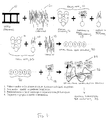
- FIG. 2 a highly schematic drawing is shown illustrating how the state machine 40 inside the facial hidden Markov model is reused in the vocal hidden Markov model.
- the mappings from states to facial configuration space are schematized by showing the average facial expression of each mapping 42.
- the internal state machine 40 is retained, thus preserving facial dynamics.
- new mappings are made to vocal configuration space 44.
- a flow chart is illustrated as to how the synthetic face trajectory is generated.
- a training video 60 is fed to a visual feature tracker 62 which generates facial motion data 64 that is utilized as an input to an entropic hidden Markov model training algorithm 66.
- the entropic hidden Markov model training unit produces a facial hidden Markov model which is composed of mappings to facial configuration space 70 and a state machine describing facial dynamics 72.
- the facial configurations and facial dynamics which most closely correspond to the animation required are married with the audio style of the individual by utilizing a similar training scenario in which audio 74 goes through acoustic analysis 76 that outputs vocal data 78 which is utilized in an output modeling module 80.
- the link between the video and the audio is provided by a facial state sequence 82 which is a series of facial images in a facial space.
- Combining the facial state sequence 82 with the vocal data 78 produces a set of vocal mappings 82, one for each facial state.
- the facial mappings, the facial dynamics, and the vocal mappings constitute the learned model from which a vocal/facial hidden Markov model 84 is produced.
- new audio 90 is put through acoustic analysis 92 which then provides new vocal data 94.
- the vocal/hidden Markov model in combination with the new vocal data, produces via dynamic programming 96 a new optimal facial state sequence 98.
- Geodesic analysis 100 combines the new facial state sequence 98 and the facial mappings 70 to provide a synthetic face trajectory 102 which is then utilized in the animation.
- the utilization of the entropically trained hidden Markov models permit lifelike animation to be achieved through a simple training session which does not require lengthy voice segmentation or dissection.
- the subject system can be trained in near-realtime on a midrange computer. Once trained, it can generate novel animators in realtime or faster.
- a computer vision system is used to simultaneously track several individual features on the face, such as the corners of the mouth.
- a computer vision system is used to simultaneously track several individual features on the face, such as the corners of the mouth.
- a mesh of such trackers covers the face.
- Spring tensions are assigned to each edge connecting a pair trackers, and the entire system is made to relax by simultaneously minimizing the spring energies and the residuals of the individual trackers. If a tracker falls off its landmark feature, spring forces from its neighbors tend to push it back into place.
- video is run through the system and the mean and variance of the distance between pairs of trackers is recorded and used to revise the spring properties. A few repetitions suffice to obtain stable and accurate tracking.
- the ultimate goal is to learn a mapping from the vocal features in a given time frame to simultaneous facial features.
- the mapping is many-to-many. Many sounds are compatible with one facial pose; many facial poses are compatible with one sound. Were it not for this ambiguity, one could use a simple regression method such as a perceptron, neutral network, or radial basis function network.
- the only remedy for this ambiguity is to use context from before and after the frame of interest.
- the fact that the disambiguating context has no fixed length or proximity to the current frame strongly recommends that one use a hidden Markov model, which, if properly trained, can make optimal use of context across a whole utterance, regardless of its length.
- a hidden Markov model uses its hidden states to carry contextual information forward and backward in time. Training will naturally assign some states to that task.
- the entropic training framework here is as follows and is outlined in U.S. Application Serial No. 08/994,533, filed December 19, 1997 and incorporated herein by reference.
- the system begins with a dataset X and a model whose parameters and structure are specified by the sparse matrix ⁇ .
- the sparsity structure of ⁇ is set in advance and one estimates non-zero parameters to maximize the likelihood P(X
- MAP Maximum A Posteriori
- Exact solutions have been found for a wide variety of such equations, yielding very fast learning algorithms.
- a related set of trimming equations tells one when one can zero a parameter without loss of posterior probability. This allows one to learn the proper size and sparsity structure of a model.
- Having an entropy term in the posterior also makes it easy to fold deterministic annealing, a powerful quasi-global optimization technique, into learning at no additional computational cost.
- entropic training of hidden Markov models recovers a finite-state machine that is very close to the mechanism that generated the data.
- this state sequence one estimates output probabilities, given each state, of the synchronized audio track. This associates audio features to each facial state.
- the internal state machine which represents facial dynamics in terms of transitions between qualitative, sub-viseme, states, is joined to the audio output probabilities. This results in a new vocal hidden Markov model which preserves the dynamics of the face, but allows them to be controlled by vocal features.
- the problem is simplified so significantly that a closed-form solution is available.
- the facial mappings by themselves contain enough information to completely specify the smooth trajectory that is most consistent with the facial dynamics. Because both pose and velocity are modeled, one has constraints on the position, heading, and length of each trajectory segment. This suffices to guarantee that the trajectory is geometrically and temporally well-behaved. It also leads to a very clean formulation.
- each state has Gaussian outputs that model positions and velocities.
- Gaussian outputs that model positions and velocities.
- the subject system trivially generalizes to Gaussian mixtures.
- From hidden Markov model training one has the mean position and velocity for each state, as well as a full-rank inverse covariance matrix relating positions and velocities in all dimensions.
- From Viterbi analysis of the new voice data one has a sequence of states governing each frame. One wants a facial trajectory that passes through or near the appropriate mean in each frame 1, 2, 3, ... This can be written as a product of Gaussians, one for each frame as determined by the governing state. Taking the log yields a quadratic sum, which one seeks to maximize.
- ⁇ i , i be the mean position and velocity for state i, and K i be a full-rank covariance matrix relating positions and velocities in all dimensions.
- y t [y t - ⁇ s(t) , (y t -y t-1 )- ⁇ s(t) ] is a row vector of instantaneous facial position and velocity.
- the system synthesizes would-be facial tracking data, e.g., what most probably would have been seen had the training subject produced the input vocalization.
- a trajectory of control points is used to drive a 3D animated head model or a 2D face image warped to give the appearance of motion.
- a 2D image of a face is texture-mapped onto a crude 3D head model count. Simple deformations of the head model give a naturalistic illusion of facial motion while the shading of the image gives the illusion of smooth surfaces.
- the deformations can be applied directly by mapping control points in the synthesized trajectory to vertices in the model, or indirectly by mapping synthetic facial configurations to Facial Action Units as discussed by P. Ekman and W. Friesen, Manual for the Facial Action Coding System, consulting Psychologists Press, Inc., Palo Alto, CA, 1978 that are defined on the model.
Landscapes
- Engineering & Computer Science (AREA)
- Theoretical Computer Science (AREA)
- Physics & Mathematics (AREA)
- General Physics & Mathematics (AREA)
- Software Systems (AREA)
- Multimedia (AREA)
- Computer Vision & Pattern Recognition (AREA)
- Artificial Intelligence (AREA)
- Data Mining & Analysis (AREA)
- Evolutionary Computation (AREA)
- General Health & Medical Sciences (AREA)
- Health & Medical Sciences (AREA)
- Medical Informatics (AREA)
- Computing Systems (AREA)
- Probability & Statistics with Applications (AREA)
- Databases & Information Systems (AREA)
- Life Sciences & Earth Sciences (AREA)
- Bioinformatics & Cheminformatics (AREA)
- Bioinformatics & Computational Biology (AREA)
- Evolutionary Biology (AREA)
- General Engineering & Computer Science (AREA)
- Oral & Maxillofacial Surgery (AREA)
- Human Computer Interaction (AREA)
- Processing Or Creating Images (AREA)
Applications Claiming Priority (2)
| Application Number | Priority Date | Filing Date | Title |
|---|---|---|---|
| US169339 | 1998-10-09 | ||
| US09/169,339 US6735566B1 (en) | 1998-10-09 | 1998-10-09 | Generating realistic facial animation from speech |
Publications (2)
| Publication Number | Publication Date |
|---|---|
| EP0992933A2 true EP0992933A2 (fr) | 2000-04-12 |
| EP0992933A3 EP0992933A3 (fr) | 2002-08-14 |
Family
ID=22615258
Family Applications (1)
| Application Number | Title | Priority Date | Filing Date |
|---|---|---|---|
| EP99107625A Withdrawn EP0992933A3 (fr) | 1998-10-09 | 1999-04-16 | Méthode pour générer directement des animations faciales réalistes directement à partir de la parole en utilisant des chaínes de Markov cachées |
Country Status (3)
| Country | Link |
|---|---|
| US (1) | US6735566B1 (fr) |
| EP (1) | EP0992933A3 (fr) |
| JP (1) | JP3633399B2 (fr) |
Cited By (16)
| Publication number | Priority date | Publication date | Assignee | Title |
|---|---|---|---|---|
| KR20020022504A (ko) * | 2000-09-20 | 2002-03-27 | 박종만 | 3차원 캐릭터의 동작, 얼굴 표정, 립싱크 및 립싱크된음성 합성을 지원하는 3차원 동영상 저작 도구의 제작시스템 및 방법 |
| EP1365359A1 (fr) * | 2002-05-24 | 2003-11-26 | BRITISH TELECOMMUNICATIONS public limited company | Procédé et système de traitement d'images |
| KR100693658B1 (ko) | 2004-10-05 | 2007-03-14 | 엘지전자 주식회사 | 휴대용 어학학습 장치 및 방법 |
| CN1320497C (zh) * | 2002-07-03 | 2007-06-06 | 中国科学院计算技术研究所 | 基于统计与规则结合的语音驱动人脸动画方法 |
| WO2011116937A1 (fr) * | 2010-03-23 | 2011-09-29 | Zoobe Gmbh | Procédé d'affectation de caractéristiques vocales à des modèles de déplacement |
| GB2510200A (en) * | 2013-01-29 | 2014-07-30 | Toshiba Res Europ Ltd | Animating a computer generated head based on information to be output by the head |
| GB2510201A (en) * | 2013-01-29 | 2014-07-30 | Toshiba Res Europ Ltd | Animating a computer generated head based on information to be output by the head |
| US9361722B2 (en) | 2013-08-08 | 2016-06-07 | Kabushiki Kaisha Toshiba | Synthetic audiovisual storyteller |
| CN109523616A (zh) * | 2018-12-04 | 2019-03-26 | 科大讯飞股份有限公司 | 一种面部动画生成方法、装置、设备及可读存储介质 |
| CN109635676A (zh) * | 2018-11-23 | 2019-04-16 | 清华大学 | 一种从视频中定位音源的方法 |
| CN112580669A (zh) * | 2020-12-28 | 2021-03-30 | 出门问问(苏州)信息科技有限公司 | 一种对语音信息的训练方法及装置 |
| CN112802164A (zh) * | 2021-04-06 | 2021-05-14 | 成都完美时空网络技术有限公司 | 一种动画状态机的实现方法、装置、存储介质和电子装置 |
| CN114663962A (zh) * | 2022-05-19 | 2022-06-24 | 浙江大学 | 一种基于图像补全的唇形同步人脸伪造生成方法及系统 |
| TWI788630B (zh) * | 2019-02-26 | 2023-01-01 | 大陸商騰訊科技(深圳)有限公司 | 三維人臉模型生成方法、裝置、電腦設備及儲存介質 |
| WO2023088080A1 (fr) * | 2021-11-22 | 2023-05-25 | 上海商汤智能科技有限公司 | Procédé et appareil de génération de vidéo parlante, dispositif électronique et support de stockage |
| CN119516063A (zh) * | 2025-01-21 | 2025-02-25 | 浙江大学 | 一种情感增强的数字人驱动与呈现系统及方法 |
Families Citing this family (92)
| Publication number | Priority date | Publication date | Assignee | Title |
|---|---|---|---|---|
| US6459808B1 (en) * | 1999-07-21 | 2002-10-01 | Mitsubishi Electric Research Laboratories, Inc. | Method for inferring target paths from related cue paths |
| US7080473B2 (en) * | 2000-05-24 | 2006-07-25 | Virtual Video Uk Ltd. | Novelty animated device with synchronized audio output, and method for achieving synchronized audio output therein |
| KR100366057B1 (ko) * | 2000-06-26 | 2002-12-27 | 한국과학기술원 | 인간 청각 모델을 이용한 효율적인 음성인식 장치 |
| US6763069B1 (en) * | 2000-07-06 | 2004-07-13 | Mitsubishi Electric Research Laboratories, Inc | Extraction of high-level features from low-level features of multimedia content |
| US7091975B1 (en) * | 2000-07-21 | 2006-08-15 | Microsoft Corporation | Shape and animation methods and systems using examples |
| US6957389B2 (en) * | 2001-04-09 | 2005-10-18 | Microsoft Corp. | Animation on-object user interface |
| US6868383B1 (en) | 2001-07-12 | 2005-03-15 | At&T Corp. | Systems and methods for extracting meaning from multimodal inputs using finite-state devices |
| US7069215B1 (en) * | 2001-07-12 | 2006-06-27 | At&T Corp. | Systems and methods for extracting meaning from multimodal inputs using finite-state devices |
| US7209882B1 (en) | 2002-05-10 | 2007-04-24 | At&T Corp. | System and method for triphone-based unit selection for visual speech synthesis |
| US7076430B1 (en) | 2002-05-16 | 2006-07-11 | At&T Corp. | System and method of providing conversational visual prosody for talking heads |
| US7133535B2 (en) * | 2002-12-21 | 2006-11-07 | Microsoft Corp. | System and method for real time lip synchronization |
| US7515156B2 (en) * | 2003-01-08 | 2009-04-07 | Hrl Laboratories, Llc | Method and apparatus for parallel speculative rendering of synthetic images |
| US7168953B1 (en) * | 2003-01-27 | 2007-01-30 | Massachusetts Institute Of Technology | Trainable videorealistic speech animation |
| US7343289B2 (en) * | 2003-06-25 | 2008-03-11 | Microsoft Corp. | System and method for audio/video speaker detection |
| KR20060090687A (ko) * | 2003-09-30 | 2006-08-14 | 코닌클리케 필립스 일렉트로닉스 엔.브이. | 시청각 콘텐츠 합성을 위한 시스템 및 방법 |
| US8965771B2 (en) * | 2003-12-08 | 2015-02-24 | Kurzweil Ainetworks, Inc. | Use of avatar with event processing |
| US20060009978A1 (en) * | 2004-07-02 | 2006-01-12 | The Regents Of The University Of Colorado | Methods and systems for synthesis of accurate visible speech via transformation of motion capture data |
| US20060053012A1 (en) * | 2004-09-03 | 2006-03-09 | Eayrs David J | Speech mapping system and method |
| US20080080744A1 (en) * | 2004-09-17 | 2008-04-03 | Mitsubishi Electric Corporation | Face Identification Apparatus and Face Identification Method |
| JP4631078B2 (ja) * | 2005-07-27 | 2011-02-16 | 株式会社国際電気通信基礎技術研究所 | リップシンクアニメーション作成用の統計確率モデル作成装置、パラメータ系列合成装置、リップシンクアニメーション作成システム、及びコンピュータプログラム |
| US8259923B2 (en) * | 2007-02-28 | 2012-09-04 | International Business Machines Corporation | Implementing a contact center using open standards and non-proprietary components |
| US11093898B2 (en) | 2005-12-08 | 2021-08-17 | International Business Machines Corporation | Solution for adding context to a text exchange modality during interactions with a composite services application |
| US20070132834A1 (en) * | 2005-12-08 | 2007-06-14 | International Business Machines Corporation | Speech disambiguation in a composite services enablement environment |
| US7792971B2 (en) * | 2005-12-08 | 2010-09-07 | International Business Machines Corporation | Visual channel refresh rate control for composite services delivery |
| US8005934B2 (en) * | 2005-12-08 | 2011-08-23 | International Business Machines Corporation | Channel presence in a composite services enablement environment |
| US7818432B2 (en) | 2005-12-08 | 2010-10-19 | International Business Machines Corporation | Seamless reflection of model updates in a visual page for a visual channel in a composite services delivery system |
| US7890635B2 (en) | 2005-12-08 | 2011-02-15 | International Business Machines Corporation | Selective view synchronization for composite services delivery |
| US10332071B2 (en) * | 2005-12-08 | 2019-06-25 | International Business Machines Corporation | Solution for adding context to a text exchange modality during interactions with a composite services application |
| US7809838B2 (en) | 2005-12-08 | 2010-10-05 | International Business Machines Corporation | Managing concurrent data updates in a composite services delivery system |
| US7827288B2 (en) | 2005-12-08 | 2010-11-02 | International Business Machines Corporation | Model autocompletion for composite services synchronization |
| US7877486B2 (en) | 2005-12-08 | 2011-01-25 | International Business Machines Corporation | Auto-establishment of a voice channel of access to a session for a composite service from a visual channel of access to the session for the composite service |
| US20070136449A1 (en) * | 2005-12-08 | 2007-06-14 | International Business Machines Corporation | Update notification for peer views in a composite services delivery environment |
| US8189563B2 (en) | 2005-12-08 | 2012-05-29 | International Business Machines Corporation | View coordination for callers in a composite services enablement environment |
| US20070133773A1 (en) * | 2005-12-08 | 2007-06-14 | International Business Machines Corporation | Composite services delivery |
| US7567251B2 (en) * | 2006-01-10 | 2009-07-28 | Sony Corporation | Techniques for creating facial animation using a face mesh |
| US20070174010A1 (en) * | 2006-01-24 | 2007-07-26 | Kiran Bhat | Collective Behavior Modeling for Content Synthesis |
| AU2007244921B2 (en) * | 2006-04-24 | 2012-05-17 | Sony Corporation | Performance driven facial animation |
| US20080018792A1 (en) * | 2006-07-19 | 2008-01-24 | Kiran Bhat | Systems and Methods for Interactive Surround Visual Field |
| US7630950B2 (en) * | 2006-08-18 | 2009-12-08 | International Business Machines Corporation | System and method for learning models from scarce and skewed training data |
| US20080124690A1 (en) * | 2006-11-28 | 2008-05-29 | Attune Interactive, Inc. | Training system using an interactive prompt character |
| US8594305B2 (en) * | 2006-12-22 | 2013-11-26 | International Business Machines Corporation | Enhancing contact centers with dialog contracts |
| US20080205625A1 (en) * | 2007-02-28 | 2008-08-28 | International Business Machines Corporation | Extending a standardized presence document to include contact center specific elements |
| US9055150B2 (en) * | 2007-02-28 | 2015-06-09 | International Business Machines Corporation | Skills based routing in a standards based contact center using a presence server and expertise specific watchers |
| US9247056B2 (en) * | 2007-02-28 | 2016-01-26 | International Business Machines Corporation | Identifying contact center agents based upon biometric characteristics of an agent's speech |
| US20080231686A1 (en) * | 2007-03-22 | 2008-09-25 | Attune Interactive, Inc. (A Delaware Corporation) | Generation of constructed model for client runtime player using motion points sent over a network |
| WO2008141125A1 (fr) * | 2007-05-10 | 2008-11-20 | The Trustees Of Columbia University In The City Of New York | Procedes et systemes de creation d'avatars a activation vocale |
| CN101896836A (zh) * | 2007-06-12 | 2010-11-24 | 华风天气有限责任公司 | 用动画式呈现体呈现个性化天气信息 |
| US9261979B2 (en) * | 2007-08-20 | 2016-02-16 | Qualcomm Incorporated | Gesture-based mobile interaction |
| CN107102723B (zh) * | 2007-08-20 | 2019-12-06 | 高通股份有限公司 | 用于基于手势的移动交互的方法、装置、设备和非暂时性计算机可读介质 |
| US20100057455A1 (en) * | 2008-08-26 | 2010-03-04 | Ig-Jae Kim | Method and System for 3D Lip-Synch Generation with Data-Faithful Machine Learning |
| US8224652B2 (en) * | 2008-09-26 | 2012-07-17 | Microsoft Corporation | Speech and text driven HMM-based body animation synthesis |
| KR101541907B1 (ko) * | 2008-10-14 | 2015-08-03 | 삼성전자 주식회사 | 음성 기반 얼굴 캐릭터 형성 장치 및 방법 |
| US8581911B2 (en) * | 2008-12-04 | 2013-11-12 | Intific, Inc. | Training system and methods for dynamically injecting expression information into an animated facial mesh |
| KR101558553B1 (ko) * | 2009-02-18 | 2015-10-08 | 삼성전자 주식회사 | 아바타 얼굴 표정 제어장치 |
| US8878773B1 (en) | 2010-05-24 | 2014-11-04 | Amazon Technologies, Inc. | Determining relative motion as input |
| US8751228B2 (en) * | 2010-11-04 | 2014-06-10 | Microsoft Corporation | Minimum converted trajectory error (MCTE) audio-to-video engine |
| WO2012088403A2 (fr) | 2010-12-22 | 2012-06-28 | Seyyer, Inc. | Transmission et partage de vidéo sur canal de communication sans fil à très faible débit binaire |
| US9728203B2 (en) | 2011-05-02 | 2017-08-08 | Microsoft Technology Licensing, Llc | Photo-realistic synthesis of image sequences with lip movements synchronized with speech |
| US9613450B2 (en) | 2011-05-03 | 2017-04-04 | Microsoft Technology Licensing, Llc | Photo-realistic synthesis of three dimensional animation with facial features synchronized with speech |
| WO2012154618A2 (fr) * | 2011-05-06 | 2012-11-15 | Seyyer, Inc. | Génération de vidéo sur la base d'un texte |
| EP2618311A1 (fr) * | 2012-01-17 | 2013-07-24 | NTT DoCoMo, Inc. | Procédé informatique et appareil pour effectuer une animation de tête |
| EP2618310B1 (fr) * | 2012-01-17 | 2014-12-03 | NTT DoCoMo, Inc. | Procédé informatique et appareil pour animer la bouche d'un visage |
| US8848068B2 (en) * | 2012-05-08 | 2014-09-30 | Oulun Yliopisto | Automated recognition algorithm for detecting facial expressions |
| US10708545B2 (en) | 2018-01-17 | 2020-07-07 | Duelight Llc | System, method, and computer program for transmitting face models based on face data points |
| US9094576B1 (en) * | 2013-03-12 | 2015-07-28 | Amazon Technologies, Inc. | Rendered audiovisual communication |
| CN103258340B (zh) * | 2013-04-17 | 2015-12-09 | 中国科学技术大学 | 富有情感表达能力的三维可视化中文普通话发音词典的发音方法 |
| US9607609B2 (en) | 2014-09-25 | 2017-03-28 | Intel Corporation | Method and apparatus to synthesize voice based on facial structures |
| US12401911B2 (en) | 2014-11-07 | 2025-08-26 | Duelight Llc | Systems and methods for generating a high-dynamic range (HDR) pixel stream |
| US12401912B2 (en) | 2014-11-17 | 2025-08-26 | Duelight Llc | System and method for generating a digital image |
| US12445736B2 (en) | 2015-05-01 | 2025-10-14 | Duelight Llc | Systems and methods for generating a digital image |
| US10540975B2 (en) | 2016-03-25 | 2020-01-21 | Intel Corporation | Technologies for automatic speech recognition using articulatory parameters |
| US10839825B2 (en) * | 2017-03-03 | 2020-11-17 | The Governing Council Of The University Of Toronto | System and method for animated lip synchronization |
| US10332515B2 (en) * | 2017-03-14 | 2019-06-25 | Google Llc | Query endpointing based on lip detection |
| US10770092B1 (en) * | 2017-09-22 | 2020-09-08 | Amazon Technologies, Inc. | Viseme data generation |
| US10586368B2 (en) | 2017-10-26 | 2020-03-10 | Snap Inc. | Joint audio-video facial animation system |
| KR102661019B1 (ko) | 2018-02-23 | 2024-04-26 | 삼성전자주식회사 | 얼굴에 대응하는 3차원 아바타를 이용하여 얼굴의 움직임이 반영된 3차원 아바타를 포함하는 이미지를 생성하는 전자 장치 및 그 동작 방법 |
| EP3815050B1 (fr) * | 2018-05-24 | 2024-01-24 | Warner Bros. Entertainment Inc. | Appariement de la forme et du mouvement d'une bouche dans une vidéo numérique avec un audio alternatif |
| US10679626B2 (en) * | 2018-07-24 | 2020-06-09 | Pegah AARABI | Generating interactive audio-visual representations of individuals |
| US11568864B2 (en) * | 2018-08-13 | 2023-01-31 | Carnegie Mellon University | Processing speech signals of a user to generate a visual representation of the user |
| US11568645B2 (en) | 2019-03-21 | 2023-01-31 | Samsung Electronics Co., Ltd. | Electronic device and controlling method thereof |
| RU2720361C1 (ru) * | 2019-08-16 | 2020-04-29 | Самсунг Электроникс Ко., Лтд. | Обучение по нескольким кадрам реалистичных нейронных моделей голов говорящих персон |
| US11113859B1 (en) * | 2019-07-10 | 2021-09-07 | Facebook Technologies, Llc | System and method for rendering three dimensional face model based on audio stream and image data |
| CN111243626B (zh) * | 2019-12-30 | 2022-12-09 | 清华大学 | 一种说话视频生成方法及系统 |
| CN111179385B (zh) * | 2019-12-31 | 2021-04-02 | 网易(杭州)网络有限公司 | 一种舞蹈动画的处理方法及装置、电子设备、存储介质 |
| EP3913581A1 (fr) * | 2020-05-21 | 2021-11-24 | Tata Consultancy Services Limited | Génération de visages parlants réalistes préservant l'identité utilisant la parole audio d'un utilisateur |
| CN113744371B (zh) * | 2020-05-29 | 2024-04-16 | 武汉Tcl集团工业研究院有限公司 | 一种生成人脸动画的方法、装置、终端及存储介质 |
| CN111915707B (zh) * | 2020-07-01 | 2024-01-09 | 天津洪恩完美未来教育科技有限公司 | 一种基于音频信息的口型动画展示方法、装置及存储介质 |
| EP3945498B1 (fr) * | 2020-07-30 | 2024-11-27 | Tata Consultancy Services Limited | Génération de visages parlants animés à commande audio-vocale à l'aide d'un réseau contradictoire génératif en cascade |
| EP3996047A1 (fr) * | 2020-11-04 | 2022-05-11 | Tata Consultancy Services Limited | Procédé et système permettant de générer des animations du visage à partir d'une entrée de signal vocal |
| CN118413722B (zh) * | 2024-07-02 | 2024-10-18 | 杭州浮云网络科技有限公司 | 音频驱动视频生成方法、装置、计算机设备以及存储介质 |
| CN118820787B (zh) * | 2024-09-14 | 2024-11-26 | 南京八点八数字科技有限公司 | 一种虚拟人口型生成训练方法、系统、介质及程序产品 |
| CN118969009B (zh) * | 2024-10-16 | 2025-02-18 | 合肥云诊信息科技有限公司 | 一种基于语音驱动人工智能的交互数字人合成方法 |
Family Cites Families (4)
| Publication number | Priority date | Publication date | Assignee | Title |
|---|---|---|---|---|
| US5657426A (en) | 1994-06-10 | 1997-08-12 | Digital Equipment Corporation | Method and apparatus for producing audio-visual synthetic speech |
| US6232965B1 (en) * | 1994-11-30 | 2001-05-15 | California Institute Of Technology | Method and apparatus for synthesizing realistic animations of a human speaking using a computer |
| US6067095A (en) * | 1997-02-04 | 2000-05-23 | Microsoft Corporation | Method for generating mouth features of an animated or physical character |
| US5933151A (en) * | 1997-03-26 | 1999-08-03 | Lucent Technologies Inc. | Simulated natural movement of a computer-generated synthesized talking head |
-
1998
- 1998-10-09 US US09/169,339 patent/US6735566B1/en not_active Expired - Fee Related
-
1999
- 1999-04-16 EP EP99107625A patent/EP0992933A3/fr not_active Withdrawn
- 1999-10-07 JP JP28689799A patent/JP3633399B2/ja not_active Expired - Fee Related
Non-Patent Citations (5)
| Title |
|---|
| C. PELACHAUD & A.: "Synthesizing Cooperative Conversation" PROC. OF THE INTERNATIONAL CONFERENCE ON COOPERATIVE MULTIMODAL COMMUNICATION, [Online] 1995, pages 237-256, XP002194148 Eindhoven, The Netherlands Retrieved from the Internet: <URL:http://citeseer.nj.nec.com/rd/3433676 3%2C378818%2C1%2C0.25%2CDownload/http%253A %252F%252Fciteseer.nj.nec.com/cache/papers /cs/17422/ftp%253AzSzzSzftp.cis.upenn.eduz SzpubzSzpelachaudzSzCMC95zSzbook.pdf/pelac haud96synthesizing.pdf> [retrieved on 2002-03-25] * |
| MATTHEW BRAND: "An entropic estimator for structure discovery" MITSUBISHI ELECTRIC RESEARCH LABORATORY TECHNICAL REPORTS, [Online] 1 August 1998 (1998-08-01), XP002194149 Cambridge, MA, USA Retrieved from the Internet: <URL:http://www.merl.com/papers/docs/TR98- 19.pdf> [retrieved on 2002-03-25] * |
| MATTHEW BRAND: "Pattern Discovery via Entropy Minimization" MITSUBISHI ELECTRIC RESEARCH LABORATORY TECHNICAL REPORTS, [Online] 1 October 1998 (1998-10-01), XP002194147 Cambridge, MA, USA Retrieved from the Internet: <URL:http://www.merl.com/papers/docs/TR98- 21.pdf> [retrieved on 2002-03-25] * |
| MATTHEW E. BRAND: "Voice-Driven Animation" WORKSHOPS ON PERCEPTUAL USER INTERFACES, [Online] 4 - 6 November 1998, pages 1-6, XP002194150 San Francisco Retrieved from the Internet: <URL:http://www.cs.ucsb.edu/conferences/PU I/PUIWorkshop98/Papers/Brand.pdf> [retrieved on 2002-03-22] * |
| MORISHIMA S ET AL: "A MEDIA CONVERSION FROM SPEECH TO FACIAL IMAGE FOR INTELLIGENT MAN-MACHINE INTERFACE" IEEE JOURNAL ON SELECTED AREAS IN COMMUNICATIONS, IEEE INC. NEW YORK, US, vol. 9, no. 4, May 1991 (1991-05), pages 594-600, XP000874621 ISSN: 0733-8716 * |
Cited By (24)
| Publication number | Priority date | Publication date | Assignee | Title |
|---|---|---|---|---|
| KR20020022504A (ko) * | 2000-09-20 | 2002-03-27 | 박종만 | 3차원 캐릭터의 동작, 얼굴 표정, 립싱크 및 립싱크된음성 합성을 지원하는 3차원 동영상 저작 도구의 제작시스템 및 방법 |
| EP1365359A1 (fr) * | 2002-05-24 | 2003-11-26 | BRITISH TELECOMMUNICATIONS public limited company | Procédé et système de traitement d'images |
| WO2003100728A3 (fr) * | 2002-05-24 | 2004-07-29 | British Telecomm | Procede et systeme de traitement d'image |
| KR100826443B1 (ko) | 2002-05-24 | 2008-04-29 | 브리티쉬 텔리커뮤니케이션즈 파블릭 리미티드 캄퍼니 | 이미지 처리 방법 및 시스템 |
| CN1320497C (zh) * | 2002-07-03 | 2007-06-06 | 中国科学院计算技术研究所 | 基于统计与规则结合的语音驱动人脸动画方法 |
| KR100693658B1 (ko) | 2004-10-05 | 2007-03-14 | 엘지전자 주식회사 | 휴대용 어학학습 장치 및 방법 |
| WO2011116937A1 (fr) * | 2010-03-23 | 2011-09-29 | Zoobe Gmbh | Procédé d'affectation de caractéristiques vocales à des modèles de déplacement |
| DE102010012427B4 (de) * | 2010-03-23 | 2014-04-24 | Zoobe Gmbh | Verfahren zur Zuordnung von Sprachmerkmalen zu Bewegungsmustern |
| GB2510200B (en) * | 2013-01-29 | 2017-05-10 | Toshiba Res Europe Ltd | A computer generated head |
| GB2510201A (en) * | 2013-01-29 | 2014-07-30 | Toshiba Res Europ Ltd | Animating a computer generated head based on information to be output by the head |
| GB2510201B (en) * | 2013-01-29 | 2017-05-03 | Toshiba Res Europe Ltd | A computer generated head |
| GB2510200A (en) * | 2013-01-29 | 2014-07-30 | Toshiba Res Europ Ltd | Animating a computer generated head based on information to be output by the head |
| US9959657B2 (en) | 2013-01-29 | 2018-05-01 | Kabushiki Kaisha Toshiba | Computer generated head |
| US9361722B2 (en) | 2013-08-08 | 2016-06-07 | Kabushiki Kaisha Toshiba | Synthetic audiovisual storyteller |
| CN109635676A (zh) * | 2018-11-23 | 2019-04-16 | 清华大学 | 一种从视频中定位音源的方法 |
| CN109523616A (zh) * | 2018-12-04 | 2019-03-26 | 科大讯飞股份有限公司 | 一种面部动画生成方法、装置、设备及可读存储介质 |
| TWI788630B (zh) * | 2019-02-26 | 2023-01-01 | 大陸商騰訊科技(深圳)有限公司 | 三維人臉模型生成方法、裝置、電腦設備及儲存介質 |
| CN112580669A (zh) * | 2020-12-28 | 2021-03-30 | 出门问问(苏州)信息科技有限公司 | 一种对语音信息的训练方法及装置 |
| CN112580669B (zh) * | 2020-12-28 | 2023-08-01 | 出门问问(武汉)信息科技有限公司 | 一种对语音信息的训练方法及装置 |
| CN112802164A (zh) * | 2021-04-06 | 2021-05-14 | 成都完美时空网络技术有限公司 | 一种动画状态机的实现方法、装置、存储介质和电子装置 |
| WO2023088080A1 (fr) * | 2021-11-22 | 2023-05-25 | 上海商汤智能科技有限公司 | Procédé et appareil de génération de vidéo parlante, dispositif électronique et support de stockage |
| CN114663962A (zh) * | 2022-05-19 | 2022-06-24 | 浙江大学 | 一种基于图像补全的唇形同步人脸伪造生成方法及系统 |
| CN119516063A (zh) * | 2025-01-21 | 2025-02-25 | 浙江大学 | 一种情感增强的数字人驱动与呈现系统及方法 |
| CN119516063B (zh) * | 2025-01-21 | 2025-04-11 | 浙江大学 | 一种情感增强的数字人驱动与呈现系统及方法 |
Also Published As
| Publication number | Publication date |
|---|---|
| US6735566B1 (en) | 2004-05-11 |
| JP2000123192A (ja) | 2000-04-28 |
| EP0992933A3 (fr) | 2002-08-14 |
| JP3633399B2 (ja) | 2005-03-30 |
Similar Documents
| Publication | Publication Date | Title |
|---|---|---|
| US6735566B1 (en) | Generating realistic facial animation from speech | |
| Brand | Voice puppetry | |
| US7636662B2 (en) | System and method for audio-visual content synthesis | |
| Cudeiro et al. | Capture, learning, and synthesis of 3D speaking styles | |
| US11587548B2 (en) | Text-driven video synthesis with phonetic dictionary | |
| Chuang et al. | Mood swings: expressive speech animation | |
| Cao et al. | Expressive speech-driven facial animation | |
| US7168953B1 (en) | Trainable videorealistic speech animation | |
| Ezzat et al. | Trainable videorealistic speech animation | |
| US8224652B2 (en) | Speech and text driven HMM-based body animation synthesis | |
| Fan et al. | A deep bidirectional LSTM approach for video-realistic talking head | |
| Pham et al. | End-to-end learning for 3d facial animation from raw waveforms of speech | |
| Chu et al. | Bimodal speech recognition using coupled hidden Markov models. | |
| Chatziagapi et al. | Av-flow: Transforming text to audio-visual human-like interactions | |
| Wen et al. | 3D Face Processing: Modeling, Analysis and Synthesis | |
| Jiang et al. | Speech driven photo realistic facial animation based on an articulatory DBN model and AAM features | |
| Deena et al. | Visual speech synthesis by modelling coarticulation dynamics using a non-parametric switching state-space model | |
| Asadiabadi et al. | Multimodal speech driven facial shape animation using deep neural networks | |
| Ding et al. | Lip animation synthesis: a unified framework for speaking and laughing virtual agent. | |
| Deena et al. | Speech-driven facial animation using a shared Gaussian process latent variable model | |
| Fang et al. | Audio-to-Deep-Lip: Speaking lip synthesis based on 3D landmarks | |
| Chuang | Analysis, synthesis, and retargeting of facial expressions | |
| Edge et al. | Model-based synthesis of visual speech movements from 3D video | |
| Bregler et al. | Probabilistic models of verbal and body gestures | |
| Chollet et al. | Multimodal human machine interactions in virtual and augmented reality |
Legal Events
| Date | Code | Title | Description |
|---|---|---|---|
| PUAI | Public reference made under article 153(3) epc to a published international application that has entered the european phase |
Free format text: ORIGINAL CODE: 0009012 |
|
| AK | Designated contracting states |
Kind code of ref document: A2 Designated state(s): AT BE CH CY DE DK ES FI FR GB GR IE IT LI LU MC NL PT SE |
|
| AX | Request for extension of the european patent |
Free format text: AL;LT;LV;MK;RO;SI |
|
| RIC1 | Information provided on ipc code assigned before grant |
Free format text: 7G 06K 9/00 A, 7G 06K 9/68 B, 7G 06T 15/70 B |
|
| PUAL | Search report despatched |
Free format text: ORIGINAL CODE: 0009013 |
|
| AK | Designated contracting states |
Kind code of ref document: A3 Designated state(s): AT BE CH CY DE DK ES FI FR GB GR IE IT LI LU MC NL PT SE |
|
| AX | Request for extension of the european patent |
Free format text: AL;LT;LV;MK;RO;SI |
|
| 17P | Request for examination filed |
Effective date: 20021210 |
|
| AKX | Designation fees paid |
Designated state(s): AT BE CH CY DE DK ES FI FR GB GR IE IT LI LU MC NL PT SE |
|
| STAA | Information on the status of an ep patent application or granted ep patent |
Free format text: STATUS: THE APPLICATION HAS BEEN WITHDRAWN |
|
| 18W | Application withdrawn |
Effective date: 20040423 |