EP0993493B1 - Pigmentzubereitungen für das ink-jet-verfahren - Google Patents
Pigmentzubereitungen für das ink-jet-verfahren Download PDFInfo
- Publication number
- EP0993493B1 EP0993493B1 EP98937503A EP98937503A EP0993493B1 EP 0993493 B1 EP0993493 B1 EP 0993493B1 EP 98937503 A EP98937503 A EP 98937503A EP 98937503 A EP98937503 A EP 98937503A EP 0993493 B1 EP0993493 B1 EP 0993493B1
- Authority
- EP
- European Patent Office
- Prior art keywords
- pigment
- weight
- binder
- acid
- pigment preparations
- Prior art date
- Legal status (The legal status is an assumption and is not a legal conclusion. Google has not performed a legal analysis and makes no representation as to the accuracy of the status listed.)
- Expired - Lifetime
Links
- UNCJHHUXDWRLJN-UHFFFAOYSA-N CCC(CC)(C(C)C)c(cc1)cc(C)c1O Chemical compound CCC(CC)(C(C)C)c(cc1)cc(C)c1O UNCJHHUXDWRLJN-UHFFFAOYSA-N 0.000 description 1
Classifications
-
- C—CHEMISTRY; METALLURGY
- C09—DYES; PAINTS; POLISHES; NATURAL RESINS; ADHESIVES; COMPOSITIONS NOT OTHERWISE PROVIDED FOR; APPLICATIONS OF MATERIALS NOT OTHERWISE PROVIDED FOR
- C09D—COATING COMPOSITIONS, e.g. PAINTS, VARNISHES OR LACQUERS; FILLING PASTES; CHEMICAL PAINT OR INK REMOVERS; INKS; CORRECTING FLUIDS; WOODSTAINS; PASTES OR SOLIDS FOR COLOURING OR PRINTING; USE OF MATERIALS THEREFOR
- C09D11/00—Inks
- C09D11/30—Inkjet printing inks
- C09D11/32—Inkjet printing inks characterised by colouring agents
- C09D11/324—Inkjet printing inks characterised by colouring agents containing carbon black
- C09D11/326—Inkjet printing inks characterised by colouring agents containing carbon black characterised by the pigment dispersant
-
- B—PERFORMING OPERATIONS; TRANSPORTING
- B33—ADDITIVE MANUFACTURING TECHNOLOGY
- B33Y—ADDITIVE MANUFACTURING, i.e. MANUFACTURING OF THREE-DIMENSIONAL [3D] OBJECTS BY ADDITIVE DEPOSITION, ADDITIVE AGGLOMERATION OR ADDITIVE LAYERING, e.g. BY 3D PRINTING, STEREOLITHOGRAPHY OR SELECTIVE LASER SINTERING
- B33Y70/00—Materials specially adapted for additive manufacturing
-
- C—CHEMISTRY; METALLURGY
- C09—DYES; PAINTS; POLISHES; NATURAL RESINS; ADHESIVES; COMPOSITIONS NOT OTHERWISE PROVIDED FOR; APPLICATIONS OF MATERIALS NOT OTHERWISE PROVIDED FOR
- C09B—ORGANIC DYES OR CLOSELY-RELATED COMPOUNDS FOR PRODUCING DYES, e.g. PIGMENTS; MORDANTS; LAKES
- C09B67/00—Influencing the physical, e.g. the dyeing or printing properties of dyestuffs without chemical reactions, e.g. by treating with solvents grinding or grinding assistants, coating of pigments or dyes; Process features in the making of dyestuff preparations; Dyestuff preparations of a special physical nature, e.g. tablets, films
- C09B67/0071—Process features in the making of dyestuff preparations; Dehydrating agents; Dispersing agents; Dustfree compositions
- C09B67/0084—Dispersions of dyes
Definitions
- the invention further relates to a method for printing on flat or three-dimensionally designed substrates using the ink jet process, in which these pigment preparations are used become.
- inkjet printing process To the inks used in the inkjet process (inkjet printing process) are used to meet a number of requirements put: You need suitable viscosity and surface tension for printing they must be stable in storage, i.e. they should not coagulate and the dispersed, undissolved, Colorants should not settle, they must not go to one Blockage of the printer nozzle result, which is also particularly so in the case of pigment-containing, ie containing, dispersed colorant particles, Inks can be problematic, and ultimately should they are environmentally friendly, i.e. largely on water as based on liquid phase and at most organic solvents contained in small quantities.
- the received must Prints meet the color requirements, i.e. brilliance and color depth, and good fastness properties, e.g. rub fastness, Lightfastness and waterfastness or washfastness when printed on textile substrate.
- binder component e.g. UV curable Binder (EP-A-658 607, JP-A-48922/1996) or thermal curable binders (EP-A-753 552, EP-A-412 548).
- the object of the present invention was to provide new pigment preparations to provide which advantageous application in the ink jet process can find.
- the pigment preparations according to the invention contain a finely divided, organic or inorganic pigment.
- organic Pigment also means vat dyes.
- the pigment preparations of the invention also mixtures of different organic or different inorganic Pigments or of organic and inorganic pigments contain.
- Suitable pigments (A) are:
- Monoazo pigments in particular lacquered BONS pigments, naphthol AS pigments
- disazo pigments in particular diaryl yellow pigments, bisacetoacetic acid acetanilide pigments, Disazopyrazolone pigments
- quinophthalone pigments phthalocyanine pigments
- Triarylcarbonium pigments alkali blue pigments, Dye salts with complex anions
- the pigment contained should be as fine as possible. Prefers have 95%, particularly preferably 99%, of the pigment particles a particle size ⁇ 1 ⁇ m.
- the pigment particles can have different shapes and accordingly affect the flow behavior of the pigment preparations.
- Non-isometric pigment particles usually result to higher flow viscosities and often show no Newtonian Flow behavior, while isometric pigment particles in general with the same pigment concentration, lower viscous preparations result and mostly show Newtonian flow behavior.
- the pigment preparations according to the invention generally contain 0.1 to 20% by weight, preferably 0.2 to 10% by weight, pigment (A).
- the pigment preparations according to the invention contain as component (B) a water-soluble dispersant based one or more arylsulfonic acid-formaldehyde condensation products (B1) or one or more water-soluble oxyalkylated Phenols (B2).
- As a dispersant (B1) are condensation products with a Sulphonic acid group content of at most 40 wt .-% preferred.
- the condensation products (B1) are more aromatic due to sulfonation Compounds such as naphthalene itself or containing naphthalene Mixtures and subsequent condensation of the formed Arylsulfonic acids available with formaldehyde.
- the dispersant (B1) is preferably prepared. in the presence of aromatic or long chain aliphatic Carboxylic acids, their salts, their anhydrides or mixtures of these connections.
- arylsulfonic acids As a starting product for the production of arylsulfonic acids comes in particular a mixture of such aromatic compounds considered by thermal fission of a naphthenic Residual oil and fractionation of the cleavage products available are.
- the naphthenic residue oils fall, for example Cracking from light petrol and are also called high-boiling aromatic Designated hydrocarbon oils.
- the naphthenic residue oil is preferably at a temperature of 1400 to Thermally split at 1700 ° C.
- the fission products then become one fractional distillation fed.
- the at normal pressure (1013 mbar) from 100 to 120 ° C passing fraction is collected and fed to the sulfonation as an aromatic compound.
- a such fraction is used in the known acetylene oil quench process usually obtained as a by-product (Ullmann's Encyclopedia of Industrial Chemistry, VCH Verlagsgesellschaft mbH, Weinheim, 1985, Volume A1, pages 107 to 112).
- This aromatic fraction consists of a mixture of many aromatic substances, the structure and amount of which can practically not be determined in detail.
- the following aryl compounds are the main representatives of this aromatic fraction: % By weight in the aromatic fraction naphthalene 30-55 2-methylnaphthalene 5 - 15 1-methylnaphthalene 4 - 10 In the 3 - 10 diphenyl 1 - 5 methyl indene 1 - 5 acenaphthene 1 - 4
- the aromatic fraction also contains identified components the following aryl compounds in amounts of 0.1 to about 2% by weight: Fluorene, indane, methylstyrene, phenanthrene, methylindane, Dimethylnaphthalene, ethylnaphthalene, xylenes, tetralin, styrene, Methylethylbenzene, anthracene, fluoranthrene, pyrene, acetonaphthylene and toluene.
- aryl compounds in amounts of 0.1 to about 2% by weight: Fluorene, indane, methylstyrene, phenanthrene, methylindane, Dimethylnaphthalene, ethylnaphthalene, xylenes, tetralin, styrene, Methylethylbenzene, anthracene, fluoranthrene, pyrene, aceton
- Particularly suitable arylsulfonic acids generally contain ⁇ and ⁇ -naphthalenesulfonic acids, the ratio of ⁇ to ⁇ -isomers usually 20: 1 to 1: 8, in particular 10: 1 to 1: 5 is.
- Aromatic carboxylic acids are suitable as the added carboxylic acid or their derivatives, such as naphthalene carboxylic acid, naphthalic acid, Terephthalic acid, isophthalic acid, benzoic acid, trimellitic acid, Phenylacetic acid, phenoxyacetic acid, salicylic acid, p-hydroxybenzoic acid, Diphenylacetic acid, m-hydroxybenzoic acid, benzene tetracarboxylic acid or acid anhydrides such as phthalic anhydride, Trimellitic anhydride, benzene-1,2,4,5-tetracarboxylic acid dianhydride or naphthalic anhydride.
- Suitable long-chain aliphatic carboxylic acids are in particular saturated or olefinically unsaturated, linear or branched aliphatic monocarboxylic acids with 8 to 22, preferably 8 to 18 Carbon atoms of natural or synthetic origin, for example higher fatty acids such as caprylic acid, capric acid, Lauric acid, myristic acid, palmitic acid, stearic acid, oleic acid, Linoleic acid or linolenic acid or synthetically produced Carboxylic acids such as 2-ethylhexanoic acid, isononanoic acid or isotridecanoic acid.
- the salts of the carboxylic acids mentioned are the alkali, Ammonium or alkaline earth metal salts, for example by neutralizing these carboxylic acids with sodium hydroxide solution, Potash lye, lithium hydroxide, soda, magnesium carbonate, calcium oxide, Calcium hydroxide, ammonia or alkanolamines such as ethanolamine, Diethanolamine or triethanolamine are available.
- Particularly preferred dispersants (B1 contain for the pigment preparations according to the invention 50 to 97% by weight, in particular 70 to 95% by weight, arylsulfonic acid-formaldehyde condensation products and 3 to 50 wt .-%, in particular 5 to 30 wt .-%, aromatic or long-chain aliphatic carboxylic acids, their salts or their anhydrides or mixtures thereof.
- the dispersants (B1 are known and e.g. in the US-A-5,186,846.
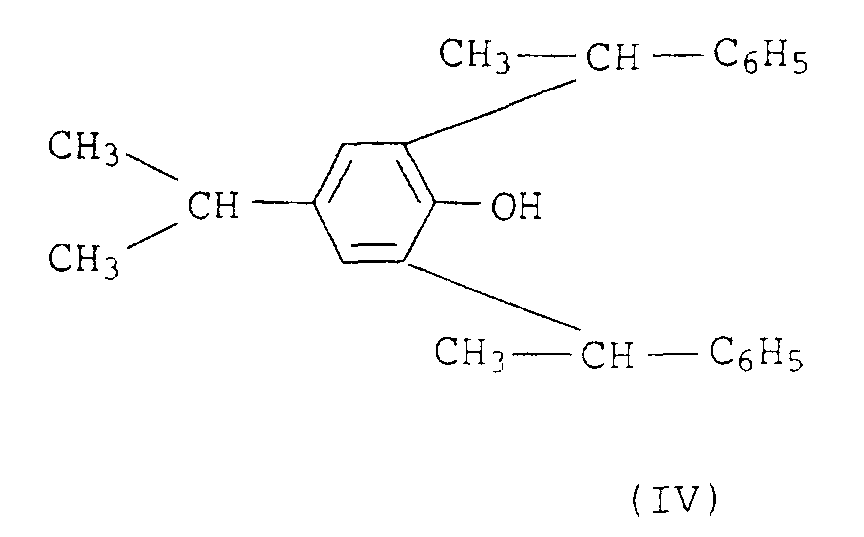
- the products of the formula I and II can by reacting the phenol derivatives of the formula III or IV with propylene oxide and subsequent reaction of the adduct with ethylene oxide or by reacting III and / or IV with ethylene oxide. If appropriate, the adducts are reacted completely or partially with chlorosulfonic acid or sulfur trioxide to give half-esters of sulfuric acid and the half-esters obtained are neutralized with alkaline agents.
- the phenols of the formula III and IV can be obtained by reacting phenol or 2,2- (p, p'-bishydroxydiphenyl) propane with 3 or 4 mol of styrene in the presence of acid as a catalyst.
- the oxyalkylation can be carried out, for example, by the process described in US Pat. No. 2,979,528. In the case of b> 37 the quotient must be used b a Be> 1.
- the sulfuric acid semi-esters are obtained by reaction of the oxyalkylation products made with chlorosulfonic acid or sulfur trioxide, the amount can be chosen so that all free Hydroxy groups or only a part is sulfated. In the latter Traps form mixtures of compounds of formula I and II, which contain free and sulfated hydroxy groups.
- to Use as dispersants in the implementation obtained half ester of sulfuric acid in water-soluble salts transferred.
- the alkali metal salts e.g. the sodium or potassium salts.
- Two equivalents for chlorosulfonic acid, for sulfur trioxide an equivalent of basic compounds is required.
- the salts obtained can be in the form of aqueous Solutions or as such isolated and in solid form be used.
- Dispersants (B2) in which a is 0 to on average are preferred 2.5, b is 37 to 250 on average and d is 0 to 0.5 on average. Especially dispersants (B2) in which a is 0 to im are preferred Average 2.5, b average 50 to 100 and d average 0.5.
- the dispersants (B2) are known and e.g. in the US-A-4 218 218.
- the pigment preparations according to the invention generally contain 0.1 to 20% by weight, preferably 0.5 to 10% by weight, of dispersant (B).
- Water is the main component (C) of the invention Pigment preparations. Its content is usually 35 to 90% by weight, preferably 45 to 80% by weight.
- the pigment preparations according to the invention preferably contain as an additional component (D) a water-retaining agent Effect, which they are particularly suitable for the ink jet process makes.
- Suitable as component (D) are polyhydric alcohols with a higher boiling point than water, preferably unbranched and branched C 3 -C 8 -alkanols such as glycerol, erythritol, pentaerythritol, pentites such as arabitol, adonite and xylitol, hexites such as sorbitol, mannitol and dulcitol, the C 3 -C 6 alkanols, especially sorbitol, being particularly preferred.
- C 3 -C 8 -alkanols such as glycerol, erythritol, pentaerythritol, pentites such as arabitol, adonite and xylitol, hexites such as sorbitol, mannitol and dulcitol, the C 3 -C 6 alkanols, especially sorbitol, being particularly preferred.
- component (D) are polyalkylene glycols with a higher boiling point than water, including the lower (di, tri and tetra) alkylene glycols should be understood.
- Polyalkylene glycols are preferred average molecular weights from 100 to 1500, with polyethylene glycols with an average molecular weight of ⁇ 800 especially are preferred.
- pigment preparations according to the invention often a combination of polyhydric alcohol and polyalkylene glycol particularly suitable (usually 0.1 to 35% by weight, in particular 5 to 25 wt .-%, based on the weight of the preparation).
- water-soluble solvents such as N-methylpyrrolidone, 2-pyrrolidone and ethoxylation products of glycerol and pentaerythritol, which are described in Amounts of 0 to 15 wt .-% can be added.
- the pigment preparations of the invention other aids, such as those used for (aqueous) Ink jet inks and are common in the printing and coatings industry, contain.
- Preservatives such as glutardialdehyde and / or tetramethylolacetylene urea
- antioxidants such as glutardialdehyde and / or tetramethylolacetylene urea
- Degasser / defoamer such as glutardialdehyde and / or tetramethylolacetylene urea
- viscosity regulating agent Flow control agents
- wetting agents such as glutardialdehyde and / or tetramethylolacetylene urea
- Degasser / defoamer such as sodium sulfoamer
- viscosity regulating agent such as sodium bicarbonate
- Flow control agents such as sodium stearate, sodium bicarbonate, sodium bicarbonate, sodium bicarbonate, sodium
- the pigment preparations according to the invention usually have a viscosity of 1 to 20 mm 2 / sec, preferably 2 to 15 mm 2 / sec.
- the surface tension of the pigment preparations according to the invention is usually 20 to 70 mN / m.
- the pH of the pigment preparations according to the invention is in the generally 5 to 11, preferably 6 to 10.
- the pigment is mixed, for example in the form of a press cake, together with the dispersant and optionally polyalkylene glycol in the presence of water and dispersed in a suitable Apparatus before.
- the resulting mixture is then ground in a grinder to set the desired pigment particle size.
- you make the final setting by still corresponding Amounts of water, optionally polyalkylene glycol and / or polyhydric alcohol and, if necessary, other auxiliaries adds and after mixing using a sieve, preferably with a pore size of 1 ⁇ m, filtered.
- the pigment preparations of the invention can advantageously in the method according to the invention for printing flat or three-dimensionally designed substrates in ink-jet processes are used, which is characterized by that one prints the pigment preparations on the substrate and then fixed the pressure obtained.
- the ink jet process the usually aqueous inks sprayed directly onto the substrate in small droplets.
- Such procedures are in text. Chem. Color, Volume 19 (8), pages 23 to 29, 1987 and Volume 21 (6), pages 27-32, 1989.
- the pigment preparations according to the invention are particularly suitable as inks for the bubble jet process and for the process using a piezoelectric crystal.
- a binder can then be formed, if desired a preferably aqueous dispersion or emulsion, and its hardening (chemical cross-linking of the binder itself) or a physical drying of the binder dispersion or -emulsion, or a film (e.g. polyethylene terephthalate) laminate on and so in particular the pressure Protect water and light.
- a preferably aqueous dispersion or emulsion and its hardening (chemical cross-linking of the binder itself) or a physical drying of the binder dispersion or -emulsion, or a film (e.g. polyethylene terephthalate) laminate on and so in particular the pressure Protect water and light.
- air drying air oxidation drying
- binders i.e. chemical crosslinking binders
- physically drying binder dispersions or emulsions in which the liquid Phase water or organic solvent
- the radiation-curable binders are according to the invention binders caused by high energy radiation, i.e. electromagnetic radiation, in particular from 220 to 450 nm (UV radiation), or electron beams, are to be hardened. Suitable are both free-radically and cationically polymerizable binder components as well as their mixtures.
- binder systems are well known and e.g. in Chemistry & Technology of UV & EB Formulation for Coatings, Inks & Paints, SITA Technology, London (1991), in The Printing Ink Manual, Fourth Edition, Van Nostrand Reinhold (International), London (1989), UV & EB Curing Formulation for Printing Inks and Paints, SITA Technology, London (1984) and in the company publication Vinyl Ethers, The innovative Challenge, BASF Aktiengesellschaft (1997).
- radiation-curable binders are acrylate-containing vinyl-containing and / or epoxy-containing Monomers, prepolymers and polymers and their mixtures called.
- the binders containing acrylate groups are in particular to prepolymers based on acrylate or methacrylate, where the acrylate compounds are particularly suitable.
- Preferred (meth) acrylate compounds usually contain 2 to 20, in particular 2 to 10 and especially 2 to 6 copolymerizable, ethylenically unsaturated double bonds.
- the average molecular weight (number average) of the (meth) acrylate compounds is preferably ⁇ 15000, particularly preferably ⁇ 5000, very particularly preferably 180 to 3000 g / mol (determined by Gel permeation chromatography with polystyrene as standard and Tetrahydrofuran as eluent).
- Examples of (meth) acrylate compounds include (meth) acrylic acid esters and especially acrylic acid esters of polyhydric alcohols, in particular those that have no further hydroxyl groups contain functional groups or at most ether groups.
- examples of such alcohols are dihydric alcohols, such as Ethylene glycol, propylene glycol and their more highly condensed representatives, e.g.
- Diethylene glycol triethylene glycol, dipropylene glycol and tripropylene glycol, butanediol, pentanediol, hexanediol, neopentyl glycol, alkoxylated phenolic compounds such as ethoxylated and propoxylated bisphenols, cyclohexanedimethanol, three and higher alcohols, such as glycerin, trimethylolpropane, Butanetriol, trimethylolethane, pentaerythritol, ditrimethylolpropane, Dipentaerythritol, sorbitol, mannitol and the corresponding alkoxylated, especially ethoxy and propoxylated alcohols.
- alkoxylated phenolic compounds such as ethoxylated and propoxylated bisphenols
- cyclohexanedimethanol three and higher alcohols, such as glycerin, trimethylolpropane
- the alkoxylation products are in a known manner Reaction of the above alcohols with alkylene oxides, in particular Ethylene or propylene oxide available.
- the degree of alkoxylation can be up to 10 per hydroxyl group, i.e. 1 mol
- the hydroxyl group can be alkoxylated with up to 10 mol of alkylene oxide his.
- Polyester (meth) acrylates are also (meth) acrylate compounds called, which is the (meth) acrylic acid ester of Polyesterols that are saturated or unsaturated can.
- polyesterols e.g. consider such as by Esterification of polycarboxylic acids, preferably dicarboxylic acids, can be produced with polyols, preferably diols.
- the starting materials for such hydroxyl-containing polyesters are known to the person skilled in the art.
- polyols preferably ethylene glycol, Propylene glycol 1,2 and 1,3, butanediol 1,4, hexanediol 1,6, neopentyl glycol, Cyclohexanedimethanol and polyalkylene glycols Based on ethylene glycol and propylene glycol.
- Polyester (meth) acrylates can be used in several stages or in one stage, as described in EP-A-279 303, from (meth) acrylic acid, Polycarboxylic acid and polyol are produced.
- the acrylate compounds can be epoxy or act urethane (meth) acrylates.
- Epoxy (meth) acrylates are e.g. those as described by the expert known implementation of epoxidized olefins or mono-, di- or Polyglycidyl ethers, such as bisphenol A diglycidyl ether, with (Meth) acrylic acid are available.
- Urethane (meth) acrylates are, in particular, reaction products of hydroxyalkyl (meth) acrylates with poly or Diisocyanates.
- the acrylate compounds can also be modified nonionically (e.g. provided with amino groups) or ionically modified (e.g. provided with acid groups or ammonium groups) and in shape preferably aqueous dispersions or emulsions are used (e.g. EP-A-704 469, EP-A-12 339).
- the acrylate polymers present in substance can be used Setting the desired viscosity with so-called reactive thinners be mixed.
- Suitable reactive diluents are, for example, those containing vinyl groups
- Monomers especially N-vinyl compounds such as N-vinylpyrrolidone, N-vinylcaprolactam and N-vinylformamide and vinyl ether, such as ethyl, propyl, isopropyl, butyl, isobutyl, tert-butyl, Amyl, 2-ethylhexyl, dodecyl, octadecyl and cyclohexyl vinyl ether, Ethylene glycol mono- and divinyl ether, di-, tri- and tetraethylene glycol mono- and divinyl ether, polyethylene glycol divinyl ether, Ethylene glycol butyl vinyl ether, triethylene glycol methyl vinyl ether, Polyethylene glycol methyl vinyl ether, butanediol mono- and divinyl ether, hexanediol mono- and divinyl ether
- Suitable radiation-curable binders are those containing epoxy groups Compounds such as cyclopentene oxide, cyclohexene oxide, epoxidized polybutadiene, epoxidized soybean oil, (3 ', 4'-epoxycyclohexylmethyl) -3,4-epoxycyclohexane carboxylate and glycidyl ether, e.g. Butanediol diglycidyl ether, hexanediol diglycidyl ether, Bisphenol A diglycidyl ether and pentaerytrithiglycidyl ether, where also cationically polymerizable monomers, e.g.
- unsaturated aldehydes and ketones dienes such as butadiene, vinyl aromatics such as styrene, N-substituted vinylamines such as vinyl carbazole and cyclic ethers such as tetrahydrofuran can also be used can.
- the binder is cured using UV radiation , it is recommended to use the binder together with a photoinitiator that starts the polymerization, to apply the pressure.
- Photoinitiators are e.g. Benzophenone and benzophenone derivatives such as 4-phenylbenzophenone and 4-chlorobenzophenone, acetophenone derivatives such as 1-benzoylcyclohexan-1-ol, 2-hydroxy-2,2-dimethylacetophenone and 2,2-dimethoxy-2-phenylacetophenone, benzoin and Benzoin ethers such as methyl, ethyl and butyl benzoin ethers, benzil ketals such as benzil dimethyl ketal, 2-methyl-1- [4- (methylthio) phenyl] -2-morpholinopropan-1-one, Acylphosphine oxides such as 2,4,6-trimethylbenzoyldiphenylphosphine oxide and bisacylphosphine oxides.
- Benzophenone and benzophenone derivatives such as 4-phenylbenzophenone and 4-chlorobenzophenone
- Photoinitiators are e.g. Aryldiazonium salts such as 4-methoxybenzene diazonium hexafluorophosphate, Benzoldiazoniumtetrafluoroborat and toluene diazonium tetrafluoroarsenate, aryl iodonium salts such as diphenyliodonium hexafluoroarsenate, arylsulfonium salts such as Triphenylsulfonium hexafluorophosphate, benzene and toluenesulfonium hexafluorophosphate and bis- [4-diphenylsulfoniphenyl] sulfide bis hexafluorophosphate, Disulfones such as diphenyl disulfone and Phenyl-4-tolyl
- a photoinitiator is usually in amounts of 0.1 to 10 wt .-%, preferably 0.1 to 8 wt .-%, based on the weight of the binder used.
- Crosslinking takes place in the case of thermally curable binders usually via polycondensation or polyaddition reactions.
- crosslinking by polycondensation Binder based on acrylates containing methylol groups For example, crosslinking by polycondensation Binder based on acrylates containing methylol groups.
- N-methylol (meth) acrylamide or their C 1 -C 4 -alkyl ethers and, if desired, monomers containing halohydrin groups, such as 2-hydroxy-3-chloropropylene acrylate and 90 to 99% by weight of comonomers, for example from the group of butadiene, styrene, (meth) acrylic acid, (meth) acrylamide, (meth) acrylonitrile, (meth) acrylic acid and vinyl esters with up to 12 carbon atoms, vinyl chloride and N. vinylpyrrolidone, called, as described for example in DE-A-16 19 656.
- drying oils such as linseed oil, wood oil and Safflower.
- the binder is in the form of a dispersion or emulsion generated with the pigment preparations of the invention Pressure applied what in the printing process according to the invention is preferred, the binder content in these is Dispersions or emulsions generally 10 to 60% by weight, preferably 30 to 50% by weight.
- binder So much binder is usually used that a about 1 to 30 ⁇ m thick (dry) protective film on the print.
- the subsequent curing of the binder i.e. the fixation pressure
- the pressure is irradiated either under an inert gas atmosphere (e.g. nitrogen) with electrons (electron beam hardening) or with high-energy electromagnetic radiation, preferably in the wavelength range from 220 to 450 nm.
- an inert gas atmosphere e.g. nitrogen
- electrons electron beam hardening
- high-energy electromagnetic radiation preferably in the wavelength range from 220 to 450 nm.
- Light intensities depend on the curing speed adjust to avoid degradation of the colorant.
- at a lamp power of 120 to 240 W / cm can increase the curing speed e.g. depending on the concentration and type of photoinitiator up to 100 m / min.
- the Hardening also in a manner known per se with the aid of hot air, Carry out superheated steam, IR radiation or microwave radiation.
- the substrate material can be flat or three-dimensional be and with the pigment preparations of the invention are printed.
- the pigment preparations according to the invention are distinguished as ink jet inks with overall advantageous application properties, especially good running behavior, and result in prints higher Light and water justice.
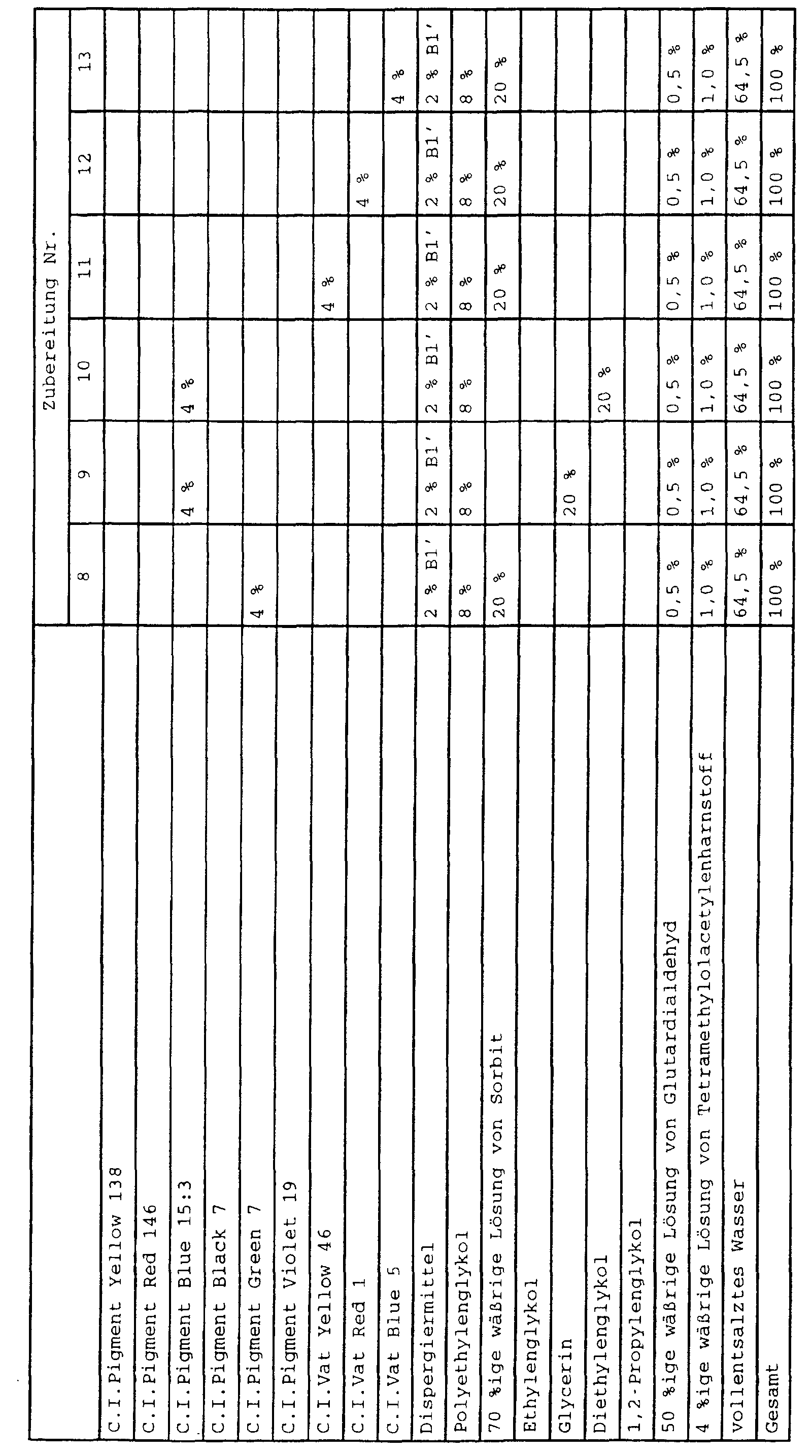
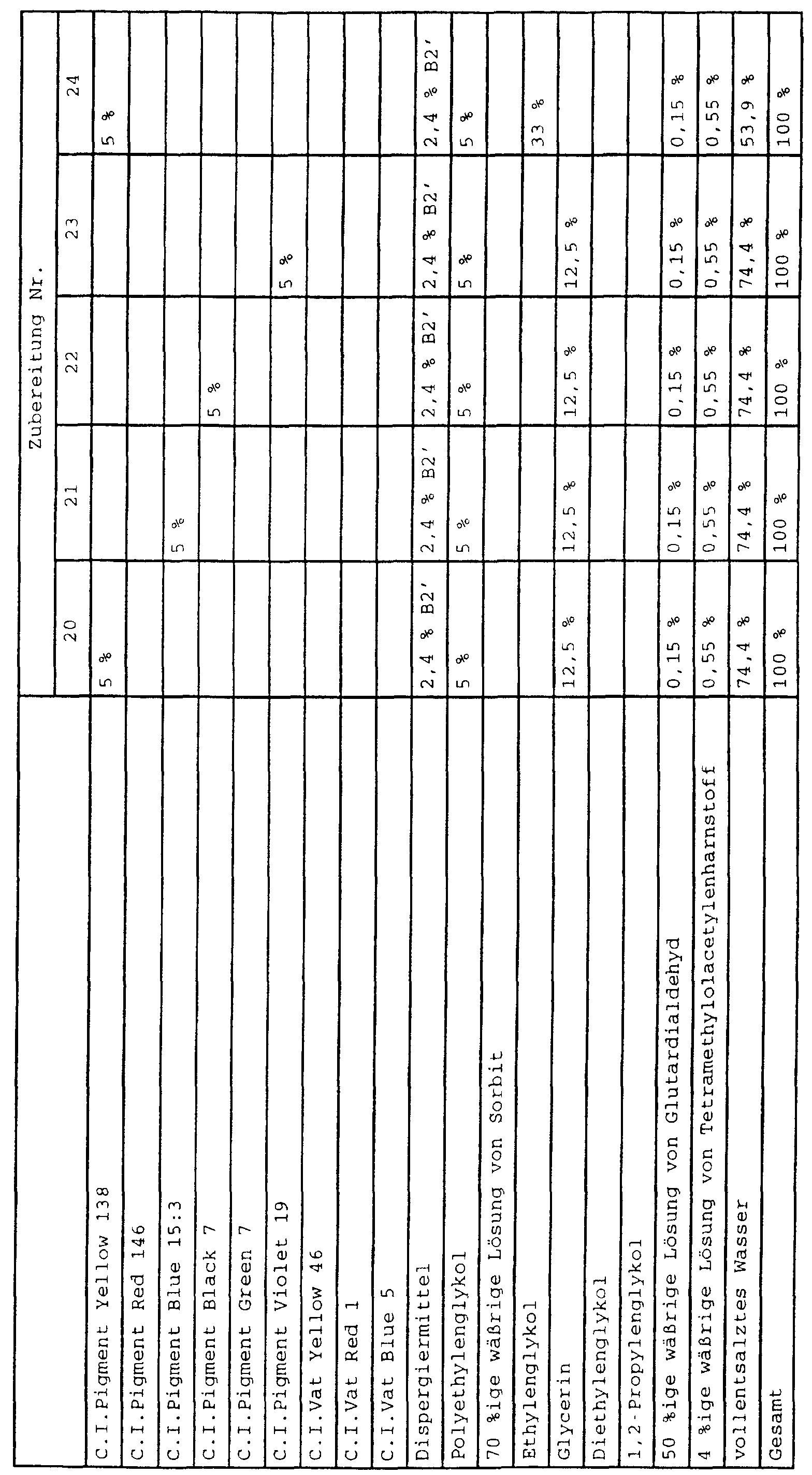
- 5,186,846 is described as dispersant 3, or 7.5 g of a dispersant (B2 ') based on an oxyalkylated phenol, that described as dispersant 13 in US-A-4,218,218 is, 0.37 g 50% by weight aqueous solution of glutardialdehyde and 0.75 g of 47% by weight aqueous solution of tetramethylolacetylene urea were with water to a total weight of 100 g filled up and pasted in a mill. Then the pH adjusted to 8.5 with 10% by weight sodium hydroxide solution.
- the mixture was then in a stirred ball mill for so long ground up to 99% of the pigment particles one size of less than 1 ⁇ m.
- the pigment preparations 1 to 31 were stable and unlimited showed no coagulation.
Landscapes
- Chemical & Material Sciences (AREA)
- Organic Chemistry (AREA)
- Materials Engineering (AREA)
- Engineering & Computer Science (AREA)
- Manufacturing & Machinery (AREA)
- Dispersion Chemistry (AREA)
- Chemical Kinetics & Catalysis (AREA)
- Life Sciences & Earth Sciences (AREA)
- Wood Science & Technology (AREA)
- Inks, Pencil-Leads, Or Crayons (AREA)
- Ink Jet (AREA)
- Ink Jet Recording Methods And Recording Media Thereof (AREA)
- Pigments, Carbon Blacks, Or Wood Stains (AREA)
Description
- Monoazopigmente:
- C.I. Pigment Brown 25;
- C.I. Pigment Orange 5, 13, 36 und 67;
- C.I. Pigment Red 1, 2, 3, 5, 8, 9, 12, 17, 22, 23, 31, 48:1, 48:2, 48:3, 48:4, 49, 49:1, 52:1, 52:2, 53, 53:1, 53:3, 57:1, 63, 251, 112, 146, 170, 184, 210 und 245;
- C.I. Pigment Yellow 1, 3, 73, 74, 65, 97, 151 und 183;
- Disazopigmente:
- C.I. Pigment Orange 16, 34 und 44;
- C.I. Pigment Red 144, 166, 214 und 242;
- C.I. Pigment Yellow 12, 13, 14, 16, 17, 81, 83, 106, 113, 126, 127, 155, 174, 176 und 188;
- Anthanthronpigmente:
- C.I. Pigment Red 168
(C.I. Vat Orange 3); - Anthrachinonpigmente:
- C.I. Pigment Yellow 147 und 177;
- C.I. Pigment Violet 31;
- Anthrapyrimidinpigmente:
- C.I. Pigment Yellow 108
(C.I. Vat Yellow 20); - Chinacridonpigmente:
- C.I. Pigment Red 122, 202 und 206
- C.I. Pigment Violet 19;
- Chinophthalonpigmente:
- C.I. Pigment Yellow 138;
- Dioxazinpigmente:
- C.I. Pigment Violet 23 und 37;
- Flavanthronpigmente:
- C.I. Pigment Yellow 24
- (C.I. Vat Yellow 1);
- Indanthronpigmente:
- C.I. Pigment Blue 60
(C.I. Vat Blue 4)
und 64 (C.I. Vat Blue 6); - Isoindolinpigmente:
- C.I. Pigment Orange 69;
- C.I. Pigment Red 260;
- C.I. Pigment Yellow 139 und 185;
- Isoindolinonpigmente:
- C.I. Pigment Orange 61;
- C.I. Pigment Red 257 und 260;
- C.I. Pigment Yellow 109, 110, 173 und 185;
- Isoviolanthronpigmente:
- C.I. Pigment Violet 31
(C.I. Vat Violet 1); - Metallkomplexpigmente:
- C.I. Pigment Yellow 117, 150 und 153;
- C.I. Pigment Green 8;
- Perinonpigmente:
- C.I. Pigment Orange 43
(C.I. Vat Orange 7); - C.I. Pigment Red 194
(C.I. Vat Red 15); - Perylenpigmente:
- C.I. Pigment Black 31 und 32;
- C.I. Pigment Red 123, 149, 178, 179
(C.I. Vat Red 23),
190 (C.I. Vat Red 29) und 224; - C.I. Pigment Violet 29;
- Phthalocyaninpigmente:
- C.I. Pigment Blue 15, 15:1, 15:2, 15:3, 15:4, 15:6 und 16;
- C.I. Pigment Green 7 und 36;
- Pyranthronpigmente:
- C.I. Pigment Orange 51;
- C.I. Pigment Red 216
(C.I. Vat Orange 4); - Thioindigopigmente:
- C.I. Pigment Red 88 und 181
(C.I. Vat Red 1); - C.I. Pigment Violet 38
(C.I. Vat Violet 3); - Triarylcarboniumpigmente:
- C.I. Pigment Blue 1, 61 und 62;
- C.I. Pigment Green 1;
- C.I. Pigment Red 81, 81:1 und 169;
- C.I. Pigment Violet 1, 2, 3 und 27;
- C.I. Pigment Black 1 (Anilinschwarz);
- C.I. Pigment Yellow 101 (Aldazingelb);
- C.I. Pigment Brown 22;
- C.I. Vat Yellow 2, 3, 4, 5, 9, 10, 12, 22, 26, 33, 37, 46, 48, 49 und 50;
- C.I. Vat Orange 1, 2, 5, 9, 11, 13, 15, 19, 26, 29, 30 und 31;
- C.I. Vat Red 2, 10, 12, 13, 14, 16, 19, 21, 31, 32, 37, 41, 51, 52 und 61;
- C.I. Vat Violet 2, 9, 13, 14, 15, 17 und 21;
- C.I. Vat Blue 1 (C.I. Pigment Blue 66), 3, 5, 10, 12, 13, 14, 16, 17, 18, 19, 20, 22, 25, 26, 29, 30, 31, 35, 41, 42, 43, 64, 65, 66, 72 und 74;
- C.I. Vat Green 1, 2, 3, 5, 7, 8, 9, 13, 14, 17, 26, 29, 30, 31, 32, 33, 40, 42, 43, 44 und 49;
- C.I. Vat Brown 1, 3, 4, 5, 6, 9, 11, 17, 25, 32, 33, 35, 38, 39, 41, 42, 44, 45, 49, 50, 55, 57, 68, 72, 73, 80, 81, 82, 83 und 84;
- C.I. Vat Black 1, 2, 7, 8, 9, 13, 14, 16, 19, 20, 22, 25, 27, 28, 29, 30, 31, 32, 34, 36, 56, 57, 58, 63, 64 und 65;
- Weißpigmente:
- Titandioxid (C.I. Pigment White 6),Zinkweiß, Farbenzinkoxid; Zinksulfid, Lithopone; Bleiweiß;
- Schwarzpigmente:
- Eisenoxidschwarz (C.I. Pigment Black 11), Eisen-Mangan-Schwarz, Spinellschwarz (C.I. Pigment Black 27); Ruß (C.I. Pigment Black 7);
- Buntpigmente:
- Chromoxid, Chromoxidhydratgrün;
Chromgrün (C.I. Pigment Green 48); Cobaltgrün (C.I. Pigment Green 50); Ultramaringrün; - Kobaltblau (C.I. Pigment Blue 28 und 36); Ultramarinblau; Eisenblau (C.I. Pigment Blue 27); Manganblau;
- Ultramarinviolett; Kobalt- und Manganviolett;
- Eisenoxidrot (C.I. Pigment Red 101); Cadmiumsulfoselenid (C.I. Pigment Red 108); Molybdatrot (C.I. Pigment Red 104); Ultramarinrot;
- Eisenoxidbraun, Mischbraun, Spinell- und Korundphasen (C.I. Pigment Brown 24, 29 und 31), Chromorange;
- Eisenoxidgelb (C.I. Pigment Yellow 42); Nickeltitangelb (C.I. Pigment Yellow 53; C.I. Pigment Yellow 157 und 164); Chromtitangelb; Cadmiumsulfid und Cadmiumzinksulfid (C.I. Pigment Yellow 37 und 35); Chromgelb (C.I. Pigment Yellow 34), Zinkgelb, Erdalkalichromate; Neapelgelb; Bismutvanadat (C.I. Pigment Yellow 184);
- Interferenzpigmente:
- Metalleffektpigmente auf der Basis beschichteter Metallplättchen; Perlglanzpigmente auf der Basis metalloxidbeschichteter Glimmerplättchen; Flüssigkristallpigmente.
| Gew.-% in der Aromatenfraktion | |
| Naphthalin | 30 - 55 |
| 2-Methylnaphthalin | 5 - 15 |
| 1-Methylnaphthalin | 4 - 10 |
| Inden | 3 - 10 |
| Diphenyl | 1 - 5 |
| Methylinden | 1 - 5 |
| Acenaphthen | 1 - 4 |
50 bis 97 Gew.-%, insbesondere 70 bis 95 Gew.-%, Arylsulfonsäure-Formaldehyd-Kondensationsprodukte und
3 bis 50 Gew.-%, insbesondere 5 bis 30 Gew.-%, aromatische oder langkettige aliphatische Carbonsäuren, deren Salze oder deren Anhydride oder Mischungen davon.


- a
- 0 bis im Mittel 125,
- b
- im Mittel 37 bis 250, wobei im Falle b>37 das Verhältnis b:a mindestens 1:1 ist, und
- d
- 0 oder 1 bedeuten,

1 bis 10 Gew.-% N-Methylol(meth)acrylamid oder deren C1-C4-Alkylethern und gewünschtenfalls Halogenhydringruppen enthaltenden Monomeren wie 2-Hydroxy-3-chlorpropylenacrylat und
90 bis 99 Gew.-% Comonomeren, z.B. aus der Gruppe Butadien, Styrol, (Meth)Acrylsäure, (Meth)Acrylamid, (Meth)Acrylnitril, (Meth)Acrylsäure- und Vinylester mit bis zu 12 C-Atomen, Vinylchlorid und N-Vinylpyrrolidon,
genannt, wie sie beispielsweise in der DE-A-16 19 656 beschrieben werden.
- cellulosehaltige Materialien wie Papier, Pappe, Karton, Holz und Holzwerkstoffe, die auch lackiert oder anderweitig beschichtet sein können,
- metallische Materialien wie Folien, Bleche oder Werkstücke aus Aluminium, Eisen, Kupfer, Silber, Gold, Zink oder Legierungen dieser Metalle, die lackiert oder anderweitig beschichtet sein können,
- silikatische Materialien wie Glas, Porzellan und Keramik, die ebenfalls beschichtet sein können,
- polymere Materialien jeder Art wie Polystyrol, Polyamide, Polyester, Polyethylen, Polypropylen, Melaminharze, Polyacrylate, Polyacrylnitril, Polyurethane, Polycarbonate, Polyvinylchlorid, Polyvinylalkohole, Polyvinylacetate, Polyvinylpyrrolidone und entsprechende Copolymere und Blockcopolymere, biologisch abbaubare Polymere und natürliche Polymere wie Gelatine,
- textile Materialien wie Fasern, Garne, Zwirne, Maschenware, Webware, Non-wovens und konfektionierte Ware aus Polyester, modifiziertem Polyester, Polyestermischgewebe, cellulosehaltige Materialien wie Baumwolle, Baumwollmischgewebe, Jute, Flachs, Hanf und Ramie, Viskose, Wolle, Seide, Polyamid, Polyamidmischgewebe, Polyacrylnitril, Triacetat, Acetat, Polycarbonat, Polypropylen, Polyvinylchlorid, Polyestermikrofasern und Glasfasergewebe,
- Leder, sowohl Naturleder als auch Kunstleder, als Glatt-, Nappa- oder Velourleder,
- Lebensmittel und Kosmetika




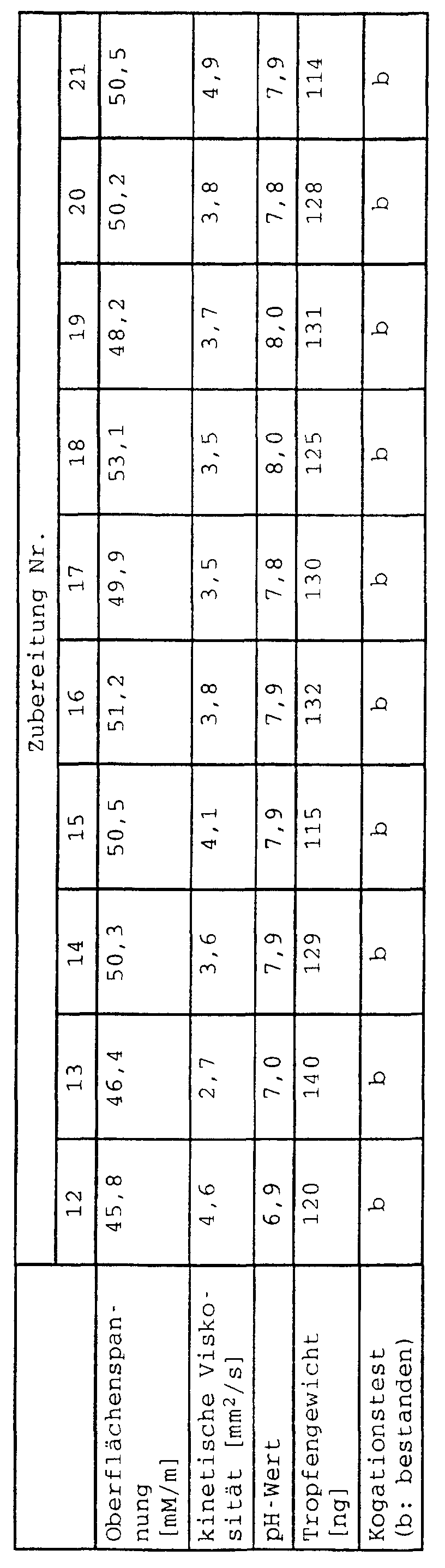
Die Oberflächenspannung wurde mit dem Digital-Tensiometer K 10 der Fa. Krüss bestimmt. Die in Tabelle 2 angegebenen Werte sind die Mittelwerte aus 3 Messungen.
Die kinetische Viskosität wurde nach der Ubbelohde Methode (DIN 51662) bestimmt.
Der pH-Wert wurde mit pH-Meter 763 der Fa. Knick bestimmt.
Von besonderer Wichtigkeit ist das Verhalten der Tinten während des Druckvorgangs in den Düsen. Die Neigung der Tinten, Ablagerungen und Verstopfungen in den Düsen zu bilden, wurde wie folgt überprüft:
Bei idealem Verhalten der Tinten sollte das mittlere Tropfengewicht über den Versuchszeitraum konstant bleiben.
Die Veränderung des Tropfengewichtes der einzelnen Tinten ist in Tabelle 2 angeführt.


- handelsübliche, für die genannte Auflösung geeignete
Papiere (Intercopy, Premium Glossy der Fa. Hewlett-Packard;
Special Coated Paper for 720 dpi Printing
der Fa. Epson):
- auf Papier kaschierte Baumwolle;
- auf Papier kaschierte Aluminiumfolie.
Zur Erhöhung der Reib-, Wasser- und Waschechtheit des Druckes wurde anschließend
Die Härtung des Bindemittels A) erfolgte durch 5 minütiges Erhitzen auf 150°C in einem Trockenschrank, die Härtung des Bindemittels B) wurde durch Belichtung auf einem UV-Bandbelichter der Firma Fusion (D-Strahler, 120 W/cm, Härtungsgeschwindigkeit 10 m/min) vorgenommen.
Weitere Einzelheiten zu diesen Versuchen sowie die bei der Prüfung der Waschechtheit (DIN 54011 = ISO 105C04) und der Reibechtheit (DIN 54021 = ISO 105X12) erhaltenen Ergebnisse sind in Tabelle 3 zusammengestellt.
| Pigmentzubereitung Nr. | 3 | 3 | 3 | 3 |
| Bindemittel | A | A | A | B |
| Auftragsverfahren | Siebdruck | Klotzen | Spritzen | Spritzen |
| Waschechtheit | 4 - 5 | 4 | 4 - 5 | 3 - 4 |
| Reibechtheit | 4 | 4 | 4 | 3 - 4 |
| Griff | mittelhart | mittelhart | weich | weich bis mittelhart |
Der jeweils erhaltene Druck wurde anschließend nach dem sog. 2 pH-Verfahren, das z.B. in Technische Information "Druck mit Küpenfarbstoffen auf Cellulosefasern", BASF Aktiengesellschaft (1993) beschrieben ist, fixiert.
In allen Fällen wurde Drucke mit hoher Licht-, Wasch- und Reibechtheit erhalten.
Claims (10)
- Pigmentzubereitungen für das Ink-Jet-Verfahren, enthaltendals wesentliche Bestandteile.A) mindestens ein feinteiliges, organisches oder anorganisches Pigment,B) ein Dispergiermittel auf der Basis von oxalkylierten Phenolen der Formel Iin der

- a
- 0 bis im Mittel 125,
- b
- im Mittel 37 bis 250, wobei im Falle b>37 das Verhältnis b:a mindestens 1:1 ist, und
- d
- 0 oder 1 bedeute oder deren Gemischen, und
C) Wasser - Pigmentzubereitungen nach Anspruch 1, die, jeweils bezogen auf das Gewicht der Zubereitung,
0,1 bis 20 Gew.-% der Komponente (A),
0,1 bis 20 Gew.-% der Komponente (B) und
mindestens 35 Gew.-% der Komponente (C)
enthalten. - Pigmentzubereitungen nach Anspruch 1 oder 2, die zusätzlich einen mehrwertigen Alkohol und/oder ein Polyalkylenglykol mit einem höheren Siedepunkt als Wasser als Komponente (D) enthalten.
- Pigmentzubereitungen nach Anspruch 3, die, bezogen auf das Gewicht der Zubereitung, 0,1 bis 35 Gew.-% der Komponente (D) enthalten.
- Pigmentzubereitungen nach den Ansprüchen 1 bis 4, bei denen 95 % der enthaltenen Pigmentteilchen (A) ≤ 1 µm sind.
- Verfahren zum Bedrucken von flächigen oder dreidimensional gestalteten Substraten im Ink-Jet-Verfahren, dadurch gekennzeichnet, daß man Pigmentzubereitungen gemäß den Ansprüchen 1 bis 5 auf das Substrat aufdruckt.
- Verfahren nach Anspruch 6, dadurch gekennzeichnet, daß man den erhaltenen Druck anschließend fixiert.
- Verfahren nach Anspruch 7, dadurch gekennzeichnet, daß man zur Fixierung des Drucks ein Bindemittel, das in Form einer Dispersion oder Emulsion vorliegen kann, aufträgt und dessen Härtung bewirkt oder eine Folie auflaminiert.
- Verfahren nach Anspruch 7, dadurch gekennzeichnet, daß man eine Dispersion oder Emulsion eines thermisch härtbaren Bindemittels, eines durch Luftoxidation trocknenden Bindemittels oder eines strahlungshärtbaren Bindemittels, die zusätzlich einen Photoinitiator enthalten kann, oder eine physikalisch trocknende Bindemitteldispersion oder -emulsion aufträgt.
- Verfahren nach Anspruch 8 oder 9, dadurch gekennzeichnet, daß man die Härtung des Bindemittels durch Einwirkung von IRoder Mikrowellenstrahlung, von Elektronenstrahlen oder von energiereicher elektromagnetischer Strahlung vornimmt.
Priority Applications (1)
| Application Number | Priority Date | Filing Date | Title |
|---|---|---|---|
| EP01130637A EP1205521B1 (de) | 1997-06-30 | 1998-06-18 | Pigmentzubereitungen für das Ink-Jet-Verfahren |
Applications Claiming Priority (5)
| Application Number | Priority Date | Filing Date | Title |
|---|---|---|---|
| DE19727766A DE19727766A1 (de) | 1997-06-30 | 1997-06-30 | Pigmentzubereitungen für das Ink-Jet-Verfahren |
| DE19727766 | 1997-06-30 | ||
| DE19753831A DE19753831A1 (de) | 1997-12-05 | 1997-12-05 | Pigmentzubereitungen für das Ink-Jet-Verfahren |
| DE19753831 | 1997-12-05 | ||
| PCT/EP1998/003708 WO1999001516A1 (de) | 1997-06-30 | 1998-06-18 | Pigmentzubereitungen für das ink-jet-verfahren |
Related Child Applications (1)
| Application Number | Title | Priority Date | Filing Date |
|---|---|---|---|
| EP01130637A Division EP1205521B1 (de) | 1997-06-30 | 1998-06-18 | Pigmentzubereitungen für das Ink-Jet-Verfahren |
Publications (2)
| Publication Number | Publication Date |
|---|---|
| EP0993493A1 EP0993493A1 (de) | 2000-04-19 |
| EP0993493B1 true EP0993493B1 (de) | 2002-09-25 |
Family
ID=26037865
Family Applications (1)
| Application Number | Title | Priority Date | Filing Date |
|---|---|---|---|
| EP98937503A Expired - Lifetime EP0993493B1 (de) | 1997-06-30 | 1998-06-18 | Pigmentzubereitungen für das ink-jet-verfahren |
Country Status (5)
| Country | Link |
|---|---|
| US (1) | US6332943B1 (de) |
| EP (1) | EP0993493B1 (de) |
| JP (1) | JP2002508015A (de) |
| DE (1) | DE59805715D1 (de) |
| WO (1) | WO1999001516A1 (de) |
Families Citing this family (78)
| Publication number | Priority date | Publication date | Assignee | Title |
|---|---|---|---|---|
| DE19754025A1 (de) * | 1997-12-05 | 1999-06-10 | Basf Ag | Farbstoffzubereitungen, enthaltend Azofarbstoffe |
| JP4118563B2 (ja) * | 1999-08-13 | 2008-07-16 | ビーエーエスエフ ソシエタス・ヨーロピア | 着色剤調製物 |
| DE10103851A1 (de) * | 2001-01-30 | 2002-08-14 | Staedtler Fa J S | Tinte für den Ink Jet Druck sowie deren Verwendung |
| JP3913123B2 (ja) * | 2001-06-28 | 2007-05-09 | キヤノン株式会社 | 電子写真感光体の製造方法 |
| DE10133643A1 (de) * | 2001-07-11 | 2003-01-30 | Clariant Gmbh | Wasserbasierende Farbmittelpräparationen |
| DE10133971A1 (de) | 2001-07-17 | 2003-02-06 | Basf Ag | Farbmittelzubereitungen |
| DE10153098A1 (de) * | 2001-10-30 | 2003-05-08 | Basf Ag | Farbmittelzubereitungen |
| BR0315353A (pt) * | 2002-10-17 | 2005-08-23 | Ciba Sc Holding Ag | Processo para o tingimento ou a estamparia de materiais de fibra têxtil com pigmentos brilhantes |
| JP2004168961A (ja) * | 2002-11-22 | 2004-06-17 | Konica Minolta Holdings Inc | 活性エネルギー線硬化型インク及びそれを用いた印刷物 |
| DE10309819A1 (de) * | 2003-03-05 | 2004-09-23 | Bayer Chemicals Ag | Pigmentpräparationen |
| ITVR20030054A1 (it) * | 2003-05-07 | 2004-11-08 | Cartiere Fedrigoni & C Spa | Procedimento per la produzione di carta patinata ad effetto perlescente |
| DE502004005151D1 (de) * | 2003-06-25 | 2007-11-15 | Basf Ag | verfahren zur behandlung von pigmenten in partikulärer form |
| DE10328716A1 (de) * | 2003-06-25 | 2005-01-13 | Basf Ag | Verfahren zur Behandlung von Pigmenten in partikulärer Form |
| DE10338142A1 (de) * | 2003-08-15 | 2005-03-17 | Basf Ag | Farbmittelzubereitungen |
| DE602004027146D1 (de) | 2003-08-25 | 2010-06-24 | Dip Tech Ltd | Tinte für keramische oberflächen |
| DE10348464A1 (de) * | 2003-10-14 | 2005-05-19 | Basf Ag | Formulierungen und ihre Verwendungen bei der Kolorierung von Substraten |
| DE10356341A1 (de) * | 2003-11-28 | 2005-06-23 | Bayer Chemicals Ag | Alkoxylierte Polyalkylenimine mit anionischen Gruppen und ihre Verwendung |
| US7060835B2 (en) | 2003-12-31 | 2006-06-13 | Sun Chemical Corporation | Preparation of yellow pigment |
| US8083338B2 (en) * | 2004-05-06 | 2011-12-27 | Agfa Graphics N.V. | Radiation-curable ink-jet printing |
| US20050270349A1 (en) * | 2004-06-08 | 2005-12-08 | Fuji Photo Film Co., Ltd. | Ink stock solution for ink jet recording, method for manufacturing the same and ink for ink jet recording |
| DE102004062438A1 (de) * | 2004-12-20 | 2006-06-22 | Basf Ag | Verfahren zum Bedrucken oder Kolorieren von Substraten |
| DE102005007763A1 (de) * | 2005-02-19 | 2006-08-24 | Lanxess Deutschland Gmbh | Wässrige Pigmentpräparationen für brilliante Ink-Jet-Ausdrucke |
| US20060281830A1 (en) * | 2005-06-08 | 2006-12-14 | Adger Kogyo Co., Ltd. | Ink composition and writing instrument |
| JP2007080217A (ja) * | 2005-09-16 | 2007-03-29 | Toshiba Corp | 紙葉類処理装置 |
| WO2007036942A2 (en) * | 2005-09-28 | 2007-04-05 | Dip Tech. Ltd. | Ink providing etch-like effect for printing on ceramic surfaces |
| DE102006019553A1 (de) * | 2006-04-27 | 2007-10-31 | Clariant International Limited | Wasserbasierende Pigmentpräparation |
| JPWO2008056523A1 (ja) * | 2006-11-07 | 2010-02-25 | コニカミノルタエムジー株式会社 | 活性光線硬化型インクジェットインク、画像形成方法及びインクジェット記録装置 |
| JP5487532B2 (ja) * | 2006-12-25 | 2014-05-07 | コニカミノルタ株式会社 | インクジェットプリンタ、析出物発生防止方法、および、インクジェット記録方法 |
| DE602007010975D1 (de) * | 2007-12-28 | 2011-01-13 | Eckart Gmbh | Pigmentzubereitung und Tintenstrahldrucktinte |
| JP5767107B2 (ja) * | 2008-06-26 | 2015-08-19 | イー・アイ・デュポン・ドウ・ヌムール・アンド・カンパニーE.I.Du Pont De Nemours And Company | マゼンタインクジェットインクならびにその製造および使用方法 |
| WO2010078413A1 (en) | 2008-12-31 | 2010-07-08 | Apinee, Inc. | Preservation of wood, compositions and methods thereof |
| US8840234B2 (en) * | 2009-04-23 | 2014-09-23 | Hewlett-Packard Development Company, L.P. | Ink compositions and methods of use |
| US10632740B2 (en) | 2010-04-23 | 2020-04-28 | Landa Corporation Ltd. | Digital printing process |
| US9878464B1 (en) | 2011-06-30 | 2018-01-30 | Apinee, Inc. | Preservation of cellulosic materials, compositions and methods thereof |
| JP2013053173A (ja) * | 2011-08-31 | 2013-03-21 | Fujifilm Corp | インク組成物、インクセット、及び画像形成方法 |
| US10434761B2 (en) | 2012-03-05 | 2019-10-08 | Landa Corporation Ltd. | Digital printing process |
| EP2822778B1 (de) | 2012-03-05 | 2019-05-08 | Landa Corporation Ltd. | Digitaldruckverfahren |
| EP2822776B1 (de) | 2012-03-05 | 2018-08-01 | Landa Corporation Ltd. | Transferdruckverfahren |
| US9902147B2 (en) | 2012-03-05 | 2018-02-27 | Landa Corporation Ltd. | Digital printing system |
| US10190012B2 (en) | 2012-03-05 | 2019-01-29 | Landa Corporation Ltd. | Treatment of release layer and inkjet ink formulations |
| DE202013012736U1 (de) | 2012-03-05 | 2018-12-20 | Landa Corporation Ltd. | Tintenfilmkonstruktionen |
| US10642198B2 (en) | 2012-03-05 | 2020-05-05 | Landa Corporation Ltd. | Intermediate transfer members for use with indirect printing systems and protonatable intermediate transfer members for use with indirect printing systems |
| BR112014021786B1 (pt) | 2012-03-05 | 2021-06-08 | Landa Corporation Ltd | estruturas de película de tinta |
| WO2015036960A1 (en) | 2013-09-11 | 2015-03-19 | Landa Corporation Ltd. | Release layer treatment formulations |
| US9643403B2 (en) | 2012-03-05 | 2017-05-09 | Landa Corporation Ltd. | Printing system |
| US9498946B2 (en) | 2012-03-05 | 2016-11-22 | Landa Corporation Ltd. | Apparatus and method for control or monitoring of a printing system |
| US9517618B2 (en) | 2012-03-15 | 2016-12-13 | Landa Corporation Ltd. | Endless flexible belt for a printing system |
| JP6163810B2 (ja) * | 2013-03-25 | 2017-07-19 | セイコーエプソン株式会社 | ラジカル重合性光硬化型インクジェット用インク組成物 |
| RU2015152145A (ru) | 2013-05-07 | 2017-06-13 | ЭксФЛЭМ ПТИ ЛТД | Способы подготовки композиционных пенопластов |
| GB201401173D0 (en) | 2013-09-11 | 2014-03-12 | Landa Corp Ltd | Ink formulations and film constructions thereof |
| CN104673152B (zh) * | 2013-11-26 | 2019-07-23 | 罗门哈斯公司 | 脂族或脂环族二甲醛和间苯二酚的水性粘合剂组合物 |
| CN113325664B (zh) | 2014-12-23 | 2024-07-19 | 普利司通美国轮胎运营有限责任公司 | 聚合物产品的增材制造方法 |
| GB2536489B (en) | 2015-03-20 | 2018-08-29 | Landa Corporation Ltd | Indirect printing system |
| GB2537813A (en) | 2015-04-14 | 2016-11-02 | Landa Corp Ltd | Apparatus for threading an intermediate transfer member of a printing system |
| EP3390006B1 (de) | 2015-12-17 | 2021-01-27 | Bridgestone Americas Tire Operations, LLC | Kartuschen zur generativen fertigung und verfahren zur herstellung gehärteter polymerprodukte durch generative fertigung |
| GB201609463D0 (en) | 2016-05-30 | 2016-07-13 | Landa Labs 2012 Ltd | Method of manufacturing a multi-layer article |
| DE112017002714T5 (de) | 2016-05-30 | 2019-02-28 | Landa Corporation Ltd. | Digitales Druckverfahren |
| CN105885409B (zh) * | 2016-06-24 | 2021-01-22 | 随身科技(北京)有限公司 | 一种粉煤灰/尼龙复合材料及制备方法和用途 |
| WO2018081053A1 (en) | 2016-10-27 | 2018-05-03 | Bridgestone Americas Tire Operations, Llc | Processes for producing cured polymeric products by additive manufacturing |
| JP6889560B2 (ja) * | 2017-01-16 | 2021-06-18 | サカタインクス株式会社 | 活性エネルギー線硬化型オフセット印刷用インキ組成物、及びそれを用いた印刷物の製造方法 |
| CN110997191B (zh) * | 2017-04-20 | 2023-02-03 | Xjet有限公司 | 用于制造打印制品的系统 |
| CN111212736B (zh) | 2017-10-19 | 2021-11-23 | 兰达公司 | 用于打印系统的环形柔性带 |
| WO2019097464A1 (en) | 2017-11-19 | 2019-05-23 | Landa Corporation Ltd. | Digital printing system |
| US11511536B2 (en) | 2017-11-27 | 2022-11-29 | Landa Corporation Ltd. | Calibration of runout error in a digital printing system |
| US11707943B2 (en) | 2017-12-06 | 2023-07-25 | Landa Corporation Ltd. | Method and apparatus for digital printing |
| US11679615B2 (en) | 2017-12-07 | 2023-06-20 | Landa Corporation Ltd. | Digital printing process and method |
| IL279556B2 (en) | 2018-06-26 | 2024-06-01 | Landa Corp Ltd | Part for intermediate transfer to a digital printing system |
| US10994528B1 (en) | 2018-08-02 | 2021-05-04 | Landa Corporation Ltd. | Digital printing system with flexible intermediate transfer member |
| US12001902B2 (en) | 2018-08-13 | 2024-06-04 | Landa Corporation Ltd. | Correcting distortions in digital printing by implanting dummy pixels in a digital image |
| WO2020060555A1 (en) | 2018-09-20 | 2020-03-26 | Hewlett-Packard Development Company, L.P. | Three-dimensional printing |
| US11318734B2 (en) | 2018-10-08 | 2022-05-03 | Landa Corporation Ltd. | Friction reduction means for printing systems and method |
| CN113272144B (zh) | 2018-12-24 | 2023-04-04 | 兰达公司 | 数字印刷系统和方法 |
| WO2020202145A1 (en) | 2019-03-31 | 2020-10-08 | Landa Corporation Ltd | Systems and methods for preventing or minimizing printing defects in printing processes |
| JP2020204115A (ja) * | 2019-06-18 | 2020-12-24 | 株式会社ミマキエンジニアリング | 捺染物の製造方法及び印刷システム |
| WO2021105806A1 (en) | 2019-11-25 | 2021-06-03 | Landa Corporation Ltd. | Drying ink in digital printing using infrared radiation absorbed by particles embedded inside itm |
| US11321028B2 (en) | 2019-12-11 | 2022-05-03 | Landa Corporation Ltd. | Correcting registration errors in digital printing |
| CN114868087A (zh) | 2019-12-29 | 2022-08-05 | 兰达公司 | 印刷方法和系统 |
| JP2024506561A (ja) | 2021-02-02 | 2024-02-14 | ランダ コーポレイション リミテッド | 印刷画像における歪みの軽減 |
Family Cites Families (17)
| Publication number | Priority date | Publication date | Assignee | Title |
|---|---|---|---|---|
| US2979528A (en) | 1953-10-19 | 1961-04-11 | Wyandotte Chemicals Corp | Nitrogen-containing polyoxyalkylene detergent compositions |
| GB1551829A (en) * | 1975-09-15 | 1979-09-05 | Ici Ltd | Process for the preparation of dispersions |
| US4204010A (en) * | 1976-09-17 | 1980-05-20 | W. R. Grace & Co. | Radiation curable, ethylenically unsaturated thixotropic agent and method of preparation |
| US4189445A (en) | 1977-10-08 | 1980-02-19 | Basf Aktiengesellschaft | Surface-active phenolic derivatives |
| DE2853921A1 (de) | 1978-12-14 | 1980-07-03 | Basf Ag | Strahlungshaertbare waessrige bindemitteldispersionen |
| DE3641677A1 (de) | 1986-12-05 | 1988-06-09 | Bayer Ag | Waessrige pigmentpraeparationen und ihre verwendung |
| DE3704098A1 (de) | 1987-02-11 | 1988-08-25 | Basf Ag | Strahlungshaertbare acrylate |
| EP0412548B2 (de) | 1989-08-09 | 2001-12-19 | Seiko Epson Corporation | Aufzeichnungstinten-Zusammensetzung und Verfahren zur Verwendung derselben |
| DE4018873A1 (de) | 1990-06-13 | 1991-12-19 | Basf Ag | Verwendung von kondensaten auf basis von arylsulfonsaeuren und formaldehyd als dispergiermittel |
| EP0518621B1 (de) * | 1991-06-10 | 1996-12-11 | Tektronix Inc. | Verfahren zum Behandeln bedruckter Substrate |
| ES2086613T3 (es) * | 1991-11-01 | 1996-07-01 | Hoechst Ag | Dispersiones acuosas de pigmentos. |
| ATE171205T1 (de) | 1993-12-14 | 1998-10-15 | Canon Kk | Tinte, tintenstrahlaufzeichnungsverfahren und tintenstrahldruckgerät unter verwendung derselben |
| DE4413242A1 (de) | 1994-04-16 | 1995-10-19 | Basf Lacke & Farben | Verfahren zur Herstellung von Gegenständen mit dreidimensionaler Oberflächenstruktur und nach diesem Verfahren hergestellte Gegenstände |
| JPH07331147A (ja) * | 1994-06-13 | 1995-12-19 | Brother Ind Ltd | 記録用インク |
| JP3040668B2 (ja) | 1994-08-05 | 2000-05-15 | 帝国インキ製造株式会社 | ラジエーション硬化性インクジェット印刷用インク |
| DE4434554A1 (de) | 1994-09-28 | 1996-04-04 | Basf Ag | Strahlungshärtbare wäßrige Polyurethandispersionen |
| KR100204380B1 (ko) | 1995-01-27 | 1999-06-15 | 나가시마 므쓰오 | 잉크젯 기록용액 및 그 제조방법 |
-
1998
- 1998-06-18 EP EP98937503A patent/EP0993493B1/de not_active Expired - Lifetime
- 1998-06-18 JP JP50623499A patent/JP2002508015A/ja not_active Ceased
- 1998-06-18 WO PCT/EP1998/003708 patent/WO1999001516A1/de not_active Ceased
- 1998-06-18 US US09/446,894 patent/US6332943B1/en not_active Expired - Lifetime
- 1998-06-18 DE DE59805715T patent/DE59805715D1/de not_active Expired - Lifetime
Also Published As
| Publication number | Publication date |
|---|---|
| DE59805715D1 (de) | 2002-10-31 |
| WO1999001516A1 (de) | 1999-01-14 |
| JP2002508015A (ja) | 2002-03-12 |
| EP0993493A1 (de) | 2000-04-19 |
| US6332943B1 (en) | 2001-12-25 |
Similar Documents
| Publication | Publication Date | Title |
|---|---|---|
| EP0993495B1 (de) | Als ink-jet-tinten geeignete pigmentzubereitungen mit strahlungshärtbarem bindemittel | |
| EP0993493A1 (de) | Pigmentzubereitungen für das ink-jet-verfahren | |
| EP1203055B1 (de) | Farbmittelzubereitungen | |
| DE69413363T2 (de) | Tinte, Tintenstrahlaufzeichnungsverfahren und Tintenstrahldruckgerät unter Verwendung derselben | |
| US9487667B2 (en) | Ink jet printing method | |
| EP1311632B1 (de) | Verfahren zum beschichten von substraten | |
| EP1720950A1 (de) | Aufzeichnungsflüssigkeiten | |
| WO2005017047A1 (de) | Farbmittelzubereitungen | |
| EP1442085B1 (de) | Farbmittelzubereitungen | |
| EP1205521B1 (de) | Pigmentzubereitungen für das Ink-Jet-Verfahren | |
| EP1058716B1 (de) | Acrylharzhaltige pigmentzubereitungen | |
| DE19753831A1 (de) | Pigmentzubereitungen für das Ink-Jet-Verfahren | |
| EP1412440B1 (de) | Farbmittelzubereitungen | |
| DE19731572A1 (de) | Pigmentpräparationen | |
| DE19826399A1 (de) | Acrylharzhaltige Pigmentzubereitungen | |
| DE19807485A1 (de) | Acrylharzhaltige Pigmentzubereitungen | |
| WO2023084968A1 (ja) | インクジェット記録方法及びインクセット | |
| WO2024095693A1 (ja) | 皮革の製造方法 | |
| DE102013223281A1 (de) | Phasenwechsel Tinte mit aus Pflanzen und Insekten gewonnenen Farbmitteln | |
| DE19938471A1 (de) | Farbmittelzubereitungen | |
| DE10026465A1 (de) | Farbmittelzubereitungen |
Legal Events
| Date | Code | Title | Description |
|---|---|---|---|
| PUAI | Public reference made under article 153(3) epc to a published international application that has entered the european phase |
Free format text: ORIGINAL CODE: 0009012 |
|
| 17P | Request for examination filed |
Effective date: 19991204 |
|
| AK | Designated contracting states |
Kind code of ref document: A1 Designated state(s): CH DE FR GB IT LI |
|
| GRAG | Despatch of communication of intention to grant |
Free format text: ORIGINAL CODE: EPIDOS AGRA |
|
| 17Q | First examination report despatched |
Effective date: 20011107 |
|
| GRAG | Despatch of communication of intention to grant |
Free format text: ORIGINAL CODE: EPIDOS AGRA |
|
| GRAH | Despatch of communication of intention to grant a patent |
Free format text: ORIGINAL CODE: EPIDOS IGRA |
|
| GRAH | Despatch of communication of intention to grant a patent |
Free format text: ORIGINAL CODE: EPIDOS IGRA |
|
| GRAA | (expected) grant |
Free format text: ORIGINAL CODE: 0009210 |
|
| AK | Designated contracting states |
Kind code of ref document: B1 Designated state(s): CH DE FR GB IT LI |
|
| REG | Reference to a national code |
Ref country code: GB Ref legal event code: FG4D Free format text: NOT ENGLISH |
|
| REG | Reference to a national code |
Ref country code: CH Ref legal event code: EP |
|
| REF | Corresponds to: |
Ref document number: 59805715 Country of ref document: DE Date of ref document: 20021031 |
|
| REG | Reference to a national code |
Ref country code: CH Ref legal event code: NV Representative=s name: SCHMAUDER & PARTNER AG PATENTANWALTSBUERO |
|
| GBT | Gb: translation of ep patent filed (gb section 77(6)(a)/1977) |
Effective date: 20021121 |
|
| ET | Fr: translation filed | ||
| PLBE | No opposition filed within time limit |
Free format text: ORIGINAL CODE: 0009261 |
|
| STAA | Information on the status of an ep patent application or granted ep patent |
Free format text: STATUS: NO OPPOSITION FILED WITHIN TIME LIMIT |
|
| 26N | No opposition filed |
Effective date: 20030626 |
|
| REG | Reference to a national code |
Ref country code: CH Ref legal event code: PCAR Free format text: SCHMAUDER & PARTNER AG PATENT- UND MARKENANWAELTE VSP;ZWAENGIWEG 7;8038 ZUERICH (CH) |
|
| PGFP | Annual fee paid to national office [announced via postgrant information from national office to epo] |
Ref country code: CH Payment date: 20090615 Year of fee payment: 12 |
|
| REG | Reference to a national code |
Ref country code: CH Ref legal event code: PL |
|
| PG25 | Lapsed in a contracting state [announced via postgrant information from national office to epo] |
Ref country code: LI Free format text: LAPSE BECAUSE OF NON-PAYMENT OF DUE FEES Effective date: 20100630 Ref country code: CH Free format text: LAPSE BECAUSE OF NON-PAYMENT OF DUE FEES Effective date: 20100630 |
|
| PGFP | Annual fee paid to national office [announced via postgrant information from national office to epo] |
Ref country code: GB Payment date: 20110630 Year of fee payment: 14 |
|
| PGFP | Annual fee paid to national office [announced via postgrant information from national office to epo] |
Ref country code: DE Payment date: 20110830 Year of fee payment: 14 |
|
| PGFP | Annual fee paid to national office [announced via postgrant information from national office to epo] |
Ref country code: IT Payment date: 20110630 Year of fee payment: 14 |
|
| GBPC | Gb: european patent ceased through non-payment of renewal fee |
Effective date: 20120618 |
|
| PG25 | Lapsed in a contracting state [announced via postgrant information from national office to epo] |
Ref country code: IT Free format text: LAPSE BECAUSE OF NON-PAYMENT OF DUE FEES Effective date: 20120618 |
|
| PG25 | Lapsed in a contracting state [announced via postgrant information from national office to epo] |
Ref country code: DE Free format text: LAPSE BECAUSE OF NON-PAYMENT OF DUE FEES Effective date: 20130101 Ref country code: GB Free format text: LAPSE BECAUSE OF NON-PAYMENT OF DUE FEES Effective date: 20120618 |
|
| REG | Reference to a national code |
Ref country code: DE Ref legal event code: R119 Ref document number: 59805715 Country of ref document: DE Effective date: 20130101 |
|
| PGFP | Annual fee paid to national office [announced via postgrant information from national office to epo] |
Ref country code: FR Payment date: 20130722 Year of fee payment: 16 |
|
| REG | Reference to a national code |
Ref country code: FR Ref legal event code: ST Effective date: 20150227 |
|
| PG25 | Lapsed in a contracting state [announced via postgrant information from national office to epo] |
Ref country code: FR Free format text: LAPSE BECAUSE OF NON-PAYMENT OF DUE FEES Effective date: 20140630 |