EP0993605B1 - Mit verschiedenen polymerzusammensetzungen hergestellten sensoren und verfahren zu deren herstellung - Google Patents
Mit verschiedenen polymerzusammensetzungen hergestellten sensoren und verfahren zu deren herstellung Download PDFInfo
- Publication number
- EP0993605B1 EP0993605B1 EP98931709A EP98931709A EP0993605B1 EP 0993605 B1 EP0993605 B1 EP 0993605B1 EP 98931709 A EP98931709 A EP 98931709A EP 98931709 A EP98931709 A EP 98931709A EP 0993605 B1 EP0993605 B1 EP 0993605B1
- Authority
- EP
- European Patent Office
- Prior art keywords
- poly
- organic material
- sensor
- concentration
- sensors
- Prior art date
- Legal status (The legal status is an assumption and is not a legal conclusion. Google has not performed a legal analysis and makes no representation as to the accuracy of the status listed.)
- Expired - Lifetime
Links
- 229920000642 polymer Polymers 0.000 title claims abstract description 108
- 238000000034 method Methods 0.000 title claims abstract description 59
- 239000011368 organic material Substances 0.000 claims abstract description 150
- 230000004044 response Effects 0.000 claims abstract description 136
- 239000012491 analyte Substances 0.000 claims abstract description 84
- 239000012530 fluid Substances 0.000 claims abstract description 37
- -1 poly(dienes) Polymers 0.000 claims description 126
- 229920002689 polyvinyl acetate Polymers 0.000 claims description 59
- 239000011118 polyvinyl acetate Substances 0.000 claims description 59
- 239000000178 monomer Substances 0.000 claims description 41
- 229920000620 organic polymer Polymers 0.000 claims description 31
- 239000004020 conductor Substances 0.000 claims description 28
- 229920003229 poly(methyl methacrylate) Polymers 0.000 claims description 24
- 239000004926 polymethyl methacrylate Substances 0.000 claims description 24
- 239000002904 solvent Substances 0.000 claims description 23
- 238000004519 manufacturing process Methods 0.000 claims description 15
- OKTJSMMVPCPJKN-UHFFFAOYSA-N Carbon Chemical compound [C] OKTJSMMVPCPJKN-UHFFFAOYSA-N 0.000 claims description 8
- 229910052799 carbon Inorganic materials 0.000 claims description 8
- 239000000758 substrate Substances 0.000 claims description 8
- 229920001519 homopolymer Polymers 0.000 claims description 6
- 229920001577 copolymer Polymers 0.000 claims description 5
- 229920002732 Polyanhydride Polymers 0.000 claims description 4
- 229920002554 vinyl polymer Polymers 0.000 claims description 4
- 229920001400 block copolymer Polymers 0.000 claims description 3
- 125000000623 heterocyclic group Chemical group 0.000 claims description 3
- 229920002223 polystyrene Polymers 0.000 claims description 3
- 150000001720 carbohydrates Chemical class 0.000 claims description 2
- 235000014633 carbohydrates Nutrition 0.000 claims description 2
- 229920002627 poly(phosphazenes) Polymers 0.000 claims description 2
- 229920002492 poly(sulfone) Polymers 0.000 claims description 2
- 229920000058 polyacrylate Polymers 0.000 claims description 2
- 229920000728 polyester Polymers 0.000 claims description 2
- 229920002635 polyurethane Polymers 0.000 claims description 2
- 229920002451 polyvinyl alcohol Polymers 0.000 claims description 2
- 229920001567 vinyl ester resin Polymers 0.000 claims description 2
- 238000003491 array Methods 0.000 abstract description 37
- 239000000126 substance Substances 0.000 abstract description 31
- 229920002959 polymer blend Polymers 0.000 abstract description 16
- 238000013459 approach Methods 0.000 abstract description 5
- 239000000243 solution Substances 0.000 description 44
- WEVYAHXRMPXWCK-UHFFFAOYSA-N Acetonitrile Chemical compound CC#N WEVYAHXRMPXWCK-UHFFFAOYSA-N 0.000 description 36
- XEKOWRVHYACXOJ-UHFFFAOYSA-N Ethyl acetate Chemical compound CCOC(C)=O XEKOWRVHYACXOJ-UHFFFAOYSA-N 0.000 description 33
- 239000000203 mixture Substances 0.000 description 33
- 239000002131 composite material Substances 0.000 description 28
- OKKJLVBELUTLKV-UHFFFAOYSA-N Methanol Chemical compound OC OKKJLVBELUTLKV-UHFFFAOYSA-N 0.000 description 27
- CSCPPACGZOOCGX-UHFFFAOYSA-N Acetone Chemical compound CC(C)=O CSCPPACGZOOCGX-UHFFFAOYSA-N 0.000 description 24
- LFQSCWFLJHTTHZ-UHFFFAOYSA-N Ethanol Chemical compound CCO LFQSCWFLJHTTHZ-UHFFFAOYSA-N 0.000 description 22
- 239000006229 carbon black Substances 0.000 description 20
- 235000019241 carbon black Nutrition 0.000 description 15
- 239000000463 material Substances 0.000 description 14
- 238000012360 testing method Methods 0.000 description 14
- 239000003570 air Substances 0.000 description 12
- 229920005601 base polymer Polymers 0.000 description 12
- 229940093499 ethyl acetate Drugs 0.000 description 11
- 235000019439 ethyl acetate Nutrition 0.000 description 11
- 238000005507 spraying Methods 0.000 description 10
- 239000011159 matrix material Substances 0.000 description 8
- 239000013598 vector Substances 0.000 description 8
- 238000005266 casting Methods 0.000 description 7
- 210000004027 cell Anatomy 0.000 description 7
- WYURNTSHIVDZCO-UHFFFAOYSA-N Tetrahydrofuran Chemical compound C1CCOC1 WYURNTSHIVDZCO-UHFFFAOYSA-N 0.000 description 6
- 239000010408 film Substances 0.000 description 6
- 238000002156 mixing Methods 0.000 description 6
- 239000000725 suspension Substances 0.000 description 6
- 239000000835 fiber Substances 0.000 description 5
- 230000006870 function Effects 0.000 description 5
- 238000000926 separation method Methods 0.000 description 5
- 239000007921 spray Substances 0.000 description 5
- 238000013528 artificial neural network Methods 0.000 description 4
- 239000002585 base Substances 0.000 description 4
- 229920001940 conductive polymer Polymers 0.000 description 4
- 238000001514 detection method Methods 0.000 description 4
- 239000011521 glass Substances 0.000 description 4
- 230000003287 optical effect Effects 0.000 description 4
- 238000003860 storage Methods 0.000 description 4
- 238000010897 surface acoustic wave method Methods 0.000 description 4
- 230000008961 swelling Effects 0.000 description 4
- XOLBLPGZBRYERU-UHFFFAOYSA-N tin dioxide Chemical compound O=[Sn]=O XOLBLPGZBRYERU-UHFFFAOYSA-N 0.000 description 4
- DALXSTTWUHZVIV-UHFFFAOYSA-N C(C)(=O)OCC.CC(=O)C.C(C)#N.CO.C(C)O Chemical compound C(C)(=O)OCC.CC(=O)C.C(C)#N.CO.C(C)O DALXSTTWUHZVIV-UHFFFAOYSA-N 0.000 description 3
- 241000282465 Canis Species 0.000 description 3
- 230000003213 activating effect Effects 0.000 description 3
- 230000008859 change Effects 0.000 description 3
- 239000003795 chemical substances by application Substances 0.000 description 3
- 239000002322 conducting polymer Substances 0.000 description 3
- 230000001419 dependent effect Effects 0.000 description 3
- 238000000151 deposition Methods 0.000 description 3
- 238000003618 dip coating Methods 0.000 description 3
- 230000000694 effects Effects 0.000 description 3
- 229910052737 gold Inorganic materials 0.000 description 3
- 239000010931 gold Substances 0.000 description 3
- 230000006872 improvement Effects 0.000 description 3
- 229910044991 metal oxide Inorganic materials 0.000 description 3
- 150000004706 metal oxides Chemical class 0.000 description 3
- 230000003278 mimic effect Effects 0.000 description 3
- 239000012071 phase Substances 0.000 description 3
- 238000003380 quartz crystal microbalance Methods 0.000 description 3
- 238000004528 spin coating Methods 0.000 description 3
- 239000011550 stock solution Substances 0.000 description 3
- YLQBMQCUIZJEEH-UHFFFAOYSA-N tetrahydrofuran Natural products C=1C=COC=1 YLQBMQCUIZJEEH-UHFFFAOYSA-N 0.000 description 3
- 230000004304 visual acuity Effects 0.000 description 3
- QTBSBXVTEAMEQO-UHFFFAOYSA-M Acetate Chemical compound CC([O-])=O QTBSBXVTEAMEQO-UHFFFAOYSA-M 0.000 description 2
- 238000012935 Averaging Methods 0.000 description 2
- VYZAMTAEIAYCRO-UHFFFAOYSA-N Chromium Chemical compound [Cr] VYZAMTAEIAYCRO-UHFFFAOYSA-N 0.000 description 2
- PPBRXRYQALVLMV-UHFFFAOYSA-N Styrene Chemical compound C=CC1=CC=CC=C1 PPBRXRYQALVLMV-UHFFFAOYSA-N 0.000 description 2
- GWEVSGVZZGPLCZ-UHFFFAOYSA-N Titan oxide Chemical compound O=[Ti]=O GWEVSGVZZGPLCZ-UHFFFAOYSA-N 0.000 description 2
- 238000004458 analytical method Methods 0.000 description 2
- 230000008901 benefit Effects 0.000 description 2
- 230000005540 biological transmission Effects 0.000 description 2
- 229910052804 chromium Inorganic materials 0.000 description 2
- 239000011651 chromium Substances 0.000 description 2
- 238000010276 construction Methods 0.000 description 2
- 238000007405 data analysis Methods 0.000 description 2
- 230000008021 deposition Effects 0.000 description 2
- 238000005516 engineering process Methods 0.000 description 2
- 235000013305 food Nutrition 0.000 description 2
- 238000004817 gas chromatography Methods 0.000 description 2
- PCHJSUWPFVWCPO-UHFFFAOYSA-N gold Chemical compound [Au] PCHJSUWPFVWCPO-UHFFFAOYSA-N 0.000 description 2
- 150000004820 halides Chemical class 0.000 description 2
- 238000012886 linear function Methods 0.000 description 2
- 238000012544 monitoring process Methods 0.000 description 2
- 210000000956 olfactory bulb Anatomy 0.000 description 2
- 239000002245 particle Substances 0.000 description 2
- 230000000379 polymerizing effect Effects 0.000 description 2
- 229920000128 polypyrrole Polymers 0.000 description 2
- 238000003908 quality control method Methods 0.000 description 2
- 238000011002 quantification Methods 0.000 description 2
- 210000003370 receptor cell Anatomy 0.000 description 2
- 238000005070 sampling Methods 0.000 description 2
- 230000002123 temporal effect Effects 0.000 description 2
- 239000010409 thin film Substances 0.000 description 2
- 239000012808 vapor phase Substances 0.000 description 2
- WSGYTJNNHPZFKR-UHFFFAOYSA-N 3-hydroxypropanenitrile Chemical compound OCCC#N WSGYTJNNHPZFKR-UHFFFAOYSA-N 0.000 description 1
- NLHHRLWOUZZQLW-UHFFFAOYSA-N Acrylonitrile Chemical compound C=CC#N NLHHRLWOUZZQLW-UHFFFAOYSA-N 0.000 description 1
- 241001120493 Arene Species 0.000 description 1
- JBRZTFJDHDCESZ-UHFFFAOYSA-N AsGa Chemical compound [As]#[Ga] JBRZTFJDHDCESZ-UHFFFAOYSA-N 0.000 description 1
- 229910015371 AuCu Inorganic materials 0.000 description 1
- 241001507939 Cormus domestica Species 0.000 description 1
- 229910001218 Gallium arsenide Inorganic materials 0.000 description 1
- GPXJNWSHGFTCBW-UHFFFAOYSA-N Indium phosphide Chemical compound [In]#P GPXJNWSHGFTCBW-UHFFFAOYSA-N 0.000 description 1
- RRHGJUQNOFWUDK-UHFFFAOYSA-N Isoprene Chemical class CC(=C)C=C RRHGJUQNOFWUDK-UHFFFAOYSA-N 0.000 description 1
- 241001465754 Metazoa Species 0.000 description 1
- VVQNEPGJFQJSBK-UHFFFAOYSA-N Methyl methacrylate Chemical compound COC(=O)C(C)=C VVQNEPGJFQJSBK-UHFFFAOYSA-N 0.000 description 1
- 102000012547 Olfactory receptors Human genes 0.000 description 1
- 108050002069 Olfactory receptors Proteins 0.000 description 1
- 239000004793 Polystyrene Substances 0.000 description 1
- 229910018974 Pt3O4 Inorganic materials 0.000 description 1
- XUIMIQQOPSSXEZ-UHFFFAOYSA-N Silicon Chemical compound [Si] XUIMIQQOPSSXEZ-UHFFFAOYSA-N 0.000 description 1
- 238000002835 absorbance Methods 0.000 description 1
- 150000001241 acetals Chemical class 0.000 description 1
- KSZVHVUMUSIKTC-UHFFFAOYSA-N acetic acid;propan-2-one Chemical compound CC(C)=O.CC(O)=O KSZVHVUMUSIKTC-UHFFFAOYSA-N 0.000 description 1
- 150000001298 alcohols Chemical class 0.000 description 1
- 150000001299 aldehydes Chemical class 0.000 description 1
- 150000001335 aliphatic alkanes Chemical class 0.000 description 1
- 229910052783 alkali metal Inorganic materials 0.000 description 1
- 150000001336 alkenes Chemical class 0.000 description 1
- 150000001345 alkine derivatives Chemical class 0.000 description 1
- 229910045601 alloy Inorganic materials 0.000 description 1
- 239000000956 alloy Substances 0.000 description 1
- 239000012080 ambient air Substances 0.000 description 1
- 150000004945 aromatic hydrocarbons Chemical class 0.000 description 1
- 238000004422 calculation algorithm Methods 0.000 description 1
- 239000003575 carbonaceous material Substances 0.000 description 1
- 125000002915 carbonyl group Chemical group [*:2]C([*:1])=O 0.000 description 1
- 239000012159 carrier gas Substances 0.000 description 1
- 239000003054 catalyst Substances 0.000 description 1
- 230000003197 catalytic effect Effects 0.000 description 1
- RZVXOCDCIIFGGH-UHFFFAOYSA-N chromium gold Chemical compound [Cr].[Au] RZVXOCDCIIFGGH-UHFFFAOYSA-N 0.000 description 1
- 238000000576 coating method Methods 0.000 description 1
- 239000000571 coke Substances 0.000 description 1
- 238000004891 communication Methods 0.000 description 1
- 229920005622 compatible polymer blend Polymers 0.000 description 1
- 230000000295 complement effect Effects 0.000 description 1
- 229910052802 copper Inorganic materials 0.000 description 1
- 239000013078 crystal Substances 0.000 description 1
- 230000007423 decrease Effects 0.000 description 1
- 230000003247 decreasing effect Effects 0.000 description 1
- 239000010432 diamond Substances 0.000 description 1
- 150000001993 dienes Chemical class 0.000 description 1
- 235000014113 dietary fatty acids Nutrition 0.000 description 1
- 238000007865 diluting Methods 0.000 description 1
- 238000007598 dipping method Methods 0.000 description 1
- 231100000613 environmental toxicology Toxicity 0.000 description 1
- 150000002170 ethers Chemical class 0.000 description 1
- 238000001704 evaporation Methods 0.000 description 1
- 238000002474 experimental method Methods 0.000 description 1
- 229930195729 fatty acid Natural products 0.000 description 1
- 239000000194 fatty acid Substances 0.000 description 1
- 150000004665 fatty acids Chemical class 0.000 description 1
- 229910002804 graphite Inorganic materials 0.000 description 1
- 239000010439 graphite Substances 0.000 description 1
- 229930195733 hydrocarbon Natural products 0.000 description 1
- PJXISJQVUVHSOJ-UHFFFAOYSA-N indium(III) oxide Inorganic materials [O-2].[O-2].[O-2].[In+3].[In+3] PJXISJQVUVHSOJ-UHFFFAOYSA-N 0.000 description 1
- 229910052741 iridium Inorganic materials 0.000 description 1
- 238000005304 joining Methods 0.000 description 1
- 150000002576 ketones Chemical class 0.000 description 1
- 239000007788 liquid Substances 0.000 description 1
- 150000002678 macrocyclic compounds Chemical class 0.000 description 1
- 238000005259 measurement Methods 0.000 description 1
- 230000007246 mechanism Effects 0.000 description 1
- 229910052751 metal Inorganic materials 0.000 description 1
- 239000002184 metal Substances 0.000 description 1
- 229910001092 metal group alloy Inorganic materials 0.000 description 1
- 229910052961 molybdenite Inorganic materials 0.000 description 1
- CWQXQMHSOZUFJS-UHFFFAOYSA-N molybdenum disulfide Chemical compound S=[Mo]=S CWQXQMHSOZUFJS-UHFFFAOYSA-N 0.000 description 1
- 229910052982 molybdenum disulfide Inorganic materials 0.000 description 1
- 235000019645 odor Nutrition 0.000 description 1
- 239000013307 optical fiber Substances 0.000 description 1
- 210000000056 organ Anatomy 0.000 description 1
- 238000005192 partition Methods 0.000 description 1
- 238000012567 pattern recognition method Methods 0.000 description 1
- 239000003208 petroleum Substances 0.000 description 1
- 229910052697 platinum Inorganic materials 0.000 description 1
- 229920002239 polyacrylonitrile Polymers 0.000 description 1
- 238000006116 polymerization reaction Methods 0.000 description 1
- 229920000193 polymethacrylate Polymers 0.000 description 1
- 238000002360 preparation method Methods 0.000 description 1
- 230000008569 process Effects 0.000 description 1
- 238000012545 processing Methods 0.000 description 1
- 150000003217 pyrazoles Chemical class 0.000 description 1
- 150000003222 pyridines Chemical class 0.000 description 1
- 150000003252 quinoxalines Chemical class 0.000 description 1
- 229920005604 random copolymer Polymers 0.000 description 1
- 238000005067 remediation Methods 0.000 description 1
- 229920006395 saturated elastomer Polymers 0.000 description 1
- 239000004065 semiconductor Substances 0.000 description 1
- 230000008786 sensory perception of smell Effects 0.000 description 1
- 230000019491 signal transduction Effects 0.000 description 1
- 229910052710 silicon Inorganic materials 0.000 description 1
- 239000010703 silicon Substances 0.000 description 1
- 229910052709 silver Inorganic materials 0.000 description 1
- 239000007787 solid Substances 0.000 description 1
- 238000000527 sonication Methods 0.000 description 1
- 238000001179 sorption measurement Methods 0.000 description 1
- 241000894007 species Species 0.000 description 1
- 238000009987 spinning Methods 0.000 description 1
- 235000000346 sugar Nutrition 0.000 description 1
- 150000008163 sugars Chemical class 0.000 description 1
- 239000002887 superconductor Substances 0.000 description 1
- 150000003505 terpenes Chemical class 0.000 description 1
- 150000003568 thioethers Chemical class 0.000 description 1
- 230000036962 time dependent Effects 0.000 description 1
- 238000012546 transfer Methods 0.000 description 1
- 150000003918 triazines Chemical class 0.000 description 1
- XLYOFNOQVPJJNP-UHFFFAOYSA-N water Chemical compound O XLYOFNOQVPJJNP-UHFFFAOYSA-N 0.000 description 1
- 229910021521 yttrium barium copper oxide Inorganic materials 0.000 description 1
Images




Classifications
-
- G—PHYSICS
- G01—MEASURING; TESTING
- G01N—INVESTIGATING OR ANALYSING MATERIALS BY DETERMINING THEIR CHEMICAL OR PHYSICAL PROPERTIES
- G01N27/00—Investigating or analysing materials by the use of electric, electrochemical, or magnetic means
- G01N27/02—Investigating or analysing materials by the use of electric, electrochemical, or magnetic means by investigating impedance
- G01N27/04—Investigating or analysing materials by the use of electric, electrochemical, or magnetic means by investigating impedance by investigating resistance
- G01N27/12—Investigating or analysing materials by the use of electric, electrochemical, or magnetic means by investigating impedance by investigating resistance of a solid body in dependence upon absorption of a fluid; of a solid body in dependence upon reaction with a fluid, for detecting components in the fluid
- G01N27/125—Composition of the body, e.g. the composition of its sensitive layer
- G01N27/126—Composition of the body, e.g. the composition of its sensitive layer comprising organic polymers
-
- B—PERFORMING OPERATIONS; TRANSPORTING
- B01—PHYSICAL OR CHEMICAL PROCESSES OR APPARATUS IN GENERAL
- B01J—CHEMICAL OR PHYSICAL PROCESSES, e.g. CATALYSIS OR COLLOID CHEMISTRY; THEIR RELEVANT APPARATUS
- B01J19/00—Chemical, physical or physico-chemical processes in general; Their relevant apparatus
- B01J19/0046—Sequential or parallel reactions, e.g. for the synthesis of polypeptides or polynucleotides; Apparatus and devices for combinatorial chemistry or for making molecular arrays
-
- G—PHYSICS
- G01—MEASURING; TESTING
- G01N—INVESTIGATING OR ANALYSING MATERIALS BY DETERMINING THEIR CHEMICAL OR PHYSICAL PROPERTIES
- G01N21/00—Investigating or analysing materials by the use of optical means, i.e. using sub-millimetre waves, infrared, visible or ultraviolet light
- G01N21/75—Systems in which material is subjected to a chemical reaction, the progress or the result of the reaction being investigated
- G01N21/77—Systems in which material is subjected to a chemical reaction, the progress or the result of the reaction being investigated by observing the effect on a chemical indicator
-
- G—PHYSICS
- G01—MEASURING; TESTING
- G01N—INVESTIGATING OR ANALYSING MATERIALS BY DETERMINING THEIR CHEMICAL OR PHYSICAL PROPERTIES
- G01N33/00—Investigating or analysing materials by specific methods not covered by groups G01N1/00 - G01N31/00
- G01N33/0004—Gaseous mixtures, e.g. polluted air
- G01N33/0009—General constructional details of gas analysers, e.g. portable test equipment
- G01N33/0027—General constructional details of gas analysers, e.g. portable test equipment concerning the detector
- G01N33/0031—General constructional details of gas analysers, e.g. portable test equipment concerning the detector comprising two or more sensors, e.g. a sensor array
-
- B—PERFORMING OPERATIONS; TRANSPORTING
- B01—PHYSICAL OR CHEMICAL PROCESSES OR APPARATUS IN GENERAL
- B01J—CHEMICAL OR PHYSICAL PROCESSES, e.g. CATALYSIS OR COLLOID CHEMISTRY; THEIR RELEVANT APPARATUS
- B01J2219/00—Chemical, physical or physico-chemical processes in general; Their relevant apparatus
- B01J2219/00274—Sequential or parallel reactions; Apparatus and devices for combinatorial chemistry or for making arrays; Chemical library technology
- B01J2219/00277—Apparatus
- B01J2219/00351—Means for dispensing and evacuation of reagents
-
- B—PERFORMING OPERATIONS; TRANSPORTING
- B01—PHYSICAL OR CHEMICAL PROCESSES OR APPARATUS IN GENERAL
- B01J—CHEMICAL OR PHYSICAL PROCESSES, e.g. CATALYSIS OR COLLOID CHEMISTRY; THEIR RELEVANT APPARATUS
- B01J2219/00—Chemical, physical or physico-chemical processes in general; Their relevant apparatus
- B01J2219/00274—Sequential or parallel reactions; Apparatus and devices for combinatorial chemistry or for making arrays; Chemical library technology
- B01J2219/00277—Apparatus
- B01J2219/00497—Features relating to the solid phase supports
- B01J2219/00513—Essentially linear supports
- B01J2219/00524—Essentially linear supports in the shape of fiber bundles
-
- B—PERFORMING OPERATIONS; TRANSPORTING
- B01—PHYSICAL OR CHEMICAL PROCESSES OR APPARATUS IN GENERAL
- B01J—CHEMICAL OR PHYSICAL PROCESSES, e.g. CATALYSIS OR COLLOID CHEMISTRY; THEIR RELEVANT APPARATUS
- B01J2219/00—Chemical, physical or physico-chemical processes in general; Their relevant apparatus
- B01J2219/00274—Sequential or parallel reactions; Apparatus and devices for combinatorial chemistry or for making arrays; Chemical library technology
- B01J2219/00583—Features relative to the processes being carried out
- B01J2219/00596—Solid-phase processes
-
- B—PERFORMING OPERATIONS; TRANSPORTING
- B01—PHYSICAL OR CHEMICAL PROCESSES OR APPARATUS IN GENERAL
- B01J—CHEMICAL OR PHYSICAL PROCESSES, e.g. CATALYSIS OR COLLOID CHEMISTRY; THEIR RELEVANT APPARATUS
- B01J2219/00—Chemical, physical or physico-chemical processes in general; Their relevant apparatus
- B01J2219/00274—Sequential or parallel reactions; Apparatus and devices for combinatorial chemistry or for making arrays; Chemical library technology
- B01J2219/00583—Features relative to the processes being carried out
- B01J2219/00603—Making arrays on substantially continuous surfaces
- B01J2219/00605—Making arrays on substantially continuous surfaces the compounds being directly bound or immobilised to solid supports
-
- B—PERFORMING OPERATIONS; TRANSPORTING
- B01—PHYSICAL OR CHEMICAL PROCESSES OR APPARATUS IN GENERAL
- B01J—CHEMICAL OR PHYSICAL PROCESSES, e.g. CATALYSIS OR COLLOID CHEMISTRY; THEIR RELEVANT APPARATUS
- B01J2219/00—Chemical, physical or physico-chemical processes in general; Their relevant apparatus
- B01J2219/00274—Sequential or parallel reactions; Apparatus and devices for combinatorial chemistry or for making arrays; Chemical library technology
- B01J2219/00583—Features relative to the processes being carried out
- B01J2219/00603—Making arrays on substantially continuous surfaces
- B01J2219/00605—Making arrays on substantially continuous surfaces the compounds being directly bound or immobilised to solid supports
- B01J2219/00612—Making arrays on substantially continuous surfaces the compounds being directly bound or immobilised to solid supports the surface being inorganic
-
- B—PERFORMING OPERATIONS; TRANSPORTING
- B01—PHYSICAL OR CHEMICAL PROCESSES OR APPARATUS IN GENERAL
- B01J—CHEMICAL OR PHYSICAL PROCESSES, e.g. CATALYSIS OR COLLOID CHEMISTRY; THEIR RELEVANT APPARATUS
- B01J2219/00—Chemical, physical or physico-chemical processes in general; Their relevant apparatus
- B01J2219/00274—Sequential or parallel reactions; Apparatus and devices for combinatorial chemistry or for making arrays; Chemical library technology
- B01J2219/00583—Features relative to the processes being carried out
- B01J2219/00603—Making arrays on substantially continuous surfaces
- B01J2219/00605—Making arrays on substantially continuous surfaces the compounds being directly bound or immobilised to solid supports
- B01J2219/00632—Introduction of reactive groups to the surface
- B01J2219/00637—Introduction of reactive groups to the surface by coating it with another layer
-
- B—PERFORMING OPERATIONS; TRANSPORTING
- B01—PHYSICAL OR CHEMICAL PROCESSES OR APPARATUS IN GENERAL
- B01J—CHEMICAL OR PHYSICAL PROCESSES, e.g. CATALYSIS OR COLLOID CHEMISTRY; THEIR RELEVANT APPARATUS
- B01J2219/00—Chemical, physical or physico-chemical processes in general; Their relevant apparatus
- B01J2219/00274—Sequential or parallel reactions; Apparatus and devices for combinatorial chemistry or for making arrays; Chemical library technology
- B01J2219/00583—Features relative to the processes being carried out
- B01J2219/00603—Making arrays on substantially continuous surfaces
- B01J2219/00659—Two-dimensional arrays
-
- B—PERFORMING OPERATIONS; TRANSPORTING
- B01—PHYSICAL OR CHEMICAL PROCESSES OR APPARATUS IN GENERAL
- B01J—CHEMICAL OR PHYSICAL PROCESSES, e.g. CATALYSIS OR COLLOID CHEMISTRY; THEIR RELEVANT APPARATUS
- B01J2219/00—Chemical, physical or physico-chemical processes in general; Their relevant apparatus
- B01J2219/00274—Sequential or parallel reactions; Apparatus and devices for combinatorial chemistry or for making arrays; Chemical library technology
- B01J2219/0068—Means for controlling the apparatus of the process
- B01J2219/00702—Processes involving means for analysing and characterising the products
- B01J2219/00707—Processes involving means for analysing and characterising the products separated from the reactor apparatus
-
- B—PERFORMING OPERATIONS; TRANSPORTING
- B01—PHYSICAL OR CHEMICAL PROCESSES OR APPARATUS IN GENERAL
- B01J—CHEMICAL OR PHYSICAL PROCESSES, e.g. CATALYSIS OR COLLOID CHEMISTRY; THEIR RELEVANT APPARATUS
- B01J2219/00—Chemical, physical or physico-chemical processes in general; Their relevant apparatus
- B01J2219/00274—Sequential or parallel reactions; Apparatus and devices for combinatorial chemistry or for making arrays; Chemical library technology
- B01J2219/00718—Type of compounds synthesised
- B01J2219/0072—Organic compounds
- B01J2219/00722—Nucleotides
-
- C—CHEMISTRY; METALLURGY
- C40—COMBINATORIAL TECHNOLOGY
- C40B—COMBINATORIAL CHEMISTRY; LIBRARIES, e.g. CHEMICAL LIBRARIES
- C40B40/00—Libraries per se, e.g. arrays, mixtures
- C40B40/04—Libraries containing only organic compounds
- C40B40/14—Libraries containing macromolecular compounds and not covered by groups C40B40/06 - C40B40/12
-
- C—CHEMISTRY; METALLURGY
- C40—COMBINATORIAL TECHNOLOGY
- C40B—COMBINATORIAL CHEMISTRY; LIBRARIES, e.g. CHEMICAL LIBRARIES
- C40B60/00—Apparatus specially adapted for use in combinatorial chemistry or with libraries
- C40B60/14—Apparatus specially adapted for use in combinatorial chemistry or with libraries for creating libraries
-
- G—PHYSICS
- G01—MEASURING; TESTING
- G01N—INVESTIGATING OR ANALYSING MATERIALS BY DETERMINING THEIR CHEMICAL OR PHYSICAL PROPERTIES
- G01N21/00—Investigating or analysing materials by the use of optical means, i.e. using sub-millimetre waves, infrared, visible or ultraviolet light
- G01N21/75—Systems in which material is subjected to a chemical reaction, the progress or the result of the reaction being investigated
- G01N21/77—Systems in which material is subjected to a chemical reaction, the progress or the result of the reaction being investigated by observing the effect on a chemical indicator
- G01N21/7703—Systems in which material is subjected to a chemical reaction, the progress or the result of the reaction being investigated by observing the effect on a chemical indicator using reagent-clad optical fibres or optical waveguides
- G01N2021/7706—Reagent provision
- G01N2021/773—Porous polymer jacket; Polymer matrix with indicator
-
- Y—GENERAL TAGGING OF NEW TECHNOLOGICAL DEVELOPMENTS; GENERAL TAGGING OF CROSS-SECTIONAL TECHNOLOGIES SPANNING OVER SEVERAL SECTIONS OF THE IPC; TECHNICAL SUBJECTS COVERED BY FORMER USPC CROSS-REFERENCE ART COLLECTIONS [XRACs] AND DIGESTS
- Y10—TECHNICAL SUBJECTS COVERED BY FORMER USPC
- Y10T—TECHNICAL SUBJECTS COVERED BY FORMER US CLASSIFICATION
- Y10T436/00—Chemistry: analytical and immunological testing
- Y10T436/25—Chemistry: analytical and immunological testing including sample preparation
- Y10T436/2575—Volumetric liquid transfer
Definitions
- the present invention is directed to novel devices and methods for preparing and using a plurality of compositionally different sensors that are capable of detecting the presence of a chemical analyte in a fluid.
- Such sensors are often fabricated from a polymeric organic material that is capable of absorbing a chemical analyte which comes in contact therewith, wherein absorbance of the analyte causes the polymeric material to swell, thereby providing a response that is capable of being detected. Variability in the ability to absorb an analyte results in variability in the detectable signal produced.
- organic polymer-based sensors have found use in a variety of different applications and devices including, for example, devices that function as analogs of the mammalian olfactory system (Lewis, U.S. Patent No.
- Arrays of metal oxide thin film resistors are typically based on SnO2 films that have been coated with various catalysts. Furthermore, these arrays generally do not allow deliberate chemical control of the response of elements in the array and the reproducibility of response from array to array is often poor. For example, the use of surface acoustic wave resonators, employs a signal transduction mechanism that involves complicated electronics and a frequency measurement to one Hz while sustaining a 200 MHz Rayleigh wave in the crystal. Therefore, a need exists for devices and methods to identify and measure analytes in fluids that overcome or minimize these problems.
- IEE AEROSPACE CONFERENCE PROCEEDINGS (CAT.N. 97CH36020), USA, 1-8 Feb. 1997, Vol. . 3, 8 Feb. 1997, pages 583-631 : M.C. Lonergan discusses array-based vapour sensing using chemically sensitive, polymer composite resistors.
- US-A-5 417 100 discloses an inexpensive polymer-based sensor for detecting solvent vapours leaking from fittings and valves in petroleum refineries.
- While methods for producing a plurality of compositionally distinct chemically sensitive sensors may prove to be very useful in a variety of applications, the utility of such methods is dependent upon whether the response produced by each of the compositionally distinct sensors is a linear function of the mole fraction of any particular component of the sensor.
- the response provided by a sensor is a direct linear function of the mole fraction of a particular component of the sensor, then not much additional information will be obtained from the responses of sensors that comprise a mixture of two different polymeric materials over those sensors that are fabricated solely from one or the other polymeric material.
- nonlinearity in the response profile as compared to the mole fraction of an organic material present in the plurality of the sensors is very important for increasing the power of these sensor arrays to resolve multitudes of analytes.
- Such systems include, for example, analogs to the mammalian olfactory system, arrays of coated surface acoustic wave sensors, fiber optic micromirrors, quartz crystal microbalance sensors, polymer-coated fiber optic sensors, and the like.
- a sensor array as defined in claim 1, a method of using it as defined in claim 20 and a method of manufacturing it as defined in claim 21.
- Novel methods are provided for manufacturing large numbers of chemically sensitive sensors starting from only a few base components. Specific embodiments are directed to methods of making and using a plurality of compositionally different polymer-based sensors that are capable of detecting the presence of an analyte in a fluid. Other embodiments are directed to the devices made by these methods.
- the sensors prepared using the presently described method comprise a polymer or polymer blend material that is capable of sorbing a chemical analyte when, brought in contact therewith.
- the act of sorbing the chemical analyte causes the polymer or polymer blend to swell, thereby providing a response that is capable of being detected. Such swelling causes a volumetric change in the sensor.
- such swelling causes a resistance response to permeation by the analyte.
- the resistance response is inversely proportional to the volumetric change. Because different polymers and polymer blends exhibit varying abilities to absorb different chemical analytes, arrays of compositionally distinct sensors will provide different responses to different analytes, those responses being capable of being detected and measured with an appropriate detection apparatus.
- Organic materials that find use herein include organic polymers, and particularly nonconductive organic polymers, which are capable of absorbing a chemical analyte when brought into contact therewith as well as organic monomeric units which, when combined, polymerize to form an organic polymer.
- each sensor in the plurality will comprise a polymer blend (i.e., a blend of two or more different organic polymers).
- the two or more polymers added to form the polymer blend may be combined either simultaneously or one or more of the components may be added to the blend at different times.
- the organic materials combined to form the sensors are monomers, those monomers, when combined or when significantly heated, exposed to light, etc., polymerize to form a single organic polymer.
- the monomer units may be added to create the sensors simultaneously or at different times.
- the organic materials can be components of the same copolymer (a polymer made from two or more different monomers).
- the organic material can be oligomers. Certain embodiments of oligomers can have molecular weights between 400 and about 2,000.
- the organic material is a homopolymer (a polymer made from one monomer).
- At least one sensor is an interpenetrating network comprising a first polymer and a second polymer formed from a monomer polymerised in the presence of the first polymer.
- the first organic material is a homopolymer or copolymer
- the second organic material is a monomer which is combined with the first material.
- IPN interpenetrating network
- Examples of such systems are (1) preformed polyvinyl acetate with monomer methylmethacrylate to form an IPN of pVA and pMMA, (2) preformed pVA with monomer styrene to form an IPN of pVA and polystyrene, and (3) preformed pVA with acrylonitrile to form an IPN- of pVA and polyacrylonitrile. More than one monomer may be used where it is desired to create an IPN having one or more copolymers.
- organic materials is intended to encompass both organic polymers, and particularly nonconductive organic polymers, and monomers, which are capable of polymerizing to form an organic polymer.
- the organic materials include main-chain carbon polymers such as poly(dienes), poly(alkenes), poly(acrylics), poly(methacrylics), poly(vinyl ethers), poly(vinyl thioethers), poly(vinyl alcohols), poly(vinyl ketones), poly(vinyl halides), poly(vinyl nitriles), poly(vinyl esters), poly(styrenes), poly(arylenes), and the like, main-chain acrylic heteroatom organic polymers such as poly(oxides), poly(carbonates), poly(esters), poly(anhydrides), poly (urethanes), poly(sulfonates), poly(siloxanes), poly (sulfides), poly(thioesters), poly(sulfones), poly
- the polymers employed are poly(vinyl acetate) (PVA) and poly(methacrylate) (PMMA).
- PVA poly(vinyl acetate)
- PMMA poly(methacrylate)
- the organic materials employed are combined in different ratios so as to provide a plurality of sensors, each of which contains a different mole fraction of at least one of the organic materials employed in the fabrication.
- a plurality of different sensors may be prepared by adding one part of a first polymer to 99 parts of a second polymer to provide the first sensor, adding two parts of a first polymer to 98 parts of a second polymer to provide the second sensor, etc. Therefore, each sensor in the plurality of sensors may be compositionally different.
- the sensors are capable of providing a detectable signal in the presence of a chemical analyte of interest. It is a preferred characteristic of the sensors that the detectable signal, or response, is not linearly related to the mole fraction of at least one of the organic materials present in the sensor elements. Further, the response is not a sum or average of the individual responses of each of the components of the sensor. Such non-linearity in response is preferable because arrays of compositionally different sensor elements will optimally provide additional information and resolution of detection if non-linearity of response exists.
- the detectable signal produced by the sensor is not linearly related to the mole fraction of at least one of the organic materials used during sensor fabrication.
- the step of combining the polymers or monomer units can be performed by a variety of different techniques such as, but not limited to, solution casting, suspension casting, and mechanical mixing.
- solution cast routes are advantageous because they provide homogeneous structures and ease of processing.
- sensors may be easily fabricated by spin, spray or dip coating.
- Suspension casting still provides the possibility of spin, spray or dip coating but more heterogeneous structures than with solution casting are expected.
- mechanical mixing there are no solubility restrictions since it involves only the physical mixing of the sensor element components, but device fabrication is more difficult since spin, spray and dip coating are no longer possible. A more detailed discussion of each of these follows.
- the sensors can be fabricated by solution casting.
- the use of such miscible solutions has an added advantage.
- the resolving power of a sensor array containing miscible blends was shown to be superior to that of arrays containing an identical number of sensors that are comprised of only the two base polymeric materials.
- Suspension casting In suspension casting, one or more of the components of the sensor is suspended and the others dissolved in a common solvent. Suspension casting is a rather general technique applicable to a wide range of species, which can be suspended in solvents by vigorous mixing or sonication. Mechanical mixing is suitable for all of the possible component permutations. In this technique, the components are physically mixed in a ball-mill or other mixing device.
- the combining step is performed by spraying a first polymer or monomer in a left to right direction across a grid which comprises multiple wells, wherein the concentration of the first polymer or monomer is smoothly varied as the spray travels across the grid.
- a second polymer or monomer is sprayed from a top to bottom direction across the surface of the grid, wherein the concentration of the second polymer or monomer is smoothly varied as the spray travels across the surface of the grid.
- An embodiment of a method for manufacturing an array of chemically sensitive sensors from a limited number of feedstock solutions of nonconductive organic materials can be carried out by the following method. First, the following are provided: a first feedstock solution of a first organic material at a concentration x in a first solvent, a second feedstock solution of a second organic material in a second solvent at three different concentrations, y, y+b and y+c, and a substrate having first, second and third preselected regions. In some embodiments, these preselected regions are physically separated on the substrate. In certain embodiments, the regions are recessed below the surface of the substrate forming wells. In other embodiments, ridges surround the regions on the surface of the substrate. In some of these embodiments, the ridges are formed from photodefinable material. In other embodiments, the ridges are formed from sputtered material.
- each of the first, second and third regions is contacted with the first feedstock solution at concentration x. Then, the first region is contacted with the second feedstock solution at concentration y, the second region is contacted with the second feedstock solution at said concentration y+b, and the third region is contacted with the second feedstock solution at said concentration y+c.
- the first organic material is different from the second organic material and y, y+b and y+c are each different concentrations.
- the resulting sensor array has a total number of sensors, one manufactured at each preselected region, that is greater than the number of feedstock solutions used to manufacture the sensors.
- the method of contacting is spraying.
- the method of contacting includes pipetting, micropipetting, depositing, spinning, evaporating, dipping, flowing and the like.
- the method further includes the step of varying the concentration of the second organic material in the second solution from y to y+b or from y+b to y+c. In certain of these embodiments, the concentration is smoothly varied.
- the method further includes the step of moving the solution from the first region to the second region. For instance, in certain embodiments using spraying as the contacting method, a spraying unit contacts the first, second and third regions and delivers the first solution at concentration x.
- the first feedstock solution further comprises a conductive material, or a third feedstock contains said conductive material, which can also be varied in concentration.
- these preselected regions are arranged in an array or grid.
- the concentrations of both nonconductive organic materials are varied.
- an embodiment is formed where 4 sensors are arranged in a square grid with the first sensor in the upper left corner, the second sensor in the upper right corner, the third sensor in the bottom left corner and the fourth sensor in the bottom right corner.
- the previously described spraying unit or units can be used as described above to form the sensors.
- the first solution is sprayed from top to bottom with the concentration smoothly varied from x to x+a.
- the second solution is sprayed from left to right with the concentration smoothly varied from y to y+b.
- the resulting combinatorial sensor array contains four sensors, each with a different mole fraction of first and second organic materials.
- sensor arrays contain more than 4 sensors. Some embodiments can contain 10 6 sensors.
- sensor arrays are arranged in shapes other than squares. For instance, arrays may be arranged in shapes such as rectangles, circles, ovals, triangles, rhomboids, diamonds and the like. In some embodiments, arrays are arranged in shapes that produce the most sensors when the array is fabricated on a silicon wafer.
- the organic materials can be polymers. Where the organic materials are polymers, in certain embodiments, the first polymer is different from the second polymer. In other embodiments, the organic materials are monomers, and the method further includes the step of polymerizing the monomers by applying an activating agent. These activating agents include light, heat and chemicals. In some embodiments, the first solution is miscible in the second solution. In certain of these embodiments, the first solvent is the same as the second solvent.
- the sensors that are prepared by these methods are capable of providing a detectable signal in response to contact with a chemical analyte.
- the polymer-based sensors are capable of absorbing a chemical analyte which, in some embodiments, causes the polymer to swell, thereby providing a signal which is capable of detection.
- Numerous apparati are known in the art and/or may be configured to detect the swelling of the sensor.
- an electrically conductive material is added to the polymer or polymer blend used to fabricate the sensors.
- two or more electrically conductive materials are added to the organic material.
- the sensors formed are chemically sensitive resistors.
- FIGS. 3 and 4 demonstrate the important concept of using a limited number of feedstock solutions to create a greater number of array sensors.
- FIG. 3 shows a limited number (n) of polymer feedstock solutions that have been combined to produce a greater number of combinatorial sensors.
- the feedstock solutions along the top of the matrix (P 1 ... P n ) are at concentration [x].
- the same feedstock polymers are shown along the left side of the matrix (P 1 ... P n ) at concentration [y].
- Individual cells in the matrix show the effect of combining the feedstock solutions to produce a sensor.
- the cell at column 2, row 1 contains sensor P 2[x] P 1[y] , indicates that this sensor is formed from polymer feedstock P 2 at concentration [x] and polymer feedstock P 1 at concentration [y].
- the cells along the diagonal contain only one polymer type and, accordingly, are not combinatorial sensors.
- a limited number of polymer feedstock solutions can be combinatorially combined to produce a greater number of sensors. For instance, if the matrix is limited to a 4x4 array of feedstock solutions P 1 through P 4 , such an array of 4 polymer feedstocks would produce 12 combinatorial sensors, assuming that x and y are different concentrations.
- the array is confined to those sensors in the cells above the diagonal in the 4x4 array, it can be seen that the four feedstocks still produce a greater number of sensors, namely 6. Thus, even if we eliminate sensors that differ from another sensor only in the concentration of the feedstock polymers used, the resulting number of sensors is still greater than the number of feedstock solutions.
- FIG. 4 the effect of increasing the variety polymer feedstock solutions is shown.
- the feedstock solutions along the top of the matrix, P 1 ... P n at concentration [x], are the same as in FIG. 3 above.
- the feedstock polymers shown along the left side of the matrix, P n+1 ... P n+m at concentration [y] are different from the feedstock polymers shown along the top of the matrix.
- the sensors in the cells along the diagonal now contain combinatorial sensors, in contrast to the diagonal cells of FIG. 3 .
- the cell at column 2, row 2 contains sensor P 2[x] P n+2[y] , indicating that this sensor is formed from polymer feedstock P 2 at concentration [x] and polymer feedstock P n+2 , which is different from P 2 , at concentration [y].
- this matrix is limited to a 4x4 array of feedstock solutions P 1 through P 4 , along the top, and P n+1 ... P n+4 along the left, such an array of 8 polymer feedstocks would produce 16 combinatorial sensors, regardless of whether x and y are different or the same concentrations.
- an electronic nose that mimics a mammalian olfactory system, that includes a substrate having a plurality of array sensors, where each array sensor includes a chemically sensitive resistor that includes a combination of a first nonconductive organic material at a concentration, a second nonconductive organic material at a concentration, and a conductive material.
- the first nonconductive organic material is different from the second nonconductive organic material and the number of array sensors is greater than the number of different nonconductive organic materials that form the array sensors.
- the electronic nose also includes an electrical measuring apparatus electrically connected to the array sensors.
- the first array sensor differs from the second array sensor in the concentration of the first nonconductive organic material.
- Another embodiment includes two chemically sensitive resistors and an electrical measuring apparatus electrically connected to the resistors.
- Each chemically sensitive resistor includes a combination of a first nonconductive organic material at a concentration, a second nonconductive organic material at a concentration, and a conductive material, with the proviso that the first nonconductive organic material is different from the second nonconductive organic material and that the concentration of the first nonconductive organic material of the first resistor is different from the concentration of the first nonconductive organic material of the second resistor.
- the first nonconductive organic material of the first resistor is different from the first nonconductive organic material of the second resistor.
- the second nonconductive organic material of the first resistor is different from the second nonconductive organic material of the second resistor.
- each chemically sensitive resistor includes a combination of a first nonconductive organic material at a concentration, a second nonconductive organic material at a concentration, and a conductive material, with the proviso that the first nonconductive organic material is different from the second nonconductive organic material.
- the first nonconductive organic material of the first resistor is the same as the first nonconductive organic material of the second resistor
- the concentration of the first nonconductive organic material of the first resistor is the same as the concentration of the first nonconductive organic material of the second resistor.
- the concentration of the second nonconductive organic material of the first resistor is different from the concentration of the second nonconductive organic material of the second resistor. In other embodiments, the second nonconductive organic material of the first resistor is different from the second nonconductive organic material of the second resistor.
- Yet another embodiment is a single sensor for detecting an analyte in a fluid, which includes a chemically sensitive resistor having a resistance, where the resistor includes a combination of a first nonconductive organic material having a resistance, a second nonconductive organic material having a resistance, and a conductive material.
- the resistance is initially a baseline resistance, when the sensor is free of the analyte. When the sensor is exposed to the analyte, the resistance is a resistance response.
- An electrical measuring apparatus is electrically connected to the resistor.
- the resistance of this resistor is nonlinear. In other words, the resistance is different from a sum of the resistance of the first nonconductive organic material and the resistance of the second nonconductive organic material, and further is different from an average of the resistance of the first nonconductive organic material and the resistance of the second nonconductive organic material.
- the first and second nonconductive organic materials are nonconductive organic polymers and the combination is an organic nonconductive polymer blend. Lists of these organic polymers have previously been cited herein.
- the first nonconductive polymer is polyvinyl acetate and the second nonconductive polymer is polymethyl methacrylate.
- the nonconductive organic materials are each nonconductive organic monomers, and the combination polymerizes the monomers into an organic polymer.
- the first nonconductive organic monomer is different from the second nonconductive organic monomer. In other embodiments, they are the same.
- the conductive material is an organic conducting polymer.
- organic conducting polymers include poly(anilines), poly(thiophenes), poly(pyrroles), poly(acetylenes), and the like.
- the conductive material is a carbonaceous material such as carbon blacks, graphite, coke, C 60 , and the like.
- the conductive material is a charge transfer complex such as tetramethylparaphenylenediamine-chloranile, alkali metal tetracyanoquinodimethane complexes, tetrathiofulvalene halide complexes, and the like.
- the conductive material is an inorganic conductor such as a metal or a metal alloy. Examples include Ag, Au, Cu, Pt, AuCu alloy, and the like. In other embodiments, the conductive material is a highly doped semiconductor. Examples include Si, GaAs, InP, MoS 2 , TiO 2 , and the like. In still other embodiments, the conductive material is a conductive metal oxide. Examples include In 2 O 3 , SnO 2 , Na x Pt 3 O 4 , and the like. In other embodiments, the conductive material is a superconductor. Examples include YBa 2 Cu 3 O 7 , Tl 2 Ba 2 Ca 2 Cu 3 O 10 , and the like.
- the conductive material is a mixed inorganic/organic conductor.
- examples include tetracyanoplatinate complexes, iridium halocarbonyl complexes, stacked macrocyclic complexes, and the like.
- Certain embodiments include a second chemically sensitive resistor that has a resistance.
- the second resistor includes a combination of a first nonconductive organic material that has a resistance, a second nonconductive organic material that has a resistance, and a conductive material.
- the resistance of the second chemically sensitive resistor is nonlinear, using the definition provided herein.
- the first nonconductive organic material in the first resistor is the same as the first nonconductive organic material in the second resistor, and in certain of these embodiments, the mole fraction of the first nonconductive organic material in the first chemically sensitive resistor is different from the mole fraction of the first nonconductive organic material in the second chemically sensitive resistor.
- the ratio of the resistance of the first resistor to the resistance of the second resistor is a function of a property different from the ratio of the mole fraction of the first nonconductive organic material in the first resistor to the mole fraction of the first nonconductive organic material in the second resistor, which is yet another example of the nonlinearity of these embodiments.
- the second nonconductive organic material in the first resistor is the same as the second nonconductive organic material in the second resistor.
- the particles of conductive material in the sensors move farther apart, thereby increasing the resistance to electrical current passing through the sensor.
- the sensors will provide (i) an electrical path, (ii) a first electrical resistance in the electrical path in the absence of the analyte, and (iii) a second electrical resistance in the presence of the chemical analyte. Where the sensor is incapable of sorbing the chemical analyte, the first and second electrical resistances will generally be the same.
- the second electrical resistance will generally be different than the first electrical resistance.
- the detectable signal that detects the presence of a chemical analyte in the fluid is a direct current electrical resistance, but could be resistance over time or frequency.
- the sensors that are chemically sensitive resistors can be used in a variety of ways.
- One embodiment is a method for detecting the presence of an analyte in a fluid, which includes the steps of providing an array of sensors that includes two chemically sensitive resistors, each having a resistance response to the fluid and a resistance response to the analyte, and an electrical measuring apparatus electrically connected to the resistors.
- Each chemically sensitive resistor includes a combination of a first nonconductive organic material at a concentration, a second nonconductive organic material, and a conductive material, with the proviso that the first nonconductive organic material in each resistor is different from the second nonconductive organic material in each resistor and with a further proviso that the concentration of the first nonconductive organic material in the first resistor is different from the concentration of the first nonconductive organic material in the second resistor.
- the resistors are then exposed to the fluid and resistance responses that occur when the resistors are permeated by the fluid are measured. Then, the measured resistance response of the first resistor is compared to the measured resistance response of the second resistor to determine the presence of the analyte in the fluid.
- certain embodiments of this method include nonconductive organic materials that are nonconductive organic polymers.
- Other embodiments include nonconductive organic materials that are monomers.
- the first organic monomer or polymer is different from the second organic monomer or polymer.
- the monomers are polymerized to form an organic polymer. Polymerization is induced by exposure of the monomers to an activating agent, such as light, heat or catalytic chemical.
- an activating agent such as light, heat or catalytic chemical.
- the first organic material in the first resistor is the same as the first organic material in the second resistor and the second organic material in the first resistor is the same as the second organic material in the second resistor.
- the concentration of the first organic material in the first resistor is different from the concentration of the first organic material in the second resistor.
- a concentration gradient of the first organic material is formed across the resistors in the combinatorial resistor array.
- a concentration gradient of the second organic material is formed across the resistors, as well.
- Certain embodiments containing at least two resistors further include the step of providing a known sample of the analyte in solution and exposing the first and second chemically sensitive resistors to the known solution to create a known response pattern to the presence of the analyte. Then, when the sensors are exposed to an unknown fluid, the first measured response and the second measured response are used to create a measured response pattern. This measured response pattern can then be compared to the known response pattern to determine the presence of the analyte in the fluid, the absence of a substance different from the analyte in the fluid or the concentration of the analyte in the fluid.
- an information storage device is coupled to the electrical measuring apparatus, and the method includes the additional step of storing information in the storage device.
- This information storage device can be coupled to embodiments having one or more sensors.
- this information storage device is a computer.
- the stored information is the resistance response to the analyte for each resistor.
- the stored information is the resistance response of the resistor as a function of time.
- the stored information can be the known response pattern to the analyte.
- the method then includes the additional step of comparing the measured response pattern to the known response pattern to determine the presence of the analyte in the fluid, the absence of a substance different from the analyte in the fluid or the concentration of the analyte in the fluid.
- the electrical measuring apparatus includes an integrated circuit.
- the integrated circuit includes neural network-based hardware.
- the integrated circuit includes a digital-analog converter.
- arrays of compositionally distinct sensors are incorporated into a device that is designed to detect the presence of an analyte in a fluid by providing a detectable response.
- Such devices include, without limitation, surface acoustic wave sensors, quartz crystal microbalance sensors, polymer-coated fiber optic sensors, devices designed as analogs of the mammalian olfactory system, and the like.
- the array of sensors employed often comprises at least ten, usually at least 100, and often at least 1000 different sensors, though with mass deposition fabrication techniques described herein or otherwise known in the art, arrays of on the order of at least 10 6 sensors are readily produced.
- arrays of sensor are placed in communication with an apparatus designed to detect and/or measure the signal produced by the sensor array both in the presence and in the absence of the chemical analyte of interest.
- the sensors described herein can be combined with a wide variety of supporting technology to measure sensor response other than resistance.
- These embodiments include techniques that detect variations in electromagnetic energy, optical properties, capacitance, inductance or impedance and other physical, chemical and electrical properties that may vary in accordance with the response of the sensors.
- the applications to which the sensors may be put is very broad.
- One embodiment is a sensor that includes two chemically sensitive elements.
- the first chemically sensitive element which includes a combination of first and second organic materials, is adapted to provide a detectable response.
- the organic materials can be any of the suitable materials previously described herein.
- the detectable response of this first element is nonlinear by the definition provided herein.
- the second chemically sensitive element which also includes a combination of first and second organic materials, is also adapted to provide a detectable response.
- the detectable response of the second element is also nonlinear by the definition provided herein.
- a detector is operatively associated with the first and second chemically sensitive elements.
- each of the first and said second chemically sensitive elements gives a detectable response when in contact with the analyte, which is different from the detectable response when the first and second elements are free of the analyte.
- the detectable response is a variation in optical transmission and the detector is a spectrophotometer.
- the detectable response is a variation in electromagnetic energy, and the detector measures electromagnetic energy.
- One embodiment is a method for detecting the presence of an analyte in a fluid, which first includes the step of providing a first chemically sensitive element as described in the immediately preceding paragraph, where the element has a detectable response to the fluid and a detectable response to the analyte.
- a second chemically sensitive element is also provided which has a detectable response to the fluid and a detectable response to the analyte.
- a detector is operatively associated with the first and second chemically sensitive elements.
- the first and second chemically sensitive elements are exposed to the fluid.
- the detectable response of the first element is measured.
- this detectable response is optical transmission.
- the detectable response is electromagnetic energy.
- This detectable response of the first element is nonlinear according to the definition provided herein.
- the detectable response of the second element is measured.
- This detectable of the second element is also nonlinear, in that it is different from a sum of the detectable response to permeation by the fluid of the first organic material and the detectable response to permeation by the fluid of the second organic material, is different from an average of the detectable response to permeation by the fluid of the first organic material and the detectable response to permeation by the fluid of the second organic material.
- the measured response of the first element is compared to the detectable response by the analyte for the first element and the measured response of the second element is compared to the detectable response to the analyte for the second element to determine the presence of the analyte in the fluid.
- a wide variety of chemical analytes and fluids may be analyzed by the disclosed sensors and arrays so long as the subject analyte is capable generating a differential response across a plurality of sensors of the array.
- Analyte applications include broad ranges of chemical classes such as organics such as alkanes, alkenes, alkynes, dienes, alicyclic hydrocarbons, arenes, alcohols, ethers, ketones, aldehydes, carbonyls, carbanions, polynuclear aromatics and derivatives of such organics, e.g., halide derivatives, etc., biomolecules such as sugars, isoprenes and isoprenoids, fatty acids and derivatives, etc.
- commercial applications of the sensors and arrays include environmental toxicology and remediation, biomedicine, materials quality control, food and agricultural products monitoring, and the like.
- Each stock solution contained 25 mL of tetrahydrofuran (THF) and 250 mg total dissolved organic polymer, with nominally identical procedures used to fabricate all sensors.
- THF tetrahydrofuran
- Each carbon black-polymer suspension was sonicated for 10 minutes and was then spin-coated, at 1000 rpm, onto a glass slide.
- the sensors were allowed to dry for a minimum of 12 hours before use. Prior to sensor deposition, the glass slide was coated with two gold contacts to allow monitoring of the resistance response of the sensors upon exposure to various test vapors.
- Figure 1 displays a typical sensor response.
- a test vapor containing 13.9 ppth (parts per thousand) of methanol in air for 540 seconds starting at the time point designated 180 seconds in the graph the resistance of the composite film increases and the response then decreases after the vapor exposure is terminated.
- This behavior has been discussed in detail for a series of pure polymeric compositions that have been used as either carbon black or polypyrrole composites to provide arrays of electrically conductive vapor sensors. Lonergan et al., Chem. Mater. 8:2298 (1996 ) and Freund and Lewis, Proc. Natl. Acad. Sci. USA 92:2652 (1995 ).
- the increase in electrical resistance observed in response to contact with the chemical analyte is a result of the polymeric material of the sensor sorbing the analyte, thereby swelling and increasing the distance between at least some of the carbon black particles present in the sensor and, in turn, increasing the relative electrical resistance.
- Figure 2 depicts a plot of ⁇ R max /R for the polymer blend chemically sensitive resistors upon exposure to ethyl acetate. Similar behavior was observed when methanol, ethanol, acetonitrile or acetone were used as test vapors (data not shown). In all cases, a statistically significant non-linearity was observed for the sensor response versus the mole fraction of the base polymer feedstocks.
- between two analytes, a and b, in the Euclidean sensor response space is then just the magnitude of the difference between X a and X b
- the reproducibility of the sensor responses to the analytes is also important in quantifying the resolving power of the array.
- This metric allows quantification of the ability of the sensor array to resolve pairwise the vapors of concern in the test analyte set. Because the functional form of the response of the various polymer chemically sensitive resistors was very similar, this procedure can be used to provide an objective measure of array performance, as opposed to performing a subjective assessment of the performance of task-specific neural network classifiers on functionally dissimilar responses of various array elements. Zupan and Gasteiger, Neural Networks for Chemists, VCH, New York, NY, pp. 305 (1993 ).
- Exploitation of a nonlinear response of binary, tertiary, and quaternary blend chemically sensitive resistors to various solvent vapors should offer the opportunity to increase significantly the diversity of a polymer composite sensor library and, therefore, to increase its classification performance relative to a library that contains chemically sensitive resistors fabricated from the pure polymeric phases alone.
- the olfactory bulb of canines has approximately 100 million receptor cells and that humans have over 1000 different olfactory receptor proteins. Axel, Sc. Am. 154 (1995 ). Thus, attempts to mimic functionally the olfactory sense are more likely to be realizable with exploitation of combinatorial sensor library methodologies to incorporate extensive diversity into a polymer-based vapor sensing array. Certain embodiments provide novel methods for preparing highly diverse libraries of chemically sensitive sensors.
- compatible blend composite detectors provided additional analyte discrimination information relative to a reference detector array that only contained composites formed using the pure polymer phases.
- PVA/PMMA blend compositions were investigated as carbon black composite chemiresistor vapor detectors.
- the compatible blend detector fabrication was achieved by combining the two initial base polymer feedstocks to produce solutions of PVA/PMMA having PVA mole fractions (by monomer) of 0.00, 0.11, 0.28, 0.44, 0.64, 0.78, 0.91, and 1.00, respectively.
- Each stock solution contained 20 mL of tetrahydrofuran, 200 mg of total dissolved polymer, and 86 mg of suspended carbon black. Standard glass microscope slides, cut to a size of approximately 2 cm x 2.5 cm, were modified for use as the substrate for each polymer blend detector.
- the detectors were placed into a 1.2 L sampling chamber and electrical leads were attached to the two chromium-gold bands of each detector.
- the dc resistance of each detector was recorded as a function of time using a Keithley model 7001 channel switcher connected to a Keithley model 2002 multimeter that was interfaced to a personal computer.
- An automated flow system consisting of LabVIEW software, a personal computer, and electrically controlled solenoid valves and mass flow controllers was used to produce and delivery controlled concentrations of solvent vapors to the detectors in the sampling chamber.
- the desired vapor concentrations were obtained by passing a stream of carrier gas through a bubbler that had been filled with the solvent of choice and then diluting this flow into a stream of air maintained at a controlled flow rate.
- the time protocol for each exposure was 120 s of air, followed by 600 s of test vapor in air, ending with another 600 s of air.
- Figure 10 displays the resistance response of a typical detector. Upon exposure to a test vapor, the resistance of the composite film increased, and the response then decreased after the vapor exposure was terminated. This behavior has been discussed in detail for a series of pure polymeric compositions that have been used as either carbon black or polypyrrole composites to provide different analytes, with the vapor concentrations chosen to be 11.3 parts per thousand (ppth) of methanol, 5.2 ppth of ethanol, 20.7 ppth of acetone, 8.3. ppth of ethyl acetate, and 8.2 ppth of acetonitrile in air at 21° C.
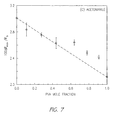
- Figs. 5-10 depict plots of ⁇ R max / R b for the polymer bland chemiresistors upon exposure to acetate, ethanol, acetonitrile, acetone, and methanol.
- a statistically significant nonlinearity was observed for the detector response versus the mole fraction of the base polymer feedstocks. Since the nonlinearity is not the same for all solvents, this indicates that useful information is available through use of such compatible blend materials in a detector array for vapor classification.
- detector arrays which can resolve analytes at one concentration can also be used to resolve analytes at other concentrations.
- the detector responses were autoscaled to account for the different dynamic ranges of different detectors.
- , between two analytes, a and b, in the Euclidean detector response space is then simply the magnitude of the difference between x a ⁇ and x b ⁇ .
- the reproducibility of the array responses to the analytes is also important in quantifying the resolving power of the array.
- a measure of array response reproducibility to analyte, a , x a ⁇ is obtained by projecting the array response vectors for each exposure to analyte a onto the vector d , and calculating the standard deviation in these scalar projections about the projection of the mean response vector, x a ⁇ onto d ⁇ .
- This metric allows quantification of the ability to resolve pairwise the vapors of concern in the test analyte set based on the response patters that they produce on the detector array. Because the functional form of the response of the various polymer composite chemiresistors was very similar, this procedure can be used to provide an objective measure of array performance, as opposed to performing a subjective assessment of the performance of task-specific neural network classifiers on functionally dissimilar responses of various array elements. It is important to realize, however, that the results are nevertheless coupled to the metric used to evaluate the response and that different algorithms, such as, for example, Fisher linear discriminants, which are linear data analysis methods that are not confined to pass through the mean response values of the analytes of concern, may well yield different conclusions from the same response data.
- Fisher linear discriminants which are linear data analysis methods that are not confined to pass through the mean response values of the analytes of concern, may well yield different conclusions from the same response data.
- the performance of each studies array was measured by its ability to resolve the solvents pairwise, as given by the calculated rf values obtained using the simple linear data analysis method described above.
- Results are presented for four sets of detectors.
- Set A contained all 14 detectors with 0% PVA and all 15 detectors with 100% PVA (i.e., all the base polymer detectors).
- Set B contained all 99 of the prepared detectors ranging from 0% through to 100% PVA content.
- Set C contained only the 10 detectors with 91% PVA.
- Set D contained all 14 of the 0% PVA detectors, all 10 of the 91% PVA detectors, and all 15 of the 100% PVA detectors.
- the results for set A, set B, and set D were obtained by averaging over 500 randomly selected 8-detector arrays composed of only the detectors within each respective set.
- the results for set C were obtained by averaging over all 45 possible 8-detector combinations of the detectors within the set.
- Set A contained all 14 of the 0% PVA detectors and all 15 of the 100% PVA detectors (i.e., all the base polymer detectors).
- Set B contained all 99 of the prepared detectors ranging from 0% to 100% PVA content.
- Set C contained only the 10 detectors with 91% PVA.
- Set D contained all 14 of the 0% PVA detectors, all 10 of the 91% PVA detectors, and all 15 of the 100% PVA detectors.
- compatible blend detectors produced a statistically significant improvement in maximizing the overall average rf, which is the average ability of all calculated 8-detector array combinations within a set of detectors to resolve all analyte pairs using the metric defined above.
- sets B, C, and D which contained compatible blend detectors, had overall average rf's of 60, 81, and 60, respectively, whereas the base polymer detector arrays (set A) had an overall average rf of 52.
- acetone that was worst resolved by set A (base polymer detectors) could also be improved by using 8-detector arrays containing only 91% PVA detectors (set C) or by including these detectors in arrays that contained the base polymer detectors (set D).
Landscapes
- Chemical & Material Sciences (AREA)
- Health & Medical Sciences (AREA)
- Physics & Mathematics (AREA)
- Life Sciences & Earth Sciences (AREA)
- General Health & Medical Sciences (AREA)
- Pathology (AREA)
- Engineering & Computer Science (AREA)
- Immunology (AREA)
- General Physics & Mathematics (AREA)
- Chemical Kinetics & Catalysis (AREA)
- Analytical Chemistry (AREA)
- Biochemistry (AREA)
- Organic Chemistry (AREA)
- Medicinal Chemistry (AREA)
- Food Science & Technology (AREA)
- Combustion & Propulsion (AREA)
- Plasma & Fusion (AREA)
- Electrochemistry (AREA)
- Investigating Or Analyzing Materials By The Use Of Fluid Adsorption Or Reactions (AREA)
- Investigating Or Analyzing Materials By The Use Of Electric Means (AREA)
- Polymerisation Methods In General (AREA)
- Addition Polymer Or Copolymer, Post-Treatments, Or Chemical Modifications (AREA)
- Compositions Of Macromolecular Compounds (AREA)
- Investigating Or Analyzing Materials By The Use Of Magnetic Means (AREA)
- Investigating Or Analyzing Materials By The Use Of Ultrasonic Waves (AREA)
Claims (21)
- Sensor-Array zum Detektieren eines Analyten in einem Fluid, umfassend:ein Substrat mit einem Array von Sensoren, wobei jeder Sensor eine Kombination eines ersten organischen Materials in einer Konzentration und eines zweiten organischen Materials in einer Konzentration umfasst, wobei mindestens ein Sensor ein ineinandergreifendes Netzwerk ist, umfassend ein erstes organisches Material, welches ein erstes Polymer ist, und ein zweites organisches Material, welches ein zweites Polymer, gebildet aus einem in Gegenwart des ersten Polymers polymerisierten Monomer, ist; undeinen Detektor, der operativ mit jedem der Sensoren verbunden ist;wobei das erste organische Material von dem zweiten organischen Material verschieden ist, und dadurch gekennzeichnet ist, dass die Zahl der in der Zusammensetzung unterschiedlichen Sensoren, die durch Kombinieren unterschiedlicher Verhältnisse des ersten und zweiten organischen Materials gebildet werden, größer ist als die Zahl von unterschiedlichen organischen Materialien, welche die Sensoren bilden.
- Sensor-Array gemäß Anspruch 1,(i) wobei jeder Sensor einen chemisch empfindlichen Widerstand umfasst und/oder(ii) wobei das erste organische Material ein nichtleitendes organisches Material ist und/oder(iii) wobei das zweite organische Material ein nichtleitendes organisches Material ist.
- Sensor-Array gemäß Anspruch 1 oder 2, wobei jeder Sensor weiter ein leitendes Material umfasst.
- Sensor-Array gemäß mindestens einem der vorausgehenden Ansprüche, wobei der Detektor eine elektrische Messapparatur ist, die elektrisch mit den Sensoren verbunden ist.
- Sensor-Array gemäß Anspruch 1, wobei das erste organische Material aus einem Copolymer, einem Homopolymer oder Blockcopolymer gewählt ist und/oder wobei das erste und zweite organische Material Homopolymere sind.
- Sensor-Array gemäß Anspruch 1, umfassend:einen ersten Sensor, umfassend eine Kombination eines ersten organischen Materials in einer Konzentration und eines zweiten organischen Materials in einer Konzentration, mit der Maßgabe, dass das erste organische Material von dem zweiten organischen Material verschieden ist und der Sensor ein ineinandergreifendes Netzwerk ist, umfassend ein erstes Polymer und ein zweites Polymer, gebildet aus einem in Gegenwart des ersten Polymers polymerisierten Monomer; undeinen zweiten Sensor, umfassend eine Kombination eines ersten organischen Materials in einer Konzentration und eines zweiten organischen Materials in einer Konzentration, mit der Maßgabe, dass das erste organische Material von dem zweiten organischen Material verschieden ist und die Konzentration des ersten organischen Materials des ersten Sensor von der Konzentration des ersten organischen Materials des zweiten Sensor verschieden ist.
- Sensor-Array gemäß Anspruch 6,(i) wobei jeder Sensor einen chemisch empfindlichen Widerstand umfasst und/oder(ii) wobei das erste organische Material ein nichtleitendes organisches Material ist und/oder(iii) wobei das zweite organische Material ein nichtleitendes organisches Material ist.
- Sensor-Array gemäß Anspruch 6 oder 7, wobei der erste und zweite Sensor ferner ein leitendes Material umfasst.
- Sensor-Array gemäß mindestens einem der Ansprüche 6 bis 8, wobei der Detektor eine elektrische Messapparatur ist, die elektrisch mit den Sensoren verbunden ist.
- Sensor-Array gemäß mindestens einem der Ansprüche 6 bis 9, wobei das erste organische Material des ersten Sensors aus einem Copolymer, einem Homopolymer oder Blockcopolymer gewählt ist und/oder wobei das erste und zweite organische Material des ersten Sensors Homopolymere sind.
- Sensor gemäß Anspruch 2, wobei jeder Sensor einen chemisch empfindlichen Widerstand umfasst, umfassend eine Kombination eines ersten nichtleitenden organischen Materials in einer Konzentration, eines zweiten nichtleitenden organischen Materials in einer Konzentration und eines leitenden Materials; und
wobei der Detektor eine elektrische Messapparatur ist, die mit den Array-Sensoren verbunden ist. - Sensor-Array gemäß Anspruch 11, wobei ein erster Array-Sensor sich von einem zweiten Array-Sensor in der Konzentration des ersten nichtleitenden organischen Materials unterscheidet und/oder wobei das erste und zweite nichtleitende organische Material nichtleitende organische Polymere sind.
- Sensor gemäß einem der Ansprüche 11 oder 12, wobei jedes nichtleitende organische Polymer gewählt ist aus der Gruppe bestehend aus Hauptkettenkohlenstoffpolymeren, organischen Hauptketten-Acrylheteroatompolymeren und heterocyclischen Hauptkettenpolymeren.
- Sensor-Array gemäß mindestens einem der Ansprüche 11 bis 13, wobei die Hauptkettenkohlenstoffpolymere gewählt sind aus der Gruppe bestehend aus Poly(dienen), Poly(alenen), Poly(acrylen), Poly(methacrylen), Poly(vinylethem), Poly(vinylthioethem), Poly(vinylalkoholen), Poly(vinylketonen), Poly(vinylhalogeniden), Poly(vinylnitrilen), Poly(vinylestem), Poly(styrolen) und Poly(arylenen).
- Sensor-Array gemäß mindestens einem der Ansprüche 11 bis 14, wobei die organischen Hauptketten-Acrylheteroatompolymere gewählt sind aus der Gruppe bestehend aus Poly(oxiden), Poly(carbonaten), Poly(estem), Poly(anhydriden), Poly(urethanen), Poly-(sulfonaten), Poly(siloxanen), Poly(sulfiden), Polythioestem, Poly(sulfonen), Poly-(sulfonamiden), Poly(amiden), Poly(harnstoffen), Poly(phosphazenen), Poly(silanen) und Poly(silazanen).
- Sensor-Array gemäß mindestens einem der Ansprüche 11 bis 15, wobei die heterocyclischen Hauptkettenpolymere gewählt sind aus der Gruppe bestehend aus Poly(furantetracarbonsäurediimiden), Poly(benzoxazolen), Poly(oxadiazolen), Poly(benzothiazino-phenothiazinen), Poly(benzothiazolen), Poly(pyrazinochin-oxalinen), Poly(pyrromellitimiden), Poly(chinoalinen), Poly(benzimidazolen), Poly(oxindolen), Poly(oxoisoindolinen), Poly(dioxoisoindolinen), Poly(triazinen), Poly(pyridazinen), Poly(piperazinen), Poly(pyridinen), Poly(piperidinen), Poly(triazolen), Poly(pyrazolen), Poly(pyrrolidinen), Poly(carboranen), Poly(oxabicyclononanen), Poly(dibenzofuranen), Poly(phthaliden), Poly(acetalen), Poly(anhydriden) und Kohlenhydraten.
- Sensor-Array gemäß mindestens einem der Ansprüche 11 bis 16, wobei das erste nichtleitende Polymer Polyvinylacetat ist und das zweite nichtleitende Polymer Polymethylmethacrylat ist.
- Sensor-Array gemäß Anspruch 11, wobei die Konzentration des ersten nichtleitenden organischen Materials eines ersten Widerstands sich von der Konzentration des ersten nichtleitenden organischen Materials eines zweiten Widerstands unterscheidet.
- Sensor-Array gemäß Anspruch 11, wobei das erste nichtleitende organische Material eines zweiten Widerstands dasselbe ist wie das erste nichtleitende organische Material eines ersten Widerstands und die Konzentration des ersten nichtleitenden organischen Materials des ersten Widerstands dieselbe ist wie die Konzentration des ersten nichtleitenden organischen Materials des zweiten Widerstands.
- Verfahren zum Detektieren des Vorhandenseins eines Analyten in einem Fluid, umfassend die folgenden Schritte:Bereitstellen eines Sensor-Arrays gemäß Anspruch 18:
wobei der erste und zweite chemisch empfindliche Widerstand eine Widerstandsantwortreaktion bezüglich Permeation durch das besagte Fluid und eine Widerstandsantwortreaktion bezüglich Permeation durch den besagten Analyten aufweist, wobei die Widerstände dem Fluid ausgesetzt werden;
Messen der Widerstandsantwortreaktionen, die auftreten, wenn die Widerstände durch das Fluid permeiert werden; und
Vergleichen der gemessenen Widerstandsantwortreaktion des ersten Widerstands mit der Widerstandsantwortreaktion bezüglich Permeation durch den Analyten des ersten Widerstands und Vergleichen der gemessenen Widerstandsantwortreaktion des zweiten Widerstands mit der Widerstandsantwortreaktion bezüglich Permeation durch den Analyten des zweiten Widerstands zur Bestimmung des Vorhandenseins des Analyten in dem Fluid. - Verfahren zur Fertigung eines Arrays von chemisch empfindlichen Sensoren gemäß Anspruch 1 aus einer begrenzten Zahl von Einsatzproduktlösungen von nichtleitenden organischen Materialien, umfassend die folgenden Schritte:Bereitstellen einer ersten Einsatzproduktlösung eines ersten organischen Materials in einer Konzentration x in einem ersten Lösungsmittel, einer zweiten Einsatzproduktlösung eines zweiten organischen Materials in einer Konzentration y in einem zweiten Lösungsmittel, einer zweiten Einsatzproduktlösung eines zweiten organischen Materials in einer Konzentration y + b in einem zweiten Lösungsmittel, einer zweiten Einsatzproduktlösung eines zweiten organischen Materials in einer Konzentration y + c in einem zweiten Lösungsmittel und eines Substrats mit einer ersten präselektierten Region, einer zweiten präselektierten Region und einer dritten präselektierten Region;Kontaktieren jeder von der ersten, zweiten und dritten Region mit der ersten Einsatzproduktlösung in der Konzentration x;Kontaktieren der ersten Region mit der zweiten Einsatzproduktlösung in der Konzentration y;Kontaktieren der zweiten Region mit der zweiten Einsatzproduktlösung in der Konzentration y + b; undKontaktieren der dritten Region mit der zweiten Einsatzproduktlösung in der Konzentration y + c;wobei das erste organische Material sich von dem zweiten organischen Material unterscheidet, wobei y, y + b und y + c jeweils unterschiedliche Konzentrationen sind, und wobei die Gesamtzahl der gefertigten Sensoren, und zwar einem an jeder präselektierten Region, größer als die Zahl der für die Fertigung der Sensoren verwendeten Einsatzproduktlösungen ist.
Applications Claiming Priority (3)
| Application Number | Priority Date | Filing Date | Title |
|---|---|---|---|
| US5120397P | 1997-06-30 | 1997-06-30 | |
| US51203P | 1997-06-30 | ||
| PCT/US1998/013486 WO1999000663A1 (en) | 1997-06-30 | 1998-06-29 | Compositionally different polymer-based sensor elements and methods for preparing same |
Publications (2)
| Publication Number | Publication Date |
|---|---|
| EP0993605A1 EP0993605A1 (de) | 2000-04-19 |
| EP0993605B1 true EP0993605B1 (de) | 2008-05-21 |
Family
ID=21969947
Family Applications (1)
| Application Number | Title | Priority Date | Filing Date |
|---|---|---|---|
| EP98931709A Expired - Lifetime EP0993605B1 (de) | 1997-06-30 | 1998-06-29 | Mit verschiedenen polymerzusammensetzungen hergestellten sensoren und verfahren zu deren herstellung |
Country Status (8)
| Country | Link |
|---|---|
| US (2) | US6290911B1 (de) |
| EP (1) | EP0993605B1 (de) |
| JP (2) | JP4054384B2 (de) |
| AT (1) | ATE396395T1 (de) |
| AU (1) | AU741702B2 (de) |
| CA (1) | CA2294173C (de) |
| DE (1) | DE69839515D1 (de) |
| WO (1) | WO1999000663A1 (de) |
Families Citing this family (40)
| Publication number | Priority date | Publication date | Assignee | Title |
|---|---|---|---|---|
| JP4163383B2 (ja) * | 1998-04-14 | 2008-10-08 | カリフォルニア・インスティテュート・オブ・テクノロジー | 検体活性を判定するための方法とシステム |
| AU4707699A (en) * | 1998-06-23 | 2000-01-10 | California Institute Of Technology | Polymer/plasticizer based sensors |
| EP1090293B2 (de) | 1998-06-24 | 2019-01-23 | Illumina, Inc. | Dekodierung von matrixartig-angeordneten Sensoren durch Mikropartikel |
| AU6131299A (en) * | 1998-08-26 | 2000-03-21 | Trustees Of Tufts College | Combinatorial polymer synthesis of sensors for polymer-based sensor arrays |
| WO2000020852A1 (en) | 1998-10-02 | 2000-04-13 | California Institute Of Technology | Conductive organic sensors, arrays and methods of use |
| AU1725200A (en) | 1998-11-16 | 2000-06-05 | California Institute Of Technology | Simultaneous determination of equilibrium and kinetic properties |
| US7113069B1 (en) * | 1999-11-30 | 2006-09-26 | Smiths Detection Inc. | Aligned particle based sensor elements |
| US6477479B1 (en) | 1998-12-11 | 2002-11-05 | Symyx Technologies | Sensor array for rapid materials characterization |
| EP1055121A1 (de) * | 1998-12-11 | 2000-11-29 | Symyx Technologies, Inc. | Vorrichtung mit einer sensorarray anordnung und geeignetes verfharen zur schnellen materialcharacterisierung |
| US6438497B1 (en) | 1998-12-11 | 2002-08-20 | Symyx Technologies | Method for conducting sensor array-based rapid materials characterization |
| US7122152B2 (en) * | 1999-05-10 | 2006-10-17 | University Of Florida | Spatiotemporal and geometric optimization of sensor arrays for detecting analytes fluids |
| US6455319B1 (en) | 1999-05-10 | 2002-09-24 | California Institute Of Technology | Use of spatiotemporal response behavior in sensor arrays to detect analytes in fluids |
| US6631333B1 (en) * | 1999-05-10 | 2003-10-07 | California Institute Of Technology | Methods for remote characterization of an odor |
| US6890715B1 (en) * | 1999-08-18 | 2005-05-10 | The California Institute Of Technology | Sensors of conducting and insulating composites |
| GB2360776A (en) * | 2000-03-28 | 2001-10-03 | Sharp Kk | Oligomers or polymers of benzofuran, benzothiophene or indole |
| US7527821B2 (en) * | 2000-05-02 | 2009-05-05 | Smiths Detection Inc. | Sensor fabricating method |
| DE10031555B4 (de) * | 2000-06-28 | 2010-04-15 | Robert Bosch Gmbh | Optischer Sensor |
| US20020142304A1 (en) * | 2001-03-09 | 2002-10-03 | Anderson Daniel G. | Uses and methods of making microarrays of polymeric biomaterials |
| US20030154031A1 (en) * | 2002-02-14 | 2003-08-14 | General Electric Company | Method and apparatus for the rapid evaluation of a plurality of materials or samples |
| US20040028804A1 (en) * | 2002-08-07 | 2004-02-12 | Anderson Daniel G. | Production of polymeric microarrays |
| US20050019747A1 (en) * | 2002-08-07 | 2005-01-27 | Anderson Daniel G. | Nanoliter-scale synthesis of arrayed biomaterials and screening thereof |
| US6994777B2 (en) * | 2002-09-04 | 2006-02-07 | Lynntech, Inc. | Chemical sensors utilizing conducting polymer compositions |
| US20050150778A1 (en) * | 2002-11-18 | 2005-07-14 | Lewis Nathan S. | Use of basic polymers in carbon black composite vapor detectors to obtain enhanced sensitivity and classification performance for volatile fatty acids |
| WO2004065000A1 (en) | 2003-01-21 | 2004-08-05 | Illumina Inc. | Chemical reaction monitor |
| JP3890413B2 (ja) * | 2003-03-12 | 2007-03-07 | 独立行政法人産業技術総合研究所 | ガスセンサ及びその製造方法 |
| US9317922B2 (en) * | 2003-05-16 | 2016-04-19 | Board Of Regents The University Of Texas System | Image and part recognition technology |
| US20050136536A1 (en) * | 2003-09-15 | 2005-06-23 | Anderson Daniel G. | Embryonic epithelial cells |
| US7279131B2 (en) * | 2004-07-01 | 2007-10-09 | Uop Llc | Method and apparatus for mass analysis of samples |
| US7460958B2 (en) * | 2004-10-07 | 2008-12-02 | E.I. Du Pont De Nemours And Company | Computer-implemented system and method for analyzing mixtures of gases |
| WO2006044368A1 (en) * | 2004-10-12 | 2006-04-27 | Bioprocessors Corp. | Microreactors incorporating interpenetrating and/or semi-interpenetrating polymers |
| US20080008625A1 (en) * | 2004-10-27 | 2008-01-10 | Thomas Ross C | Infrared sensor |
| JP4805283B2 (ja) * | 2007-03-22 | 2011-11-02 | 信越化学工業株式会社 | マイクロアレイ作製用基板の製造方法 |
| US8980640B2 (en) * | 2009-12-02 | 2015-03-17 | The Research Foundation Of State University Of New York | Selective chemosensors based on the ferroelectric materials, mixed oxides, or temperature modulation of oxide polymorph stability |
| US9448180B2 (en) | 2009-12-15 | 2016-09-20 | Flir Detection, Inc. | Multi-analyte detection system and method |
| US8920731B2 (en) | 2010-09-20 | 2014-12-30 | Kimberly-Clark Worldwide, Inc. | Nonwoven-based chemi-capacitive or chemi-resistive gas sensor |
| JP6682412B2 (ja) | 2016-09-20 | 2020-04-15 | 株式会社東芝 | 分子検出装置 |
| CA3000385A1 (en) * | 2017-04-11 | 2018-10-11 | Syscor Controls & Automation Inc. | Polymer absorption sensor having low cross-sensitivity |
| US11331019B2 (en) | 2017-08-07 | 2022-05-17 | The Research Foundation For The State University Of New York | Nanoparticle sensor having a nanofibrous membrane scaffold |
| CA3087304C (en) | 2017-12-30 | 2024-04-30 | Mark Alan Lemkin | Cannabinoid processing system and method |
| WO2025179388A1 (en) * | 2024-03-01 | 2025-09-04 | Stratuscent Inc. | A system and method for designing an analyte sensing system |
Citations (1)
| Publication number | Priority date | Publication date | Assignee | Title |
|---|---|---|---|---|
| US5571401A (en) * | 1995-03-27 | 1996-11-05 | California Institute Of Technology | Sensor arrays for detecting analytes in fluids |
Family Cites Families (26)
| Publication number | Priority date | Publication date | Assignee | Title |
|---|---|---|---|---|
| US3045198A (en) | 1959-12-11 | 1962-07-17 | James P Dolan | Detection device |
| DE3305683C2 (de) * | 1983-02-18 | 1986-08-14 | Murata Manufacturing Co., Ltd., Nagaokakyo, Kyoto | Feuchtigkeitsmeßfühler |
| US4542640A (en) | 1983-09-15 | 1985-09-24 | Clifford Paul K | Selective gas detection and measurement system |
| FR2564092B1 (fr) * | 1984-05-10 | 1988-06-10 | Commissariat Energie Atomique | Complexes organiques amphiphiles a transfert de charge, conducteurs de l'electricite ou precurseurs de conducteurs de l'electricite |
| US4631952A (en) | 1985-08-30 | 1986-12-30 | Chevron Research Company | Resistive hydrocarbon leak detector |
| US4759210A (en) | 1986-06-06 | 1988-07-26 | Microsensor Systems, Inc. | Apparatus for gas-monitoring and method of conducting same |
| FR2601136B1 (fr) | 1986-07-03 | 1989-05-12 | Commissariat Energie Atomique | Procede et dispositif de detection d'especes moleculaires ou ioniques |
| GB8702390D0 (en) | 1987-02-03 | 1987-03-11 | Warwick University Of | Identifying/measuring odorants |
| US4855706A (en) | 1987-09-11 | 1989-08-08 | Hauptly Paul D | Organic liquid detector |
| US4992244A (en) | 1988-09-27 | 1991-02-12 | The United States Of America As Represented By The Secretary Of The Navy | Films of dithiolene complexes in gas-detecting microsensors |
| US5256574A (en) | 1989-06-26 | 1993-10-26 | Bell Communications Research, Inc. | Method for selective detection of liquid phase hydrocarbons |
| US5045285A (en) | 1989-09-05 | 1991-09-03 | United States Of America As Represented By The Secretary Of The Air Force | Gaseous component identification with polymeric film sensor |
| US5120421A (en) | 1990-08-31 | 1992-06-09 | The United States Of America As Represented By The United States Department Of Energy | Electrochemical sensor/detector system and method |
| GB9116360D0 (en) | 1991-07-29 | 1991-09-11 | Neotronics Ltd | Device for sensing volatile materials |
| US5512882A (en) | 1991-08-07 | 1996-04-30 | Transducer Research, Inc. | Chemical sensing apparatus and methods |
| US5654497A (en) | 1992-03-03 | 1997-08-05 | Lockheed Martin Energy Systems, Inc. | Motor vehicle fuel analyzer |
| DE4241438C2 (de) * | 1992-06-27 | 1995-06-14 | Draegerwerk Ag | Sensor zum Nachweis von Analyten in einem fluiden Medium |
| JP2546608B2 (ja) | 1992-06-27 | 1996-10-23 | ドレーゲルヴェルク アクチェンゲゼルシャフト | 流体媒体中の被検体を検出するためのセンサおよびその製造方法 |
| US5417100A (en) | 1993-03-10 | 1995-05-23 | Hughes Aircraft Company | Reversible sensor for detecting solvent vapors |
| JP3299623B2 (ja) | 1994-03-23 | 2002-07-08 | 能美防災株式会社 | 臭い圧測定方法、臭い圧基準化方法、臭い検知装置、及び火災検知装置 |
| GB9417913D0 (en) | 1994-09-06 | 1994-10-26 | Univ Leeds | Odour sensor |
| US5985356A (en) * | 1994-10-18 | 1999-11-16 | The Regents Of The University Of California | Combinatorial synthesis of novel materials |
| DE19509518C2 (de) * | 1995-03-20 | 1997-08-28 | Inst Chemo Biosensorik | Vorrichtung zur Detektion organischer Komponenten und Lösungsmitteldämpfen in der Luft |
| US5675070A (en) | 1996-02-09 | 1997-10-07 | Ncr Corporation | Olfatory sensor identification system and method |
| GB9604627D0 (en) | 1996-03-04 | 1996-05-01 | Neotronics Ltd | Sensor for volatile materials and gases |
| US5788883A (en) * | 1996-03-29 | 1998-08-04 | General Electric Company | Determination process for determining if quantum splitting phosphors are obtained and novel compositions |
-
1998
- 1998-06-29 EP EP98931709A patent/EP0993605B1/de not_active Expired - Lifetime
- 1998-06-29 WO PCT/US1998/013486 patent/WO1999000663A1/en not_active Ceased
- 1998-06-29 CA CA002294173A patent/CA2294173C/en not_active Expired - Fee Related
- 1998-06-29 DE DE69839515T patent/DE69839515D1/de not_active Expired - Lifetime
- 1998-06-29 AT AT98931709T patent/ATE396395T1/de not_active IP Right Cessation
- 1998-06-29 AU AU81755/98A patent/AU741702B2/en not_active Ceased
- 1998-06-29 US US09/106,791 patent/US6290911B1/en not_active Expired - Lifetime
- 1998-06-29 JP JP50584999A patent/JP4054384B2/ja not_active Expired - Fee Related
-
2001
- 2001-01-24 US US09/770,089 patent/US7175885B2/en not_active Expired - Fee Related
-
2007
- 2007-07-02 JP JP2007174666A patent/JP2007286070A/ja not_active Withdrawn
Patent Citations (1)
| Publication number | Priority date | Publication date | Assignee | Title |
|---|---|---|---|---|
| US5571401A (en) * | 1995-03-27 | 1996-11-05 | California Institute Of Technology | Sensor arrays for detecting analytes in fluids |
Also Published As
| Publication number | Publication date |
|---|---|
| US6290911B1 (en) | 2001-09-18 |
| JP2007286070A (ja) | 2007-11-01 |
| AU741702B2 (en) | 2001-12-06 |
| JP4054384B2 (ja) | 2008-02-27 |
| AU8175598A (en) | 1999-01-19 |
| CA2294173A1 (en) | 1999-01-07 |
| WO1999000663A1 (en) | 1999-01-07 |
| JP2002508064A (ja) | 2002-03-12 |
| ATE396395T1 (de) | 2008-06-15 |
| EP0993605A1 (de) | 2000-04-19 |
| DE69839515D1 (de) | 2008-07-03 |
| US20060099113A1 (en) | 2006-05-11 |
| US7175885B2 (en) | 2007-02-13 |
| CA2294173C (en) | 2007-08-14 |
Similar Documents
| Publication | Publication Date | Title |
|---|---|---|
| EP0993605B1 (de) | Mit verschiedenen polymerzusammensetzungen hergestellten sensoren und verfahren zu deren herstellung | |
| JP3963474B2 (ja) | 流体中のアナライトを検出するためのセンサアレイ | |
| EP1019715B1 (de) | Techniken und systeme zum nachweis von analyten | |
| US5951846A (en) | Sensor arrays for detecting analytes in fluids | |
| EP0918986A1 (de) | Sensoren zur feststellung von analyten in flüssigkeiten | |
| US6752964B1 (en) | Polymer/plasticizer based sensors | |
| US20050241935A1 (en) | Colloidal particles used in sensing array | |
| WO1999067627A1 (en) | Polymer/plasticizer based sensors | |
| EP1555527A1 (de) | Anordnung chemisch sensitiver Kapazitoren | |
| Lewis et al. | Sensor arrays for detecting analytes in fluids | |
| Lewis et al. | Sensor arrays for detecting microorganisms | |
| MXPA97007351A (en) | Sensor arrangements to detect enflui analytes |
Legal Events
| Date | Code | Title | Description |
|---|---|---|---|
| PUAI | Public reference made under article 153(3) epc to a published international application that has entered the european phase |
Free format text: ORIGINAL CODE: 0009012 |
|
| 17P | Request for examination filed |
Effective date: 20000128 |
|
| AK | Designated contracting states |
Kind code of ref document: A1 Designated state(s): AT BE CH CY DE DK ES FI FR GB GR IE IT LI LU MC NL PT SE |
|
| AX | Request for extension of the european patent |
Free format text: AL PAYMENT 20000128;LT PAYMENT 20000128;LV PAYMENT 20000128;MK PAYMENT 20000128;RO PAYMENT 20000128;SI PAYMENT 20000128 |
|
| RIN1 | Information on inventor provided before grant (corrected) |
Inventor name: SEVERIN, ERIK Inventor name: SANNER, ROBERT,LAWRENCE LIVERMORE NATIONAL LAB. Inventor name: DOLEMAN, BRETT Inventor name: GRUBBS, ROBERT, H. Inventor name: LEWIS, NATHAN, S. |
|
| 17Q | First examination report despatched |
Effective date: 20050330 |
|
| 17Q | First examination report despatched |
Effective date: 20050330 |
|
| RIN1 | Information on inventor provided before grant (corrected) |
Inventor name: SEVERIN, ERIK Inventor name: SANNER, ROBERT,LAWRENCE LIVERMORE NATIONAL LAB. Inventor name: DOLEMAN, BRETT Inventor name: GRUBBS, ROBERT, H. Inventor name: LEWIS, NATHAN, S. |
|
| GRAP | Despatch of communication of intention to grant a patent |
Free format text: ORIGINAL CODE: EPIDOSNIGR1 |
|
| GRAS | Grant fee paid |
Free format text: ORIGINAL CODE: EPIDOSNIGR3 |
|
| GRAA | (expected) grant |
Free format text: ORIGINAL CODE: 0009210 |
|
| AK | Designated contracting states |
Kind code of ref document: B1 Designated state(s): AT BE CH CY DE DK ES FI FR GB GR IE IT LI LU MC NL PT SE |
|
| AX | Request for extension of the european patent |
Extension state: AL LT LV MK RO SI |
|
| REG | Reference to a national code |
Ref country code: GB Ref legal event code: FG4D |
|
| REG | Reference to a national code |
Ref country code: CH Ref legal event code: EP |
|
| REF | Corresponds to: |
Ref document number: 69839515 Country of ref document: DE Date of ref document: 20080703 Kind code of ref document: P |
|
| REG | Reference to a national code |
Ref country code: IE Ref legal event code: FG4D |
|
| PG25 | Lapsed in a contracting state [announced via postgrant information from national office to epo] |
Ref country code: FI Free format text: LAPSE BECAUSE OF FAILURE TO SUBMIT A TRANSLATION OF THE DESCRIPTION OR TO PAY THE FEE WITHIN THE PRESCRIBED TIME-LIMIT Effective date: 20080521 Ref country code: ES Free format text: LAPSE BECAUSE OF FAILURE TO SUBMIT A TRANSLATION OF THE DESCRIPTION OR TO PAY THE FEE WITHIN THE PRESCRIBED TIME-LIMIT Effective date: 20080901 |
|
| NLV1 | Nl: lapsed or annulled due to failure to fulfill the requirements of art. 29p and 29m of the patents act | ||
| PG25 | Lapsed in a contracting state [announced via postgrant information from national office to epo] |
Ref country code: NL Free format text: LAPSE BECAUSE OF FAILURE TO SUBMIT A TRANSLATION OF THE DESCRIPTION OR TO PAY THE FEE WITHIN THE PRESCRIBED TIME-LIMIT Effective date: 20080521 Ref country code: AT Free format text: LAPSE BECAUSE OF FAILURE TO SUBMIT A TRANSLATION OF THE DESCRIPTION OR TO PAY THE FEE WITHIN THE PRESCRIBED TIME-LIMIT Effective date: 20080521 |
|
| PG25 | Lapsed in a contracting state [announced via postgrant information from national office to epo] |
Ref country code: SE Free format text: LAPSE BECAUSE OF FAILURE TO SUBMIT A TRANSLATION OF THE DESCRIPTION OR TO PAY THE FEE WITHIN THE PRESCRIBED TIME-LIMIT Effective date: 20080821 Ref country code: PT Free format text: LAPSE BECAUSE OF FAILURE TO SUBMIT A TRANSLATION OF THE DESCRIPTION OR TO PAY THE FEE WITHIN THE PRESCRIBED TIME-LIMIT Effective date: 20081021 Ref country code: MC Free format text: LAPSE BECAUSE OF NON-PAYMENT OF DUE FEES Effective date: 20080630 Ref country code: DK Free format text: LAPSE BECAUSE OF FAILURE TO SUBMIT A TRANSLATION OF THE DESCRIPTION OR TO PAY THE FEE WITHIN THE PRESCRIBED TIME-LIMIT Effective date: 20080521 |
|
| REG | Reference to a national code |
Ref country code: CH Ref legal event code: PL |
|
| PG25 | Lapsed in a contracting state [announced via postgrant information from national office to epo] |
Ref country code: BE Free format text: LAPSE BECAUSE OF FAILURE TO SUBMIT A TRANSLATION OF THE DESCRIPTION OR TO PAY THE FEE WITHIN THE PRESCRIBED TIME-LIMIT Effective date: 20080521 |
|
| PLBE | No opposition filed within time limit |
Free format text: ORIGINAL CODE: 0009261 |
|
| STAA | Information on the status of an ep patent application or granted ep patent |
Free format text: STATUS: NO OPPOSITION FILED WITHIN TIME LIMIT |
|
| 26N | No opposition filed |
Effective date: 20090224 |
|
| PG25 | Lapsed in a contracting state [announced via postgrant information from national office to epo] |
Ref country code: IE Free format text: LAPSE BECAUSE OF NON-PAYMENT OF DUE FEES Effective date: 20080629 |
|
| PG25 | Lapsed in a contracting state [announced via postgrant information from national office to epo] |
Ref country code: LI Free format text: LAPSE BECAUSE OF NON-PAYMENT OF DUE FEES Effective date: 20080630 Ref country code: CH Free format text: LAPSE BECAUSE OF NON-PAYMENT OF DUE FEES Effective date: 20080630 |
|
| PG25 | Lapsed in a contracting state [announced via postgrant information from national office to epo] |
Ref country code: IT Free format text: LAPSE BECAUSE OF FAILURE TO SUBMIT A TRANSLATION OF THE DESCRIPTION OR TO PAY THE FEE WITHIN THE PRESCRIBED TIME-LIMIT Effective date: 20080521 |
|
| PG25 | Lapsed in a contracting state [announced via postgrant information from national office to epo] |
Ref country code: LU Free format text: LAPSE BECAUSE OF NON-PAYMENT OF DUE FEES Effective date: 20080629 |
|
| PG25 | Lapsed in a contracting state [announced via postgrant information from national office to epo] |
Ref country code: CY Free format text: LAPSE BECAUSE OF FAILURE TO SUBMIT A TRANSLATION OF THE DESCRIPTION OR TO PAY THE FEE WITHIN THE PRESCRIBED TIME-LIMIT Effective date: 20080521 |
|
| PG25 | Lapsed in a contracting state [announced via postgrant information from national office to epo] |
Ref country code: GR Free format text: LAPSE BECAUSE OF FAILURE TO SUBMIT A TRANSLATION OF THE DESCRIPTION OR TO PAY THE FEE WITHIN THE PRESCRIBED TIME-LIMIT Effective date: 20080822 |
|
| PGFP | Annual fee paid to national office [announced via postgrant information from national office to epo] |
Ref country code: FR Payment date: 20110621 Year of fee payment: 14 |
|
| REG | Reference to a national code |
Ref country code: FR Ref legal event code: ST Effective date: 20130228 |
|
| PG25 | Lapsed in a contracting state [announced via postgrant information from national office to epo] |
Ref country code: FR Free format text: LAPSE BECAUSE OF NON-PAYMENT OF DUE FEES Effective date: 20120702 |
|
| PGFP | Annual fee paid to national office [announced via postgrant information from national office to epo] |
Ref country code: DE Payment date: 20160622 Year of fee payment: 19 Ref country code: GB Payment date: 20160629 Year of fee payment: 19 |
|
| REG | Reference to a national code |
Ref country code: DE Ref legal event code: R119 Ref document number: 69839515 Country of ref document: DE |
|
| GBPC | Gb: european patent ceased through non-payment of renewal fee |
Effective date: 20170629 |
|
| PG25 | Lapsed in a contracting state [announced via postgrant information from national office to epo] |
Ref country code: DE Free format text: LAPSE BECAUSE OF NON-PAYMENT OF DUE FEES Effective date: 20180103 Ref country code: GB Free format text: LAPSE BECAUSE OF NON-PAYMENT OF DUE FEES Effective date: 20170629 |