EP0994580A1 - Procédé de transmission dans un système de radiocommunication du type à accès multiple - Google Patents
Procédé de transmission dans un système de radiocommunication du type à accès multiple Download PDFInfo
- Publication number
- EP0994580A1 EP0994580A1 EP99402417A EP99402417A EP0994580A1 EP 0994580 A1 EP0994580 A1 EP 0994580A1 EP 99402417 A EP99402417 A EP 99402417A EP 99402417 A EP99402417 A EP 99402417A EP 0994580 A1 EP0994580 A1 EP 0994580A1
- Authority
- EP
- European Patent Office
- Prior art keywords
- users
- transmission
- sharing
- signal
- degradation
- Prior art date
- Legal status (The legal status is an assumption and is not a legal conclusion. Google has not performed a legal analysis and makes no representation as to the accuracy of the status listed.)
- Granted
Links
- 230000005540 biological transmission Effects 0.000 title claims abstract description 46
- 238000000034 method Methods 0.000 title claims abstract description 38
- 230000015556 catabolic process Effects 0.000 claims abstract description 20
- 238000006731 degradation reaction Methods 0.000 claims abstract description 20
- 210000004027 cell Anatomy 0.000 description 3
- 230000004069 differentiation Effects 0.000 description 3
- 230000000737 periodic effect Effects 0.000 description 2
- 238000001228 spectrum Methods 0.000 description 2
- 108010003272 Hyaluronate lyase Proteins 0.000 description 1
- 230000000593 degrading effect Effects 0.000 description 1
- 238000001514 detection method Methods 0.000 description 1
- 238000000295 emission spectrum Methods 0.000 description 1
Images

Classifications
-
- H—ELECTRICITY
- H04—ELECTRIC COMMUNICATION TECHNIQUE
- H04J—MULTIPLEX COMMUNICATION
- H04J13/00—Code division multiplex systems
- H04J13/16—Code allocation
- H04J13/18—Allocation of orthogonal codes
-
- H—ELECTRICITY
- H04—ELECTRIC COMMUNICATION TECHNIQUE
- H04J—MULTIPLEX COMMUNICATION
- H04J13/00—Code division multiplex systems
- H04J13/0007—Code type
- H04J13/004—Orthogonal
Definitions
- the present invention relates generally to radiocommunication, of the so-called multiple access type.
- CDMA code division multiple access
- CDMA code-division multiple access
- TDMA time division multiple access
- TDMA time division multiple access
- CDMA has become very fashionable in recent years and is now used in a number of standards for terrestrial communications as well as for satellite systems.
- CDMA Code Division Multiple Access
- PN-CDMA pseudo-random sequences for spread of the emission spectrum and despreading at reception.
- OCDMA orthogonal like the Walsh-Hadamard sequences. This technique will hereafter called OCDMA (from English “Orthogonal CDMA”).
- the TDMA technique consists in multiplexing over time the signals of different users, to form a time multiplex also called a frame.
- the uplink frame is thus divided into N time units, or intervals of time, or "time-slots" in English, and each time slot is allocated to a user.
- the signals from different users are separated in time, so that they can be detected by the station central without any mutual interference.
- W is the band needed for the transmission of a D baud rate in the modulation technique used
- a TDMA system with N users each transmitting a D baud rate requires a frequency band of N.WHz.
- CDMA Code Division Multiple Access
- spectrum spread attributes are discretion (the signal is embedded in the noise) and robustness to narrowband jammers.
- OCDMA is a technique that uses sequences perfectly orthogonal to each other. So the mutual interference between the spread signals from different users is zero.
- the band available on the uplink to central station is N times the band required at each individual user, then exactly N users can be served in OCDMA, because the number of orthogonal sequences of length N is indeed N. This indicates that the capacity of OCDMA is exactly the same as that of TDMA.
- the spreading sequences are pseudo-random sequences, and therefore are not orthogonal. Consequently, he interference occurs when there are two active users.
- the interference of one user on another has a power of 1 / N, if the useful signal strength is normalized to 1.
- each user receives interference from (p-1) / N from other p-1 users. If we assume that N users are active, the ratio of the useful signal on the total interference is then equal to N-1 / N (roughly equal to 1), which indicates that it is not possible to have N users in a PN-CDMA system having a spread factor of N.
- the number of users that can be served is directly related to the degradation that we are ready to accept. For example, if we wants to limit the interference to 30% of the useful signal strength, the number users should be limited to 0.3N, which is more than three times less than the capacity of TDMA and OCDMA systems.
- the smallest capacity is that of the PN-CDMA.
- this technique is not an access technique natural multiple since it results in interference as soon as there are two users active, while the other techniques give strictly zero interference up to a number of users N.
- conventional TDMA and OCDMA do not not allow adding a single additional user when this number maximum is reached.
- An object of the present invention consists of a variant of these multiple access techniques, with higher capacity than known techniques.
- an object of the present invention consists in a transmission method for an access type radio system multiple, with orthogonal transmission resources, which is capable of supporting a number M of users greater than the number N of transmission resources of this system, and in which no degradation of the signal to noise ratio is obtained for a number of users less than or equal to N, and the degradation of the signal to noise ratio is minimal when the number of users becomes greater than N.
- the present invention also relates to a transmission device and a receiving device for implementing such a method.
- the present invention makes it possible to increase the capacity of techniques multiple access using orthogonal transmission resources, such as notably the OCDMA (said transmission resources then being spreading sequences) or TDMA (said transmission resources then being time slots, or "time-slots").
- orthogonal transmission resources such as notably the OCDMA (said transmission resources then being spreading sequences) or TDMA (said transmission resources then being time slots, or "time-slots").
- OCDMA transmission resources then being spreading sequences
- TDMA transmission resources then being time slots, or "time-slots"
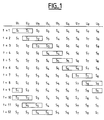
- Figure 1 shows an example of the use of eight orthogonal sequences, denoted s 1 , s 2 , ..., S 8 , by nine users denoted u 1 , u 2 , ..., u 9 .
- the sequence s 1 is allocated to the users u 1 and u 2 , while each of the seven remaining sequences is allocated to one of the other users.
- there is a collision between users u 1 and u 2 since they interfere with each other.
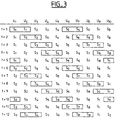
- s 1 , s 2 , ..., s 8 ten users denoted u 1 , u 2 , ..., u 9 , u 10
- N 8
- M 10
- the collisions are between u 2 and u 3 on the one hand (which in this case use the same sequence s 2 ) and between u 7 and u 8 on the other hand (which use in this case the same sequence s 6 ), and so on ...
- the sequence (s) shared at a given time could be the same at different times, since at at any time the unshared sequences are distinct from the sequence (s) shared, and distinct from each other.
- a single sequence could be shared, at a given time, by more than two users, instead of two sequences each shared by two users, as shown.
- At least one resource is shared at any given time by at least two users, and users who share a resource change over time, so as to distribute the better possible between different users the degradation of signal to signal ratio noise resulting from said sharing.
- the present invention as will now be described, further allows increase the number of users, without reducing their speed, while countering interference resulting from such sharing of resources.
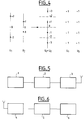
- the signal r (s1) received and despread by the sequence s 1 is the sum of the symbols emitted by u 1 and u 2 . This then takes its values from the alphabet (-3, -1, +1, +3), as also illustrated in Figure 4.
- This decoding is done in this case by comparing the signal r i (s i ) with respect to different decision thresholds, corresponding to the different possible combinations for the different values of the different alphabets used by the different users sharing the same sequence. instant considered.
- said decision thresholds have the levels -2, 0, +2.
- the alphabet (-2, +2) thus arrives once every N + 1 symbols and therefore the average power cost of increasing the capacity of a user is
- FIG. 4 has been given only as an example intended for illustrate such a technique.
- the alphabets could be different from the alphabets (-2, +2) and (-1, +1) considered, since they allow the desired differentiation.
- the degradation of signal-to-noise ratio is reduced by differentiating, by their emission level, the signals corresponding to users sharing the same resource at a instant.
- the technique thus described makes it possible to increase the number of users accepting performance degradation, but unlike PN-CDMA, the degradation is zero until the number of users reaches N, and is minimal thereafter, while the performance of the PN-CDMA become unacceptable long before the number of users has reached that number.
- the present invention also relates to a transmission device and a receiving device for implementing such a method.
- the means 1 for coding information to transmit include means to differentiate, by their emission level, signals corresponding to different users sharing the same resource at a given time.
- the means 6 for decoding information received comprise themselves means for comparing the level of signal received versus different decision thresholds corresponding to the different possible combinations different emission levels for users sharing at a time given the same resource.
- Such means also operate according to the method described. previously, an example of which has been illustrated in FIG. 4. Their realization practice does not raise any particular difficulty, these means do not also need not be described here in more detail than by their function.
Landscapes
- Engineering & Computer Science (AREA)
- Computer Networks & Wireless Communication (AREA)
- Signal Processing (AREA)
- Mobile Radio Communication Systems (AREA)
- Reduction Or Emphasis Of Bandwidth Of Signals (AREA)
- Time-Division Multiplex Systems (AREA)
Abstract
Description
- au moins une desdites ressources de transmission est partagée à un instant donné par au moins deux utilisateurs,
- les utilisateurs qui partagent une ressource de transmission changent au cours du temps, de manière à répartir le mieux possible entre les différents utilisateurs la dégradation de rapport signal à bruit résultant dudit partage,
- ladite dégradation de rapport signal à bruit est en outre réduite en différenciant, par leur niveau d'émission, les signaux correspondant à des utilisateurs partageant une même ressource à un instant donné.
- la figure 1 est destinée à illustrer un premier exemple d'allocation de ressources de transmission suivant l'invention,
- la figure 2 est destinée à illustrer un deuxième exemple d'allocation de ressources de transmission suivant l'invention,
- la figure 3 est destinée à illustrer un troisième exemple d'allocation de ressources de transmission suivant l'invention,
- la figure 4 est destinée à illustrer le principe de la différenciation, par leur niveau d'émission, des signaux correspondant à des utilisateurs partageant une même ressource à un instant donné,
- la figure 5 est destinée à illustrer le type de moyens à prévoir dans un dispositif d'émission suivant l'invention,
- la figure 6 est destinée à illustrer le type de moyens à prévoir dans un dispositif de réception suivant l'invention.

- des moyens 1 de codage d'informations à transmettre,
- des moyens 2 dits ici d'accès multiple, permettant une mise au format de transmission correspondant à la technique d'accès multiple considérée,
- des moyens 3 de modulation et d'émission radioélectrique .
- des moyens 4 de réception radioélectrique et de démodulation, effectuant des opérations inverses de celles effectuées par les moyens 3,
- des moyens 5 dits ici également d'accès multiple, effectuant des opérations inverses de celles effectuées par les moyens 2,
- des moyens 6 de décodage, effectuant des opérations inverses de celles effectuées par les moyens 1.
- au moins une desdites ressources est partagée à un instant donné par au moins deux utilisateurs,
- les utilisateurs qui partagent une ressource changent au cours du temps, de manière à répartir le mieux possible entre les différents utilisateurs la dégradation de rapport signal à bruit résultant dudit partage.
Claims (3)
- Procédé de transmission dans un système de radiocommunication du type à accès multiple, à ressources de transmission orthogonales, ce procédé étant caractérisé en ce que, pour un nombre M d'utilisateurs supérieur au nombre N de ressources de transmission de ce système :au moins une desdites ressources de transmission (s1, ..., s8) est partagée à un instant donné par au moins deux utilisateurs,les utilisateurs qui partagent une ressource de transmission changent au cours du temps, de manière à répartir le mieux possible entre les différents utilisateurs (u1 ..., u9) la dégradation de rapport signal à bruit résultant dudit partage,ladite dégradation de rapport signal à bruit est en outre réduite en différenciant, par leur niveau d'émission, les signaux correspondant à des utilisateurs partageant une même ressource à un instant donné.
- Dispositif d'émission pour système de radiocommunication du type à accès multiple, à ressources de transmission orthogonales, caractérisé en ce qu'il comporte :des moyens (2) pour utiliser une ressource de transmission telle que, pour un nombre M d'utilisateurs supérieur au nombre N de ressources de ce système :au moins une desdites ressources (s1, ..., s8) est partagée à un instant donné par au moins deux utilisateurs,les utilisateurs qui partagent une ressource changent au cours du temps, de manière à répartir le mieux possible entre les différents utilisateurs (u1, ...u9) la dégradation de rapport signal à bruit résultant dudit partage,des moyens (1) pour différencier, par leur niveau d'émission, les signaux émis par différents utilisateurs partageant une même ressource à un instant donné.
- Dispositif de réception pour système de radiocommunication du type à accès multiple, à ressources de transmission orthogonales, caractérisé en ce qu'il comporte :des moyens (5) pour utiliser une ressource de transmission telle que, pour un nombre M d'utilisateurs supérieur au nombre N de ressources de transmission de ce système :au moins une desdites ressources (s1, ..., s8) est partagée à un instant donné par au moins deux utilisateurs,les utilisateurs qui partagent une ressource changent au cours du temps, de manière à répartir le mieux possible entre les différents utilisateurs (u1, ..., u9) la dégradation de rapport signal à bruit résultant dudit partage,des moyens (6) pour comparer un niveau de signal reçu par rapport à différents seuils de décision correspondant aux différentes combinaisons possibles de niveaux d'émission différents pour des utilisateurs partageant à un instant donné une même ressource.
Applications Claiming Priority (2)
| Application Number | Priority Date | Filing Date | Title |
|---|---|---|---|
| FR9812928 | 1998-10-15 | ||
| FR9812928A FR2784823B1 (fr) | 1998-10-15 | 1998-10-15 | Procede de transmission dans un systeme de radiocommunication du type a acces multiple |
Publications (2)
| Publication Number | Publication Date |
|---|---|
| EP0994580A1 true EP0994580A1 (fr) | 2000-04-19 |
| EP0994580B1 EP0994580B1 (fr) | 2007-07-25 |
Family
ID=9531594
Family Applications (1)
| Application Number | Title | Priority Date | Filing Date |
|---|---|---|---|
| EP99402417A Expired - Lifetime EP0994580B1 (fr) | 1998-10-15 | 1999-10-04 | Procédé de transmission dans un système de radiocommunication du type à accès multiple |
Country Status (6)
| Country | Link |
|---|---|
| US (1) | US6556558B1 (fr) |
| EP (1) | EP0994580B1 (fr) |
| JP (1) | JP2000138974A (fr) |
| AT (1) | ATE368330T1 (fr) |
| DE (1) | DE69936622T2 (fr) |
| FR (1) | FR2784823B1 (fr) |
Families Citing this family (4)
| Publication number | Priority date | Publication date | Assignee | Title |
|---|---|---|---|---|
| US7173899B1 (en) * | 2000-08-28 | 2007-02-06 | Lucent Technologies Inc. | Training and synchronization sequences for wireless systems with multiple transmit and receive antennas used in CDMA or TDMA systems |
| US7369847B1 (en) * | 2000-09-14 | 2008-05-06 | The Directv Group, Inc. | Fixed cell communication system with reduced interference |
| US7715460B2 (en) | 2005-04-22 | 2010-05-11 | Interdigital Technology Corporation | Hybrid orthogonal frequency division multiple access system and method |
| JP2007300383A (ja) * | 2006-04-28 | 2007-11-15 | Fujitsu Ltd | Mimo−ofdm送信機 |
Citations (2)
| Publication number | Priority date | Publication date | Assignee | Title |
|---|---|---|---|---|
| EP0630132A2 (fr) * | 1993-06-14 | 1994-12-21 | AT&T Corp. | Espaces de signal mises en forme dans un système de parole et données simultané |
| FR2719959A1 (fr) * | 1994-05-10 | 1995-11-17 | Alcatel Mobile Comm France | Procédé d'accès paquet dans un système de radiocommunication numérique cellulaire. |
Family Cites Families (6)
| Publication number | Priority date | Publication date | Assignee | Title |
|---|---|---|---|---|
| FR2660131B1 (fr) * | 1990-03-23 | 1992-06-19 | France Etat | Dispositif de transmissions de donnees numeriques a au moins deux niveaux de protection, et dispositif de reception correspondant. |
| US5600672A (en) * | 1991-03-27 | 1997-02-04 | Matsushita Electric Industrial Co., Ltd. | Communication system |
| JPH05336061A (ja) * | 1992-05-29 | 1993-12-17 | Fujitsu Ltd | 移動無線システム |
| JPH0779477A (ja) * | 1993-06-30 | 1995-03-20 | Toshiba Corp | スペクトラム拡散通信方式を適用した無線通信システム |
| JP2863975B2 (ja) * | 1993-07-16 | 1999-03-03 | 松下電器産業株式会社 | Cdma方式送信装置および受信装置、cdma方式送信方法およびcdma方式移動通信システム |
| FI943196A7 (fi) * | 1994-07-04 | 1996-01-05 | Nokia Mobile Phones Ltd | Vastaanottomenetelmä |
-
1998
- 1998-10-15 FR FR9812928A patent/FR2784823B1/fr not_active Expired - Fee Related
-
1999
- 1999-10-04 AT AT99402417T patent/ATE368330T1/de not_active IP Right Cessation
- 1999-10-04 DE DE69936622T patent/DE69936622T2/de not_active Expired - Lifetime
- 1999-10-04 EP EP99402417A patent/EP0994580B1/fr not_active Expired - Lifetime
- 1999-10-13 US US09/417,081 patent/US6556558B1/en not_active Expired - Lifetime
- 1999-10-14 JP JP11292786A patent/JP2000138974A/ja active Pending
Patent Citations (2)
| Publication number | Priority date | Publication date | Assignee | Title |
|---|---|---|---|---|
| EP0630132A2 (fr) * | 1993-06-14 | 1994-12-21 | AT&T Corp. | Espaces de signal mises en forme dans un système de parole et données simultané |
| FR2719959A1 (fr) * | 1994-05-10 | 1995-11-17 | Alcatel Mobile Comm France | Procédé d'accès paquet dans un système de radiocommunication numérique cellulaire. |
Also Published As
| Publication number | Publication date |
|---|---|
| FR2784823A1 (fr) | 2000-04-21 |
| DE69936622T2 (de) | 2008-05-21 |
| JP2000138974A (ja) | 2000-05-16 |
| DE69936622D1 (de) | 2007-09-06 |
| EP0994580B1 (fr) | 2007-07-25 |
| FR2784823B1 (fr) | 2002-11-29 |
| US6556558B1 (en) | 2003-04-29 |
| ATE368330T1 (de) | 2007-08-15 |
Similar Documents
| Publication | Publication Date | Title |
|---|---|---|
| EP0630120B1 (fr) | Procédé de synchronisation pour des communications radiotéléphoniques à accès multiple à répartition par codes | |
| FR2770708A1 (fr) | Procede et dispositif pour le suivi d'un signal de communication dans un systeme de communication sans fil | |
| FR2718306A1 (fr) | Procédé d'adaptation de l'interface air, dans un système de radiocommunication vers des mobiles. | |
| EP0652647A1 (fr) | Procédé de construction d'un code d'étalement associé à un utilisateur d'un système de transmisssion numérique à accès multiple par répartition par codes et à séquence directe, et procédé correspondant de génération d'un tableau | |
| FR2473824A1 (fr) | Procede de commutation entre les recepteurs et les correlateurs d'un systeme de communication et appareil de reception-correlation pour la mise en oeuvre de ce procede | |
| EP0643504A1 (fr) | Détecteur à seuil pour système à AMRC | |
| WO2001065789A1 (fr) | Procede et dispositif d'estimation d'un canal de propagation | |
| CA2209476C (fr) | Procede de commutation d'un canal d'un premier chemin de propagation vers un second chemin de propagation | |
| EP0994580B1 (fr) | Procédé de transmission dans un système de radiocommunication du type à accès multiple | |
| EP0820157B1 (fr) | Procédé de démodulation différentielle numérique | |
| EP2161847A1 (fr) | Procéde de transmission de données utilisant des jeux répétitifs de séquences d'étalement, émetteur et récepteur correspondants | |
| EP0629059B1 (fr) | Système de transmission numérique à étalement de spectre obtenu par codage pseudo-aléatoire basse fréquence de l'information utile et procédé d'étalement et de compression de spectre utilisé un tel système | |
| EP1283605A1 (fr) | Procédé pour augmenter le débit dans un système de communication comportant N émetteurs et M récepteurs | |
| EP0037770B1 (fr) | Système de transmission de données numériques par paquets utilisant un type particulier de mots de synchronisation | |
| FR2782428A1 (fr) | Dispositif permettant des facteurs d'etalement differents tout en preservant un code d'embrouillage commun, notamment pour systeme cellulaire de radiocommunications mobiles du type a acces multiple par repartition de codes | |
| EP3917024A1 (fr) | Methode de demodulation par apprentissage automatique pour recepteurs mimo a detection d'energie | |
| CA2296204C (fr) | Satellite a couverture omnidirectionnelle | |
| EP0892579B1 (fr) | Procédés de transmission et de réception de cellules ATM à codage à taux variable et signal numérique correspondant | |
| EP1009105A1 (fr) | Récepteur, système de télécommunications CDMA et procédé de synchronisation d'un récepteur avec une station d'émission d'un tel système | |
| EP0998065A1 (fr) | Canal module d'acquisition et de poursuite pour un systeme de radiocommunications | |
| EP0942542B1 (fr) | Procédé de démodulation de signaux représentatifs de séquences émises dans un système de communications | |
| EP1427157B1 (fr) | Procédé de detection d'une rafale à partir d'une estimation de canal et système recepteur pour la mise en oeuvre du procédé | |
| WO2020127496A1 (fr) | Procédés et dispositifs pour l'émission et pour l'estimation de l'instant d'arrivée d'une séquence de bits | |
| EP1573933B1 (fr) | Procede et systeme de reception d'un signal ultra-large bande a nombre de trajets de propagation auto-adaptatif | |
| EP1982429B1 (fr) | Communication à accès multiple basée sur une couche physique ultra large bande par impulsion |
Legal Events
| Date | Code | Title | Description |
|---|---|---|---|
| PUAI | Public reference made under article 153(3) epc to a published international application that has entered the european phase |
Free format text: ORIGINAL CODE: 0009012 |
|
| AK | Designated contracting states |
Kind code of ref document: A1 Designated state(s): AT BE CH CY DE DK ES FI FR GB GR IE IT LI LU MC NL PT SE |
|
| AX | Request for extension of the european patent |
Free format text: AL;LT;LV;MK;RO;SI |
|
| 17P | Request for examination filed |
Effective date: 20001019 |
|
| AKX | Designation fees paid |
Free format text: AT BE CH CY DE DK ES FI FR GB GR IE IT LI LU MC NL PT SE |
|
| GRAP | Despatch of communication of intention to grant a patent |
Free format text: ORIGINAL CODE: EPIDOSNIGR1 |
|
| RAP1 | Party data changed (applicant data changed or rights of an application transferred) |
Owner name: ALCATEL LUCENT |
|
| GRAS | Grant fee paid |
Free format text: ORIGINAL CODE: EPIDOSNIGR3 |
|
| GRAA | (expected) grant |
Free format text: ORIGINAL CODE: 0009210 |
|
| AK | Designated contracting states |
Kind code of ref document: B1 Designated state(s): AT BE CH CY DE DK ES FI FR GB GR IE IT LI LU MC NL PT SE |
|
| REG | Reference to a national code |
Ref country code: GB Ref legal event code: FG4D Free format text: NOT ENGLISH |
|
| REG | Reference to a national code |
Ref country code: CH Ref legal event code: EP |
|
| REG | Reference to a national code |
Ref country code: IE Ref legal event code: FG4D Free format text: LANGUAGE OF EP DOCUMENT: FRENCH |
|
| REF | Corresponds to: |
Ref document number: 69936622 Country of ref document: DE Date of ref document: 20070906 Kind code of ref document: P |
|
| GBT | Gb: translation of ep patent filed (gb section 77(6)(a)/1977) |
Effective date: 20071025 |
|
| PG25 | Lapsed in a contracting state [announced via postgrant information from national office to epo] |
Ref country code: PT Free format text: LAPSE BECAUSE OF FAILURE TO SUBMIT A TRANSLATION OF THE DESCRIPTION OR TO PAY THE FEE WITHIN THE PRESCRIBED TIME-LIMIT Effective date: 20071226 Ref country code: NL Free format text: LAPSE BECAUSE OF FAILURE TO SUBMIT A TRANSLATION OF THE DESCRIPTION OR TO PAY THE FEE WITHIN THE PRESCRIBED TIME-LIMIT Effective date: 20070725 Ref country code: FI Free format text: LAPSE BECAUSE OF FAILURE TO SUBMIT A TRANSLATION OF THE DESCRIPTION OR TO PAY THE FEE WITHIN THE PRESCRIBED TIME-LIMIT Effective date: 20070725 Ref country code: ES Free format text: LAPSE BECAUSE OF FAILURE TO SUBMIT A TRANSLATION OF THE DESCRIPTION OR TO PAY THE FEE WITHIN THE PRESCRIBED TIME-LIMIT Effective date: 20071105 |
|
| NLV1 | Nl: lapsed or annulled due to failure to fulfill the requirements of art. 29p and 29m of the patents act | ||
| PG25 | Lapsed in a contracting state [announced via postgrant information from national office to epo] |
Ref country code: AT Free format text: LAPSE BECAUSE OF FAILURE TO SUBMIT A TRANSLATION OF THE DESCRIPTION OR TO PAY THE FEE WITHIN THE PRESCRIBED TIME-LIMIT Effective date: 20070725 |
|
| REG | Reference to a national code |
Ref country code: IE Ref legal event code: FD4D |
|
| BERE | Be: lapsed |
Owner name: ALCATEL LUCENT Effective date: 20071031 |
|
| PG25 | Lapsed in a contracting state [announced via postgrant information from national office to epo] |
Ref country code: GR Free format text: LAPSE BECAUSE OF FAILURE TO SUBMIT A TRANSLATION OF THE DESCRIPTION OR TO PAY THE FEE WITHIN THE PRESCRIBED TIME-LIMIT Effective date: 20071026 Ref country code: DK Free format text: LAPSE BECAUSE OF FAILURE TO SUBMIT A TRANSLATION OF THE DESCRIPTION OR TO PAY THE FEE WITHIN THE PRESCRIBED TIME-LIMIT Effective date: 20070725 |
|
| PG25 | Lapsed in a contracting state [announced via postgrant information from national office to epo] |
Ref country code: MC Free format text: LAPSE BECAUSE OF NON-PAYMENT OF DUE FEES Effective date: 20071031 Ref country code: IE Free format text: LAPSE BECAUSE OF FAILURE TO SUBMIT A TRANSLATION OF THE DESCRIPTION OR TO PAY THE FEE WITHIN THE PRESCRIBED TIME-LIMIT Effective date: 20070725 |
|
| PLBE | No opposition filed within time limit |
Free format text: ORIGINAL CODE: 0009261 |
|
| STAA | Information on the status of an ep patent application or granted ep patent |
Free format text: STATUS: NO OPPOSITION FILED WITHIN TIME LIMIT |
|
| REG | Reference to a national code |
Ref country code: CH Ref legal event code: PL |
|
| PG25 | Lapsed in a contracting state [announced via postgrant information from national office to epo] |
Ref country code: SE Free format text: LAPSE BECAUSE OF FAILURE TO SUBMIT A TRANSLATION OF THE DESCRIPTION OR TO PAY THE FEE WITHIN THE PRESCRIBED TIME-LIMIT Effective date: 20071025 |
|
| 26N | No opposition filed |
Effective date: 20080428 |
|
| PG25 | Lapsed in a contracting state [announced via postgrant information from national office to epo] |
Ref country code: LI Free format text: LAPSE BECAUSE OF NON-PAYMENT OF DUE FEES Effective date: 20071031 Ref country code: CH Free format text: LAPSE BECAUSE OF NON-PAYMENT OF DUE FEES Effective date: 20071031 |
|
| PG25 | Lapsed in a contracting state [announced via postgrant information from national office to epo] |
Ref country code: BE Free format text: LAPSE BECAUSE OF NON-PAYMENT OF DUE FEES Effective date: 20071031 |
|
| PG25 | Lapsed in a contracting state [announced via postgrant information from national office to epo] |
Ref country code: CY Free format text: LAPSE BECAUSE OF FAILURE TO SUBMIT A TRANSLATION OF THE DESCRIPTION OR TO PAY THE FEE WITHIN THE PRESCRIBED TIME-LIMIT Effective date: 20070725 |
|
| PG25 | Lapsed in a contracting state [announced via postgrant information from national office to epo] |
Ref country code: LU Free format text: LAPSE BECAUSE OF NON-PAYMENT OF DUE FEES Effective date: 20071004 |
|
| PG25 | Lapsed in a contracting state [announced via postgrant information from national office to epo] |
Ref country code: IT Free format text: LAPSE BECAUSE OF NON-PAYMENT OF DUE FEES Effective date: 20071031 |
|
| REG | Reference to a national code |
Ref country code: FR Ref legal event code: GC Effective date: 20131018 |
|
| REG | Reference to a national code |
Ref country code: FR Ref legal event code: RG Effective date: 20141016 |
|
| REG | Reference to a national code |
Ref country code: FR Ref legal event code: CA Effective date: 20150521 |
|
| REG | Reference to a national code |
Ref country code: FR Ref legal event code: CA Effective date: 20150521 |
|
| REG | Reference to a national code |
Ref country code: FR Ref legal event code: PLFP Year of fee payment: 17 |
|
| REG | Reference to a national code |
Ref country code: FR Ref legal event code: PLFP Year of fee payment: 18 |
|
| REG | Reference to a national code |
Ref country code: FR Ref legal event code: PLFP Year of fee payment: 19 |
|
| PGFP | Annual fee paid to national office [announced via postgrant information from national office to epo] |
Ref country code: FR Payment date: 20171024 Year of fee payment: 19 Ref country code: DE Payment date: 20171019 Year of fee payment: 19 |
|
| PGFP | Annual fee paid to national office [announced via postgrant information from national office to epo] |
Ref country code: GB Payment date: 20171019 Year of fee payment: 19 |
|
| REG | Reference to a national code |
Ref country code: DE Ref legal event code: R119 Ref document number: 69936622 Country of ref document: DE |
|
| REG | Reference to a national code |
Ref country code: GB Ref legal event code: 732E Free format text: REGISTERED BETWEEN 20190429 AND 20190502 |
|
| REG | Reference to a national code |
Ref country code: DE Ref legal event code: R082 Ref document number: 69936622 Country of ref document: DE Representative=s name: MENZIETTI WETZEL, DE Ref country code: DE Ref legal event code: R081 Ref document number: 69936622 Country of ref document: DE Owner name: PROVENANCE ASSET GROUP LLC, PITTSFORD, US Free format text: FORMER OWNER: ALCATEL LUCENT, PARIS, FR |
|
| GBPC | Gb: european patent ceased through non-payment of renewal fee |
Effective date: 20181004 |
|
| PG25 | Lapsed in a contracting state [announced via postgrant information from national office to epo] |
Ref country code: DE Free format text: LAPSE BECAUSE OF NON-PAYMENT OF DUE FEES Effective date: 20190501 |
|
| PG25 | Lapsed in a contracting state [announced via postgrant information from national office to epo] |
Ref country code: FR Free format text: LAPSE BECAUSE OF NON-PAYMENT OF DUE FEES Effective date: 20181031 |
|
| PG25 | Lapsed in a contracting state [announced via postgrant information from national office to epo] |
Ref country code: GB Free format text: LAPSE BECAUSE OF NON-PAYMENT OF DUE FEES Effective date: 20181004 |