EP0995483A1 - Appareil de filtration à écoulement tangentiel - Google Patents
Appareil de filtration à écoulement tangentiel Download PDFInfo
- Publication number
- EP0995483A1 EP0995483A1 EP98203574A EP98203574A EP0995483A1 EP 0995483 A1 EP0995483 A1 EP 0995483A1 EP 98203574 A EP98203574 A EP 98203574A EP 98203574 A EP98203574 A EP 98203574A EP 0995483 A1 EP0995483 A1 EP 0995483A1
- Authority
- EP
- European Patent Office
- Prior art keywords
- cross
- filtration
- flow filtration
- zone
- fluid communication
- Prior art date
- Legal status (The legal status is an assumption and is not a legal conclusion. Google has not performed a legal analysis and makes no representation as to the accuracy of the status listed.)
- Withdrawn
Links
Images



Classifications
-
- B—PERFORMING OPERATIONS; TRANSPORTING
- B01—PHYSICAL OR CHEMICAL PROCESSES OR APPARATUS IN GENERAL
- B01D—SEPARATION
- B01D61/00—Processes of separation using semi-permeable membranes, e.g. dialysis, osmosis or ultrafiltration; Apparatus, accessories or auxiliary operations specially adapted therefor
- B01D61/14—Ultrafiltration; Microfiltration
- B01D61/147—Microfiltration
-
- A—HUMAN NECESSITIES
- A47—FURNITURE; DOMESTIC ARTICLES OR APPLIANCES; COFFEE MILLS; SPICE MILLS; SUCTION CLEANERS IN GENERAL
- A47L—DOMESTIC WASHING OR CLEANING; SUCTION CLEANERS IN GENERAL
- A47L15/00—Washing or rinsing machines for crockery or tableware
- A47L15/42—Details
- A47L15/4202—Water filter means or strainers
-
- B—PERFORMING OPERATIONS; TRANSPORTING
- B01—PHYSICAL OR CHEMICAL PROCESSES OR APPARATUS IN GENERAL
- B01D—SEPARATION
- B01D61/00—Processes of separation using semi-permeable membranes, e.g. dialysis, osmosis or ultrafiltration; Apparatus, accessories or auxiliary operations specially adapted therefor
- B01D61/02—Reverse osmosis; Hyperfiltration ; Nanofiltration
- B01D61/025—Reverse osmosis; Hyperfiltration
-
- B—PERFORMING OPERATIONS; TRANSPORTING
- B01—PHYSICAL OR CHEMICAL PROCESSES OR APPARATUS IN GENERAL
- B01D—SEPARATION
- B01D61/00—Processes of separation using semi-permeable membranes, e.g. dialysis, osmosis or ultrafiltration; Apparatus, accessories or auxiliary operations specially adapted therefor
- B01D61/02—Reverse osmosis; Hyperfiltration ; Nanofiltration
- B01D61/04—Feed pretreatment
-
- B—PERFORMING OPERATIONS; TRANSPORTING
- B01—PHYSICAL OR CHEMICAL PROCESSES OR APPARATUS IN GENERAL
- B01D—SEPARATION
- B01D61/00—Processes of separation using semi-permeable membranes, e.g. dialysis, osmosis or ultrafiltration; Apparatus, accessories or auxiliary operations specially adapted therefor
- B01D61/14—Ultrafiltration; Microfiltration
- B01D61/145—Ultrafiltration
-
- B—PERFORMING OPERATIONS; TRANSPORTING
- B01—PHYSICAL OR CHEMICAL PROCESSES OR APPARATUS IN GENERAL
- B01D—SEPARATION
- B01D61/00—Processes of separation using semi-permeable membranes, e.g. dialysis, osmosis or ultrafiltration; Apparatus, accessories or auxiliary operations specially adapted therefor
- B01D61/14—Ultrafiltration; Microfiltration
- B01D61/149—Multistep processes comprising different kinds of membrane processes selected from ultrafiltration or microfiltration
-
- B—PERFORMING OPERATIONS; TRANSPORTING
- B01—PHYSICAL OR CHEMICAL PROCESSES OR APPARATUS IN GENERAL
- B01D—SEPARATION
- B01D61/00—Processes of separation using semi-permeable membranes, e.g. dialysis, osmosis or ultrafiltration; Apparatus, accessories or auxiliary operations specially adapted therefor
- B01D61/14—Ultrafiltration; Microfiltration
- B01D61/16—Feed pretreatment
-
- B—PERFORMING OPERATIONS; TRANSPORTING
- B01—PHYSICAL OR CHEMICAL PROCESSES OR APPARATUS IN GENERAL
- B01J—CHEMICAL OR PHYSICAL PROCESSES, e.g. CATALYSIS OR COLLOID CHEMISTRY; THEIR RELEVANT APPARATUS
- B01J19/00—Chemical, physical or physico-chemical processes in general; Their relevant apparatus
-
- C—CHEMISTRY; METALLURGY
- C02—TREATMENT OF WATER, WASTE WATER, SEWAGE, OR SLUDGE
- C02F—TREATMENT OF WATER, WASTE WATER, SEWAGE, OR SLUDGE
- C02F1/00—Treatment of water, waste water, or sewage
- C02F1/44—Treatment of water, waste water, or sewage by dialysis, osmosis or reverse osmosis
-
- C—CHEMISTRY; METALLURGY
- C12—BIOCHEMISTRY; BEER; SPIRITS; WINE; VINEGAR; MICROBIOLOGY; ENZYMOLOGY; MUTATION OR GENETIC ENGINEERING
- C12M—APPARATUS FOR ENZYMOLOGY OR MICROBIOLOGY; APPARATUS FOR CULTURING MICROORGANISMS FOR PRODUCING BIOMASS, FOR GROWING CELLS OR FOR OBTAINING FERMENTATION OR METABOLIC PRODUCTS, i.e. BIOREACTORS OR FERMENTERS
- C12M29/00—Means for introduction, extraction or recirculation of materials, e.g. pumps
- C12M29/04—Filters; Permeable or porous membranes or plates, e.g. dialysis
-
- C—CHEMISTRY; METALLURGY
- C12—BIOCHEMISTRY; BEER; SPIRITS; WINE; VINEGAR; MICROBIOLOGY; ENZYMOLOGY; MUTATION OR GENETIC ENGINEERING
- C12M—APPARATUS FOR ENZYMOLOGY OR MICROBIOLOGY; APPARATUS FOR CULTURING MICROORGANISMS FOR PRODUCING BIOMASS, FOR GROWING CELLS OR FOR OBTAINING FERMENTATION OR METABOLIC PRODUCTS, i.e. BIOREACTORS OR FERMENTERS
- C12M29/00—Means for introduction, extraction or recirculation of materials, e.g. pumps
- C12M29/18—External loop; Means for reintroduction of fermented biomass or liquid percolate
-
- C—CHEMISTRY; METALLURGY
- C12—BIOCHEMISTRY; BEER; SPIRITS; WINE; VINEGAR; MICROBIOLOGY; ENZYMOLOGY; MUTATION OR GENETIC ENGINEERING
- C12M—APPARATUS FOR ENZYMOLOGY OR MICROBIOLOGY; APPARATUS FOR CULTURING MICROORGANISMS FOR PRODUCING BIOMASS, FOR GROWING CELLS OR FOR OBTAINING FERMENTATION OR METABOLIC PRODUCTS, i.e. BIOREACTORS OR FERMENTERS
- C12M47/00—Means for after-treatment of the produced biomass or of the fermentation or metabolic products, e.g. storage of biomass
- C12M47/10—Separation or concentration of fermentation products
-
- C—CHEMISTRY; METALLURGY
- C12—BIOCHEMISTRY; BEER; SPIRITS; WINE; VINEGAR; MICROBIOLOGY; ENZYMOLOGY; MUTATION OR GENETIC ENGINEERING
- C12M—APPARATUS FOR ENZYMOLOGY OR MICROBIOLOGY; APPARATUS FOR CULTURING MICROORGANISMS FOR PRODUCING BIOMASS, FOR GROWING CELLS OR FOR OBTAINING FERMENTATION OR METABOLIC PRODUCTS, i.e. BIOREACTORS OR FERMENTERS
- C12M47/00—Means for after-treatment of the produced biomass or of the fermentation or metabolic products, e.g. storage of biomass
- C12M47/12—Purification
-
- C—CHEMISTRY; METALLURGY
- C25—ELECTROLYTIC OR ELECTROPHORETIC PROCESSES; APPARATUS THEREFOR
- C25D—PROCESSES FOR THE ELECTROLYTIC OR ELECTROPHORETIC PRODUCTION OF COATINGS; ELECTROFORMING; APPARATUS THEREFOR
- C25D13/00—Electrophoretic coating characterised by the process
- C25D13/22—Servicing or operating apparatus or multistep processes
- C25D13/24—Regeneration of process liquids
-
- D—TEXTILES; PAPER
- D06—TREATMENT OF TEXTILES OR THE LIKE; LAUNDERING; FLEXIBLE MATERIALS NOT OTHERWISE PROVIDED FOR
- D06F—LAUNDERING, DRYING, IRONING, PRESSING OR FOLDING TEXTILE ARTICLES
- D06F39/00—Details of washing machines not specific to a single type of machines covered by groups D06F9/00 - D06F27/00
- D06F39/10—Filtering arrangements
-
- B—PERFORMING OPERATIONS; TRANSPORTING
- B01—PHYSICAL OR CHEMICAL PROCESSES OR APPARATUS IN GENERAL
- B01D—SEPARATION
- B01D2311/00—Details relating to membrane separation process operations and control
- B01D2311/04—Specific process operations in the feed stream; Feed pretreatment
-
- C—CHEMISTRY; METALLURGY
- C02—TREATMENT OF WATER, WASTE WATER, SEWAGE, OR SLUDGE
- C02F—TREATMENT OF WATER, WASTE WATER, SEWAGE, OR SLUDGE
- C02F1/00—Treatment of water, waste water, or sewage
- C02F1/44—Treatment of water, waste water, or sewage by dialysis, osmosis or reverse osmosis
- C02F1/441—Treatment of water, waste water, or sewage by dialysis, osmosis or reverse osmosis by reverse osmosis
-
- C—CHEMISTRY; METALLURGY
- C02—TREATMENT OF WATER, WASTE WATER, SEWAGE, OR SLUDGE
- C02F—TREATMENT OF WATER, WASTE WATER, SEWAGE, OR SLUDGE
- C02F1/00—Treatment of water, waste water, or sewage
- C02F1/44—Treatment of water, waste water, or sewage by dialysis, osmosis or reverse osmosis
- C02F1/444—Treatment of water, waste water, or sewage by dialysis, osmosis or reverse osmosis by ultrafiltration or microfiltration
-
- C—CHEMISTRY; METALLURGY
- C02—TREATMENT OF WATER, WASTE WATER, SEWAGE, OR SLUDGE
- C02F—TREATMENT OF WATER, WASTE WATER, SEWAGE, OR SLUDGE
- C02F2103/00—Nature of the water, waste water, sewage or sludge to be treated
- C02F2103/002—Grey water, e.g. from clothes washers, showers or dishwashers
Definitions
- the present invention is based on cross-flow filtration.
- the present invention concerns a cross-flow filtration apparatus, which allows continuous in-situ filter action of process fluid as well as automated and separate harvesting of substantially undiluted permeate and, if desired, of retentate.
- the permeate is re-directed to the original process zone, making it possible to achieve virtually no process volume dilution.
- Serial interconnection of several such cross-flow filtration apparatuses allows process liquid purification by different parameters; thereby facilitating particulates removal or macromolecule removal as desired.
- a cross-flow filtration apparatus suitable for connection to a process zone (12) for filtration of process fluid
- the apparatus comprising a cross-flow filtration means (50) having a feed inlet means (18, 22), a permeate outlet means (16) and a retentate outlet means (20) in fluid communication therewith
- the apparatus (10) comprises a buffer zone (14); in that the feed inlet means (18, 22) includes first and second conduits, the first conduit (18) being in fluid communication from the process zone (12) to the buffer zone (14), and the second conduit (22) being in fluid communication from the buffer zone (14) to the filtration means (50); in that the retentate outlet means (20) is in fluid communication with the buffer zone (14); and in that the permeate outlet means (16) is in fluid communication with the process zone (12).
- the process zone (12) can generally take the form of a reaction zone, a cleaning zone, a coating zone, a living zone for humans or other animals, a treatment zone, a manufacturing zone, a storage zone and/or a feed zone.
- the process zone (12) is a reservoir (sometimes referred to herein as "the second reservoir") which can be open or closed to atmosphere, although open reservoirs are preferred herein.
- Process zones other than reservoirs are also envisaged, such as, for example, tubular reaction zones, surface treatment zones, etc.
- the process zone (12) acts both as feed source and as output sink for the cross-flow filtration means (50).
- the primary function of the buffer zone (14), on the other hand, is to act as a storage and/or accumulation zone for the retentate and, as such, the buffer zone (14) will normally take the form of a reservoir (sometimes referred to herein as "the first reservoir"). It will be understood, however, that the buffer zone (14) can also act as a reaction, cleaning, treatment zone, etc., for the process fluid and/or retentate and is thus not limited to a storage functionality.
- the buffer zone (14) is adapted and arranged such that, at steady-state, outflow along the permeate outlet means (16) is substantially equivalent (mass-balanced) to inflow along the first conduit (18).
- the buffer zone (14) is substantially closed to atmosphere.
- the retentate outlet means (20), the buffer zone (14) and the second conduit (22) form, with the filtration means (50), a normally closed, but bleedable, retentate recirculating loop (70).
- the filtration means (50) is adapted for filtration of liquids and is, preferably, selected from a microfiltration, ultrafiltration or reverse osmosis filtration means (50).
- the filtration means (50) is adapted for filtration of gases.
- first conduits (18), buffer zones (14), second conduits (22), filtration means (50), retentate outlet means (20) and permeate outlet means (16) are in fluid communication with one process zone (12).
- a valve (40) is provided in operative association with the two or more first conduits (18).
- the process zone (12) comprises liquid conduits of a laundry or dishwashing machine or an aquarium.
- a domestic appliance preferably a laundry or dishwashing machine incorporating a cross-flow filtration apparatus (10) according to a first aspect of the present invention.
- cross-flow filtration equipment examples include chemical reactors, enzyme reactors, bioreactors, electrocoating and electroplating equipment, blood/plasma fractionation/filtration equipment and air/water/effluent treatment equipment.
- cross-flow filtration apparatus comprising only a single reservoir (buffer zone) is also envisaged herein, the apparatus being connected to an external process zone at the point of use.
- a cross-flow filtration apparatus suitable for connection to a process zone (12) for the filtration of process fluid
- the apparatus comprising a buffer zone (14), a cross-flow filtration means (50) having a feed inlet means (18, 22), a permeate outlet means (16) and a retentate outlet means (20) in fluid communication therewith
- the feed inlet means (18, 22) includes first and second conduits, characterised in that in use, the first conduit (18) is in fluid communication from the process zone (12) to the buffer zone (14), the second conduit (22) is in fluid communication from the buffer zone (14) to the filtration means (50), the retentate outlet means (20) is in fluid communication with the buffer zone (14), and the permeate outlet means (16) is in fluid communication with the process zone (12).
- cross-flow filtration requires that flow through the filter medium (permeate) be perpendicular to the feed flow, the flow alongside the filter medium from the filtration means being defined as retentate.
- An additional feature of cross-flow filtration is that particle polarisation is prevented by the shear induced by the flow rate.
- through-flow filtration sometimes called dead-ended filtration
- Through-flow filtration requires frequent back-washing, in order to allow filtration to continue.
- the present invention concerns the general field of cross-flow filtration for separations involving domestic, industrial or municipal process streams. Most of such membrane separation processes are pressure driven, the main exception being electrodialysis, whereby ions are separated under the influence of an electric field.
- the pressure driven liquid cross-flow filtration processes may be distinguished by the size of particle/molecule the membrane is capable of retaining or passing. This, in turn, roughly relates to the pore-size of the membrane.
- An arbitrary dividing line between microfiltration and ultrafiltration would be at 1,000 ⁇ .
- microfiltration is capable of retaining pollen, starch, blood cells and bacteria.
- the dividing line between ultrafiltration and reverse osmosis is somewhat semantic at about 10 ⁇ .
- ultrafiltration is capable of retaining DNA, viruses, albumin, Vitamin B 12 and glucose
- reverse osmosis is capable of retaining water and salts.
- the present invention has particular utility in continuous filter action processes which allow harvesting of both substantially undiluted permeate and retentate without the need to interrupt the manufacturing, cleaning or treatment process.
- materials such as pollen, starch, blood cells, bacteria, heavy metals and the like may be continuously harvested from a manufacturing or process medium.
- materials such as DNA, viruses, albumin, glucose and the like may be continuously harvested, whilst a reverse osmosis apparatus of the present invention may be used to continuously harvest water, salts and the like.
- Ultrafiltration and reverse osmosis usually use cross-flow filtration to sweep away deposited particles from the membrane surface, whilst most microfiltration systems use through-flow filtration, so that the particles accumulate on the membrane and are disposed of with the membrane.
- microfiltration systems can also operate using cross-flow filtration.
- the pressure driven gas filtration processes include pervaporation and gas separations.
- Pervaporation is a special form of gas separation in that it is a concentration driven process - the feed mixture is supplied as a liquid to the membrane and the permeate is recovered as a vapour on the low pressure side of the membrane.
- Microfiltration can be traced back to the 19th century with the development of the first nitrocellulose membranes in 1855. Even today, the most common polymers used in microfiltration membranes are mixed esters of cellulose. Eventually, membranes made of materials other than cellulose nitrate began to appear such as, for example, cellulose triacetate, regenerated cellulose, polyvinyl chloride, polyamide, polycarbonate, silver membrane, polypropylene, polytetrafluoroethylene, polysulfone, polyvinylidene fluoride, polyester and alumina.
- All current microfiltration membranes may be classified as either “tortuous-pore” or “capillary-pore” membranes, both of which may be used in the apparatus of the present invention.
- the "tortuous-pore” structure resembles a sponge with a network of interconnecting tortuous pores, whilst the “capillary-pore” structure is distinguished by its straight-through cylindrical capillaries.
- the “tortuous-pore” membranes are the more common and include typical cellulosic membranes and virtually all other polymers.
- the "capillary-pore” membranes are available as polycarbonate or polyester membranes supplied by Nuclepore Corporation and by Poretics Corporation.
- Tortuous-pore membranes are usually made by a process known as phase inversion.
- "tortuous-pore” membranes may be made by a stretching process or by a thermal-phase-inversion process.
- Capillary-pore membranes may be made using laser beams, electroforming, photochemical etching and ionotropy, so as to orientate anisotropic gel particles to form ionotropic-gel membranes.
- the "track etch” process described in US-A-3, 303, 085, produces submicron capillary-pore membranes.
- Permeate flux decay due to internal pore fouling can often be relieved by back flushing or chemical cleaning but the ultimate solution is to develop microfiltration membranes with a high degree of anisotropy, so that the membrane surface facing the feed stream has exceedingly small pores preventing blockage, thereby, of the internal pores.
- Microfiltration membranes usually take the form of plate and frame units; pleated cartridges; or tubular/hollow-fibre modules, the use of all of which falls within the scope of the invention.
- Plate and frame units suitable for cross-flow filtration can take sheet stock microfiltration membranes.
- the plate and frame unit may take a pre-assembled membrane cassette, which is a sandwich of two outer layers of membranes sealed to an inner filtrate collection screen.
- the plate and frame arrangement is formed by placing a cross-flow spacer between the adjacent filter packets which are then stacked in the plate and frame arrangement.
- Pleated cartridges are also suitable for use in cross-flow microfiltration.
- a sleeve may be placed around the cartridge and the housing modified, so as to withdraw the retentate stream from the bottom of the housing, the cross-flow stream being thereby forced into the pleats where it moves tangential to the membrane.
- Tubular/hollow-fibre modules comprise "tortuous-pore" membranes.
- Suitable tubular modules include membranes composed of alumina, polypropylene or polyvinylidene difluoride and suitable hollow-fibre modules are composed of cellulose ester, polypropylene, polysulfone or polyvinyl alcohol.
- cross-flow filtration applications include removal of heavy metals from waste waters; plasmapheresis; cell harvesting/washing; continuous cell culture; and prefiltration for ultrafiltration.
- a typical ultrafiltration membrane has a thin skin on its surface, which permits high hydraulic permeability with a more open porous substructure which provides good mechanical support. Additional strength may be provided by casting the membrane on a spun-bonded polyethylene or polypropylene backing.
- ultrafiltration membranes may be made from a variety of synthetic polymers, including polyvinyl chloride, polyacrylonitrile, polycarbonate, aliphatic and aromatic polyamides, polyimides, polysulfone, polyarylsulfone and polyvinylidene difluoride, as well as inorganic sources such as zirconium and aluminium oxides.
- Suitable ultrafiltration membranes may be cast as flat-sheets, as tubes or as hollow fibres, the use of all of which are within the scope of the present invention.
- Permeate flux may be augmented either by centrifugal forces for particles having a density higher than water or by electric fields for particles bearing an electric charge.
- centrifugal force vector is perpendicular to the membrane surface but opposite (and parallel) to the flux vector, significant permeate flux improvements can be observed.
- the application of an electric field can cause such species to migrate away from the membrane, thereby augmenting the mass transfer co-efficient and augmenting the permeate flux observed.
- the field strength be below the voltage at which net particle migration toward the ultrafiltration membrane is zero and, in this event, increases in tangential velocity result in a higher permeate flux.
- the ultrafiltration membrane configuration is application-dependent and generally includes four generic configurations, namely, tubes; hollow fibres; plate and frame units; and spiral wound modules, the use of all of which is within the scope of the present invention.
- Tubes are, perhaps, the simplest configuration, in which the membrane is cast on the inside wall of a porous support tube.
- the biggest disadvantage of tubes is their cost, the porous support tube itself being the dominant cost factor.
- Hollow fibres are, in theory, the ideal membrane configuration in that there is no "parasite” drag and no expensive porous support tube. Such fibres can be pressurised on the inside permitting "thin channel” fluid management of the feed stream.
- the biggest disadvantage of hollow fibres is the pressure constraint which limits the cross-flow velocity down the lumen of the fibre.
- the hollow fibre configuration is more susceptible to fouling and plugging than the other three configurations and larger diameter fibres are becoming popular to improve fouling resistance.
- hollow fibres can be readily cleaned by back-washing, which tends to compensate for their propensity to foul.
- tubes; plate and frame units; and spiral wound modules be back-washed, due to problems with membrane delamination and glue line seal rupture.
- Flat sheet membranes in a plate and frame unit offer the greatest versatility but at the highest financial cost.
- Spiral wound modules were originally developed for reverse osmosis, but are capturing an increasing share of the ultrafiltration market by providing one of the least expensive ultrafiltration modules available in terms of cost per membrane area unit. Spiral wound units cannot be unwrapped for cleaning and most cannot be autoclaved. In terms of propensity to fouling, they are intermediate between hollow fibres on the one hand and, on the other hand, tubes and some plate and frame units.
- ultrapure water as permeate
- yields of integrated circuits are improved, when the water quality is improved.
- the electrocoat paint market forms the largest single application for ultrafiltration.
- Car plants usually use electrocoat as the undercoat.
- Ultrafiltration may be employed to reduce pollution problems and to reduce paint loss, by recycling electrocoat-containing permeate and by discarding retentate.
- Waste lubricating oil can be refined into clean lubricants (as permeate) by ultrafiltration which can remove all contaminants (as retentate), although the flux is very low at room temperature.
- Crude oil contains metals, either chemically bound or associated with asphaltenes, and ultrafiltration can retain such metal asphaltene complexes whilst passing virtually all other crude oil factions as permeate. Again, the flux is low due to the high viscosity.
- Warp sizing agents are used to improve the strength and surface characteristics of warp ions prior to weaving operations and recovery of such synthetic sizing agents as polyvinyl alcohol and sodium carboxymethylcellulose can be achieved by ultrafiltration.
- low molecular weight dyes such as indigo can be recovered by way of ultrafiltration or reverse osmosis.
- Ultrafiltration can also remove heavy metals from metal plating wastes and lignin compounds and colour bodies from waste in the pulp and paper industry. Ultrafiltration can also be used to recover cheese whey protein, soy whey, egg white or gelatin; to increase fruit juice recovery; to sterilise wine; and to improve beer clarity.
- ultrafiltration may be used to harvest cells, as in the case of microfiltration described hereinabove; concentrate and purify enzymes, by removal of small peptides, etc.; process blood plasma to obtain purified therapeutic proteins; diafiltration (removal of salts and/or lower molecular weight species from larger macromolecules); or concentrate viruses and hormones and materials of similar size.
- ultrafiltration membranes can be used in the processing of pharmaceuticals and biologicals by, for example, using enzyme reactors or membrane fermentors, the use of both of which fall within the scope of the present invention.
- the enzyme is immobilised on a membrane.
- the enzyme is retained by an ultrafiltration membrane which is permeable to the products of the reaction. Thus, retentate and enzyme are recirculated, but enzyme may become inactivated due to the continuous pumping and recirculation through the ultrafiltration unit.
- the enzyme is immobilised within the ultrafiltration membrane.
- the immobilised version can be used in a back flush mode or in a recycle mode.
- disperse soluble immobilised enzyme version enzymes are immobilised onto mobile supports, whereupon improved stability, but decreased access of the enzyme to the substrate, is observed.
- a membrane fermentor is an enzyme reactor using intracellular, rather than extracellular, enzymes.
- membrane fermentors There are two main types of membrane fermentors, namely, mobile cells and immobilised cells, the use of both of which falls within the scope of the present invention.
- the ultrafiltration apparatus retains the biomass, whilst the products of the fermentation and, in addition, metabolic waste products are continuously withdrawn through the membrane.
- the cells can be immobilised in the walls of the ultrafiltration hollow fibres, so that products such as interferon, monoclonal antibodies, antigens, viruses and hormones may be produced continuously.
- Reverse osmosis finds applications predominantly in industrial areas where it is used to prepare industrial process water or to process wastes; irrigation where it is used to upgrade waters for agricultural purposes; municipal, where it is used to upgrade waters to municipal drinking water levels; and power, where it is used to prepare process water in electric power stations.
- Typical membrane configurations for reverse osmosis include plate and frame; spiral wound; tubular; and hollow, fine fibre, the use of all of which are contemplated in the present invention.
- the plate and frame configuration is much like a conventional plate and frame configuration, except that, in reverse osmosis, a higher fluid operating pressure is typically used.
- Such configurations have the advantage that only the membrane itself must be replaced when a membrane becomes defective but suffer from the disadvantage of complex flow patterns and high costs.
- the spiral wound membrane configuration has the advantage of high packing density and high flux, which makes it one of the more cost effective elements, but the disadvantage that a moderate amount of pre-treatment is required for some feed waters to prevent fouling of the spacers.
- the tubular reverse osmosis device has the advantage of being able to tolerate high suspended solids concentrations in the feed and the possibility of mechanical membrane cleaning, but the disadvantages are the excessive number of tube end fittings in proportion to the active membrane area in each pressure vehicle; the bulkiness of the overall configuration; and the high cost.
- Hollow, fine, fibrous, synthetic filaments have the advantage of high packing density and the elimination of the membrane support materials, but the main disadvantage is the need for an efficient feed water pre-treatment, to remove suspended and colloidal solids.
- Reverse osmosis membranes can also take the form of dynamic membranes which are formed by feeding a feed solution containing the membrane-forming material tangential to a clean porous surface, thereby quickly forming the dynamic membrane.
- dynamic membranes may have applications for, for example, orange juice concentration and promise high flux with lower rejection and a low membrane cost.
- Process liquid is fed, using a pump, via the feed inlet means, to the cross-flow filtration apparatus and permeate is collected. Unlike the batch process, the retentate is not returned to the process liquid reservoir. Only a small increase in concentration is achieved. Single-pass ultrafiltration can only be used with relatively pure feed streams such as, for example, deionised water where, if the retained matter is low in concentration, the permeate recovery can be as much as 95-99% of the feed.
- Process liquid is fed, using a pump, from a feed reservoir via the feed inlet means, to the cross-flow filtration apparatus.
- Retentate is recirculated back to the feed reservoir; permeate is fed away from the recirculation loop via a permeate outlet means and is collected.
- permeate is removed via the permeate outlet means, the volume in the feed reservoir drops and the concentration of retained species rises, whilst freely permeable species, for example, salts, remain at the same concentration both in the feed reservoir and in the permeate outlet stream.
- freely permeable species for example, salts
- Process liquid as in the batch process, is continuously fed into the system, the difference being that the feed reservoir is not in line in the recirculating loop, the feed stream being merely fed into the recirculating loop.
- Permeate is again collected and retentate is recirculated.
- the concentration of retained species continues to increase with an ever decreasing flux, unless a purge stream is taken from the recirculating loop.
- a ratio controller may be used to keep the feed to bleed ratio equal to the concentration ratio required so that, even with flux decay, the concentration ratio and recovery will remain constant.
- the disadvantage is that the separation of the bleed liquid is not complete.
- process liquid is fed from a process liquid reservoir to the cross-flow filtration apparatus, using a pump.
- Dilute permeate is fed out of the recirculation loop and is collected; retentate is recirculated to the process liquid reservoir, which is closed to atmosphere.
- the permeate volume removed by the filtration means is replaced by fresh solvent (feed solvent), which is fed into the process liquid reservoir from a feed solvent reservoir.
- feed solvent fresh solvent
- the diafiltration approach is most effective to eliminate, for example, insoluble matter from detergent matrix solutions.
- the disadvantage is the large end volume of permeate. Typically a diafiltration feed volume to process volume ratio of 4:1 is required to obtain sufficient separation. This, in turn, means that a concentration step must be carried out on the dilute permeate before moving to the next purification process. Such a concentration step is tedious and time consuming.
- the harvesting of substantially undiluted permeate enabled by the present invention opens up a wide variety of potential applications, including analytical purification of detergent matrices and isolation of e.g. polymeric compounds; in-line process fluid clean up (e.g. automatic laundry or dish washing machines); and continuous removal of by-products or end-products in laboratory-scale, pilot plant scale or industrial scale processes.
- analytical purification of detergent matrices and isolation of e.g. polymeric compounds e.g. polymeric compounds
- in-line process fluid clean up e.g. automatic laundry or dish washing machines
- continuous removal of by-products or end-products in laboratory-scale, pilot plant scale or industrial scale processes.
- Polymers are important ingredients in current detergent formulations. Ultrafiltration and diafiltration are frequently employed for characterisation and identification of such polymers. For detergent matrices, a particular problem arises with conventional cross-flow filtration apparatus system designs - current detergent formulations may contain up to 30% insoluble materials, mostly, zeolites, which must be removed before attempting polymer isolation. Currently this is achieved by a dead-ended batch filtration on a flat glass fibre (1 ⁇ m) filter. This is not satisfactory, as the filter materials clog and filtration may take several hours, requiring much manual manipulation.
- the present invention concerns a cross-flow filtration apparatus which permits automated quantitative solids separation (for example, zeolites) from a detergent formulation without accumulation of solids on the membrane surface and substantially quantitative recovery of substantially undiluted permeate.
- automated quantitative solids separation for example, zeolites
- the invention is described and exemplified in relation to filtration of liquid detergent formulations, it is by no means limited to particulate filtration, but covers the range of micro and ultra filtration as well as reverse osmosis. In addition, the invention covers the range of gas cross-flow filtration.
- the benefits of the present cross-flow filtration apparatus are not limited to analytical applications, but can be expanded to e.g. pilot plant scale or process scale purification or it can be built, in-line, in industrial equipment or in home appliances such as laundry or dish washing machines.
- An important advantage of the present invention is that, because retained matter is fed to a remote location separate from the process zone (second reservoir or process fluid tank), the process zone, the first conduit, the second conduit and/or the filtration means itself, can be fitted with optional devices for selective processing of the process fluid and/or retentate, e.g. to improve reaction kinetics.
- Suitable optional devices include, but are not limited to, a UV source outside the process zone or the modification of the filtration membrane with, for example, enzymes or other reactants as described hereinabove. Positioning of a UV source outside the process zone avoids unwanted UV irradiation of components inside the process zone and immobilising enzymes or other reactants outside the process zone permits added control over process reactions.
- the basic system design can be used to remove or release reactants to the process zone in a controlled manner, by a time controlled operation of the unit.
- the filtration process of the present invention makes it possible to produce "clean" substantially undiluted process fluid (process fluid substantially free of retained matter) in the process zone (original process fluid tank or second reservoir) and a concentrated slurry of retained matter, remote from the process zone, in the buffer zone (first reservoir). This is in direct contrast to the conventional filtration system, where the filtration process has to be stopped when retained matter is concentrated in the process fluid tank to such an extent that the pump fails to recirculate the mixture, or the filtration membrane ruptures.
- the individual components of the cross-flow filtration apparatus of the present invention are commercially available.
- the invention revolves, in one aspect, around solving the dilution issue, created by constant addition of feed solvent which eventually ends up as permeate.
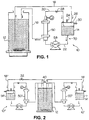
- the suspension to be filtered is kept mixed in a second reservoir 12 or process liquid tank (process zone).
- the first reservoir 14 is substantially airtight such that, when permeate liquid is removed via a permeate outlet means 16 into the second reservoir 12, liquid is drawn into the first reservoir 14 via a first conduit 18 from the second reservoir 12, the latter being a vessel at atmospheric pressure at all times.
- permeate or material passing through a filtration means 50 will be transported back to the second reservoir 12 or process fluid tank, whereas the retained solids or retentate is recirculated in a substantially airtight loop 70 comprising a retentate outlet means 20, the first reservoir 14 and a second conduit 22 and is, thereby, concentrated in the first reservoir 14 or buffer vessel. Solids will remain in suspension in the first reservoir liquid volume and thus prevent clogging up of the filtration means 50.
- a relief valve 24 may be positioned on the top cover 26 of the first reservoir 14, which valve 24 can be opened at the end of the process, to permit recovery of dissolved analyte in the buffer liquid. Opening the valve 24 will stop the process liquid flow along the first conduit 18 to the first reservoir 14 and concentration of the buffer liquid will then ensue.
- a valve 28 may also be located on the retentate outlet means 20. This valve 28 can be opened to empty the first reservoir 14 after a purification run. Fresh solvent (i.e. de-ionised water) can be fed through a rinse port 30 provided in the first reservoir 14 to clean the apparatus 10 of the present invention.
- Fresh solvent i.e. de-ionised water
- the apparatus 10 as described hereinabove and as illustrated in Figure 1 acts as large scale filtration, as an automated laboratory pre-purification step.
- the Figure 1 embodiment can be used to batch-wise eliminate particulate matter from turbid solutions. Specifically, particulate matter is concentrated in the first reservoir 14 and clear process liquid is to be found in the second reservoir 12.
- the filtration process does not require operator intervention as the system does not require, for example, switching off after a clear process liquid is obtained, in contrast to the conventional filtration approaches.
- liquid separations at the molecular scale range can be accomplished as well.
- two stand-alone apparatuses 10', 10'' can be inter-connected to allow multiple stage separations, specifically, a microfiltration unit 10' can be connected to an identical unit 10'' fitted with ultrafiltration separation capability.
- a microfiltration unit 10' can be connected to an identical unit 10'' fitted with ultrafiltration separation capability.
- Analytes of interest for treatment that remain in the first reservoir 14' of the microfiltration unit 10' can be completely recovered and transported to the ultrafiltration device 10'' by simply allowing continuous recirculation of the process fluid in the microfiltration module 10'.
- Fitting a by-pass valve 32 in the first conduit 18'' (from the second reservoir 12'' to the first reservoir 14'') makes the ultrafiltration module 10'' compatible with a conventional diafiltration mode of operation.
- a valve (not shown) may be fitted to the permeate outlet means 16', so as to induce a back pressure in the lower half of the filtration means 50'.
- a valve 40 is fitted to interconnect the respective first conduits 18', 18'' and, thereby, to permit the microfiltration unit 10' and the ultrafiltration unit 10'' to be operated in that sequence. Alternatively, an operator may actuate, firstly, the microfiltration unit 10' and then the ultrafiltration unit 10''.
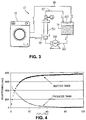
- the fluid conduits of the laundry machine itself comprise the second reservoir 12 and the first conduit 18 feeds wash liquor from the laundry machine 12 to the first reservoir 14.
- a coarse filter 60 is provided in the first reservoir 14, to prevent clogging with fabric debris or the like.
- the second conduit 22 feeds fluid from the first reservoir 14 to the filtration means 50, using a pump means or pump 58.
- Permeate is returned to the laundry machine (or second reservoir 12) via the permeate outlet means 16, whilst retentate is recirculated via the retentate outlet means 20 to the first reservoir 14.
- the Figure 3 embodiment permits efficient particulates removal from the wash liquor and returns substantially undiluted, substantially particulates-free or clean wash liquor to the laundry machine.
- the Figure 3 embodiment also permits in-line particulates elimination from aquarium water and, in that event, the aquarium itself would constitute the second reservoir 12.
- cross-flow filtration apparatus of the present invention can be fitted with the following options to permit:
- the first and second reservoirs had respective volumes of 3000ml and 1000ml.
- the filtration means had a pore size of 0.1 ⁇ m and a surface area of 0.03m 2 .
- the filtration means was supplied by Amicon.
- As a test process liquid a 5% emulsion of zeolite in water (pH 10.5) was used, so as to mimic the characteristics of a detergent solution. 2 litres of the emulsion could be processed in one hour - no operator intervention was required during the purification process.
- the present cross-flow filtration apparatus in the form of a reversed diafiltration system and operating with a hollow fibre type filtration means of 0.1 ⁇ m pore size; a 1.51 second reservoir; and a 0.51 first reservoir, was used to demonstrate its applicability for laundry detergent (liquid and granular detergent) analytical purification.
- a liquid detergent formulation (Ariel Futur (Trade Mark), prod. Code 247 A41 08:07, in a concentration of 6.67ml/l water)and a zeolite-containing granular detergent formulation (Ariel Color (Trade Mark), prod. Code 417 BA1, in a concentration of 7 g/l water) were each prepared in deionised water. The progress of the filtration was monitored via a phototrode probe (wavelength 650nm) in the process volume (see Figures 5-6 of the accompanying drawings).
- Figure 5 shows the filtration progress (absorbance; mV) with time for Ariel Futur (Trade Mark) in deionised water. Substantially complete solids removal is observed after just over 20 minutes.
- Figure 6 shows the filtration progress (absorbance; mV) with time for Ariel Color (Trade Mark) in deionised water.
- the absorbance is off-scale for the first 20 minutes or so, following which a steady filtration progression is observed.
- Figures 5 and 6 are examples of reversed diafiltration data, obtained for both detergent matrices in deionised water. Purification takes longer for the granular detergent, most probably due to the large zeolite load (see Figure 6 in comparison to Figure 5).
- a liquid detergent (Ariel Futur (Trade Mark), prod. Code 247 A41 08:07, in a concentration of 6.5ml/l water) and a granular detergent (Ariel Color (Trade Mark), prod. Code 417 BA1, in a concentration of 7 g/l water) were each prepared, both in deionised water and in city water. Progress of the filtration was monitored via a phototrode probe (wavelength 650nm; absorbance; mV) in the process volume (see Figures 7-10 of the accompanying drawings) Filtration means' permeation flow rates were restored after each experiment by rinsing with acidified deionised water (10 ml HCl/l water).
- Example 2 Compared with Example 2, permeate flow rates are reduced for both deionised and city water based detergent solutions. Even so, filtration is almost complete after 60 to 120 minutes for all conditions tested, although the filtration means' membrane area, at 0.013 m 2 , was much smaller as compared to Example 2 data using a 0.1 ⁇ m filtration means (0.03m 2 , Amicon H1MP01-43).
- a minimum first reservoir or buffer vessel volume of 500ml is normally required to allow sufficiently high cross-flow rates across the filtration means and to ensure thorough mixing of process fluid and buffer vessel contents.
- HDL type detergent Ariel Futur (Trade Mark) in city water
- Ariel Color(Trade Mark) in city water takes approximately one hour to complete.
- Filtration was progressed at back pressures of 0.2 bar or lower.
- a low operating pressure is important as it enables the cross-flow filtration apparatus of the present invention to be run with a low-cost centrifugal pump (e.g. of the type used in laundry washing machines).
- Liquid volumes used in laundry machines are usually about 15-20 litres (typically 161).
- the required filtration means' surface area is preferably at least 0.25m 2 .
- the present example concerns filtration, using a laundry wash liquor as the process fluid.
- the liquid detergent (Dash Color Liquor (Trade Mark) was assessed using, as the process fluid, the output from a 60°C wash in a Zanussi-JetSystem (Trade Mark) laundry washing machine operated under typical in-home conditions following the manufacturer's recommendations as to laundry load and product usage.
- the filtration means was of the "hollow fibre” type (having a pore size of 0.65 ⁇ m; a surface area of 0.013m 2 and supplied by AG Technology.
- the filtration equipment was identical to that in Example 3.
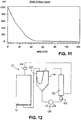
- Figure 11 of the accompanying drawings shows the filtration progression with time, by plotting the absorbance (mV) of the wash liquor (as measured by a 650nm phototrode) versus filtration time.
- the process can also be undertaken with larger pore sized (i.e. 1-1.5 ⁇ m) filtration means for additional purification speed and with filtration means in the form of plate and frame devices, rather than hollow fibre modules which are limited with respect to pore size.
- larger pore sized (i.e. 1-1.5 ⁇ m) filtration means for additional purification speed and with filtration means in the form of plate and frame devices, rather than hollow fibre modules which are limited with respect to pore size.
- Figure 12 of the accompanying drawings illustrates an optimised cross-flow filtration apparatus of the present invention.
- filtration speed and/or filtration means' load of the apparatus of Example 4 is further improved by incorporating a disposable pre-filter device 60 in the first reservoir 14 to retain part of the particulate load in the first reservoir 14 or buffer vessel.
- a pre-filter device 60 also serves to prevent entry of larger sized debris (e.g. fabric fragments) into the narrow channels of cross-flow filtration apparatus 10 itself.
- an in-line, pre-filter device 62 is located intermediate the re-circulation pump 58 and the filtration means 50, allowing the pump's pressure to force liquid through the in-line pre-filter device 62.
- Example 6 concerns filtration progression, by manually applying an intermittent filtration membrane clean-sweeping step.
- Filtration means' efficacy and life-span is increased by applying an intermittent filtration membrane clean-sweeping step.
- the result is an increased back pressure at the lower half of the filtration membrane's permeate side. This causes retained matter to be released from the membrane at the pressure side, which retained matter is subsequently swept away by the cross-flow liquid in the filtration means 50. Simulating this effect by manually shutting off the permeate outlet means 16 is an effective way to improve the overall performance of the cross-flow apparatus of the present invention 10.
- the detergent formulation is Dash Color Liquor (Trade Mark) in a 60°C wash liquor from a Zanussi-JetSystem (Trade Mark) laundry washing machine.
- Figure 13 shows the filtration progression (absorbance; mV versus time) with and without a manual switching regime.
- the manual switching regime chosen was a frequency of 0.03 minutes and an open-closed ratio of 1:1.
- the present example demonstrates surfactant separation from Ariel Futur (Trade Mark) and Ariel Color (Trade Mark) detergent formulations in both city water and deionised (Milli-Q (Trade Mark)) water.
- the filtration means is a hydrophobic polysulfone membrane.
- SURFACTANT REMOVAL (meq/mL) Product Type Filter Type ( ⁇ m) City Water Milli-Q Water Buffer Process Buffer Process Ariel Futur 0.1 - - 0.05936 0.01375 Ariel Color 0.1 - - 0.03679 0.003875 Ariel Futur 0.65 0.04506 0.02103 0.01865 0.01794 Ariel Color 0.65 0.02254 0.01006 0.02910 0.003488
Landscapes
- Engineering & Computer Science (AREA)
- Chemical & Material Sciences (AREA)
- Water Supply & Treatment (AREA)
- Organic Chemistry (AREA)
- Life Sciences & Earth Sciences (AREA)
- Chemical Kinetics & Catalysis (AREA)
- Health & Medical Sciences (AREA)
- Zoology (AREA)
- Wood Science & Technology (AREA)
- Bioinformatics & Cheminformatics (AREA)
- Biotechnology (AREA)
- Biochemistry (AREA)
- Genetics & Genomics (AREA)
- Biomedical Technology (AREA)
- Microbiology (AREA)
- Sustainable Development (AREA)
- General Health & Medical Sciences (AREA)
- General Engineering & Computer Science (AREA)
- Electrochemistry (AREA)
- Materials Engineering (AREA)
- Metallurgy (AREA)
- Textile Engineering (AREA)
- Nanotechnology (AREA)
- Hydrology & Water Resources (AREA)
- Environmental & Geological Engineering (AREA)
- Separation Using Semi-Permeable Membranes (AREA)
Priority Applications (3)
| Application Number | Priority Date | Filing Date | Title |
|---|---|---|---|
| EP98203574A EP0995483A1 (fr) | 1998-10-23 | 1998-10-23 | Appareil de filtration à écoulement tangentiel |
| PCT/US1999/024505 WO2000024499A1 (fr) | 1998-10-23 | 1999-10-20 | Dispositif filtrant a flux transversal |
| AU12128/00A AU1212800A (en) | 1998-10-23 | 1999-10-20 | A cross-flow filtration apparatus |
Applications Claiming Priority (1)
| Application Number | Priority Date | Filing Date | Title |
|---|---|---|---|
| EP98203574A EP0995483A1 (fr) | 1998-10-23 | 1998-10-23 | Appareil de filtration à écoulement tangentiel |
Publications (1)
| Publication Number | Publication Date |
|---|---|
| EP0995483A1 true EP0995483A1 (fr) | 2000-04-26 |
Family
ID=8234253
Family Applications (1)
| Application Number | Title | Priority Date | Filing Date |
|---|---|---|---|
| EP98203574A Withdrawn EP0995483A1 (fr) | 1998-10-23 | 1998-10-23 | Appareil de filtration à écoulement tangentiel |
Country Status (3)
| Country | Link |
|---|---|
| EP (1) | EP0995483A1 (fr) |
| AU (1) | AU1212800A (fr) |
| WO (1) | WO2000024499A1 (fr) |
Cited By (33)
| Publication number | Priority date | Publication date | Assignee | Title |
|---|---|---|---|---|
| WO2002004354A1 (fr) * | 2000-07-11 | 2002-01-17 | Textil-Service | Procede et dispositif de traitement d'eaux usees provenant de laveries |
| WO2003031035A1 (fr) * | 2001-10-09 | 2003-04-17 | Millipore Corporation | Systeme automatique de filtrage et d'execution de processus de separation, et d'acquisition et enregistrement de donnees correspondantes |
| WO2004058038A1 (fr) * | 2002-12-25 | 2004-07-15 | Arçelik A. S. | Lave-vaisselle et procede de commande associe |
| US6763860B2 (en) | 2001-07-10 | 2004-07-20 | Ecolab, Inc. | Flow-based chemical dispense system |
| EP1598468A1 (fr) * | 2004-05-17 | 2005-11-23 | The Procter & Gamble Company | Procédé et appareil pour laver avec purification et recyclage du liquide laveur |
| EP1598467A1 (fr) * | 2004-05-17 | 2005-11-23 | The Procter & Gamble Company | Procédé et dispositif pour laver |
| EP1598469A1 (fr) * | 2004-05-17 | 2005-11-23 | The Procter & Gamble Company | Procédé et appareil pour laver avec purification et recyclage du liquide laveur |
| WO2005116320A1 (fr) * | 2004-05-17 | 2005-12-08 | The Procter & Gamble Company | Procede et systeme de lavage et de recyclage avec une solution concentree de lavage |
| EP1605089A1 (fr) * | 2004-05-17 | 2005-12-14 | The Procter & Gamble Company | Procédé et appareil pour laver avec purification et recyclage du liquide laveur |
| DE102004032318A1 (de) * | 2004-07-02 | 2006-01-19 | Fachhochschule Gießen-Friedberg | Herstellung einer konzentrierten Lösung aus biologischen Substanzen |
| EP1707254A1 (fr) * | 2005-03-30 | 2006-10-04 | Special Membrane Technologies, Inc. | Module de filtration à haute densité |
| US7270744B2 (en) | 2001-10-09 | 2007-09-18 | Millipore Corporation | Automated low-volume tangential flow filtration process development device |
| WO2007110203A1 (fr) * | 2006-03-28 | 2007-10-04 | Ge Healthcare Bio-Sciences Ab | Filtration tangentielle de faible volume automatisée |
| US7292914B2 (en) | 2001-07-10 | 2007-11-06 | Ecolab Inc. | Remote access to chemical dispense system |
| EP1752080A3 (fr) * | 2005-08-12 | 2007-11-07 | Premark FEG L.L.C. | Lave-vaisselle du type transport comportant des moyens pour réduire la salissure du fluide de lavage |
| US7803321B2 (en) | 2005-03-18 | 2010-09-28 | Ecolab Inc. | Formulating chemical solutions based on volumetric and weight based control measurements |
| EP1971437A4 (fr) * | 2005-12-29 | 2011-06-08 | Spf Innovations Llc | Procede et appareil pour la filtration d'echantillons biologiques |
| DE102011121519A1 (de) * | 2011-12-16 | 2013-06-20 | Fritz Emde Fabrikation von Maschinen- und Vakuumanlagen | Verfahren und Anlage zur Abtrennung von Wasser aus einem Schaumlöschmittel |
| EP2644259A1 (fr) * | 2012-03-29 | 2013-10-02 | Roche Diagniostics GmbH | Système de filtration à micro-écoulement et procédé de filtration d'écoulement |
| ITPN20120063A1 (it) * | 2012-10-16 | 2014-04-17 | Emainox S P A | Lavastoviglie con riciclo del liquido di lavaggio per cicli di lavaggio successivi |
| WO2014155310A3 (fr) * | 2013-03-28 | 2014-12-04 | Indesit Company S.P.A. | Appareil de repassage, en particulier destiné à un usage domestique |
| CN105506931A (zh) * | 2014-09-22 | 2016-04-20 | 青岛海尔智能技术研发有限公司 | 对洗衣机循环水过滤系统中的过滤组件进行清洗的方法 |
| CN105506934A (zh) * | 2014-09-22 | 2016-04-20 | 青岛海尔智能技术研发有限公司 | 洗衣机的过滤组件的自清洁方法 |
| WO2017025210A1 (fr) * | 2015-08-08 | 2017-02-16 | Stobbe Pharma Tech Gmbh | Système jetable de bioprocédé supportant une activité biologique |
| US9700845B2 (en) | 2012-03-29 | 2017-07-11 | Hoffmann-La Roche Inc. | Micro flow filtration system and flow filtration method for a fluid sample |
| CN109330375A (zh) * | 2018-11-03 | 2019-02-15 | 邢二江 | 一种可自动上水的饮水装置 |
| CN109381917A (zh) * | 2018-11-23 | 2019-02-26 | 楚天科技股份有限公司 | 药液灌装前除菌过滤装置、除菌过滤方法、灌装系统及灌装方法 |
| EP3501599A1 (fr) | 2017-12-19 | 2019-06-26 | BEMER Int. AG | Dispositif permettant de stimuler le réglage local de la microcirculation, procédé prophylactique ou thérapeutique ainsi qu'utilisation destiné à améliorer les caractéristiques représentatives de l'état de fonctionnement de la microcirculation |
| EP3688134A1 (fr) * | 2017-09-27 | 2020-08-05 | Univercells Technologies S.A. | Système et procédé pour la production de biomolécules telles que des vaccins viraux |
| US20210155892A1 (en) * | 2018-07-27 | 2021-05-27 | Univercells Technologies S.A. | System and method for the production of biomolecules |
| WO2025046212A1 (fr) * | 2023-08-31 | 2025-03-06 | VWS (UK) Limited | Appareil et procédé de traitement d'eaux usées contenant des microparticules et des molécules organiques |
| US12297825B2 (en) | 2022-04-14 | 2025-05-13 | Viking Pump, Inc. | Expandable, inner liner pump |
| WO2025260001A1 (fr) * | 2024-06-14 | 2025-12-18 | Donaldson Company, Inc. | Système et procédés de biotraitement |
Families Citing this family (11)
| Publication number | Priority date | Publication date | Assignee | Title |
|---|---|---|---|---|
| US7980395B2 (en) | 2009-01-29 | 2011-07-19 | Whirlpool Corporation | Cross-flow filtration system |
| US8497359B2 (en) | 2010-02-26 | 2013-07-30 | Ppg Industries Ohio, Inc. | Cationic electrodepositable coating composition comprising lignin |
| DE102012103497A1 (de) * | 2012-04-20 | 2013-10-24 | Miele & Cie. Kg | Geschirrspülautomat |
| CN103845027B (zh) * | 2012-12-07 | 2016-12-21 | 佛山市顺德区美的洗涤电器制造有限公司 | 洗碗机外循环节水过滤器、洗碗机及其节水过滤方法 |
| CN105051515A (zh) * | 2013-02-26 | 2015-11-11 | 伊诺瓦普瑞普有限公司 | 具有一次性流体路径的液体到液体生物粒子浓缩器 |
| CN108314273B (zh) * | 2018-04-18 | 2024-07-12 | 北京吉工科技有限公司 | 一种污水处理设备及污水处理方法 |
| CN110803733B (zh) * | 2018-08-04 | 2024-03-29 | 青岛海晏环境技术工程有限公司 | 一种预涂层膜分离技术及成套装置 |
| US10864483B2 (en) | 2018-11-16 | 2020-12-15 | Integrated Protein Technologies, Snc. | Molecular weight filtration system and apparatus |
| GB2593223A (en) * | 2020-03-20 | 2021-09-22 | Dairy Crest Ltd | Reactor |
| CN112608843B (zh) * | 2020-12-21 | 2022-05-03 | 山东壹瑞特生物科技有限公司 | 一种脉动流方式培养细胞的方法及其细胞反应器械 |
| EP4392541A1 (fr) * | 2021-08-24 | 2024-07-03 | Stellenbosch University | Bioréacteur pour co-culture sans contact |
Citations (9)
| Publication number | Priority date | Publication date | Assignee | Title |
|---|---|---|---|---|
| DE3513940A1 (de) * | 1984-05-29 | 1985-12-05 | Inst Kommunalwirtschaft | Einrichtung zur behandlung von waeschereiwasser |
| JPS62274083A (ja) * | 1986-05-21 | 1987-11-28 | Seiko Instr & Electronics Ltd | アルカリ脱脂液の再生方法 |
| US4839488A (en) * | 1986-08-20 | 1989-06-13 | Toshiba Ceramics Co., Ltd. | Electric discharge machine using a ceramic filter to filter the working fluid |
| US5034121A (en) * | 1988-08-19 | 1991-07-23 | Josef Budin | Apparatus for preparing a machining liquid of an electroerosion machine |
| JPH0487699A (ja) * | 1990-07-27 | 1992-03-19 | Hitachi Kiden Kogyo Ltd | 汚濁水域の浄化方法 |
| JPH04136194A (ja) * | 1990-09-25 | 1992-05-11 | Toho Chem Ind Co Ltd | 洗浄方法 |
| EP0747773A1 (fr) * | 1994-12-27 | 1996-12-11 | Mitsubishi Chemical Corporation | Procede et appareil pour traiter un revelateur pour materiau photosensible sans halogenure d'argent et contenant des pigments, et machine a developper automatique |
| JPH1015464A (ja) * | 1996-06-28 | 1998-01-20 | Asahi Chem Ind Co Ltd | 塗装工程における被洗浄物の洗浄方法、および洗浄装置 |
| US5868937A (en) * | 1996-02-13 | 1999-02-09 | Mainstream Engineering Corporation | Process and system for recycling and reusing gray water |
Family Cites Families (5)
| Publication number | Priority date | Publication date | Assignee | Title |
|---|---|---|---|---|
| SE456244B (sv) * | 1987-01-19 | 1988-09-19 | Casco Nobel Ab | Sett och anleggning for separation genom ultrafiltrering av vattenlosliga syntetiska polymerer |
| DE4041433A1 (de) * | 1990-12-21 | 1992-06-25 | Siemens Ag | Einrichtung zur aufbereitung von mehrphasengemischen fuer die analyse |
| DE4420575A1 (de) * | 1994-06-03 | 1995-12-07 | Schmidt & Haensch Franz | Filtereinrichtung |
| DE19620513C2 (de) * | 1996-05-22 | 2003-11-13 | Miele & Cie | Vorrichtung und Verfahren zur Standzeitverlängerung eines Entfettungsbades |
| DE19630089C1 (de) * | 1996-07-26 | 1997-10-16 | Brochier Wasser Und Abwasserte | Verfahren zur Aufbereitung von Abwasser mittels Membranfiltration |
-
1998
- 1998-10-23 EP EP98203574A patent/EP0995483A1/fr not_active Withdrawn
-
1999
- 1999-10-20 AU AU12128/00A patent/AU1212800A/en not_active Abandoned
- 1999-10-20 WO PCT/US1999/024505 patent/WO2000024499A1/fr not_active Ceased
Patent Citations (9)
| Publication number | Priority date | Publication date | Assignee | Title |
|---|---|---|---|---|
| DE3513940A1 (de) * | 1984-05-29 | 1985-12-05 | Inst Kommunalwirtschaft | Einrichtung zur behandlung von waeschereiwasser |
| JPS62274083A (ja) * | 1986-05-21 | 1987-11-28 | Seiko Instr & Electronics Ltd | アルカリ脱脂液の再生方法 |
| US4839488A (en) * | 1986-08-20 | 1989-06-13 | Toshiba Ceramics Co., Ltd. | Electric discharge machine using a ceramic filter to filter the working fluid |
| US5034121A (en) * | 1988-08-19 | 1991-07-23 | Josef Budin | Apparatus for preparing a machining liquid of an electroerosion machine |
| JPH0487699A (ja) * | 1990-07-27 | 1992-03-19 | Hitachi Kiden Kogyo Ltd | 汚濁水域の浄化方法 |
| JPH04136194A (ja) * | 1990-09-25 | 1992-05-11 | Toho Chem Ind Co Ltd | 洗浄方法 |
| EP0747773A1 (fr) * | 1994-12-27 | 1996-12-11 | Mitsubishi Chemical Corporation | Procede et appareil pour traiter un revelateur pour materiau photosensible sans halogenure d'argent et contenant des pigments, et machine a developper automatique |
| US5868937A (en) * | 1996-02-13 | 1999-02-09 | Mainstream Engineering Corporation | Process and system for recycling and reusing gray water |
| JPH1015464A (ja) * | 1996-06-28 | 1998-01-20 | Asahi Chem Ind Co Ltd | 塗装工程における被洗浄物の洗浄方法、および洗浄装置 |
Non-Patent Citations (8)
| Title |
|---|
| DATABASE WPI Section Ch Week 8802, Derwent World Patents Index; Class D15, AN 88-010850, XP002097271 * |
| DATABASE WPI Section Ch Week 9218, Derwent World Patents Index; Class D15, AN 92-146773, XP002097273 * |
| DATABASE WPI Section Ch Week 9225, Derwent World Patents Index; Class L03, AN 92-205386, XP002097270 * |
| DATABASE WPI Section Ch Week 9813, Derwent World Patents Index; Class J01, AN 98-139059, XP002097272 * |
| PATENT ABSTRACTS OF JAPAN vol. 012, no. 165 (C - 496) 18 May 1988 (1988-05-18) * |
| PATENT ABSTRACTS OF JAPAN vol. 016, no. 310 (C - 0960) 8 July 1992 (1992-07-08) * |
| PATENT ABSTRACTS OF JAPAN vol. 016, no. 411 (C - 0979) 31 August 1992 (1992-08-31) * |
| PATENT ABSTRACTS OF JAPAN vol. 098, no. 005 30 April 1998 (1998-04-30) * |
Cited By (59)
| Publication number | Priority date | Publication date | Assignee | Title |
|---|---|---|---|---|
| WO2002004354A1 (fr) * | 2000-07-11 | 2002-01-17 | Textil-Service | Procede et dispositif de traitement d'eaux usees provenant de laveries |
| US6763860B2 (en) | 2001-07-10 | 2004-07-20 | Ecolab, Inc. | Flow-based chemical dispense system |
| US7292914B2 (en) | 2001-07-10 | 2007-11-06 | Ecolab Inc. | Remote access to chemical dispense system |
| US7270744B2 (en) | 2001-10-09 | 2007-09-18 | Millipore Corporation | Automated low-volume tangential flow filtration process development device |
| WO2003031035A1 (fr) * | 2001-10-09 | 2003-04-17 | Millipore Corporation | Systeme automatique de filtrage et d'execution de processus de separation, et d'acquisition et enregistrement de donnees correspondantes |
| JP2005505405A (ja) * | 2001-10-09 | 2005-02-24 | ミリポア・コーポレイション | 分離プロセスを行いそれについてのデータを取得し記録するための自動流体ろ過システム |
| WO2004058038A1 (fr) * | 2002-12-25 | 2004-07-15 | Arçelik A. S. | Lave-vaisselle et procede de commande associe |
| US7708837B2 (en) | 2002-12-25 | 2010-05-04 | Ayla Kuran | Dishwasher and corresponding control method |
| WO2005116319A1 (fr) * | 2004-05-17 | 2005-12-08 | The Procter & Gamble Company | Méthode et système pour le lavage |
| WO2005116320A1 (fr) * | 2004-05-17 | 2005-12-08 | The Procter & Gamble Company | Procede et systeme de lavage et de recyclage avec une solution concentree de lavage |
| EP1605089A1 (fr) * | 2004-05-17 | 2005-12-14 | The Procter & Gamble Company | Procédé et appareil pour laver avec purification et recyclage du liquide laveur |
| US7950254B2 (en) | 2004-05-17 | 2011-05-31 | The Procter & Gamble Company | Method and system for washing |
| EP1598469A1 (fr) * | 2004-05-17 | 2005-11-23 | The Procter & Gamble Company | Procédé et appareil pour laver avec purification et recyclage du liquide laveur |
| EP1598467A1 (fr) * | 2004-05-17 | 2005-11-23 | The Procter & Gamble Company | Procédé et dispositif pour laver |
| EP1598468A1 (fr) * | 2004-05-17 | 2005-11-23 | The Procter & Gamble Company | Procédé et appareil pour laver avec purification et recyclage du liquide laveur |
| DE102004032318A1 (de) * | 2004-07-02 | 2006-01-19 | Fachhochschule Gießen-Friedberg | Herstellung einer konzentrierten Lösung aus biologischen Substanzen |
| US8540937B2 (en) | 2005-03-18 | 2013-09-24 | Ecolab Inc. | Formulating chemical solutions based on volumetric and weight based control measurements |
| US7803321B2 (en) | 2005-03-18 | 2010-09-28 | Ecolab Inc. | Formulating chemical solutions based on volumetric and weight based control measurements |
| EP1707254A1 (fr) * | 2005-03-30 | 2006-10-04 | Special Membrane Technologies, Inc. | Module de filtration à haute densité |
| EP1752080A3 (fr) * | 2005-08-12 | 2007-11-07 | Premark FEG L.L.C. | Lave-vaisselle du type transport comportant des moyens pour réduire la salissure du fluide de lavage |
| EP1971437A4 (fr) * | 2005-12-29 | 2011-06-08 | Spf Innovations Llc | Procede et appareil pour la filtration d'echantillons biologiques |
| WO2007110203A1 (fr) * | 2006-03-28 | 2007-10-04 | Ge Healthcare Bio-Sciences Ab | Filtration tangentielle de faible volume automatisée |
| DE102011121519A1 (de) * | 2011-12-16 | 2013-06-20 | Fritz Emde Fabrikation von Maschinen- und Vakuumanlagen | Verfahren und Anlage zur Abtrennung von Wasser aus einem Schaumlöschmittel |
| US9700845B2 (en) | 2012-03-29 | 2017-07-11 | Hoffmann-La Roche Inc. | Micro flow filtration system and flow filtration method for a fluid sample |
| EP2644259A1 (fr) * | 2012-03-29 | 2013-10-02 | Roche Diagniostics GmbH | Système de filtration à micro-écoulement et procédé de filtration d'écoulement |
| WO2013144091A1 (fr) * | 2012-03-29 | 2013-10-03 | Roche Diagnostics Gmbh | Système de micro-filtration d'écoulement et procédé de filtration d'écoulement |
| CN104220149A (zh) * | 2012-03-29 | 2014-12-17 | 弗·哈夫曼-拉罗切有限公司 | 微流过滤系统和流过滤方法 |
| US10213742B2 (en) | 2012-03-29 | 2019-02-26 | Hoffmann-La Roche, Inc. | Micro flow filtration system and flow filtration method |
| CN104220149B (zh) * | 2012-03-29 | 2016-08-24 | 弗·哈夫曼-拉罗切有限公司 | 微流过滤系统和流过滤方法 |
| JP2017205760A (ja) * | 2012-03-29 | 2017-11-24 | エフ.ホフマン−ラ ロシュ アーゲーF. Hoffmann−La Roche Aktiengesellschaft | マイクロフロー濾過システム及びフロー濾過方法 |
| ITPN20120063A1 (it) * | 2012-10-16 | 2014-04-17 | Emainox S P A | Lavastoviglie con riciclo del liquido di lavaggio per cicli di lavaggio successivi |
| WO2014155310A3 (fr) * | 2013-03-28 | 2014-12-04 | Indesit Company S.P.A. | Appareil de repassage, en particulier destiné à un usage domestique |
| CN105506931A (zh) * | 2014-09-22 | 2016-04-20 | 青岛海尔智能技术研发有限公司 | 对洗衣机循环水过滤系统中的过滤组件进行清洗的方法 |
| CN105506934A (zh) * | 2014-09-22 | 2016-04-20 | 青岛海尔智能技术研发有限公司 | 洗衣机的过滤组件的自清洁方法 |
| EP3187642A4 (fr) * | 2014-09-22 | 2017-07-05 | Qingdao Haier Smart Technology R&D Co., Ltd. | Procédé d'auto-nettoyage d'ensemble de filtre de lave-linge |
| CN105506934B (zh) * | 2014-09-22 | 2019-08-09 | 青岛海尔智能技术研发有限公司 | 洗衣机的过滤组件的自清洁方法 |
| CN105506931B (zh) * | 2014-09-22 | 2019-07-12 | 青岛海尔智能技术研发有限公司 | 对洗衣机循环水过滤系统中的过滤组件进行清洗的方法 |
| US12110484B2 (en) | 2015-08-08 | 2024-10-08 | Stobbe Gmbh | Disposable bioprocess system supporting biological activity |
| US12157878B2 (en) | 2015-08-08 | 2024-12-03 | Stobbe Gmbh | Retention system |
| WO2017025210A1 (fr) * | 2015-08-08 | 2017-02-16 | Stobbe Pharma Tech Gmbh | Système jetable de bioprocédé supportant une activité biologique |
| KR102621101B1 (ko) | 2015-08-08 | 2024-01-05 | 스토베 게엠베하 | 생물학적 활동을 지원하는 일회용 생물 공정 시스템 |
| US11414642B2 (en) | 2015-08-08 | 2022-08-16 | Stobbe Gmbh | Disposable bioprocess system supporting biological activity |
| JP2018534940A (ja) * | 2015-08-08 | 2018-11-29 | ストッべ・ファルマ・テック・ゲーエムベーハー | 生物活性をサポートする使い捨てバイオプロセスシステム |
| KR20180040134A (ko) * | 2015-08-08 | 2018-04-19 | 스토베 파마 테크 게엠베하 | 생물학적 활동을 지원하는 일회용 생물 공정 시스템 |
| JP2021061853A (ja) * | 2015-08-08 | 2021-04-22 | ストッべ・ファルマ・テック・ゲーエムベーハー | 生物活性をサポートする使い捨てバイオプロセスシステム |
| US12152231B2 (en) * | 2017-09-27 | 2024-11-26 | Univercells Technologies S.A. | System and method for the production of biomolecules such as viral vaccines |
| AU2018348962B2 (en) * | 2017-09-27 | 2025-02-13 | Univercells Technologies S.A. | System and method for the production of biomolecules such as viral vaccines |
| EP3688134A1 (fr) * | 2017-09-27 | 2020-08-05 | Univercells Technologies S.A. | Système et procédé pour la production de biomolécules telles que des vaccins viraux |
| US20200318060A1 (en) * | 2017-09-27 | 2020-10-08 | Univercells S.A. | System and method for the production of biomolecules such as viral vaccines |
| WO2019121622A1 (fr) | 2017-12-19 | 2019-06-27 | Bemer International Ag | Dispositif et procédé pour stimuler la régulation locale de la microcirculation |
| EP3501599A1 (fr) | 2017-12-19 | 2019-06-26 | BEMER Int. AG | Dispositif permettant de stimuler le réglage local de la microcirculation, procédé prophylactique ou thérapeutique ainsi qu'utilisation destiné à améliorer les caractéristiques représentatives de l'état de fonctionnement de la microcirculation |
| US20210155892A1 (en) * | 2018-07-27 | 2021-05-27 | Univercells Technologies S.A. | System and method for the production of biomolecules |
| US12351793B2 (en) * | 2018-07-27 | 2025-07-08 | Univercells Technologies S.A. | System and method for the production of biomolecules |
| CN109330375A (zh) * | 2018-11-03 | 2019-02-15 | 邢二江 | 一种可自动上水的饮水装置 |
| CN109330375B (zh) * | 2018-11-03 | 2020-11-17 | 浙江三宝知识产权服务有限公司 | 一种可自动上水的饮水装置 |
| CN109381917A (zh) * | 2018-11-23 | 2019-02-26 | 楚天科技股份有限公司 | 药液灌装前除菌过滤装置、除菌过滤方法、灌装系统及灌装方法 |
| US12297825B2 (en) | 2022-04-14 | 2025-05-13 | Viking Pump, Inc. | Expandable, inner liner pump |
| WO2025046212A1 (fr) * | 2023-08-31 | 2025-03-06 | VWS (UK) Limited | Appareil et procédé de traitement d'eaux usées contenant des microparticules et des molécules organiques |
| WO2025260001A1 (fr) * | 2024-06-14 | 2025-12-18 | Donaldson Company, Inc. | Système et procédés de biotraitement |
Also Published As
| Publication number | Publication date |
|---|---|
| WO2000024499A1 (fr) | 2000-05-04 |
| AU1212800A (en) | 2000-05-15 |
Similar Documents
| Publication | Publication Date | Title |
|---|---|---|
| EP0995483A1 (fr) | Appareil de filtration à écoulement tangentiel | |
| Eykamp | Microfiltration and ultrafiltration | |
| Drioli et al. | Biocatalytic membrane reactors: applications in biotechnology and the pharmaceutical industry | |
| Charcosset | Membrane processes in biotechnology and pharmaceutics | |
| Scott | Handbook of industrial membranes | |
| Nagata et al. | Cross‐flow membrane microfiltration of a bacteriol fermentation broth | |
| Strathmann | Membrane separation processes | |
| US5944998A (en) | Rotary filtration device with flow-through inner member | |
| US5132015A (en) | Flow control for ultra filtration systems | |
| CN101415482B (zh) | 用于化合物分离的切向流动过滤设备、系统和方法 | |
| JP2003519005A (ja) | クロスフロー濾過装置 | |
| KR20100074128A (ko) | 내부 오염 제어에 의한 여과 | |
| JPS6236723B2 (fr) | ||
| EP1726353A1 (fr) | Filtration membranaire d'un produit | |
| CN217139563U (zh) | 一种采用膜技术的浓缩分离系统 | |
| Aptel et al. | Ultrafiltration | |
| Mir et al. | Crossflow microfiltration: Applications, design, and cost | |
| Bowen | Understanding flux patterns in membrane processing of protein solutions and suspensions | |
| Caridis et al. | Pressure effects in cross-flow microfiltration of suspensions of whole bacterial cells | |
| Michaels | Fifteen years of ultrafiltration: problems and future promises of an adolescent technology | |
| CN203002094U (zh) | 啤酒陶瓷膜过滤系统装置 | |
| US20050092664A1 (en) | Improvised device for concentrating the aqueous solution and a pocess thereof | |
| JPS63126511A (ja) | クロスフロ−型精密濾過方法 | |
| JPH04190835A (ja) | クロスフロー型濾過器 | |
| Vigneswaran | Ultrafiltration |
Legal Events
| Date | Code | Title | Description |
|---|---|---|---|
| PUAI | Public reference made under article 153(3) epc to a published international application that has entered the european phase |
Free format text: ORIGINAL CODE: 0009012 |
|
| AK | Designated contracting states |
Kind code of ref document: A1 Designated state(s): AT BE CH CY DE DK ES FI FR GB GR IE IT LI LU MC NL PT SE |
|
| AX | Request for extension of the european patent |
Free format text: AL;LT;LV;MK;RO;SI |
|
| AKX | Designation fees paid | ||
| STAA | Information on the status of an ep patent application or granted ep patent |
Free format text: STATUS: THE APPLICATION IS DEEMED TO BE WITHDRAWN |
|
| 18D | Application deemed to be withdrawn |
Effective date: 20001027 |
|
| REG | Reference to a national code |
Ref country code: DE Ref legal event code: 8566 |