EP0995987A2 - PH-Sensoranordnung - Google Patents
PH-Sensoranordnung Download PDFInfo
- Publication number
- EP0995987A2 EP0995987A2 EP99203371A EP99203371A EP0995987A2 EP 0995987 A2 EP0995987 A2 EP 0995987A2 EP 99203371 A EP99203371 A EP 99203371A EP 99203371 A EP99203371 A EP 99203371A EP 0995987 A2 EP0995987 A2 EP 0995987A2
- Authority
- EP
- European Patent Office
- Prior art keywords
- sensor assembly
- insulating layer
- planar
- particles
- electrically conductive
- Prior art date
- Legal status (The legal status is an assumption and is not a legal conclusion. Google has not performed a legal analysis and makes no representation as to the accuracy of the status listed.)
- Withdrawn
Links
Images

Classifications
-
- G—PHYSICS
- G01—MEASURING; TESTING
- G01N—INVESTIGATING OR ANALYSING MATERIALS BY DETERMINING THEIR CHEMICAL OR PHYSICAL PROPERTIES
- G01N27/00—Investigating or analysing materials by the use of electric, electrochemical, or magnetic means
- G01N27/26—Investigating or analysing materials by the use of electric, electrochemical, or magnetic means by investigating electrochemical variables; by using electrolysis or electrophoresis
- G01N27/28—Electrolytic cell components
- G01N27/30—Electrodes, e.g. test electrodes; Half-cells
- G01N27/36—Glass electrodes
Definitions
- This invention relates to a solid state pH sensor assembly.
- the most widely used technique to measure values of pH is to use a glass pH electrode in conjunction with a reference electrode.
- Conventional pH electrodes comprise a glass sheath and bulb containing a solution of potassium chloride and a pH buffer, together with a dipped silver chloride wire.
- This fill solution, together with a pH sensing membrane formed in the glass sheath, define the potential that is measured to determine the pH of the solution in which the sensor is immersed.
- the potential produced is the algebraic sum of the potentials developed across the glass membrane, indicative of the sampled pH, and the potential of an internal reference electrode, usually a coated silver wire, and the external reference electrode
- a conventional glass bulb pH electrode can have a maximum glass thickness of 100 ⁇ to 200 ⁇ .
- the electrodes are very fragile and difficult to manufacture. They must also be frequently calibrated. This means that a skilled operator is required to take pH measurements.
- the aim of the invention is to provide a device for measuring pH values which is cheap to manufacture and which can be mass produced with small batch variations. Ideally the device will be able to be used by an unskilled operator.
- a planar pH sensor assembly comprising a planar substrate having a first surface and a second surface, an electrically conductive layer formed on the first surface of the substrate, an insulating layer formed on the surface of the electrically conductive layer remote from the substrate, the insulating layer covering the electrically conductive layer, and electrical contact means in connection with the electrically conductive layer for connecting the sensor assembly to a meter device, the insulating layer comprising a high resistance binder interspersed with a plurality of particles of pH glass, a number of particles remaining substantially uncoated and partially exposed above the surface of the insulating layer, at least one current path through the insulating layer being provided by point to point contact of the particles.
- a solid electrolyte layer provided between the insulating layer and the electrically conductive layer.
- the invention further provides methods of manufacturing a pH sensor assembly.
- Sensors according to the invention are much cheaper to manufacture than conventional glass bulb pH electrodes.
- the sensors can be mass produced and calibrated at manufacture. They are thus much simpler to use and can be used by unskilled operators.
- an electrically conductive layer 4 is deposited on a substrate 2.
- the conductive layer 4 is formed from a soft material such as indium or gold.
- a solid electrolyte ion conductive layer 12 is deposited over part of the electrically conductive layer.
- a layer of soft insulating material 6 is deposited over the solid electrolyte layer. The thickness of the insulating layer is in the region of 200 ⁇ .
- the insulating layer 6 comprises a high resistance binder in which particles 10 of pH glass have been mixed.
- the particles 10 have a linear dimension of between 5 ⁇ to 150 ⁇ , preferably 10 ⁇ .
- at least one current path through the insulating layer must be provided by point to point contact of the particles.
- a glass to binder ratio of 60 - 85% is the preferred range. This range provides a suitable aspect ratio to allow partially uncoated particles to appear at the surface of the insulating layer 6.
- a suitable insulating dielectric 22 is deposited over the surface of the sensor excepting a window 14 through which part of the pH sensitive surface is exposed.
- figure 1 is a schematic only and that the particles 10 are in contact as explained above.
- Electrical contacts are provided in connection with the electrically conductive layer 6 for contact with a meter device 18.
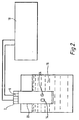
- FIG. 2 shows the assembly in use.
- the sensor assembly 20 is immersed in sample 16. Signals from the window 14 and the reference electrode 24 are supplied to the pH meter device 18.
- the binder containing the glass particles is coated onto the planar substrate.
- the substrate can be made by any known method, such as moulding.
- the substrate can be alumina, forsterite, zirconia or coated steel.
- the preferred thickness of the substrate is 0.1mm to 2mm.
- the unsolidified binder matrix can also be deposited in a pattern onto and over suitable solid conductor electrodes. These electrodes may themselves be deposited as a pattern onto a suitable solid substrate.
- a protective overlay of suitable dielectric material can be deposited over the entire surface except a window through which part of the pH sensitive substance is exposed.
- a suitable method may be screen printing.
Landscapes
- Chemical & Material Sciences (AREA)
- Life Sciences & Earth Sciences (AREA)
- Health & Medical Sciences (AREA)
- Physics & Mathematics (AREA)
- Chemical Kinetics & Catalysis (AREA)
- Electrochemistry (AREA)
- Molecular Biology (AREA)
- Analytical Chemistry (AREA)
- Biochemistry (AREA)
- General Health & Medical Sciences (AREA)
- General Physics & Mathematics (AREA)
- Immunology (AREA)
- Pathology (AREA)
- Investigating Or Analyzing Materials By The Use Of Electric Means (AREA)
- Investigating Or Analyzing Materials By The Use Of Fluid Adsorption Or Reactions (AREA)
Applications Claiming Priority (2)
| Application Number | Priority Date | Filing Date | Title |
|---|---|---|---|
| GB9823011 | 1998-10-22 | ||
| GBGB9823011.3A GB9823011D0 (en) | 1998-10-22 | 1998-10-22 | Ph sensor assembly |
Publications (2)
| Publication Number | Publication Date |
|---|---|
| EP0995987A2 true EP0995987A2 (de) | 2000-04-26 |
| EP0995987A3 EP0995987A3 (de) | 2001-11-21 |
Family
ID=10840993
Family Applications (1)
| Application Number | Title | Priority Date | Filing Date |
|---|---|---|---|
| EP99203371A Withdrawn EP0995987A3 (de) | 1998-10-22 | 1999-10-14 | PH-Sensoranordnung |
Country Status (3)
| Country | Link |
|---|---|
| EP (1) | EP0995987A3 (de) |
| JP (1) | JP2000131266A (de) |
| GB (1) | GB9823011D0 (de) |
Families Citing this family (1)
| Publication number | Priority date | Publication date | Assignee | Title |
|---|---|---|---|---|
| KR101115694B1 (ko) | 2009-01-19 | 2012-03-06 | 경북대학교 산학협력단 | 유리 pH 센서를 이용한 pH 측정 시스템 |
Family Cites Families (6)
| Publication number | Priority date | Publication date | Assignee | Title |
|---|---|---|---|---|
| US3607710A (en) * | 1969-02-14 | 1971-09-21 | Perkin Elmer Corp | Seal for ion-selective electrode |
| US4052285A (en) * | 1975-03-20 | 1977-10-04 | National Research Development Corporation | Ion selective electrodes |
| US4133735A (en) * | 1977-09-27 | 1979-01-09 | The Board Of Regents Of The University Of Washington | Ion-sensitive electrode and processes for making the same |
| US4282079A (en) * | 1980-02-13 | 1981-08-04 | Eastman Kodak Company | Planar glass ion-selective electrode |
| DE3789491T2 (de) * | 1986-11-27 | 1994-10-20 | Horiba Ltd | Plattenförmige Glaselektrode. |
| DK163944C (da) * | 1990-02-07 | 1992-09-21 | Radiometer As | Glaselektrode og anvendelse af denne |
-
1998
- 1998-10-22 GB GBGB9823011.3A patent/GB9823011D0/en not_active Ceased
-
1999
- 1999-10-14 EP EP99203371A patent/EP0995987A3/de not_active Withdrawn
- 1999-10-18 JP JP11295230A patent/JP2000131266A/ja active Pending
Also Published As
| Publication number | Publication date |
|---|---|
| JP2000131266A (ja) | 2000-05-12 |
| GB9823011D0 (en) | 1998-12-16 |
| EP0995987A3 (de) | 2001-11-21 |
Similar Documents
| Publication | Publication Date | Title |
|---|---|---|
| US4889612A (en) | Ion-selective electrode having a non-metal sensing element | |
| Koncki et al. | Screen-printed ruthenium dioxide electrodes for pH measurements | |
| AU596736B2 (en) | Ion selective sensors | |
| EP0472398B1 (de) | pH-Messelektrode und Verfahren zur Herstellung derselben | |
| CN118221064A (zh) | 生产传感器元件的方法 | |
| US4772377A (en) | Membrane anchor for ion-selective electrodes | |
| US11391688B2 (en) | Sensor element for a potentiometric sensor | |
| US5480534A (en) | Electrode for measuring PH | |
| JPH07109413B2 (ja) | 化学感応性変換器 | |
| US5785830A (en) | Electrochemical planar metal/metal oxide electrodes | |
| CN102770756B (zh) | 具有工作电极的受控变化的层压电化学传感器 | |
| US4732662A (en) | Measuring electrode | |
| AU1430692A (en) | Electrode calibration | |
| EP0973028A2 (de) | Elektrodenanordnung | |
| CN112415064B (zh) | 制造用于电位传感器的传感器元件的方法 | |
| JPS6243560A (ja) | 混合物成分の活性を測定するための固体電池 | |
| EP0441659A1 (de) | Feststellung eines Risses in der Wand eines elektrochemischen Sensors | |
| CN112415065A (zh) | 电位计式传感器用传感器元件及其制造方法 | |
| EP0682247A1 (de) | Verbesserte Bezugselektrode | |
| US5262205A (en) | Process for producing the ion-sensitive probe electrode of a heavy-metal-ion sensor | |
| EP0997730A1 (de) | PH-Sensor unter Verwendung von Glasspartikeln, die in eine Isolierschicht eingebetted sind | |
| CN112083052B (zh) | 电位计探针 | |
| JP2813423B2 (ja) | 電気化学式ガスセンサ | |
| US7736478B2 (en) | Ion solution concentration-detecting device | |
| JPH04250353A (ja) | pH値測定装置 |
Legal Events
| Date | Code | Title | Description |
|---|---|---|---|
| PUAI | Public reference made under article 153(3) epc to a published international application that has entered the european phase |
Free format text: ORIGINAL CODE: 0009012 |
|
| AK | Designated contracting states |
Kind code of ref document: A2 Designated state(s): AT BE CH CY DE DK ES FI FR GB GR IE IT LI LU MC NL PT SE Kind code of ref document: A2 Designated state(s): DE FR GB |
|
| AX | Request for extension of the european patent |
Free format text: AL;LT;LV;MK;RO;SI |
|
| PUAL | Search report despatched |
Free format text: ORIGINAL CODE: 0009013 |
|
| AK | Designated contracting states |
Kind code of ref document: A3 Designated state(s): AT BE CH CY DE DK ES FI FR GB GR IE IT LI LU MC NL PT SE |
|
| AX | Request for extension of the european patent |
Free format text: AL;LT;LV;MK;RO;SI |
|
| 17P | Request for examination filed |
Effective date: 20020429 |
|
| AKX | Designation fees paid |
Free format text: DE FR GB |
|
| STAA | Information on the status of an ep patent application or granted ep patent |
Free format text: STATUS: THE APPLICATION HAS BEEN WITHDRAWN |
|
| 18W | Application withdrawn |
Effective date: 20051103 |