EP0996647B1 - Verfahren zur herstellung von olefinpolymeren mit einer gewünschten verteilung des molekulargewichtes - Google Patents
Verfahren zur herstellung von olefinpolymeren mit einer gewünschten verteilung des molekulargewichtes Download PDFInfo
- Publication number
- EP0996647B1 EP0996647B1 EP98935058A EP98935058A EP0996647B1 EP 0996647 B1 EP0996647 B1 EP 0996647B1 EP 98935058 A EP98935058 A EP 98935058A EP 98935058 A EP98935058 A EP 98935058A EP 0996647 B1 EP0996647 B1 EP 0996647B1
- Authority
- EP
- European Patent Office
- Prior art keywords
- polymerization
- hydrogen
- molecular weight
- process according
- weight distribution
- Prior art date
- Legal status (The legal status is an assumption and is not a legal conclusion. Google has not performed a legal analysis and makes no representation as to the accuracy of the status listed.)
- Expired - Lifetime
Links
Images


Classifications
-
- C—CHEMISTRY; METALLURGY
- C08—ORGANIC MACROMOLECULAR COMPOUNDS; THEIR PREPARATION OR CHEMICAL WORKING-UP; COMPOSITIONS BASED THEREON
- C08F—MACROMOLECULAR COMPOUNDS OBTAINED BY REACTIONS ONLY INVOLVING CARBON-TO-CARBON UNSATURATED BONDS
- C08F10/00—Homopolymers and copolymers of unsaturated aliphatic hydrocarbons having only one carbon-to-carbon double bond
-
- C—CHEMISTRY; METALLURGY
- C08—ORGANIC MACROMOLECULAR COMPOUNDS; THEIR PREPARATION OR CHEMICAL WORKING-UP; COMPOSITIONS BASED THEREON
- C08F—MACROMOLECULAR COMPOUNDS OBTAINED BY REACTIONS ONLY INVOLVING CARBON-TO-CARBON UNSATURATED BONDS
- C08F10/00—Homopolymers and copolymers of unsaturated aliphatic hydrocarbons having only one carbon-to-carbon double bond
- C08F10/02—Ethene
-
- C—CHEMISTRY; METALLURGY
- C08—ORGANIC MACROMOLECULAR COMPOUNDS; THEIR PREPARATION OR CHEMICAL WORKING-UP; COMPOSITIONS BASED THEREON
- C08F—MACROMOLECULAR COMPOUNDS OBTAINED BY REACTIONS ONLY INVOLVING CARBON-TO-CARBON UNSATURATED BONDS
- C08F110/00—Homopolymers of unsaturated aliphatic hydrocarbons having only one carbon-to-carbon double bond
- C08F110/02—Ethene
-
- C—CHEMISTRY; METALLURGY
- C08—ORGANIC MACROMOLECULAR COMPOUNDS; THEIR PREPARATION OR CHEMICAL WORKING-UP; COMPOSITIONS BASED THEREON
- C08F—MACROMOLECULAR COMPOUNDS OBTAINED BY REACTIONS ONLY INVOLVING CARBON-TO-CARBON UNSATURATED BONDS
- C08F210/00—Copolymers of unsaturated aliphatic hydrocarbons having only one carbon-to-carbon double bond
- C08F210/16—Copolymers of ethene with alpha-alkenes, e.g. EP rubbers
-
- C—CHEMISTRY; METALLURGY
- C08—ORGANIC MACROMOLECULAR COMPOUNDS; THEIR PREPARATION OR CHEMICAL WORKING-UP; COMPOSITIONS BASED THEREON
- C08F—MACROMOLECULAR COMPOUNDS OBTAINED BY REACTIONS ONLY INVOLVING CARBON-TO-CARBON UNSATURATED BONDS
- C08F4/00—Polymerisation catalysts
- C08F4/42—Metals; Metal hydrides; Metallo-organic compounds; Use thereof as catalyst precursors
- C08F4/44—Metals; Metal hydrides; Metallo-organic compounds; Use thereof as catalyst precursors selected from light metals, zinc, cadmium, mercury, copper, silver, gold, boron, gallium, indium, thallium, rare earths or actinides
- C08F4/60—Metals; Metal hydrides; Metallo-organic compounds; Use thereof as catalyst precursors selected from light metals, zinc, cadmium, mercury, copper, silver, gold, boron, gallium, indium, thallium, rare earths or actinides together with refractory metals, iron group metals, platinum group metals, manganese, rhenium technetium or compounds thereof
- C08F4/62—Refractory metals or compounds thereof
- C08F4/64—Titanium, zirconium, hafnium or compounds thereof
- C08F4/659—Component covered by group C08F4/64 containing a transition metal-carbon bond
- C08F4/65916—Component covered by group C08F4/64 containing a transition metal-carbon bond supported on a carrier, e.g. silica, MgCl2, polymer
-
- C—CHEMISTRY; METALLURGY
- C08—ORGANIC MACROMOLECULAR COMPOUNDS; THEIR PREPARATION OR CHEMICAL WORKING-UP; COMPOSITIONS BASED THEREON
- C08F—MACROMOLECULAR COMPOUNDS OBTAINED BY REACTIONS ONLY INVOLVING CARBON-TO-CARBON UNSATURATED BONDS
- C08F4/00—Polymerisation catalysts
- C08F4/42—Metals; Metal hydrides; Metallo-organic compounds; Use thereof as catalyst precursors
- C08F4/44—Metals; Metal hydrides; Metallo-organic compounds; Use thereof as catalyst precursors selected from light metals, zinc, cadmium, mercury, copper, silver, gold, boron, gallium, indium, thallium, rare earths or actinides
- C08F4/60—Metals; Metal hydrides; Metallo-organic compounds; Use thereof as catalyst precursors selected from light metals, zinc, cadmium, mercury, copper, silver, gold, boron, gallium, indium, thallium, rare earths or actinides together with refractory metals, iron group metals, platinum group metals, manganese, rhenium technetium or compounds thereof
- C08F4/62—Refractory metals or compounds thereof
- C08F4/64—Titanium, zirconium, hafnium or compounds thereof
- C08F4/659—Component covered by group C08F4/64 containing a transition metal-carbon bond
- C08F4/6592—Component covered by group C08F4/64 containing a transition metal-carbon bond containing at least one cyclopentadienyl ring, condensed or not, e.g. an indenyl or a fluorenyl ring
Definitions
- the invention relates to a process for the production of an olefin polymer having a desirable broad molecular weight distribution, comprising:
- Some olefin polymerization catalysts are known to be very sensitive towards hydrogen, i.e. they can efficiently be used together with hydrogen to control the molecular weight of the produced olefin polymer.
- Catalyst systems that are known to be hydrogen sensitive are mostly conventional Ziegler-Natta catalysts.
- Metallocene based catalyst systems are known to be highly hydrogen sensitive. Additionally, the metallocene based catalyst systems during polymerization form only one type of catalytically active centers, which give polymers with a very narrow molecular weight distribution (i.e., in this publication defined as a polymer having a polydispersity index M w /M n ⁇ 2, wherein M w is the weight average, and M n the number average molecular weight). In olefin polymers produced by metallocene based catalyst systems, the resulting narrow molecular weight distribution is not always an advantage and can e.g. cause processability problems.
- US 4,530,914 discloses a method for producing polyethylene with a broad molecular weight distribution by using a catalyst system comprising an aluminoxane and two or more metallocenes, wherein each metallocene has a different propagation and termination rate. Two or more active centers will then produce polyethylene with two or more average molecular weights, correspondingly, which combined lead to polyethylene having a broad molecular weight distribution.
- the molecular weight distribution has been broadened by using a polymerization step without hydrogen, and a succeeding step with hydrogen, as molecular weight regulator.
- WO 92/15619 discloses a method for producing an olefin polymer having a bimodal (two-peak) molecular weight distribution in two steps. In the first step, high molecular weight olefin polymer is produced in the absence of hydrogen, and in the second step, low molecular weight olefin polymer is produced in the presence of hydrogen.
- the present invention provides a novel process for the production of an olefin polymer having a desirable broad molecular weight distribution.
- the process comprises the contacting under polymerization conditions of at least one olefin, a catalyst system, which is hydrogen sensitive and under constant hydrogen concentration gives polymer with a narrower molecular weight distribution than the desirable molecular weight distribution, and hydrogen as a molecular weight regulating agent, to give a polymerization mixture (step b).
- the olefin polymer is recovered from the polymerization mixture (step c).
- Characteristic for the present invention is that during said residence time of the contact step b); the absolute and/or partial pressure of the hydrogen is varied by a repeated cycle comprising at first applying a maximal partial pressure of hydrogen and then dropping it or, preferably, allowing it to drop with hydrogen consumption, whereby such cycle is repeated more than once.
- Residence time is the time of the catalyst system staying under polymerization conditions in the polymerization equipment.
- Polymerization conditions are the type and amount of reactants, the reaction pressure, temperature and other parameters, under which polymerization takes place.
- “Varied or allowed to vary”; vary means partially or completely carrying out the application or release of the partial pressure of hydrogen, allowing to vary means partially or completely letting the partial pressure of hydrogen rise, or drop spontaneously e.g. as a consequence of consumption.
- Continuous means varying the partial pressure of hydrogen or allowing it to vary in a way, which is slower than during the discontinuous filling and emptying of hydrogen in conventional polymerizations.
- “Varied or allowed to vary by a repeated cycle” means varying or allowing to vary, see above, in a way where the partial pressure of hydrogen returns to its initial value and this is repeated more than once. It may vary between a maximal and minimal value, meaning the maximal and minimal partial pressure of hydrogen corresponding to the minimal and maximal molecular weights, respectively, of said olefin polymer having a desirable broad molecular weight distribution.
- the invention provides essentially two ways (embodiments) of producing olefin polymer with a desirable broad molecular weight distribution, although the invention also covers any combination of the two ways.
- the hydrogen concentration (absolute or relative to the monomer concentration) is continuously varied or allowed to vary according to a certain program during the residence time of the catalyst.
- an olefin polymer with a tailor-made broad molecular weight distribution can be produced. The method can be explained as follows.
- Fig. 9 shows hydrogen pulsing expressed as varying hydrogen amount as a function of time.
- Fig 10 shows how the content of hydrogen when pulsating affects the molecular weight and its distribution.
- Fig. 11 shows how the number of hydrogen pulses affects the molecular weight and its distribution.
- Fig. 12 shows how the length of the hydrogen pulses affect the molecular weight and its distribution.
- the hydrogen concentration (absolute or relative to the monomer concentration) is cyclically varied or allowed to vary according to a certain program during the course of the polymerization.
- a desired partial pressure of hydrogen is applied to the reactor and after a certain period the pressure is dropped or allowed to drop (by consumption) to an earlier value.
- Such a cycle is carried out more than once during the course of the polymerization.
- the process according to the invention is a continuous process having at least one reactor, whereby during said residence time of contact step b), the hydrogen concentration is varied or allowed to vary by a repeated cycle. More preferably, a single reactor i used for the claimed process.
- the absolute and/or partial partial pressure of hydrogen is varied by a cycle comprising at first applying a maximal partial pressure of hydrogen and then dropping it or, preferably, allowing it to drop with hydrogen consumption, said cycle being carried out more than once during said contact (polymerization) step b).
- the dropping of the partial pressure of hydrogen according to the invention is not identical with the releasing of the partial pressure of hydrogen which happens at the end of a conventional polymerization.
- the maximal partial pressure of hydrogen of said cycle is preferably applied by connecting the polymerization reactor to a pressurized hydrogen source.
- the dropping of the partial pressure of hydrogen can be carried out by gradually releasing the pressure from the polymerization reactor, but then the monomer escapes with the hydrogen and must be replaced by more monomer.
- the partial pressure of hydrogen is therefore allowed to drop with its consumption as a molecular weight regulating agent.
- Said cycle is preferably started during the first half, more preferably at the beginning, of said contact step a).
- the normal technical adaptation of the cycles to the polymerization conditions, including the polymerization time and the residence time of the growing polymer particles in the reactor, involves only rutinous planning and experimental work for the skilled person. However, if each polymer particle is to have the same treatment, the polymerization material of a continuous process must be the subject of at least two cycles during a time period equal to said residence time.
- the absolute and/or partial partial pressure of hydrogen is preferably dropped or allowed to drop to approximative zero level. This means that macromolecules of maximal molecular weight are preferably also produced and present in the polymer product.
- the idea of the invention is to combine a hydrogen sensitive catalyst giving an olefin polymer having a narrow molecular weight distribution with a programmed hydrogen concentration variation to build an olefin polymer having a tailored broad molecular weight and molecular weight distribution. Therefore, the catalyst system preferably comprises a hydrogen sensitive catalyst component having essentially one type of active site and/or giving at constant partial pressure of hydrogen a very narrow molecular. weight distribution corresponding to a polydispersity index M w /M n ⁇ 2.
- the catalyst system is a hydrogen sensitive metallocene based catalyst system for olefin polymerization.
- the advance of metallocene catalyst is their very high hydrogen sensitivity and high conversion capability. When these two properties are combined it is possible to use very low hydrogen concentrations and because of high reactivity (conversion of H 2 ) this small amount of hydrogen is also used rapidly. These two properties makes it possible to cycle hydrogen concentration inside reactor and during very short period consume all hydrogen fed into polymerization vessel.
- the hydrogen sensitive metallocene is a compound of the general formula (I): (Cp) m M a X n Y o Z p wherein each Cp is the same or different and is one of an unsubstituted or substituted, fused or non-fused, homo- or heterocyclic cyclopentadienyl, indeciyl, tetrahydroindenyl, fluorenyl or octahydrofluorenyl ligand; M is a transition metal of Group 3, 4, 5 or 6 of the Periodic Table (IUPAC 1990) and bound to said ligand Cp at least in an ⁇ 5 bonding mode; each X is the same or different and is one of a hydrogen atom, a halogen atom, a C 1 -C 8 hydrocarbyl group, a C 1 -C 8 hydrocarbyl heteroatom group or a tri-C 1 -C 8 hydrocarbylsilyl group, two of said groups X optionally forming
- Unbridged group 4 metal metallocenes having a ligand comprising a cyclopentadiene ring, such as bis-cyclopentadienyl titanium dimethyl, bis-cyclopentadienyl titanium dichloride, bis-cyclopentadienyl zirconium dimethyl, bis-cyclopentadienyl zirconium dichloride, bis-cyclopentadienyl hafnium dimethyl, bis-cyclopentadienyl hafnium dichloride, bis-indenyl titanium dimethyl, bis-indenyl titanium dichloride, bis-indenyl zirconium dimethyl, bis-indenyl zirconium dichloride, bis-indenyl hafnium dimethyl, bis-indenyl hafnium dichloride, bis-tetrahydroindenyl titanium dimethyl, bis-tetrahydroindenyl titanium dichloride, bis-tetrahydroindenyl zirconium di
- the metallocene can be used with any activating cocatalyst including all kinds of compounds generating cationical metallocenes such as ionic coactivators triphenyl-pentafluoroboron and triphenylcarbenium tetranaphthylfluoro boron, but it is preferable if it is used with an organoaluminium component, most preferably an aluminoxane component.
- the aluminoxane is a compound of the general formula (II): (OAlR) p wherein each R is the same or different and is a C 1 -C 10 alkyl group, and p is an integer between 1 and 40.
- the metallocene is according to one embodiment of the invention contacted with a soluble aluminoxane to form a catalyst system.
- a mixture of the metallocene and an aluminium alkyl in a hydrocarbon solvent is treated with moisture such as moist inert gas to hydrolyze the alkyl aluminium to catalytically active aluminoxane.
- the metallocene and the aluminoxane are contacted with and deposited on an inert support such as silica, alumina, a derivative or mixture thereof, to give a hydrogen sensitive supported catalyst system.
- an inert support such as silica, alumina, a derivative or mixture thereof.
- the atomic ratio of aluminium to metallocene metal is preferably from 5:1 to 5000:1 preferably from 10:1 to 200:1.
- the preparation method of the catalyst system is not critical for the invention, because it is known in the art how to prepare hydrogen sensitive catalyst systems, which produce olefin polymers with a narrow molecular weight distribution.
- the catalyst system used by the invention can comprise a metallocene catalyst component and an aluminoxane, or a reaction product thereof, either in a solution or supported on a solid carrier, the last mentioned representing a more preferred embodiment.
- the contacting step b), i.e. the polymerization is preferably carried out as a solution, slurry or gas phase polymerization.
- the time of a cycle of applying and dropping the partial pressure of hydrogen is about 1/30 to about 1/2 of the catalyst residence time in slurry polymerization and about 1/100 to about 1/10 of the polymer material residence time in gas-phase polymerization.
- gas-phase polymerization is preferred if several partial pressure of hydrogen pulses are used to broaden the molecular weight of the olefin polymer.
- gas-phase polymerization has from 2 to 50, preferably from 5 to 40, most preferably from 10 to 30 cycles during the residence time of the catalyst in the reactor. This means that during a polymerization, the number of cycles may be even more.
- the contact step is performed in one or more, preferably in one single reactor and/or using only one or more types of catalyst component.
- the polymerization process is a continuous one.
- the preferred polymerization temperature, pressure and average catalyst system residence time are, independently: 40-200 °C, preferably 60-100 °C; 1-100 bar in a slurry process and 1-20 bar in a gas-phase process; at least 10 min, preferably at least 30 min.; respectively.
- the total amount of hydrogen used in the process preferably varies from 0.0001 to 50 mol percent, more preferably 1 to 40 mol percent, based on the total amount of hydrogen and olefin present.
- the olefins used in the process are preferably ⁇ -olefins having from 2 to 12 carbon atoms.
- Such olefins are ethene, propene, 1-butene, 1-pentene, 3-methyl-1-butene, 1-hexene, 3-methyl-1-pentene, 4-methyl-1-pentene, 1-heptene, 1-octene, 3-ethyl-1-hexene and 1-decene.
- dienes such as hexadiene, butadiene, decadiene etc. can be used.
- the olefins can be used together in the process, giving modified homopolymers or copolymers.
- the polymerizations were performed in a 2 or 3 dm 3 stainless steel autoclave reactor equipped with paddle stirrer. 1.3 or 1.8 dm 3 dried and deoxygenated isobutane/pentane used as medium was charged to the reactor which was beforehand dried at 100 °C in vacuum and then purged with nitrogen. The catalyst was weighed into a metal cylinder in a glove box. Then the catalyst cylinder was connected to the reactor and the catalyst was added to the reactor with a help of nitrogen pressure. The reactor was heated up to desired polymerization temperature and then ethylene was introduced to the reactor. When hydrogen was used it was charged to a constant volume cylinder and flushed with ethylene to the reactor in the beginning of the polymerization or in several batches during the polymerization. The total pressure was adjusted to have a desired ethylene partial pressure in the reactor. Continuous flow of ethylene kept the total pressure constant. The polymerization was continued for a desired time and after that the polymerization was stopped by rapidly releasing pressure and cooling down the reactor.
- Examples 1 to 7 has been done according to above described polymerization method. Examples 1 to 6 are used to illustrate the hydrogen sensitivity of metallocene catalysts. Example 7 shows example to this invention where hydrogen has been pulsed several times to the reactor during polymerization run. Examples 8 and 9 present continuous polymerization performed in slurry loop reactor.
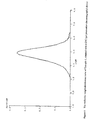
- the polymerization was performed in 2 dm 3 reactor and 1.3 dm 3 isobutane was used as medium. 114 mg of Catalyst 1 was used in polymerization. No hydrogen was used. Ethylene partial pressure in the reactor was 3.5 bar. Polymerization temperature was 80 °C. Polymerization was continued for 60 minutes and yield was 26 g of PE. The Mw was 114,500 and Mw/Mn was 3.2. Figure 1 shows the GPC curve which shows unimodal MWD.
- the polymerization was made. like Example 1 but here 116 mg of Catalyst 1 was used and hydrogen was added from cylinder (660 kPa/45.5 cm 3 ). The yield was 79 g. The Mw was 71,200 and MWD 13.1. The GPC curve in Figure 2 shows clearly bimodal MWD.
- the polymerization was performed as in Example 2 but here 100 mg of Catalyst 1 was used and polymerization time was only 30 minutes.
- the yield was 42 g of PE.
- the Mw was 57,400 and Mw/Mn was 19.2.
- the GPC curve in Figure 3 shows clearly bimodal MWD where the low Mw part is larger than in Example 2.
- the polymerization was performed as in Example 2 but here 100 mg of Catalyst 1 was used and polymerization time was only 10 minutes.
- the yield was 7 g of PE.
- the Mw was 2,800 and MWD 3.1.
- the GPC curve in Figure 4 shows unimodal MWD with very low Mw.
- the polymerization was performed in 3 dm 3 reactor and 1.8 dM3 n-pentane was used as medium. 36 mg of catalyst made according to above was used in polymerization. Hydrogen was fed from the cylinder (660 kPa/45.5 cm 3 ) . Ethylene partial pressure in the reactor was 10 bar. Polymerization was continued for 60 minutes and yield was 99 g of PE. The Mw was 168,500 and Mw/Mn was 9.1. Figure 5 shows the GPC curve which shows bimodal MWD.
- the polymerization was performed in 3 dm 3 reactor and 1.8 dm 3 n-pentane was used as medium. 35 mg of catalyst made according to above was used in polymerization. Hydrogen was fed from the cylinder (2640 kPa/45.5 cm 3 ). Ethylene partial pressure in the reactor was 10 bar. Polymerization was continued for 60 minutes and yield was 87 g of PE. The Mw was 98,300 and Mw/Mn was 63.2. Figure 6 shows the GPC curve which shows bimodal MWD.
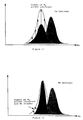
- the polymerization was performed in 3 dm 3 reactor and 1.8 dm 3 n-pentane was used as medium. 65 mg of Catalyst 1 made according to above was used in polymerization. Hydrogen was fed from cylinder in 5 equal size pulses (500 kPa/50 cm 3 ) every 10 minutes. Ethylene partial pressure in the reactor was 10 bar. Polymerization was continued for 60 minutes and yield was 250 g of PE. The Mw was 21,350 and Mw/Mn was 8.35. Figure 7 shows the GPC curve which shows clearly very broad MWD.
- Loop reactor which was 500 dm 3 was run in 80 °C feeding continuously isobutane, Catalyst 1, ethylene and 1-hexene to the reactor.
- Ethylene-hexene copolymer discharged from the reactor had Mw 84,700 and MWD 2.4.
- Figure 8 shows the MWD obtained with GPC.
- Example 8 Polymerization was performed as in Example 8 but here hydrogen was fed so that hydrogen/ethylene ratio was 20 mol/kmol.
- the polymer discharged from the reactor had Mw 58,600 and MWD 2.45.
- Figure 8 shows the MWD obtained with GPC.
- Table 4 shows that when hydrogen was fed continuously the MWD can be moved downwards very effectively and no broadening of MWD was seen.
- Example 10 is a comparative example
- the polymerization was performed in a continuous mode in gas phase fluidized reactor. Up through the polymer powder bed which was supported by a die plate, was flowing a gas that fluidized the powder bed. This reactor gas was then cooled in order to remove the heat of polymerization and recirculated back to the powder bed.
- Catalyst powder was fed into the bed on a semi-continuous basis. Ethylene, 1-butene and nitrogen was added continuously to the reactor system. Hydrogen was fed during short periods at regular intervals (see Table).
- the approximate hold-up of polymer powder in the bed was 50 kg.
- the reactor temperature was kept at 75 °C, total pressure was 17.5 bar, the ethylene partial pressure in the reactor was about 15 bar.
- the total volume of the reactor system (reactor and gas recirculation system) was 1.6 m 3 .
- the amount of recirculation gas was about 1600 kg/h.
- the bleed from the recirculation gas was 16 kg/h.
Landscapes
- Chemical & Material Sciences (AREA)
- Health & Medical Sciences (AREA)
- Chemical Kinetics & Catalysis (AREA)
- Medicinal Chemistry (AREA)
- Polymers & Plastics (AREA)
- Organic Chemistry (AREA)
- Transition And Organic Metals Composition Catalysts For Addition Polymerization (AREA)
- Addition Polymer Or Copolymer, Post-Treatments, Or Chemical Modifications (AREA)
- Preparation Of Compounds By Using Micro-Organisms (AREA)
- Heat Treatment Of Steel (AREA)
- Polymerisation Methods In General (AREA)
Claims (16)
- Verfahren zur Herstellung eines Olefinpolymers mit einer erwünschten weiten Molekulargewichtsverteilung, welches umfaßt:dadurch gekennzeichnet, daß während der Verweilzeit des Kontaktschrittes b) der absolute und/oder Partialdruck von Wasserstoff durch einen wiederholten Zyklus geändert wird, welcher umfaßt: zuerst wird der maximale Partialdruck von Wasserstoff angewendet und danach wird dieser verringert oder er kann vorzugsweise mit dem Wasserstoffverbrauch abnehmen, wobei dieser Zyklus mehr als einmal wiederholt wird.a) in eine Polymerisationsvorrichtung werden eingeführta1) ein Polymerisationsmaterial, das mindestens ein Olefin umfaßt,a2) ein Katalysatorsystem, das im wesentlichen aus einer Metallocenverbindung der allgemeinen Formel (I) besteht:
M ein Übergangsmetall der Gruppe 3, 4, 5 oder 6 des Periodensystems (IUPAC 1990) ist und zumindest in der η5-Bindungsform an den Liganden Cp gebunden ist;
X jeweils gleich oder verschieden ist und ein Wasserstoffatom, ein Halogenatom, ein C1-C8-Kohlenwasserstoffrest, ein heteroaromatischer C1-C8-Kohlenwasserstoffrest oder eine Tri-C1-C8-hydrocarbylsilylgruppe ist, wobei zwei der Gruppen X miteinander und mit M gegebenenfalls einen metallocyclischen Ring bilden;
Y ein Brückenatom oder -rest zwischen zwei der Liganden Cp ist;
Z ein Brückenatom oder -rest zwischen einem der Liganden
Cp und dem Übergangsmetall M ist;
m gleich 1 - 3 ist;
n gleich 1 - 4 ist;
o gleich 0 oder 1 ist; und
p gleich 0 oder 1 ist;
a = Wertigkeit von M = m + n + p ist,
wobei das Metallocen für Wasserstoff empfindlich ist und bei einer Wasserstoffkonzentration von Null oder einer konstanten Wasserstoffkonzentration ein Olefinpolymer mit einer engeren Molekulargewichtsverteilung als das Polymer mit der erwünschten weiten Molekulargewichtsverteilung ergibt; unda3) Wasserstoff als ein das Molekulargewicht regelndes Mittel;b) in Kontakt bringen der Reaktanten a1), a2) und a3) während der Verweilzeit in der Polymerisationsvorrichtung und bei Polymerisationsbedingungen, wodurch ein Polymerisationsgemisch erhalten wird; undc) Gewinnen des Polymerisationsmaterials in Form des Olefinpolymers mit der gewünschten weiten Molekulargewichtsverteilung aus dem Polymerisationsgemisch, - Verfahren nach Anspruch 1, dadurch gekennzeichnet, daß es als kontinuierliches Verfahren durchgeführt wird.
- Verfahren nach Anspruch 1 oder 2, dadurch gekennzeichnet, daß es in einem einzigen Polymerisationsreaktor oder in einer Reihe von Polymerisationsreaktoren durchgeführt wird.
- Verfahren nach Anspruch 1, 2 oder 3, dadurch gekennzeichnet, daß der Zyklus während der ersten Hälfte, vorzugsweise zu Beginn, des Kontaktschrittes b) gestartet wird.
- Verfahren nach einem der Ansprüche 1 bis 4, dadurch gekennzeichnet, daß der absolute und/oder Partialdruck von Wasserstoff auf einen Wert von ungefähr Null verringert wird oder abnehmen kann.
- Verfahren nach einem der vorstehenden Ansprüche, dadurch gekennzeichnet, daß das Metallocen im wesentlichen eine Art einer aktiven Stelle aufweist und/oder bei einem konstanten Partialdruck von Wasserstoff Mw/Mn = 2, vorzugsweise eine Metallocenkatalysatorkomponente für die Olefinpolymerisation, ergibt.
- Verfahren nach einem der vorstehenden Ansprüche, dadurch gekennzeichnet, daß das Katalysatorsystem eine Organoaluminiumkomponente, vorzugsweise eine Aluminoxankatalysatorkomponente für die Olefinpolymerisation umfaßt .
- Verfahren nach Anspruch 7, dadurch gekennzeichnet, daß das Aluminoxan eine Verbindung der allgemeinen Formel (II) ist:


- Verfahren nach einem der vorstehenden Ansprüche, dadurch gekennzeichnet, daß das Katalysatorsystem eine Metallocenkatalysatorkomponente und ein Aluminoxan oder ein Reaktionsprodukt davon, auf einem festen Träger getragen, umfaßt.
- Verfahren nach einem der vorstehenden Ansprüche, dadurch gekennzeichnet, daß nur ein Typ der Katalysatorkomponente verwendet wird.
- Verfahren nach einem der vorstehenden Ansprüche, dadurch gekennzeichnet, daß die Polymerisationsbedingungen die einer Lösungs-, Suspensions- oder Gasphasenpolymerisation, vorzugsweise einer Gasphasenpolymerisation, sind.
- Verfahren nach Anspruch 11, dadurch gekennzeichnet, daß die Gasphasenpolymerisation während der Verweilzeit des Polymermaterials in der Vorrichtung 2 bis 50, vorzugsweise 5 bis 40, besonders bevorzugt 10 bis 20 wiederholte Zyklen der Änderung des Partialdrucks von Wasserstoff aufweist.
- Verfahren nach einem der vorstehenden Ansprüche, dadurch gekennzeichnet, daß die Polymerisationsbedingungen eine Temperatur zwischen 40 und 200°C, vorzugsweise zwischen etwa 60 und etwa 100°C, umfassen.
- Verfahren nach einem der vorstehenden Ansprüche, dadurch gekennzeichnet, daß die Polymerisationsbedingungen einen Druck von etwa 1 bis 100 bar umfassen.
- Verfahren nach einem der vorstehenden Ansprüche, dadurch gekennzeichnet, daß die Polymerisationsbedingungen eine Verweilzeit der Polymerpartikel von mindestens 5 Minuten, vorzugsweise mindestens 20 Minuten, umfassen.
- Verfahren nach einem der vorstehenden Ansprüche, dadurch gekennzeichnet, daß das Olefin aus linearen oder cyclischen Olefinen, die eine oder mehrere Doppelbindungen aufweisen, gegebenenfalls zusammen mit einem oder mehreren Dienen, vorzugsweise aus Ethen, Propen, 1-Buten, 3-Methyl-1-buten, 1-Penten, 3-Methyl-1-penten, 4-Methyl-1-penten, 1-Hexen, 3-Ethyl-1-hexen, 1-Hepten, 1-Octen und 1-Decen, vorzugsweise Ethen, gegebenenfalls zusammen mit irgendeinem der aufgeführten anderen Olefine oder Diolefine, wie Hexadien, Butadien, Decadien, ausgewählt ist.
Applications Claiming Priority (3)
| Application Number | Priority Date | Filing Date | Title |
|---|---|---|---|
| FI973050A FI973050L (fi) | 1997-07-18 | 1997-07-18 | Menetelmä sellaisten olefiinipolymeerien valmistamiseksi joilla on haluttu molekyylipainojakauma |
| FI973050 | 1997-07-18 | ||
| PCT/FI1998/000599 WO1999003897A1 (en) | 1997-07-18 | 1998-07-17 | Process for the production of olefin polymers having a desirable molecular weight distribution |
Publications (2)
| Publication Number | Publication Date |
|---|---|
| EP0996647A1 EP0996647A1 (de) | 2000-05-03 |
| EP0996647B1 true EP0996647B1 (de) | 2004-09-08 |
Family
ID=8549279
Family Applications (1)
| Application Number | Title | Priority Date | Filing Date |
|---|---|---|---|
| EP98935058A Expired - Lifetime EP0996647B1 (de) | 1997-07-18 | 1998-07-17 | Verfahren zur herstellung von olefinpolymeren mit einer gewünschten verteilung des molekulargewichtes |
Country Status (8)
| Country | Link |
|---|---|
| EP (1) | EP0996647B1 (de) |
| JP (1) | JP2001510210A (de) |
| AT (1) | ATE275586T1 (de) |
| AU (1) | AU8444198A (de) |
| DE (1) | DE69826130T2 (de) |
| ES (1) | ES2229519T3 (de) |
| FI (1) | FI973050L (de) |
| WO (1) | WO1999003897A1 (de) |
Families Citing this family (12)
| Publication number | Priority date | Publication date | Assignee | Title |
|---|---|---|---|---|
| US20060189769A1 (en) * | 2005-02-22 | 2006-08-24 | Nova Chemicals (International) S.A. | Broad/bimodal resins with controlled comonomer distribution |
| EP1840140A1 (de) * | 2006-03-30 | 2007-10-03 | Total Petrochemicals Research Feluy | Verfahren zum Wechseln zwischen Polymertypen |
| JP2008121027A (ja) * | 2008-02-12 | 2008-05-29 | Tosoh Corp | オレフィン重合体の製造方法 |
| ATE535554T1 (de) * | 2008-10-08 | 2011-12-15 | Borealis Ag | Verfahren zur herstellung von sehr steifem polyproylen |
| EP2216346A1 (de) * | 2009-02-04 | 2010-08-11 | Borealis AG | Verfahren zur Herstellung von Polyolefinen mit breiter Molekulargewichtverteilung |
| KR101412846B1 (ko) * | 2011-04-01 | 2014-06-30 | 주식회사 엘지화학 | 폴리올레핀의 제조방법 및 이로부터 제조된 폴리올레핀 |
| KR101503567B1 (ko) | 2011-08-18 | 2015-03-17 | 주식회사 엘지화학 | 폴리올레핀 수지의 제조방법 |
| KR101528603B1 (ko) * | 2012-09-27 | 2015-06-12 | 주식회사 엘지화학 | 폴리올레핀의 제조 방법 및 이로부터 제조된 폴리올레핀 |
| BR112016019334B1 (pt) | 2014-02-11 | 2021-03-09 | Univation Technologies, Llc | método para formar uma composição de catalisador |
| SG11201701260WA (en) | 2014-08-19 | 2017-03-30 | Univation Tech Llc | Fluorinated catalyst supports and catalyst systems |
| BR112017003306B1 (pt) | 2014-08-19 | 2022-03-03 | Univation Technologies, Llc | Método para preparar um suporte de catalisador fluorado e sistema de catalisador |
| CN106794455B (zh) | 2014-08-19 | 2020-09-04 | 尤尼威蒂恩技术有限责任公司 | 氟化催化剂载体和催化剂系统 |
Family Cites Families (6)
| Publication number | Priority date | Publication date | Assignee | Title |
|---|---|---|---|---|
| US4851488A (en) * | 1987-04-23 | 1989-07-25 | Shell Oil Company | Process for altering hydrogenated polymer compositions from high melt flow to low melt flow |
| DE3723526A1 (de) * | 1987-07-16 | 1989-01-26 | Hoechst Ag | Verfahren zur herstellung eines polyolefins mit einer breiten molmassenverteilung |
| CA2060019A1 (en) * | 1991-03-04 | 1992-09-05 | Phil Marvin Stricklen | Process for producing polyolefins having a bimodal molecular weight distribution |
| US5134208A (en) * | 1991-09-27 | 1992-07-28 | Shell Oil Company | Polymerization process |
| FI96216C (fi) * | 1994-12-16 | 1996-05-27 | Borealis Polymers Oy | Prosessi polyeteenin valmistamiseksi |
| US5739220A (en) * | 1997-02-06 | 1998-04-14 | Fina Technology, Inc. | Method of olefin polymerization utilizing hydrogen pulsing, products made therefrom, and method of hydrogenation |
-
1997
- 1997-07-18 FI FI973050A patent/FI973050L/fi unknown
-
1998
- 1998-07-17 AT AT98935058T patent/ATE275586T1/de not_active IP Right Cessation
- 1998-07-17 ES ES98935058T patent/ES2229519T3/es not_active Expired - Lifetime
- 1998-07-17 DE DE69826130T patent/DE69826130T2/de not_active Expired - Fee Related
- 1998-07-17 AU AU84441/98A patent/AU8444198A/en not_active Abandoned
- 1998-07-17 WO PCT/FI1998/000599 patent/WO1999003897A1/en not_active Ceased
- 1998-07-17 JP JP2000503119A patent/JP2001510210A/ja active Pending
- 1998-07-17 EP EP98935058A patent/EP0996647B1/de not_active Expired - Lifetime
Also Published As
| Publication number | Publication date |
|---|---|
| FI973050A0 (fi) | 1997-07-18 |
| WO1999003897A1 (en) | 1999-01-28 |
| DE69826130T2 (de) | 2005-09-22 |
| EP0996647A1 (de) | 2000-05-03 |
| FI973050A7 (fi) | 1999-01-19 |
| ATE275586T1 (de) | 2004-09-15 |
| DE69826130D1 (de) | 2004-10-14 |
| ES2229519T3 (es) | 2005-04-16 |
| JP2001510210A (ja) | 2001-07-31 |
| FI973050L (fi) | 1999-01-19 |
| AU8444198A (en) | 1999-02-10 |
Similar Documents
| Publication | Publication Date | Title |
|---|---|---|
| EP0993478B1 (de) | Olefin polymerisationsverfahren | |
| EP0956307B1 (de) | Neues aktivatorsystem für metallocenverbindungen | |
| KR100527018B1 (ko) | 중합 촉매 조성물 및 중합 방법 | |
| EP1242477B1 (de) | Verfahren zur herstellung eines geträgerten katalysatorsystems und dessen verwendung in einem polymerisationsverfahren | |
| US5912202A (en) | Olefin polymerization catalyst composition having increased activity | |
| JPH06322014A (ja) | ポリオレフイン類およびポリオレフイン触媒の製造方法 | |
| WO1999061489A1 (en) | Supported olefin polymerization catalyst composition | |
| WO1999003897A1 (en) | Process for the production of olefin polymers having a desirable molecular weight distribution | |
| US6300439B1 (en) | Group 15 containing transition metal catalyst compounds, catalyst systems and their use in a polymerization process | |
| CN102264773B (zh) | 不相容的烯烃聚合催化剂体系之间转变的方法 | |
| EP1385890B1 (de) | Verfahren zur olefinpolymerisation | |
| US6812303B1 (en) | Olefin polymerizaion catalyst and method for polymerizing an olefin using the catalyst | |
| US6506858B1 (en) | Olefin polymerization catalyst material and process for its preparation | |
| JPH10226711A (ja) | α−オレフィンの重合及び共重合用の有機金属触媒 | |
| AU754627B2 (en) | Germanium bridged metallocenes producing polymers with increased melt strength | |
| EP0585512B1 (de) | Katalysatorkomponente für Olefinpolymerisation | |
| US6534607B1 (en) | Catalysts and processes for the polymerization of olefins | |
| EP1042376B1 (de) | Verfahren zur ethylenpolymerisation in einem flüssigen reaktionsmedium | |
| US6710144B2 (en) | Process for producing olefin polymer | |
| EP0952996B1 (de) | Verfahren zur kontrolle der aktivität einer olefinpolymerisationkatalysatorzusammensetzung | |
| WO1999021898A1 (en) | Magnesium halide based metallocene catalyst system |
Legal Events
| Date | Code | Title | Description |
|---|---|---|---|
| PUAI | Public reference made under article 153(3) epc to a published international application that has entered the european phase |
Free format text: ORIGINAL CODE: 0009012 |
|
| 17P | Request for examination filed |
Effective date: 20000122 |
|
| AK | Designated contracting states |
Kind code of ref document: A1 Designated state(s): AT BE CH CY DE DK ES FI FR GB GR IE IT LI LU MC NL PT SE |
|
| 17Q | First examination report despatched |
Effective date: 20020816 |
|
| RTI1 | Title (correction) |
Free format text: PROCESS FOR THE PRODUCTION OF OLEFIN POLYMERS HAVING A DESIRABLE MOLECULAR WEIGHT DISTRIBUTION |
|
| GRAP | Despatch of communication of intention to grant a patent |
Free format text: ORIGINAL CODE: EPIDOSNIGR1 |
|
| GRAS | Grant fee paid |
Free format text: ORIGINAL CODE: EPIDOSNIGR3 |
|
| RAP1 | Party data changed (applicant data changed or rights of an application transferred) |
Owner name: BOREALIS TECHNOLOGY OY |
|
| GRAA | (expected) grant |
Free format text: ORIGINAL CODE: 0009210 |
|
| AK | Designated contracting states |
Kind code of ref document: B1 Designated state(s): AT BE CH CY DE DK ES FI FR GB GR IE IT LI LU MC NL PT SE |
|
| PG25 | Lapsed in a contracting state [announced via postgrant information from national office to epo] |
Ref country code: LI Free format text: LAPSE BECAUSE OF FAILURE TO SUBMIT A TRANSLATION OF THE DESCRIPTION OR TO PAY THE FEE WITHIN THE PRESCRIBED TIME-LIMIT Effective date: 20040908 Ref country code: FI Free format text: LAPSE BECAUSE OF FAILURE TO SUBMIT A TRANSLATION OF THE DESCRIPTION OR TO PAY THE FEE WITHIN THE PRESCRIBED TIME-LIMIT Effective date: 20040908 Ref country code: CH Free format text: LAPSE BECAUSE OF FAILURE TO SUBMIT A TRANSLATION OF THE DESCRIPTION OR TO PAY THE FEE WITHIN THE PRESCRIBED TIME-LIMIT Effective date: 20040908 Ref country code: AT Free format text: LAPSE BECAUSE OF FAILURE TO SUBMIT A TRANSLATION OF THE DESCRIPTION OR TO PAY THE FEE WITHIN THE PRESCRIBED TIME-LIMIT Effective date: 20040908 |
|
| REG | Reference to a national code |
Ref country code: GB Ref legal event code: FG4D |
|
| REG | Reference to a national code |
Ref country code: CH Ref legal event code: EP |
|
| REG | Reference to a national code |
Ref country code: IE Ref legal event code: FG4D |
|
| REF | Corresponds to: |
Ref document number: 69826130 Country of ref document: DE Date of ref document: 20041014 Kind code of ref document: P |
|
| PG25 | Lapsed in a contracting state [announced via postgrant information from national office to epo] |
Ref country code: SE Free format text: LAPSE BECAUSE OF FAILURE TO SUBMIT A TRANSLATION OF THE DESCRIPTION OR TO PAY THE FEE WITHIN THE PRESCRIBED TIME-LIMIT Effective date: 20041208 Ref country code: GR Free format text: LAPSE BECAUSE OF FAILURE TO SUBMIT A TRANSLATION OF THE DESCRIPTION OR TO PAY THE FEE WITHIN THE PRESCRIBED TIME-LIMIT Effective date: 20041208 Ref country code: DK Free format text: LAPSE BECAUSE OF FAILURE TO SUBMIT A TRANSLATION OF THE DESCRIPTION OR TO PAY THE FEE WITHIN THE PRESCRIBED TIME-LIMIT Effective date: 20041208 |
|
| REG | Reference to a national code |
Ref country code: CH Ref legal event code: PL |
|
| REG | Reference to a national code |
Ref country code: ES Ref legal event code: FG2A Ref document number: 2229519 Country of ref document: ES Kind code of ref document: T3 |
|
| PLBE | No opposition filed within time limit |
Free format text: ORIGINAL CODE: 0009261 |
|
| STAA | Information on the status of an ep patent application or granted ep patent |
Free format text: STATUS: NO OPPOSITION FILED WITHIN TIME LIMIT |
|
| PG25 | Lapsed in a contracting state [announced via postgrant information from national office to epo] |
Ref country code: LU Free format text: LAPSE BECAUSE OF NON-PAYMENT OF DUE FEES Effective date: 20050717 Ref country code: IT Free format text: LAPSE BECAUSE OF NON-PAYMENT OF DUE FEES;WARNING: LAPSES OF ITALIAN PATENTS WITH EFFECTIVE DATE BEFORE 2007 MAY HAVE OCCURRED AT ANY TIME BEFORE 2007. THE CORRECT EFFECTIVE DATE MAY BE DIFFERENT FROM THE ONE RECORDED. Effective date: 20050717 Ref country code: GB Free format text: LAPSE BECAUSE OF NON-PAYMENT OF DUE FEES Effective date: 20050717 Ref country code: CY Free format text: LAPSE BECAUSE OF FAILURE TO SUBMIT A TRANSLATION OF THE DESCRIPTION OR TO PAY THE FEE WITHIN THE PRESCRIBED TIME-LIMIT Effective date: 20050717 |
|
| PG25 | Lapsed in a contracting state [announced via postgrant information from national office to epo] |
Ref country code: IE Free format text: LAPSE BECAUSE OF NON-PAYMENT OF DUE FEES Effective date: 20050718 Ref country code: ES Free format text: LAPSE BECAUSE OF NON-PAYMENT OF DUE FEES Effective date: 20050718 |
|
| PG25 | Lapsed in a contracting state [announced via postgrant information from national office to epo] |
Ref country code: MC Free format text: LAPSE BECAUSE OF NON-PAYMENT OF DUE FEES Effective date: 20050731 Ref country code: BE Free format text: LAPSE BECAUSE OF NON-PAYMENT OF DUE FEES Effective date: 20050731 |
|
| ET | Fr: translation filed | ||
| 26N | No opposition filed |
Effective date: 20050609 |
|
| PG25 | Lapsed in a contracting state [announced via postgrant information from national office to epo] |
Ref country code: NL Free format text: LAPSE BECAUSE OF NON-PAYMENT OF DUE FEES Effective date: 20060201 Ref country code: DE Free format text: LAPSE BECAUSE OF NON-PAYMENT OF DUE FEES Effective date: 20060201 |
|
| GBPC | Gb: european patent ceased through non-payment of renewal fee |
Effective date: 20050717 |
|
| PG25 | Lapsed in a contracting state [announced via postgrant information from national office to epo] |
Ref country code: FR Free format text: LAPSE BECAUSE OF NON-PAYMENT OF DUE FEES Effective date: 20060331 |
|
| NLV4 | Nl: lapsed or anulled due to non-payment of the annual fee |
Effective date: 20060201 |
|
| REG | Reference to a national code |
Ref country code: IE Ref legal event code: MM4A |
|
| REG | Reference to a national code |
Ref country code: FR Ref legal event code: ST Effective date: 20060331 |
|
| REG | Reference to a national code |
Ref country code: ES Ref legal event code: FD2A Effective date: 20050718 |
|
| BERE | Be: lapsed |
Owner name: *BOREALIS TECHNOLOGY OY Effective date: 20050731 |
|
| PG25 | Lapsed in a contracting state [announced via postgrant information from national office to epo] |
Ref country code: PT Free format text: LAPSE BECAUSE OF NON-PAYMENT OF DUE FEES Effective date: 20050208 |