EP0997251A2 - Gerät mit hoher leistungsfähigkeit zum verflüssigen oder viskositätsverminderen von materialen - Google Patents
Gerät mit hoher leistungsfähigkeit zum verflüssigen oder viskositätsverminderen von materialen Download PDFInfo
- Publication number
- EP0997251A2 EP0997251A2 EP99121097A EP99121097A EP0997251A2 EP 0997251 A2 EP0997251 A2 EP 0997251A2 EP 99121097 A EP99121097 A EP 99121097A EP 99121097 A EP99121097 A EP 99121097A EP 0997251 A2 EP0997251 A2 EP 0997251A2
- Authority
- EP
- European Patent Office
- Prior art keywords
- platen
- fins
- chamber
- heat exchanging
- liquified
- Prior art date
- Legal status (The legal status is an assumption and is not a legal conclusion. Google has not performed a legal analysis and makes no representation as to the accuracy of the status listed.)
- Withdrawn
Links
- 239000000463 material Substances 0.000 title claims abstract description 99
- 238000010438 heat treatment Methods 0.000 claims description 25
- 238000000034 method Methods 0.000 claims description 16
- 238000005086 pumping Methods 0.000 claims description 11
- 238000004891 communication Methods 0.000 claims description 4
- 239000012530 fluid Substances 0.000 claims description 4
- 239000012815 thermoplastic material Substances 0.000 description 12
- 239000007787 solid Substances 0.000 description 10
- 238000002844 melting Methods 0.000 description 7
- 230000008018 melting Effects 0.000 description 7
- 229910052782 aluminium Inorganic materials 0.000 description 5
- XAGFODPZIPBFFR-UHFFFAOYSA-N aluminium Chemical compound [Al] XAGFODPZIPBFFR-UHFFFAOYSA-N 0.000 description 5
- 238000013461 design Methods 0.000 description 4
- 229920001169 thermoplastic Polymers 0.000 description 4
- 239000004416 thermosoftening plastic Substances 0.000 description 4
- 230000008901 benefit Effects 0.000 description 3
- 238000004519 manufacturing process Methods 0.000 description 3
- 238000010276 construction Methods 0.000 description 2
- 229920001971 elastomer Polymers 0.000 description 2
- 239000007788 liquid Substances 0.000 description 2
- 239000011344 liquid material Substances 0.000 description 2
- 229910052751 metal Inorganic materials 0.000 description 2
- 239000002184 metal Substances 0.000 description 2
- 230000002093 peripheral effect Effects 0.000 description 2
- 239000005060 rubber Substances 0.000 description 2
- 239000004831 Hot glue Substances 0.000 description 1
- 230000000740 bleeding effect Effects 0.000 description 1
- 239000004020 conductor Substances 0.000 description 1
- 230000000694 effects Effects 0.000 description 1
- 238000005485 electric heating Methods 0.000 description 1
- 238000005516 engineering process Methods 0.000 description 1
- 238000012986 modification Methods 0.000 description 1
- 230000004048 modification Effects 0.000 description 1
- 229920003052 natural elastomer Polymers 0.000 description 1
- 229920001194 natural rubber Polymers 0.000 description 1
- 230000009467 reduction Effects 0.000 description 1
- 238000012552 review Methods 0.000 description 1
- 239000000565 sealant Substances 0.000 description 1
- 239000012056 semi-solid material Substances 0.000 description 1
- 239000011343 solid material Substances 0.000 description 1
- 229920003051 synthetic elastomer Polymers 0.000 description 1
- 239000005061 synthetic rubber Substances 0.000 description 1
- 238000012546 transfer Methods 0.000 description 1
- 239000011345 viscous material Substances 0.000 description 1
- 238000003466 welding Methods 0.000 description 1
Images


Classifications
-
- B—PERFORMING OPERATIONS; TRANSPORTING
- B29—WORKING OF PLASTICS; WORKING OF SUBSTANCES IN A PLASTIC STATE IN GENERAL
- B29B—PREPARATION OR PRETREATMENT OF THE MATERIAL TO BE SHAPED; MAKING GRANULES OR PREFORMS; RECOVERY OF PLASTICS OR OTHER CONSTITUENTS OF WASTE MATERIAL CONTAINING PLASTICS
- B29B13/00—Conditioning or physical treatment of the material to be shaped
- B29B13/02—Conditioning or physical treatment of the material to be shaped by heating
- B29B13/022—Melting the material to be shaped
Definitions
- the present invention generally relates to apparatus for liquifying or reducing the viscosity of materials such as thermoplastic or various natural or synthetic rubbers. More particularly, the invention relates to drum unloaders using heated platens to heat and pump material from a container such as a drum, barrel, or pail.
- One type of device includes an arrangement in which a heated platen is lowered into the open end of a container for melting and/or liquifying material contained therein and pumping the material, for example, to various types of dispensing devices.
- the platens generally have an engagement surface which may either be generally smooth or may have a plurality of projecting heat exchanging elements, such as fins.
- a platen having a smooth heated surface leaves less residue in the bottom of the container and is typically easier to clean than a finned platen.
- smooth platens generally have lower output capabilities than a finned platen.
- smooth platens may not be suitable for use with dispensers demanding a high flow rate of material from the platen.
- the projecting heat exchanging elements or fins on a platen can provide a higher melt rate and therefore higher output from the platen. Also, due to the increased contact with the heated surfaces of the fins, higher temperatures are possible.
- Another problematic area in this technology relates to the downtime experienced when changing over from a depleted container of material to a new container of material. Often, a production process stops during this changeover time and this effectively results in higher production costs.
- One solution to this problem involves using a two unit system in which a second drum unloader takes over while the first unit is reloaded with a new container of material. This is an undesirable solution in many cases due to the increased cost of the two unit system.
- apparatus including a platen for heating, melting and dispensing various materials such as solid thermoplastic or rubber materials with higher liquid output and/or temperature.
- apparatus for heating and reducing the viscosity of various materials includes a platen having first and second spaced apart surfaces.
- the first surface is an exterior surface including a plurality of projecting heat exchanging elements, such as fins, with openings therebetween.
- the heat exchanging elements contact, heat and liquify or, in other words, reduce the viscosity of various materials.
- these materials may include various solid, semi-solid or viscous thermoplastic or rubber based materials.
- the second surface is an interior surface and the platen further includes at least one flow passage for receiving melted material and communicating with the openings between the heat exchanging elements and also communicating with the second surface.
- the flow passage may advantageously comprise one or more elongate slots, however, passages of other shapes may be used as well.
- the second surface forms at least part of an elongate channel communicating with the slot and further communicating with a discharge flow passage which is adapted to communicate with a pump.
- the channel may be formed, for example, as a recess in a surface of a multi-piece platen structure or as a bore which is cast within or otherwise formed in a one-piece platen structure.
- At least one heater is thermally coupled to the heat exchanging elements for supplying heat to melt the material. Liquified material will flow through the openings between the heat exchanging elements, and through the one or more slots in the platen and the elongate channel to the discharge flow passage. From the discharge flow passage, the liquified material may be pumped to one or more downstream dispensers.
- the platen further includes a separate fin plate and mounting member.
- the fin plate includes the fins on one side thereof and is fastened to the mounting member on the other side thereof.
- the elongated slot or slots extend through the fin plate and are located generally between the fins and the mounting member.
- the first and second spaced apart surfaces may each be on the fin plate, with the second surface abutting the mounting member.
- the elongate slot extends transversely between the first and second surfaces and preferably lengthwise across the platen.
- the elongate channel is preferably contained in the second surface of the fin plate and intersects the elongate slot for providing a fluid flow path therebetween.
- the elongate channel may instead be located in the abutting surface of the mounting member.
- a plurality of the elongate channels and elongate slots establish multiple heated flow paths to the discharge flow passage.
- the platen is preferably formed from aluminum and includes a plurality of embedded heaters which supply heat to the entire platen, including the heat exchanging elements and the walls of the various flow passages, e.g., the elongate channels and slots.
- the elongate slots advantageously extend transverse the fins to communicate with the multiple openings between the spaced apart fins.
- the platen in another embodiment, includes first and second sides and a first plurality of heat exchanging elements, which may again be fins, extending from the first side and adapted to contact and melt the material.
- the platen in this embodiment may be multi-piece, but is preferably a one-piece platen for better heat transfer capability.
- a chamber is disposed on the second side of the platen and communicates with the first side through at least one flow passage.
- the chamber is adapted for connection with a pump for pumping liquified material out of the chamber.
- the interior of the chamber includes at least one projecting heat exchanging element, and most preferably a second plurality of heated fins.
- the heat exchanging elements within the chamber can help maintain or increase the temperature of the liquified material prior to pumping the material from the chamber.
- the chamber itself provides additional space for liquified material, for example, to be pumped to dispensers during a drum or container changeover procedure.
- a platen may include first and second sides with a first plurality of heat exchanging elements extending from the first side and adapted to contact and melt the material.
- a chamber is again disposed on the second side and communicates with the first side through a plurality of flow passages.
- the chamber may include a second plurality of heat exchanging elements and preferably receives a pump.
- a plurality of flow passages communicate with openings between the first plurality of heat exchanging elements and further communicate with at least one flow passage leading to the chamber.
- At least one heater is thermally coupled to the first plurality of heat exchanging elements for supplying heat to melt the material.
- the same heater or a different heater may be thermally coupled to the second plurality of heat exchanging elements.
- This platen is preferably a one-piece platen, however, it may comprise a multi-piece platen as well.
- At least one flow passage intersects with the flow passage or passages communicating with the openings between the first plurality of heat exchanging elements. These intersecting flow passages provide a fluid flow path to the chamber.
- a central flow passage may also be provided in the platen to communicate with a central portion of the chamber.
- additional peripheral flow passages may also be provided in the platen to direct liquified material from the openings between the first plurality of heat exchanging elements into the chamber.
- the invention further contemplates methods of liquifying and, for example, unloading the material from a container.
- one method may comprise engaging a plurality of projecting heating elements of a heated platen with the material to produce liquified, heated material.
- the material is moved through a plurality of flow passages in the platen which communicate with openings between the projecting heating elements.
- the material is further moved from the flow passages into a plurality of channels in the platen communicating with a discharge flow passage to deliver the material to an opposite side of the platen.
- Apparatus 10 generally includes a platen support and moving device 12 which, in one typical form, includes a pair of air-actuated cylinders 14, 16 each having respective retractable and extendable cylinder rods 18, 20. Rods 18, 20 are connected to a cross head support member 22 at upper ends thereof and cylinders 14, 16 are further connected to a suitable base structure 24. It will be understood that additional support members connected between cylinders 14, 16 and base 24 are typically used but are deleted from the drawing for clarity.
- a motor assembly 26 is affixed to cross head support member 22 and includes a drive shaft 27 extending through a tube 28 rigidly mounted, such as by welding, to a flange 29. Flange 29 is bolted by fasteners 31 to a platen 30 constructed in accordance with one preferred embodiment.
- drive shaft 27 extends from motor assembly 26 through tube 28 and drives a pump 33.
- Pump 33 pumps liquified material from platen 30 into a manifold 34 as will be described in detail below.
- a hose or conduit 35 is connected to manifold 34 to direct the liquified material to downstream applications.
- Platen 30 is mounted to be moved downwardly into a drum 32 of material, such as a solid hot melt adhesive, a sealant, or a caulk. This material may be formed as a solid slug contained in drum 32.
- Other containers such as barrels and pails may be used in conjunction with apparatus 10 as well. These containers may range in volume, for example, from five gallons to 55 gallons.
- Drum 32 may be positioned in line with platen 30 by a pair of positioners 36, 38, for example, connected with cylinders 14, 16 or other support structure.
- a control box 40 is shown for generally controlling apparatus 10, such as in a conventional manner well known in the art, to effect the movement of platen 30 into drum 32 and to control the heating and pumping equipment associated therewith.
- Platen 30 includes conventional seals 39, 41 for engaging the inner wall of drum 32.
- Platen 30 can include a fin plate 42 affixed to a separate mounting member 44.
- a unitary or one-piece construction may be used as well.
- each of these components is formed from cast aluminum.
- Fin plate 42 may be affixed directly to mounting member 44 by a plurality of fasteners 48.
- a plurality of flow passages are provided preferably in fin plate 42 for allowing liquid thermoplastic material to flow through fin plate 42.
- fin plate 42 includes a plurality of elongate fins 46 having tapering side surfaces 46a converging to leading edges or tips 46b.
- the angle a between tapered side surfaces 46a is about 30°.
- the maximum fin spacing "s" or, in other words, the width of openings 70 at the trailing edges or bases 46c of adjacent fins 46, is preferably about 0.19 of an inch.
- Surfaces 46d taper at second angles ⁇ of about 5°.
- a preferred length "l” for fins 46 is about 1-2/3 inches.
- the preferred width w of the fins at base 46c is about 0.56 of an inch. Therefore, the ratio of length "l” to spacing "s” is about 9 and the ratio of length "l” to width "w” is about 3. It may be necessary to provide thicker portions (not shown) of certain fins 46 to accommodate fasteners in plate 42.
- a central channel or flow passage 50 in fin plate 42 communicates with a central discharge flow passage 52 in mounting member 44 and with a pump inlet 33a.
- Fin plate 42 further includes a pair of outer channels or flow passages 54, 56 extending parallel to central channel 50.
- a plurality of additional flow passages in the preferred form of slots 58, 60, 62 are provided in fin plate 42.
- Central slot 58 intersects with each interior channel 50, 54, 56 and also with the central discharge flow passage 52 of mounting member 44.
- Outer slots 60, 62 respectively intersect with each channel 50, 54, 56.
- Electrical resistive type heating elements 64 are embedded in mounting member 44. Connectors 64a extend out of mounting member 44 for connection to a heater control, which may be of a conventional design. These supply heat to both mounting member 44 and fin plate 42 mainly by thermal conductivity through the aluminum material.
- Each slot 58, 60, 62 preferably extends between first and second surfaces 66, 68 of fin plate 42 such that these slots 58, 60, 62 each communicate with openings 70 between fins 46 and with channels 50, 54, 56.
- Channels 50, 54, 56 are preferably formed in second, interior surface 68 and are therefore formed at least in part by this second, interior surface 68.
- channels 50, 54, 56 may be formed in mounting member or may be channels in a one-piece platen structure. In any case, they are formed at least in part by an interior surface of the platen structure. This provides for a high flow rate of liquid material from openings 70 through fin plate 42 and into central discharge flow passage 52.
- slots 58, 60, 62 may be replaced by flow passages of other shapes, configurations and orientations than the illustrated embodiment.
- Other one-piece or multi-piece platen structures having such interior slots, bores or other passages may be provided in accordance with the principles of this invention.
- a hole 72 (not shown) is provided in passage 52 for bleeding air off while inserting platen 30 into drum 32.
- the primary motive force for moving liquified material to central discharge passage 52 will be the force of platen 30 against the slug of material.
- the movement of liquified material through the various flow passage in platen 30 may be assisted by pump 33.
- a second embodiment of the invention includes platen 80 comprising a one-piece structure having outer seals 82, 84 and including a plurality of elongate fins 86, which may have the same design as described with respect to the first embodiment, for contacting and melting solid thermoplastic material.
- a chamber 88 is provided in platen 80 for containing and heating the liquified thermoplastic material which has been melted by fins 86. Fins 86 may be of the same configuration as the first embodiment or replaced with elements of a different design.
- a plurality of flow passages 90 deliver the liquified thermoplastic material into chamber 88, as will be described further below.
- Chamber 88 includes a plurality of heating elements for supplying heat to the liquified material.
- the heating elements may be, for example, generally radially extending fins 92.
- a central area 94 is preferably free of any fins 92 for receiving a suitable pump (not shown), as in the first embodiment.
- a plurality of electric heating elements 96 are also embedded within plate 80 and include electrical connector portions 96a extending upwardly through appropriate channels 98 within platen 80.
- each flow passage 90 communicates with at least one additional flow passage for transferring liquified thermoplastic material generally from openings 100 between adjacent fins 86 into chamber 88.
- these additional flow passages take the preferred form of elongate slots 102, although other shapes, configurations and orientations may be used to advantage as well.
- Each elongate slot 102 communicates with at least two flow passages 90.
- Platen 80 is constructed of a highly thermally conductive material, such as cast aluminum.
- a suitable pump (not shown) may be located within central area 94 and connected to platen 80 in a suitable manner, such as described with regard to the first embodiment.
- the pump may begin pumping the material from chamber 88.
- fins 92 supply additional heat to the liquified material and, during a drum changeover, the material remaining in chamber 88 may continue being pumped to downstream dispensing devices at an elevated temperature.
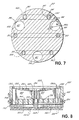
- a third alternative platen 120 combines various features of the first two embodiments. More specifically, platen 120 preferably comprises a one-piece structure cast from a highly conductive metal, such as aluminum, but multi-piece structures may be used as well. Platen 120 includes a pair of outer seals 122, 124 and a plurality of elongate fins 126, which may be of the same configuration discussed with respect to the first two embodiments or replaced with elements of a different design. Platen 120 further includes a chamber 128 communicating with a plurality of flow passages 130, similar to those described with respect to the second embodiment.
- Chamber 128 includes generally radially directed fins 132 extending to a central area 134 which is adapted to receive a pump (not shown) such as generally described with respect to the first embodiment. Fins 132 are also formed of a heat conductive metal for heating liquified thermoplastic material contained within chamber 128. For supplying the heat, a plurality of electrical resistive-type heating elements 136 are preferably cast within platen 120 and have connecting ends 136a disposed within channels 138, similar to the second embodiment.
- Fins 126 have openings 140 therebetween which communicate with a plurality of elongate slots 142, only one of which is shown in Fig. 8.
- the remaining slots may, for example, be of the same general configuration as shown in Fig. 7.
- a plurality of interior channels or flow passages 148, 150, 152 are provided for reasons similar to the first embodiment. These channels 148, 150, 152 intersect with the slots 142 and may also communicate with a central discharge flow passage 154 in platen 120 which, in turn, communicates with chamber 128.
- liquified thermoplastic material may be drawn from openings 140 between fins 126, through slots 142 and into channels 148, 150, 152.
- Liquified thermoplastic material may be moved into central discharge flow passage 154 or may flow into peripheral flow passages 130 in order to reach the interior of chamber 128.
- liquified material is moved through the various flow passages of the platen primarily by the force of the platen against the unmelted material.
- the liquified material may be heated by fins 132 and ultimately drawn into a pump (not shown) disposed in central area 134.
Landscapes
- Physics & Mathematics (AREA)
- Thermal Sciences (AREA)
- Engineering & Computer Science (AREA)
- Mechanical Engineering (AREA)
- Coating Apparatus (AREA)
- Processing And Handling Of Plastics And Other Materials For Molding In General (AREA)
Priority Applications (1)
| Application Number | Priority Date | Filing Date | Title |
|---|---|---|---|
| EP04105931A EP1514659A1 (de) | 1998-10-29 | 1999-10-22 | Gerät mit hoher Leistungsfähigkeit zum Verflüssigen oder Viskositätsvermindern von Materialen |
Applications Claiming Priority (2)
| Application Number | Priority Date | Filing Date | Title |
|---|---|---|---|
| US182247 | 1994-01-13 | ||
| US09/182,247 US6046437A (en) | 1998-10-29 | 1998-10-29 | High output device for liquifying or reducing the viscosity of materials |
Related Child Applications (1)
| Application Number | Title | Priority Date | Filing Date |
|---|---|---|---|
| EP04105931A Division EP1514659A1 (de) | 1998-10-29 | 1999-10-22 | Gerät mit hoher Leistungsfähigkeit zum Verflüssigen oder Viskositätsvermindern von Materialen |
Publications (2)
| Publication Number | Publication Date |
|---|---|
| EP0997251A2 true EP0997251A2 (de) | 2000-05-03 |
| EP0997251A3 EP0997251A3 (de) | 2002-04-10 |
Family
ID=22667641
Family Applications (2)
| Application Number | Title | Priority Date | Filing Date |
|---|---|---|---|
| EP04105931A Withdrawn EP1514659A1 (de) | 1998-10-29 | 1999-10-22 | Gerät mit hoher Leistungsfähigkeit zum Verflüssigen oder Viskositätsvermindern von Materialen |
| EP99121097A Withdrawn EP0997251A3 (de) | 1998-10-29 | 1999-10-22 | Gerät mit hoher leistungsfähigkeit zum verflüssigen oder viskositätsverminderen von materialen |
Family Applications Before (1)
| Application Number | Title | Priority Date | Filing Date |
|---|---|---|---|
| EP04105931A Withdrawn EP1514659A1 (de) | 1998-10-29 | 1999-10-22 | Gerät mit hoher Leistungsfähigkeit zum Verflüssigen oder Viskositätsvermindern von Materialen |
Country Status (3)
| Country | Link |
|---|---|
| US (1) | US6046437A (de) |
| EP (2) | EP1514659A1 (de) |
| AU (1) | AU755036B2 (de) |
Cited By (1)
| Publication number | Priority date | Publication date | Assignee | Title |
|---|---|---|---|---|
| WO2017011458A1 (en) * | 2015-07-15 | 2017-01-19 | Moldman Systems Llc | Stacked hot melt reservoir and methods of assembling same |
Families Citing this family (13)
| Publication number | Priority date | Publication date | Assignee | Title |
|---|---|---|---|---|
| US6386398B2 (en) * | 2000-05-08 | 2002-05-14 | Osram Sylvania Inc. | Dispenser |
| US6550643B1 (en) * | 2001-12-19 | 2003-04-22 | Gordon Brian Foster | Dispenser for viscous fluids |
| US6836616B2 (en) * | 2002-02-14 | 2004-12-28 | Valco Cincinnati, Inc. | Molten material application machine |
| US7687743B2 (en) * | 2003-10-23 | 2010-03-30 | Ravarini Castoldi & C. S.R.L. | Apparatus and method for heating and melting solid lubricants in the delivery drum |
| US7626143B2 (en) * | 2005-02-17 | 2009-12-01 | Scott Richard Miller | Apparatus and method for processing hot melt adhesives |
| DE102007014342A1 (de) | 2007-03-26 | 2008-10-02 | Nordson Corporation, Westlake | Dichtvorrichtung für einen Heizstempel, sowie Verfahren |
| EP2216153B1 (de) | 2009-02-05 | 2013-07-24 | Nordson Corporation | Schmelzgerät und Verfahren zum Verflüssigen eines thermoplastischen Materials |
| US20110064587A1 (en) * | 2009-09-17 | 2011-03-17 | Nordson Corporation | Low waste pump follower |
| USD780237S1 (en) * | 2015-07-15 | 2017-02-28 | Moldman Systems Llc | Finned unit of a stackable heating section of a thermal reservoir for a hot melt dispenser |
| US10239681B2 (en) * | 2017-04-26 | 2019-03-26 | Knoll America | Drum unloader |
| US10486958B1 (en) * | 2018-08-27 | 2019-11-26 | Integrated Dispense Solutions | Follower plate geometry |
| FR3107736B1 (fr) * | 2020-03-02 | 2022-04-01 | Fives Filling & Sealing | Dispositif et procede de transfert de matiere visqueuse |
| CN115970996A (zh) * | 2023-02-02 | 2023-04-18 | 深圳威迈斯新能源股份有限公司 | 一种胶桶压盘、供胶装置及点胶机 |
Family Cites Families (28)
| Publication number | Priority date | Publication date | Assignee | Title |
|---|---|---|---|---|
| US2478893A (en) * | 1945-11-26 | 1949-08-16 | David O Brant | Apparatus for liquefying frozen food products |
| US2630248A (en) * | 1948-10-08 | 1953-03-03 | Dirkes Ind Inc | Pump for dispensing fluid substances from containers |
| US3282469A (en) * | 1965-04-16 | 1966-11-01 | Albert W Skonberg | Heated dispensing apparatus |
| US3412903A (en) * | 1967-06-20 | 1968-11-26 | Parkway Products Inc | Apparatus for heating and dispensing viscous materials |
| US3637111A (en) * | 1967-08-29 | 1972-01-25 | Inmont Corp | Heating system |
| US3546430A (en) * | 1968-12-31 | 1970-12-08 | Tremco Mfg Co | Apparatus for heating caulking materials |
| US3758003A (en) * | 1971-12-20 | 1973-09-11 | Aro Corp | Hot melt liquefying and pumping mechanism |
| US3976229A (en) * | 1975-03-31 | 1976-08-24 | Pyles Industries, Inc. | Hot melt dispensing apparatus |
| US4090640A (en) * | 1975-07-24 | 1978-05-23 | Smith Ray V | Hot melt adhesive pumping apparatus having pressure-sensitive feedback control |
| US3982669A (en) * | 1975-11-20 | 1976-09-28 | Industrial Machine Service Company | Hot melt dispensing apparatus and method |
| US4073409A (en) * | 1977-01-12 | 1978-02-14 | Fluid Kinetics, Inc. | Hot melt dispenser with removeable pump in follower |
| US4227069A (en) * | 1978-04-20 | 1980-10-07 | Nordson Corporation | Hot melt dispenser |
| US4195755A (en) * | 1978-06-29 | 1980-04-01 | Lockwood Technical, Inc. | Apparatus for dispensing thermoplastic material from containers |
| US4344547A (en) * | 1980-02-27 | 1982-08-17 | Moore Leo M | Integral heater follower plate |
| US4355734A (en) * | 1980-11-25 | 1982-10-26 | Moore Leo M | Scraper and sensor apparatus |
| FR2550777B1 (fr) * | 1983-08-17 | 1985-12-06 | Fraco Sa | Dispositif pour vider des recipients contenant des produits de viscosite elevee |
| US4632277A (en) * | 1984-07-19 | 1986-12-30 | Nordson Corporation | Bulk melter having drum hold-down device |
| US4661688A (en) * | 1985-11-27 | 1987-04-28 | Nordson Corporation | Bulk melter platen assembly |
| US4635820A (en) * | 1986-01-09 | 1987-01-13 | Slautterback Corporation | Bulk unloader of solidified thermoplastic material from pails and drums |
| US4790458A (en) * | 1987-09-11 | 1988-12-13 | Industrial Machine Manufacturing, Inc. | Follower plate seal |
| US5148947A (en) * | 1988-02-24 | 1992-09-22 | Bostik, Inc. | Drum extender apparatus for melting and dispensing hot melts |
| US5078321A (en) * | 1990-06-22 | 1992-01-07 | Nordson Corporation | Rotary atomizer cup |
| USD341146S (en) | 1991-01-22 | 1993-11-09 | Emhart Industries, Inc. | Orifice plate |
| US5173308A (en) * | 1992-01-02 | 1992-12-22 | Scantland Industries, Inc. | Steam platen for tire curing press |
| US5257723A (en) * | 1992-06-02 | 1993-11-02 | Nordson Corporation | Bulk melter with material recirculation |
| DE4422606C1 (de) * | 1994-06-28 | 1995-08-17 | Wolfgang Puffe | Verfahren und Vorrichtung zum Schmelzen und Fördern von in einem Faß enthaltenem thermoplastischem Material, insbesondere Heißklebemittel |
| US5971211A (en) * | 1996-09-30 | 1999-10-26 | Nordson Corporation | Dispenser and platen for heating viscous thermoplastic material, such as hot melt adhesives |
| US6076705A (en) * | 1997-09-15 | 2000-06-20 | Graco Inc. | Heated follower plate |
-
1998
- 1998-10-29 US US09/182,247 patent/US6046437A/en not_active Expired - Fee Related
-
1999
- 1999-10-22 EP EP04105931A patent/EP1514659A1/de not_active Withdrawn
- 1999-10-22 EP EP99121097A patent/EP0997251A3/de not_active Withdrawn
- 1999-10-28 AU AU57093/99A patent/AU755036B2/en not_active Ceased
Cited By (1)
| Publication number | Priority date | Publication date | Assignee | Title |
|---|---|---|---|---|
| WO2017011458A1 (en) * | 2015-07-15 | 2017-01-19 | Moldman Systems Llc | Stacked hot melt reservoir and methods of assembling same |
Also Published As
| Publication number | Publication date |
|---|---|
| AU5709399A (en) | 2000-05-04 |
| EP0997251A3 (de) | 2002-04-10 |
| AU755036B2 (en) | 2002-11-28 |
| EP1514659A1 (de) | 2005-03-16 |
| US6046437A (en) | 2000-04-04 |
Similar Documents
| Publication | Publication Date | Title |
|---|---|---|
| US6046437A (en) | High output device for liquifying or reducing the viscosity of materials | |
| JP4451659B2 (ja) | マニホルドを中央に配置し区域加熱機能を有するホットメルト接着剤システム | |
| JP5265382B2 (ja) | 熱可塑性材料を溶融及び吐出する装置並びに方法 | |
| US4485942A (en) | Apparatus for melting and dispensing thermoplastic material | |
| JPS5861864A (ja) | 熱可塑性材料の溶融・分配装置 | |
| EP1115542A1 (de) | Vorrichtung zum verflüssigen von schmelzmassen mit hohem durchsatz und erwärmungsvermögen | |
| US6003732A (en) | Heated platen for liquefying thermoplastic materials | |
| JP4634726B2 (ja) | 調製された流動可能材料を制御してディスペンスするための方法、装置およびシステム | |
| EP1446272B1 (de) | Pumpe mit integralem filter für ein heissschmelzklebstoffsystem | |
| US20050274740A1 (en) | System for dispensing viscous liquids | |
| US20030080154A1 (en) | Strainer and level indicator for a hot melt adhesive system | |
| CN220681698U (zh) | 一种用于连续供胶系统的加热盘及含有其的供胶装置 | |
| CN224127684U (zh) | 一种点胶用金刚石喷嘴 | |
| WO2005123268A2 (en) | System for dispensing viscous liquid | |
| JP6878731B2 (ja) | 温度調節された自動車ボディ用シーラントを吐出するための方法および装置 | |
| CN119777244A (zh) | 一种热熔道路划线机 | |
| JPH07137297A (ja) | ぜん動ポンプ用途に用いる非閉塞低トルク管 | |
| JPH07284649A (ja) | 熱可塑性樹脂の溶融タンク | |
| JPH0672669U (ja) | 加熱プレート装置 |
Legal Events
| Date | Code | Title | Description |
|---|---|---|---|
| PUAI | Public reference made under article 153(3) epc to a published international application that has entered the european phase |
Free format text: ORIGINAL CODE: 0009012 |
|
| AK | Designated contracting states |
Kind code of ref document: A2 Designated state(s): AT BE CH CY DE DK ES FI FR GB GR IE IT LI LU MC NL PT SE Kind code of ref document: A2 Designated state(s): CH DE ES FR GB IT LI |
|
| AX | Request for extension of the european patent |
Free format text: AL;LT;LV;MK;RO;SI |
|
| RIC1 | Information provided on ipc code assigned before grant |
Free format text: 7B 29B 13/02 A, 7B 67D 5/62 B, 7B 05C 11/10 B |
|
| PUAL | Search report despatched |
Free format text: ORIGINAL CODE: 0009013 |
|
| AK | Designated contracting states |
Kind code of ref document: A3 Designated state(s): AT BE CH CY DE DK ES FI FR GB GR IE IT LI LU MC NL PT SE |
|
| AX | Request for extension of the european patent |
Free format text: AL;LT;LV;MK;RO;SI |
|
| 17P | Request for examination filed |
Effective date: 20021010 |
|
| AKX | Designation fees paid |
Free format text: CH DE ES FR GB IT LI |
|
| 17Q | First examination report despatched |
Effective date: 20030219 |
|
| STAA | Information on the status of an ep patent application or granted ep patent |
Free format text: STATUS: THE APPLICATION IS DEEMED TO BE WITHDRAWN |
|
| 18D | Application deemed to be withdrawn |
Effective date: 20041125 |