EP0997537A2 - Détection de modulateurs de l'activité de la phosphatase sérine/thréonine - Google Patents
Détection de modulateurs de l'activité de la phosphatase sérine/thréonine Download PDFInfo
- Publication number
- EP0997537A2 EP0997537A2 EP99307236A EP99307236A EP0997537A2 EP 0997537 A2 EP0997537 A2 EP 0997537A2 EP 99307236 A EP99307236 A EP 99307236A EP 99307236 A EP99307236 A EP 99307236A EP 0997537 A2 EP0997537 A2 EP 0997537A2
- Authority
- EP
- European Patent Office
- Prior art keywords
- agent
- activity
- serine
- expression
- viral
- Prior art date
- Legal status (The legal status is an assumption and is not a legal conclusion. Google has not performed a legal analysis and makes no representation as to the accuracy of the status listed.)
- Withdrawn
Links
Images
Classifications
-
- C—CHEMISTRY; METALLURGY
- C12—BIOCHEMISTRY; BEER; SPIRITS; WINE; VINEGAR; MICROBIOLOGY; ENZYMOLOGY; MUTATION OR GENETIC ENGINEERING
- C12Q—MEASURING OR TESTING PROCESSES INVOLVING ENZYMES, NUCLEIC ACIDS OR MICROORGANISMS; COMPOSITIONS OR TEST PAPERS THEREFOR; PROCESSES OF PREPARING SUCH COMPOSITIONS; CONDITION-RESPONSIVE CONTROL IN MICROBIOLOGICAL OR ENZYMOLOGICAL PROCESSES
- C12Q1/00—Measuring or testing processes involving enzymes, nucleic acids or microorganisms; Compositions therefor; Processes of preparing such compositions
- C12Q1/34—Measuring or testing processes involving enzymes, nucleic acids or microorganisms; Compositions therefor; Processes of preparing such compositions involving hydrolase
- C12Q1/42—Measuring or testing processes involving enzymes, nucleic acids or microorganisms; Compositions therefor; Processes of preparing such compositions involving hydrolase involving phosphatase
-
- C—CHEMISTRY; METALLURGY
- C12—BIOCHEMISTRY; BEER; SPIRITS; WINE; VINEGAR; MICROBIOLOGY; ENZYMOLOGY; MUTATION OR GENETIC ENGINEERING
- C12Q—MEASURING OR TESTING PROCESSES INVOLVING ENZYMES, NUCLEIC ACIDS OR MICROORGANISMS; COMPOSITIONS OR TEST PAPERS THEREFOR; PROCESSES OF PREPARING SUCH COMPOSITIONS; CONDITION-RESPONSIVE CONTROL IN MICROBIOLOGICAL OR ENZYMOLOGICAL PROCESSES
- C12Q1/00—Measuring or testing processes involving enzymes, nucleic acids or microorganisms; Compositions therefor; Processes of preparing such compositions
- C12Q1/48—Measuring or testing processes involving enzymes, nucleic acids or microorganisms; Compositions therefor; Processes of preparing such compositions involving transferase
- C12Q1/485—Measuring or testing processes involving enzymes, nucleic acids or microorganisms; Compositions therefor; Processes of preparing such compositions involving transferase involving kinase
-
- G—PHYSICS
- G01—MEASURING; TESTING
- G01N—INVESTIGATING OR ANALYSING MATERIALS BY DETERMINING THEIR CHEMICAL OR PHYSICAL PROPERTIES
- G01N2500/00—Screening for compounds of potential therapeutic value
Definitions
- the present invention relates to an assay.
- the present invention relates to an assay for screening for putative agents that may be useful as anti-viral agents.
- the present invention relates to an assay for screening for putative anti-viral agents that may be useful for affecting protein kinase and/or phosphonase activity and, in doing so, cause an anti-viral effect.
- Kinases are phosphotransferase enzymes that transfer a phosphate group, typically from ATP, from one entity to another. Protein kinases phosphorylate one or more hydroxyl or phenolic groups in proteins. By way of example, serine protein kinases phosphorylate serine groups in proteins.
- the first class of kinases are those that phosphorylate seryl or threonyl hydroxyls. This class contains enzymes that were classically identified as regulating pathways of intermediary metabolism (eg. glycogen phosphorylase kinase). Subsequently, protein kinase A (cyclic-AMP-dependent protein kinase) and protein kinase C were recognised in this class.
- enzymes that were classically identified as regulating pathways of intermediary metabolism (eg. glycogen phosphorylase kinase).
- protein kinase A cyclic-AMP-dependent protein kinase
- protein kinase C were recognised in this class.
- the second class of kinases are those that phosphorylate tyrosyl phenolic groups.
- the enzyme activity of this class is found in some cytokine receptors such as platelet-derived growth factor receptor and epidermal growth factor receptor and in onco-gene products such as that of SRC.
- interferon activates protein kinase (PKR) by phosphorylating it to PKR-P.
- P68 protein kinase
- IFN activatable PKR is sometimes referred to as being an interferon-induced dsRNA-activated kinase.
- P68 has been found in cells infected by adenovirus, Epstein-Barr virus, influenza virus, picornavirus (such as poliovirus, mengovirus, encephalomyocarditis virus), human immunodeficiency virus (HIV), reovirus, and vaccinia virus.
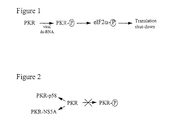
- P68 activation takes place in virally infected cells. After P68 activation has occured in virally infected cells, the resultant PKR-P then phosphorylates (switches off) the translation initiation factor eIF2 ⁇ , which leads to cell death (i.e. of the virus infected cell). This mechanism is schematically presented in Figure 1.
- the first mechanism concerns use of a viral protein (e.g. NS5A).
- NS5A can form a complex with PKR. This resultant complex can be called NS5A/PKR.
- NS5A Some teachings on NS5A may be found in WO-A-98/39487.
- the second mechanism concerns the virus inducing the expression of the host cell protein P58 (sometimes referred to as p58).
- P58 can bind to PKR.
- the resultant complex can be called the P58/PKR complex.
- the dsRNA activated protein kinase will be referred to as P68 based on its M r of 68,000 in human cells, although it also has been referred to by others as dsI, DAI, dsRNA-PK, eIF-2-PK ds , and P1/elF-2 kinase.
- the only other species in which the kinase has been well characterized is mice, where the kinase has a M r of 65,000; however, recently we identified kinase homologues in bovine and monkey cells as well (G.N. Barber and M.G. Katze, unpublished).
- the P68 protein kinase is a serine/threonine kinase characterized by two distinct kinase activities: the first involves an autophosphorylation (activation) reaction and the second a protein kinase activity on exogenous substrates.
- activation activation
- P68 phosphorylates its natural substrate, the ⁇ -subunit of protein synthesis eukaryotic initiation factor 2, eIF-2.
- Phosphorylation of the eIF-2 ⁇ -subunit blocks the eIF-2 ⁇ -mediated exchange of GDP in the inactive eIF-2-GDP complex, with GTP required for catalytic utilization of eIF-2.
- eIF-2 is an essential component of protein synthesis and is normally required to bind initiator Met-tRNA (via the ternary complex eIF-2-GTP-Met-tRNA) to the initiating ribosomal subunit before mRNA is bound.
- activation of the kinase triggers a series of events that culminates in an inhibition of protein synthesis initiation. Since virus-specific RNAs synthesized during infection have the potential to activate P68, viruses must down-regulate kinase activity to replicate and survive.”
- PKR mutants were generated by the authors, and kinase activities and eIF2 ⁇ affinities were analyzed in vitro.
- the in vivo function was investigated by growth inhibitory assays in yeast and translational assays in COS cells. Among the 13 mutations, 5 lost kinase activity and 3 exhibited less than 30% of wild-type eIF2 ⁇ binding activity.
- the deletion of the conserved sequence (amino acids 362-370) resulted in a protein that had no kinase activity and only about 25% of wild-type eIF2 ⁇ binding. The authors suggest that this sequence is not only required for PKR kinase activity but also is important for substrate interaction.
- the recombinant protein was purified to >90% homogeneity in a single immunoaffinity chromatographic step.
- the protein was free of endogenous eIF2 ⁇ kinase activity and was rapidly phosphorylated by the eIF2 ⁇ kinases HCR and PFR.
- a variant of eIF2 ⁇ in which the phosphorylation site was changed in Ala was also expressed and purified.
- the variant eIF2 ⁇ was not phosphorylated by either HCR or PKR, demonstrating that the kinases specifically phosphorylate the correct site in the recombinant protein even in the absence of the other two subunits of the protein.
- RNA-dependent protein kinase (PKR) is an important component of the interferon response to virus infection.
- PKA RNA-dependent protein kinase
- the activation of PKR is accompanied by autophosphorylation at multiple sites, including one in the N-terminal regulatory region (Thr-258) that is required for full kinase activity.
- Thr-258 the N-terminal regulatory region
- several protein kinases are activated by phosphorylation in the region between kinase subdomains VII and VIII, referred to as the activation loop.
- Thr-446 and Thr-451 in the PKR activation loop are required in vivo and in vitro for high-level kinase activity.
- mutation of either residue to Ala impaired translational control by PKR in yeast cells and COS1 cells and led to tumour formation in mice.
- mutations also impaired autophosphorylation and eukaryotic initiation factor 2 subunit ⁇ (eIF2 ⁇ ) phosphorylation by PKR in vitro.
- eIF2 ⁇ eukaryotic initiation factor 2 subunit ⁇
- PKR specifically phosphorylated Thr-446 and Thr-451 in synthetic peptides in vitro
- mass spectrometry analysis of PKR phosphopeptides confirmed that Thr-446 is an autophosphorylation site in vivo.
- Substitution of Glu-490 in subdomain X of PKR partially restored kinase activity when combined with the Ala-451 mutation. According to the authors, this finding suggests that the interaction between subdomain X and the activation loop, described previously for MAP kinase, is a regulatory feature conserved in PKR.
- eIF-2 ⁇ may be found in US-A-5795713.
- This document discloses a method for identifying inducers and inhibitors of programmed cell death in a cell-free system that would be useful in preventing neurodegenerative conditions, Alzheimer's disease, amyotrophic lateral sclerosis, Huntington's disease, spinal muscle atrophy, and other neurodegenerative disorders. According to the authors, the method expolits the finding that programmed cell death is accompanied by shutdown of cellular protein synthesis and by phosphorylation of eIF-2 ⁇ , and that the dephosphorylation of eIF-2 ⁇ prevents the shutdown of protein synthesis.
- the protein known as p68 protein kinase is an interferon-induced double-stranded RNA-activated protein kinase. This kinase is activated by the double-stranded RNA typically found in virus-infected cells. Once activated, the kinase phosphorylates the alpha subunit of the initiation factor eIF-2, an event which quickly leads to a block in the initiation stage of translation. The effect is to shut down protein synthesis in the cell, causing that cell to die: something which the multi-cellular infected organism can afford but which the virus cannot.
- viruses have evolved a variety of mechanisms to prevent or counteract activation of the p68 kinase (reviewed in Katze, 1992). These include viral RNAs which bind to the kinase and prevent binding of the double-stranded RNA activator, as used by adenovirus (reviewed by Mathews M. B. & Shenk T., J. Virology 65, 5657-5662), HIV (Edery et al., Cell 56, 303-312, 1989; Gunnery et al., Proc. Natl. Acad. Sci. USA 87, 8687-8691, 1990; Roy et al., J.
- RNAs and proteins just described which interact with it are examples of a broader class of macromolecules which have been shown to be involved in the seizure or retention by viruses of control of translation in infected cells.
- Other examples include: the host translational factors eIF2 and eIF3/4B, which are reported to be impaired in cells infected with vesicular stomatitis virus (VSV) (Centrella and Lucas-Lenard, J.
- VSV vesicular stomatitis virus
- VSV gene "P” reportedly responsible for host translational inhibition
- poliovirus 2A protease responsible for degrading the p220 subunit of cap-binding protein complex (eIF-4F) in infected cells, and thereby preventing cap-dependent translation of host-cell mRNAs (Etchison et al., J. Biol. Chem.
- HSV herpes simplex virus
- HSV virion protein which binds to a sequence-specific DNA-binding protein in host cells, causing increased transcription from viral gene promoters (Campbell et al., J. Mol. Biol. 180, 1-19, 1984); a cap-dependent endonuclease encoded by influenza virus which cleaves nascent host-cell transcripts in the nucleus to provide primers for the synthesis of viral mRNA from the viral RNA genome (Bouloy et al., Proc. Natl. Acad. Sci.
- nucleases used by influenza virus and poxvirus to degrade host-cell mRNAs (Rice and Roberts, J. Virology 47, 529-539, 1983; Inglis SC, Mol. Cell. Biol 2, 1644-1648, 1982); viral inhibitors of host-cell RNA polymerase II (the enzyme responsible for transcription of host-cell mRNAs) such as the "positive-strand leader RNA" believed to bind a host-cell factor and prevent its binding to host-cell promoters (Grinell and Wagner, J.
- a variety of procedures are available to those skilled in the art which enable them to identify other such macromolecules (including polypeptides, proteins, glycoproteins, lipids, carbohydrates, mucopolysaccharides, glycolipids, and nucleic acids), and to design methods for selecting compounds which can prevent or moderate the interaction between viruses and these macromolecules.
- the steps required include: ascertaining whether translation is modulated by a given virus during infection; identifying the specific macromolecule(s) mediating the effect on translation; identifying any other cellular and/or viral components involved; characterizing the interaction between these components; and designing a screening method in which disruption or moderation of this interaction can be detected.
- viruses replicate inside cells by making use of cellular mechanisms of the host cells for replication.
- events that could be targetted by an antiviral agent. These viral specific events include: attachment of the virus to the cell membrane; penetration of the virus into the cells; uncoating of the virus; viral nucleic acid synthesis; viral protein synthesis and maturation; and assembly and release of infectious particles (Drug and Market Development, Vol 3. No. 9, pp. 174-180 (Feb. 15, 1993)).
- a feature of viral protein synthesis is that use is made of the host cell ribosomes and other host components.
- An example of such a host component is a protein called P58 (which is discussed further herein).
- protein synthesis inhibitors may be equally likely to be harmful to the host cell as they are to the virus itself. So, in the development of an antiviral therapeutic there is often a balance between not harming the host and destroying, or at least arresting the replication of, the virus (Drug and Market Development, Vol 3. No. 9, pp. 174-180 (Feb. 15, 1993)).
- agents are now used to overcome or suppress viral infection. These agents include naturally-occurring proteins - such as interferon - and other chemical compounds - such as AZT. These agents do not have, however, a universal applicability - as it is known that interferons have some efficacy with respect to some viral diseases and AZT is used in respect of an immunodeficiency disease caused by the virus HIV-1. Thus, there is still a need for screening for new anti-viral agents.
- “Screening” typically means a process in which a number of potentially useful agents are processed to see if they possess favourable properties.
- Some methods for screening for agents useful for the treatment of infection are known.
- further reference may be made to US-A-5738985 which discloses a method for screening for an antiviral agent. That method comprises determining whether a potential agent interacts with a virus or cellular component which allows or prevents preferential translation of a virus RNA compared to a host RNA under virus infection conditions; and determining whether any interaction of the agent with the component reduces the level of translation of an RNA of the virus.
- a preferred assay of US-A-5738985 concerns determining whether a potential antiviral agent is effective to inhibit viral replication in a host eukaryotic cell, where the virus produces an inhibitor which interferes with the activation or activity of the host-cell interferon-induced, double-stranded RNA-activated protein kinase, comprising incubating a mixture containing the protein kinase, the viral inhibitor, and the agent to be tested under conditions effective to cause inhibitor interference with the activation or activity of the protein kinase, and examining the mixture for such interference.
- interferons are known to have a broad antiviral effect. This particular phenomenon is reviewed in Vilcek and Sen (1996).
- IFN interferons
- their effectiveness as therapeutic drugs is often compromised by the fact that many viruses have evolved ways to interfere with the molecular interactions necessary to elicit an IFN antiviral response (again, see Table 1).
- Virus Inhibitor Vaccinia K3L HSV-1 ⁇ 1 34.5 Influenza NS1 Reo and Rotaviruses ⁇ 3 protein; s1 RNA Epstein-Barr Virus EBERS1 & 2; W1W2 exons Adenovirus VA1, Activated p58 Poliovirus PKR protease HIV-1 Tar HCV NS5A
- IFN antiviral effect of IFN on viruses such as picornaviruses, reoviruses, adenovirus, vaccinia, vescicular stomatitis virus, influenza, and potentially HCV, is achieved via inhibition of translation, with consequent death of the infected cell.
- IFN-induced enzyme pathways lead to inhibition of protein synthesis: the ds-RNA dependent protein kinase (PKR) pathway and the 2'-5' oligoadenylate synthase/RNAse L pathway.
- HCV-specific target related to the PKR pathway is the interaction between the HCV NS5A protein and PKR.
- a relatively small (ca. 35 amino acid) sequence of this protein has been shown to correlate with response to IFN.
- this target poses greater obstacles to the development of small molecule inhibitors.
- the 2'-5' oligoadenylate synthetase (2-5(A)synthase)/RNAse L pathway causes degradation of cellular and viral mRNA through the action of the IFN-induced enzyme and RNAse L.
- the active form of 2-5(A) synthase requires ds-RNA as its only cofactor.
- This pathway has been shown to be responsible for inhibiting the replication of picornaviruses, to which HCV is related, in IFN-treated cells.
- To the picornaviridae family of viruses belong several human pathogens that cause a variety of conditions that range from minor malaise to polyomelitis. A particular group of viruses that belong to this family, are known as coxsackieviruses.
- the group B of these viruses are being increasingly recognized as a cause of primary myocardial disease in adults and children.
- a preferred method continues to be the mass screening of compound "libraries" for active agents by exposing cultures of viral pathogens to the test compounds and assaying for inhibition of growth.
- a correspondingly large number of viral cultures must be grown over time periods which are relatively long compared to most bacterial culture times.
- a compound which is found to inhibit viral growth in culture may be acting not on the desired target but on a different, less unique viral component, with the result that the compound may act against host cells as well and thereby produce unacceptable side effects.
- the present invention seeks to provide targets for identifying potential agents for the effective treatment of opportunistic infections caused by one or more viral species, which may be related.
- the present invention seeks to provide a nucleotide sequence and/or its expression product (EP) thereof as targets for antiviral therapy as well as targets in assays for the identification of one or more agents which can act as antiviral agents.
- EP nucleotide sequence and/or its expression product
- the present invention also seeks to provide screening methods for identifying anti-viral agents.
- the present invention also seeks to provide an assay that can enable workers to screen for inter alia anti-viral agents, in particular small molecule inhibitors.
- the present invention provides a screen that is useful for identifying potential anti-viral agents.
- the screen makes use of a serine/threonine phosphatase.
- serine/threonine phosphatase as used herein with reference to the present invention includes a complete serine/threonine phosphatase enzyme per se, or just active fragments or units thereof, such as sub-units thereof, or combinations thereof.
- active fragments/units of the serine/threonine phosphatase include the catalytic subunit and/or regulatory subunit. These active fragments/units may be sub-units.
- the active fragments may be the subunits per se (i.e. on their own) or they can located in or associated with other amino acid sequences (such as being contained within the complete sequence of a serine/threonine phosphatase) or they may be free of other serine/threonine phosphatase enzyme sequences (i.e. on their own or in proteins that do not contain all of the sequence for the serine/threonine phosphatase enzyme).
- a serine/threonine phosphatase - such as the catalytic subunit thereof and/or the regulatory subunit thereof (sometimes referred to as the targeting sub-unit) - instead of the complete serine/threonine phosphatase enzyme.
- nucleotide sequences coding for those active fragments/subunits - i.e. nucleotide sequences that encode the catalytic subunit and/or regulatory subunit - instead of the nucleotide sequence coding for the complete serine/threonine phosphatase enzyme.
- the reference to the serine/threonine phosphatase of the present invention includes a reference to the enzyme itself. In some cases, the reference to the serine/threonine phosphatase of the present invention just means a reference to the enzyme itself.
- the reference to the serine/threonine phosphatase of the present invention means sequences which encompass the catalytic subunit thereof and/or the regulatory subunit thereof.
- the reference to the serine/threonine phosphatase of the present invention means sequences which just encompass the catalytic subunit thereof and the regulatory subunit thereof.
- the reference to the serine/threonine phosphatase of the present invention encompasses at least the catalytic subunit thereof.
- the reference to the serine/threonine phosphatase of the present invention encompasses at least the catalytic subunit PP1 ⁇ .
- the reference to the serine/threonine phosphatase of the present invention encompasses just the catalytic subunit PP1 ⁇ .
- the catalytic sub-unit may be used on its own or in the presence of other catalytic subunit(s) and/or one or more regulatory units and/or targetting units.
- the reference to the serine/threonine phosphatase of the present invention encompasses at least a regulatory subunit (or targetting sub-unit) which is normally associated with PP1 ⁇ .
- the reference to the serine/threonine phosphatase of the present invention encompasses just the regulatory subunit (or targetting sub-unit) which is normally associated with PP1 ⁇ .
- the regulatory sub-unit may be used on its own or in the presence of other regulatory sub-unit(s) and/or one or more catalytic sub-unit regulatory units.
- the screen makes use of PP1 ⁇ and/or a tagetting sub-unit normally associated with PP1 ⁇ .
- PP1 ⁇ can be used on its own, the tagetting sub-unit can be used on its own, or the PP1 ⁇ can be used in combination with - such as when bound to - the tagetting sub-unit with which it is normally associated.
- the target is eIF2 ⁇ then the targetting sub-unit can be GADD34. Teachings on GADD34 may be found in Hollander et al 1997 J Biol Chem 272 pp 13731-13737 and US-A-5795713.
- the targetting sub-unit may be the targetting sub-closet for PKR.
- PKR knockout mice exhibit a diminished antiviral response to encephalomyocarditis virus (EMCV) infection. Also, a similar diminished response to EMCV infection is observed in mouse embryo fibrolasts devoid of PKR.
- EMCV encephalomyocarditis virus
- an assay method for identifying an agent that can affect the activity or expression of a nucleotide sequence or the expression product (EP) thereof comprising contacting an agent with: a nucleotide sequence coding for a serine/threonine phosphatase; and/or the EP thereof (i.e. a serine/threonine phosphatase); and determining whether the agent affects the activity or expression of the nucleotide sequence and/or the EP.
- an assay method for identifying an agent that can affect serine/threonine phosphatase activity or expression thereof comprising contacting an agent with an expression product (EP) which is a serine/threonine phosphatase; and determining whether the agent binds to or otherwise interacts with and activates or inhibits an activity of the EP; wherein the presence or absence of a signal generated from the binding or interaction of the agent with the EP enzyme or nucleotide sequence encoding same is indicative that the agent can affect the EP activity or expression.
- EP expression product
- a process comprising the steps of: (a) performing the assay according to the present invention; (b) identifying one or more agents that do affect the EP activity or expression; and (c) preparing a quantity of those one or more identified agents.
- a modulator of an interaction between a serine/threonine phosphatase and PKR-P and/or eIF2 ⁇ -P wherein the modulator is capable of exhibiting anti-viral effects.
- treatment includes a therapeutic effect and/or a prophylatic effect.
- the anti-viral effect will be a prophylatic effect and/or a therapeutic effect.
- the assay method of the present invention is used to screen for agents useful in the therapeutic treatment of viral infections.
- the treatment may be for any animal. However, in a preferred embodiment, the treatment will be for a human.
- the agent may affect the activity or expression of the nucleotide sequence coding for the serine/threonine phosphatase by binding to the sequence itself - either the sense strand or the anti-sense strand - or by interacting with the corresponding RNA sequence.
- the agent may modulate the expression of the nucleotide sequence by interacting with, for example, one or more of the expression control elements - such as the promoter associated with the sequence coding for the serine/threonine phosphatase.
- the agent may modulate the expression of the nucleotide sequence by interacting with any signalling molecule that leads to upregulation of the expression of the serine/threonine phosphatase.
- a putative anti-viral agent may affect the activity or expression of the serine/threonine phosphatase by binding to it and thereby preventing the serine/threonine phosphatase from affecting the activation or activity of P68.
- the agent may affect the activity or expression of the serine/threonine phosphatase by binding to it. and thereby preventing the serine/threonine phosphatase from affecting the activity of the activated P68.
- the agent may affect the activity or expression of the serine/threonine phosphatase by binding to it and thereby preventing the serine/threonine phosphatase from affecting the activation or activity of eIF2.
- the agent may affect the activity or expression of the serine/threonine phosphatase by binding to it and thereby preventing the serine/threonine phosphatase from affecting the activity of the activated eIF2.
- the invention provides a method of treating a subject comprising administering to the subject a therapeutically effective amount of an agent identified by the assay method of the present invention or an agent corresponding thereto.
- agent corresponding thereto means that the agent that is used as the therapeutic need not be the actual agent that was used in the assay screen - but is an agent having the same chemical structure as that agent which was used in the screen.
- the present invention also relates to novel antiviral agents identified by the assay method according to the present invention. It also includes novel pharmaceutical compositions which include antiviral agents identified by the assay method of the present invention.
- the present invention also covers constructs comprising a sequence coding for the phosphatase of the present invention or an active portion thereof linked (directly or indirectly) to a nucleotide sequence coding for a reporter polypeptide.
- the construct may be contained within a cell, preferably a eukaryotic cell.
- the construct may be, or may be part of, an expression vector or expression system.
- vectors include chromosomal, episomal and virus-derived vectors.
- the vectors may be derived from bacterial plasmids.
- the vectors may be derived from yeast chromosomal elements.
- the vectors may be derived from bacteriophage.
- the vectors may be derived from viruses such as baculoviruses, papova viruses, such as vaccinia viruses, SV40, pseudorabies viruses adenoviruses, fowl pox viruses, and retroviruses.
- the vectors may be derived from transposons. In the alternative or in addition, the vectors may be derived from yeast episomes. In the alternative or in addition, the vectors may be derived from insertion elements. In the alternative or in addition, the vectors may be derived from vectors derived from combinations thereof, such as those derived from plasmid and bacteriophage genetic elements.
- constructs of the present invention may contain control regions that regulate expression.
- any system or vector suitable to maintain, propagate or express polynucleotides and/or to express a polypeptide in a host may be used for expression in this regard.
- the appropriate DNA sequence may be inserted into the expression system by any of a variety of well-known and routine techniques.
- the present invention also provides a method of inhibiting viral replication in a host eukaryotic cell comprising administering an agent identified by the assay method of the present invention or an agent corresponding thereto.
- the invention also provides a modified virus which is capable of producing an agent that is capable of modulating a host component that is able to affect P68 activity.
- the invention also provides a modified virus which is capable of producing an agent that is capable of modulating a host component that is able to affect eIF2 activity.
- the present invention also provides a method for screening for agents that are capable of inhibiting viral replication in a host eukaryotic cell, wherein the virus is capable of upregulating a serine/threonine phosphatase that interferes with the activity of the host-cell interferon-induced, double-stranded RNA-activated protein kinase.
- the method includes incubating a mixture containing the protein kinase, the serine/threonine phosphatase, and the agent to be tested, under conditions effective to cause inhibitor interference with the activity of the protein kinase, and determining whether such interference occurs.
- the protein kinase and the serine/threonine phosphatase according to the present invention are expressed in a yeast cell.
- the invention features a yeast cell for use in screening for putative anti-viral agents effective to inhibit viral replication in a host eukaryotic cell, where the virus upregulates expression of serine/threonine phosphatase that interferes with the activity of the host-cell interferon-induced, double-stranded RNA-activated protein kinase.
- the cell may include (1) an expressable sequence(s) coding for a mammalian interferon-induced, double-stranded RNA-activated protein kinase and/or eIF2; (b) an expressable reporter sequence gene whose expression in increased by activation of the protein kinase; and (c) an expressable sequence coding for a serine/threonine phosphatase that is able to affect the activation of the protein kinase and/or eIF2.
- One key aspect of the present invention is that it enables workers to identify or select agents that could overcome or suppress viral suppression of interferon-induced cell death.
- the assay method comprises forming an assay mixture comprising the agent or agents to be tested; a nucleotide sequence coding for the serine/threonine phosphatase and/or the serine/threonine phosphatase itself; and eIF2 ⁇ (which may be in an activatable form or may be in activated form).
- eIF2 ⁇ which may be in an activatable form or may be in activated form.
- this assay method one still determines whether the agent affects the activity or expression of the nucleotide sequence and/or the serine/threonine phosphatase. However, this can be achieved by determining the activity of the serine/threonine phosphatase itself and/or determining the activity of the eIF2 ⁇ (which may or may not be a phosphorylated form).
- the assay method comprises forming an assay mixture comprising the agent or agents to be tested; a nucleotide sequence coding for the serine/threonine phosphatase and/or the serine/threonine phosphatase itself; and P68 (which may be in an activatable form or may be in activated form) and/or eIF2 (which may be in an activatable form or may be in activated form).
- P68 which may be in an activatable form or may be in activated form
- eIF2 which may be in an activatable form or may be in activated form
- the assay method comprises forming an assay mixture comprising the agent or agents to be tested; a nucleotide sequence coding for the serine/threonine phosphatase and/or the serine/threonine phosphatase itself; P68 (which may be in an activatable form or may be in activated form); and eIF2 ⁇ (which may be in an activatable form or may be in activated form).
- P68 which may be in an activatable form or may be in activated form
- eIF2 ⁇ which may be in an activatable form or may be in activated form.
- protein kinase can be prepared from a number of sources.
- the protein kinase can be prepared from interferon-induced mammalian cells, preferably from interferon-induced human cells.
- the P68 can be prepared by recominant DNA techniques. In this respect, if the assay occurs in a host cell then that host cell may prepare heterologous P68.
- US-A-5738985 states that: "p68 protein kinase can be prepared from interferon-induced human tissue culture cell lines. In this respect, cells can be lysed by Dounce homogenization, and nuclei and cell debris removed by centrifugation at 30,000xg for 20 minutes. 4M KCl is added to the supernatant to a final concentration of 100 mM, and ribosomes are pelleted by centrifugation at 60,000 rpm in Beckman type 60 rotor.
- the ribosomal pellet is resuspended in 800 mM KCl, 20 mM HEPES (pH 7.4), 1.5 mM MgCl 2 , 0.1 mM EDTA, 1 mM DTT and 1 ⁇ M phenylmethylsulfonyl fluoride (PMSF), then homogenized using a Dounce homogenizer.
- the ribosomes are then centrifuged again at 60,000 rpm for 90 min at 4°C in a type 60 rotor.
- the resulting supernatant is dialyzed against 50 mM KCl, 20 mM HEPES (pH 7.4), 1.5 mM MgCl 2 , 0.1 mM EDTA, 1 mM DTT, 10% glycerol and 1 ⁇ M PMSF.
- the dialysate is centrifuged again to remove solids.
- the resulting supernatant (ribosomal salt wash) is applied to a DEAE-cellulose column equilibrated in 50 mM KCI, 20 mM HEPES (pH 7.4), 1.5 mM MgCl 2 , 0.1 mM EDTA, 1 mM DTT, 10% glycerol and 1 ⁇ M PMSF.
- p68 kinase is collected in the flow through fraction, adjusted to pH 6.8, and applied to a S-Sepharose Fast Flow (Pharmacia) column equilibrated with 50 mM KCl, 20 mM HEPES (pH 6.8), 1.5 mM MgCl 2 , 0.1 mM EDTA, 1 mM DTT, 10% glycerol and 1 ⁇ M PMSF.
- p68 kinase is eluted from the column in a linear gradient of 50-500 mM KCl in 20 mM HEPES (pH 7.4), 1.5 mM MgCl 2 , 0.1 mM EDTA, 1 mM DTT, 10% glycerol and 1 ⁇ .M PMSF.
- the p68 kinase peak is loaded onto a hydroxyapatite HPHT (BioRad) column equilibrated in 50 mM KCl, 20 mM HEPES (pH 7.2), 50 mM potassium phosphate (pH 7.2), 1.5 mM MgCl 2 , 0.1 mM EDTA, 1 mM DTT, 10% glycerol and 1 ⁇ M PMSF.
- p68 kinase is eluted in a linear gradient of 50-500 mM potassium phosphate (pH 7.2).
- the p68 peak is loaded to an HR 5/10 Mono S column (Pharmacia) and eluted in a linear gradient of 50-500 mM KCl in 20 mM HEPES (pH 7.4), 1.5 mM MgCl 2 , 0.1 mM EDTA, 1 mM DTT, 10% glycerol and 1 ⁇ M PMSF.
- the purified p68 is stored at -70°C.”
- US-A-5738985 also provides information on how to prepare P68 from recombinant E. coli cells.
- US-A-5738985 states that: "p68 is purified from E.coli expressing human p68 kinase, according to published methods (Barber et al., 1991, Biochemistry 30:10356). Briefly, E. coli strain BL21 (DE3) pLysS is transformed with a plasmid containing the coding sequence for wild-type p68 protein kinase under the control of an inducible promoter. The resulting E. coli strain is grown to log phase, then induced to express p68 kinase. Cells are harvested by centrifugation, and lysed by lysozyme.
- p68 kinase is purified from the lysate by affinity chromatography using a monoclonal antibody to p68 kinase coupled to Sepharose, according to published methods (Galabru et al., 1989, Eur. J. Biochem. 178:581)".
- the protein can be prepared from a number of sources.
- the protein can be prepared from interferon-induced mammalian cells, preferably from interferon-induced human cells.
- the eIF2 ⁇ can be prepared by recominant DNA techniques.
- the assay occurs in a host cell then that host cell may prepare heteologous eIF2 ⁇ .
- teachings on the eIF-2a protein kinases which are regulators of translation in eukaryotes from yeasts to humans, may be found in J. Bio. Chem. 268: 7603-7606. A further reference is Scheper et al., 1991, Biochem. Biophys. Acta 1089, 220-226.
- an assay that enables workers to identify or select agents that could be used to affect some molecular aspects of the IFN pathway, especially where small molecule inhibitors can be expected to augment the effectiveness of IFN as antiviral therapeutics.
- the assay of the present invention enables workers to identify or select agents against the target protein phosphatase, especially those that comprise as their catalytic domain PP1 ⁇ , including the coding sequences therefor or the expression control elements therefor.
- an infected host cell modulates the activity of the activated PKR-P, by use of the cellular protein PP1 ⁇ which dephosphorylates the PKR-P to PKR.
- the cell may deactivate the PKR-P by PP1 ⁇ .
- the present invention relates to methods for screening for agents which are useful in combatting or suppressing viral infection.
- the assay screening method of the present invention includes the step of bringing putative anti-viral agents into contact with serine/threonine phosphatase or the nucleotide sequence coding for same or the expression control elements therefor in order to ascertain whether any one or more of those agents can be used to combat or suppress viral infection.
- the assay screening method of the present invention may also be used to investigate required or desirable dosage levels of known or identified anti-viral agents wherein the agents are brought into contact with serine/threonine phosphatase or the nucleotide sequence coding for same or the expression control elements therefor in order to ascertain which dose levels are preferable for combatting or suppressing viral infection.
- the present invention also relates to the use of serine/threonine phosphatase or the nucleotide sequence coding for the same or the expression control elements therefor in the diagnosis and/or treatment of disease.
- the present invention also relates to the use serine/threonine phosphatase or the nucleotide sequence coding for same or the expression control elements therefor as targets to evaluate and/or to screen for agents that can modulate viral activity.
- the present invention further relates to genetically engineered host cells that comprise or express serine/threonine phosphatase or the nucleotide sequence coding for same or the expression control elements therefor that are useful to evaluate and/or to screen for agents that can modulate viral activity.
- the assay method of the present invention may include use of the serine/threonine phosphatase or the nucleotide sequence coding for same or the expression control elements therefor linked to a reporter group (such as a polypeptide).
- the assay method of the present invention includes contacting the target sequence(s) with a potential antiviral agent under conditions which allow, for example, preparation of the reporter group in the absence of the agent. Then one determines whether the agent reduces the level of preparation of the reporter group. Hence, any agent which reduces this level is potentially a useful antiviral agent.
- the assay method of the present invention includes contacting the target sequence(s) with a potential antiviral agent under conditions which only allow, for example, preparation of the reporter group in the presence of the agent. Then one determines whether the agent increases the level of preparation of the reporter group. Hence, any agent which increases this level is potentially a useful antiviral agent.
- the serine/threonine phosphatase is PP1.
- the serine/threonine phosphatase is the catalytic domain PP1 ⁇ and/or the targeting sub-unit normally associated with PP1 ⁇ .
- PP1 and PP1 ⁇ are known entities.
- the native structure of PP1 is a 1:1 complex between the catalytic and a number of regulatory subunits.
- the role of these regulatory subunits is to target the catalytic subunit towards specific subcellular and to increase activity towards particular substrates.
- PP1 has been described by Takizawa N et al (J Biochem (Tokyo) 1997 Oct; 122(4):730-737).
- the authors report that in response to stimulation of B-cells through cell surface IgM, the activity of the serine/threonine protein phosphatase PP1, but not PP2A, was transiently decreased and reached a minimum 10-20 min after the stimulation. The decrease was more profound in the immature B-cell line WEHI-231, than in the mature B-cell line BAL-17.
- PP1 ⁇ an isoform of PP1
- PP1 ⁇ showed unique alterations in the patterns of several spots with distinct isoelectic points in the Western blot after two-dimensional eletrophoresis, whereas another isoform, PP1 ⁇ , did not shown any alteration.
- PP1 in particular PP1 ⁇
- Solow B Young JC, Kennelly PJ (J Bacteriol 1997 Aug; 179(16):5072-5075) report that with oligonucleotides modelled after conserved regions within the protein-serine/threonine phosphatases (Pps) of the PP1/2A/2B superfamily, the gene for the archaeal protein phosphatase PP1-arch2 was identified, cloned, and sequences from the methanogenic archaeon Methanosarcina thermophila TM-1.
- Pps protein-serine/threonine phosphatases
- the activity of the recombinant PP1-arch2 was sensitive to several naturally occurring microbial toxins known to potently inhibit eucaryal PP1 and PP2A, including microcystin-LR, okadaic acid, tautomycin, and calyculin A.
- Serine/threonine protein phosphatases such as PP1 have also been reviewed by Wera and Hemmings (1995 Biochem J 311: 17-29). These authors say "Based on biochemical parameters, Ser/Thr protein phosphatases were initially divided into two classes: type-1 phosphatases (PP1) are inhibited by two heat-stable proteins, termed inhibitor-1 (I-1) and inhibitor-2 (I-2), and preferentially dephosphorylate the ⁇ -subunit of phosphorylase kinase, whereas type-2 phosphatases are insensitive to the heat-stable inhibitors and preferentially dephosphorylate the ⁇ -subunit of phosphorylase kinase.
- Type-2 phosphatases can be further subdivided into spontaneously active (PP2A), Ca 2+ -dependent (PP2B) and Mg 2+ -dependent (PP2C) classes. Molecular cloning revealed that PP2A was in fact much more closely related to PP1 than to PP2C. Moreover, in the past few years many novel protein phosphatases have been identified that do not fit into the above classification. Many of these protein phosphatases are closely related to the existing classes or are intermediates between classes. From a phylogenetic point of view, it would be more reasonable to group PP1, PP2A and PP2B in a family I and PP2C in a family II.
- PP1c has been crystallized in the presence of the phosphatase inhibitor microcystin. Initially two isoforms of PP1c were cloned, termed ⁇ and ⁇ . PP1c ⁇ was later shown to be a cloning artefact. In rat, cDNA cloning revealed the existence of at least four isoforms, termed ⁇ , ⁇ 1, ⁇ 2 and ⁇ . Interestingly, the ⁇ 1 and ⁇ 2 isoforms are produced by alternative splicing of the same primary transcript. The mouse homologues, derived from a brain library, were termed dis2m1 (for the ⁇ 1 isoform) and dis2m2 (for the ⁇ isoform).
- PP1 has some interesting properties that can be utilised in the present invention.
- PP1 can be bound to solid supports.
- PP1 can be bound to Sepharose columns in the assay methods of the present invention.
- Zhao S, Lee EY Biochemistry 1997 Jul8; 36(27):8318-8324
- the authors demonstrated that the catalytic subunit of rabbit muscle protein phosphatase-1 (PP1) binds to muscle phosphofructokinase (6-phosphofructo-1-kinase, PFK).
- PP1-phosphofructokinase 6-phosphofructo-1-kinase
- PP1 can also be phosphorylated.
- Villa-Moruzzi E, Puntoni F (Biochem Biophys Res Commun 1996Feb27;219(3):863-867) report that phosphatase-1 (PP1) is phosphorylated "in vitro" by the tyrosine-kinases c-src, v-src and v-abl.
- src the authors report that this induces enzyme inactivation.
- the serine/threonine phosphatase is the catalytic domain PP1 ⁇ .of a serine/threonine phosphatase and/or the targeting sub-unit normally associated with PP1 ⁇ .
- Preferred nucleotide and amino acid sequences for PP1 ⁇ are presented as SEQ ID No. 1 and SEQ ID No. 2 respectively. These sequences have been taken from MEDLINE reference 93209540 and are derived from Durfee, T., Becherer, K., Chen, P.L., Yeh, S.H., Yang, Y., Kilburn, A.E., Lee, W.H. and Elledge, S.J. "The retinoblastoma protein associates with the protein phosphatase type 1 catalytic subunit", Genes Dev. 7 (4), 555-569 (1993) (Fig. 5).
- Nucleotide and amino acid sequences for one of the targeting sub-units normally associated with PP1 ⁇ are presented as SEQ ID No. 3 and SEQ ID No. 4 respectively.
- a preferred screen of the present invention is a screen for agents that can inhibit the modulation (such as deactivation) of PKR-P by PP1 ⁇ and/or the targeting sub-unit normally associated with PP1 ⁇ . Such an agent should increase the concentration of PKR-P and thus force cell death.
- the serine/threonine phosphatase (preferably that comprising as the catalytic domain PP1 ⁇ and/or the targeting sub-unit normally associated with PP1 ⁇ ) could be associated with (such as bound to and/or complexed with) one or more host components and/or one or more viral components.
- viral inhibitors of the PKR pathway can be broadly grouped into three categories:
- anti-viral agents these being modulators of those same viral inhibitors of the PKR pathway.
- these anti-viral agents can be classified as being:
- the third category is that of the present invention. Nevertheless, the present invention also encompasses combination therapies wherein one or more of these modulators may be used but wherein at least one of those modulators is a modulator of an activator of PP1 ⁇ and/or the targeting sub-unit normally associated with PP1 ⁇ .
- Another screen encompassed by the present invention is a screen for agents that can inhibit the modulation of eIF2 ⁇ -P by PP1 ⁇ and/or the targeting sub-unit normally associated with PP1 ⁇ .
- the targeting sub-unit normally associated with PP1 ⁇ could be GADD34. Such an agent should also force cell death.
- the assay of the present invention would be useful for screening for at least agents capable of affecting any one or more of HIV, HCV, Vaccinia, HSV-1, Influenza, Reoviruses, Rotaviruses, Epstein-Barr Virus, Adenovirus, Poliovirus, VSV activity.
- the assay of the present invention is used to screen for agents capable of affecting any one or more of HIV, HCV, Vaccinia, HSV-1, Influenza, Reoviruses, Rotaviruses, Epstein-Barr Virus, Adenovirus, Poliovirus, VSV activity.
- the assay of the present invention is used to screen for agents capable of affecting any one or more of HIV, HCV, Vaccinia, Influenza, Reoviruses, Rotaviruses, Epstein-Barr Virus, Adenovirus, Poliovirus, VSV activity.
- the anti-viral agent of the present invention can be generically called a "PP1 ⁇ inhibitor".
- the inhibitors may interact with or affect PP1 ⁇ and/or the targeting sub-unit normally associated with PP1 ⁇ .
- the PP1 ⁇ inhibitor may be used with other therapeutics.
- the PP1 ⁇ inhibitor could be added to available combination therapies, including nucleoside, non-nucleoside and protease inhibitors.
- the PP1 ⁇ inhibitor could be added to available therapies, including protease inhibitors.
- the assay of the present invention provides a means to discover PP1 ⁇ inhibitors, such as novel PP1 ⁇ inhibitors, for use as antiviral therapeutics.
- a suitable assay according to the present invention may comprise use of the relatively simple colorimetric (or even filter binding) assay (compatible with automation) that has been recently developed for this enzyme (see Gupta, Ogawa et al. 1997).
- Potential assay formats include any one or more of the following:
- the present invention also includes a method which comprises determining whether an agent has an effect on the translational machinery of an infected host cell or an uninfected viral host cell.
- the present invention also encompasses combinations of the agents of the present invention.
- the present invention encompasses combinations comprising one or more of the agents of the present invention and other therapeutic agents - which agents may be administered simultaneously, sequentially, previously or subsequently in relationship to the agents of the present invention.
- typical combination therapies include administration of a PP1 ⁇ inhibitor and an inhibitor of NS5A and/or interferon.
- Interferon is used in the normal sense in the art. For example, reference may be made to Oxford Dictionary of Biochemistry and Molecular Biology (Oxford University Press, 1997) - viz. "Interferon abbr.: IFN; any member of a group of proteins that form a closely related group of nonviral proteins, of M r in the range 15,000 to 30,000, that are produced and liberated by animal cells following exposure to a variety of inducing agents; they are not normally present in uninduced cells. They exert nonspecific, antiviral activity, at least in homologous cells, through cellular metabolic processes involving the synthesis of both RNA and protein.
- Viruses are the most potent inducing agents, but interferons can also be induced by exposure of cells to a wide variety of microorganisms, bacterial endotoxins, phytohemagglutinins, and other substances. Interferons do not prevent viral penetration into cells but induce within the cells a complex of inhibitors of protein synthesis that block translation of viral mRNA, but do not the cell's own mRNA.
- interferon inhibitors are a protein kinase, which phosphorylates an initiation factor in protein synthesis, and an oligonucleotide synthetase, which catalyses the synthesis of pppA2'p5'A2'p5'A (abbr.: 2,5-A) - this trinucleotide activates a latent cellular endonuclease that degrades the viral mRNA.
- Interferons are classified into three types.
- IFN- ⁇ (formerly leukocyte interferon) comprises many examples; they are produced by macrophages, have antiviral activities, and stimulate production of two enzymes: a protein kinase and an oligoadenylate synthetase; they exist as monomers.
- IFN- ⁇ (formerly fibroblast interferon) has antiviral, antibacterial, and anticancer activities. It is related to the ⁇ family (three motifs).
- IFN- ⁇ (formerly immune interferon) is produced by lymphocytes activated by specific antigens or mitogens. In addition to antiviral activity it has important immunoregulatory functions: it is a potent activator of macrophages, it has antiproliferative effects on transformed cells, and can potentiate the antiviral and antitumour effects of the type I interferons ( ⁇ and ⁇ ). It is a glycoprotein and exists as a homodimer.
- the present invention is advantageous because it offers means of identifying targets based on essential functions for identifying potential viral inhibitors; it provides means for screening agents with a view to identifying anti-viral targets; it enables the identification of a nucleotide sequence and its EP thereof which are distinct from nucleotide sequences and EPs targeted by existing antiviral agents. Such a nucleotide sequence and EP thereof therefore serves as targets for therapeutics based on mechanisms which are likely to be distinct from the mechanisms of existing drugs.
- the present invention enables the identification of agents which inhibit the function of the nucleotide sequence and EP thereof by methods disclosed herein and which are distinct from known agents.
- coding sequences or EP sequences that have few or no close homologues. Consequently, it is believed that the therapeutic agents directed towards targets (such as genes or gene products) may have fewer side effects and may also have an effective therapeutic effect at a lower overall dosage.
- the present invention relates to certain host nucleic acid and amino acid sequences which may be essential for the pathogenic virus to maintain host cell viability.
- the present invention also relates to the use of the nucleic acid and amino acid sequences in the diagnosis and treatment of disease.
- the present invention also relates to the use of the nucleic acid and amino acid sequences to evaluate and/or to screen for agents that can modulate the expression of the nucleotide sequence or the activity of its EP.
- the present invention further relates to genetically engineered host cells that comprise or express the nucleic acid and amino acid sequences to evaluate and/or to screen for agents that can modulate the EP of the nucleotide sequence
- nucleotide sequence refers to an oligonucleotide sequence or polynucleotide sequence, and variants, homologues, fragments and derivatives thereof (such as portions thereof).
- the nucleotide sequence may be DNA or RNA of genomic or synthetic or recombinant origin which may be double-stranded or single-stranded whether representing the sense or antisense strand.
- nucleotide sequence is prepared by use of recombinant DNA techniques (e.g. recombinant DNA).
- nucleotide sequence means RNA.
- the present invention does not cover the native nucleotide coding sequence according to the present invention in its natural environment when it is under the control of its native promoter which is also in its natural environment.
- the "non-native nucleotide sequence” we shall call this preferred embodiment the "non-native nucleotide sequence".
- amino acid sequence refers to peptide, polypeptide or protein sequences or portions thereof.
- the present invention does not cover the native EP according to the present invention when it is in its natural environment and when it has been expressed by its native nucleotide coding sequence which is also in its natural environment and when that nucleotide sequence is under the control of its native promoter which is also in its natural environment.
- the "non-native amino acid sequence” we shall call this preferred embodiment the "non-native amino acid sequence".
- the term "the EP” refers to an EP as such, as well as fusion protein derivatives thereof.
- the EP of the present invention may be the same as the naturally occuring form - for this aspect, preferably the EP has a non-native amino acid sequence - or is a variant, homologue, fragment or derivative thereof.
- the EP is the isolated EP and/or the purified EP.
- the EP can be obtainable from or produced by any suitable source, whether natural or not, or it may be synthetic, semi-synthetic or recombinant.
- the EP coding sequence may be the same as the naturally occuring form - for this aspect, preferably the EP coding sequence is the non-native nucleotide sequence - or is a variant, homologue, fragment or derivative thereof.
- the EP coding sequence is an isolated EP coding sequence and/or a purified EP coding sequence.
- the EP coding sequence can be obtainable from or produced by any suitable source, whether natural or not, or it may be synthetic, semi-synthetic or recombinant.
- Altered EP polynucleotide sequences which may be used in accordance with the invention include deletions, insertions or substitutions of different nucleotide residues resulting in a polynucleotide that encodes the same or a functionally equivalent to the EP.
- deletion is defined as a change in either nucleotide or amino acid sequence in which one or more nucleotides or amino acid residues, respectively, are absent.
- an "insertion” or “addition” is that change in a nucleotide or amino acid sequence which has resulted in the addition of one or more nucleotides or amino acid residues, respectively, as compared to the naturally occurring EP.
- substitution results from the replacement of one or more nucleotides or amino acids by different nucleotides or amino acids, respectively.
- naturally occurring refers to an EP with an amino acid sequence found in nature.
- biologically active refers to an EP having structural, regulatory or biochemical functions of the naturally occurring EP.
- immunological activity is defined as the capability of the natural, recombinant or synthetic EP or any oligopeptide thereof, to induce a specific immune response in appropriate animals or cells and to bind with specific antibodies.
- derivative as used herein includes chemical modification of an EP. Illustrative of such modifications would be replacement of hydrogen by an alkyl, acyl, or amino group.
- nucleotide sequence and/or the EP thereof are isolated and purified.
- isolated and purified refer to molecules, either nucleic or amino acid sequences, that are removed from their natural environment and/or isolated or separated from at least one other component with which they are naturally associated.
- variant in relation to the amino acid sequence for the EP of the present invention include any substitution of, variation of, modification of, replacement of, deletion of or addition of one (or more) amino acid from or to the sequence providing the resultant EP has an activity, preferably being at least as biologically active as the polypeptide shown as SEQ ID No. 2.
- homologue covers homology with respect to structure and/or function. With respect to sequence homology, preferably there is at least 75%, more preferably at least 85 %, more preferably at least 90% homology to the sequence shown as SEQ ID No. 2. More preferably there is at least 95%, more preferably at least 98%, homology to the sequence shown as SEQ ID No. 2.
- variant in relation to the nucleotide sequence coding for the EP of the present invention include any substitution of, variation of, modification of, replacement of, deletion of or addition of one (or more) nucleic acid from or to the sequence providing the resultant nucleotide sequence codes for or is capable of coding for an EP preferably being at least as biologically active as the EP encoded by the sequences shown as SEQ ID No.1.
- homologue covers homology with respect to structure and/or function providing the resultant nucleotide sequence codes for or is capable of coding for an EP being at least as biologically active as the EP encoded by the sequences shown as SEQ ID No.1.
- sequence homology preferably there is at least 75%, more preferably at least 85%, more preferably at least 90% homology to the sequence shown as SEQ ID No.1. More preferably there is at least 95%, more preferably at least 98%, homology to the sequence shown as SEQ ID No. 1.
- variant in relation to the amino acid sequence for the EP of the present invention include any substitution of, variation of, modification of, replacement of, deletion of or addition of one (or more) amino acid from or to the sequence providing the resultant EP has an activity, preferably being at least as biologically active as the polypeptide shown as SEQ ID No. 4.
- homologue covers homology with respect to structure and/or function. With respect to sequence homology, preferably there is at least 75%, more preferably at least 85%, more preferably at least 90% homology to the sequence shown as SEQ ID No. 4. More preferably there is at least 95%, more preferably at least 98%, homology to the sequence shown as SEQ ID No. 4.
- variant in relation to the nucleotide sequence coding for the EP of the present invention include any substitution of, variation of, modification of, replacement of, deletion of or addition of one (or more) nucleic acid from or to the sequence providing the resultant nucleotide sequence codes for or is capable of coding for an EP preferably being at least as biologically active as the EP encoded by the sequences shown as SEQ ID No. 3.
- homologue covers homology with respect to structure and/or function providing the resultant nucleotide sequence codes for or is capable of coding for an EP being at least as biologically active as the EP encoded by the sequences shown as SEQ ID No. 3.
- sequence homology preferably there is at least 75%, more preferably at least 85%, more preferably at least 90% homology to the sequence shown as SEQ ID No. 3. More preferably there is at least 95 %, more preferably at least 98%, homology to the sequence shown as SEQ ID No. 3.
- sequence identity can be determined by commercially available computer programs that can calculate % homology between two or more sequences.
- a typical example of such a computer program is CLUSTAL.
- Substantial homology where homology indicates sequence identity, means more than 80% sequence identity, preferably more than 85% sequence identity and most preferably a sequence identity of 90% or more, as judged by direct sequence alignment and comparison.
- Sequence homology may moreover be determined using any suitable homology algorithm, using for example default parameters.
- the BLAST algorithm is employed, with parameters set to default values.
- the BLAST algorithm is described in detail at http://www.ncbi.nih.gov/BLAST/blast_help.html, which is incorporated herein by reference.
- the search parameters are defined as follows, and are advantageously set to the defined default parameters.
- substantially homology when assessed by BLAST equates to sequences which match with an EXPECT value of at least about 7, preferably at least about 9 and most preferably 10 or more.
- the default threshold for EXPECT in BLAST searching is usually 10.
- BLAST Basic Local Alignment Search Tool
- blastp, blastn, blastx, tblastn, and tblastx these programs ascribe significance to their findings using the statistical methods of Karlin and Altschul (see http://www.ncbi.nih.gov/BLAST/blast_help.htm1) with a few enhancements.
- the BLAST programs were tailored for sequence similarity searching, for example to identify homologues to a query sequence. The programs are not generally useful for motif-style searching.
- BLAST uses the following search parameters:
- HISTOGRAM Display a histogram of scores for each search; default is yes. (See parameter H in the BLAST Manual).
- DESCRIPTION Restricts the number of short descriptions of matching sequences reported to the number specified; default limit is 100 descriptions. (See parameter V in the manual page). See also EXPECT and CUTOFF.
- ALIGNMENTS Restricts database sequences to the number specified for which high-scoring segment pairs (HSPs) are reported; the default limit is 50. If more database sequences than this happen to satisfy the statistical significance threshold for reporting (see EXPECT and CUTOFF below), only the matches ascribed the greatest statistical significance are reported. (See parameter B in the BLAST Manual).
- EXPECT The statistical significance threshold for reporting matches against database sequences; the default value is 10, such that 10 matches are expected to be found merely by chance, according to the stochastic model of Karlin and Altschul (1990). If the statistical significance ascribed to a match is greater than the EXPECT threshold, the match will not be reported. Lower EXPECT thresholds are more stringent, leading to fewer chance matches being reported. Fractional values are acceptable. (See parameter E in the BLAST Manual).
- CUTOFF Cutoff score for reporting high-scoring segment pairs.
- the default value is calculated from the EXPECT value (see above).
- HSPs are reported for a database sequence only if the statistical significance ascribed to them is at least as high as would be ascribed to a lone HSP having a score equal to the CUTOFF value. Higher CUTOFF values are more stringent, leading to fewer chance matches being reported. (See parameter S in the BLAST Manual). Typically, significance thresholds can be more intuitively managed using EXPECT.
- MATRIX Specify an alternate scoring matrix for BLASTP, BLASTX, TBLASTN and TBLASTX.
- the default matrix is BLOSUM62 (Henikoff & Henikoff, 1992).
- the valid alternative choices include: PAM40, PAM120, PAM250 and IDENTITY.
- No alternate scoring matrices are available for BLASTN; specifying the MATRIX directive in BLASTN requests returns an error response.
- STRAND Restrict a TBLASTN search to just the top or bottom strand of the database sequences; or restrict a BLASTN, BLASTX or TBLASTX search to just reading frames on the top or bottom strand of the query sequence.
- FILTER Mask off segments of the query sequence that have low compositional complexity, as determined by the SEG program of Wootton & Federhen (1993) Computers and Chemistry 17:149-163, or segments consisting of short-periodicity internal repeats, as determined by the XNU program of Claverie & States (1993) Computers and Chemistry 17:191-201, or, for BLASTN, by the DUST program of Tatusov and Lipman (see http://www.ncbi.nlm.nih.gov). Filtering can eliminate statistically significant but biologically uninteresting reports from the blast output (e.g., hits against common acidic-, basic- or proline-rich regions), leaving the more biologically interesting regions of the query sequence available for specific matching against database sequences.
- Filtering is only applied to the query sequence (or its translation products), not to database sequences. Default filtering is DUST for BLASTN, SEG for other programs.
- NCBI-gi Causes NCBI gi identifiers to be shown in the output, in addition to the accession and/or locus name.
- sequence comparisons are conducted using the simple BLAST search algorithm provided at http://www.ncbi.nlm.nih.gov/BLAST.
- variants As used herein, the terms “variant”, “homologue”, “fragment” and “deriavtive” are synonymous with allelic variations of the sequences.
- variant also encompasses sequences that are complementary to sequences that are capable of hydridising to the nucleotide sequences presented herein.
- the present invention also relates to nucleotide sequences that can hybridise to the nucleotide sequences of the present invention (including complementary sequences of those presented herein).
- the present invention also relates to nucleotide sequences that are complementary to the sequences that can hybridise to the nucleotide sequences of the present invention (including complementary sequences of those presented herein).
- hybridization shall include "the process by which a strand of nucleic acid joins with a complementary strand through base pairing" (Coombs J (1994) Dictionary of Biotechnology, Stockton Press, New York NY) as well as the process of amplification as carried out in polymerase chain reaction technologies as described in Dieffenbach CW and GS Dveksler (1995, PCR Primer, a Laboratory Manual, Cold Spring Harbor Press, Plainview NY).
- nucleotide sequences that are capable of hybridizing to the nucleotide sequence of SEQ ID No.1 (and/or or SEQ ID No.3) or other sequences coding for the amino acid sequence of SEQ ID No. 2 (and/or SEQ ID No.4, respectively) under conditions of intermediate to maximal stringency.
- Hybridization conditions are based on the melting temperature (Tm) of the nucleic acid binding complex, as taught in Berger and Kimmel (1987, Guide to Molecular Cloning Techniques, Methods in Enzymology, Vol 152, Academic Press, San Diego CA), and confer a defined "stringency” as explained below.
- Maximum stringency typically occurs at about Tm-5°C (5°C below the Tm of the probe); high stringency at about 5°C to 10°C below Tm; intermediate stringency at about 10°C to 20°C below Tm; and low stringency at about 20°C to 25°C below Tm.
- a maximum stringency hybridization can be used to identify or detect identical polynucleotide sequences while an intermediate (or low) stringency hybridization can be used to identify or detect similar or related polynucleotide sequences.
- the present invention covers nucleotide sequences that can hybridise to the nucleotide sequence of the present invention under stringent conditions (e.g. 65°C and 0.1xSSC).
- stringent conditions e.g. 65°C and 0.1xSSC.
- the presence of the EP polynucleotide coding sequence can be detected by DNA-DNA or DNA-RNA hybridization or amplification using probes, portions or fragments of the sequence presented as SEQ ID No. 1 (and/or SEQ ID No.3) or other sequences coding for the amino acid sequence of SEQ ID No. 2 (and/or SEQ ID No.4, respectively).
- Nucleic acid amplification based assays involve the use of oligonucleotides or oligomers based on the EP coding sequence to detect transformants containing the EP DNA or RNA.
- oligonucleotides may refer to a nucleic acid sequence of at least about 10 nucleotides and as many as about 60 nucleotides, preferably about 15 to 30 nucleotides, and more preferably about 20-25 nucleotides which can be used as a probe or amplifier.
- oligonucleotides are derived from the 3' region of the nucleotide sequence shown as SEQ ID No. 1 (and/or SEQ ID No.3) or other sequences coding for the amino acid sequence of SEQ ID No. 2 (and/or SEQ ID No.4, respectively).
- vector includes expression vectors and transformation vectors.
- expression vector means a construct capable of in vivo or in vitro expression.
- transformation vector means a construct capable of being transferred from one species to another.
- the present invention relates to an EP and to a nucleic acid sequence encoding same.
- Either or both of the nucleotide sequence coding for the EP or the EP itself may be used to screen for agents that can affect the EP activity.
- the nucleotide sequence coding for the EP or the EP itself may be used to screen for agents that can inhibit the EP activity.
- the nucleotide sequence coding for the EP or the EP itself may be used to screen for agents that selectively affect the EP activity, such as selectively inhibit the EP activity.
- nucleotide sequence coding for the EP or a sequence that is complementary thereto may also be used in assays in the presence of EP coding sequences from human cells. These competitive assays may provide information regarding the selectivity of an EP inhibitor.
- the present invention also covers antibodies to the EP (including a derivative, fragment, homologue or variant thereof).
- the antibodies to the EP may be used in assays to detect the presence of the EP in human cells. These assays would provide information regarding the tissue distribution of the EP and its biological relevance with respect to particular disease states.
- any one or more of the EP, the nucleotide sequence coding for same, the nucleotide sequences that are complementary to same, and the antibodies directed to same may be used in assays to screen for agents that selectively affect the EP.
- These assays would provide information regarding the tissue distribution of the EP and to provide information regarding the biological relevance of the EP with respect to particular disease states.
- These assays would also allow workers to test for and identify agents that are useful to affect the expression of or activity of the EP - such as in a particular tissue or in a particular disease state.
- the present invention also relates to polypeptides produced by expression in a host cell into which has been incorporated the foregoing DNA sequences or allelic variations thereof.
- the present invention also provides a method for producing a polypeptide having the EP activity, the method comprising the steps of a) transforming a host cell with a nucleotide sequence shown as SEQ ID No. 1 and/or SEQ ID No.3 or a derivative, homologue, variant or fragment thereof; b) culturing the transformed host cell under conditions suitable for the expression of said polypeptide; and c) recovering said polypeptide from the host cell culture.
- the EP and/or its coding sequence and/or a sequence capable of hybridising thereto and/or a sequence that are complementary to the sequences capable of hybridising thereto is/are useful for screening drug candidates useful as antiviral.
- the EP and/or its coding sequence and/or a sequence capable of hybridising thereto sequence that are complementary to the sequences capable of hybridising thereto is/are useful for screening drug candidates for the treatment of viral infections.
- the EP and/or its coding sequence and/or a sequence capable of hybridising thereto sequence that are complementary to the sequences capable of hybridising thereto is/are useful for testing the selectivity of drug candidates between different the EPs.
- the present invention relates to a DNA sequence (preferably a cDNA sequence) encoding the EP.
- the present invention relates to cDNA sequences encoding the EP.
- alleles of the EP include alleles of the EP.
- an "allele” or “allelic sequence” is an alternative form of the EP. Alleles result from a mutation, i.e., a change in the nucleic acid sequence, and generally produce altered mRNAs or polypeptides whose structure or function may or may not be altered. Any given gene may have none, one or many allelic forms. Common mutational changes which give rise to alleles are generally ascribed to deletions, additions or substitutions of amino acids. Each of these types of changes may occur alone, or in combination with the others, one or more times in a given sequence.
- the present invention also relates to DNA segments comprising the DNA sequence of SEQ ID No. 1 and/or SEQ ID No.3 or allelic variations of such sequences.
- a highly preferred aspect of the present invention relates to a polypeptide comprising the amino acid sequence of SEQ ID No. 2 and/or SEQ ID No.4.
- the present invention relates to an isolated polypeptide comprising the amino acid sequence of SEQ ID No. 2 and/or SEQ ID No.4.
- the present invention also relates to DNA comprising the DNA sequence of SEQ ID No. 1 and/or SEQ ID No.3, or an allelic variation thereof.
- the present invention also relates to non-native DNA comprising the DNA sequence of SEQ ID No. 1 and/or SEQ ID No.3, or an allelic variation thereof.
- a highly preferred aspect of the present invention relates to recombinant DNA comprising the DNA sequence of SEQ ID No. 1 or an allelic variation thereof.
- the present invention also relates to an assay method for detecting the presence of the EP in cells (such as human cells) comprising: (a) performing a reverse transcriptase-polymerase chain reaction on RNA (such as total RNA) from such cells using a pair of polymerase chain reaction primers that are specific for the EP, as determined from the DNA sequence of SEQ ID No. 1 and/or SEQ ID No.3, or an allelic variation thereof; and (b) assaying the appearance of an appropriately sized PCR (polymerase chain reaction) fragment - such as by agarose gel electrophoresis.
- RNA such as total RNA
- the present invention also relates to a method of identifying agents (such as compounds, other substances or compositions comprising same) that affect (such as inhibit or otherwise modify) the activity of the EP, the method comprising contacting the EP or the nucleotide sequence coding for same with the agent and then measuring the activity of the EP.
- agents such as compounds, other substances or compositions comprising same
- the present invention also relates to a method of identifying agents (such as compounds, other substances or compositions comprising same) that selectively affect (such as inhibit or otherwise modify) the activity of the EP, the method comprising contacting the EP or the nucleotide sequence coding for same with the agent and then measuring the activity of the EP.
- agents such as compounds, other substances or compositions comprising same
- the present invention also relates to a method of identifying agents (such as compounds, other substances or compositions comprising same) that affect (such as inhibit or otherwise modify) the activity of the EP, the method comprising measuring the activity of the EP in the presence of the agent or after the addition of the agent in: (a) a cell line into which has been incorporated recombinant construct comprising the nucleotide sequence of SEQ ID No. 1 and/or SEQ ID No.3, or an allelic variation thereof, or (b) a cell population or cell line that naturally selectively expresses the EP and then measuring the activity of the EP.
- agents such as compounds, other substances or compositions comprising same
- the method comprising measuring the activity of the EP in the presence of the agent or after the addition of the agent in: (a) a cell line into which has been incorporated recombinant construct comprising the nucleotide sequence of SEQ ID No. 1 and/or SEQ ID No.3, or an allelic variation thereof, or (b) a cell population or cell line that
- the present invention also relates to a method of identifying agents (such as compounds, other substances or compositions comprising same) that selectively affect (such as inhibit or otherwise modify) the activity of the EP, the method comprising measuring the activity of the EP in the presence of the agent or after the addition of the agent in: (a) a cell line into which has been incorporated recombinant construct comprising the nucleotide sequence of SEQ ID No. 1 and/or SEQ ID No.3, or an allelic variation thereof, or (b) a cell population or cell line that naturally selectively expresses the EP and then measuring the activity of the EP.
- agents such as compounds, other substances or compositions comprising same
- Some specific embodiments of the present invention relate to assay methods for the identification of antiviral agents using assays for antiviral agents which may be carried out both in whole cell preparations and in ex vivo cell-free systems.
- the assay target is the target nucleotide sequence - which is essential for the virus to maintain cell viability - and/or its EP.
- Candidate agents which are found to inhibit the target nucleotide sequence and/or the EP in any assay method of the present invention are thus identified as potential antiviral agents.
- the assay methods of the present invention will be suitable for both small and large-scale screening of test compounds as well as in quantitative assays such as serial dilution studies wherein the target nuceotide sequence or its EP thereof are exposed to a range of candidate agent concentrations.
- the target nucleotide sequence and/or its EP and the entire living host cell may be exposed to the candidate agent under conditons normally suitable for growth.
- conditons normally suitable for growth.
- Such conditions including essential nutrients, optimal temperatures and other parameters, depend upon the particular viral strain being used and will be well known in the art.
- Inhibition of the target nucleotide sequence and/or the EP may be determined in a number of ways including observing the cell culture's growth or lack therof. Such observation may be made visually, by optical densitometric or other light absorption/scattering means or by yet other suitable means, whether manual or automated.
- an observed lack of cell growth may be due to inhibition of the target nucleotide sequence and/or the EP or may be due to an entirely different effect of the candidate agent and further evaluation may be required to establish the mechanism of action and to determine whether the candidate agent is a specific inhibitor of the target.
- the method may be performed as a paired-cell assay in which each test compound is separately tested against two different host cells, the first host cells having a target with altered properties making it more susceptible to inhibition compared with that of the second host cells.
- a particularly useful strain is one having a temperature sensitive (“ts") mutation as a result of which the target is more prone than the wild type target to loss of functionality at high temperatures (that is, temperatures higher than optimal, but still permitting growth in wild type cells).
- ts temperature sensitive
- the activity of a ts mutant target may be attenuated but sufficient for growth.
- differential susceptibility to target inhibitors may be obtained by using a second host cell which has altered properties making it less susceptible to inhibition compared with that of a wild type cells as for example, a host cell which has been genetically manipulated to cause overexpression of the target.
- overexpression can be achieved by placing into a wild type cell a plasmid carrying the nucleotide sequence for the target.
- the techniques for generating temperature sensitive mutants, for preparing specific plasmids and for transforming cell lines with such plasmids are well known in the art.
- the access of candidate agents to a cell or an organism may be enhanced by mutating or deleting a gene or genes which encode a protein or proteins responsible for providing a permeability barrier for a cell or an organism.
- the present invention also relates to a method for identifying antiviral agents utilising cell systems that are sensitive to perturbation to one or several transcriptional/translational components.
- the present invention relates to a method of constructing mutant host cells in which one or more of the transcriptional/translational components is present in an altered form or in a different amount compared with a corresponding wild-type cell.
- This method further involves examining a candidate agent for its ability to perturb transcriptional/translation by assessing the impact it has on the growth of the mutant and wild-type cells.
- Agents which perturb transcriptional/translation by acting on a particular component that participates in transcriptional/translation may cause a mutant host cell which has an altered form or amount of that component to grow differently from the corresponding wild-type cell but do not affect the growth relative to the wild type cell of other mutant cells bearing alterations in other components participating in transcription/translation.
- This method thus provides not only a means to identify whether a candidate agent perturbs transcriptional/translation but also an indication of the site at which it exerts its effects.
- the transcriptional/translation component which is present in altered form or amount in a cell whose growth is affected by a candidate agent is likely to be the site of action of the agent.
- Representative examples of appropriate hosts for use in the assay of the present invention include: animal cells such as and Bowes melanoma cells, BHK, CHO, HeLa, COS, C127, 3T3, 293 cells fungal cells, such as yeast cells and Aspergillus cells; bacterial cells, such as Bacillus subtilis, streptococci, staphlococci, enterococci E. coli, streptomyces; insect cells such as Drosophila S2 and Spodoptera Sf9 cells; plant cells.
- animal cells such as and Bowes melanoma cells, BHK, CHO, HeLa, COS, C127, 3T3, 293 cells fungal cells, such as yeast cells and Aspergillus cells
- bacterial cells such as Bacillus subtilis, streptococci, staphlococci, enterococci E. coli, streptomyces
- insect cells such as Drosophila S2 and Spodoptera Sf9 cells
- the sequences of the present invention may be expressed in a yeast cell which is constructed to increase the expression of a suitable marker protein when in the presence of an inhibitor of the expression or activity of the sequences when in the presence of a suitable agent.
- This aspect of the present invention concerns use of a yeast cell in screening agents effective to inhibit the action of, for example, serine/threonine phosphatase in a host eukaryotic cell.
- the cell may include an expressable gene encoding a mammalian interferon-induced, double-stranded RNA-activated protein kinase; a suitable reporter sequence; and a sequence coding for serine/threonine phosphatase or an active fragment thereof.
- Proteins that may be agents putative agents according to the present invention can also be identified using a yeast genetic system known as the two-hybrid system (Fields & Song, Nature, 340, 245-246, 1989; Chien et al., Proc. Natl. Acad. Sci. USA 88, 9578-9582, 1991).
- This technique is summarised in US-A-5738985 - which states that the technique requires the availability of a gene or cDNA encoding one of the two proteins which interact with each other.
- the gene or cDNA is cloned into a specific plasmid in such a way that it is expressed fused to the DNA-binding domain of a yeast transcriptional activator such as GAL4 which has two separable and functionally essential domains, one for DNA-binding and the other for transcriptional activation.
- genes or cDNAs encoding putative binding partners of the known component are cloned in such a way that each putative partner is expressed fused to the transcriptional activation domain of the same DNA-binding protein.
- Introduction of both types of fusion into the same yeast cell results in generation of functional DNA-binding protein only if the fusion partners of the two domains of this protein interact with one another closely enough to bring together its two separately-expressed domains.
- Clones which produce such functional DNA-binding protein can be selected very easily by plating them on a medium which requires the yeast to produce an enzyme that is under the control of the DNA-binding protein.
- the gene or cDNA for the partner which binds to the previously identified component can then be recovered from yeast clones which grow on the selective medium.
- US-A-5738985 also reports on other methods that may be adapted for use in the assay method of the present invention.
- the component in question it is possible to use the component in question as an affinity ligand to identify viral and cellular products which bind to it; labeling this component with a detectable label and using it as a probe to detect viral and cellular products on blots of electrophoresis gels; labeling the component and using it to probe libraries of viral and cellular genes and/or cDNAs; labeling the component and using it to probe cDNA expression libraries to find clones synthesizing proteins which can bind to the component; performing UV-crosslinking studies to identify viral or cellular products which can bind to the component; using the component in gel retardation assays which would detect its ability to bind to viral or cellular nucleic acids; performing footprinting analyses to identify the regions within a nucleic acid to which the component binds; and so on.
- the present invention also provides a method for identifying antiviral agents which interfere with steps in translational accuracy, such as maintaining a proper reading frame during translation and terminating translation at a stop codon.
- This method involves constructing mutant host cells in which a detectable reporter polypeptide can only be produced if the normal process of staying in one reading frame or of terminating translation at a stop codon has been disrupted.
- This method further involves contacting the mutant host cells with a candidate agent to examine whether it increases the production of the reporter polypeptide.
- the reporter polypeptide can be a peptide which is directly detectable, such as by providing a colorimetric signal, or is indirectly detectable, such as by providing a suitable binding domain for a labelled probe (such as an antibody).
- the present invention also provides a method of screening an agent for specific binding affinity with the EP (or a derivative, homologue, variant or fragment thereof) or the nucleotide sequence coding for same (including a derivative, homologue, variant or fragment thereof), the method comprising the steps of: a) providing a candidate agent; b) combining the EP (or the derivative, homologue, variant or fragment thereof) or the nucleotide sequence coding for same (or the derivative, homologue, variant or fragment thereof) with the candidate agent for a time sufficient to allow binding under suitable conditions; such binding or interaction being associated with a second component capable of providing a detectable signal in response to the binding or interaction of the EP or the nucleotide sequence encoding same with the agent and c) determining whether the agent binds to or otherwise interacts with and activates or inhibits an activity of the EP (or the derivative, homologue, variant or fragment thereof) or the nucleotide sequence coding for same (or the derivative, homologue, variant or fragment thereof) by detecting the presence or
- the cell system is an extract of a host cell that was grown under defined conditions, and the method involves measuring transcription or translation in vitro.
- defined conditions are selected so that transcription or translation of the reporter is increased by the addition of a transcription inhibitor or a translation inhibitor to the cell extract.
- One such method for identifying antiviral (known and unknown) agents relies upon a transcription-responsive gene product.
- This method involves constructing a host cell in which the production of a reporter molecule, measured as a percentage of over-all transcription, increases under conditions in which overall host cell transcription is reduced.
- the reporter molecule is encoded by a nucleic acid either transcriptionally linked to a sequence constructed and arranged to cause a relative increase in the production of the reporter molecule when overall transcription is reduced.
- the overall transcription is measured by the expression of a second indicator gene whose expression, when measured as a percentage of overall transcription, remains constant when the overall transcription is reduced.
- the method further involves contacting the host cell with a candidate agent, and determining whether the agent increases the production of the first reporter molecule in the host cell.
- the reporter molecule is itself the transcription-responsive gene product whose production increases when overall transcription is reduced.
- the reporter is a different molecule whose production is linked to that of the transcription-responsive gene product.
- linkage between the reporter and the transcription-responsive gene product can be achieved in several ways.
- a gene sequence encoding the reporter may, for example, be fused to part or all of the gene encoding the transcription-responsive gene product and/or to part or all of the genetic elements which control the production of the gene product.
- the transcription-responsive gene product may stimulate transcription of the gene encoding the reporter, either directly or indirectly.
- the method for identifying antiviral (known and unknown) agents relies upon a translation-responsive gene product.
- This method involves constructing a host cell in which the production of a reporter molecule, measured as a percentage of over-all translation, increases under conditions in which overall host cell translation is reduced.
- the reporter molecule is encoded by nucleic acid either translationally linked or transcriptionally linked to a sequence constructed and arranged to cause a relative increase in the production of the reporter molecule when overall translation is reduced.
- the overall translation is measured by the expression of a second indicator gene whose expression, when measured as a percentage of overall translation, remains constant when the overall translation is reduced.
- the method further involves contacting the host cell with a candidate agent, and determining whether the agent increases the production of the first reporter molecule in the host cell.
- the reporter molecule is itself the translation-responsive gene product whose production increases when overall translation is reduced.
- the reporter is a different molecule whose production is linked to that of the translation-responsive gene product.
- linkage between the reporter and the translation-responsive gene product can be achieved in several ways.
- a gene sequence encoding the reporter may, for example, be fused to part or all of the gene encoding the translation-responsive gene product and/or to part or all of the genetic elements which control the production of the gene product.
- the translation-responsive gene product may stimulate translation of the gene encoding the reporter, either directly or indirectly.
- a wide variety of reporters may be used, with preferred reporters providing conveniently detectable signals (eg. by spectroscopy).
- a reporter gene may encode an enzyme which catalyses a reaction which alters light absorption properties.
- reporter molecules include but are not limited to ⁇ -galactosidase, invertase, green fluorescent protein, luciferase, chloramphenicol, acetyltransferase, ⁇ -glucuronidase, exo-glucanase and glucoamylase.
- radiolabeled or fluorescent tag-labeled nucleotides can be incorporated into nascent transcripts which are then identified when bound to oligonucleotide probes.
- the production of the reporter molecule is measured by the enzymatic activity of the reporter gene product, such as ⁇ -galactosidase.
- a method of identifying agents that affect the target nucleotide sequence and/or EP comprises (i) arranging cells from a target organism, such as a virus or an individual, in a physical matrix such as a microtiter plate wherein each of the cells contains a recombinant construct comprising a reporter gene operatively linked to a different endogenous transcriptional regulatory element of said target organism such that said transcriptional regulatory element regulates the expression of said reporter gene; (ii) including a sufficient number of different recombinant cells to provide an ensemble of transcriptional regulatory elements of said organism sufficient to model the transcriptional responsiveness of said organism to a candidate agent under one or more of a variety of physical conditions; (iii) contacting a plurality of cells from the target organism with a candidate agent which may provoke a specific cellular response; and (iv) detecting a reporter gene product signal for each cell.
- Each cell is contacted with a candidate agent which can provoke a specific cellular response.
- Preferred agents are pharmaceutical agents, particularly therapeutic agents.
- the agent may be an organic compound or an inorganic compound.
- the agent may induce a complex response pattern of induction, repression, silence or which may be expressed as an increase in reporter activity, a decrease in reporter activity or no change at all in reporter activity.
- the response profile is designed to reflect the cell's transcriptional adjustments to maintain homeostasis in the presence of the agent.
- the reporter gene product signals from one or more of the cells is measured to determine a stimulated response profile.
- the basal of background response profile is then compared with (e.g. subtracted from, or divided into) the stimulated response profile to identify the cellular response profile to the candidate agent.
- the cellular response may be characterised in a number of ways. For example, the basal profile may be subtracted from the stimulated profile to yield a net stimulation profile. In another embodiment, the stimulated profile may be divided by the basal profile to yield an induction ratio profile.
- Such comparison profiles provide an estimate of the physiological specificity of the candidate agent.
- Response profiles for unknown agents may be analysed by comparing the new stimulus response profiles with response profiles to known chemical stimuli.
- a selection of hybridisation probes corresponding to a predetermined population of genes of the selected viral organism may be used to specifically detect changes in gene transcription which result from exposing the selected organism or cells thereof to a candidate agent.
- one or more cells derived from the organism is exposed to the candidate agent in vivo or ex vivo under conditions wherein the agent effects a change in gene transcription in the cell to maintain homeostasis. Thereafter, the gene transcripts, primarily mRNA, of the cell or cells are isolated by conventional means.
- the isolated transcripts or cDNAs complementary thereto are then contacted with an ordered matrix of hybridisation probes, each probe being specific for a different one of the transcripts, under conditions wherein each of the transcripts hybridises with a corresponding one of the probes to form hybridisation pairs.
- the ordered matrix of probes provides, in aggregate, complements for an ensemble of genes of the organism sufficient to model the transcriptional responsiveness of the organism to a candidate agent.
- the probes are generally immobilised and arrayed onto a solid substrate such as a microtiter plate. Specific hybridisation may be effected, for example, by washing the hybridised matrix with excess non-specific oligonucleotides. A hybridisation signal is then detected at each hybridisation pair to obtain a transcription signal profile.
- hybridisation signals may be used.
- the cells are pre-labeled with radionucleotides such that the gene transcripts provide a radioactive signal that can be detected in the hybridisation pairs.
- the transcription signal profile of the agent-treated cells is then compared with a transcription signal profile of negative control cells to obtain a specific transcription response profile to the candidate agent.
- nucleotide sequences of the present invention may be engineered in order to alter the EP coding sequence for a variety of reasons, including but not limited to, alterations which modify the cloning, processing and/or expression of the gene product.
- mutations may be introduced using techniques which are well known in the art, e.g., site-directed mutagenesis to insert new restriction sites, to alter glycosylation patterns or to change codon preference.
- an EP natural, modified or recombinant sequence may be ligated to a heterologous sequence to encode a fusion protein.
- a heterologous sequence For example, for screening of peptide libraries for inhibitors of the EP activity, it may be useful to encode a chimeric EP expressing a heterologous epitope that is recognized by a commercially available antibody.
- the present invention thus provides for fusion proteins comprising the respected target or an enzymatically active fragment or derivative thereof linked to an affinity tag such as glutathione-S-transferase (GST), biotin, His6, myc and hemagglutinin (HA) (as described in Wilson et al (1984 Cell 37 767).
- GST glutathione-S-transferase
- HA hemagglutinin
- the fused recombinant protein comprises an antigenic co-protein such as GST, ⁇ -galactosidase or the lipoprotein D from Haemophilus influenzae which are relatively large co-proteins, which solubilise and facilitate production and purification thereof.
- the fused protein may comprise a carrier protein such as bovine serum albumin (BSA) or keyhole limpet haemocyanin (KLH).
- BSA bovine serum albumin
- KLH keyhole limpet haemocyanin
- the marker sequence is a hexa-histidine peptide, as provided in the pQE vector (Qiagen Inc) and described in Gentz et al (1989 PNAS 86: 821-824).
- fusion proteins are readily expressable in yeast culture (as described in Mitchell et al 1993 Yeast 5: 715-723) and are easily purified by affinity chromatography.
- a fusion protein may also be engineered to contain a cleavage site located between the nucleotide sequence encoding the EP and the heterologous protein sequence, so that the EP may be cleaved and purified away from the heterologous moiety.
- an assay for the target protein may be conducted using the entire, bound fusion protein.
- the co-protein may act as an adjuvant in the sense of providing a generalised stimulation of the immune system.
- the co-protein may be attached to either the amino or carboxy terminus of the first protein.
- marker gene expression suggests that the nucleotide sequence and/or its EP is also present, its presence and expression should be confirmed.
- the EP coding sequence is inserted within a marker gene sequence, recombinant cells containing the EP coding regions may be identified by the absence of marker gene function.
- a marker gene may be placed in tandem with a the EP coding sequence under the control of a single promoter. Expression of the marker gene in response to induction or selection usually indicates expression of the EP as well.
- Additional methods to quantitate the expression of a particular molecule include radiolabeling (Melby PC et al 1993 J Immunol Methods 159:235-44) or biotinylating (Duplaa C et al 1993 Anal Biochem 229-36) nucleotides, coamplification of a control nucleic acid, and standard curves onto which the experimental results are interpolated. Quantitation of multiple samples may be speeded up by running the assay in an ELISA format where the oligomer of interest is presented in various dilutions and a spectrophotometric or calorimetric response gives rapid quantitation.
- the present invention also relates to expression vectors and host cells comprising polynucleotide sequences encoding the EP or variant, homologue, fragment or derivative thereof for the in vivo or in vitro production of the EP with a view to screening for agents that can affect the EP expression or activity.
- the EP polynucleotide sequences which encode the EP, fragments of the polypeptide, fusion proteins or functional equivalents thereof, may be used to generate recombinant DNA molecules that direct the expression of the EP in appropriate host cells.
- polynucleotide encoding the EP of the present invention is operably linked to a promoter sequence capable of directing expression of the polynucleotide in a suitable host cell.
- the transformed host cell When inserted into the host cell, the transformed host cell may be cultured under suitable conditions until sufficient levels of the polypeptide are achieved after which the cells may be lysed and the EP isolated.
- the EP itself may be isolated from host cells using familiar techniques for the fragmentation and sequence analysis of genetic material including the use of oligonucleotide probes and PCR amplification techniques to identify known target sequences or suspected sequences having substantial sequence homology with the target sequence.
- Altered EP polynucleotide sequences which may be used in accordance with the invention include deletions, insertions or substitutions of different nucleotide residues resulting in a polynucleotide that encodes the same or a functionally equivalent the EP.
- the protein may also have deletions, insertions or substitutions of amino acid residues which produce a silent change and result in a functionally equivalent EP.
- Deliberate amino acid substitutions may be made on the basis of similarity in polarity, charge, solubility, hydrophobicity, hydrophilicity, and/or the amphipathic nature of the residues as long as the biological activity of the EP is retained.
- negatively charged amino acids include aspartic acid and glutamic acid; positively charged amino acids include lysine and arginine; and amino acids with uncharged polar head groups having similar hydrophilicity values include leucine, isoleucine, valine, glycine, alanine, asparagine, glutamine, serine, threonine, phenylalanine, and tyrosine.
- the coding sequence of the EP may be synthesized, in whole or in part, using chemical methods well known in the art (see Caruthers MH et al (1980) Nuc Acids Res Symp Ser 215-23, Horn T et al (1980) Nuc Acids Res Symp Ser 225-232).
- the EP itself may be produced using chemical methods to synthesize the EP amino acid sequence, in whole or in part.
- peptides can be synthesized by solid phase techniques, cleaved from the resin, and purified by preparative high performance liquid chromatography (e.g., Creighton (1983) Proteins Structures And Molecular Principles, WH Freeman and Co, New York NY). The composition of the synthetic peptides may be confirmed by amino acid analysis or sequencing (e.g., the Edman degradation procedure; Creighton, supra).
- Direct peptide synthesis can be performed using various solid-phase techniques (Roberge JY et al (1995) Science 269: 202-204) and automated synthesis may be achieved, for example, using the ABI 43 1 A Peptide Synthesizer (Perkin Elmer) in accordance with the instructions provided by the manufacturer. Additionally, the amino acid sequence of the EP, or any part thereof, may be altered during direct synthesis and/or combined using chemical methods with a sequence from other subunits, or any part thereof, to produce a variant polypeptide.
- the EP may also be expressed as a recombinant protein with one or more additional polypeptide domains added to facilitate protein purification.
- purification facilitating domains include, but are not limited to, metal chelating peptides such as histidine-tryptophan modules that allow purification on immobilized metals (Porath J (1992) Protein Expr Purif 3 -.26328 1), protein A domains that allow purification on immobilized immunoglobulin, and the domain utilized in the FLAGS extension/affinity purification system (Immunex Corp, Seattle, WA).
- a cleavable linker sequence such as Factor XA or enterokinase (Invitrogen, San Diego, CA) between the purification domain and the EP is useful to facilitate purification.
- Host cells transformed with the EP nucleotide coding sequence may be cultured under conditions suitable for the expression and recovery of the encoded protein from cell culture.
- the protein produced by a recombinant cell may be secreted or may be contained intracellularly depending on the sequence and/or the vector used.
- expression vectors containing the EP coding sequences can be designed with signal sequences which direct secretion of the EP coding sequences through a particular prokaryotic or eukaryotic cell membrane.
- the EP or a variant, homologue, fragment or derivative thereof and/or a cell line that expresses the EP or variant, homologue, fragment or derivative thereof may be used to screen for antibodies, peptides, or other agent, such as organic or inorganic molecules, that act as modulators of the EP activity, thereby identifying a therapeutic agent capable of modulating the levels of the EP.
- anti-EP antibodies capable of neutralizing the activity of the EP may be used to inhibit the EP activity thereby increasing their levels.
- nucleotide sequences encoding the N-terminal region of the EP may be expressed in a cell line which can be used for screening of allosteric modulators, either agonists or antagonists, of the EP activity.
- nucleotide sequences encoding the conserved catalytic domain of the EP can be expressed in cell lines and used to screen for inhibitors of the EP activity.
- Antibodies to the EP polypeptides include, but are not limited to, polyclonal, monoclonal, chimeric, single chain, Fab fragments and fragments produced by a Fab expression library.
- Neutralizing antibodies i.e., those which inhibit biological activity of the EP polypeptides, are especially preferred for diagnostics and therapeutics.
- various hosts including goats, rabbits, rats, mice, etc. may be immunized by injection with the EP polypeptide or any portion, variant, homologue, fragment or derivative thereof or oligopeptide which retains immunogenic properties.
- various adjuvants may be used to increase immunological response.
- adjuvants include, but are not limited to, Freund's, mineral gels such as aluminium hydroxide, and surface active substances such as lysolecithin, pluronic polyols, polyanions, peptides, oil emulsions, keyhole limpet hemocyanin, and dinitrophenol.
- BCG Bacilli Calmette-Guerin
- Corynebacterium parvum are potentially useful human adjuvants which may be employed if purified the EP polypeptide is administered to immunologically compromised individuals for the purpose of stimulating systemic defence.
- Monoclonal antibodies to the EP polypeptide may be prepared using any technique which provides for the production of antibody molecules by continuous cell lines in culture. These include, but are not limited to, the hybridoma technique originally described by Koehler and Milstein (1975 Nature 256:495-497), the human B-cell hybridoma technique (Kosbor et al (1983) Immunol Today 4:72; Cote et al (1983) Proc Natl Acad Sci 80:2026-2030) and the EBV-hybridoma technique (Cole et al (1985) Monoclonal Antibodies and Cancer Therapy, Alan R Liss Inc, pp 77-96).
- Antibodies may also be produced by inducing in vivo production in the lymphocyte population or by screening recombinant immunoglobulin libraries or panels of highly specific binding reagents as disclosed in Orlandi et al (1989, Proc Natl Acad Sci 86: 3833-3837), and Winter G and Milstein C (1991; Nature 349:293-299).
- Antibody fragments which contain specific binding sites for the EP may also be generated.
- such fragments include, but are not limited to, the F(ab') 2 fragments which can be produced by pepsin digestion of the antibody molecule and the Fab fragments which can be generated by reducing the disulfide bridges of the F(ab') 2 fragments.
- Fab expression libraries may be constructed to allow rapid and easy identification of monoclonal Fab fragments with the desired specificity (Huse WD et al (1989) Science 256:1275-128 1).
- the EP-specific antibodies are useful for the diagnosis of conditions and diseases associated with expression of the EP polypeptide.
- a variety of protocols for competitive binding or immunoradiometric assays using either polyclonal or monoclonal antibodies with established specificities are well known in the art. Such immunoassays typically involve the formation of complexes between the EP polypeptides and its specific antibody (or similar the EP-binding molecule) and the measurement of complex formation.
- a two-site, monoclonal based immunoassay utilizing monoclonal antibodies reactive to two noninterfering epitopes on a specific EP protein is preferred, but a competitive binding assay may also be employed. These assays are described in Maddox DE et al (1983, J Exp Med 158:121 1).
- Anti-EP antibodies are useful for the diagnosis of inflammation, conditions associated with proliferation of hematopoietic cells and HIV infection or other disorders or diseases characterized by abnormal expression of the EP.
- Diagnostic assays for an EP include methods utilizing the antibody and a label to detect an EP polypeptide in human body fluids, cells, tissues or sections or extracts of such tissues.
- the polypeptides and antibodies of the present invention may be used with or without modification. Frequently, the polypeptides and antibodies will be labeled by joining them, either covalently or noncovalently, with a reporter molecule. As already outlined, a wide variety of reporter molecules are known to those of skill in the art.
- a variety of protocols for measuring an EP polypeptide, using either polyclonal or monoclonal antibodies specific for the respective protein are known in the art. Examples include enzyme-linked immunosorbent assay (ELISA), radioimmunoassay (RIA), competitive binding assays, Western Blot analysis and fluorescent activated cell sorting (FACS).
- ELISA enzyme-linked immunosorbent assay
- RIA radioimmunoassay
- FACS fluorescent activated cell sorting
- a two-site, monoclonal-based immunoassay utilizing monoclonal antibodies reactive to two non-interfering epitopes on an the EP polypeptide is preferred, but a competitive binding assay may be employed. These assays are described, among other places, in Maddox, DE et al (1983, J Exp Med 15 8:121 1).
- the present invention relates to the use of an EP polypeptide, or variant, homologue, fragment or derivative thereof, to produce anti-EP antibodies which can, for example, be used diagnostically to detect and quantitate the EP levels in disease states.
- Another aspect of the subject invention is to provide for nucleic acid hybridization or PCR probes which are capable of detecting polynucleotide sequences, including genomic sequences, encoding the EP coding region or closely related molecules, such as alleles.
- the specificity of the probe i.e., whether it is derived from a highly conserved, conserved or non-conserved region or domain, and the stringency of the hybridization or amplification (high, intermediate or low) will determine whether the probe identifies only naturally occurring EP coding sequence, or related sequences.
- Probes for the detection of related nucleic acid sequences are selected from conserved or highly conserved nucleotide regions of the EP family members, such as the 3' region, and such probes may be used in a pool of degenerate probes.
- nucleic acid probes are selected from the non-conserved nucleotide regions or unique regions of the EP polynucleotides.
- non-conserved nucleotide region refers to a nucleotide region that is unique to the EP coding sequence disclosed herein and does not occur in related family members.
- An EP nucleic acid antisense molecule may be used to modify the expression of or block the activity of the EP in conditions where it would be deemed preferable. Alternatively, these sequences can be used as a probe, or for amplifying all or part of such sequence when used as a polymerase chain reaction primer. An EP antisense molecule may also provide the basis for treatment of various abnormal conditions related to, for example, increased the EP activity - such as found in mycoses, viral infection or infestations.
- Means for producing labelled hybridization or PCR probes for detecting the EP polynucleotide sequences include oligolabelling, nick translation, end-labelling or PCR amplification using a labelled nucleotide.
- the EP coding sequence, or any portion of it may be cloned into a vector for the production of an mRNA probe.
- Such vectors are known in the art, are commercially available, and may be used to synthesize RNA probes in vitro by addition of an appropriate RNA polymerase such as T7, T3 or SP6 and labeled nucleotides.
- reporter molecules or labels include those radionuclides, enzymes, fluorescent, chemiluminescent, or chromogenic agents as well as substrates, cofactors, inhibitors, magnetic particles and the like.
- Patents teaching the use of such labels include US-A-3,817,837; US-A-3,850,752; US-A-3,939,350; US-A-3,996,345; US-A-4,277,437; US-A-4,275,149 and US-A-4,366,241.
- recombinant immunoglobulins may be produced as shown in US-A-4,816,567.
- PCR as described in US-A-4,683,195; US-A-4,800,195; and US-A-4,965,188 provides additional uses for oligonucleotides based upon the EP sequence.
- oligomers are generally chemically synthesized, but they may be generated enzymatically or produced from a recombinant source.
- Oligomers generally comprise two nucleotide sequences, one with sense orientation (5'->3') and one with antisense (3' ⁇ -5') employed under optimized conditions for identification of a specific gene or condition. The same two oligomers, nested sets of oligomers, or even a degenerate pool of oligomcrs may be employed under less stringent conditions for detection and/or quantitation of closely related DNA or RNA sequences.
- the nucleic acid sequence for the EP can also be used to generate hybridization probes as previously described, for mapping the endogenous genomic sequence.
- the sequence may be mapped to a particular chromosome or to a specific region of the chromosome using well known techniques. These include in situ hybridization to chromosomal spreads (Verma et al (1988) Human Chromosomes: A Manual of Basic Techniques, Pergamon Press, New York City), flow-sorted chromosomal preparations, or artificial chromosome constructions such as YACs, bacterial artificial chromosomes (BACs), bacterial PI constructions or single chromosome cDNA libraries.
- AT ataxia telangiectasia
- genomic region for example, AT to 1Iq22-23 (Gatti et al (1988) Nature 336:577-580)
- any sequences mapping to that area may represent associated or regulatory genes for further investigation.
- the nucleotide sequence of the subject invention may also be used to detect differences in the chromosomal location due to translocation, inversion, etc between normal, carrier or affected individuals.
- nucleotide sequences encoding an EP in a biological sample may reflect a chromosomal aberration, such as a nucleic acid deletion or mutation. Accordingly, nucleotide sequences encoding an EP provide the basis for probes which can be used diagnostically to detect chromosomal aberrations such as deletions, mutations or chromosomal translocations in the gene encoding the EP.
- the EP gene expression may be altered in such disease states or there may be a chromosomal aberration present in the region of the gene encoding an the EP.
- Such assays may be tailored to evaluate the efficacy of a particular therapeutic treatment regime and may be used in animal studies, in clinical trials, or in monitoring the treatment of an individual.
- a normal or standard profile for the EP must be established. This is accomplished by combining body fluids or cell extracts taken from normal subjects, either animal or human, with the EP or a portion thereof, under conditions suitable for hybridization or amplification. Standard hybridization may be quantified by comparing the values obtained for normal subjects with a dilution series of positive controls run in the same experiment where a known amount of purified EP is used. Standard values obtained from normal samples may be compared with values obtained from samples from subjects potentially affected by a disorder or disease related to expression of the EP coding sequence.
- Deviation between standard and subject values establishes the presence of the disease state. If disease is established, an existing therapeutic agent is administered, and treatment profile or values may be generated. Finally, the assay may be repeated on a regular basis to evaluate whether the values progress toward or return to the normal or standard pattern. Successive treatment profiles may be used to show the efficacy of treatment over a period of several days or several months.
- An EP encoding polynucleotide sequence may be used for the diagnosis of diseases resulting from expression of the EP.
- polynucleotide sequences encoding the EP may be used in hybridization or PCR assays of tissues from biopsies or autopsies or biological fluids, such as serum, synovial fluid or tumor biopsy, to detect abnormalities in the expression of the EP.
- the form of such qualitative or quantitative methods may include Southern or Northern analysis, dot blot or other membrane-based technologies; PCR technologies; dip stick, pin or chip technologies; and ELISA or other multiple sample formal technologies. All of these techniques are well known in the art and are in fact the basis of many commercially available diagnostic kits.
- oligonucleotide sequences include oligonucleotide sequences, antisense RNA and DNA molecules and ribozymes, which function to destabilize the EP mRNA or inhibit translation of the EP.
- Such nucleotide sequences may be used in conditions where it would be preferable to increase the EP levels.
- Expression vectors derived from retroviruses, adenovirus, herpes or vaccinia viruses, or from various bacterial plasmids, may be used for delivery of recombinant the EP sense or antisense molecules to the targeted cell population. Methods which are well known to those skilled in the art can be used to construct recombinant vectors containing the EP. Alternatively, recombinant EP can be delivered to target cells in liposomes.
- cDNA sequence and/or its regulatory elements enable researchers to use the EP as a tool in sense (Youssoufian H and HF Lodish 1993 Mol Cell Biol 13:98-104) or antisense (Eguchi et al (1991) Ann Rev Biochem 60:631-652) investigations of gene function.
- Oligonucleotides, designed from the cDNA or control sequences obtained from the genomic DNA can be used in vitro or in vivo to inhibit expression. Such technology is now well known in the art, and sense or antisense oligonucleotides or larger fragments can be designed from various locations along the coding or control regions.
- the EP can be modulated by transfecting a cell or tissue with expression vectors which express high levels of an EP fragment in conditions where it would be preferable to block the EP activity.
- Such constructs can flood cells with untranslatable sense or antisense sequences. Even in the absence of integration into the DNA, such vectors may continue to transcribe RNA molecules until all copies of the vector are disabled by endogenous nucleases. Such transient expression may last for a month or more with a non-replicating vector and even longer if appropriate replication elements are part of the vector system.
- Modifications of gene expression can be obtained by designing antisense sequences to the control regions of the EP gene, such as the promoters, enhancers, and introns.
- Oligonucleotides derived from the transcription initiation site are preferred.
- Antisense RNA and DNA molecules may also be designed to block translation of mRNA by preventing the transcript from binding to ribosomes. Similarly, inhibition can be achieved using Hogeboom base-pairing methodology, also known as "triple helix" base pairing. Triple helix pairing compromises the ability of the double helix to open sufficiently for the binding of polymerases, transcription factors, or regulatory molecules.
- oligonucleotide sequences include oligonucleotide sequences, antisense RNA and DNA molecules and ribozymes, which function to destabilize the EP mRNA or inhibit translation of the EP.
- Such nucleotide sequences may be used in conditions where it would be preferable to increase the EP levels.
- Ribozymes are enzymatic RNA molecules capable of catalyzing the specific cleavage of RNA.
- the mechanism of ribozyme action involves sequence specific hybridization of the ribozyme molecule to complementary target RNA, followed by a endonucleolytic cleavage.
- engineered hammerhead motif ribozyme molecules that specifically and efficiently catalyze endonucleolytic cleavage of the EP RNA sequences.
- ribozyme cleavage sites within any potential RNA target are initially identified by scanning the target molecule for ribozyme cleavage sites which include the following sequences, GUA, GUU and GUC. Once identified, short RNA sequences of between 15 and 20 ribonucleotides corresponding to the region of the target gene containing the cleavage site may be evaluated for secondary structural features which may render the oligonucleotide sequence inoperable. The suitability of candidate targets may also be evaluated by testing accessibility to hybridization with complementary oligonucleotides using ribonuclease protection assays.
- RNA molecules may be generated by in vitro or in vivo transcription of DNA sequences encoding the antisense RNA molecule. Such DNA sequences may be incorporated into a wide variety of vectors with suitable RNA polymerase promoters such as T7 or SP6. Alternatively, antisense cDNA constructs that synthesize antisense RNA constitutively or inducibly can be introduced into cell lines, cells or tissues.
- DNA molecules may be modified to increase intracellular stability and half-life. Possible modifications include, but are not limited to, the addition of flanking sequences of the 5' and/or 3' ends of the molecule or the use of phosphorothioate or 2' O-methyl rather than phosphodiesterase linkages within the backbone of the molecule.
- Methods for introducing vectors into cells or tissue include those methods discussed herein. In addition, several of these transformation or transfection methods are equally suitable for ex vivo therapy,
- the present invention also relates to the use of genetically engineered host cells expressing an EP or variant, homologue, fragment or derivative thereof in screening methods for the identification of inhibitors and antagonists of the EP that would modulate the EP activity.
- Such genetically engineered host cells could be used to screen peptide libraries or organic molecules capable of modulating the EP activity.
- Antagonists and inhibitors of the EP such as antibodies, peptides or small organic molecules will provide the basis for pharmaceutical compositions for the treatment of diseases associated with, for example, mycoses, viral infections and infestation.
- Such inhibitors or antagonists can be administered alone or in combination with other therapeutics for the treatment of such diseases.
- host cells which contain the coding sequence for the EP and express the EP coding regions may be identified by a variety of procedures known to those of skill in the art. These procedures include, but are not limited to, DNA-DNA or DNA-RNA hybridization and protein bioassay or immunoassay techniques which include membrane-based, solution-based, or chip-based technologies for the detection and/or quantification of the nucleic acid or protein.
- An EP polypeptide, its immunogenic fragments or oligopeptides thereof can be used for screening therapeutic compounds in any of a variety of drug screening techniques.
- the polypeptide employed in such a test may be free in solution, affixed to a solid support, borne on a cell surface, or located intracellularly. The abolition of activity or the formation of binding complexes between the EP polypeptide and the agent being tested may be measured.
- normal or standard values from an EP polypeptide expression must be established. This is accomplished by combining body fluids or cell extracts taken from normal subjects, either animal or human, with antibody to an EP polypeptide under conditions suitable for complex formation which are well known in the art. The amount of standard complex formation may be quantified by comparing it to a dilution series of positive controls where a known amount of antibody is combined with known concentrations of a purified EP polypeptide. Then, standard values obtained from normal samples may be compared with values obtained from samples from subjects potentially affected by a disorder or disease related to an EP polypeptide expression. Deviation between standard and subject values establishes the presence of the disease state.
- Phage display can be employed in the identification of candidate agents which are anti-viral inhibitory molecules.
- Phage display is a protocol of molecular screening which utilises recombinant bacteriophage.
- the technology involves transforming bacteriophage with a gene that encodes an appropriate ligand (in this case a candidate agent) capable of binding to the EP (or a variant, homologue, fragment or derivative therof) or the nucleotide sequence (or a variant, homologue, fragment or derivative therof) encoding same.
- the transformed bacteriophage (which preferably is tethered to a solid support) expresses the appropriate ligand (such as the candidate agent) and displays it on their phage coat.
- Phage display has advantages over standard affinity ligand screening technologies.
- the phage surface displays the candidate agent in a three dimensional configuration, more closely resembling its naturally occuring conformation. This allows for more specific and higher affinity binding for screening purposes.
- the present invention provides a method for screening a plurality of agents for specific binding affinity with the EP, or a portion, variant, homologue, fragment or derivative thereof, comprising providing a plurality of agents; combining the EP or a portion, variant, homologue, fragment or derivative thereof with each of a plurality of agents for a time sufficient to allow binding under suitable conditions; and detecting binding of the EP, or portion, variant, homologue, fragment or derivative thereof, to each of the plurality of agents, thereby identifying the agent or agents which specifically bind the EP.
- the plurality of agents may be produced by combinatorial chemistry techniques known to those of skill in the art.
- Another technique for screening provides for high throughput screening of agents having suitable binding affinity to the EP polypeptides and is based upon the method described in detail in Geysen, European Patent Application 84/03564, published on September 13, 1984.
- large numbers of different small peptide test compounds are synthesized on a solid substrate, such as plastic pins or some other surface.
- the peptide test agents are reacted with the EP fragments and washed.
- a bound EP is then detected - such as by appropriately adapting methods well known in the art.
- a purified EP can also be coated directly onto plates for use in the aforementioned drug screening techniques.
- non-neutralizing antibodies can be used to capture the peptide and immobilize it on a solid support.
- This invention also contemplates the use of competitive drug screening assays in which neutralizing antibodies capable of binding the EP specifically compete with a test compound for binding the EP. In this manner, the antibodies can be used to detect the presence of any peptide which shares one or more antigenic determinants with an the EP.
- An EP polynucleotide, or any part thereof, may provide the basis for a diagnostic and/or a therapeutic compound.
- the EP polynucleotide sequences may be used to detect and quantitate gene expression in conditions, disorders or diseases in which the EP activity may be implicated, for example, in viral infection or infestations.
- the present invention also provides a diagnostic composition for the detection of the EP polynucleotide sequences.
- the diagnostic composition may comprise the polynucleotide SEQ ID No. 1 and/or SEQ ID No.3, or a variant, homologue, fragment or derivative thereof, or a sequence capable of hybridising to all or part of SEQ ID No. 1 and/or SEQ ID No.3, or an allelic variation thereof.
- the putative agent to be screened may be any suitable candidiate chemical entity - such as a small organic molecule, small inorganic molecule, a large organic molecule, a large in organic molecule etc.
- suitable candidiate chemical entity - such as a small organic molecule, small inorganic molecule, a large organic molecule, a large in organic molecule etc.
- putative agents may include nucleotide sequences - which may be sense or anti-sense sequences, anti-bodies, enzymes, proteins, peptides etc.
- an agent which binds to the nucleotide sequence of the present invention and/or the protein sequence of the present invention and, as a result of which, causes directly or indirectly an adverse effect on the viral infection is potentially useful as an anti-viral agent. If necessary, such agents can be further screened to ensure that they are specific to virally infected cells and have no effect non-infected cells. Thus, the agents could be used as a therapeutic or as a prophylactic. Even if the agents have a detrimental effect on the host cells then they may nevertheless still be useful as a therapeutic - particularly when treating life threatening infections, such as HIV-1 infection.
- the present invention also provides a pharmaceutical composition for treating an individual in need of same due to the EP activity comprising administering a therapeutically effective amount of an agent that affects (such as inhibits) said activity and a pharmaceutically acceptable carrier, diluent, excipient or adjuvant.
- Acceptable carriers or diluents for therapeutic use are well known in the pharmaceutical art, and are described, for example, in Remington's Pharmaceutical Sciences, Mack Publishing Co. (A. R. Gennaro edit. 1985).
- Preservatives, stabilizers, dyes and even flavoring agents may be provided in the pharmaceutical composition.
- preservatives include sodium benzoate, sorbic acid and esters of p-hydroxybenzoic acid.
- Antioxidants and suspending agents may be also used.
- the pharmaceutical compositions may be for human or animal usage and will typically comprise any one or more of a pharmaceutically acceptable diluent, carrier, excipient or adjuvant.
- a pharmaceutically acceptable diluent carrier, excipient or adjuvant.
- the choice of pharmaceutical carrier, excipient or diluent can be selected with regard to the intended route of administration and standard pharmaceutical practice.
- the pharmaceutical compositions may comprise as - or in addition to - the carrier, excipient or diluent any suitable binder(s), lubricant(s), suspending agent(s), coating agent(s), solubilising agent(s).
- the pharmaceutical compositions will comprise one or more of: an agent that has been screened by an assay of the present invention; an agent that is capable of interacting with any one or more of SEQ ID No. 1, SEQ ID NO. 2, SEQ ID No.3, SEQ ID No.4, including derivatives, fragments, homologues or variants thereof or sequences capable of hybridising to SEQ ID No. 1 and/or SEQ ID No.3 other nucleotide sequences coding for SEQ ID No. 2 and/or SEQ ID No.4.
- the present invention also provides the use of an agent to selectively affect the EP activity (such as to inhibit, modulate or agonise) in an individual.
- the present invention also provides a method of treating an individual in need of same due to the EP activity comprising administering to said individual an effective amount of the pharmaceutical composition of the present invention.
- a physician will determine the actual dosage which will be most suitable for an individual subject and it will vary with the age, weight and response of the particular patient.
- the above dosages are exemplary of the average case. There can, of course, be individual instances where higher or lower dosage ranges are merited.
- compositions can be administered by inhalation, in the form of a suppository or pessary, topically in the form of a lotion, solution, cream, ointment or dusting powder, by use of a skin patch, orally in the form of tablets containing excipients such as starch or lactose, or in capsules or ovules either alone or in admixture with excipients, or in the form of elixirs, solutions or suspensions containing flavouring or colouring agents, or they can be injected parenterally, for example intracavernosally, intravenously, intramuscularly or subcutaneously.
- compositions may be best used in the form of a sterile aqueous solution which may contain other substances, for example enough salts or monosaccharides to make the solution isotonic with blood.
- compositions may be administered in the form of tablets or lozenges which can be formulated in a conventional manner.
- the present invention also relates to pharmaceutical compositions comprising effective amounts of inhibitors or antagonists of the EP protein (including anti-sense nucleic acid sequences) in admixture with a pharmaceutically acceptable diluent, carrier, excipient or adjuvant (including combinations thereof).
- the present invention relates to pharmaceutical compositions which may comprise all or portions of the EP polynucleotide sequences, the EP antisense molecules, the EP polypeptides, protein, peptide or organic modulators of the EP bioactivity, such as inhibitors, antagonists (including antibodies) or agonists, alone or in combination with at least one other agent, such as a stabilizing compound, and may be administered in any sterile, biocompatible pharmaceutical carrier, including, but not limited to, saline, buffered saline, dextrose, and water.
- the present invention further provides diagnostic assays and kits for the detection of the EP in cells and tissues comprising a purified EP which may be used as a positive control, and anti-EP antibodies.
- a purified EP which may be used as a positive control, and anti-EP antibodies.
- Such antibodies may be used in solution-based, membrane-based, or tissue-based technologies to detect any disease state or condition related to the expression of the EP protein or expression of deletions or a variant, homologue, fragment or derivative thereof.
- the screening can be performed by adding the test agent to intact cells which have been infected by virus and then examining the component of interest by whatever procedure has been established to demonstrate the viral effect on this component.
- the screening can be performed by adding the test agent to in vitro translation reactions and then proceeding with the established analysis.
- purified or partially purified components which have been determined to interact with one another by the methods described above can be placed under conditions in which the interaction between them would normally occur, with and without the addition of the test agent, and the procedures previously established to analyze the interaction can be used to assess the impact of the test agent.
- the purified or partially purified components may be prepared by fractionation of extracts from uninfected and infected cells, or they may be obtained by expression of cloned genes or cDNAs or fragments thereof, optionally followed by purification of the expressed material.
- Binding interactions between two or more components can be measured in a variety of ways.
- One approach is to label one of the components with an easily detectable label, place it together with the other component(s) in conditions under which they would normally interact, perform a separation step which separates bound labeled component from unbound labeled component, and then measure the amount of bound component.
- the effect of a test agent included in the binding reaction can be determined by comparing the amount of labeled component which binds in the presence of this agent to the amount which binds in its absence.
- the separation step in this type of procedure can be accomplished in various ways.
- (one of) the binding partner(s) for the labeled component can be immobilized on a solid phase prior to the binding reaction, and unbound labeled component can be removed after the binding reaction by washing the solid phase.
- Attachment of the binding partner to the solid phase can be accomplished in various ways known to those skilled in the art, including but not limited to chemical cross-linking, non-specific adhesion to a plastic surface, interaction with an antibody attached to the solid phase, interaction between a ligand attached to the binding partner (such as biotin) and a ligand-binding protein (such as avidin or streptavidin) attached to the solid phase, and so on.
- the separation step can be accomplished after the labeled component had been allowed to interact with its binding partner(s) in solution. If the size differences between the labeled component and its binding partner(s) permit such a separation, the separation can be achieved by passing the products of the binding reaction through an ultrafilter whose pores allow passage of unbound labeled component but not of its binding partner(s) or of labeled component bound to its partner(s). Separation can also be achieved using any reagent capable of capturing a binding partner of the labeled component from solution, such as an antibody against the binding partner, a ligand-binding protein which can interact with a ligand previously attached to the binding partner, and so on.
- Test methods which rely on measurements of enzyme activity are performed in accordance with the characteristics of the enzyme in each case.
- a variety of enzyme activities can be determined to be involved in the translational effect of a virus, including but not limited to kinases, phosphatases, glycosylases, deglycosylases, transferases, lipases, deoxyribonucleases, ribonucleases, proteases, synthetases, polymerases, and the like, as well as those other enzyme activities noted above.
- measurements of enzyme activity require the ability to measure the product of the reaction in the presence of other materials, and often to distinguish or separate the product of the reaction from the substrate for the reaction.
- Methods which may be used to measure reaction products include but are not limited to measurement of the transfer or incorporation of a radioactive or other labeled atom or group, spectrophotometric or colorimetric measurement of the concentration of the product, measurement of light output from a luminescent or chemiluminescent reaction, measurement of fluorescence from a fluorescent product, immunoassays, other immunochemical procedures, and other competitive binding assays. Enzyme activity can also be measured using any of the procedures just mentioned to detect the product of a secondary reaction or reactions which rely on the product of the reaction of interest as a substrate or a cofactor.
- the product of an enzyme reaction can be detected without separating that product from other constituents of the reaction mixture, as for example when an uncolored chromogenic substrate gives rise to a colored product or the absorption spectrum for the product is different from that of the substrate, allowing selection of a wavelength for absorbance measurements of just the product.
- Immunoassays, other immunochemical procedures and other competitive binding assays can also often be performed without first separating the product of interest.
- the necessary separation can be accomplished by a variety of procedures, including but not limited to centrifugation, trichloroacetic acid precipitation, ethanol precipitation, ammonium sulfate precipitation, other differential precipitations, gel filtration, ion exchange chromatography, hydrophobic interaction chromatography, reverse phase chromatography, affinity chromatography, differential extractions, isoelectric focusing, electrophoresis, isotachophoresis, and the like.
- test methods may also be employed which have been configured such that the component(s) implicated in the viral effect controls the activity or expression of a "reporter" protein, that is, an enzyme or other detectable or selectable protein.
- a reporter protein that is, an enzyme or other detectable or selectable protein.
- the test method might be configured in such a way that phosphorylation of a particular protein by the kinase leads to the activation or inhibition of that protein or of some other protein controlled by that protein.
- phosphorylation of eIF2- ⁇ by the GCN2 protein leads to an inhibition of the initiation of translation, which in turn leads to an increase in the synthesis of the GCN4 protein, which in turn induces the synthesis of further proteins involved in amino acid biosynthesis.
- Reporter proteins can be readily fused to the GCN4 protein at the genetic level so that the synthesis of these reporters is effectively induced by the initial phosphorylation event catalyzed by GCN2 or mammalian p68.
- test agents of the activity of a variety of other components which might be implicated in viral effects on translation.
- the effect of a test agent on a protease can be monitored by following the survival in an in vitro reaction of a reporter protein which is a target for that protease.
- the effect of a test agent on a nuclease can be monitored by following the appearance in an in vitro translation reaction or in vitro transcription-translation reaction of a reporter protein translated from a suitably configured coding sequence provided to the reaction.
- Proteins suitable for use as reporters in such assays include, but are not limited to, easily assayed enzymes such as ⁇ -galactosidase, luciferase, ⁇ -glucuronidase, chloramphenicol acetyl transferase, and secreted embryonic alkaline phosphatase; proteins for which immunoassays are readily available such as hormones and cytokines; proteins which confer a selective growth advantage on cells such as adenosine deaminase, aminoglycoside phosphotransferase (the product of the neo gene), dihydrofolate reductase, hygromycin-B-phosphotransferase, thymidine kinase (when used with HAT medium), xanthine-guanine phosphoribosyltransferase (XGPRT), and proteins which provide a biosynthetic capability missing from an auxotroph; proteins which confer a growth disadvantage on cells,
- coding sequence(s) encoding part or all of a component or components would be introduced into a selected type of cell. Coding sequences for this approach include cloned genes or cDNAs or fragments of either or fragments amplified by the polymerase chain reaction or natural RNAs or transcribed RNAs or the like.
- a coding sequence is introduced for a first component into a cell known to contain components with which this; first component will interact.
- a coding sequence for a viral component is introduced into a cell which is a normal target for infection by the virus in question. Agents are tested to select those which block the effect of the viral component within the cell into which the coding sequence has been introduced.
- coding sequences for two or more components which interact with one another might be introduced into a cell, and agents tested for their ability to moderate the interaction between these components, this interaction being followed by the procedures previously established as suitable for the purpose.
- the cell into which the coding sequences are introduced can be one which would normally be a target for infection by the virus in question. Alternatively and usefully, the cell can be one which is easier to grow, manipulate and test such as a yeast cell.
- the present invention relates to assay methods for screening for agents useful for treatment of viral infection.
- the present invention also relates to agents - such as novel agents - identified using such assay screening methods.
- the present invention also relates to the use of such agents as antiviral agents.
- the present invention relates inter alia to an assay method for identifying an agent that can affect the activity or expression of a nucleotide sequence or the expression product (EP) thereof, the assay method comprising contacting an agent with: a nucleotide sequence coding for a serine/threonine phosphatase; and/or the EP thereof (i.e. a serine/threonine phosphatase); and determining whether the agent affects the activity or expression of the nucleotide sequence and/or the EP.
- an agent comprising contacting an agent with: a nucleotide sequence coding for a serine/threonine phosphatase; and/or the EP thereof (i.e. a serine/threonine phosphatase); and determining whether the agent affects the activity or expression of the nucleotide sequence and/or the EP.
- the present invention relates inter alia to an assay method for identifying an agent that can affect the activity or expression of a nucleotide sequence or the expression product (EP) thereof, the assay method comprising contacting an agent with: a nucleotide sequence coding for a serine/threonine phosphatase; and/or the EP thereof (i.e. a serine/threonine phosphatase); determining whether the agent affects the activity or expression of the nucleotide sequence and/or the EP; and wherein the EP is PP1 or an active sub-unit thereof.
- an agent comprising contacting an agent with: a nucleotide sequence coding for a serine/threonine phosphatase; and/or the EP thereof (i.e. a serine/threonine phosphatase); determining whether the agent affects the activity or expression of the nucleotide sequence and/or the EP; and wherein the EP is PP1 or an active sub-unit thereof
- the present invention relates inter alia to an assay method for identifying an agent that can affect the activity or expression of a nucleotide sequence or the expression product (EP) thereof, the assay method comprising contacting an agent with: a nucleotide sequence coding for a serine/threonine phosphatase; and/or the EP thereof (i.e. a serine/threonine phosphatase); determining whether the agent affects the activity or expression of the nucleotide sequence and/or the EP; and wherein the EP is PP1 ⁇ and/or the targeting sub-unit normally associated with PP1 ⁇ .
- the present invention relates inter alia to an assay method for identifying an agent that can affect the activity or expression of a nucleotide sequence or the expression product (EP) thereof, the assay method comprising contacting an agent with: a nucleotide sequence coding for a serine/threonine phosphatase; and/or the EP thereof (i.e. a serine/threonine phosphatase); determining whether the agent affects the activity or expression of the nucleotide sequence and/or the EP; wherein the EP is PP1 ⁇ and/or the targeting sub-unit normally associated with PP1 ⁇ ; and wherein the assay is to screen for anti-viral agents.
- an agent comprising contacting an agent with: a nucleotide sequence coding for a serine/threonine phosphatase; and/or the EP thereof (i.e. a serine/threonine phosphatase); determining whether the agent affects the activity or expression of the nucleot
- the present invention relates inter alia to an assay method for identifying an agent that can affect the activity or expression of a nucleotide sequence or the expression product (EP) thereof, the assay method comprising contacting an agent with: a nucleotide sequence coding for a serine/threonine phosphatase; and/or the EP thereof (i.e. a serine/threonine phosphatase); determining whether the agent affects the activity or expression of the nucleotide sequence and/or the EP; wherein the EP is PP1 ⁇ and/or the targeting sub-unit normally associated with PP1 ⁇ ; and wherein the assay is to screen for anti-viral agents but not for anti-HSV agents.
- an agent comprising contacting an agent with: a nucleotide sequence coding for a serine/threonine phosphatase; and/or the EP thereof (i.e. a serine/threonine phosphatase); determining whether the agent affects the activity
- the present invention relates inter alia to an assay method for identifying an agent that can affect the activity or expression of a nucleotide sequence or the expression product (EP) thereof, the assay method comprising contacting an agent with: a nucleotide sequence coding for a serine/threonine phosphatase; and/or the EP thereof (i.e. a serine/threonine phosphatase); determining whether the agent affects the activity or expression of the nucleotide sequence and/or the EP; wherein the EP is PP1 ⁇ and/or the targeting sub-unit normally associated with PP1 ⁇ ; and wherein the assay is to screen for agents that can affect the activity or activation of at least P68.
- an agent comprising contacting an agent with: a nucleotide sequence coding for a serine/threonine phosphatase; and/or the EP thereof (i.e. a serine/threonine phosphatase); determining whether the agent affects the
- the present invention relates inter alia to an assay method for identifying an agent that can affect the activity or expression of a nucleotide sequence or the expression product (EP) thereof, the assay method comprising contacting an agent with: a nucleotide sequence coding for a serine/threonine phosphatase; and/or the EP thereof (i.e. a serine/threonine phosphatase); determining whether the agent affects the activity or expression of the nucleotide sequence and/or the EP; wherein the EP is PP1 ⁇ and/or the targeting sub-unit normally associated with PP1 ⁇ ; and wherein the assay is to screen for agents that can affect the activity or activation of P68 alone.
- an agent comprising contacting an agent with: a nucleotide sequence coding for a serine/threonine phosphatase; and/or the EP thereof (i.e. a serine/threonine phosphatase); determining whether the agent affects the activity
- the present invention relates inter alia to an assay method for identifying an agent that can affect the activity or expression of a nucleotide sequence or the expression product (EP) thereof, the assay method comprising contacting an agent with: a nucleotide sequence coding for a serine/threonine phosphatase; and/or the EP thereof (i.e. a serine/threonine phosphatase); determining whether the agent affects the activity or expression of the nucleotide sequence and/or the EP; wherein the EP is PP1 ⁇ and/or the targeting sub-unit normally associated with PP1 ⁇ ; and wherein the agent is not okadaic acid.
- an agent comprising contacting an agent with: a nucleotide sequence coding for a serine/threonine phosphatase; and/or the EP thereof (i.e. a serine/threonine phosphatase); determining whether the agent affects the activity or expression of the nucleotide
- p68 (1 ⁇ g/ml, 100 ⁇ l/well), partially purified as described previously (Barber et al. 1991, Biochemistry 30:10356), is immobilised in each well of a microtiter plate (Nunc-Immuno MaxiSorb). After incubation for 2.5 hours at 37°C, the plate is washed three times with a solution of 0.1% Tween-20 in phosphate buffered saline (Tween/PBS). To reduce non specific binding, cells are then blocked for 2 hours at 37°C with 200 ⁇ l/well of a solution containing 0.1% bovine serum albumin (BSA), 0.1% Tween-20 in PBS. Excess BSA is then removed by washing three times with Tween/PBS.
- BSA bovine serum albumin
- Binding reactions are performed by adding a solution of protein phosphatase 1 (1 ⁇ g/ml), partially purified as described previously (Moorhead et al., 1994, FEBS Lett 12:46), containing various concentrations of the test inhibitor (typically 5-10 ⁇ M). After 1 hour at 37°C, unbound PP1 is removed by 3-4 washes with PBS. Bound PP1 can then be quantitated by liquid scintillation if PP1 labelled with radioactive isotopes I 125 or H 3 is used. Alternatively, rabbit polyclonal anti-PP1 serum, appropriately diluted (typically 1/500 - 1/1000), is added and allowed to bind to PP1 for an hour at room temperature.
- Anti-rabbit IgG antibody, conjugated to alkaline phosphatase, is then added, and after a final wash step, bound PP1 is quantitated using commercially available chromogenic or fluorogenic substrates for alkaline phosphatase.
- Typical control reactions during the screen include the following: a) a control reaction with p68 but no PP1; b) a control reaction with a standard PP1 inhibitor but no test compound; and c) a control reaction with neither test compound nor inhibitor.
- Example 1 is repeated but wherein PP1 ⁇ is used instead of PP1.
- Example 1 is repeated but wherein the targetting sub-unit normally associated with PP1 ⁇ is used instead of PP1.
- Example 1 is repeated but wherein the combination of PP1 ⁇ when bound to the targetting sub-unit normally associated with PP1 ⁇ is used instead of PP1.
- the present invention relates to assay methods for screening for agents useful for treatment of viral infection.
- the present invention also relates to agents - such as novel agents - identified using such assay screening methods.
- the present invention also relates to the use of such agents as antiviral agents.
- the present invention provides an assay method for identifying an agent that can affect the activity or expression of a nucleotide sequence or the expression product (EP) thereof, the assay method comprising contacting an agent with: a nucleotide sequence coding for a serine/threonine phosphatase; and/or the EP thereof; and determining whether the agent affects the activity or expression of the nucleotide sequence and/or the EP.
- the present invention also provides an assay method for identifying an agent that can affect serine/threonine phosphatase activity or expression thereof, the assay method comprising contacting an agent with an expression product (EP) which is a serine/threonine phosphatase or a nucleotide sequence encoding same; and determining whether the agent binds to or otherwise interacts with and activates or inhibits an activity of the EP; wherein the presence or absence of a signal generated from the binding or interaction of the agent with the EP enzyme or nucleotide sequence encoding same is indicative that the agent can affect the EP activity or expression.
- EP expression product
- the present invention provides an assay method for identifying an anti-viral agent that can affect the activity or expression of a nucleotide sequence or the expression product (EP) thereof, the assay method comprising contacting an agent with: a nucleotide sequence coding for a serine/threonine phosphatase; and/or the EP thereof; and determining whether the agent affects the activity or expression of the nucleotide sequence and/or the EP.
- an agent comprising contacting an agent with: a nucleotide sequence coding for a serine/threonine phosphatase; and/or the EP thereof; and determining whether the agent affects the activity or expression of the nucleotide sequence and/or the EP.
- the present invention also provides an assay method for identifying an antiviral agent that can affect serine/threonine phosphatase activity or expression thereof, the assay method comprising contacting an agent with an expression product (EP) which is a serine/threonine phosphatase or a nucleotide sequence encoding same; and determining whether the agent binds to or otherwise interacts with and activates or inhibits an activity of the EP; wherein the presence or absence of a signal generated from the binding or interaction of the agent with the EP enzyme or nucleotide sequence encoding same is indicative that the agent can affect the EP activity or expression.
- EP expression product
- the present invention provides an assay method for identifying an anti-viral agent that can affect the activity or expression of a nucleotide sequence or the expression product (EP) thereof, the assay method comprising contacting an agent with: a nucleotide sequence coding for a serine/threonine phosphatase; and/or the EP thereof; and determining whether the agent affects the activity or expression of the nucleotide sequence and/or the EP; wherein the EP is PP1 ⁇ and/or the targeting sub-unit normally associated with PP1 ⁇ .
- the present invention also provides an assay method for identifying an antiviral agent that can affect serine/threonine phosphatase activity or expression thereof, the assay method comprising contacting an agent with an expression product (EP) which is a serine/threonine phosphatase or a nucleotide sequence encoding same; and determining whether the agent binds to or otherwise interacts with and activates or inhibits an activity of the EP; wherein the presence or absence of a signal generated from the binding or interaction of the agent with the EP enzyme or nucleotide sequence encoding same is indicative that the agent can affect the EP activity or expression; wherein the EP is PP1 ⁇ and/or the targeting sub-unit normally associated with PP1 ⁇ .
- EP expression product
- the present invention also provides a modulator of an interaction between a serine/threonine phosphatase and PKR-P and/or eIF2 ⁇ -P, wherein the modulator is capable of exhibiting anti-viral effects.
- the present invention provides a modulator of an interaction between PP1 ⁇ and/or the targeting sub-unit normally associated with PP1 ⁇ and PKR-P and/or eIF2 ⁇ -P, wherein the modulator is capable of exhibiting anti-viral effects.
Landscapes
- Chemical & Material Sciences (AREA)
- Organic Chemistry (AREA)
- Life Sciences & Earth Sciences (AREA)
- Health & Medical Sciences (AREA)
- Wood Science & Technology (AREA)
- Proteomics, Peptides & Aminoacids (AREA)
- Zoology (AREA)
- Engineering & Computer Science (AREA)
- Immunology (AREA)
- Biochemistry (AREA)
- Microbiology (AREA)
- Molecular Biology (AREA)
- Analytical Chemistry (AREA)
- Biotechnology (AREA)
- Physics & Mathematics (AREA)
- Biophysics (AREA)
- Bioinformatics & Cheminformatics (AREA)
- General Engineering & Computer Science (AREA)
- General Health & Medical Sciences (AREA)
- Genetics & Genomics (AREA)
- Measuring Or Testing Involving Enzymes Or Micro-Organisms (AREA)
- Medicines That Contain Protein Lipid Enzymes And Other Medicines (AREA)
- Enzymes And Modification Thereof (AREA)
- Investigating Or Analysing Biological Materials (AREA)
Applications Claiming Priority (4)
| Application Number | Priority Date | Filing Date | Title |
|---|---|---|---|
| GBGB9820025.6A GB9820025D0 (en) | 1998-09-14 | 1998-09-14 | Assay |
| GB9820025 | 1998-09-14 | ||
| GB9917631 | 1999-07-27 | ||
| GB9917631A GB2342716B (en) | 1998-09-14 | 1999-07-27 | Assay for identifying anti-viral agents that affect the activity or expression of serine/threonine phosphatases |
Publications (2)
| Publication Number | Publication Date |
|---|---|
| EP0997537A2 true EP0997537A2 (fr) | 2000-05-03 |
| EP0997537A3 EP0997537A3 (fr) | 2004-01-28 |
Family
ID=26314368
Family Applications (1)
| Application Number | Title | Priority Date | Filing Date |
|---|---|---|---|
| EP99307236A Withdrawn EP0997537A3 (fr) | 1998-09-14 | 1999-09-13 | Détection de modulateurs de l'activité de la phosphatase sérine/thréonine |
Country Status (3)
| Country | Link |
|---|---|
| EP (1) | EP0997537A3 (fr) |
| JP (1) | JP2000135100A (fr) |
| CA (1) | CA2280276A1 (fr) |
Cited By (1)
| Publication number | Priority date | Publication date | Assignee | Title |
|---|---|---|---|---|
| US7097996B2 (en) * | 2002-09-06 | 2006-08-29 | New York University | Methods of screening test compounds using GADD34L, an eIF2α-specific phosphatase subunit |
Family Cites Families (3)
| Publication number | Priority date | Publication date | Assignee | Title |
|---|---|---|---|---|
| DE69434931T2 (de) * | 1993-04-02 | 2007-11-22 | Rigel Pharmaceuticals, Inc., South San Francisco | Methode zur selektiven inaktivierung der viralen replication |
| US6884600B1 (en) * | 1996-03-30 | 2005-04-26 | Medical Research Council London | Protein phosphatase-1 catalytic subunit interactions |
| US5795713A (en) * | 1997-02-04 | 1998-08-18 | Arch Development Corporation | Methods for identifying inducers and inhibitors of programmed cell death |
-
1999
- 1999-08-30 CA CA 2280276 patent/CA2280276A1/fr not_active Abandoned
- 1999-09-13 EP EP99307236A patent/EP0997537A3/fr not_active Withdrawn
- 1999-09-14 JP JP11259843A patent/JP2000135100A/ja active Pending
Cited By (1)
| Publication number | Priority date | Publication date | Assignee | Title |
|---|---|---|---|---|
| US7097996B2 (en) * | 2002-09-06 | 2006-08-29 | New York University | Methods of screening test compounds using GADD34L, an eIF2α-specific phosphatase subunit |
Also Published As
| Publication number | Publication date |
|---|---|
| JP2000135100A (ja) | 2000-05-16 |
| CA2280276A1 (fr) | 2000-03-14 |
| EP0997537A3 (fr) | 2004-01-28 |
Similar Documents
| Publication | Publication Date | Title |
|---|---|---|
| Corbalan-Garcia et al. | Identification of the mitogen-activated protein kinase phosphorylation sites on human Sosl that regulate interaction with Grb2 | |
| EP1005540B1 (fr) | Proteines ikk-beta, acides nucleiques et procedes | |
| Gingras et al. | Regulation of 4E-BP1 phosphorylation: a novel two-step mechanism | |
| US9513289B2 (en) | Isoform-selective inhibitors and activators of PDE3 cyclic nucleotide phosphodiesterases | |
| US20100055714A1 (en) | IKB kinase, subunits thereof, and methods of using same | |
| JP2008115164A (ja) | IκBキナーゼ、そのサブユニット、およびこれらを使用する方法 | |
| JP4261050B2 (ja) | ヒト・チェックポイントキナーゼhcds1の組成物および方法 | |
| Wang et al. | Deletions and insertions within an amino-terminal domain of pp60v-src inactivate transformation and modulate membrane stability | |
| EP1005539B1 (fr) | Proteines ikk-alpha, acides nucleiques et procedes | |
| US6383734B1 (en) | Method to determine inhibition of PAK3 activation of Raf-1 | |
| Masson et al. | Poly (ADP-ribose) polymerase interacts with a novel human ubiquitin conjugating enzyme: hUbc9 | |
| JP2002505842A (ja) | 延長因子2キナーゼ(ef−2キナーゼ)およびその使用方法 | |
| US5801015A (en) | Nucleic acid encoding a Candida cell cycle regulatory protein, TYP1 polypeptide | |
| EP0997537A2 (fr) | Détection de modulateurs de l'activité de la phosphatase sérine/thréonine | |
| GB2342716A (en) | Anti-viral agents which modulate SER/THR phosphatase activity | |
| US7176293B1 (en) | Compositions and methods to enhance sensitivity of cancer cells to mitotic stress | |
| US20030104362A1 (en) | Cell-cycle regulatory proteins from human pathogens, and uses related thereto | |
| KR20010085407A (ko) | Tpl-2/cot 키나제 및 그의 사용 방법 | |
| Su | Control of eIF2 alpha kinases by tyrosine phosphorylation: implications for gene translation and anti-viral signaling | |
| Su | Department of Microbiology & Immunology | |
| Taylor | Activation of the protein kinase, PKR | |
| Cobb | Regulation of pp60 (src) oncogenic activity by phosphorylation at tyrosines 416 and 527 | |
| MacLachlan | Characterization of thePITALRE/CDK9 and PISSLREcdc2-related kinases | |
| WO1994017180A1 (fr) | Kinases situees dans le noyau, qui activent des facteurs de transcription |
Legal Events
| Date | Code | Title | Description |
|---|---|---|---|
| PUAI | Public reference made under article 153(3) epc to a published international application that has entered the european phase |
Free format text: ORIGINAL CODE: 0009012 |
|
| AK | Designated contracting states |
Kind code of ref document: A2 Designated state(s): AT BE CH CY DE DK ES FI FR GB GR IE IT LI LU MC NL PT SE |
|
| AX | Request for extension of the european patent |
Free format text: AL;LT;LV;MK;RO;SI |
|
| PUAL | Search report despatched |
Free format text: ORIGINAL CODE: 0009013 |
|
| AK | Designated contracting states |
Kind code of ref document: A3 Designated state(s): AT BE CH CY DE DK ES FI FR GB GR IE IT LI LU MC NL PT SE |
|
| AX | Request for extension of the european patent |
Extension state: AL LT LV MK RO SI |
|
| RIC1 | Information provided on ipc code assigned before grant |
Ipc: 7G 01N 33/569 B Ipc: 7G 01N 33/573 B Ipc: 7C 12Q 1/70 A |
|
| AKX | Designation fees paid | ||
| REG | Reference to a national code |
Ref country code: DE Ref legal event code: 8566 |
|
| STAA | Information on the status of an ep patent application or granted ep patent |
Free format text: STATUS: THE APPLICATION IS DEEMED TO BE WITHDRAWN |
|
| 18D | Application deemed to be withdrawn |
Effective date: 20040729 |