EP0997565A2 - Textilstoff zum Ableiten von elektrischen Ladungen - Google Patents
Textilstoff zum Ableiten von elektrischen Ladungen Download PDFInfo
- Publication number
- EP0997565A2 EP0997565A2 EP99120867A EP99120867A EP0997565A2 EP 0997565 A2 EP0997565 A2 EP 0997565A2 EP 99120867 A EP99120867 A EP 99120867A EP 99120867 A EP99120867 A EP 99120867A EP 0997565 A2 EP0997565 A2 EP 0997565A2
- Authority
- EP
- European Patent Office
- Prior art keywords
- electrically conductive
- yarns
- textile fabric
- electrical charges
- conductive yarns
- Prior art date
- Legal status (The legal status is an assumption and is not a legal conclusion. Google has not performed a legal analysis and makes no representation as to the accuracy of the status listed.)
- Withdrawn
Links
- 239000004744 fabric Substances 0.000 title claims abstract description 131
- 239000004753 textile Substances 0.000 title claims abstract description 40
- 239000011159 matrix material Substances 0.000 claims abstract description 15
- 238000010276 construction Methods 0.000 claims description 15
- 239000002245 particle Substances 0.000 claims description 9
- OKTJSMMVPCPJKN-UHFFFAOYSA-N Carbon Chemical compound [C] OKTJSMMVPCPJKN-UHFFFAOYSA-N 0.000 claims description 7
- 229910052799 carbon Inorganic materials 0.000 claims description 7
- 239000000835 fiber Substances 0.000 claims description 7
- 238000007747 plating Methods 0.000 abstract 1
- 238000009940 knitting Methods 0.000 description 14
- 230000005611 electricity Effects 0.000 description 13
- 230000003068 static effect Effects 0.000 description 12
- 239000000463 material Substances 0.000 description 7
- 230000009467 reduction Effects 0.000 description 6
- 238000009825 accumulation Methods 0.000 description 4
- 229920000728 polyester Polymers 0.000 description 4
- 239000000126 substance Substances 0.000 description 4
- 239000002759 woven fabric Substances 0.000 description 4
- 239000004677 Nylon Substances 0.000 description 3
- 238000010586 diagram Methods 0.000 description 3
- 238000004519 manufacturing process Methods 0.000 description 3
- 229920001778 nylon Polymers 0.000 description 3
- 230000006978 adaptation Effects 0.000 description 2
- 230000015572 biosynthetic process Effects 0.000 description 2
- 239000004020 conductor Substances 0.000 description 2
- 230000002708 enhancing effect Effects 0.000 description 2
- 239000002360 explosive Substances 0.000 description 2
- 238000012986 modification Methods 0.000 description 2
- 230000004048 modification Effects 0.000 description 2
- 239000000758 substrate Substances 0.000 description 2
- 229920000914 Metallic fiber Polymers 0.000 description 1
- 230000001010 compromised effect Effects 0.000 description 1
- 230000007423 decrease Effects 0.000 description 1
- 238000005259 measurement Methods 0.000 description 1
- 238000004377 microelectronic Methods 0.000 description 1
- 230000035939 shock Effects 0.000 description 1
Images


Classifications
-
- D—TEXTILES; PAPER
- D04—BRAIDING; LACE-MAKING; KNITTING; TRIMMINGS; NON-WOVEN FABRICS
- D04B—KNITTING
- D04B21/00—Warp knitting processes for the production of fabrics or articles not dependent on the use of particular machines; Fabrics or articles defined by such processes
- D04B21/10—Open-work fabrics
- D04B21/12—Open-work fabrics characterised by thread material
-
- D—TEXTILES; PAPER
- D03—WEAVING
- D03D—WOVEN FABRICS; METHODS OF WEAVING; LOOMS
- D03D15/00—Woven fabrics characterised by the material, structure or properties of the fibres, filaments, yarns, threads or other warp or weft elements used
- D03D15/50—Woven fabrics characterised by the material, structure or properties of the fibres, filaments, yarns, threads or other warp or weft elements used characterised by the properties of the yarns or threads
- D03D15/533—Woven fabrics characterised by the material, structure or properties of the fibres, filaments, yarns, threads or other warp or weft elements used characterised by the properties of the yarns or threads antistatic; electrically conductive
-
- D—TEXTILES; PAPER
- D10—INDEXING SCHEME ASSOCIATED WITH SUBLASSES OF SECTION D, RELATING TO TEXTILES
- D10B—INDEXING SCHEME ASSOCIATED WITH SUBLASSES OF SECTION D, RELATING TO TEXTILES
- D10B2401/00—Physical properties
- D10B2401/16—Physical properties antistatic; conductive
-
- Y—GENERAL TAGGING OF NEW TECHNOLOGICAL DEVELOPMENTS; GENERAL TAGGING OF CROSS-SECTIONAL TECHNOLOGIES SPANNING OVER SEVERAL SECTIONS OF THE IPC; TECHNICAL SUBJECTS COVERED BY FORMER USPC CROSS-REFERENCE ART COLLECTIONS [XRACs] AND DIGESTS
- Y10—TECHNICAL SUBJECTS COVERED BY FORMER USPC
- Y10T—TECHNICAL SUBJECTS COVERED BY FORMER US CLASSIFICATION
- Y10T442/00—Fabric [woven, knitted, or nonwoven textile or cloth, etc.]
- Y10T442/40—Knit fabric [i.e., knit strand or strip material]
- Y10T442/425—Including strand which is of specific structural definition
-
- Y—GENERAL TAGGING OF NEW TECHNOLOGICAL DEVELOPMENTS; GENERAL TAGGING OF CROSS-SECTIONAL TECHNOLOGIES SPANNING OVER SEVERAL SECTIONS OF THE IPC; TECHNICAL SUBJECTS COVERED BY FORMER USPC CROSS-REFERENCE ART COLLECTIONS [XRACs] AND DIGESTS
- Y10—TECHNICAL SUBJECTS COVERED BY FORMER USPC
- Y10T—TECHNICAL SUBJECTS COVERED BY FORMER US CLASSIFICATION
- Y10T442/00—Fabric [woven, knitted, or nonwoven textile or cloth, etc.]
- Y10T442/40—Knit fabric [i.e., knit strand or strip material]
- Y10T442/45—Knit fabric is characterized by a particular or differential knit pattern other than open knit fabric or a fabric in which the strand denier is specified
- Y10T442/456—Including additional strand inserted within knit fabric
Definitions
- the present invention relates generally to textile fabrics and, more particularly, to textile fabrics incorporating electrically conductive yarns so as to be capable of conducting electrical current sufficiently for dissipating electrical charges.
- One of the most common forms of electrostatic dissipation fabrics incorporates such yarns at regular spacings in both the warp and weft of a woven fabric, typically a one-by-one weave.
- the electrically conductive warp and weft yarns make electrical contact with one another at their various crossing points, thereby creating a regular checkerboard matrix by which electrostatic charges can be electrically conducted across the fabric.
- warp knitted fabrics have been developed which incorporate two sets of such conductive yarns formed in opposed lapping patterns by which the conductive yarns extend diagonally through the fabric to create a diamond-like or argyle-like pattern.
- the present invention is based upon the theorization that improved conductivity of electricity within electrostatic dissipation fabrics can be achieved by enhancing the electrical contact between electrically conductive yarns in such fabrics at the points at which such yarns intersect with one another.
- a more specific premise of the present invention is the theory that the resistivity of known electrostatic dissipation fabrics of the type described above is negatively affected by the provision in such fabrics of only point-type contact between electrically conductive yarns at such intersections, i.e., the mere crossing contact between electrically conductive yarns in woven fabrics and the mere interlooping of electrically conductive yarns within only single spaced stitches in knitted fabrics.
- the present invention contemplates the creation of a textile fabric for dissipating static electricity and like electrical charges via a fabric structure of interconnected yarns wherein electrically conductive yarns intersect with one another in a pattern by which at least some of the intersections between the electrically conductive yarns comprise plural successive interconnections of two electrically conductive yarns within the fabric structure.
- intersections between the electrically conductive yarns provide electrical contact of such yarns with one another to form a matrix for conducting electrical charges to be dissipated, with the intersections being elongated, i.e., extending beyond a point contact crossing or a single stitch between two electrically conductive yarns, e.g., the intersections having plural successive interconnections of electrically conductive yarns, thereby effectively enhancing the electrical conductivity between such yarns.
- the overall resistivity of the electrically conductive matrix formed within such fabrics should be significantly lower than with the known conventional fabrics described above.
- the warp knitted textile fabric comprises a knitted structure of yarns formed in loops interknitted with one another in wales oriented longitudinally along a lengthwise extent of the fabric and courses oriented transversely along a widthwise extent of the fabric.
- the fabric includes a plurality of electrically conductive yarns contained within the knitted structure in a pattern wherein the electrically conductive yarns intersect in electrical contact with one another to form the aforementioned matrix for conducting electrical charges to be dissipated. At least some of the intersections between the electrically conductive yarns, and preferably each of such intersections, extend across a plurality of adjacent loops in the knitted structure to achieve enhanced conductivity between the electrically conductive yarns.
- substantially any electrically conductive yarns may be utilized in the present invention, including known yarns which comprise electrically conductive particles or like elements distributed within a textile fiber or fibers.
- the term "yarn" as used here in is intended and to be understood in its broadest sense to include, without limitation, any elongated strand material of indefinite or indeterminant length suitable for interconnection with other yarns into a textile fabric structure, regardless of the material, composition, or fabrication of such yarns.
- a synthetic polymeric fiber having electrically conductive particles such as carbon particles suffused within the polymeric material has the advantage of being readily available commercially.
- the knitted structure of the present fabric preferably has sufficient dimensional stability to resist distortion beyond any extent which would substantially reduce the electrical conductivity between the electrically conductive yarns. It is further preferred that each intersection between the electrically conductive yarns extend across the interknitted loops of a plurality of successive courses, within which intersections the electrically conductive yarns are interknitted with one another. In this manner, the electrically conductive yarns are intimately contacted with one another over the full extent of the loops within the successive courses, as opposed to the mere point-contact or single-stitch contact in known fabrics.
- One advantageous warp knitted structure for the present fabric is of a multi-bar construction having two sets of ground yarns warp knitted in substantially every wale and course in a dimensionally stable stitch pattern and two sets of electrically conductive yarns warp knitted in only selected spaced wales and courses.
- one set of the ground yarns is warp knitted in a repeating 1-0, 3-4 stitch pattern, while the other set of ground yarns is warp knitted in a repeating 1-2, 1-0 stitch pattern.
- One set of the electrically conductive yarns is warp knitted in a repeating (1-0, 0-1) x2, 1-2, 2-3, (3-4, 4-3) x2, 3-2, 2-1 stitch pattern, while the other set of electrically conductive yarns is warp knitted in a repeating (3-4, 4-3) x2, 3-2, 2-1, (1-0, 0-1) x2, 1-2, 2-3 stitch pattern.
- the fabric of the present invention is formed on a warp knitting machine which may be of any conventional type of an at least four-bar construction having four or more yarn guide bars and a needle bar, e.g., a conventional tricot warp knitting machine.
- a warp knitting machine which may be of any conventional type of an at least four-bar construction having four or more yarn guide bars and a needle bar, e.g., a conventional tricot warp knitting machine.
- the construction and operation of such machines are well-known in the knitting art and need not herein be specifically described and illustrated.
- the yarn guide bars of the knitting machine are identified as “top”, “upper middle”, “lower middle”, and “bottom” guide bars for reference purposes only and not by way of limitation.
- the needle bar of the warp knitting machine carries a series of aligned knitting needles, while each guide bar of the machine carries a series of guide eyes, the needle and guide bars of the machine preferably having the same gauge, i.e., the same number of needles and guide eyes per inch.
- the bottom (or back) guide bar I is threaded on every guide eye with a set of yarns 10 delivered from a respective warp beam (not shown), and the lower middle yarn guide bar II of the machine is likewise threaded on every guide eye with another set of yarns 12 delivered from another warp beam (also not shown), suitable for formation of a ground structure for the fabric.
- the upper middle guide bar III is threaded with a third set of yarns 14 from a third warp beam (also not shown) in a so-called one-in, five-out pattern, i.e., one yarn being delivered to one guide with the next five adjacent guide eyes being left empty, and so on in continuing alternation along the length of the guide bar.
- the top (or front) guide bar IV is similarly threaded with the fourth set of yarns 16 from a fourth warp beam (also not shown) in the same one-in, five-out pattern.
- the yarns 14,16 are electrically conductive and serve to form a matrix in the fabric for dissipating electrostatic charges.
- the threading arrangement of the four guide bars is set up in conjunction with the stitch patterns of the four sets of yarns to achieve the desired electrically conductive matrix.
- ground yarns 10,12 are multifilament synthetic yarns, e.g., polyester, but may be of differing denier and filament makeup.
- the ground yarns are a 40 denier, 24 filament semi-dull polyester yarn.
- ground yarns may also be employed as necessary or desirable according to the fabric weight, feel, and other characteristics sought to be achieved, the principal requirement of the ground yarns being that they must be electrically insulative so as not to impair the ability of the electrically conductive yarns 14,16 to conduct electricity.
- all of the yarns 14,16 are adapted to be electrically conductive. While the present invention contemplates that substantially any electrically conductive yarn, now known or hereafter coming into existence, may be utilized in the textile fabric of the present invention, it is presently preferred that the electrically conductive yarns 14,16 are extruded monofilament synthetic polymeric yarns having electrically conductive particles suffused or otherwise distributed throughout the polymeric material, e.g., a 44 denier monofilament nylon yarns uniformly suffused with electrically conductive carbon particles.
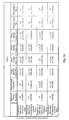
- the bottom guide bar of the machine manipulates the ground yarns 10 to traverse laterally back and forth relative to the needles 15 of the needle bar of the machine to stitch the ground yarns 10 in a repeating 1-0,3-4 stitch pattern (diagrammatically indicated at I of FIG. 1) as the ground yarns 10 are fed progressively from their respective warp beam.
- the lower middle guide bar of the knitting machine manipulates the ground yarns 12 as they are fed from their respective warp beam to traverse relative to the needles 15 to stitch the ground yarns 12 in a repeating 1-2,1-0 stitch pattern (diagrammatically indicated at II of FIG. 1).
- the lower middle guide bar of the machine manipulates the electrically conductive yarns 14 as they are fed from their respective warp beam to traverse relative to the needles 15 to stitch the electrically conductive yarns 14 in a repeating (1-0,0-1) x2, 1-2,2-3, (3-4,4-3) x2, 3-2,2-1 stitch pattern at six needle spacings in the same one-in, five-out alternation as the threading of the yarns on the upper middle guide bar, as indicated at III of FIG. 1.
- the top guide bar of the machine manipulates the other set of electrically conductive yarns 16 as they are fed from their respective warp beam to traverse relative to the needles 15 to stitch the electrically conductive yarns 16 in a repeating (3-4,4-3) x2, 3-2,2-1, (1-0,0-1) x2, 1-2,2-3 stitch pattern also at six needle spacings according to the one-in, five-out threading of such yarns, as indicated at IV of FIG. 1.
- the ground yarns 10,12 are interknitted with one another in the described stitch constructions with each other ground yarn 10,12 being formed from one fabric course C to the next fabric course C in respective series of needle loops 10n,12n, and in connecting underlaps 10u,12u, extending between the successive needle loops 10n, 12n, whereby according to the stitch pattern and the threading pattern of the ground yarns 10,12, the needle loops 10n,12n appear in substantially every wale W of every course C in the fabric.
- Each electrically conductive yarns 14 is formed in needle loops 14n interknitted in plated relation with the needle loops 10n,12n of the ground yarns 10,12 in every sixth wale W of every course C.
- each electrically conductive yarn 16 is formed in needle loops 16n interknitted in plated relation with the needle loops 10n, 12n of the ground yarns 10 in every sixth wale W of every course C. Due to the mirror-image stitch patterns followed by the respective electrically conductive yarns 14,16 as depicted at III and IV of FIG. 1, the respective electrically conductive yarns are also interknitted in plated relationship with one another within every sixth wale W of spaced groups of courses C' each group spanning four successive courses and separated from adjacent groups by two successive intervening courses C'', as depicted in FIG. 2.
- the ground yarns 10,12 form a base or substrate to the fabric with the electrically conductive yarns 14,16 appearing predominantly at the technical face of the fabric.
- the base or substrate of the fabric thereby formed has a high degree of dimensional stability against stretching and distortion, the coursewise underlaps 10u of the ground yarns 10 serving to restrict coursewise stretching or distortion of the fabric while the walewise underlaps 12u of the ground yarns 12 serve to restrict walewise stretching or distortion of the fabric.
- each cooperating pair of electrically conductive yarns 14,16 define a series of hexagons aligned and extending walewise along the longitudinal extent of the fabric with the multiple hexagons defined collectively by all of the electrically conductive yarns 14,16 being arranged in a staggered array throughout the lengthwise and widthwise extent of the fabric and interconnected with one another widthwise and lengthwise at respective intersections formed by the respective series of needle loops 14n,16n which are plated with one another.
- This matrix formed by the electrically conductive yarns 14,16 may be seen and understood in FIG. 2 wherein the knitted relationship between multiple electrically conductive yarns 14,16 is depicted.
- the various intersections between the electrically conductive yarns 14,16 formed at the locations at which their respective needle loops 14n,16n are plated with one another insure that the electrically conductive yarns make secure electrical contact with one another whereby the matrix of such yarns is well adapted to conduct electrical charges such as static electricity across the ground structure of the fabric thereby to dissipate such charges and minimize if not eliminate the build-up of such charges within the fabric.
- the electrical connection is substantially more secure and reliable than in known electrically conductive fabrics such as those described above wherein electrically conductive yarns make contact with one another only within a single stitch or otherwise only in the form of a point contact.
- an electrically conductive fabric in accordance with the present invention constructed in the preferred embodiment described above, i.e., utilizing 40 denier, 24 filament semi-dull polyester ground yarns and 44 denier monofilament carbon suffused nylon as the electrically conductive yarns warp knitted in the preferred stitch patterns depicted in FIG. 1 was tested for surface resistivity using a conventional TREK Model 150 Precision Surface Resistivity Meter and found to have a resistivity of only 10 5 (100,000) ohms per square in both lengthwise and widthwise directions at both the technical face and technical back of the fabric.
- the magnitude of the reduction in resistivity of the preferred embodiment of the present fabric in comparison to these known fabrics is remarkable and far exceeds any reduction in resistivity which might be expected. It is believed that the reduction in resistivity can only be attributed to the fundamental uniqueness of the fabric of the present invention in providing extended electrically connecting intersections between the respective electrically conductive yarns forming the overall dissipation matrix in the fabric. As persons skilled in the art will recognize and understand, it is believed that equally significant reductions in resistivity may be achieved in other electrostatic dissipation fabrics made utilizing differing stitch and threading patterns which still accomplish extended multi-stitch intersections between the electrically conductive yarns.
- the resistivity values of a fabric be generally uniform in both lengthwise and widthwise extent and at each opposite surface of the fabric, to insure that the ability of garments made with the fabric to dissipate electrostatic charges is not compromised or reduced as a result of the particular manner in which the fabric may be cut and sewn into a garment.
- the present invention not only achieves a dramatic reduction in surface resistivity over known fabrics, but is equally unique in achieving substantial uniformity and resistivity in each direction of each surface of the fabric.
Landscapes
- Engineering & Computer Science (AREA)
- Textile Engineering (AREA)
- Knitting Of Fabric (AREA)
- Woven Fabrics (AREA)
Applications Claiming Priority (2)
| Application Number | Priority Date | Filing Date | Title |
|---|---|---|---|
| US182846 | 1998-10-29 | ||
| US09/182,846 US6291375B1 (en) | 1998-10-29 | 1998-10-29 | Textile fabric for dissipating electrical charges |
Publications (2)
| Publication Number | Publication Date |
|---|---|
| EP0997565A2 true EP0997565A2 (de) | 2000-05-03 |
| EP0997565A3 EP0997565A3 (de) | 2001-06-06 |
Family
ID=22670295
Family Applications (1)
| Application Number | Title | Priority Date | Filing Date |
|---|---|---|---|
| EP19990120867 Withdrawn EP0997565A3 (de) | 1998-10-29 | 1999-10-26 | Textilstoff zum Ableiten von elektrischen Ladungen |
Country Status (2)
| Country | Link |
|---|---|
| US (1) | US6291375B1 (de) |
| EP (1) | EP0997565A3 (de) |
Cited By (7)
| Publication number | Priority date | Publication date | Assignee | Title |
|---|---|---|---|---|
| GB2385605A (en) * | 2002-02-21 | 2003-08-27 | Ball & Son Ltd W | Electromagnetic shield textile fabric |
| WO2004084987A1 (en) * | 2003-03-19 | 2004-10-07 | F & S, Llc | Fabric with pain-relieving characteristics and structures fabricated therefrom, and method |
| US6860122B2 (en) | 2002-03-28 | 2005-03-01 | F&S, Llc | Fabric with pain-relieving characteristics and structures therefrom, and method |
| WO2006094801A1 (de) * | 2005-03-11 | 2006-09-14 | Eybl International Ag | Antistatische textilfläche |
| US7320947B2 (en) | 2002-09-16 | 2008-01-22 | Milliken & Company | Static dissipative textile and method for producing the same |
| US7635439B2 (en) | 2002-09-16 | 2009-12-22 | Milliken & Company | Static dissipative textile and method producing the same |
| EP1330964B1 (de) * | 2002-01-25 | 2011-10-05 | Mmi-Ipco, Llc | Gegen elektromagnetische Strahlung abschirmender Textilstoff |
Families Citing this family (6)
| Publication number | Priority date | Publication date | Assignee | Title |
|---|---|---|---|---|
| IT1296577B1 (it) * | 1997-11-27 | 1999-07-14 | Edilio Livio Alpini | Indumento deviatore di campi elettromagnetici |
| US20040102116A1 (en) * | 2002-11-25 | 2004-05-27 | Milliken & Company | Electrostatic dissipating fabric and garments formed therefrom |
| US6854296B1 (en) | 2004-01-23 | 2005-02-15 | Sara Lee Corporation | Bi-ply fabric construction and apparel formed therefrom |
| WO2017197228A2 (en) * | 2016-05-13 | 2017-11-16 | Warwick Mills, Inc. | E-fabric and e-garment having intergral interconnected conductors and embedded devices |
| US20220307168A1 (en) * | 2021-03-29 | 2022-09-29 | Hornwood, Inc. | Mesh fabric and mesh fabric garment |
| JP6932285B1 (ja) * | 2021-04-09 | 2021-09-08 | ユニチカトレーディング株式会社 | 制電性経編地 |
Family Cites Families (15)
| Publication number | Priority date | Publication date | Assignee | Title |
|---|---|---|---|---|
| US2670620A (en) | 1950-08-29 | 1954-03-02 | Goldstaub Henry Herbert | Flexible electric heating element |
| US3586597A (en) | 1967-11-20 | 1971-06-22 | Teijin Ltd | Cloth having durable antistatic properties for use in garments and underwear |
| US3806959A (en) | 1972-03-13 | 1974-04-30 | Fairhope Fabrics Inc | Knitted anti-static and flame-retardant blanket |
| DE2528189C2 (de) | 1974-07-02 | 1983-02-10 | Kuraray Co., Ltd., Kurashiki, Okayama | Gewirktes oder gewebtes Tuch mit antistatischen Eigenschaften |
| US4322232A (en) | 1979-05-09 | 1982-03-30 | Beane Filter Media, Inc. | Filter bag and method for suppressing electrostatic charges |
| US4232082A (en) * | 1979-07-11 | 1980-11-04 | Nippon Keori Kabushiki Kaisha | Anti-electrostatically guarded worsted suiting |
| US4335589A (en) | 1980-06-30 | 1982-06-22 | Bentley-Harris Manufacturing Co. | Grounding structures comprising composite knitted fabrics |
| US4606968A (en) | 1983-07-25 | 1986-08-19 | Stern And Stern Textiles, Inc. | Electrostatic dissipating fabric |
| GB8423219D0 (en) | 1984-09-14 | 1984-10-17 | Raychem Ltd | Shaped woven fabrics |
| US4672825A (en) | 1984-12-06 | 1987-06-16 | Katsura Roller Mfg. Co., Ltd. | Antistatic cover |
| JPH0686100B2 (ja) | 1986-04-24 | 1994-11-02 | 積水化学工業株式会社 | 導電性布状物とその製造方法及び導電性シ−ト又はフイルム |
| US4753088A (en) | 1986-10-14 | 1988-06-28 | Collins & Aikman Corporation | Mesh knit fabrics having electrically conductive filaments for use in manufacture of anti-static garments and accessories |
| US4970109A (en) * | 1986-12-12 | 1990-11-13 | Conductex, Inc. | Knitted barrier fabric |
| US4815299A (en) | 1986-12-12 | 1989-03-28 | Conductex, Inc. | Knitted fabric having improved electrical charge dissipation properties |
| US4878148A (en) | 1987-07-22 | 1989-10-31 | Jes, Lp | Crocheted fabric elastic wrist bracelet bearing an interior conductive yarn |
-
1998
- 1998-10-29 US US09/182,846 patent/US6291375B1/en not_active Expired - Lifetime
-
1999
- 1999-10-26 EP EP19990120867 patent/EP0997565A3/de not_active Withdrawn
Cited By (10)
| Publication number | Priority date | Publication date | Assignee | Title |
|---|---|---|---|---|
| EP1330964B1 (de) * | 2002-01-25 | 2011-10-05 | Mmi-Ipco, Llc | Gegen elektromagnetische Strahlung abschirmender Textilstoff |
| GB2385605A (en) * | 2002-02-21 | 2003-08-27 | Ball & Son Ltd W | Electromagnetic shield textile fabric |
| GB2385605B (en) * | 2002-02-21 | 2005-08-31 | Ball & Son Ltd W | Electromagnetic shield fabrics |
| US6860122B2 (en) | 2002-03-28 | 2005-03-01 | F&S, Llc | Fabric with pain-relieving characteristics and structures therefrom, and method |
| WO2004001111A3 (en) * | 2002-03-28 | 2007-12-27 | F & S Llc | Fabric with pain-relieving characteristics and structures fabricated therefrom |
| US7320947B2 (en) | 2002-09-16 | 2008-01-22 | Milliken & Company | Static dissipative textile and method for producing the same |
| US7635439B2 (en) | 2002-09-16 | 2009-12-22 | Milliken & Company | Static dissipative textile and method producing the same |
| US8114791B2 (en) | 2002-09-16 | 2012-02-14 | Sage Automtive Interiors, Inc. | Static dissipative textile |
| WO2004084987A1 (en) * | 2003-03-19 | 2004-10-07 | F & S, Llc | Fabric with pain-relieving characteristics and structures fabricated therefrom, and method |
| WO2006094801A1 (de) * | 2005-03-11 | 2006-09-14 | Eybl International Ag | Antistatische textilfläche |
Also Published As
| Publication number | Publication date |
|---|---|
| EP0997565A3 (de) | 2001-06-06 |
| US6291375B1 (en) | 2001-09-18 |
Similar Documents
| Publication | Publication Date | Title |
|---|---|---|
| US4815299A (en) | Knitted fabric having improved electrical charge dissipation properties | |
| US6291375B1 (en) | Textile fabric for dissipating electrical charges | |
| EP1330964B1 (de) | Gegen elektromagnetische Strahlung abschirmender Textilstoff | |
| CA1281767C (en) | Conductive wrist band | |
| US20180347081A1 (en) | Electrical resistance-variable conductive elasticized knitted fabric and conductive part | |
| JP2012197521A (ja) | 導電性伸縮性編地 | |
| US20030054719A1 (en) | Fabrics and dust proof clothes excellent in conductivity and antistatic property | |
| KR100543477B1 (ko) | 섬유복합체 및 그의 용도 | |
| US20100279572A1 (en) | Fabric and clothes using the same | |
| EA010089B1 (ru) | Биаксиально электропроводящее трикотажное полотно | |
| US7213313B2 (en) | Method of manufacturing fleece having different kinds of fibers in front and back faces | |
| US20040198117A1 (en) | Electrostatic dissipating garments and fabrics for use in making same | |
| US5542269A (en) | Warp knitted fabric with ribbed satin-like back | |
| CN121548666A (zh) | 阻燃双面针织物 | |
| EP0931866A3 (de) | Jacquard-Stoff und Verfahren zu dessen Herstellung | |
| US7076974B1 (en) | Warp knitting fabric | |
| IT1288977B1 (it) | Procedimento di fabbricazione di tessuto elastico di maglieria e relativo tessuto | |
| HK1026722A (en) | Textile fabric for dissipating electrical charges | |
| US20170246469A1 (en) | Pain Relieving Fabric | |
| EP0676495B1 (de) | Strickware und Verfahren zur Herstellung | |
| JP7141830B2 (ja) | 繊維構造体、及び、被服 | |
| RU2012697C1 (ru) | Трикотажный материал для изготовления защитной от электромагнитного излучения одежды | |
| JP7695837B2 (ja) | 制電性編物及び制電性衣類 | |
| CA1296196C (en) | Knitted fabric having improved electrical charge dissipation and absorption properties | |
| JP6932285B1 (ja) | 制電性経編地 |
Legal Events
| Date | Code | Title | Description |
|---|---|---|---|
| PUAI | Public reference made under article 153(3) epc to a published international application that has entered the european phase |
Free format text: ORIGINAL CODE: 0009012 |
|
| AK | Designated contracting states |
Kind code of ref document: A2 Designated state(s): AT BE CH CY DE DK ES FI FR GB GR IE IT LI LU MC NL PT SE |
|
| AX | Request for extension of the european patent |
Free format text: AL;LT;LV;MK;RO;SI |
|
| PUAL | Search report despatched |
Free format text: ORIGINAL CODE: 0009013 |
|
| AK | Designated contracting states |
Kind code of ref document: A3 Designated state(s): AT BE CH CY DE DK ES FI FR GB GR IE IT LI LU MC NL PT SE |
|
| AX | Request for extension of the european patent |
Free format text: AL;LT;LV;MK;RO;SI |
|
| 17P | Request for examination filed |
Effective date: 20011109 |
|
| AKX | Designation fees paid |
Free format text: AT BE CH CY DE DK ES FI FR GB GR IE IT LI LU MC NL PT SE |
|
| RAP1 | Party data changed (applicant data changed or rights of an application transferred) |
Owner name: GFD FABRICS, INC. |
|
| 17Q | First examination report despatched |
Effective date: 20021101 |
|
| STAA | Information on the status of an ep patent application or granted ep patent |
Free format text: STATUS: THE APPLICATION IS DEEMED TO BE WITHDRAWN |
|
| 18D | Application deemed to be withdrawn |
Effective date: 20030312 |
|
| REG | Reference to a national code |
Ref country code: HK Ref legal event code: WD Ref document number: 1026722 Country of ref document: HK |