EP0997963A1 - Procédé de valorisation des batteries ainsi que dispositif pour la mise en oeuvre du procédé - Google Patents
Procédé de valorisation des batteries ainsi que dispositif pour la mise en oeuvre du procédé Download PDFInfo
- Publication number
- EP0997963A1 EP0997963A1 EP19990121142 EP99121142A EP0997963A1 EP 0997963 A1 EP0997963 A1 EP 0997963A1 EP 19990121142 EP19990121142 EP 19990121142 EP 99121142 A EP99121142 A EP 99121142A EP 0997963 A1 EP0997963 A1 EP 0997963A1
- Authority
- EP
- European Patent Office
- Prior art keywords
- electrolyte
- electrolysis
- zinc
- battery powder
- cathode
- Prior art date
- Legal status (The legal status is an assumption and is not a legal conclusion. Google has not performed a legal analysis and makes no representation as to the accuracy of the status listed.)
- Withdrawn
Links
Images

Classifications
-
- C—CHEMISTRY; METALLURGY
- C22—METALLURGY; FERROUS OR NON-FERROUS ALLOYS; TREATMENT OF ALLOYS OR NON-FERROUS METALS
- C22B—PRODUCTION AND REFINING OF METALS; PRETREATMENT OF RAW MATERIALS
- C22B7/00—Working up raw materials other than ores, e.g. scrap, to produce non-ferrous metals and compounds thereof; Methods of a general interest or applied to the winning of more than two metals
- C22B7/006—Wet processes
- C22B7/008—Wet processes by an alkaline or ammoniacal leaching
-
- B—PERFORMING OPERATIONS; TRANSPORTING
- B03—SEPARATION OF SOLID MATERIALS USING LIQUIDS OR USING PNEUMATIC TABLES OR JIGS; MAGNETIC OR ELECTROSTATIC SEPARATION OF SOLID MATERIALS FROM SOLID MATERIALS OR FLUIDS; SEPARATION BY HIGH-VOLTAGE ELECTRIC FIELDS
- B03B—SEPARATING SOLID MATERIALS USING LIQUIDS OR USING PNEUMATIC TABLES OR JIGS
- B03B9/00—General arrangement of separating plant, e.g. flow sheets
- B03B9/06—General arrangement of separating plant, e.g. flow sheets specially adapted for refuse
- B03B9/061—General arrangement of separating plant, e.g. flow sheets specially adapted for refuse the refuse being industrial
-
- C—CHEMISTRY; METALLURGY
- C22—METALLURGY; FERROUS OR NON-FERROUS ALLOYS; TREATMENT OF ALLOYS OR NON-FERROUS METALS
- C22B—PRODUCTION AND REFINING OF METALS; PRETREATMENT OF RAW MATERIALS
- C22B19/00—Obtaining zinc or zinc oxide
- C22B19/30—Obtaining zinc or zinc oxide from metallic residues or scraps
-
- H—ELECTRICITY
- H01—ELECTRIC ELEMENTS
- H01M—PROCESSES OR MEANS, e.g. BATTERIES, FOR THE DIRECT CONVERSION OF CHEMICAL ENERGY INTO ELECTRICAL ENERGY
- H01M10/00—Secondary cells; Manufacture thereof
- H01M10/54—Reclaiming serviceable parts of waste accumulators
-
- H—ELECTRICITY
- H01—ELECTRIC ELEMENTS
- H01M—PROCESSES OR MEANS, e.g. BATTERIES, FOR THE DIRECT CONVERSION OF CHEMICAL ENERGY INTO ELECTRICAL ENERGY
- H01M6/00—Primary cells; Manufacture thereof
- H01M6/52—Reclaiming serviceable parts of waste cells or batteries, e.g. recycling
-
- B—PERFORMING OPERATIONS; TRANSPORTING
- B03—SEPARATION OF SOLID MATERIALS USING LIQUIDS OR USING PNEUMATIC TABLES OR JIGS; MAGNETIC OR ELECTROSTATIC SEPARATION OF SOLID MATERIALS FROM SOLID MATERIALS OR FLUIDS; SEPARATION BY HIGH-VOLTAGE ELECTRIC FIELDS
- B03B—SEPARATING SOLID MATERIALS USING LIQUIDS OR USING PNEUMATIC TABLES OR JIGS
- B03B9/00—General arrangement of separating plant, e.g. flow sheets
- B03B9/06—General arrangement of separating plant, e.g. flow sheets specially adapted for refuse
- B03B2009/066—General arrangement of separating plant, e.g. flow sheets specially adapted for refuse the refuse being batteries
-
- H—ELECTRICITY
- H01—ELECTRIC ELEMENTS
- H01M—PROCESSES OR MEANS, e.g. BATTERIES, FOR THE DIRECT CONVERSION OF CHEMICAL ENERGY INTO ELECTRICAL ENERGY
- H01M2300/00—Electrolytes
- H01M2300/0002—Aqueous electrolytes
-
- Y—GENERAL TAGGING OF NEW TECHNOLOGICAL DEVELOPMENTS; GENERAL TAGGING OF CROSS-SECTIONAL TECHNOLOGIES SPANNING OVER SEVERAL SECTIONS OF THE IPC; TECHNICAL SUBJECTS COVERED BY FORMER USPC CROSS-REFERENCE ART COLLECTIONS [XRACs] AND DIGESTS
- Y02—TECHNOLOGIES OR APPLICATIONS FOR MITIGATION OR ADAPTATION AGAINST CLIMATE CHANGE
- Y02P—CLIMATE CHANGE MITIGATION TECHNOLOGIES IN THE PRODUCTION OR PROCESSING OF GOODS
- Y02P10/00—Technologies related to metal processing
- Y02P10/20—Recycling
-
- Y—GENERAL TAGGING OF NEW TECHNOLOGICAL DEVELOPMENTS; GENERAL TAGGING OF CROSS-SECTIONAL TECHNOLOGIES SPANNING OVER SEVERAL SECTIONS OF THE IPC; TECHNICAL SUBJECTS COVERED BY FORMER USPC CROSS-REFERENCE ART COLLECTIONS [XRACs] AND DIGESTS
- Y02—TECHNOLOGIES OR APPLICATIONS FOR MITIGATION OR ADAPTATION AGAINST CLIMATE CHANGE
- Y02W—CLIMATE CHANGE MITIGATION TECHNOLOGIES RELATED TO WASTEWATER TREATMENT OR WASTE MANAGEMENT
- Y02W30/00—Technologies for solid waste management
- Y02W30/50—Reuse, recycling or recovery technologies
- Y02W30/52—Mechanical processing of waste for the recovery of materials, e.g. crushing, shredding, separation or disassembly
-
- Y—GENERAL TAGGING OF NEW TECHNOLOGICAL DEVELOPMENTS; GENERAL TAGGING OF CROSS-SECTIONAL TECHNOLOGIES SPANNING OVER SEVERAL SECTIONS OF THE IPC; TECHNICAL SUBJECTS COVERED BY FORMER USPC CROSS-REFERENCE ART COLLECTIONS [XRACs] AND DIGESTS
- Y02—TECHNOLOGIES OR APPLICATIONS FOR MITIGATION OR ADAPTATION AGAINST CLIMATE CHANGE
- Y02W—CLIMATE CHANGE MITIGATION TECHNOLOGIES RELATED TO WASTEWATER TREATMENT OR WASTE MANAGEMENT
- Y02W30/00—Technologies for solid waste management
- Y02W30/50—Reuse, recycling or recovery technologies
- Y02W30/84—Recycling of batteries or fuel cells
Definitions
- the invention relates to a method for recycling unsorted batteries, in which they are shredded, freed from coarse particles by sieving and the remaining Battery powder processed using wet metallurgy becomes.
- the recovery can in particular thermally or wet metallurgically respectively.
- the thermal recovery at which the separation of the individual contained in the batteries and accumulators Metals by their different melting or Boiling points takes a lot of heating energy and a downstream exhaust air purification.
- the thermal recovery a wet metallurgical recovery preferable, in which the contained in the batteries Metals first in solution and then by one appropriate selective mechanism separated become.
- the object of the present invention is a method of the type mentioned and a device create with which in a simple manner and inexpensively a recovery of the main component of the the seven remaining battery powder, namely the Zinc, is possible.
- the anodic oxidation is therefore used as a “selective mechanism” for separating the various metallic components of the battery powder. Since zinc is not only the most commonly represented in the battery powder but also the least noble metal, the parameters of the electrolysis process can be set so that almost exclusively zinc is brought into solution, while the other metals remain almost completely in the insoluble anode sludge, which then must be processed otherwise. If, however, less noble metals than zinc dissolve due to anodic oxidation, poorly soluble hydroxides are formed in view of the high OH - concentration; these noble metals would then remain in this form in the anode sludge and would also only be electrolytically deposited to a small extent. Overall, the method according to the invention represents an extremely inexpensive solution, in particular when the main focus is on zinc recovery.
- the method according to the invention is particularly advantageous then when the metallic contained in the battery powder Zinc in solution in the same electrolysis process is brought in which from the electrolyte cathodic metallic Zinc is extracted.
- This type of procedure provides So it is a kind of "refining process” as it is another area used for the extraction of high-purity copper becomes.
- the electrolyte is expediently an aqueous solution of potassium or sodium hydroxide, the concentration of the hydroxide in the electrolyte can be about 15%.
- the electrolyte accumulates with alkali chloride over time on. To regenerate it is recommended to carry out an alkali chlorine electrolysis. That too The chlorine gas that forms here can already be in the above be disposed of as described.
- the electrolyte will color of carbon dust in the battery powder black. Therefore, the electrolyte should be replaced by a Microfiltration to be freed from carbon dust.
- Electrolysis cell finds the “refining” of the zinc instead, in which the zinc is initially anodized separated from the other metallic components and then by electrolysis in high-purity metallic Form is regained.
- the cathode can be rotating around its longitudinal axis Cylinder be formed. This makes acceptance easier of the metallic formed on the cathode surface Zinc.
- the cathode is a Coiler is assigned, on which the from the outer surface of the cathode as a foil removable metallic Zinc can be wound up.
- an insoluble one Anode sludge which mainly consists of undissolved Metal particles, partly from the poorly soluble ones Metal hydroxides of noble metals than zinc.
- This Anode slurry must be batch or continuous be removed.
- a Proven design of the device according to the invention in which the anode is rotatable about its longitudinal axis Funding spiral is formed.
- This anode feed coil then dips into the anode sludge with its lower end one that is naturally in the vicinity of this anode finds particular measure. By rotating the anode in the the anode sludge is collected in the corresponding direction, promoted upwards and from there in a suitable manner ejected.
- Graphite is recommended as the material for the anode.
- a preferred embodiment of the invention Device a microfiltration device with which the electrolyte of carbon dust in the container can be exempted.
- the battery powder to be broken down by wet metallurgy to a small extent contains insoluble, light Components, e.g. Paper or plastic particles. These float on the surface of the electrolyte and must be removed continuously or periodically. It is therefore recommended that the device according to the invention has a surface clearing device with which on the Surface of the electrolyte removes floating particles are.
- the device can also be used Have water bath in which the extracted ammonia and the extracted chlorine can be converted to ammonium chloride.
- FIG. 1 Flowcharts are not just through appropriate blocks the individual process steps are indicated schematically; in addition, it is indicated which quantities - starting from a total of 1,000 kg unsorted Used batteries - after the respective process step be eliminated or remain in the further proceedings.
- the flow chart of Figure 1 begins at the top left the crushing of the initial quantity of 1,000 kg unsorted Used batteries. This crushing is used for preparation the subsequent separation processes or the wet chemical one Processing. The crushed batteries are then passed through a magnetic separator which scrap iron is removed in an amount of 222 kg become. The remaining shredded battery mix, which now lacks the ferrous metals, in total of 778 kg are fed to a sieve separator. At this point they still contain the rough non-magnetic ones Components zinc sheet, stainless steel, brass, Plastic, paper, coal and graphite as well as the "passive goods", namely the battery powder to be further processed.
- the sieve is separated with a mesh size of about 2 mm.
- the coarse screen overflow is approximately 200.6 kg, which is further processed in an eddy current separator become.
- the opposite pole of this electrolysis is a cathode that is immersed in the same electrolyte and in the manner to be described below (recovery of the metallic zinc.
- the order of oxidation of various metals depends on the electrochemical voltage series. Because zinc is one of the most base metals, which is located in the battery powder can by a suitable Potential choice in the anodic metal dissolution for it be taken care of that practically only zinc ions in solution go. Should also dissolve nobler metal than zinc would be in the form of poorly soluble hydroxides fail.
- the batteries Ammonium chloride can be introduced. This can cause the metal hydroxides of zinc, copper, Nickel and cadmium are present as amine complexes in the solution.
- the residual battery powder remaining as anode sludge and the electrolyte adhering thereto in a total amount of 513 kg is drained.
- the electrolyte e.g. B. KOH
- Remaining battery powder, which still has a residual moisture of 15%, is in an amount of 378.3 kg further processing supplied in the present Context is no longer of interest.
- the batteries contain their battery powder which is fed to anodic metal dissolution, Ammonium chloride, which is strongly alkaline Character of the alkali is distributed in the electrolyte and outgassed as ammonia. Because this is not free in the environment must get through an appropriate suction to be caught. The same applies to the gaseous Chlorine, which is derived from the battery powder Chloride forms at the anode.
- the one in the battery powder, which is the anodic metal dissolution is fed, contained coal is very finely distributed and stains the electrolyte over time black.
- the electrolyte is therefore, as well shown in Figure 1, before or after chlor-alkali electrolysis a microfiltration, in which the coal is removed. So he will turn in the anodic metal resolution used.
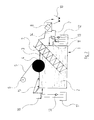
- the device is shown schematically in FIG which is the central step of the above Process, namely the anodic metal dissolution and electrolytic extraction of the metallic zinc becomes.
- This device comprises an electrolyte container 1 that up to level 3 with an alkaline Electrolytes, for example with the one already mentioned 15% potassium hydroxide solution is filled.
- Electrolyte 2 dips a cylindrical one from above Stainless steel cathode 4, which can be rotated about its longitudinal axis is about a half.
- the cathode 4 electrolytically separates the metallic Zinc in the form of a film 5 from the cathode 4th deducted and wound on a supply reel 6 can be.
- the electrolyte 2 also dips at an oblique angle an anode 7 formed of graphite.
- the anode 7 has the shape of a conveyor spiral and is also about theirs Longitudinal axis rotatable. The sense of rotation is so on Spiral shape matched that a promotional effect of bottom up results.
- When rotating the anode 7 therefore becomes the insoluble anode sludge, which is in the area of the bottom of the container 1 near the Anode 7 collects, transported upwards, ejected there and introduced into the schematically illustrated centrifuge 8.
- the centrifuge 8 becomes the recovered one Electrolyte via line 9 into the container 1 returned; on the other hand, the dehydrated battery powder (Which according to FIG. 1 still has 15% residual moisture contains) for further processing, which here is indicated schematically by a carriage 10.
- Anode 7 and cathode 4 are with the corresponding poles a DC voltage source, not shown in the drawing connected.
- the electrolyte regenerated in this way is removed using a Pump taken from the secondary tank 12 and a microfilter 14 again added to the (main) container 1.
Landscapes
- Engineering & Computer Science (AREA)
- Chemical & Material Sciences (AREA)
- Manufacturing & Machinery (AREA)
- Mechanical Engineering (AREA)
- Materials Engineering (AREA)
- General Chemical & Material Sciences (AREA)
- Life Sciences & Earth Sciences (AREA)
- Electrochemistry (AREA)
- Organic Chemistry (AREA)
- Metallurgy (AREA)
- Chemical Kinetics & Catalysis (AREA)
- Sustainable Development (AREA)
- Geology (AREA)
- General Life Sciences & Earth Sciences (AREA)
- Environmental & Geological Engineering (AREA)
- Electrolytic Production Of Metals (AREA)
- Primary Cells (AREA)
- Manufacture And Refinement Of Metals (AREA)
Applications Claiming Priority (2)
| Application Number | Priority Date | Filing Date | Title |
|---|---|---|---|
| DE19849385 | 1998-10-27 | ||
| DE1998149385 DE19849385A1 (de) | 1998-10-27 | 1998-10-27 | Verfahren zur Verwertung unsortierter Altbatterien sowie Vorrichtung zur Durchführung dieses Verfahrens |
Publications (1)
| Publication Number | Publication Date |
|---|---|
| EP0997963A1 true EP0997963A1 (fr) | 2000-05-03 |
Family
ID=7885722
Family Applications (1)
| Application Number | Title | Priority Date | Filing Date |
|---|---|---|---|
| EP19990121142 Withdrawn EP0997963A1 (fr) | 1998-10-27 | 1999-10-22 | Procédé de valorisation des batteries ainsi que dispositif pour la mise en oeuvre du procédé |
Country Status (2)
| Country | Link |
|---|---|
| EP (1) | EP0997963A1 (fr) |
| DE (1) | DE19849385A1 (fr) |
Cited By (3)
| Publication number | Priority date | Publication date | Assignee | Title |
|---|---|---|---|---|
| WO2003056645A3 (fr) * | 2001-12-28 | 2004-09-02 | Zoxy Energy Systems Ag | Procede et dispositif de regeneration d'electrodes en zinc |
| RU2431690C1 (ru) * | 2010-06-23 | 2011-10-20 | Государственное образовательное учреждение высшего профессионального образования Московский государственный технический университет "МАМИ" | Способ переработки отработанных химических источников тока марганцевоцинковой системы для комплексной утилизации |
| RU2486262C2 (ru) * | 2011-09-09 | 2013-06-27 | Закрытое акционерное общество "Экология" | Способ утилизации отработанных химических источников тока |
Citations (4)
| Publication number | Priority date | Publication date | Assignee | Title |
|---|---|---|---|---|
| EP0158627A2 (fr) * | 1984-04-10 | 1985-10-16 | VOEST-ALPINE Aktiengesellschaft | Procédé de récupération de zinc et de manganèse à partir de déchets contenant du zinc et de l'oxyde de manganèse et provenant de batteries déchargées du type zinc-carbone-oxyde de manganèse |
| EP0274059A2 (fr) * | 1986-12-12 | 1988-07-13 | Recytec S.A. | Procédé de recyclage pour batteries électriques, circuits imprimés et composants électroniques |
| CH670015A5 (en) * | 1987-02-27 | 1989-04-28 | Leclanche Sa | Used electric battery recycling system - uses two-stage thermic decomposition process breakdown and moistening |
| DE4224884A1 (de) * | 1992-07-28 | 1994-02-03 | Batenus Gmbh & Co Kg | Verfahren zur Rückgewinnung von Rohstoffen aus vorsortiert gesammeltem, verbrauchten Gut, insbesondere aus verbrauchten elektrochemischen Batterien und Akkumulatoren |
Family Cites Families (2)
| Publication number | Priority date | Publication date | Assignee | Title |
|---|---|---|---|---|
| US5120409A (en) * | 1989-08-08 | 1992-06-09 | Recytec S.A. | Process for recycling an unsorted mixture of spent button cells and/or other metallic objects and for recovering their metallic components |
| AT400780B (de) * | 1991-11-27 | 1996-03-25 | Kurt Ramskogler | Verfahren zur aufbereitung von altbatterien |
-
1998
- 1998-10-27 DE DE1998149385 patent/DE19849385A1/de not_active Ceased
-
1999
- 1999-10-22 EP EP19990121142 patent/EP0997963A1/fr not_active Withdrawn
Patent Citations (4)
| Publication number | Priority date | Publication date | Assignee | Title |
|---|---|---|---|---|
| EP0158627A2 (fr) * | 1984-04-10 | 1985-10-16 | VOEST-ALPINE Aktiengesellschaft | Procédé de récupération de zinc et de manganèse à partir de déchets contenant du zinc et de l'oxyde de manganèse et provenant de batteries déchargées du type zinc-carbone-oxyde de manganèse |
| EP0274059A2 (fr) * | 1986-12-12 | 1988-07-13 | Recytec S.A. | Procédé de recyclage pour batteries électriques, circuits imprimés et composants électroniques |
| CH670015A5 (en) * | 1987-02-27 | 1989-04-28 | Leclanche Sa | Used electric battery recycling system - uses two-stage thermic decomposition process breakdown and moistening |
| DE4224884A1 (de) * | 1992-07-28 | 1994-02-03 | Batenus Gmbh & Co Kg | Verfahren zur Rückgewinnung von Rohstoffen aus vorsortiert gesammeltem, verbrauchten Gut, insbesondere aus verbrauchten elektrochemischen Batterien und Akkumulatoren |
Non-Patent Citations (1)
| Title |
|---|
| NIRDOSH I ET AL: "BENCH SCALE INVESTIGATIONS ON THE ELCTROLYTIC RECOVERY OF ZINC POWDER FROM GALVANIZER'S ASH", HYDROMETALLURGY,NL,ELSEVIER SCIENTIFIC PUBLISHING CY. AMSTERDAM, vol. 20, no. 2, 1 May 1988 (1988-05-01), pages 203 - 217, XP002051571, ISSN: 0304-386X * |
Cited By (3)
| Publication number | Priority date | Publication date | Assignee | Title |
|---|---|---|---|---|
| WO2003056645A3 (fr) * | 2001-12-28 | 2004-09-02 | Zoxy Energy Systems Ag | Procede et dispositif de regeneration d'electrodes en zinc |
| RU2431690C1 (ru) * | 2010-06-23 | 2011-10-20 | Государственное образовательное учреждение высшего профессионального образования Московский государственный технический университет "МАМИ" | Способ переработки отработанных химических источников тока марганцевоцинковой системы для комплексной утилизации |
| RU2486262C2 (ru) * | 2011-09-09 | 2013-06-27 | Закрытое акционерное общество "Экология" | Способ утилизации отработанных химических источников тока |
Also Published As
| Publication number | Publication date |
|---|---|
| DE19849385A1 (de) | 2000-05-04 |
Similar Documents
| Publication | Publication Date | Title |
|---|---|---|
| DE2718462A1 (de) | Verfahren zur gewinnung von blei aus zu verschrottenden bleiakkumulatoren | |
| DE69223040T2 (de) | Mineralienaufbereitungsvorrichtung | |
| EP3746576A1 (fr) | Procédé de recyclage de batteries au lithium | |
| EP0652811A1 (fr) | Procede de recuperation de matieres premieres provenant de produits usages, collectes et pretries, notamment de piles electrochimiques et d'accumulateurs usages. | |
| CH652240A5 (de) | Hydrometallurgisches verfahren zur wiedergewinnung von metallhaltigen stoffen aus erschoepften sauren bleiakkumulatoren. | |
| DE2818971A1 (de) | Verbesserte vorrichtung und verbessertes verfahren zur abtrennung eines metalles aus einem salz | |
| US20190226051A1 (en) | System and method for recycling metals from industrial waste | |
| WO2005015668A1 (fr) | Procede pour traiter des composants electriques contenant des cations organiques, des solvants non aqueux et du carbone | |
| DE3686393T2 (de) | Verfahren und vorrichtung zur reinigung von gold. | |
| DE2607512C2 (de) | Verfahren zur Herstellung eines Metallpulvers, Elektrolysezelle zur Durchführung des Verfahrens und Anwendung des Verfahrens | |
| AT400780B (de) | Verfahren zur aufbereitung von altbatterien | |
| EP0997963A1 (fr) | Procédé de valorisation des batteries ainsi que dispositif pour la mise en oeuvre du procédé | |
| DE112014005310B4 (de) | Verfahren für die Aufbereitung von Wolframcarbidzusammensetzungen | |
| CH671780A5 (fr) | ||
| DE102013105177A1 (de) | Verfahren zur Gewinnung metallischer Anteile sowie von metallabgereichertem Material aus metallhaltigen Materialien | |
| EP0650209B1 (fr) | Procédé hydrométallurgique pour le traitement de batteries épuisées | |
| DE4230765A1 (de) | Verfahren zur Wiederaufbereitung von gebrauchten ölhaltigen Emulsionen | |
| DE2739970A1 (de) | Verfahren zur rueckgewinnung des zinks aus dieses enthaltenden rueckstaenden, und bei diesem verfahren benutzbare elektrolysevorrichtung | |
| DE69710870T2 (de) | Elektrolytische Gewinnung von Reinzink aus einer Mangan enthaltenden Laugungslösung durch vorhergehender Entmanganisierung der Lösung mittels kalter Elektrolyse | |
| DE69105296T2 (de) | Verfahren zur Vernichtung von elektrischen Altbatterien und Wiedergewinnung der verschiedenen Komponenten. | |
| DE3102229A1 (de) | Verfahren zum aufbereiten von verbrauchter kupfer-elektrolyseloesung | |
| DE102015110179B3 (de) | Verfahren zur Behandlung von festem Ausgangsmaterial | |
| EP0656669B1 (fr) | Procédé de traitement hydrométallurgique de batteries usagées provenant d'appareils ménager et équipements | |
| LU102054B1 (de) | Verfahren zur Gewinnung von Gold und Silber aus Rohstoffen | |
| EP0429748A1 (fr) | Electrode pour la récupération de métaux à partir d'une solution contenant des ions métalliques |
Legal Events
| Date | Code | Title | Description |
|---|---|---|---|
| PUAI | Public reference made under article 153(3) epc to a published international application that has entered the european phase |
Free format text: ORIGINAL CODE: 0009012 |
|
| AK | Designated contracting states |
Kind code of ref document: A1 Designated state(s): DE ES FR GB IT SE |
|
| AX | Request for extension of the european patent |
Free format text: AL;LT;LV;MK;RO;SI |
|
| AKX | Designation fees paid | ||
| 17P | Request for examination filed |
Effective date: 20001027 |
|
| RBV | Designated contracting states (corrected) |
Designated state(s): DE ES FR GB IT SE |
|
| 17Q | First examination report despatched |
Effective date: 20030905 |
|
| GRAP | Despatch of communication of intention to grant a patent |
Free format text: ORIGINAL CODE: EPIDOSNIGR1 |
|
| RAP1 | Party data changed (applicant data changed or rights of an application transferred) |
Owner name: EISENMANN MASCHINENBAU GMBH & CO. KG |
|
| STAA | Information on the status of an ep patent application or granted ep patent |
Free format text: STATUS: THE APPLICATION IS DEEMED TO BE WITHDRAWN |
|
| 18D | Application deemed to be withdrawn |
Effective date: 20040918 |