EP0997976A1 - Atténuateur de liaison radio pour terminal d'adaptation à antenne intégrée - Google Patents
Atténuateur de liaison radio pour terminal d'adaptation à antenne intégrée Download PDFInfo
- Publication number
- EP0997976A1 EP0997976A1 EP98460047A EP98460047A EP0997976A1 EP 0997976 A1 EP0997976 A1 EP 0997976A1 EP 98460047 A EP98460047 A EP 98460047A EP 98460047 A EP98460047 A EP 98460047A EP 0997976 A1 EP0997976 A1 EP 0997976A1
- Authority
- EP
- European Patent Office
- Prior art keywords
- panel
- housing
- antenna
- absorbent material
- attenuator
- Prior art date
- Legal status (The legal status is an assumption and is not a legal conclusion. Google has not performed a legal analysis and makes no representation as to the accuracy of the status listed.)
- Withdrawn
Links
- 239000000463 material Substances 0.000 claims abstract description 14
- 230000002745 absorbent Effects 0.000 claims abstract description 12
- 239000002250 absorbent Substances 0.000 claims abstract description 12
- 230000006978 adaptation Effects 0.000 claims description 24
- XEEYBQQBJWHFJM-UHFFFAOYSA-N Iron Chemical compound [Fe] XEEYBQQBJWHFJM-UHFFFAOYSA-N 0.000 claims description 6
- 239000004593 Epoxy Substances 0.000 claims description 4
- OKTJSMMVPCPJKN-UHFFFAOYSA-N Carbon Chemical compound [C] OKTJSMMVPCPJKN-UHFFFAOYSA-N 0.000 claims description 3
- 229910052799 carbon Inorganic materials 0.000 claims description 3
- 229910052742 iron Inorganic materials 0.000 claims description 3
- 230000000116 mitigating effect Effects 0.000 description 3
- 230000000295 complement effect Effects 0.000 description 1
- 239000000843 powder Substances 0.000 description 1
- 238000012795 verification Methods 0.000 description 1
Images
Classifications
-
- H—ELECTRICITY
- H01—ELECTRIC ELEMENTS
- H01Q—ANTENNAS, i.e. RADIO AERIALS
- H01Q17/00—Devices for absorbing waves radiated from an antenna; Combinations of such devices with active antenna elements or systems
- H01Q17/001—Devices for absorbing waves radiated from an antenna; Combinations of such devices with active antenna elements or systems for modifying the directional characteristic of an aerial
-
- G—PHYSICS
- G01—MEASURING; TESTING
- G01R—MEASURING ELECTRIC VARIABLES; MEASURING MAGNETIC VARIABLES
- G01R29/00—Arrangements for measuring or indicating electric quantities not covered by groups G01R19/00 - G01R27/00
- G01R29/08—Measuring electromagnetic field characteristics
- G01R29/0864—Measuring electromagnetic field characteristics characterised by constructional or functional features
- G01R29/0892—Details related to signal analysis or treatment; presenting results, e.g. displays; measuring specific signal features other than field strength, e.g. polarisation, field modes, phase, envelope, maximum value
-
- G—PHYSICS
- G01—MEASURING; TESTING
- G01R—MEASURING ELECTRIC VARIABLES; MEASURING MAGNETIC VARIABLES
- G01R29/00—Arrangements for measuring or indicating electric quantities not covered by groups G01R19/00 - G01R27/00
- G01R29/08—Measuring electromagnetic field characteristics
- G01R29/10—Radiation diagrams of antennas
Definitions
- the present invention relates to a radio link for antenna adaptation terminal integrated.
- the present invention finds everything particularly its application in the field of wireless communication networks operating with the DECT standard.
- a wireless network usually has a plurality of adaptation terminals, called commonly in technical language CTA (Cordless Adapter Terminal), intended to communicate, on the one hand, by radio link with a related base station with the traditional telephone network and secondly, with subscriber terminals (digital telephones or analog, modems, NUMERIS interface, handsets DECT, ...) by radio or wire link.
- CTA Cordless Adapter Terminal
- the installer When a link is put into service radio between an adaptation terminal and its station basis, the installer must not only check the correct functioning of the link but also guarantee client an operating margin of a few decibels to deal with possible bad conditions atmospheric. This operating margin is typically 8 decibels. To control this margin, the installer generally introduces at the time of link verification an attenuator between terminal antenna and transmitter / receiver adaptation. This manipulation is simple when the antenna of the adaptation terminal is offset to outside of it.
- the antenna when it is integrated into the adaptation terminal i.e. when it is placed inside the terminal box adaptation or when it was an integral part of this case, it may turn out to be impossible to operate a such manipulation for lack of space.
- the terminals adapters are in fact more and more compact.
- the terminal assembly and disassembly operation adaptation to introduce the attenuator to the inside of the terminal box can be very delicate, since the adaptation terminals are generally arranged at the top of pylons.
- the invention aims to provide a simple design attenuator to verify the operating margin of a link using adaptation terminals with integrated antenna.
- the invention relates to an attenuation device intended to be used during the putting into service of a radio link between a base station and an adaptation terminal with integrated antenna to check the operating margin of said liaison, characterized in that it is in the form of a panel of absorbent material to be disposed removably outside the housing of the adaptation terminal between the antenna and the base station.
- Said absorbent material panel is composed of epoxy loaded with carbon or iron balls.
- the absorbent material panel is preferably housed in a frame provided with means of hanging.
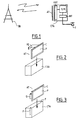
- Figure 1 shows a radio link between a SB base station and a CTA adaptation terminal.
- the adaptation terminal is mainly composed of a ANT antenna, an E / R transmitter / receiver and a INT subscriber interface, the whole being grouped in a housing.
- the antenna is placed at inside the case.
- the device of the invention is also particularly advantageous when the antenna is an integral part of the housing.
- the INT subscriber interface is connected to one or multiple subscriber terminals. In the example of the Figure 1, the subscriber interface is connected to a set telephone T.
- the CTA adaptation terminal When this link is put into service, the CTA adaptation terminal is fitted with a device attenuation AT responsible for attenuating the signals by from or to the base station SB and this, in order to guarantee an operating margin of the radio link.
- this device mitigation is placed outside the terminal adaptation adapter between its antenna and the SB base.
- This mitigation device consists of mainly of a panel P of absorbent material in epoxy powder loaded with carbon or iron balls.
- the panel P is preferably covered with a material insulating plastic to protect it from bad weather.
- the device mitigation of the invention advantageously comprises a frame C serving to support the material panel absorbent and provided with hooking means for hook the AT attenuation device to the housing of the CTA adaptation terminal.
- the means hooks are made up of a snap tab PE intended to be placed on the upper face of the CTA terminal box, one end of which is fixed to frame C and of which a second end has a curved section which is pressed against the rear side of the housing when the attenuator is in position.
- FIG 3. Another embodiment of the means is shown in Figure 3. They are in the form of slide-forming means G on the sides of frame C of the attenuator. Means complementary F (slots in the faces side of the terminal box) are provided on the CTA adaptation terminal.
- the attenuation device may also include a fitting means (not shown in the figures) to set up said device on the housing of the CTA by means of a pole when said housing is positioned at the top of a pylon.
Landscapes
- Physics & Mathematics (AREA)
- Electromagnetism (AREA)
- General Physics & Mathematics (AREA)
- Transceivers (AREA)
Abstract
La présente invention concerne un atténuateur de liaison radio pour terminal d'adaptation à antenne intégrée. Selon l'invention, l'atténuateur se présente sous la forme d'un panneau (P) de matière absorbante disposé de manière amovible à l'extérieur du boîtier du terminal d'adaptation entre l'antenne et la station de base (SB). Application dans le domaine des réseaux de communication sans fil fonctionnant avec la norme DECT par exemple. <IMAGE>
Description
La présente invention concerne un atténuateur de
liaison radio pour terminal d'adaptation à antenne
intégrée. La présente invention trouve tout
particulièrement son application dans le domaine des
réseaux de communication sans fil fonctionnant avec la
norme DECT.
Un réseau sans fil comporte généralement une
pluralité de terminaux d'adaptation, appelés
communément en langage technique CTA (Cordless Adapter
Terminal), prévus pour communiquer, d'une part, par
liaison hertzienne avec une station de base en relation
avec le réseau téléphonique classique et d'autre part,
avec des terminaux d'abonnés (téléphones numériques ou
analogiques, modems, interface NUMERIS, combinés
DECT,...) par liaison hertzienne ou filaire.
Au moment de la mise en service d'une liaison
radio entre un terminal d'adaptation et sa station de
base, l'installateur doit non seulement vérifier le bon
fonctionnement de la liaison mais également garantir au
client une marge de fonctionnement de quelques décibels
pour faire face à d'éventuelles mauvaises conditions
atmosphériques. Cette marge de fonctionnement est
typiquement de 8 décibels. Pour contrôler cette marge,
l'installateur introduit généralement au moment de la
vérification de la liaison un atténuateur entre
l'antenne et l'émetteur/récepteur du terminal
d'adaptation. Cette manipulation est simple lorsque
l'antenne du terminal d'adaptation est déportée à
l'extérieur de celui-ci.
Cependant, lorsque l'antenne est intégrée au
terminal d'adaptation c'est-à-dire lorsqu'elle est
placée à l'intérieur du boítier du terminal
d'adaptation ou lorsqu'elle tait partie intégrante de
ce boítier, il peut se révéler impossible d'opérer une
telle manipulation par manque de place. Les terminaux
d'adaptation sont en effet de plus en plus compacts. De
plus, l'opération de montage et démontage du terminal
d'adaptation pour introduire l'atténuateur à
l'intérieur du boítier du terminal peut se révéler très
délicate, les terminaux d'adaptation étant généralement
disposés aux sommets de pylônes.
Aussi, l'invention a pour but de proposer un
atténuateur de conception simple permettant de vérifier
la marge de fonctionnement d'une liaison utilisant des
terminaux d'adaptation avec antenne intégrée.
Selon l'invention, on prévoit l'utilisation d'un
atténuateur se plaçant à l'extérieur du boítier du
terminal d'adaptation entre l'antenne de celui-ci et la
station de base associée.
Aussi, l'invention a pour objet un dispositif
d'atténuation destiné à être utilisé lors de la mise en
service d'une liaison radio entre une station de base
et un terminal d'adaptation à antenne intégrée pour
vérifier la marge de fonctionnement de ladite liaison,
caractérisé en ce qu'il se présente sous la forme d'un panneau de matière absorbante à disposer de manière amovible à l'extérieur du boítier du terminal d'adaptation entre l'antenne et la station de base.
caractérisé en ce qu'il se présente sous la forme d'un panneau de matière absorbante à disposer de manière amovible à l'extérieur du boítier du terminal d'adaptation entre l'antenne et la station de base.
Ledit panneau de matière absorbante est composé
d'epoxy chargé de carbone ou de billes de fer.
Pour accrocher ledit atténuateur au boítier du
terminal d'adaptation, le panneau de matière absorbante
est logé de préférence dans un cadre muni de moyens
d' accrochage.
D'autres caractéristiques et avantages de
l'invention apparaítront à la lecture de la description
détaillée qui suit et qui est faite en référence aux
dessins annexés, parmi lesquels :
- la figure 1 représente schématiquement une liaison radio entre une station de base et un terminal d'adaptation muni du dispositif d'atténuation selon l'invention,
- la figure 2 représente une première forme de réalisation du dispositif d'atténuation selon l'invention, et
- la figure 3 représente une seconde forme de réalisation du dispositif d'atténuation selon l'invention.
La figure 1 représente une liaison radio entre une
station de base SB et un terminal d'adaptation CTA. Le
terminal d'adaptation est principalement composé d'une
antenne ANT, d'un émetteur/récepteur E/R et d'une
interface abonné INT, l'ensemble étant regroupé dans un
boítier. Dans le cas présent, l'antenne est placée à
l'intérieur du boítier. Le dispositif de l'invention
est également particulièrement avantageux lorsque
l'antenne fait partie intégrante du boítier. Par
ailleurs, l'interface abonné INT est connectée à un ou
plusieurs terminaux d'abonné. Dans l'exemple de la
figure 1, l'interface abonné est reliée à un poste
téléphonique T.
Au moment de la mise en service de cette liaison,
le terminal d'adaptation CTA est muni d'un dispositif
d'atténuation AT chargé d'atténuer les signaux en
provenance ou à destination de la station de base SB et
cela, afin de garantir une marge de fonctionnement de
la liaison radio. Selon l'invention, ce dispositif
d'atténuation est placé à l'extérieur du terminal
d'adaptation CTA entre son antenne et la station de
base SB.
Ce dispositif d'atténuation est constitué
principalement d'un panneau P de matière absorbante en
poudre d'epoxy chargé de carbone ou de billes de fer.
Le panneau P est de préférence recouvert d'une matière
plastique isolante pour le protéger des intempéries.
En référence à la figure 2, le dispositif
d'atténuation de l'invention comporte avantageusement
un cadre C servant de support au panneau de matière
absorbante et muni de moyens d'accrochage pour
accrocher le dispositif d'atténuation AT au boítier du
terminal d'adaptation CTA.
Dans l'exemple de la figure 2, les moyens
d'accrochage sont composés d'une patte d'encliquetage
PE destiné à être placée sur la face supérieure du
boítier du terminal CTA, dont une première extrémité
est fixée au cadre C et dont une seconde extrémité
présente un pan recourbé venant se plaquer contre la
face arrière du boítier lorsque l'atténuateur est en
position.
Une autre forme de réalisation des moyens
d'accrochage est illustrée à la figure 3. Ils se
présentent sous la forme de moyens formant glissières
G sur les cotés du cadre C de l'atténuateur. Des moyens
complémentaires F (fentes ménagées dans les faces
latérales du boítier du terminal) sont prévus sur le
terminal d'adaptation CTA.
Selon l'invention, le dispositif d'atténuation
peut comporter en outre un moyen d'emmanchement (non
représenté sur les figures) pour mettre en place ledit
dispositif sur le boítier du CTA au moyen d'une perche
lorsque ledit boítier est positionné au sommet d'un
pylône.
Claims (5)
- Dispositif d'atténuation (ATT) destiné à être utilisé lors de la mise en service d'une liaison radio entre une station de base (SB) et un terminal d'adaptation (CTA) à antenne intégrée (ANT) pour vérifier la marge de fonctionnement de ladite liaison,
caractérisé en ce qu'il se présente sous la forme d'un panneau (P) de matière absorbante à disposer de manière amovible à l'extérieur du boítier du terminal d'adaptation (CTA) entre l'antenne (ANT) et la station de base (SB). - Dispositif d'atténuation (ATT) selon la revendication 1, caractérisé en ce que le panneau (P) de matière absorbante est logé dans un cadre (C) muni de moyens d'accrochage (PE, F, G) pour accrocher ledit dispositif d'atténuation au boítier.
- Dispositif d'atténuation selon la revendication 1 ou 2, caractérisé en ce que ledit panneau (P) de matière absorbante est recouvert d'une matière plastique isolante pour le protéger des intempéries.
- Dispositif d'atténuation selon l'une des revendications précédentes, caractérisé en ce que ledit panneau (P) de matière absorbante est composé d'epoxy et de carbone.
- Dispositif d'atténuation selon l'une des revendications précédentes, caractérisé en ce que ledit panneau (P) de matière absorbante est composé d'epoxy et de fer.
Priority Applications (2)
| Application Number | Priority Date | Filing Date | Title |
|---|---|---|---|
| EP98460047A EP0997976A1 (fr) | 1998-10-27 | 1998-10-27 | Atténuateur de liaison radio pour terminal d'adaptation à antenne intégrée |
| EP99308180A EP0997977A1 (fr) | 1998-10-27 | 1999-10-18 | Atténuateur de liaison radio pour adaptateur d'antenne de terminal integré |
Applications Claiming Priority (1)
| Application Number | Priority Date | Filing Date | Title |
|---|---|---|---|
| EP98460047A EP0997976A1 (fr) | 1998-10-27 | 1998-10-27 | Atténuateur de liaison radio pour terminal d'adaptation à antenne intégrée |
Publications (1)
| Publication Number | Publication Date |
|---|---|
| EP0997976A1 true EP0997976A1 (fr) | 2000-05-03 |
Family
ID=8235728
Family Applications (1)
| Application Number | Title | Priority Date | Filing Date |
|---|---|---|---|
| EP98460047A Withdrawn EP0997976A1 (fr) | 1998-10-27 | 1998-10-27 | Atténuateur de liaison radio pour terminal d'adaptation à antenne intégrée |
Country Status (1)
| Country | Link |
|---|---|
| EP (1) | EP0997976A1 (fr) |
Citations (5)
| Publication number | Priority date | Publication date | Assignee | Title |
|---|---|---|---|---|
| WO1989010569A1 (fr) * | 1988-04-19 | 1989-11-02 | Home Box Office Inc. | Procede et appareil de determination des parametres d'une station terrestre, tels que la marge de pluie, a l'aide de tampons d'attenuation |
| EP0449107A2 (fr) * | 1990-03-27 | 1991-10-02 | Ferguson Limited | Unité d'antenne À micro-ondes |
| US5151222A (en) * | 1991-08-26 | 1992-09-29 | Mcdonnell Douglas Corporation | Foam absorber |
| WO1994018817A1 (fr) * | 1993-02-15 | 1994-08-18 | Increa Oy | Dispositif de radiocommunication |
| US5805667A (en) * | 1997-01-02 | 1998-09-08 | Lucent Technologies Inc. | Apparatus for range-testing cordless communication devices and method of operation thereof |
-
1998
- 1998-10-27 EP EP98460047A patent/EP0997976A1/fr not_active Withdrawn
Patent Citations (5)
| Publication number | Priority date | Publication date | Assignee | Title |
|---|---|---|---|---|
| WO1989010569A1 (fr) * | 1988-04-19 | 1989-11-02 | Home Box Office Inc. | Procede et appareil de determination des parametres d'une station terrestre, tels que la marge de pluie, a l'aide de tampons d'attenuation |
| EP0449107A2 (fr) * | 1990-03-27 | 1991-10-02 | Ferguson Limited | Unité d'antenne À micro-ondes |
| US5151222A (en) * | 1991-08-26 | 1992-09-29 | Mcdonnell Douglas Corporation | Foam absorber |
| WO1994018817A1 (fr) * | 1993-02-15 | 1994-08-18 | Increa Oy | Dispositif de radiocommunication |
| US5805667A (en) * | 1997-01-02 | 1998-09-08 | Lucent Technologies Inc. | Apparatus for range-testing cordless communication devices and method of operation thereof |
Similar Documents
| Publication | Publication Date | Title |
|---|---|---|
| AU693613B2 (en) | Cellular speakerphone and method of operation thereof | |
| FR2725580A1 (fr) | Casque d'ecoute radiotelephonique | |
| US20050124191A1 (en) | Connector cover for communication device | |
| EP0932266A1 (fr) | Dispositif pour permettre l'utilisation dans un aéronef de moyens de radiocommunication | |
| WO1995012293A1 (fr) | Installation de radio-telephone numerique a terminaux mobiles | |
| WO1999031892A3 (fr) | Systeme de reexpedition et de consignation de messages numeriques, a partir d'un dispositif de telecommunications | |
| FR2758671A1 (fr) | Telephone cellulaire repliable en trois parties | |
| EP1134958A1 (fr) | Téléphone mobile avec connecteur multifonctions | |
| FR2791508A1 (fr) | Telephone portable avec volet articule par rapport au boitier | |
| EP0997976A1 (fr) | Atténuateur de liaison radio pour terminal d'adaptation à antenne intégrée | |
| WO2023161218A1 (fr) | Activation automatique d'un point d'accès 6ghz | |
| FR2763456A1 (fr) | Couvercle rabattable pour telephone portable de type a rabat | |
| EP0996272B1 (fr) | Procédé d'activation d'un processus de transfert d'appel et terminal téléphonique pour la mise en oeuvre du procédé | |
| FR2749463A1 (fr) | Systeme de carter modulaire | |
| EP0997977A1 (fr) | Atténuateur de liaison radio pour adaptateur d'antenne de terminal integré | |
| EP1195844A1 (fr) | Dispositif et procédé de contrôle et de commande de la puissance du signal d'un terminal de radiocommunications | |
| FR3075171A1 (fr) | Plateforme d'accueil pour accueillir un dispositif electronique portable dans un aeronef | |
| FR2738096A1 (fr) | Systeme de communication mains libres pour un telephone cellulaire | |
| FR2677826A1 (fr) | Ensemble pour l'adaptation d'un radiotelephone portable a une moto. | |
| EP0919093B1 (fr) | Equipement de commutation entre terminaux de reseaux telephoniques differents | |
| FR2784842A1 (fr) | Terminal telephonique de reseau filaire associe a un socle de reception d'un terminal mobile d'un reseau de radiotelephonie | |
| EP1024646A1 (fr) | Dispositif de raccordement d'une embase pour terminal sans fil à une prise murale | |
| EP2673945B1 (fr) | Systeme de communication telephonique comprenant une station d'accueil comportant un logement destine a recevoir un telephone mobile | |
| KR101055370B1 (ko) | 외장형 스피커 모듈의 스피커 음 누설 방지 장치 | |
| WO1999056487A3 (fr) | Dispositif de detection de telephones mobiles |
Legal Events
| Date | Code | Title | Description |
|---|---|---|---|
| PUAI | Public reference made under article 153(3) epc to a published international application that has entered the european phase |
Free format text: ORIGINAL CODE: 0009012 |
|
| AK | Designated contracting states |
Kind code of ref document: A1 Designated state(s): AT BE CH CY DE DK ES FI FR GB GR IE IT LI LU MC NL PT SE |
|
| AX | Request for extension of the european patent |
Free format text: AL;LT;LV;MK;RO;SI |
|
| AKX | Designation fees paid | ||
| STAA | Information on the status of an ep patent application or granted ep patent |
Free format text: STATUS: THE APPLICATION IS DEEMED TO BE WITHDRAWN |
|
| 18D | Application deemed to be withdrawn |
Effective date: 20001103 |
|
| REG | Reference to a national code |
Ref country code: DE Ref legal event code: 8566 |