EP0999533A2 - Fernbedienungssystem für verstellbare Möbel - Google Patents
Fernbedienungssystem für verstellbare Möbel Download PDFInfo
- Publication number
- EP0999533A2 EP0999533A2 EP99610067A EP99610067A EP0999533A2 EP 0999533 A2 EP0999533 A2 EP 0999533A2 EP 99610067 A EP99610067 A EP 99610067A EP 99610067 A EP99610067 A EP 99610067A EP 0999533 A2 EP0999533 A2 EP 0999533A2
- Authority
- EP
- European Patent Office
- Prior art keywords
- signal
- control
- hand
- hand control
- furniture
- Prior art date
- Legal status (The legal status is an assumption and is not a legal conclusion. Google has not performed a legal analysis and makes no representation as to the accuracy of the status listed.)
- Withdrawn
Links
- GDOPTJXRTPNYNR-UHFFFAOYSA-N CC1CCCC1 Chemical compound CC1CCCC1 GDOPTJXRTPNYNR-UHFFFAOYSA-N 0.000 description 2
- DKOUGEOTYXHEOR-UHFFFAOYSA-N CC(C1)CC11CCCC1 Chemical compound CC(C1)CC11CCCC1 DKOUGEOTYXHEOR-UHFFFAOYSA-N 0.000 description 1
- 0 CC1*CCC1 Chemical compound CC1*CCC1 0.000 description 1
Images


Classifications
-
- A—HUMAN NECESSITIES
- A47—FURNITURE; DOMESTIC ARTICLES OR APPLIANCES; COFFEE MILLS; SPICE MILLS; SUCTION CLEANERS IN GENERAL
- A47C—CHAIRS; SOFAS; BEDS
- A47C31/00—Details or accessories for chairs, beds, or the like, not provided for in other groups of this subclass, e.g. upholstery fasteners, mattress protectors, stretching devices for mattress nets
- A47C31/008—Use of remote controls
-
- G—PHYSICS
- G08—SIGNALLING
- G08C—TRANSMISSION SYSTEMS FOR MEASURED VALUES, CONTROL OR SIMILAR SIGNALS
- G08C17/00—Arrangements for transmitting signals characterised by the use of a wireless electrical link
- G08C17/02—Arrangements for transmitting signals characterised by the use of a wireless electrical link using a radio link
-
- A—HUMAN NECESSITIES
- A47—FURNITURE; DOMESTIC ARTICLES OR APPLIANCES; COFFEE MILLS; SPICE MILLS; SUCTION CLEANERS IN GENERAL
- A47B—TABLES; DESKS; OFFICE FURNITURE; CABINETS; DRAWERS; GENERAL DETAILS OF FURNITURE
- A47B2220/00—General furniture construction, e.g. fittings
- A47B2220/0091—Electronic or electric devices
- A47B2220/0097—Remote control for furniture, e.g. tables or shelves
-
- A—HUMAN NECESSITIES
- A61—MEDICAL OR VETERINARY SCIENCE; HYGIENE
- A61G—TRANSPORT, PERSONAL CONVEYANCES OR ACCOMMODATION SPECIALLY ADAPTED FOR PATIENTS OR DISABLED PERSONS; OPERATING TABLES OR CHAIRS; CHAIRS FOR DENTISTRY; FUNERAL DEVICES
- A61G2203/00—General characteristics of devices
- A61G2203/10—General characteristics of devices characterised by specific control means, e.g. for adjustment or steering
- A61G2203/12—Remote controls
-
- A—HUMAN NECESSITIES
- A61—MEDICAL OR VETERINARY SCIENCE; HYGIENE
- A61G—TRANSPORT, PERSONAL CONVEYANCES OR ACCOMMODATION SPECIALLY ADAPTED FOR PATIENTS OR DISABLED PERSONS; OPERATING TABLES OR CHAIRS; CHAIRS FOR DENTISTRY; FUNERAL DEVICES
- A61G7/00—Beds specially adapted for nursing; Devices for lifting patients or disabled persons
- A61G7/002—Beds specially adapted for nursing; Devices for lifting patients or disabled persons having adjustable mattress frame
- A61G7/018—Control or drive mechanisms
Definitions
- the present invention relates to a remote control system, in particular for adjustable articles of furniture and office, hospital and nursing home equipment, such as beds, chairs, tables, patient lifters, etc.
- the invention also relates to an adjustable article of furniture and to a power driven actuator.
- a hospital bed has an electrical appliance with a linear actuator for adjusting the backrest part of a hinged support section as well as an actuator for adjusting its legrest part.
- the support section as a whole may be raised and lowered as well as be caused to assume a tilted position (Trendelenburg's or anti-Trendelenburg's position). Adjustment of the support section as a whole is performed by two actuators. Beds of this type are described e.g. in US 5 161 274 and US 5 205 004, both to J. Nesbit Evans & Co. Ltd.
- the actuators are connected to a control box, which also contains a power supply.
- the actuators and the control box are positioned below the bottom of the bed.
- the control box is operated by a hand control connected by wire to it.
- the hand control must be capable of being operated by the patient himself and also by the hospital staff, such as patient care staff, nurses, orderlies, doctors, and cleaning staff.
- the wire for the hand control constitutes a problem per se, and this is not lessened by the fact that it must be relatively long even though a helically twisted wire is used. Lying in bed, the patient must be able to reach and operate the hand control, while the staff must be able to operate it, standing at the foot end of the bed. Further, the wire must not be in the way when the patient goes to bed or is taken to bed by the staff, nor of course when the patient gets out of bed. This may take place from both the one and the other side of the bed. Of course, a hand control might be arranged at each end of the bed, but this is much too expensive.
- the bed After each use, the bed must be washed, and here the helically twisted wire constitutes a problem since it is difficult to clean.
- Another drawback of the wire is that because of its length and the movement of it from one end to the other it will frequently get squeezed between the movable parts of the bed and thereby be damaged or even be cut completely.
- a wireless hand control might be considered, but this presents other problems.
- One of the problems is actually the storage of the hand control. It must be readily accessible for both patient and staff. In an emergency it is no good that the patient has packed the hand control away in a side table, if e.g. the bed is to be placed in Trendelenburg's position immediately. At a hospital with several hundreds of beds it is altogether no good having a corresponding number of loose hand controls. Connecting these to the beds by a wire is no solution to the problems.
- a hand control based on an infrared transmitter moreover involves a problem of mounting the receiver at a place accessible to all parties. Lying in bed, the patient will naturally direct the hand control toward the foot end, while the staff will direct it toward the head end, which is psychologically unfortunate for the patient.
- the other common wireless option is a hand control based on radio communication.
- One way of performing the dedication of the hand control is to mount a code recognition circuit in the individual receiver. This, however, involves the use of rather complicated electronics, and therefore adds to the costs, and radio communication per se is more expensive than infrared communication. Further, it gives rise to considerations that the allocated frequency ranges are crowded, involving risks of interference, and that radio communication per se presents a latent risk of operational disturbances of the often highly sensitive electronic equipment which is used at hospitals.
- the object of the invention has been to provide a wireless remote control system in which a dedicated remote control for operating each individual unit is avoided, while ensuring that only one selected unit can be operated at a time.
- the invention provides a remote control system which is characterized by
- an arbitrary hand control in the system can adapt itself to the control unit from which the signal is strongest, and subsequently communicate with the control unit.
- there is no need for hand controls which are dedicated to the individual control unit as an arbitrary control unit may be used in connection with all the control units. If it is desired to communicate with a specific control unit, then it is just necessary to assume a position where it is known with certainty that the signal from there is the strongest.
- a remote control might conceivably be placed in a holder on each bed or the associated side table and one in a holder on the wall or the door to the ward for use by the staff.
- the inventive concept provides several options of realizing the invention adapted to specific fields of use, and the invention may also be used where infrared communication has traditionally been used previously.
- the remote control may thus be used in connection with TV, video players, hi-fi systems, etc., it being ensured of course that the signal of the remote control does not interfere with the radio/television signal.
- the remote control system may be constructed such that the control units constantly transmit signals, but where this is not desired for some reason, the system may be arranged so that the transmitters of the control units are normally turned off and are turned on only upon activation of a remote control, understood in the way that it is only the closest one or ones within a given radius from the remote control that are turned on.
- the range of the transmitter need not be very great in reality, since the user is normally in bed or quite close to it, and it may even be an advantage to construct the remote control system such that the range is quite short.
- the same problems actually apply to practically all types of adjustable articles of furniture, including office furniture.
- the structure may be made simple, just as the consumption of energy will be low.
- the extent and shape of the field may moreover be determined by the antenna means used, and a loop of wire is thus particularly useful in connection with furniture.
- the field is here within the boundary of the loop and perpendicular to it, while radiation outside the boundary of the loop has a modest range.
- the remote control can communicate with the control unit, but in other situations it is desirable with a duplex where the control unit can send information back to the remote control.
- the control unit is provided with means for coding the transmitted signal with instructions, while the hand control has means for decoding and executing the instructions on the received signal.
- coding of the transmitted signals with instructions may take place by phase-shifting selected phases 180 degrees, so that a shifted phase e.g. represents a digital 0 and a non-shifted phase represents a digital 1, and a decoder, upon reception of the signal, can detect whether the individual phases are phase-shifted relatively to what is expected.
- control unit In order to be able to determine quite uniquely whether the signal has been phase-shifted or not, the control unit is arranged such that its transmitter sweeps in narrow ranges.
- the invention also relates to an adjustable article of furniture, preferably a bed, a chair and a table equipped with at least an electric motor for performing adjustments of the article of furniture, said article being equipped with a remote control system as stated above.
- article of furniture is used in its widest sense and also covers hospital, nursing home, hospice, clinic, institution, office and hotel furniture.
- the antenna means preferably in the form of a wire loop, are integrated in it. This may be in a chassis frame or in a tabletop.
- the invention moreover relates to a power driven actuator and a power driven lifting column equipped with a remote control system as stated above.
- Power driven actuator or lifting column should also be taken to mean a system consisting of several power driven actuators or lifting columns having a common control.
- an article of furniture preferably a bed, a chair or a table having at least one adjustable element, such as a backrest of a bed or chair or a tabletop of a table, a drive unit, such as an actuator or lifting column with an electric motor to execute the adjustments of said adjustable element, a control box with an electrical or electronic control for operating said drive unit, a hand control comprising a cabinet with keys for communication with said control box, wherein said furniture is having an antenna means, said control box furnished with or being connected to a radio receiver and said receiver being connected to the antenna means, and said hand control being furnished with a radio transmitter and antenna means for communicating with said radio receiver for operating said adjustable element of said article of furniture.
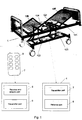
- Fig. 1 shows a hospital bed 100 having a wheeled chassis on which there is an intermediate frame 101 with a hinged mattress support section.
- the intermediate frame 101 may be raised and lowered or be caused to assume a position tilted about a transverse axis, by two linear actuators 102, 103.
- the support section comprises a backrest part 105 likewise adjustable by a linear actuator 104.
- the support section moreover has a hinged legrest part 106, which may likewise be adjusted by a linear actuator 107.
- the linear actuators are controlled by a control unit 4 which is operated by a wireless hand control 2 having a plurality of keys 3 for the various functions.
- the hand control 2 comprises a receiver and adapter part 5 and a transmitter part 6.
- the control unit comprises a transmitter part 7 and a receiver part 8.
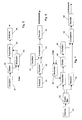
- Fig. 2 shows a diagram which illustrates how the hand control adapts itself to the individual control unit 4, following which it can communicate with the control unit 4.
- Fig. 2 will be explained in detail below by first explaining the principle of adaptation and then the principle of communication.
- the remote control system will be designed so that the control units are constantly active.
- the transmitter part 6 of the hand control may be constructed such that an activation signal is emitted when a key 3 on the hand control 2 is pressed. This activation signal causes all control units within a given range to be activated.
- the transmitter part 7 of the control unit comprises a circuit which is activated in step 12 by detection of an activation signal. All the control units within the given range now begin to emit a signal with a frequency which is individual for the individual control unit 4.
- the receiver and adapter part 5 of the hand control comprises a phase locking circuit, which allows the hand control to form a signal which is phase-locked to the frequency from the strongest signal emitted by the transmitter part 7 of the control unit.
- the signal of the hand control is phase-locked to the signal from the control unit/bed which is closest to the hand control 2.
- the hand control 2 is now adapted to emit a signal which is in phase with the strongest signal received from the closest control unit 4.
- frequency dividers are used for dividing the frequency of the signals. This means that transmitted and received signals may be separated as the signals hereby get different frequencies.
- the hand control 2 is thus adapted to be able to communicate with a specific control unit 4, which will be explained more fully below.
- the individual control units are designed such that they only execute instructions which arrive in connection with a signal having a frequency which corresponds to the frequency of the circuit of the control unit. This is achieved in that the receiver part 8 in the control unit 4 is designed such that it has a very narrow bandwidth.
- the hand control 2 After phase locking, the hand control 2 is ready to send messages to the control unit 4, and in step 14 the transmitter part 6 modulates instructions on the transmitted phase-locked signal.
- the instructions depend on which key 3 on the hand control 2 is pressed.
- control unit 4 receives the modulated signal and reads the instructions from it by using a decoder, and then in step 16 the control unit 4 ensures that these instructions are executed.
- Fig. 3 shows the structure of the receiver and adapter part 5.
- a receiver 21 which receives the strongest signal via an antenna 22.
- This signal is passed further on to the adapter part 23 which is constructed as a control loop.
- This loop has a comparator 24 which compares the phase of the received signal with the phase of a divided signal which arrives from a controllable circuit 25. If the phases of the two signals differ, the frequency of the signal in the controllable circuit 25 is adjusted.
- the controllable signal must be divided so as to correspond to the signal from the control unit 4 which has been divided correspondingly before transmission.
- the divider 26 may e.g. be constructed as a digital divider circuit.
- Fig. 4 illustrates the structure of the transmitter part 6 of the hand control.
- identification means 31 identify the key 3 that has been activated.
- This information is passed on to a coder 3 which converts the information into a code which can be recognized by the receiver part 8 of the control unit.
- This code is modulated on the transmit signal by a modulator 33, and then a transmitter 34 transmits the signal via a transmitter antenna 35.
- Fig. 5 illustrates the structure of the transmitter part 7 of the control unit.
- An oscillator 41 is provided, composed of a circuit, e.g. consisting of a coil and a resistor. It is important that the frequency of the circuit in the individual control units varies from bed to bed. It is expedient in this connection to use the same components in the individual receiver systems and to utilize the inaccuracy present in the component values for achieving a varying oscillation circuit. Thus, quite unique receiver systems are achieved, and they are moreover easier and cheaper to produce.
- a divider 42 is used for dividing the frequency by an integer. Use is then made of a transmitter 43 which transmits the signal via an antenna 44.
- Fig. 6 illustrates the structure of the receiver part 8 of the control unit.
- the receiver part 8 uses a receiver 52 which, via an antenna 51, receives the signal transmitted from the transmitter part 6 of the hand control. This signal is compared with the signal which is formed by the oscillator 41 of the receiver part. If a comparator 53 determines that the two signals are in phase, the information from the received signal is decoded via a decoder 54 and is converted into a control signal which activates the desired part of the bed.
- Fig. 7 illustrates an assembly of the receiver part 8 and the transmitter part 7 of the control unit, using a common antenna 61 via a duplex filter 62.
- the modulation of information on this signal may take place in that the phases of the transmitted signal are shifted 180 degrees.
- a shifted phase may represent a digital 1
- a non-shifted phase may represent a digital 1.
- the receiver part of the control unit must include means that detect how the individual phases are oriented.
- the embodiment described in the foregoing has a one-way communication, viz. from the hand control to the control unit.
- the bed may be provided with an angular detector, or the angle may be measured indirectly by the mutual position of the actuators 102, 103.
- the signal may be fed to a modulator 63 connected to the divider 42 and the transmitter 43.
- the modulated signal is fed from the receiver 21 to a comparator 64 connected to the divider 26.
- the signal may be fed from the comparator 64 to a display in the hand control which displays the angular position.
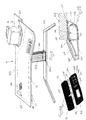
- Fig. 8 of the drawing shows the use of the remote control system in connection with a height adjustable table.
- This comprises a lifting column 200 mounted with the lower end in a foot 201, and a main tabletop 202 is mounted on the upper end of the column.
- the column comprises two telescopic hollow profiles 203a,203b and is driven by a linear actuator placed in the interior of the innermost profile 203a.
- the motor of the actuator is equipped with Hall sensors. A signal indicative of the table height may be tapped from these Hall sensors.
- the main tabletop 202 has an auxiliary tabletop 204, which is height adjustable, e.g. by means of an linear actuator having an motor with Hall sensors. A signal indicative of the auxiliary table height may be tapped from these Hall sensors.
- the remote control system is likewise a duplex system wherein a signal may be transmitted from the control unit 205 placed under the table top to the hand control 206 with the table height concerned, which may be read on a display 207.
- the hand control 206 comprises a sideways elongated cabinet 209 with a plane bottom 210 acting as a foot for standing on the tabletop.
- the display 207 together with keys 208 is placed in an upward facing control 211 surface inclined towards the user.
- the rear side of the hand control has a compartment 212 for two rows of cylindrical batteries. Access to the compartment is through a lid 213 closed with a catch lock.
- the plane bottom 210 and the weight of the batteries (six all together) means that the hand control is stable on the tabletop. Additionally the bottom may be furnished with friction pads.
- the hand control could be placed in a holder 214 having a cavity 215 for the rear side of the hand control.
- the hand control rest in a secure manner in the holder. Additionally, the hand control is retained by two resilient members 216 protruding into the cavity from the ceiling 217 of the holder.
- the resilient members 216 are tongues bearing a cam 218 resting in the groove 219 between the two cylindrical portions of the compartment for the batteries.
- the holder can be fixed to the underside of the tabletop 202 by means of screws which could be reached through holes in the holder alternatively fixed by means of an adhesive. Resting in the holder the control surface is exposed to the user and could be operated by the user. When removing the hand control from the holder the tongues are displaced into respective openings in the ceiling of the holder.
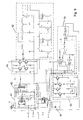
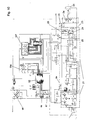
- Figs. 9 and 10 of the drawing show an example of the electronic circuit of the hand control and of the control unit, respectively.
- the embodiment is directed to a design for use in connection with tables.
- the individual parts in the block diagrams of figs. 4 and 7 are identified by the same reference numerals.
- the oscillator 41 of the control unit is an integrated circuit, in which a signal having a frequency of the order of 160 kHz is currently generated.
- a sweeper 65 such that the transmitter sweeps in narrow ranges, e.g. in the order of 600Hz.
- the signal is fed to a divider 42, which is likewise an integrated circuit in which the signal is divided eight times to a frequency of the order of 20 kHz.
- This signal is passed further on to the transmitter, which is formed by an amplifier 43 in the form of a traditional transistor amplifier.
- the signal thus amplified is passed via the duplex filter 62 to the antenna 61, from where a signal is constantly emitted, having a frequency of the order of 20 kHz unique to the control unit.
- the antenna 61 is a wire loop attached to the underside of the tabletop 202. As the wire loop is placed along the edge of the tabletop the field is in essentially limited within the boundaries of the tabletop and perpendicular thereto.
- Another part of the signal from the IC circuit 41 is divided four times in the divider 42 to a signal having a frequency of the order of 40 kHz, which is sent back to the IC circuit which contains a phase modulator 63 as a standard component in addition to the oscillator.
- Data from the control of the actuator specifying the height of the tabletop are fed to the IC circuit in which the 40 kHz signal is phase-modulated with the data.
- the signal thus modulated is fed to the transmitter 43 and further to the antenna via the duplex filter.
- the signal is used for transmitting an identification signal in the form of a ping.
- a signal with a frequency of the order of 80 kHz and with data received from a remote control is fed from the antenna to the duplex filter 62 and further on to the receiver 52, which is a traditional transistor amplifier. From there, the signal is fed to the comparator 52 which contains a filter of operational amplifiers and a single logic component, viz. an inverting gate. The carrier wave is separated in the filter, and the data signal is fed to the gate in which it is inverted.
- the decoder 54 in fig. 6 and7) in the present embodiment is integrated in the control box for the lifting column.
- the receiver antenna 22 of the hand control is formed by a coil.
- the unique signal of the order of 20 kHz is fed from the antenna to the receiver 21, which is formed by a traditional transistor amplifier and a filter based on two operational amplifiers. From the filter, the unique signal is fed to the phase-locking circuit 23 which comprises a crystal oscillator 25, a divider 24 and a comparator 26, the latter in the form of IC circuits.
- the oscillator creates a signal with a frequency of the order of 80 kHz which is divided by four to a frequency of the order of 20 kHz or the same as the received signal.
- the thus adapted transmit signal with the frequency of the order of 80 kHz is subsequently fed to a phase modulator 33 in the form of a logic circuit (exclusive OR gate).
- a data signal e.g. to have the tabletop raised more, is generated by pressing the key concerned on the keyboard 208.
- the data signal is fed to a processor which also constitutes a coder 32.
- 66 indicate the oscillator for the processor and the other oscillator 67 is the clock and the time is shown in the display when nothing else is displayed.
- the transmit signal is phase-modulated in the modulator 33 with the coded data signal, which is fed to the transmitter 34 that is formed by a traditional transistor amplifier, and from there the signal is fed to the transmit antenna 35 here formed by a coil.
- the receiver antenna 22 In addition to receiving the unique signal, the receiver antenna 22 also picks up the data signal of the order of 40 kHz from the control unit. What is first picked up by the hand control is the ping on this signal. The ping is used for turning on the transmitter of the hand control, which is normally turned off to minimize the consumption of power.
- the hand control has a power supply in the form of batteries with a voltage stabilization 68. The circuit which is activated by the ping information and turns on the receiver, is identified hereby. Cutting the power of to the receiver when not in use saves energy such the batteries last longer.
- the signal is fed from the transistor amplifier in the receiver 21 to a comparator 64 in the form of an IC circuit and a filter based on four operational amplifiers, in which the carrier wave of the 40 kHz is filtered off.
- the data are fed via the processor 32 to the display which shows the current height of the tabletop. The user can thus directly read the current height of the tabletop.
- the table may as previously mentioned also be provided with an auxiliary tabletop 204 for e.g. a monitor and moreover a side tabletop, both of which may be individually adjustable in height.
- the drives of these are likewise conceivably driven by a linear actuator.
- the hand control is formed with three switching keys 208I-III, one for each drive. Further there is a key 208D which should be activated in combination with one of the keys 208I-III to activate the tabletop chosen.
- the user could choose pre-selected heights of the table and with a key 208S pre-selected heights could be stored.
- the two keys 208> and 208 ⁇ the table could be raised or lowered and said keys is also used in combination with the keys 208U and 208S to choose the desired settings. Further said two keys are used to set the time.
Landscapes
- Engineering & Computer Science (AREA)
- Computer Networks & Wireless Communication (AREA)
- Physics & Mathematics (AREA)
- General Physics & Mathematics (AREA)
- Selective Calling Equipment (AREA)
- Invalid Beds And Related Equipment (AREA)
- Transmitters (AREA)
Applications Claiming Priority (2)
| Application Number | Priority Date | Filing Date | Title |
|---|---|---|---|
| DKPA199801434 | 1998-11-05 | ||
| DK143498 | 1998-11-05 |
Publications (1)
| Publication Number | Publication Date |
|---|---|
| EP0999533A2 true EP0999533A2 (de) | 2000-05-10 |
Family
ID=8104796
Family Applications (1)
| Application Number | Title | Priority Date | Filing Date |
|---|---|---|---|
| EP99610067A Withdrawn EP0999533A2 (de) | 1998-11-05 | 1999-11-05 | Fernbedienungssystem für verstellbare Möbel |
Country Status (3)
| Country | Link |
|---|---|
| US (1) | US6570491B1 (de) |
| EP (1) | EP0999533A2 (de) |
| JP (1) | JP2000165969A (de) |
Cited By (12)
| Publication number | Priority date | Publication date | Assignee | Title |
|---|---|---|---|---|
| WO2001085085A3 (en) * | 2000-05-05 | 2002-03-07 | Hill Rom Services Inc | Remote control for a hospital bed |
| WO2004019751A3 (de) * | 2002-08-06 | 2004-07-29 | Steute Schaltgeraete Gmbh & Co | Anordnung und verfahren zur drahtlosen übertragung von stellsignalen zu einem medizinischen gerät |
| WO2006039929A3 (en) * | 2004-10-13 | 2006-05-18 | Linak As | An actuator system, preferably for adjustable articles of furniture |
| EP1733646A1 (de) * | 2005-06-17 | 2006-12-20 | T4L S.r.l. | Computerarbeitsplatz |
| WO2007144145A3 (de) * | 2006-06-12 | 2008-05-29 | Logicdata Elect & Software Ent | Schaltungsanordnung und verfahren zur steuerung eines antriebs für eine verstellbare tischplatte |
| WO2009021800A1 (de) * | 2007-08-14 | 2009-02-19 | Dewert Antriebs- Und Systemtechnik Gmbh | Bedienungseinheit für elektromotorische möbelantriebe |
| US7757313B2 (en) | 2004-12-17 | 2010-07-20 | John Koorey | Bed lifting system |
| GB2471401A (en) * | 2009-06-25 | 2010-12-29 | Ljubomir Gnjatovic | Bed system having an adjustable configuration |
| US8125318B2 (en) | 2004-09-10 | 2012-02-28 | Hill-Rom Services, Inc. | Wireless control system for a patient-support apparatus |
| US8125309B2 (en) | 2005-06-07 | 2012-02-28 | Koninklijke Philips Electronics N.V. | Fail-safe remote control |
| US8710950B2 (en) | 2004-12-23 | 2014-04-29 | Hill-Rom Services, Inc. | Wireless control system for a patient support apparatus |
| CN104380361A (zh) * | 2012-06-15 | 2015-02-25 | 德沃特奥金有限公司 | 电动家具驱动组件 |
Families Citing this family (6)
| Publication number | Priority date | Publication date | Assignee | Title |
|---|---|---|---|---|
| PT2100282T (pt) * | 2006-12-31 | 2018-01-12 | Linak As | Aplicação tal como uma cama electricamente ajustável ou a força electricamente comandada para a elevação de doente |
| WO2009155919A1 (en) * | 2008-06-25 | 2009-12-30 | Linak A/S | A wireless control unit |
| DE202013104924U1 (de) | 2013-11-04 | 2015-02-05 | Dewertokin Gmbh | Handfernbedienung für elektrische Geräte |
| US10789833B2 (en) * | 2017-10-19 | 2020-09-29 | Standata Technology, Llc | Power adjustable furniture management systems and methods |
| CN108984673B (zh) * | 2018-06-30 | 2023-04-07 | 平安科技(深圳)有限公司 | 一种文件检测方法及装置 |
| WO2022132587A1 (en) * | 2020-12-18 | 2022-06-23 | Sleep Number Corporation | Bed foundation adustment controls |
Family Cites Families (5)
| Publication number | Priority date | Publication date | Assignee | Title |
|---|---|---|---|---|
| US4510495A (en) * | 1982-08-09 | 1985-04-09 | Cornell Research Foundation, Inc. | Remote passive identification system |
| GB9220412D0 (en) * | 1992-09-28 | 1992-11-11 | Texas Instruments Holland | Transponder systems for automatic identification purposes |
| US5940006A (en) * | 1995-12-12 | 1999-08-17 | Lucent Technologies Inc. | Enhanced uplink modulated backscatter system |
| US5887176A (en) * | 1996-06-28 | 1999-03-23 | Randtec, Inc. | Method and system for remote monitoring and tracking of inventory |
| US6211773B1 (en) * | 1997-12-17 | 2001-04-03 | Ncr Corporation | Remote control device and method for electronic price label systems |
-
1999
- 1999-11-05 EP EP99610067A patent/EP0999533A2/de not_active Withdrawn
- 1999-11-05 JP JP11316089A patent/JP2000165969A/ja active Pending
- 1999-11-05 US US09/435,205 patent/US6570491B1/en not_active Expired - Fee Related
Cited By (12)
| Publication number | Priority date | Publication date | Assignee | Title |
|---|---|---|---|---|
| WO2001085085A3 (en) * | 2000-05-05 | 2002-03-07 | Hill Rom Services Inc | Remote control for a hospital bed |
| WO2004019751A3 (de) * | 2002-08-06 | 2004-07-29 | Steute Schaltgeraete Gmbh & Co | Anordnung und verfahren zur drahtlosen übertragung von stellsignalen zu einem medizinischen gerät |
| US8125318B2 (en) | 2004-09-10 | 2012-02-28 | Hill-Rom Services, Inc. | Wireless control system for a patient-support apparatus |
| WO2006039929A3 (en) * | 2004-10-13 | 2006-05-18 | Linak As | An actuator system, preferably for adjustable articles of furniture |
| US7757313B2 (en) | 2004-12-17 | 2010-07-20 | John Koorey | Bed lifting system |
| US8710950B2 (en) | 2004-12-23 | 2014-04-29 | Hill-Rom Services, Inc. | Wireless control system for a patient support apparatus |
| US8125309B2 (en) | 2005-06-07 | 2012-02-28 | Koninklijke Philips Electronics N.V. | Fail-safe remote control |
| EP1733646A1 (de) * | 2005-06-17 | 2006-12-20 | T4L S.r.l. | Computerarbeitsplatz |
| WO2007144145A3 (de) * | 2006-06-12 | 2008-05-29 | Logicdata Elect & Software Ent | Schaltungsanordnung und verfahren zur steuerung eines antriebs für eine verstellbare tischplatte |
| WO2009021800A1 (de) * | 2007-08-14 | 2009-02-19 | Dewert Antriebs- Und Systemtechnik Gmbh | Bedienungseinheit für elektromotorische möbelantriebe |
| GB2471401A (en) * | 2009-06-25 | 2010-12-29 | Ljubomir Gnjatovic | Bed system having an adjustable configuration |
| CN104380361A (zh) * | 2012-06-15 | 2015-02-25 | 德沃特奥金有限公司 | 电动家具驱动组件 |
Also Published As
| Publication number | Publication date |
|---|---|
| US6570491B1 (en) | 2003-05-27 |
| JP2000165969A (ja) | 2000-06-16 |
Similar Documents
| Publication | Publication Date | Title |
|---|---|---|
| US6570491B1 (en) | Associating a hand control unit | |
| US10369067B2 (en) | Method and apparatus to detect transponder tagged objects, for example during medical procedures | |
| CA2355791C (en) | Apparatus for energizing a remote station and related method | |
| US9792408B2 (en) | Method and apparatus to detect transponder tagged objects and to communicate with medical telemetry devices, for example during medical procedures | |
| US8074662B2 (en) | Surgical communication and power system | |
| EP2764889B1 (de) | Implantierbare medizinische Vorrichtung, medizinisches System und Verfahren zur Datenkommunikation | |
| US5579781A (en) | Wireless transmitter for needle electrodes as used in electromyography | |
| CN102422330B (zh) | 无线传感器读取器 | |
| US20060058587A1 (en) | Wireless control system for a patient-support apparatus | |
| KR20130060359A (ko) | 무선 전력 브리지 | |
| MX2007005192A (es) | Transmision segura de control inalambrico a unidad central. | |
| Van Schuylenbergh et al. | Self-tuning inductive powering for implantable telemetric monitoring systems | |
| WO2004084733A1 (en) | Remote wireless control device for an ultrasound machine and method | |
| CN102752653A (zh) | 遥控器和电视广播接收器 | |
| US20120105248A1 (en) | Physiological Data Acquisition and Management System for Use with an Implanted Wireless Sensor | |
| US20110089162A1 (en) | Induction-Based Heating Appliances Employing Long Wave Magnetic Communication | |
| AU2016341937A1 (en) | Night-light and alert system | |
| CN113940515B (zh) | 陪护床头柜 | |
| WO2025101499A1 (en) | Patient support apparatus with environmental interaction | |
| WO2025144590A1 (en) | Patient support apparatus and asset monitoring | |
| CN116859303A (zh) | 磁共振射频线圈 | |
| US20070195910A1 (en) | Transmission system | |
| JPH0464333A (ja) | 体温、脈拍監視装置 | |
| JPH0820082B2 (ja) | 電気コタツ | |
| HK1169737A (en) | Wireless sensor reader |
Legal Events
| Date | Code | Title | Description |
|---|---|---|---|
| PUAI | Public reference made under article 153(3) epc to a published international application that has entered the european phase |
Free format text: ORIGINAL CODE: 0009012 |
|
| AK | Designated contracting states |
Kind code of ref document: A2 Designated state(s): AT BE CH CY DE DK ES FI FR GB GR IE IT LI LU MC NL PT SE |
|
| AX | Request for extension of the european patent |
Free format text: AL;LT;LV;MK;RO;SI |
|
| STAA | Information on the status of an ep patent application or granted ep patent |
Free format text: STATUS: THE APPLICATION IS DEEMED TO BE WITHDRAWN |
|
| 18D | Application deemed to be withdrawn |
Effective date: 20040531 |