EP0999614A2 - Mit einem Verriegelungsglied versehener elektrischer Verbinder - Google Patents
Mit einem Verriegelungsglied versehener elektrischer Verbinder Download PDFInfo
- Publication number
- EP0999614A2 EP0999614A2 EP99308587A EP99308587A EP0999614A2 EP 0999614 A2 EP0999614 A2 EP 0999614A2 EP 99308587 A EP99308587 A EP 99308587A EP 99308587 A EP99308587 A EP 99308587A EP 0999614 A2 EP0999614 A2 EP 0999614A2
- Authority
- EP
- European Patent Office
- Prior art keywords
- connector
- retaining member
- housing
- housing retaining
- fitted position
- Prior art date
- Legal status (The legal status is an assumption and is not a legal conclusion. Google has not performed a legal analysis and makes no representation as to the accuracy of the status listed.)
- Withdrawn
Links
Images



Classifications
-
- H—ELECTRICITY
- H01—ELECTRIC ELEMENTS
- H01R—ELECTRICALLY-CONDUCTIVE CONNECTIONS; STRUCTURAL ASSOCIATIONS OF A PLURALITY OF MUTUALLY-INSULATED ELECTRICAL CONNECTING ELEMENTS; COUPLING DEVICES; CURRENT COLLECTORS
- H01R13/00—Details of coupling devices of the kinds covered by groups H01R12/70 or H01R24/00 - H01R33/00
- H01R13/62—Means for facilitating engagement or disengagement of coupling parts or for holding them in engagement
- H01R13/639—Additional means for holding or locking coupling parts together, after engagement, e.g. separate keylock, retainer strap
Definitions
- this connector is provided with a pair of housings 1 and 2 capable of fitting mutually together.
- a locking member 3 formed on an upper face of the housing 1 passes through and engages a protruding member 4 shaped like an inverted U and formed on the housing 2.
- a housing retaining member 5 is passes horizontally through the locking member 3 and the housings 1 and 2 are thereby retained in a fitted state.
- a half-fitted state can be detected because member 5 cannot be installed into the locking member 3.
- the two housings of a connector are usually installed into the ends of separate harnesses at a harness factory and are then transported to an assembly site (such as an automobile assembly site, etc.).
- an assembly site such as an automobile assembly site, etc.
- the housing retaining member 5 and the housings 1 and 2 of the conventional connector are in a separated state. Consequently, it is troublesome to control these components, and a troublesome assembly operation must be performed at the assembly site.
- the housing retaining member temporarily stops the housings and is pushed into a main stopping position at the assembly site, there is the risk that the housing retaining member might strike against other components while being transported and thereby move into the main stopping position. If the temporary stopping strength of the housing retaining member is merely increased in order to deal with this problem, the operation of pushing in the housing retaining member at the assembly site is rendered more difficult.
- a connector comprising male and female connector housings mutually engageable in a fitting direction, one of said connector housings being provided with a housing retaining member movable in a direction intersecting said fitting direction between a temporary fitted position and a fully fitted position, the temporary fitted position allowing the connector housings to be fitted together, and the fully fitted position retaining the connector housings in a fully fitted state, the housing retaining member being provided with a resilient locking arm protruding in a direction intersecting said fitting direction, and said one of the connector housings being provided with a recess within which the locking arm is received when the retaining member is in the temporary fitted position, wherein the other of the connector housings is provided with an abutment surface adapted to move the locking arm as the connector housings are fitted together, thereby disengaging the locking arm from the recess and permitting movement of the housing retaining member from the temporary fitted position to the fully fitted position.
- the housing retaining member With the locking arm of the housing retaining member received in the recess of the connector housing, the housing retaining member is resistant to external forces, for example experienced during transportation, acting to move it to the fully fitted position.
- the aforementioned problems associated with having a separate housing retaining member are also alleviated.
- the recess is provided in a partition wall of said one of the connector housings and the locking arm overlies an edge of said partition wall when the housing retaining member is in the fully fitted position. By overlying an edge of the wall, the locking arm retains the housing retaining member in the fully fitted position.
- the housing retaining member includes an upstanding contact member adapted to contact said other of the connector housings if the connector housings are fitted together with the housing retaining member in the fully fitted position, the contact member being adapted to move the housing retaining member to the temporary fitted state as a result of further movement of said other of the connector housings in the fitting direction.
- the contact member is preferably provided with a tapered contact face, said tapered contact face intersecting diagonally with the direction of fitting of the connector housings.
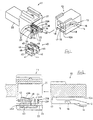
- a connector of the present embodiment shown in its entirety in Fig. 1, is provided with a female connector housing 10 and a male connector housing 11 capable of fitting mutually together.
- the fitting face side of the female connector housing 10 and of the male connector housing 11 shall be referred to as the anterior side.
- the female connector housing 10 (hereafter referred to as the female housing 10) forms a rectangular parallelipiped shape, the interior thereof housing female terminal fittings (not shown).
- a locking arm 13 is provided on a lower face 10A of this female housing 10.
- the locking arm 13 forms a cantilever which drops downwards from an anterior end of the female hosing 10 and extends horizontally, a pushing member 14 being provided on the posterior end thereof.
- a slit 15 which extends in a longitudinal direction is formed in the centre (with respect to the width-wise direction) of the locking arm 13. This slit 15 is intersected by a stopping wall 16 located at the centre, in a longitudinal direction, of the locking arm 13.
- a receiving wall 17 drops downwards from the anterior end of the lower face 10A of the female housing 10. As shown in Fig. 2, a portion of this receiving wall 17 intersects with the end of the slit 15.
- a pair of regulating rails 18 are provided symmetrically to the left and right at the two edges of the lower face 10A of the female housing 10.
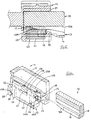
- These regulating rails 18, which are shown in an enlarged form in Fig. 6. are cross-sectionally L-shaped and have projecting members 19 which protrude from tips of inner side faces thereof towards the locking arm 13. Tapered faces 19A are provided on the anterior sides of these projecting members 19, these tapered faces 19A inclining further away from the locking arm 13 the closer they are to the anterior side.
- the male connector housing 11, shown on the left side in Fig. 1, is provided with an angular tubular shaped hood member 21 to the anterior of a terminal housing member 20 which houses male terminal fittings (not shown).
- a lower wall 22 of the hood member 21, at the lower side of Fig. 1, has a locking protrusion 23 which protrudes from the centre of the anterior end of the lower wall 22 towards the interior of the hood member 21.
- the locking protrusion 23 has a tapered face 23A at its anterior side, and its posterior side has a stopping face 23B which is approximately perpendicular.
- a pair of short columns 24 are formed on an inner face of the lower wall 22, these short columns being formed symmetrically to the left and right of the locking protrusion 23.
- Angular column shaped partitioning walls 25 extend between each short column 24 and the innermost wall of the hood member 21. More specifically, the partitioning walls 25 are connected to the end portions of the short columns 24 at side faces thereof which are on the sides opposite to the locking protrusion 23. These partitioning walls 25 protrude outwards in a sideways direction away from the short columns 24.
- opening spaces 26 that open to the anterior of the male housing 11 are formed between the partitioning walls 25 and the lower wall 22, the projecting members 19 of the regulating rails 18 being inserted therein.
- tapered faces 25A inclining towards the interior side are formed on upper faces of the partitioning walls 25.
- slits 30 extending in the direction of fitting pass through the lower wall 22 of the hood member 21. These slits 30 are formed farther to the interior, in the direction of fitting, than the locking protrusion 23 and the short columns 24.
- the anterior of each of the two slits 30 located at the sides has an inner face, these forming a unified face with a posterior face of the short columns 24.
- a pair of stopping protrusions 27 are formed in an up-down direction thereon.
- a protecting wall 28 drops downwards from a posterior end of the lower wall 22, and stopping protrusions 29 protrude in an anterior direction from a lower end of a portion of the protecting wall 28 that is closer to the two side slits 30.
- a housing retaining member 40 (to be explained next) is engaged by these stopping protrusions 27 and 29.
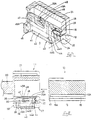
- the housing retaining member 40 shown in its entirety in Fig. 1, is provided with a pair of main protruding walls 42 rising vertically upwards from locations adjacent to two edges of a plate-shaped base member 41, and a secondary protruding wall 43 rising vertically from the centre of the base member 41.
- the housing retaining member 40 is installed on the male housing 11 by passing these protruding walls 42 and 43 through the slits 30 of the hood member 21.
- the secondary protruding wall 43 shown from the side in Fig. 2, is provided with a returning tapered face 43A that relates to the present invention, this returning tapered face 43A facing in an anterior direction from the anterior end portion of the secondary protruding wall 43 and inclining downwards.
- a stopping protrusion 44A protruding in an anterior direction is formed on each first stopping arm 44 adjacent to the end thereof, and a stopping protrusion 45A protruding in a posterior direction is formed on each second stopping arm 45 adjacent to the lower edge thereof. These stopping protrusions 44A and 45A are engaged by the stopping protrusions 27 and 29 formed on the hood member 21.
- a locking member 46 relating to the present invention is provided on the upper edge of each main protruding wall 42.
- a cavity 47 opens from the upper edge of the main protruding wall 42, and the locking member 46 is located therein.
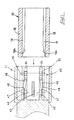
- This locking member 46 has a cantilevered shape and extends in a posterior direction from an inner face at the anterior end of the main protruding wall 42. More specifically, each locking member 46 has an angular column shape and, as shown in Fig. 11 inclines further away from the secondary protruding wall 43 the further it extends towards the posterior, relative to the direction of fitting of the connector. The tip portion of each locking member 46 turns back towards the secondary protruding wall 43 and extends in the direction of fitting of the connector, forming a stopping end 48.
- Each stopping end 48 protrudes out beyond the side face of the main protruding wall 42 and, as shown in Fig. 6, is housed within the opening space 26 below the partitioning wall 25 when the housing retaining member 40 is pushed into the temporary stopping position. As shown in Fig. 7. each stopping end 48 is housed on the upper side of the partitioning wall 25 when the housing retaining member 40 is pushed into the main stopping position. The upper face of each stopping end 48 is flat and, when the housing retaining member 40 is in the temporary stopping position, is face-to-face with a lower face of the partitioning wall 25 in the direction of sliding of the housing retaining member 40. A tapered face 48A (see Figs.
- each stopping end 48 is formed at a lower side of each stopping end 48 and, when the housing retaining member 40 is in the main stopping position, it is face-to-face with the tapered face 25A on the upper face of the partitioning wall 25 in a direction intersecting with the direction of sliding of the housing retaining member 40.
- the housing retaining member 40 is installed at the connector production side as far as the temporary stopping position of the male housing 11.
- the stopping ends 48 of the locking members 46 provided on the housing retaining member 40 enter into the opening spaces 26 of the male housing 11 and are gripped between the lower wall 22 and the partitioning walls 25.
- the stopping protrusions 44A and 45A formed on the stopping arms 44 and 45 of the housing retaining member 40 are engaged by the stopping protrusions 27 and 29 formed on the male housing 11, and the up-down movement of the housing retaining member 40 is thus regulated.
- the connector is shipped to, for example, a harness factory with the housings 10 and 11 in a separated state.
- the two housings 10 and 11 are installed into the ends of separate harnesses (not shown) and those harnesses are transported in a separated state to, for example, an automobile assembly site. It is possible that, during these processes, the housing retaining member 40 may make contact with other components and be pushed towards the main stopping position. However, the locking members 46 and the stopping arms 44 and 45 engage with the parts (described above) of the male housing 11 and therefore prevent the housing retaining member 40 from moving to the main stopping position. At this point, the stopping ends 48 of the locking members 46 are face-to-face with the partitioning wall 25 in the direction of sliding of the housing retaining member 40.
- the housings 10 and 11 are fitted together as follows.
- the female housing 10 is pushed into the hood member 21 of the male housing 11.
- the stopping wall 16 of the locking arm 13 provided on the female housing 10 rises over the locking protrusion 23 provided inside the hood member 21 of the male housing 11 and engages the stopping face 23B provided at the innermost side of this locking protrusion 23 (see Fig. 4).
- the two housings 10 and 11 are thereby locked in a fitted state.
- the regulating rails 18 of the female housing 10 are inserted into the opening spaces 26 of the male housing 11, and the stopping ends 48 of the locking members 46 slide along the tapered faces 19A of the regulating rails 18 and are pushed into the interior, next, as shown in Fig. 12, when the connector has reached a completely fitted state, the locking members 46 resilient change shape and the stopping ends 48 reach a state whereby they have moved away from the opening spaces 26.
- the housing retaining member 40 While the locking members 46 are in this moved-away state, the housing retaining member 40 is pushed into the main stopping position. While this is being done, the first stopping arms 44 rise over the stopping protrusions 27 of the male housing 11 and change shape (see Fig. 3) and, immediately after the housing retaining member 40 has reached the main stopping position, the first stopping arms 44 return to their original position and are retained against the upper faces of the stopping protrusions 27 of the male housing 11 (see Fig. 4). At this juncture, the locking members 46 are in the moved-away state (see Fig. 12), and the stopping ends 48 of the locking members 46 and the partitioning walls 25 do not interfere with the direction of sliding of the housing retaining member 40. Consequently, the housing retaining member 40 can easily be pushed into the main stopping position. When the housing retaining member 40 reaches the main stopping position, the locking members 46 return to their original position and remain above the upper faces for the partitioning walls 25 (see Fig. 7).
- the stopping protrusions 44A of the first stopping arms 44 and the stopping protrusions 27 of the make housing 11 all have tapered faces (see Fig. 2) which make sliding contact with one another and thereby release the engagement of the stopping protrusions 44A and the stopping protrusions 27.
- the housing retaining member 40 is able to move downwards and, when the housings 10 and 11 have reached the fully fitted state, the housing retaining member 40 automatically returns to the temporary stopping position. Next, the housing retaining member 40 may be pushed into the main stopping position.
- the housing retaining member 40 can be reliably retained in the temporary stopping position when the connector is in a separated state. Consequently, unlike the conventional example, there is no danger that housing retaining members which have been inadvertently moved into the main stopping position while connectors were being fitted together need to be returned one by one to the temporary stopping position. Moreover, when the connector is in a fitted state, the housing retaining member 40 can easily be pushed into the main stopping position, and consequently the operability of assembling the connector improves. In addition, even if the housing retaining member 40 were somehow to be in the main stopping position, an operation to return the housing retaining member 40 to the temporary stopping position when the housings 10 and 11 are being fitted together is not required, and efficiency of operability therefore improves.
- the housings 10 and 11 can be separated from a fitted state by pulling the housing retaining member 40 from the main stopping position to the temporary stopping position, and pushing the pushing member 14 of the locking arm 13 while simultaneously pulling the female housing 10 out of the hood member 21.
- a connector which can reliably retain a housing retaining member in a temporary stopping position when the connector is separated, and in which an assembly operation of the housing retaining member can be performed easily is provided.
Landscapes
- Details Of Connecting Devices For Male And Female Coupling (AREA)
Applications Claiming Priority (2)
| Application Number | Priority Date | Filing Date | Title |
|---|---|---|---|
| JP31234998 | 1998-11-02 | ||
| JP10312349A JP2000138084A (ja) | 1998-11-02 | 1998-11-02 | コネクタ |
Publications (2)
| Publication Number | Publication Date |
|---|---|
| EP0999614A2 true EP0999614A2 (de) | 2000-05-10 |
| EP0999614A3 EP0999614A3 (de) | 2002-06-19 |
Family
ID=18028184
Family Applications (1)
| Application Number | Title | Priority Date | Filing Date |
|---|---|---|---|
| EP99308587A Withdrawn EP0999614A3 (de) | 1998-11-02 | 1999-10-29 | Mit einem Verriegelungsglied versehener elektrischer Verbinder |
Country Status (3)
| Country | Link |
|---|---|
| US (1) | US6220886B1 (de) |
| EP (1) | EP0999614A3 (de) |
| JP (1) | JP2000138084A (de) |
Cited By (1)
| Publication number | Priority date | Publication date | Assignee | Title |
|---|---|---|---|---|
| WO2015114662A1 (en) * | 2014-01-30 | 2015-08-06 | Te Connectivity India Private Limited | Multi function connector positioning assurance device |
Families Citing this family (6)
| Publication number | Priority date | Publication date | Assignee | Title |
|---|---|---|---|---|
| US6572401B2 (en) | 2001-06-06 | 2003-06-03 | Sumitomo Wiring Systems, Ltd. | Connector locking member with disengagement feature |
| JP2006344538A (ja) * | 2005-06-10 | 2006-12-21 | Tyco Electronics Amp Kk | 電気コネクタ |
| JP5562108B2 (ja) * | 2010-04-26 | 2014-07-30 | 日本端子株式会社 | ロック検知コネクタ |
| JP5721473B2 (ja) * | 2011-03-01 | 2015-05-20 | 矢崎総業株式会社 | コネクタ |
| JP6254982B2 (ja) * | 2015-09-09 | 2017-12-27 | 矢崎総業株式会社 | コネクタ |
| KR102313403B1 (ko) * | 2020-06-19 | 2021-10-15 | 주식회사 경신 | 차량용 커넥터 |
Family Cites Families (13)
| Publication number | Priority date | Publication date | Assignee | Title |
|---|---|---|---|---|
| US4746306A (en) | 1982-03-26 | 1988-05-24 | General Motors Corporation | Electrical connector lock with gauge pin |
| US4772229A (en) * | 1984-07-30 | 1988-09-20 | Amp Incorporated | Plug connector having separate terminal retaining member |
| JP2503320B2 (ja) * | 1991-04-04 | 1996-06-05 | 矢崎総業株式会社 | 二重ロック機構を有するコネクタ |
| US5257944A (en) * | 1992-07-14 | 1993-11-02 | Interlock Corporation | Connector position assurance assembly |
| US5370552A (en) * | 1992-09-16 | 1994-12-06 | Sumitomo Wiring Systems, Ltd. | Electrical connector |
| JP2596866Y2 (ja) * | 1993-09-11 | 1999-06-21 | 古河電気工業株式会社 | 嵌合確認機構付コネクタ |
| US5370550A (en) * | 1993-12-13 | 1994-12-06 | Osram Sylvania Inc. | Locking connector exhibiting audio-tactile didacticism |
| JP3216775B2 (ja) * | 1995-02-10 | 2001-10-09 | 矢崎総業株式会社 | 嵌合検知体を備えたコネクタ |
| JP3155189B2 (ja) * | 1996-02-09 | 2001-04-09 | 住友電装株式会社 | コネクタ |
| JPH10199622A (ja) * | 1997-01-16 | 1998-07-31 | Yazaki Corp | コネクタ用二重ロック |
| JP3324690B2 (ja) * | 1997-03-26 | 2002-09-17 | 住友電装株式会社 | コネクタ |
| JPH1126069A (ja) * | 1997-06-27 | 1999-01-29 | Yazaki Corp | スライド嵌合型コネクタ |
| JP3313048B2 (ja) * | 1997-07-14 | 2002-08-12 | 住友電装株式会社 | ブロックコネクタ |
-
1998
- 1998-11-02 JP JP10312349A patent/JP2000138084A/ja not_active Abandoned
-
1999
- 1999-10-29 EP EP99308587A patent/EP0999614A3/de not_active Withdrawn
- 1999-11-01 US US09/431,068 patent/US6220886B1/en not_active Expired - Lifetime
Cited By (3)
| Publication number | Priority date | Publication date | Assignee | Title |
|---|---|---|---|---|
| WO2015114662A1 (en) * | 2014-01-30 | 2015-08-06 | Te Connectivity India Private Limited | Multi function connector positioning assurance device |
| CN106063049A (zh) * | 2014-01-30 | 2016-10-26 | 泰科电子连接印度私有有限公司 | 多功能连接器定位保证装置 |
| CN106063049B (zh) * | 2014-01-30 | 2019-08-02 | 泰科电子连接印度私有有限公司 | 多功能连接器定位保证装置 |
Also Published As
| Publication number | Publication date |
|---|---|
| EP0999614A3 (de) | 2002-06-19 |
| JP2000138084A (ja) | 2000-05-16 |
| US6220886B1 (en) | 2001-04-24 |
Similar Documents
| Publication | Publication Date | Title |
|---|---|---|
| EP0804821B1 (de) | Gehäuseverriegelung mit vorrichtung zur lagesicherung eines verbinders | |
| US9929509B1 (en) | Connector system with low profile connector position assurance device | |
| US5628649A (en) | Lock detecting structure of connector | |
| US5928038A (en) | Electrical connector position assurance system | |
| US7448888B2 (en) | Connector and a connector assembly | |
| US6287139B1 (en) | Connector | |
| US6439915B2 (en) | Connector | |
| CN109616829B (zh) | 连接器 | |
| JPH0917505A (ja) | 嵌合保証装置付コネクタ組立体、それに使用されるコネクタ及びその嵌合保証装置 | |
| JP2003264039A (ja) | 電気コネクタ組立体及び電気コネクタ半体組立体 | |
| EP0905823B1 (de) | Elektrischer Verbinder | |
| EP1047155B1 (de) | Hebelartiger Steckverbinder | |
| US7066773B1 (en) | Electrical connector with TPA stop | |
| EP0923169B1 (de) | Steckverbinder mit einem Kurzschlusskontakt | |
| EP1115181A1 (de) | Elektrischer Verbinder | |
| US7223113B2 (en) | Connector and a connector assembly | |
| EP0660451B1 (de) | Steckverbinder | |
| US6220886B1 (en) | Connector | |
| JPH09115615A (ja) | 嵌合確認機構を備えたコネクタ | |
| EP1094559B1 (de) | Steckverbinder mit Kontakthaltevorrichtung | |
| CN111834788A (zh) | 带有端子锁的电端子壳体 | |
| US6450840B2 (en) | Connector with insertable retainer | |
| EP1058353B1 (de) | Verbinder | |
| KR102722218B1 (ko) | 커넥터 위치 보장 부재 | |
| US20110104921A1 (en) | Connector and series of connectors |
Legal Events
| Date | Code | Title | Description |
|---|---|---|---|
| PUAI | Public reference made under article 153(3) epc to a published international application that has entered the european phase |
Free format text: ORIGINAL CODE: 0009012 |
|
| 17P | Request for examination filed |
Effective date: 19991112 |
|
| AK | Designated contracting states |
Kind code of ref document: A2 Designated state(s): AT BE CH CY DE DK ES FI FR GB GR IE IT LI LU MC NL PT SE |
|
| AX | Request for extension of the european patent |
Free format text: AL;LT;LV;MK;RO;SI |
|
| PUAL | Search report despatched |
Free format text: ORIGINAL CODE: 0009013 |
|
| AK | Designated contracting states |
Kind code of ref document: A3 Designated state(s): AT BE CH CY DE DK ES FI FR GB GR IE IT LI LU MC NL PT SE |
|
| AX | Request for extension of the european patent |
Free format text: AL;LT;LV;MK;RO;SI |
|
| RIC1 | Information provided on ipc code assigned before grant |
Free format text: 7H 01R 13/627 A, 7H 01R 13/629 B |
|
| GRAH | Despatch of communication of intention to grant a patent |
Free format text: ORIGINAL CODE: EPIDOS IGRA |
|
| AKX | Designation fees paid |
Designated state(s): DE FR GB IT |
|
| STAA | Information on the status of an ep patent application or granted ep patent |
Free format text: STATUS: THE APPLICATION IS DEEMED TO BE WITHDRAWN |
|
| 18D | Application deemed to be withdrawn |
Effective date: 20030315 |