EP0999721A2 - Gerät zur Verbindungssteuerung von einem eingebauten Ohrmikrofon für tragbares Funkendgerät - Google Patents
Gerät zur Verbindungssteuerung von einem eingebauten Ohrmikrofon für tragbares Funkendgerät Download PDFInfo
- Publication number
- EP0999721A2 EP0999721A2 EP99122154A EP99122154A EP0999721A2 EP 0999721 A2 EP0999721 A2 EP 0999721A2 EP 99122154 A EP99122154 A EP 99122154A EP 99122154 A EP99122154 A EP 99122154A EP 0999721 A2 EP0999721 A2 EP 0999721A2
- Authority
- EP
- European Patent Office
- Prior art keywords
- microphone
- earphone
- ear
- node
- signal
- Prior art date
- Legal status (The legal status is an assumption and is not a legal conclusion. Google has not performed a legal analysis and makes no representation as to the accuracy of the status listed.)
- Ceased
Links
Images





Classifications
-
- H—ELECTRICITY
- H04—ELECTRIC COMMUNICATION TECHNIQUE
- H04M—TELEPHONIC COMMUNICATION
- H04M1/00—Substation equipment, e.g. for use by subscribers
- H04M1/60—Substation equipment, e.g. for use by subscribers including speech amplifiers
- H04M1/6033—Substation equipment, e.g. for use by subscribers including speech amplifiers for providing handsfree use or a loudspeaker mode in telephone sets
- H04M1/6041—Portable telephones adapted for handsfree use
- H04M1/6058—Portable telephones adapted for handsfree use involving the use of a headset accessory device connected to the portable telephone
-
- H—ELECTRICITY
- H04—ELECTRIC COMMUNICATION TECHNIQUE
- H04B—TRANSMISSION
- H04B1/00—Details of transmission systems, not covered by a single one of groups H04B3/00 - H04B13/00; Details of transmission systems not characterised by the medium used for transmission
- H04B1/38—Transceivers, i.e. devices in which transmitter and receiver form a structural unit and in which at least one part is used for functions of transmitting and receiving
- H04B1/3827—Portable transceivers
- H04B1/3877—Arrangements for enabling portable transceivers to be used in a fixed position, e.g. cradles or boosters
-
- H—ELECTRICITY
- H04—ELECTRIC COMMUNICATION TECHNIQUE
- H04M—TELEPHONIC COMMUNICATION
- H04M1/00—Substation equipment, e.g. for use by subscribers
- H04M1/02—Constructional features of telephone sets
- H04M1/04—Supports for telephone transmitters or receivers
- H04M1/05—Supports for telephone transmitters or receivers specially adapted for use on head, throat or breast
-
- H—ELECTRICITY
- H04—ELECTRIC COMMUNICATION TECHNIQUE
- H04R—LOUDSPEAKERS, MICROPHONES, GRAMOPHONE PICK-UPS OR LIKE ACOUSTIC ELECTROMECHANICAL TRANSDUCERS; ELECTRIC HEARING AIDS; PUBLIC ADDRESS SYSTEMS
- H04R1/00—Details of transducers, loudspeakers or microphones
- H04R1/10—Earpieces; Attachments therefor ; Earphones; Monophonic headphones
-
- H—ELECTRICITY
- H04—ELECTRIC COMMUNICATION TECHNIQUE
- H04R—LOUDSPEAKERS, MICROPHONES, GRAMOPHONE PICK-UPS OR LIKE ACOUSTIC ELECTROMECHANICAL TRANSDUCERS; ELECTRIC HEARING AIDS; PUBLIC ADDRESS SYSTEMS
- H04R1/00—Details of transducers, loudspeakers or microphones
- H04R1/10—Earpieces; Attachments therefor ; Earphones; Monophonic headphones
- H04R1/1041—Mechanical or electronic switches, or control elements
-
- H—ELECTRICITY
- H04—ELECTRIC COMMUNICATION TECHNIQUE
- H04R—LOUDSPEAKERS, MICROPHONES, GRAMOPHONE PICK-UPS OR LIKE ACOUSTIC ELECTROMECHANICAL TRANSDUCERS; ELECTRIC HEARING AIDS; PUBLIC ADDRESS SYSTEMS
- H04R1/00—Details of transducers, loudspeakers or microphones
- H04R1/08—Mouthpieces; Microphones; Attachments therefor
- H04R1/083—Special constructions of mouthpieces
-
- H—ELECTRICITY
- H04—ELECTRIC COMMUNICATION TECHNIQUE
- H04R—LOUDSPEAKERS, MICROPHONES, GRAMOPHONE PICK-UPS OR LIKE ACOUSTIC ELECTROMECHANICAL TRANSDUCERS; ELECTRIC HEARING AIDS; PUBLIC ADDRESS SYSTEMS
- H04R1/00—Details of transducers, loudspeakers or microphones
- H04R1/10—Earpieces; Attachments therefor ; Earphones; Monophonic headphones
- H04R1/1016—Earpieces of the intra-aural type
-
- H—ELECTRICITY
- H04—ELECTRIC COMMUNICATION TECHNIQUE
- H04R—LOUDSPEAKERS, MICROPHONES, GRAMOPHONE PICK-UPS OR LIKE ACOUSTIC ELECTROMECHANICAL TRANSDUCERS; ELECTRIC HEARING AIDS; PUBLIC ADDRESS SYSTEMS
- H04R2201/00—Details of transducers, loudspeakers or microphones covered by H04R1/00 but not provided for in any of its subgroups
- H04R2201/10—Details of earpieces, attachments therefor, earphones or monophonic headphones covered by H04R1/10 but not provided for in any of its subgroups
- H04R2201/107—Monophonic and stereophonic headphones with microphone for two-way hands free communication
-
- H—ELECTRICITY
- H04—ELECTRIC COMMUNICATION TECHNIQUE
- H04R—LOUDSPEAKERS, MICROPHONES, GRAMOPHONE PICK-UPS OR LIKE ACOUSTIC ELECTROMECHANICAL TRANSDUCERS; ELECTRIC HEARING AIDS; PUBLIC ADDRESS SYSTEMS
- H04R2420/00—Details of connection covered by H04R, not provided for in its groups
- H04R2420/05—Detection of connection of loudspeakers or headphones to amplifiers
Definitions
- the present invention relates generally to a portable radio terminal, and in particular, to a device for controlling connection of a built-in type ear-microphone.
- An ear-microphone used for a portable radio terminal can be classified into an internal type (or built-in type) and an external type.
- a built-in type ear-microphone commonly includes a three-pole type plug which is to be inserted into a jack of a portable radio terminal.
- An external type ear-microphone includes a plug which is to be inserted into an interface connector mounted at the bottom of the portable ratio terminal.
- Fig. 1A is a perspective view illustrating the connection between a built-in type ear-microphone and a portable radio terminal
- Fig. 1B is a perspective view illustrating the connection between an external type ear-microphone and a portable radio terminal.
- Fig. 2 illustrates a conventional device for controlling connection of the built-in type ear-microphone.
- a plug 200 of the ear-microphone when a plug 200 of the ear-microphone is mechanically connected to an ear-microphone jack 100, the user can make a telephone conversation through the ear-microphone.
- the ear-microphone jack 100 is located at the top or side of the terminal. More specifically, as shown in Fig. 2, the ear-microphone jack 100 has pins 1, 3 and 2, which are connected to ground node G, speaker node S and microphone node M, respectively. Therefore, a microphone 250 and a speaker 260 of the ear-microphone are electrically connected to a microphone amplifier AMP1 and a speaker amplifier AMP2 prepared in a vocoder 130, respectively, allowing the user to make a telephone conversation.
- a comparator COM1 compares an electric signal sensed at a pin 4 in the ear-microphone jack 100 with a reference voltage Vref to generate a jack detection signal JD1 representative of whether or not the plug 200 is inserted into the jack 100.
- the jack detection signal JD1 is an initial detection signal for generating a signal having a level appropriate for the ear-microphone.
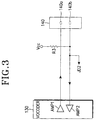
- Fig. 3 illustrates a conventional external type ear-microphone.
- An interface connector 140 mounted at the bottom of the terminal includes ports 140a and 140b for connection of the ear-microphone. Though not shown, the interface connector 140 further includes ports for a hands-free kit and ports for data communication. More specifically, when a plug 230 shown in Fig. 1B is inserted into the interface connector 140, the microphone 250 and the speaker 260 are electrically connected to the microphone amplifier AMP1 and the speaker amplifier AMP2 prepared in the vocoder 130, respectively, thus allowing the user to make a telephone conversation.
- the built-in type ear-microphone which is commonly used for a code division multiple access (CDMA) portable radio terminal, is inserted during the telephone conversation, unpleasant noises are generated. This is because the microphone is instantaneously short-circuited to the speaker while the ear-microphone is inserted.
- CDMA code division multiple access
- a GSM portable radio terminal employing a time division multiple access (TDMA) technique has the following problems in addition to the problems mentioned above.
- the external type ear-microphone is typically used for a TDMA portable radio terminal, while the built-in type ear-microphone is typically used for the CDMA portable radio terminal.
- the TDMA terminal has high instantaneous power consumption of 2 W while the CDMA terminal has low instantaneous power consumption of 0.6 W, thereby causing degradation of audio quality due to TDMA noises.
- the reason to use the external type ear-microphone for the TDMA terminal is that the TDMA terminal lacks an internal space.
- the external type ear-microphone used for the GSM portable radio terminal is unhandy to carry about and restricts movement of the user, because a ratio of the plug to the portable radio terminal in size is very high.
- the GSM terminal cannot use the interface connector for other uses.
- Nokia company has proposed a TDMA portable radio terminal which uses the built-in type ear-microphone by employing a single ended technique which is used in the CDMA portable radio terminal.
- the single ended built-in type ear-microphone is effective in detecting switching of the ear-microphone, it is susceptible to TDMA noises, causing deterioration of audio quality.
- employment of the single ended technique causes a decrease in volume of the audio.
- Fig. 4 illustrates a device for controlling connection of a single ended ear-microphone.
- the conventional device includes a 3-pole 5-node earphone jack 430 into which an earphone plug is inserted; a vocoder 400 for processing audio signals input and output to/from an earphone, and a speaker and a microphone of the terminal; a reference voltage generator 410 for generating a reference voltage; and a voltage comparator 420 for comparing a variation in voltage, happened when the earphone plug is inserted in the earphone jack 430, with the reference voltage generated from the reference voltage generator 410, to notify insertion of the earphone plug to a controller of the portable terminal. Therefore, in the TDMA portable radio terminal, it is very difficult to implement a built-in type ear-microphone which is insusceptible to the TDMA noises.
- the object of the present invention to provide a device for controlling connection of an ear-microphone for a portable radio terminal, which is handy to carry about and prevents generation of unpleasant noises even though the ear-microphone is inserted during telephone conversation.
- a device for controlling connection of a built-in type ear-microphone for a portable radio terminal comprises a vocoder including a speaker amplifier and a microphone amplifier of the portable radio terminal and an ear-microphone amplifier; first logic combination means for logically combining a signal output from the speaker amplifier and a signal output from the ear-microphone amplifier so as to prevent generation of noises due to short-circuit of a microphone signal and a speaker signal while an earphone plug is inserted in an earphone jack; a comparator for comparing an electric signal sensed at the earphone jack with a reference voltage; second logic combination means for logically combining an output of the first logic combination means and an output of the comparator to generate a jack detection signal; and a central processing unit for generating a control signal for enabling the vocoder to switch an audio signal path to the ear-microphone amplifier, upon detection of the jack detection signal during a call.
- a device for controlling connection of a built-in type ear-microphone for a time division multiple access (TDMA) portable radio terminal comprises a vocoder including positive and negative nodes for a speaker and a microphone, for processing audio signals input and output from/to the nodes; a doubled ended 4-pole 6-node earphone jack for connecting, upon insertion of an earphone plug, a positive line of an earphone microphone to a microphone positive node of the vocoder through a first node, connecting a negative line of the earphone microphone to a microphone negative node through a second node, and disconnecting the second node from a third node; and a voltage comparator for comparing a voltage input through the first or third node with a reference voltage, to detecting switching of an earphone switch and insertion of the earphone plug.
- TDMA time division multiple access
- Fig. 5 illustrates a device for controlling connection of a built-in type ear-microphone for a potable radio terminal according to a first embodiment of the present invention.
- a central processing unit (CPU, not shown) of the portable radio terminal changes an audio processing path of a vocoder 537. That is, an audio processing path connected to a speaker amplifier AMP3 and a microphone amplifier AMP5 of the terminal is switched to amplifiers AMP4 and AMP6 for the ear-microphone (or hands-free kit for vehicle).
- CPU central processing unit
- a signal input from the ear-microphone through a pin 2 of the jack 100 is amplified into two-phase signals by amplifiers AMP8 and AMP9 and then input to the microphone amplifier AMP5 in the vocoder 537.
- two-phase signals output from the speaker amplifier AMP3 for the terminal are converted into a single-phase signal by a differential amplifier AMP7 and then output to an earphone of the ear-microphone through a pin 3 of the jack 100, so that the user can hear the sound.
- a detection signal representative of the plug inserted state is output from a second AND gate G2 and then provided to the CPU.
- the second AND gate G2 ANDs an output of a first AND gate G1 and an output of a comparator COM1 to generate a jack detection signal JD3.
- the jack detection signal JD3 is an initial detection signal for generating a signal having a level appropriate for the ear-microphone.
- the comparator COM1 compares an electric signal sensed at a pin 4 in the jack 100 with a reference voltage Vref.
- the first AND gate G1 ANDs an output of the differential amplifier AMP7, which converts the two-phase signals output from the speaker amplifier AMP3 of the terminal into a single-phase signal, and a signal input from the ear-microphone through a pin 2 of the jack 100.
- Fig. 6 illustrates a device for controlling connection of a built-in type ear-microphone for a portable radio terminal according to a second embodiment of the present invention.
- the device is similar in structure to the device of Fig. 5, except that the separate amplifiers are required since single-phase signals are used. That is, in Fig. 5, the separate amplifiers AMP7, AMP8 and AMP9 are required, since the two-phase signals are used.
- Fig. 7 illustrates the connection between a TDMA portable radio terminal and a built-in type ear-microphone according to another embodiment of the present invention.
- a built-in type ear-microphone includes an earphone plug 740 which is inserted in an earphone jack of a TDMA portable radio terminal 700, a speaker 710, a microphone 730 and an earphone switch 720.
- the ear-microphone for the TDMA terminal of Fig. 7 is different from that of Fig. 1B in that the ear-microphone is inserted in the earphone jack of the TDMA terminal rather than in the interface connector. That is, the ear-microphone for the TDMA terminal of Fig.
- ear-microphone 7 is used in the same way as the ear-microphone for the CDMA terminal of Fig. 1A. This implies that the ear-microphone for the TDMA terminal according to the present invention does not require a separate chip for controlling an audio signal path. In the prior art, however, a voice path control chip is built in the plug 230 connected to the interface connector 140, causing inconvenience in carrying about and increasing the production cost.
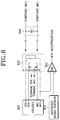
- Fig. 8 illustrates a device for controlling connection of a built-in type ear-microphone for a TDMA portable radio terminal, which can detect switching of an earphone, according to a third embodiment of the present invention.
- a vocoder 800 which is typically implemented by a single chip, compresses input/output audio signals and has speaker nodes SPK+ and SPK- and microphone nodes MIC+ and MIC-. For these nodes, designated I/O nodes are typically used.
- a 4-pole 6-node earphone jack 830 has a first node A connected to the MIC+ node of the vocoder 800, a second node B connected to the MIC- node of the vocoder 800, a third node C connected to a MIC- node of the portable radio terminal, a fourth node D connected to the a SPK- node of the portable radio terminal, a fifth node E connected to the SPK- node of the vocoder 800, and a sixth node F connected to the SPK+ node of the vocoder 800. Further, the first node A is also connected to an inverse input node (-) of a voltage comparator 820.
- the voltage comparator 820 compares input voltages and provides the results to a controller which is implemented by a microprocessor in the portable radio terminal.
- a reference voltage generator 810 generates a predetermined reference voltage and provides the generated reference voltage to the voltage comparator 820 through a non-inverse input node (+).
- An earphone which is normally inserted in an earphone jack 830, includes an earphone speaker and an earphone microphone. Further, the earphone includes an earphone switch 840 for controlling various functions of the portable terminal, such as call start and call end functions.
- the earphone switch 840 is connected between an earphone MIC+ line and an earphone MIC- line.
- an earphone speaker line is also divided into a positive (+) speaker line and a negative (-) speaker line. Since the earphone device employs the double ended technique, the speaker node, the microphone node and the earphone line are divided into positive (+) and negative (-) sides, respectively.
- the conventional built-in type ear-microphone of FIG 4 employs the single ended technique.
- the double ended technique is used to minimize a susceptibility to TDMA noises generated in the TDMA portable terminal. That is, even though instantaneous power consumption increases due to the TDMA noises, the respective positive (+) and negative (-) nodes of the speaker and the microphone cancel the noises, so that the earphone device is insusceptible to the TDMA noises.
- the double ended technique is well known in the art, so the detailed description will be avoided.
- a specific bias voltage is generated between the MIC+ node and the MIC- node of the vocoder 800.
- the MIC- node has 2.2 V and the MIC+ node has 0.3 V.
- the reference voltage generator 810 generates a predetermined reference voltage and provides the generated reference voltage to the non-inverse input node (+) of the voltage comparator 820.
- the reference voltage has a voltage level between 1 V and 1.5 V.
- the earphone switch 840 is opened (i.e., turned OFF)
- a signal from the earphone is applied to the inverse input node (-) of the voltage comparator 820 against an inherent impedance 2.2K ⁇ of the microphone lines of the earphone.
- the voltage at the inverse input node (-) becomes 0.3 V.
- the voltage comparator 820 compares a voltage at the inverse input node (-) with a voltage at the non-inverse input node (+) and provides the results to the controller, wherein the output of the voltage comparator 820 indicates that the earphone switch 840 is turned OFF.
- the earphone switch 840 when the earphone switch 840 is closed (i.e., turned ON), a bias voltage between the earphone MIC+ line and the earphone MIC- line is changed, an increased voltage level (e.g., 2.2 V) is applied to the inverse input node (-) of the voltage comparator 820.
- the voltage comparator 820 compares the applied voltage with the reference voltage received at the non-inverse input node (+), and outputs the reverse results of the switch OFF state. For example, assuming that the voltage comparator 820 outputs a high" signal when the earphone switch 840 is turned OFF, and a low" signal when the earphone switch 840 is turned ON, the voltage comparator 820 will output the low" signal to the controller.
- the controller then performs a corresponding operation according to the signal output from the voltage comparator 820.
- the corresponding operation includes call start, call end, voice recognition start functions. That is, it is possible to detect switching of the earphone switch 840 depending on the output of the voltage comparator 820.
- the above operation is performed in the state where the earphone plug is inserted in the earphone jack 830. When the earphone plug is not inserted, the operation of detecting switching of the earphone switch is not performed, thereby avoiding unnecessary power consumption.
- Fig. 9 illustrates a device for controlling connection of a built-in type ear-microphone for a TDMA portable radio terminal, which can detect insertion of an earphone, according to a fourth embodiment of the present invention.
- a vocoder 900, a reference voltage generator 910, a voltage comparator 920 and an earphone jack 930 have the same structures and functions as those in Fig. 8.
- a third node C of the earphone jack 930 is commonly connected to an inverse input node (-) of the voltage comparator 920 and a MIC- node of the terminal.
- a first node A is connected to a MIC+ node of the terminal. This connection is used to detect insertion of the earphone plug.
- the reference voltage from the reference voltage generator 910 is provided to the voltage comparator 920.
- the third node C is connected to the second node B, so that a bias voltage from the MIC- node of the vocoder 900 is applied to the inverse input node (-) of the voltage comparator 920.
- the voltage comparator 920 will output a low " signal and provide the output signal to the controller.
- the controller then set an audio signal path of the vocoder 900 to the speaker and microphone in the portable terminal body.
- fourth and fifth nodes D and E of the earphone jack 930 are disconnected from each other and the third node C is floated to 0 V.
- the voltage comparator 920 compares the floated voltage 0 V with the reference voltage and outputs a high" signal. The controller then recognizes insertion of the earphone plug and performs a corresponding operation.
- the device according to the present invention has the following advantages:
Landscapes
- Engineering & Computer Science (AREA)
- Signal Processing (AREA)
- Physics & Mathematics (AREA)
- Acoustics & Sound (AREA)
- Health & Medical Sciences (AREA)
- Otolaryngology (AREA)
- Computer Networks & Wireless Communication (AREA)
- Headphones And Earphones (AREA)
- Telephone Function (AREA)
Applications Claiming Priority (4)
| Application Number | Priority Date | Filing Date | Title |
|---|---|---|---|
| KR9847904 | 1998-11-07 | ||
| KR9847903 | 1998-11-07 | ||
| KR1019980047904A KR100557155B1 (ko) | 1998-11-07 | 1998-11-07 | 휴대용 무선 단말기에서 내장형 이어폰-마이크로폰 접속을제어하기 위한 회로 |
| KR1019980047903A KR100322049B1 (ko) | 1998-11-07 | 1998-11-07 | 시분할다중접속방식 휴대단말기의 내장형 이어폰 장치 |
Publications (2)
| Publication Number | Publication Date |
|---|---|
| EP0999721A2 true EP0999721A2 (de) | 2000-05-10 |
| EP0999721A3 EP0999721A3 (de) | 2003-05-21 |
Family
ID=26634308
Family Applications (1)
| Application Number | Title | Priority Date | Filing Date |
|---|---|---|---|
| EP99122154A Ceased EP0999721A3 (de) | 1998-11-07 | 1999-11-05 | Gerät zur Verbindungssteuerung von einem eingebauten Ohrmikrofon für tragbares Funkendgerät |
Country Status (2)
| Country | Link |
|---|---|
| US (1) | US6397087B1 (de) |
| EP (1) | EP0999721A3 (de) |
Cited By (5)
| Publication number | Priority date | Publication date | Assignee | Title |
|---|---|---|---|---|
| DE102007046438A1 (de) * | 2007-09-28 | 2008-10-30 | Siemens Audiologische Technik Gmbh | Hörhilfegerät oder Hörhilfegerätesystem mit einer Klinkenbuchse |
| CN102395084A (zh) * | 2011-11-11 | 2012-03-28 | 杭州硅星科技有限公司 | 耳麦电路 |
| CN102595299A (zh) * | 2010-11-22 | 2012-07-18 | 快捷半导体(苏州)有限公司 | 配件检测系统和方法 |
| EP3122064A1 (de) * | 2015-07-20 | 2017-01-25 | Samsung Electronics Co., Ltd. | Verfahren und vorrichtung zur konfigurierung einer ausgabeschnittstelle basierend auf dem konnektortyp |
| CN106537932A (zh) * | 2014-07-23 | 2017-03-22 | 三星电子株式会社 | 耳机及耳机操作方法 |
Families Citing this family (67)
| Publication number | Priority date | Publication date | Assignee | Title |
|---|---|---|---|---|
| JP3855015B2 (ja) * | 1999-02-25 | 2006-12-06 | 株式会社ノボル電機製作所 | ハンドセット押えを有する電話機 |
| JP2001136251A (ja) * | 1999-11-05 | 2001-05-18 | Matsushita Electric Ind Co Ltd | 折畳式携帯電話装置 |
| EP1154621B1 (de) * | 2000-05-11 | 2008-01-23 | Lucent Technologies Inc. | Mobilstation für Telekommunikationssystem |
| US20040125979A1 (en) * | 2001-08-07 | 2004-07-01 | Josef Elidan | Earphone for a cellular phone |
| KR100422475B1 (ko) * | 2001-09-25 | 2004-03-11 | 에스케이텔레텍주식회사 | 이어잭에 접속되는 스피커모듈과 이를 이용한 통화방법 |
| US20030060242A1 (en) * | 2001-09-27 | 2003-03-27 | Kevin Dotzler | Microphone switchover circuit |
| KR100396267B1 (ko) * | 2001-10-24 | 2003-09-02 | 삼성전자주식회사 | 통신 단말기에서 이어마이크로폰 상태 확인 방법 |
| WO2003051022A1 (en) * | 2001-12-12 | 2003-06-19 | Gary Ragner | Audio extension for wireless communication devices |
| US7373182B2 (en) * | 2002-03-01 | 2008-05-13 | Varia Mobil Llc | Wireless mobile phone including a headset |
| US7187948B2 (en) * | 2002-04-09 | 2007-03-06 | Skullcandy, Inc. | Personal portable integrator for music player and mobile phone |
| USD471890S1 (en) | 2002-04-19 | 2003-03-18 | Alan P. Clarkson | Light weight headset for remote hands free connection to mobile phone |
| US6771780B2 (en) * | 2002-04-22 | 2004-08-03 | Chi-Lin Hong | Tri-functional dual earphone device |
| US20040204170A1 (en) * | 2002-05-01 | 2004-10-14 | Mkhitarian Harry A. | Mobile phone battery pack and battery cover with earphone-microphone earpiece jack |
| US7406339B2 (en) * | 2002-08-05 | 2008-07-29 | Qualcomm Incorporated | On-chip detection circuit off-chip mechanical switch's open and close actions |
| TW589527B (en) * | 2002-09-20 | 2004-06-01 | Realtek Semiconductor Corp | Device and method for automatically recognizing output and input of analog signal |
| TW595239B (en) * | 2003-01-28 | 2004-06-21 | Htc Corp | Detection circuit to detect the earphone type plugged into the insertion hole |
| TWI226731B (en) * | 2003-03-26 | 2005-01-11 | Realtek Semiconductor Corp | Multi-jacks detector |
| KR20040090577A (ko) * | 2003-04-17 | 2004-10-26 | 주식회사 팬택앤큐리텔 | 무선통신 단말기의 스트로보 자동 감지 장치 및 그 방법 |
| US6928176B2 (en) * | 2003-05-13 | 2005-08-09 | Princeton Technology Corporation | Switching circuit built in IC for earphone and loudspeaker of portable information device |
| TW594544B (en) * | 2003-05-14 | 2004-06-21 | Benq Corp | Interface device for automatically determining peripherals and electronic device having such a function |
| US6902412B2 (en) * | 2003-08-26 | 2005-06-07 | Motorola, Inc. | Apparatus for intrinsically safe power interface |
| US7349546B2 (en) * | 2003-09-04 | 2008-03-25 | Kyocera Wireless Corp. | System and method for identifying a headset type in an electrical device |
| USD494157S1 (en) | 2003-09-16 | 2004-08-10 | Motorola Inc. | Communication device |
| USD494575S1 (en) | 2003-09-16 | 2004-08-17 | Motorola, Inc. | Communication device |
| TW200514415A (en) * | 2003-10-08 | 2005-04-16 | qing-chang Ou | Multiple audio-source on-line real-time listening and recording device |
| USD494576S1 (en) | 2003-10-29 | 2004-08-17 | Motorola, Inc. | Wireless accessory for a communication device |
| KR100540835B1 (ko) * | 2003-10-29 | 2006-01-10 | 주식회사 팬택앤큐리텔 | 이동통신 단말기에서의 이어_핸즈프리 신호 처리 장치 |
| US7023983B2 (en) * | 2003-12-30 | 2006-04-04 | Qualcomm Incorporated | Versatile circuit for interfacing with audio headsets |
| KR100663511B1 (ko) * | 2004-01-24 | 2007-01-02 | 삼성전자주식회사 | 이동통신 단말에서 이어-마이크 폰을 위한 이어폰 마이크바이어스 전원 공급회로 |
| US20060013410A1 (en) * | 2004-04-20 | 2006-01-19 | Wurtz Michael J | Mobile-telephone adapters for automatic-noise-reduction headphones |
| KR100559039B1 (ko) * | 2004-05-18 | 2006-03-10 | 주식회사 팬택 | 이동 통신 단말기의 음성 처리 장치 및 방법 |
| KR100907451B1 (ko) * | 2004-10-25 | 2009-07-13 | 노키아 코포레이션 | 비디오/오디오 플러그를 통하여 전자 장치에 연결된 주변장치의 감지, 식별 및 동작 |
| FR2881005B1 (fr) * | 2005-01-18 | 2007-03-30 | Atmel Corp | Methode et topologie pour commuter un etage de sortie dans un amplificateur audio de classe ab pour des applications sans fil |
| EP1839378A4 (de) * | 2005-01-18 | 2009-01-14 | Atmel Corp | Verfahren und topologie zum schalten einer ausgangsstufe in einem klasse-ab-audioverstärker für drahtlose anwendungen |
| US20060183509A1 (en) * | 2005-02-16 | 2006-08-17 | Shuyong Shao | DC power source for an accessory of a portable communication device |
| US20060218327A1 (en) * | 2005-03-23 | 2006-09-28 | Dell Products L.P. | Information handling system including detection of an audio input device |
| US7929991B2 (en) * | 2005-03-31 | 2011-04-19 | Qualcomm Incorporated | Mobile device interface for input devices |
| KR101191263B1 (ko) * | 2005-10-19 | 2012-10-16 | 엘지전자 주식회사 | 스피커폰 기능 사용여부를 상대방에게 알려주는 방법 |
| US20090264147A1 (en) * | 2005-10-26 | 2009-10-22 | Jun Kuroda | Telephone terminal and signal processing method |
| KR101177948B1 (ko) * | 2006-01-13 | 2012-08-28 | 삼성전자주식회사 | PoC 시스템에서 미디어 전송 시간 정보 제공을 위한단말 장치 및 방법과 미디어 전송 시간 정보 제공을 위한PoC 시스템 |
| US7912501B2 (en) | 2007-01-05 | 2011-03-22 | Apple Inc. | Audio I/O headset plug and plug detection circuitry |
| US8144915B2 (en) * | 2007-01-06 | 2012-03-27 | Apple Inc. | Wired headset with integrated switch |
| USD579413S1 (en) | 2007-08-27 | 2008-10-28 | Ernie Ball, Inc. | Amplifier cable plug end |
| USD577678S1 (en) | 2007-11-28 | 2008-09-30 | Ernie Ball, Inc. | Cable plug |
| US8600080B2 (en) | 2008-01-14 | 2013-12-03 | Apple Inc. | Methods for communicating with electronic device accessories |
| US8831680B2 (en) * | 2008-01-31 | 2014-09-09 | Qualcomm Incorporated | Flexible audio control in mobile computing device |
| US8861743B2 (en) * | 2008-05-30 | 2014-10-14 | Apple Inc. | Headset microphone type detect |
| KR20100034229A (ko) * | 2008-09-23 | 2010-04-01 | 삼성전자주식회사 | 이어폰 회로를 포함하는 휴대 단말기 및 이의 운용방법 |
| JP4612728B2 (ja) * | 2009-06-09 | 2011-01-12 | 株式会社東芝 | 音声出力装置、及び音声処理システム |
| CN101719610A (zh) * | 2009-12-30 | 2010-06-02 | 华为终端有限公司 | 一种有线耳机兼容方法和装置 |
| CN102740185A (zh) * | 2011-04-01 | 2012-10-17 | 富泰华工业(深圳)有限公司 | 音频设备及其耳机插拔静音方法 |
| CN102740180A (zh) * | 2011-04-01 | 2012-10-17 | 富泰华工业(深圳)有限公司 | 一种用于播音装置的播音方法 |
| US8616214B2 (en) | 2011-04-06 | 2013-12-31 | Kimberly-Clark Worldwide, Inc. | Earplug having a resilient core structure |
| CN102395069A (zh) * | 2011-08-22 | 2012-03-28 | 华为终端有限公司 | 用于兼容不同插头类型的耳机的方法、装置及终端设备 |
| US9031253B2 (en) * | 2011-12-16 | 2015-05-12 | Qualcomm Incorporated | Plug insertion detection |
| KR101832832B1 (ko) * | 2011-12-26 | 2018-02-28 | 삼성전자주식회사 | 휴대용 단말기의 배터리 팩 충전 장치 및 방법 |
| USD692852S1 (en) * | 2012-04-09 | 2013-11-05 | Rocco Joseph DeLeonardis | Hands free/tangle free device for cellular telephone |
| JP5745476B2 (ja) * | 2012-08-08 | 2015-07-08 | ビートロボ, インコーポレーテッドBeatrobo, Inc. | 接続デバイス、アプリケーションプログラムおよびコンテンツ取得システム |
| CN103634106A (zh) * | 2012-08-29 | 2014-03-12 | 北京同方微电子有限公司 | 一种自适应的音频智能密码钥匙及其实现方法 |
| KR101937839B1 (ko) | 2012-08-29 | 2019-04-10 | 삼성전자 주식회사 | 이어폰 접속 인터페이스 및 이를 포함하는 단말기와 단말기 운용 방법 |
| KR20140047201A (ko) * | 2012-10-08 | 2014-04-22 | 삼성전자주식회사 | 단말기의 이어마이크 폰의 삽입 감지 장치 및 방법 |
| US9681241B2 (en) * | 2013-02-26 | 2017-06-13 | Blackberry Limited | Apparatus, systems and methods for detecting insertion or removal of an audio accessory from an electronic device |
| USD780726S1 (en) * | 2015-12-04 | 2017-03-07 | Howard Wang | Wireless adapter |
| KR102395343B1 (ko) | 2016-02-04 | 2022-05-09 | 삼성전자주식회사 | 전자 장치에서 노이즈를 방지하는 장치 |
| US9813800B2 (en) * | 2016-03-11 | 2017-11-07 | Terry Stringer | Audio surveillance system |
| ES2690155A1 (es) * | 2017-05-17 | 2018-11-19 | Juan Mondejar Capsir | Dispositivo de comunicación adherible a prendas de vestir |
| CN114974320B (zh) * | 2021-02-24 | 2024-08-13 | 瑞昱半导体股份有限公司 | 音频转接器的控制电路及控制方法 |
Family Cites Families (6)
| Publication number | Priority date | Publication date | Assignee | Title |
|---|---|---|---|---|
| SE466427B (sv) * | 1990-06-25 | 1992-02-10 | Ericsson Telefon Ab L M | Handfrigoeringsmodul foer en mobiltelefon |
| US5257413A (en) * | 1991-10-10 | 1993-10-26 | Motorola, Inc. | Option selection method and apparatus |
| JPH07203582A (ja) * | 1994-01-06 | 1995-08-04 | Uniden Corp | ヘッドフォーンおよびイヤーフォーン共用回路 |
| JP3656334B2 (ja) * | 1996-09-05 | 2005-06-08 | ソニー株式会社 | ステレオ音声/映像装置の接続装置 |
| US6181801B1 (en) * | 1997-04-03 | 2001-01-30 | Resound Corporation | Wired open ear canal earpiece |
| US5978689A (en) * | 1997-07-09 | 1999-11-02 | Tuoriniemi; Veijo M. | Personal portable communication and audio system |
-
1999
- 1999-11-05 EP EP99122154A patent/EP0999721A3/de not_active Ceased
- 1999-11-08 US US09/436,290 patent/US6397087B1/en not_active Expired - Lifetime
Cited By (13)
| Publication number | Priority date | Publication date | Assignee | Title |
|---|---|---|---|---|
| DE102007046438A1 (de) * | 2007-09-28 | 2008-10-30 | Siemens Audiologische Technik Gmbh | Hörhilfegerät oder Hörhilfegerätesystem mit einer Klinkenbuchse |
| CN102595299A (zh) * | 2010-11-22 | 2012-07-18 | 快捷半导体(苏州)有限公司 | 配件检测系统和方法 |
| US9014388B2 (en) | 2010-11-22 | 2015-04-21 | Fairchild Semiconductor Corporation | Enable and disable comparator voltage reference |
| CN102595299B (zh) * | 2010-11-22 | 2015-09-23 | 快捷半导体(苏州)有限公司 | 配件检测系统和方法 |
| US9635453B2 (en) | 2010-11-22 | 2017-04-25 | Fairchild Semiconductor Corporation | Enable and disable comparator voltage reference |
| US10142751B2 (en) | 2010-11-22 | 2018-11-27 | Fairchild Semiconductor Corporation | Enable and disable comparator voltage reference |
| CN102395084A (zh) * | 2011-11-11 | 2012-03-28 | 杭州硅星科技有限公司 | 耳麦电路 |
| CN102395084B (zh) * | 2011-11-11 | 2014-05-14 | 杭州硅星科技有限公司 | 耳麦电路 |
| US10225642B2 (en) | 2014-07-23 | 2019-03-05 | Samsung Electronics Co., Ltd. | Earset and earset operation method |
| CN106537932A (zh) * | 2014-07-23 | 2017-03-22 | 三星电子株式会社 | 耳机及耳机操作方法 |
| CN106537932B (zh) * | 2014-07-23 | 2019-05-28 | 三星电子株式会社 | 耳机及耳机操作方法 |
| EP3122064A1 (de) * | 2015-07-20 | 2017-01-25 | Samsung Electronics Co., Ltd. | Verfahren und vorrichtung zur konfigurierung einer ausgabeschnittstelle basierend auf dem konnektortyp |
| US9949024B2 (en) | 2015-07-20 | 2018-04-17 | Samsung Electronics Co., Ltd | Method and apparatus for controlling output based on type of connector |
Also Published As
| Publication number | Publication date |
|---|---|
| US6397087B1 (en) | 2002-05-28 |
| EP0999721A3 (de) | 2003-05-21 |
Similar Documents
| Publication | Publication Date | Title |
|---|---|---|
| EP0999721A2 (de) | Gerät zur Verbindungssteuerung von einem eingebauten Ohrmikrofon für tragbares Funkendgerät | |
| US7340284B2 (en) | Device for connecting ear-microphone to mobile phone through interface connector thereof | |
| JP3428532B2 (ja) | 開閉角度検出装置及び折り畳み式機器 | |
| US5802167A (en) | Hands-free device for use with a cellular telephone in a car to permit hands-free operation of the cellular telephone | |
| JP3349449B2 (ja) | イヤホン・マイクロホンセット用アダプター | |
| US8111841B2 (en) | Audio input/output device and method for switching input/output functions | |
| JP4099520B2 (ja) | 移動端末装置及びヘッドセット | |
| JPH07203582A (ja) | ヘッドフォーンおよびイヤーフォーン共用回路 | |
| JP3398699B2 (ja) | 携帯端末装置 | |
| KR100557155B1 (ko) | 휴대용 무선 단말기에서 내장형 이어폰-마이크로폰 접속을제어하기 위한 회로 | |
| US20050111670A1 (en) | Stereo audio headset interface and method that is compatible with mono headsets | |
| KR20070022442A (ko) | 이어폰 삽입 순간의 팝업 노이즈 차단 기능을 가진이동통신 단말기 | |
| JP2005191651A (ja) | 携帯電話システム | |
| JP3878884B2 (ja) | ジャック回路、これを利用する携帯型電子機器および電話機 | |
| KR200226159Y1 (ko) | 이동통신 단말기 | |
| US7120260B2 (en) | Jack circuit and portable type electronic apparatus and telephone set using the same | |
| KR100455148B1 (ko) | 4극잭 이동통신 단말기의 단락방지회로 | |
| KR100393812B1 (ko) | 리모콘 스위치 증가장치 및 방법 | |
| CN221886695U (zh) | 一种双声道有线耳机和音频转接线 | |
| KR100268711B1 (ko) | 휴대형 이동 전화기 | |
| KR100322049B1 (ko) | 시분할다중접속방식 휴대단말기의 내장형 이어폰 장치 | |
| KR100352329B1 (ko) | 이동 통신 단말기의 대기 시간 개선을 위한 이어폰(Earphone) 회로. | |
| KR100630205B1 (ko) | 이어폰 플러그 연결 여부 검출장치 | |
| KR200284742Y1 (ko) | 헤드셋/스피커 겸용 사운드신호 절환시스템 | |
| KR100258218B1 (ko) | 플러그 접속장치 및 방법 |
Legal Events
| Date | Code | Title | Description |
|---|---|---|---|
| PUAI | Public reference made under article 153(3) epc to a published international application that has entered the european phase |
Free format text: ORIGINAL CODE: 0009012 |
|
| 17P | Request for examination filed |
Effective date: 19991105 |
|
| AK | Designated contracting states |
Kind code of ref document: A2 Designated state(s): AT BE CH CY DE DK ES FI FR GB GR IE IT LI LU MC NL PT SE |
|
| AX | Request for extension of the european patent |
Free format text: AL;LT;LV;MK;RO;SI |
|
| PUAL | Search report despatched |
Free format text: ORIGINAL CODE: 0009013 |
|
| AK | Designated contracting states |
Designated state(s): AT BE CH CY DE DK ES FI FR GB GR IE IT LI LU MC NL PT SE |
|
| AX | Request for extension of the european patent |
Extension state: AL LT LV MK RO SI |
|
| RIC1 | Information provided on ipc code assigned before grant |
Ipc: 7H 04M 1/60 B Ipc: 7H 04R 1/10 A |
|
| AKX | Designation fees paid |
Designated state(s): DE FR GB |
|
| 17Q | First examination report despatched |
Effective date: 20071008 |
|
| RAP1 | Party data changed (applicant data changed or rights of an application transferred) |
Owner name: SAMSUNG ELECTRONICS CO., LTD. |
|
| RIC1 | Information provided on ipc code assigned before grant |
Ipc: H04R 1/10 20060101ALI20130122BHEP Ipc: H04M 1/60 20060101AFI20130122BHEP Ipc: H04B 1/38 20060101ALI20130122BHEP Ipc: H04M 1/05 20060101ALI20130122BHEP |
|
| STAA | Information on the status of an ep patent application or granted ep patent |
Free format text: STATUS: THE APPLICATION HAS BEEN REFUSED |
|
| 18R | Application refused |
Effective date: 20140116 |