EP1000138B1 - Microemulsions aqueuses - Google Patents
Microemulsions aqueuses Download PDFInfo
- Publication number
- EP1000138B1 EP1000138B1 EP98938097A EP98938097A EP1000138B1 EP 1000138 B1 EP1000138 B1 EP 1000138B1 EP 98938097 A EP98938097 A EP 98938097A EP 98938097 A EP98938097 A EP 98938097A EP 1000138 B1 EP1000138 B1 EP 1000138B1
- Authority
- EP
- European Patent Office
- Prior art keywords
- microemulsion
- esters
- group
- mixtures
- surfactant
- Prior art date
- Legal status (The legal status is an assumption and is not a legal conclusion. Google has not performed a legal analysis and makes no representation as to the accuracy of the status listed.)
- Expired - Lifetime
Links
- 239000004530 micro-emulsion Substances 0.000 title claims abstract description 121
- XLYOFNOQVPJJNP-UHFFFAOYSA-N water Substances O XLYOFNOQVPJJNP-UHFFFAOYSA-N 0.000 claims abstract description 54
- 229930195733 hydrocarbon Natural products 0.000 claims abstract description 36
- 150000002430 hydrocarbons Chemical class 0.000 claims abstract description 36
- 150000002009 diols Chemical class 0.000 claims abstract description 33
- 239000004215 Carbon black (E152) Substances 0.000 claims abstract description 32
- 239000003945 anionic surfactant Substances 0.000 claims abstract description 5
- 125000004432 carbon atom Chemical group C* 0.000 claims abstract description 5
- 239000000203 mixture Substances 0.000 claims description 88
- 239000004094 surface-active agent Substances 0.000 claims description 44
- 150000002148 esters Chemical class 0.000 claims description 34
- 238000004140 cleaning Methods 0.000 claims description 31
- -1 tetraesters Chemical class 0.000 claims description 21
- 239000003960 organic solvent Substances 0.000 claims description 19
- SVTBMSDMJJWYQN-UHFFFAOYSA-N 2-methylpentane-2,4-diol Chemical compound CC(O)CC(C)(C)O SVTBMSDMJJWYQN-UHFFFAOYSA-N 0.000 claims description 18
- 239000002562 thickening agent Substances 0.000 claims description 14
- 150000001279 adipic acids Chemical class 0.000 claims description 12
- 150000001298 alcohols Chemical class 0.000 claims description 12
- FBELJLCOAHMRJK-UHFFFAOYSA-L disodium;2,2-bis(2-ethylhexyl)-3-sulfobutanedioate Chemical group [Na+].[Na+].CCCCC(CC)CC(C([O-])=O)(C(C([O-])=O)S(O)(=O)=O)CC(CC)CCCC FBELJLCOAHMRJK-UHFFFAOYSA-L 0.000 claims description 12
- 150000002311 glutaric acids Chemical class 0.000 claims description 12
- 239000002904 solvent Substances 0.000 claims description 12
- 235000011044 succinic acid Nutrition 0.000 claims description 12
- 150000003444 succinic acids Chemical class 0.000 claims description 12
- XMGQYMWWDOXHJM-JTQLQIEISA-N (+)-α-limonene Chemical compound CC(=C)[C@@H]1CCC(C)=CC1 XMGQYMWWDOXHJM-JTQLQIEISA-N 0.000 claims description 11
- 229940015975 1,2-hexanediol Drugs 0.000 claims description 9
- QWGRWMMWNDWRQN-UHFFFAOYSA-N 2-methylpropane-1,3-diol Chemical compound OCC(C)CO QWGRWMMWNDWRQN-UHFFFAOYSA-N 0.000 claims description 9
- FHKSXSQHXQEMOK-UHFFFAOYSA-N hexane-1,2-diol Chemical compound CCCCC(O)CO FHKSXSQHXQEMOK-UHFFFAOYSA-N 0.000 claims description 9
- SLCVBVWXLSEKPL-UHFFFAOYSA-N neopentyl glycol Chemical compound OCC(C)(C)CO SLCVBVWXLSEKPL-UHFFFAOYSA-N 0.000 claims description 9
- 150000001242 acetic acid derivatives Chemical class 0.000 claims description 7
- 150000004996 alkyl benzenes Chemical class 0.000 claims description 7
- LYCAIKOWRPUZTN-UHFFFAOYSA-N ethylene glycol Natural products OCCO LYCAIKOWRPUZTN-UHFFFAOYSA-N 0.000 claims description 7
- 150000002596 lactones Chemical class 0.000 claims description 7
- SECXISVLQFMRJM-UHFFFAOYSA-N N-Methylpyrrolidone Chemical compound CN1CCCC1=O SECXISVLQFMRJM-UHFFFAOYSA-N 0.000 claims description 6
- 229920002125 Sokalan® Polymers 0.000 claims description 6
- RJLKIAGOYBARJG-UHFFFAOYSA-N 1,3-dimethylpiperidin-2-one Chemical compound CC1CCCN(C)C1=O RJLKIAGOYBARJG-UHFFFAOYSA-N 0.000 claims description 5
- 125000002091 cationic group Chemical group 0.000 claims description 5
- RUOJZAUFBMNUDX-UHFFFAOYSA-N propylene carbonate Chemical compound CC1COC(=O)O1 RUOJZAUFBMNUDX-UHFFFAOYSA-N 0.000 claims description 5
- QCAHUFWKIQLBNB-UHFFFAOYSA-N 3-(3-methoxypropoxy)propan-1-ol Chemical compound COCCCOCCCO QCAHUFWKIQLBNB-UHFFFAOYSA-N 0.000 claims description 4
- ULUAUXLGCMPNKK-UHFFFAOYSA-N Sulfobutanedioic acid Chemical compound OC(=O)CC(C(O)=O)S(O)(=O)=O ULUAUXLGCMPNKK-UHFFFAOYSA-N 0.000 claims description 4
- 229920003086 cellulose ether Polymers 0.000 claims description 4
- 150000005690 diesters Chemical class 0.000 claims description 4
- 125000000118 dimethyl group Chemical group [H]C([H])([H])* 0.000 claims description 4
- ACCCMOQWYVYDOT-UHFFFAOYSA-N hexane-1,1-diol Chemical class CCCCCC(O)O ACCCMOQWYVYDOT-UHFFFAOYSA-N 0.000 claims description 4
- WGCNASOHLSPBMP-UHFFFAOYSA-N hydroxyacetaldehyde Natural products OCC=O WGCNASOHLSPBMP-UHFFFAOYSA-N 0.000 claims description 4
- 150000002576 ketones Chemical class 0.000 claims description 4
- 229920000642 polymer Polymers 0.000 claims description 4
- 235000007586 terpenes Nutrition 0.000 claims description 4
- 150000005691 triesters Chemical class 0.000 claims description 4
- 150000004945 aromatic hydrocarbons Chemical class 0.000 claims description 3
- 150000001875 compounds Chemical class 0.000 claims description 3
- 150000003950 cyclic amides Chemical class 0.000 claims description 3
- 150000005676 cyclic carbonates Chemical class 0.000 claims description 3
- WCVRQHFDJLLWFE-UHFFFAOYSA-N pentane-1,2-diol Chemical compound CCCC(O)CO WCVRQHFDJLLWFE-UHFFFAOYSA-N 0.000 claims description 3
- 239000004584 polyacrylic acid Substances 0.000 claims description 3
- 229920002635 polyurethane Polymers 0.000 claims description 3
- 239000004814 polyurethane Substances 0.000 claims description 3
- 150000003462 sulfoxides Chemical class 0.000 claims description 3
- 150000003505 terpenes Chemical class 0.000 claims description 3
- HNSDLXPSAYFUHK-UHFFFAOYSA-N 1,4-bis(2-ethylhexyl) sulfosuccinate Chemical class CCCCC(CC)COC(=O)CC(S(O)(=O)=O)C(=O)OCC(CC)CCCC HNSDLXPSAYFUHK-UHFFFAOYSA-N 0.000 claims description 2
- CBCQTCPKFYFJEU-UHFFFAOYSA-N 1,4-dioxo-1,4-dipentoxybutane-2-sulfonic acid Chemical class CCCCCOC(=O)CC(S(O)(=O)=O)C(=O)OCCCCC CBCQTCPKFYFJEU-UHFFFAOYSA-N 0.000 claims description 2
- KMZHZAAOEWVPSE-UHFFFAOYSA-N 2,3-dihydroxypropyl acetate Chemical compound CC(=O)OCC(O)CO KMZHZAAOEWVPSE-UHFFFAOYSA-N 0.000 claims description 2
- MHIBEGOZTWERHF-UHFFFAOYSA-N heptane-1,1-diol Chemical class CCCCCCC(O)O MHIBEGOZTWERHF-UHFFFAOYSA-N 0.000 claims description 2
- 159000000000 sodium salts Chemical class 0.000 claims description 2
- 125000000545 (4R)-limonene group Chemical group 0.000 claims 1
- CLJDUFMUISGSEC-UHFFFAOYSA-N 1,4-bis(4-methylpentan-2-yloxy)-1,4-dioxobutane-2-sulfonic acid Chemical class CC(C)CC(C)OC(=O)CC(S(O)(=O)=O)C(=O)OC(C)CC(C)C CLJDUFMUISGSEC-UHFFFAOYSA-N 0.000 claims 1
- UFPKCZXPUJSYMN-UHFFFAOYSA-N 4-methylhexane-2,4-diol Chemical compound CCC(C)(O)CC(C)O UFPKCZXPUJSYMN-UHFFFAOYSA-N 0.000 claims 1
- BMRWNKZVCUKKSR-UHFFFAOYSA-N butane-1,2-diol Chemical compound CCC(O)CO BMRWNKZVCUKKSR-UHFFFAOYSA-N 0.000 claims 1
- LFQSCWFLJHTTHZ-UHFFFAOYSA-N Ethanol Chemical compound CCO LFQSCWFLJHTTHZ-UHFFFAOYSA-N 0.000 description 19
- 238000009472 formulation Methods 0.000 description 14
- 239000000839 emulsion Substances 0.000 description 13
- 239000003921 oil Substances 0.000 description 11
- 239000003973 paint Substances 0.000 description 11
- 239000000243 solution Substances 0.000 description 11
- XTDYIOOONNVFMA-UHFFFAOYSA-N dimethyl pentanedioate Chemical compound COC(=O)CCCC(=O)OC XTDYIOOONNVFMA-UHFFFAOYSA-N 0.000 description 10
- DNIAPMSPPWPWGF-UHFFFAOYSA-N Propylene glycol Chemical compound CC(O)CO DNIAPMSPPWPWGF-UHFFFAOYSA-N 0.000 description 9
- 238000000034 method Methods 0.000 description 7
- 238000002156 mixing Methods 0.000 description 7
- 125000003118 aryl group Chemical group 0.000 description 6
- UDSFAEKRVUSQDD-UHFFFAOYSA-N Dimethyl adipate Chemical compound COC(=O)CCCCC(=O)OC UDSFAEKRVUSQDD-UHFFFAOYSA-N 0.000 description 5
- 238000005238 degreasing Methods 0.000 description 5
- 239000004519 grease Substances 0.000 description 5
- MUXOBHXGJLMRAB-UHFFFAOYSA-N Dimethyl succinate Chemical compound COC(=O)CCC(=O)OC MUXOBHXGJLMRAB-UHFFFAOYSA-N 0.000 description 4
- 239000000654 additive Substances 0.000 description 4
- 229910052751 metal Inorganic materials 0.000 description 4
- 239000002184 metal Substances 0.000 description 4
- 239000002689 soil Substances 0.000 description 4
- 238000003756 stirring Methods 0.000 description 4
- 239000000126 substance Substances 0.000 description 4
- OKKJLVBELUTLKV-UHFFFAOYSA-N Methanol Chemical compound OC OKKJLVBELUTLKV-UHFFFAOYSA-N 0.000 description 3
- 238000007792 addition Methods 0.000 description 3
- 230000008901 benefit Effects 0.000 description 3
- 238000010587 phase diagram Methods 0.000 description 3
- APSBXTVYXVQYAB-UHFFFAOYSA-M sodium docusate Chemical compound [Na+].CCCCC(CC)COC(=O)CC(S([O-])(=O)=O)C(=O)OCC(CC)CCCC APSBXTVYXVQYAB-UHFFFAOYSA-M 0.000 description 3
- PUPZLCDOIYMWBV-UHFFFAOYSA-N (+/-)-1,3-Butanediol Chemical compound CC(O)CCO PUPZLCDOIYMWBV-UHFFFAOYSA-N 0.000 description 2
- JSFATNQSLKRBCI-NLORQXDXSA-N 73945-47-8 Chemical compound CCCCCC(O)\C=C\C=C\C\C=C\C\C=C\CCCC(O)=O JSFATNQSLKRBCI-NLORQXDXSA-N 0.000 description 2
- DGAQECJNVWCQMB-PUAWFVPOSA-M Ilexoside XXIX Chemical compound C[C@@H]1CC[C@@]2(CC[C@@]3(C(=CC[C@H]4[C@]3(CC[C@@H]5[C@@]4(CC[C@@H](C5(C)C)OS(=O)(=O)[O-])C)C)[C@@H]2[C@]1(C)O)C)C(=O)O[C@H]6[C@@H]([C@H]([C@@H]([C@H](O6)CO)O)O)O.[Na+] DGAQECJNVWCQMB-PUAWFVPOSA-M 0.000 description 2
- KFZMGEQAYNKOFK-UHFFFAOYSA-N Isopropanol Chemical compound CC(C)O KFZMGEQAYNKOFK-UHFFFAOYSA-N 0.000 description 2
- WHXSMMKQMYFTQS-UHFFFAOYSA-N Lithium Chemical compound [Li] WHXSMMKQMYFTQS-UHFFFAOYSA-N 0.000 description 2
- 235000008331 Pinus X rigitaeda Nutrition 0.000 description 2
- 235000011613 Pinus brutia Nutrition 0.000 description 2
- 241000018646 Pinus brutia Species 0.000 description 2
- 230000015572 biosynthetic process Effects 0.000 description 2
- 230000008859 change Effects 0.000 description 2
- 239000011248 coating agent Substances 0.000 description 2
- 238000000576 coating method Methods 0.000 description 2
- 238000001816 cooling Methods 0.000 description 2
- FSCIDASGDAWVED-UHFFFAOYSA-N dimethyl hexanedioate;dimethyl pentanedioate Chemical compound COC(=O)CCCC(=O)OC.COC(=O)CCCCC(=O)OC FSCIDASGDAWVED-UHFFFAOYSA-N 0.000 description 2
- 238000010438 heat treatment Methods 0.000 description 2
- ZSIAUFGUXNUGDI-UHFFFAOYSA-N hexan-1-ol Chemical compound CCCCCCO ZSIAUFGUXNUGDI-UHFFFAOYSA-N 0.000 description 2
- 229940051250 hexylene glycol Drugs 0.000 description 2
- 125000002887 hydroxy group Chemical group [H]O* 0.000 description 2
- 238000007654 immersion Methods 0.000 description 2
- 229910052744 lithium Inorganic materials 0.000 description 2
- 238000003760 magnetic stirring Methods 0.000 description 2
- 239000000693 micelle Substances 0.000 description 2
- 239000011368 organic material Substances 0.000 description 2
- 235000019271 petrolatum Nutrition 0.000 description 2
- 238000005191 phase separation Methods 0.000 description 2
- XNGIFLGASWRNHJ-UHFFFAOYSA-N phthalic acid Chemical compound OC(=O)C1=CC=CC=C1C(O)=O XNGIFLGASWRNHJ-UHFFFAOYSA-N 0.000 description 2
- 229910052708 sodium Inorganic materials 0.000 description 2
- 239000011734 sodium Substances 0.000 description 2
- BTJYKXPSPBJJDQ-UHFFFAOYSA-M sodium;1,4-bis(4-methylpentan-2-yloxy)-1,4-dioxobutane-2-sulfonate Chemical compound [Na+].CC(C)CC(C)OC(=O)CC(S([O-])(=O)=O)C(=O)OC(C)CC(C)C BTJYKXPSPBJJDQ-UHFFFAOYSA-M 0.000 description 2
- 238000010998 test method Methods 0.000 description 2
- DAFHKNAQFPVRKR-UHFFFAOYSA-N (3-hydroxy-2,2,4-trimethylpentyl) 2-methylpropanoate Chemical compound CC(C)C(O)C(C)(C)COC(=O)C(C)C DAFHKNAQFPVRKR-UHFFFAOYSA-N 0.000 description 1
- 229940031723 1,2-octanediol Drugs 0.000 description 1
- XHEDTHUFPRAWPH-UHFFFAOYSA-N 1,4-bis(4-methylpentan-2-yloxy)-1,4-dioxobutane-2-sulfonic acid;sodium Chemical compound [Na].CC(C)CC(C)OC(=O)CC(S(O)(=O)=O)C(=O)OC(C)CC(C)C XHEDTHUFPRAWPH-UHFFFAOYSA-N 0.000 description 1
- WVUYYXUATWMVIT-UHFFFAOYSA-N 1-bromo-4-ethoxybenzene Chemical compound CCOC1=CC=C(Br)C=C1 WVUYYXUATWMVIT-UHFFFAOYSA-N 0.000 description 1
- BRPZWLMGTNHYJB-UHFFFAOYSA-N 2,2-bis(4-methylpentan-2-yl)-3-sulfobutanedioic acid Chemical compound CC(C)CC(C)C(C(O)=O)(C(C(O)=O)S(O)(=O)=O)C(C)CC(C)C BRPZWLMGTNHYJB-UHFFFAOYSA-N 0.000 description 1
- UWNADWZGEHDQAB-UHFFFAOYSA-N 2,5-dimethylhexane Chemical group CC(C)CCC(C)C UWNADWZGEHDQAB-UHFFFAOYSA-N 0.000 description 1
- RVHOBHMAPRVOLO-UHFFFAOYSA-N 2-ethylbutanedioic acid Chemical compound CCC(C(O)=O)CC(O)=O RVHOBHMAPRVOLO-UHFFFAOYSA-N 0.000 description 1
- 241001454395 Alvania Species 0.000 description 1
- OYPRJOBELJOOCE-UHFFFAOYSA-N Calcium Chemical compound [Ca] OYPRJOBELJOOCE-UHFFFAOYSA-N 0.000 description 1
- 208000032538 Depersonalisation Diseases 0.000 description 1
- VGGSQFUCUMXWEO-UHFFFAOYSA-N Ethene Chemical compound C=C VGGSQFUCUMXWEO-UHFFFAOYSA-N 0.000 description 1
- 101100074988 Neurospora crassa (strain ATCC 24698 / 74-OR23-1A / CBS 708.71 / DSM 1257 / FGSC 987) nmp-1 gene Proteins 0.000 description 1
- CTQNGGLPUBDAKN-UHFFFAOYSA-N O-Xylene Chemical compound CC1=CC=CC=C1C CTQNGGLPUBDAKN-UHFFFAOYSA-N 0.000 description 1
- 238000000333 X-ray scattering Methods 0.000 description 1
- 230000000996 additive effect Effects 0.000 description 1
- WNLRTRBMVRJNCN-UHFFFAOYSA-L adipate(2-) Chemical compound [O-]C(=O)CCCCC([O-])=O WNLRTRBMVRJNCN-UHFFFAOYSA-L 0.000 description 1
- 239000000443 aerosol Substances 0.000 description 1
- 125000005907 alkyl ester group Chemical group 0.000 description 1
- 125000000129 anionic group Chemical group 0.000 description 1
- 230000003139 buffering effect Effects 0.000 description 1
- 125000000484 butyl group Chemical group [H]C([*])([H])C([H])([H])C([H])([H])C([H])([H])[H] 0.000 description 1
- 229910052791 calcium Inorganic materials 0.000 description 1
- 239000011575 calcium Substances 0.000 description 1
- 239000004927 clay Substances 0.000 description 1
- 238000010276 construction Methods 0.000 description 1
- 230000007423 decrease Effects 0.000 description 1
- 238000007865 diluting Methods 0.000 description 1
- 239000003085 diluting agent Substances 0.000 description 1
- QYMFNZIUDRQRSA-UHFFFAOYSA-N dimethyl butanedioate;dimethyl hexanedioate;dimethyl pentanedioate Chemical compound COC(=O)CCC(=O)OC.COC(=O)CCCC(=O)OC.COC(=O)CCCCC(=O)OC QYMFNZIUDRQRSA-UHFFFAOYSA-N 0.000 description 1
- BNMYXGKEMMVHOX-UHFFFAOYSA-N dimethyl butanedioate;dimethyl pentanedioate Chemical compound COC(=O)CCC(=O)OC.COC(=O)CCCC(=O)OC BNMYXGKEMMVHOX-UHFFFAOYSA-N 0.000 description 1
- OGQYPPBGSLZBEG-UHFFFAOYSA-N dimethyl(dioctadecyl)azanium Chemical compound CCCCCCCCCCCCCCCCCC[N+](C)(C)CCCCCCCCCCCCCCCCCC OGQYPPBGSLZBEG-UHFFFAOYSA-N 0.000 description 1
- SNRUBQQJIBEYMU-UHFFFAOYSA-N dodecane Chemical group CCCCCCCCCCCC SNRUBQQJIBEYMU-UHFFFAOYSA-N 0.000 description 1
- 238000002296 dynamic light scattering Methods 0.000 description 1
- 239000003759 ester based solvent Substances 0.000 description 1
- 150000002170 ethers Chemical class 0.000 description 1
- 239000011152 fibreglass Substances 0.000 description 1
- JFCQEDHGNNZCLN-UHFFFAOYSA-N glutaric acid Chemical compound OC(=O)CCCC(O)=O JFCQEDHGNNZCLN-UHFFFAOYSA-N 0.000 description 1
- 230000000415 inactivating effect Effects 0.000 description 1
- 238000011835 investigation Methods 0.000 description 1
- 229940094522 laponite Drugs 0.000 description 1
- XCOBTUNSZUJCDH-UHFFFAOYSA-B lithium magnesium sodium silicate Chemical compound [Li+].[Li+].[OH-].[OH-].[OH-].[OH-].[OH-].[OH-].[OH-].[OH-].[OH-].[OH-].[OH-].[OH-].[Na+].[Na+].[Mg+2].[Mg+2].[Mg+2].[Mg+2].[Mg+2].[Mg+2].[Mg+2].[Mg+2].[Mg+2].[Mg+2].[Mg+2].[Mg+2].[Mg+2].[Mg+2].[Mg+2].[Mg+2].O1[Si](O2)([O-])O[Si]3([O-])O[Si]1([O-])O[Si]2([O-])O3.O1[Si](O2)([O-])O[Si]3([O-])O[Si]1([O-])O[Si]2([O-])O3.O1[Si](O2)([O-])O[Si]3([O-])O[Si]1([O-])O[Si]2([O-])O3.O1[Si](O2)([O-])O[Si]3([O-])O[Si]1([O-])O[Si]2([O-])O3.O1[Si](O2)([O-])O[Si]3([O-])O[Si]1([O-])O[Si]2([O-])O3.O1[Si](O2)([O-])O[Si]3([O-])O[Si]1([O-])O[Si]2([O-])O3 XCOBTUNSZUJCDH-UHFFFAOYSA-B 0.000 description 1
- 239000000391 magnesium silicate Substances 0.000 description 1
- 235000012243 magnesium silicates Nutrition 0.000 description 1
- 239000000463 material Substances 0.000 description 1
- AEIJTFQOBWATKX-UHFFFAOYSA-N octane-1,2-diol Chemical compound CCCCCCC(O)CO AEIJTFQOBWATKX-UHFFFAOYSA-N 0.000 description 1
- 239000002798 polar solvent Substances 0.000 description 1
- 239000002987 primer (paints) Substances 0.000 description 1
- 230000008569 process Effects 0.000 description 1
- LLHKCFNBLRBOGN-UHFFFAOYSA-N propylene glycol methyl ether acetate Chemical compound COCC(C)OC(C)=O LLHKCFNBLRBOGN-UHFFFAOYSA-N 0.000 description 1
- 239000011347 resin Substances 0.000 description 1
- 229920005989 resin Polymers 0.000 description 1
- 238000007790 scraping Methods 0.000 description 1
- 238000001998 small-angle neutron scattering Methods 0.000 description 1
- UMEWSJNRBXKWKZ-UHFFFAOYSA-M sodium;1,4-dioxo-1,4-dipentoxybutane-2-sulfonate Chemical compound [Na+].CCCCCOC(=O)CC(S([O-])(=O)=O)C(=O)OCCCCC UMEWSJNRBXKWKZ-UHFFFAOYSA-M 0.000 description 1
- 230000003381 solubilizing effect Effects 0.000 description 1
- 229910001220 stainless steel Inorganic materials 0.000 description 1
- 239000010935 stainless steel Substances 0.000 description 1
- 239000011550 stock solution Substances 0.000 description 1
- 238000003860 storage Methods 0.000 description 1
- KDYFGRWQOYBRFD-UHFFFAOYSA-L succinate(2-) Chemical compound [O-]C(=O)CCC([O-])=O KDYFGRWQOYBRFD-UHFFFAOYSA-L 0.000 description 1
- 230000002195 synergetic effect Effects 0.000 description 1
- 230000008719 thickening Effects 0.000 description 1
- 238000005303 weighing Methods 0.000 description 1
- 239000008096 xylene Substances 0.000 description 1
Images

Classifications
-
- C—CHEMISTRY; METALLURGY
- C11—ANIMAL OR VEGETABLE OILS, FATS, FATTY SUBSTANCES OR WAXES; FATTY ACIDS THEREFROM; DETERGENTS; CANDLES
- C11D—DETERGENT COMPOSITIONS; USE OF SINGLE SUBSTANCES AS DETERGENTS; SOAP OR SOAP-MAKING; RESIN SOAPS; RECOVERY OF GLYCEROL
- C11D3/00—Other compounding ingredients of detergent compositions covered in group C11D1/00
- C11D3/43—Solvents
-
- C—CHEMISTRY; METALLURGY
- C11—ANIMAL OR VEGETABLE OILS, FATS, FATTY SUBSTANCES OR WAXES; FATTY ACIDS THEREFROM; DETERGENTS; CANDLES
- C11D—DETERGENT COMPOSITIONS; USE OF SINGLE SUBSTANCES AS DETERGENTS; SOAP OR SOAP-MAKING; RESIN SOAPS; RECOVERY OF GLYCEROL
- C11D1/00—Detergent compositions based essentially on surface-active compounds; Use of these compounds as a detergent
- C11D1/02—Anionic compounds
- C11D1/12—Sulfonic acids or sulfuric acid esters; Salts thereof
- C11D1/123—Sulfonic acids or sulfuric acid esters; Salts thereof derived from carboxylic acids, e.g. sulfosuccinates
-
- C—CHEMISTRY; METALLURGY
- C11—ANIMAL OR VEGETABLE OILS, FATS, FATTY SUBSTANCES OR WAXES; FATTY ACIDS THEREFROM; DETERGENTS; CANDLES
- C11D—DETERGENT COMPOSITIONS; USE OF SINGLE SUBSTANCES AS DETERGENTS; SOAP OR SOAP-MAKING; RESIN SOAPS; RECOVERY OF GLYCEROL
- C11D17/00—Detergent materials or soaps characterised by their shape or physical properties
- C11D17/0008—Detergent materials or soaps characterised by their shape or physical properties aqueous liquid non soap compositions
- C11D17/0017—Multi-phase liquid compositions
- C11D17/0021—Aqueous microemulsions
-
- C—CHEMISTRY; METALLURGY
- C11—ANIMAL OR VEGETABLE OILS, FATS, FATTY SUBSTANCES OR WAXES; FATTY ACIDS THEREFROM; DETERGENTS; CANDLES
- C11D—DETERGENT COMPOSITIONS; USE OF SINGLE SUBSTANCES AS DETERGENTS; SOAP OR SOAP-MAKING; RESIN SOAPS; RECOVERY OF GLYCEROL
- C11D3/00—Other compounding ingredients of detergent compositions covered in group C11D1/00
- C11D3/16—Organic compounds
- C11D3/20—Organic compounds containing oxygen
- C11D3/2003—Alcohols; Phenols
- C11D3/2041—Dihydric alcohols
-
- C—CHEMISTRY; METALLURGY
- C11—ANIMAL OR VEGETABLE OILS, FATS, FATTY SUBSTANCES OR WAXES; FATTY ACIDS THEREFROM; DETERGENTS; CANDLES
- C11D—DETERGENT COMPOSITIONS; USE OF SINGLE SUBSTANCES AS DETERGENTS; SOAP OR SOAP-MAKING; RESIN SOAPS; RECOVERY OF GLYCEROL
- C11D3/00—Other compounding ingredients of detergent compositions covered in group C11D1/00
- C11D3/16—Organic compounds
- C11D3/20—Organic compounds containing oxygen
- C11D3/2003—Alcohols; Phenols
- C11D3/2041—Dihydric alcohols
- C11D3/2044—Dihydric alcohols linear
-
- C—CHEMISTRY; METALLURGY
- C11—ANIMAL OR VEGETABLE OILS, FATS, FATTY SUBSTANCES OR WAXES; FATTY ACIDS THEREFROM; DETERGENTS; CANDLES
- C11D—DETERGENT COMPOSITIONS; USE OF SINGLE SUBSTANCES AS DETERGENTS; SOAP OR SOAP-MAKING; RESIN SOAPS; RECOVERY OF GLYCEROL
- C11D3/00—Other compounding ingredients of detergent compositions covered in group C11D1/00
- C11D3/16—Organic compounds
- C11D3/20—Organic compounds containing oxygen
- C11D3/2003—Alcohols; Phenols
- C11D3/2041—Dihydric alcohols
- C11D3/2048—Dihydric alcohols branched
Definitions
- the present invention relates to microemulsions which remain stable when mixed with a variety of organic solvents and thickening agents making them particularly useful in cleaning applications involving the removal of grease, oils, paint films and other difficult to remove organic materials.
- U.S. Pat. No.'s 5,080,831 and 5,080,822 teach true solutions of non-hydrocarbon and non-hydrogenated hydrocarbon organic solvents having water solubilities of from 0.2 to 6% in a combination of water and a solubilizer.
- U.S. Pat. No. 5,158,710 teaches a microemulsion of non-hydrocarbon and non-hydrogenated hydrocarbon organic solvents having water solubilities of from 0.2 to 6% with a solubilizing additive, a builder and optionally a coupler.
- the builder is a material that enhances the cleaning efficiency of the surfactant by inactivating water hardness, supplying alkalinity to assist in cleaning and buffering the pH of the composition so that it remains above 7.
- Wo -A- 96 /16132 discloses a microemulsion cleaning composition involving water, a terpene compound, a pyrolidine compound and an anionic surfactant.
- Microemulsions have properties that make them attractive for consideration in the formulation of cleaning products.
- the object of the present invention is to provide a microemulsion characterized in that it has a wide range of compositional and thermal stabilities and that can, without loss of identity as a microemulsion, be combined with solvents and additives for formulation into various cleaning compositions.
- the present invention provides a microemulsion comprising:
- the microemulsion of the present invention may further comprise an organic solvent, the organic solvent being mixed with the microemulsion to form a mixture wherein the weight ratio of microemulsion to organic solvent is such that the mixture is a microemulsion.
- the present invention provides cleaning compositions formulated from the microemulsion alone or the microemulsion mixed with an organic solvent(s) and/or other additives. In mixtures of the microemulsion with organic solvents or thickeners, the microemulsion retains its stability.
- microemulsion means a single phase, microstructured equilibrium mixture of at least three components. Two of the three components of the microemulsion are sparingly soluble one in the other, for example oil and water or oil and a polar solvent.
- the third component is a substance which functions to solubilize one of the first two in the other, for example oil in water or water in oil.
- the third component may be an amphiphile, that is a molecule containing both hydrophilic and lipophilic moieties.
- a microemulsion appears clear to the eye, but it is not a solution.
- a microemulsion may be stable over a wide range of temperatures and concentrations with no loss in function or stability.
- microemulsions may be distinguished from solutions in that they are microstructured and may contain "oil”-swollen micelles, a bi-continuous structure, water-swollen inverse micelles or other structures depending on the amount of "oil” in the system. True solutions show none of these microstructural characteristics.
- oil as used in the definition above means the organic, non-surfactant, component of the microemulsion.
- microemulsions may show Tyndall scattering and have low interfacial tensions.
- a microemulsion is not an emulsion, and is distinguished from an emulsion in that the microemulsion is thermodynamically stable, that is at its lowest energy state, while an emulsion is only kinetically stable, that is the rate at which the emulsified phase is separating from the water is very slow. Although an emulsion may be stable for days, months or even longer, it will become unstable with time and separate into a layered mixture.
- Microemulsions have the following identifying characteristics: they are easily prepared by gentle mixing or shaking the components together; they are thermodynamically stable and will not separate into separate phases or settle out, as long as they retain their chemical identity, without some change in temperature; and if they become unstable because of a change in the temperature, the microemulsion is easily restored by heating or cooling the mixture until it is again at a temperature within the range of the microemulsion's thermodynamic stability.
- microemulsion generally involves the two mutually insoluble or sparingly soluble substances and a surfactant or surfactant/co-surfactant mixture.
- the formation of a microemulsion may be proved by any one of the following test methods: Tyndall scattering, dynamic light scattering, X-ray scattering, and small angle neutron scattering; all well known scattering techniques.
- Other important methods include conductivity, NMR and fluorescence techniques described in Surfactant Solutions, New Methods of Investigation, R Zana, ed., Marcel Dekker, New York, 1987 and "Microemulsions", Ber. Bunsenges Phys. Chem., 100, 181(1996) No. 3.
- surfactant means a surface active substance of an anionic, cationic or nonionic type which lowers the surface tension of water.
- the functionalized hydrocarbons which form the microemulsions of the present invention include esters, diesters, triesters, tetraesters, acetates and diacetates, and lactones.
- the functionalized hydrocarbons preferred for formulating cleaning compositions are the dibasic esters.
- the functionalized hydrocarbon of the present invention is sparingly soluble in water.
- sparingly soluble is meant that the solubility of the functionalized hydrocarbon in water is less than 10% by weight, and conversely the solubility of water in the functionalized hydrocarbon is less than 10% by weight.
- Surfactants useful in the microemulsions of the present invention are anionic sulfosuccinates.
- Preferred surfactants are sodium salts of bis(2-ethylhexyl)sulfosuccinate,(bEHSs), di(1,3-dimethylbutyl)sulfosuccinate, and diamylsulfosuccinate.
- These surfactants are available commercially neat or in solution form (in alcohol or water) under the AEROSOL trademark of Cytec, Inc. of West Patterson, NJ as AEROSOL-OT (AOT) or AEROSOL-GPG, AEROSOL-MA-80 (MA-80) and AEROSOL-AY (AY), respectively.
- MACKANATE DOS-75 Another source of surfactant is MACKANATE DOS-75 (MACKANATE is a trademark of the McIntyre Group Ltd. of University Park, IL, and the DOS-75 product is a mixture of sodium bis (2-ethylhexyl)sulfosuccinate, water, ethanol and propylene glycol).
- bEHSs is most preferred followed in order by sodium diamylsulfosuccinate and sodium di(1,3-dimethylbutyl) sulfosuccinate.
- Diols useful in the present invention are those diols having from 2 to 10 carbons and preferably having the OH groups present in the 1,2 positions.
- the diols may be linear or branched and include a functionality in addition to the OH groups.
- Useful diols include 1,3-butanediol, 1,2-pentanediol, hexanediols, octanediols, 1,2,3-propanetriol monoacetate, heptanediols, decanediols, + neopentyl glycol, 2-methyl-2,4-pentanediol (commonly known as hexylene glycol) and 2-methyl-1,3-propanediol.
- the function of the diol in the present invention is particularly surprising in the case of 1,2-bexanediol and bEHSs since the corresponding alcohol, hexanol, shows no synergy in combination with the surfactants of the present invention.
- synergy does exist between the lower chain alcohols and the surfactant. This is of particular importance since many commercially available surfactants are sold as solutions in lower chain alcohols.
- microemulsions of the present invention provide a microemulsion having a greater range of thermal stability at a lower concentration of surfactant.
- Practical microemulsions of the present invention may be formulated at lower levels of volatile organic content (VOC) and at higher flash points than known solution or emulsion products. This is of particular interest when the microemulsion is used in formulating cleaning compositions.
- VOC volatile organic content
- These microemulsions are stable over the temperature range of from at least 5 ⁇ C to a temperature as high as 100°C.
- microemulsions of the present invention may be diluted with organic solvents without loss of function or stability, that is the mixture of the microemulsion and the solvent is also a microemulsion.
- Such diluted microemulsions also have wide ranges of temperature stability resulting from the presence of the diol. These diluted microemulsions are of special interest in formulating efficient cleaning compositions.
- Organic solvents that may be used in diluting the microemulsions of the present invention are solvents selected from the group consisting of alcohols, ketones, esters, acyclic amides, cyclic amides, glycol ethers, acetates, glycol ether acetates, lactones, sulfoxides, cyclic carbonates, aromatic hydrocarbons, terpenes, N-methylpyrrolidone and other N-alkyl pyrrolidones, dimethylpiperidone, dipropylene glycol monomethyl ether, propylene carbonate, alkylbenzenes, d-limonene and mixtures of any combination of these compounds.
- Preferred organic solvents include N-methylpyrrolidone; dimethyl piperidone; ethylene and propylene glycol based ethers and their esters, such as propylene glycol methyl ether acetate; propylene carbonate; alkyl acetates such as those sold under the EXXATE trademark of EXXON (Houston, TX); alkyl esters of phthalic acid; water immiscible ketones; d-limonene; ester-alcohols such as those sold under the TEXANOL trademark of Eastman Chemical Company (Kingsport, TN); xylene, and other alkyl benzenes and mixtures of alkyl benzenes such as Aromatic 100, 150 and 200 sold by EXXON (outside of the United States "Aromatic" is known as "Solvesso").
- the functionalized hydrocarbons of the present invention include dibasic esters preferably those esters of adipic, glutaric and succinic acids and alcohols having from 1 to 12 carbons and mixtures of these esters.
- dibasic esters preferably those esters of adipic, glutaric and succinic acids and alcohols having from 1 to 12 carbons and mixtures of these esters.
- Dimethyl adipate, dimethyl glutarate, dimethyl succinate are sold individually and as mixtures under the DBE product name by E.I.
- DBE mixtures include DBE, a mixture of each of the three esters with the major component being dimethyl glutarate; DBE-2, a mixture of dimethyl adipate in dimethyl glutarate; DBE-3, a mixture of dimethyl glutarate in dimethyl adipate; DBE-4, dimethyl succinate; DBE-5 dimethyl glutarate; DBE-6, dimethyl adipate; DBE-9 dimethyl glutarate in dimethyl succinate, and DBE-IB, a mixture of diisobutyl esters adipate, glutarate and succinate.
- microemulsions of the present invention are of particular interest in the formulation of cleaning compositions and especially those containing the dibasic esters.
- Microemulsions offer advantages as cleaning compositions over solutions and two phase emulsions.
- Microemulsions have greater stability and the unique property in the ease of re-forming with heating or cooling if the microemulsion is broken due to changes in storage temperatures.
- Microemulsions may have better cleaning power than emulsions or solutions in given situations and may be formulated at lower VOC and sometimes lower costs than true solutions.
- Cleaning applications for which the microemulsions of the present invention are of use include metal cleaning, degreasing and paint stripping.
- cleaning composition includes, for example, compositions for degreasing and paint stripping.
- a cleaning composition of the present invention may be formulated by mixing the microemulsion of the present invention with a organic solvent and optionally a thickener.
- Thickeners that may be used in this formulation include unmodified and hydrophobically modified cationic cellulose ether polymers, polyurethanes and polyacrylic acids and polyacrylics.
- Inorganic thickeners may also be used.
- layered hydrous magnesium silicates sold as LAPONITE, a trademark of Southern Clay Products of Gonzales, TX is useful in the present invention.
- a preferred organic thickener is a polyacrylic acid thickener sold under the B.F. Goodrich trademark PEMULEN.
- Useful diols in the formulating of cleaning compositions are 2-methyl-1,3-propanediol, 2-methyl-2,4-pentanediol and neopentyl glycol.
- Phase boundary determination and construction of the phase diagrams Samples were prepared by individually weighing the water (A), DBE (B), bEHSs (C), and C n -diol (D) into graduated cylinders having sealable closures and magnetic stirring bars. The samples were sealed, and the graduated cylinders were placed in a constant temperature bath(s). Samples were then equilibrated in constant-temperature baths to within ⁇ 0.05°C of the desired temperature. While the samples were coming to thermal equilibrium, they were stirred using the stirring bars to agitate the mixtures.
- the stirring was stopped, and the samples were allowed to stand so that any phase separation could occur before visually observing and recording the phase behavior(evidence of more than one phase).
- the samples were then removed from the temperature bath and allowed to return to room temperature.
- the sample containers were opened and components were added from stock solutions to make the next concentration to be examined. This process was continued until the sample mixture in the cylinder became too large to be properly stirred or equilibrated.
- phase boundary was determined at +0.1°C, and the numerical average of the temperature before and after the phase boundary crossed was used as the boundary point.
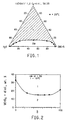
- Figure 1 shows the microemulsion of the present invention at 20°C for a composition containing water, DBE-5 and a mixture of bEHSs and 1,2-hexanediol at a weight ratio of 50:50.
- the region of the microemulsion is the larger shaded portion of the pseudo ternary phase diagram.
- microemulsions may be formulated having stabilities over the entire temperature range of from 5 to 100°C or having stabilities within any range of temperatures between 5 and 100°C.
- the temperature range is limited to 5 to 100°C only at atmospheric pressure. At higher pressures, the range of stability of the microemulsion is extended beyond this temperature range at both. the upper and the lower temperature limits.
- the region of the microemulsion is area marked 1 in the Figure.
- the region of the microemulsion is the area to the right of the plotted phase boundary line.
- Each Figure illustrates the extensive compositional range of the microemulsion of the present invention.
- a particular advantage of the present invention is that one can prepare microemulsions consisting of equal fractions of functionalized hydrocarbon and water making these microemulsions suitable for a variety of different applications.
- Formulations, that is mixtures of the microemulsions with organic sclvents and/or other additives, formed from the microemulsion of the present invention can be used as effective replacements for organic solvents in applications such as paint stripping, degreasing, resin clean-up, aircraft and vehicle cleaning, electronic cleaning and other general cleaning applications.
- Suitable diols for use in the present invention include those having from 2 to 10 carbon atoms, for example 1,2-butanadiol(BD), 1,2-pentanediol (PD) , 1,2-octanediol and 2-methyl-1,3-propanediol.
- BD 1,2-butanadiol
- PD 1,2-pentanediol
- 1,2-octanediol 1,2-octanediol
- 2-methyl-1,3-propanediol 2-methyl-1,3-propanediol.
- the preferred diol is 1,2-hexanediol, but in specific cleaning formulations other diols may he preferred over the hexanediol.
- This example illustrates a microemulsion containing water, DBE-5, 1,2-hexanediol and several commercial surfactants.
- AY65 is a mixture of sodium diamylsulfosuccinate, water, ethanol and methanol. It was of interest to understand if the synergistic effect of the diol would be effected by the presence of the alcohol, especially ethanol since ethanol is a common diluent found in commercial surfactants. It was found that presence of ethanol in the commercial surfactant decreases the amount of hexanediol needed to form the microemulsion.
- GPG surfactant composed of sodium di(2-ethylhexyl) sulfosuccinats (66-72%), ethanol (7-9%) and water (19-27%), sold by Cytec under the trademark GPG was tested in the microemulsions of the present invention. Again the microemulsions showed were acceptable over the temperature range of 5 to 100°C and were readily diluted by "oil” or water to form microemulsions having a broad range of compositions.
- This example illustrates the use of a thickener in the microemulsion of the present invention.
- the microemulsion made according to Example 1 was mixed with 1% by weight of JR-400, an unmodified cationic cellulose ether polymer available as OCARE from Amerchol corporation of Edison, New Jersey.
- JR-400 an unmodified cationic cellulose ether polymer available as OCARE from Amerchol corporation of Edison, New Jersey.
- OCARE unmodified cationic cellulose ether polymer available as OCARE from Amerchol corporation of Edison, New Jersey.
- the additions of the thickener were below 1.25%, the mixture remained a clear single phase microemulsion.
- a viscous emulsion was formed.
- the 1% JR-400 by weight thickened microemulsions had a zero shear viscosity of 0.2 Pa-s (200 times more viscous than water) measured using a Rheometrics Dynamic Stress Model SR500 rheometer.
- This example illustrates the addition of various organic solvents to the microemulsion.
- Base microemulsions were made by mixing 3.9 g of DBE, 1.2 g of Aerosol-OT, 3.9 g water, 0.5 g ethanol and 0.5 g 1,2-hexanediol. To each microemulsion 2.0 g of solvent, listed below, was mixed.
- the mixtures with solvent formed a single phase and were stable microemulsions over the range of 5 to 100°C.
- Aromatic 150 was stable from 20 to 75°C. At temperatures below 20°C, phase separation occurred.
- microemulsion of the present invention illustrates the utility of the microemulsion of the present invention in paint stripping.
- the microemulsion was formed by mixing a DBE, water, surfactant and diol to give the following composition by weight: 37.5% DBE, 37.5% water, 15% sodium bis(2-ethylhexyl) sulfosuccinate and 10% 2-methyl-1,3-propanediol.
- This example illustrates a degreasing composition using the microemulsion of the present invention.
- a microemulsion prepared from 187.5 g DBE, 187.5 g water, 50.0 g Aromatic 150, 75.0 g sodium bis(2-ethylhexyl)sulfosuccinate, and 50.0 g 2-methyl-1,3-propanediol was tested for cleaning ability in the following fashion.
- a 4" by 1/4" stainless steel eye bolt was coated with a thin coating (approx. 0.1 g) of a soil.
- the eye bolt was immersed, except for the eye, in approx. 115 g of the above microemulsion for 10 minutes at room temperature with gentle magnetic stirring.
- the bolt was then rinsed with water by immersion for 10 minutes at room temperature and allowed to dry at room temperature for 24 hours.
- the bolt was then reweighed and the amount of soil removed relative to the initial amount was determined. This amount was compared to the amount removed by immersion in water alone for 10 minutes.
- Soil Weight % Removed by water by microemulsion Conoco HD Calcium Grease No. 2 0.6% 17.0% Petroleum Jelly 1.1% 16.5% Shell Alvania Grease No. 2 0.0% 32.3% Sta-Lube Lithium Purpose Grease No. 2 0.0% 41.2%
- This example illustrates another degreasing formulation using the microemulsion of the present invention.
- the formulation was made as described below and tested as described in Example 6. Data shown below is for the weight removed by the formulation.
- the weight removed by water is the same as shown in the table in Example 6.
- a microemulsion was prepared from 115.5 g DBE, 115.6 g water, 77.0 g d-limonene, 46.2 g sodium bis(2-ethylhexyl) sulfosuccinate, and 30.8 g 2-methyl-1,3-propanediol. Soil Weight Removed, % Conoco HD 20.2 Petroleum Jelly 55.4 Shell ALVANIA 63.1 Sta-Lube Lithium Grease 81.3
- This example illustrates the utility of neopentyl glycol in a microemulsion of the present invention.
- a microemulsion was formed by mixing 56.4 grams of DBE, 30 grams of MACKANATE DOS-75 (MACKANATE is a trademark of the McIntyre Group Ltd. of University Park, IL; the DOS-75 product is a mixture of sodium bis(2-ethylhexyl)sulfosuccinate, water, ethanol and propylene glycol), 13.5 grams of neopentyl glycol and 50.4 grams of water. The components mixed together easily with stirring to form a clear microemulsion.
- This example illustrates the utility of 2-methyl-2,4-pentanediol (commonly known as hexylene glycol) as the diol in a microemulsion of the present invention.
- a microemulsion was prepared from mixing together 4.0 grams of DBE, 1.0 gram of MACKANATE DOS-75, 1.0 gram of 2-methyl-2,4-pentanediol, and 4 grams of water. The components mixed together easily with stirring to form a clear microemulsion.
- PEMULEN a polyacrylic acid
- PEMULEN is a trademark of the B.F. Goodrich Company of Cleveland, OH.
- a microemulsion was prepared by mixing 3.36 grams of DBE, 1.0 grams of NMP, 1.79 grams of MACKANATE DOS-75, 0.81 grams of neopentyl glycol and 3 grams of water. To this microemulsion was added 0.3 grams of PEMULEN 1622. The resulting combination was stirred vigorously using a magnetic stirrer until it became uniform, clear and extremely viscous. Approximately 2 grams of this thickened formulation was placed on a vertical surface and observed for a period of 60 minutes. During the observation time the formulation remained in its original position on the surface without showing any evidence of downward flow.
- This example shows the use of the formulation of Example 10 in paint stripping.
- example 10 formulation was placed on a pine board which was coated with Marine paint as described in example 5.
- the board was held vertically for 60 minutes, the sample of the formulation was then removed by gently scraping the surface of the board with a flat metal spatula. All layers of the paint were removed.
Landscapes
- Chemical & Material Sciences (AREA)
- Oil, Petroleum & Natural Gas (AREA)
- Life Sciences & Earth Sciences (AREA)
- Engineering & Computer Science (AREA)
- Chemical Kinetics & Catalysis (AREA)
- Wood Science & Technology (AREA)
- Organic Chemistry (AREA)
- Emergency Medicine (AREA)
- Health & Medical Sciences (AREA)
- Detergent Compositions (AREA)
- Cosmetics (AREA)
- Colloid Chemistry (AREA)
- Emulsifying, Dispersing, Foam-Producing Or Wetting Agents (AREA)
- Medicines Containing Material From Animals Or Micro-Organisms (AREA)
Claims (18)
- Microémulsion comprenant:dans laquelle l'hydrocarbure fonctionnalisé est à peine soluble dans l'eau sur l'ensemble du domaine de stabilité de la microémulsion et est présent dans une quantité en excès de sa solubilité dans l'eau, et dans lequel l'hydrocarbure est sélectionné parmi le groupe constitué des esters, des diesters, des triesters, des tétraesters, des acétates et des diacétates, et des lactones, et dans lequel l'agent tensioactif est un sulfosuccinate.(a) de l'eau,(b) un hydrocarbure fonctionnalisé,(c) un agent tensioactif anionique, et(d) un diol ayant de 2 à 10 atomes de carbone,
- Microémulsion selon la revendication 1, dans laquelle l'hydrocarbure fonctionnalisé est sélectionné parmi le groupe constitué des esters des acides adipique, glutarique et succinique et des alcools ayant de 1 à 12 atomes de carbone et de mélanges de ces esters.
- Microémulsion selon la revendication 2, dans laquelle l'hydrocarbure fonctionnalisé est sélectionné parmi le groupe constitué des esters diméthyliques des acides adipique, glutarique et succinique et de mélanges de ces esters.
- Microémulsion selon la revendication 1, comprenant en outre un solvant organique, le solvant organique étant mélangé à la microémulsion pour former un mélange, dans lequel le rapport pondéral de la microémulsion au solvant organique est tel que le mélange soit une microémulsion .
- Microémulsion selon la revendication 4, dans laquelle le solvant est sélectionné parmi le groupe constitué des alcools, des cétones, des esters, des amides acycliques, des amides cycliques, des éthers glycoliques, des acétates, des acétates d'éthers glycoliques, des lactones, des sulfoxydes, des carbonates cycliques, des hydrocarbures aromatiques, des terpènes, de la N-méthylpyrrolidone et d'autres N-alkylpyrrolidones, de la diméthylpipéridone, de l'éther monométhylique du dipropylèneglycol, du carbonate de propylène, des alkylbenzènes, du d-limonène et de mélanges d'une combinaison quelconque de ces composés.
- Microémulsion selon la revendication 1, dans laquelle l'agent tensioactif est le bis(2-éthylhexyl)sulfosuccinate de sodium, le diol est le 1,2-hexanediol et l'hydrocarbure fonctionnalisé est sélectionné parmi le groupe constitué des esters des acides adipique, glutarique et succinique et d'alcools ayant de 1 à 12 atomes de carbone et de mélanges de ces esters.
- Microémulsion selon la revendication 1, dans laquelle l'agent tensioactif est le bis(2-éthylhexyl)sulfosuccinate de sodium, le diol est sélectionné parmi le groupe constitué du néopentylglycol et du 2-méthyl-2,4-pentanediol et dans laquelle l'hydrocarbure fonctionnalisé est sélectionné parmi le groupe constitué des esters des acides adipique, glutarique et succinique et d'alcools ayant de 1 à 12 atomes de carbone et de mélanges de ces esters.
- Microémulsion selon la revendication 1, dans laquelle l'agent tensioactif est sélectionné parmi le groupe constitué des sels de sodium du bis(2-éthylhexyl)sulfosuccinate, du di(1,3-diméthylbutyl)sulfosuccinate et du diamylsulfosuccinate.
- Microémulsion selon la revendication 1, dans laquelle le diol est sélectionné parmi le groupe constitué du 1,2-butanediol, du 1,2-pentanediol, du néopentylglycol, des hexanediols, des octanediols, du monoacétate du 1,2,3-propanetriol, des heptanediols, des décanediols et du 2-méthyl-1,3-propanediol.
- Microémulsion selon la revendication 1, comprenant en outre un agent épaississant sélectionné parmi le groupe constitué de polymères d'éthers de cellulose cationiques non modifiés et modifiés de manière hydrophobe, de polyuréthannes, de polyacryliques et d'acides polyacryliques.
- Microémulsion selon la revendication 10, dans laquelle l'agent tensioactif est le bis(2-éthylhexyl)sulfosuccinate, dans laquelle le diol est sélectionné parmi le groupe constitué du 1,2-hexanediol, du néopentylglycol et du 2-méthyl-2,4-pentanediol et dans laquelle l'hydrocarbure fonctionnalisé est sélectionné parmi le groupe constitué des esters des acides adipique, glutarique et succinique et d'alcools ayant de 1 à 12 atomes de carbone et de mélanges de ces esters.
- Composition de nettoyage comprenant une microémulsion, un solvant organique et, en option, un agent épaississant, dans laquelle la microémulsion contientdans laquelle l'hydrocarbure fonctionnalisé est à peine soluble dans l'eau sur l'ensemble du domaine de stabilité de la microémulsion et est présent dans une quantité en excès de sa solubilité dans l'eau, et dans lequel l'hydrocarbure fonctionnalisé est sélectionné parmi le groupe constitué des esters, des diesters, des triesters, des tétraesters, des acétates et des diacétates, et des lactones, et dans lequel l'agent tensioactif est un sulfosuccinate.(a) de l'eau,(b) un hydrocarbure fonctionnalisé,(c) un agent tensioactif anionique, et(d) un diol ayant de 2 à 10 atomes de carbone,
- Composition de nettoyage selon la revendication 12, dans laquelle l'agent tensioactif est le bis(2-éthylhexyl)sulfosuccinate de sodium, dans laquelle le diol est sélectionné parmi le groupe constitué du 1,2 hexanediol, du 2-méthyl-1,3-propanediol, du néopentylglycol et du 2-méthyl-2,4-pentanediol, dans laquelle l'hydrocarbure fonctionnalisé est sélectionné parmi le groupe constitué d'esters des acides adipique, glutarique et succinique et d'alcools ayant de 1 à 12 atomes de carbone et de mélanges de ces esters, dans laquelle le solvant est sélectionné parmi le groupe constitué des alcools, des cétones, des esters, des amides acycliques, des amides cycliques, des éthers glycoliques, des acétates, des acétates d'éthers glycoliques, des lactones, des sulfoxydes, des carbonates cycliques, des hydrocarbures aromatiques, des terpènes, de la N-méthylpyrrolidone et d'autres N-alkylpyrrolidones, de la diméthylpipéridone, de l'éther monométhylique du dipropylèneglycol, du carbonate de propylène, des alkylbenzènes, du d-limonène et de mélanges d'une combinaison quelconque des ces composés.
- Composition de nettoyage selon la revendication 12, ayant un agent épaississant et dans laquelle l'agent épaississant est sélectionné parmi le groupe constitué de polymères d'éthers de cellulose cationiques non modifiés et modifiés de manière hydrophobe, de polyuréthannes, de polyacryliques et d'acides polyacryliques.
- Composition de nettoyage selon la revendication 12, dans laquelle l'agent tensioactif est le bis(2-éthylhexyl)sulfosuccinate, le diol est le 2-méthyl-1,3-propanediol et dans laquelle l'hydrocarbure fonctionnalisé est sélectionné parmi le groupe constitué des esters des acides adipique, glutarique et succinique et d'alcools ayant de 1 à 12 atomes de carbone et de mélanges de ces esters.
- Composition de nettoyage selon la revendication 13, dans laquelle l'hydrocarbure fonctionnalisé est sélectionné parmi les esters diméthyliques des acides adipique, glutarique et succinique et de mélanges de ces esters et dans laquelle le solvant est le d-limonène.
- Composition de nettoyage selon la revendication 13, dans laquelle l'hydrocarbure fonctionnalisé est sélectionné parmi les esters diméthyliques des acides adipiques, glutarique et succinique et de mélanges de ces esters et dans laquelle le solvant est un alkylbenzène ou des mélanges d'alkylbenzènes.
- Composition de nettoyage selon la revendication 13, dans laquelle l'agent tensioactif est le bis(2-éthylhexyl)sulfosuccinate, le diol est le néopentylglycol ou le 2-méthyl-2,4-pentanediol, et dans laquelle l'hydrocarbure fonctionnalisé est sélectionné parmi le groupe constitué des esters des acides adipique, glutarique et succinique et d'alcools ayant de 1 à 12 atomes de carbone et de mélanges de ces esters, dans laquelle le solvant est la N-méthylpyrrolidone et dans laquelle l'agent épaississant est un acide polyacrylique.
Applications Claiming Priority (5)
| Application Number | Priority Date | Filing Date | Title |
|---|---|---|---|
| US90416697A | 1997-07-31 | 1997-07-31 | |
| US904166 | 1997-07-31 | ||
| US09/050,307 US6165962A (en) | 1997-07-31 | 1998-03-30 | Aqueous microemulsions |
| US50307 | 1998-03-30 | ||
| PCT/US1998/015744 WO1999006520A1 (fr) | 1997-07-31 | 1998-07-30 | Microemulsions aqueuses |
Publications (2)
| Publication Number | Publication Date |
|---|---|
| EP1000138A1 EP1000138A1 (fr) | 2000-05-17 |
| EP1000138B1 true EP1000138B1 (fr) | 2003-09-17 |
Family
ID=26728132
Family Applications (1)
| Application Number | Title | Priority Date | Filing Date |
|---|---|---|---|
| EP98938097A Expired - Lifetime EP1000138B1 (fr) | 1997-07-31 | 1998-07-30 | Microemulsions aqueuses |
Country Status (10)
| Country | Link |
|---|---|
| EP (1) | EP1000138B1 (fr) |
| JP (1) | JP4271366B2 (fr) |
| AT (1) | ATE250119T1 (fr) |
| AU (1) | AU740364B2 (fr) |
| BR (1) | BR9810847A (fr) |
| DE (1) | DE69818271T2 (fr) |
| DK (1) | DK1000138T3 (fr) |
| ES (1) | ES2202881T3 (fr) |
| PT (1) | PT1000138E (fr) |
| WO (1) | WO1999006520A1 (fr) |
Families Citing this family (22)
| Publication number | Priority date | Publication date | Assignee | Title |
|---|---|---|---|---|
| FR2795088B1 (fr) * | 1999-06-21 | 2002-05-24 | Atofina | Compositions de nettoyage a froid du type microemulsions |
| US6511952B1 (en) | 2000-06-12 | 2003-01-28 | Arco Chemical Technology, L.P. | Use of 2-methyl-1, 3-propanediol and polycarboxylate builders in laundry detergents |
| US6624128B1 (en) | 2001-03-30 | 2003-09-23 | Dixie Chemical Company | Water miscible composition containing a carboxylic acid diester and a fatty acid salt |
| KR100779296B1 (ko) * | 2001-12-12 | 2007-11-27 | 애경산업(주) | 지방족 탄화수소 오일을 함유하는 수중유 마이크로에멀젼타입 세정제 조성물 |
| JP4629354B2 (ja) * | 2004-02-25 | 2011-02-09 | 三洋化成工業株式会社 | 界面活性剤組成物 |
| EP2392908B1 (fr) * | 2004-12-17 | 2019-08-21 | Ventana Medical Systems, Inc. | Procédés pour la préparation d'un échantillon biologique inclus en paraffine pour la coloration. |
| US7547670B2 (en) * | 2005-10-25 | 2009-06-16 | Cognis Ip Management Gmbh | Low odor ester-based microemulsions for cleaning hard surfaces |
| GB0605157D0 (en) * | 2006-03-15 | 2006-04-26 | Gramos Applied Ltd | Decontaminant formulations |
| JP5066881B2 (ja) | 2006-09-27 | 2012-11-07 | 住友化学株式会社 | 乳剤組成物 |
| EP2045320B1 (fr) * | 2007-09-19 | 2012-04-25 | Bubbles & Beyond Gmbh | Produit de nettoyage pour la suppression de couches de couleurs de surfaces, procédé de fabrication du produit et procédé de nettoyage |
| JP5256749B2 (ja) | 2008-01-23 | 2013-08-07 | 住友化学株式会社 | 乳剤組成物 |
| JP5262131B2 (ja) | 2008-01-24 | 2013-08-14 | 住友化学株式会社 | 乳剤組成物 |
| JP2009173578A (ja) | 2008-01-24 | 2009-08-06 | Sumitomo Chemical Co Ltd | 乳剤組成物 |
| DE102009013469B4 (de) * | 2009-03-19 | 2014-04-17 | Bubbles And Beyond Gmbh | Zubereitung zur äußerlichen Anwendung |
| DE102009014380A1 (de) | 2009-03-26 | 2010-10-07 | Bubbles And Beyond Gmbh | Verfahren und Zusammensetzung zum Reinigen von Gegenständen |
| CN102575200B (zh) * | 2009-10-19 | 2014-09-17 | 罗地亚管理公司 | 自动乳化的清洁体系及其使用方法 |
| JP2013513481A (ja) * | 2009-12-15 | 2013-04-22 | インビスタ テクノロジーズ エス エイ アール エル | エマルジョン組成物および表面活性剤の選択法 |
| US9109191B2 (en) | 2009-12-15 | 2015-08-18 | Invista North America S.A.R.L. | Emulsion compositions and a method for selecting surfactants |
| MX2012013928A (es) * | 2010-06-02 | 2013-02-12 | Rhodia Operations | Uso de microemulsiones ecologicamente favorables en aplicaciones de limpieza de aceite. |
| US8569218B2 (en) * | 2011-03-07 | 2013-10-29 | Illinois Tool Works, Inc. | Cleaning composition containing polymer microemulsion |
| JP6199013B2 (ja) * | 2012-07-19 | 2017-09-20 | 株式会社トクヤマMetel | 洗浄剤及び洗浄方法 |
| DE102018123858A1 (de) * | 2018-09-27 | 2020-04-02 | BÜFA GmbH & Co. KG | Lösungsmittel und Anwendung für ein Lösungsmittel |
Family Cites Families (12)
| Publication number | Priority date | Publication date | Assignee | Title |
|---|---|---|---|---|
| US2606874A (en) * | 1947-06-23 | 1952-08-12 | Shell Dev | Water in oil emulsions containing 1, 2-alkanediols as coupling agents |
| US4781848A (en) * | 1987-05-21 | 1988-11-01 | Aluminum Company Of America | Metalworking lubricant comprising an oil-in-water microemulsion |
| US4927556A (en) * | 1987-06-04 | 1990-05-22 | Minnesota Mining And Manufacturing Company | Aqueous based composition containing dibasic ester and thickening agent for removing coatings |
| US4934391A (en) * | 1988-02-08 | 1990-06-19 | 501 Petroleum Fermentations N.V. | Dibasic esters for cleaning electronic circuits |
| US5080831A (en) * | 1989-06-29 | 1992-01-14 | Buckeye International, Inc. | Aqueous cleaner/degreaser compositions |
| US5158710A (en) * | 1989-06-29 | 1992-10-27 | Buckeye International, Inc. | Aqueous cleaner/degreaser microemulsion compositions |
| US5035826A (en) * | 1989-09-22 | 1991-07-30 | Colgate-Palmolive Company | Liquid crystal detergent composition |
| ES2173115T3 (es) * | 1993-04-02 | 2002-10-16 | Dow Chemical Co | Composiciones de limpieza en microemulsion y emulsion. |
| US5401326A (en) * | 1993-07-29 | 1995-03-28 | Drew Chemical Corporation | Microemulsion cleansers and their uses |
| WO1995013345A1 (fr) * | 1993-11-12 | 1995-05-18 | The Procter & Gamble Company | Compositions detergentes liquides pour surfaces dures contenant un agent tensioactif detergent amphotere ainsi qu'un parfum |
| US5691289A (en) * | 1994-11-17 | 1997-11-25 | Kay Chemical Company | Cleaning compositions and methods of using the same |
| WO1998006817A1 (fr) * | 1996-08-14 | 1998-02-19 | Colgate-Palmolive Company | Compositions liquides de nettoyage sous forme de microemulsion pour taches legeres |
-
1998
- 1998-07-30 ES ES98938097T patent/ES2202881T3/es not_active Expired - Lifetime
- 1998-07-30 PT PT98938097T patent/PT1000138E/pt unknown
- 1998-07-30 AT AT98938097T patent/ATE250119T1/de active
- 1998-07-30 AU AU86699/98A patent/AU740364B2/en not_active Ceased
- 1998-07-30 EP EP98938097A patent/EP1000138B1/fr not_active Expired - Lifetime
- 1998-07-30 BR BR9810847-6A patent/BR9810847A/pt not_active IP Right Cessation
- 1998-07-30 JP JP2000505264A patent/JP4271366B2/ja not_active Expired - Fee Related
- 1998-07-30 DE DE69818271T patent/DE69818271T2/de not_active Expired - Lifetime
- 1998-07-30 DK DK98938097T patent/DK1000138T3/da active
- 1998-07-30 WO PCT/US1998/015744 patent/WO1999006520A1/fr not_active Ceased
Also Published As
| Publication number | Publication date |
|---|---|
| DE69818271D1 (de) | 2003-10-23 |
| DK1000138T3 (da) | 2004-02-02 |
| ES2202881T3 (es) | 2004-04-01 |
| JP2002501087A (ja) | 2002-01-15 |
| JP4271366B2 (ja) | 2009-06-03 |
| EP1000138A1 (fr) | 2000-05-17 |
| BR9810847A (pt) | 2000-07-25 |
| DE69818271T2 (de) | 2004-06-03 |
| ATE250119T1 (de) | 2003-10-15 |
| WO1999006520A1 (fr) | 1999-02-11 |
| AU740364B2 (en) | 2001-11-01 |
| AU8669998A (en) | 1999-02-22 |
| PT1000138E (pt) | 2004-01-30 |
Similar Documents
| Publication | Publication Date | Title |
|---|---|---|
| US6165962A (en) | Aqueous microemulsions | |
| EP1000138B1 (fr) | Microemulsions aqueuses | |
| US5597792A (en) | High water content, low viscosity, oil continuous microemulsions and emulsions, and their use in cleaning applications | |
| US5098591A (en) | Paint stripper and varnish remover compositions containing organoclay rheological additives, methods for making these compositions and methods for removing paint and other polymeric coatings from flexible and inflexible surfaces | |
| US4927556A (en) | Aqueous based composition containing dibasic ester and thickening agent for removing coatings | |
| US5171475A (en) | Soil-removal microemulsion compositions | |
| US2955047A (en) | Cleaning compositions | |
| US9150823B2 (en) | Microemulsion-based cleaning agent comprising an anionic/nonionic surfactant mixture | |
| US5167853A (en) | Paint stripper and varnish remover compositions containing organoclay rheological additives, methods for making these compositions and methods for removing paint and other polymeric coatings from flexible and inflexible surfaces | |
| DE69208266T2 (de) | Reinigungsmittel | |
| FR2795088A1 (fr) | Compositions de nettoyage a froid du type microemulsions | |
| US5744437A (en) | Single phase liquid composition for cleaning and paint stripping and use thereof | |
| US20080191164A1 (en) | Method For the Treatment of a Material Other Than the Human Body | |
| CA2747936C (fr) | Nettoyant a base d'eau pour le nettoyage des peintures a base de solvants | |
| DE69217486T2 (de) | Verfahren zur reinigung gestrichener harter oberflaechen mit reinigungsmitteln, die wenig fluechtige organische verbindungen enthalten | |
| Matero et al. | Alkyl polyglucosides as hydrotropes | |
| JPH08500376A (ja) | 第一アルキルスルフェート及び非イオン界面活性剤を含む液体洗浄組成物 | |
| US5792278A (en) | Process for cleaning inks from various surfaces including printing plates | |
| EP3350307A1 (fr) | Agent de nettoyage sous forme de microémulsion | |
| JPH11502558A (ja) | 二塩基酸エステル及びエーテルを基とする清浄化及び/又は剥離用組成物 | |
| US5531939A (en) | Concentrated glass and window cleaning composition and method of use | |
| US6030466A (en) | Paint stripping composition based on tetrahydrofurfuryl ethers | |
| JP7292748B2 (ja) | 塗膜剥離剤 | |
| JP2614982B2 (ja) | スクリーン版用洗浄剤 | |
| JPH0412417B2 (fr) |
Legal Events
| Date | Code | Title | Description |
|---|---|---|---|
| PUAI | Public reference made under article 153(3) epc to a published international application that has entered the european phase |
Free format text: ORIGINAL CODE: 0009012 |
|
| 17P | Request for examination filed |
Effective date: 20000121 |
|
| AK | Designated contracting states |
Kind code of ref document: A1 Designated state(s): AT BE DE DK ES FI FR GB IT NL PT SE |
|
| RAP1 | Party data changed (applicant data changed or rights of an application transferred) |
Owner name: UNIVERSITY OF DELAWARE Owner name: E.I. DU PONT DE NEMOURS AND COMPANY |
|
| GRAH | Despatch of communication of intention to grant a patent |
Free format text: ORIGINAL CODE: EPIDOS IGRA |
|
| GRAS | Grant fee paid |
Free format text: ORIGINAL CODE: EPIDOSNIGR3 |
|
| GRAA | (expected) grant |
Free format text: ORIGINAL CODE: 0009210 |
|
| AK | Designated contracting states |
Kind code of ref document: B1 Designated state(s): AT BE DE DK ES FI FR GB IT NL PT SE |
|
| REG | Reference to a national code |
Ref country code: GB Ref legal event code: FG4D |
|
| REG | Reference to a national code |
Ref country code: SE Ref legal event code: TRGR |
|
| REF | Corresponds to: |
Ref document number: 69818271 Country of ref document: DE Date of ref document: 20031023 Kind code of ref document: P |
|
| REG | Reference to a national code |
Ref country code: DK Ref legal event code: T3 |
|
| REG | Reference to a national code |
Ref country code: ES Ref legal event code: FG2A Ref document number: 2202881 Country of ref document: ES Kind code of ref document: T3 |
|
| ET | Fr: translation filed | ||
| REG | Reference to a national code |
Ref country code: GB Ref legal event code: 732E |
|
| PLBE | No opposition filed within time limit |
Free format text: ORIGINAL CODE: 0009261 |
|
| STAA | Information on the status of an ep patent application or granted ep patent |
Free format text: STATUS: NO OPPOSITION FILED WITHIN TIME LIMIT |
|
| 26N | No opposition filed |
Effective date: 20040618 |
|
| REG | Reference to a national code |
Ref country code: GB Ref legal event code: 732E |
|
| REG | Reference to a national code |
Ref country code: GB Ref legal event code: 732E |
|
| REG | Reference to a national code |
Ref country code: FR Ref legal event code: TQ |
|
| REG | Reference to a national code |
Ref country code: GB Ref legal event code: 732E Free format text: REGISTERED BETWEEN 20090507 AND 20090513 |
|
| REG | Reference to a national code |
Ref country code: PT Ref legal event code: PC4A Owner name: INVISTA TECHNOLOGIES S.A.R.L., CH Effective date: 20090903 |
|
| REG | Reference to a national code |
Ref country code: ES Ref legal event code: PC2A |
|
| REG | Reference to a national code |
Ref country code: FR Ref legal event code: PLFP Year of fee payment: 18 |
|
| PGFP | Annual fee paid to national office [announced via postgrant information from national office to epo] |
Ref country code: ES Payment date: 20150611 Year of fee payment: 18 |
|
| PGFP | Annual fee paid to national office [announced via postgrant information from national office to epo] |
Ref country code: NL Payment date: 20150709 Year of fee payment: 18 |
|
| PGFP | Annual fee paid to national office [announced via postgrant information from national office to epo] |
Ref country code: DK Payment date: 20150713 Year of fee payment: 18 Ref country code: FI Payment date: 20150709 Year of fee payment: 18 Ref country code: PT Payment date: 20150720 Year of fee payment: 18 Ref country code: GB Payment date: 20150729 Year of fee payment: 18 Ref country code: DE Payment date: 20150722 Year of fee payment: 18 |
|
| PGFP | Annual fee paid to national office [announced via postgrant information from national office to epo] |
Ref country code: FR Payment date: 20150629 Year of fee payment: 18 Ref country code: AT Payment date: 20150625 Year of fee payment: 18 Ref country code: SE Payment date: 20150713 Year of fee payment: 18 Ref country code: BE Payment date: 20150713 Year of fee payment: 18 |
|
| PGFP | Annual fee paid to national office [announced via postgrant information from national office to epo] |
Ref country code: IT Payment date: 20150727 Year of fee payment: 18 |
|
| PG25 | Lapsed in a contracting state [announced via postgrant information from national office to epo] |
Ref country code: BE Free format text: LAPSE BECAUSE OF NON-PAYMENT OF DUE FEES Effective date: 20160731 |
|
| REG | Reference to a national code |
Ref country code: DE Ref legal event code: R119 Ref document number: 69818271 Country of ref document: DE |
|
| REG | Reference to a national code |
Ref country code: DK Ref legal event code: EBP Effective date: 20170131 |
|
| REG | Reference to a national code |
Ref country code: NL Ref legal event code: MM Effective date: 20160801 |
|
| REG | Reference to a national code |
Ref country code: SE Ref legal event code: EUG |
|
| REG | Reference to a national code |
Ref country code: AT Ref legal event code: MM01 Ref document number: 250119 Country of ref document: AT Kind code of ref document: T Effective date: 20160730 |
|
| GBPC | Gb: european patent ceased through non-payment of renewal fee |
Effective date: 20160730 |
|
| PG25 | Lapsed in a contracting state [announced via postgrant information from national office to epo] |
Ref country code: FR Free format text: LAPSE BECAUSE OF NON-PAYMENT OF DUE FEES Effective date: 20160801 Ref country code: FI Free format text: LAPSE BECAUSE OF NON-PAYMENT OF DUE FEES Effective date: 20160730 Ref country code: DE Free format text: LAPSE BECAUSE OF NON-PAYMENT OF DUE FEES Effective date: 20170201 Ref country code: NL Free format text: LAPSE BECAUSE OF NON-PAYMENT OF DUE FEES Effective date: 20160801 Ref country code: SE Free format text: LAPSE BECAUSE OF NON-PAYMENT OF DUE FEES Effective date: 20160731 |
|
| REG | Reference to a national code |
Ref country code: FR Ref legal event code: ST Effective date: 20170331 |
|
| PG25 | Lapsed in a contracting state [announced via postgrant information from national office to epo] |
Ref country code: GB Free format text: LAPSE BECAUSE OF NON-PAYMENT OF DUE FEES Effective date: 20160730 Ref country code: AT Free format text: LAPSE BECAUSE OF NON-PAYMENT OF DUE FEES Effective date: 20160730 Ref country code: PT Free format text: LAPSE BECAUSE OF NON-PAYMENT OF DUE FEES Effective date: 20170130 |
|
| PG25 | Lapsed in a contracting state [announced via postgrant information from national office to epo] |
Ref country code: IT Free format text: LAPSE BECAUSE OF NON-PAYMENT OF DUE FEES Effective date: 20160730 |
|
| PG25 | Lapsed in a contracting state [announced via postgrant information from national office to epo] |
Ref country code: DK Free format text: LAPSE BECAUSE OF NON-PAYMENT OF DUE FEES Effective date: 20160731 |
|
| PG25 | Lapsed in a contracting state [announced via postgrant information from national office to epo] |
Ref country code: ES Free format text: LAPSE BECAUSE OF NON-PAYMENT OF DUE FEES Effective date: 20160731 |
|
| REG | Reference to a national code |
Ref country code: ES Ref legal event code: FD2A Effective date: 20181116 |