EP1000698A1 - Composants refroidis avec canaux coniques de refroidissement - Google Patents
Composants refroidis avec canaux coniques de refroidissement Download PDFInfo
- Publication number
- EP1000698A1 EP1000698A1 EP98811114A EP98811114A EP1000698A1 EP 1000698 A1 EP1000698 A1 EP 1000698A1 EP 98811114 A EP98811114 A EP 98811114A EP 98811114 A EP98811114 A EP 98811114A EP 1000698 A1 EP1000698 A1 EP 1000698A1
- Authority
- EP
- European Patent Office
- Prior art keywords
- hot gas
- gas side
- cooling
- component
- channel
- Prior art date
- Legal status (The legal status is an assumption and is not a legal conclusion. Google has not performed a legal analysis and makes no representation as to the accuracy of the status listed.)
- Granted
Links
- 238000001816 cooling Methods 0.000 title claims abstract description 71
- 239000002826 coolant Substances 0.000 claims abstract description 27
- 238000004519 manufacturing process Methods 0.000 claims abstract description 21
- 239000000463 material Substances 0.000 claims description 7
- 238000000034 method Methods 0.000 claims description 7
- 238000005553 drilling Methods 0.000 claims description 4
- 238000005520 cutting process Methods 0.000 description 9
- 230000000694 effects Effects 0.000 description 7
- 238000013461 design Methods 0.000 description 6
- 238000002485 combustion reaction Methods 0.000 description 3
- 230000003068 static effect Effects 0.000 description 3
- 230000017525 heat dissipation Effects 0.000 description 2
- 230000000149 penetrating effect Effects 0.000 description 2
- 238000012545 processing Methods 0.000 description 2
- 238000012546 transfer Methods 0.000 description 2
- 238000013459 approach Methods 0.000 description 1
- 238000010276 construction Methods 0.000 description 1
- 238000009826 distribution Methods 0.000 description 1
- 238000005516 engineering process Methods 0.000 description 1
- 230000002349 favourable effect Effects 0.000 description 1
- 238000009434 installation Methods 0.000 description 1
- 230000003287 optical effect Effects 0.000 description 1
- 238000013021 overheating Methods 0.000 description 1
- 238000009827 uniform distribution Methods 0.000 description 1
- 238000009736 wetting Methods 0.000 description 1
Images


Classifications
-
- F—MECHANICAL ENGINEERING; LIGHTING; HEATING; WEAPONS; BLASTING
- F01—MACHINES OR ENGINES IN GENERAL; ENGINE PLANTS IN GENERAL; STEAM ENGINES
- F01D—NON-POSITIVE DISPLACEMENT MACHINES OR ENGINES, e.g. STEAM TURBINES
- F01D5/00—Blades; Blade-carrying members; Heating, heat-insulating, cooling or antivibration means on the blades or the members
- F01D5/12—Blades
- F01D5/14—Form or construction
- F01D5/18—Hollow blades, i.e. blades with cooling or heating channels or cavities; Heating, heat-insulating or cooling means on blades
- F01D5/186—Film cooling
-
- B—PERFORMING OPERATIONS; TRANSPORTING
- B23—MACHINE TOOLS; METAL-WORKING NOT OTHERWISE PROVIDED FOR
- B23K—SOLDERING OR UNSOLDERING; WELDING; CLADDING OR PLATING BY SOLDERING OR WELDING; CUTTING BY APPLYING HEAT LOCALLY, e.g. FLAME CUTTING; WORKING BY LASER BEAM
- B23K26/00—Working by laser beam, e.g. welding, cutting or boring
- B23K26/36—Removing material
- B23K26/38—Removing material by boring or cutting
- B23K26/382—Removing material by boring or cutting by boring
- B23K26/389—Removing material by boring or cutting by boring of fluid openings, e.g. nozzles, jets
-
- F—MECHANICAL ENGINEERING; LIGHTING; HEATING; WEAPONS; BLASTING
- F05—INDEXING SCHEMES RELATING TO ENGINES OR PUMPS IN VARIOUS SUBCLASSES OF CLASSES F01-F04
- F05D—INDEXING SCHEME FOR ASPECTS RELATING TO NON-POSITIVE-DISPLACEMENT MACHINES OR ENGINES, GAS-TURBINES OR JET-PROPULSION PLANTS
- F05D2250/00—Geometry
- F05D2250/20—Three-dimensional
- F05D2250/23—Three-dimensional prismatic
- F05D2250/232—Three-dimensional prismatic conical
-
- Y—GENERAL TAGGING OF NEW TECHNOLOGICAL DEVELOPMENTS; GENERAL TAGGING OF CROSS-SECTIONAL TECHNOLOGIES SPANNING OVER SEVERAL SECTIONS OF THE IPC; TECHNICAL SUBJECTS COVERED BY FORMER USPC CROSS-REFERENCE ART COLLECTIONS [XRACs] AND DIGESTS
- Y10—TECHNICAL SUBJECTS COVERED BY FORMER USPC
- Y10T—TECHNICAL SUBJECTS COVERED BY FORMER US CLASSIFICATION
- Y10T29/00—Metal working
- Y10T29/49—Method of mechanical manufacture
- Y10T29/49316—Impeller making
- Y10T29/49336—Blade making
- Y10T29/49339—Hollow blade
- Y10T29/49341—Hollow blade with cooling passage
Definitions
- the invention relates to a thermally highly resilient component, which in Operation is subject to a hot gas flow, which component at least one hot gas side exposed to the hot gas flow and one the hot gas flow has not exposed cold gas side, in which Component channels are incorporated, which the hot gas side and the Connect the cold gas side in such a way that a cooling medium from the cold gas side to the hot gas side, which cooling medium flows through during the passage a channel absorbs heat from the component and to the hot gas side dissipates, with at least one of the cooling channels over its entire Length has a substantially circular cross section, which Cross-section increases continuously from the cold gas side to the hot gas side, wherein an opening half angle is included, so that the at least one Channel is frustoconical.
- Film cooling is the component to be cooled on a hot gas overflowed side - with components flowing around, such as blades, in their Inside - with cooling medium - generally compressed air - acted upon.
- the cold gas side and the hot gas side are through a variety of channels in connection with each other, which is as tangential to the hot gas side as possible Hot gas flow open. This creates a layer of cool medium the component applied, the direct contact of component and Hot gas flow is prevented.
- shownhead cooling represents a special form used in particular at places where the hot gas flow approximately normally hits the component to be cooled. There it is impossible in itself to let the cooling channel open tangentially to the main flow and so to form an effective cooling film. In contrast, the cooling medium is in one comparatively steep angle to the component surface; during the Flow through the cooling channel takes the cooling medium from the heat highly loaded component. The cooling medium is successively replaced by the Inflow also applied to the component again, so this cooling method Features of convective cooling combined with those of film cooling.
- cooling channels must be relative for several reasons close tolerances.
- compressor air is usually considered Coolant used.
- the result of this is that in the thermal extremely heavily loaded first turbine stages only a slight driving Pressure drop is available for the outflow of the cooling medium, especially in places that are directly affected by the free flow of hot gas are flown, and at which there are stagnation points of the hot gas flow form, in particular on the front edge of the first blades of the first Guiding series. If too little cooling air now passes through the cooling channels, it breaks Cooling together. On the other hand, too much cooling air becomes the cycle taken from the outset, this has a negative impact on efficiency the working machine.
- Cooling channels are to be introduced, the diameter of which is typically in on the order of a few tenths to a little more than 1 millimeter moves, and that in doing so, especially when a defined diffuser effect is aimed for is a very high level of manufacturing accuracy. It remains to be determined continue that the diffuser geometry in a pure film cooling has significant advantages, with better wetting in the first place Component surface with the cooling medium would be mentioned.
- the reduction is namely the Surface temperature through a cooling film as close as possible not that primary goal, but the most effective possible heat dissipation from the Material by means of the coolant flowing through the channels, which is why in the Stagnation point areas of the components - e.g. on the Bucket leading edges or on platform edges - purely cylindrical Cooling ducts were still the medium of choice.
- the manufacturer initially receives Specifications for the cross section of the cooling channels to be manufactured.
- the Component with the introduced cooling channels is shown below measured by applying the different pressure ratios Mass flow is measured.
- Cooling holes also increase, their flow behavior a lower Dependency on deviations from the design point that Operational reliability of a thermally highly stressed component and thus the Availability of a technical system, the component of which this Component represents significantly.
- the object of the invention is in a thermally highly resilient Component which is subjected to a hot gas flow during operation, which component exposes at least one to the hot gas flow Hot gas side and a cold gas side not exposed to the hot gas flow has in which component channels are incorporated, which the Connect the hot gas side and the cold gas side in such a way that a Coolant flows from the cold gas side to the hot gas side, which Cooling medium during passage through a channel of heat from the Receives component and leads to the hot gas side, at least one of the cooling channels over its entire length essentially one has a circular cross section, which cross section from the cold gas side to the hot gas side increases continuously, with an opening half angle is included, so that the at least one channel is frustoconical represents to specify the at least one cooling channel so that its Flow behavior as small as possible from the prevailing Pressure ratio and manufacturing tolerances depends, and its geometry so is that a large number of such channels with as possible can be manufactured with little effort.
- this is achieved in that the opening half angle of the at least one cooling channel over the entire channel depth in It is essentially constant that the opening half angle is between 0.2 ° and 2.5 °, and that the cross-sectional ratio of a mouth of the Cooling channel on the hot gas side and a mouth on the Cold gas side is less than 1.2.
- the essence of the invention is therefore one that can be used in hot gas flows Component in areas that are so-called "showerhead cooling" be cooled, specify the geometry of the cooling channels so that under sufficient cooling is guaranteed in all circumstances, which due to the required large number the application of a simple as possible Allow manufacturing process.
- This is achieved by using the cooling channels slightly divergent in the direction of flow.
- the desired goal is achieved according to the invention even with extremely small channel divergences.
- there is a channel divergence in the area that is normally at Film cooling channels is realized, already unfavorable, because in the present If a pronounced diffuser effect tends to be negative.
- Conical cooling channels with a circular cross-section can be used Manufacture particularly easily if the opening angle over the entire Channel depth is constant.
- outlet cross section of the cooling channel is less than 120% of the entrance cross-section, on the one hand Manufacturing reasons, so the change in the power density of the Cutting beam over the material thickness to be penetrated in one practical framework is kept, and not too short a focal length required collimation optics.
- opening half angle of the resulting hollow cone is not 2.5 ° should exceed what continues to serve an excessive Delay in cooling flow associated with possible Detachment phenomena of the cooling flow in the channel, particularly in the "Showerhead cooling" would be extremely counterproductive.
- the invention is illustrated using a cooled turbine blade. This is however not to be understood in a restrictive sense, since the transfer of a hot gas-flowed component on components that only on one side with hot gas, such as combustion chamber segments, for the specialist is to be carried out without further notice.
- FIG. 1 shows an example of the design of a cooled turbine blade 10, which flows in the direction of the arrows.
- the blade contains cavities 11, which are separated from one another by webs 20.
- the outlet openings of the cooling channels 30 can be seen in the blade. Through this cooling medium should emerge from the cavities 11 and if possible flow off along the blade surface, and thus the blade from Insulate hot gas in exterior space 12.
- FIG. 2 shows a cross section through a cooled blade.
- the blade is flown in the direction of the arrow marked 8.
- the static pressure before the blade is p 0 , after the blade p 1 . If this blade is installed in a first guide row of a turbine, p 0 corresponds to the compressor end pressure, reduced by the dynamic pressure of the blade inflow and combustion chamber pressure losses.
- p 0 corresponds to the compressor end pressure, reduced by the dynamic pressure of the blade inflow and combustion chamber pressure losses.
- ⁇ and ⁇ are coordinates running on the pressure-sensitive suction side along the blade surface, originating in O.
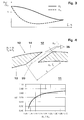
- FIG. 3 shows the basic pressure curve on the blade surface along the coordinates ⁇ and ⁇ , the pressure being standardized to the static pressure p 0 of the inflow.
- the increase in static pressure at the stagnation point of the blade can be seen.
- compressor air is usually used as the cooling medium, a very small pressure difference across the cooling channels 30 results in the case of a blade of a first turbine guide row in the area of the stagnation point. Quite similar conditions can also be found in the outflow in the area of the platform edges.
- FIGS. 4 and 5 show the area of a cooling duct 30 in detail.
- the pressure p t and the temperature T t prevail in the interior 11 of the blade, outside the pressure p s and the temperature T s .
- An air flow 35 is to flow out of the interior of the blade 11 through the cooling channel 30 and lie over the blade surface 14 as a cooling film.
- the flow coefficient c d of the cooling channel 30 is shown as a function of the pressure ratio p t / p s .
- This flow coefficient represents the ratio of the actual mass flow and the mass flow theoretically determined for a pressure ratio.
- Circular cross section results in a very low pressure ratio strong dependence of the flow coefficient on the pressure ratio.
- the cooling duct shown in FIG. 5 shows a cross section increasing from the cold gas side 13 to the hot gas side 14, with a constant opening angle ⁇ .
- the flow coefficient depends to a much lesser extent on the pressure ratio p t / p s .
- Conical cooling channels with a circular cross-section can pass through Laser drilling can be made without being compared to cylindrical Drilling would require additional manufacturing effort.
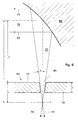
- 6 is the Production of a conical channel 30 by a not shown Cutting laser shown schematically.
- the cutting beam 70 is through its Edge rays 71, 72 outlined. Generally the beam becomes a High power laser expanded. This beam has to go through optics to be mapped to a smaller diameter for processing to get the necessary power density.
- the expanded beam 70 falls into Direction of the arrow, from the left, and meets a focusing lens, in the example represented by a mirror 60.
- the installation of other components such as for example, apertures in the beam path, or the replacement of the one in the example individual mirror represented by a mirror system or by lenses, is of no relevance in this context.
- a convergent beam also results from the necessary beam collimation the focal point F, which includes the half angle ⁇ .
- the focal point F which includes the half angle ⁇ .
- the focal length f of the focusing optics 60 becomes conical cooling air holes chosen so that the cutting beam 70 the desired half angle ⁇ includes and with precisely this beam geometry on the workpiece 10 hits.
- the distance f 'of the focal point F from the workpiece surface 14 larger or smaller than that penetrating material thickness t is different Cross-sectional profiles of the hole.
- the surface is 14 of the workpiece 10 the hot gas side.
- the distance s between Workpiece surface 14 and collimation optics 60 by at least that penetrating material thickness t chosen smaller than the focal length f Collimation optics 60. This creates the desired one Cross-sectional profile of the bore 30 in one step.
Landscapes
- Engineering & Computer Science (AREA)
- Physics & Mathematics (AREA)
- Optics & Photonics (AREA)
- Mechanical Engineering (AREA)
- Plasma & Fusion (AREA)
- General Engineering & Computer Science (AREA)
- Turbine Rotor Nozzle Sealing (AREA)
Priority Applications (3)
| Application Number | Priority Date | Filing Date | Title |
|---|---|---|---|
| DE59808481T DE59808481D1 (de) | 1998-11-09 | 1998-11-09 | Gekühlte Komponenten mit konischen Kühlungskanälen |
| EP98811114A EP1000698B1 (fr) | 1998-11-09 | 1998-11-09 | Composants refroidis avec canaux coniques de refroidissement |
| US09/431,178 US6923247B1 (en) | 1998-11-09 | 1999-11-01 | Cooled components with conical cooling passages |
Applications Claiming Priority (1)
| Application Number | Priority Date | Filing Date | Title |
|---|---|---|---|
| EP98811114A EP1000698B1 (fr) | 1998-11-09 | 1998-11-09 | Composants refroidis avec canaux coniques de refroidissement |
Publications (2)
| Publication Number | Publication Date |
|---|---|
| EP1000698A1 true EP1000698A1 (fr) | 2000-05-17 |
| EP1000698B1 EP1000698B1 (fr) | 2003-05-21 |
Family
ID=8236430
Family Applications (1)
| Application Number | Title | Priority Date | Filing Date |
|---|---|---|---|
| EP98811114A Expired - Lifetime EP1000698B1 (fr) | 1998-11-09 | 1998-11-09 | Composants refroidis avec canaux coniques de refroidissement |
Country Status (3)
| Country | Link |
|---|---|
| US (1) | US6923247B1 (fr) |
| EP (1) | EP1000698B1 (fr) |
| DE (1) | DE59808481D1 (fr) |
Families Citing this family (13)
| Publication number | Priority date | Publication date | Assignee | Title |
|---|---|---|---|---|
| US20070201980A1 (en) * | 2005-10-11 | 2007-08-30 | Honeywell International, Inc. | Method to augment heat transfer using chamfered cylindrical depressions in cast internal cooling passages |
| US7870742B2 (en) * | 2006-11-10 | 2011-01-18 | General Electric Company | Interstage cooled turbine engine |
| US7926289B2 (en) * | 2006-11-10 | 2011-04-19 | General Electric Company | Dual interstage cooled engine |
| US7743613B2 (en) * | 2006-11-10 | 2010-06-29 | General Electric Company | Compound turbine cooled engine |
| US7870743B2 (en) * | 2006-11-10 | 2011-01-18 | General Electric Company | Compound nozzle cooled engine |
| DE102007029367A1 (de) * | 2007-06-26 | 2009-01-02 | Rolls-Royce Deutschland Ltd & Co Kg | Schaufel mit Tangentialstrahlerzeugung am Profil |
| US20090255268A1 (en) * | 2008-04-11 | 2009-10-15 | General Electric Company | Divergent cooling thimbles for combustor liners and related method |
| US8353669B2 (en) * | 2009-08-18 | 2013-01-15 | United Technologies Corporation | Turbine vane platform leading edge cooling holes |
| US8684691B2 (en) | 2011-05-03 | 2014-04-01 | Siemens Energy, Inc. | Turbine blade with chamfered squealer tip and convective cooling holes |
| US9410435B2 (en) * | 2012-02-15 | 2016-08-09 | United Technologies Corporation | Gas turbine engine component with diffusive cooling hole |
| US20170298743A1 (en) * | 2016-04-14 | 2017-10-19 | General Electric Company | Component for a turbine engine with a film-hole |
| US10443396B2 (en) | 2016-06-13 | 2019-10-15 | General Electric Company | Turbine component cooling holes |
| JP7522603B2 (ja) * | 2020-08-06 | 2024-07-25 | リンナイ株式会社 | 電動式ガス流量調節弁 |
Citations (5)
| Publication number | Priority date | Publication date | Assignee | Title |
|---|---|---|---|---|
| US3527543A (en) | 1965-08-26 | 1970-09-08 | Gen Electric | Cooling of structural members particularly for gas turbine engines |
| US4737613A (en) * | 1987-08-24 | 1988-04-12 | United Technologies Corporation | Laser machining method |
| EP0287267A2 (fr) * | 1987-04-16 | 1988-10-19 | The Black Clawson Company | Platines cylindriques pour épurateurs |
| US4818834A (en) * | 1988-03-21 | 1989-04-04 | Raycon Corporation | Process for drilling chamfered holes |
| EP0648918B1 (fr) | 1993-10-15 | 1998-01-07 | United Technologies Corporation | Passage pour le refroidissement des parois minces par pellicule |
Family Cites Families (14)
| Publication number | Priority date | Publication date | Assignee | Title |
|---|---|---|---|---|
| US3700418A (en) * | 1969-11-24 | 1972-10-24 | Gen Motors Corp | Cooled airfoil and method of making it |
| GB1361256A (en) * | 1971-08-25 | 1974-07-24 | Rolls Royce | Gas turbine engine blades |
| US4314442A (en) * | 1978-10-26 | 1982-02-09 | Rice Ivan G | Steam-cooled blading with steam thermal barrier for reheat gas turbine combined with steam turbine |
| US5232343A (en) * | 1984-05-24 | 1993-08-03 | General Electric Company | Turbine blade |
| US4726735A (en) * | 1985-12-23 | 1988-02-23 | United Technologies Corporation | Film cooling slot with metered flow |
| GB2227965B (en) * | 1988-10-12 | 1993-02-10 | Rolls Royce Plc | Apparatus for drilling a shaped hole in a workpiece |
| US5192192A (en) * | 1990-11-28 | 1993-03-09 | The United States Of America As Represented By The Secretary Of The Air Force | Turbine engine foil cap |
| US5326224A (en) * | 1991-03-01 | 1994-07-05 | General Electric Company | Cooling hole arrangements in jet engine components exposed to hot gas flow |
| US5356265A (en) * | 1992-08-25 | 1994-10-18 | General Electric Company | Chordally bifurcated turbine blade |
| US5690473A (en) * | 1992-08-25 | 1997-11-25 | General Electric Company | Turbine blade having transpiration strip cooling and method of manufacture |
| US5779437A (en) * | 1996-10-31 | 1998-07-14 | Pratt & Whitney Canada Inc. | Cooling passages for airfoil leading edge |
| DE59709701D1 (de) * | 1997-09-15 | 2003-05-08 | Alstom Switzerland Ltd | Plattformkühlung für Gasturbinen |
| US6224336B1 (en) * | 1999-06-09 | 2001-05-01 | General Electric Company | Triple tip-rib airfoil |
| US6273682B1 (en) * | 1999-08-23 | 2001-08-14 | General Electric Company | Turbine blade with preferentially-cooled trailing edge pressure wall |
-
1998
- 1998-11-09 EP EP98811114A patent/EP1000698B1/fr not_active Expired - Lifetime
- 1998-11-09 DE DE59808481T patent/DE59808481D1/de not_active Expired - Lifetime
-
1999
- 1999-11-01 US US09/431,178 patent/US6923247B1/en not_active Expired - Lifetime
Patent Citations (5)
| Publication number | Priority date | Publication date | Assignee | Title |
|---|---|---|---|---|
| US3527543A (en) | 1965-08-26 | 1970-09-08 | Gen Electric | Cooling of structural members particularly for gas turbine engines |
| EP0287267A2 (fr) * | 1987-04-16 | 1988-10-19 | The Black Clawson Company | Platines cylindriques pour épurateurs |
| US4737613A (en) * | 1987-08-24 | 1988-04-12 | United Technologies Corporation | Laser machining method |
| US4818834A (en) * | 1988-03-21 | 1989-04-04 | Raycon Corporation | Process for drilling chamfered holes |
| EP0648918B1 (fr) | 1993-10-15 | 1998-01-07 | United Technologies Corporation | Passage pour le refroidissement des parois minces par pellicule |
Also Published As
| Publication number | Publication date |
|---|---|
| US6923247B1 (en) | 2005-08-02 |
| DE59808481D1 (de) | 2003-06-26 |
| EP1000698B1 (fr) | 2003-05-21 |
Similar Documents
| Publication | Publication Date | Title |
|---|---|---|
| DE60031185T2 (de) | Methode zur Kühlung einer Wand einer Strömungsmaschinenschaufel | |
| DE1946535C3 (de) | Bauteil für ein Gasturbinentriebwerk | |
| EP1000698B1 (fr) | Composants refroidis avec canaux coniques de refroidissement | |
| EP1320661B1 (fr) | Aube de turbine a gaz | |
| DE69407721T2 (de) | Kanalmündung zur Filmkühlung dünner Wände | |
| DE60018817T2 (de) | Gekühlte Gasturbinenschaufel | |
| EP1113145B1 (fr) | Aube pour turbine a gaz avec section de mesure sur le bord de fuite | |
| EP2087206B1 (fr) | Aube de turbine | |
| DE10001109B4 (de) | Gekühlte Schaufel für eine Gasturbine | |
| DE69302614T2 (de) | Gekühlte Schaufel für eine Turbomaschine | |
| DE69932688T2 (de) | Kühlungsöffnungen für Gasturbinenkomponenten | |
| DE3873130T2 (de) | Zwangskuehlung fuer einen gasturbineneinlasskanal. | |
| DE60122050T2 (de) | Turbinenleitschaufel mit Einsatz mit Bereichen zur Prallkühlung und Konvektionskühlung | |
| DE60015233T2 (de) | Turbinenschaufel mit interner Kühlung | |
| CH701041A2 (de) | Turbinenleitapparat mit Seitenwandkühlplenum. | |
| EP1260678A1 (fr) | Dispositif de refroidissement pour les éléments d'une turbine à gaz | |
| DE10053356A1 (de) | Gekühltes Bauteil, Gusskern für die Herstellung eines solchen Bauteils, sowie Verfahren zum Herstellen eines solchen Bauteils | |
| EP1207268B1 (fr) | Aube de turbine à gaz et procédé de fabrication d'une aube de turbine à gaz | |
| EP3658751B1 (fr) | Aubage d'aube de turbine | |
| DE2628807A1 (de) | Prallkuehlsystem | |
| EP0031174A1 (fr) | Aube refroidie pour turbine à gaz | |
| DE102007060930A1 (de) | Verfahren zur Rückflussverhinderung und Erzeugung einer Kühlschicht an einem Schaufelblatt | |
| DE1601563B2 (de) | Luftgekühlte Laufschaufel | |
| EP0973998B1 (fr) | Procede pour refroidir une aube de turbine | |
| EP0892151A1 (fr) | Système de refroidissement pour le bord d'attaque d'une aube de turbine à gas |
Legal Events
| Date | Code | Title | Description |
|---|---|---|---|
| PUAI | Public reference made under article 153(3) epc to a published international application that has entered the european phase |
Free format text: ORIGINAL CODE: 0009012 |
|
| AK | Designated contracting states |
Kind code of ref document: A1 Designated state(s): DE GB |
|
| AX | Request for extension of the european patent |
Free format text: AL;LT;LV;MK;RO;SI |
|
| 17P | Request for examination filed |
Effective date: 20000921 |
|
| RAP1 | Party data changed (applicant data changed or rights of an application transferred) |
Owner name: ABB (SCHWEIZ) AG |
|
| AKX | Designation fees paid |
Free format text: DE GB |
|
| RAP1 | Party data changed (applicant data changed or rights of an application transferred) |
Owner name: ALSTOM |
|
| GRAH | Despatch of communication of intention to grant a patent |
Free format text: ORIGINAL CODE: EPIDOS IGRA |
|
| RAP1 | Party data changed (applicant data changed or rights of an application transferred) |
Owner name: ALSTOM (SWITZERLAND) LTD |
|
| GRAH | Despatch of communication of intention to grant a patent |
Free format text: ORIGINAL CODE: EPIDOS IGRA |
|
| GRAA | (expected) grant |
Free format text: ORIGINAL CODE: 0009210 |
|
| AK | Designated contracting states |
Designated state(s): DE GB |
|
| REG | Reference to a national code |
Ref country code: GB Ref legal event code: FG4D Free format text: NOT ENGLISH |
|
| REF | Corresponds to: |
Ref document number: 59808481 Country of ref document: DE Date of ref document: 20030626 Kind code of ref document: P |
|
| GBT | Gb: translation of ep patent filed (gb section 77(6)(a)/1977) | ||
| PLBE | No opposition filed within time limit |
Free format text: ORIGINAL CODE: 0009261 |
|
| STAA | Information on the status of an ep patent application or granted ep patent |
Free format text: STATUS: NO OPPOSITION FILED WITHIN TIME LIMIT |
|
| 26N | No opposition filed |
Effective date: 20040224 |
|
| REG | Reference to a national code |
Ref country code: DE Ref legal event code: R082 Ref document number: 59808481 Country of ref document: DE Representative=s name: UWE ROESLER, DE |
|
| REG | Reference to a national code |
Ref country code: GB Ref legal event code: 732E Free format text: REGISTERED BETWEEN 20120802 AND 20120808 |
|
| REG | Reference to a national code |
Ref country code: DE Ref legal event code: R082 Ref document number: 59808481 Country of ref document: DE Representative=s name: ROESLER, UWE, DIPL.-PHYS.UNIV., DE Effective date: 20120713 Ref country code: DE Ref legal event code: R081 Ref document number: 59808481 Country of ref document: DE Owner name: ANSALDO ENERGIA IP UK LIMITED, GB Free format text: FORMER OWNER: ALSTOM (SWITZERLAND) LTD., BADEN, CH Effective date: 20120713 Ref country code: DE Ref legal event code: R081 Ref document number: 59808481 Country of ref document: DE Owner name: GENERAL ELECTRIC TECHNOLOGY GMBH, CH Free format text: FORMER OWNER: ALSTOM (SWITZERLAND) LTD., BADEN, CH Effective date: 20120713 Ref country code: DE Ref legal event code: R081 Ref document number: 59808481 Country of ref document: DE Owner name: ALSTOM TECHNOLOGY LTD., CH Free format text: FORMER OWNER: ALSTOM (SWITZERLAND) LTD., BADEN, CH Effective date: 20120713 |
|
| REG | Reference to a national code |
Ref country code: DE Ref legal event code: R082 Ref document number: 59808481 Country of ref document: DE Representative=s name: ROESLER, UWE, DIPL.-PHYS.UNIV., DE Ref country code: DE Ref legal event code: R081 Ref document number: 59808481 Country of ref document: DE Owner name: ANSALDO ENERGIA IP UK LIMITED, GB Free format text: FORMER OWNER: ALSTOM TECHNOLOGY LTD., BADEN, CH Ref country code: DE Ref legal event code: R081 Ref document number: 59808481 Country of ref document: DE Owner name: GENERAL ELECTRIC TECHNOLOGY GMBH, CH Free format text: FORMER OWNER: ALSTOM TECHNOLOGY LTD., BADEN, CH |
|
| REG | Reference to a national code |
Ref country code: DE Ref legal event code: R082 Ref document number: 59808481 Country of ref document: DE Representative=s name: ROESLER, UWE, DIPL.-PHYS.UNIV., DE Ref country code: DE Ref legal event code: R081 Ref document number: 59808481 Country of ref document: DE Owner name: ANSALDO ENERGIA IP UK LIMITED, GB Free format text: FORMER OWNER: GENERAL ELECTRIC TECHNOLOGY GMBH, BADEN, CH |
|
| REG | Reference to a national code |
Ref country code: GB Ref legal event code: 732E Free format text: REGISTERED BETWEEN 20170824 AND 20170830 |
|
| PGFP | Annual fee paid to national office [announced via postgrant information from national office to epo] |
Ref country code: DE Payment date: 20171121 Year of fee payment: 20 |
|
| PGFP | Annual fee paid to national office [announced via postgrant information from national office to epo] |
Ref country code: GB Payment date: 20171123 Year of fee payment: 20 |
|
| REG | Reference to a national code |
Ref country code: DE Ref legal event code: R071 Ref document number: 59808481 Country of ref document: DE |
|
| REG | Reference to a national code |
Ref country code: GB Ref legal event code: PE20 Expiry date: 20181108 |
|
| PG25 | Lapsed in a contracting state [announced via postgrant information from national office to epo] |
Ref country code: GB Free format text: LAPSE BECAUSE OF EXPIRATION OF PROTECTION Effective date: 20181108 |