EP1000861A2 - Vorrichtung zum Anordnen von Artikeln auf einem Förderband - Google Patents
Vorrichtung zum Anordnen von Artikeln auf einem Förderband Download PDFInfo
- Publication number
- EP1000861A2 EP1000861A2 EP99122406A EP99122406A EP1000861A2 EP 1000861 A2 EP1000861 A2 EP 1000861A2 EP 99122406 A EP99122406 A EP 99122406A EP 99122406 A EP99122406 A EP 99122406A EP 1000861 A2 EP1000861 A2 EP 1000861A2
- Authority
- EP
- European Patent Office
- Prior art keywords
- conveyor belt
- articles
- pitching
- conveyor
- recited
- Prior art date
- Legal status (The legal status is an assumption and is not a legal conclusion. Google has not performed a legal analysis and makes no representation as to the accuracy of the status listed.)
- Withdrawn
Links
- 238000013459 approach Methods 0.000 claims description 2
- 239000002783 friction material Substances 0.000 description 6
- 230000032258 transport Effects 0.000 description 6
- 238000000034 method Methods 0.000 description 5
- 238000011144 upstream manufacturing Methods 0.000 description 5
- 230000007704 transition Effects 0.000 description 3
- 230000000694 effects Effects 0.000 description 1
- 239000003292 glue Substances 0.000 description 1
- 238000004519 manufacturing process Methods 0.000 description 1
- 238000003908 quality control method Methods 0.000 description 1
- 230000000284 resting effect Effects 0.000 description 1
- 238000012163 sequencing technique Methods 0.000 description 1
Images


Classifications
-
- B—PERFORMING OPERATIONS; TRANSPORTING
- B65—CONVEYING; PACKING; STORING; HANDLING THIN OR FILAMENTARY MATERIAL
- B65G—TRANSPORT OR STORAGE DEVICES, e.g. CONVEYORS FOR LOADING OR TIPPING, SHOP CONVEYOR SYSTEMS OR PNEUMATIC TUBE CONVEYORS
- B65G47/00—Article or material-handling devices associated with conveyors; Methods employing such devices
- B65G47/22—Devices influencing the relative position or the attitude of articles during transit by conveyors
- B65G47/26—Devices influencing the relative position or the attitude of articles during transit by conveyors arranging the articles, e.g. varying spacing between individual articles
- B65G47/30—Devices influencing the relative position or the attitude of articles during transit by conveyors arranging the articles, e.g. varying spacing between individual articles during transit by a series of conveyors
- B65G47/31—Devices influencing the relative position or the attitude of articles during transit by conveyors arranging the articles, e.g. varying spacing between individual articles during transit by a series of conveyors by varying the relative speeds of the conveyors forming the series
-
- B—PERFORMING OPERATIONS; TRANSPORTING
- B65—CONVEYING; PACKING; STORING; HANDLING THIN OR FILAMENTARY MATERIAL
- B65G—TRANSPORT OR STORAGE DEVICES, e.g. CONVEYORS FOR LOADING OR TIPPING, SHOP CONVEYOR SYSTEMS OR PNEUMATIC TUBE CONVEYORS
- B65G21/00—Supporting or protective framework or housings for endless load-carriers or traction elements of belt or chain conveyors
- B65G21/20—Means incorporated in, or attached to, framework or housings for guiding load-carriers, traction elements or loads supported on moving surfaces
- B65G21/2027—Suction retaining means
- B65G21/2036—Suction retaining means for retaining the load on the load-carrying surface
Definitions
- the present invention relates generally to an apparatus for staging or pitching articles. Specifically, the present invention relates to a conveyor table that provides a predetermined distance between adjacent articles carried on the conveyor table.
- the spacing, sequencing, staging or pitching (the terms as used herein are synonymous), of articles moving along a conveyor assembly is an important task. Proper pitching of the articles reduces the tendency for the apparatus to jam.
- maintaining a predetermined distance between an article and a subsequent article is necessary so that the operations on a first article can be completed without interference from the second article.
- the subsequent article then must be in the proper initial position and orientation for the completion of operations on it.
- U.S. Patent number 3,908,333 to Cavanna typifies such a conventional apparatus.
- the conveyor includes several endless conveyor belts.
- the faster operating conveyor belts have pusher elements thereon- projections from the belt which prevent slipping of the conveyed article on the belt.
- the slower moving conveyor belts generally lack the pusher elements.
- the slower moving conveyor belts transport the articles until the pusher elements on the faster moving conveyor belt, initially trailing the article, contact a rear edge of the article. At that point, the faster moving conveyor belt captures and transports the article.
- the pusher elements somewhat maintain the proper pitch of the articles.
- One drawback of the aforementioned device may be the misalignment caused by the pusher elements especially when multiple belts are used and become out of synchronization.
- the pusher elements can skew the article on the conveyor assembly.
- the mass of the conveyor belt and pusher elements is significantly greater than the mass of the article, creating exaggerated effects on the article when contacted by the pusher elements especially as throughput is increased. Skewing articles on the conveyor assembly can jam the apparatus or cause quality control problems.
- an apparatus for pitching articles comprising: a table; a first conveyor belt located on the table; a second conveyor belt located on the table, the second conveyor belt having projections extending outwardly therefrom; and at least one motor operating the first conveyor belt at a first speed and means for operating the second conveyor belt at a second speed, slower than the first conveyor belt speed.
- a method of pitching articles comprising the steps of: providing an article handling unit, comprising: a table; a first conveyor belt traversing at least one exposed surface of the table; a second conveyor belt located on a surface of the table, the second conveyor belt having projections extending outwardly therefrom; and at least one means for operating the first and second conveyor belts; placing an article on the article handling unit; driving the first conveyor at a first speed to transport the article along the article handling unit; and driving the second conveyor at a second speed, slower than the first conveyor belt speed.
- the article approaches one of the projections on the second conveyor belt at the first speed and in the direction of travel of the second conveyor belt.
- the article becomes constrained by the projection from the second conveyor belt to travel at the slower rate of speed.
- the first conveyor belt traverses the table parallel to the second conveyor but for only a portion of the distance traversed by the second conveyor belt.
- a third belt traverses the table parallel to the second belt linearly aligned with said first belt but operating at substantially the same speed as the second belt.
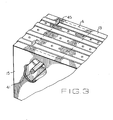
- Figures 1-3 display one embodiment of the present invention.
- the apparatus includes a housing 11 formed by a table, or upper surface 13, side walls 15, end walls 17, and bottom surface 19.
- Table 13, side walls 15, end walls 17 and bottom surface 19 form an enclosure 21.
- Table 13 along with a series of endless conveyor belts 23, 25, 27 thereon, transport articles A (shown in phantom in Figure 3) downstream.
- table 13 includes apertures 29 therein. Aside from apertures 29, enclosure 21 should be airtight.
- An air-moving means such as fan 31 withdraws air from enclosure 21. The vacuum produced by fan 31 draws air through apertures 29 and into enclosure 21. Any article A positioned above apertures 29 is drawn towards table 13. The force with which table 13 retains article A depends upon the amount of suction force created by fan 31.
- enclosure 21 preferably is compartmentalized and has an area of reduced volume, or plenum 33.
- Fan 31 preferably resides with the downstream compartment of enclosure 21 ( see Figure 2).
- the suction force on articles A that are positioned downstream is greater than the suction force on articles A that are positioned further upstream.
- the relative sizes of enclosure 21 and plenum 33, along with other factors, determine the relative suction force gradient along table 13.
- the apparatus can include adjustable rails 35 extending along side walls 15. Rails 35 are positionable at selected distances relative to side walls 15 depending on the size of the article carried thereon and the amount of guidance needed. Rails 35 help guide articles A downstream and help maintain alignment of the article on the conveyor belts 23, 25, 27.
- Conveyor belts 23 preferably extend the entire length of table 13. As seen in Figure 1, conveyor belts 23 flank conveyor belts 25, 27. Conveyor belts 25, 27 preferably only extend along a portion of the length of table 13.
- Conveyor belts 23 travel around enclosure 11 using idler rollers 37, tension roller 39 and a drive roller 41.
- a motor 43 rotates drive roller 41, propelling conveyor belts 23.
- Each conveyor belt 23 could utilize its own motor, but in order to operate conveyor belts 23 at the same speed, a single motor is preferred.
- Tension roller 39 removes slack in conveyor belts 23 in a conventional manner.
- the rollers used with conveyor belts 23 are preferably cantilevered. This allows rapid removal of conveyor belts 23 from the apparatus. An operator can quickly swap different conveyor belts onto the apparatus without disturbing the other conveyor belts 25, 27. The lateral positioning of conveyor belts 23 also aid in the removal process. The new conveyor belts could have a different pitch, or the same pitch, as the now-removed conveyor belts.
- Conveyor belts 23 include projections 45 extending therefrom.
- Projections 45 can have a variety of shapes and methods of securement and are not otherwise limited. The distance between adjacent projections 45 determines the pitch of articles A carried thereon.
- Figure 3 demonstrates projections 45 as being a block permanently secured to conveyor belt 23.
- projections 45 could be a post extending from conveyor belt 23 or another suitable shape.
- projections could be removably mounted to conveyor belt 23. This would allow selective adjustment of the pitch, or distance between adjacent projections 45, on conveyor belt 23.
- the apparatus preferably uses two conveyor belts 23.
- the projections on each conveyor 23 should have the same longitudinal position (in other words, when viewed from the side, such as in Figure 2) when placed on table 13. This ensures proper positioning of article A when article A contacts projections 45.
- articles A carried on table 13 would skew, potentially interrupting the article handling process.
- article A may have a leading edge which is not orthodinal to the sides of the conveyor (e.g. may be trapezoidal), in which case the projections 45 may be staggered and angled.
- Conveyor belts 25 preferably extend only along a portion of table 13. As seen in Figure 1, conveyor belts 25 travel approximately the first half of table 13.
- the conveyor belts 25 are preferably a laminated belt having a surface of a high friction material such as a high tack rubber (e.g., LinotexTM)
- conveyor belts 25 travel around enclosure 11 using a series of rollers.
- conveyor belts 25 travel on rollers having a common axis to the other conveyor belts where possible.
- conveyor belts 25 utilize one common idler roller axis 37, but also rely upon additional idler rollers 47, tension roller 49 and drive roller 51.
- a motor 53 rotates drive roller 51, driving conveyor belts 25.
- Each conveyor belt 25 could utilize its own motor, but a single motor is preferred to ensure the same operational speed.
- Tension roller 49 removes slack in conveyor belts 25 in a conventional manner.
- Conveyor belts 25 utilize a motor different than the motor used with conveyor belts 23 and 27 since the present invention operates these belts at different speeds.
- motor 53 drives conveyor belts 25 faster than conveyor belts 23 and 27. This allows article A travelling along table 13 and between adjacent projections 45 to catch up with and eventually to contact the leading projection 45.
- a leading projection refers to the projection located downstream of article A.
- a trailing projection refers to the projection located upstream of the article.
- Conveyor belts 27 extend along the remainder of table 13 not occupied by conveyor belts 25. As seen in Figure 1, conveyor belts 27 travel the second half of table 13. The purpose of which will become clearer below, conveyor belts 27 are preferably made of a low friction material, having low tack compared to the surface of belt 25.
- conveyor belts 27 travel around enclosure 11 using a series of rollers. Preferably, conveyor belts 27 travel on rollers or roller axes common to the other conveyor belts where possible. As seen in Figure 2, conveyor belts 27 utilize one common idler roller 37, but also rely upon an additional idler roller 55 and a tension roller 57.
- conveyor belts 27 operate at the same speed as conveyor belts 23.
- conveyor belts 27 may use motor 43 that additionally rotates conveyor belts 23.
- conveyor belts 27 could utilize their own separate motor (not shown). This is desired when, for example, conveyor belts 27 are operated at a slightly faster speed than conveyor belts 23. Since conveyor belts 27 are made from a low friction material similar to or the same as belt 23, operations at a speed slightly greater than conveyor belts 23 should not cause skewing of the articles.
- the apparatus can include a control system (not shown), for example, to monitor operations and to control drive motors 43, 53 and fan motor 31.
- the control system could be part of a larger control system (not shown) for the other components (not shown) used in an integrated article handling process.
- the apparatus is part of a larger article handling unit, such as a carton forming assembly.
- a carton forming assembly various components transform a blank into a carton, then package the cartons for transport.
- the present invention can provide a desired spacing, or pitch, to articles A travelling along the various components of the article handling unit.
- the apparatus of the present invention receives articles A from an upstream component of the article handling unit, such as a prefeeder (not shown).
- the upstream component of the article handling unit could, for example, receive articles A in an overlapping, or shingled, condition, then dispense one article A from the stack at a time.
- the upstream component of article handling unit dispenses article A so that it enters between a leading and a trailing projection 45 on conveyor belts 23.
- article A will contact the rear of leading projections 45.
- articles A exhibit the desired spacing, or pitch, between adjacent articles A travelling along table 13.
- article A contacts leading projections 45 near a transition area 59.
- Transition area 59 is the location along table 13 where conveyor belts 25 end, and conveyor belts 27 begin. Contact between article A and projections 45 should occur near transition area 59 to prevent skewing of articles A on table 13. If the high friction conveyor belts 25 continued to drive articles A faster than conveyor belts 23, skewing is likely. Therefore, around the time article A contacts projections 45, articles A should be controlled by conveyor belts 27 and 23. The result is a "soft landing" of the article onto the slower belts and into projections 45.
- the low friction material of conveyor belts 27 prevents skewing of articles A since they do not continue to drive article A against projections 45. Once resting against projections 45, the low friction material of conveyor belts 27 prevents further movement of article A.
- Conveyor belts 27 may be driven slightly faster than conveyor belts 23 in case conveyor belts 25 did not drive article A sufficiently forward to contact projections 45. This may be accomplished by small changes in diameters of rollers 41.
- the apparatus delivers properly spaced, or pitched, articles A to the downstream component of the article handling unit.
- a downstream component of the article handling unit could be, for example, a folder/gluer which creases and glues flaps (not shown) on article A.
Landscapes
- Engineering & Computer Science (AREA)
- Mechanical Engineering (AREA)
- Attitude Control For Articles On Conveyors (AREA)
Applications Claiming Priority (2)
| Application Number | Priority Date | Filing Date | Title |
|---|---|---|---|
| US09/191,013 US6044959A (en) | 1998-11-12 | 1998-11-12 | Apparatus for staging (pitching) articles on a conveyor system |
| US191013 | 1998-11-12 |
Publications (1)
| Publication Number | Publication Date |
|---|---|
| EP1000861A2 true EP1000861A2 (de) | 2000-05-17 |
Family
ID=22703768
Family Applications (1)
| Application Number | Title | Priority Date | Filing Date |
|---|---|---|---|
| EP99122406A Withdrawn EP1000861A2 (de) | 1998-11-12 | 1999-11-10 | Vorrichtung zum Anordnen von Artikeln auf einem Förderband |
Country Status (2)
| Country | Link |
|---|---|
| US (1) | US6044959A (de) |
| EP (1) | EP1000861A2 (de) |
Families Citing this family (16)
| Publication number | Priority date | Publication date | Assignee | Title |
|---|---|---|---|---|
| US6216848B1 (en) * | 1999-04-09 | 2001-04-17 | Profold, Inc. | Vacuum table conveying apparatus and associated methods |
| US20030102016A1 (en) * | 2001-12-04 | 2003-06-05 | Gary Bouchard | Integrated circuit processing system |
| ITBO20020530A1 (it) * | 2002-08-08 | 2004-02-09 | Gd Spa | Apparecchiatura e metodo di alimentazione di pacchetti. |
| US20070289843A1 (en) * | 2006-04-18 | 2007-12-20 | Barry Kitazumi | Conveyor System Including Offset Section |
| US7281623B1 (en) * | 2006-04-18 | 2007-10-16 | Aquest Systems Corporation | Transport system including vertical rollers |
| ITRE20060051A1 (it) * | 2006-04-21 | 2007-10-22 | Costi Srl | Macchina ordinatrice |
| US20080050208A1 (en) * | 2006-08-25 | 2008-02-28 | Barry Kitazumi | High speed transporter including horizontal belt |
| TW200909318A (en) * | 2006-08-25 | 2009-03-01 | Aquest Systems Corp | Conveyor transfer system |
| US20080230352A1 (en) * | 2007-03-20 | 2008-09-25 | Yasunari Hirata | Conveyer apparatus |
| DE102007049424A1 (de) * | 2007-10-12 | 2009-04-23 | Bhs Corrugated Maschinen- Und Anlagenbau Gmbh | Wellpappe-Streifen-Transport-Einrichtung |
| US7921981B2 (en) * | 2008-10-01 | 2011-04-12 | United Bakery Equipment Company, Inc. | Method and apparatus for conveying and arranging bakery products |
| US8127915B2 (en) * | 2009-12-21 | 2012-03-06 | Martin's Famous Pastry Shoppe, Inc. | System and method for separating a cluster of interconnected food products |
| EP2746197B1 (de) * | 2012-12-20 | 2016-06-08 | MediSeal GmbH | Blisterstreifentransportvorrichtung |
| DE202016005874U1 (de) * | 2016-09-23 | 2016-10-19 | SOMIC Verpackungsmaschinen GmbH & Co. KG | Vorrichtung zum Zuführen einer Mehrzahl flächig aneinander anliegender, flächiger Elementen, insbesondere Kartonzuschnitten, zu einer Verpackungsvorrichtung |
| CN106890808B (zh) * | 2017-03-23 | 2023-02-28 | 合肥迅达电器有限公司 | 一种具有除杂功能的金属零部件送料机 |
| EP4056503B1 (de) * | 2021-03-10 | 2025-05-07 | Fameccanica.Data S.p.A. | Vorrichtung und verfahren zur veränderung des abstands zwischen sich bewegenden gegenständen |
Family Cites Families (10)
| Publication number | Priority date | Publication date | Assignee | Title |
|---|---|---|---|---|
| US3482674A (en) * | 1968-03-11 | 1969-12-09 | Emhart Corp | Conveyor system for handling groups of articles |
| IT970180B (it) * | 1972-11-02 | 1974-04-10 | Cavanna M | Dispositivo per l abbinamento di prodotti e relativi imbalaggi durante l alimentazione di una macchina confezionatrice |
| CA1009175A (en) * | 1974-04-19 | 1977-04-26 | Arthur G. Alsop | Stacking mechanism and method |
| US3938650A (en) * | 1975-02-27 | 1976-02-17 | Franklin Electric Subsidiaries, Inc. | Indexing article separating and feeding conveyor |
| DE4001050A1 (de) * | 1990-01-16 | 1991-07-18 | Nienstedt Heinz Maschf | Trennvorrichtung fuer im wesentlichen quaderfoermige koerper aus tiefgefrorenen lebens- oder futtermitteln |
| US5547004A (en) * | 1992-01-28 | 1996-08-20 | Klockner Hansel Tevopharm B.V. | Method and device for arranging a stream of products |
| IT1285513B1 (it) * | 1996-02-02 | 1998-06-08 | Gd Spa | Metodo per l'alimentazione di sbozzati in una macchina impacchettatrice di sigarette |
| DE19625470A1 (de) * | 1996-06-26 | 1998-01-02 | Bielomatik Leuze & Co | Verfahren und Vorrichtung zur Förderung von Gegenständen |
| US5685410A (en) * | 1996-09-03 | 1997-11-11 | U.S. Natural Resources, Inc. | Infeed conveyor system |
| US5827162A (en) * | 1997-01-02 | 1998-10-27 | The Langston Corporation | Folder/gluer machine for paperboard blanks |
-
1998
- 1998-11-12 US US09/191,013 patent/US6044959A/en not_active Expired - Lifetime
-
1999
- 1999-11-10 EP EP99122406A patent/EP1000861A2/de not_active Withdrawn
Also Published As
| Publication number | Publication date |
|---|---|
| US6044959A (en) | 2000-04-04 |
Similar Documents
| Publication | Publication Date | Title |
|---|---|---|
| US6044959A (en) | Apparatus for staging (pitching) articles on a conveyor system | |
| US7651089B2 (en) | Method and device for forming stacks of flat elements | |
| US5310041A (en) | Device for equally-spaced transportation of randomly arranged incoming products | |
| JPH0155172B2 (de) | ||
| JP3991120B2 (ja) | 扁平な発送物のための搬送システム | |
| JPH02261740A (ja) | 板紙の供給装置 | |
| KR100254706B1 (ko) | 층상으로 적재된 판형물체를 분리하는 장치 | |
| US7168696B2 (en) | Apparatus and method for separating flat parceled goods | |
| JPH0578000A (ja) | 鱗状に重り合つた一連の物品の形成装置 | |
| EP0894750B1 (de) | Verfahren und Einheit zum kombinierten Übergeben-Wenden von Zigarettenpackungen | |
| US6669006B2 (en) | Method and device for conveying reams of paper | |
| JP3051009B2 (ja) | 紙巻き煙草用パックの移送装置 | |
| US5291985A (en) | Method and device for forming groups of flat products, in particular biscuits, for supply to a packing line | |
| JPH0733272A (ja) | ページ合わせ装置 | |
| JP3553695B2 (ja) | 金属シートを搬送するための装置 | |
| US5096043A (en) | Device for feeding products from a supply unit to a receiving unit | |
| JP2001354348A (ja) | 物品を供給するための装置および方法 | |
| EP0344787B1 (de) | Verfahren und Vorrichtung zum Zuführen von Signaturen zu einer Heftmaschine | |
| US6619650B2 (en) | Device for feeding printed products to a conveying channel | |
| EP0719883B1 (de) | Vorrichtung zum Fördern, zu einer Endstation, von losen Textilgegenständen die selektiv durch mindestens zwei Zuführstationen zugeführt werden | |
| EP1409347A1 (de) | Verfahren und vorrichtung zum einwickeln von druckerzeugnissen | |
| JPH1192006A (ja) | 印刷物処理装置 | |
| GB2147569A (en) | Stack handling control | |
| JPH05162831A (ja) | 幅可変式ベルトコンベア装置 | |
| JPH05338777A (ja) | 物品の方向修正装置 |
Legal Events
| Date | Code | Title | Description |
|---|---|---|---|
| PUAI | Public reference made under article 153(3) epc to a published international application that has entered the european phase |
Free format text: ORIGINAL CODE: 0009012 |
|
| AK | Designated contracting states |
Kind code of ref document: A2 Designated state(s): AT BE CH CY DE DK ES FI FR GB GR IE IT LI LU MC NL PT SE |
|
| AX | Request for extension of the european patent |
Free format text: AL;LT;LV;MK;RO;SI |
|
| STAA | Information on the status of an ep patent application or granted ep patent |
Free format text: STATUS: THE APPLICATION IS DEEMED TO BE WITHDRAWN |
|
| 18D | Application deemed to be withdrawn |
Effective date: 20040602 |