EP1001047A2 - Précurseur de ligand à base d'alcène et procédé de synthèse - Google Patents
Précurseur de ligand à base d'alcène et procédé de synthèse Download PDFInfo
- Publication number
- EP1001047A2 EP1001047A2 EP99308880A EP99308880A EP1001047A2 EP 1001047 A2 EP1001047 A2 EP 1001047A2 EP 99308880 A EP99308880 A EP 99308880A EP 99308880 A EP99308880 A EP 99308880A EP 1001047 A2 EP1001047 A2 EP 1001047A2
- Authority
- EP
- European Patent Office
- Prior art keywords
- precursor
- bond
- ligand
- mol
- proportion
- Prior art date
- Legal status (The legal status is an assumption and is not a legal conclusion. Google has not performed a legal analysis and makes no representation as to the accuracy of the status listed.)
- Granted
Links
- 239000002243 precursor Substances 0.000 title claims abstract description 138
- 239000003446 ligand Substances 0.000 title claims abstract description 112
- 150000001336 alkenes Chemical class 0.000 title claims abstract description 63
- 238000001308 synthesis method Methods 0.000 title abstract description 8
- 239000010949 copper Substances 0.000 claims abstract description 102
- RYGMFSIKBFXOCR-UHFFFAOYSA-N Copper Chemical compound [Cu] RYGMFSIKBFXOCR-UHFFFAOYSA-N 0.000 claims abstract description 66
- 229910052802 copper Inorganic materials 0.000 claims abstract description 66
- 229910052751 metal Inorganic materials 0.000 claims abstract description 62
- 239000002184 metal Substances 0.000 claims abstract description 62
- 229910052799 carbon Inorganic materials 0.000 claims abstract description 16
- 239000007791 liquid phase Substances 0.000 claims abstract description 15
- 125000003545 alkoxy group Chemical group 0.000 claims abstract description 14
- 125000001188 haloalkyl group Chemical group 0.000 claims abstract description 11
- 125000002347 octyl group Chemical group [H]C([*])([H])C([H])([H])C([H])([H])C([H])([H])C([H])([H])C([H])([H])C([H])([H])C([H])([H])[H] 0.000 claims abstract description 11
- 229910052739 hydrogen Inorganic materials 0.000 claims abstract description 9
- 125000004432 carbon atom Chemical group C* 0.000 claims abstract description 6
- 238000001465 metallisation Methods 0.000 claims abstract description 6
- 150000001875 compounds Chemical class 0.000 claims description 48
- YWAKXRMUMFPDSH-UHFFFAOYSA-N pentene Chemical compound CCCC=C YWAKXRMUMFPDSH-UHFFFAOYSA-N 0.000 claims description 48
- YMWUJEATGCHHMB-UHFFFAOYSA-N Dichloromethane Chemical compound ClCCl YMWUJEATGCHHMB-UHFFFAOYSA-N 0.000 claims description 41
- 238000000034 method Methods 0.000 claims description 41
- LIKMAJRDDDTEIG-UHFFFAOYSA-N 1-hexene Chemical compound CCCCC=C LIKMAJRDDDTEIG-UHFFFAOYSA-N 0.000 claims description 40
- AFFLGGQVNFXPEV-UHFFFAOYSA-N 1-decene Chemical compound CCCCCCCCC=C AFFLGGQVNFXPEV-UHFFFAOYSA-N 0.000 claims description 32
- BKOOMYPCSUNDGP-UHFFFAOYSA-N 2-methylbut-2-ene Chemical compound CC=C(C)C BKOOMYPCSUNDGP-UHFFFAOYSA-N 0.000 claims description 32
- BERDEBHAJNAUOM-UHFFFAOYSA-N copper(I) oxide Inorganic materials [Cu]O[Cu] BERDEBHAJNAUOM-UHFFFAOYSA-N 0.000 claims description 30
- KRFJLUBVMFXRPN-UHFFFAOYSA-N cuprous oxide Chemical compound [O-2].[Cu+].[Cu+] KRFJLUBVMFXRPN-UHFFFAOYSA-N 0.000 claims description 30
- 238000005229 chemical vapour deposition Methods 0.000 claims description 26
- FXNDIJDIPNCZQJ-UHFFFAOYSA-N 2,4,4-trimethylpent-1-ene Chemical compound CC(=C)CC(C)(C)C FXNDIJDIPNCZQJ-UHFFFAOYSA-N 0.000 claims description 22
- 239000000243 solution Substances 0.000 claims description 22
- 239000000203 mixture Substances 0.000 claims description 21
- 239000000654 additive Substances 0.000 claims description 20
- 230000000996 additive effect Effects 0.000 claims description 19
- QAMFBRUWYYMMGJ-UHFFFAOYSA-N hexafluoroacetylacetone Chemical compound FC(F)(F)C(=O)CC(=O)C(F)(F)F QAMFBRUWYYMMGJ-UHFFFAOYSA-N 0.000 claims description 15
- PKXHXOTZMFCXSH-UHFFFAOYSA-N 3,3-dimethylbut-1-ene Chemical compound CC(C)(C)C=C PKXHXOTZMFCXSH-UHFFFAOYSA-N 0.000 claims description 14
- WYURNTSHIVDZCO-UHFFFAOYSA-N Tetrahydrofuran Chemical compound C1CCOC1 WYURNTSHIVDZCO-UHFFFAOYSA-N 0.000 claims description 14
- 238000001914 filtration Methods 0.000 claims description 14
- 239000002904 solvent Substances 0.000 claims description 12
- OWWIWYDDISJUMY-UHFFFAOYSA-N 2,3-dimethylbut-1-ene Chemical compound CC(C)C(C)=C OWWIWYDDISJUMY-UHFFFAOYSA-N 0.000 claims description 11
- 239000011343 solid material Substances 0.000 claims description 10
- 239000011259 mixed solution Substances 0.000 claims description 9
- 125000001449 isopropyl group Chemical group [H]C([H])([H])C([H])(*)C([H])([H])[H] 0.000 claims description 8
- YLQBMQCUIZJEEH-UHFFFAOYSA-N tetrahydrofuran Natural products C=1C=COC=1 YLQBMQCUIZJEEH-UHFFFAOYSA-N 0.000 claims description 7
- VYPSYNLAJGMNEJ-UHFFFAOYSA-N Silicium dioxide Chemical compound O=[Si]=O VYPSYNLAJGMNEJ-UHFFFAOYSA-N 0.000 claims description 6
- BQCADISMDOOEFD-UHFFFAOYSA-N Silver Chemical compound [Ag] BQCADISMDOOEFD-UHFFFAOYSA-N 0.000 claims description 5
- 229910052741 iridium Inorganic materials 0.000 claims description 5
- GKOZUEZYRPOHIO-UHFFFAOYSA-N iridium atom Chemical compound [Ir] GKOZUEZYRPOHIO-UHFFFAOYSA-N 0.000 claims description 5
- 125000004123 n-propyl group Chemical group [H]C([H])([H])C([H])([H])C([H])([H])* 0.000 claims description 5
- 229910052709 silver Inorganic materials 0.000 claims description 5
- 239000004332 silver Substances 0.000 claims description 5
- 230000002194 synthesizing effect Effects 0.000 claims description 4
- 125000000999 tert-butyl group Chemical group [H]C([H])([H])C(*)(C([H])([H])[H])C([H])([H])[H] 0.000 claims description 4
- FGUUSXIOTUKUDN-IBGZPJMESA-N C1(=CC=CC=C1)N1C2=C(NC([C@H](C1)NC=1OC(=NN=1)C1=CC=CC=C1)=O)C=CC=C2 Chemical compound C1(=CC=CC=C1)N1C2=C(NC([C@H](C1)NC=1OC(=NN=1)C1=CC=CC=C1)=O)C=CC=C2 FGUUSXIOTUKUDN-IBGZPJMESA-N 0.000 claims description 3
- GNFTZDOKVXKIBK-UHFFFAOYSA-N 3-(2-methoxyethoxy)benzohydrazide Chemical compound COCCOC1=CC=CC(C(=O)NN)=C1 GNFTZDOKVXKIBK-UHFFFAOYSA-N 0.000 claims 1
- 239000000853 adhesive Substances 0.000 abstract description 2
- 230000001070 adhesive effect Effects 0.000 abstract description 2
- 239000012691 Cu precursor Substances 0.000 description 29
- VMQMZMRVKUZKQL-UHFFFAOYSA-N Cu+ Chemical class [Cu+] VMQMZMRVKUZKQL-UHFFFAOYSA-N 0.000 description 25
- 125000002496 methyl group Chemical group [H]C([H])([H])* 0.000 description 21
- 125000000325 methylidene group Chemical group [H]C([H])=* 0.000 description 21
- 239000007787 solid Substances 0.000 description 21
- 230000015572 biosynthetic process Effects 0.000 description 20
- 238000003786 synthesis reaction Methods 0.000 description 19
- 239000013078 crystal Substances 0.000 description 14
- 239000007788 liquid Substances 0.000 description 14
- 239000000047 product Substances 0.000 description 13
- UHOVQNZJYSORNB-MZWXYZOWSA-N benzene-d6 Chemical compound [2H]C1=C([2H])C([2H])=C([2H])C([2H])=C1[2H] UHOVQNZJYSORNB-MZWXYZOWSA-N 0.000 description 12
- 229910052782 aluminium Inorganic materials 0.000 description 11
- XAGFODPZIPBFFR-UHFFFAOYSA-N aluminium Chemical compound [Al] XAGFODPZIPBFFR-UHFFFAOYSA-N 0.000 description 10
- 150000001721 carbon Chemical group 0.000 description 10
- 239000010409 thin film Substances 0.000 description 10
- 239000000758 substrate Substances 0.000 description 9
- 238000000425 proton nuclear magnetic resonance spectrum Methods 0.000 description 8
- 238000005160 1H NMR spectroscopy Methods 0.000 description 7
- 238000005481 NMR spectroscopy Methods 0.000 description 7
- 238000000354 decomposition reaction Methods 0.000 description 7
- 238000000151 deposition Methods 0.000 description 7
- 125000000956 methoxy group Chemical group [H]C([H])([H])O* 0.000 description 7
- 239000002244 precipitate Substances 0.000 description 7
- 238000012916 structural analysis Methods 0.000 description 7
- WSNDAYQNZRJGMJ-UHFFFAOYSA-N 2,2,2-trifluoroethanone Chemical compound FC(F)(F)[C]=O WSNDAYQNZRJGMJ-UHFFFAOYSA-N 0.000 description 6
- 230000008021 deposition Effects 0.000 description 6
- 239000010408 film Substances 0.000 description 6
- 239000000706 filtrate Substances 0.000 description 6
- 239000007789 gas Substances 0.000 description 6
- SNVLJLYUUXKWOJ-UHFFFAOYSA-N methylidenecarbene Chemical compound C=[C] SNVLJLYUUXKWOJ-UHFFFAOYSA-N 0.000 description 6
- 238000001556 precipitation Methods 0.000 description 6
- GVNVAWHJIKLAGL-UHFFFAOYSA-N 2-(cyclohexen-1-yl)cyclohexan-1-one Chemical compound O=C1CCCCC1C1=CCCCC1 GVNVAWHJIKLAGL-UHFFFAOYSA-N 0.000 description 5
- 101150065749 Churc1 gene Proteins 0.000 description 5
- 102100038239 Protein Churchill Human genes 0.000 description 5
- 125000000217 alkyl group Chemical group 0.000 description 5
- 150000002430 hydrocarbons Chemical class 0.000 description 5
- 238000003756 stirring Methods 0.000 description 5
- -1 tungsten metals Chemical class 0.000 description 5
- 239000011521 glass Substances 0.000 description 4
- 229930195733 hydrocarbon Natural products 0.000 description 4
- 238000004519 manufacturing process Methods 0.000 description 4
- 239000000463 material Substances 0.000 description 4
- 238000005240 physical vapour deposition Methods 0.000 description 4
- 239000005749 Copper compound Substances 0.000 description 3
- XUIMIQQOPSSXEZ-UHFFFAOYSA-N Silicon Chemical group [Si] XUIMIQQOPSSXEZ-UHFFFAOYSA-N 0.000 description 3
- 230000004888 barrier function Effects 0.000 description 3
- 238000006243 chemical reaction Methods 0.000 description 3
- GCSJLQSCSDMKTP-UHFFFAOYSA-N ethenyl(trimethyl)silane Chemical compound C[Si](C)(C)C=C GCSJLQSCSDMKTP-UHFFFAOYSA-N 0.000 description 3
- 239000012705 liquid precursor Substances 0.000 description 3
- 150000004767 nitrides Chemical class 0.000 description 3
- 229910052710 silicon Inorganic materials 0.000 description 3
- 238000003860 storage Methods 0.000 description 3
- 229910052721 tungsten Inorganic materials 0.000 description 3
- WGLLSSPDPJPLOR-UHFFFAOYSA-N 2,3-dimethylbut-2-ene Chemical compound CC(C)=C(C)C WGLLSSPDPJPLOR-UHFFFAOYSA-N 0.000 description 2
- RYPKRALMXUUNKS-UHFFFAOYSA-N 2-Hexene Natural products CCCC=CC RYPKRALMXUUNKS-UHFFFAOYSA-N 0.000 description 2
- 125000003903 2-propenyl group Chemical group [H]C([*])([H])C([H])=C([H])[H] 0.000 description 2
- IJGRMHOSHXDMSA-UHFFFAOYSA-N Atomic nitrogen Chemical compound N#N IJGRMHOSHXDMSA-UHFFFAOYSA-N 0.000 description 2
- OKTJSMMVPCPJKN-UHFFFAOYSA-N Carbon Chemical compound [C] OKTJSMMVPCPJKN-UHFFFAOYSA-N 0.000 description 2
- 239000004215 Carbon black (E152) Substances 0.000 description 2
- QPLDLSVMHZLSFG-UHFFFAOYSA-N Copper oxide Chemical compound [Cu]=O QPLDLSVMHZLSFG-UHFFFAOYSA-N 0.000 description 2
- VGGSQFUCUMXWEO-UHFFFAOYSA-N Ethene Chemical class C=C VGGSQFUCUMXWEO-UHFFFAOYSA-N 0.000 description 2
- 239000005977 Ethylene Substances 0.000 description 2
- ATJFFYVFTNAWJD-UHFFFAOYSA-N Tin Chemical compound [Sn] ATJFFYVFTNAWJD-UHFFFAOYSA-N 0.000 description 2
- KDKYADYSIPSCCQ-UHFFFAOYSA-N but-1-yne Chemical compound CCC#C KDKYADYSIPSCCQ-UHFFFAOYSA-N 0.000 description 2
- 239000004020 conductor Substances 0.000 description 2
- 238000011109 contamination Methods 0.000 description 2
- 230000001934 delay Effects 0.000 description 2
- YMWUJEATGCHHMB-DICFDUPASA-N dichloromethane-d2 Chemical compound [2H]C([2H])(Cl)Cl YMWUJEATGCHHMB-DICFDUPASA-N 0.000 description 2
- 125000000219 ethylidene group Chemical group [H]C(=[*])C([H])([H])[H] 0.000 description 2
- 239000004615 ingredient Substances 0.000 description 2
- 239000012263 liquid product Substances 0.000 description 2
- 238000004518 low pressure chemical vapour deposition Methods 0.000 description 2
- QMMOXUPEWRXHJS-UHFFFAOYSA-N pentene-2 Natural products CCC=CC QMMOXUPEWRXHJS-UHFFFAOYSA-N 0.000 description 2
- 229920002120 photoresistant polymer Polymers 0.000 description 2
- 238000002360 preparation method Methods 0.000 description 2
- 238000012545 processing Methods 0.000 description 2
- 238000011160 research Methods 0.000 description 2
- 239000000126 substance Substances 0.000 description 2
- 239000010937 tungsten Substances 0.000 description 2
- WACNXHCZHTVBJM-UHFFFAOYSA-N 1,2,3,4,5-pentafluorobenzene Chemical compound FC1=CC(F)=C(F)C(F)=C1F WACNXHCZHTVBJM-UHFFFAOYSA-N 0.000 description 1
- LAAVYEUJEMRIGF-UHFFFAOYSA-N 2,4,4-trimethylpent-2-ene Chemical compound CC(C)=CC(C)(C)C LAAVYEUJEMRIGF-UHFFFAOYSA-N 0.000 description 1
- YHQXBTXEYZIYOV-UHFFFAOYSA-N 3-methylbut-1-ene Chemical compound CC(C)C=C YHQXBTXEYZIYOV-UHFFFAOYSA-N 0.000 description 1
- RYKZRKKEYSRDNF-UHFFFAOYSA-N 3-methylidenepentane Chemical compound CCC(=C)CC RYKZRKKEYSRDNF-UHFFFAOYSA-N 0.000 description 1
- CSDQQAQKBAQLLE-UHFFFAOYSA-N 4-(4-chlorophenyl)-4,5,6,7-tetrahydrothieno[3,2-c]pyridine Chemical compound C1=CC(Cl)=CC=C1C1C(C=CS2)=C2CCN1 CSDQQAQKBAQLLE-UHFFFAOYSA-N 0.000 description 1
- BHELIUBJHYAEDK-OAIUPTLZSA-N Aspoxicillin Chemical compound C1([C@H](C(=O)N[C@@H]2C(N3[C@H](C(C)(C)S[C@@H]32)C(O)=O)=O)NC(=O)[C@H](N)CC(=O)NC)=CC=C(O)C=C1 BHELIUBJHYAEDK-OAIUPTLZSA-N 0.000 description 1
- VFSSGALBLCUPAT-UHFFFAOYSA-N C[NH+]([N-](I)I)[N]#C Chemical compound C[NH+]([N-](I)I)[N]#C VFSSGALBLCUPAT-UHFFFAOYSA-N 0.000 description 1
- XFXPMWWXUTWYJX-UHFFFAOYSA-N Cyanide Chemical compound N#[C-] XFXPMWWXUTWYJX-UHFFFAOYSA-N 0.000 description 1
- OAICVXFJPJFONN-UHFFFAOYSA-N Phosphorus Chemical compound [P] OAICVXFJPJFONN-UHFFFAOYSA-N 0.000 description 1
- 238000004639 Schlenk technique Methods 0.000 description 1
- 229910004166 TaN Inorganic materials 0.000 description 1
- 150000005215 alkyl ethers Chemical class 0.000 description 1
- XYLMUPLGERFSHI-UHFFFAOYSA-N alpha-Methylstyrene Chemical compound CC(=C)C1=CC=CC=C1 XYLMUPLGERFSHI-UHFFFAOYSA-N 0.000 description 1
- 238000001505 atmospheric-pressure chemical vapour deposition Methods 0.000 description 1
- 125000004429 atom Chemical group 0.000 description 1
- 238000009835 boiling Methods 0.000 description 1
- 239000006227 byproduct Substances 0.000 description 1
- 230000015556 catabolic process Effects 0.000 description 1
- FZFAMSAMCHXGEF-UHFFFAOYSA-N chloro formate Chemical compound ClOC=O FZFAMSAMCHXGEF-UHFFFAOYSA-N 0.000 description 1
- 229940125773 compound 10 Drugs 0.000 description 1
- 150000001880 copper compounds Chemical class 0.000 description 1
- AGIFICBLANTEOD-UHFFFAOYSA-N copper(1+) 1,5-dimethylcycloocta-1,5-diene Chemical compound [Cu+].CC1=CCCC(C)=CCC1 AGIFICBLANTEOD-UHFFFAOYSA-N 0.000 description 1
- PFGMJBLQMLKUKN-UHFFFAOYSA-N copper(1+) 1,6-dimethylcycloocta-1,5-diene Chemical compound [Cu+].CC1=CCCC=C(C)CC1 PFGMJBLQMLKUKN-UHFFFAOYSA-N 0.000 description 1
- MUYKGFREZGMJSE-UHFFFAOYSA-N copper(1+);hex-1-yne Chemical compound [Cu+].CCCCC#C MUYKGFREZGMJSE-UHFFFAOYSA-N 0.000 description 1
- HZXGNBMOOYOYIS-PAMPIZDHSA-L copper;(z)-1,1,1,5,5,5-hexafluoro-4-oxopent-2-en-2-olate Chemical compound [Cu+2].FC(F)(F)C(/[O-])=C/C(=O)C(F)(F)F.FC(F)(F)C(/[O-])=C/C(=O)C(F)(F)F HZXGNBMOOYOYIS-PAMPIZDHSA-L 0.000 description 1
- LBJNMUFDOHXDFG-UHFFFAOYSA-N copper;hydrate Chemical compound O.[Cu].[Cu] LBJNMUFDOHXDFG-UHFFFAOYSA-N 0.000 description 1
- 125000000753 cycloalkyl group Chemical group 0.000 description 1
- 238000006731 degradation reaction Methods 0.000 description 1
- 238000005137 deposition process Methods 0.000 description 1
- 238000013461 design Methods 0.000 description 1
- 238000009792 diffusion process Methods 0.000 description 1
- 238000007323 disproportionation reaction Methods 0.000 description 1
- 238000004821 distillation Methods 0.000 description 1
- 125000001495 ethyl group Chemical group [H]C([H])([H])C([H])([H])* 0.000 description 1
- 238000011156 evaluation Methods 0.000 description 1
- 238000002474 experimental method Methods 0.000 description 1
- 238000011049 filling Methods 0.000 description 1
- 239000000446 fuel Substances 0.000 description 1
- 238000007429 general method Methods 0.000 description 1
- 229910052736 halogen Inorganic materials 0.000 description 1
- 150000002367 halogens Chemical class 0.000 description 1
- 239000001257 hydrogen Substances 0.000 description 1
- 125000004435 hydrogen atom Chemical class [H]* 0.000 description 1
- 239000012948 isocyanate Substances 0.000 description 1
- 150000002513 isocyanates Chemical class 0.000 description 1
- ZLVXBBHTMQJRSX-VMGNSXQWSA-N jdtic Chemical compound C1([C@]2(C)CCN(C[C@@H]2C)C[C@H](C(C)C)NC(=O)[C@@H]2NCC3=CC(O)=CC=C3C2)=CC=CC(O)=C1 ZLVXBBHTMQJRSX-VMGNSXQWSA-N 0.000 description 1
- 238000005304 joining Methods 0.000 description 1
- 238000002488 metal-organic chemical vapour deposition Methods 0.000 description 1
- 150000002739 metals Chemical class 0.000 description 1
- 229910052757 nitrogen Inorganic materials 0.000 description 1
- 150000002894 organic compounds Chemical class 0.000 description 1
- 125000004430 oxygen atom Chemical group O* 0.000 description 1
- 238000004806 packaging method and process Methods 0.000 description 1
- 125000001997 phenyl group Chemical group [H]C1=C([H])C([H])=C(*)C([H])=C1[H] 0.000 description 1
- 229910052698 phosphorus Inorganic materials 0.000 description 1
- 239000011574 phosphorus Substances 0.000 description 1
- 230000000704 physical effect Effects 0.000 description 1
- 229910052697 platinum Inorganic materials 0.000 description 1
- 230000002028 premature Effects 0.000 description 1
- 238000000746 purification Methods 0.000 description 1
- 239000004065 semiconductor Substances 0.000 description 1
- 238000000926 separation method Methods 0.000 description 1
- 239000010703 silicon Substances 0.000 description 1
- 239000012265 solid product Substances 0.000 description 1
- 230000006641 stabilisation Effects 0.000 description 1
- 238000011105 stabilization Methods 0.000 description 1
- 239000003381 stabilizer Substances 0.000 description 1
- 230000000087 stabilizing effect Effects 0.000 description 1
- YWWDBCBWQNCYNR-UHFFFAOYSA-N trimethylphosphine Chemical compound CP(C)C YWWDBCBWQNCYNR-UHFFFAOYSA-N 0.000 description 1
- AKQNYQDSIDKVJZ-UHFFFAOYSA-N triphenylsilane Chemical compound C1=CC=CC=C1[SiH](C=1C=CC=CC=1)C1=CC=CC=C1 AKQNYQDSIDKVJZ-UHFFFAOYSA-N 0.000 description 1
- WFKWXMTUELFFGS-UHFFFAOYSA-N tungsten Chemical compound [W] WFKWXMTUELFFGS-UHFFFAOYSA-N 0.000 description 1
- 239000006200 vaporizer Substances 0.000 description 1
- XLYOFNOQVPJJNP-UHFFFAOYSA-N water Substances O XLYOFNOQVPJJNP-UHFFFAOYSA-N 0.000 description 1
Images



Classifications
-
- C—CHEMISTRY; METALLURGY
- C07—ORGANIC CHEMISTRY
- C07F—ACYCLIC, CARBOCYCLIC OR HETEROCYCLIC COMPOUNDS CONTAINING ELEMENTS OTHER THAN CARBON, HYDROGEN, HALOGEN, OXYGEN, NITROGEN, SULFUR, SELENIUM OR TELLURIUM
- C07F1/00—Compounds containing elements of Groups 1 or 11 of the Periodic Table
- C07F1/08—Copper compounds
-
- C—CHEMISTRY; METALLURGY
- C23—COATING METALLIC MATERIAL; COATING MATERIAL WITH METALLIC MATERIAL; CHEMICAL SURFACE TREATMENT; DIFFUSION TREATMENT OF METALLIC MATERIAL; COATING BY VACUUM EVAPORATION, BY SPUTTERING, BY ION IMPLANTATION OR BY CHEMICAL VAPOUR DEPOSITION, IN GENERAL; INHIBITING CORROSION OF METALLIC MATERIAL OR INCRUSTATION IN GENERAL
- C23C—COATING METALLIC MATERIAL; COATING MATERIAL WITH METALLIC MATERIAL; SURFACE TREATMENT OF METALLIC MATERIAL BY DIFFUSION INTO THE SURFACE, BY CHEMICAL CONVERSION OR SUBSTITUTION; COATING BY VACUUM EVAPORATION, BY SPUTTERING, BY ION IMPLANTATION OR BY CHEMICAL VAPOUR DEPOSITION, IN GENERAL
- C23C16/00—Chemical coating by decomposition of gaseous compounds, without leaving reaction products of surface material in the coating, i.e. chemical vapour deposition [CVD] processes
- C23C16/06—Chemical coating by decomposition of gaseous compounds, without leaving reaction products of surface material in the coating, i.e. chemical vapour deposition [CVD] processes characterised by the deposition of metallic material
- C23C16/18—Chemical coating by decomposition of gaseous compounds, without leaving reaction products of surface material in the coating, i.e. chemical vapour deposition [CVD] processes characterised by the deposition of metallic material from metallo-organic compounds
Definitions
- This invention relates generally to integrated circuit processes and fabrication, and more particularly, to a precursor and synthesis method, having an alkene ligand, which improves volatility, and which is capable of depositing copper at high deposition rates, low resistivity, and with good adhesion on selected integrated circuit surfaces.
- interconnects and vias there is a need for interconnects and vias to have both low resistivity, and the ability to withstand process environments of volatile ingredients.
- Aluminum and tungsten metals are often used in the production of integrated circuits for making interconnections or vias between electrically active areas. These metals are popular because they are easy to use in a production environment, unlike copper which requires special handling.
- Copper would appear to be a natural choice to replace aluminum in the effort to reduce the size of lines and vias in an electrical circuit.
- the conductivity of copper is approximately twice that of aluminum and over three times that of tungsten. As a result, the same current can be carried through a copper line having nearly half the width of an aluminum line.
- the electromigration characteristics of copper are also much superior to those of aluminum.
- Aluminum is approximately ten times more susceptible than copper to degradation and breakage due to electromigration.
- a copper line even one having a much smaller cross-section than an aluminum line, is better able to maintain electrical integrity.
- the technique is not selective with regard to surfaces.
- adjoining non-conductive surfaces must either be masked or etched clean in a subsequent process step.
- photoresist masks and some other adjoining IC structures are potentially damaged at the high temperatures at which copper is processed.
- the CVD technique is an improvement over PVD because it is more selective as to which surfaces copper is deposited on.
- the CVD technique is selective because it is designed to rely on a chemical reaction between the metallic surface and the copper vapor to cause the deposition of copper on the metallic surface.
- copper is combined with a ligand, or organic compound, to help insure that the copper compound becomes volatile, and eventually decomposes, at consistent temperatures. That is, copper becomes an element in a compound that is vaporized into a gas, and later deposited as a solid when the gas decomposes. Selected surfaces of an integrated circuit, such as diffusion barrier material, are exposed to the copper gas, or precursor, in an elevated temperature environment. When the copper gas compound decomposes, copper is left behind on the selected surface.
- ligand or organic compound
- Copper metal thin films have been prepared via chemical vapor deposition by using many different kinds of copper precursors.
- these copper precursors are solids, which can not be used in the liquid delivery system for copper thin film CVD processing.
- the copper films often contain contamination of carbon and phosphorus, which can not be used as interconnectors in microprocessors.
- Cu 2+ (hfac) 2 , or copper (II) hexafluoroacetylacetonate, precursors have previously been used to apply CVD copper to IC substrates and surfaces.
- these Cu 2+ precursors are notable for leaving contaminates in the deposited copper, and for the relatively high temperatures that must be used to decompose the precursor into copper.
- Copper(I) fluorinated ⁇ -diketonate complexes were first synthesized by Gerald Doyle, U.S. Pat. No. 4,385,005 (1983) and 4,425,281 (1984), in which he presented the synthesis method and their application in the separation of unsaturated organic hydrocarbons.
- Thomas H. Baum, et at. claimed the application of these copper(I) fluorinated ⁇ -diketonate complexes as copper precursors for CVD copper thin film preparation. Copper thin films have been prepared via chemical vapor deposition using these precursors.
- the copper thin films deposited using (DMCOD)Cu(hfac) have very good adhesion to metal or metal nitride substrates, but a high resistivity (2.5 ⁇ cm) and a low deposition rate.
- Copper films deposited using a liquid copper precursor, (hfac)Cu(TMVS), where TMVS trimethylvinylsilane, have low resistivities and reasonably adhesion to substrates.
- This precursor is useful because it can be used at relatively low temperatures, approximately 200°C.
- This liquid copper precursor has been used for the preparation of copper metal thin films via CVD for some time, but there are still some drawbacks: stability, the adhesion of copper films, and cost for the trimethylvinylsilane stabilizer. Also, the precursor is not especially stable, and can have a relatively short shelf life if not refrigerated.
- a Cu precursor comprising a ligand of methoxy and methyl groups is disclosed in co-pending application Serial No. 08/779,640, filed Jan. 7, 1997, entitled “Precursor with (Methoxy)(methyl)silylolefin Ligands to Deposit Cu and Method for Same", invented by Senzaki et al., and assigned to the same assignee as the instant patent.
- the disclosed precursor permits either one or two methoxy groups to be bonded to the silicon atom of the ligand. That is, the precursor can be "fine tuned” using ligands having more methoxy groups than tmvs, but less than tmovs are provided.
- the oxygen atoms in the methoxy groups contribute electrons to the Cu atoms, to strengthen the Cu-olefin bond, and so, prevent the premature decomposition of the precursor in storage, or as the precursor is heated for the application of Cu to an IC surface.
- hydrocarbon groups of one carbon atom, CH 3 (methyl) and OCH 3 (methoxy) are disclosed.
- a Cu precursor comprising a ligand of alkyl and alkyl groups is disclosed in U.S. Patent 5,767,301, entitled “Precursor with (Alkyloxy)(Alkyl)silylolefin Ligands to Deposit Copper", invented by Senzaki et al.
- the disclosed precursor describes alkyl groups bonded to the silicon atom of the ligand with alkoxyl groups.
- the search continues for even more effective copper precursors.
- the first bond is selected from a group consisting of C 1 to C 8 alkyl, C 1 to C 8 haloalkyl, and C 1 to C 8 alkoxyl.
- the second bond is selected from a group consisting of H, C 1 to C 8 alkyl, C 1 to C 8 haloalkyl, and C 1 to C 8 alkoxyl.
- a second carbon atom includes a third and fourth bond. The third and fourth bonds are selected, independent of each other, from the group consisting of H, C 1 to C 8 alkyl, C 1 to C 8 haloalkyl, and C 1 to C 8 alkoxyl.
- the allyl-derived ligand includes a first carbon atom double bonded to a second carbon atom.
- the first carbon atom has a first bond to a methylene and a second bond to an hydrogen (H) molecule.
- the second carbon has a third bond to an H molecule and a fourth bond to an H molecule.
- the methylene has a further bond to a molecule selected from the group consisting of alkyl, phenyl, trialkylsilane, trialkoxylsilane, halodialkylsilane, dihaloalkylsilane, trihalosilane, triphenylsilane, alkoxyl, halogen, chloroformate, cyanide , cycloalkyl, cycloalkylamine, alkyl ether, isocyanate, pentafluorobenzene.
- a molecule selected from the group consisting of alkyl, phenyl, trialkylsilane, trialkoxylsilane, halodialkylsilane, dihaloalkylsilane, trihalosilane, triphenylsilane, alkoxyl, halogen, chloroformate, cyanide , cycloalkyl, cycloalkylamine, alkyl ether, isocyanate, pentaflu
- a volatile metal (M) precursor compound for the chemical vapor deposition (CVD) of metal, such as copper, silver, and iridium to selected surfaces is provided.
- the precursor compound comprises a M +1 (hexafluoroacetylacetonate) and an alkene ligand.
- the alkene ligand includes a first and second bond to a first carbon atom and a third and fourth bond to a second carbon atom.
- the two carbon atoms are double bonded to each other.
- the first, second, third, and fourth bonds are independently variable, and selected from a the group consisting of H, C 1 to C 8 alkyl, C 1 to C 8 haloalkyl, and C 1 to C 8 alkoxyl. In this manner, a stable precursor capable of high metal deposition rates is formed.
- the first through fourth bonds are varied to form 2, 4, 4-trimethyl-1-pentene, 3, 3-dimethyl-1-butene, 2, 3-dimethyl-1-butene, 2-methyl-2-butene, 1-hexene, 1-pentene, and 1-decene ligands, to name but a few possibilities.
- the compound includes an additive to create a precursor blend. Then, the precursor blend comprises less than approximately 10% alkene, as measured by weight ratio of the precursor compound, to facilitate a stable liquid phase precursor.
- a method for synthesizing a copper(hfac) alkene ligand precursor comprises the steps of:
- Step a) includes the Cu 2 O being, in proportion, 0.310 mol
- Step b) includes 2,4,4-trimethyl-1-pentene being, in proportion, 0.48 mol
- Step c) includes the hfac being, in proportion, 0.48 mol.
- Other examples are provided, as described in detail below.
- Step f a further step follows Step f), of: g) adding less than approximately 10%, by weight ratio, of the alkene used in Step b) to the solution, whereby the liquid phase stability of the precursor is improved. Approximately 4.7 % alkene additive is added in some aspects of the invention.
- the alkene metal precursor is inexpensive to synthesize. Compared to trimethylvinylsilane, which costs approximately $180 per 100 g, the general class of alkene ligands are inexpensive. Many of these alkene precursors are stable at room temperature for easy storage and handling. Despite retaining liquid phase at room temperature, many alkene ligand precursors are highly volatile at higher temperatures. Therefore, no decomposition occurs in the CVD liquid delivery line and vaporizer, which requires precursor stability at 90 degrees C, under vacuum, for four minutes. Further, many of the alkene ligand precursors have excellent adhesion to - metal and metal nitride substrates, such as W, Ti, TiN, Ta, TaN, Al, Pt, WN, and similar barrier materials. The copper deposited with many of these precursors has low resistivity ( ⁇ 1.9 ⁇ cm), high electromigration resistance, and excellent conformality to severe surface morphology.
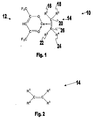
- Fig. 1 is a schematic representation of the present invention precursor with an alkene ligand.
- a volatile metal (M) precursor compound 10 for the chemical vapor deposition (CVD) of metal to selected surfaces comprises M +1 (hexafluoroacetylacetonate) 12 and an alkene ligand 14.
- the metal of metal precursor 10 is selected from the group consisting of copper, silver, and iridium.
- Fig. 2 is a schematic representation of alkene ligand 14.
- Metal precursor 10 includes a first 16 and second 18 bond to a first carbon atom 20.
- Metal precursor 10 also includes a third 22 and fourth 24 bond to a second carbon atom 26.
- First 16, second 18, third 22, and fourth 24 bonds vary independently from each other, and are selected from a the group consisting of H, C 1 to C 8 alkyl, C 1 to C 8 haloalkyl, and C 1 to C 8 alkoxyl, whereby a stable precursor capable of high metal deposition rates is formed.
- Fig. 3 is a schematic representation of a 2, 4, 4-trimethyl-1-pentene ligand.
- the order of the bonds are defined in Fig. 1, however, the specific ordering is arbitrary.
- the first bond is H
- the second is H
- the third bond is CH 2 C(CH 3 ) 3
- the fourth bond is CH 3 .
- Fig. 4 is a schematic representation of a Cu precursor with 2, 4, 4-trimethyl-1-pentene ligand of Fig. 3.
- Fig. 5 is a schematic representation of a 3, 3-dimethyl-1-butene ligand.
- the first bond is H
- the second bond is H
- the third bond is C(CH 3 ) 3
- the fourth bond is H
- Fig. 6 is a schematic representation of a Cu precursor with 3, 3-dimethyl-1-butene ligand of Fig. 5.
- Fig. 7 is a schematic representation of a 2, 3-dimethyl-1-butene ligand.
- the first bond is H
- the second bond is H
- the third bond is CH 3
- the fourth bond is CH(CH 3 ) 2 .
- Fig. 8 is a schematic representation of a Cu precursor with 2, 3-dimethyl-1-butene ligand of Fig. 7.
- Fig. 9 is a schematic representation of a 2-methyl-2-butene ligand.
- the first bond is H
- the second bond is CH 3
- the third bond is CH 3
- the fourth bond is CH 3
- Fig. 10 is a schematic representation of a Cu precursor with 2-methyl-2-butene ligand of Fig. 9.
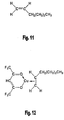
- Fig. 11 is a schematic representation of a 1-hexene ligand.
- First bond is H
- second bond is H
- the third bond is CH 2 (CH 2 ) 2 CH 3
- the fourth bond is H.
- Fig. 12 is a schematic representation of a Cu precursor with 1-hexene ligand of Fig. 11.
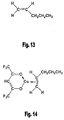
- Fig. 13 is a schematic representation of a 1-pentene ligand.
- the first bond is H
- the second bond is H
- the third bond is CH 2 CH 2 CH 3
- the fourth bond is H.
- Fig. 14 is a schematic representation of a Cu precursor with 1-pentene ligand of Fig. 13.
- the 1-pentene ligand precursor compound includes an additive to create a precursor blend.
- the precursor blend comprises: less than approximately 10% 1-pentene (see Fig. 13), as measured by weight ratio of the precursor compound, to facilitate a stable liquid phase precursor.
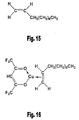
- Fig. 15 is a schematic representation of a 1-decene ligand.
- the first bond is H
- the second bond is H
- the third bond is CH 2 (CH 2 ) 6 CH 3
- the fourth bond is H.
- Fig. 16 is a schematic representation of a Cu precursor with 1-decene ligand of Fig. 15.
- metal precursor 10 includes an additive to create a precursor blend, and in which the precursor blend comprises less than approximately 10% alkene, as measured by weight ratio of the precursor compound, to facilitate a stable liquid phase precursor.
- alkene additives are shown in Figs. 3, 5, 7, 9, 11, and 13, and a list of alkene ligands is provided, above, in the discussion of Figs. 1 and 2.
- R 1 , R 2 , R 3 , and R 4 vary independently from each other.
- R 1 is H
- R 2 is H
- R 3 is CH 3
- R 4 is CH 2 C(CH 3 ) 3
- a 2, 4, 4-trimethyl-1-pentene ligand is formed.
- R 1 is H
- R 2 is H
- R 3 is H
- R 4 is C(CH 3 ) 3
- a 3, 3-dimethyl-1-butene ligand is formed.
- R 1 is H
- R 2 is H
- R 3 is CH 3
- R 4 is CH(CH 3 ) 2
- a 2, 3-dimethyl-1-butene ligand is formed.
- R 1 is H
- R 2 is CH 3
- R 3 is CH 3
- R 4 is CH 3
- a 2-methyl-2-butene ligand is formed.
- R 1 is H
- R 2 is H
- R 3 is H
- R 4 is CH 2 (CH 2 ) 2 CH 3
- a 1-hexene ligand is formed.
- a 1-pentene ligand is formed.
- the compound includes a 1-pentene ligand additive to create a metal precursor blend.
- R 1 is H
- R 2 is H
- R 3 is H
- R 4 is CH 2 (CH 2 ) 6 CH 3
- Other alkene ligand combinations are possible.
- the alkene ligand is typically less than approximately 10% by weight ratio of the precursor blend, and is preferably about 4.7%, depending on the specific alkene ligand in use.
- the alkene ligand selected to form the precursor is the same alkene ligand used as the additive to from the precursor blend.
- a 1-hexene ligand metal precursor is formed, a 1-hexene ligand is used as an additive to make a precursor blend.
- Fig. 17 illustrates steps in a method for synthesizing a copper(hfac) alkene ligand precursor.
- the method expressly discusses the synthesis of a copper precursor, the general method is applicable for the synthesis of iridium and silver precursors.
- Step 100 provides copper oxide (Cu 2 O), or the oxide of the metal to be used.
- Step 102 forms a uniformly mixed solution of Cu 2 O in a solvent.
- Step 102 includes using a solvent selected from the group consisting of dichloromethane and tetrahydrofuran (THF). Dichloromethane, especially, has been found to be an effective solvent.
- Step 104 introduces an alkene ligand to the solution of Step 102, forming a uniformly mixed solution.
- Step 106 introduces hexafluoroacetylacetone (hfac) to the solution of Step 104, forming a uniformly mixed solution.
- Step 108 filters the solution to remove solid materials, whereby any excess Cu 2 O is removed.
- Step 108 includes using celite to filter the solution, removing solid material larger than approximately 10 microns.
- Step 110 removes the solvent from the solution.
- Step 112 filters to remove the solid material.
- Step 112 typically includes filtering solid material having a size greater than approximately 1 micron.
- Step 114 is a product, where a liquid phase alkene ligand precursor is formed.
- Step 102 includes the Cu 2 O being, in proportion, 0.310 mol
- Step 104 includes 2,4,4-trimethyl-1-pentene being, in proportion, 0.48 mol
- Step 106 includes the hfac being, in proportion, 0.48 mol.
- Step 102 includes the Cu 2 O being, in proportion, 0.16 mol
- Step 104 includes 3, 3-dimethyl-1-butene being, in proportion, 0.24 mol
- Step 106 includes the hfac being, in proportion, 0.24 mol.
- Step 102 includes the Cu 2 O being, in proportion, 0.15 mol
- Step 104 includes 2, 3-dimethyl-1-butene being, in proportion, 0.21 mol
- Step 106 includes the hfac being, in proportion, 0.21 mol.
- Step 102 includes the Cu 2 O being, in proportion, 0.64 mol
- Step 104 includes 2-methyl-2-butene being, in proportion, 0.96 mol
- Step 106 includes the hfac being, in proportion, 0.96 mol.
- Step 102 includes the Cu 2 O being, in proportion, 0.310 mol
- Step 104 includes 1-hexene being, in proportion, 0.48 mol
- Step 106 includes the hfac being, in proportion, 0.48 mol.
- Step 102 includes the Cu 2 O being, in proportion, 0.310 mol
- Step 104 includes 1-pentene being, in proportion, 0.48 mol
- Step 106 includes the hfac being, in proportion, 0.48 mol.
- Step 102 includes using dichloromethane solvent and Step 104 includes using 1-penten ligand.
- Step 102 includes the Cu 2 O being, in proportion, 0.310 mol
- Step 104 includes 1-decene being, in proportion, 0.48 mol
- Step 106 includes the hfac being, in proportion, 0.48 mol.
- Step 112a adds less than approximately 10%, by weight ratio, of the alkene ligand used in Step 104 to the solution, whereby the liquid phase stability of the precursor is improved. In some aspects of the invention, Step 112a includes adding approximately 4.7% alkene additive.
- organometallic copper(I) complexes were firstly described by Doyle in U.S. Pat. No. 4,385,005, in which copper monoxide reacted with unsaturated organic hydrocarbon and 1,1,1,5,5,5-hexafluoroacetylacetone in dichloromethane or THF.
- the reaction is described by the following equation: where L is an unsaturated organic hydrocarbon ligand.
- the synthesized alkene copper(I)(hfac) product is not stable at room temperature for long periods of time. To solve this problem, less than 10% extra organic stabilizing ligand (by product weight) was added into the product for the compound stabilization. After one month, no solid precipitation or decomposition was observed in these stabilized products.
- 1,1,1,5,5,5-hexafluoroacetylacetone was completed within 2 minutes, during which the color of the solution began to gradually change to green, after about 1 minute.
- the solution was continually stirred for another 5 minutes, and then filtered through celite (10-25 ⁇ m filter size).
- the green filtrate was stripped under vacuum for two hours and then heated to 35° C under vacuum for another half-hour stripping. During the stripping, some crystals were precipitated, and then dissolved by strong stirring.
- the results of copper metal thin films deposition via CVD using these volatile liquid precursors were very good.
- the copper thin films have shown good adhesion to metal and metal nitride substrates, low resistivity (1.8 ⁇ cm), and also very good reproducibility. Some of precursors are very volatile, and thus high deposition rate has been achieved.
- alkenes with asymmetric structures produce a liquid copper(I) hfac complex with a reduced tendency to crystallize, and alkenes with a low boiling point produce a copper(I) hfac complex more volatile, but easier to decompose.
- a new and improved copper precursor, and synthesis method for the copper precursor has been disclosed above.
- the alkene ligand precursors, as a general class, are stable at low temperatures, and sufficiently volatile at higher temperatures. Copper deposited with the precursor has low resistivity and high adhesive characteristics. Finally, the - precursor is inexpensive to make.
- a synthesis method has been disclosed which produces a high yield of the above-described precursor. Other variations and embodiments will occur to those skilled in the art.
Landscapes
- Chemical & Material Sciences (AREA)
- Organic Chemistry (AREA)
- General Chemical & Material Sciences (AREA)
- Chemical Kinetics & Catalysis (AREA)
- Engineering & Computer Science (AREA)
- Materials Engineering (AREA)
- Mechanical Engineering (AREA)
- Metallurgy (AREA)
- Chemical Vapour Deposition (AREA)
- Organic Low-Molecular-Weight Compounds And Preparation Thereof (AREA)
Applications Claiming Priority (4)
| Application Number | Priority Date | Filing Date | Title |
|---|---|---|---|
| US10789298P | 1998-11-10 | 1998-11-10 | |
| US107892P | 1998-11-10 | ||
| US281722 | 1999-03-30 | ||
| US09/281,722 US6090963A (en) | 1998-11-10 | 1999-03-30 | Alkene ligand precursor and synthesis method |
Publications (3)
| Publication Number | Publication Date |
|---|---|
| EP1001047A2 true EP1001047A2 (fr) | 2000-05-17 |
| EP1001047A3 EP1001047A3 (fr) | 2000-05-31 |
| EP1001047B1 EP1001047B1 (fr) | 2003-10-08 |
Family
ID=26805297
Family Applications (1)
| Application Number | Title | Priority Date | Filing Date |
|---|---|---|---|
| EP99308880A Expired - Lifetime EP1001047B1 (fr) | 1998-11-10 | 1999-11-08 | Précurseur de ligand à base d'alcène et procédé de synthèse |
Country Status (6)
| Country | Link |
|---|---|
| US (1) | US6090963A (fr) |
| EP (1) | EP1001047B1 (fr) |
| JP (1) | JP2000186053A (fr) |
| KR (1) | KR100343632B1 (fr) |
| DE (1) | DE69911887T2 (fr) |
| TW (1) | TW495557B (fr) |
Cited By (5)
| Publication number | Priority date | Publication date | Assignee | Title |
|---|---|---|---|---|
| GB2362892A (en) * | 2000-05-27 | 2001-12-05 | Gfe Met & Mat Gmbh | iridium coated implant |
| EP1185538A4 (fr) * | 1999-05-25 | 2002-07-24 | Advanced Tech Materials | Compositions reactives a base de cuivre et leur procede d'elaboration et d'utilisation pour des structures de dispositif microelectronique |
| EP1102872A4 (fr) * | 1999-04-15 | 2008-04-30 | Postech Foundation | Nouveaux precurseurs organo-cuivreux destines au depot chimique en phase vapeur d'un film de cuivre |
| EP1387898A4 (fr) * | 2001-04-16 | 2008-08-13 | Sharp Kk | Nouveaux precurseurs du cuivre a substitution cycloalcene pour depot chimique en phase vapeur de couches minces de cuivre |
| DE10064042B4 (de) * | 1999-12-22 | 2009-10-01 | Hyundai Electronics Industries Co., Ltd., Ichon | Verfahren zur Herstellung einer Kupferverdrahtung in einem Halbleiterbauelement |
Families Citing this family (11)
| Publication number | Priority date | Publication date | Assignee | Title |
|---|---|---|---|---|
| US6273951B1 (en) * | 1999-06-16 | 2001-08-14 | Micron Technology, Inc. | Precursor mixtures for use in preparing layers on substrates |
| KR100338112B1 (ko) * | 1999-12-22 | 2002-05-24 | 박종섭 | 반도체 소자의 구리 금속 배선 형성 방법 |
| KR100347838B1 (ko) * | 2000-03-07 | 2002-08-07 | 학교법인 포항공과대학교 | 액상 유기구리 전구체의 열적 안정성 향상방법 |
| US6596344B2 (en) * | 2001-03-27 | 2003-07-22 | Sharp Laboratories Of America, Inc. | Method of depositing a high-adhesive copper thin film on a metal nitride substrate |
| KR100502882B1 (ko) * | 2002-07-11 | 2005-07-25 | 한국과학기술연구원 | 초전도체 박막 제조용 구리 전구체 |
| US8617312B2 (en) * | 2002-08-28 | 2013-12-31 | Micron Technology, Inc. | Systems and methods for forming layers that contain niobium and/or tantalum |
| US7115528B2 (en) | 2003-04-29 | 2006-10-03 | Micron Technology, Inc. | Systems and method for forming silicon oxide layers |
| US6838573B1 (en) * | 2004-01-30 | 2005-01-04 | Air Products And Chemicals, Inc. | Copper CVD precursors with enhanced adhesion properties |
| FR2880036B1 (fr) * | 2004-12-23 | 2007-09-07 | Commissariat Energie Atomique | Procede de preparation de nonoparticules d'argent ou d'alliage d'argent dispersees sur un substrat par depot chimique en phase vapeur |
| US20080051765A1 (en) * | 2006-08-23 | 2008-02-28 | Medtronic Minimed, Inc. | Systems and methods allowing for reservoir filling and infusion medium delivery |
| WO2008085426A1 (fr) * | 2006-12-28 | 2008-07-17 | Air Products And Chemicals, Inc. | Précurseurs de cuivre liquide volatile pour des applications de film fin |
Family Cites Families (6)
| Publication number | Priority date | Publication date | Assignee | Title |
|---|---|---|---|---|
| US4425281A (en) * | 1981-07-13 | 1984-01-10 | Exxon Research And Engineering Co. | Copper or silver complexes with fluorinated diketones and unsaturated ligands |
| US4385005A (en) * | 1981-07-13 | 1983-05-24 | Exxon Research And Engineering Co. | Process for separating unsaturated hydrocarbons using copper or silver complexes with fluorinated diketonates |
| US4434317A (en) * | 1983-05-06 | 1984-02-28 | Exxon Research And Engineering Company | Separation and recovery of unsaturated hydrocarbons by copper (I) complexes |
| US5096737A (en) * | 1990-10-24 | 1992-03-17 | International Business Machines Corporation | Ligand stabilized +1 metal beta-diketonate coordination complexes and their use in chemical vapor deposition of metal thin films |
| US5085731A (en) * | 1991-02-04 | 1992-02-04 | Air Products And Chemicals, Inc. | Volatile liquid precursors for the chemical vapor deposition of copper |
| US5994571A (en) * | 1998-11-10 | 1999-11-30 | Sharp Laboratories Of America, Inc. | Substituted ethylene precursor and synthesis method |
-
1999
- 1999-03-30 US US09/281,722 patent/US6090963A/en not_active Expired - Lifetime
- 1999-10-08 JP JP11288869A patent/JP2000186053A/ja active Pending
- 1999-11-06 TW TW088119427A patent/TW495557B/zh not_active IP Right Cessation
- 1999-11-08 EP EP99308880A patent/EP1001047B1/fr not_active Expired - Lifetime
- 1999-11-08 DE DE69911887T patent/DE69911887T2/de not_active Expired - Lifetime
- 1999-11-09 KR KR1019990049538A patent/KR100343632B1/ko not_active Expired - Fee Related
Cited By (5)
| Publication number | Priority date | Publication date | Assignee | Title |
|---|---|---|---|---|
| EP1102872A4 (fr) * | 1999-04-15 | 2008-04-30 | Postech Foundation | Nouveaux precurseurs organo-cuivreux destines au depot chimique en phase vapeur d'un film de cuivre |
| EP1185538A4 (fr) * | 1999-05-25 | 2002-07-24 | Advanced Tech Materials | Compositions reactives a base de cuivre et leur procede d'elaboration et d'utilisation pour des structures de dispositif microelectronique |
| DE10064042B4 (de) * | 1999-12-22 | 2009-10-01 | Hyundai Electronics Industries Co., Ltd., Ichon | Verfahren zur Herstellung einer Kupferverdrahtung in einem Halbleiterbauelement |
| GB2362892A (en) * | 2000-05-27 | 2001-12-05 | Gfe Met & Mat Gmbh | iridium coated implant |
| EP1387898A4 (fr) * | 2001-04-16 | 2008-08-13 | Sharp Kk | Nouveaux precurseurs du cuivre a substitution cycloalcene pour depot chimique en phase vapeur de couches minces de cuivre |
Also Published As
| Publication number | Publication date |
|---|---|
| EP1001047B1 (fr) | 2003-10-08 |
| DE69911887T2 (de) | 2004-08-05 |
| EP1001047A3 (fr) | 2000-05-31 |
| TW495557B (en) | 2002-07-21 |
| JP2000186053A (ja) | 2000-07-04 |
| KR100343632B1 (ko) | 2002-07-11 |
| KR20000035357A (ko) | 2000-06-26 |
| DE69911887D1 (de) | 2003-11-13 |
| US6090963A (en) | 2000-07-18 |
Similar Documents
| Publication | Publication Date | Title |
|---|---|---|
| US6090963A (en) | Alkene ligand precursor and synthesis method | |
| KR100824913B1 (ko) | 휘발성 금속 베타-케토이미네이트 및 금속베타-디이미네이트 착물 | |
| US5767301A (en) | Precursor with (alkyloxy)(alkyl)-silylolefin ligand to deposit copper | |
| EP1000947B1 (fr) | Précurseurs à base de 2-méthyl-1-butène contenant un métal, et leur préparation | |
| KR100737260B1 (ko) | 휘발성 금속 베타-케토이미네이트 착물 | |
| EP1016666B1 (fr) | Précurseur contenant un groupement allylique, et sa préparation | |
| US6245261B1 (en) | Substituted phenylethylene precursor and synthesis method | |
| EP1000948B1 (fr) | Précurseurs à base de phénylethylène substitué et cuivre, et procédé pour le préparer | |
| US6281377B1 (en) | Substituted cycloalkene new copper precursors for chemical vapor deposition of copper metal thin films | |
| EP0855399B1 (fr) | Précurseur contenant un alkylaminosilylolefine ligand pour le dépôt de cuivre | |
| EP1047807B1 (fr) | PROCEDE DE DEPOSITION POUR L'UTILISATION D'UN Cu(hfac)-PRECURSEUR AVEC UN PHENYLETHYLENE LIGAND | |
| EP0987346A1 (fr) | Procédé de dépôt de cuivre par l'intermédiaire d'un précurseur contenant des ligands de type (alkyloxy)(alkyl)silyloléfine | |
| KR20030092077A (ko) | 구리금속 박막의 화학 기상 증착을 위한 치환된시클로알켄 신규 구리 전구체 |
Legal Events
| Date | Code | Title | Description |
|---|---|---|---|
| PUAI | Public reference made under article 153(3) epc to a published international application that has entered the european phase |
Free format text: ORIGINAL CODE: 0009012 |
|
| PUAL | Search report despatched |
Free format text: ORIGINAL CODE: 0009013 |
|
| AK | Designated contracting states |
Kind code of ref document: A2 Designated state(s): DE FR GB |
|
| AX | Request for extension of the european patent |
Free format text: AL;LT;LV;MK;RO;SI |
|
| RIC1 | Information provided on ipc code assigned before grant |
Free format text: 7C 07F 1/08 A, 7C 07F 15/00 B, 7C 07F 1/00 B, 7C 23C 16/18 B |
|
| AK | Designated contracting states |
Kind code of ref document: A3 Designated state(s): AT BE CH CY DE DK ES FI FR GB GR IE IT LI LU MC NL PT SE |
|
| AX | Request for extension of the european patent |
Free format text: AL;LT;LV;MK;RO;SI |
|
| 17P | Request for examination filed |
Effective date: 20000831 |
|
| AKX | Designation fees paid |
Free format text: DE FR GB |
|
| 17Q | First examination report despatched |
Effective date: 20011018 |
|
| GRAH | Despatch of communication of intention to grant a patent |
Free format text: ORIGINAL CODE: EPIDOS IGRA |
|
| GRAS | Grant fee paid |
Free format text: ORIGINAL CODE: EPIDOSNIGR3 |
|
| GRAA | (expected) grant |
Free format text: ORIGINAL CODE: 0009210 |
|
| AK | Designated contracting states |
Kind code of ref document: B1 Designated state(s): DE FR GB |
|
| REG | Reference to a national code |
Ref country code: GB Ref legal event code: FG4D |
|
| REF | Corresponds to: |
Ref document number: 69911887 Country of ref document: DE Date of ref document: 20031113 Kind code of ref document: P |
|
| ET | Fr: translation filed | ||
| PLBE | No opposition filed within time limit |
Free format text: ORIGINAL CODE: 0009261 |
|
| STAA | Information on the status of an ep patent application or granted ep patent |
Free format text: STATUS: NO OPPOSITION FILED WITHIN TIME LIMIT |
|
| 26N | No opposition filed |
Effective date: 20040709 |
|
| PGFP | Annual fee paid to national office [announced via postgrant information from national office to epo] |
Ref country code: GB Payment date: 20121107 Year of fee payment: 14 |
|
| PGFP | Annual fee paid to national office [announced via postgrant information from national office to epo] |
Ref country code: FR Payment date: 20131108 Year of fee payment: 15 Ref country code: DE Payment date: 20131106 Year of fee payment: 15 |
|
| GBPC | Gb: european patent ceased through non-payment of renewal fee |
Effective date: 20131108 |
|
| PG25 | Lapsed in a contracting state [announced via postgrant information from national office to epo] |
Ref country code: GB Free format text: LAPSE BECAUSE OF NON-PAYMENT OF DUE FEES Effective date: 20131108 |
|
| REG | Reference to a national code |
Ref country code: DE Ref legal event code: R119 Ref document number: 69911887 Country of ref document: DE |
|
| REG | Reference to a national code |
Ref country code: FR Ref legal event code: ST Effective date: 20150731 |
|
| PG25 | Lapsed in a contracting state [announced via postgrant information from national office to epo] |
Ref country code: DE Free format text: LAPSE BECAUSE OF NON-PAYMENT OF DUE FEES Effective date: 20150602 |
|
| PG25 | Lapsed in a contracting state [announced via postgrant information from national office to epo] |
Ref country code: FR Free format text: LAPSE BECAUSE OF NON-PAYMENT OF DUE FEES Effective date: 20141201 |