EP1001287A2 - Multiplexer und Demultiplexer für monomodige Faser-optische Kommunikationsverbindung - Google Patents
Multiplexer und Demultiplexer für monomodige Faser-optische Kommunikationsverbindung Download PDFInfo
- Publication number
- EP1001287A2 EP1001287A2 EP99308893A EP99308893A EP1001287A2 EP 1001287 A2 EP1001287 A2 EP 1001287A2 EP 99308893 A EP99308893 A EP 99308893A EP 99308893 A EP99308893 A EP 99308893A EP 1001287 A2 EP1001287 A2 EP 1001287A2
- Authority
- EP
- European Patent Office
- Prior art keywords
- optical
- beams
- wavelength
- polarization
- different
- Prior art date
- Legal status (The legal status is an assumption and is not a legal conclusion. Google has not performed a legal analysis and makes no representation as to the accuracy of the status listed.)
- Withdrawn
Links
Images



Classifications
-
- G—PHYSICS
- G02—OPTICS
- G02B—OPTICAL ELEMENTS, SYSTEMS OR APPARATUS
- G02B6/00—Light guides; Structural details of arrangements comprising light guides and other optical elements, e.g. couplings
- G02B6/24—Coupling light guides
- G02B6/26—Optical coupling means
- G02B6/27—Optical coupling means with polarisation selective and adjusting means
- G02B6/2706—Optical coupling means with polarisation selective and adjusting means as bulk elements, i.e. free space arrangements external to a light guide, e.g. polarising beam splitters
- G02B6/2713—Optical coupling means with polarisation selective and adjusting means as bulk elements, i.e. free space arrangements external to a light guide, e.g. polarising beam splitters cascade of polarisation selective or adjusting operations
- G02B6/272—Optical coupling means with polarisation selective and adjusting means as bulk elements, i.e. free space arrangements external to a light guide, e.g. polarising beam splitters cascade of polarisation selective or adjusting operations comprising polarisation means for beam splitting and combining
-
- G—PHYSICS
- G02—OPTICS
- G02B—OPTICAL ELEMENTS, SYSTEMS OR APPARATUS
- G02B6/00—Light guides; Structural details of arrangements comprising light guides and other optical elements, e.g. couplings
- G02B6/24—Coupling light guides
- G02B6/26—Optical coupling means
- G02B6/27—Optical coupling means with polarisation selective and adjusting means
- G02B6/2753—Optical coupling means with polarisation selective and adjusting means characterised by their function or use, i.e. of the complete device
- G02B6/2793—Controlling polarisation dependent loss, e.g. polarisation insensitivity, reducing the change in polarisation degree of the output light even if the input polarisation state fluctuates
-
- G—PHYSICS
- G02—OPTICS
- G02B—OPTICAL ELEMENTS, SYSTEMS OR APPARATUS
- G02B6/00—Light guides; Structural details of arrangements comprising light guides and other optical elements, e.g. couplings
- G02B6/24—Coupling light guides
- G02B6/26—Optical coupling means
- G02B6/28—Optical coupling means having data bus means, i.e. plural waveguides interconnected and providing an inherently bidirectional system by mixing and splitting signals
- G02B6/293—Optical coupling means having data bus means, i.e. plural waveguides interconnected and providing an inherently bidirectional system by mixing and splitting signals with wavelength selective means
- G02B6/29304—Optical coupling means having data bus means, i.e. plural waveguides interconnected and providing an inherently bidirectional system by mixing and splitting signals with wavelength selective means operating by diffraction, e.g. grating
- G02B6/29305—Optical coupling means having data bus means, i.e. plural waveguides interconnected and providing an inherently bidirectional system by mixing and splitting signals with wavelength selective means operating by diffraction, e.g. grating as bulk element, i.e. free space arrangement external to a light guide
- G02B6/2931—Diffractive element operating in reflection
-
- G—PHYSICS
- G02—OPTICS
- G02B—OPTICAL ELEMENTS, SYSTEMS OR APPARATUS
- G02B6/00—Light guides; Structural details of arrangements comprising light guides and other optical elements, e.g. couplings
- G02B6/24—Coupling light guides
- G02B6/26—Optical coupling means
- G02B6/28—Optical coupling means having data bus means, i.e. plural waveguides interconnected and providing an inherently bidirectional system by mixing and splitting signals
- G02B6/293—Optical coupling means having data bus means, i.e. plural waveguides interconnected and providing an inherently bidirectional system by mixing and splitting signals with wavelength selective means
- G02B6/29379—Optical coupling means having data bus means, i.e. plural waveguides interconnected and providing an inherently bidirectional system by mixing and splitting signals with wavelength selective means characterised by the function or use of the complete device
- G02B6/2938—Optical coupling means having data bus means, i.e. plural waveguides interconnected and providing an inherently bidirectional system by mixing and splitting signals with wavelength selective means characterised by the function or use of the complete device for multiplexing or demultiplexing, i.e. combining or separating wavelengths, e.g. 1xN, NxM
-
- G—PHYSICS
- G02—OPTICS
- G02B—OPTICAL ELEMENTS, SYSTEMS OR APPARATUS
- G02B6/00—Light guides; Structural details of arrangements comprising light guides and other optical elements, e.g. couplings
- G02B6/24—Coupling light guides
- G02B6/26—Optical coupling means
- G02B6/28—Optical coupling means having data bus means, i.e. plural waveguides interconnected and providing an inherently bidirectional system by mixing and splitting signals
- G02B6/293—Optical coupling means having data bus means, i.e. plural waveguides interconnected and providing an inherently bidirectional system by mixing and splitting signals with wavelength selective means
- G02B6/29379—Optical coupling means having data bus means, i.e. plural waveguides interconnected and providing an inherently bidirectional system by mixing and splitting signals with wavelength selective means characterised by the function or use of the complete device
- G02B6/2938—Optical coupling means having data bus means, i.e. plural waveguides interconnected and providing an inherently bidirectional system by mixing and splitting signals with wavelength selective means characterised by the function or use of the complete device for multiplexing or demultiplexing, i.e. combining or separating wavelengths, e.g. 1xN, NxM
- G02B6/29382—Optical coupling means having data bus means, i.e. plural waveguides interconnected and providing an inherently bidirectional system by mixing and splitting signals with wavelength selective means characterised by the function or use of the complete device for multiplexing or demultiplexing, i.e. combining or separating wavelengths, e.g. 1xN, NxM including at least adding or dropping a signal, i.e. passing the majority of signals
- G02B6/29383—Adding and dropping
-
- G—PHYSICS
- G02—OPTICS
- G02B—OPTICAL ELEMENTS, SYSTEMS OR APPARATUS
- G02B6/00—Light guides; Structural details of arrangements comprising light guides and other optical elements, e.g. couplings
- G02B6/24—Coupling light guides
- G02B6/26—Optical coupling means
- G02B6/28—Optical coupling means having data bus means, i.e. plural waveguides interconnected and providing an inherently bidirectional system by mixing and splitting signals
- G02B6/293—Optical coupling means having data bus means, i.e. plural waveguides interconnected and providing an inherently bidirectional system by mixing and splitting signals with wavelength selective means
- G02B6/29379—Optical coupling means having data bus means, i.e. plural waveguides interconnected and providing an inherently bidirectional system by mixing and splitting signals with wavelength selective means characterised by the function or use of the complete device
- G02B6/29395—Optical coupling means having data bus means, i.e. plural waveguides interconnected and providing an inherently bidirectional system by mixing and splitting signals with wavelength selective means characterised by the function or use of the complete device configurable, e.g. tunable or reconfigurable
-
- H—ELECTRICITY
- H04—ELECTRIC COMMUNICATION TECHNIQUE
- H04B—TRANSMISSION
- H04B10/00—Transmission systems employing electromagnetic waves other than radio-waves, e.g. infrared, visible or ultraviolet light, or employing corpuscular radiation, e.g. quantum communication
- H04B10/25—Arrangements specific to fibre transmission
- H04B10/2507—Arrangements specific to fibre transmission for the reduction or elimination of distortion or dispersion
- H04B10/2572—Arrangements specific to fibre transmission for the reduction or elimination of distortion or dispersion due to forms of polarisation-dependent distortion other than PMD
-
- H—ELECTRICITY
- H04—ELECTRIC COMMUNICATION TECHNIQUE
- H04J—MULTIPLEX COMMUNICATION
- H04J14/00—Optical multiplex systems
- H04J14/02—Wavelength-division multiplex systems
- H04J14/03—WDM arrangements
- H04J14/0305—WDM arrangements in end terminals
-
- G—PHYSICS
- G02—OPTICS
- G02B—OPTICAL ELEMENTS, SYSTEMS OR APPARATUS
- G02B6/00—Light guides; Structural details of arrangements comprising light guides and other optical elements, e.g. couplings
- G02B6/24—Coupling light guides
- G02B6/42—Coupling light guides with opto-electronic elements
- G02B6/4201—Packages, e.g. shape, construction, internal or external details
- G02B6/4204—Packages, e.g. shape, construction, internal or external details the coupling comprising intermediate optical elements, e.g. lenses, holograms
- G02B6/4206—Optical features
Definitions
- This invention relates generally to an optic device and more particularly to an optical multiplexer and demultiplexer for dense wavelength division multiplexed (“DWDM”) fiber optic communication systems.
- DWDM dense wavelength division multiplexed
- Photonics communication system architectures based on optical wavelength division multiplexing (WDM) or optical frequency division multiplexing (coherent techniques) to increase the information carrying potential of the optical fiber systems are being developed.
- WDM optical wavelength division multiplexing
- coherent techniques optical frequency division multiplexing
- a plurality of lasers are used with each laser emitting a different wavelength.
- devices for multiplexing and demultiplexing the optical signals into or out of a single optical fiber are required.
- Fiber optic directional coupler technology was used to multiplex such widely spaced wavelength channels.
- WDM dense wavelength division multiplexed
- Micro-optical devices use optical interference filters and diffraction gratings to combine and separate different wavelengths.
- Integrated optic devices utilize optical waveguides of different lengths to introduce phase differences so that optical interference effects can be used to spatially separate different wavelengths.
- Fiber optic devices utilize Bragg gratings fabricated within the light guiding regions of the fiber to reflect narrow wavelength bands.
- the present invention directly addresses and overcomes the shortcomings of the prior art by providing DWDM with low polarization dependent loss ( ⁇ 0.5 dB), low insertion loss with single mode fiber optic systems ( ⁇ 5 dB), low cross talk between wavelength channels ( ⁇ 35 dB for 100 GHz channel separation and ⁇ 30 dB for 50 GHz channel separation), and low return loss ( ⁇ 55 dB).
- the present invention provides for an optical multiplexer and demultiplexer for dense wavelength division multiplexed ("DWDM") fiber optic communication systems.
- a device may be constructed in accordance with the principles of the present invention as a multiplexer. This device functions to spatially combine the optical signals from several laser sources (each of which is a different wavelength) and launch the spatially combined laser beams into a single optical fiber.
- a device may be constructed in accordance with the principles of the present invention as a demultiplexer.
- the device functions to spatially separate the different wavelengths of a wavelength division multiplexed optical link and launch each of the different wavelengths into a different optical fiber.
- the device includes both bulk optic and integrated optic components.
- the spatial separation or spatial combination of laser beams of different wavelength is achieved with the use of bulk diffraction gratings.
- bulk optical components are used to collimate and shape (or steer) the free space propagating laser beams to enable efficient coupling of light into single mode optical fibers, or integrated optic waveguides, and to reduce optical cross talk.
- Polarizing beamsplitters orient the polarization direction of the light to enable maximum diffraction efficiency by the gratings and to reduce the polarization dependent loss.
- the end faces of optical fibers and integrated optic waveguides are angle polished to reduce back reflection and thereby reduce noise caused by feedback to the laser source.
- the diffraction grating and focusing optics are specified to permit multiplexing and demultiplexing of laser wavelengths separated by 0.4 nanometers (nm) in the 1550 nm wavelength band.
- the preferred field of view of the optics permit multiplexing and demultiplexing of up to 32-48 wavelength channels separated by 0.4 nanometers in the 1550 nm wavelength band.
- the device components can be designed for use at other wavelength bands, e.g., the optical fiber low absorption loss band at ⁇ ⁇ 1310 nm.
- a bi-directional optical apparatus of the type which is used in connection with optical signals generated by a plurality of laser sources and which is carried by optical fibers, the apparatus comprising: an optical fiber; multiplexer means for spatially combining the optical signals from several laser sources, each of which is a different wavelength, and launching the spatially combined optical signals into a single optical fiber to form a wavelength division multiplexed optical signal; and demultiplexer means for spatially separating the different wavelengths from a single optical fiber carrying a wavelength division multiplexed optical signal and launching each of the different wavelengths into a separate optical fiber.
- a bi-directional optical apparatus comprising: means for collimating the plurality of optical signals of different wavelength; means for splitting the plurality of optical wavelength signals into two parallel propagating beams which are polarized perpendicular to each other; means for rotating the polarization direction of one of the beams by 90° so that both beams at each wavelength are polarized in the same direction; means for expanding the diameter of the collimated beams in the direction parallel to the polarization direction; means for diffracting each of the different wavelengths into a different angular direction relative to a defined direction; means for reducing the expanded diameter of the collimated beams in the direction parallel to the polarization direction; means for recombining the two beams for each wavelength into a single beam for each wavelength, and wherein the recombined beams have two mutually perpendicular polarization components and each recombined beam is propagating in a different angular direction relative to an optic axis; means for focusing each beam of different wavelength
- a bi-directional optical apparatus comprising: means for collimating the plurality of optical signals of different wavelength; means for splitting the plurality of optical wavelength signals into two parallel propagating beams which are polarized perpendicular to each other; means for rotating the polarization direction of one of the beams by 90° so that both beams at each wavelength are polarized in the same direction; means for steering the propagation direction of the collimated beams; means for diffracting each of the different wavelengths into a different angular direction relative to a defined direction; means for recombining the two beams for each wavelength into a single beam for each wavelength, and wherein the recombined beams have two mutually perpendicular polarization components and each recombined beam is propagating in a different angular direction relative to an optic axis; means for focusing each beam of different wavelength to a different spatial location along a line in the focal plane of the focusing means; and means for receiving the focused optical signals at each wavelength and
- One of the features of the present invention is that it comprises a bi-directional device which can be used as both a multiplexer to spatially combine the optical signals from several laser sources, each of which is a different wavelength, and launch the spatially combined laser beams into a single optical fiber and as a demultiplexer to spatially separate the different wavelengths of a wavelength division multiplexed optical link and launch each of the different wavelengths into a different optical fiber.
- the device meets the DWDM requirements for low polarization dependent loss, low insertion loss with single mode fiber optic systems, low cross talk between wavelength channels, and low return loss.
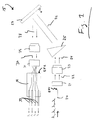
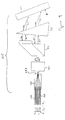
- Fig. 1 is a functional block diagram of a demultiplexer constructed in accordance with the principles of the present invention.
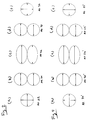
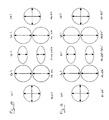
- Figs. 2a - 2e are diagrammatic figures illustrating the changes in beam diameter and the polarization state of the various wavelength optical signals as they progress through the apparatus 15 of Fig. 1.
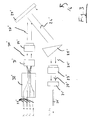
- Fig. 3 is a functional block diagram of a multiplexer constructed in accordance with the principles of the present invention.
- Figs. 4a - 4e are diagrammatic figures illustrating the changes in beam diameter and the polarization state of the various wavelength optical signals as they progress through the apparatus 16 of Fig. 3.
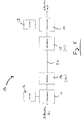
- Fig. 5 illustrates an environment in which the principles of the present invention multiplexer 16 and demultiplexer 15 (or alternative embodiment devices 115 and 116) may be employed.
- Fig. 6 illustrates the polarizing beamsplitter 23, 29, 23', and 29' in Figs 1 and 3 (and the polarizing beamsplitter 123 and 123' of Figs. 9 and 11).
- Fig. 7 illustrates the light beams through prism 25 and 25' (and 125 and 125') in more detail.
- Figs. 8a and 8b illustrate two possible configurations of the polarizing beamsplitter 23, 29, 23' and 29' of Figs. 1 and 3 (and devices 123 and 123' of Figs. 9 and 11).
- Fig. 9 is a functional block diagram of an alternative embodiment demultiplexer constructed in accordance with the principles of the present invention.
- Figs. 10a-10e are diagrammatic figures illustrating the changes in beam diameter and the polarization state of the various wavelength optical signals as they progress through the apparatus 115 of Fig. 9.
- Fig. 11 is a functional block diagram of an alternative embodiment multiplexer constructed in accordance with the principles of the present invention.
- Figs. 12a-12e are diagrammatic figures illustrating the changes in beam diameter and the polarization state of the various wavelength optical signals as they progress through the apparatus 116 of Fig. 11.
- a device constructed in accordance with the principles of the present invention can preferably be used for either multiplexing or demultiplexing several closely spaced optical wavelengths. Therefore, the device operation and components will be described in detail for operation as a demultiplexer.
- the reverse operating mode, i.e., as a multiplexer, will be described more briefly below since those of skill in the art will appreciate that essentially only the direction of propagation of the light is changed.
- Fig. 1 there is illustrated in functional form the components and operation of an optical demultiplexer device constructed in accordance with the principles of the present invention.
- the demultiplexer device is shown generally by the designation 15.
- Several wavelengths e.g., ⁇ 1 , ⁇ 2 , ⁇ 3 , through ⁇ n ) are transmitted to the device 15 by a single optical fiber 20.
- the light exiting the optical fiber 20 is collected and collimated by collimating lens assembly 21.
- Light at each of the wavelengths exits the collimating lens assembly 21 as a collimated beam.
- the differing wavelengths exit the collimating lens assembly 21 as an equal number of collimated beams (i.e., there are a number of wavelength components of the beam equal to wavelengths ⁇ n ) which propagate along parallel directions, along the same path, and are incident on beamsplitter component 23.
- the specifications for the collimating lens assembly 21 are that the numerical aperture (NA) of the lens assembly (21 and 21') match that of the guided beam in the optical fiber 20 to minimize input and output coupling losses with the optical fiber.
- the aperture of the lens assembly is preferably approximately twice the 1/ e 2 beam diameter of the free space propagating collimated beams to reduce diffraction effects which can increase both insertion loss and polarization dependent loss.
- Beamsplitter 23 splits the collimated beam into two collimated beams and also includes a half wave plate for rotating the polarization of one of the two beams (as defined by the beamsplitting interface) so that the polarization of both collimated beams is perpendicular to the grooves on the diffraction grating element 27.
- Beamsplitter 23 greater than 98% of the light exiting the optical fiber 20 is conditioned to have the proper polarization direction at the diffraction grating 27 so to achieve optimum diffraction efficiency, independent of the polarization state of the light exiting the optical fiber 20.
- the polarization of the collimated beams at designation 22 is best seen in Fig. 2a and at designation 24 is best seen in Fig. 2b.
- a right angle prism 35 which forms an interface I1 with prism 35
- a beam displacement prism 36 which forms an interface I1 with prism 35
- a half wave plate 37 is cemented together to form a monolithic structure 23.
- the face F2 of prism 36 (which forms an interface I1 with prism 35) is coated with a multilayer dielectric polarizing beamsplitter coating.
- Component faces F1, F6, and F8 are antireflective coated.
- Light incident on interface I1 is split into two components, one polarized perpendicular to the plane of incidence (i.e., s component) and one polarized parallel to the plane of incidence (i.e., p component).
- the s component is reflected to face F5 where it undergoes total internal reflection so as to exit face F6 of prism 36.
- the p component is transmitted to the half wave plate 37.
- the polarization direction is rotated 90° so that when the light exits face F8 of the half wave plate 37, the polarization direction is parallel to that of the s component which exits face F6 of prism 36.
- Polarizing beamsplitters 23, 23', 29, and 29' of Figs. 1 and 3 are shown oriented so that the two beams exiting (or entering) the polarizing beamsplitter propagate parallel to each other in a plane which is perpendicular to the plane of the DWDM device 15.
- the polarizing beamsplitter is constructed as shown in Fig. 8a.
- the polarizing beamsplitters could also be rotated 90° so that the two beams exiting (or entering) the polarizing beamsplitter propagate parallel to each other in a plane which is parallel the plane of DWDM device 15.
- the polarizing beamsplitter is constructed as shown in Fig. 8b.
- the p polarized component (as defined by the incident light direction and the interface I1 of Fig. 6) is oriented perpendicular to the diffraction grating grooves.
- the split, polarized, and collimated beams then pass through optically transparent prism 25 which expands the diameter of the beams in the direction of polarization, i.e., the direction perpendicular to the diffraction grating 27 grooves.
- Fig. 2c schematically illustrates the expansion of the diameter of the collimated beam shape along the path from the beam shaping prism 25 to the diffraction grating 27, designated as 26. Beam expansion in one direction is implemented because the beam undergoes an anamorphic demagnification upon diffraction at grating 27.
- the diffracted beam then has a circular cross section which increases coupling efficiency to the circularly symmetric optical fibers (33 and 20) and integrated optic waveguides 32.
- the preferred prism 25 is described with reference to Figure 7.
- Angle A1 of the right angle prism is in the range of 25° to 30°.
- the collimated light beam is incident on the hypotenuse (face F9) of the right angle prism at an angle which is approximately equal to the Brewsters angle for the air to glass interface.
- the incident light which is s polarized relative to the beam splitting interface of the polarizing beamsplitter 23, is p polarized relative to the plane of incidence at the anamorphic beam expanding prism 25.
- the reflectance for the p polarized light incident on surface F9 is less than one percent ( ⁇ 1%).
- prism 25 Light transmitted through prism 25 is incident on face F10 at near normal incidence. Face F10 is antireflective coated to reduce reflection losses. Refraction of the incident light beam at surface F9 increases the diameter of the beam in the direction of the hypotenuse of the right angle prism 25, and since the light is near normal incidence at face F10, the light exits prism face F10 with an anamorphic magnification of the beam diameter as described in Figs. 2b and 2c.
- the collimated beams of each of the different wavelengths ( ⁇ 1 , ⁇ 2 , ⁇ 3 through ⁇ n ) is diffracted into a different angular direction relative to the grating normal (shown in phantom). Also, the collimated beam of each wavelength undergoes an anamorphic demagnification upon diffraction. That is, the beam diameter in the direction perpendicular to the grating grooves is reduced (as best seen at designation 28 in Fig. 2d). Accordingly, after diffraction, the collimated beam cross section is again nearly circular.
- the diffraction grating 27 is a holographic grating with ⁇ 9000 grooves/cm for the 100 GHz channel spacing, and ⁇ 11000 grooves/cm for the 50 GHz channel spacing.
- the two collimated beams at each wavelength are then recombined into a single beam by the beamsplitting polarizer and half waveplate component 29.
- the two beams are recombined into a single beam to improve the coupling efficiency to the integrated optic waveguides 32 (and to the optical fiber 20 in the reverse mode operation, i.e. as a multiplexer).
- Each beam at designation 30 again has two mutually perpendicular polarization components (best seen in Fig. 2e).
- the collimated beam for each wavelength propagates in a different angular direction relative to the optic axis of the lens assembly component 31.
- the beamsplitting polarizer and half waveplate component 29 is identical to component 23.
- the lens assembly 31 focuses each wavelength to a different spatial location along a line in the focal plane of the lens assembly 31.
- the lens assembly 31 is identical to lens assembly 21.
- the integrated optic fan out circuit component 32 has an array of integrated optic waveguides with input coupling ports equally spaced at a distance of several tens of microns.
- the spacing of the waveguide input ports, along with the focal length of lens assembly 31 and the period of the diffraction grating 27 are specified so that the focused spot of each of the wavelengths aligns to a different waveguide coupling port.
- the collimated beam diameters and the focal length of lens assembly 31 are specified to match the diameter of the focused spot with the mode diameter of the guided beam in the integrated optic waveguides. This ensures good optical coupling efficiency to the waveguides.
- the integrated optic waveguides of component 32 fan out to a larger separation which permits butt coupling of the waveguides to a linear array of single mode optical fibers 33.
- each wavelength is coupled to a different optical fiber 33 which can then be used to transmit each wavelength to different local terminals.
- the end faces of the waveguide coupling ports EF2 and optical fiber end face EF1 are angle polished to reduce back reflected light to ⁇ 60 dB. It will be appreciated that reducing feed back to the laser sources reduces optical intensity noise on the laser output beam.
- the waveguide device 32 is a silica-based integrated optical waveguide circuit.
- a multiplexer device 16 which includes components similar to the demultiplexer described above in connection with Fig. 1. It will be appreciated that the multiplexer device 16 is used in the reverse direction as a demultiplexer 15 and is used to combine several laser sources of different wavelengths. Accordingly, those components which are similar to components described above in connection with Fig. 1 are designated by the same number designation followed by a prime. It will be appreciated by those of skill in the art that the considerations for selection of the components are generally the same, although both overall and individually the components perform "reverse" functions in the two embodiments.
- each of the wavelengths ( ⁇ 1 , ⁇ 2 , ⁇ 3 through ⁇ n ) is coupled into the multiplexer device 16 from a different single mode optical fiber 33'.
- the wavelengths are launched into a fan-in circuit 32', wherein the light in each fiber is coupled into a different integrated optic waveguide.
- These waveguides are arranged and configured to guide each of the wavelengths to a different output coupling port.
- the waveguide output coupling ports are equally spaced at a distance of several tens of microns. At the output coupling ports, each wavelength is launched into a free space propagating beam.
- Lens assembly 31' collects the light emitted at the linear array of waveguide output ports and collimates the light. Since each wavelength is launched from a port located at a different location along a line in the focal plane of lens assembly 31', the light at each wavelength propagates in a different angular direction after collimation by lens assembly 31'.
- a schematic diagram of the light at designation 30' is illustrated in Fig. 4a.
- the beamsplitting polarizer and half wave plate assembly 29' splits each of the collimated beams into two beams and rotates the polarization of the p component beam so that the polarization of each of the two beams for each of the wavelengths is perpendicular to the grating grooves of the diffraction grating 27'.
- a schematic diagram of the polarization state and the beam cross section shape at designation 28' is shown in Fig. 4b.
- each of the collimated beams (for each of the wavelengths) is diffracted into the same angular direction. That is, the collimated beams for each of the diffracted wavelengths propagates in parallel directions along the same optical path.
- the collimated beams undergo an anamorphic magnification so that the beam diameter in the direction perpendicular to the grating grooves is increased by approximately a factor of two.
- the beam cross sectional shape and the polarization direction of the beam at designation 26' is shown schematically in Fig. 4c.
- Beam shaping prism 25' then reduces the diameter of the collimated beams in the direction of polarization so that the collimated beams propagating from component 25' to components 23', 21' and 20' have a circular cross sectional shape.
- This circular cross section shape at designation 24' is illustrated schematically in Fig. 4d.
- Polarizing beam splitter 23' recombines the two collimated beams for each of the wavelengths and rotates the polarization of one of the two beams so that the collimated beam exiting component 23' (e.g., at designation 22') has two polarization states, as shown schematically in Fig. 4e.
- Lens assembly 21' focuses the collimated beams for each wavelength onto the end face of optical fiber 20'.
- beam diameters and lens assembly focal lengths are specified to match the focused spot diameter to the diameter of the guided mode in the optical fiber. This ensures efficient input coupling of the optical beam.
- the end faces of the waveguide coupling ports 32' and optical fiber end faces 33', and 20' are angle polished to reduce back reflected light to less than sixty dB ( ⁇ 60 dB). It will be appreciated that reducing feed back to the laser sources reduces optical intensity noise on the laser output beam.
- Fig. 9 there is illustrated in functional form the components and operation of an alternative optical demultiplexer device constructed in accordance with the principles of the present invention.
- the demultiplexer device is shown generally by the designation 115.
- Several wavelengths e.g., ⁇ 1 , ⁇ 2 , ⁇ 3 , through ⁇ n ) are transmitted to the device 115 by a single optical fiber 120.
- the light exiting the optical fiber 120 is collected and collimated by collimating lens assembly 121.
- Light at each of the wavelengths exits the collimating lens assembly 121 as a collimated beam.
- the differing wavelengths exit the collimating lens assembly '21 as an equal number of collimated beams (i.e., there are a number of wavelength components of the beam equal to wavelengths ⁇ n ) which propagate along parallel directions, along the same path, and are incident on beamsplitter component 123.
- the specifications for the collimating lens assembly 121 are that the numerical aperture (NA) of the lens assembly (121 and 121') match that of the guided beam and in the fan out integrated optic circuit waveguides 132 to minimize input and output coupling losses with the optical waveguide.
- the aperture of the lens assembly is preferably approximately twice the 1/ e 2 beam diameter of the free space propagating collimated beams to reduce diffraction effects which can increase both insertion loss and polarization dependent loss.
- Beamsplitter 123 splits the collimated beam into two collimated beams and also includes a half wave plate for rotating the polarization of one of the two beams (as defined by the beamsplitting interface) so that the polarization of both collimated beams is perpendicular to the grooves on the diffraction grating element 127.
- beamsplitter 123 greater than 98% of the light exiting the optical fiber 120 is conditioned to have the proper polarization direction at the diffraction grating 127 so to achieve optimum diffraction efficiency, independent of the polarization state of the light exiting the optical fiber 120.
- the polarization of the collimated beams at designation 122 is best seen in Fig. 10a and at designation 124 is best seen in Fig. 10b.
- Polarizing beamsplitters 123 and 123' of Figs. 9 and 11 are shown oriented so that the two beams exiting (or entering) the polarizing beamsplitter propagate parallel to each other in a plane which is parallel to the plane of the DWDM device 115.
- the polarizing beamsplitter is constructed as shown in Fig. 8b.
- the polarizing beamsplitters could also be rotated 90° so that the two beams exiting (or entering) the polarizing beamsplitter propagate parallel to each other in a plane which is perpendicular to the plane of DWDM device 115.
- the polarizing beamsplitter is constructed as shown in Fig. 8a.
- the s polarized component (as defined by the incident light direction and the interface I1 of Fig. 6) is oriented perpendicular to the diffraction grating grooves.
- Fig. 10c schematically illustrates the reduction of the diameter of the collimated beam shape along the path from the beam steering prism 125 to the diffraction grating 127, designated as 126.
- the preferred prism 125 is described with reference to Figure 7.
- Angle Al of the right angle prism is in the range of 25° to 30°.
- the collimated light beam is incident on a leg (face F10) of the right angle prism.
- the incident light which is p polarized relative to the beam splitting interface of the polarizing beamsplitter 123, is p polarized relative to the plane of incidence at the beam steering prism 125.
- Faces F9 and F10 are antireflective coated to reduce reflection losses. Refraction of the incident light beam at surface F9 decreases the diameter of the beam in the direction of the hypotenuse of the right angle prism 125.
- the angle of incidence at face F10 is changed, resulting in a change in the propagation direction of the beam exiting face F9.
- the change in the angular direction of the light beam exiting face F9 is less than the change in angle of incidence on face F10.
- the beam steering prism 125 therefore provides a fine tuning control of the angle of incidence on the diffraction grating 127.
- the collimated beams of each of the different wavelengths ( ⁇ 1 , ⁇ 2 , ⁇ 3 through ⁇ n ) are diffracted into a different angular direction relative to the grating normal (shown in phantom).
- the diffraction grating is used in the Littrow configuration, therefore the angular deviation between the incident beam and the diffracted beams is small.
- the diffraction grating 127 is a holographic grating with ⁇ 11,000 grooves/cm for the 100 GHz and 50 GHz channel spacing, and ⁇ 9,000 grooves/cm for the 200 GHz channel spacing.
- the two collimated beams 128 at each wavelength are then recombined into a single beam by the beamsplitting polarizer and half waveplate component 123.
- the two beams are recombined into a single beam to improve the coupling efficiency to the integrated optic waveguides 132.
- Each beam at designation 130 again has two mutually perpendicular polarization components (best seen in Fig. 10e).
- the collimated beam for each wavelength propagates in a different angular direction relative to the optic axis of the lens assembly component 121.
- the lens assembly 121 focuses each wavelength to a different spatial location along a line in the focal plane of the lens assembly 121.
- the integrated optic fan out circuit component 132 has an array of integrated optic waveguides with input/output coupling ports spaced at distances of several tens of microns.
- the spacing of the waveguide input ports, along with the focal length of lens assembly 121 and the period of the diffraction grating 127 are specified so that the focused spot of each of the wavelengths aligns to a different waveguide coupling port.
- the collimated beam diameters and the focal length of lens assembly 121 are specified to match the diameter of the focused spot with the mode diameter of the guided beam in the integrated optic waveguides. This ensures good optical coupling efficiency to the waveguides.
- the integrated optic waveguides of component 132 fan out to a larger separation which permits butt coupling of the waveguides to a linear array of single mode optical fibers 133 and 120.
- each wavelength is coupled to a different optical fiber 133 which can then be used to transmit each wavelength to different local terminals.
- the end faces of the waveguide coupling ports EF2 are angle polished to reduce back reflected light to ⁇ 60 dB. It will be appreciated that reducing feed back to the laser sources reduces optical intensity noise on the laser output beam.
- the waveguide device 132 is an integrated optical waveguide circuit.
- multiplexer device 116 which includes components similar to the demultiplexer described above in connection with Fig. 9. It will be appreciated that the multiplexer device 116 is used in the reverse direction as a demultiplexer 115 and is used to combine several laser sources of different wavelengths. Accordingly, those components which are similar to components described above in connection with Fig. 9 are designated by the same number designation followed by a prime. It will be appreciated by those of skill in the art that the considerations for selection of the components are generally the same, although both overall and individually the components perform "reverse" functions in the two embodiments.
- each of the wavelengths ( ⁇ 1 , ⁇ 2 , ⁇ 3 through ⁇ n ) is coupled into the multiplexer device 116 from a different single mode optical fiber 133'.
- the wavelengths are launched into a fan-in circuit 132', wherein the light in each fiber is coupled into a different integrated optic waveguide.
- These waveguides are arranged and configured to guide each of the wavelengths to a different output coupling port.
- the waveguide output coupling ports are spaced at a distance of several tens of microns. At the output coupling ports, each wavelength is launched into a free space propagating beam.
- Lens assembly 121' collects the light emitted at the linear array of waveguide output ports and collimates the light. Since each wavelength is launched from a port located at a different location along a line in the focal plane of lens assembly 121', the light at each wavelength propagates in a different angular direction after collimation by lens assembly 121'.
- a schematic diagram of the light at designation 130' is illustrated in Fig. 12a.
- the beamsplitting polarizer and half wave plate assembly 123' splits each of the collimated beams into two beams and rotates the polarization of the s component beam so that the polarization of each of the two beams for each of the wavelengths is perpendicular to the grating grooves of the diffraction grating 127'.
- a schematic diagram of the polarization state and the beam cross section shape at designation 129' is shown in Fig. 12b.
- Beam steering prism 125' refracts the two beams for each wavelength so that the beams are incident on the diffraction grating at an angle close to that required for the Littrow operating configuration. Large angular rotations of beam steering prism 125' provides fine tuning control of the incident angle at the diffraction grating.
- each of the collimated beams (for each of the wavelengths) is diffracted into the same angular direction when the incident angles are tuned properly. That is, the collimated beams for each of the diffracted wavelengths propagates in parallel directions along the same optical path.
- the beam cross sectional shape and the polarization direction of the beam at designation 126' is shown schematically in Fig. 12c.
- Polarizing beam splitter 123' recombines the two collimated beams for each of the wavelengths and rotates the polarization of one of the two beams so that the collimated beam exiting component 123' (e.g., at designation 122') has two polarization states, as shown schematically in Fig. 12e.
- Lens assembly 121' focuses the collimated beams for each wavelength onto the end face of the integrated optic waveguide 132' which is coupled to optical fiber 120'.
- beam diameters and lens assembly focal lengths are specified to match the focused spot diameter to the diameter of the guided mode in the integrated optic waveguide. This ensures efficient input coupling of the optical beam.
- the end faces of the waveguide coupling ports 132' and optical fiber end faces 133', and 120' are angle polished to reduce back reflected light to less than sixty dB ( ⁇ 60 dB). It will be appreciated that reducing feed back to the laser sources reduces optical intensity noise on the laser output beam.
- the preferred multiplexer 16 and demultiplexer 15 may be used in a system 10 for transmitting information over optical fiber 20.
- Devices which provide for multiplexing a plurality of wavelengths, including modulating the wavelengths to encode information therein are described in more detail in U.S. Patent Application Ser. No. 08/769,459, filed December 18, 1996; U.S. Patent Application Ser. No. 08/482,642, filed June 7, 1995; and U.S. Patent Application Ser. No. 08/257,083, filed June 9, 1994.
- Each of the foregoing applications are owned by the Assignee of the present invention and are hereby incorporated herein and made a part hereof.
- alternative embodiment devices 115 and 116 may be used in a system as generally described in Fig. 5 in lieu of devices 15 and 16 respectively.
- encoded information may be provided to multiplexer 16 by preprocessing block 11.
- controller block 12 which may be comprised of a mini-computer, special purpose computer and/or personal computer as will be appreciated by those of skill in the art.
- the information provided to block 11 may include digitized data, voice, video, etc.
- amplitude modulation may be used in connection with multiplexer 16 and demultiplexer 15.
- the demultiplexer 15 provides the separated optical signals to post-processing block 14.
- controller block 13 which may be comprised of a mini-computer, special purpose computer and/or personal computer.
- the multiplexer 16 and demultiplexer 15 help develop a building block on which new telecommunication system architectures can be developed.
- These new telecommunication system architectures are capable of distributing large amounts of information throughout the network. Wavelength division multiplexing and high speed external modulation of the laser light provide for the generation of the large bundles of information.
Landscapes
- Physics & Mathematics (AREA)
- General Physics & Mathematics (AREA)
- Optics & Photonics (AREA)
- Engineering & Computer Science (AREA)
- Computer Networks & Wireless Communication (AREA)
- Signal Processing (AREA)
- Electromagnetism (AREA)
- Optical Couplings Of Light Guides (AREA)
- Optical Communication System (AREA)
- Optical Integrated Circuits (AREA)
Applications Claiming Priority (2)
| Application Number | Priority Date | Filing Date | Title |
|---|---|---|---|
| US191575 | 1988-05-09 | ||
| US09/191,575 US6441934B1 (en) | 1998-02-13 | 1998-11-13 | Multiplexer and demultiplexer for single mode optical fiber communication links |
Publications (2)
| Publication Number | Publication Date |
|---|---|
| EP1001287A2 true EP1001287A2 (de) | 2000-05-17 |
| EP1001287A3 EP1001287A3 (de) | 2004-03-10 |
Family
ID=22706034
Family Applications (1)
| Application Number | Title | Priority Date | Filing Date |
|---|---|---|---|
| EP99308893A Withdrawn EP1001287A3 (de) | 1998-11-13 | 1999-11-08 | Multiplexer und Demultiplexer für monomodige Faser-optische Kommunikationsverbindung |
Country Status (3)
| Country | Link |
|---|---|
| US (2) | US6441934B1 (de) |
| EP (1) | EP1001287A3 (de) |
| JP (1) | JP2000147304A (de) |
Cited By (17)
| Publication number | Priority date | Publication date | Assignee | Title |
|---|---|---|---|---|
| WO2001007947A1 (en) * | 1999-07-26 | 2001-02-01 | Apa Optics, Inc. | Multiplexer and demultiplexer for single mode optical fiber communication links |
| WO2001073980A1 (en) * | 2000-03-28 | 2001-10-04 | Lee Jae Seung | Dwdm optical source wavelength control |
| US6362919B1 (en) | 2000-08-22 | 2002-03-26 | Axsun Technologies, Inc. | Laser system with multi-stripe diode chip and integrated beam combiner |
| EP1223456A1 (de) * | 2001-12-14 | 2002-07-17 | Agilent Technologies, Inc. (a Delaware corporation) | Strahlteiler zur Reduktion von Effekten betreffend polarisationsabhängigem |
| GB2366115B (en) * | 2000-07-20 | 2003-04-02 | Leica Microsystems | Laser light transmission in a microscope |
| WO2002011339A3 (en) * | 2000-07-26 | 2003-04-17 | Apa Optics Inc | Multiplexer, demultiplexer and add/drop multiplexer for single mode optical fiber communication links |
| US6608721B1 (en) | 2000-06-02 | 2003-08-19 | Essex Corporation | Optical tapped delay line |
| WO2002067475A3 (en) * | 2001-02-21 | 2003-12-24 | Ibsen Photonics | Wavelength division multiplexed device |
| WO2003107045A3 (en) * | 2002-06-12 | 2004-04-08 | Optical Res Associates | Wavelength selective optical switch |
| US6842239B2 (en) | 2001-08-10 | 2005-01-11 | Ibsen Photonics A/S | Alignment of multi-channel diffractive WDM device |
| US6941073B2 (en) | 2002-07-23 | 2005-09-06 | Optical Research Associates | East-west separable ROADM |
| US7044444B2 (en) | 2003-02-04 | 2006-05-16 | Mann & Hummel Gmbh | Actuator element with position detection |
| US7085492B2 (en) | 2001-08-27 | 2006-08-01 | Ibsen Photonics A/S | Wavelength division multiplexed device |
| US7177493B2 (en) | 2001-03-30 | 2007-02-13 | Optical Research Associates | Programmable optical add/drop multiplexer |
| US7203421B2 (en) | 2001-09-28 | 2007-04-10 | Optical Research Associates | Littrow grating based OADM |
| US7720226B2 (en) | 2002-11-19 | 2010-05-18 | Essex Corporation | Private and secure optical communication system using an optical tapped delay line |
| CN104597569A (zh) * | 2015-01-14 | 2015-05-06 | 青岛海信宽带多媒体技术有限公司 | 波分复用/解复用器以及光发射组件 |
Families Citing this family (23)
| Publication number | Priority date | Publication date | Assignee | Title |
|---|---|---|---|---|
| EP1124146B1 (de) * | 2000-02-12 | 2001-10-24 | Acterna Eningen GmbH | Optisches Spektrometer mit Lichtwellenleiter |
| CA2411348A1 (en) * | 2000-06-15 | 2001-12-20 | California Institute Of Technology | Direct electrical-to-optical conversion and light modulation in micro whispering-gallery-mode resonators |
| US6728488B1 (en) * | 2001-01-26 | 2004-04-27 | Avanex Corporation | Optical systems employing anamorphic beams and diffraction gratings |
| US6952510B1 (en) * | 2001-08-31 | 2005-10-04 | Nlight Photonics Corporation | Optically corrected intracavity fiber coupled multigain element laser |
| US6507685B1 (en) * | 2001-09-20 | 2003-01-14 | Capella Photonics, Inc. | Method and apparatus for servo-based spectral array alignment in optical systems |
| CA2357991C (en) * | 2001-09-28 | 2009-04-21 | Itf Technologies Optiques Inc.- Itf Optical Technologies Inc. | Optical phase shifting, splitting and combining device |
| US6882775B1 (en) * | 2002-01-08 | 2005-04-19 | Avanex Corporation | Apparatus and method for multiplexing and de-multiplexing optical signals employing a anamorphic beams and diffraction gratings |
| US6859324B2 (en) * | 2002-07-31 | 2005-02-22 | Agere Systems Inc. | Optical demultiplexer/multiplexer architecture |
| US20040212883A1 (en) * | 2002-08-15 | 2004-10-28 | Agere Systems Inc. | Planar polarization beam combiner/splitter |
| DE10241472B4 (de) * | 2002-09-04 | 2019-04-11 | Carl Zeiss Microscopy Gmbh | Verfahren und Anordnung zur einstellbaren Veränderung von Beleuchtungslicht und/oder Probenlicht bezüglich seiner spektralen Zusammensetzung und/oder Intensität |
| US20040047571A1 (en) * | 2002-09-06 | 2004-03-11 | Boord Warren Timothy | Hermetically sealed ferrule |
| DE102005060256A1 (de) * | 2005-12-16 | 2007-06-21 | Deutsche Telekom Ag | Verfahren und Vorrichtung zur kanalangepassten Signalübertragung in optischen Netzen |
| US7566173B2 (en) * | 2007-07-09 | 2009-07-28 | Alcon, Inc. | Multi-spot ophthalmic laser probe |
| CN102665622B (zh) * | 2009-11-24 | 2015-03-25 | 爱尔康研究有限公司 | 用于眼科内照明的单纤多点激光探针 |
| CA2781870C (en) * | 2009-12-15 | 2017-02-21 | Alcon Inc. | Multi-spot laser probe |
| US8705975B2 (en) | 2011-02-24 | 2014-04-22 | Avago Technologies General Ip (Singapore) Pte. Ltd. | Single wavelength bidirectional fiber optical link with beam-splitting element |
| US8917997B2 (en) * | 2012-10-05 | 2014-12-23 | Applied Micro Circuits Corporation | Collimated beam channel with four lens optical surfaces |
| US10245181B2 (en) | 2012-12-21 | 2019-04-02 | Alcon Research, Ltd. | Grin fiber multi-spot laser probe |
| US9323013B2 (en) | 2013-04-19 | 2016-04-26 | Avago Technologies General Ip (Singapore) Pte. Ltd. | Bidirectional optical communications module having an optics system that reduces optical losses and increases tolerance to optical misalignment |
| US9429725B2 (en) | 2013-04-19 | 2016-08-30 | Avago Technologies General Ip (Singapore) Pte. Ltd. | Bidirectional parallel optical transceiver module and a method for bidirectionally communicating optical signals over an optical link |
| US10469195B2 (en) * | 2017-10-12 | 2019-11-05 | Luxtera, Inc. | Method and system for eliminating polarization dependence for 45 degree incidence MUX/DEMUX designs |
| CN109768841B (zh) * | 2019-04-03 | 2025-07-15 | 深圳市讯吉光电有限公司 | 一种光纤通信的角度空分复用装置及方法 |
| CN115166907B (zh) * | 2022-07-08 | 2025-07-25 | 上海频准激光科技股份有限公司 | 一种实现保偏波分复用及解复用的可调分光比分路器 |
Family Cites Families (29)
| Publication number | Priority date | Publication date | Assignee | Title |
|---|---|---|---|---|
| DE2952071A1 (de) | 1979-12-22 | 1981-09-24 | Ibm Deutschland Gmbh, 7000 Stuttgart | Anordnung zur spektralen zerlegung von licht |
| NL8104123A (nl) * | 1981-09-07 | 1983-04-05 | Philips Nv | Optische multiplex- en demultiplexinrichting. |
| DE3149615A1 (de) | 1981-12-15 | 1983-07-21 | Licentia Patent-Verwaltungs-Gmbh, 6000 Frankfurt | Optisches signaluebertragungsverfahren und anordnung zur durchfuehrung des verfahrens |
| US4723829A (en) | 1982-10-12 | 1988-02-09 | U.S. Philips Corporation | Optical wavelength demultiplexer |
| US4566761A (en) * | 1984-09-13 | 1986-01-28 | Gte Laboratories Incorporated | Birefringent optical wavelength multiplexer/demultiplexer |
| JPH0814647B2 (ja) | 1985-09-27 | 1996-02-14 | 富士通株式会社 | 光分波器 |
| GB2184560B (en) * | 1985-12-18 | 1990-06-20 | Gen Electric Plc | Apparatus for deflecting a beam of light |
| JPS62264009A (ja) * | 1986-05-10 | 1987-11-17 | Fujitsu Ltd | 光分波器 |
| US4973169A (en) | 1987-06-24 | 1990-11-27 | Martin Marietta Corporation | Method and apparatus for securing information communicated through optical fibers |
| US5026131A (en) | 1988-02-22 | 1991-06-25 | Physical Optics Corporation | High channel density, broad bandwidth wavelength division multiplexer with highly non-uniform Bragg-Littrow holographic grating |
| JPH01270284A (ja) | 1988-04-22 | 1989-10-27 | Hitachi Ltd | 半導体レーザ素子およびその製造方法 |
| JPH02277008A (ja) | 1989-04-19 | 1990-11-13 | Fujitsu Ltd | 波長多重光伝送装置 |
| DE4022090A1 (de) | 1989-12-18 | 1991-06-20 | Forschungszentrum Juelich Gmbh | Elektro-optisches bauelement und verfahren zu dessen herstellung |
| GB9005647D0 (en) | 1990-03-13 | 1990-05-09 | Secr Defence | Optical multiplexer |
| US5245404A (en) | 1990-10-18 | 1993-09-14 | Physical Optics Corportion | Raman sensor |
| FI90289C (fi) | 1992-04-08 | 1994-01-10 | Valtion Teknillinen | Optinen komponentti |
| US5224183A (en) | 1992-07-23 | 1993-06-29 | Alcatel Network Systems, Inc. | Multiple wavelength division multiplexing signal compensation system and method using same |
| US5228103A (en) | 1992-08-17 | 1993-07-13 | University Of Maryland | Monolithically integrated wavelength division multiplexing laser array |
| DE69323702T2 (de) * | 1992-12-18 | 1999-07-22 | Raytheon Co., El Segundo, Calif. | Eine Kombination aus Beugungsgitter und Prisma |
| US5355237A (en) | 1993-03-17 | 1994-10-11 | The United States Of America As Represented By The Administrator Of The National Aeronautics And Space Administration | Wavelength-division multiplexed optical integrated circuit with vertical diffraction grating |
| US5917625A (en) * | 1993-09-09 | 1999-06-29 | Kabushiki Kaisha Toshiba | High resolution optical multiplexing and demultiplexing device in optical communication system |
| US5450510A (en) | 1994-06-09 | 1995-09-12 | Apa Optics, Inc. | Wavelength division multiplexed optical modulator and multiplexing method using same |
| US5608826A (en) | 1994-06-09 | 1997-03-04 | Apa Optics, Inc. | Wavelength division multiplexed optical modulator and multiplexing method using same |
| US5659413A (en) * | 1995-02-28 | 1997-08-19 | The Mitre Corporation | Laser satellite communication system |
| US5748350A (en) * | 1996-06-19 | 1998-05-05 | E-Tek Dynamics, Inc. | Dense wavelength division multiplexer and demultiplexer devices |
| US6166838A (en) * | 1997-03-24 | 2000-12-26 | Chorum Technologies, Inc. | Optical add/drop wavelength switch |
| US6163393A (en) * | 1996-10-29 | 2000-12-19 | Chorum Technologies Inc. | Method and apparatus for wavelength multipexing/demultiplexing |
| US6084695A (en) | 1997-02-14 | 2000-07-04 | Photonetics | Optical fiber wavelength multiplexer and demutiplexer |
| WO1999041858A1 (en) * | 1998-02-13 | 1999-08-19 | Apa Optics, Inc. | Multiplexer and demultiplexer for single mode optical fiber communication links |
-
1998
- 1998-11-13 US US09/191,575 patent/US6441934B1/en not_active Expired - Fee Related
-
1999
- 1999-11-08 EP EP99308893A patent/EP1001287A3/de not_active Withdrawn
- 1999-11-12 JP JP11322979A patent/JP2000147304A/ja active Pending
-
2002
- 2002-07-03 US US10/190,204 patent/US20020176135A1/en not_active Abandoned
Cited By (23)
| Publication number | Priority date | Publication date | Assignee | Title |
|---|---|---|---|---|
| US6647209B1 (en) | 1998-02-13 | 2003-11-11 | Apa Optics, Inc. | Multiplexer and demultiplexer for single mode optical fiber communication links |
| WO2001007947A1 (en) * | 1999-07-26 | 2001-02-01 | Apa Optics, Inc. | Multiplexer and demultiplexer for single mode optical fiber communication links |
| WO2001073980A1 (en) * | 2000-03-28 | 2001-10-04 | Lee Jae Seung | Dwdm optical source wavelength control |
| US6608721B1 (en) | 2000-06-02 | 2003-08-19 | Essex Corporation | Optical tapped delay line |
| GB2366115B (en) * | 2000-07-20 | 2003-04-02 | Leica Microsystems | Laser light transmission in a microscope |
| WO2002011339A3 (en) * | 2000-07-26 | 2003-04-17 | Apa Optics Inc | Multiplexer, demultiplexer and add/drop multiplexer for single mode optical fiber communication links |
| US6362919B1 (en) | 2000-08-22 | 2002-03-26 | Axsun Technologies, Inc. | Laser system with multi-stripe diode chip and integrated beam combiner |
| WO2002067475A3 (en) * | 2001-02-21 | 2003-12-24 | Ibsen Photonics | Wavelength division multiplexed device |
| US6978062B2 (en) | 2001-02-21 | 2005-12-20 | Ibsen Photonics A/S | Wavelength division multiplexed device |
| US7177493B2 (en) | 2001-03-30 | 2007-02-13 | Optical Research Associates | Programmable optical add/drop multiplexer |
| US6842239B2 (en) | 2001-08-10 | 2005-01-11 | Ibsen Photonics A/S | Alignment of multi-channel diffractive WDM device |
| US7085492B2 (en) | 2001-08-27 | 2006-08-01 | Ibsen Photonics A/S | Wavelength division multiplexed device |
| US7203421B2 (en) | 2001-09-28 | 2007-04-10 | Optical Research Associates | Littrow grating based OADM |
| US6847486B2 (en) | 2001-12-14 | 2005-01-25 | Agilent Technologies, Inc | Low-PDL beam splitter |
| EP1223456A1 (de) * | 2001-12-14 | 2002-07-17 | Agilent Technologies, Inc. (a Delaware corporation) | Strahlteiler zur Reduktion von Effekten betreffend polarisationsabhängigem |
| WO2003107045A3 (en) * | 2002-06-12 | 2004-04-08 | Optical Res Associates | Wavelength selective optical switch |
| US7058251B2 (en) | 2002-06-12 | 2006-06-06 | Optical Research Associates | Wavelength selective optical switch |
| US7330615B2 (en) | 2002-06-12 | 2008-02-12 | Optical Research Associates | Wavelength selective optical switch |
| US7519247B2 (en) | 2002-06-12 | 2009-04-14 | Optical Research Associates | Wavelength selective optical switch |
| US6941073B2 (en) | 2002-07-23 | 2005-09-06 | Optical Research Associates | East-west separable ROADM |
| US7720226B2 (en) | 2002-11-19 | 2010-05-18 | Essex Corporation | Private and secure optical communication system using an optical tapped delay line |
| US7044444B2 (en) | 2003-02-04 | 2006-05-16 | Mann & Hummel Gmbh | Actuator element with position detection |
| CN104597569A (zh) * | 2015-01-14 | 2015-05-06 | 青岛海信宽带多媒体技术有限公司 | 波分复用/解复用器以及光发射组件 |
Also Published As
| Publication number | Publication date |
|---|---|
| EP1001287A3 (de) | 2004-03-10 |
| US6441934B1 (en) | 2002-08-27 |
| US20020176135A1 (en) | 2002-11-28 |
| JP2000147304A (ja) | 2000-05-26 |
Similar Documents
| Publication | Publication Date | Title |
|---|---|---|
| US6441934B1 (en) | Multiplexer and demultiplexer for single mode optical fiber communication links | |
| EP1057290B1 (de) | Multiplexer und demultiplexer für nachrichtenverbindungen mit monomodigen optischen fasern | |
| US6647209B1 (en) | Multiplexer and demultiplexer for single mode optical fiber communication links | |
| US5808763A (en) | Optical demultiplexor | |
| US6337935B1 (en) | Dispersed image inverting optical wavelength multiplexer | |
| CA2327654A1 (en) | Nonlinear interferometer for fiber optic dense wavelength division multiplexer utilizing a phase differential method of wavelenght separation | |
| WO2002011339A2 (en) | Multiplexer, demultiplexer and add/drop multiplexer for single mode optical fiber communication links | |
| US7050234B2 (en) | Lossless beam combination in a dual fiber collimator using a polarizing beamsplitter | |
| EP1203248B1 (de) | Dichter wellenlängenmultiplexer hoher isolation mit polarisationsstrahlteiler, nichtlinearem interferometer und doppelbrechenden platten | |
| US20030063385A1 (en) | Optical multiplexer/demultiplexer and adjustment method thereof | |
| US6839485B2 (en) | Optical device for compensation of multiple wavelengths and working distances in dual-fiber collimators | |
| WO2001010069A9 (en) | Polarization-independent, dense wavelength division multiplexer (dwdm) | |
| JP2004271743A (ja) | 光学装置 | |
| JP2000131542A (ja) | 光送受信モジュール | |
| US20050249458A1 (en) | Wavelength selection device | |
| US6778780B1 (en) | WDM utilizing grating-based channel separators | |
| US6567578B1 (en) | Fiber optic device operating at two or more wavelengths | |
| US20010055442A1 (en) | Optical wavelength-division multiplexing and demultiplexing by using a common optical bandpass filter for adding, dropping, or excanging one or more channels | |
| Chamberlin et al. | Designs for high channel density single-mode wavelength-division-multiplexers | |
| US6707965B2 (en) | Polarization controlling optics in fiber collimator assemblies | |
| US20040136071A1 (en) | Diffractive optics assembly in an optical signal multiplexer/demultiplexer | |
| CA2211644C (en) | Optical demultiplexor | |
| JP2003322739A (ja) | 波長多重通信モジュール |
Legal Events
| Date | Code | Title | Description |
|---|---|---|---|
| PUAI | Public reference made under article 153(3) epc to a published international application that has entered the european phase |
Free format text: ORIGINAL CODE: 0009012 |
|
| AK | Designated contracting states |
Kind code of ref document: A2 Designated state(s): AT BE CH CY DE DK ES FI FR GB GR IE IT LI LU MC NL PT SE |
|
| AX | Request for extension of the european patent |
Free format text: AL;LT;LV;MK;RO;SI |
|
| PUAL | Search report despatched |
Free format text: ORIGINAL CODE: 0009013 |
|
| AK | Designated contracting states |
Kind code of ref document: A3 Designated state(s): AT BE CH CY DE DK ES FI FR GB GR IE IT LI LU MC NL PT SE |
|
| AX | Request for extension of the european patent |
Extension state: AL LT LV MK RO SI |
|
| AKX | Designation fees paid | ||
| REG | Reference to a national code |
Ref country code: DE Ref legal event code: 8566 |
|
| STAA | Information on the status of an ep patent application or granted ep patent |
Free format text: STATUS: THE APPLICATION IS DEEMED TO BE WITHDRAWN |
|
| 18D | Application deemed to be withdrawn |
Effective date: 20040911 |