EP1001428A2 - Appareil d'enregistrement et de lecture audio digital - Google Patents
Appareil d'enregistrement et de lecture audio digital Download PDFInfo
- Publication number
- EP1001428A2 EP1001428A2 EP99308957A EP99308957A EP1001428A2 EP 1001428 A2 EP1001428 A2 EP 1001428A2 EP 99308957 A EP99308957 A EP 99308957A EP 99308957 A EP99308957 A EP 99308957A EP 1001428 A2 EP1001428 A2 EP 1001428A2
- Authority
- EP
- European Patent Office
- Prior art keywords
- digital audio
- audio data
- solid state
- state memory
- external
- Prior art date
- Legal status (The legal status is an assumption and is not a legal conclusion. Google has not performed a legal analysis and makes no representation as to the accuracy of the status listed.)
- Withdrawn
Links
- 230000015654 memory Effects 0.000 claims abstract description 291
- 239000007787 solid Substances 0.000 claims abstract description 151
- 230000005236 sound signal Effects 0.000 claims abstract description 62
- 238000004891 communication Methods 0.000 claims abstract description 19
- 238000013500 data storage Methods 0.000 claims description 42
- 238000013523 data management Methods 0.000 claims description 21
- 238000007906 compression Methods 0.000 claims description 20
- 230000006835 compression Effects 0.000 claims description 20
- 230000006837 decompression Effects 0.000 claims description 15
- 239000004065 semiconductor Substances 0.000 claims description 12
- 230000005540 biological transmission Effects 0.000 claims description 10
- 230000004044 response Effects 0.000 claims description 5
- 230000003287 optical effect Effects 0.000 claims description 2
- 230000006870 function Effects 0.000 description 23
- 238000012545 processing Methods 0.000 description 14
- 230000003247 decreasing effect Effects 0.000 description 10
- 238000010586 diagram Methods 0.000 description 5
- 238000007726 management method Methods 0.000 description 5
- 230000007246 mechanism Effects 0.000 description 5
- 238000006243 chemical reaction Methods 0.000 description 4
- 230000007423 decrease Effects 0.000 description 4
- 230000003203 everyday effect Effects 0.000 description 4
- 239000004973 liquid crystal related substance Substances 0.000 description 4
- 239000007788 liquid Substances 0.000 description 3
- 238000012546 transfer Methods 0.000 description 3
- 238000003780 insertion Methods 0.000 description 2
- 230000037431 insertion Effects 0.000 description 2
- 238000005070 sampling Methods 0.000 description 2
- 230000035939 shock Effects 0.000 description 2
- 230000008859 change Effects 0.000 description 1
- 238000010276 construction Methods 0.000 description 1
- 125000004122 cyclic group Chemical group 0.000 description 1
- 238000013144 data compression Methods 0.000 description 1
- 238000013461 design Methods 0.000 description 1
- 230000006866 deterioration Effects 0.000 description 1
- 239000006185 dispersion Substances 0.000 description 1
- 230000000694 effects Effects 0.000 description 1
- 230000000977 initiatory effect Effects 0.000 description 1
- 238000012423 maintenance Methods 0.000 description 1
- 238000012986 modification Methods 0.000 description 1
- 230000004048 modification Effects 0.000 description 1
- 230000009467 reduction Effects 0.000 description 1
- 239000002699 waste material Substances 0.000 description 1
Images




Classifications
-
- G—PHYSICS
- G11—INFORMATION STORAGE
- G11C—STATIC STORES
- G11C7/00—Arrangements for writing information into, or reading information out from, a digital store
- G11C7/16—Storage of analogue signals in digital stores using an arrangement comprising analogue/digital [A/D] converters, digital memories and digital/analogue [D/A] converters
-
- G—PHYSICS
- G11—INFORMATION STORAGE
- G11C—STATIC STORES
- G11C2207/00—Indexing scheme relating to arrangements for writing information into, or reading information out from, a digital store
- G11C2207/16—Solid state audio
Definitions
- the present invention relates to a digital audio recording and reproducing apparatus comprising an A/D converter for converting an analog audio signal collected by a microphone into digital audio data, a digital compression circuit for compressing said digital audio data to generate compressed digital audio data, an internal solid state memory for storing said compressed digital audio data, a digital decompression circuit for decompressing said compressed digital audio data read out of said internal solid state memory to generate decomposed digital audio data, a D/A convener for converting said decompressed digital audio data into an analog audio signal, and a reproducing means for reproducing said analog audio signal supplied from said D/A converter.
- an audio tape recorder has been widely used as an apparatus for recording and reproducing audio or speech information.
- the audio tape recorder has various problems. That is to say, the audio tape recorder includes a mechanical driving portion which requires a cyclic maintenance, and it is difficult to make a small and light tape recorder. A battery or batteries have to be exchanged frequently, because a power consumption of the tape recorder including the driving mechanism is large. An audio tape is liable to be expanded and cut, and a quality of the reproduced sound might be deteriorated. Further, random access to the recorded audio information cannot be effected, and therefore desired audio information cannot be retrieved easily and promptly.
- a digital audio recording and reproducing apparatus (generally called IC recorder) using a solid state memory as an audio information record medium which does not require a mechanical driving portion.
- IC recorder a digital audio recording and reproducing apparatus
- a semiconductor memory such as EEPROM is used as an internal solid state memory installed in the apparatus. After converting an analog audio signal into digital audio data, the digital audio data is compressed and the thus compressed digital audio data is stored in the semiconductor memory.
- the compressed digital audio data is decompressed and the thus decompressed digital audio data is converted into an analog audio signal, and the analog audio signal is reproduced by a loud speaker or earphone or headphone.
- digital audio data obtained by compressing the audio information is stored in the semiconductor memory, it is no longer necessary to provide the driving mechanism, and the apparatus can be small in size and light in weight, can be protected against mechanical shock, and can be easily transported by a user. Furthermore, random access to the stored audio information can be performed, and desired audio information can be reproduced promptly. Moreover, digital audio data can be stored with adding various kinds of digital information. For instance, when identification data for respective recorded audio data is recorded, the stored audio information can be retrieved efficiently.
- the audio information is recorded on the semiconductor memory as the digital audio data
- this digital data is preferably inputted into a computer. That is to say, the digital audio data stored in the internal semiconductor memory is supplied to the computer and is stored and managed in the computer on a memory of the computer.
- the digital audio data can be further transmitted to another computer via a communication means such as internet as a voice mail.
- the digital audio data is stored in a semiconductor memory installed in the apparatus.
- an external memory can be detachably connected to the apparatus and the digital audio signal is also stored in this external memory.
- an external memory there have been proposed various kinds of memories. For instance, in Japanese Patent Application Laid-open Publications Kokai Hei 9-52811 and 10-111917, there have been proposed to utilize a semiconductor memory such as flash memory and smart media and a solid state memory such as memory stick as the removable memory. By using such an external solid state memory is used to send the digital audio data to the computer.
- the D/A conversion and audio data compression have not been determined on the basis of the processing on the computer.
- the D/A conversion and audio compression have to be common both in the computer and in the digital audio recording and reproducing apparatus. Therefore, when the computer operates in the environment of Windows (registered trade mark), the audio file formed by the digital audio recording and reproducing apparatus should have a file format which can be treated in the environment of Windows. Therefore, in order to treat the digital speech data recorded by the known digital audio recording and reproducing apparatus on the computer, it is necessary to use a software for converting the data format and file format of the recorded digital audio data into those compatible to the computer. This results in tat the digital audio data could not be simply transferred to the computer and a data transfer cost is also increased.
- a mechanical lock for preventing the installed tape cassette from being removed during the recording and reproducing operation.
- Such a mechanical lock may be provided also on the digital audio recording and reproducing apparatus.
- the digital audio recording and reproducing apparatus is generally small, it is difficult to find a space for providing such a mechanical lock.
- a large force might be applied to the external memory, and in an extreme case, the external memory might be damaged by the mechanical lock.
- the external memory may be used instead of the internal solid state memory or may be used together with the internal memory.
- the internal and external solid state memories form jointly a wide storage area for the digital audio data.
- the digital audio recording and reproducing apparatus In comparison with the analog audio recording and reproducing apparatus using the conventional magnetic tape cassette, the digital audio recording and reproducing apparatus has the merit that random access can be performed. Due to this function, the digital audio recording and reproducing apparatus has a repeat reproduction function in which a same digital data file is reproduced repeatedly. For instance, in Japanese Patent Application Laid-open Publication Kokai Hei 10-187200, there is disclosed a digital audio recording and reproducing apparatus having the repeat reproduction function for reproducing repeatedly a desired digital audio data file selected from digital audio data files stored in the internal solid state memory.
- a digital audio recording and reproducing apparatus having a plural file continuous reproduction function, in which a plurality of digital audio data files stored in the memory are successively reproduced in a continuous manner.
- this plural file continuous reproduction function a user can easily and promptly find a desired digital audio data file among a plurality of data files.
- this operation since a plurality of data files are reproduced only once, if the user does not find a desired data file during the plural file continuous reproducing operation, this operation has to be carried out again.
- an advertising message is reproduced repeatedly at a shopping store.
- the conventional digital audio recording and reproducing apparatus since only a single digital audio data file can be reproduced repeatedly, this application is restricted. That is to say, in order to increase the advertising effect, it is sometimes preferable to reproduce a plurality of digital audio data files repeatedly.
- the advertising message preferably contains a content which could be reproduced every day and a content which is desired to be changed every day. Since the known digital audio recording and reproducing apparatus could not reproduce a plurality of digital audio data files in a repeated manner, when the advertising message contains a content which has to be changed every day, it is necessary to alter a whole advertising message every day. This is apparently inconvenient for the user.
- One of the functions of the above mentioned digital audio recording and reproducing apparatus is an alarm function, in which a previously recorded alarm message is automatically reproduced at a suitable time which has been preset by the user.
- This alarm function is similar to a schedule management function. In the schedule management function, a special message can be reproduced or an alarm sound is generated at a preset time.
- the alarm function and schedule management function are specific to the digital audio recording and reproducing apparatus.
- a digital audio data file of a message to be reproduced at a preset time is stored in a data storage area of the memory in which digital audio data files of normal speech are stored. Any desired digital audio data file stored in the normal data storage area can be selectively erased in accordance with a predetermined erasing operation, and an alarm data file can be also erased by the same erasing operation. Therefore, there is a rather large possibility that the digital data file of the alarm message might be erroneously erased.
- the digital data file of the alarm message may be denoted by adding thereto a special mark.
- a special mark even if such a mark is added, inadvertent erasing of the alarm message is still possible
- the digital audio recording and reproducing apparatus is a portable device, it is energised by a power source including a battery or batteries.
- a power source including a battery or batteries.
- various portions have been designed to save a power.
- the battery has a finite life time. Therefore, a residual capacity of a battery is displayed or a remaining recording time is displayed. It has been also proposed to generate an alarm when an output voltage of the power source reaches a level which is slightly higher than a threshold voltage below which the apparatus could not work satisfactorily.
- a back-up battery in addition to the main battery.
- a digital audio recording and reproducing apparatus including a back-up battery, by means of which at least the storage of the digital audio data file and data management information into the internal memory and RAM, respectively can be performed.
- the data management information stored in the RAM can be transferred to the FAT area of the external memory and stored therein. Therefore, the digital audio data so far stored in the external memory can be reproduced normally. It is apparent that such an operation can be performed only when the output voltage of the back-up battery is higher than the threshold value.
- a digital audio recording and reproducing apparatus comprises:
- the digital compression circuit is constructed such that the analog audio signal of sixty seconds, i.e. one minute,is converted into compressed digital audio data of not larger than 100K bytes, and the compressed digital audio data outputted to the external computer has a file format which can be directly treated by the computer. Therefore, the compressed digital audio data can be directly transferred between the digital audio recording and reproducing apparatus and the external computer, and it is no longer necessary to provide a special connection cable and data conversion software and the data transmission can be carried out within a very short time period. Moreover, a size of the digital audio data is sufficiently small so that the digital audio data can be transmitted between the apparatus and the computer by means of the conventional communication line.
- the digital audio data may be compressed in accordance with an audio coding system based on the ITU-T recommendation G723.1, and the file format of the compressed digital audio data may be WAVE file, while the computer works in Windows.
- said output means for outputting the compressed digital audio data to the external computer comprises a connecting terminal for connecting detachably an external solid state memory.
- the compressed digital audio data can be freely transferred between the internal solid state memory and the external solid state memory. That is to say, the compressed digital audio data stored in the external solid state memory can be simply transferred to the computer by inserting the external like as said internal solid state memory into the computer, and further a digital audio message formed by the computer may be transferred to the digital audio recording and reproducing apparatus by connecting the external solid state memory storing this message to the digital audio recording and reproducing apparatus.
- the external solid state memory when the external solid state memory is connected to the digital audio recording and reproducing apparatus, the external solid state memory may be used together with the internal solid state memory. Therefore, even if the internal solid state memory is full of the digital audio data, succeeding digital audio data may be stored in the external solid state memory without interrupting the recording operation. When the external solid state memory is full of the digital audio data, the recording operation can be continued by exchanging the external memory by another external memory.
- Said transmitting means may comprise a cable connecting terminal to which one end of a connection cable is detachably connected, the other end of said connection cable being connected to the external computer.
- Said transmitting means may comprise a transmitter which transmits the compressed digital audio data by means of a radio wave signal or an optical signal to a receiver provided in the external computer.
- said transmitting means may comprises a modem and a communication connecting terminal connected to said modem.
- Said internal solid state memory and external solid state memory are preferably formed by a non-volatile semiconductor memory without a back-up battery. It is preferable that the non-volatile semiconductor memory may be a small flash ROM such as SSFDC.
- a digital recording and reproducing apparatus comprises:
- the compressed digital audio data is stored in sectors in a normal data storage zone of the external memory and data management information such as sector addresses, data size and distribution information are temporally stored in RAM of the central processing unit.
- data management information such as sector addresses, data size and distribution information are temporally stored in RAM of the central processing unit.
- the data management information is read out of the RAM and is stored in a FAT zone of the external memory.
- the reproduction at first the data management information is read out of the FAT of the external memory, and then a desired digital audio data file is read out of the normal data storage zone of the external memory. Therefore, when the external memory is accidentally removed during the recording operation, although the digital audio data stored in the external memory is not broken, but since the data management information is not recorded on the external memory, the digital audio data could not be reproduced.
- the external solid state memory is detected to be removed from the external memory connecting terminal during the recording operation using the external solid state memory, a warning for requesting a user to insert the relevant external slid state memory to the apparatus.
- a warning for indication that the currently connected external solid state memory is different from that removed during the recording operation when it is detected that an external solid state memory different from the external slid state memory which has been removed during the recording operation is inserted into the apparatus, it is preferable to generate a warning for indication that the currently connected external solid state memory is different from that removed during the recording operation.
- a digital audio recording and reproducing apparatus embodying a third aspect of the invention comprises:
- digital audio recording and reproducing apparatus embodying the third aspect of the invention, since there is provided the plural file repeat mode in which a plurality of digital audio data files stored in said internal solid state memory and/or external solid state memory are successively reproduced in a repeated manner, a desired digital audio data file can be easily and promptly found out of a plurality of digital audio data files. Moreover, since a plurality of digital audio data files are successively reproduced repeatedly, it is easy to produce an advertising message at a shopping store and the applicability of the apparatus can be improved.
- all digital audio data files or a selected number of digital audio data files stored in said internal solid state memory and/or external solid state memory may be successively reproduced in a repeated manner.
- a plurality of digital audio data files are stored in said internal solid state memory and/or external solid state memory with ordinal file numbers, and in said plural file continuous reproduction mode, a plurality of digital audio data files from a digital audio data file having a file number denoted by a user to a digital audio data file having the last file number are successively reproduced. Then, unnecessary digital audio data files are not reproduced, and thus the retrieve can be performed within a short time period and the accuracy of retrieve can be improved.
- said plural file continuous reproduction mode or plural file repeat reproduction mode when a repeat button is operated by a user in response to a reproduction of a desired speech, said plural file continuous reproduction mode or plural file repeat reproduction mode is automatically interrupted and said single file repeat reproduction mode is automatically started to reproduce repeatedly a currently reproduced digital audio data file. Then, the user can listen a content of said single digital audio data file repeatedly, and therefore a desired file can be accurately and positively retrieved.
- a digital audio recording and reproducing apparatus embodying a fourth aspect of the invention comprises:
- the normal reproduction mode and alarm reproduction mode when the normal reproduction mode is selected, only the normal data storage zone of the internal memory can be accessed, and when the alarm mode is selected, only the alarm data storage area can be accessed. Therefore, during the normal reproduction mode, the alarm message data stored in the alarm data storage area could never be erased, and a possibility of erasing the alarm data by an error can be reduced materially. Furthermore, it is also possible to utilize the alarm data storage area for storing a special message which should not be erased by the normal erasing operation, said special message being a message stored by a person which is different from a person who mainly uses the relevant apparatus. Moreover, when no alarm message is recorded, an alarm sound may be reproduced at a time present by the user.
- a digital audio recording and reproducing apparatus embodying a fifth aspect of the invention comprises:
- digital audio recording and reproducing apparatus embodying the fifth aspect of the invention, when the output voltage of the power source becomes not higher than the second level during the recording operation, the recording operation is automatically stopped without any manual operation of the user, and the data management information for the currently recorded digital audio data is automatically stored in a given storage area. Therefore, the stored digital audio data can be correctly reproduced without wasting the stored digital audio data. In this case, the automatic saving operation does not require any manual operation of the user, and thus the stored data can be positively saved.
- the power supply to the various portions of the apparatus is automatically stopped. Then, it is judged that the operation of the apparatus is stopped in a normal manner, and therefore it is not necessary to change various preset values after exchanging the battery.
- the preset values might be set to the initial default values. Therefore, after exchanging the battery, these values have to be changed into desired preset values.
- the digital audio recording and reproducing apparatus when the output voltage of the power source becomes not higher than said second level during the recording operation using an external solid state memory which is detachably connected to the apparatus, data management information for currently recorded digital audio data is read out of RAM provided in the apparatus and is stored in a FAT area in the external solid state memory, and then the recording operation is stopped. In this case, to digital audio data stored in the external solid state memory is not wasted, but can be reproduced in a usual manner.
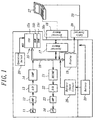
- Fig. 1 is a block diagram showing a basic construction of an embodiment of the digital audio recording and reproducing apparatus according to the present invention
- Fig. 2 is a planview illustrating an outer appearance of this apparatus.
- An audio or speech signal collected by a microphone 11 is processed by an analog audio signal processing circuit 12 and is converted by an A/D converter 13 into a digital audio data.
- a sampling in the A/C converter 13 is carried out with eight bits and 8KHz. Then, according to the sampling theory, it is possible to recover the audio signal higher than 16 KHz with a fidelity and this is sufficient for reproducing a speech.
- the digital audio data is supplied from the A/D converter 13 to a compression circuit 14, and the compressed digital audio data is stored in an internal memory 17 or a removable memory 18 serving as a detachable external solid state memory via a data bus 16 under the control of a central processing unit (CPU) 15a installed in a main processing unit 15.
- CPU central processing unit
- the digital audio data may be predominantly stored in the removable memory 18 or may be stored in either one of the internal memory 17 and external memory 18 selected by CPU 15a.
- the digital audio recording and reproducing apparatus further comprises a liquid crystal display 19 for displaying various kinds of commands and indicating information, and an operation switch unit 20.
- the main processing unit 15 comprises ROM 15b and RAM 15c in addition to the CPU 15a.
- the RAM 15c stores data information such as address of a sector in which the digital audio data is stored, a size of the digital audio data and dispersion information.
- the recording operation is completed by storing the data information in a FAT (File Allocation Table) area of the internal memory 17 or external memory 18.
- the data information stored in the FAT area of the internal memory 17 or external memory 18 is first read out and is stored in the RAM 15c under the control of the central processing unit 15a. Then, a desired digital audio data is read out of the internal memory 17 or external memory 18 under to the control of the data information, and the thus read out digital audio data is supplied to a digital decompression circuit 21 and is decompressed thereby. The decompressed digital audio data is then supplied to D/A converter 22 and is converted into an analog audio signal. After processing the analog audio signal by an analog audio signal processing circuit 23, the audio signal is supplied to a speaker 24 and is converted thereby into an acoustic speech. Since the analog audio signal is also supplied to an earphone terminal, the audio signal may be reproduced by an earphone or headphone. There are further provided a power source 25 including a battery or batteries and a battery check circuit 26 for checking an output voltage of the battery 25.
- the digital audio recording and reproducing apparatus further comprises a light emitting diode LED which emits light during the recording and reproducing operations. For instance, during the recording, the LED may emit green light and during the reproduction, the LED may emit red light.
- the operation switch unit 20 includes recording button 20a, reproducing button 20b, stop button 20c, erase button 20d, hold/repeat button 20e, menu button 20f, file button 20g for reading out file numbers of digital data files, and up and down select buttons 20h and 20i for increasing and decreasing a data file number.
- the digital compression circuit 14 is constructed such that the compressed digital audio data of sixty seconds, i.e. one minute has a data amount not larger than 100K bytes and can be treated on a conventional computer as a digital audio data file.
- the digital audio data file may be WAVE file which is a general sound file.
- the compressed digital audio data of sixty seconds might amount to about 165K bytes.
- the digital audio data of sixty seconds is compressed to have not larger than 100K bytes. Therefore, the thus compressed data can be directly handled on the conventional computer, and a load for the computer upon execution can be substantially reduced.
- the digital audio data compressed in the manner explained above is then stored in the internal solid state memory 17 or external solid state memory 18.
- various attribute data of the digital audio data such as title, date and file number may be also recorded, but here only the principal operation is explained.
- the compression and decompression circuits 14 and 16 are constructed such that the recorded digital audio data has a data file format which can be directly treated on the conventional computer, and therefore the digital audio data can be simply transferred to an external computer 27.
- the digital audio recording and reproducing apparatus comprises an external memory connecting terminal 18a and the compressed digital audio data is stored in the removable memory 18 connected to the connecting terminal 18a. After recording, the removable memory 18 is removed from the apparatus and is set on the computer 27. Then, the digital audio data can be loaded to the computer in a usual manner. Alternately the digital audio data may be transferred to the computer 27 via a connection cable 28 connected between the digital audio recording and reproducing apparatus and the computer 27.
- the digital audio data is recorded as the conventional sound file which can be directly treated by the computer 27, it is no more necessary to install a software for converting the digital audio data transmitted from the digital audio recording and reproducing apparatus into a computer readable audio data file format.
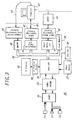
- Fig. 3 is a block diagram illustrating a more detailed structure of a main portion of the digital audio recording and reproducing apparatus of the present embodiment. For the sake of explanation, portions similar to those shown in Fig. 1 are denoted by different numerical references from those used in Fig. 1.
- a CODEC 32 which performs both A/D conversion and D/A conversion in accordance with 8 bits and 8 KHz.
- Digital audio data converted by the CODEC 32 is then supplied to compression-decompression circuit (COMP/DECOMP) 33 and is compressed thereby.
- the COMP/DECOMP 33 may be formed by a CT8005 digital signal processor manufactured and sold by DSP GROUP INC. in U.S.A.
- This processor can derive a digital audio data file as "True Speech" (registered trade mark) which can be generally treated on DOS/V.
- This data format is based on the recommendation G723.1 of ITU-T, and this digital audio data file may be directly transmitted on a conventional telephone communication line.
- the digital audio data of the DOS data file format generated by the processor 33 is converted into a WAVE file format, i.e. a sound file which can be reproduced by a computer operating in the Windows environment, under the control of the central processing unit (host CPU) 34, and the thus converted sound file is stored in an external solid state memory composed of a flash memory 36 via a data bus 35.
- a power source circuit 37 To the host CPU 34 are connected a power source circuit 37, a key pad 38 and a liquid crystal display driver 40 to which a liquid crystal display 40 is connected.
- a SSFDC interface 41 to which is detachably connected an external solid state memory consisting of SSFDC 43 by means of a SSFDC connecting terminal 42.
- the SSFDC 43 may have a storage capacity of 16-64 megabits.
- the SSFDC is removed from the digital audio recording and reproducing apparatus 30 and is installed into an external computer 47.
- the computer 47 can use the digital audio data in a usual manner.
- the digital audio data can be transmitted via the data bus 35 between the internal solid state memory, i.e. flash memory 36 and the external solid state memory consisting of SSFDC 43. Therefore, when both the 16 megabits flash memory 36 and the 16-64 megabits SSFDC 43 are jointly used, it is possible to record a speech having a very long time from 60-150 minutes.
- a communication cable interface 44 To the data bus 35, is connected a communication cable interface 44, to which is connected a cable connecting terminal 45.
- a communication cable 46 By connecting a communication cable 46 to the cable connecting terminal 45, it is possible to transmit the digital audio data from the digital audio recording and reproducing apparatus 30 to the external computer 47.
- a MODRM 48 To the data bus 35, are further connected a MODRM 48 and a communication line connecting terminal 49.
- a communication line 50 such as a conventional telephone line and internet line
- the digital audio data may be transmitted to an external computer 47.
- the MODEM 48 may be constructed by a hardware or software. Since the digital audio file has the WAVE file format and its capacity is small, the digital audio signal can be transferred to the computer 48 within a short time period even by using the data communication line 50.
- the relevant data file is read out under the control of the host CPU 34, and the thus read out digital audio data is supplied to the COMP/DECOMP 33 and is decompressed thereby. Then, the decompressed digital audio data is supplied to the CODEC 32 and is converted into an analog audio signal. After processing the analog audio signal by an analog processing circuit (18 in Fig. 1), the audio signal is converted into a sound by a speaker 51 or is supplied to an earphone jack 52.
- Fig. 4 depict various digital audio data transmission modes between the digital audio recording and reproducing apparatus 30 and the external computer 47.
- the digital audio data is transferred with the aid of the external solid state memory, i.e. SSFDC 43
- the digital audio data is transmitted from the apparatus 30 to the computer 47 via the communication cable 46.
- the communication line 50 is used for transmitting the digital audio data from the apparatus 30 to the computer 47
- the transmission of the digital audio data is performed by a radio or infra-red transmitter provided on the digital audio recording and reproducing apparatus 30.
- the transmitted digital audio data has a data file format which can be directly treated by the computer 47, it is no more necessary to provide any conversion software for converting the transmitted digital audio data into a computer readable audio data file.
- the transmitted digital audio data file has a small capacity, the data transmission can be performed within a very short time period. This is particularly preferable for transmitting the digital audio data by means of the communication line, because the download time can be shortened and a communication cost can be saved.
- the digital audio data file has the WAVE file format which is generally used in computers working in the environment of Windows, but any other file format may be utilized as long as it is based on the ITU-T recommendation G723.1 format.
- the internal solid state memory is consisting of the flash memory 36 and the external solid state memory is formed by the SSFDC 43, but any kind of solid state memory such as semiconductor memory and magnetic stick may be used.
- the digital audio data is compressed such that the data of sixty seconds is compressed to data having a capacity not larger than 100 KB and having a data file format, WAVE file which can be directly treated by the computer, the transmission of the data to the computer can be performed simply without using the special data converting cable as well as the conversion software. Moreover, the data transmission though the communication line or internet line can be completed within a short time period.
- the digital audio data can be transmitted between the internal memory 17 and the external memory 18, when the internal memory is full of the recorded audio data, the data may be transmitted to the external memory. Therefore, it is not necessary to waste the digital audio data stored in the internal memory. Further, when the external memory 18 is full of the stored data, the relevant external memory may be exchanged by another external solid state memory. In this manner, a user can continue the recording operation without worry about the available capacity of the memory.
- an audio message may be commonly transmitted from a computer installed at a head office to similar digital audio recording and reproducing apparatuses provided in a number of branches. Then, all the branches, the audio message can be reproduced by the respective digital audio recording and reproducing apparatuses. In this manner, the application of the digital audio recording and reproducing apparatus can be extended.
- the digital audio recording and reproducing apparatus of the present invention further includes the feature of the second aspect of the present invention. That is to say, when the external removable memory 18 might be erroneously removed during the recording operation, the digital audio data so far stored in the internal memory 17 or external memory 18 can be held without being wasted and the thus held digital audio data can be reproduced in a usual manner.
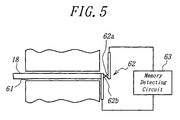
- Fig. 5 is a schematic view showing an embodiment of a mechanism for detecting the insertion as well as removal of the removable memory 18 (see Fig. 1) with respect to the digital audio recording and reproducing apparatus.
- the memory detecting circuit 63 detects the removal of the removable memory 18 during a recording operation, the data information including the attribute data of the relevant removable memory 18 stored in the RAM 15c of the main processing unit 15 during the relevant recording operation is not wasted, but is saved as it is. Then, the CPU 15a indicates on the LC display 19 a warning such that the removed memory should be inserted again. This warning may be "Insert the removed memory card”.
- the insertion and removal of the external memory 18 is detected by the switch 62 and memory detecting circuit 63, but a photoelectric detecting mechanism may be used.
- the speech signal could not be recorded, but the digital audio data obtained during a time period from the removal of the external removable memory to the restart of the recording operation may be stored in the internal memory 17.
- the digital audio data temporally stored in the internal memory 17 may be transmitted to the external memory 18. Then, the audio information can be still recorded even if the removable memory 18 is removed by an error.
- the warning for recommending a user to insert the removed memory is displayed on the LC display 19, and when a different removable memory is inserted, the warning for recommending the user to insert the correct memory is displayed.
- the user can operate the apparatus without confusion and the erroneous operation of the user can be avoided.
- an operation menu includes a normal reproduction mode in which a signal digital audio data file is reproduced only once (this is default menu), a single file repeat mode in which a single digital audio data file is reproduced repeatedly, a plural file continuous repeat mode in which a plurality of digital audio data files are successively reproduced only once, and a plural file repeat mode in which a plurality of digital audio data files are successively reproduced in a repeated manner, and a user can select any of these reproduction modes.
- a denoted single digital audio data file is reproduced once as usual.
- the plural file continuous reproduction mode is selected, a conventional reproducing operation is carried out, but a part of which is different.
- the plural file repeat reproduction mode is a novel one which has not been provided in known apparatuses. Therefore, the plural file continuous reproduction mode and plural file repeat reproduction mode will be further explained in detail.
- a plurality of digital audio data files are stored in the internal solid state memory 17, but according to the invention, a plurality of digital audio data files may be stored in the external solid state memory 18 or may be stored in both the internal and external memories.
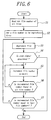
- Fig. 6 is a flow chart showing successive steps in the plural file continuous reproduction mode.
- file numbers of all audio data files are read out of the data manage information stored in the FAT area of the internal solid state memory 17 (step S1), then a file number of a data file which is to be reproduced first is set by a user (step S2), and the relevant data file is reproduced (step S3).
- step S4 it is always checked whether or not a stop signal is generated (step S4). When the stop signal is generated, the reproducing operation is stopped at once.
- a file number is incremented by one (step S5), and it is checked whether or not the incremented file number is found in the initially read out file numbers of all data files (step S6). When the incremented file number is not found, the file number is incremented by one in the step S5. When the thus incremented file number is found in the initially read out file numbers, it is checked whether or not this file number corresponds to a sum of the last file number and one (step S7). If the incremented file number is not equal to said sum, then a data file of the incremented file number is reproduced.
- step S7 when it is judged that the incremented file number is equal to the last file number plus one, the plural file continuous reproduction mode is completed. In this manner, the continuous reproduction can be carried out from the data file initially denoted by the user to the last data file. Therefore, data files which should not be apparently reproduced are not reproduced, and the file retrieve can be performed promptly and an accuracy of retrieve can be improved.
- the plural file continuous reproduction mode when the plural file continuous reproduction mode is selected, all the data files stored in the internal solid state memory 17 may be successively reproduced. In this case, in the step S2, a data file having the smallest file number may be reproduced first.
- Fig. 7 is a flow chart illustrating successive steps in the plural file repeat reproduction mode.
- the plural file repeat reproduction mode all the digital audio data files stored in the internal solid state memory 17 are successively reproduced in a repeated manner.
- file numbers of all audio data files are read out of the data manage information stored in the FAT area of the internal solid state memory 17 (step S1).
- the smallest file number is extracted as a file number which should be reproduced first (step S2), and the relevant data file is reproduced (step S3).
- step S4 it is always checked whether or not a stop signal is generated (step S4). When the stop signal is generated, the reproducing operation is stopped at once.
- a file number is incremented by one (step S5), and it is checked whether or not the incremented file number is found in the initially read out file numbers of all data files (step S6). When the incremented file number is not found, the file number is incremented again by one in the step S5. When the thus incremented file number is found in the initially read out file numbers, it is checked whether or not this file number corresponds to a sum of the last file number and one (step S7). If the incremented file number is not equal to said sum, then a data file of this incremented file number is reproduced.
- step S7 when it is judged that the incremented file number is equal to the last file number plus one, it is checked whether or not a stop signal is generated (step S8).
- the stop signal is generated, the plural file repeat reproduction mode is completed immediately. However, if not stop signal is generated, the operation is repeated from the step S2, and above explained steps S3-8 are repeated until the stop signal is generated. In this manner, all the digital audio data files stored in the internal solid state memory 17 can be successively reproduced repeatedly.
- the plural file continuous reproduction mode or plural file repeat reproduction mode when a desired speech is seemed to be reproduced and the user pushes the repeat button 20e, the plural file continuous reproduction mode or plural file repeat reproduction mode is interrupted and the single file reproduction mode is automatically selected and the relevant digital audio data file is reproduced repeatedly. In this manner, it is possible to confirm easily and accurately whether or not a desired speech is reproduced. In this case, if the relevant speech is not a desired one or if the user wishes to find a next desired speech, the repeat button 20e is pushed again or the stop button 20c is pushed. Then, the interrupted plural file continuous reproduction mode or plural file repeat reproduction mode can be restarted.
- a plurality of digital audio data files stored in the internal solid state memory 17 are successively reproduced from a data file having the smallest file number.
- the order of reproduction may be denoted by the user.
- a special button for starting the plural file continuous reproduction mode or a special button for initiating the plural file repeat reproduction mode may be provided in the key pad 20.
- the digital audio recording and reproducing apparatus of the present embodiment has the fourth aspect of the present invention. That is to say, the operation menu further includes a normal mode in which the normal speech information is recorded and reproduced, and an alarm mode in which the alarm message is recorded and reproduced.
- the normal mode is selected, the compressed digital audio data is stored in a normal data storage area allocated in a data zone of the internal solid state memory 17, and only the digital files stored in this normal data storage area can be read out and erased.
- the alarm mode is selected, a time at which the alarm message is reproduced can be set by the user, a digital audio data file of alarm message is stored in an alarm data storage area which is separately allocated from the normal data storage area, and only the alarm message file can be reproduced or erased.
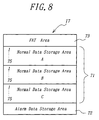
- Fig. 8 is a plan view showing the structure of the internal solid state memory 17.
- a data zone is divided into a normal data storage zone 71 storing digital audio data files of normal speeches, an alarm data storage zone 72 for storing one or more digital audio data file of alarm message, and a FAT area 73 for storing data management information such as addresses of areas in which normal data and alarm data are stored, data sizes and distribution information.
- the normal data storage zone 71 is further divided into three sub-areas A-C, and each sub-area is divided into 1-75 file areas.
- An alarm message of thirty seconds is recorded with a compression rate of 8.5 K bps, and thus the alarm data storage area 72 has a size of 255 K bits.
- a selection image between the normal mode and the alarm mode, and a desired mode is selected by operating the select buttons 20h and 20i.
- the digital audio data is stored in the normal data storage zone 71, and a data file stored therein can be reproduced. Furthermore, a denoted data file stored in the normal data storage zone 71 can be selectively erased or all the data files stored in the normal data storage zone 71 can be erased simultaneously.
- a desired alarm time is set by the user.
- digital audio data of an alarm message is stored in the alarm data storage area 72.
- an alarm sound is reproduced at the alarm time.
- Such a function is similar to the conventional schedule management function. Since the alarm massage stored in the alarm data storage area 72 can be erased only in the alarm mode, and therefore a possibility of erasing the alarm message by an error is very small.
- the alarm mode is selected by operating the menu button 20f and select buttons 20h, 20i, but an alarm button may be provided. Only when the alarm button is pushed, the alarm message can be recorded and erased. Furthermore, a plurality of alarm messages may be stored in the alarm data storage area 72, and in such a case, respective alarm messages may be separately erased or simultaneously.
- the data zone of the internal solid state memory 17 is divided into the normal data storage zone 71 and the alarm data storage area 72, and therefore the alarm message data stored in the alarm data storage area 72 could not be erased by the operation for erasing the normal data stored in the normal data storage zone 71.
- a possibility of erasing the alarm data by an error can be reduced materially.
- the alarm data is not erased by this operation. Therefore, the user can use this function without worry about the erroneous erase of the alarm data.
- the digital audio recording and reproducing apparatus of the present embodiment has the fifth aspect of the present invention. That is to say, even if the output voltage of the power source is decreased, the digital audio data so far stored in the memory is not lost and can be reproduced positively.
- the output voltage is checked by the battery check circuit 26 and the detected output voltage is compared with four voltage levels.
- a digital signal representing a comparison result is supplied to the central; processing unit 15.
- the power source 25 includes a series connection of two batteries of 1.5 V, and ICs composing various circuits are operated at a nominal voltage of 3 V. ICs are sensitive to the applied voltage, and when the applied voltage is decreased, they do not work stably, and therefore the power source 25 includes a DC/DC converter for compensating the reduction in the output voltage even if the battery voltage is lowered.
- the recording operation is continued and the output voltage of the power source 25 is decreased to or lower than 1.8 V, "BATTERY LOW" is displayed and the recording operation is automatically stopped without any operation of the user. That is to say, the data management information so far stored in the RAM 15c is transmitted to the removable memory 18 and is stored in its FAT area. Therefore, the digital audio data so far recorded on the removable memory 18 can be reproduced as usual.
- the power switch not shown is automatically switched into the off condition, and all the operation of the digital audio recording and reproducing apparatus is stopped.
- Fig. 9 is a graph showing the variation in the output voltage of the power source 25 and the display and recording operation.
- the output voltage of the power source 25 is 3 V and is gradually deceased.
- the "FULL” is displayed, and when the output voltage becomes not higher than 2.4 V, "HALF” is displayed instead of "FULL".
- the power switch is forcedly switched off and the power supply to the whole apparatus is stopped.
- the removable memory 18 is used, the compressed digital audio data is stored in the data storage area of the removable memory and the data management information for managing this digital audio data is stored in the RAM 15c.
- the normal operation for stopping the recording operation is performed. That is to say, new digital audio data is not stored in the removable memory 18 and the data management information so far stored in the RAM 15c is transferred to the FAT area of the removable memory 18 and is stored therein. This operation is identical with the stopping operation effected by pushing the stop button 20c. Therefore, the digital audio data stored in the removable memory 18 can be reproduced in a usual manner.
- comparison levels are denoted for the sake of explanation and may be set to any desired values in accordance with the output voltage of the power source and design.
- a time during which the recording will be possible may be displayed or a warning alarm may be produced.
- the output voltage of the power source 25 is detected by the battery check circuit 26, and when the output voltage is higher than a threshold value at which the apparatus could not work correctly, but becomes not higher than a first level (corresponding to the second comparison level L2), this condition is displayed, when the output voltage is higher than the threshold value at which the apparatus could not work correctly, but becomes not higher than a second level (corresponding to the third comparison level L3), this condition is displayed, when the output voltage becomes not higher than said second level during the recording operation, data management information for currently recorded digital audio data is automatically stored and the recording operation is automatically stopped, and when the output voltage reaches a third level (corresponding to the fourth comparison level L4) which is lower than said second level but is slightly higher than the threshold value, the power supply to the various portions of the apparatus is stopped.
- the recording operation can be automatically stopped in a usual manner without the manual stopping operation of the user, and thus the audio information so far recorded can be reproduced as usual. In this manner, the user can perform the recording operation without wary about the battery condition.
Landscapes
- Signal Processing For Digital Recording And Reproducing (AREA)
- Electric Clocks (AREA)
- Reverberation, Karaoke And Other Acoustics (AREA)
Applications Claiming Priority (10)
| Application Number | Priority Date | Filing Date | Title |
|---|---|---|---|
| JP31881098 | 1998-11-10 | ||
| JP10318810A JP2000148188A (ja) | 1998-11-10 | 1998-11-10 | ディジタル式音声録音再生装置 |
| JP17973899A JP3611985B2 (ja) | 1999-06-25 | 1999-06-25 | ディジタル式音声録音再生装置 |
| JP17995199 | 1999-06-25 | ||
| JP17973899 | 1999-06-25 | ||
| JP11179951A JP2001013996A (ja) | 1999-06-25 | 1999-06-25 | ディジタル式音声録音再生装置 |
| JP11179670A JP2001005494A (ja) | 1999-06-25 | 1999-06-25 | ディジタル式音声録音再生装置 |
| JP17967099 | 1999-06-25 | ||
| JP17973999 | 1999-06-25 | ||
| JP17973999A JP3581273B2 (ja) | 1999-06-25 | 1999-06-25 | ディジタル式音声録音再生装置 |
Publications (2)
| Publication Number | Publication Date |
|---|---|
| EP1001428A2 true EP1001428A2 (fr) | 2000-05-17 |
| EP1001428A3 EP1001428A3 (fr) | 2000-11-29 |
Family
ID=27528752
Family Applications (1)
| Application Number | Title | Priority Date | Filing Date |
|---|---|---|---|
| EP99308957A Withdrawn EP1001428A3 (fr) | 1998-11-10 | 1999-11-10 | Appareil d'enregistrement et de lecture audio digital |
Country Status (4)
| Country | Link |
|---|---|
| US (1) | US20060116780A1 (fr) |
| EP (1) | EP1001428A3 (fr) |
| CN (1) | CN1257270A (fr) |
| TW (1) | TW479220B (fr) |
Cited By (2)
| Publication number | Priority date | Publication date | Assignee | Title |
|---|---|---|---|---|
| FR2801718A1 (fr) * | 1999-11-29 | 2001-06-01 | Lyes Seba | Appareil pour la lecture de sons, notamment enregistres, pouvant etre monte sur un vehicule |
| RU2234727C1 (ru) * | 2002-12-04 | 2004-08-20 | Открытое акционерное общество "Корпорация "Фазотрон - научно-исследовательский институт радиостроения" | Устройство управления бортовой радиолокационной станцией с альтернативным каналом речевого управления |
Families Citing this family (11)
| Publication number | Priority date | Publication date | Assignee | Title |
|---|---|---|---|---|
| EP1532734A4 (fr) | 2002-06-05 | 2008-10-01 | Sonic Focus Inc | Moteur de realite virtuelle acoustique et techniques avancees pour l'amelioration d'un son delivre |
| US20080136629A1 (en) * | 2004-01-30 | 2008-06-12 | Ivoice, Inc. | Wirelessly loaded speaking medicine container |
| US20050168337A1 (en) * | 2004-01-30 | 2005-08-04 | Mahoney Jerome R. | Wirelessly loaded speaking medicine container |
| JP4779797B2 (ja) * | 2006-05-10 | 2011-09-28 | ソニー株式会社 | 情報処理装置、および情報処理方法、並びにコンピュータ・プログラム |
| KR101343406B1 (ko) * | 2007-01-30 | 2013-12-20 | 삼성전자주식회사 | 수신제한 정보 제공방법 및 이를 적용한 영상수신장치 |
| JP2011244181A (ja) * | 2010-05-18 | 2011-12-01 | Sanyo Electric Co Ltd | 記録再生装置 |
| TW201328205A (zh) * | 2011-12-23 | 2013-07-01 | Hon Hai Prec Ind Co Ltd | 音頻設備轉接器 |
| TW201327170A (zh) * | 2011-12-23 | 2013-07-01 | Hon Hai Prec Ind Co Ltd | Ieee1394設備轉接器 |
| CN102711006B (zh) * | 2012-05-30 | 2017-04-05 | 蒋憧 | 一种声音采集系统 |
| EP2988300A1 (fr) * | 2014-08-18 | 2016-02-24 | Fraunhofer-Gesellschaft zur Förderung der angewandten Forschung e.V. | Commutation de fréquences d'échantillonnage au niveau des dispositifs de traitement audio |
| EP3040851B1 (fr) * | 2014-12-30 | 2017-11-29 | GN Audio A/S | Procédé d'exploitation d'un ordinateur et ordinateur |
Family Cites Families (21)
| Publication number | Priority date | Publication date | Assignee | Title |
|---|---|---|---|---|
| GB2172126A (en) * | 1985-01-24 | 1986-09-10 | John Richard Mumford | Interchangeable solid state memory device |
| JPH07121630B2 (ja) * | 1987-05-30 | 1995-12-25 | 株式会社東芝 | Icカ−ド |
| JPH03163953A (ja) * | 1989-11-22 | 1991-07-15 | Canon Inc | 画像通信装置 |
| DE4121698C1 (en) * | 1991-06-29 | 1992-12-10 | Blaupunkt-Werke Gmbh, 3200 Hildesheim, De | CD player with memory storing favourite pieces for automatic playing - has initial memory for recognising inserted CD and programme selection button for ordering sequence from stored titles |
| JP3163119B2 (ja) * | 1991-07-19 | 2001-05-08 | シャープ株式会社 | 記録再生装置 |
| US5566339A (en) * | 1992-10-23 | 1996-10-15 | Fox Network Systems, Inc. | System and method for monitoring computer environment and operation |
| CA2111298C (fr) * | 1992-12-28 | 1999-07-27 | David A. Ellis | Machine a dicter qui comporte un ordinateur portable et un combine |
| US5581703A (en) * | 1993-06-29 | 1996-12-03 | International Business Machines Corporation | Method and apparatus for reserving system resources to assure quality of service |
| US5511000A (en) * | 1993-11-18 | 1996-04-23 | Kaloi; Dennis M. | Electronic solid-state record/playback device and system |
| US5491774A (en) * | 1994-04-19 | 1996-02-13 | Comp General Corporation | Handheld record and playback device with flash memory |
| AU3586495A (en) * | 1994-09-08 | 1996-03-27 | Voice It Worldwide, Inc. | Credit card size audio record and playback device |
| US5751672A (en) * | 1995-07-26 | 1998-05-12 | Sony Corporation | Compact disc changer utilizing disc database |
| US5903871A (en) * | 1996-04-22 | 1999-05-11 | Olympus Optical Co., Ltd. | Voice recording and/or reproducing apparatus |
| US6283764B2 (en) * | 1996-09-30 | 2001-09-04 | Fujitsu Limited | Storage medium playback system and method |
| US6009519A (en) * | 1997-04-04 | 1999-12-28 | Andrea Electronics, Corp. | Method and apparatus for providing audio utility software for use in windows applications |
| US6125343A (en) * | 1997-05-29 | 2000-09-26 | 3Com Corporation | System and method for selecting a loudest speaker by comparing average frame gains |
| US6538687B1 (en) * | 1997-07-23 | 2003-03-25 | Olympus Optical Co., Ltd. | Endoscopic imaging system making it possible to detachably attach expansion unit having external expansion facility and add expansion facility for improving capability of system |
| US6128661A (en) * | 1997-10-24 | 2000-10-03 | Microsoft Corporation | Integrated communications architecture on a mobile device |
| KR100287366B1 (ko) * | 1997-11-24 | 2001-04-16 | 윤순조 | 엠피이지 방식을 이용한 휴대용 음향 재생장치 및 방법 |
| US6349668B1 (en) * | 1998-04-27 | 2002-02-26 | Msp Corporation | Method and apparatus for thin film deposition on large area substrates |
| US6226618B1 (en) * | 1998-08-13 | 2001-05-01 | International Business Machines Corporation | Electronic content delivery system |
-
1999
- 1999-11-10 CN CN99126329.4A patent/CN1257270A/zh active Pending
- 1999-11-10 TW TW088119641A patent/TW479220B/zh not_active IP Right Cessation
- 1999-11-10 EP EP99308957A patent/EP1001428A3/fr not_active Withdrawn
-
2006
- 2006-01-13 US US11/330,999 patent/US20060116780A1/en not_active Abandoned
Cited By (2)
| Publication number | Priority date | Publication date | Assignee | Title |
|---|---|---|---|---|
| FR2801718A1 (fr) * | 1999-11-29 | 2001-06-01 | Lyes Seba | Appareil pour la lecture de sons, notamment enregistres, pouvant etre monte sur un vehicule |
| RU2234727C1 (ru) * | 2002-12-04 | 2004-08-20 | Открытое акционерное общество "Корпорация "Фазотрон - научно-исследовательский институт радиостроения" | Устройство управления бортовой радиолокационной станцией с альтернативным каналом речевого управления |
Also Published As
| Publication number | Publication date |
|---|---|
| CN1257270A (zh) | 2000-06-21 |
| TW479220B (en) | 2002-03-11 |
| US20060116780A1 (en) | 2006-06-01 |
| EP1001428A3 (fr) | 2000-11-29 |
Similar Documents
| Publication | Publication Date | Title |
|---|---|---|
| US5182769A (en) | Telephone set having a volatile memory | |
| EP1001428A2 (fr) | Appareil d'enregistrement et de lecture audio digital | |
| KR100287366B1 (ko) | 엠피이지 방식을 이용한 휴대용 음향 재생장치 및 방법 | |
| US5903871A (en) | Voice recording and/or reproducing apparatus | |
| CN100422920C (zh) | 信息处理设备、信息处理方法 | |
| US20030163634A1 (en) | Portable data storage apparatus | |
| EP0957489A1 (fr) | Dispositif portable et procédé d'enregistrement, d'édition et de reproduction d'un signal audio numérique | |
| US7010719B2 (en) | External storage device capable of selectively storing data in a semiconductor memory or a hard disk | |
| US5587977A (en) | Recording/reproducing apparatus having means to detect the exchange of an external memory | |
| US5696812A (en) | Data communication apparatus having a function of recording a voice into a memory | |
| US20030007783A1 (en) | Recording/reproducingdisk control device and disc apparatus comprising the same | |
| KR20050071351A (ko) | 휴대단말기에서 보조메모리의 파일을 처리하는 방법 | |
| US7124086B2 (en) | Data reproducing apparatus and data reproducing system for reproducing contents stored on a removable recording medium | |
| US20090175592A1 (en) | Information recording processing apparatus and information recording processing method | |
| EP1826994A2 (fr) | Appareil et procédé de contrôle du son d'une sonnerie dans un terminal portable comportant une commande de disque dur | |
| JP2004096511A (ja) | 通信装置 | |
| JP4385422B2 (ja) | 時計装置 | |
| JPH05158813A (ja) | 半導体メモリーのバックアップ装置 | |
| JP2001056777A (ja) | デジタルデータ記録再生装置 | |
| KR100640363B1 (ko) | 교환 시스템의 안내 방송 메시지 기록 제어 장치 및 방법 | |
| JP2595599Y2 (ja) | 留守番電話機の応答メッセージ消去報知装置 | |
| KR20050037978A (ko) | 데이터 처리 장치 | |
| JP2007505418A (ja) | 通信方法及びシステム | |
| HK1027198A (en) | Digital audio recording and reproducing apparatus | |
| JP2000267697A (ja) | 音声記録再生装置 |
Legal Events
| Date | Code | Title | Description |
|---|---|---|---|
| PUAI | Public reference made under article 153(3) epc to a published international application that has entered the european phase |
Free format text: ORIGINAL CODE: 0009012 |
|
| AK | Designated contracting states |
Kind code of ref document: A2 Designated state(s): DE FR GB NL |
|
| AX | Request for extension of the european patent |
Free format text: AL;LT;LV;MK;RO;SI |
|
| PUAL | Search report despatched |
Free format text: ORIGINAL CODE: 0009013 |
|
| RIC1 | Information provided on ipc code assigned before grant |
Free format text: 7G 11C 7/16 A, 7G 11C 5/14 B |
|
| AK | Designated contracting states |
Kind code of ref document: A3 Designated state(s): AT BE CH CY DE DK ES FI FR GB GR IE IT LI LU MC NL PT SE |
|
| AX | Request for extension of the european patent |
Free format text: AL;LT;LV;MK;RO;SI |
|
| 17P | Request for examination filed |
Effective date: 20010129 |
|
| AKX | Designation fees paid |
Free format text: DE FR GB NL |
|
| 17Q | First examination report despatched |
Effective date: 20030430 |
|
| STAA | Information on the status of an ep patent application or granted ep patent |
Free format text: STATUS: THE APPLICATION IS DEEMED TO BE WITHDRAWN |
|
| 18D | Application deemed to be withdrawn |
Effective date: 20031111 |