EP1001516A2 - Alimentation de puissance avec condensateur de recirculation et méthode pour l'opération de celui-ci - Google Patents
Alimentation de puissance avec condensateur de recirculation et méthode pour l'opération de celui-ci Download PDFInfo
- Publication number
- EP1001516A2 EP1001516A2 EP99308669A EP99308669A EP1001516A2 EP 1001516 A2 EP1001516 A2 EP 1001516A2 EP 99308669 A EP99308669 A EP 99308669A EP 99308669 A EP99308669 A EP 99308669A EP 1001516 A2 EP1001516 A2 EP 1001516A2
- Authority
- EP
- European Patent Office
- Prior art keywords
- power switch
- side power
- power supply
- coupled
- output
- Prior art date
- Legal status (The legal status is an assumption and is not a legal conclusion. Google has not performed a legal analysis and makes no representation as to the accuracy of the status listed.)
- Withdrawn
Links
Images


Classifications
-
- H—ELECTRICITY
- H02—GENERATION; CONVERSION OR DISTRIBUTION OF ELECTRIC POWER
- H02M—APPARATUS FOR CONVERSION BETWEEN AC AND AC, BETWEEN AC AND DC, OR BETWEEN DC AND DC, AND FOR USE WITH MAINS OR SIMILAR POWER SUPPLY SYSTEMS; CONVERSION OF DC OR AC INPUT POWER INTO SURGE OUTPUT POWER; CONTROL OR REGULATION THEREOF
- H02M7/00—Conversion of AC power input into DC power output; Conversion of DC power input into AC power output
- H02M7/42—Conversion of DC power input into AC power output without possibility of reversal
- H02M7/44—Conversion of DC power input into AC power output without possibility of reversal by static converters
- H02M7/48—Conversion of DC power input into AC power output without possibility of reversal by static converters using discharge tubes with control electrode or semiconductor devices with control electrode
- H02M7/4807—Conversion of DC power input into AC power output without possibility of reversal by static converters using discharge tubes with control electrode or semiconductor devices with control electrode having a high frequency intermediate AC stage
-
- H—ELECTRICITY
- H02—GENERATION; CONVERSION OR DISTRIBUTION OF ELECTRIC POWER
- H02M—APPARATUS FOR CONVERSION BETWEEN AC AND AC, BETWEEN AC AND DC, OR BETWEEN DC AND DC, AND FOR USE WITH MAINS OR SIMILAR POWER SUPPLY SYSTEMS; CONVERSION OF DC OR AC INPUT POWER INTO SURGE OUTPUT POWER; CONTROL OR REGULATION THEREOF
- H02M3/00—Conversion of DC power input into DC power output
- H02M3/22—Conversion of DC power input into DC power output with intermediate conversion into AC
- H02M3/24—Conversion of DC power input into DC power output with intermediate conversion into AC by static converters
- H02M3/28—Conversion of DC power input into DC power output with intermediate conversion into AC by static converters using discharge tubes with control electrode or semiconductor devices with control electrode to produce the intermediate AC
- H02M3/325—Conversion of DC power input into DC power output with intermediate conversion into AC by static converters using discharge tubes with control electrode or semiconductor devices with control electrode to produce the intermediate AC using devices of a triode or a transistor type requiring continuous application of a control signal
- H02M3/335—Conversion of DC power input into DC power output with intermediate conversion into AC by static converters using discharge tubes with control electrode or semiconductor devices with control electrode to produce the intermediate AC using devices of a triode or a transistor type requiring continuous application of a control signal using semiconductor devices only
- H02M3/33561—Conversion of DC power input into DC power output with intermediate conversion into AC by static converters using discharge tubes with control electrode or semiconductor devices with control electrode to produce the intermediate AC using devices of a triode or a transistor type requiring continuous application of a control signal using semiconductor devices only having more than one ouput with independent control
Definitions
- the present invention is directed, in general, to power conversion and, more specifically, to a power supply employing a circulating capacitor for current circulation and a method of operating the same.
- a power converter is a power processing circuit that converts an input voltage waveform into a specified output voltage waveform.
- a switched-mode power converter is a frequently employed power converter that converts an input voltage waveform into a specified output voltage waveform.
- a buck power converter is one example of a switched-mode converter that converts the input voltage to an output voltage that is lower than the input voltage.
- the buck power converter is employed in applications wherein a stable, regulated voltage is desired at the output of the power converter.
- a buck power converter generally includes an active switch coupled to a source of input voltage.
- the active switch intermittently switches to provide an output voltage to a load at an output of the buck power converter.
- a controller regulates the output voltage by varying a duty cycle of the active switch. Depending on the duty cycle of the active switch, the output voltage may be regulated to any desired voltage between zero and the input voltage.
- Employing a high switching frequency in the power converter may cause ripple fluctuations in the output voltage.
- Conventional buck power converters therefore, typically include a low pass output filter having an inductor and an output capacitor. The corner frequency of the output filter may be set sufficiently lower than the switching frequency of the active switch to minimize the ripple fluctuations.
- the active switch Since the active switch is coupled in series with the inductor, an inductor current is established during a conduction interval of the active switch. Opening the active switch may, therefore, result in a high voltage across the active switch unless an alternative path is provided for the inductor current.
- the problem of inductor current may be overcome by coupling a diode between the active switch and the inductor. During the conduction interval of the active switch, the diode is reversed biased. Then, during a nonconduction interval of the active switch, the inductor current flows through the diode, transferring some of its stored energy to the load.
- the buck power converter like other switched-mode power converters, thus preferably includes at least two semiconductor switches, the active switch and the diode, to execute a switching cycle.
- Switched-mode power supplies may also be required to operate in four quadrants (e.g., provide a bipolar output voltage or transmit power in either direction at the input or output). If four-quadrant operation is required, conventional switched-mode power supplies typically employ a bipolar source of input power and an auxiliary active switch in place of the diode. While the use of two active switches may enable four-quadrant operation, circuit complexity is increased. Further, unlike the active switches employed in the buck power converter previously discussed, the active switches of the four-quadrant power supply may be required to block or conduct currents in both directions.
- each active switch may consist of two series-coupled FETs.
- custom controllers may also be required to provide isolated drive signals to the control terminals of the active switches, further increasing the cost and complexity of the power supply.
- the present invention provides a power supply and method of operation thereof.
- the power supply includes: (1) a primary side power switch, (2) an isolation transformer having a primary winding coupled to the primary side power switch, the primary side power switch conducting intermittently to transfer current from an input of the power supply to the isolation transformer, (3) a secondary side power switch, coupled to a secondary winding of the isolation transformer, that is operable to conduct within a conduction period of the primary side power switch to transfer current from the isolation transformer to an output of the power supply, a portion of the current being contained within the power supply during a nonconduction period of the secondary side power switch and (4) a capacitor, coupled to the secondary side power switch, that circulates the portion toward the output during the nonconduction period.
- the present invention therefore introduces the broad concept of employing a capacitor for current circulation.
- the capacitor may be employed in lieu of a diode for current circulation.
- the capacitor is, of course, capable of bi-directional operation and may advantageously be employed in four-quadrant switched-mode power supplies in lieu of an auxiliary bi-directional active switch.
- the capacitor avoids the high cost and complexities associated with the use of the bi-directional active switch.
- the power supply further includes an output capacitor coupled across the output.
- the output capacitor filters and smooths the output voltage, thus minimizing ripple fluctuations therein.
- the power supply further includes an inductor coupled to the output.
- the power supply further includes a filter resistor coupled to the output.
- the inductor or filter resistor filters the output voltage to minimize ripple fluctuations therein.
- the power supply further includes a resistor series-coupled to the secondary side power switch.
- the resistor supplements a parasitic resistance of the secondary side power switch and reduces a peak current therethrough.
- the secondary side power switch is at least one metal oxide semiconductor field-effect transistor (MOSFET).
- the secondary side power switch is at least one insulated gate bipolar junction transistor (IGBT).
- IGBT insulated gate bipolar junction transistor
- the input of the power supply is couplable to a source of direct current (DC) power.
- the input may be coupled to a DC-DC converter via an isolation transformer.
- the DC-DC converter includes a primary inverter selected from the group consisting of an asymmetrical half bridge, a half bridge, a full bridge, a forward, a flyback, a Sepic, and a Zeta.
- Conventional inverter topologies are familiar to those skilled in the art. Of course, the present invention is not limited to the inverter topologies disclosed herein.
- the DC-DC converter further includes a rectifier selected from the group consisting of a half wave rectifier, a full wave rectifier, a hybridge rectifier, a multiple transformer rectifier and a flyback rectifier.
- a rectifier selected from the group consisting of a half wave rectifier, a full wave rectifier, a hybridge rectifier, a multiple transformer rectifier and a flyback rectifier.
- the forward power converter 100 is an isolated version of the buck power converter previously discussed.
- the forward power converter 100 has an input coupled to a source of input power 110 and an output couplable to a load 150.
- the forward power converter 100 includes a primary inverter 120 having a primary side power switch Spri coupled to the input.
- the forward power converter 100 further includes an isolation transformer T1 having a primary winding P1 coupled to the primary side power switch Spri and secondary and reset windings S1, S2.
- the primary side power switch Spri conducts intermittently to transfer current from the input to the isolation transformer T1.
- a diode D1 coupled to the reset winding S2, cooperates therewith to reset the flux in the transformer T1 during a nonconduction period of the primary side power switch Spri.
- the diode D1 and reset winding S2 represent only one method for resetting the flux in the transformer T1 and that other methods of resetting the flux in the transformer T1 may also be employed.
- the forward power converter 100 further includes a rectifier 130 having an active switch Sw and a freewheeling diode Df coupled to the secondary winding S1.
- the active switch Sw conducts in synchronism with the primary side power switch Spri to transfer current to the output of the forward power converter 100.
- the forward power converter 100 still further includes an output filter 140 having an inductor L and an output capacitor Cout coupled to the rectifier 130.
- the freewheeling diode Df is reverse biased and power from the source of input power 110 is provided to both the inductor L and the load 150. Then, during the nonconduction period of the primary side power switch Spri, the active switch Sw opens, isolating the output from the secondary winding S1. The voltage impressed across the output filter 140 is, therefore, substantially zero during the nonconduction period of the primary side power switch Spri. Current now flows through the freewheeling diode Df to transfer some of the energy stored in the inductor L to the load 150.
- the output filter 140 filters and dampens the voltage fluctuations caused by the switching of the primary side power switch Spri and the active switch Sw to provide a substantially constant output voltage Vout at the output of the forward power converter 100.
- the freewheeling diode Df is adequate for power supplies that provide DC outputs, the freewheeling diode Df is a unidirectional device and thus is not capable of supporting four-quadrant operation.
- the present invention therefore, introduces a circulating capacitor employable (in a preferred embodiment) in power supplies capable of four-quadrant operation.
- FIGURE 2 illustrated is a schematic diagram of an embodiment of a power supply 200 constructed in accordance with the principles of the present invention.
- the power supply 200 has an input coupled to a source of input power 210 and an output couplable to a load 250.
- the power supply 200 includes a primary inverter 220 having a primary side power switch Spri coupled to the input.
- the power supply 200 further includes an isolation transformer T1 having a primary winding P1 coupled to the primary side power switch Spri and secondary and reset windings S1, S2.
- the primary side power switch Spri conducts intermittently to transfer current from the input to the isolation transformer T1.
- the primary inverter 220 operates analogously to the primary inverter 120 of the forward power converter 100 of FIGURE 1.
- the power supply 200 further includes a secondary side power switch Sw coupled to the secondary winding S1.
- the secondary side power switch Sw is operable to conduct within a conduction period of the primary side power switch to transfer current from the isolation transformer T1 to the output. In the illustrated embodiment, a portion of the current is contained within the power supply 200 during a nonconduction period of the secondary side power switch Sw.
- the power supply 200 therefore, further includes a capacitor (circulating capacitor Cf), coupled to the secondary side power switch Sw, that circulates the portion of the current toward the output during the nonconduction period of the secondary side power switch Sw.
- the power supply 200 further includes a resistor R coupled in series with the source of input power 210 and the circulating capacitor Cf. While the resistor R is illustrated as a discrete component, those skilled in the art realize that the resistor R may be a parasitic resistance of the secondary side power switch Sw.
- FIGURE 3 illustrated is a graph of a voltage Vcf across the circulating capacitor Cf of the power supply 200 of FIGURE 2.
- the power supply 200 operates as follows.
- the primary side power switch Spri conducts for a primary period D to impress the input voltage Vin across the isolation transformer T1.
- the primary side power switch Spri is nonconducting.
- the primary side power switch Spri thus develops an alternating voltage across the isolation transformer T1.
- the secondary side power switch Sw conducts within the primary period D or the auxiliary period 1-D (depending on a desired polarity of the output voltage) to impress the alternating voltage from the secondary winding S1 across the circulating capacitor Cf and the resistor R.
- the circulating capacitor Cf quickly charges to a portion of the alternating voltage from the secondary winding S1. (See FIGURE 3). Since the voltage Vcf across the circulating capacitor Cf may not always be equal to the alternating voltage from the secondary winding S1, the resistor R allows some energy to be dissipated. Then, during a nonconduction period 1-Dsec of the secondary side power switch Sw, the output is isolated from the alternating voltage at the isolation transformer T1. The circulating capacitor Cf now discharges to the load 250. The circulating capacitor Cf thus allows current to circulate toward the output during the nonconduction period 1-Dsec of the secondary side power switch Sw.
- the power supply 200 is therefore capable of supplying a bipolar output waveform at the output.
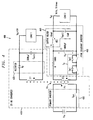
- FIGURE 4 illustrated is a schematic diagram of another embodiment of a power supply 400 constructed in accordance with the principles of the present invention.
- the power supply 400 includes a DC-DC converter 410 that receives a DC input voltage Vin at an input of the power supply 400 and generates a DC output voltage V DC at a first output of the power supply 400.
- the power supply 400 further includes a four-quadrant inverter 450, coupled to the DC-DC converter 410, that generates an AC output waveform having a voltage V AC at a second output of the power supply 400.
- a first load requiring a DC voltage is coupled to the first output.
- a second load requiring an AC voltage is coupled to the second output.
- the DC-DC converter 410 includes a primary inverter 420 (e.g., a full-bridge, half-bridge, forward, flyback, Sepic or Zeta inverter) having a primary side power switch Spri coupled to an input of the power supply 400.
- the DC-DC converter 410 further includes an isolation transformer T1 having a primary winding P1 coupled to the primary side power switch Spri and first and second secondary windings S1, S2.
- the DC-DC converter 410 further includes a rectifier 430 coupled to the first secondary winding S1.
- the rectifier 430 includes a rectifying diode Dr.
- the DC-DC converter 410 still further includes a first output capacitor Cout1 coupled to the rectifier 430.
- the DC-DC converter 410 provides the DC output voltage V DC at the first output of the power supply 400.
- the isolation transformer T1 has a second secondary winding S2.
- the four-quadrant inverter 450 is thus coupled to the DC-DC converter 410 via the second secondary winding S2.
- the present invention is also applicable to topologies having more than one transformer or to topologies without transformers.
- the four-quadrant inverter 450 includes a secondary side power switch Sa, coupled between the second secondary winding S2 and the second output of the power supply 400.
- the secondary side power switch Sa is a bidirectional switch having opposing first and second unidirectional switches, Sw1, Sw2.
- first and second unidirectional switches Sw1, Sw2 are illustrated as metal oxide semiconductor field-effect transistors (MOSFETs), those skilled in the art realize that the first and second unidirectional switches Sw1, Sw2 may be insulated gate bipolar junction transistors (IGBTs) or other conventional active switches.
- first and second unidirectional switches Sw1, Sw2 of the secondary side power switch Sa are hereinafter described as concurrently switched, those skilled in the art will realize that the first and second unidirectional switches Sw1, Sw2 may also be switched individually, based on a level of current therethrough.
- the four-quadrant inverter 450 further includes a circulating capacitor Cf coupled to the secondary side power switch Sa.
- the four-quadrant inverter 450 further includes a resistor R, series coupled to the secondary side power switch Sa. While the resistor R is illustrated as a separate element, those skilled in the art realize that the resistor R may be a parasitic resistance of the secondary side power switch Sa.
- the four-quadrant inverter 450 still further includes an output filter 460 having an inductor L and a second output capacitor Cout2. Alternatively, the output filter 460 may have a resistor in lieu of the inductor L. While the illustrated embodiment includes the output filter 460, those skilled in the art realize that the output filter 460 is not required to practice the present invention.
- the four-quadrant inverter 450 thus provides the AC output waveform at the second output of the power supply 400.
- Specific component values and output voltages are disclosed in the illustrated embodiment. Those skilled in the art will realize, of course, that the values shown are for illustrative purposes only and that the present invention is not restricted to such values and output voltages.
- the power supply 400 operates as follows.
- the primary side power switch Spri of the primary inverter 420 conducts intermittently to transfer current from the input of the DC-DC converter 410 to the isolation transformer T1.
- the primary side power switch Spri thus applies an alternating voltage across the primary winding P1.
- the primary inverter 420 is controlled by pulse-width modulation (PWM).
- PWM pulse-width modulation
- the alternating voltage therefore, exhibits a substantially rectangular and bipolar waveform.
- the isolation transformer T1 then conveys the alternating voltage between the primary winding P1 and the first and second secondary windings S1, S2.
- the rectifier 430 rectifies an alternating voltage waveform from the first secondary winding S1.
- the first output capacitor Cout1 then filters the rectified waveform to supply the DC output voltage V DC at the first output of the power supply 400.
- the duty cycle of the primary side power switch Spri is regulated to maintain the DC output voltage V DC at a substantially constant voltage.
- the primary inverter 420 may be free-running, providing an unregulated DC output voltage V DC .
- rectifiers having active switches may be also employed, the rectifier switching to regulate the DC output voltage V DC .
- the four-quadrant inverter 450 is coupled to the second secondary winding S2.
- the four-quadrant inverter 450 receives an alternating voltage from the second secondary winding S2 and develops therefrom an AC waveform.
- the alternating voltage from the second secondary winding S2 is at about a first frequency (e.g., 100 kHz) and exhibits both positive and negative voltages in each switching cycle of the primary inverter 420.
- the alternating voltage from the second secondary winding S2 may be substantially negative.
- the alternating voltage from the second secondary winding S2 may be substantially positive.
- the secondary side power switch Sa conducts to transfer a portion of the alternating voltage from the second secondary winding S2 to the output filter 460.
- the secondary side power switch Sa may, for example, conduct during the primary period D of the switching cycle to couple the negative voltage on the second secondary winding S2 to the output filter 460.
- the secondary side power switch Sa may conduct during the auxiliary period 1-D of the switching cycle to couple the positive voltage on the second secondary winding S2 to the output filter 460.
- the bi-directional switch Sa may conduct during both the primary and auxiliary periods D, 1-D of the switching cycle.
- the circulating capacitor Cf charges to a voltage that may be as large as the alternating voltage from the second secondary winding S2. Since the voltage Vcf across the circulating capacitor Cf may not initially be equal to the alternating voltage from the second secondary winding S2, some energy will be dissipated in the resistor R.
- the alternating voltage from the second secondary winding S2 provides power to both the inductor L and the second load. The second load establishes a current through both the second load and the inductor L. Then, during a nonconduction period of the secondary side power switch Sa, the alternating voltage from the second secondary winding S2 is isolated from the second output.
- the circulating capacitor Cf now discharges in a resonant manner through the inductor L to the second output capacitor Cout2 and the second load.
- the circulating capacitor Cf thus allows the current to circulate toward the second output during the nonconduction period of the secondary side power switch Sa.
- the output filter 460 then filters and dampens the voltage fluctuations caused by the switching of the secondary side power switch Sa to provide the AC output waveform.
Landscapes
- Engineering & Computer Science (AREA)
- Power Engineering (AREA)
- Dc-Dc Converters (AREA)
Applications Claiming Priority (2)
| Application Number | Priority Date | Filing Date | Title |
|---|---|---|---|
| US191441 | 1998-11-12 | ||
| US09/191,441 US6038147A (en) | 1998-11-12 | 1998-11-12 | Power supply employing circulating capacitor and method of operation thereof |
Publications (2)
| Publication Number | Publication Date |
|---|---|
| EP1001516A2 true EP1001516A2 (fr) | 2000-05-17 |
| EP1001516A3 EP1001516A3 (fr) | 2001-12-12 |
Family
ID=22705525
Family Applications (1)
| Application Number | Title | Priority Date | Filing Date |
|---|---|---|---|
| EP99308669A Withdrawn EP1001516A3 (fr) | 1998-11-12 | 1999-11-02 | Alimentation de puissance avec condensateur de recirculation et méthode pour l'opération de celui-ci |
Country Status (3)
| Country | Link |
|---|---|
| US (1) | US6038147A (fr) |
| EP (1) | EP1001516A3 (fr) |
| JP (1) | JP2000152615A (fr) |
Cited By (2)
| Publication number | Priority date | Publication date | Assignee | Title |
|---|---|---|---|---|
| WO2003041254A3 (fr) * | 2001-11-05 | 2003-10-16 | Koninkl Philips Electronics Nv | Convertisseur indirect a entrees multiples |
| WO2004100614A1 (fr) * | 2003-05-07 | 2004-11-18 | Koninklijke Philips Electronics N.V. | Procede et circuit de regulation de courant pour diodes electroluminescentes |
Families Citing this family (12)
| Publication number | Priority date | Publication date | Assignee | Title |
|---|---|---|---|---|
| FR2773013B1 (fr) * | 1997-12-23 | 2000-03-03 | Sextant Avionique | Procede de commande d'un convertisseur de tension continu-continu a stockage inductif |
| US6104623A (en) * | 1999-10-21 | 2000-08-15 | Lucent Technologies, Inc. | Multiple output converter having secondary regulator using self-driven synchronous rectifiers |
| DE10110239A1 (de) * | 2001-01-24 | 2002-07-25 | Patent Treuhand Ges Fuer Elektrische Gluehlampen Mbh | Betriebsgerät für Lampen mit SEPIC Wandler |
| JP2008533959A (ja) * | 2005-03-11 | 2008-08-21 | エヌエックスピー ビー ヴィ | 切換式電力変換器及びその動作方法 |
| US9036538B2 (en) | 2005-04-19 | 2015-05-19 | Qualcomm Incorporated | Frequency hopping design for single carrier FDMA systems |
| JP4320336B2 (ja) * | 2006-10-24 | 2009-08-26 | Tdk株式会社 | スイッチング電源装置 |
| JP5783796B2 (ja) | 2010-05-26 | 2015-09-24 | 株式会社半導体エネルギー研究所 | 光電変換装置 |
| JP2012015491A (ja) | 2010-06-04 | 2012-01-19 | Semiconductor Energy Lab Co Ltd | 光電変換装置 |
| US8493126B2 (en) * | 2010-07-15 | 2013-07-23 | Qualcomm Incorporated | Wideband balun having a single primary and multiple secondaries |
| US8598737B2 (en) | 2010-12-13 | 2013-12-03 | Light-Based Technologies Incorporated | Synchronous switching power supply |
| KR101443760B1 (ko) | 2013-11-28 | 2014-09-29 | 동양하이테크산업주식회사 | 온-칩 마이크로-트랜스포머를 이용한 전원공급장치 |
| CN104852587B (zh) * | 2015-06-03 | 2018-02-16 | 矽力杰半导体技术(杭州)有限公司 | 开关型变换器 |
Family Cites Families (16)
| Publication number | Priority date | Publication date | Assignee | Title |
|---|---|---|---|---|
| US3573597A (en) * | 1969-12-29 | 1971-04-06 | Gen Electric | High current switching regulator with overlapped output current pulses |
| US3839668A (en) * | 1973-06-13 | 1974-10-01 | Bell Northern Research Ltd | Electronic converter with regulated output current and frequency |
| DE2714152C2 (de) * | 1977-03-30 | 1982-10-28 | Siemens Ag, 1000 Berlin Und 8000 Muenchen | Schaltungsanordnung zur Erzeugung von Spannungen mit wechselnder Polarität aus einer Gleichspannung |
| US4357524A (en) * | 1980-01-29 | 1982-11-02 | Westinghouse Electric Corp. | Electrical heater controller for aircraft window heat control |
| GB2087171A (en) * | 1980-11-05 | 1982-05-19 | Chloride Group Ltd | Static inverter |
| US4675797A (en) * | 1985-11-06 | 1987-06-23 | Vicor Corporation | Current-fed, forward converter switching at zero current |
| US4785387A (en) * | 1986-04-28 | 1988-11-15 | Virginia Tech Intellectual Properties, Inc. | Resonant converters with secondary-side resonance |
| US4788634A (en) * | 1987-06-22 | 1988-11-29 | Massachusetts Institute Of Technology | Resonant forward converter |
| US4841220A (en) * | 1987-09-23 | 1989-06-20 | Tabisz Wojciech A | Dc-to-Dc converters using multi-resonant switches |
| US4866585A (en) * | 1988-06-08 | 1989-09-12 | Das Pawan K | AC to DC solid state power supply using high frequency pulsed power switching |
| US5057986A (en) * | 1990-03-12 | 1991-10-15 | Unisys Corporation | Zero-voltage resonant transition switching power converter |
| US5291385A (en) * | 1992-04-02 | 1994-03-01 | Vlt Corporation | Zero-current switching forward power converter operating in damped reverse boost mode |
| US5623397A (en) * | 1994-01-27 | 1997-04-22 | Vlt Corporation | Power conversion in anticipatory reverse boost mode |
| KR0144540B1 (ko) * | 1994-08-25 | 1998-10-01 | 김광호 | 스위칭 모드 파워 써플라이의 서지 보호 회로 |
| JP2914251B2 (ja) * | 1995-10-31 | 1999-06-28 | 日本電気株式会社 | インバータ装置 |
| US5774351A (en) * | 1996-05-21 | 1998-06-30 | National Science Council | Series resonant DC-to-AC inverter system |
-
1998
- 1998-11-12 US US09/191,441 patent/US6038147A/en not_active Expired - Fee Related
-
1999
- 1999-11-02 EP EP99308669A patent/EP1001516A3/fr not_active Withdrawn
- 1999-11-12 JP JP11321873A patent/JP2000152615A/ja active Pending
Cited By (4)
| Publication number | Priority date | Publication date | Assignee | Title |
|---|---|---|---|---|
| WO2003041254A3 (fr) * | 2001-11-05 | 2003-10-16 | Koninkl Philips Electronics Nv | Convertisseur indirect a entrees multiples |
| WO2004100614A1 (fr) * | 2003-05-07 | 2004-11-18 | Koninklijke Philips Electronics N.V. | Procede et circuit de regulation de courant pour diodes electroluminescentes |
| US7511436B2 (en) | 2003-05-07 | 2009-03-31 | Koninklijke Philips Electronics N.V. | Current control method and circuit for light emitting diodes |
| KR101160588B1 (ko) * | 2003-05-07 | 2013-11-27 | 코닌클리케 필립스 엔.브이. | 평균 암페어수 조절 방법 및 led 전류 제어 회로 |
Also Published As
| Publication number | Publication date |
|---|---|
| JP2000152615A (ja) | 2000-05-30 |
| US6038147A (en) | 2000-03-14 |
| EP1001516A3 (fr) | 2001-12-12 |
Similar Documents
| Publication | Publication Date | Title |
|---|---|---|
| US6831847B2 (en) | Synchronous rectifier drive circuit and power supply including same | |
| US6201719B1 (en) | Controller for power supply and method of operation thereof | |
| US6069798A (en) | Asymmetrical power converter and method of operation thereof | |
| US6570268B1 (en) | Synchronous rectifier drive circuit and power supply including same | |
| US6058026A (en) | Multiple output converter having a single transformer winding and independent output regulation | |
| Panov et al. | Design and performance evaluation of low-voltage/high-current DC/DC on-board modules | |
| US9812977B2 (en) | Resonant converters with an improved voltage regulation range | |
| US8520414B2 (en) | Controller for a power converter | |
| US7830684B2 (en) | Reverse biasing active snubber | |
| US6246592B1 (en) | Unique power supply architecture with cascaded converters for large input-to-output step-down ratio | |
| US7218081B2 (en) | Power system having multiple power converters with reduced switching loss | |
| US8488355B2 (en) | Driver for a synchronous rectifier and power converter employing the same | |
| EP2421137B1 (fr) | Unité d'alimentation électrique à commutation | |
| US6344768B1 (en) | Full-bridge DC-to-DC converter having an unipolar gate drive | |
| US20090196072A1 (en) | Phase-shifted dual-bridge DC/DC converter with wide-range ZVS and zero circulating current | |
| US20010030879A1 (en) | DC-to-DC power converter | |
| WO2017147790A1 (fr) | Alimentations à découpage comprenant des circuits de fixation de niveau côté primaire commandés sur la base de signaux côté secondaire | |
| US6038147A (en) | Power supply employing circulating capacitor and method of operation thereof | |
| US6980447B1 (en) | Active snubber circuit for synchronous rectifier | |
| EP1229635B1 (fr) | Circuit de verrouillage actif pour circuit redresseur synchrone autopiloté | |
| US12603583B2 (en) | Integrated gate signal and power circuit including an isolated DC-DC converter that includes a non-isolated DC-DC converter | |
| US6104623A (en) | Multiple output converter having secondary regulator using self-driven synchronous rectifiers | |
| US11075582B2 (en) | Switching converter | |
| Heintze et al. | A GaN 500 kHz high current active clamp phase-shifted full-bridge converter with zero-voltage switching over the entire line and load range | |
| JP4605532B2 (ja) | 多出力型スイッチング電源装置 |
Legal Events
| Date | Code | Title | Description |
|---|---|---|---|
| PUAI | Public reference made under article 153(3) epc to a published international application that has entered the european phase |
Free format text: ORIGINAL CODE: 0009012 |
|
| AK | Designated contracting states |
Kind code of ref document: A2 Designated state(s): AT BE CH CY DE DK ES FI FR GB GR IE IT LI LU MC NL PT SE |
|
| AX | Request for extension of the european patent |
Free format text: AL;LT;LV;MK;RO;SI |
|
| PUAL | Search report despatched |
Free format text: ORIGINAL CODE: 0009013 |
|
| AK | Designated contracting states |
Kind code of ref document: A3 Designated state(s): AT BE CH CY DE DK ES FI FR GB GR IE IT LI LU MC NL PT SE |
|
| AX | Request for extension of the european patent |
Free format text: AL;LT;LV;MK;RO;SI |
|
| AKX | Designation fees paid | ||
| REG | Reference to a national code |
Ref country code: DE Ref legal event code: 8566 |
|
| STAA | Information on the status of an ep patent application or granted ep patent |
Free format text: STATUS: THE APPLICATION IS DEEMED TO BE WITHDRAWN |
|
| 18D | Application deemed to be withdrawn |
Effective date: 20020602 |