EP1001568A2 - Verfahren und Vorrichtung zur Erzeugung komplexer Verschlüsselungskodesequenzen - Google Patents
Verfahren und Vorrichtung zur Erzeugung komplexer Verschlüsselungskodesequenzen Download PDFInfo
- Publication number
- EP1001568A2 EP1001568A2 EP99308692A EP99308692A EP1001568A2 EP 1001568 A2 EP1001568 A2 EP 1001568A2 EP 99308692 A EP99308692 A EP 99308692A EP 99308692 A EP99308692 A EP 99308692A EP 1001568 A2 EP1001568 A2 EP 1001568A2
- Authority
- EP
- European Patent Office
- Prior art keywords
- code sequence
- complex
- scrambling code
- long
- produce
- Prior art date
- Legal status (The legal status is an assumption and is not a legal conclusion. Google has not performed a legal analysis and makes no representation as to the accuracy of the status listed.)
- Granted
Links
Images


Classifications
-
- H—ELECTRICITY
- H04—ELECTRIC COMMUNICATION TECHNIQUE
- H04J—MULTIPLEX COMMUNICATION
- H04J13/00—Code division multiplex systems
- H04J13/10—Code generation
-
- H—ELECTRICITY
- H04—ELECTRIC COMMUNICATION TECHNIQUE
- H04B—TRANSMISSION
- H04B1/00—Details of transmission systems, not covered by a single one of groups H04B3/00 - H04B13/00; Details of transmission systems not characterised by the medium used for transmission
- H04B1/69—Spread spectrum techniques
- H04B1/707—Spread spectrum techniques using direct sequence modulation
Definitions
- This invention relates to wireless communications and, more particularly, to a system for generating a complex scrambling code sequence.
- FIG. 1 depicts a schematic diagram of a portion of a typical wireless communications system 10, which provides wireless communications service to a number of wireless units 12a-c, such as mobile or fixed units, that are situated within a geographic region.
- the heart of a typical wireless communications system is a Mobile Switching Center (“MSC") 14, which might be known also as a Wireless Switching Center (“WSC”) or a Mobile Telephone Switching Office (“MTSO”).
- MSC Mobile Switching Center
- WSC Wireless Switching Center
- MTSO Mobile Telephone Switching Office
- the Mobile Switching Center 14 is connected to a plurality of base stations, such as base stations 16a-c, that are dispersed throughout the geographic area serviced by the system and to the local and long-distance telephone offices, such as local-office 18, local-office 20 and toll-office 22).
- the Mobile Switching Center 14 is responsible for, among other things, establishing and maintaining calls between the wireless units and calls between a wireless unit and a wireline unit (e.g., wireline unit 24), which wireline unit is connected to the Mobile Switching Center 14 via the local and/or long-distance networks.
- a wireline unit e.g., wireline unit 24
- each cell is schematically represented by one hexagon in a honeycomb pattern; in practice, however, each cell has an irregular shape that depends on the topography of the terrain surrounding the cell and other factors.
- each cell contains a base station, which comprises the radios and antennas that the base station uses to communicate with the wireless units in that cell and also comprises the transmission equipment that the base station uses to communicate with Mobile Switching Center 14.
- base station 16c which relays the information to Mobile Switching Center 14.
- Mobile Switching Center 14 Upon receipt of the information, and with the knowledge that it is intended for wireless unit 12c, Mobile Switching Center 14 then returns the information back to base station 16c, which relays the information, via radio, to wireless unit 12c.
- the information signal or baseband data sent between the base station 16c and the mobile unit 12c is multiplied by a spread spectrum signal.
- a spread spectrum signal such as code-division multiple access (CDMA) systems, spread and/or scramble the baseband data information signal by multiplying the information signal with a spreading and/or scrambling code sequence ("scrambling code sequence"), such as a pseudo-noise (PN) code which is a binary sequence that appears random but can be reproduced by the intended receiving station.
- PN pseudo-noise
- the scrambling code sequence has the same pulse rate as the information signal, the product of the scrambling code sequence and the information signal is scrambled, and the spectrum is unchanged.
- the scrambling code sequence has a faster pulse rate than the information signal, the product of the scrambling code sequence and the information signal has its spectrum spread in addition to being scrambled.
- a single pulse of the scrambling code sequence is called a chip.
- FIG. 2 shows a general block diagram of a CDMA transmitter 30 and receiver 31.
- the CDMA transmitter 30 spreads and/or scrambles the information or data signal to produce a spread spectrum signal for transmission, and the CDMA receiver 31 de-scrambles and/or de-spreads the spread spectrum signal to retrieve the information or data signaL
- the original data is manipulated by the coder and/or processing block 32, which can perform speech coding, channel coding, bit interleaving, digital modulation as well as other functions, to produce the information or data signal D(t) ("information signal").
- a scrambling code sequence generator 33 generates the scrambling code sequence, and a multiplier 34 multiplies the scrambling code sequence with the information signal D(t) to produce the wide band or spread spectrum information signal y(t).
- Modulator 35 modulates the spread spectrum information signal onto a carrier signal, for example using quadrature modulation, after which the spread spectrum signal is transmitted to the receiver 31.
- a demodulator 36 demodulates the signal transmitted from the transmitter 30 to produce the spread spectrum information signal y(t).
- the spread spectrum signal y(t) is multiplied by a multiplier 37 with a locally-generated version of the scrambling code sequence from a scrambling code generator 38.
- the multiplication with the correct scrambling code sequence de-spreads and/or de-scrambles the spread spectrum signal y(t) and restores the information signal D(t). Multiplying the spread spectrum signal y(t) from an undesired user with the scrambling code sequence results in a small amount of noise.
- a decoder and deprocessing block 39 manipulates the information signal D(t) to obtain the original data.
- each process in the transmitter 30 has a peer in the receiver 31.
- the data is being transmitted from the base station and received by the wireless unit.
- the data is being sent over the reverse link.
- the forward link and reverse link processes there are differences between the forward link and reverse link processes as well as differences in how the scrambling code sequence is generated.
- FIG. 3 shows how the reverse link scrambling code sequence is generated for the TIA/EIA-95-B standard ("IS-95B") using a (2 42 - 1) bit long code and a 2 15 bit complex short code.
- a long code generator 40 generates a long code sequence which is the inner product of a 42-bit user mask 41, which is uniquely assigned to each user, and a 42-bit long code vector which is the state of a long code generator engine 42.
- the long code generator engine 42 can be based on a shift register which maintains the long code vector or state of the shift register, and the mask 41 is used select bits from the long code vector which are exclusive-ord (for example, using AND gate arrangement 43 and mod 2 summer 44) to produce the long code sequence.
- the long code is effectively time shifted a different amount for each user to produce the long code sequence.
- the base station can identify the particular user.
- the long code sequence is provided to a quadrature spreader 45. Quadrature spreading ensures that other user interference appears to have random phase and amplitude.
- the quadrature spreader and/or scrambler 45 multiplies long code sequence with the complex short code sequence.
- the complex short code sequence is generated using two independent generator polynomials of degree 15 as described in IS-95B to produce the in-phase (I) and quadrature (Q) short code sequences of the complex short code sequence.
- the I and Q short code sequences are chip synchronous, but otherwise independent of each other.
- An in-phase (I) mixer 46 effectively multiplies the long code sequence with the I short code sequence
- a quadrature mixer 47 effectively multiplies the long code sequence with the Q short code sequence.
- the quadrature spreader 45 produces an I scrambling code sequence and a Q scrambling code sequence.
- both the I spreading code sequence and the Q spreading code sequence are multiplied with the information signal D(t) to produce the I and Q spread spectrum signals y i (t) and y q (t) which are quadrature modulated and transmitted to the base station after being added together.
- multipliers 48a-b respectively multiply the information signal D(t) with the I spreading code sequence and the Q spreading code sequence to produce the in-phase spread spectrum signal y i (t) and the quadrature spread spectrum signal y q (t).
- the quadrature spreader 45 multiplies the short complex code with the product of the information signal D(t) and the long code sequence.
- the information signal signal D(t) can be multiplied with the long code sequence by a multiplier 49 before the quadrature spreader 45 in which case the information signal D(t) is scrambled by the quadrature spreader 45 and has already been spread by the multiplication with the long code sequence.
- FIG. 4 shows an embodiment of the long code sequence generator 40 of FIG. 3.
- the long code sequence generator 40 includes a long code generator engine 42, such as a linear feedback shift register with a 42 bit fixed generator polynomial 51. Initially, the current state of for the shift register is received by the mobile unit over the sync channel and loaded into the shift register as would be understood by one of skill in the art. The shift register is then clocked, and the 42 bit code vector or current state of the shift register is applied to the AND gate arrangement 43 along with the user mask 41. The outputs of the AND gate arrangement 43 are applied to the modulo 2 summer 44. The modulo 2 summer 44 produces the long code sequence which is a time shifted version of the long code. The time offset being introduced by the user mask 41.
- a long code generator engine 42 such as a linear feedback shift register with a 42 bit fixed generator polynomial 51.
- cdma2000 propose using a reverse channel consisting of several physical channels: a reverse pilot channel which is always used, a reverse fundamental channel (R-FCH), one or more supplemental channel (R-SCH) and a reverse dedicated control channel (R-DCCH).
- R-FCH reverse fundamental channel
- R-SCH supplemental channel
- R-DCCH reverse dedicated control channel
- Each physical channel is spread using a Walsh code sequence to provide orthogonal channelization among the physical channels.
- the spread pilot and R-DCCH are mapped to the in-phase (I) data path
- the spread R-FCH and R-SCH are mapped to the quadrature (Q) path to form the composite reverse link signal.
- the I and Q data signals D i (t) and D q (t) are scrambled by a complex scrambling code sequence by using a complex multiply operation.
- the proposed CDMA systems use a complex long code sequence (whose I and Q components are two different real long codes) as the scrambling code sequence which is unique to each user.
- Various techniques for generating the complex scrambling code sequence have been proposed.
- FIG. 5 shows a complex scrambling code generator 50 using one long code sequence generator engine 52 and two 42-bit user masks, an I-mask 54 and a Q-mask 56.
- the current long code generator state 58 is received by the mobile unit over the sync channel and loaded into a 42-bit linear feedback shift register of the code generator engine 52 as described in FIG. 4.
- the code vector from the shift register of the code generator engine 52 is exclusive-ord with the I-mask 54, for example using an AND gate arrangement 60 and a modulo 2 summer 62, to produce the I long code sequence which is used as the I scrambling code sequence.
- the code vector from the register of the generator engine 52 is also exclusive-ord with the Q-mask 56, for example using an AND gate arrangement 64 and a modulo 2 summer 66, to produce the Q long code sequence which is used as the Q scrambling code sequence.
- the I mask 54 can be the the IS-95B user mask 42 (FIG. 4), and the Q-mask 56 can be a permutation of a subset of the I-mask bits or a different set of fixed bits, for example inverting bit 32 of the I-mask 54 to get the Q-mask 56.
- This approach may produce self-interference problems because the relative time offset of the user's I and Q long code sequences may be small, thereby I and Q can cross interfere due to delay spread.
- the relative time offset of the I long code sequence and the Q long code sequence cannot be computed easily.
- mutual interference problems can arises because there is no guaranteed delay between the I long code sequences (or Q long code sequences) of two different users. In principle, two users could interfere with each other due to path loss differences.
- the long code sequences of any two users should be sufficiently separated (delay > maximum difference in propagation delay).
- FIG. 6 shows another complex scrambling code sequence generator 70 which uses a user mask 72 and two long code generator engines, an I long code generator engine 74 and a Q long code generator engine 76.
- the I long code generator engine 74 receives the current state 78 from the sync channel as called for in IS-95B, and the current state is loaded into a 42-bit linear feedback shift register of the I code generator engine 72 as described in FIG. 4.
- the current state 78 is advanced by a certain number of chips (for example, 512 chips) as shown by block 80 and loaded into a 42-bit linear feedback shift register of the Q code generator engine 76.
- Advancing the bits of the Q state can be accomplished by loading the shift register of the Q long code generator engine 76 with the current state 78 and clocking the shift register ahead by the desired amount of chips.
- the I and Q long code generator engines 72 and 74 have the same generator polynomials.
- the code vector of the I long code generator shift register is exclusive-ord with the user mask 72, for example using an AND gate arrangement 82 and a modulo 2 summer 84, to produce the I long code sequence which is used as the I scrambling code sequence.
- the code vector from the Q long code generator shift register is also exclusive-ord with the user mask 72, for example using an AND gate arrangement 86 and a modulo 2 summer 88, to produce the Q long code sequence which is used as the Q scrambling code sequence.
- the user mask 72 can be the IS-95B user mask 42 (FIG. 4). This approach, however, increases the complexity of the circuitry and may produce mutual interference problems.
- Mutual interference problems can arise because among users, I long code sequences are unique and Q long code sequences are unique, but one user's Q long code could be another user's I long code. Again, mutual interference problems can arise because there is no guaranteed delay between the I long code sequences (or Q long code sequences) of two different users.
- FIG. 7 shows another complex scrambling code sequence generator 90 which uses a user mask 92 and two long code generator engines, an I long code generator engine 94 and a Q long code generator engine 96.
- the I long code generator engine 94 receives the current I generator state 98 from the sync channel as called for in IS-95B
- the Q long code generator engine 96 receives the current Q generator state 100 from the sync channel.
- the I state is loaded into a 42-bit linear feedback shift register of the I generator engine 94
- the Q state is loaded into a 42-bit linear feedback shift register of the Q generator engine 96.
- the I and Q long code generator engines 94 and 96 have unique generator polynomials.
- the I long code generator engine 94 uses the IS-95B generator polynomial, and the Q long code generator engine 96 can use the reciprocal polynomial of the IS-95B generator polynomial.
- the code vector of the I long code generator engine 94 is exclusive-ord with the user mask 92, for example using an AND gate arrangement 102 and a modulo 2 summer 104, to produce the I long code sequence which is used as the I scrambling code sequence.
- the code vector from the Q long code generator engine register is also exclusive-ord with the user mask 92, for example using an AND gate arrangement 106 and a modulo 2 summer 108, to produce the Q long code sequence which is used as the Q scrambling code sequence.
- This approach reduces the interference problems but requires current I and Q states to be transmitted on the sync channel for both I and Q engine registers. Additionally, this system also does not guarantee the delay between the I long code sequences (or Q long code sequences) of two different users.
- mapping between the user mask value to an offset value for the long code is very complicated.
- a problem with the proposed schemes which employ only long code generators which are masked is the difficulty in guaranteeing the time difference between the I and/or Q scrambling code sequences of the same and/or different user's.
- the present invention involves a complex spreading and/or scrambling code sequence (“scrambling code sequence”) generation system which uses a first complex code sequence having at least two components and a second complex code sequence having at least two components.
- the components of the first complex code sequence are respectively mixed with the corresponding components of a second complex code sequence to generate the complex scrambling code sequence.
- an offset between the components of the complex scrambling code sequence is achieved for the same and/or different users.
- the complex spreading code sequence generation system can use a long code generator which produces a long code sequence produced from the inner product of a code vector and a user mask.
- the long code sequence is provided to an I path and a Q path.
- the long code sequence on the Q path is delayed to produce a second long code sequence on the Q path or a Q component of the complex long code sequence.
- the I long code sequence or the I component of the complex long code sequence is mixed with an I component of a short code sequence to produce the I component of the complex scrambling code sequence.
- the Q long code sequence is mixed with a Q component of the short code sequence to produce the Q component of the complex scrambling code sequence.
- the offset between the components of the complex scrambling code sequence for different and/or the same user is at least the period of the short code.
- the complex scrambling code sequence can be used for spreading, scrambling, de-spreading or de-scrambling an information signal.
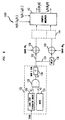
- a complex scrambling code sequence generation system 120 includes a code sequence, such as long code sequence generator 122, which generates a first component of a first complex code sequence, such as a long code sequence.
- the long code generator 122 includes a long code generator engine 126 which uses a 42-bit linear feedback shift register and a polynomial generator to produce a 42-bit code vector.
- the long code sequence is the inner product of a 42-bit user mask 124 and the 42-bit code vector from the long code generator engine 126.
- the long code generator 122 receives the current 42-bit state vector over the sync channel from the base station and loads the state vector into the shift register.
- Each user is assigned a unique 42-bit user mask 124, and the mask 124 is used select bits from the vector which are exclusive-ord (for example, using an AND arrangement 128 and a modulo 2 summer 130) to produce the long code sequence.
- the long code sequence is effectively time shifted a different amount for each user.
- the long code sequence is provided to an I path 132 and a Q path 134.
- a delay 136 delays the long code sequence on the path 134 to produce a Q component of a complex long code sequence (Q long code sequence) which is a second component of the first complex code sequence.
- the Q long code sequence is delayed with respect to the I component of the long code sequence (I long code sequence) on the I path 132.
- an I mixer 138 mixes or multiplies the I component of the long code sequence with a first component of a second complex code sequence, such as an I component of a short code sequence (I short code sequence), to produce the I component (I scrambling code sequence) of a complex scrambling code sequence.
- a Q mixer 140 mixes or multiplies the Q long code sequence with a second component of the complex short code sequence, such as a Q component of the short code sequence, to produce the Q component (Q scrambling code sequence) of the complex scrambling code sequence.
- a delay could be used on the I path 132 alone or delays on both I and Q paths 132 and 134 to provide a relative delay between the I and Q long code sequences. The delay between the I and Q long code sequences could be as small as one chip.
- the complex short code sequence (I and Q components) are distinct PN codes which are generated using two independent generator polynomials of degree 15 as described in IS-95B and 15-bit linear feedback shift registers similar to those described in FIG. 4.
- Alternative techniques for generating the complex short and complex long codes are possible.
- the complex short PN code components are chip synchronous, but otherwise independent of each other.
- the complex scrambling code sequence is processed using a processing block 144 to alter the complex scrambling code sequence before performing a mixing or complex multiplication 142 with the data streams D i (t) and D q (t) in order to improve the peak power to average power ratio of the transmission.
- the modulation scheme is effectively changed.
- the processing block 144 could decimate the Q scrambling code by a factor of 2 and then multiply the resulting sequence by a repeating cover sequence of -1 and 1 and the I scrambling code sequence.
- the resulting Q scrambling code sequence produced from the processing block 144 would be used in the complex multiplication of the complex scrambling code and the data streams D i (t) and D q (t).
- the complex scrambling code would exhibit phase transitions which could reduce the peak to average power ratio.
- the complex scrambling chip will be one of four quadrature phase shift keying (QPSK) symbols.
- QPSK quadrature phase shift keying
- the complex scrambling code is limited to s +/- 90 degree phase shift from the previous complex scrambling chip.
- the complex scrambling code sequence can be generated using a hybrid phase shift keying approach which is a hybrid combination of QPSK and binary phase shift keying (BPSK).
- BPSK binary phase shift keying
- the processing block 144 could alter both the I scrambling code sequence and/or the Q scrambling code sequence in different ways to effectively alter the modulation scheme or provide other desired operational characteristics.
- the processing block 144 would not be performed and the complex scrambling code is directly provided to the complex multiplier 142.
- the I scrambling code sequence and the Q scrambling code sequence are used in the complex multiplication by the complex multiplier 142.
- the complex multiplier 142 performs a complex multiplication on the I and Q data streams D i (t) and D q (t) using the complex scrambling code sequence to provide the I and Q spread spectrum signals y i (t) and y q (t) which are modulated and transmitted to the base station after being added together.
- the ""' after Q scrambling code sequence denotes that the Q scrambling code sequence in this embodiment has been altered by the processing block 144. Other embodiments are possible.
- the scrambling code sequence generation system can be performed in a system where the complex multiplier 142 is simply a multiplication performed on the I path 132 between the data stream D i (t) and the I scrambling code sequence and a multiplication on the Q path 134 between the Q scrambling code sequence and the data stream D q (t).
- the multiplication between with the data streams can occur at other locations, such as after the generation of the complex long code sequence.
- the D i (t) and D q (t) information signals are different, but alternative embodiments could have D i (t) equal to D q (t).
- the system can be backward compatible with the TIA/EIA-95-B standard.
- the system reduces the self-interference problem because the relative time offset between the user's I and Q scrambling codes will be sufficiently large (> than one period of the short code generators) due to the existence of the complex short code.
- the mutual interference problem is reduced because the I and Q scrambling code sequences are unique among users, and one user's I code will be un-correlated with another user's Q code due to the use of different user masks and the different I and Q components of the complex short code sequence.
- alternative configurations of the scrambling code sequence generation system are possible according to the principles of the present invention which omit and/or add components and/or use variations or portions of the described scrambling code generation system.
- the above described embodiment is described as using a 42-bit user mask, 42-bit code vector and 15-bit short code sequences, but alternative mask, code vector, and code sequences are possible.
- the code sequences are described as long and short, but alternative embodiments could produce the complex scrambling code using first and second complex code sequences with different relative lengths or equal lengths.
- the complex scrambling code as well as the long and short code sequences are described in terms of two components (I and Q), but other embodiments can use additional components and/or different numbers of components which are combined in different fashions to enable various forms of modulation.
- the long code generator engine is described as receiving the current state vector on the sync channel from the base station, but alternative schemes are possible where the current state vector is received from different sources.
- the long code generator 122 is further described as using the code vector from the long code generator shift register to produce the long code sequence by taking an inner product using the AND gate arrangement 128 and modulo 2 summer 130 of the code vector 126 and the user mask 124. Alternative configurations are possible for generating the long code and short code sequences.
- the complex scrambling code sequence generation system can operate in various operating environments.
- the complex scrambling code sequence generation system has been described as operating in a transmit path of the reverse link (at the wireless unit) of a CDMA system.
- the complex scrambling code sequence generation system is also located at the receive path (base station) of the reverse link.
- the complex scrambling code is used in performing a de-spreading and/or de-scrambling of the spread spectrum signals as would be understood by one of skill in the art with the benefit of this disclosure.
- the complex scrambling code sequence generation system 120 provides the complex scrambling code sequence, and a corresponding complex multiplier 142 performs a complex multiplication between the conjugates of the components of the complex scrambling code sequence and the I and Q spread spectrum signals to produce the I and Q data signals Di and Dq (shown in parenthesis) as would be understood by one of skill in the art.
- certain embodiments of the complex scrambling code generation system can be used on a transmit path (base station) and a receive path (wireless unit) on the forward link of a wireless communications system.
- the complex scrambling code sequence generator has been described as generating I and Q scrambling code sequences which are then mixed with the data signals Di(t) and Dq(t).
- the first complex code sequence, the second complex code sequence and the data signals Di(t) and Dq(t) can be mixed together in different ways.
- the multiplier 142 is simply two multipliers (one on each of the I and Q paths)
- the data signals Di(t) and Dq(t) could be multiplied with the I and Q short code sequences respectively, then the corresponding components of the resulting sequence would be multiplied with the corresponding components of the complex long code sequence.
- the complex scrambling code sequence generation system has been described using a particular configuration of distinct components, but it should be understood that the scrambling code generation system and portions thereof can be implemented in application specific integrated circuits, software-driven processing circuitry, firmware or other arrangements of discrete components as would be understood by one of ordinary skill in the art with the benefit of this disclosure. Although in the illustrative embodiment is shown with a particular circuitry, the system can use different components which together perform similar functions when compared to the circuitry shown. What has been described is merely illustrative of the application of the principles of the present invention. Those skilled in the art will readily recognize that these and various other modifications, arrangements and methods can be made to the present invention without strictly following the exemplary applications illustrated and described herein and without departing from the spirit and scope of the present invention.
Landscapes
- Engineering & Computer Science (AREA)
- Computer Networks & Wireless Communication (AREA)
- Signal Processing (AREA)
- Mobile Radio Communication Systems (AREA)
- Error Detection And Correction (AREA)
- Two-Way Televisions, Distribution Of Moving Picture Or The Like (AREA)
- Compression, Expansion, Code Conversion, And Decoders (AREA)
- Radar Systems Or Details Thereof (AREA)
- Analysing Materials By The Use Of Radiation (AREA)
- Diaphragms For Electromechanical Transducers (AREA)
Applications Claiming Priority (2)
| Application Number | Priority Date | Filing Date | Title |
|---|---|---|---|
| US190195 | 1998-11-12 | ||
| US09/190,195 US6389138B1 (en) | 1998-11-12 | 1998-11-12 | Method and apparatus for generating a complex scrambling code sequence |
Publications (3)
| Publication Number | Publication Date |
|---|---|
| EP1001568A2 true EP1001568A2 (de) | 2000-05-17 |
| EP1001568A3 EP1001568A3 (de) | 2001-01-10 |
| EP1001568B1 EP1001568B1 (de) | 2002-06-19 |
Family
ID=22700379
Family Applications (1)
| Application Number | Title | Priority Date | Filing Date |
|---|---|---|---|
| EP99308692A Expired - Lifetime EP1001568B1 (de) | 1998-11-12 | 1999-11-02 | Verfahren und Vorrichtung zur Erzeugung komplexer Verschlüsselungskodesequenzen |
Country Status (12)
| Country | Link |
|---|---|
| US (1) | US6389138B1 (de) |
| EP (1) | EP1001568B1 (de) |
| JP (1) | JP3559738B2 (de) |
| KR (1) | KR100669832B1 (de) |
| CN (1) | CN1115896C (de) |
| AT (1) | ATE219613T1 (de) |
| AU (1) | AU764690B2 (de) |
| BR (1) | BR9906122A (de) |
| CA (1) | CA2284330C (de) |
| DE (1) | DE69901870T2 (de) |
| ES (1) | ES2178868T3 (de) |
| ID (1) | ID23828A (de) |
Cited By (1)
| Publication number | Priority date | Publication date | Assignee | Title |
|---|---|---|---|---|
| KR100374354B1 (ko) * | 1999-07-07 | 2003-03-04 | 삼성전자주식회사 | 이동통신시스템의 스크램블링 코드 생성 장치 및 방법 |
Families Citing this family (42)
| Publication number | Priority date | Publication date | Assignee | Title |
|---|---|---|---|---|
| US6788728B1 (en) * | 1999-01-12 | 2004-09-07 | Sony Corporation | System and method for reducing peak-to-average ratio of the reverse link modulator in a CDMA phone system |
| US6680978B1 (en) * | 1999-03-01 | 2004-01-20 | Adtran, Inc. | Method and apparatus for nonlinear filtering and controlling the peak-to-average ratio |
| US6597911B1 (en) * | 1999-05-28 | 2003-07-22 | Ericsson Inc. | System, method, and apparatus for cell searching in a next generation overlay of a preexisting network |
| KR100434262B1 (ko) * | 1999-08-17 | 2004-06-04 | 엘지전자 주식회사 | 순방향 다중 스크램블링 코드 발생 방법 |
| KR100594042B1 (ko) * | 1999-09-22 | 2006-06-28 | 삼성전자주식회사 | 비동기 이동통신시스템의 멀티 스크램블링 코드 생성 장치 및 방법 |
| US6643280B1 (en) * | 1999-10-27 | 2003-11-04 | Lucent Technologies Inc. | Method and apparatus for generation of CDMA long codes |
| JP3769432B2 (ja) * | 1999-11-01 | 2006-04-26 | 日本電気株式会社 | 符号分割多重セルラにおける拡散符号割り当て方法及び基地局 |
| US6961369B1 (en) | 1999-11-09 | 2005-11-01 | Aware, Inc. | System and method for scrambling the phase of the carriers in a multicarrier communications system |
| US6724778B1 (en) * | 2000-03-16 | 2004-04-20 | Motorola, Inc. | Method and apparatus for long code generation in synchronous, multi-chip rate systems |
| US6975584B1 (en) * | 2000-09-29 | 2005-12-13 | Qualcomm, Incorporated | Communication system method and apparatus |
| AUPR206300A0 (en) * | 2000-12-13 | 2001-01-11 | Advanced Communications Technologies (Australia) Pty Ltd | A method for quadrature spreading |
| US7558310B1 (en) | 2001-01-09 | 2009-07-07 | Urbain Alfred von der Embse | Multi-scale code division frequency/wavelet multiple access |
| US7277382B1 (en) * | 2001-01-09 | 2007-10-02 | Urbain A. von der Embse | Hybrid walsh encoder and decoder for CDMA |
| US7394792B1 (en) | 2002-10-08 | 2008-07-01 | Urbain A. von der Embse | Multi-scale CDMA |
| US7352796B1 (en) * | 2001-02-13 | 2008-04-01 | Urbain Alfred von der Embse | Multiple data rate complex Walsh codes for CDMA |
| KR100401801B1 (ko) * | 2001-03-27 | 2003-10-17 | (주)텔레시스테크놀로지 | 데이터 전송 성능을 개선하기 위한 직교주파수 분할 다중통신 시스템 및 방법 |
| US7068701B2 (en) * | 2001-04-16 | 2006-06-27 | Motorola, Inc. | Data transmission and reception within a spread-spectrum communication system |
| KR100424538B1 (ko) * | 2001-05-29 | 2004-03-27 | 엘지전자 주식회사 | 이동통신시스템에서의 스크램블링 코드 생성 장치 및 방법 |
| US6973579B2 (en) | 2002-05-07 | 2005-12-06 | Interdigital Technology Corporation | Generation of user equipment identification specific scrambling code for the high speed shared control channel |
| US7173900B1 (en) * | 2002-06-26 | 2007-02-06 | Nortel Networks Limited | Method and apparatus for chip generation of a chip sequence |
| US6917641B2 (en) * | 2002-07-23 | 2005-07-12 | Motorola, Inc. | Method and apparatus for detecting software tampering in a subscriber device |
| US7697413B2 (en) * | 2003-04-28 | 2010-04-13 | Alcatel-Lucent Usa Inc. | Method for generating a code mask for coding transmission over a traffic channel |
| US9094144B2 (en) * | 2004-04-29 | 2015-07-28 | Alcatel Lucent | Methods and apparatus for code division multiple access communication using code book that provides reduced peak-to-average power ratio |
| US8213611B2 (en) * | 2004-11-03 | 2012-07-03 | Broadcom Corporation | Two-stage block synchronization and scrambling |
| US7443819B2 (en) * | 2005-03-23 | 2008-10-28 | Lucent Technologies Inc. | Managing scrambling codes during serving radio network subsystem relocation |
| CN1870484B (zh) * | 2005-05-25 | 2010-04-28 | 上海原动力通信科技有限公司 | 蜂窝移动通信系统中用于区分不同码道的复合码生成方法 |
| US20090129448A1 (en) * | 2006-02-15 | 2009-05-21 | Joshua Lawrence Koslov | Apparatus and Method For Generating Scrambling Codes |
| US7715563B2 (en) * | 2006-02-16 | 2010-05-11 | General Dynamics C4 Systems, Inc. | Rapid acquisition of state vectors in an encrypted data communication system |
| US7930623B2 (en) * | 2006-03-07 | 2011-04-19 | Samsung Electronics Co., Ltd. | Method and system for generating parallel codes |
| US9792246B2 (en) * | 2014-12-27 | 2017-10-17 | Intel Corporation | Lower-power scrambling with improved signal integrity |
| US10020839B2 (en) * | 2016-11-14 | 2018-07-10 | Rampart Communications, LLC | Reliable orthogonal spreading codes in wireless communications |
| US10873361B2 (en) | 2019-05-17 | 2020-12-22 | Rampart Communications, Inc. | Communication system and methods using multiple-in-multiple-out (MIMO) antennas within unitary braid divisional multiplexing (UBDM) |
| US10917148B2 (en) | 2019-07-01 | 2021-02-09 | Rampart Communications, Inc. | Systems, methods and apparatus for secure and efficient wireless communication of signals using a generalized approach within unitary braid division multiplexing |
| US11025470B2 (en) | 2019-07-01 | 2021-06-01 | Rampart Communications, Inc. | Communication system and method using orthogonal frequency division multiplexing (OFDM) with non-linear transformation |
| US11641269B2 (en) | 2020-06-30 | 2023-05-02 | Rampart Communications, Inc. | Modulation-agnostic transformations using unitary braid divisional multiplexing (UBDM) |
| US10833749B1 (en) | 2019-07-01 | 2020-11-10 | Rampart Communications, Inc. | Communication system and method using layered construction of arbitrary unitary matrices |
| US11050604B2 (en) | 2019-07-01 | 2021-06-29 | Rampart Communications, Inc. | Systems, methods and apparatuses for modulation-agnostic unitary braid division multiplexing signal transformation |
| US10951442B2 (en) | 2019-07-31 | 2021-03-16 | Rampart Communications, Inc. | Communication system and method using unitary braid divisional multiplexing (UBDM) with physical layer security |
| US10735062B1 (en) | 2019-09-04 | 2020-08-04 | Rampart Communications, Inc. | Communication system and method for achieving high data rates using modified nearly-equiangular tight frame (NETF) matrices |
| US10965352B1 (en) | 2019-09-24 | 2021-03-30 | Rampart Communications, Inc. | Communication system and methods using very large multiple-in multiple-out (MIMO) antenna systems with extremely large class of fast unitary transformations |
| KR102243889B1 (ko) * | 2019-12-13 | 2021-04-23 | 국방과학연구소 | 데이터 복호화 장치 및 방법 |
| US11159220B2 (en) | 2020-02-11 | 2021-10-26 | Rampart Communications, Inc. | Single input single output (SISO) physical layer key exchange |
Family Cites Families (6)
| Publication number | Priority date | Publication date | Assignee | Title |
|---|---|---|---|---|
| US414728A (en) * | 1889-11-12 | Can-soldering machine | ||
| US5103459B1 (en) * | 1990-06-25 | 1999-07-06 | Qualcomm Inc | System and method for generating signal waveforms in a cdma cellular telephone system |
| US5414728A (en) | 1993-11-01 | 1995-05-09 | Qualcomm Incorporated | Method and apparatus for bifurcating signal transmission over in-phase and quadrature phase spread spectrum communication channels |
| US5497395A (en) * | 1994-04-04 | 1996-03-05 | Qualcomm Incorporated | Method and apparatus for modulating signal waveforms in a CDMA communication system |
| KR970002951B1 (ko) | 1994-04-13 | 1997-03-13 | 양승택 | 2^n길이 의사 난수 계열 발생 장치 |
| US6222828B1 (en) * | 1996-10-30 | 2001-04-24 | Trw, Inc. | Orthogonal code division multiple access waveform format for use in satellite based cellular telecommunications |
-
1998
- 1998-11-12 US US09/190,195 patent/US6389138B1/en not_active Expired - Lifetime
-
1999
- 1999-09-29 CA CA002284330A patent/CA2284330C/en not_active Expired - Fee Related
- 1999-11-02 AT AT99308692T patent/ATE219613T1/de not_active IP Right Cessation
- 1999-11-02 DE DE69901870T patent/DE69901870T2/de not_active Expired - Lifetime
- 1999-11-02 ES ES99308692T patent/ES2178868T3/es not_active Expired - Lifetime
- 1999-11-02 EP EP99308692A patent/EP1001568B1/de not_active Expired - Lifetime
- 1999-11-05 BR BR9906122-8A patent/BR9906122A/pt not_active Application Discontinuation
- 1999-11-05 AU AU58302/99A patent/AU764690B2/en not_active Ceased
- 1999-11-11 ID IDP991041A patent/ID23828A/id unknown
- 1999-11-11 CN CN99123466A patent/CN1115896C/zh not_active Expired - Fee Related
- 1999-11-12 JP JP32193399A patent/JP3559738B2/ja not_active Expired - Fee Related
- 1999-11-12 KR KR1019990050144A patent/KR100669832B1/ko not_active Expired - Fee Related
Cited By (1)
| Publication number | Priority date | Publication date | Assignee | Title |
|---|---|---|---|---|
| KR100374354B1 (ko) * | 1999-07-07 | 2003-03-04 | 삼성전자주식회사 | 이동통신시스템의 스크램블링 코드 생성 장치 및 방법 |
Also Published As
| Publication number | Publication date |
|---|---|
| DE69901870T2 (de) | 2003-01-09 |
| ES2178868T3 (es) | 2003-01-01 |
| ID23828A (id) | 2000-05-17 |
| JP3559738B2 (ja) | 2004-09-02 |
| DE69901870D1 (de) | 2002-07-25 |
| ATE219613T1 (de) | 2002-07-15 |
| US6389138B1 (en) | 2002-05-14 |
| CN1256598A (zh) | 2000-06-14 |
| EP1001568B1 (de) | 2002-06-19 |
| CN1115896C (zh) | 2003-07-23 |
| BR9906122A (pt) | 2000-09-19 |
| EP1001568A3 (de) | 2001-01-10 |
| KR100669832B1 (ko) | 2007-01-18 |
| AU5830299A (en) | 2000-05-18 |
| JP2000188590A (ja) | 2000-07-04 |
| AU764690B2 (en) | 2003-08-28 |
| KR20000047627A (ko) | 2000-07-25 |
| CA2284330A1 (en) | 2000-05-12 |
| CA2284330C (en) | 2003-03-18 |
Similar Documents
| Publication | Publication Date | Title |
|---|---|---|
| US6389138B1 (en) | Method and apparatus for generating a complex scrambling code sequence | |
| CA2175488C (en) | Method and apparatus for bifurcating signal transmission over in-phase and quadrature phase spread spectrum communication channels | |
| JP4456171B2 (ja) | 複数低データレートチャンネルでの高データレートによるデータ転送方法及び装置 | |
| US6490267B1 (en) | Device and method for generating spreading code and spreading channel signals using spreading code in a CDMA communication system | |
| EP1147618B1 (de) | Verfahren und vorrichtung zur verminderung der maximalen zur mittleren leistung in einer cdma kommunikationsanordnung | |
| JP2004120782A (ja) | Cdmaシステムにおけるパイロット信号および不要トラヒック信号の消去 | |
| KR20010064686A (ko) | 대역 확산 통신 방식에서의 확산 변조 방식을 이용한송수신방식 및 송수신장치 | |
| JP2002534837A (ja) | 移動通信システムのチャネル拡散装置及び方法 | |
| US20030128787A1 (en) | Method and apparatus for mitigating interference between base stations in a wideband CDMA system | |
| JP4589441B2 (ja) | マルチチャンネルリンクの縮小された最大・平均振幅 | |
| HK1099139B (en) | Reduced peak-to-average amplitude multichannel | |
| HK1028303B (en) | Reduced peak-to-average amplitude multichannel link | |
| HK1104155A (en) | Reduced peak-to-average amplitude multichannel link | |
| HK1144339A (en) | Reduced peak to average amplitude multichannel link |
Legal Events
| Date | Code | Title | Description |
|---|---|---|---|
| PUAI | Public reference made under article 153(3) epc to a published international application that has entered the european phase |
Free format text: ORIGINAL CODE: 0009012 |
|
| 17P | Request for examination filed |
Effective date: 19991115 |
|
| AK | Designated contracting states |
Kind code of ref document: A2 Designated state(s): AT BE CH CY DE DK ES FI FR GB GR IE IT LI LU MC NL PT SE |
|
| AX | Request for extension of the european patent |
Free format text: AL;LT;LV;MK;RO;SI |
|
| PUAL | Search report despatched |
Free format text: ORIGINAL CODE: 0009013 |
|
| AK | Designated contracting states |
Kind code of ref document: A3 Designated state(s): AT BE CH CY DE DK ES FI FR GB GR IE IT LI LU MC NL PT SE |
|
| AX | Request for extension of the european patent |
Free format text: AL;LT;LV;MK;RO;SI |
|
| RIC1 | Information provided on ipc code assigned before grant |
Free format text: 7H 04J 13/00 A, 7H 03K 3/84 B, 7H 04B 7/26 B |
|
| 17Q | First examination report despatched |
Effective date: 20010129 |
|
| GRAG | Despatch of communication of intention to grant |
Free format text: ORIGINAL CODE: EPIDOS AGRA |
|
| AKX | Designation fees paid |
Free format text: AT BE CH CY DE DK ES FI FR GB GR IE IT LI LU MC NL PT SE |
|
| GRAG | Despatch of communication of intention to grant |
Free format text: ORIGINAL CODE: EPIDOS AGRA |
|
| GRAG | Despatch of communication of intention to grant |
Free format text: ORIGINAL CODE: EPIDOS AGRA |
|
| GRAH | Despatch of communication of intention to grant a patent |
Free format text: ORIGINAL CODE: EPIDOS IGRA |
|
| GRAH | Despatch of communication of intention to grant a patent |
Free format text: ORIGINAL CODE: EPIDOS IGRA |
|
| GRAA | (expected) grant |
Free format text: ORIGINAL CODE: 0009210 |
|
| AK | Designated contracting states |
Kind code of ref document: B1 Designated state(s): AT BE CH CY DE DK ES FI FR GB GR IE IT LI LU MC NL PT SE |
|
| PG25 | Lapsed in a contracting state [announced via postgrant information from national office to epo] |
Ref country code: NL Free format text: LAPSE BECAUSE OF FAILURE TO SUBMIT A TRANSLATION OF THE DESCRIPTION OR TO PAY THE FEE WITHIN THE PRESCRIBED TIME-LIMIT Effective date: 20020619 Ref country code: LI Free format text: LAPSE BECAUSE OF FAILURE TO SUBMIT A TRANSLATION OF THE DESCRIPTION OR TO PAY THE FEE WITHIN THE PRESCRIBED TIME-LIMIT Effective date: 20020619 Ref country code: GR Free format text: LAPSE BECAUSE OF FAILURE TO SUBMIT A TRANSLATION OF THE DESCRIPTION OR TO PAY THE FEE WITHIN THE PRESCRIBED TIME-LIMIT Effective date: 20020619 Ref country code: CH Free format text: LAPSE BECAUSE OF FAILURE TO SUBMIT A TRANSLATION OF THE DESCRIPTION OR TO PAY THE FEE WITHIN THE PRESCRIBED TIME-LIMIT Effective date: 20020619 Ref country code: BE Free format text: LAPSE BECAUSE OF FAILURE TO SUBMIT A TRANSLATION OF THE DESCRIPTION OR TO PAY THE FEE WITHIN THE PRESCRIBED TIME-LIMIT Effective date: 20020619 Ref country code: AT Free format text: LAPSE BECAUSE OF FAILURE TO SUBMIT A TRANSLATION OF THE DESCRIPTION OR TO PAY THE FEE WITHIN THE PRESCRIBED TIME-LIMIT Effective date: 20020619 |
|
| REF | Corresponds to: |
Ref document number: 219613 Country of ref document: AT Date of ref document: 20020715 Kind code of ref document: T |
|
| REG | Reference to a national code |
Ref country code: GB Ref legal event code: FG4D |
|
| REG | Reference to a national code |
Ref country code: CH Ref legal event code: EP |
|
| REG | Reference to a national code |
Ref country code: IE Ref legal event code: FG4D |
|
| REF | Corresponds to: |
Ref document number: 69901870 Country of ref document: DE Date of ref document: 20020725 |
|
| PG25 | Lapsed in a contracting state [announced via postgrant information from national office to epo] |
Ref country code: DK Free format text: LAPSE BECAUSE OF FAILURE TO SUBMIT A TRANSLATION OF THE DESCRIPTION OR TO PAY THE FEE WITHIN THE PRESCRIBED TIME-LIMIT Effective date: 20020919 |
|
| PG25 | Lapsed in a contracting state [announced via postgrant information from national office to epo] |
Ref country code: PT Free format text: LAPSE BECAUSE OF FAILURE TO SUBMIT A TRANSLATION OF THE DESCRIPTION OR TO PAY THE FEE WITHIN THE PRESCRIBED TIME-LIMIT Effective date: 20020923 |
|
| ET | Fr: translation filed | ||
| PG25 | Lapsed in a contracting state [announced via postgrant information from national office to epo] |
Ref country code: LU Free format text: LAPSE BECAUSE OF NON-PAYMENT OF DUE FEES Effective date: 20021102 |
|
| PG25 | Lapsed in a contracting state [announced via postgrant information from national office to epo] |
Ref country code: IE Free format text: LAPSE BECAUSE OF NON-PAYMENT OF DUE FEES Effective date: 20021104 |
|
| PG25 | Lapsed in a contracting state [announced via postgrant information from national office to epo] |
Ref country code: CY Free format text: LAPSE BECAUSE OF FAILURE TO SUBMIT A TRANSLATION OF THE DESCRIPTION OR TO PAY THE FEE WITHIN THE PRESCRIBED TIME-LIMIT Effective date: 20021130 |
|
| NLV1 | Nl: lapsed or annulled due to failure to fulfill the requirements of art. 29p and 29m of the patents act | ||
| REG | Reference to a national code |
Ref country code: CH Ref legal event code: PL |
|
| REG | Reference to a national code |
Ref country code: ES Ref legal event code: FG2A Ref document number: 2178868 Country of ref document: ES Kind code of ref document: T3 |
|
| PLBE | No opposition filed within time limit |
Free format text: ORIGINAL CODE: 0009261 |
|
| STAA | Information on the status of an ep patent application or granted ep patent |
Free format text: STATUS: NO OPPOSITION FILED WITHIN TIME LIMIT |
|
| PG25 | Lapsed in a contracting state [announced via postgrant information from national office to epo] |
Ref country code: MC Free format text: LAPSE BECAUSE OF NON-PAYMENT OF DUE FEES Effective date: 20030601 |
|
| 26N | No opposition filed |
Effective date: 20030320 |
|
| REG | Reference to a national code |
Ref country code: IE Ref legal event code: MM4A |
|
| REG | Reference to a national code |
Ref country code: GB Ref legal event code: 732E Free format text: REGISTERED BETWEEN 20131121 AND 20131127 |
|
| REG | Reference to a national code |
Ref country code: FR Ref legal event code: CD Owner name: ALCATEL-LUCENT USA INC. Effective date: 20131122 |
|
| REG | Reference to a national code |
Ref country code: FR Ref legal event code: GC Effective date: 20140410 |
|
| REG | Reference to a national code |
Ref country code: FR Ref legal event code: RG Effective date: 20141015 |
|
| REG | Reference to a national code |
Ref country code: FR Ref legal event code: PLFP Year of fee payment: 17 |
|
| PGFP | Annual fee paid to national office [announced via postgrant information from national office to epo] |
Ref country code: FI Payment date: 20151111 Year of fee payment: 17 Ref country code: DE Payment date: 20151119 Year of fee payment: 17 Ref country code: GB Payment date: 20151118 Year of fee payment: 17 Ref country code: IT Payment date: 20151125 Year of fee payment: 17 |
|
| PGFP | Annual fee paid to national office [announced via postgrant information from national office to epo] |
Ref country code: ES Payment date: 20151111 Year of fee payment: 17 Ref country code: SE Payment date: 20151118 Year of fee payment: 17 Ref country code: FR Payment date: 20151119 Year of fee payment: 17 |
|
| REG | Reference to a national code |
Ref country code: DE Ref legal event code: R119 Ref document number: 69901870 Country of ref document: DE |
|
| REG | Reference to a national code |
Ref country code: SE Ref legal event code: EUG |
|
| GBPC | Gb: european patent ceased through non-payment of renewal fee |
Effective date: 20161102 |
|
| PG25 | Lapsed in a contracting state [announced via postgrant information from national office to epo] |
Ref country code: FI Free format text: LAPSE BECAUSE OF NON-PAYMENT OF DUE FEES Effective date: 20161102 |
|
| REG | Reference to a national code |
Ref country code: FR Ref legal event code: ST Effective date: 20170731 |
|
| PG25 | Lapsed in a contracting state [announced via postgrant information from national office to epo] |
Ref country code: SE Free format text: LAPSE BECAUSE OF NON-PAYMENT OF DUE FEES Effective date: 20161103 |
|
| PG25 | Lapsed in a contracting state [announced via postgrant information from national office to epo] |
Ref country code: IT Free format text: LAPSE BECAUSE OF NON-PAYMENT OF DUE FEES Effective date: 20161102 Ref country code: FR Free format text: LAPSE BECAUSE OF NON-PAYMENT OF DUE FEES Effective date: 20161130 |
|
| PG25 | Lapsed in a contracting state [announced via postgrant information from national office to epo] |
Ref country code: DE Free format text: LAPSE BECAUSE OF NON-PAYMENT OF DUE FEES Effective date: 20170601 Ref country code: GB Free format text: LAPSE BECAUSE OF NON-PAYMENT OF DUE FEES Effective date: 20161102 |
|
| PG25 | Lapsed in a contracting state [announced via postgrant information from national office to epo] |
Ref country code: ES Free format text: LAPSE BECAUSE OF FAILURE TO SUBMIT A TRANSLATION OF THE DESCRIPTION OR TO PAY THE FEE WITHIN THE PRESCRIBED TIME-LIMIT Effective date: 20020619 |
|
| REG | Reference to a national code |
Ref country code: ES Ref legal event code: FD2A Effective date: 20180626 |
|
| PG25 | Lapsed in a contracting state [announced via postgrant information from national office to epo] |
Ref country code: ES Free format text: LAPSE BECAUSE OF FAILURE TO SUBMIT A TRANSLATION OF THE DESCRIPTION OR TO PAY THE FEE WITHIN THE PRESCRIBED TIME-LIMIT Effective date: 20161103 |
|
| RIC2 | Information provided on ipc code assigned after grant |
Ipc: H04J 13/00 20110101AFI20000210BHEP Ipc: H04B 7/26 20060101ALI20001123BHEP Ipc: H03K 3/84 20060101ALI20001123BHEP |