EP1001609A2 - Système et procédé de traitement de signal - Google Patents
Système et procédé de traitement de signal Download PDFInfo
- Publication number
- EP1001609A2 EP1001609A2 EP99308885A EP99308885A EP1001609A2 EP 1001609 A2 EP1001609 A2 EP 1001609A2 EP 99308885 A EP99308885 A EP 99308885A EP 99308885 A EP99308885 A EP 99308885A EP 1001609 A2 EP1001609 A2 EP 1001609A2
- Authority
- EP
- European Patent Office
- Prior art keywords
- moiré
- color
- separations
- image
- amplitude
- Prior art date
- Legal status (The legal status is an assumption and is not a legal conclusion. Google has not performed a legal analysis and makes no representation as to the accuracy of the status listed.)
- Granted
Links
- 238000000034 method Methods 0.000 title claims abstract description 40
- 238000012545 processing Methods 0.000 title claims abstract description 14
- 238000000926 separation method Methods 0.000 claims abstract description 73
- 239000003086 colorant Substances 0.000 abstract description 26
- 230000008569 process Effects 0.000 abstract description 18
- 230000000116 mitigating effect Effects 0.000 abstract description 10
- 230000009467 reduction Effects 0.000 abstract description 3
- 230000000737 periodic effect Effects 0.000 description 8
- 230000008859 change Effects 0.000 description 5
- 238000012512 characterization method Methods 0.000 description 5
- 230000001419 dependent effect Effects 0.000 description 5
- 238000006243 chemical reaction Methods 0.000 description 4
- 238000012937 correction Methods 0.000 description 4
- 239000011159 matrix material Substances 0.000 description 4
- 230000009466 transformation Effects 0.000 description 3
- 238000013459 approach Methods 0.000 description 2
- 238000004364 calculation method Methods 0.000 description 2
- 238000009795 derivation Methods 0.000 description 2
- 238000006073 displacement reaction Methods 0.000 description 2
- 230000000694 effects Effects 0.000 description 2
- 238000005259 measurement Methods 0.000 description 2
- 238000002156 mixing Methods 0.000 description 2
- 230000004044 response Effects 0.000 description 2
- 238000012216 screening Methods 0.000 description 2
- 230000003595 spectral effect Effects 0.000 description 2
- 238000000844 transformation Methods 0.000 description 2
- 238000002834 transmittance Methods 0.000 description 2
- 238000002835 absorbance Methods 0.000 description 1
- 238000010521 absorption reaction Methods 0.000 description 1
- 238000004422 calculation algorithm Methods 0.000 description 1
- 238000004042 decolorization Methods 0.000 description 1
- 230000003247 decreasing effect Effects 0.000 description 1
- 230000001747 exhibiting effect Effects 0.000 description 1
- 239000000976 ink Substances 0.000 description 1
- 230000003993 interaction Effects 0.000 description 1
- 239000000463 material Substances 0.000 description 1
- 230000007935 neutral effect Effects 0.000 description 1
- 238000000059 patterning Methods 0.000 description 1
- 230000002250 progressing effect Effects 0.000 description 1
- 238000009877 rendering Methods 0.000 description 1
- 230000003252 repetitive effect Effects 0.000 description 1
- 238000010561 standard procedure Methods 0.000 description 1
- 230000007704 transition Effects 0.000 description 1
- 230000000007 visual effect Effects 0.000 description 1
- 239000001060 yellow colorant Substances 0.000 description 1
Images




Classifications
-
- H—ELECTRICITY
- H04—ELECTRIC COMMUNICATION TECHNIQUE
- H04N—PICTORIAL COMMUNICATION, e.g. TELEVISION
- H04N1/00—Scanning, transmission or reproduction of documents or the like, e.g. facsimile transmission; Details thereof
- H04N1/46—Colour picture communication systems
- H04N1/52—Circuits or arrangements for halftone screening
Definitions
- This invention relates to a processing system and method for the reduction of moiré in multiseparation images.
- Color in documents is the result of a combination of a limited set of colorants over a small area, in amounts selected to integrate to a desired color response. This is accomplished in many printing devices by reproducing separations of the image, where each separation provides varying amounts of a single primary colorant. When combined together with other separations, the result is a full color image.
- Each color separation corresponds to a single colorant, and may be defined by a number of gray levels in excess of the capability of the printer. In such cases, each of the color separations is reduced from the input number of levels to the smaller output number of levels reproducible by the printer.
- the multiple color separations are combined together at printing to yield the final color print. Commonly, color documents are formed using cyan, magenta and yellow colorants or cyan, magenta, yellow and black colorants. A larger number or alternative colorants may also be used.
- the desired gray level over an area is commonly achieved by halftoning, where image gray level variation is represented by placing greater or lesser numbers of ON pixels in a discrete area of the image.
- image gray level variation is represented by placing greater or lesser numbers of ON pixels in a discrete area of the image.
- dithering or screening over a given area having a number of gray separation pixels therein, a value representing the gray level of each separation pixel of an array of gray separation pixels within the area is compared to one of a set of preselected thresholds (the thresholds are stored as a dither matrix and the repetitive pattern generated by this matrix is considered a halftone cell) as taught, for example, in US-A 4,149,194 to Holladay.
- the image pixels or cell elements for which the thresholds are exceeded might be printed as a maximum colorant value, while the remaining separation pixels are allowed to remain white, dependent on the actual physical quantity described by the data.
- the described halftoning method produces an output pattern that is periodic or quasi-periodic in the spatial coordinates.
- Halftoning creates problems in color document reproduction where the repeating pattern of a screen through the image, when superposed over similar repeating patterns in multiple separations, can cause moiré or other artifacts, particularly in printing systems with less than ideal registration between separations.
- the artifacts caused by misregistration can be understood from simple examples. Assume for simplicity two separations having halftone screens with identical screen frequencies and angles. Printing those two separations on top one another in perfect registration will give a homogeneous color without periodic artifacts. If the second screen is spatially shifted with respect to the first screen, a strong shift in the output color will occur. Printing systems that are likely to have such a spatial displacement between the separations due to physical limitations are prone to color shift artifacts in the final prints.
- a different type of artifact occurs if the printing system is likely to have a slight rotation between separations. In these instances, a color moiré is formed, spatially progressing from one color to another.
- a color moiré is formed, spatially progressing from one color to another.
- two separations having halftone screens having identical screen frequencies but different angles Printing those two separations on top of one another in perfect registration will give a homogeneous color and, depending on the angle between the two separations, a high or low frequency moiré. In situations where the angle is large (e.g.: 30°) a high frequency moiré occurs which is usually not distracting, and in cases where the angle is small (e.g.: 2°) a low frequency moiré occurs which is usually distracting.
- the color halftoning scheme using different angles for some or all of the color separations is common for applications that have slight misregistrations due to physical limitations. Accordingly, and with reference again to US-A 4,149,194 to Holladay, the angle of the screen can be changed to generate similar screen patterns which do not strongly beat visually against each other, with the result the objectionable moiré is reduced. Particularly critical are the angles between the most prominent colors, particularly cyan, magenta and black (if present) . A common arrangement of rotated screen angles is 0°, 15°, 45° and 75° for yellow, cyan, black and magenta, respectively, in which case all separations are commonly halftoned using the same screen frequency, sometimes with the exception of yellow. However, objectionable patternings still occur. In general it can be said that periodic halftone schemes suffer from a combination of color moiré and color shifts on misregistration, dependent on the actual scheme frequency, but is usually at a very objectionable low frequency.
- the input color is generally described as a 3 parameter quantity, e.g.: Xerox R,G,B as specified in the Xerox Color Encoding Standard, tristimulus values X,Y,Z, L*a*b*, scanner R,G,B etc.
- rendering of a 3-separation image with more than 3 colorants e.g. cyan (c), magenta (m), yellow (y), black (k)
- UCR undercolor removal
- GCR gray component replacement
- This process while most widely used for CMYK printing, can be generalized for an arbitrary choice and number (greater than 3) of colorants.
- Representing 3 input parameter quantities with e.g.: 4 output parameters, leaves one additional degree of freedom in selecting the 4 parameters.
- This patent describes a method to optimize the UCR/GCR process, and exploit the extra degree of freedom, to minimize moiré.
- moiré is caused by the unwanted absorption of the printing materials. With "perfect" inks, none of the described two or three color moirés would occur with the exception of the moirés formed through the k (black) separation. Looking at moiré more closely, as noted above, two basic types of color moiré influence print quality. The first type is the 2 color moiré commonly found between yellow and cyan or yellow and magenta, etc. The second, normally more disturbing, moiré is caused by the superposition of cyan, magenta, and black, or, in the case of more than 4 colorants, by the three dominant colorants present. For simplicity of the description and not for limiting the method, we will use the c,m,k case in the following.
- moiré is not only a function of the spectral absorptance of the colorants, but also a rather direct function of the area coverage of any halftone dot used in reproduction of the image.
- a simple 1-dimensional example can be used.
- GCR/UCR strategies are a function of the minimum component of the requested color and potentially the overall lightness of the color. Commonly this means that while GCR/UCR is performed for darker colors, the UCR is set to zero for light colors, and colors with high chroma.
- the moiré amplitude approximation is calculated in accordance with the function:
- I k is completely determined as soon as the separations c,m,y are pre-determined, but that different c,m,y,k separations can lead to the identical colorimetrically described color.
- the invention finds particularly advantageous use in a color-characterized printing system including black addition and undercolor removal, and for which a device characterization process generates a characterization table relating device independent colors to device dependent colors
- the characterization process includes a method of mitigating three color moiré, including: receiving and printing a set of characterization image signals in plural separations including black after black addition and undercolor removal; determining the presence of undesirable three color moiré in said printed calibration image signals; generating a moiré mitigation strategy, modifying the cyan, magenta, yellow, and black pixel values according to this strategy; and storing said strategy as part of a calibration table generated for said calibrated printing systems.
- Equation (3) is strongly influenced by the UCR/GCR (under color removal/gray component replacement) strategies that are employed.
- UCR/GCR under color removal/gray component replacement
- the k-component of many images, and consequently b k,n is usually generated "artificially" by color correction software as part of a black addition scheme to improve the aesthetic appearance of the image.
- Several distinct (c,m,y,k) quadruplets would result in identical colors.
- One trivial way to eliminate three component moiré would be to eliminate k, thereby setting b k,n to zero. This is equivalent to reproducing the image with a standard three color process.
- this method is undesirable since the color gamut of normal three color systems is far more restricted than the color gamut of 4 color systems.
- the Fourier coefficients b i,n are a function of the opening ratio, i.e.: the ratio of pixels in the ON state to pixels in the OFF state, of the halftone dot and consequently of the input level to the halftoning process.
- the Fourier coefficients for n>0 can be written as:
- Equation (4) describes the Fourier coefficients for an ideal, binary halftone. Any deviation from that ideal model can be easily included in the calculation by using the appropriate Fourier coefficients for the real transmittances.
- the moiré amplitude M is therefore directly dependent on the triplet ( I c , I m , I k ) of gray level inputs to the halftoner.
- Equation (6) A simple extension to two dimensions can be made as shown in Equation (6):
- gray image data may be characterized as image signals or pixels, each being defined at a single gray level or reflectance or the like in a set of 'c' gray levels, the number of members in the set of levels being larger than desired.
- Each pixel will be processed in the manner described herein below, to redefine each pixel in terms of a new, smaller set of 'd' levels.
- 'c' and 'd' are integer values representing pixel depth, or a number of signal levels at which the pixel may appear.
- One common case of this method includes the conversion of data from a relatively large set of gray levels to one of two legal or allowed binary levels for printing in a binary printer. If standard multiple separation screening or dithering processes are used, the image will thereafter have a frequency, and angle associated with it.
- a "pixel” refers to an image signal associated with a particular position in an image, having a gray level between a minimum and a maximum. Accordingly, pixels are defined by gray level and position.
- “Gray”, as used herein does not refer to a color unless specifically identified as such. Rather, the term refers to image signals that vary between maximum and minimum, irrespective of the color of the separation in which the signals are used.
- color documents are represented by multiple sets of image signals (bitmaps), each set (or separation) represented by an independent channel, which is usually processed independently.
- a "color image” is therefore a document including at least two separations, such as in the Xerox 4850 Highlight Color Printer and commonly three or four separations, such as in the Xerox 4900 Color Laser or sometimes more than four separations.
- One possible digital copier (a scanner/printer combination) is described for example, US-A 5,655,061 or US-A 5,659,634 incorporated herein by reference.
- Each document provides a set of image signals or pixels that will drive a printer to produce an image.
- color pixels we will describe color pixels as the combination of pixels which represent gray levels of each separation of the document image in a given small area thereof.
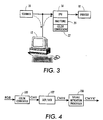
- a document system derives an electronic representation of a document being either a calibration document or a customer document (hereinafter, an image) from image input terminal such as scanner 10, in a format related to the physical characteristics of the device, and commonly with pixels defined at m bits per pixel.
- image input terminal such as scanner 10
- Common scanners such, for example, produce 8 bit/pixel data, at resolutions acceptable for many purposes. If this is a color document, the image is defined with two or more separation bitmaps, usually with identical resolution and pixel depth.
- Data from scanner 10 may be directed on for processing directly, or to an appropriately programmed general purpose computer 12, or the like. Alternatively, the source of image data may be the appropriately programmed general purpose computer.
- the electronic image signals are directed through an image processing unit (IPU) 16 to be processed so that an image suitable for reproduction on image output terminal or printer 18 is obtained.
- Image processing unit 16 commonly includes a color conversion unit 22 which converts the 3 component color description to the printer specific 4 or more component color description, and a halftoner 20 which converts a c bit digital image signals to d bit digital image signals, suitable for driving a particular printer, where c and d are integer values.
- IPU 16 may be part of the printer, or part of a general purpose computer. It may include special purpose hardware, or merely represent appropriate programs running on the general purpose computer. It may also represent special purpose programs running on a remote computer.
- Equation (6) can be used to restrict the GCR/UCR scheme in the blue area (c and m are present) to those schemes that have a small moiré value. In the red area, CMK moiré limitation disappears. GCR/UCR schemes that do not take this into account run the risk of introducing a moiré in one area or of using a suboptimal GCR/UCR in another area of color space.
- Equation (6) it is possible to derive an algorithm that reduces the moiré by limiting the moiré amplitude M . It is initially noted that many different combinations of CMYK can yield approximately the same printed color. Employing a typical color and using a clustered halftone dot, it is possible to derive the information of Figure 2, which shows a projection onto the 2-dimensional C-K plane of a set of CMYK values which yield very similar L*a*b* values with this printer when measured. A comparison of Figures 1 and 2 shows that for a given color, one can pick CMYK combinations that cause different moiré amplitudes. From Equation (6), the moiré amplitudes can be calculated for any particular color.
- the remaining components may be adjusted to compensate for this change, using a predetermined printer characterization function.
- This approach might take several computations per point in color space, but it is only performed once during the generation of the color profile.
- linearization TRC's often follow the GCR/UCR module in the image path, and must be taken into account when computing the moiré amplitude from the output of the UCR/GCR step. In fact, it may be more convenient to perform the moiré based adjustments as a CMYK-to-CMYK transformation following the TRC's, rather than in the GCR/UCR step.
- CMYK signals are converted to CMY signals at a color converter 100.
- the CMYK signals will be altered, either integrally or independently, based on aesthetics, for black addition and undercolor removal (together GCR/UCR 102).
- the CMYK signals (CMYK) are directed to a printer.
- the CMYK signals are also directed to moiré mitigation processor 106 which in turn modifies the CMYK signals to be C'M'YK', based on the response of the moiré mitigation processor.
- the transformations in Figure 4 could be used to build a 3-D lookup table that maps the input triplet to final output CMYK.
- CMYK signals coming out of the UCR/GCR step are initially received (step 200). From the signals, a value for the moiré amplitude is calculated at step 202. This calculation requires knowledge of all the image processing functions that possibly modify the CMYK values between the UCR/GCR and halftoning steps. Most often, these are linearization TRCs (312), as shown in Figure 5.
- the moiré value M is used in the decision 204 determining whether M is greater or less than a threshold value T, which controls the application of moiré mitigation. If M is greater than the threshold value T, then a GCR/UCR reduction or change is calculated (206) so as to achieve the same or similar color, and applied at step 208.
- the CMYK adjustment (206) can be accomplished by looking up a table (210) that maps CMYK to CIE color (e.g. L*, a*, b*) to find different CMYK combinations that result in the same printed color.
- CIE color e.g. L*, a*, b*
- Another potential embodiment considers only the area coverage of one of the color components - preferably k - and limits area coverage to reduce Moiré. Since the model Equation (6) predicts the highest moiré around 1 ⁇ 4 area coverage, the chosen component could be restricted to an area coverage AC ⁇ 1 ⁇ 4 - ⁇ and AC > 1 ⁇ 4 + ⁇ for the "blue" part of color space, where "blue” can be defined by an approximation to hue, derived from the input CMYK. This limit in one of the components could be compensated for by changing the values of the remaining three components in some reasonable fashion.
- CMYK signals are initially received (step 300). From the signals, a value for the moiré amplitude M is calculated at step 302. The process takes into account of image processing variations, such as linearization TRC's 312. For each color used (step 303), this value is used in the decision 304 determining whether AC is between values of 1 ⁇ 4 + ⁇ and 1 ⁇ 4- ⁇ , which controls the application of moiré. If AC is between the identified values, then a GCR/UCR adjustment is calculated (306), and directed to those function at step 308. Optionally, the adjustment values may be available in a LUT available to the process.
- a third embodiment begins with a standard GCR/UCR which is optimized with respect to some other criterion like neutral reproduction. Subsequently, patches of constant color in the "blue" area of color space are printed using different UCR/GCR schemes. A visual examination of the patches yields the acceptable moiré amplitude and corresponding GCR/UCR parameters.
- the final GCR/UCR scheme uses the standard method, adapted to the moiré scheme in a limited hue range of color space. Smooth transitions are done, e.g. by conventional blending techniques.
- RGB signals are converted at a color converter 400.
- GCR/UCR 402 and gray balance 406 or linearization 406 prints can be made exhibiting undesirable moiré.
- the prints can be scanned at scanner 408 or visually examined for subsequent measurement of moiré amplitude 410.
- a moiré mitigation signal is generated at 412.
- the moiré mitigation signal is used to generate new calibration data at 414 and UCR 402, for use in generating C'M'Y'K'.
Landscapes
- Engineering & Computer Science (AREA)
- Multimedia (AREA)
- Signal Processing (AREA)
- Color Image Communication Systems (AREA)
- Facsimile Image Signal Circuits (AREA)
Applications Claiming Priority (2)
| Application Number | Priority Date | Filing Date | Title |
|---|---|---|---|
| US192106 | 1998-11-13 | ||
| US09/192,106 US6285462B1 (en) | 1998-11-13 | 1998-11-13 | Intelligent GCR/UCR process to reduce multiple colorant moire in color printing |
Publications (3)
| Publication Number | Publication Date |
|---|---|
| EP1001609A2 true EP1001609A2 (fr) | 2000-05-17 |
| EP1001609A3 EP1001609A3 (fr) | 2001-04-25 |
| EP1001609B1 EP1001609B1 (fr) | 2010-03-31 |
Family
ID=22708273
Family Applications (1)
| Application Number | Title | Priority Date | Filing Date |
|---|---|---|---|
| EP99308885A Expired - Lifetime EP1001609B1 (fr) | 1998-11-13 | 1999-11-08 | Système et procédé de traitement de signal |
Country Status (4)
| Country | Link |
|---|---|
| US (1) | US6285462B1 (fr) |
| EP (1) | EP1001609B1 (fr) |
| JP (1) | JP4271799B2 (fr) |
| DE (1) | DE69942195D1 (fr) |
Cited By (2)
| Publication number | Priority date | Publication date | Assignee | Title |
|---|---|---|---|---|
| EP1083737A3 (fr) * | 1999-09-08 | 2005-11-09 | Eastman Kodak Company | Elimination de formes couleurs de moiré dans des images numériques avec chromaticité connue |
| EP1989874A1 (fr) * | 2006-02-24 | 2008-11-12 | OCE Printing Systems GmbH | Procede et dispositif pour la conversion de donnees d'entree descriptives de couleurs appropriees a l'edition graphique a l'aide d'un appareil d'edition en donnees de sortie adaptees descriptives de couleurs |
Families Citing this family (9)
| Publication number | Priority date | Publication date | Assignee | Title |
|---|---|---|---|---|
| US7072072B1 (en) * | 2000-05-02 | 2006-07-04 | Xerox Corporation | Color rendering optimized for text and line art |
| US20020164181A1 (en) * | 2001-05-01 | 2002-11-07 | Parker Kenneth O. | System, method and computer program product for generating a desirable image density using a plurality of image layers |
| US20040264769A1 (en) * | 2003-06-30 | 2004-12-30 | Xerox Corporation | Systems and methods for associating color profiles with a scanned input image using spatial attributes |
| US20040264768A1 (en) * | 2003-06-30 | 2004-12-30 | Xerox Corporation | Systems and methods for associating color profiles with a scanned input image using spatial attributes |
| US7474783B2 (en) * | 2003-06-30 | 2009-01-06 | Xerox Corporation | Systems and methods for associating color profiles with a scanned input image using spatial attributes |
| US20040264770A1 (en) * | 2003-06-30 | 2004-12-30 | Xerox Corporation | Systems and methods for associating color profiles with a scanned input image using spatial attributes |
| US7453604B2 (en) * | 2003-06-30 | 2008-11-18 | Xerox Corporation | Systems and methods for estimating an image marking process using scanned image attributes |
| US7336401B2 (en) * | 2003-12-19 | 2008-02-26 | Xerox Corporation | Systems and methods for estimating an image marking process using event mapping of scanned image attributes |
| US8749575B2 (en) * | 2007-03-07 | 2014-06-10 | Telefonaktiebolaget L M Ericssson (Publ) | Display controller, electronic apparatus and method for creating a translucency effect using color model transform |
Family Cites Families (15)
| Publication number | Priority date | Publication date | Assignee | Title |
|---|---|---|---|---|
| US2790844A (en) | 1954-05-11 | 1957-04-30 | Adalia Ltd | Color correction selector |
| US4149194A (en) | 1977-07-07 | 1979-04-10 | Xerox Corporation | Variable angle electronic halftone screening |
| US4275413A (en) | 1978-03-30 | 1981-06-23 | Takashi Sakamoto | Linear interpolator for color correction |
| US4500919A (en) | 1982-05-04 | 1985-02-19 | Massachusetts Institute Of Technology | Color reproduction system |
| US5296923A (en) | 1991-01-09 | 1994-03-22 | Konica Corporation | Color image reproducing device and method |
| US5168552A (en) | 1991-10-29 | 1992-12-01 | Hewlett-Packard Company | Color separation in ink jet color graphics printing |
| US5305119A (en) | 1992-10-01 | 1994-04-19 | Xerox Corporation | Color printer calibration architecture |
| EP0631430A3 (fr) * | 1993-06-22 | 1995-02-22 | Nippon Electric Co | Appareil de traitement d'images en couleurs permettant la suppression de moiré. |
| US5402245A (en) | 1994-01-27 | 1995-03-28 | Hewlett-Packard Company | Bi-level digital color printer system exhibiting improved undercolor removal and error diffusion procedures |
| US5394252A (en) | 1994-03-02 | 1995-02-28 | Xerox Corporation | Hybrid quantization method for color document reproduction |
| US5786900A (en) * | 1994-03-23 | 1998-07-28 | Fuji Photo Film Co., Ltd. | Image recording device for recording multicolor images with dot pitch pattern randomly arranged only in the sub-scanning direction |
| US5659634A (en) | 1994-09-29 | 1997-08-19 | Xerox Corporation | Apparatus and method for encoding and reconstructing image data |
| US5734800A (en) * | 1994-11-29 | 1998-03-31 | Pantone, Inc. | Six-color process system |
| US5655061A (en) | 1995-11-15 | 1997-08-05 | Xerox Corporation | System and method for providing a high addressable printing system |
| US5740334A (en) * | 1996-07-01 | 1998-04-14 | Xerox Corporation | Quantization method for color document reproduction in a color printing system |
-
1998
- 1998-11-13 US US09/192,106 patent/US6285462B1/en not_active Expired - Lifetime
-
1999
- 1999-11-08 DE DE69942195T patent/DE69942195D1/de not_active Expired - Lifetime
- 1999-11-08 EP EP99308885A patent/EP1001609B1/fr not_active Expired - Lifetime
- 1999-11-12 JP JP32244199A patent/JP4271799B2/ja not_active Expired - Fee Related
Cited By (3)
| Publication number | Priority date | Publication date | Assignee | Title |
|---|---|---|---|---|
| EP1083737A3 (fr) * | 1999-09-08 | 2005-11-09 | Eastman Kodak Company | Elimination de formes couleurs de moiré dans des images numériques avec chromaticité connue |
| EP1989874A1 (fr) * | 2006-02-24 | 2008-11-12 | OCE Printing Systems GmbH | Procede et dispositif pour la conversion de donnees d'entree descriptives de couleurs appropriees a l'edition graphique a l'aide d'un appareil d'edition en donnees de sortie adaptees descriptives de couleurs |
| US8422100B2 (en) | 2006-02-24 | 2013-04-16 | OCé PRINTING SYSTEMS GMBH | Method and apparatus for converting color-describing input data, which are suitable for graphical output using an output device, into color-describing adapted output data |
Also Published As
| Publication number | Publication date |
|---|---|
| EP1001609B1 (fr) | 2010-03-31 |
| JP2000152019A (ja) | 2000-05-30 |
| EP1001609A3 (fr) | 2001-04-25 |
| US6285462B1 (en) | 2001-09-04 |
| JP4271799B2 (ja) | 2009-06-03 |
| DE69942195D1 (de) | 2010-05-12 |
Similar Documents
| Publication | Publication Date | Title |
|---|---|---|
| Bala | Inverse problems in color device characterization | |
| CA2210244C (fr) | Traitement d'image couleur inter-separation utilisant la diffusion d'erreur | |
| US5070413A (en) | Color digital halftoning with vector error diffusion | |
| US7403310B2 (en) | Image processing apparatus and method | |
| EP0670655B1 (fr) | Procédé pour la reproduction de documents en couleurs | |
| EP0658044A2 (fr) | Production d'images utilisant la diffusion d'erreur de couleur | |
| US20020081022A1 (en) | Contrast enhancement of an image using luminance and RGB statistical metrics | |
| EP0637886B1 (fr) | Procédé pour préparer une image en couleurs | |
| US7502150B2 (en) | Color converting device, image forming apparatus, color conversion method, computer program and recording medium | |
| US6014233A (en) | Error diffusion for color images with semi-vector quantization | |
| JP6947021B2 (ja) | 画像処理方法、画像処理装置および画像処理システム | |
| US5784496A (en) | Error sum method and apparatus for intercolor separation control in a printing system | |
| US5991512A (en) | Ink relocation for color halftones | |
| US8049929B2 (en) | Color management of halftoned images | |
| EP1001609B1 (fr) | Système et procédé de traitement de signal | |
| US6920243B2 (en) | Color smooth error diffusion | |
| US20030128395A1 (en) | Color halftoning using a multi-level successive-filling halftone screening alogorithm | |
| US7095530B2 (en) | Color vector halftoning using a successive filling with improved color registration latitude | |
| US6529291B1 (en) | Fuzzy black color conversion using weighted outputs and matched tables | |
| US8294964B2 (en) | CMYK to CMYKKpRGB transform for halftone dot overlap control | |
| Balasubramanian et al. | Reducing multi-separation color moiré by a variable undercolor removal and gray component replacement strategy | |
| US6157462A (en) | Method and apparatus for error diffusion and undercolor removal/grey component replacement of digital color images | |
| EP1416716A1 (fr) | Procédé pour l'obtention de demi-teintes d'une image en couleur numérique, à canaux multiples, avec au moins un groupe similaire de canaux en couleur | |
| EP1732307A2 (fr) | Impression en couleur | |
| US7345786B2 (en) | Method for color cast removal in scanned images |
Legal Events
| Date | Code | Title | Description |
|---|---|---|---|
| PUAI | Public reference made under article 153(3) epc to a published international application that has entered the european phase |
Free format text: ORIGINAL CODE: 0009012 |
|
| AK | Designated contracting states |
Kind code of ref document: A2 Designated state(s): DE FR GB |
|
| AX | Request for extension of the european patent |
Free format text: AL;LT;LV;MK;RO;SI |
|
| PUAL | Search report despatched |
Free format text: ORIGINAL CODE: 0009013 |
|
| AK | Designated contracting states |
Kind code of ref document: A3 Designated state(s): AT BE CH CY DE DK ES FI FR GB GR IE IT LI LU MC NL PT SE |
|
| AX | Request for extension of the european patent |
Free format text: AL;LT;LV;MK;RO;SI |
|
| 17P | Request for examination filed |
Effective date: 20011025 |
|
| AKX | Designation fees paid |
Free format text: DE FR GB |
|
| 17Q | First examination report despatched |
Effective date: 20070928 |
|
| GRAP | Despatch of communication of intention to grant a patent |
Free format text: ORIGINAL CODE: EPIDOSNIGR1 |
|
| GRAS | Grant fee paid |
Free format text: ORIGINAL CODE: EPIDOSNIGR3 |
|
| GRAA | (expected) grant |
Free format text: ORIGINAL CODE: 0009210 |
|
| AK | Designated contracting states |
Kind code of ref document: B1 Designated state(s): DE FR GB |
|
| REG | Reference to a national code |
Ref country code: GB Ref legal event code: FG4D |
|
| REF | Corresponds to: |
Ref document number: 69942195 Country of ref document: DE Date of ref document: 20100512 Kind code of ref document: P |
|
| PLBE | No opposition filed within time limit |
Free format text: ORIGINAL CODE: 0009261 |
|
| STAA | Information on the status of an ep patent application or granted ep patent |
Free format text: STATUS: NO OPPOSITION FILED WITHIN TIME LIMIT |
|
| 26N | No opposition filed |
Effective date: 20110104 |
|
| PGFP | Annual fee paid to national office [announced via postgrant information from national office to epo] |
Ref country code: DE Payment date: 20131022 Year of fee payment: 15 Ref country code: FR Payment date: 20131121 Year of fee payment: 15 Ref country code: GB Payment date: 20131025 Year of fee payment: 15 |
|
| REG | Reference to a national code |
Ref country code: DE Ref legal event code: R119 Ref document number: 69942195 Country of ref document: DE |
|
| GBPC | Gb: european patent ceased through non-payment of renewal fee |
Effective date: 20141108 |
|
| REG | Reference to a national code |
Ref country code: FR Ref legal event code: ST Effective date: 20150731 |
|
| PG25 | Lapsed in a contracting state [announced via postgrant information from national office to epo] |
Ref country code: DE Free format text: LAPSE BECAUSE OF NON-PAYMENT OF DUE FEES Effective date: 20150602 Ref country code: GB Free format text: LAPSE BECAUSE OF NON-PAYMENT OF DUE FEES Effective date: 20141108 |
|
| PG25 | Lapsed in a contracting state [announced via postgrant information from national office to epo] |
Ref country code: FR Free format text: LAPSE BECAUSE OF NON-PAYMENT OF DUE FEES Effective date: 20141201 |