EP1001649A2 - Intégrité de canal dans un réseau transmettant la voix sur ATM - Google Patents
Intégrité de canal dans un réseau transmettant la voix sur ATM Download PDFInfo
- Publication number
- EP1001649A2 EP1001649A2 EP99308939A EP99308939A EP1001649A2 EP 1001649 A2 EP1001649 A2 EP 1001649A2 EP 99308939 A EP99308939 A EP 99308939A EP 99308939 A EP99308939 A EP 99308939A EP 1001649 A2 EP1001649 A2 EP 1001649A2
- Authority
- EP
- European Patent Office
- Prior art keywords
- virtual circuit
- network
- data
- port
- atm
- Prior art date
- Legal status (The legal status is an assumption and is not a legal conclusion. Google has not performed a legal analysis and makes no representation as to the accuracy of the status listed.)
- Withdrawn
Links
Images

Classifications
-
- H—ELECTRICITY
- H04—ELECTRIC COMMUNICATION TECHNIQUE
- H04Q—SELECTING
- H04Q11/00—Selecting arrangements for multiplex systems
- H04Q11/04—Selecting arrangements for multiplex systems for time-division multiplexing
- H04Q11/0428—Integrated services digital network, i.e. systems for transmission of different types of digitised signals, e.g. speech, data, telecentral, television signals
- H04Q11/0478—Provisions for broadband connections
-
- H—ELECTRICITY
- H04—ELECTRIC COMMUNICATION TECHNIQUE
- H04L—TRANSMISSION OF DIGITAL INFORMATION, e.g. TELEGRAPHIC COMMUNICATION
- H04L12/00—Data switching networks
- H04L12/54—Store-and-forward switching systems
- H04L12/56—Packet switching systems
- H04L12/5601—Transfer mode dependent, e.g. ATM
- H04L2012/5625—Operations, administration and maintenance [OAM]
-
- H—ELECTRICITY
- H04—ELECTRIC COMMUNICATION TECHNIQUE
- H04L—TRANSMISSION OF DIGITAL INFORMATION, e.g. TELEGRAPHIC COMMUNICATION
- H04L12/00—Data switching networks
- H04L12/54—Store-and-forward switching systems
- H04L12/56—Packet switching systems
- H04L12/5601—Transfer mode dependent, e.g. ATM
- H04L2012/5629—Admission control
- H04L2012/563—Signalling, e.g. protocols, reference model
-
- H—ELECTRICITY
- H04—ELECTRIC COMMUNICATION TECHNIQUE
- H04L—TRANSMISSION OF DIGITAL INFORMATION, e.g. TELEGRAPHIC COMMUNICATION
- H04L12/00—Data switching networks
- H04L12/54—Store-and-forward switching systems
- H04L12/56—Packet switching systems
- H04L12/5601—Transfer mode dependent, e.g. ATM
- H04L2012/5629—Admission control
- H04L2012/5631—Resource management and allocation
-
- H—ELECTRICITY
- H04—ELECTRIC COMMUNICATION TECHNIQUE
- H04L—TRANSMISSION OF DIGITAL INFORMATION, e.g. TELEGRAPHIC COMMUNICATION
- H04L12/00—Data switching networks
- H04L12/54—Store-and-forward switching systems
- H04L12/56—Packet switching systems
- H04L12/5601—Transfer mode dependent, e.g. ATM
- H04L2012/5638—Services, e.g. multimedia, GOS, QOS
- H04L2012/5671—Support of voice
Definitions
- This invention relates generally to management techniques for a communications network and, more particularly, to a system and method for completing, monitoring, and maintaining a connection in the communications network.
- PSTN public switched telephone network
- data networks such as the internet
- ATM or asynchronous transfer mode, is a method for transmitting and receiving information around a network of switches and routers and is defined according to the International Telecommunications Union-Telecommunications Services Sector (ITU-T).
- ITU-T International Telecommunications Union-Telecommunications Services Sector
- An ATM network includes one or more ATM switches for handling multiple connections between two or more endpoints.
- the ATM network may be within a building, or can span several countries.
- ATM One key feature of ATM is that it is designed to allow different services such as video, voice and computer data to be mixed simultaneously on the same network. This is because ATM networks utilize "cells" for carrying information. Each cell has a 5 byte header and a 48 byte payload, thereby setting a fixed size of 53 bytes. The fixed cell size of ATM is beneficial because it allows traffic to flow in a predictable manner, which works well with services such as voice and video.
- a virtual circuit is a path between two end devices that appears to a user to be a dedicated point-to-point circuit.
- An ATM network has multiple ways of setting up and grouping virtual circuits, including a permanent virtual circuit and a switched virtual circuit.
- a permanent virtual circuit (“PVC") is a connection that is set up by an administrator of the ATM network and exists even if no traffic is using the circuit. Also, a PVC has fixed parameters, independent of the traffic pattern using the path. Although a PVC is not an efficient use of bandwidth, it is still desirable because it does not have to be setup or torn down for each call.
- a switched virtual circuit is a connection that only exists when there is actual traffic to be sent down that path.
- An SVC has variable parameters that will change depending on the traffic pattern.
- the SVC is desirable because it uses the bandwidth of the ATM network more efficiently than a PVC.
- each SVC requires that a path be connected and disconnected through multiple ATM switches for each call, it is a labor intensive process. Most ATM switches can not perform this process very quickly (e.g., the maximum number of SVC's that can be setup per second is relatively low).
- ATM networks often serve as a "backbone" connecting two or more non-ATM networks.
- a computer network which uses Ethernet may be connected to another Ethernet network via an ATM network.
- a router is used at each interface between the ATM and Ethernet networks to control access and to translate between the Ethernet data stream (having packets of variable length) and the ATM data stream (having cells of fixed length).
- Two or more telephone networks may also be connected via an ATM backbone.
- An access interface device (similar to the router in a computer network) is required at the connection point between the ATM and telephone networks to control access and to convert between the continuous voice streams of the telephone networks and the data stream of fixed length ATM cells.
- each access interface (AI) device has very many channels, or ports, so that one port is available for each path through the ATM network.
- TDM time division multiplexing
- Integrity is significant to ensuring quality of service in a voice-on-ATM network, particularly in the case where (semi) permanent paths through the ATM network are to be reused over many calls.
- the present invention accordingly, provides an application and method for analyzing a virtual circuit in a data network.
- the data network may include multiple switches and connect to multiple devices and/or networks.
- the ATM network may connect two telecommunications networks through two interface devices, one for each telecommunications network.
- a virtual circuit is created in the ATM network between the two telecommunications networks, connecting to the first telecommunications network through a port of the first interface device and the second telecommunications network through a port of the second interface device.
- the method transfers a data value from the port of the first interface device to the port of the second interface device before or during a call.
- the data value identifies the two ports. In this way, the data value can later be examined to determine if it still identifies the two ports. By so doing, the examining interface device can determine a status of the virtual circuit.
- the data network interconnects at least two telecommunications networks through at least two interface devices, one for each telecommunications network.
- a virtual circuit is created in the data network between the two telecommunications networks, connecting to the first telecommunications network through a port of the first interface device and to the second telecommunications network through a port of the second interface device.
- the method transfers a data value from the port of the first interface device to the port of the second interface device through the virtual circuit.
- the data value identifies the two ports. In this way, the data value can later be examined to determine a status of the virtual circuit. For example, if no data value is ever received, the status of the virtual circuit is that no data is flowing and the virtual circuit has been corrupted. If the data value is changed, the status of the virtual circuit is that data is flowing, but there may have been a premature re-use of the virtual circuit.
- a glare condition One problem with the virtual circuit occurs when two ports are simultaneously trying to initiate a call on the same virtual circuit, i.e., a glare condition. This can happen when using cached virtual circuits.
- the above-described method can detect the glare condition when it examines the received data value.
- the data network is an asynchronous transfer mode ("ATM") network and the two telecommunications networks are time division multiplexing networks.
- ATM asynchronous transfer mode
- the method can be part of an application that exists on the fifth (upper-most) layer of the ATM protocol reference model. This works well with calls that contain either voice or video data.
- One benefit of the present invention is that information is passed between two endpoints in a voice-on-ATM call to ensure the continuing existence of the voice-path.
- Another benefit of the present invention is that a glare condition or premature reuse of a path through a network can be detected.
- Yet another benefit of the present invention is that it can be easily implemented by an application on the upper-most layer of the network model, without requiring any new hardware.
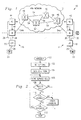
- Fig. 1 is a functional block diagram of two TDM networks interconnected by an ATM network for implementing features of the present invention.
- Fig. 2 is a flow chart of a method for maintaining the integrity of a virtual circuit in the ATM network of Fig. 1.
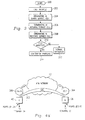
- Fig. 3 is a flow chart of a method for handling a glare condition in a virtual circuit in the ATM network of Fig. 1.
- Figs. 4a, 4b, and 4c are flow diagrams for illustrating the method of Fig. 3 in a glare condition.
- the reference numeral 10 designates a telecommunications system 10.
- the system 10 include an ATM network 12 and two TDM networks 14, 16.
- the TDM networks 14, 16 are illustrated each with a single local exchange carrier ("LEC") 18, 20, respectively.
- LECs 18, 20 are representative of many types of networks, including private branch exchanges, long distance networks, local area networks, cable networks, and so forth.
- Terminals 22, 24 are connected to LECs 18, 20 through telephone lines 26, 28, respectively.
- terminals 22, 24 are telephones, but other types of terminals can also be used.
- the LEC 18 is capable of connecting the telephone line 26 to a voice channel 30 associated with a signal channel 32.
- the LEC 20 is capable of connecting the telephone line 28 to a voice channel 34 associated with a signal channel 36.
- the voice channels 30, 34 further connect to access interfaces (AIs) 38, 40, respectively, and the signal channels 32, 36 further connect to front ends 42, 44, respectively.
- AIs access interfaces
- the signal channels 32, 36 further connect to front ends 42, 44, respectively.
- many AIs and many front ends will exist for providing an interface to and between the ATM network 12 and the TDM networks 14, 16. Therefore, the number of AIs and front ends illustrated in Fig. 1 are limited for the sake of simplicity.
- the ATM network 12 includes a plurality of ATM switches, including edge switches 46, 48 and backbone switches 50, 52.
- Data paths 54 interconnect the ATM switches 46-52, including a path 54a between switch 46 and AI 38 and a path 54b between switch 48 and AI 40.
- the front ends 42, 44 are connected to a signaling system 7 ("SS7") link (not shown) through the ATM network 12 where call logic (signaling) is processed, such as setting up an SVC for a call.
- SS7 link is not related to the ATM switches' call processing for SVC setup. It is understood, however, that the function of SVC setup takes place between the AIs 38, 40 and the ATM network 12 using an ATM interface such as a user network interface ("UNI") or a private network-network interface (“PNNI").
- UNI user network interface
- PNNI private network-network interface
- the front ends 42, 44 perform telephony call processing logic on the signaling received on the signal channels 32, 36, such as translating a called number and routing the call by causing the AIs to establish a connection through the ATM network.
- the ATM network 12 is capable of simultaneously establishing multiple SVCs through the various ATM switches 46-52 and data paths 54. In this way, one or more calls can be supported at the same time. For example, a call between the telephones 22, 24 can be established and maintained through channels, or ports, on the AIs 38, 40, respectively and using an SVC in the ATM network 12 between the two AIs. However, after an SVC has been established (and the front ends 42, 44 become idle with respect to the call), it is important to be certain that the call integrity is maintained. That is, during the life of the call, the SVC should properly and continuously connect the appropriate ports on the AIs 42, 44.
- a method 100 is performed by an application protocol of the ATM network 12 to maintain the integrity of each SVC.
- an application using the F5 application-specific maintenance flow will be described for implementing the method 100.
- the F5 application-specific maintenance flow operates for a specific virtual circuit and F5 service cells are carried within that circuit along with data cells.
- the F5 application-specific maintenance flow is a function that exists on the fifth (upper-most) layer of the ATM protocol reference model according to the International Telecommunications Union-Telecommunications Services Sector (ITU-T).
- a call is initiated and an SVC is provided for the call.
- the call is started by terminal 22 and is directed to terminal 24.
- the LEC 18 routes the call to AI 38 (the originating AI) and front end 42, which then obtains an SVC for the call.
- the front ends 42, 44 may construct the SVC specifically for the call, or the front end 42 may use a pre-existing SVC that is now available.
- the front ends 42, 44 exchange port numbers assigned in the respective AIs 38, 40.
- the SVC uses a specific port in AI 38 which is assigned to the call (e.g., port number 32).
- the SVC uses a specific port in AI 40 (the terminating AI) which is assigned to the call (e.g., port number 11).
- AI 40 then routes the call to the LEC 20 which completes the call to terminal 24.
- the originating AI (AI 38) sends an F5 service cell.
- the F5 service cell has information that indicates the port number of the originating AI (AI 38) and the port number of the terminating AI (AI 40). In the present example, the F5 service cell includes the data (32, 11).
- the terminating AI (AI 40) waits a predetermined period of time to receive the F5 service cell. As described in greater detail below, the F5 service cell not only allows the F5 function to determine if the SVC is good, but also to determine that the data flow between the AIs 38, 40 is also good.
- the AI 40 examines the received F5 service cell. If the data in the F5 service cell is correct, the method 100 thereby determines that data is indeed flowing through the SVC and that the SVC's integrity status is good. Execution then proceeds to step 112 where the call progress is checked. If the call is finished, execution stops. Otherwise, execution returns to step 106 where the terminating AI (AI 40) sends the F5 service cell (which includes the data (32, 11)) back to the originating AI (AI 38). The F5 service cells continue to go back and forth between the two AIs until the call is finished.
- step 108 If at step 108 the service cell is never received, the F5 application thereby determines that no data is flowing through the SVC. Execution then proceeds to step 114 where appropriate action can be taken.
- the appropriate action may include re-establishing the SVC for the call or notifying an administrator system of the error.
- step 110 If at step 110 the data in the service cell is incorrect, the F5 application thereby determines that even though data is flowing, the SVC has been compromised, e.g., the SVC is not connected to the correct ports in the respective AIs. Execution then proceeds to step 114 where appropriate action can be taken.
- each SVC requires that a connection be set up and torn down through multiple ATM switches for each call. This process is labor intensive and most ATM switches can not perform this connection very quickly (i.e., the maximum number of SVC's that can be setup per second is relatively low).
- One solution is to store-up or cache SVCs after they have been used. Instead of disconnecting an SVC after a call is finished, the SVC is cached and maintained for a period of time. If another call that uses the same two AIs that were used for the cached SVC is initiated, the cached SVC can then be reused. As a result, the labor of setting up an SVC for that call has been avoided. However, a problem occurs when both AIs on a single cached SVC try to utilize the SVC at the same time (a "glare" condition).
- a method 200 is performed by an application protocol of the ATM network 12 to handle the glare condition.
- an F5 application will be described for implementing the method 200. It is understood, however, that the application performing the method 200 may be part of the same application performing the method 100, or may be a totally separate application.
- a call is initiated by a terminal connectable to one of the AIs and its associated front end.
- the call is started by terminal 22 and is directed to terminal 24.
- the LEC 18 routes the call to AI 38 (the originating AI) and front end 42, which then obtains a cached SVC for the call.
- the front ends 42, 44 exchange port numbers in the respective AIs 38, 40.
- the AI 38 uses a specific port which is already connected to the SVC (e.g., port number 32).
- the AI 40 (the terminating AI) also uses a specific port which is already connected to the SVC (e.g., port number 11).
- the originating AI sends a service cell on the cached SVC towards the terminating AI (AI 40).
- the service cell has information that indicates the port number of the originating AI (port 32 of AI 38) and the port number of the terminating AI (port 11 of AI 40).
- the service cell includes the data (32, 11).
- the terminating AI sends the data from the service cell back towards the originating AI.
- the originating AI receives the service cell, which includes the data (32, 11) from the terminating AI.
- the originating AI examines the received service cell.
- the contention routine can determine what to do with the SVC, such as perform an arbitration analysis to determine which AI should use the SVC or select different SVCs for both calls altogether.
- the method 200 can be simultaneously performed multiple times in the ATM network 12 and can thereby be used to detect a glare condition.
- a call flow is illustrated in Figs. 4a-4c that shows two instances of the method 200 being performed at about the same time. The two instances are being performed on a common cached SVC 302 so that a glare condition will occur.
- the first instance of the method 200 is the same as the example described above with reference to Fig. 3.
- AI 38 is the originating AI and attempts to use the SVC 302 to complete a call.
- the AI 38 sends out a first service cell that includes information that indicates the port number it is using as well as the port number of the terminating AI (AI 40).
- the first service cell includes the data (32, 11), designated in Figs. 4a-4c with the reference numeral 304.
- a call is being started by terminal 24 and is directed to terminal 22.
- the LEC 20 routes the call to AI 40 and front end 44, which then obtains the cached SVC 302 for the call. Since the first and second instance are happening at about the same time, AI 40 considers SVC 302 to be available.
- the AI 40 sends out a second service cell that includes the data of ports at AI 40 and 38 (e.g., the data (24, 45)).
- the second service cell is designated in Figs. 4a-4c with the reference numeral 306.
- the two service cells 304, 306 pass each other somewhere in the ATM network 12.
- step 206 of Fig. 3 will not be performed by the respective terminating AIs because each was trying to use the SVC 302 at about the same time. Instead, at step 208, AI 40 will receive the first service cell 304 that includes the data (32, 11) and AI 38 will receive the second service cell 306 that includes the data (24, 45). At step 210, each AI will recognize that the service cell that it received is different from the service cell it transmitted. Therefore, the status of the SVC 302 indicates a glare condition. Execution then proceeds to step 214 for a contention routine. The contention routine may, for example, decide that AI 38 may use SVC 302 and AI 40 must find another SVC.
- the ATM network may include multiple switches and connects two telecommunications networks through two interface devices, one for each telecommunications network.
- a virtual circuit is created in the ATM network between the two telecommunications networks, connecting to the first telecommunications network through a port of the first interface device and the second telecommunications network through a port of the second interface device.
- the method transfers a data value from the port of the first interface device to the port of the second interface device before or during a call.
- the data value identifies the two ports. In this way, the data value can later be examined to determine if it still identifies the two ports. By so doing, the examining interface device can determine a status of the virtual circuit.
- connection protocol is disclosed in conjunction with the completion of a call in an ATM network, the disclosed protocol is equally suitable for use in conjunction with other data networks. Accordingly, it is appropriate that the appended claims be construed broadly and in a manner consistent with the scope of the invention.
Landscapes
- Engineering & Computer Science (AREA)
- Computer Networks & Wireless Communication (AREA)
- Data Exchanges In Wide-Area Networks (AREA)
- Telephonic Communication Services (AREA)
Applications Claiming Priority (2)
| Application Number | Priority Date | Filing Date | Title |
|---|---|---|---|
| US189605 | 1998-11-10 | ||
| US09/189,605 US6381219B1 (en) | 1998-11-10 | 1998-11-10 | Channel integrity in a voice-on-ATM network |
Publications (2)
| Publication Number | Publication Date |
|---|---|
| EP1001649A2 true EP1001649A2 (fr) | 2000-05-17 |
| EP1001649A3 EP1001649A3 (fr) | 2003-07-02 |
Family
ID=22698031
Family Applications (1)
| Application Number | Title | Priority Date | Filing Date |
|---|---|---|---|
| EP99308939A Withdrawn EP1001649A3 (fr) | 1998-11-10 | 1999-11-10 | Intégrité de canal dans un réseau transmettant la voix sur ATM |
Country Status (4)
| Country | Link |
|---|---|
| US (1) | US6381219B1 (fr) |
| EP (1) | EP1001649A3 (fr) |
| JP (1) | JP2000151653A (fr) |
| CA (1) | CA2282944A1 (fr) |
Cited By (1)
| Publication number | Priority date | Publication date | Assignee | Title |
|---|---|---|---|---|
| WO2005013562A1 (fr) * | 2003-07-29 | 2005-02-10 | Xelor Software Pty Ltd | Circuits virtuels pour reseaux a commutation par paquets |
Families Citing this family (2)
| Publication number | Priority date | Publication date | Assignee | Title |
|---|---|---|---|---|
| US6343065B1 (en) * | 2000-01-20 | 2002-01-29 | Sbc Technology Resources, Inc. | System and method of measurement-based adaptive caching of virtual connections |
| US20030099192A1 (en) * | 2001-11-28 | 2003-05-29 | Stacy Scott | Method and system for a switched virtual circuit with virtual termination |
Family Cites Families (7)
| Publication number | Priority date | Publication date | Assignee | Title |
|---|---|---|---|---|
| GB9401092D0 (en) * | 1994-01-21 | 1994-03-16 | Newbridge Networks Corp | A network management system |
| US5563874A (en) * | 1995-01-27 | 1996-10-08 | Bell Communications Research, Inc. | Error monitoring algorithm for broadband signaling |
| GB9507454D0 (en) * | 1995-04-11 | 1995-05-31 | Gen Datacomm Adv Res | Data network switch with fault tolerance |
| US6067286A (en) * | 1995-04-11 | 2000-05-23 | General Datacomm, Inc. | Data network switch with fault tolerance |
| US5751698A (en) * | 1996-03-15 | 1998-05-12 | Network General Technology Corporation | System and method for automatically identifying and analyzing active channels in an ATM network |
| KR100459306B1 (ko) * | 1996-11-22 | 2004-12-03 | 스프린트 커뮤니케이숀스 컴파니 리미티드 파트너쉽 | 원격통신 네트워크에서 호출을 전송하기 위한 시스템 및 방법 |
| US5987320A (en) * | 1997-07-17 | 1999-11-16 | Llc, L.C.C. | Quality measurement method and apparatus for wireless communicaion networks |
-
1998
- 1998-11-10 US US09/189,605 patent/US6381219B1/en not_active Expired - Lifetime
-
1999
- 1999-09-21 CA CA002282944A patent/CA2282944A1/fr not_active Abandoned
- 1999-11-05 JP JP11314502A patent/JP2000151653A/ja active Pending
- 1999-11-10 EP EP99308939A patent/EP1001649A3/fr not_active Withdrawn
Cited By (1)
| Publication number | Priority date | Publication date | Assignee | Title |
|---|---|---|---|---|
| WO2005013562A1 (fr) * | 2003-07-29 | 2005-02-10 | Xelor Software Pty Ltd | Circuits virtuels pour reseaux a commutation par paquets |
Also Published As
| Publication number | Publication date |
|---|---|
| US6381219B1 (en) | 2002-04-30 |
| CA2282944A1 (fr) | 2000-05-10 |
| EP1001649A3 (fr) | 2003-07-02 |
| JP2000151653A (ja) | 2000-05-30 |
Similar Documents
| Publication | Publication Date | Title |
|---|---|---|
| US6222820B1 (en) | Method of VCC/VPC redundancy for asynchronous transfer mode networks | |
| EP1320219B1 (fr) | Appareil et procédé pour la transmission de paquets de OAM entre des réseaux ATM et des réseaux de commutation en cas d' erreurs | |
| US5956334A (en) | Method for interfacing a telephony and an ATM network to establish voice communication | |
| EP0931402B1 (fr) | Systeme de telecommunications a large bande | |
| US6449275B1 (en) | Internal routing through multi-staged ATM node | |
| EP0909525B1 (fr) | Systemes de telecommunications atm et methode de routage du trafic en bande etroite | |
| US6718419B1 (en) | System and method for extending the number of addressable physical devices on a data bus | |
| US6396811B1 (en) | Segmented performance monitoring of multi-stage ATM node | |
| US7054273B1 (en) | Circuit integrity in a packet-switched network | |
| US6233221B1 (en) | System and method for a ring network with virtual path connections | |
| US8547849B2 (en) | ATM telecommunications systems and method for routing narrow band traffic | |
| US6381219B1 (en) | Channel integrity in a voice-on-ATM network | |
| WO2001011853A2 (fr) | Integrite de circuit dans un reseau a commutation de paquets | |
| EP1145588B1 (fr) | Mecanisme et procede d'affectation dynamique de connexions atm entre des centraux | |
| KR100194592B1 (ko) | 비연결형 데이터 서비스 제공 방법 | |
| US7483372B2 (en) | Communication network | |
| US7006493B1 (en) | Virtual voice port configured to connect a switched voice call to a permanent voice call | |
| EP0999719B1 (fr) | Procédé et appareil pour compléter des appels téléphoniques entre des sous-réseaux | |
| KR19990060335A (ko) | 광대역 정합장치에서 프로토콜 정합방법 | |
| HK1022393B (en) | Methods and systems for handling a call and signaling processing systems |
Legal Events
| Date | Code | Title | Description |
|---|---|---|---|
| PUAI | Public reference made under article 153(3) epc to a published international application that has entered the european phase |
Free format text: ORIGINAL CODE: 0009012 |
|
| AK | Designated contracting states |
Kind code of ref document: A2 Designated state(s): AT BE CH CY DE DK ES FI FR GB GR IE IT LI LU MC NL PT SE |
|
| AX | Request for extension of the european patent |
Free format text: AL;LT;LV;MK;RO;SI |
|
| RAP1 | Party data changed (applicant data changed or rights of an application transferred) |
Owner name: NORTEL NETWORKS LIMITED |
|
| PUAL | Search report despatched |
Free format text: ORIGINAL CODE: 0009013 |
|
| AK | Designated contracting states |
Designated state(s): AT BE CH CY DE DK ES FI FR GB GR IE IT LI LU MC NL PT SE |
|
| AX | Request for extension of the european patent |
Extension state: AL LT LV MK RO SI |
|
| RAP1 | Party data changed (applicant data changed or rights of an application transferred) |
Owner name: NORTEL NETWORKS LIMITED |
|
| 17P | Request for examination filed |
Effective date: 20031217 |
|
| AKX | Designation fees paid |
Designated state(s): DE FR GB SE |
|
| 17Q | First examination report despatched |
Effective date: 20040304 |
|
| STAA | Information on the status of an ep patent application or granted ep patent |
Free format text: STATUS: THE APPLICATION IS DEEMED TO BE WITHDRAWN |
|
| 18D | Application deemed to be withdrawn |
Effective date: 20080603 |