EP1002432B1 - Procede pour creer et/ou executer un service d'un reseau intelligent - Google Patents
Procede pour creer et/ou executer un service d'un reseau intelligent Download PDFInfo
- Publication number
- EP1002432B1 EP1002432B1 EP98943712A EP98943712A EP1002432B1 EP 1002432 B1 EP1002432 B1 EP 1002432B1 EP 98943712 A EP98943712 A EP 98943712A EP 98943712 A EP98943712 A EP 98943712A EP 1002432 B1 EP1002432 B1 EP 1002432B1
- Authority
- EP
- European Patent Office
- Prior art keywords
- service
- prototypes
- data
- entities
- service provider
- Prior art date
- Legal status (The legal status is an assumption and is not a legal conclusion. Google has not performed a legal analysis and makes no representation as to the accuracy of the status listed.)
- Expired - Lifetime
Links
- 238000000034 method Methods 0.000 title claims description 54
- 238000012545 processing Methods 0.000 title claims description 12
- 230000006870 function Effects 0.000 claims description 19
- 230000004913 activation Effects 0.000 claims description 9
- 238000013475 authorization Methods 0.000 claims description 9
- 230000008569 process Effects 0.000 claims description 8
- 238000006243 chemical reaction Methods 0.000 claims description 4
- 230000004044 response Effects 0.000 claims description 2
- 238000007726 management method Methods 0.000 description 43
- 230000006978 adaptation Effects 0.000 description 15
- 230000008901 benefit Effects 0.000 description 3
- 230000008859 change Effects 0.000 description 3
- 230000003213 activating effect Effects 0.000 description 2
- 230000009286 beneficial effect Effects 0.000 description 2
- 230000000694 effects Effects 0.000 description 2
- 230000002349 favourable effect Effects 0.000 description 2
- 238000012546 transfer Methods 0.000 description 2
- 230000005540 biological transmission Effects 0.000 description 1
- 239000000969 carrier Substances 0.000 description 1
- 238000012508 change request Methods 0.000 description 1
- 238000004590 computer program Methods 0.000 description 1
- 238000010276 construction Methods 0.000 description 1
- 238000013523 data management Methods 0.000 description 1
- 230000001419 dependent effect Effects 0.000 description 1
- 238000013461 design Methods 0.000 description 1
- 238000012423 maintenance Methods 0.000 description 1
- 238000004519 manufacturing process Methods 0.000 description 1
- 230000001404 mediated effect Effects 0.000 description 1
- 230000002093 peripheral effect Effects 0.000 description 1
- 230000009467 reduction Effects 0.000 description 1
- 230000001960 triggered effect Effects 0.000 description 1
Images

Classifications
-
- H—ELECTRICITY
- H04—ELECTRIC COMMUNICATION TECHNIQUE
- H04M—TELEPHONIC COMMUNICATION
- H04M3/00—Automatic or semi-automatic exchanges
- H04M3/42—Systems providing special services or facilities to subscribers
- H04M3/42136—Administration or customisation of services
-
- H—ELECTRICITY
- H04—ELECTRIC COMMUNICATION TECHNIQUE
- H04Q—SELECTING
- H04Q3/00—Selecting arrangements
- H04Q3/0016—Arrangements providing connection between exchanges
- H04Q3/0029—Provisions for intelligent networking
-
- H—ELECTRICITY
- H04—ELECTRIC COMMUNICATION TECHNIQUE
- H04M—TELEPHONIC COMMUNICATION
- H04M2207/00—Type of exchange or network, i.e. telephonic medium, in which the telephonic communication takes place
- H04M2207/12—Type of exchange or network, i.e. telephonic medium, in which the telephonic communication takes place intelligent networks
-
- H—ELECTRICITY
- H04—ELECTRIC COMMUNICATION TECHNIQUE
- H04M—TELEPHONIC COMMUNICATION
- H04M7/00—Arrangements for interconnection between switching centres
- H04M7/12—Arrangements for interconnection between switching centres for working between exchanges having different types of switching equipment, e.g. power-driven and step by step or decimal and non-decimal
- H04M7/1205—Arrangements for interconnection between switching centres for working between exchanges having different types of switching equipment, e.g. power-driven and step by step or decimal and non-decimal where the types of switching equipement comprises PSTN/ISDN equipment and switching equipment of networks other than PSTN/ISDN, e.g. Internet Protocol networks
- H04M7/126—Interworking of session control protocols
Definitions
- the invention also relates to a method for producing Service data prototypes, which are used to describe the in a Intelligent network telecommunications service used Serve data.
- Services can be set up on an intelligent network be a managed over the telecommunications network Service provider service for other participants of the intelligent Represent network; these participants are supported by the Use of the service to service subscribers.
- Typical examples Such services include: Universal numbers like one Emergency number at which the calling service subscriber forwarded to the responsible emergency center according to the caller's location becomes; a weather information service that updates regularly must be and possibly also regionally, again with respect to the caller location can; or an information service where the service subscriber depending on the type of information you want Offices are mediated, and this mediation automatically in the dialogue between the participant via announcements Questions and as for example dialing signals Answers of the participant is carried out.
- the service moves in one of the part of the Service subscriber made connection, the service subscriber can also be called party, however for example with a news service that e.g. electronic Forwarding mail to the service subscriber, being in this If the terminal of the service subscriber is a computer with a modem instead of a telephone device.
- a news service that e.g. electronic Forwarding mail to the service subscriber, being in this
- the terminal of the service subscriber is a computer with a modem instead of a telephone device.
- the service provider In contrast to the service subscriber, the service provider must generally no subscriber to the telecommunications network his; this illustrates the example of a weather service, which only consists of spoken texts and for which the Text of the announcements from the service provider, a meteorological Institute, the network operator even without using the telecommunications network, e.g. on a sound carrier can. Furthermore, the distinction made here closes between the network operator as the supervisor of the intelligent Network on the one hand and the service provider as the operator of the Service, on the other hand, does not rule out the case that the service provider is itself the network operator; can actually one Network operators also provide services on their own behalf on that of him offer maintained network.
- the telecommunications networks discussed here can be of any kind, e.g. also radio networks like the GSM network.
- the intelligent network indicates the execution of the services one or more service operating stations ('service control point ', SCP), all for the operation of the services have the necessary information and devices and on the data the telecommunication network, e.g. the number plan, Have access. Access to the service operating stations, for example for service maintenance, takes place via service management stations ('service management point', SMP) instead of the usual units independent of the service operating stations group; however, in special cases, the functions both stations also taken over by a device become.
- the set of service management and operations stations is used in connection with the invention as a network control station designated.
- a service on an intelligent network is on an order of the service provider created by the network operator and preconfigured; then the service provider fits the Service according to his needs, however within the the network operator's specified options. If the change requests of the service provider over that of the network operator the specified framework, the service must go from Network operators can be revised or created from scratch.
- Steps a) to c) i.e. the creation or editing of the Service definition, the conversion of this into service functions and service data prototypes and service preparation on the telecommunications network, to manage the service count
- steps d) to f namely the generation of Service data instances from the service data prototypes, the selection of service data instances for activation or update of the service as well as the activation of a new one Service or update of an existing service, the Identify service customization.
- a service subscriber can also take the place service provider to customize a service.
- the service subscriber is in such cases on the part of the service provider, in rare cases also of the network operator, for service adaptation been authorized, the authorization also specifying to what extent the respective service subscriber has the characteristics of a service can change.
- Authorization of the service subscriber for adaptation can take place expressly or implicitly, for example by communicating the possibility of access to the Network control station to the service subscriber. If in the following of service adaptation by the service provider the possibility is therefore implicitly included, that a service subscriber instead of the service provider adjusts the service.
- service data prototypes are described below and service data instances for short prototypes or instances called.
- the network operator is responsible for service management and service adaptation or the service provider various tools for Usually available as on the data management station or computer programs running at the service provider terminal available.
- the service functions, prototypes and usually represents instances as files that be created on the service management station; usually applies this also applies to the service definitions, if any available in concrete form and not just as a concept.
- Previous solutions for the establishment of telecommunications services provided that the network operator defined the service on the service management station and there with a service compiler into multiple data objects, including the Prototypes. There are more for further processing Operating tools are provided that allow certain data and parameters associated with the telecommunications service to choose or set. For creating and describing of service user permissions, for access authorization of data objects and for creation and editing of number plans is up to the network operator a service management tool is available. The administration the data to be provided by the service provider regarding the handling of statistical data provided by the service provider serves its own Tool, the service customization (CSC, 'customer service control '), which the network operator makes available to the service provider must face.
- CSC service customization
- the prototypes and instances must be between the computer of the service provider and the service management station be exchanged, be it via data carriers such as floppy disks, or via a connection such as a modem line.
- the transfer between is only for text files various systems in any case without problems. So far limited on the one hand, therefore, a pure text format for the prototypes and instances, on the other hand on simple held programs of service adaptation.
- For the service provider brought a brittle user interface of the service adaptation with itself, with a confusing and often unclear Presentation of service data.
- a data format is selected that will accommodate both Text as well as instruction codes in a text-compatible format, e.g. as symbolic commands, allowed in the chosen Markup prototype with instruction codes shown in data format be equipped, which the generation of Instances serve the content of at least one markup prototype is displayed on the terminal of the service provider and the Service provider creates the instances by going over on commands entered from its instruction codes at its terminal of the markup prototypes displayed, at least a suitable one selects and runs.
- a graphical structure that matches the logical structure of the Service corresponds when creating or editing or Conversion of the service definition on the part of the network operator generated and using the text-compatible instruction codes filed in a markup prototype.
- the effort in the Implementation of the procedure is significantly reduced Service defined in that the network operator has a number predefined service modules and the link these service modules with each other and with the components of the intelligent network.
- the Generation of the instances of the service providers for entering Data prompted for the creation of the instances used become.
- the service provider Triggers a command prompt, e.g. by selecting an instruction code or by clicking a graphic element to which an input form is assigned is.
- markup language for the data format of the markup prototypes, e.g. HTML
- the markup prototype uses that Service providers with the help of a markup language-compatible language Browser program is displayed.
- Another cheap variant has the advantage that the Method according to the invention from practically any location can be carried out in that the connection from Service provider terminal to the service management station is produced via a freely accessible computer network.
- the procedure is further simplified by the inexpensive variant, where the network operator provides the service on the telecommunications network prepared with the help of an administrative tool.
- Another advantageous embodiment which is the flexible Simplified handling of services allows the Generation of the instances and / or selection of the instances and / or the activation or update of the service of a service subscriber is carried out by the Service provider and / or the network operator.
- the effort at Implementation of the method significantly reduced in that a service by selecting a number of predefined ones Service modules and establishing the link between these service modules with each other and with the components of the intelligent Network defines functionally related service modules grouped together and at least each group an object can be assigned to the graphic structure.
- the Service data instances using the above service data prototypes generated by the content of at least one prototype is displayed on the user's terminal and the user the instances generated by being over on his terminal commands entered from the instruction codes of the at least select a displayed prototype at least a suitable one and let it run.
- the Prompts user for data to be used for generation of the instances are used.
- the user uses the Triggers a command prompt, e.g. by selecting an instruction code or by clicking a graphic element to which an input form is assigned is.
- the prototype is presented to the user with the help of a Markup language suitable browser program displayed.
- the security of the service management station favorable embodiment is the connection from the terminal of the user to the service management station via one of the Service management station associated firewall computer manufactured.
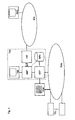
- the intelligent telecommunication network of FIG. 1 exists from the actual telecommunications network TKN, to which several Participants TEL are connected, as well as the operator TVM of the telecommunications network and the network control station TSS for the services of the intelligent telecommunications network.
- the network control station TSS consists of the Service operating station SCP ('service control point'), the Service management station SMP ('service management point') and various devices that act as peripheral to the service management station serve.
- the latter include in particular at least a terminal TML, which gives the network operator access to the service management station SMP for the purpose of service management offers databases such as the RPN numbering plan to which also the mediation TVM directly or indirectly through the Service operating station SCP accesses, as well as a firewall calculator FIR ('firewall computer'), which acts as a connection point between the network control station TSS and the Internet IPN serves.
- a terminal TML which gives the network operator access to the service management station SMP for the purpose of service management offers databases such as the RPN numbering plan to which also the mediation TVM directly or indirectly through the Service operating station SCP accesses, as well as a firewall calculator FIR ('firewall computer'), which acts as a connection point between the network control station TSS and the Internet IPN serves.
- FIR 'firewall computer'
- the firewall computer FIR serves to protect the service management station SMP against unauthorized access from the Internet.
- Firewall calculators or 'firewalls' are a well-known concept to secure computer networks.
- the takes over Firewall calculator all functions of an internet server for the adaptation of services and thus relieves the actual service management station SMP from these tasks.
- a service provider adjusts one of its services wants, he reports to the network control station TSS via the Firewall calculator FIR, and the processing of the prototypes and instances take place, for example, according to the client-server principle between the firewall computer FIR and the terminal DAC of the service provider, which is typically a PC with Internet software is.
- the firewall calculator FIR obtains the service-related files from the service management station SMP and provides modified versions of this data if necessary back to the service management station; the traffic between however, these computers are limited to these files. For the service provider, of course, if it is from his DAC terminal computer connected to the Internet Services, the firewall calculator FIR transparent and thus no difference in recognizing whether he is adapting to the service management station SMP directly or via a Firewall calculator executes.
- the invention enables data to be transmitted via an external medium to make accessible to a closed control system for telecommunication services.
- an existing computer network like the Internet the service provider has access to customize the service of any computer location connected to this computer network connected; means in the case of the Internet this is a worldwide way of access.
- TSS The components, applications and files of the network control station As far as they are relevant for the invention, TSS are in Fig. 2 shown.
- SD 'service definition'
- SIBs system independent building blocks'
- SIBs elementary tasks of a service flow execute, e.g. the output of a text announcement or the query the current time, as well as "global" data of a general nature, such as. Standard announcements or tariff plans.
- the service modules and the global data are in own databases SBD and GDD of the service management station stored.
- the network operator now selects the ones required for the service Service modules and arranges them in the manner of a flow chart to each other.
- Branches can also be used here are programmed, namely by means of appropriate branching SIBs, made dependent on various parameters can be, e.g. from the caller's location or the Area code of the calling party or of the calling party active inputs.
- This arrangement of service modules in The service definition which at Can be saved as a separate data object SDF.
- the service definition is symbolic in nature, comparable to one Algorithm or a program of a higher programming language.
- the service modules of the Service definition in general parameters by the service provider are to be adapted and left free by the network operator or pre-configured, e.g. an information text. Out for these reasons, the service definition cannot be used directly for the Execution of the service can be used. Instead, it will the service definition SDF to a compiler tool SC ('service compiler ') passed to the service management station SMP and by this compiler tool SC in service functions FSL and Service data prototypes SPP, briefly referred to as prototypes, converted.
- SC 'service compiler '
- the service functions FSL ('flexible service logic') contain the procedures of the service in procedural Shape, but still require that to be supplied by the service provider Data whose type and format are defined in the prototypes are.
- the network operator can already at this point prepare the service on the telecommunications network. This includes editing the number plans, e.g. the Setting up a universal number, and creating it and description of service user permissions.
- service data instances SDD The service data to be adjusted by the service provider must now be delivered by the service provider. This is done in the form the service data instances SDD, briefly referred to as instances.
- the data contained in an instance are of type and format determined by the underlying prototype SPP, comparable to a formal text, its shape is determined by a form.
- the invention provides the service provider with a simplified, present graphical representation.
- This graphic The network operator generates a presentation of the service flow the creation of the service definition using the definition tool SD. Alternatively, it is also conceivable that graphic presentation only when converting to prototypes to create. The network operator summarizes this in each case functionally related service modules in a group together and creates a graphic object that this Group represented in the graphic representation.
- a graphic Object is also a set on the part of the service provider assigned parameters to be adjusted, namely the Parameters of those service modules that represent the object Belong to service module group. Any graphic Furthermore, one or more forms belong to the object the service data assigned to the object is entered.
- the graphic representation is shared with the rest Data formats when converting the data definition stored the service compiler SD in its own markup prototypes MSP, which generates SPP in addition to the service prototype be and then through when customizing the service the graphic representation is available to the service provider becomes. It would of course also be possible to provide information to the Store markup prototypes MSP directly in the prototype SPP; however, this is in practice because of the size of the treated Amounts of data not advisable. Usually every service prototype SPP assigned a markup prototype MSP; however, this must Assignment should not be clear, because in special cases too One markup prototype MSP receives several service prototypes SPP can and vice versa.
- a service module group can also consist of only one service module.
- a group can be empty, for example with a special one Service in a flow branch nothing to do. Can too Parts of the service flow that are irrelevant for the service provider are omitted in the graphical representation his.
- These special cases are particularly common Designing service families of importance, or if one Service belong to several markup prototypes.
- HTML Hyper-text markup language
- HTML is one on the Internet, especially on the World-Wide Web, commonly used typesetting language and based on the 'standard generalized set in the ISO 8879 standard markup language ', in the formatting information of text, text styles, cross references etc. as so-called markups being represented.
- Markups are commands in text form that appear at certain features, e.g. an escape symbol, as commands are recognizable. From a markup text interpreter or - Compilers will markups in the appropriate characteristics converted for the rest of the text.
- HTML documents can be done in different ways be implemented in HTML documents, e.g. by embedding an HTML-independent image, by means of construction graphic markups, by assembling and arranging Elements to a graphic or by combining these methods.
- Markups can also contain commands that can be executed interactively in the form of a response from the HTML browser or Servers are and by a specific command of the user - here the service provider - are activated. The activation e.g. by clicking on the screen with Help the mouse.
- the so-called Links in HTML texts are markups that are mostly considered im keywords appearing in ordinary text appear and by e.g.
- Highlighting in a specific color for the Service providers are recognizable as links; actually pose they cross-reference to other parts of the same document or to other HTML documents. By activating a link the text passage to which the link refers is displayed, where necessary, switched to another HTML document becomes.
- the service provider registers for the adaptation of a service from his DAC terminal using the on the terminal running browser over the Internet at the network control station TSS on.
- the service provider must now first authorize to be able to access the service data objects. This happens e.g. by entering a PIN number or a transaction identification.
- All of the following now Service customization processes take place with the help of HTML documents instead of taking the service provider through its commands Enable markups or when prompted with a markup by entering instructions there.
- Become the service provider at the beginning of the service adjustment in an overview list Represents services to which the service provider has access accordingly the authorization he entered, and the assigned prototypes and any existing ones Instances. The entries in this list provide links to the respective Prototypes etc.
- the service provider now chooses the service and the prototype that he wants to customize Activate the corresponding entry, whereupon the so selected prototype is displayed using the markup prototype MSP becomes.
- the markup prototypes MSP depend on theirs Scope as separate HTML documents before or as sections in a larger document, such as the one expanded accordingly Service overview list.
- a service prototype SPP selected by the service provider is now using the graphical representation in the markup prototypes MSP represented.
- the service provider activates a graphic object, whereupon the one assigned to the graphic object Forms appear and the service provider the Enter service data or change existing ones.
- the Service providers convert the data of a service prototype into one for has given it a satisfactory shape, e.g. by activating a "button", which of course is also a Markup is the customization, whereupon from the markup prototype an instance with the entered data on the network control station TSS is generated. It should be noted here that the Prototypes even while customizing the service the service provider is not changed, just serve as a template and instrument for creating instances. With the help of another "button" the service provider leaves the prototype SPP / MSP and returns to the service overview list back.
- the newly created instance is considered to be current version, which will be updated the next time the Service should be taken into account. If the service provider however, use an existing instance wants, e.g. to return to an earlier information text, this is done by selecting this instance in the Service overview list.
- the service provider can also change existing instances by that he selects the instance to be changed and then activates it, whereupon an adaptation process begins for this instance. If desired by the service provider, additional associated prototypes called and the data of the instance are used as presets, now by the service provider can be changed as needed. At the end The adjustment is made according to the instructions from the service provider either overwrite the instance with the new version or remains next to the new version.
- the service provider resolves activation or, if the service already exists, updating the service, for example by a corresponding one "Stud".
- Service activation or update happens in that the service provider as current Versions marked instances SDD in the network control station transmitted to the service operating station SCP and linked with the service functions FSL.
- This takes place depending on the configuration of the network control station TSS automatically and is created by the presence of new ones Instance versions triggered, or it is explicitly by causes the service provider. Of course there is for the service provider also the possibility of using the service adjustment a "cancel button".
Landscapes
- Engineering & Computer Science (AREA)
- Computer Networks & Wireless Communication (AREA)
- Signal Processing (AREA)
- Data Exchanges In Wide-Area Networks (AREA)
- Computer And Data Communications (AREA)
- Exchange Systems With Centralized Control (AREA)
- Information Transfer Between Computers (AREA)
Claims (29)
- Procédé pour la mise en place et/ou la modification un service d'un réseau intelligent, qui est géré par un exploitant de réseau et qui comprend un réseau de télécommunications proprement dit, au moins un point de commande de service (SCP) créé pour l'exécution des services du réseau intelligent et au moins un point de gestion de service (SMP) affecté au(x) point(s) de commande de service dans lequelcaractérisé en ce quea) l'exploitant de réseau crée resp. modifie une définition du service sur commande d'un prestataire de services,b) l'exploitant du réseau convertit cette définition du service sur le point de gestion de service (SMP) en fonctions de service et en prototypes de données de service, les fonctions de service représentant les procédures à exécuter par le service et ces prototypes servant à décrire les données utilisées par les fonctions de service,c) l'exploitant de réseau prépare le service en utilisant les fonctions de service et les prototypes sur le réseau intelligent,d) le prestataire de services génère au moins une instance de données de service à partir d'un terminal par l'intermédiaire d'une liaison établie avec le point de gestion de service (SMP), cette instance contenant les données utilisées par les fonctions de service,e) le prestataire de services sélectionne parmi les instances au moins une instance pour l'activation resp. l'actualisation du service etf) le prestataire de services active resp. actualise le service en utilisant les fonctions de service et les instances sélectionnées par l'utilisateur de services,
pour un certain nombre de prototypes, mais au moins pour l'un d'entre eux, un format de données est choisi, qui permet d'enregistrer tant du texte que des codes d'instructions dans un format compatible texte, comme par ex. des instructions symboliques,
les prototypes "markup" représentés dans le format de données sélectionné sont dotés de codes d'instructions, qui servent à produire des instances,
le contenu d'au moins un prototype "markup" est affiché sur le terminal du prestataire de services et
le prestataire de services produit les instances en sélectionnant et en laissant exécuter au moins un code d'instructions au moyen des instructions entrées sur son terminal à partir des codes d'instructions de l'au moins un prototype "markup" affiché. - Procédé selon la revendication 1, caractérisé en ce qu'une structure graphique, qui correspond à la structure logique du service, est produite lors de la création resp. de l'exécution ou de la conversion de la définition du service par l'exploitant du réseau et qui est déposée dans un prototype "markup" à l'aide des codes d'instructions compatibles texte.
- Procédé selon la revendication 2, caractérisé en ce que la structure graphique est représentée sur le terminal du prestataire de services lors de la production ou de la sélection des instances.
- Procédé selon l'une des revendications 1 à 3, caractérisé en ce qu'un service est défini en ce que l'exploitant du réseau sélectionne un certain nombre de modules de service prédéfinis et qu'il définit l'association mutuelle de ces modules de service et avec les composants du réseau intelligent.
- Procédé selon les revendications 2 et 4, caractérisé en ce que les modules de service connexes au plan fonctionnel sont regroupés et qu'au moins un objet de la structure graphique est affecté à chaque groupe.
- Procédé selon l'une des revendications 1 à 5, caractérisé en ce que le prestataire de services est invité à entrer des données lors de la production des instances, qui sont utilisées pour produire les instances.
- Procédé selon les revendications 5 et 6, caractérisé en ce que le prestataire de services est invité à entrer des paramètres de modules de service, ce qui s'effectue à l'aide de formulaires, chacun étant affecté à un objet de la structure graphique et servant à entrer des paramètres de ces modules de service, qui sont représentés par l'objet correspondant à un formulaire.
- Procédé selon la revendication 6 ou 7, caractérisé en ce que le prestataire de services déclenche l'invitation à entrer des données par une instruction spécifique, par ex. en sélectionnant un code d'instructions ou en cliquant sur un élément graphique auquel un formulaire d'entrée est affecté.
- Procédé selon l'une des revendications 1 à 8, caractérisé en ce que un langage "markup", par ex. HTML, est utilisé pour le format des données des prototypes "markup" et en ce que le prototype "markup" est affiché aux prestataires de service à l'aide d'un programme de navigation approprié au langage "markup".
- Procédé selon l'une des revendications 1 à 9, caractérisé en ce que la liaison du terminal du prestataire de services au point de gestion de service (SMP) est établie par un réseau informatique en libre accès.
- Procédé selon l'une des revendications 1 à 10, caractérisé en ce que la liaison du terminal du prestataire de services au point de gestion de service (SMP) est établie par un ordinateur pare-feu affecté au poste de gestion du service.
- Procédé selon l'une des revendications 1 à 11, caractérisé en ce que l'accès au point de gestion de service (SMP) resp, l'accès aux prototypes n'est accordé au prestataire de services qu'après entrée d'une autorisation, par ex. d'un code d'identification personnel PIN ou d'un numéro d'identification de transaction.
- Procédé selon l'une des revendications 1 à 12, caractérisé en ce que l'exploitant de réseau utilise un outil de définition (SD) du point de gestion de service (SMP) pour la création resp. la modification de la définition de services.
- Procédé selon l'une des revendications 1 à 13, caractérisé en ce que l'exploitant du réseau utilise un outil compilateur (SC) du point de gestion de service (SMP) pour la conversion de la définition du service.
- Procédé selon l'une des revendications 1 à 14, caractérisé en ce que l'exploitant de réseau prépare le service sur le réseau de télécommunications (TKN) à l'aide d'un outil de gestion.
- Procédé selon l'une des revendications 1 à 15, caractérisé en ce que la production des instances et/ou la sélection des instances et/ou l'activation resp. l'actualisation du service est exécutée par un abonné au service autorisé à cet effet par le prestataire de services et/ou l'exploitant du réseau.
- Procédé pour la production de prototypes de données de service, qui servent à décrire les données utilisées dans un service de télécommunications d'un réseau intelligent,
caractérisé en ce que
pour les prototypes un format de données est choisi, qui permet d'enregistrer à la fois du texte et des codes d'instruction dans un format compatible texte, comme par ex. des instructions symboliques et
les prototypes sont dotés de codes d'instruction, qui servent à produire des instances de données de service, les instances contenant les données utilisées dans un service de télécommunications d'un réseau intelligent. - Procédé selon la revendication 17, caractérisé en ce qu'une structure graphique, qui correspond à la structure logique du service, est produite et déposée dans un prototype à l'aide de codes d'instruction compatibles texte.
- Procédé selon la revendication 18, caractérisé en ce qu'un service est défini par la sélection d'un nombre prédéfini de modules de service et par la définition de l'association mutuelle de ces modules de service et avec les composants du réseau intelligent, les modules de service connexes au plan fonctionnel sont regroupés et au moins un objet de la structure graphique est affecté à chaque groupe.
- Procédé selon l'une des revendications 17 à 19, caractérisé en ce qu'un langage "markup", par ex. HTML, est utilisé pour le format des données des prototypes.
- Procédé pour produire des instances de données de service à l'aide de prototypes de données de service selon l'une des revendications 17 à 20 par un utilisateur, caractérisé en ce que le contenu d'au moins un prototype est affiché sur le terminal de l'utilisateur et l'utilisateur produit les instances en sélectionnant et en laissant exécuter au moins un code d'instructions approprié au moyen d'instructions entrées sur son terminal à partir des codes d'instruction.
- Procédé pour produire des instances de données de service selon la revendication 21 à l'aide de prototypes de données de service selon l'une des revendications 18 à 20, caractérisé en ce que la structure graphique est représentée sur un terminal de l'utilisateur.
- Procédé selon l'une des revendications 21 à 22, caractérisé en ce que l'utilisateur est invité à entrer des données, qui sont utilisées pour la production des instances.
- Procédé pour la production d'instances de données de service selon la revendication 23 à l'aide de prototypes de données de service selon la revendication 19 ou 20, caractérisé en ce que l'utilisateur est invité à entrer des paramètres de module de service, ceci s'effectuant à l'aide de formulaires, qui sont affectés chacun à un objet de la structure graphique et qui servent à entrer des paramètres de chacun de ces modules de service, qui sont représentés par l'objet correspondant à un formulaire.
- Procédé selon la revendication 23 ou 24, caractérisé en ce que l'utilisateur déclenche l'invitation à entrer des données par une instruction spécifique, par ex. en sélectionnant un code d'instructions ou en cliquant sur un élément graphique auquel un formulaire d'entrée est affecté.
- Procédé selon l'une des revendications 21 à 25, caractérisé en ce que le prototype est affiché à l'utilisateur à l'aide d'un programme de navigation approprié au langage "markup".
- Procédé selon l'une des revendications 21 à 26, caractérisé en ce que l'utilisateur effectue la production des instances à partir d'un terminal relié au point de gestion de service (SMP) du réseau intelligent au moyen d'un réseau informatique en libre accès.
- Procédé selon l'une des revendications 21 à 27, caractérisé en ce que la liaison du terminal de l'utilisateur au point de gestion de service (SMP) est établie au moyen d'un ordinateur pare-feu affecté au point de gestion de service.
- Procédé selon l'une des revendications 21 à 28, caractérisé en ce que l'accès au point de gestion de service (SMP) resp. aux prototypes n'est accordé à l'utilisateur qu'après entrée d'une autorisation, par ex. d'un code d'identification personnel PIN ou d'un numéro d'identification de transaction.
Applications Claiming Priority (3)
| Application Number | Priority Date | Filing Date | Title |
|---|---|---|---|
| DE19734515 | 1997-08-08 | ||
| DE19734515A DE19734515A1 (de) | 1997-08-08 | 1997-08-08 | Verfahren zur Einrichtung und/oder Bearbeitung eines Dienstes eines intelligenten Netzes |
| PCT/DE1998/002062 WO1999008452A2 (fr) | 1997-08-08 | 1998-07-22 | Procede pour creer et/ou executer un service d'un reseau intelligent |
Publications (2)
| Publication Number | Publication Date |
|---|---|
| EP1002432A2 EP1002432A2 (fr) | 2000-05-24 |
| EP1002432B1 true EP1002432B1 (fr) | 2004-10-13 |
Family
ID=7838475
Family Applications (1)
| Application Number | Title | Priority Date | Filing Date |
|---|---|---|---|
| EP98943712A Expired - Lifetime EP1002432B1 (fr) | 1997-08-08 | 1998-07-22 | Procede pour creer et/ou executer un service d'un reseau intelligent |
Country Status (4)
| Country | Link |
|---|---|
| US (1) | US7072953B1 (fr) |
| EP (1) | EP1002432B1 (fr) |
| DE (2) | DE19734515A1 (fr) |
| WO (1) | WO1999008452A2 (fr) |
Cited By (1)
| Publication number | Priority date | Publication date | Assignee | Title |
|---|---|---|---|---|
| US11210082B2 (en) | 2009-07-23 | 2021-12-28 | S3G Technology Llc | Modification of terminal and service provider machines using an update server machine |
Families Citing this family (6)
| Publication number | Priority date | Publication date | Assignee | Title |
|---|---|---|---|---|
| DE10111036A1 (de) * | 2001-03-07 | 2002-09-12 | Gloocorp Ag | Übergreifendes Authentifizierungskonzept für Teilnehmer in öffentlichen Telefonnetzen und dem Internet |
| CN100407639C (zh) * | 2004-07-08 | 2008-07-30 | 中兴通讯股份有限公司 | 一种动态自适应的智能网网管系统及实现方法 |
| US7406520B2 (en) * | 2004-07-30 | 2008-07-29 | Sap Aktiengesellschaft | Identifying interfaces related to a service |
| US7664841B2 (en) * | 2005-12-07 | 2010-02-16 | International Business Machines Corporation | Selective activation of TCP/IP link and traffic |
| US8504989B2 (en) * | 2011-03-10 | 2013-08-06 | Infosys Limited | Service definition document for providing blended services utilizing multiple service endpoints |
| CN103124381B (zh) * | 2011-11-18 | 2018-06-15 | 中兴通讯股份有限公司 | 业务配置方法及系统 |
Family Cites Families (8)
| Publication number | Priority date | Publication date | Assignee | Title |
|---|---|---|---|---|
| US5915008A (en) * | 1995-10-04 | 1999-06-22 | Bell Atlantic Network Services, Inc. | System and method for changing advanced intelligent network services from customer premises equipment |
| KR19990067327A (ko) * | 1995-11-02 | 1999-08-16 | 내쉬 로저 윌리엄 | 통신 네트워크용 서비스 창조 장치 |
| US6115737A (en) * | 1996-07-24 | 2000-09-05 | Telcordia Technologies, Inc. | System and method for accessing customer contact services over a network |
| US6031904A (en) * | 1996-10-23 | 2000-02-29 | Nortel Networks Corporation | Service order mechanism for telephone subscriber |
| US5912954A (en) * | 1997-02-28 | 1999-06-15 | Alcatel Usa Sourcing, L.P. | Method and system for providing billing information in a telecommunications network |
| US6282566B1 (en) * | 1997-05-30 | 2001-08-28 | Alcatel Usa Sourcing, L.P. | System and method for a debit card telecom service |
| US5958016A (en) * | 1997-07-13 | 1999-09-28 | Bell Atlantic Network Services, Inc. | Internet-web link for access to intelligent network service control |
| US6243451B1 (en) * | 1997-10-09 | 2001-06-05 | Alcatel Usa Sourcing, L.P. | Service management access point |
-
1997
- 1997-08-08 DE DE19734515A patent/DE19734515A1/de not_active Withdrawn
-
1998
- 1998-07-22 WO PCT/DE1998/002062 patent/WO1999008452A2/fr not_active Ceased
- 1998-07-22 DE DE1998512126 patent/DE59812126D1/de not_active Expired - Fee Related
- 1998-07-22 EP EP98943712A patent/EP1002432B1/fr not_active Expired - Lifetime
-
2000
- 2000-02-08 US US09/500,281 patent/US7072953B1/en not_active Expired - Lifetime
Cited By (1)
| Publication number | Priority date | Publication date | Assignee | Title |
|---|---|---|---|---|
| US11210082B2 (en) | 2009-07-23 | 2021-12-28 | S3G Technology Llc | Modification of terminal and service provider machines using an update server machine |
Also Published As
| Publication number | Publication date |
|---|---|
| WO1999008452A3 (fr) | 1999-04-29 |
| US7072953B1 (en) | 2006-07-04 |
| EP1002432A2 (fr) | 2000-05-24 |
| WO1999008452A2 (fr) | 1999-02-18 |
| DE19734515A1 (de) | 1999-02-11 |
| DE59812126D1 (de) | 2004-11-18 |
Similar Documents
| Publication | Publication Date | Title |
|---|---|---|
| DE69835158T2 (de) | Zugriffpunkt zur dienstverwaltung | |
| EP0619684B1 (fr) | Procédé pour le contrôle à distance de l'administration de systèmes de communication | |
| DE60314601T2 (de) | System und Verfahren zur Dienstbereitsstellung für ein Kommunikationsgerät | |
| DE69420263T2 (de) | Verfahren und system zur steuerung des betriebs einer fernsprechvermittlungsanlage von einem teilnehmeranschluss | |
| DE69636157T2 (de) | Verfahren und System zum graphischen Anzeigen und zur Navigation durch ein interaktives Sprachantwortmenü | |
| EP0684725A2 (fr) | Ordinateur personnel de service à structure modulaire | |
| EP0207255B1 (fr) | Montage pour commander et maintenir un central de télécommunications, en particulier un central téléphonique | |
| DE69925711T2 (de) | Dienstabgabe in einem kommunikationssystem | |
| DE69332927T2 (de) | Gerät zur Verwaltung eines Elementverwalters für ein Fernmeldevermittlungssystem | |
| EP1002432B1 (fr) | Procede pour creer et/ou executer un service d'un reseau intelligent | |
| EP1396990A1 (fr) | Procédé de gestion de données dans une distribution d'appels automatique | |
| DE19810869A1 (de) | Verfahren zur Verwaltung von Telekommunikationsdienst-Daten eines Teilnehmers sowie Server und Vermittlungsstelle hierzu | |
| DE60114949T2 (de) | Leitweglenkung | |
| DE19801563A1 (de) | Kommunikationssystem mit Unterstützung mobiler Teilnehmer und automatischer Informations- und Medienumsetzung | |
| DE19615683A1 (de) | Verfahren und Steuereinrichtung für eine graphische Steuerung von Abläufen in einem Netzwerkmanagementsystem | |
| EP0303869A1 (fr) | Système de communication numérique à structure modulaire comprenant des moyens de communication d'opération technique | |
| DE69833470T2 (de) | Verfahren und Gerät zur Aktualisierung von Textdaten für eine elektrische Einrichtung | |
| EP0614551B1 (fr) | Procede de commande de l'interaction entre une interface utilisateur et une application | |
| DE10050360B4 (de) | Verfahren Aktivierung und/oder Deaktivierung von Diensten in einem Vermittlungssystem | |
| DE19845272A1 (de) | Verfahren, Server und Endgerät zur Modifikation von in einem Server gespeicherten Dienstleistungs-Daten | |
| EP1150479A2 (fr) | Méthode pour la demande d'information interactive par un telephone mobile | |
| DE4418208C2 (de) | Verfahren und Service-Personalcomputer zum Administrieren und Warten von Kommunikationssystemen | |
| DE10001417A1 (de) | Verfahren, Vermittlungsstelle, Diensterechner, Programm-Modul und Schnittstelleneinrichtung zur Übermittlung von Telekommunikationsdienst-Daten zwischen einer Vermittlungsstelle und einem Diensterechner | |
| DE69533164T2 (de) | Vereinfachte mehranrufverarbeitung | |
| DE69534777T2 (de) | Flexibler anrufregistrierungsmechanismus |
Legal Events
| Date | Code | Title | Description |
|---|---|---|---|
| PUAI | Public reference made under article 153(3) epc to a published international application that has entered the european phase |
Free format text: ORIGINAL CODE: 0009012 |
|
| 17P | Request for examination filed |
Effective date: 20000121 |
|
| AK | Designated contracting states |
Kind code of ref document: A2 Designated state(s): DE GB |
|
| GRAP | Despatch of communication of intention to grant a patent |
Free format text: ORIGINAL CODE: EPIDOSNIGR1 |
|
| GRAS | Grant fee paid |
Free format text: ORIGINAL CODE: EPIDOSNIGR3 |
|
| GRAA | (expected) grant |
Free format text: ORIGINAL CODE: 0009210 |
|
| AK | Designated contracting states |
Kind code of ref document: B1 Designated state(s): DE GB |
|
| REG | Reference to a national code |
Ref country code: GB Ref legal event code: FG4D Free format text: NOT ENGLISH |
|
| GBT | Gb: translation of ep patent filed (gb section 77(6)(a)/1977) |
Effective date: 20041013 |
|
| REF | Corresponds to: |
Ref document number: 59812126 Country of ref document: DE Date of ref document: 20041118 Kind code of ref document: P |
|
| PLBE | No opposition filed within time limit |
Free format text: ORIGINAL CODE: 0009261 |
|
| STAA | Information on the status of an ep patent application or granted ep patent |
Free format text: STATUS: NO OPPOSITION FILED WITHIN TIME LIMIT |
|
| 26N | No opposition filed |
Effective date: 20050714 |
|
| PGFP | Annual fee paid to national office [announced via postgrant information from national office to epo] |
Ref country code: DE Payment date: 20070731 Year of fee payment: 10 |
|
| PGFP | Annual fee paid to national office [announced via postgrant information from national office to epo] |
Ref country code: GB Payment date: 20070720 Year of fee payment: 10 |
|
| REG | Reference to a national code |
Ref country code: GB Ref legal event code: 732E Free format text: REGISTERED BETWEEN 20090212 AND 20090218 |
|
| GBPC | Gb: european patent ceased through non-payment of renewal fee |
Effective date: 20080722 |
|
| PG25 | Lapsed in a contracting state [announced via postgrant information from national office to epo] |
Ref country code: DE Free format text: LAPSE BECAUSE OF NON-PAYMENT OF DUE FEES Effective date: 20090203 |
|
| PG25 | Lapsed in a contracting state [announced via postgrant information from national office to epo] |
Ref country code: GB Free format text: LAPSE BECAUSE OF NON-PAYMENT OF DUE FEES Effective date: 20080722 |