EP1002462A2 - Dispositif pour attraper des escargots et moyens utilisables dans un tel dispositif - Google Patents
Dispositif pour attraper des escargots et moyens utilisables dans un tel dispositif Download PDFInfo
- Publication number
- EP1002462A2 EP1002462A2 EP99122927A EP99122927A EP1002462A2 EP 1002462 A2 EP1002462 A2 EP 1002462A2 EP 99122927 A EP99122927 A EP 99122927A EP 99122927 A EP99122927 A EP 99122927A EP 1002462 A2 EP1002462 A2 EP 1002462A2
- Authority
- EP
- European Patent Office
- Prior art keywords
- snails
- plates
- barbs
- hair
- scale
- Prior art date
- Legal status (The legal status is an assumption and is not a legal conclusion. Google has not performed a legal analysis and makes no representation as to the accuracy of the status listed.)
- Withdrawn
Links
Images




Classifications
-
- A—HUMAN NECESSITIES
- A01—AGRICULTURE; FORESTRY; ANIMAL HUSBANDRY; HUNTING; TRAPPING; FISHING
- A01M—CATCHING, TRAPPING OR SCARING OF ANIMALS; APPARATUS FOR THE DESTRUCTION OF NOXIOUS ANIMALS OR NOXIOUS PLANTS
- A01M25/00—Devices for dispensing poison for animals
- A01M25/008—Devices specially adapted for snails, e.g. bait stations therefor
-
- A—HUMAN NECESSITIES
- A01—AGRICULTURE; FORESTRY; ANIMAL HUSBANDRY; HUNTING; TRAPPING; FISHING
- A01G—HORTICULTURE; CULTIVATION OF VEGETABLES, FLOWERS, RICE, FRUIT, VINES, HOPS OR SEAWEED; FORESTRY; WATERING
- A01G13/00—Protection of plants
- A01G13/10—Devices for affording protection against animals, birds or other pests
- A01G13/105—Protective devices against slugs, snails, crawling insects or other climbing animals
Definitions
- the present invention relates to a device for catching snails.
- the device comprises an arrangement of barbs.
- the device comprises a trap with a hollow between sides formed by one or more surfaces where the movement of snails is controlled by the barb arrangement.
- a large number of different traps, baits and killing methods for catching and killing snails, especially so-called killer snails of the species Arion Lusitanicus, are known.
- the traps either utilises the feature that the snail seek shelter in dark and humid locations as the snails are night-active animals or the feature that the snails are attracted by strongly smelling objects, like decaying plants, fruits or animals.
- the traps may either be of the fall trap kind where the snail fall into a hollow wherefrom they cannot come up again or of the kind where in the trap there is placed a material or a product which is attractive to the snails but which is deadly to the snails.
- the baits may be the previously mentioned strongly smelling objects which may be provided with materials which are poisonous, detrimental or in other ways deadly to the snails.
- the killing methods may either be materials or products which are deadly to the snails, or be electric or mechanical killing methods.
- the device according to the invention is technically simple to make as the baits can be made as integral elements on plates.
- the trap itself is easy to set up as such plates are used for building up the device or as separate elements which are fastened on the plates.
- the barbs may be hair- or scale-like material.
- a particularly effective trap my be formed of two plates forming an interspace where the barbs are placed for creating a lock effect
- the barbs only allow passage in one direction and close effectively the interspace when they are raised at attempts of passing in the opposite direction. Because of the elastic flexibility the barbs will thus yield and be pressed against the base by passing in the said one direction. When attempting passage the barbs will yield and be raised which prevents passage in the opposite direction.
- the barbs are placed under an acute angle in relation to the base with orientation in the direction where passage is possible. Therefore, because of the elastic flexibility they will only yield and be pressed against the base when passing in the one direction.
- the plates may be assembled in any optional way.
- the plates may be assembled with tape, clips, Velcro tape or other external means for mechanical joining the plates.
- the plates may be provided along the sides with means in the shape of hooks, hinges or other integrated means for joining the sides of the plates.
- the means according to the invention has the features indicated in claim 10. It consists of small particles which the snails eat and which contain materials being detrimental to the snails. If the particles consist of liposomes, these comprise an outer shell formed of lipids.
- the lipids in the shell are formed of a material preferably being attractive to the snails, at least not being repulsive to the snails, and which at the same time has sufficient stability to the weather.
- the material that the outer shell should be formed of is vegetable starch, like maize starch, or wax, possibly added with scents and/or flavourings, or other natural products.
- the shell has a thickness so that the shell form a sufficiently resistant exterior of the particles with respect to strength and resistance to outside weather, but also so that the shell has a sufficiently small thickness in order that the shell may be broken down chemically by the inner of the snail or mechanically by the tooth organ of the snail. Thereby it is ensured that the material or product constituting the core may come into contact with the inner of the snail after the snail has eaten the particles.
- the particles will preferably be contained in e.g. a gelatine mass. If the particles are liposomes, the shell on the liposomes will initially have sufficient stability against the weather but may also, like other particles, be contained in e.g. a gelatine mass.
- the liposomes also comprise an inner core formed by a material or a product which destroys the inner of the snail, either by a chemical or physical decomposition of the snail or by a mechanical destruction of the snail.
- the materials or products in the core of the liposomes comes into contact with the inner of the snail after the snail has eaten the liposomes and the small tooth organs possessed by the throat of the snail have grated off the outer shell the liposomes. Then the core of the liposomes will be free and be able to destroy the stomach of the snail.
- the materials or products which the inner core is formed of and which destroys the snail chemically or physically are vitamin A, chitinase, chalk, aluminium, complex metal binders, acetyl choline and other materials known to break down organisms like the inner of a snail, like an organism as the human stomach.
- Materials or products that the inner core also may be formed of and which destroys the snail mechanically are hair, metal shavings and other fibrous materials. Alternatively, it may be sharp or pointed, granulated materials like broken glass.
- the core is preferably formed of a foamed material or other material with a moisture absorbing capability and which will dehydrate the snail. It may be a synthetic sponge, pressed sphagnum or small pellets of copper sulphate.
- the material has a texture so that the snail can move around in the material.
- the material forming the core has hydrophilic qualities so that the snails become dehydrated when the move around in the material.
- the material may be filled with a material which destroys the snails chemically, physically or mechanically, e.g. a mucous loosening agent like acetyl choline.
- the shell as well as the core are formed of a biologically decomposable material, it will be possible to compost the body when it has destroyed a sufficient number of snails. Shell, core as well as snails will thereby become part of the circulation of the nature in a natural way.
- Fig. 1 shows the special barb arrangement 1 which by placing on surface parts 2 of a trap 3 (see Fig. 2) ensures that the movement of the snails 4 is guided in one direction 5.
- the barbs function trough their mechanical and designed ability of bending when a snail is moving along with the barbs. On the contrary, the barbs are raised when the snails move against the barbs, and a barrier of many pointed barbs appears.
- the barbs will be double-acting in a preferred embodiment where there will be barbs on upper plate members 2' and on lower plate members 2'' of the trap 3, as shown in Fig 2, where the disposal of the barbs on the upper and lower plate member is arranged so that the barbs together completely shuts off movements against the barbs, whereas it is possible to move with the barbs in the direction 5 because of the elastic flexibility of the barbs.
- Fig. 2 shows a first embodiment of a trap for catching snails.
- the snails are lured into the trap, whereafter they may be killed with a material which is deadly for the snails, or the snails may be collected in a bag or the like placed at the bottom of the hollow.
- the trap consists of a hollow formed between sides 6 of the hollow.
- the sides consist of a number of plates 2',2'' joined along edges 7 of plates 2 for forming the sides.
- the sides may have different shapes and may be formed of one or more plate members or plates. In the embodiment shown the sides are formed of at least isosceles triangular plates. Thereby it is possible to form hollows with different sizes and depths.
- the hollow is preferably partly filled with a means attracting the snails, like beer, decaying apples, cabbage, onions, etc.
- the plates are provided with an arrangement of barbs as shown in Fig. 1.
- the scales or hairs extend in direction upwards or downwards towards the base line of the triangle.
- the scales or hairs are oppositely directed.
- the scales or hairs may be made of plastic or other material being resistant to the weather.
- plates there is used plates with another design and where either both sides or only one side are/is provided with a material formed as scale or hair extending in the same direction.
- the scales or hairs at the outer side have to be directed upwards from the bottom of the plates and toward the top of the hollow. If the plates are provided with scales or hair at the inner side of the plates as in the shown embodiment the scales or hairs at the inner side will be directed downwards from the top of the hollow toward the bottom of the hollow.
- Snails will be able to crawl along the sides in the same direction that the scales or hairs are directed.
- the snails will, however, not be able to or at least have difficulty in crawling along the sides in direction opposite to the scales or hairs. Because of the bait in the hollow, the snails will be attracted to the hollow, crawl up along the outer side of the plates and then crawl down along the inner side of the plates, or, if the sides form a frustum of a pyramid, fall down into the hollow.
- the advantage of forming the sides around the hollow by means of at least isosceles triangular plates is that it is possible by means of such plates for toxin hollows with different form, size and depth. From a given number of plates there may either be formed several small or lesser hollows or there may be form one large hollow, possibly a hollow with covering, for further attracting the snails with darkness. If such a covering is formed it will be possible to use this covering for further preventing the snails from getting out of the trap. By providing the covering at a suitable distance from the plate below, e.g. at a distance of between 0.5 and 5 cm, the hairs or scales will not hinder movement in direction of the scales.
- the hairs or scales will have tendency to be lifted when the snail tries to crawl the opposite direction of the one that the hairs or scales are directed in. Thereby the hairs or scales will extend between the plate and the covering and thus form a barrier between the plate and the covering and entirely prevent the snail form crawling back.
- the covering itself may be provided with a hair- or scale-like material at the underside, acting instead of or cooperating with hair- or scale-like material on the plates forming the sides of the hollow.
- the special feature of the plates 2 is that they are all identical, and by joining the identical plates a desired shape of an inner part 8 and an outer part 9 of the trap 3 appears.
- the plates may be joined along the sides in any optional way.
- the plates may be assembled with tape, clips, Velcro tape or other external means for mechanical joining the plates.
- the plates may be provided along the sides with means in the shape of hooks, hinges or other integrated means for joining the sides of the plates.
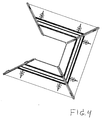
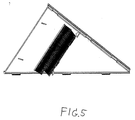
- the plates may also be joined in such a way that there is formed a plane with a hole at the centre. It is then necessary to establish a trapping possibility, like a hole digged into the earth immediately under the hole in the plane, or a killing possibility like liposomes. Furthermore, the plates can be assembled so that a frusto-conical hollow is formed. The two latter possibilities of assembling the plates are most suited if the plates are trapezoidal as illustrated in Figs. 1, 3 and 4 instead of triangular as shown in Figs. 2, 5, 6 and 7.
- Figs. 2, 4 and 7 show the trap in embodiments where the surfaces are assembled to whole surfaces which by joining form a pyramidal trap.
- the trap consists of four identical sides for the inner part 8 and four identical parts for the outer part 9.
- Figs. 8 and 9 illustrates a trap 3 built up from curved plates 10 and 11 to an inner and an outer part, respectively.
- the plates 10,11 are provided with a barb arrangement 1. This may be provided on one and/or both plates.
- the inner plate is annular around an opening 12 making possible the passing of the snails into the inner of the trap.
- the opening is covered by the outer plate 1 which forms a covering.
Landscapes
- Life Sciences & Earth Sciences (AREA)
- Insects & Arthropods (AREA)
- Zoology (AREA)
- Health & Medical Sciences (AREA)
- General Health & Medical Sciences (AREA)
- Toxicology (AREA)
- Environmental Sciences (AREA)
- Engineering & Computer Science (AREA)
- Pest Control & Pesticides (AREA)
- Wood Science & Technology (AREA)
- Birds (AREA)
- Catching Or Destruction (AREA)
Applications Claiming Priority (2)
| Application Number | Priority Date | Filing Date | Title |
|---|---|---|---|
| DKPA199801510 | 1998-11-18 | ||
| DK151098 | 1998-11-18 |
Publications (2)
| Publication Number | Publication Date |
|---|---|
| EP1002462A2 true EP1002462A2 (fr) | 2000-05-24 |
| EP1002462A3 EP1002462A3 (fr) | 2000-08-23 |
Family
ID=8105598
Family Applications (1)
| Application Number | Title | Priority Date | Filing Date |
|---|---|---|---|
| EP99122927A Withdrawn EP1002462A3 (fr) | 1998-11-18 | 1999-11-18 | Dispositif pour attraper des escargots et moyens utilisables dans un tel dispositif |
Country Status (1)
| Country | Link |
|---|---|
| EP (1) | EP1002462A3 (fr) |
Cited By (4)
| Publication number | Priority date | Publication date | Assignee | Title |
|---|---|---|---|---|
| US6739087B2 (en) | 2002-10-15 | 2004-05-25 | Exhart Environmental Systems, Inc. | Garden pest trap |
| WO2009092595A1 (fr) * | 2008-01-25 | 2009-07-30 | Etradan Bs Aps | Piège à limaces |
| CN104365419A (zh) * | 2014-10-30 | 2015-02-25 | 曾赞安 | 用于农业生产中防治软体动物的装置与方法 |
| CN104756964A (zh) * | 2015-04-09 | 2015-07-08 | 中国水产科学研究院珠江水产研究所 | 一种腹足类软体动物收集装置 |
Family Cites Families (5)
| Publication number | Priority date | Publication date | Assignee | Title |
|---|---|---|---|---|
| DE1901602A1 (de) * | 1969-01-14 | 1970-08-13 | Johannes Linke | Maeuse- und Rattenfalle im Reusen-Prinzip mit Koederpatrone |
| DE3604321C1 (de) * | 1986-02-12 | 1987-02-26 | Andreas Boeck | Schneckensperre |
| DE3728731C1 (de) * | 1987-08-28 | 1988-09-15 | Tobias Dipl-Agr-Bio Sachtleben | Einrichtung zur Schneckenabwehr |
| GB2262424B (en) * | 1991-12-17 | 1995-05-10 | Sheila Southwell | Slug stop collars |
| GB2321838B (en) * | 1997-02-11 | 2000-12-20 | Geraldine Orton | Device for protecting plants and seedlings |
-
1999
- 1999-11-18 EP EP99122927A patent/EP1002462A3/fr not_active Withdrawn
Cited By (5)
| Publication number | Priority date | Publication date | Assignee | Title |
|---|---|---|---|---|
| US6739087B2 (en) | 2002-10-15 | 2004-05-25 | Exhart Environmental Systems, Inc. | Garden pest trap |
| WO2009092595A1 (fr) * | 2008-01-25 | 2009-07-30 | Etradan Bs Aps | Piège à limaces |
| CN104365419A (zh) * | 2014-10-30 | 2015-02-25 | 曾赞安 | 用于农业生产中防治软体动物的装置与方法 |
| CN104756964A (zh) * | 2015-04-09 | 2015-07-08 | 中国水产科学研究院珠江水产研究所 | 一种腹足类软体动物收集装置 |
| CN104756964B (zh) * | 2015-04-09 | 2018-03-02 | 中国水产科学研究院珠江水产研究所 | 一种腹足类软体动物收集装置 |
Also Published As
| Publication number | Publication date |
|---|---|
| EP1002462A3 (fr) | 2000-08-23 |
Similar Documents
| Publication | Publication Date | Title |
|---|---|---|
| US3997999A (en) | Mosquito trap | |
| US5896697A (en) | Mosquito destroyer | |
| AU2002325191B2 (en) | A fencing | |
| US5119586A (en) | Insect trap | |
| TW568746B (en) | Device for controlling insects | |
| US5170584A (en) | Snail barrier | |
| US5622001A (en) | Slug and snail trap | |
| US4696127A (en) | Container for capturing insects | |
| US4607447A (en) | Food decoy mat for waterfowl | |
| JP6700100B2 (ja) | 天敵昆虫の保護装置 | |
| US5275125A (en) | Animal harborages | |
| US4441272A (en) | Method and apparatus for attracting useful insects | |
| US6718689B1 (en) | Insecticide packet for biting insects | |
| GB2232052A (en) | Device for protection against garden molluscs | |
| EP1002462A2 (fr) | Dispositif pour attraper des escargots et moyens utilisables dans un tel dispositif | |
| US4977701A (en) | Tamper resistant flying insect control device | |
| US9565845B1 (en) | Fly deterrent | |
| US6634315B1 (en) | Method of feeding ants and a food dispenser for the purpose | |
| JP6086268B1 (ja) | ナメクジ駆除器 | |
| JP2825337B2 (ja) | 害虫駆除用の誘引捕獲器 | |
| Byford | Nonpoisonous Snakes | |
| KR100425251B1 (ko) | 개미의 유인 모이용기 | |
| KR950008035Y1 (ko) | 살충용 바퀴벌레 유인기 | |
| JPS584439Y2 (ja) | 害虫等の駆除板 | |
| JP3036870U (ja) | ナメクジ等の害虫誘引殺薬剤入れ |
Legal Events
| Date | Code | Title | Description |
|---|---|---|---|
| PUAI | Public reference made under article 153(3) epc to a published international application that has entered the european phase |
Free format text: ORIGINAL CODE: 0009012 |
|
| AK | Designated contracting states |
Kind code of ref document: A2 Designated state(s): AT BE CH CY DE DK ES FI FR GB GR IE IT LI LU MC NL PT SE |
|
| AX | Request for extension of the european patent |
Free format text: AL;LT;LV;MK;RO;SI |
|
| PUAL | Search report despatched |
Free format text: ORIGINAL CODE: 0009013 |
|
| AK | Designated contracting states |
Kind code of ref document: A3 Designated state(s): AT BE CH CY DE DK ES FI FR GB GR IE IT LI LU MC NL PT SE |
|
| AX | Request for extension of the european patent |
Free format text: AL;LT;LV;MK;RO;SI |
|
| AKX | Designation fees paid | ||
| STAA | Information on the status of an ep patent application or granted ep patent |
Free format text: STATUS: THE APPLICATION IS DEEMED TO BE WITHDRAWN |
|
| 18D | Application deemed to be withdrawn |
Effective date: 20010224 |
|
| REG | Reference to a national code |
Ref country code: DE Ref legal event code: 8566 |