EP1002780A1 - Adsorbant pour isomères aromatiques et leur séparation - Google Patents
Adsorbant pour isomères aromatiques et leur séparation Download PDFInfo
- Publication number
- EP1002780A1 EP1002780A1 EP99309249A EP99309249A EP1002780A1 EP 1002780 A1 EP1002780 A1 EP 1002780A1 EP 99309249 A EP99309249 A EP 99309249A EP 99309249 A EP99309249 A EP 99309249A EP 1002780 A1 EP1002780 A1 EP 1002780A1
- Authority
- EP
- European Patent Office
- Prior art keywords
- adsorbent
- zeolite
- isomers
- desorbent
- mixture
- Prior art date
- Legal status (The legal status is an assumption and is not a legal conclusion. Google has not performed a legal analysis and makes no representation as to the accuracy of the status listed.)
- Granted
Links
- 239000003463 adsorbent Substances 0.000 title claims abstract description 155
- 238000000926 separation method Methods 0.000 title claims abstract description 47
- 125000003118 aryl group Chemical group 0.000 title claims abstract description 30
- HNPSIPDUKPIQMN-UHFFFAOYSA-N dioxosilane;oxo(oxoalumanyloxy)alumane Chemical compound O=[Si]=O.O=[Al]O[Al]=O HNPSIPDUKPIQMN-UHFFFAOYSA-N 0.000 claims abstract description 89
- 239000010457 zeolite Substances 0.000 claims abstract description 89
- 229910021536 Zeolite Inorganic materials 0.000 claims abstract description 85
- 239000000203 mixture Substances 0.000 claims abstract description 41
- 238000000034 method Methods 0.000 claims description 54
- IVSZLXZYQVIEFR-UHFFFAOYSA-N m-xylene Chemical group CC1=CC=CC(C)=C1 IVSZLXZYQVIEFR-UHFFFAOYSA-N 0.000 claims description 50
- KCXMKQUNVWSEMD-UHFFFAOYSA-N benzyl chloride Chemical group ClCC1=CC=CC=C1 KCXMKQUNVWSEMD-UHFFFAOYSA-N 0.000 claims description 15
- URLKBWYHVLBVBO-UHFFFAOYSA-N Para-Xylene Chemical group CC1=CC=C(C)C=C1 URLKBWYHVLBVBO-UHFFFAOYSA-N 0.000 claims description 14
- 150000004816 dichlorobenzenes Chemical class 0.000 claims description 13
- OSOUNOBYRMOXQQ-UHFFFAOYSA-N 1-chloro-3-methylbenzene Chemical compound CC1=CC=CC(Cl)=C1 OSOUNOBYRMOXQQ-UHFFFAOYSA-N 0.000 claims description 11
- 150000001491 aromatic compounds Chemical class 0.000 claims description 8
- CTQNGGLPUBDAKN-UHFFFAOYSA-N O-Xylene Chemical compound CC1=CC=CC=C1C CTQNGGLPUBDAKN-UHFFFAOYSA-N 0.000 claims description 7
- OCJBOOLMMGQPQU-UHFFFAOYSA-N 1,4-dichlorobenzene Chemical compound ClC1=CC=C(Cl)C=C1 OCJBOOLMMGQPQU-UHFFFAOYSA-N 0.000 claims description 5
- 229940117389 dichlorobenzene Drugs 0.000 claims description 5
- 239000008096 xylene Substances 0.000 claims description 5
- 125000005843 halogen group Chemical group 0.000 claims description 4
- ZPQOPVIELGIULI-UHFFFAOYSA-N 1,3-dichlorobenzene Chemical compound ClC1=CC=CC(Cl)=C1 ZPQOPVIELGIULI-UHFFFAOYSA-N 0.000 claims description 3
- 125000004169 (C1-C6) alkyl group Chemical group 0.000 claims description 2
- 238000001179 sorption measurement Methods 0.000 description 39
- 239000000243 solution Substances 0.000 description 36
- FGIUAXJPYTZDNR-UHFFFAOYSA-N potassium nitrate Chemical compound [K+].[O-][N+]([O-])=O FGIUAXJPYTZDNR-UHFFFAOYSA-N 0.000 description 32
- XLYOFNOQVPJJNP-UHFFFAOYSA-N water Substances O XLYOFNOQVPJJNP-UHFFFAOYSA-N 0.000 description 22
- NLSCHDZTHVNDCP-UHFFFAOYSA-N caesium nitrate Chemical compound [Cs+].[O-][N+]([O-])=O NLSCHDZTHVNDCP-UHFFFAOYSA-N 0.000 description 20
- 230000000052 comparative effect Effects 0.000 description 17
- 235000010333 potassium nitrate Nutrition 0.000 description 16
- 239000004323 potassium nitrate Substances 0.000 description 16
- SQGYOTSLMSWVJD-UHFFFAOYSA-N silver(1+) nitrate Chemical compound [Ag+].[O-]N(=O)=O SQGYOTSLMSWVJD-UHFFFAOYSA-N 0.000 description 16
- WYUIWKFIFOJVKW-UHFFFAOYSA-N 1,2-dichloro-4-methylbenzene Chemical compound CC1=CC=C(Cl)C(Cl)=C1 WYUIWKFIFOJVKW-UHFFFAOYSA-N 0.000 description 14
- BKIMMITUMNQMOS-UHFFFAOYSA-N nonane Chemical compound CCCCCCCCC BKIMMITUMNQMOS-UHFFFAOYSA-N 0.000 description 12
- PNEYBMLMFCGWSK-UHFFFAOYSA-N aluminium oxide Inorganic materials [O-2].[O-2].[O-2].[Al+3].[Al+3] PNEYBMLMFCGWSK-UHFFFAOYSA-N 0.000 description 9
- 239000011230 binding agent Substances 0.000 description 9
- 150000001768 cations Chemical class 0.000 description 9
- 238000005342 ion exchange Methods 0.000 description 9
- 239000007791 liquid phase Substances 0.000 description 8
- 229910001961 silver nitrate Inorganic materials 0.000 description 8
- 239000002245 particle Substances 0.000 description 7
- 150000004945 aromatic hydrocarbons Chemical class 0.000 description 6
- 239000000126 substance Substances 0.000 description 6
- 229910052792 caesium Inorganic materials 0.000 description 5
- 238000004817 gas chromatography Methods 0.000 description 5
- 229910052751 metal Inorganic materials 0.000 description 5
- 239000002184 metal Substances 0.000 description 5
- 238000011084 recovery Methods 0.000 description 5
- 229910052701 rubidium Inorganic materials 0.000 description 5
- 239000002250 absorbent Substances 0.000 description 4
- 230000002745 absorbent Effects 0.000 description 4
- 229910052593 corundum Inorganic materials 0.000 description 4
- 238000010586 diagram Methods 0.000 description 4
- 229910001845 yogo sapphire Inorganic materials 0.000 description 4
- YXFVVABEGXRONW-UHFFFAOYSA-N Toluene Chemical compound CC1=CC=CC=C1 YXFVVABEGXRONW-UHFFFAOYSA-N 0.000 description 3
- 238000002441 X-ray diffraction Methods 0.000 description 3
- 230000000274 adsorptive effect Effects 0.000 description 3
- 229910052782 aluminium Inorganic materials 0.000 description 3
- 239000007864 aqueous solution Substances 0.000 description 3
- 238000010828 elution Methods 0.000 description 3
- 238000002474 experimental method Methods 0.000 description 3
- 239000008187 granular material Substances 0.000 description 3
- 239000012071 phase Substances 0.000 description 3
- RTHYXYOJKHGZJT-UHFFFAOYSA-N rubidium nitrate Inorganic materials [Rb+].[O-][N+]([O-])=O RTHYXYOJKHGZJT-UHFFFAOYSA-N 0.000 description 3
- -1 sodium ions Chemical class 0.000 description 3
- KHAUBYTYGDOYRU-IRXASZMISA-N trospectomycin Chemical compound CN[C@H]([C@H]1O2)[C@@H](O)[C@@H](NC)[C@H](O)[C@H]1O[C@H]1[C@]2(O)C(=O)C[C@@H](CCCC)O1 KHAUBYTYGDOYRU-IRXASZMISA-N 0.000 description 3
- FYGHSUNMUKGBRK-UHFFFAOYSA-N 1,2,3-trimethylbenzene Chemical compound CC1=CC=CC(C)=C1C FYGHSUNMUKGBRK-UHFFFAOYSA-N 0.000 description 2
- KVNYFPKFSJIPBJ-UHFFFAOYSA-N 1,2-diethylbenzene Chemical compound CCC1=CC=CC=C1CC KVNYFPKFSJIPBJ-UHFFFAOYSA-N 0.000 description 2
- YNQLUTRBYVCPMQ-UHFFFAOYSA-N Ethylbenzene Chemical compound CCC1=CC=CC=C1 YNQLUTRBYVCPMQ-UHFFFAOYSA-N 0.000 description 2
- XEEYBQQBJWHFJM-UHFFFAOYSA-N Iron Chemical group [Fe] XEEYBQQBJWHFJM-UHFFFAOYSA-N 0.000 description 2
- CDBYLPFSWZWCQE-UHFFFAOYSA-L Sodium Carbonate Chemical compound [Na+].[Na+].[O-]C([O-])=O CDBYLPFSWZWCQE-UHFFFAOYSA-L 0.000 description 2
- XAGFODPZIPBFFR-UHFFFAOYSA-N aluminium Chemical compound [Al] XAGFODPZIPBFFR-UHFFFAOYSA-N 0.000 description 2
- 229910000323 aluminium silicate Inorganic materials 0.000 description 2
- 125000004429 atom Chemical group 0.000 description 2
- OCKPCBLVNKHBMX-UHFFFAOYSA-N butylbenzene Chemical compound CCCCC1=CC=CC=C1 OCKPCBLVNKHBMX-UHFFFAOYSA-N 0.000 description 2
- 229910001417 caesium ion Inorganic materials 0.000 description 2
- MVPPADPHJFYWMZ-UHFFFAOYSA-N chlorobenzene Chemical compound ClC1=CC=CC=C1 MVPPADPHJFYWMZ-UHFFFAOYSA-N 0.000 description 2
- 150000001875 compounds Chemical class 0.000 description 2
- 238000003795 desorption Methods 0.000 description 2
- 239000006185 dispersion Substances 0.000 description 2
- 230000000694 effects Effects 0.000 description 2
- 239000012013 faujasite Substances 0.000 description 2
- 238000005469 granulation Methods 0.000 description 2
- 230000003179 granulation Effects 0.000 description 2
- 150000002500 ions Chemical class 0.000 description 2
- RLJMLMKIBZAXJO-UHFFFAOYSA-N lead nitrate Chemical compound [O-][N+](=O)O[Pb]O[N+]([O-])=O RLJMLMKIBZAXJO-UHFFFAOYSA-N 0.000 description 2
- 150000002739 metals Chemical class 0.000 description 2
- 239000011148 porous material Substances 0.000 description 2
- 239000000843 powder Substances 0.000 description 2
- UOHMMEJUHBCKEE-UHFFFAOYSA-N prehnitene Chemical compound CC1=CC=C(C)C(C)=C1C UOHMMEJUHBCKEE-UHFFFAOYSA-N 0.000 description 2
- ODLMAHJVESYWTB-UHFFFAOYSA-N propylbenzene Chemical compound CCCC1=CC=CC=C1 ODLMAHJVESYWTB-UHFFFAOYSA-N 0.000 description 2
- 229910001419 rubidium ion Inorganic materials 0.000 description 2
- 239000011734 sodium Substances 0.000 description 2
- 238000003756 stirring Methods 0.000 description 2
- RELMFMZEBKVZJC-UHFFFAOYSA-N 1,2,3-trichlorobenzene Chemical compound ClC1=CC=CC(Cl)=C1Cl RELMFMZEBKVZJC-UHFFFAOYSA-N 0.000 description 1
- QSSXJPIWXQTSIX-UHFFFAOYSA-N 1-bromo-2-methylbenzene Chemical compound CC1=CC=CC=C1Br QSSXJPIWXQTSIX-UHFFFAOYSA-N 0.000 description 1
- NVLHGZIXTRYOKT-UHFFFAOYSA-N 1-chloro-2,3-dimethylbenzene Chemical group CC1=CC=CC(Cl)=C1C NVLHGZIXTRYOKT-UHFFFAOYSA-N 0.000 description 1
- RNEMUWDQJSRDMQ-UHFFFAOYSA-N 1-chloro-2-propan-2-ylbenzene Chemical compound CC(C)C1=CC=CC=C1Cl RNEMUWDQJSRDMQ-UHFFFAOYSA-N 0.000 description 1
- MNNZINNZIQVULG-UHFFFAOYSA-N 2-chloroethylbenzene Chemical compound ClCCC1=CC=CC=C1 MNNZINNZIQVULG-UHFFFAOYSA-N 0.000 description 1
- XZBXAYCCBFTQHH-UHFFFAOYSA-N 3-chloropropylbenzene Chemical compound ClCCCC1=CC=CC=C1 XZBXAYCCBFTQHH-UHFFFAOYSA-N 0.000 description 1
- CAHQGWAXKLQREW-UHFFFAOYSA-N Benzal chloride Chemical compound ClC(Cl)C1=CC=CC=C1 CAHQGWAXKLQREW-UHFFFAOYSA-N 0.000 description 1
- GYHNNYVSQQEPJS-UHFFFAOYSA-N Gallium Chemical group [Ga] GYHNNYVSQQEPJS-UHFFFAOYSA-N 0.000 description 1
- DGAQECJNVWCQMB-PUAWFVPOSA-M Ilexoside XXIX Chemical compound C[C@@H]1CC[C@@]2(CC[C@@]3(C(=CC[C@H]4[C@]3(CC[C@@H]5[C@@]4(CC[C@@H](C5(C)C)OS(=O)(=O)[O-])C)C)[C@@H]2[C@]1(C)O)C)C(=O)O[C@H]6[C@@H]([C@H]([C@@H]([C@H](O6)CO)O)O)O.[Na+] DGAQECJNVWCQMB-PUAWFVPOSA-M 0.000 description 1
- 229910002651 NO3 Inorganic materials 0.000 description 1
- VYPSYNLAJGMNEJ-UHFFFAOYSA-N Silicium dioxide Chemical compound O=[Si]=O VYPSYNLAJGMNEJ-UHFFFAOYSA-N 0.000 description 1
- 230000002411 adverse Effects 0.000 description 1
- 229910001413 alkali metal ion Inorganic materials 0.000 description 1
- 229910001420 alkaline earth metal ion Inorganic materials 0.000 description 1
- 239000004411 aluminium Substances 0.000 description 1
- 238000004458 analytical method Methods 0.000 description 1
- 238000001479 atomic absorption spectroscopy Methods 0.000 description 1
- 238000009835 boiling Methods 0.000 description 1
- 150000004649 carbonic acid derivatives Chemical class 0.000 description 1
- 238000005341 cation exchange Methods 0.000 description 1
- 239000000460 chlorine Substances 0.000 description 1
- 229910052801 chlorine Inorganic materials 0.000 description 1
- 150000001805 chlorine compounds Chemical class 0.000 description 1
- 238000013375 chromatographic separation Methods 0.000 description 1
- 239000004927 clay Substances 0.000 description 1
- 230000001112 coagulating effect Effects 0.000 description 1
- 238000001816 cooling Methods 0.000 description 1
- 125000004122 cyclic group Chemical group 0.000 description 1
- 238000009792 diffusion process Methods 0.000 description 1
- 229910052733 gallium Chemical group 0.000 description 1
- 239000007789 gas Substances 0.000 description 1
- 230000036571 hydration Effects 0.000 description 1
- 238000006703 hydration reaction Methods 0.000 description 1
- 150000004679 hydroxides Chemical class 0.000 description 1
- 229910052742 iron Inorganic materials 0.000 description 1
- 238000002955 isolation Methods 0.000 description 1
- 238000004519 manufacturing process Methods 0.000 description 1
- 229910052914 metal silicate Inorganic materials 0.000 description 1
- 238000002156 mixing Methods 0.000 description 1
- 150000002823 nitrates Chemical class 0.000 description 1
- 229940078552 o-xylene Drugs 0.000 description 1
- 125000004430 oxygen atom Chemical group O* 0.000 description 1
- 229910052700 potassium Inorganic materials 0.000 description 1
- 238000002360 preparation method Methods 0.000 description 1
- 238000007493 shaping process Methods 0.000 description 1
- 238000007086 side reaction Methods 0.000 description 1
- 229910052709 silver Inorganic materials 0.000 description 1
- 229910052708 sodium Inorganic materials 0.000 description 1
- 229910001415 sodium ion Inorganic materials 0.000 description 1
- 229910001220 stainless steel Inorganic materials 0.000 description 1
- 239000010935 stainless steel Substances 0.000 description 1
- 150000003467 sulfuric acid derivatives Chemical class 0.000 description 1
- 238000011282 treatment Methods 0.000 description 1
Images



Classifications
-
- B—PERFORMING OPERATIONS; TRANSPORTING
- B01—PHYSICAL OR CHEMICAL PROCESSES OR APPARATUS IN GENERAL
- B01J—CHEMICAL OR PHYSICAL PROCESSES, e.g. CATALYSIS OR COLLOID CHEMISTRY; THEIR RELEVANT APPARATUS
- B01J20/00—Solid sorbent compositions or filter aid compositions; Sorbents for chromatography; Processes for preparing, regenerating or reactivating thereof
- B01J20/02—Solid sorbent compositions or filter aid compositions; Sorbents for chromatography; Processes for preparing, regenerating or reactivating thereof comprising inorganic material
- B01J20/10—Solid sorbent compositions or filter aid compositions; Sorbents for chromatography; Processes for preparing, regenerating or reactivating thereof comprising inorganic material comprising silica or silicate
- B01J20/16—Alumino-silicates
- B01J20/18—Synthetic zeolitic molecular sieves
- B01J20/186—Chemical treatments in view of modifying the properties of the sieve, e.g. increasing the stability or the activity, also decreasing the activity
-
- C—CHEMISTRY; METALLURGY
- C07—ORGANIC CHEMISTRY
- C07C—ACYCLIC OR CARBOCYCLIC COMPOUNDS
- C07C17/00—Preparation of halogenated hydrocarbons
- C07C17/38—Separation; Purification; Stabilisation; Use of additives
- C07C17/389—Separation; Purification; Stabilisation; Use of additives by adsorption on solids
Definitions
- the present invention relates to a process for separating aromatic isomers by adsorption separation and to an adsorbent used therefor.
- the present invention relates to a process for adsorption separation.
- the present invention addresses the problems of providing an adsorbent for selective separation of desired aromatic isomers from a mixture of aromatic isomers, particularly a mixture of halogenated aromatic isomers, a process for separation of halogenated aromatic isomers by adsorption separation with the above adsorbent, an adsorbent for separation of a meta-isomer from a mixture of dihalogenated aromatic isomers and a process for production of a meta-isomer by adsorption separation with such an adsorbent.
- the present invention provides an adsorbent which comprises a zeolite containing Cs and/or Rb, the zeolite being characterized in that the ratio of [the number of moles of Cs and/or Rb in the zeolite] to [the number of moles of A1 in the zeolite] is 0.1 or more.
- the present invention provides a process for separation of halogenated aromatic isomers which comprises separation of at least one species of isomer from a mixture of aromatic isomers with the aid of an adsorbent which is a zeolite containing Cs and/or Rb, the zeolite being characterized in that the ratio of [the number of moles of Cs and/or Rb in the zeolite] to [the number of moles of A1 in the zeolite] is 0.1 or more.
- Fig. 1 is a schematic diagram showing the procedure for adsorption separation by a simulated moving bed, which is one embodiment according to the present invention.
- Fig. 2 is a diagram showing the change with time of the amount of effluent of each component in Example 10 of the present invention.
- Fig. 3 is a diagram showing the change with time of the amount of effluent of each component in Comparative Example 6.
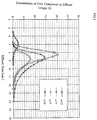
- Fig. 4 is a diagram showing adsorption separation of dichlorobenzene isomers in Example 12 and Comparative Example 9.
- the adsorbent used in the present invention is a zeolite containing Cs and/or Rb, the zeolite being characterized in that the ratio of [the number of moles of Cs and/or Rb in the zeolite] to [the number of moles of Al in the zeolite] is 0.1 or more.
- zeolite usually refers to a porous crystalline aluminosilicate.
- Zeolites used in the present invention may include crystalline metallosilicates in which aluminium is substituted by iron or gallium. Any metallosilicate is acceptable; but those capable of ion exchange are desirable and trivalent or divalent metal silicates are desirable.
- Zeolites having a pore inlet diameter larger than a ring of 12 oxygen atoms and having a multidimensional pore structure are particularly desirable. Examples of such zeolites include ⁇ -type zeolite and faujasite-type zeolite, with the latter being preferable.
- An aluminosilicate may be represented by the following formula: 0.9 ⁇ 0.2 M 2/n O : Al 2 O 3 : xSiO 2 : yH 2 O where, M denotes a cation and n denotes its valence.
- x is usually in the range of from 2 to 6. Faujasite is classified as zeolite X if x is 2 to 3 and as zeolite Y if x is 3 to 6.
- Zeolite Y may become ultrastable zeolite (USY) upon dealuminization to have the value of x of 6 or more. Any of these zeolites may be used in the present invention. However, zeolite X and zeolite Y are preferable.
- Zeolite X and zeolite Y may differ in performance for adsorption separation depending on the kind of halogenated aromatic isomers to be separated.
- zeolite Y would be desirable if m-chlorotoluene is a non-adsorptive component (or raffinate) and zeolite X would be desirable if m-chlorotoluene is an adsorptive component (or extract).
- the value of y varies depending on the degree of hydration.
- the cation M in a zeolite of the faujasite-type usually includes sodium. This cation may be replaced by any other one by ion exchange. Cation exchange may be accomplished usually by bringing the zeolite into contact with an aqueous solution of a compound containing the desired cation. Examples of such a compound include chlorides, nitrates, sulfates, carbonates, and hydroxides.
- the amount of ion exchange varies depending on the kind of cation; it may be established as desired according to the amount of cation in the aqueous solution and the number of ion exchange treatments. Ion exchange should be followed by thorough rinsing for removal of those ions (such as sodium ions, chlorine ions and nitrate ions) which have been exchanged and dissolved in the aqueous solution.
- the adsorbent used in the present invention should contain Cs and/or Rb as essential cations. These cations may not be at ion exchange sites so long as they are contained in the zeolite. However, they should preferably be at ion exchange sites.
- the content of Cs and/or Rb should be such that [the number of moles of Cs and/or Rb in the zeolite] to [the number of moles of Al in the zeolite] is 0.1 or more, preferably 0.3 or more, particularly 0.5 or more. Such a specific content is necessary for efficient separation of halogenated aromatic isomers.
- the upper limit of ion exchange is usually equal to the number of moles of Al in zeolite. In other words, it is about 1.0.
- the upper limit of ion exchange would be about 0.7 because not all Cs and/or Rb ions exchange with ions in zeolite X or Y because of their large ionic radius.
- the content of Cs and/or Rb may be determined in any manner, such as atomic absorption spectrometry, fluorescent X-ray analysis, and energy dispersion X-ray analysis, which is capable of specifying the ratio of elements.
- elements contained in zeolite are traced and determined and the content of Cs and/or Rb is estimated.
- the content of Cs and/or Rb may be calculated by subtracting the content of aluminum in the binder (if the amount of the binder is known) or it may be replaced by the content of Cs and/or Rb in metals excluding Si and Al (if the amount of the binder is unclear).
- the kind of the metals that can coexist with Cs and Rb without adverse effect varies depending on the halogenated aromatic isomers to be separated.
- the presence of K and/or Ag is desirable if m-chlorotoluene is to be separated as raffinate from a mixture of chlorotoluene isomers, or the presence of Pb and/or K (in addition to Cs and Rb) is desirable if m-dichlorobenzene is to be separated as raffinate from a mixture of dichlorobenzene isomers.
- Adsorbents are usually used in the form of granules obtained by coagulating zeolite.
- Granulation may be accomplished with the aid of a binder such as alumina and clay.
- Granulation may be accomplished by mixing zeolite together with a binder, extruding the mixture through an extruder, and shaping the extrudate into spheres by using a Marumerizer.
- the particle size is usually larger than 0.1 mm. Particles smaller than 0.1 mm may lead to an increase in pressure loss.
- the upper limit of the particle size is usually 5 mm.
- the adsorbent used in this present invention preferably has a smaller particle size for efficient diffusion because it contains large cations such as Cs and Rb.
- the particle size is preferably smaller than 1 mm, more preferably smaller than 0.5 mm.
- the adsorbent Prior to use, the adsorbent is preferably heated usually at 200 to 600° C to remove water almost completely from zeolite.
- the adsorbent according to the present invention is used for adsorption separation of a specific isomer from a mixture of halogenated aromatic isomers, and this adsorption separation may be either chromatographic separation or separation by simulated moving bed. The latter is preferable when only one specific isomer is to be separated.
- the continuous adsorption separation by a simulated moving bed basically consists of the cyclic steps of adsorption, concentration, desorption, and recovery of desorbent which are explained below.
- Fig. 1 schematically shows the procedure for adsorption separation by a simulated moving bed.
- adsorbing chambers 1 to 12 filled with adsorbent, which are serially connected for circulation.
- a desorbent feed line 13 an extract discharge line 14
- an isomer mixture feed line 15 a raffinate discharge line 16
- a desorbent recovery line 17 a valve 18.
- the isomers for adsorption separation according to the present invention are those of aromatic compounds, preferably halogenated aromatic compounds represented by the following formula. (where X denotes a C 1-6 alkyl group or a halogen atom, and Y denotes a halogen atom).
- halogenated aromatic compounds examples include chlorotoluene, dichlorobenzene, chloroethylbenzene, chloropropylbenzene, chlorocumene, and bromotoluene.
- the adsorbent of the present invention fully produces its effect when it is used for separation of chlorotoluene and dichlorobenzene isomers.
- the desorbent employed for the above-mentioned procedure of adsorption separation includes, for example, alkyl-substituted aromatic hydrocarbons, halogenated aromatic hydrocarbons and halogenated alkyl-substituted aromatic hydrocarbons.
- alkyl-substituted aromatic hydrocarbons examples include toluene, ethylbenzene, xylene, propylbenzene, butylbenzene, trimethylbenzene, diethylbenzene and tetramethylbenzene.
- halogenated aromatic hydrocarbons examples include chlorobenzene, dichlorobenzene and trichlorobenzene.
- halogenated alkyl-substituted aromatic hydrocarbons examples include chlorotoluene, dichlorotoluene and chloroxylene.
- desorbents may be used alone or in combination with one another.
- An adequate desorbent should be selected according to the substance to be separated. If disubstituted halogenated aromatic compounds are to be separated into m-form (as the raffinate component), for example if chlorotoluene isomers are to be separated into m-chlorotoluene or if dichlorobenzene isomers are to be separated into m-dichlorobenzene, an adequate desorbent is at least mainly (i.e.
- a halogen-free aromatic compound preferably alkyl-substituted aromatic compound, such as a desorbent which is at least mainly (i.e. at least 50 wt.%), more preferably entirely, xylene, particularly m-xylene.
- a desorbent which is at least mainly (i.e. at least 50 wt.%), more preferably entirely, xylene, particularly m-xylene.
- an adequate desorbent is at least mainly (i.e. at least 50 wt.%), more preferably entirely, xylene, particularly p-xylene.
- the temperature is usually in the range of from room temperature to 350°C, preferably from 50 to 250°C.
- the pressure is usually in the range of from atmospheric pressure to 20 MPa, preferably from atmospheric pressure to 3 MPa.
- the procedure for adsorption separation according to the present invention may be accomplished in gas phase; however, it is preferably carried out in liquid phase so as to reduce undesirable side reactions of feedstock or desorbent by keeping the operating temperature low.
- the procedure in accordance with the invention may allow complete isolation of a desired isomer and the term "procedure for adsorption separation" as used herein means not only “separation” but also recovery of specific substances by adsorption separation.
- the adsorbing characteristics of the adsorbent are expressed by the adsorption selectivity a defined by the equations below. (where o, m, and p each represents the o-isomer, m-isomer, and p-isomer of disubstituted aromatic isomers; and A denotes the adsorption phase and U denotes the liquid phase in equilibrium with the adsorption phase.)
- ⁇ o/m and ⁇ p/m should be greater than 1, preferably 1.4 or more from the standpoint of separation efficiency.
- a o/m and a p/m should be smaller than 1, preferably 0.7 or less from the standpoint of separation efficiency.
- adsorbent 1 10 g of adsorbent 1 is immersed in a solution of cesium nitrate (7.94 g) dissolved in 40 cc of pure water at 80°C for 1 hour. The treated adsorbent is filtered off, rinsed thoroughly, and finally dried. The content of Cs is 0.4.
- adsorbent 1 10 g of adsorbent 1 is immersed in a solution of rubidium nitrate (3.00 g) dissolved in 40 cc of pure water at 80°C for 1 hour. The treated adsorbent is filtered off, rinsed thoroughly, and finally dried. The content of Rb is 0.2.
- adsorbent 2 10 g of adsorbent 2 is immersed in a solution of potassium nitrate (4.0 g) dissolved in 40 cc of pure water at 80°C for 1 hour. The treated adsorbent is filtered off. This procedure is repeated eight times (in total) using freshly prepared potassium nitrate solution. The treated adsorbent is filtered off and rinsed thoroughly. The adsorbent is further immersed in a solution of cesium nitrate (7.21 g) dissolved in 40 cc of pure water at 80°C for 1 hour. This procedure is repeated twice (in total) using freshly prepared cesium nitrate solution. The treated adsorbent is filtered off, rinsed thoroughly, and finally dried. The content of Cs is 0.5.
- adsorbent 2 10 g of adsorbent 2 is immersed in a solution of potassium nitrate (4.0 g) dissolved in 40 cc of pure water at 80°C for 1 hour. The treated adsorbent is filtered off. This procedure is repeated eight times (in total) using freshly prepared potassium nitrate solution. The treated adsorbent is filtered off and rinsed thoroughly. The adsorbent is further immersed in a solution of silver nitrate (1.26 g) dissolved in 40 cc of pure water at 80°C for 1 hour. The treated adsorbent is filtered off. This procedure is repeated twice (in total) using freshly prepared silver nitrate solution. The treated adsorbent is filtered off and rinsed thoroughly.
- the adsorbent is further immersed in a solution of cesium nitrate (7.21 g) dissolved in 40 cc of pure water at 80°C for 1 hour. This procedure is repeated twice (in total) using freshly prepared cesium nitrate solution. The treated adsorbent is filtered off, rinsed thoroughly, and finally dried. The content of Cs is 0.5.
- adsorbent 2 10 g of adsorbent 2 is immersed in a sdlution of potassium nitrate (4.0 g) dissolved in 40 cc of pure water at 80°C for 1 hour. The treated adsorbent is filtered off. This procedure is repeated eight times (in total) using freshly prepared potassium nitrate solution. The treated adsorbent is filtered off and rinsed thoroughly. The adsorbent is further immersed in a solution of silver nitrate (1.26 g) dissolved in 40 cc of pure water at 80°C for 1 hour. The treated adsorbent is filtered off. This procedure is repeated twice (in total) using freshly prepared silver nitrate solution. The treated adsorbent is filtered off and rinsed thoroughly.
- the adsorbent is further immersed in a solution of cesium nitrate (2.88 g) dissolved in 40 cc of pure water at 80°C for 1 hour.
- the treated adsorbent is filtered off, rinsed thoroughly, and finally dried.
- the content of Cs is 0.3.
- adsorbent 2 10 g of adsorbent 2 is immersed in a solution of potassium nitrate (4.0 g) dissolved in 40 cc of pure water at 80°C for 1 hour. The treated adsorbent is filtered off. This procedure is repeated eight times (in total) using freshly prepared potassium nitrate solution. The treated adsorbent is filtered off and rinsed thoroughly. The adsorbent is further immersed in a solution of silver nitrate (1.26 g) dissolved in 40 cc of pure water at 80°C for 1 hour. The treated adsorbent is filtered off. This procedure is repeated twice (in total) using freshly prepared silver nitrate solution. The treated adsorbent is filtered off, rinsed thoroughly, and finally dried. The content of Cs is 0.
- adsorbent 2 10 g of adsorbent 2 is immersed in a solution of potassium nitrate (4.0 g) dissolved in 40 cc of pure water at 80°C for 1 hour. The treated adsorbent is filtered off. This procedure is repeated eight times (in total) using freshly prepared potassium nitrate solution. The treated adsorbent is filtered off and rinsed thoroughly. The adsorbent is further immersed in a solution of silver nitrate (1.26 g) dissolved in 40 cc of pure water at 80°C for 1 hour. The treated adsorbent is filtered off. This procedure is repeated twice (in total) using freshly prepared silver nitrate solution. The treated adsorbent is filtered off and rinsed thoroughly.
- the adsorbent is further immersed in a solution of rubidium nitrate (5.45 g) dissolved in 40 cc of pure water at 80°C for 1 hour.
- the treated adsorbent is filtered off. This prbcedure is repeated twice (in total) using freshly prepared rubidium nitrate solution.
- the treated adsorbent is filtered off, rinsed thoroughly, and finally dried.
- the content of Rb is 0.4.
- adsorbent 2 10 g of adsorbent 2 is immersed in a solution of potassium nitrate (4.0 g) dissolved in 40 cc of pure water at 80°C for 1 hour. The treated adsorbent is filtered off. This procedure is repeated eight times (in total) using freshly prepared potassium nitrate solution. The treated adsorbent is filtered off, rinsed thoroughly, and finally dried. The content of Cs is 0.
- adsorbent 2 10 g of adsorbent 2 is immersed in a solution of potassium nitrate (4.0 g) dissolved in 40 cc of pure water at 80°C for 1 hour. The treated adsorbent is filtered off. This procedure is repeated eight times (in total) using freshly prepared potassium nitrate solution. The treated adsorbent is filtered off and rinsed thoroughly. The adsorbent is further immersed in a solution of lead nitrate (2.45 g) dissolved in 40 cc of pure water at 80°C for 1 hour. The treated adsorbent is filtered off and rinsed thoroughly.
- the adsorbent is further immersed in a solution of cesium nitrate (7.21 g) dissolved in 40 cc of pure water at 80° C for 1 hour.
- the treated adsorbent is filtered off: This procedure is repeated twice (in total) using freshly prepared cesium nitrate solution.
- the treated adsorbent is filtered off, rinsed thoroughly, and finally dried.
- the content of Cs is 0.5.
- adsorbent 2 10 g of adsorbent 2 is immersed in a solution of potassium nitrate (4.0 g) dissolved in 40 cc of pure water at 80°C for 1 hour. The treated adsorbent is filtered off. This procedure is repeated eight times (in total) using freshly prepared potassium nitrate solution. The treated adsorbent is filtered off and rinsed thoroughly. The adsorbent is further immersed in a solution of lead nitrate (2.45 g) dissolved in 40 cc of pure water at 80°C for 1 hour. The treated adsorbent is filtered off, rinsed thoroughly, and finally dried. The content of Cs is 0.
- Adsorbents 3 and 4 were examined for adsorption selectivity in the adsorption of chlorotoluene isomers which employs p-xylene as a desorbent.
- the procedure is as follows. An autoclave (6 ml internal volume) is filled with 2.6 g of liquid phase mixture and 2.4 g of the adsorbent (calcined at 500° C). The autoclave is allowed to stand at 130° C for 1 hour, with occasional stirring.
- n-nonane is added as an internal standard substance for gas chromatography. It is substantially inactive in this experiment for adsorption.
- Adsorbent Desorbent ⁇ p/m ⁇ o/m Example 1 Adsorbent 3 p-xylene 0.67 0.67 Example 2 Adsorbent 4 p-xylene 0.63 0.71 Comparative Example 1 Adsorbent 1 p-xylene 0.65 0.99
- Adsorbent Desorbent ⁇ p/m ⁇ o/m Example 3 Adsorbent 5 m-xylene 1.80 1.47
- Example 4 Adsorbent 6 m-xylene 1.65 1.66
- Example 5 Adsorbent 7 m-xylene 1.98 1.48
- Example 6 Adsorbent 8 m-xylene 2.03 1.45 Comparative
- Comparative Example 2 Adsorbent 9 m-xylene 2.09 1.33 Comparative Example 3
- a stainless steel column 1 m long and 4.6 mm in inside diameter, is filled with adsorbent 6 which was calcined at 500° C.
- the filled column is placed in an oil bath at 130° C, and m-xylene as the desorbent is passed through it at a constant flow rate of 1.5 ml/min (at room temperature).
- CT chlorotoluene
- n-C9 n-nonane
- the n-nonane is added as a standard for elution time. Its adsorption relative to other components is practically negligible.
- the eluate from the column outlet is sampled at constant intervals for analysis by gas chromatography. An elution curve as shown in Fig. 2 is obtained.
- Example 11 The same procedure as in Example 11 was repeated except that adsorbent 10 which was calcined at 500°C was used and 3,4-dichlorotoluene was used as the desorbent.
- the elution curve is shown in Fig. 3.
- Figs. 1 and 2 showing the peaks of respective components indicate that the zeolite Y containing Cs, Ag, and K, when used as an adsorbent in combination with m-xylene as a desorbent, permits efficient separation of m-chlorotoluene as the non-adsorbed component.
- Adsorbent 13 was examined for adsorption selectivity in the adsorption of dichlorobenzene isomers which employs m-xylene as a desorbent.
- the procedure is as follows. An autoclave (6 ml internal volume) is filled with 2.6 g of liquid phase mixture and 2.5 g of the adsorbent (calcined at 500°C). The autoclave is allowed to stand at 130°C for 1 hour, with occasional stirring.
- n-nonane is added as an internal standard substance for gas chromatography. It is substantially inactive in this experiment for adsorption.
- Example 12 The same procedure as in Example 12 was repeated except that the absorbent was replaced by adsorbent 14 which was calcined at 500°C and the desorbent was replaced by m-xylene and 3,4-dichlorotoluene.
- the results are shown in Table 6.
- Adsorbent Desorbent ⁇ p/m ⁇ o/m Comparative Example 7 Adsorbent 14 m-xylene 1.66 2.37 Comparative Example 8 Adsorbent 14 3,4-dichlorotoluene 1.75 2.00
- Example 12 m-isomer is the non-adsorbed component and hence is recovered as the raffinate component.
- the performance curve Fig. 4 indicates that the performance of separation is good when the concentration of m-isomer is low in the extract and the concentration of m-isomer is high in the raffinate. It has been shown that the adsorbent of the present invention, when used in combination with a specific desorbent, permits efficient separation of m-isomer from a mixture of dichlorobenzene isomers.
- the amount of such a metal is taken into account when determining the amount of Cs and/or Rb.
- the amount of Cs and/or Rb may be adjusted in dependence upon the number of valences provided by the M 2/n component of a zeolite.
- the proportion of Cs and/or Rb in the zeolite is such that either the following respective ratios is at least 0.1:
Landscapes
- Chemical & Material Sciences (AREA)
- Organic Chemistry (AREA)
- Inorganic Chemistry (AREA)
- Analytical Chemistry (AREA)
- Chemical Kinetics & Catalysis (AREA)
- Organic Low-Molecular-Weight Compounds And Preparation Thereof (AREA)
- Solid-Sorbent Or Filter-Aiding Compositions (AREA)
- Treatment Of Liquids With Adsorbents In General (AREA)
Applications Claiming Priority (2)
| Application Number | Priority Date | Filing Date | Title |
|---|---|---|---|
| JP33051598 | 1998-11-20 | ||
| JP33051598 | 1998-11-20 |
Publications (2)
| Publication Number | Publication Date |
|---|---|
| EP1002780A1 true EP1002780A1 (fr) | 2000-05-24 |
| EP1002780B1 EP1002780B1 (fr) | 2005-01-26 |
Family
ID=18233500
Family Applications (1)
| Application Number | Title | Priority Date | Filing Date |
|---|---|---|---|
| EP99309249A Expired - Lifetime EP1002780B1 (fr) | 1998-11-20 | 1999-11-19 | Adsorbant pour isomères aromatiques et leur séparation |
Country Status (6)
| Country | Link |
|---|---|
| US (1) | US6262322B1 (fr) |
| EP (1) | EP1002780B1 (fr) |
| AT (1) | ATE287865T1 (fr) |
| CA (1) | CA2290334A1 (fr) |
| DE (1) | DE69923409T2 (fr) |
| SG (1) | SG75993A1 (fr) |
Families Citing this family (1)
| Publication number | Priority date | Publication date | Assignee | Title |
|---|---|---|---|---|
| JP2002054422A (ja) * | 2000-08-08 | 2002-02-20 | Ngk Insulators Ltd | セラミック製フィルター及びその製造方法 |
Citations (10)
| Publication number | Priority date | Publication date | Assignee | Title |
|---|---|---|---|---|
| JPS49102624A (fr) * | 1973-02-12 | 1974-09-27 | ||
| US4051192A (en) * | 1971-04-21 | 1977-09-27 | Uop Inc. | Separation of bi-alkyl substituted monocyclic aromatic isomers |
| JPS53105434A (en) * | 1977-02-25 | 1978-09-13 | Nippon Kayaku Co Ltd | Separation of dichlorobenzene isomers |
| US4175099A (en) * | 1975-03-07 | 1979-11-20 | Exxon Research & Engineering Co. | Separation and recovery of ethylbenzene from C8 aromatic mixtures using rubidium-X sieves |
| EP0046068A1 (fr) * | 1980-08-13 | 1982-02-17 | Toray Industries, Inc. | Procédé pour la séparation d'un isomère de toluène halogéné monohalogené sur le cycle |
| EP0099161A1 (fr) * | 1982-07-15 | 1984-01-25 | CAFFARO S.p.A. Società per l'Industria Chimica ed Elettrochimica | Procédé pour séparer un mélange d'isomères de monochlorotoluène, installation pour exécuter ce procédé ainsi que les isomères séparès de cette manière |
| EP0125077A1 (fr) * | 1983-04-28 | 1984-11-14 | Toray Industries, Inc. | Procédé de séparation par adsorption |
| US4663052A (en) * | 1985-12-12 | 1987-05-05 | Union Carbide Corporation | Drying process using chabazite-type adsorbents |
| JPH06239808A (ja) * | 1993-02-15 | 1994-08-30 | Toray Ind Inc | 2−メチル−3−ニトロベンゾトリフルオライドの分離方法 |
| US5453560A (en) * | 1994-05-20 | 1995-09-26 | Uop | Process for adsorptive separation of ethylbenzene from aromatic hydrocarbons |
-
1999
- 1999-11-05 US US09/434,891 patent/US6262322B1/en not_active Expired - Fee Related
- 1999-11-18 SG SG1999005770A patent/SG75993A1/en unknown
- 1999-11-19 DE DE69923409T patent/DE69923409T2/de not_active Expired - Lifetime
- 1999-11-19 EP EP99309249A patent/EP1002780B1/fr not_active Expired - Lifetime
- 1999-11-19 AT AT99309249T patent/ATE287865T1/de not_active IP Right Cessation
- 1999-11-19 CA CA002290334A patent/CA2290334A1/fr not_active Abandoned
Patent Citations (10)
| Publication number | Priority date | Publication date | Assignee | Title |
|---|---|---|---|---|
| US4051192A (en) * | 1971-04-21 | 1977-09-27 | Uop Inc. | Separation of bi-alkyl substituted monocyclic aromatic isomers |
| JPS49102624A (fr) * | 1973-02-12 | 1974-09-27 | ||
| US4175099A (en) * | 1975-03-07 | 1979-11-20 | Exxon Research & Engineering Co. | Separation and recovery of ethylbenzene from C8 aromatic mixtures using rubidium-X sieves |
| JPS53105434A (en) * | 1977-02-25 | 1978-09-13 | Nippon Kayaku Co Ltd | Separation of dichlorobenzene isomers |
| EP0046068A1 (fr) * | 1980-08-13 | 1982-02-17 | Toray Industries, Inc. | Procédé pour la séparation d'un isomère de toluène halogéné monohalogené sur le cycle |
| EP0099161A1 (fr) * | 1982-07-15 | 1984-01-25 | CAFFARO S.p.A. Società per l'Industria Chimica ed Elettrochimica | Procédé pour séparer un mélange d'isomères de monochlorotoluène, installation pour exécuter ce procédé ainsi que les isomères séparès de cette manière |
| EP0125077A1 (fr) * | 1983-04-28 | 1984-11-14 | Toray Industries, Inc. | Procédé de séparation par adsorption |
| US4663052A (en) * | 1985-12-12 | 1987-05-05 | Union Carbide Corporation | Drying process using chabazite-type adsorbents |
| JPH06239808A (ja) * | 1993-02-15 | 1994-08-30 | Toray Ind Inc | 2−メチル−3−ニトロベンゾトリフルオライドの分離方法 |
| US5453560A (en) * | 1994-05-20 | 1995-09-26 | Uop | Process for adsorptive separation of ethylbenzene from aromatic hydrocarbons |
Non-Patent Citations (3)
| Title |
|---|
| DATABASE WPI Section Ch Week 197503, Derwent World Patents Index; Class E14, AN 1975-04713W, XP002130701 * |
| DATABASE WPI Section Ch Week 197842, Derwent World Patents Index; Class E14, AN 1978-75419A, XP002130703 * |
| DATABASE WPI Section Ch Week 199439, Derwent World Patents Index; Class B05, AN 1994-313661, XP002130702 * |
Also Published As
| Publication number | Publication date |
|---|---|
| EP1002780B1 (fr) | 2005-01-26 |
| CA2290334A1 (fr) | 2000-05-20 |
| ATE287865T1 (de) | 2005-02-15 |
| US6262322B1 (en) | 2001-07-17 |
| DE69923409D1 (de) | 2005-03-03 |
| DE69923409T2 (de) | 2005-12-29 |
| SG75993A1 (en) | 2000-10-24 |
Similar Documents
| Publication | Publication Date | Title |
|---|---|---|
| US4571441A (en) | Process for separation of substituted benzene isomers | |
| EP0412623B1 (fr) | Procédé pour la séparation de 2-Chloro-m-xylène | |
| EP0046068B1 (fr) | Procédé pour la séparation d'un isomère de toluène halogéné monohalogené sur le cycle | |
| EP1002780B1 (fr) | Adsorbant pour isomères aromatiques et leur séparation | |
| JPS6323976B2 (fr) | ||
| KR920003117B1 (ko) | 디클로로큐멘 이성질체의 분리방법 | |
| KR100537444B1 (ko) | 할로겐화 에틸벤젠의 이성화 방법 | |
| JP4411711B2 (ja) | ハロゲン化芳香族異性体の製造方法 | |
| JP3807061B2 (ja) | ハロゲン化エチルベンゼン異性体の分離方法 | |
| JPS6324981B2 (fr) | ||
| EP0324041B1 (fr) | Procédé pour la séparation d'un isomère de trihalogénobenzène | |
| JP2576725B2 (ja) | 2,4−ジクロロトルエンの分離方法 | |
| JP2516339B2 (ja) | ジクロロトルエンの吸着分離方法 | |
| JPH08796B2 (ja) | ジクロロニトロベンゼン異性体の分離方法 | |
| JP5017952B2 (ja) | p−ジクロロベンゼンの分離方法 | |
| JPH0786092B2 (ja) | ジクロロベンゼン異性体の分離方法 | |
| JPH11180911A (ja) | ジクロロベンゼン異性体の分離方法 | |
| JP2002012567A (ja) | メタ−ハロゲン化ノルマルアルキル芳香族化合物の製造方法 | |
| JPH0446931B2 (fr) | ||
| JPS6324495B2 (fr) | ||
| JPH09316015A (ja) | 2,4−ジクロロトルエンまたは2,6−ジクロロトルエンの分離方法 | |
| JPH0112732B2 (fr) | ||
| JP2002212117A (ja) | 3,5−ジクロロトルエンの製造方法 | |
| JP2000247913A (ja) | ジクロロトルエン異性体の製造法 | |
| JPH0112735B2 (fr) |
Legal Events
| Date | Code | Title | Description |
|---|---|---|---|
| PUAI | Public reference made under article 153(3) epc to a published international application that has entered the european phase |
Free format text: ORIGINAL CODE: 0009012 |
|
| AK | Designated contracting states |
Kind code of ref document: A1 Designated state(s): AT BE CH CY DE DK ES FI FR GB GR IE IT LI LU MC NL PT SE |
|
| AX | Request for extension of the european patent |
Free format text: AL;LT;LV;MK;RO;SI |
|
| 17P | Request for examination filed |
Effective date: 20001019 |
|
| AKX | Designation fees paid |
Free format text: AT BE CH CY DE DK ES FI FR GB GR IE IT LI LU MC NL PT SE |
|
| 17Q | First examination report despatched |
Effective date: 20011015 |
|
| GRAP | Despatch of communication of intention to grant a patent |
Free format text: ORIGINAL CODE: EPIDOSNIGR1 |
|
| GRAS | Grant fee paid |
Free format text: ORIGINAL CODE: EPIDOSNIGR3 |
|
| GRAA | (expected) grant |
Free format text: ORIGINAL CODE: 0009210 |
|
| AK | Designated contracting states |
Kind code of ref document: B1 Designated state(s): AT BE CH CY DE DK ES FI FR GB GR IE IT LI LU MC NL PT SE |
|
| PG25 | Lapsed in a contracting state [announced via postgrant information from national office to epo] |
Ref country code: NL Free format text: LAPSE BECAUSE OF FAILURE TO SUBMIT A TRANSLATION OF THE DESCRIPTION OR TO PAY THE FEE WITHIN THE PRESCRIBED TIME-LIMIT Effective date: 20050126 Ref country code: LI Free format text: LAPSE BECAUSE OF FAILURE TO SUBMIT A TRANSLATION OF THE DESCRIPTION OR TO PAY THE FEE WITHIN THE PRESCRIBED TIME-LIMIT Effective date: 20050126 Ref country code: FI Free format text: LAPSE BECAUSE OF FAILURE TO SUBMIT A TRANSLATION OF THE DESCRIPTION OR TO PAY THE FEE WITHIN THE PRESCRIBED TIME-LIMIT Effective date: 20050126 Ref country code: CH Free format text: LAPSE BECAUSE OF FAILURE TO SUBMIT A TRANSLATION OF THE DESCRIPTION OR TO PAY THE FEE WITHIN THE PRESCRIBED TIME-LIMIT Effective date: 20050126 Ref country code: AT Free format text: LAPSE BECAUSE OF FAILURE TO SUBMIT A TRANSLATION OF THE DESCRIPTION OR TO PAY THE FEE WITHIN THE PRESCRIBED TIME-LIMIT Effective date: 20050126 |
|
| REG | Reference to a national code |
Ref country code: GB Ref legal event code: FG4D |
|
| REG | Reference to a national code |
Ref country code: CH Ref legal event code: EP |
|
| REG | Reference to a national code |
Ref country code: IE Ref legal event code: FG4D |
|
| REF | Corresponds to: |
Ref document number: 69923409 Country of ref document: DE Date of ref document: 20050303 Kind code of ref document: P |
|
| PG25 | Lapsed in a contracting state [announced via postgrant information from national office to epo] |
Ref country code: SE Free format text: LAPSE BECAUSE OF FAILURE TO SUBMIT A TRANSLATION OF THE DESCRIPTION OR TO PAY THE FEE WITHIN THE PRESCRIBED TIME-LIMIT Effective date: 20050426 Ref country code: GR Free format text: LAPSE BECAUSE OF FAILURE TO SUBMIT A TRANSLATION OF THE DESCRIPTION OR TO PAY THE FEE WITHIN THE PRESCRIBED TIME-LIMIT Effective date: 20050426 Ref country code: DK Free format text: LAPSE BECAUSE OF FAILURE TO SUBMIT A TRANSLATION OF THE DESCRIPTION OR TO PAY THE FEE WITHIN THE PRESCRIBED TIME-LIMIT Effective date: 20050426 |
|
| PG25 | Lapsed in a contracting state [announced via postgrant information from national office to epo] |
Ref country code: ES Free format text: LAPSE BECAUSE OF FAILURE TO SUBMIT A TRANSLATION OF THE DESCRIPTION OR TO PAY THE FEE WITHIN THE PRESCRIBED TIME-LIMIT Effective date: 20050507 |
|
| NLV1 | Nl: lapsed or annulled due to failure to fulfill the requirements of art. 29p and 29m of the patents act | ||
| REG | Reference to a national code |
Ref country code: CH Ref legal event code: PL |
|
| PG25 | Lapsed in a contracting state [announced via postgrant information from national office to epo] |
Ref country code: CY Free format text: LAPSE BECAUSE OF FAILURE TO SUBMIT A TRANSLATION OF THE DESCRIPTION OR TO PAY THE FEE WITHIN THE PRESCRIBED TIME-LIMIT Effective date: 20051119 |
|
| PG25 | Lapsed in a contracting state [announced via postgrant information from national office to epo] |
Ref country code: IE Free format text: LAPSE BECAUSE OF NON-PAYMENT OF DUE FEES Effective date: 20051121 |
|
| PG25 | Lapsed in a contracting state [announced via postgrant information from national office to epo] |
Ref country code: MC Free format text: LAPSE BECAUSE OF NON-PAYMENT OF DUE FEES Effective date: 20051130 Ref country code: LU Free format text: LAPSE BECAUSE OF NON-PAYMENT OF DUE FEES Effective date: 20051130 |
|
| PLBE | No opposition filed within time limit |
Free format text: ORIGINAL CODE: 0009261 |
|
| STAA | Information on the status of an ep patent application or granted ep patent |
Free format text: STATUS: NO OPPOSITION FILED WITHIN TIME LIMIT |
|
| ET | Fr: translation filed | ||
| 26N | No opposition filed |
Effective date: 20051027 |
|
| REG | Reference to a national code |
Ref country code: IE Ref legal event code: MM4A |
|
| PG25 | Lapsed in a contracting state [announced via postgrant information from national office to epo] |
Ref country code: PT Free format text: LAPSE BECAUSE OF NON-PAYMENT OF DUE FEES Effective date: 20050626 |
|
| PGFP | Annual fee paid to national office [announced via postgrant information from national office to epo] |
Ref country code: FR Payment date: 20101123 Year of fee payment: 12 |
|
| PGFP | Annual fee paid to national office [announced via postgrant information from national office to epo] |
Ref country code: DE Payment date: 20101117 Year of fee payment: 12 |
|
| PGFP | Annual fee paid to national office [announced via postgrant information from national office to epo] |
Ref country code: GB Payment date: 20101117 Year of fee payment: 12 Ref country code: IT Payment date: 20101120 Year of fee payment: 12 |
|
| PGFP | Annual fee paid to national office [announced via postgrant information from national office to epo] |
Ref country code: BE Payment date: 20111114 Year of fee payment: 13 |
|
| REG | Reference to a national code |
Ref country code: FR Ref legal event code: ST Effective date: 20120731 |
|
| PG25 | Lapsed in a contracting state [announced via postgrant information from national office to epo] |
Ref country code: FR Free format text: LAPSE BECAUSE OF NON-PAYMENT OF DUE FEES Effective date: 20111130 |
|
| BERE | Be: lapsed |
Owner name: *TORAY INDUSTRIES INC. Effective date: 20121130 |
|
| GBPC | Gb: european patent ceased through non-payment of renewal fee |
Effective date: 20121119 |
|
| PG25 | Lapsed in a contracting state [announced via postgrant information from national office to epo] |
Ref country code: IT Free format text: LAPSE BECAUSE OF NON-PAYMENT OF DUE FEES Effective date: 20121119 Ref country code: BE Free format text: LAPSE BECAUSE OF NON-PAYMENT OF DUE FEES Effective date: 20121130 |
|
| REG | Reference to a national code |
Ref country code: DE Ref legal event code: R119 Ref document number: 69923409 Country of ref document: DE Effective date: 20130601 |
|
| PG25 | Lapsed in a contracting state [announced via postgrant information from national office to epo] |
Ref country code: DE Free format text: LAPSE BECAUSE OF NON-PAYMENT OF DUE FEES Effective date: 20130601 |
|
| PG25 | Lapsed in a contracting state [announced via postgrant information from national office to epo] |
Ref country code: GB Free format text: LAPSE BECAUSE OF NON-PAYMENT OF DUE FEES Effective date: 20121119 |