EP1002837B1 - Bei Raumtemperatur härtbare Siliconkautschukzusammensetzung - Google Patents
Bei Raumtemperatur härtbare Siliconkautschukzusammensetzung Download PDFInfo
- Publication number
- EP1002837B1 EP1002837B1 EP99123019A EP99123019A EP1002837B1 EP 1002837 B1 EP1002837 B1 EP 1002837B1 EP 99123019 A EP99123019 A EP 99123019A EP 99123019 A EP99123019 A EP 99123019A EP 1002837 B1 EP1002837 B1 EP 1002837B1
- Authority
- EP
- European Patent Office
- Prior art keywords
- silicone rubber
- group
- room
- rubber composition
- weight
- Prior art date
- Legal status (The legal status is an assumption and is not a legal conclusion. Google has not performed a legal analysis and makes no representation as to the accuracy of the status listed.)
- Expired - Lifetime
Links
- AYRRURJYKJNRDL-UHFFFAOYSA-N COC(C(C#[I])=C(c1ccccc1)c1ccccc1)=O Chemical compound COC(C(C#[I])=C(c1ccccc1)c1ccccc1)=O AYRRURJYKJNRDL-UHFFFAOYSA-N 0.000 description 1
Images

Classifications
-
- C—CHEMISTRY; METALLURGY
- C08—ORGANIC MACROMOLECULAR COMPOUNDS; THEIR PREPARATION OR CHEMICAL WORKING-UP; COMPOSITIONS BASED THEREON
- C08L—COMPOSITIONS OF MACROMOLECULAR COMPOUNDS
- C08L83/00—Compositions of macromolecular compounds obtained by reactions forming in the main chain of the macromolecule a linkage containing silicon with or without sulfur, nitrogen, oxygen or carbon only; Compositions of derivatives of such polymers
- C08L83/04—Polysiloxanes
-
- C—CHEMISTRY; METALLURGY
- C08—ORGANIC MACROMOLECULAR COMPOUNDS; THEIR PREPARATION OR CHEMICAL WORKING-UP; COMPOSITIONS BASED THEREON
- C08K—Use of inorganic or non-macromolecular organic substances as compounding ingredients
- C08K5/00—Use of organic ingredients
- C08K5/0008—Organic ingredients according to more than one of the "one dot" groups of C08K5/01 - C08K5/59
-
- C—CHEMISTRY; METALLURGY
- C08—ORGANIC MACROMOLECULAR COMPOUNDS; THEIR PREPARATION OR CHEMICAL WORKING-UP; COMPOSITIONS BASED THEREON
- C08L—COMPOSITIONS OF MACROMOLECULAR COMPOUNDS
- C08L83/00—Compositions of macromolecular compounds obtained by reactions forming in the main chain of the macromolecule a linkage containing silicon with or without sulfur, nitrogen, oxygen or carbon only; Compositions of derivatives of such polymers
- C08L83/14—Compositions of macromolecular compounds obtained by reactions forming in the main chain of the macromolecule a linkage containing silicon with or without sulfur, nitrogen, oxygen or carbon only; Compositions of derivatives of such polymers in which at least two but not all the silicon atoms are connected by linkages other than oxygen atoms
-
- C—CHEMISTRY; METALLURGY
- C08—ORGANIC MACROMOLECULAR COMPOUNDS; THEIR PREPARATION OR CHEMICAL WORKING-UP; COMPOSITIONS BASED THEREON
- C08G—MACROMOLECULAR COMPOUNDS OBTAINED OTHERWISE THAN BY REACTIONS ONLY INVOLVING UNSATURATED CARBON-TO-CARBON BONDS
- C08G77/00—Macromolecular compounds obtained by reactions forming a linkage containing silicon with or without sulfur, nitrogen, oxygen or carbon in the main chain of the macromolecule
- C08G77/04—Polysiloxanes
- C08G77/14—Polysiloxanes containing silicon bound to oxygen-containing groups
-
- C—CHEMISTRY; METALLURGY
- C08—ORGANIC MACROMOLECULAR COMPOUNDS; THEIR PREPARATION OR CHEMICAL WORKING-UP; COMPOSITIONS BASED THEREON
- C08G—MACROMOLECULAR COMPOUNDS OBTAINED OTHERWISE THAN BY REACTIONS ONLY INVOLVING UNSATURATED CARBON-TO-CARBON BONDS
- C08G77/00—Macromolecular compounds obtained by reactions forming a linkage containing silicon with or without sulfur, nitrogen, oxygen or carbon in the main chain of the macromolecule
- C08G77/04—Polysiloxanes
- C08G77/14—Polysiloxanes containing silicon bound to oxygen-containing groups
- C08G77/18—Polysiloxanes containing silicon bound to oxygen-containing groups to alkoxy or aryloxy groups
-
- C—CHEMISTRY; METALLURGY
- C08—ORGANIC MACROMOLECULAR COMPOUNDS; THEIR PREPARATION OR CHEMICAL WORKING-UP; COMPOSITIONS BASED THEREON
- C08G—MACROMOLECULAR COMPOUNDS OBTAINED OTHERWISE THAN BY REACTIONS ONLY INVOLVING UNSATURATED CARBON-TO-CARBON BONDS
- C08G77/00—Macromolecular compounds obtained by reactions forming a linkage containing silicon with or without sulfur, nitrogen, oxygen or carbon in the main chain of the macromolecule
- C08G77/04—Polysiloxanes
- C08G77/20—Polysiloxanes containing silicon bound to unsaturated aliphatic groups
-
- C—CHEMISTRY; METALLURGY
- C08—ORGANIC MACROMOLECULAR COMPOUNDS; THEIR PREPARATION OR CHEMICAL WORKING-UP; COMPOSITIONS BASED THEREON
- C08G—MACROMOLECULAR COMPOUNDS OBTAINED OTHERWISE THAN BY REACTIONS ONLY INVOLVING UNSATURATED CARBON-TO-CARBON BONDS
- C08G77/00—Macromolecular compounds obtained by reactions forming a linkage containing silicon with or without sulfur, nitrogen, oxygen or carbon in the main chain of the macromolecule
- C08G77/04—Polysiloxanes
- C08G77/22—Polysiloxanes containing silicon bound to organic groups containing atoms other than carbon, hydrogen and oxygen
- C08G77/24—Polysiloxanes containing silicon bound to organic groups containing atoms other than carbon, hydrogen and oxygen halogen-containing groups
-
- C—CHEMISTRY; METALLURGY
- C08—ORGANIC MACROMOLECULAR COMPOUNDS; THEIR PREPARATION OR CHEMICAL WORKING-UP; COMPOSITIONS BASED THEREON
- C08G—MACROMOLECULAR COMPOUNDS OBTAINED OTHERWISE THAN BY REACTIONS ONLY INVOLVING UNSATURATED CARBON-TO-CARBON BONDS
- C08G77/00—Macromolecular compounds obtained by reactions forming a linkage containing silicon with or without sulfur, nitrogen, oxygen or carbon in the main chain of the macromolecule
- C08G77/04—Polysiloxanes
- C08G77/22—Polysiloxanes containing silicon bound to organic groups containing atoms other than carbon, hydrogen and oxygen
- C08G77/26—Polysiloxanes containing silicon bound to organic groups containing atoms other than carbon, hydrogen and oxygen nitrogen-containing groups
-
- C—CHEMISTRY; METALLURGY
- C08—ORGANIC MACROMOLECULAR COMPOUNDS; THEIR PREPARATION OR CHEMICAL WORKING-UP; COMPOSITIONS BASED THEREON
- C08G—MACROMOLECULAR COMPOUNDS OBTAINED OTHERWISE THAN BY REACTIONS ONLY INVOLVING UNSATURATED CARBON-TO-CARBON BONDS
- C08G77/00—Macromolecular compounds obtained by reactions forming a linkage containing silicon with or without sulfur, nitrogen, oxygen or carbon in the main chain of the macromolecule
- C08G77/48—Macromolecular compounds obtained by reactions forming a linkage containing silicon with or without sulfur, nitrogen, oxygen or carbon in the main chain of the macromolecule in which at least two but not all the silicon atoms are connected by linkages other than oxygen atoms
- C08G77/50—Macromolecular compounds obtained by reactions forming a linkage containing silicon with or without sulfur, nitrogen, oxygen or carbon in the main chain of the macromolecule in which at least two but not all the silicon atoms are connected by linkages other than oxygen atoms by carbon linkages
Definitions
- the present invention is a room-temperature curable silicone rubber composition.
- it is a room-temperature curable silicone rubber composition that provides excellent bonding durability after being cured, so that it retains a high degree of bonding power even when it is used outdoors for a long period of time.
- room-temperature curable silicone rubber compositions that turn into silicone rubber after being cured at room temperature upon contact with the water in air.
- room-temperature curable silicone rubber compositions with the main constituents of polydiorganosiloxane and alkoxysilane that have alkoxysilyl groups on both ends of a molecular chain and that harden by releasing alcohol in the presence of an organo-titanium compound catalyst (also known as de-alcohol curable room-temperaturecurable silicone rubber compositions).
- organo-titanium compound catalyst also known as de-alcohol curable room-temperaturecurable silicone rubber compositions.
- the inventors discovered that the addition of small amounts of a light stabilizer and/or a UV absorber to de-alcohol curable room-temperature curable silicone rubber compositions containing a specific polydiorganosiloxane as a main constituent solves the above problems, and consequently, have resulted in the present invention.
- the present invention is a room-temperature curable composition comprising:
- the purpose of the present invention is to provide a room-temperature curable silicone rubber composition that excels in bonding durability and that can retain its bonding power even when used outdoors for a long period of time.
- Figure 1 is a schematic diagram of the bonding durability test piece that was used for the evaluation of the bonding durability of the room-temperature curable silicone rubber composition in Examples 1 - 4 and Comparison Examples 1 - 2.
- the present invention is a room-temperature curable silicone rubber composition comprising:
- the polydiorganosiloxane of Component (A) used in the present invention is the main ingredient of the compositions of the present invention and comprises Components (A-1) and (A-2).
- Component (A-1) is a first polydiorganosiloxane having either an alkoxy or alkoxy-alkoxy group that is a hydrolyzable group occurring at both ends of a molecular chain.
- R 1 and R 2 in the above formula are alkyl groups such as a methyl, ethyl, propyl, or butyl groups; or alkoxyalkyl groups such as a methoxyethyl, ethoxyethyl, methoxypropyl, or methoxybutyl groups.
- R 3 is an alkyl group such as a methyl, ethyl, propyl, or butyl group; a cycloalkyl group such as a cyclopentyl or cyclohexyl group; an alkenyl group such as a vinyl or allyl group; an aryl group such as a phenyl, tolyl, or naphthyl group; an aralkyl group such as a benzyl, phenylethyl or phenylpropyl group; a halogenated hydrocarbon group such as a chloromethyl, trifluoropropyl, or chloropropyl group; or a cyanoalkyl group such as ⁇ -cyanoethyl, ⁇ -cyanopropyl, or ⁇ -cyanopropyl group.
- the methyl group is preferable.
- bivalent hydrocarbon groups of Components Y and Z include methylene, propylene, and butylene groups.
- Component (A-2) is a second polydiorganosiloxane having either an alkoxy or alkoxyalkoxy group that is a hydrolyzable group and that occurs only at the end of a molecular fragment chain.
- Component (A-2) has the property of reducing the modulus of the silicone rubber produced when the composition of the present invention is cured.
- Component (A-2) has a general formula where the groups R 1 , R 2 , R 3 , a, n, and Z are as described in connection with Component (A-1) above, and R 4 denotes an alkyl group such as a methyl, ethyl, propyl, or butyl group, or an alkenyl group such as a vinyl or allyl group.
- Component (A) is polydiorganosiloxane comprising per 100 weight parts, 20 to 100 parts by weight of Component (A-1) and 0 to 80 parts by weight of Component (A-2).
- Component (B) is a cross-linking agent, and selected from an alkoxysilanes and alkoxysilane partial hydrolysis condensate.
- Component (B) can be represented by the following general formula: R 5 b Si(OR 6 ) 4-b where R 5 is an alkyl group such as a methyl, ethyl, or propyl group; or a monovalent hydrocarbon group such as a vinyl, allyl, and related alkenyl group; where R 6 is an alkyl group such as a methyl, ethyl, propyl, or butyl group, or an alkoxyalkyl group such as a methoxyethyl, ethoxyethyl, methoxypropyl, or methoxybutyl group; and where b is either 0 or 1.
- Component (B) examples include: tri-functional alkoxysilanes such as methyl-trimethoxysilane, methyl-triethoxysilane, ethyl-trimethoxysilane,vinyl-trimethoxysilane, phenyl-trimethoxysilane,and methyl-trimethoxysilane;tetra-functional alkoxysilanes such as tetra-methoxysilane and tetra-ethoxysilane; and their hydrolyzed condensation products.
- Component (B) can be made either by using these compounds singly or by mixing two or more of the same.
- Component (B) should be added in a range of about 1 to 25 parts by weight, and preferably 2 to 10 parts by weight, for 100 parts by weight of Component (A).
- An additive amount that is too low results in inadequate curing of the composition of the present invention or in gelling during storage due to an increase in viscosity.
- using an excessive amount of additive can result in high cost.
- the organo-titanium compound, Component (C), used in the present invention is a catalyst for the curing of the composition of the present invention.
- a titanium compound include: tetra-(i-propoxy) titanium, tetra-(n-butoxy) titanium, tetra-(t-butoxy) titanium, and other titanic acid esters; and titanium chelates such as di-(i-isopropoxy) bis-(acetoacetateethyl)titanium, di-(i-isopropoxy) bis-(acetoacetatemethyl) titanium, and di-(i-isopropoxy) bis-(acetylacetone) titanium.
- Component (C) should be added in a range of 0.5 to 10 parts by weight relative to 100 parts by weight of Component (A); preferably, it should be used in a range of 1 to 5 parts by weight range.
- An additive amount that is too low results in slow curing of the composition of the present invention.
- An excessive amount of the additive causes poor storage stability and high cost.
- the light stabilizer and UV absorber which form Component (D), represent a key feature of the present invention, acting to confer bonding durability on the composition of the present invention.
- light stabilizers composed of hindered amine compounds are used.
- these light stabilizers composed of hindered amine compounds include compounds that can be represented by the following structural formulas:
- Adekastab LA-52 Adekastab LA-57
- Adekastab LA-62 Adekastab LA-67
- Adekastab LA-63P Adekastab LA-68LD
- CHIMASSORB 944 and CHIMASSORB 119 trademarks of Ciba Specialty Chemicals K.K.
- UV absorbers examples include benzotriazole compounds, benzophenone compounds, arylester compounds, cyanoacrylate compounds, and triazine compounds. Among these, UV absorbers composed of cyanoacrylate and triazine compounds are preferable. Examples of UV absorbers composed of cyanoacrylate compounds include compounds that can be represented by the following structural formulas:
- UV absorbers composed of triazine compounds include compounds that can be represented by the following structural formula:
- Component (D) should be added in a range of 0.01 to 5 parts by weight relative to 100 parts by weight of Component (A); preferably, it should be used in a range of 0.1 to 2 parts by weight. An additive amount that is too low results in reduced bonding durability, and an excessive amount of the additive causes a reduced bonding capacity and mechanical strength.
- Component (D) should be added as a combination of a light stabilizer and a UV absorber. When these agents are used in combination, the light stabilizer and UV absorber should be mixed in a weight ratio range of (1:0.1) to (1:2).
- silane coupling agents may be added in addition to the named components: a silane coupling agent containing amino groups, a coupling agent containing epoxy groups, and a silane-coupling agent containing silane and mercapto.
- silane-coupling agents can be used either singly or in a combination of two or more silane-coupling agents. Reaction mixtures of silane-coupling agents containing organic amines and amino groups, and those containing epoxy groups can also be used.
- those containing amino groups provide an especially improved bonding capacity and are therefore effective.
- bi-functional alkoxysilanes including dimethyl dimethoxy silane and diphenyl dimethoxy silane; and dimethyl polysiloxane, and dimethylsiloxane oligomer.
- composition of the present invention composed of Components (A) through (D)
- additives include: inorganic fillers, organic solvents, anti-mildew agents, flame retardants, heat resistant agents, plasticizers, thixotropic agents, adhesiveness-conferringagents, hardening accelerators, and pigments.
- inorganic fillers examples include aerosol silica, precipitating silica, quartz fine powder, calcium carbonate, aerosol titanium dioxide, diatomaceous earth, aluminum hydroxide powder, alumina powder, magnesium powder, zinc oxide powder, and zinc carbonate powder; and these substances made hydrophobic through surface treatment with organo silanes, silazanes, and siloxane oligomers.
- composition of the present invention can be easily manufactured by uniformly mixing Components (A) through (D) and the various additives in the absence of humidity.
- the composition of the present invention thus obtained should be stored in a hermetically sealed container. When exposed to air prior to use, the composition is cured by water present in the air, turning into a silicone rubber that has a rubber-like elasticity.
- composition of the present invention possesses the characteristic of retaining its bonding capacity even when exposed to the elements outdoors for a long period of time.
- the composition is highly effective when used in applications for which this characteristic is required, including building material sealant, and especially construction material sealant that is applied to glass and other optically transparent materials.
- the curable composition of the present invention comprising Components (A) through (D), specifically containing a prescribed amount of Component (D), which is a light stabilizer and UV absorber, excels in bonding durability. As such, it has the characteristic of retaining the bonding capacity even when used outdoors for a long period of time.
- a bonding durability test piece was prepared according to the method set forth in JIS A 1439, Construction Material Sealant Test Methods.
- a bonding durability test piece 1 (also referred to as a "type H test piece"), was prepared by packing the room-temperature curable silicone rubber composition 3 between two float glass plates 2 (as defined under JIS R3202). Subsequently, the room-temperature curable silicone rubber composition was cured by holding it in quiescence for twenty-eight days at 23°C and 50% humidity. After that, bonding durability test pieces thus obtained were placed in a fluorescent UV light-reinforced accelerated exposure test apparatus (commercial name UVCON UC-1 made by Atlas Co., Ltd.).
- the bonding durability test pieces were irradiated with UV rays across a glass plate by using a UVA-340 fluorescent lamp. Following the UV irradiation, bonding durability test pieces were removed after 1,000 hours, 2,000 hours, and 3,000 hours. They were subjected to stretching tests based upon JIS A1439, and the state of the silicone rubber breakage was observed. The results were noted as follows:
- a silicone rubber base compound was prepared by mixing 40 parts by weight of ⁇ , ⁇ -triethoxysilylethylenepolydimethylsiloxane, indicated by Formula 1 below (where n denotes an integer that produces a viscosity of 15,000 mPa.s) with a 15,000 mPa.s viscosity; 60 parts by weight of ⁇ -methyl, ⁇ -triethoxysilylethylenepolydimethylsiloxane,indicated by Formula 2 below (where n denotes an integer that produces a viscosity of 15,000 mPa.s) with a 15,000 mPa.s viscosity; and 12 parts by weight of dry-method silica with a BET method specific surface of 130 m 2 /g that was surface treated with dimethyldimethoxy silane and hexamethyl silazane.
- the silicone rubber-base compound was mixed with 4.5 parts by weight of methyltrimethoxysilane, 3.0 parts by weight of tetra-(t-butoxy) titanium, and 0.5 parts by weight of a reaction mixture of ⁇ -aminopropyltrimethoxysilane and ⁇ -glycidoxypropyltrimethoxysilane (obtained by mixing ⁇ -aminopropyltrimethoxy silane and ⁇ -glycidoxypropyltrimethoxysilane in a 1:2 molar ratio and by holding the mixture in quiescence for four weeks under conditions of 25°C temperature and 50% humidity).
- Example 1 A room-temperature curable silicone rubber composition was produced as in Example 1, except that the light stabilizer indicated by Formula 3, 0.3 parts by weight in Example 1, was not mixed.
- the bonding durability of the room-temperaturecurable silicone rubber composition was measured as in Example 1 and the results are summarized in Table 1 below.
- Example 1 A room-temperature curable silicone rubber composition was produced as in Example 1, except that the UV absorber indicated by Formula 4, 0.3 parts by weight in Example 1, was not mixed.
- the bonding durability of the room-temperature curable silicone rubber composition was measured as in Example 1 and the results are summarized in Table 1 below.
- a silicone rubber base compound was prepared by mixing 100 parts by weight of ⁇ , ⁇ -triethoxysilyl ethylene polydimethylsiloxane with a viscosity of 15,000 mPa.s, indicated by Formula 5, and 12 parts by weight of dry-method silica with a BET method specific surface of 130 m 2 /g that was surface treated with dimethyl dimethoxy silane and hexamethyl silazane.
- the silicone rubber-based compound was mixed with 4.5 parts by weight of methyl trimethoxy silane, 3.0 parts by weight of tetra-(t-butoxy) titanium, and 0.5 parts by weight of a reaction mixture of ⁇ -aminopropyl trimethoxy silane and ⁇ -glycidoxy propyl trimethoxy silane (obtained by mixing ⁇ amino propyl trimethoxy silane and ⁇ -glycidoxy propyl trimethoxy silane in a 1:2 molar ratio and by holding the mixture in quiescence for four weeks under conditions of 25°C temperature and 50% humidity).
- Example 1 a room-temperature curable silicone rubber composition was produced as in Example 1, except that neither 0.3 parts by weight of light stabilizer nor 0.3 parts by weight of UV absorber was mixed. The bonding durability of the room-temperature curable silicone rubber composition was measured and the results are summarized in Table 1 below.
- Example 3 a room-temperaturecurable silicone rubber composition was produced as in Example 3, except that 0.3 parts by weight of triethyl amine was substituted for 0.3 parts by weight of light stabilizer.
- the bonding durability of the room-temperature curable silicone rubber composition was measured and the results are summarized in Table 1 below.
- Example 3 a room-temperaturecurable silicone rubber composition was produced as in Example 3, except that 0.3 parts by weight of ⁇ -amino propyl trimethoxy silane was substituted for 0.3 parts by weight of light stabilizer.
- the bonding durability of the room-temperature curable silicone rubber composition was measured and the results are summarized in Table 1 below.
Landscapes
- Chemical & Material Sciences (AREA)
- Health & Medical Sciences (AREA)
- Chemical Kinetics & Catalysis (AREA)
- Medicinal Chemistry (AREA)
- Polymers & Plastics (AREA)
- Organic Chemistry (AREA)
- Compositions Of Macromolecular Compounds (AREA)
- Adhesives Or Adhesive Processes (AREA)
Claims (10)
- Bei Raumtemperatur härtbare Siliconkautschukzusammensetzung umfassend:(A) 100 Teile eines Polydiorganosiloxans umfassend:wobei R1, R2 und R3 die oben angegebene Bedeutung besitzen, wobei R4 für eine Alkyl- oder Alkenylgruppe steht und wobei Y, a und n die oben angegebene Bedeutung besitzen;(A-1) 20 bis 100 Gew.-Teile eines ersten Polydiorganosiloxans der allgemeinen Formel:wobei R1 und R2 für eine Alkyl- oder Alkoxyalkylgruppe stehen, R3 für eine Gruppe steht, die aus einer einwertigen Kohlenwasserstoffgruppe, einer halogenierten Kohlenwasserstoffgruppe oder einer Cyanoalkylgruppe ausgewählt ist, wobei a entweder 0 oder 1 bedeutet, wobei n eine ganze Zahl ist, die eine Viskosität von 20 bis 1.000.000 mPa.s bei 25 °C liefert, und wobei Y ein Sauerstoffatom, eine zweiwertige Kohlenwasserstoffgruppe oder eine Gruppe der folgenden allgemeinen Formel bedeutet:
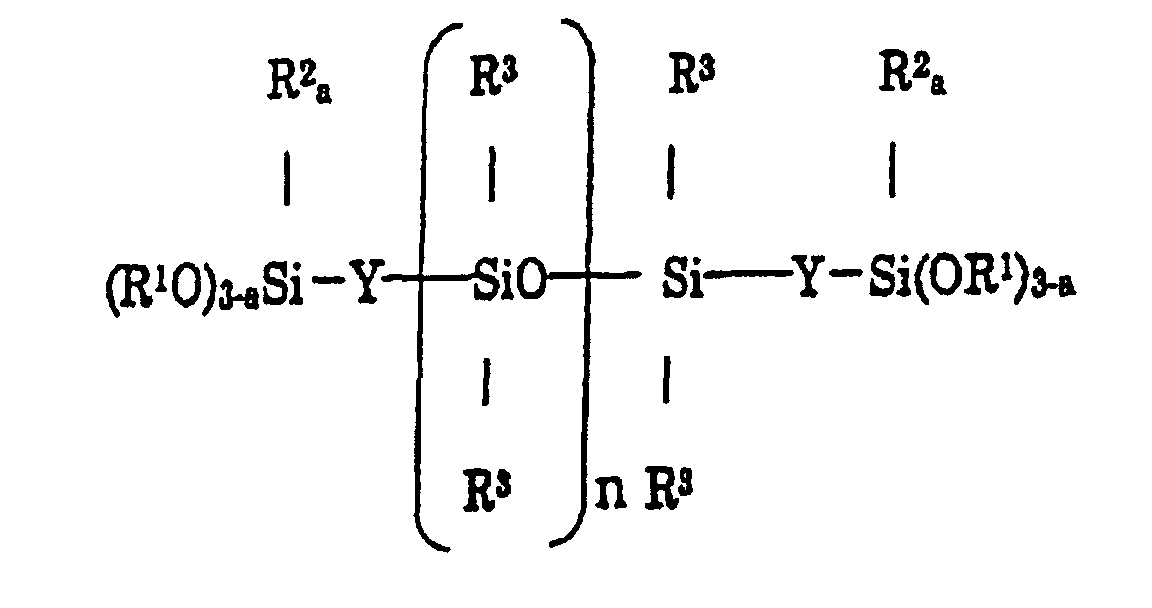 wobei R3 die oben angegebene Bedeutung besitzt und Z für eine zweiwertige Kohlenwasserstoffgruppe steht; und
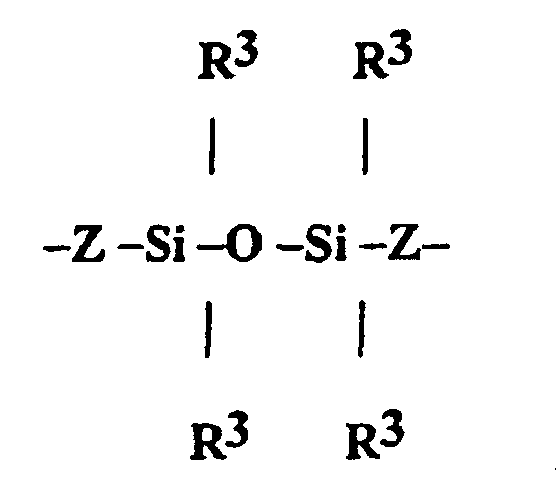 (A-2) 100 Gew.-Teile eines zweiten Polydiorganosiloxans der allgemeinen Formel:
 (B) 1 bis 25 Gew.-Teile eines Vernetzungsmittels, das aus Alkoxysilanen der allgemeinen Formel R5 bSi(OR6)4-b (wobei R5 für eine einwertige Kohlenwasserstoffgruppe steht, R6 eine Alkyl- oder Alkoxyalkylgruppe bedeutet und b entweder 0 oder 1 ist) und Teilhydrolysekondensaten derartiger Alkoxysilane ausgewählt ist;(C) 0,5 bis 10 Gew.-Teile einer Organotitanverbindung und(D) 0,01 bis 5 Gew.-Teile eines Gemisches aus einem Lichtstabilisator auf Basis eines gehinderten Amins und einem UV-Absorber, der aus Benzotriazolverbindungen, Benzophenonverbindungen, Arylesterverbindungen, Cyanoacrylatverbindungen und Triazinverbindungen ausgewählt ist.
 - Bei Raumtemperatur härtbare Siliconkautschukzusammensetzung nach Anspruch 1, wobei die Komponente Y in den Komponenten (A-1) und (A-2) eine Alkylengruppe ist.
- Bei Raumtemperatur härtbare Siliconkautschukzusammensetzung nach Anspruch 1, wobei die Komponente (B) aus trifunktionellen Alkoxysilanen, tetrafunktionellen Alkoxysilanen, den Teilhydrolysekondensaten von trifunktionellen Alkoxysilanen und den Teilhydrolysekondensaten von tetrafunktionellen Alkoxysilanen ausgewählt ist.
- Bei Raumtemperatur härtbare Siliconkautschukzusammensetzung nach Anspruch 1, wobei die Komponente (B) in einer Menge von 2 bis 10 Gewichtsteilen pro 100 Gewichtsteile der Komponente (A) verwendet wird.
- Bei Raumtemperatur härtbare Siliconkautschukzusammensetzung nach Anspruch 1, wobei die Organotitanverbindung der Komponente (C) aus Titansäureestern und Titanchelaten ausgewählt ist.
- Bei Raumtemperatur härtbare Siliconkautschukzusammensetzung nach Anspruch 1, wobei der Lichtstabilisator auf Basis eines gehinderten Amins und der UV-Absorber in einem Gewichtsverhältnis von 1:0,1 bis 1:2 vorliegen.
- Bei Raumtemperatur härtbare Siliconkautschukzusammensetzung nach Anspruch 1, wobei der Lichtstabilisator auf Basis eines gehinderten Amins aus Verbindungen der folgenden Strukturformeln ausgewählt ist:
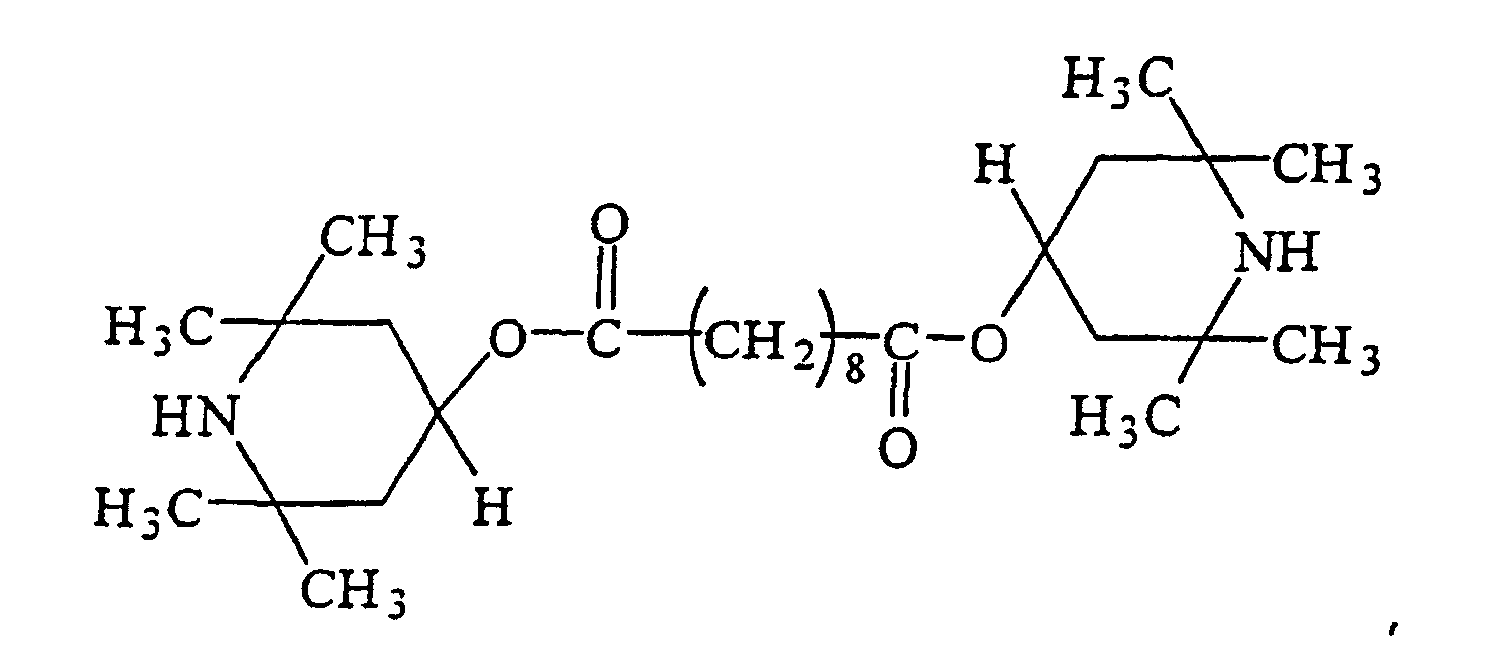 und
und
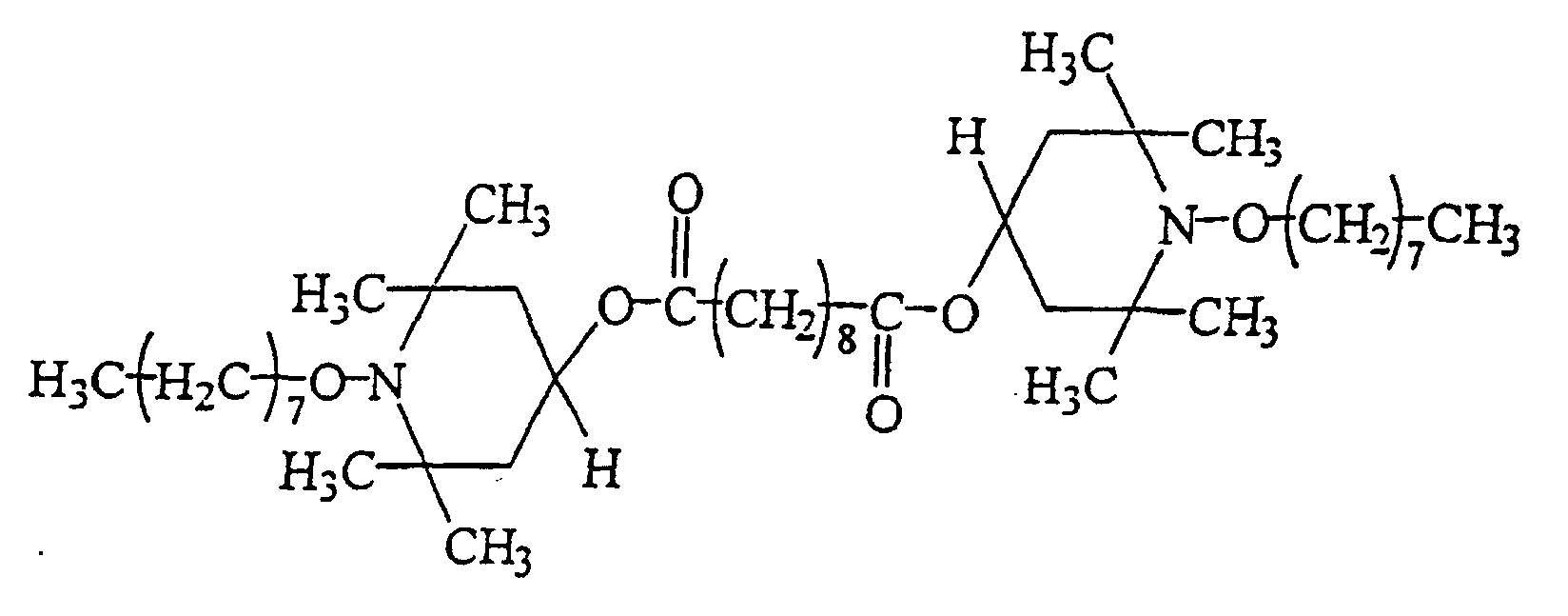
- Bei Raumtemperatur härtbare Siliconkautschukzusammensetzung nach Anspruch 1, wobei der UV-Absorber aus Cyanoacrylaten der folgenden Strukturformeln ausgewählt ist:und

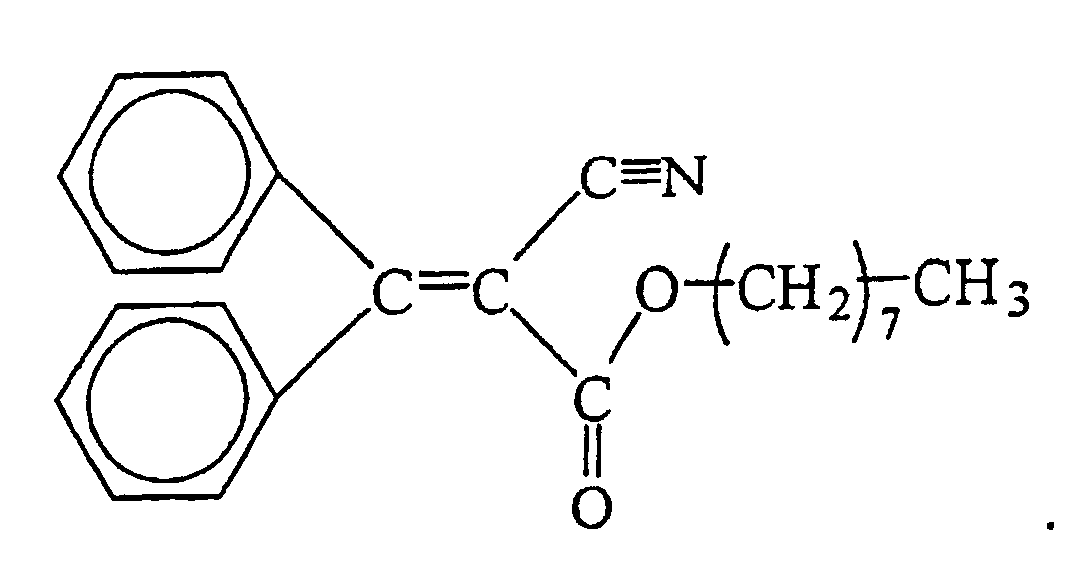
- Bei Raumtemperatur härtbare Siliconkautschukzusammensetzung nach Anspruch 1, die ferner ein Silankupplungsmittel umfasst, das aus Silankupplungsmitteln mit Aminogruppen, Silankupplungsmitteln mit Epoxygruppen, Silankupplungsmitteln mit Mercaptogruppen und Reaktionsgemischen von Silankupplungsmitteln mit Amin- und Aminogruppen und solchen mit Epoxygruppen ausgewählt ist.
- Bei Raumtemperatur härtbare Siliconkautschukzusammensetzung nach Anspruch 9, wobei das Silankupplungsmittel ein Reaktionsgemisch von γ-Aminopropyltrimethoxysilan und γ-Glycidoxypropyltrimethoxysilan ist.
Applications Claiming Priority (2)
| Application Number | Priority Date | Filing Date | Title |
|---|---|---|---|
| JP33008498 | 1998-11-20 | ||
| JP33008498 | 1998-11-20 |
Publications (2)
| Publication Number | Publication Date |
|---|---|
| EP1002837A1 EP1002837A1 (de) | 2000-05-24 |
| EP1002837B1 true EP1002837B1 (de) | 2003-06-11 |
Family
ID=18228615
Family Applications (1)
| Application Number | Title | Priority Date | Filing Date |
|---|---|---|---|
| EP99123019A Expired - Lifetime EP1002837B1 (de) | 1998-11-20 | 1999-11-19 | Bei Raumtemperatur härtbare Siliconkautschukzusammensetzung |
Country Status (2)
| Country | Link |
|---|---|
| EP (1) | EP1002837B1 (de) |
| DE (1) | DE69908738T2 (de) |
Cited By (1)
| Publication number | Priority date | Publication date | Assignee | Title |
|---|---|---|---|---|
| US11058610B2 (en) | 2016-06-24 | 2021-07-13 | Dow Toray Co., Ltd. | Agent for treating powder for cosmetic, powder for cosmetic, and cosmetic formulated using said powder |
Families Citing this family (5)
| Publication number | Priority date | Publication date | Assignee | Title |
|---|---|---|---|---|
| JP4823431B2 (ja) | 2001-01-30 | 2011-11-24 | 東レ・ダウコーニング株式会社 | 室温硬化性シリコーンゴム組成物 |
| US7271233B2 (en) * | 2001-05-30 | 2007-09-18 | Dow Corning Toray Silicone Co., Ltd. | Room-temperature-curable silicone rubber composition |
| JP4530136B2 (ja) * | 2004-04-06 | 2010-08-25 | 信越化学工業株式会社 | 室温硬化性オルガノポリシロキサン組成物及びその製造方法 |
| CN105874010A (zh) * | 2013-12-27 | 2016-08-17 | 道康宁东丽株式会社 | 室温下可固化的有机硅橡胶组合物及其用途 |
| US20210179904A1 (en) * | 2018-08-24 | 2021-06-17 | Sika Technology Ag | Moisture-curing rtv silicone composition with homogeneous deep-cure |
Family Cites Families (6)
| Publication number | Priority date | Publication date | Assignee | Title |
|---|---|---|---|---|
| US4111890A (en) * | 1977-12-19 | 1978-09-05 | Sws Silicones Corporation | Curable organopolysiloxane compositions containing titanium esters |
| JPS5543119A (en) * | 1978-09-20 | 1980-03-26 | Sws Silicones Corp | Titanium ester contained vulcanizable organopolysiloxane composition and its manufacture |
| DE3221655A1 (de) * | 1982-06-08 | 1983-12-08 | Polychemie-Gesellschaft mbH, 8900 Augsburg | Elastische dichtungsmassen und klebwerkstoffe, sowie deren verwendung |
| JPH06329914A (ja) * | 1993-05-18 | 1994-11-29 | Toray Dow Corning Silicone Co Ltd | 室温硬化性オルガノポリシロキサン組成物およびその製造方法 |
| DE19603628A1 (de) * | 1996-02-01 | 1997-08-07 | Wacker Chemie Gmbh | Bei Raumtemperatur vulkanisierende, kondensationsvernetzende Siliconkautschuke |
| GB9607897D0 (en) * | 1996-04-17 | 1996-06-19 | Dow Corning Sa | Organosiloxane compositions |
-
1999
- 1999-11-19 EP EP99123019A patent/EP1002837B1/de not_active Expired - Lifetime
- 1999-11-19 DE DE69908738T patent/DE69908738T2/de not_active Expired - Lifetime
Cited By (1)
| Publication number | Priority date | Publication date | Assignee | Title |
|---|---|---|---|---|
| US11058610B2 (en) | 2016-06-24 | 2021-07-13 | Dow Toray Co., Ltd. | Agent for treating powder for cosmetic, powder for cosmetic, and cosmetic formulated using said powder |
Also Published As
| Publication number | Publication date |
|---|---|
| EP1002837A1 (de) | 2000-05-24 |
| DE69908738D1 (de) | 2003-07-17 |
| DE69908738T2 (de) | 2004-05-13 |
Similar Documents
| Publication | Publication Date | Title |
|---|---|---|
| US6288152B1 (en) | Room-temperature curable silicon rubber composition | |
| KR100675021B1 (ko) | 실온 경화성 실리콘 고무 조성물 | |
| RU2434906C2 (ru) | Отверждаемая силиконовая композиция (варианты) | |
| US6809136B2 (en) | Room temperature curable organopolysiloxane compositions | |
| US4760123A (en) | Room temperature curing polyorganosiloxane compositions | |
| JPH0413382B2 (de) | ||
| HU217578B (hu) | Szobahőmérsékleten vulkanizálható, fenilcsoporttal szubsztituált triszfunkciós ketoxim-szilánokat tartalmazó szilikonkészítmények | |
| CN110997783A (zh) | 可湿固化组合物 | |
| KR0140083B1 (ko) | 실리콘 밀봉제 | |
| US6878769B2 (en) | Room temperature curable organopolysiloxane compositions | |
| EP4267677A1 (de) | Dichtungsmittelzusammensetzung | |
| JP2003327829A (ja) | 室温硬化性オルガノポリシロキサン組成物 | |
| EP1392773B1 (de) | Bei raumtemperatur härtbare siliconzusammensetzung | |
| EP1002837A1 (de) | Bei Raumtemperatur härtbare Siliconkautschukzusammensetzung | |
| CA1245790A (en) | Water resistant room temperature vulcanizable polyorganosiloxane compositions and method for preparing same | |
| JP2003049072A (ja) | 室温硬化性シリコーンゴム組成物 | |
| JP2002356616A (ja) | 室温硬化性シリコーンゴム組成物 | |
| KR100595495B1 (ko) | 오르가노실리콘화합물을 기재로 한 가황재 | |
| HK1029362B (en) | Room-temperature curable silicone rubber composition | |
| JP6994349B2 (ja) | 室温硬化性ポリオルガノシロキサン組成物、および目地形成方法 | |
| WO2025220627A1 (ja) | 室温硬化性オルガノポリシロキサン組成物 | |
| JP2000007918A (ja) | 室温硬化性ポリオルガノシロキサン組成物 | |
| JP2026050585A (ja) | 室温硬化性オルガノポリシロキサン組成物 |
Legal Events
| Date | Code | Title | Description |
|---|---|---|---|
| PUAI | Public reference made under article 153(3) epc to a published international application that has entered the european phase |
Free format text: ORIGINAL CODE: 0009012 |
|
| AK | Designated contracting states |
Kind code of ref document: A1 Designated state(s): DE FR GB IT |
|
| AX | Request for extension of the european patent |
Free format text: AL;LT;LV;MK;RO;SI |
|
| 17P | Request for examination filed |
Effective date: 20000621 |
|
| AKX | Designation fees paid |
Free format text: DE FR GB IT |
|
| 17Q | First examination report despatched |
Effective date: 20020131 |
|
| GRAH | Despatch of communication of intention to grant a patent |
Free format text: ORIGINAL CODE: EPIDOS IGRA |
|
| GRAH | Despatch of communication of intention to grant a patent |
Free format text: ORIGINAL CODE: EPIDOS IGRA |
|
| GRAA | (expected) grant |
Free format text: ORIGINAL CODE: 0009210 |
|
| AK | Designated contracting states |
Designated state(s): DE FR GB IT |
|
| REG | Reference to a national code |
Ref country code: GB Ref legal event code: FG4D |
|
| REF | Corresponds to: |
Ref document number: 69908738 Country of ref document: DE Date of ref document: 20030717 Kind code of ref document: P |
|
| ET | Fr: translation filed | ||
| PLBE | No opposition filed within time limit |
Free format text: ORIGINAL CODE: 0009261 |
|
| STAA | Information on the status of an ep patent application or granted ep patent |
Free format text: STATUS: NO OPPOSITION FILED WITHIN TIME LIMIT |
|
| 26N | No opposition filed |
Effective date: 20040312 |
|
| PGFP | Annual fee paid to national office [announced via postgrant information from national office to epo] |
Ref country code: FR Payment date: 20131108 Year of fee payment: 15 Ref country code: GB Payment date: 20131113 Year of fee payment: 15 |
|
| PGFP | Annual fee paid to national office [announced via postgrant information from national office to epo] |
Ref country code: IT Payment date: 20131112 Year of fee payment: 15 |
|
| GBPC | Gb: european patent ceased through non-payment of renewal fee |
Effective date: 20141119 |
|
| REG | Reference to a national code |
Ref country code: FR Ref legal event code: ST Effective date: 20150731 |
|
| PG25 | Lapsed in a contracting state [announced via postgrant information from national office to epo] |
Ref country code: GB Free format text: LAPSE BECAUSE OF NON-PAYMENT OF DUE FEES Effective date: 20141119 |
|
| PG25 | Lapsed in a contracting state [announced via postgrant information from national office to epo] |
Ref country code: FR Free format text: LAPSE BECAUSE OF NON-PAYMENT OF DUE FEES Effective date: 20141201 |
|
| PG25 | Lapsed in a contracting state [announced via postgrant information from national office to epo] |
Ref country code: IT Free format text: LAPSE BECAUSE OF NON-PAYMENT OF DUE FEES Effective date: 20141119 |
|
| PGFP | Annual fee paid to national office [announced via postgrant information from national office to epo] |
Ref country code: DE Payment date: 20181106 Year of fee payment: 20 |
|
| REG | Reference to a national code |
Ref country code: DE Ref legal event code: R071 Ref document number: 69908738 Country of ref document: DE |
|
| REG | Reference to a national code |
Ref country code: DE Ref legal event code: R082 Ref document number: 69908738 Country of ref document: DE Representative=s name: DR. SCHOEN, NEYMEYR & PARTNER MBB, DE Ref country code: DE Ref legal event code: R081 Ref document number: 69908738 Country of ref document: DE Owner name: DOW TORAY CO., LTD., JP Free format text: FORMER OWNER: DOW CORNING TORAY SILICONE COMPANY, LTD., TOKIO/TOKYO, JP |