EP1003071A2 - Système d'impression avec modulateur de lumière à cristaux liquides du type réflectif - Google Patents
Système d'impression avec modulateur de lumière à cristaux liquides du type réflectif Download PDFInfo
- Publication number
- EP1003071A2 EP1003071A2 EP99203707A EP99203707A EP1003071A2 EP 1003071 A2 EP1003071 A2 EP 1003071A2 EP 99203707 A EP99203707 A EP 99203707A EP 99203707 A EP99203707 A EP 99203707A EP 1003071 A2 EP1003071 A2 EP 1003071A2
- Authority
- EP
- European Patent Office
- Prior art keywords
- modulator
- light
- spatial light
- printing
- image
- Prior art date
- Legal status (The legal status is an assumption and is not a legal conclusion. Google has not performed a legal analysis and makes no representation as to the accuracy of the status listed.)
- Withdrawn
Links
- 239000004973 liquid crystal related substance Substances 0.000 title claims abstract description 15
- 238000005286 illumination Methods 0.000 claims abstract description 60
- 230000010287 polarization Effects 0.000 claims abstract description 43
- 238000000034 method Methods 0.000 claims abstract description 30
- 238000003384 imaging method Methods 0.000 claims description 11
- 230000033001 locomotion Effects 0.000 description 17
- 238000013461 design Methods 0.000 description 13
- 238000005516 engineering process Methods 0.000 description 12
- 239000003086 colorant Substances 0.000 description 10
- 230000003287 optical effect Effects 0.000 description 10
- 238000013459 approach Methods 0.000 description 8
- 230000008901 benefit Effects 0.000 description 6
- 230000000694 effects Effects 0.000 description 6
- 229910052736 halogen Inorganic materials 0.000 description 6
- 150000002367 halogens Chemical class 0.000 description 5
- 239000006059 cover glass Substances 0.000 description 4
- 238000012986 modification Methods 0.000 description 3
- 230000004048 modification Effects 0.000 description 3
- 230000035945 sensitivity Effects 0.000 description 3
- 238000013519 translation Methods 0.000 description 3
- 238000003491 array Methods 0.000 description 2
- 230000000712 assembly Effects 0.000 description 2
- 238000000429 assembly Methods 0.000 description 2
- 230000000903 blocking effect Effects 0.000 description 2
- 230000008859 change Effects 0.000 description 2
- 239000002131 composite material Substances 0.000 description 2
- 230000003111 delayed effect Effects 0.000 description 2
- 239000010408 film Substances 0.000 description 2
- 230000004907 flux Effects 0.000 description 2
- 238000010348 incorporation Methods 0.000 description 2
- 230000010354 integration Effects 0.000 description 2
- 239000000203 mixture Substances 0.000 description 2
- OAICVXFJPJFONN-UHFFFAOYSA-N Phosphorus Chemical compound [P] OAICVXFJPJFONN-UHFFFAOYSA-N 0.000 description 1
- XUIMIQQOPSSXEZ-UHFFFAOYSA-N Silicon Chemical compound [Si] XUIMIQQOPSSXEZ-UHFFFAOYSA-N 0.000 description 1
- 230000003213 activating effect Effects 0.000 description 1
- 230000004913 activation Effects 0.000 description 1
- 230000008033 biological extinction Effects 0.000 description 1
- 230000005540 biological transmission Effects 0.000 description 1
- 230000015556 catabolic process Effects 0.000 description 1
- 150000001875 compounds Chemical class 0.000 description 1
- 238000012937 correction Methods 0.000 description 1
- 239000013078 crystal Substances 0.000 description 1
- 230000007547 defect Effects 0.000 description 1
- 238000006731 degradation reaction Methods 0.000 description 1
- 230000001419 dependent effect Effects 0.000 description 1
- 238000010894 electron beam technology Methods 0.000 description 1
- 238000005538 encapsulation Methods 0.000 description 1
- 239000011521 glass Substances 0.000 description 1
- 230000007257 malfunction Effects 0.000 description 1
- 230000008569 process Effects 0.000 description 1
- 238000012545 processing Methods 0.000 description 1
- 230000004044 response Effects 0.000 description 1
- 229910052710 silicon Inorganic materials 0.000 description 1
- 239000010703 silicon Substances 0.000 description 1
- 230000003595 spectral effect Effects 0.000 description 1
- 239000010409 thin film Substances 0.000 description 1
Images



Classifications
-
- G—PHYSICS
- G03—PHOTOGRAPHY; CINEMATOGRAPHY; ANALOGOUS TECHNIQUES USING WAVES OTHER THAN OPTICAL WAVES; ELECTROGRAPHY; HOLOGRAPHY
- G03B—APPARATUS OR ARRANGEMENTS FOR TAKING PHOTOGRAPHS OR FOR PROJECTING OR VIEWING THEM; APPARATUS OR ARRANGEMENTS EMPLOYING ANALOGOUS TECHNIQUES USING WAVES OTHER THAN OPTICAL WAVES; ACCESSORIES THEREFOR
- G03B27/00—Photographic printing apparatus
- G03B27/72—Controlling or varying light intensity, spectral composition, or exposure time in photographic printing apparatus
-
- B—PERFORMING OPERATIONS; TRANSPORTING
- B41—PRINTING; LINING MACHINES; TYPEWRITERS; STAMPS
- B41J—TYPEWRITERS; SELECTIVE PRINTING MECHANISMS, i.e. MECHANISMS PRINTING OTHERWISE THAN FROM A FORME; CORRECTION OF TYPOGRAPHICAL ERRORS
- B41J2/00—Typewriters or selective printing mechanisms characterised by the printing or marking process for which they are designed
- B41J2/435—Typewriters or selective printing mechanisms characterised by the printing or marking process for which they are designed characterised by selective application of radiation to a printing material or impression-transfer material
- B41J2/465—Typewriters or selective printing mechanisms characterised by the printing or marking process for which they are designed characterised by selective application of radiation to a printing material or impression-transfer material using masks, e.g. light-switching masks
-
- G—PHYSICS
- G02—OPTICS
- G02B—OPTICAL ELEMENTS, SYSTEMS OR APPARATUS
- G02B27/00—Optical systems or apparatus not provided for by any of the groups G02B1/00 - G02B26/00, G02B30/00
- G02B27/28—Optical systems or apparatus not provided for by any of the groups G02B1/00 - G02B26/00, G02B30/00 for polarising
- G02B27/283—Optical systems or apparatus not provided for by any of the groups G02B1/00 - G02B26/00, G02B30/00 for polarising used for beam splitting or combining
Definitions
- This invention relates generally to an apparatus and method for spatially and temporally modulating a light beam and imaging modulated light onto a photosensitive media.
- Photographic images are traditionally printed onto photographic paper using conventional film based optical printers.
- the photographic industry is converting to digital imaging.
- One step in the digital imaging process is to utilize images obtained from digital cameras or scanned film exposed in traditional photographic cameras to create digital image files that are then printed onto photographic paper.
- the current invention relates to the area of digital image printing of digital image files onto photographic paper.
- CTR cathode ray tube
- CRT printers tend to be expensive which is a severe shortcoming in a cost sensitive market. Also, CRT printers are limited in the ability to provide sufficient red exposure to the media when operating at frame rates above 10,000 prints per hour.
- Flying spot laser printers expose each of the pixels for a very short time, on the order of a fraction of a microsecond.
- Optical printing systems expose the paper for the duration of the whole frame time, which can be on the order of seconds. Thus, a special paper is required for laser printers.
- a more contemporary approach uses a single spatial light modulator such as a Texas Instruments digital micromirror device (DMD) as shown in U.S. Patent No. 5,061,049 or liquid crystal device (LCD) modulator to modulate an incoming optical beam.
- DMD Texas Instruments digital micromirror device
- LCD liquid crystal device
- Spatial light modulators provide both significant advantages in cost, allow longer exposure times, and have been proposed for a variety of different printing systems from line printing systems such as the printer depicted in U.S. Patent No. 5,521,748, to area printing systems such as the system described in U.S. Patent No. 5,652,661.
- the second approach is to use a liquid crystal spatial light modulator.
- Liquid crystal modulators are a low cost solution for applications involving spatial light modulators.
- Several photographic printers using commonly available LCD technology have been proposed. Some examples of such systems are described in U.S. Patent Nos. 5,652,661; 5,701,185; and 5,745,156.
- Most designs revolve around the use of a transmissive spatial light modulator such as depicted in U.S. Patent Nos. 5,652,661 and 5,701,185..
- most spatial light modulators have been designed for use in transmission. While such a method offers several advantages in ease of optical design for printing, there are several drawbacks to the use of conventional transmissive LCD technology.
- Transmissive spatial light modulators generally have reduced aperture ratios and the use of (thin film transistor) TFT on glass technology does not promote the pixel to pixel uniformity desired in many printing applications. Furthermore, in order to provide large numbers of pixels, many high resolution transmissive LCDs possess footprints of several inches. Such a large footprint can be unwielding when combined with a printlens. As a result, most LCD printers using transmissive technology are constrained to either low resolution or small print sizes. To print high resolution 8 in. by 10 in. images with at least 300 pixels per inch requires 2400 by 3000 pixels. Spatial light modulators with such resolutions are not readily available. Furthermore, each pixel must have a gray scale depth so as to be able to render a continuous tone print and do so uniformly over the frame size
- An object of the present invention is to overcome the above-mentioned drawbacks of digital image printing on photographic paper, namely cost, resolution, and reciprocity failure.
- the recent advent of high resolution reflective LCDs with high contrast (greater than 100:1), such as described in U.S. Patent Nos. 5,325,137 and 5,805,274 has opened possibilities for printing that were previously unavailable.
- the inventive printer is based on a reflective LCD spatial light modulator illuminated sequentially by red, green and blue, light emitting diodes (LEDs), and where the LCD spatial light modulator may be sub-apertured and dithered in two directions, and possibly three to increase the resolution. This method has been applied to transmissive LCD systems due to the already less than perfect fill factor.
- Incorporating dithering into a reflective LCD printing system would allow high resolution printing while maintaining a small footprint. Also, because of the naturally high fill factor present in many reflective LCD technologies, the dithering can be omitted with no detriment to the continuity of the printed image. While devices such as the TI micromirror can incorporate a secondary mask as shown in U.S. Patent No. 5,754,217, the mask may be displaced from the device or at the very least add to the processing complexity of an already complex device. The use of a single LCD serves to significantly reduce the cost of the printing system. Furthermore, the use of an area spatial light modulator sets the exposure times at sufficient length to avoid or significantly reduce reciprocity failure.
- One aspect of the inventive design is that a LCD designed for projection display can be incorporated into the printing design with little or no modification to the LCD itself.
- the most suitable to this design is one which incorporates a small footprint with an integrated CMOS backplane.
- the compact size along with the uniformity of drive offered by such a device will translate into better image quality than other LCD technologies.
- There has been progress in the projection display industry towards incorporating a single reflective LCD (see U.S. Patent No. 5,743,612), primarily because of the lower cost and weight of single device systems.
- the LCD technologies it is the reflective LCD with the silicon backplane that can best achieve the high speeds required for color sequential operation. While this increased speed may not be as essential to printing as it is for projection display, the higher speeds can be utilized to incorporate additional gray scale and uniformity correction to printing systems.
- Spatial light modulator printing systems can incorporate a variety o methods to achieve gray scale.
- Texas Instruments employs a time delayed integration system that works well with line arrays as shown in U.S. Patent Nos. 5,721,622 and 5,461,410. While this method can provide adequate gray levels at a reasonable speed, line printing TDI methods can result in registration problems and soft images.
- Alternate methods have been proposed particularly around transmissive LCDs such as the design presented in U.S. Patent No. 5,754,305, which can also be incorporated into reflective LCDs. However, if the LCD is sufficiently fast, the proposed printer can create gray scale in area images adequately without time delayed integration or analog operation.
- An object of this invention to provide for a high pixel density color image at a media exposure plane in an AgX printing system; and to provide means by which to utilize a high site density spatial light modulator to create digital images for imaging onto photographic media.
- light emitting diode sources are imaged color sequentially through a polarizer, spatial uniformizing optics and a polarizing beamsplitter to create essentially telecentric illumination at the plane of a spatial light modulator.
- the spatial light modulator is comprised of a plurality of modulator sites in two dimensions. Individual modulator sites rotate the polarization state of incoming light and reflected light passes through the polarizing beamsplitter cube.
- Light is then imaged through a print lens assembly and an additional polarization element onto a media plane. The media is exposed in a color sequential manner with a two dimensional color image. The media is then moved to a second position and a new image is printed.
- the light emitting diodes are arranged in a two-dimensional pattern such that light emitted from the sources is largely collected by the imaging optics.
- the light emitting diodes are then addressed in a series of pulses of varying amplitude and duration, in a color sequential manner to provide illumination of varying light levels to the reflective spatial light modulator, thus extending the gray scale available through the spatial light modulator.
- the light emitting diodes and collimating lenses are replaced by a refletorised tungsten-halogen lamp, an infrared-rejecting filter and a color filter wheel with red, green, blue and opaque filter positions.
- Incident light passes though individual collimating lenses to a linear polarizer.
- the linear polarizer serves to establish the polarization axis of the incident light to be the same as the polarizing beamsplitter cube.
- Light passes through a lenslet array and field lens arrangement to provide uniform and telecentric illumination.
- Light incident on the polarizing beamsplitter cube is channeled in the direction of the spatial light modulator as the initial polarizer in the optical system established the polarization axis as such.
- Uniform light incident on the spatial light modulator is modulated on a site by site basis.
- Image data is displayed on the spatial light modulator as a series of frames corresponding to the illumination level and color.
- the voltage supplied to the spatial light modulator may vary with the illumination wavelength.
- Light rotated by the spatial light modulator is passed through the polarizing beamsplitter cube and through a subsequent polarizer and print lens assembly.
- the print lens assembly is used in combination with a linear polarizer to provide a high contrast magnified image at the image plane.
- multiple images generated color sequentially are imaged on a two dimensional area or swath on the media. Upon completion of exposure of a given image, the media is advanced and the next image is exposed.
- the polarizer following the polarizing beamsplitter is rotated to multiple distinct positions to compensate for the difference in rotation between illumination wavelengths.
- multiple spatial light modulators are sequentially placed in the illumination path and imaged onto the media.
- the multiple modulators may be distinct in their operation with respect to wavelength of illumination, drive voltage, or aspect ratio.
- the spatial light modulators may also incorporate polarization compensators before the polarizing beamsplitter to improve contrast. Additionally, multiple modulators may be needed to switch between differing aspect ratios.
- the spatial light modulator or an image thereof is moved to multiple distinct locations displaced at a distance determined by the modulator site size to create multiple images.
- This approach referred to as dithering, provides additional resolution at the image plane.
- the spatial light modulator is comprised of apertured modulator sites that are dithered and imaged to create higher pixel density at the image plane.
- the print lens assembly is replaced by another print lens assembly on command to create a larger area print.
- the image generated by dithering in combination with the larger image size provides larger prints at high resolution.
- the present invention relates to a method of printing onto a photosensitive media using at least one reflective liquid crystal spatial light modulator.
- the method comprises the steps of: imaging light from a light source at least through an optics assembly; passing the light from the optics assembly through a polarization beamsplitter element to isolate polarization states of the light; directing the polarized light to the spatial light modulator to create an essentially telecentric illumination at the spatial light modulator; and imaging the light through a print lens assembly at the photosensitive media.
- the present invention also relates to a printing assembly which prints onto a photosensitive media.
- the printing assembly comprises a light source; illumination optics which receive light from the light source and image the light at a beamsplitter element which images one polarization state of light at a spatial light modulator, wherein an essentially telecentric illumination is created at the spatial light modulator; and a print lens assembly which images the light onto the photosensitive media.
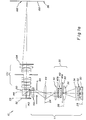
- Fig. 1a illustrates a printer referred to in general by numeral 10.
- Printer 10 is comprised of a light source 30 which can be in the form of light emitting diodes (LED); illumination optics 11; a polarization beamsplitter element 50 which can be in the form of a beamsplitting cube; a reflective spatial light modulator 52 in the form of a reflective liquid crystal device(LCD) modulator; a data path (not shown) for providing image information to modulator 52; and a print lens assembly 132.
- Printer 10 provides a two dimensional image or swaths of area to light sensitive media 160 located at an image plane 150.
- Light source 30 comprises a two-dimensional array of LEDs at three distinct wavelengths representing red, blue, and green emission.
- One arrangement of LEDs of light source 30 is shown in Fig.2.
- the LEDs of light source 30 are contained in a circular aperture 20.
- LEDs emitting in the red wavelength 14, LEDS emitting in the blue wavelengths 18, and LEDs emitting in the green wavelength 16, are placed in a frame 19.
- the LEDs are arranged such that the colors of emission are spread evenly about the aperture.
- the relative number of LEDs emitting at a given wavelength are determined by the sensitivity of the media onto which the light is imaged.
- An example arrangement could include four red LEDs 14, two green LEDs 16, and two blue LEDs 18.
- the LEDs are spaced such that a significant fraction of the light emitted can be captured in the collection aperture of the downstream optics of illumination optics 11. Furthermore, redundancy in emitters reduces the system sensitivity to malfunction in any individual LED.
- the LEDs of light source 30 are operated in a pulsed and color sequential manner. For any given image, groups of LEDs are activated in order of wavelength. For example, the LEDs 14 are activated and deactivated, blue LEDs 18 are activated and deactivated, then green LEDs 16 are activated and deactivated. Any activation cycle for a given wavelength consists of a series of pulses, which may vary in duration or amplitude. The length and duration of the pulses are determined by the level of illumination needed per image to define the gray scale and by the sensitivity of media 160 to light level and illumination time.
- Illumination optics 11 are designed to provide uniform and essentially telecentric illumination at the modulator plane. This design is unique to printing applications because the requirements for uniformity of illumination and uniformity of image are far more stringent in printing then in projection display. Specifically, the tolerance to roll-off at the edges of the illumination is much greater. The telecentricity is required to maintain the uniformity of the image at the image plane due to constraints on the LCD operation. Throughout the system conjugate planes 28 are shown in Fig. 1a.
- the first element in illumination optics 11 is a collimating lens 32 placed in front of each LED of light source 30. Fig.
- FIG. 3 shows a cross sectional view of red 14, green 16 and blue 18 LEDs mounted with collimating lenses 32 into frame 19.
- Each LED 14, 16, 18 is mounted in frame 19 with the anode 22 and a cathode 24 leads behind frame 19 and collimating lens 32 in front.
- the individual collimating lenses 32 are required only if the encapsulation of the diodes is insufficient.
- the collimating lenses aid in collecting the light from the rapidly diverging light from LEDs 14, 16, 18.
- the use of collimating lens 32 is optional and dependent on the particular choice of LEDs.
- a LED wheel as shown in Fig.4 can be employed.
- LEDs of the three colors, red 14, blue 18, and green 16 are separated into the three segments of a disk assembly 26.
- Disk assembly 26 rotates the appropriate color LEDs into position and the LEDs are illuminated.
- Disk assembly 26 spins to three distinct positions for the three distinct colors.
- Illumination optics 11 is designed to illuminate a nearly square or rectangular aperture. In general, axially symmetric components are employed in the illumination. Following collimating lens 32 is a combiner field lens 34 that images light to an integrator assembly 35 which comprises two field lenses 36, 42 and a lenslet array assembly 40 which includes two lenslet arrays 40a, 40b. The light at the intermediate illumination plane is broken into a number of portions equivalent to the number of elements in lenslet array 40a. The individual portions are then imaged and magnified by second lenslet array 40b and second field lens 42. Light passing through integrator assembly 35 along with a following field lens 44 is passed through an aperture stop 46 and a relay lens 48. Relay lens 48 is positioned immediately before polarization beamsplitter element 50.
- the LEDs of light source 30, collimating lens 32 and combiner field lens 34 can be replaced by a red, green and blue 2-dimensional array of suitably lensed lamps 12 placed on a spherical surface 21 which is placed on a printed circuit board 25 (Figure 1b).
- the center of curvature of spherical surface 21 is at least at the center of collimating lens 32 as shown in Figure 1b.
- relay lens 48, field lens 44, and field lens 42 are shown as separate elements in Figure 1a, a single compound lens 49 providing uniform and essentially telecentric illumination could be employed instead of the three individual elements as is depicted in Figure 1c.
- a light source in the form of a broadband visible source with a color filter wheel can be employed. More specifically, an alternate light source such as a halogen lamp 29 can be employed in conjunction with a color filter wheel 33 to provide the required color sequential illumination. Such an arrangement is shown in Figure 1c. If a halogen lamp 29 is employed, it is advisable to incorporate an infrared rejecting filter 31 following the lamp in the assembly.
- the reflector present in the housing of a halogen lamp in combination with lenses 36 and 37 direct the flux from the filament into the entrance aperture of uniformizer 40.
- Rotating color filter wheel 33 separates the illumination in time into red, green and blue spectral bands, and also provides a light blocking position to provide zero illumination blocking intervals. While an illumination incorporating a halogen lamp and filter wheel is adequate, the mechanical motion of the filter wheel adds complexity which may not be desirable.
- polarization beamsplitter element 50 may not provide adequate extinction between s polarization state of light 142 and p polarization state of light 144, a linear polarizer 38 may be incorporated in the illumination assembly prior to beamsplitter element 50. There are several places where this polarizer 38 can be placed; one such position is immediately preceding lenslet array assembly 40. Linear polarizer 38 is used to isolate the polarization state parallel to the axis of polarization beamsplitter element 50. This serves to reinforce the polarization state determined by polarization beamsplitter element 50, decrease leakage light and increase the resulting contrast ratio. In Fig. 1, light of the s-polarization state 142 passing through polarization beamsplitter element 50 is directed to the plane of LCD modulator 52. The p polarization state 144 is passed through beamsplitter element 50.
- the light in s polarization state 142 directed onto LCD modulator 52 is essentially telecentric. This a key aspect of this design and sets the design apart from those generally used for projection display. If the light impingent is not telecentric, then modulation across the different angles of incident light is not uniform which will lead to a severe degradation in contrast.
- Spatial light modulator 52 of this system is designed for a two dimensional reflective polarization based spatial light modulator as is shown in Fig. 5a.
- Modulator 52 includes a plurality of modulator sites 53 that are individually modulatable. Light passes through modulator 52, is reflected off the back of the modulator 52, and returns through modulator 52. If a modulator site 53 is "on" or bright, during the round-trip through modulator 52, the polarization state of the light is rotated. In an ideal case the light is rotated 90 degrees. However, this degree of rotation is rarely easily achieved. If a given modulator site is "off' or dark, the light is not rotated.
- the light that is not rotated is not passed straight through the beamplitter element 50 but is redirected away from the media plane by beamsplitter element 50. It should be noted that light which is rotated by LCD modulator 52 may become elliptically polarized. Upon passing through a linear polarizer, the light will regain linearity. However, light that is not passed through a linear polarizer will retain ellipticity.
- reflective polarization based modulators The most readily available choice of reflective polarization based modulators is the reflective liquid crystal modulator.
- Such modulators originally developed for use in projection display, can have resolutions as high as 4000 x 2000 modulator sites. Currently, resolutions of 1200 x 1600 sites are available with footprints as small as a 0.9 in diagonal.
- These high resolution reflective LCDs are often twisted nematic LCDs, or homeotropically aligned reflective LCDs, although other types of reflective LCDs such as ferroelectric are often employed in projection display.
- Some of the key characteristics of these LCDs are the high resolution, the high contrast ( >100:1) in all three primary colors, the fast frame rate of 70 frames per second or higher, and the high aperture ratio (> 90%).
- CMOS backplane increases the uniformity across the array.
- the LCDs are also capable of producing an eight bit gray scale either through pulse width modulation or through analog operation. In either case data may be introduced digitally to the printing system. These characteristics ensure that the reflective LCD is an excellent choice for use in a reflective printing system.
- Modulator 52 can be designed in a number of different configurations. The most amenable to a low cost printing system is a single chip system used in color sequential mode. Such a modulator may be either specifically designed for color sequential use, often incorporating a faster backplane and slightly different liquid crystal compositions, or can be a single chip with a 60 to 70 frame per second backplane. The latter option is sufficient for printing because the high frame rates are not a necessity and often reduce the bit depth of the resulting image. However, while many liquid crystals are the same basic crystal for all three primary color wavelengths, sometimes either due to the specific applied voltage or the liquid crystal thickness, operation may differ in the three wavelengths.
- the resulting polarization rotation on an incident beam may vary with wavelength.
- the efficiency and contrast of the modulation will vary among the three colors.
- This optical system is designed to image and pass rotated light.
- the degree of rotation will vary as a function of wavelength.
- this difference in rotation will effect the efficiency of the system.
- the percentage of incident light that is actually rotated and imaged on the media plane will vary.
- This difference in wavelength efficiency can be accounted for by varying the illumination strength, and exposure time.
- the media requires different power densities in the different wavelengths. The bigger problems arise in the dark or "off state". In this state, the light is not rotated and should not be directed thought the cube and imaged. If the light is in fact, rotated, light will leak through the imaging system and decrease the contrast.
- a polarization compensator 76 may be introduced to the surface of modulator 52. Such an arrangement is depicted in Fig. 5b.
- Figure 5b is a cross-sectional view of modulator 52.
- the top surface or layer includes compensator 76
- the second surface or layer is a cover glass 74 of modulator 52
- the third layer is modulator 52 with a reflective backplane
- behind modulator 52 are mounted actuators 70, 72 or mounts for actuators to position modulator 52.
- Another possibility, is to incorporate a polarization compensator in the path of the optical beam to correct the polarization state of the light.
- a single compensator may be placed in the optical path to particularly correct the off state of the light.
- the design is to be truly efficient for each wavelength, the system would require three compensators placed sequentially with the illumination timing.
- Polarization compensation devices can prove to be expensive, and an efficient but inexpensive means to accomplish the same results can be obtained through the use of linear polarizers.
- a single LCD operating in color sequential mode imparts different degrees of polarization rotation to the three colors of illumination.
- special care must be taken to provide a truly dark "off state". Because the rotation of the light of modulator 52 is not always crossed perfectly with beamsplitter element 50 in the off state, additional polarization selection must be incorporated into the optical path. Also, beamsplitter element 50 is not perfect and will leak some amount of appositely polarized light. For these reasons, an additional sheet polarizer is either immediately before or after print lens assembly 132.
- This additional polarizer serves to reject leakage light that is passed through beamsplitter element 50. Specifically, for a particular LCD modulator, the dark state of the light is actually rotated 7 degrees from the polarization transmitting direction of beamsplitter element 50. To correct this, a second analyzer polarizer 134 is rotated 7 degrees off-axis and the leakage light is suppressed. The particular angle at which polarizer 134 must be placed is a function of the particular reflective LCD chosen for the printing system. A suggested placement of analyzer polarizer 134 is shown in Fig 1.
- the residual rotation present in the off-state is quite different for the three wavelengths.
- the implication is that there is some degree of residual charge or rotation on the LCD in the "off state". While this state is designed not to impart rotation to the incident light, a small degree of rotation and possibly ellipticity is introduced. Because for a specific thickness and voltage the rotation will vary with wavelength, the analyzer polarizer position may be different for the three wavelengths.
- One method to ensure sufficient contrast is to place three polarizers sequentially in time in the path of the beam, or to rotate the existing polarizer 134 to three distinct positions for the three different illumination wavelengths.
- a further embodiment or approach to dealing with different operation methods for the different wavelength is to use three LCD modulators as shown in Fig. 6.
- three LCD modulators 54, 55, 56 one representing each color are mounted on a single frame 78. Attached to frame 78 is a mount or dither assembly 58 needed for motion in shorter distances in the plane of the LCD modulator.
- the assembly is attached to a linear translation rail system 59 with bearings 57 used to linearly translate each of the three LCD modulators 54, 55, 56 sequentially in position to utilize the color sequential illumination. It should be understood that methods other than a rail assembly may be used to position the three LCD modulators 54, 55, 56 into position.
- FIG. 7 is a picture of a rail assembly for motion between spatial light modulators of opposite aspect rations.
- One LCD modulator is in landscape format 98, while the other is in portrait format 96.
- a single mount or dither assembly 58 is used to hold both LCDs 96, 98 to linear translation rail system 59. This motion assembly is different from the assembly for dithering because the required motion is a greater distance.
- LCDs 96, 98 sit on linear translation rail system 59 with ball bearings 57 situated underneath. The assembly is electro-statically or mechanically actuated and moves laterally between two stops 66.
- Fig. 8 is an assembly with vertical motion to switch between portrait 108, 110, 112 and landscape 102, 104, 106 LCDs and a lateral assembly to switch between LCD colors red 106,108, blue 104, 110, and green 102 112.
- the vertical assembly uses a rail 114 to move the mounting plane.
- Dither assembly 58 is attached at the rear of the device and at the bottom of the mounting plane.
- a lateral assembly using rollers or ball bearings 57 is the base or rail system 59 of the entire assembly.
- a single LCD may be used to increase resolution.
- One of the issues when printing with a two-dimensional modulator is the effect of modulator site defects. Another possible issue is a need to increase resolution for larger print sizes. Both these issues can be addressed through dithered printing.
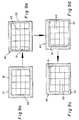
- Dithering a standard high aperture ratio LCD modulator 52 is shown in Figs. 9a-9d. To dither a full aperture LCD is to image the modulator 52 at one position, and reposition modulator 52 a fraction of a modulator site distance away and image. In so doing, multiple images are created and overlapped. By overlapping multiple images, the system acquires a redundancy that corrects for modulator site failure or drop out.
- Figs. 9a-9d One particular dithering scheme is depicted in Figs. 9a-9d.
- modulator 52 is positioned at a given position 61 and modulator sites 63 are positioned and imaged (Fig. 9a).
- Modulator 52 is then moved to a second position 62 (Fig. 9b) one half of a modulator site laterally displaced from previous position 61.
- Modulator 52 is then imaged at position 62.
- Modulator 52 is then displaced one half of a modulator site longitudinally from previous position 62, which means it is diagonally displaced from initial position 61.
- Modulator sites 63 are illuminated and the media exposed again.
- Modulator 52 is then moved to a fourth position 65 that is laterally displaced from third position 64.
- the media is then exposed at this position. Effectively, there is a four times increase in the amount of data written. This serves to increase image resolution and provide means to further sharpen images. With a high aperture ratio, it may be sufficient to simply dither in one diagonal direction to achieve comparable results.
- Dithering requires motion of the modulator in two directions. Each motion is approximately between 5 um and 20 um for a typical reflective LCD modulator.
- actuator or motion assemblies can be employed.
- the assembly can use two piezo-electric actuators. Whatever method is employed, the assembly must accommodate the actuators with the modulator.
- An example of the inclusion of actuators is shown in Fig. 5b.
- the back of the LCD mount contains mountings to mate to the motion controllers to be used in dithering.
- the device can be sub-apertured.
- the modulator can contain an aperture ratio that is relatively small. Ideally this aperture must be symmetrically placed within each modulator site. The result is a modulator site for which only a fraction of the area transmits light.
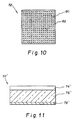
- Fig. 10 is an illustration of a sub-apertured area modulator. Black regions 80 represent the non reflecting, non-transmitting regions of the device. Clear areas 82 represent the sub-apertured transmitting areas of the LCD.
- Figure 11 is a cross-section of a two-dimensional LCD modulator 52'.
- a frame 78' which can be in the form of a CMOS backplane on top of which rests an LCD 76'.
- a cover glass 74' Above the LCD 76' is a cover glass 74'.
- Sub-apertures may exist as a mask in frame 78', as a pattern in LCD 76', or as a pattern on the surface of cover glass 74' closest to LCD 76'.
- a sub-aperture of approximately 25% may be employed. By dithering a 25% aperture ratio device, it is possible to double the resolution in the image.
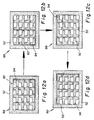
- Figures 12a-12d represent the dithering of a sub-apertured device.
- Modulator 52 is positioned at a given position 84 (Fig. 12a) and sub-apertured modulator sites 92 are positioned and exposed while darkened ( non reflecting regions) 94 are not imaged onto media 160.
- Modulator 52 is moved to a second position 86 (Fig. 12b) a half full modulator site( sub-aperture and surrounding non-reflective area) laterally displaced from previous position 84.
- Modulator 52 is then exposed at position 84.
- Modulator 52 is then displaced a half a full modulator site longitudinally from previous position 86 to position 88 (Fig. 12c), which means it is diagonally displaced from initial position 84.
- Modulator 52 is then illuminated and the media exposed again. Modulator 52 is then moved to a fourth position 90 (Fig. 12d) that is laterally displaced from third position 88. The media is exposed at this position. Effectively, there is a four times increase in the amount of data written. This serves to increase image resolution and provide means to further sharpen images.
- a sub-aperture of 25% by area will give the highest image quality for a four step dither, however, in an effort to allow for redundancy in the modulator sites, it is better to use a sub-aperture ratio of greater than 25 % by area.
- modulator 52 is left un-dithered. But, dithering takes place in one of the previously mentioned conjugate image planes 28 as is seen in Fig. 13. In this conjugate plane 28 a mask 184 containing the sub-aperture is placed. It is then mask 184 that is dithered while the information content to the modulator sites at modulator 52 is updated. This allows a sub-apertured image to be recorded although the device may not be sub-apertured. It is also possible to create an intermediate image plane, however, this will prove cumbersome.
- mask 184 Another means by which to accomplish the dithering through the use of mask 184 is to place mask 184 in the image plane immediately before media 160. This mask 184 can then be dithered while data is refreshed to the device between dither positions. This method of dither will accomplish the same effect as the previous method of the intermediate image.
- modulator 52 or mask 184 In all cases involving dithering, it is best to move modulator 52 or mask 184 to a position, expose sequentially in all three colors then move to the next position. In this manner, the number of physical motions is reduced.
- Lens assembly 132 provides the correct magnification of the image of modulator 52 to image plane 150 where media 160 is located.
- Print lens assembly 132 is designed to provide magnification relating to a given image size at image plane 150.
- the printing system it is possible for the printing system to create images corresponding to different print sizes. For instance, some prints may be 4 in. by 6 in. while others may be 8 in by 10 in.
- the printlens assembly 132 must be changed. Ideally, the illumination and modulator assemblies remain unaltered and a different print lens assembly 132 is positioned.
- the printer moves the media to a next position and the next image is recorded. It is possible to move the media to the next position and record the next image, where the next image is a continuation in space of the original image. Thereby, creating a final image that is a juxtaposition of two images.
- Modulator 52 alone can receive up to 8 bits of bit depth. However, 8 bits to the modulator may not translate to 8 bits at the media. To print an adequate gray scale, additional bit depth must be provided.
- LCD modulators are known to have some measure of roll-off or loss of contrast at the edges of the device. To address both these issues, the print system takes advantage of the fact that modulators designed for projection display generally refresh data faster then is required for printing. Consequently, it is possible to create a single image at the media as a super-position of a series of images. The individual images that comprise the final image vary both in information content and illumination.
- Every image is broken into the three basic color components.
- Information corresponding to the red content of the image is displayed on the modulator.
- multiple frames of image data are displayed on the modulator.
- the first illumination pulse is employed.
- a subsequent frame is displayed on the modulator.
- the illumination level of the subsequent frame is altered according to the density requirements at the media.
- as many frames as may be needed are introduced at the modulator and imaged at the media with the illumination adjusted accordingly. It is possible to maintain the same image data at the modulator and by altering the illumination level alone, introduce additional bit depth.
- the system can build a composite image out of a series of preliminary images.
- the superposition of the images in a given color of varied information content and varied illumination level introduces additional bit depth to the composite image. Once a given color is printed the same procedure is repeated with the data and illumination corresponding to the next color.
- the first frame of new data may display some history or residual information from the preceding data. If this is the case, that frame of data is not illuminated immediately, rather, it is refreshed and then illuminated.
- the second concern in the imaging system is to correct non-uniformities in the print.
- the exposure system can correct for some uniformities such as roll-off at the modulator edges.
- One way to accomplish this is to introduce additional image data to the modulator activating only the edge modulator sites. These images are exposed and superimposed on the other images thus giving additional depth to the edge regions.
- An example method would be to scan a series of images taken at LCD modulator 52, create data maps and convolve all input data with an initial map of LCD modulator 52 to correct the image. Similar techniques can be used to adjust for modulator non-uniformities that are known prior to operation.
- this approach to printing provides an adequate bit depth and reasonable timing for use in a photographic printer.
- the advantages of this invention are the ability to use commodity technology to produce low cost, high resolution prints, without reciprocity failure.
Landscapes
- Physics & Mathematics (AREA)
- General Physics & Mathematics (AREA)
- Optics & Photonics (AREA)
- Spectroscopy & Molecular Physics (AREA)
- Liquid Crystal (AREA)
- Printers Or Recording Devices Using Electromagnetic And Radiation Means (AREA)
- Projection Apparatus (AREA)
Applications Claiming Priority (2)
| Application Number | Priority Date | Filing Date | Title |
|---|---|---|---|
| US09/197,328 US6215547B1 (en) | 1998-11-19 | 1998-11-19 | Reflective liquid crystal modulator based printing system |
| US197328 | 1998-11-19 |
Publications (2)
| Publication Number | Publication Date |
|---|---|
| EP1003071A2 true EP1003071A2 (fr) | 2000-05-24 |
| EP1003071A3 EP1003071A3 (fr) | 2004-07-07 |
Family
ID=22728951
Family Applications (1)
| Application Number | Title | Priority Date | Filing Date |
|---|---|---|---|
| EP99203707A Withdrawn EP1003071A3 (fr) | 1998-11-19 | 1999-11-08 | Système d'impression avec modulateur de lumière à cristaux liquides du type réflectif |
Country Status (3)
| Country | Link |
|---|---|
| US (1) | US6215547B1 (fr) |
| EP (1) | EP1003071A3 (fr) |
| JP (1) | JP2000272170A (fr) |
Cited By (48)
| Publication number | Priority date | Publication date | Assignee | Title |
|---|---|---|---|---|
| EP1174752A1 (fr) * | 2000-07-18 | 2002-01-23 | Eastman Kodak Company | Procédé et dispositif pour imprimer sur un support photosensible utilisant plusieurs modulateurs spatiaux de lumière |
| EP1176803A1 (fr) * | 2000-07-27 | 2002-01-30 | Eastman Kodak Company | Procédé et appareil pour l'impression d'images sur un support photosensible avec des modulateurs de lumière à cristaux liquides du type réflectif |
| WO2002097515A1 (fr) * | 2001-05-26 | 2002-12-05 | Thales Optics Ltd | Dispositif optique utilisant un separateur de faisceau polarisant |
| WO2002103458A1 (fr) * | 2001-06-19 | 2002-12-27 | Holographic Imaging Llc | Systeme de duplication d'image |
| EP1291711A1 (fr) * | 2001-09-05 | 2003-03-12 | Eastman Kodak Company | Imprimante pour matériau photosensible comprenant une source lumineuse hybride |
| EP1291702A1 (fr) | 2001-08-23 | 2003-03-12 | Eastman Kodak Company | Impression de trames d'image correspondant des images animées |
| WO2002065184A3 (fr) * | 2001-02-12 | 2003-03-20 | Silicon Light Machines Inc | Systeme d'eclairage pour modulateurs spatiaux uni-dimensionnels de lumiere faisant appel a des sources lumineuses multiples |
| US6614580B2 (en) | 2001-04-10 | 2003-09-02 | Silicon Light Machines | Modulation of light out of the focal plane in a light modulator based projection system |
| EP1380885A1 (fr) * | 2002-07-11 | 2004-01-14 | Agfa-Gevaert AG | Dispositif et procédé pour imprimer des images numériques sur matériaux photosensibles |
| US6692129B2 (en) | 2001-11-30 | 2004-02-17 | Silicon Light Machines | Display apparatus including RGB color combiner and 1D light valve relay including schlieren filter |
| US6707591B2 (en) | 2001-04-10 | 2004-03-16 | Silicon Light Machines | Angled illumination for a single order light modulator based projection system |
| US6712480B1 (en) | 2002-09-27 | 2004-03-30 | Silicon Light Machines | Controlled curvature of stressed micro-structures |
| US6767751B2 (en) | 2002-05-28 | 2004-07-27 | Silicon Light Machines, Inc. | Integrated driver process flow |
| US6782205B2 (en) | 2001-06-25 | 2004-08-24 | Silicon Light Machines | Method and apparatus for dynamic equalization in wavelength division multiplexing |
| US6785001B2 (en) | 2001-08-21 | 2004-08-31 | Silicon Light Machines, Inc. | Method and apparatus for measuring wavelength jitter of light signal |
| US6801354B1 (en) | 2002-08-20 | 2004-10-05 | Silicon Light Machines, Inc. | 2-D diffraction grating for substantially eliminating polarization dependent losses |
| US6800238B1 (en) | 2002-01-15 | 2004-10-05 | Silicon Light Machines, Inc. | Method for domain patterning in low coercive field ferroelectrics |
| EP1185077A3 (fr) * | 2000-06-12 | 2004-10-06 | Eastman Kodak Company | Méthode d'amélioration de la résolution d'exposition utilisant des expositions multiples |
| US6806997B1 (en) | 2003-02-28 | 2004-10-19 | Silicon Light Machines, Inc. | Patterned diffractive light modulator ribbon for PDL reduction |
| US6813059B2 (en) | 2002-06-28 | 2004-11-02 | Silicon Light Machines, Inc. | Reduced formation of asperities in contact micro-structures |
| US6822797B1 (en) | 2002-05-31 | 2004-11-23 | Silicon Light Machines, Inc. | Light modulator structure for producing high-contrast operation using zero-order light |
| US6829092B2 (en) | 2001-08-15 | 2004-12-07 | Silicon Light Machines, Inc. | Blazed grating light valve |
| US6829077B1 (en) | 2003-02-28 | 2004-12-07 | Silicon Light Machines, Inc. | Diffractive light modulator with dynamically rotatable diffraction plane |
| US6839479B2 (en) | 2002-05-29 | 2005-01-04 | Silicon Light Machines Corporation | Optical switch |
| US6872984B1 (en) | 1998-07-29 | 2005-03-29 | Silicon Light Machines Corporation | Method of sealing a hermetic lid to a semiconductor die at an angle |
| WO2005009736A3 (fr) * | 2003-07-22 | 2005-04-28 | Eastman Kodak Co | Impression d'images a partir de donnes d'image numeriques |
| US6908201B2 (en) | 2002-06-28 | 2005-06-21 | Silicon Light Machines Corporation | Micro-support structures |
| US6922272B1 (en) | 2003-02-14 | 2005-07-26 | Silicon Light Machines Corporation | Method and apparatus for leveling thermal stress variations in multi-layer MEMS devices |
| US6922273B1 (en) | 2003-02-28 | 2005-07-26 | Silicon Light Machines Corporation | PDL mitigation structure for diffractive MEMS and gratings |
| US6928207B1 (en) | 2002-12-12 | 2005-08-09 | Silicon Light Machines Corporation | Apparatus for selectively blocking WDM channels |
| US6927891B1 (en) | 2002-12-23 | 2005-08-09 | Silicon Light Machines Corporation | Tilt-able grating plane for improved crosstalk in 1×N blaze switches |
| US6934070B1 (en) | 2002-12-18 | 2005-08-23 | Silicon Light Machines Corporation | Chirped optical MEM device |
| US6947613B1 (en) | 2003-02-11 | 2005-09-20 | Silicon Light Machines Corporation | Wavelength selective switch and equalizer |
| US6956995B1 (en) | 2001-11-09 | 2005-10-18 | Silicon Light Machines Corporation | Optical communication arrangement |
| US6987600B1 (en) | 2002-12-17 | 2006-01-17 | Silicon Light Machines Corporation | Arbitrary phase profile for better equalization in dynamic gain equalizer |
| US7027202B1 (en) | 2003-02-28 | 2006-04-11 | Silicon Light Machines Corp | Silicon substrate as a light modulator sacrificial layer |
| US7042611B1 (en) | 2003-03-03 | 2006-05-09 | Silicon Light Machines Corporation | Pre-deflected bias ribbons |
| US7046420B1 (en) | 2003-02-28 | 2006-05-16 | Silicon Light Machines Corporation | MEM micro-structures and methods of making the same |
| US7049164B2 (en) | 2001-09-13 | 2006-05-23 | Silicon Light Machines Corporation | Microelectronic mechanical system and methods |
| US7054515B1 (en) | 2002-05-30 | 2006-05-30 | Silicon Light Machines Corporation | Diffractive light modulator-based dynamic equalizer with integrated spectral monitor |
| US7057819B1 (en) | 2002-12-17 | 2006-06-06 | Silicon Light Machines Corporation | High contrast tilting ribbon blazed grating |
| US7057795B2 (en) | 2002-08-20 | 2006-06-06 | Silicon Light Machines Corporation | Micro-structures with individually addressable ribbon pairs |
| US7068372B1 (en) | 2003-01-28 | 2006-06-27 | Silicon Light Machines Corporation | MEMS interferometer-based reconfigurable optical add-and-drop multiplexor |
| US7177081B2 (en) | 2001-03-08 | 2007-02-13 | Silicon Light Machines Corporation | High contrast grating light valve type device |
| US7286764B1 (en) | 2003-02-03 | 2007-10-23 | Silicon Light Machines Corporation | Reconfigurable modulator-based optical add-and-drop multiplexer |
| US7391973B1 (en) | 2003-02-28 | 2008-06-24 | Silicon Light Machines Corporation | Two-stage gain equalizer |
| USRE43841E1 (en) | 2000-12-14 | 2012-12-04 | F. Poszat Hu, Llc | Printing by active tiling |
| CN103207472A (zh) * | 2013-03-27 | 2013-07-17 | 北京京东方光电科技有限公司 | 显示装置 |
Families Citing this family (61)
| Publication number | Priority date | Publication date | Assignee | Title |
|---|---|---|---|---|
| US6369933B1 (en) * | 1999-01-28 | 2002-04-09 | Display Tech, Inc | Optical correlator having multiple active components formed on a single integrated circuit |
| US7306338B2 (en) * | 1999-07-28 | 2007-12-11 | Moxtek, Inc | Image projection system with a polarizing beam splitter |
| US6542177B1 (en) * | 2000-02-29 | 2003-04-01 | Hewlett-Packard Company | Laser printing system with low cost linear modulator |
| ATE268091T1 (de) * | 2000-03-15 | 2004-06-15 | Imax Corp | Verbesserungen an dmd-bildanzeigevorrichtungen |
| WO2001096907A2 (fr) | 2000-03-31 | 2001-12-20 | Imax Corporation | Techniques et dispositif de projection numerique |
| US6480259B1 (en) * | 2000-09-28 | 2002-11-12 | Eastman Kodak Company | Method and apparatus for printing monochromatic images using a spatial light modulator having a selectable light source |
| US6580490B1 (en) * | 2000-10-30 | 2003-06-17 | Eastman Kodak Company | Method and apparatus for printing images in multiple formats using a spatial light modulator |
| TW550396B (en) * | 2000-11-13 | 2003-09-01 | Optoma Corp | Optical device capable of eliminating stray light |
| US6930797B2 (en) * | 2001-02-27 | 2005-08-16 | Eastman Kodak Company | Method and apparatus for printing high resolution images using multiple reflective spatial light modulators |
| DE10133617B4 (de) * | 2001-07-13 | 2008-01-03 | Rodenstock Gmbh | Progressives Brillenglas mit echter kurzer Progression |
| US6980321B2 (en) * | 2001-08-20 | 2005-12-27 | Eastman Kodak Company | Method and apparatus for printing high resolution images using multiple reflective spatial light modulators |
| US6980280B2 (en) * | 2001-10-12 | 2005-12-27 | Eastman Kodak Company | Two level image writer |
| US6714350B2 (en) * | 2001-10-15 | 2004-03-30 | Eastman Kodak Company | Double sided wire grid polarizer |
| US7061561B2 (en) * | 2002-01-07 | 2006-06-13 | Moxtek, Inc. | System for creating a patterned polarization compensator |
| US6909473B2 (en) * | 2002-01-07 | 2005-06-21 | Eastman Kodak Company | Display apparatus and method |
| US6624949B2 (en) | 2002-02-06 | 2003-09-23 | Eastman Kodak Company | Printing apparatus for photosensitive media using dichroic prism in illumination path |
| US6762785B2 (en) | 2002-02-26 | 2004-07-13 | Eastman Kodak Company | Four color film writer |
| US6686947B2 (en) | 2002-04-12 | 2004-02-03 | Eastman Kodak Company | Recording a digital image of a desired aperture format and resolution onto motion picture photosensitive medium |
| US6805445B2 (en) * | 2002-06-05 | 2004-10-19 | Eastman Kodak Company | Projection display using a wire grid polarization beamsplitter with compensator |
| US6734889B2 (en) | 2002-09-10 | 2004-05-11 | Eastman Kodak Company | Color printer comprising a linear grating spatial light modulator |
| US6947459B2 (en) * | 2002-11-25 | 2005-09-20 | Eastman Kodak Company | Organic vertical cavity laser and imaging system |
| US7369268B2 (en) * | 2003-01-14 | 2008-05-06 | Eastman Kodak Company | Light source using large area LEDs |
| WO2004068147A2 (fr) * | 2003-01-27 | 2004-08-12 | Umi Group Incorporated | Systeme d'imagerie a modulation de zone reflechissante |
| US6882356B2 (en) * | 2003-02-11 | 2005-04-19 | Eastman Kodak Company | Method and apparatus for watermarking film |
| US6890690B2 (en) * | 2003-02-17 | 2005-05-10 | Eastman Kodak Company | Photographic article |
| US20060250666A1 (en) * | 2003-02-17 | 2006-11-09 | Wexler Ronald M | Automated image processing system and method |
| US7042483B2 (en) * | 2003-03-10 | 2006-05-09 | Eastman Kodak Company | Apparatus and method for printing using a light emissive array |
| US6738127B1 (en) * | 2003-04-24 | 2004-05-18 | Eastman Kodak Company | LCD-based printing apparatus for printing onto high contrast photosensitive medium |
| US7142300B2 (en) * | 2003-05-05 | 2006-11-28 | Kla-Tencor Corp. Technologies | Edge bead removal inspection by reflectometry |
| US6930759B2 (en) * | 2003-09-23 | 2005-08-16 | Eastman Kodak Company | Method and apparatus for exposing a latent watermark on film |
| JP2005156650A (ja) * | 2003-11-21 | 2005-06-16 | Hitachi Ltd | 投射型映像表示装置 |
| US6917758B1 (en) * | 2003-12-19 | 2005-07-12 | Eastman Kodak Company | Method of image compensation for watermarked film |
| JP4138677B2 (ja) * | 2004-02-18 | 2008-08-27 | セイコーエプソン株式会社 | 表示装置および表示方法、並びに投射型表示装置 |
| US7777859B2 (en) * | 2004-05-06 | 2010-08-17 | Eastman Kodak Company | Two-stage exposure device for watermarking film |
| US7221383B2 (en) * | 2004-06-21 | 2007-05-22 | Eastman Kodak Company | Printer for recording on a moving medium |
| US7283209B2 (en) * | 2004-07-09 | 2007-10-16 | Carl Zeiss Smt Ag | Illumination system for microlithography |
| US7800823B2 (en) | 2004-12-06 | 2010-09-21 | Moxtek, Inc. | Polarization device to polarize and further control light |
| US20080055720A1 (en) * | 2006-08-31 | 2008-03-06 | Perkins Raymond T | Optical Data Storage System with an Inorganic, Dielectric Grid Polarizer |
| US20080055722A1 (en) * | 2006-08-31 | 2008-03-06 | Perkins Raymond T | Optical Polarization Beam Combiner/Splitter with an Inorganic, Dielectric Grid Polarizer |
| US7570424B2 (en) | 2004-12-06 | 2009-08-04 | Moxtek, Inc. | Multilayer wire-grid polarizer |
| US20080055549A1 (en) * | 2006-08-31 | 2008-03-06 | Perkins Raymond T | Projection Display with an Inorganic, Dielectric Grid Polarizer |
| US20080055721A1 (en) * | 2006-08-31 | 2008-03-06 | Perkins Raymond T | Light Recycling System with an Inorganic, Dielectric Grid Polarizer |
| US7630133B2 (en) | 2004-12-06 | 2009-12-08 | Moxtek, Inc. | Inorganic, dielectric, grid polarizer and non-zero order diffraction grating |
| US7961393B2 (en) | 2004-12-06 | 2011-06-14 | Moxtek, Inc. | Selectively absorptive wire-grid polarizer |
| US20060238467A1 (en) * | 2005-04-26 | 2006-10-26 | Hung Chien C | Full-color light-emitting diode scanning display |
| JP2006337834A (ja) * | 2005-06-03 | 2006-12-14 | Fujifilm Holdings Corp | 露光装置及び露光方法 |
| US20070297052A1 (en) * | 2006-06-26 | 2007-12-27 | Bin Wang | Cube wire-grid polarizing beam splitter |
| US20070296921A1 (en) * | 2006-06-26 | 2007-12-27 | Bin Wang | Projection display with a cube wire-grid polarizing beam splitter |
| US8755113B2 (en) | 2006-08-31 | 2014-06-17 | Moxtek, Inc. | Durable, inorganic, absorptive, ultra-violet, grid polarizer |
| US7789515B2 (en) * | 2007-05-17 | 2010-09-07 | Moxtek, Inc. | Projection device with a folded optical path and wire-grid polarizer |
| US20080316599A1 (en) * | 2007-06-22 | 2008-12-25 | Bin Wang | Reflection-Repressed Wire-Grid Polarizer |
| US8162483B2 (en) * | 2009-06-25 | 2012-04-24 | Eastman Kodak Company | Hierarchical light intensity control in light projector |
| US8248696B2 (en) | 2009-06-25 | 2012-08-21 | Moxtek, Inc. | Nano fractal diffuser |
| US8444275B2 (en) | 2010-08-12 | 2013-05-21 | Eastman Kodak Company | Light source control for projector with multiple pulse-width modulated light sources |
| US8611007B2 (en) | 2010-09-21 | 2013-12-17 | Moxtek, Inc. | Fine pitch wire grid polarizer |
| US8913321B2 (en) | 2010-09-21 | 2014-12-16 | Moxtek, Inc. | Fine pitch grid polarizer |
| US8873144B2 (en) | 2011-05-17 | 2014-10-28 | Moxtek, Inc. | Wire grid polarizer with multiple functionality sections |
| US8913320B2 (en) | 2011-05-17 | 2014-12-16 | Moxtek, Inc. | Wire grid polarizer with bordered sections |
| US8922890B2 (en) | 2012-03-21 | 2014-12-30 | Moxtek, Inc. | Polarizer edge rib modification |
| US9632223B2 (en) | 2013-10-24 | 2017-04-25 | Moxtek, Inc. | Wire grid polarizer with side region |
| WO2016170686A1 (fr) * | 2015-04-24 | 2016-10-27 | Necディスプレイソリューションズ株式会社 | Système d'affichage de type projection, dispositif d'affichage de type projection, et procédé de réglage de synchronisation |
Family Cites Families (29)
| Publication number | Priority date | Publication date | Assignee | Title |
|---|---|---|---|---|
| US5061049A (en) | 1984-08-31 | 1991-10-29 | Texas Instruments Incorporated | Spatial light modulator and method |
| US4728965A (en) | 1986-06-20 | 1988-03-01 | Eastman Kodak Company | Laser printer having means for correcting laser pointing errors |
| US5235437A (en) * | 1989-12-18 | 1993-08-10 | Sharp Kabushiki Kaisha | Analog/digital image processor apparatus with liquid crystal light modulator |
| US5325137A (en) | 1991-08-28 | 1994-06-28 | Victor Company Of Japan, Ltd. | Overhead projector with a spatial light modulator |
| US5504514A (en) | 1992-02-13 | 1996-04-02 | Texas Instruments Incorporated | System and method for solid state illumination for spatial light modulators |
| JPH05257110A (ja) * | 1992-03-13 | 1993-10-08 | Sharp Corp | 投射型液晶表示装置 |
| US5461410A (en) | 1993-03-29 | 1995-10-24 | Texas Instruments Incorporated | Gray scale printing using spatial light modulators |
| US5461411A (en) | 1993-03-29 | 1995-10-24 | Texas Instruments Incorporated | Process and architecture for digital micromirror printer |
| US5475513A (en) * | 1993-06-02 | 1995-12-12 | Sharp Kabushiki Kaisha | Projection type image display device maintaining resolution of an image unaffected by parallax |
| US5745156A (en) | 1994-04-28 | 1998-04-28 | Xerox Corporation | Digital printer using two-dimensional, full frame light valve |
| US5521748A (en) | 1994-06-16 | 1996-05-28 | Eastman Kodak Company | Light modulator with a laser or laser array for exposing image data |
| US5701185A (en) | 1994-11-21 | 1997-12-23 | Polaroid Corporation | Spatial light modulator assembly for adapting a photographic printer to print electronic images |
| US5668611A (en) | 1994-12-21 | 1997-09-16 | Hughes Electronics | Full color sequential image projection system incorporating pulse rate modulated illumination |
| US5808800A (en) * | 1994-12-22 | 1998-09-15 | Displaytech, Inc. | Optics arrangements including light source arrangements for an active matrix liquid crystal image generator |
| US5757348A (en) * | 1994-12-22 | 1998-05-26 | Displaytech, Inc. | Active matrix liquid crystal image generator with hybrid writing scheme |
| EP1310805B1 (fr) | 1994-12-27 | 2006-05-17 | Seiko Epson Corporation | Unité à prismes et dispositif d'affichage par projection l'utilisant |
| JPH08240867A (ja) | 1995-03-03 | 1996-09-17 | Fuji Photo Film Co Ltd | 写真プリンタ |
| US5754217A (en) | 1995-04-19 | 1998-05-19 | Texas Instruments Incorporated | Printing system and method using a staggered array spatial light modulator having masked mirror elements |
| US5652661A (en) | 1995-06-07 | 1997-07-29 | Eastman Kodak Company | High speed photographic printer using optical and digital printing with an active matrix LCD |
| US5621486A (en) * | 1995-06-22 | 1997-04-15 | International Business Machines Corporation | Efficient optical system for a high resolution projection display employing reflection light valves |
| US5699168A (en) | 1995-06-22 | 1997-12-16 | Texas Instruments Incorporated | Grayscale printing with sliding window memory |
| US5851060A (en) * | 1995-09-13 | 1998-12-22 | Nikon Corporation | Projective display device |
| US5743612A (en) | 1995-11-10 | 1998-04-28 | Hitachi, Ltd | Liquid crystal projector |
| JPH09329846A (ja) * | 1996-06-11 | 1997-12-22 | Fuji Photo Film Co Ltd | 光パターン照射装置及び光パターン照射方法 |
| US5754305A (en) | 1996-12-03 | 1998-05-19 | Eastman Kodak Company | Method and apparatus for correcting light non-uniformity in an LCD photographic printer |
| US5883687A (en) * | 1997-04-02 | 1999-03-16 | International Business Machines Corporation | Polarization independent liquid crystal phase gratings for reflective spatial light modulators |
| US5870164A (en) * | 1997-06-20 | 1999-02-09 | International Business Machines Corporation | Polarization dependent twisted nematic liquid crystal devices for reflective spatial light modulators |
| US5971545A (en) * | 1997-06-25 | 1999-10-26 | Hewlett-Packard Company | Light source for projection display |
| US5914817A (en) * | 1998-05-15 | 1999-06-22 | Optical Coating Laboratory, Inc. | Thin film dichroic color separation filters for color splitters in liquid crystal display systems |
-
1998
- 1998-11-19 US US09/197,328 patent/US6215547B1/en not_active Expired - Lifetime
-
1999
- 1999-11-08 EP EP99203707A patent/EP1003071A3/fr not_active Withdrawn
- 1999-11-09 JP JP31813999A patent/JP2000272170A/ja active Pending
Cited By (55)
| Publication number | Priority date | Publication date | Assignee | Title |
|---|---|---|---|---|
| US6872984B1 (en) | 1998-07-29 | 2005-03-29 | Silicon Light Machines Corporation | Method of sealing a hermetic lid to a semiconductor die at an angle |
| EP1185077A3 (fr) * | 2000-06-12 | 2004-10-06 | Eastman Kodak Company | Méthode d'amélioration de la résolution d'exposition utilisant des expositions multiples |
| EP1174752A1 (fr) * | 2000-07-18 | 2002-01-23 | Eastman Kodak Company | Procédé et dispositif pour imprimer sur un support photosensible utilisant plusieurs modulateurs spatiaux de lumière |
| EP1176803A1 (fr) * | 2000-07-27 | 2002-01-30 | Eastman Kodak Company | Procédé et appareil pour l'impression d'images sur un support photosensible avec des modulateurs de lumière à cristaux liquides du type réflectif |
| USRE43841E1 (en) | 2000-12-14 | 2012-12-04 | F. Poszat Hu, Llc | Printing by active tiling |
| WO2002065184A3 (fr) * | 2001-02-12 | 2003-03-20 | Silicon Light Machines Inc | Systeme d'eclairage pour modulateurs spatiaux uni-dimensionnels de lumiere faisant appel a des sources lumineuses multiples |
| US7177081B2 (en) | 2001-03-08 | 2007-02-13 | Silicon Light Machines Corporation | High contrast grating light valve type device |
| US6707591B2 (en) | 2001-04-10 | 2004-03-16 | Silicon Light Machines | Angled illumination for a single order light modulator based projection system |
| US6614580B2 (en) | 2001-04-10 | 2003-09-02 | Silicon Light Machines | Modulation of light out of the focal plane in a light modulator based projection system |
| GB2390912A (en) * | 2001-05-26 | 2004-01-21 | Thales Optics Ltd | Optical device using a polarizing beam splitter |
| WO2002097515A1 (fr) * | 2001-05-26 | 2002-12-05 | Thales Optics Ltd | Dispositif optique utilisant un separateur de faisceau polarisant |
| USRE44301E1 (en) | 2001-06-19 | 2013-06-18 | F. Poszat Hu, L.L.C. | Image replication system having focusing means to receive reflected light through lightguide from spatial light modulator |
| US7012659B2 (en) | 2001-06-19 | 2006-03-14 | Qinetiq Limited | Image replication system having focusing means to receive reflected light through lightguide from spatial light modulator |
| WO2002103458A1 (fr) * | 2001-06-19 | 2002-12-27 | Holographic Imaging Llc | Systeme de duplication d'image |
| US6782205B2 (en) | 2001-06-25 | 2004-08-24 | Silicon Light Machines | Method and apparatus for dynamic equalization in wavelength division multiplexing |
| US6829092B2 (en) | 2001-08-15 | 2004-12-07 | Silicon Light Machines, Inc. | Blazed grating light valve |
| US6785001B2 (en) | 2001-08-21 | 2004-08-31 | Silicon Light Machines, Inc. | Method and apparatus for measuring wavelength jitter of light signal |
| EP1291702A1 (fr) | 2001-08-23 | 2003-03-12 | Eastman Kodak Company | Impression de trames d'image correspondant des images animées |
| EP1291711A1 (fr) * | 2001-09-05 | 2003-03-12 | Eastman Kodak Company | Imprimante pour matériau photosensible comprenant une source lumineuse hybride |
| US7049164B2 (en) | 2001-09-13 | 2006-05-23 | Silicon Light Machines Corporation | Microelectronic mechanical system and methods |
| US6956995B1 (en) | 2001-11-09 | 2005-10-18 | Silicon Light Machines Corporation | Optical communication arrangement |
| US6692129B2 (en) | 2001-11-30 | 2004-02-17 | Silicon Light Machines | Display apparatus including RGB color combiner and 1D light valve relay including schlieren filter |
| US6800238B1 (en) | 2002-01-15 | 2004-10-05 | Silicon Light Machines, Inc. | Method for domain patterning in low coercive field ferroelectrics |
| US6767751B2 (en) | 2002-05-28 | 2004-07-27 | Silicon Light Machines, Inc. | Integrated driver process flow |
| US6839479B2 (en) | 2002-05-29 | 2005-01-04 | Silicon Light Machines Corporation | Optical switch |
| US7054515B1 (en) | 2002-05-30 | 2006-05-30 | Silicon Light Machines Corporation | Diffractive light modulator-based dynamic equalizer with integrated spectral monitor |
| US6822797B1 (en) | 2002-05-31 | 2004-11-23 | Silicon Light Machines, Inc. | Light modulator structure for producing high-contrast operation using zero-order light |
| US6813059B2 (en) | 2002-06-28 | 2004-11-02 | Silicon Light Machines, Inc. | Reduced formation of asperities in contact micro-structures |
| US6908201B2 (en) | 2002-06-28 | 2005-06-21 | Silicon Light Machines Corporation | Micro-support structures |
| US6867847B2 (en) | 2002-07-11 | 2005-03-15 | Agfa-Gevaert Aktiengesellschaft | Apparatus and method for projecting graphic information onto a light-sensitive material |
| EP1380885A1 (fr) * | 2002-07-11 | 2004-01-14 | Agfa-Gevaert AG | Dispositif et procédé pour imprimer des images numériques sur matériaux photosensibles |
| US6801354B1 (en) | 2002-08-20 | 2004-10-05 | Silicon Light Machines, Inc. | 2-D diffraction grating for substantially eliminating polarization dependent losses |
| US7057795B2 (en) | 2002-08-20 | 2006-06-06 | Silicon Light Machines Corporation | Micro-structures with individually addressable ribbon pairs |
| US6712480B1 (en) | 2002-09-27 | 2004-03-30 | Silicon Light Machines | Controlled curvature of stressed micro-structures |
| US6928207B1 (en) | 2002-12-12 | 2005-08-09 | Silicon Light Machines Corporation | Apparatus for selectively blocking WDM channels |
| US7057819B1 (en) | 2002-12-17 | 2006-06-06 | Silicon Light Machines Corporation | High contrast tilting ribbon blazed grating |
| US6987600B1 (en) | 2002-12-17 | 2006-01-17 | Silicon Light Machines Corporation | Arbitrary phase profile for better equalization in dynamic gain equalizer |
| US6934070B1 (en) | 2002-12-18 | 2005-08-23 | Silicon Light Machines Corporation | Chirped optical MEM device |
| US6927891B1 (en) | 2002-12-23 | 2005-08-09 | Silicon Light Machines Corporation | Tilt-able grating plane for improved crosstalk in 1×N blaze switches |
| US7068372B1 (en) | 2003-01-28 | 2006-06-27 | Silicon Light Machines Corporation | MEMS interferometer-based reconfigurable optical add-and-drop multiplexor |
| US7286764B1 (en) | 2003-02-03 | 2007-10-23 | Silicon Light Machines Corporation | Reconfigurable modulator-based optical add-and-drop multiplexer |
| US6947613B1 (en) | 2003-02-11 | 2005-09-20 | Silicon Light Machines Corporation | Wavelength selective switch and equalizer |
| US6922272B1 (en) | 2003-02-14 | 2005-07-26 | Silicon Light Machines Corporation | Method and apparatus for leveling thermal stress variations in multi-layer MEMS devices |
| US7391973B1 (en) | 2003-02-28 | 2008-06-24 | Silicon Light Machines Corporation | Two-stage gain equalizer |
| US6829077B1 (en) | 2003-02-28 | 2004-12-07 | Silicon Light Machines, Inc. | Diffractive light modulator with dynamically rotatable diffraction plane |
| US6806997B1 (en) | 2003-02-28 | 2004-10-19 | Silicon Light Machines, Inc. | Patterned diffractive light modulator ribbon for PDL reduction |
| US7046420B1 (en) | 2003-02-28 | 2006-05-16 | Silicon Light Machines Corporation | MEM micro-structures and methods of making the same |
| US7027202B1 (en) | 2003-02-28 | 2006-04-11 | Silicon Light Machines Corp | Silicon substrate as a light modulator sacrificial layer |
| US6922273B1 (en) | 2003-02-28 | 2005-07-26 | Silicon Light Machines Corporation | PDL mitigation structure for diffractive MEMS and gratings |
| US7042611B1 (en) | 2003-03-03 | 2006-05-09 | Silicon Light Machines Corporation | Pre-deflected bias ribbons |
| WO2005009736A3 (fr) * | 2003-07-22 | 2005-04-28 | Eastman Kodak Co | Impression d'images a partir de donnes d'image numeriques |
| US7023463B2 (en) | 2003-07-22 | 2006-04-04 | Eastman Kodak Company | Method and apparatus for printing images from digital image data |
| CN103207472A (zh) * | 2013-03-27 | 2013-07-17 | 北京京东方光电科技有限公司 | 显示装置 |
| WO2014153847A1 (fr) * | 2013-03-27 | 2014-10-02 | 北京京东方光电科技有限公司 | Dispositif d'affichage |
| CN103207472B (zh) * | 2013-03-27 | 2015-09-09 | 北京京东方光电科技有限公司 | 显示装置 |
Also Published As
| Publication number | Publication date |
|---|---|
| EP1003071A3 (fr) | 2004-07-07 |
| JP2000272170A (ja) | 2000-10-03 |
| US6215547B1 (en) | 2001-04-10 |
Similar Documents
| Publication | Publication Date | Title |
|---|---|---|
| US6215547B1 (en) | Reflective liquid crystal modulator based printing system | |
| EP1174752B1 (fr) | Procédé et dispositif pour imprimer sur un support photosensible utilisant plusieurs modulateurs spatiaux de lumière | |
| US6646716B1 (en) | Method and apparatus for printing multiple simultaneous images onto a photosensitive media | |
| US6980321B2 (en) | Method and apparatus for printing high resolution images using multiple reflective spatial light modulators | |
| US6574032B1 (en) | Imaging apparatus using dither to minimize pixel effects | |
| US6330018B1 (en) | Method and apparatus for printing high resolution images using reflective LCD modulators | |
| US6930797B2 (en) | Method and apparatus for printing high resolution images using multiple reflective spatial light modulators | |
| EP1177908B1 (fr) | Méthode et appareil d'impression monochrome en utilisant un modulateur spatial de lumière | |
| US5684620A (en) | High resolution imaging system and method of imaging using the same | |
| US7330298B2 (en) | Optical system and method for increasing image resolution and/or dithering in projection applications | |
| US6980280B2 (en) | Two level image writer | |
| US6480259B1 (en) | Method and apparatus for printing monochromatic images using a spatial light modulator having a selectable light source | |
| US6700599B2 (en) | Apparatus for printing high resolution images using reflective LCD modulators | |
| US6734889B2 (en) | Color printer comprising a linear grating spatial light modulator | |
| US6396530B1 (en) | Method for improving exposure resolution using multiple exposures | |
| US20060176362A1 (en) | Optical system and method for increasing image resolution and/or dithering in printing applications | |
| WO2005009736A2 (fr) | Impression d'images a partir de donnes d'image numeriques | |
| US7164434B2 (en) | LCD based imaging apparatus for printing multiple formats | |
| EP1967000A1 (fr) | Dispositif d'ecriture en continu haute vitesse, destine a ecrire des donnees sur un film |
Legal Events
| Date | Code | Title | Description |
|---|---|---|---|
| PUAI | Public reference made under article 153(3) epc to a published international application that has entered the european phase |
Free format text: ORIGINAL CODE: 0009012 |
|
| AK | Designated contracting states |
Kind code of ref document: A2 Designated state(s): AT BE CH CY DE DK ES FI FR GB GR IE IT LI LU MC NL PT SE |
|
| AX | Request for extension of the european patent |
Free format text: AL;LT;LV;MK;RO;SI |
|
| PUAL | Search report despatched |
Free format text: ORIGINAL CODE: 0009013 |
|
| AK | Designated contracting states |
Kind code of ref document: A3 Designated state(s): AT BE CH CY DE DK ES FI FR GB GR IE IT LI LU MC NL PT SE |
|
| AX | Request for extension of the european patent |
Extension state: AL LT LV MK RO SI |
|
| 17P | Request for examination filed |
Effective date: 20041209 |
|
| AKX | Designation fees paid |
Designated state(s): DE FR GB |
|
| STAA | Information on the status of an ep patent application or granted ep patent |
Free format text: STATUS: THE APPLICATION IS DEEMED TO BE WITHDRAWN |
|
| 18D | Application deemed to be withdrawn |
Effective date: 20051123 |